
Japan Eyewear Market Size, Share, Trends and Forecast by Product, Gender, Distribution Channel, and Region, 2026-2034
Japan Eyewear Market Size, Share, Trends & Forecast (2026-2034)
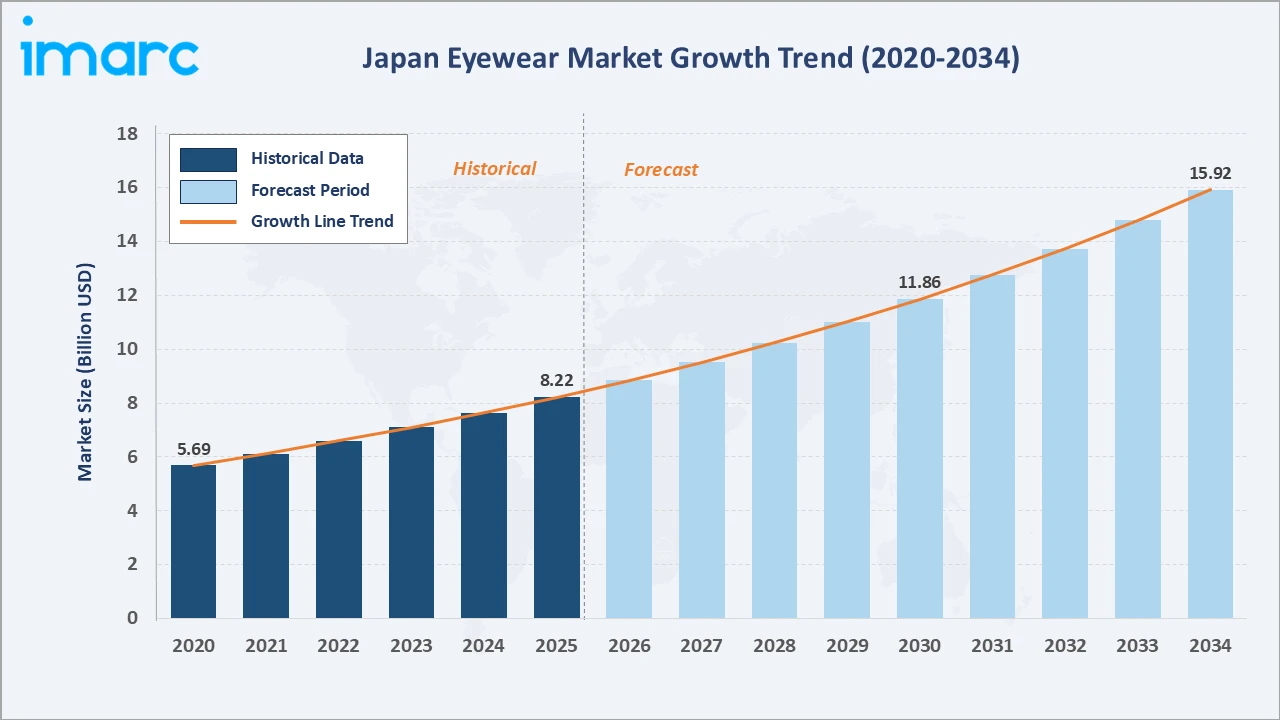
The Japan eyewear market grew from USD 8.22 Billion in 2025 to USD 8.84 Billion in 2026 and is projected to reach USD 15.92 Billion by 2034, growing at a CAGR of 7.62% during 2026-2034. Japan's aging population, rising myopia prevalence, and growing consumer preference for premium and fashion-forward eyewear are the primary growth engines. Japan has the highest proportion of people aged 65 and older among countries with populations of at least 40 million, at 29.6%, creating an unprecedented structural base for corrective eyewear demand that underpins long-term market stability. Spectacles lead by product at 63.5%, women's eyewear leads by gender at 41.8%, and the Kanto region commands the largest regional share at 36.8% in 2025.
Market Snapshot
|
Metric |
Value |
|
Base Year Market Size (2025) |
USD 8.22 Billion |
|
Market Size (2026) |
USD 8.84 Billion |
|
Forecast Market Size (2034) |
USD 15.92 Billion |
|
CAGR (2026-2034) |
7.62% |
|
Base Year |
2025 |
|
Historical Period |
2020-2025 |
|
Forecast Period |
2026-2034 |
|
Dominant Product |
Spectacles (63.5%, 2025) |
|
Dominant Gender |
Women (41.8%, 2025) |
|
Leading Region |
Kanto Region (36.8%, 2025) |
The Japan eyewear market expanded from USD 5.69 Billion in 2020 to USD 8.22 Billion in 2025, and further to USD 8.84 Billion in 2026, reflecting robust demand driven by demographic aging trends, increased screen exposure accelerating prescription demand, and the continued premiumization of eyewear as a fashion accessory. The market is projected to reach USD 11.86 Billion by 2030 before reaching USD 15.92 Billion by 2034.
To get more information on this market, Request Sample
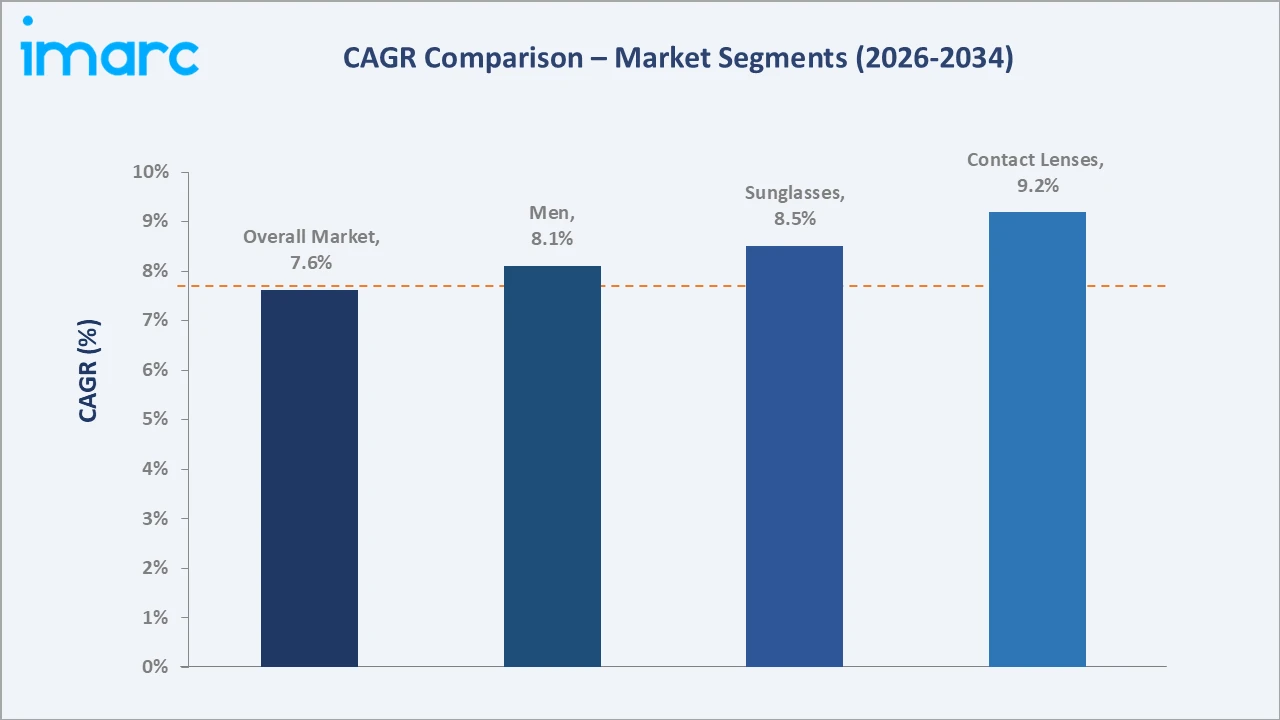
Contact lenses is fastest growing segment at 9.2% CAGR over the 2026-2034 forecast period. Sunglasses exhibit 8.5% CAGR and men's eyewear is projected at 8.1% CAGR, reflecting broad-based expansion across all key segments.
Executive Summary
The Japan eyewear market is experiencing steady structural expansion driven by three converging forces: demographic aging, digital lifestyle-driven myopia growth, and a maturing premium consumer segment. Japan's population over 65 years old exceeded 29.6%, creating persistent structural demand for corrective eyewear. Simultaneously, increasing digital device usage among younger demographics is accelerating myopia incidence and driving prescription eyewear demand across all age groups.
Spectacles command 63.5% of the market in 2025 due to high replacement rates, fashion-driven purchasing behavior, and broad retail distribution across specialty optical chains, department stores, and e-commerce. Women's eyewear leads gender segmentation at 41.8%, reflecting higher fashion accessory purchasing frequency and premium lens adoption. The Kanto region, anchored by the Greater Tokyo metropolitan area, dominates at 36.8% of market share in 2025.
Key Market Insights
|
Insight |
Data |
|
Dominant Product |
Spectacles – 63.5% share (2025) |
|
Dominant Gender |
Women – 41.8% share (2025) |
|
Leading Region |
Kanto Region – 36.8% share (2025) |
|
Key Market Opportunity |
Rising demand for prescription eyewear, growing adoption of premium and designer frames, increasing awareness of eye health, demand for lightweight and technologically advanced lenses, and the development of sustainable and customized eyewear products. |
Key Analytical Observations Supporting the Above Data:
- Spectacles at 63.5%: Spectacles lead the market driven by high repeat-purchase frequency among Japan's aging population and rising myopia correction needs across younger demographics.
- Women at 41.8%: Women’s eyewear reflects strong fashion accessory purchasing patterns, with Japanese female consumers showing higher willingness to invest in premium frames and designer eyewear brands.
- The Kanto Region at 36.8%: The Kanto region benefits from the highest concentration of optical specialty chains, as well as premium department store eyewear boutiques.
Japan Eyewear Market Overview
The eyewear market encompasses corrective, protective, and fashion-oriented optical products including prescription spectacles, sunglasses, contact lenses, and emerging smart eyewear. Japan's eyewear industry spans lens manufacturing, frame design, optical retailing, and optometry services, with both domestic and international players operating across premium and value segments. Key macroeconomic influences include demographic aging, rising per-capita healthcare expenditure, digital lifestyle shifts increasing myopia prevalence, and Japan's position as a leader in precision optical manufacturing. The industry ecosystem integrates upstream raw material suppliers, optical lens and frame manufacturers, distribution networks, and downstream specialty optical retailers and e-commerce platforms serving Japan's highly brand-conscious consumer base.
Market Dynamics
To evaluate market opportunities, Request Sample
Market Drivers
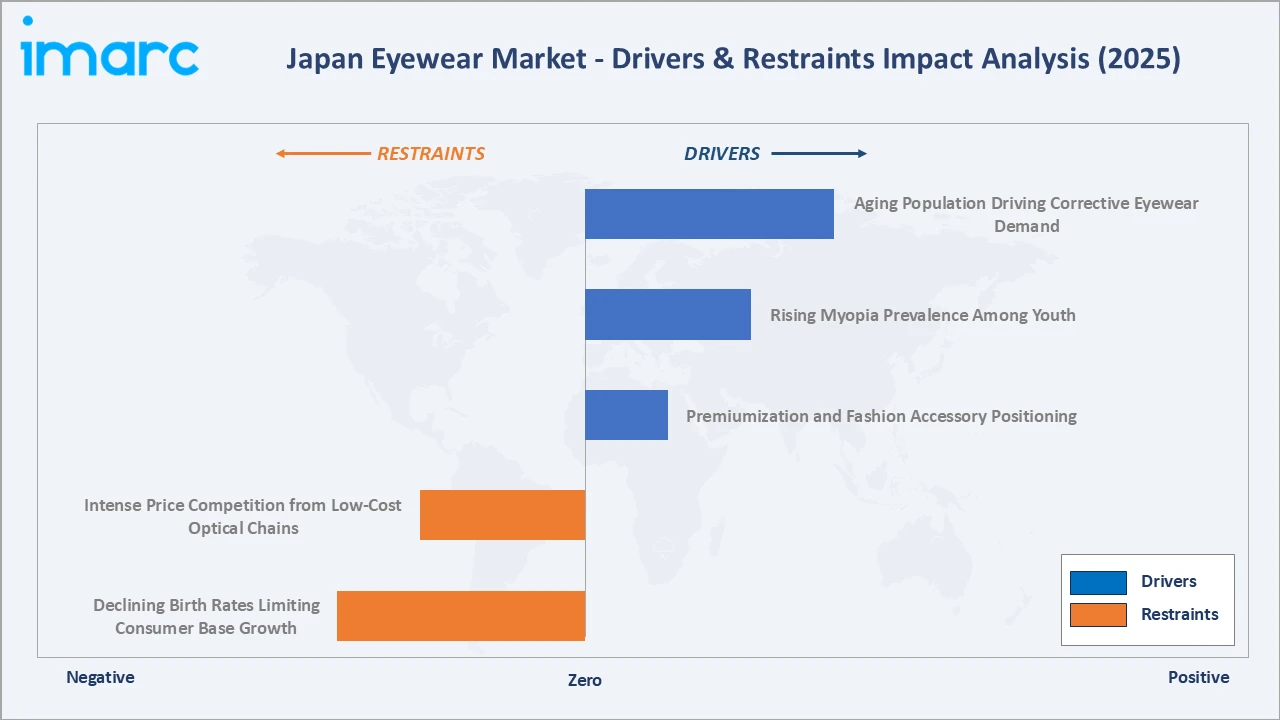
- Aging Population Driving Corrective Eyewear Demand: Japan's demographic structure, with over 29.6% of the population above age 65, creates consistent structural demand for prescription spectacles and reading glasses. Presbyopia affects virtually all individuals over 45 years old, ensuring a large, stable corrective eyewear customer base with high annual replacement cycles that supports both volume growth and premium lens upsell opportunities.
- Rising Myopia Prevalence Among Youth: Screen-time intensive academic and professional environments are accelerating myopia progression across Japan's youth population. This creates an expanding lifetime corrective eyewear customer cohort that will sustain prescription spectacle and contact lens demand growth for decades.
- Premiumization and Fashion Accessory Positioning: Japanese consumers increasingly treat eyewear as a fashion accessory rather than a purely functional medical device. The average number of spectacle frames owned per adult consumer has risen, driving multi-pair purchasing behavior and expanding the addressable market value per customer household.
Market Restraints
- Intense Price Competition from Low-Cost Optical Chains: The growth of fast-fashion optical retailers offering complete spectacle packages at significantly reduced prices creates margin pressure across the market. This competitive dynamic constrains average selling price growth for entry-level and mid-market optical products.
- Declining Birth Rates Limiting Consumer Base Growth: Japan recorded 670,000 births in 2025, marking the lowest annual figure since records began in 1899. Japan's persistently low birth rates reduce the size of younger consumer cohorts entering the eyewear market, limiting structural growth in the new-customer acquisition pipeline over the long term.
Market Opportunities
- Smart Eyewear and Augmented Reality Integration: The convergence of traditional eyewear with AR display technology, health monitoring sensors, and connectivity features represents an emerging high-value product category with strong adoption potential among Japan's technology-forward consumer base.
- Personalized Prescription and AI-Powered Eye Health Platforms: Integration of AI-driven vision assessment tools, virtual try-on platforms, and personalized lens recommendation engines can expand optical retail reach and increase conversion rates across both physical and digital channels.
Market Challenges
- Supply Chain Disruptions for Specialty Optical Materials: Supply chain volatility affecting specialty optical polymers, high-index lens materials, and precision frame components can disrupt manufacturing timelines and increase input costs for Japan's domestic optical manufacturers.
- Regulatory Complexity for Smart Eyewear Medical Device Classification: The integration of health monitoring and diagnostic features into smart eyewear creates regulatory classification uncertainties, potentially delaying product launches and increasing compliance costs for innovation-focused manufacturers.
Emerging Market Trends
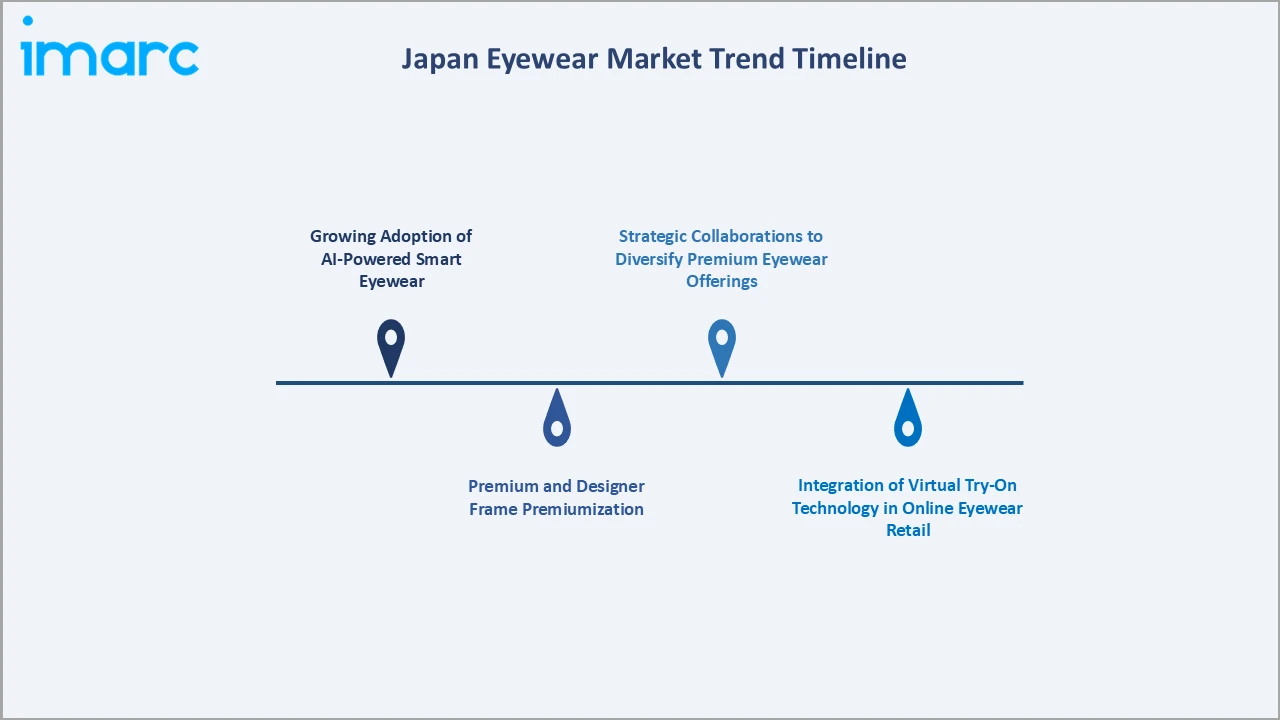
1. Growing Adoption of AI-Powered Smart Eyewear
The availability of prescription-ready frames, multiple lens options, and diverse designs is creating opportunities for manufacturers to combine advanced digital functionality with everyday vision correction and fashion. In August 2026, Meta launched its AI-powered smart glasses in Japan, offering 26 styles across three frame categories, including a Kylie Jenner collaboration. Starting at ¥50,600, the collection features multiple lens options, prescription compatibility, and frame replacement support for damage during lens fitting.
2. Premium and Designer Frame Premiumization
Japanese consumers demonstrate a sustained premiumization trend, increasing spending on designer and premium spectacle frames. Collaborations between Japanese optical brands and domestic fashion designers, combined with limited-edition frame collections, drive multi-pair purchasing behavior. This trend elevates the average transaction value per customer visit and improves revenue per square meter for specialty optical retailers.
3. Strategic Collaborations to Diversify Premium Eyewear Offerings
In May 2026, Meta and EssilorLuxottica announced that Ray-Ban Meta and Oakley Meta AI glasses launched in Japan. The second-generation Ray-Ban Meta features up to eight hours of battery life, a 12MP ultra-wide camera capable of capturing 3K photos and videos and enhanced immersive audio. Such partnerships support the development of differentiated eyewear designs, integration of advanced features, and broader consumer reach in Japan’s eyewear market.
4. Integration of Virtual Try-On Technology in Online Eyewear Retail
Zoff launched its “EASee Zoff Virtual Fitting” service in March 2024 in collaboration with Auglio, introducing 3D virtual try-on technology to its Japanese online store. The service measures eye distance to provide realistic eyewear fitting and allows customers to customize frames and lens colors. These technologies enable consumers to assess frame fit and customize lens and frame colors online, improving shopping convenience and supporting the growth of e-commerce eyewear sales.
Industry Value Chain Analysis
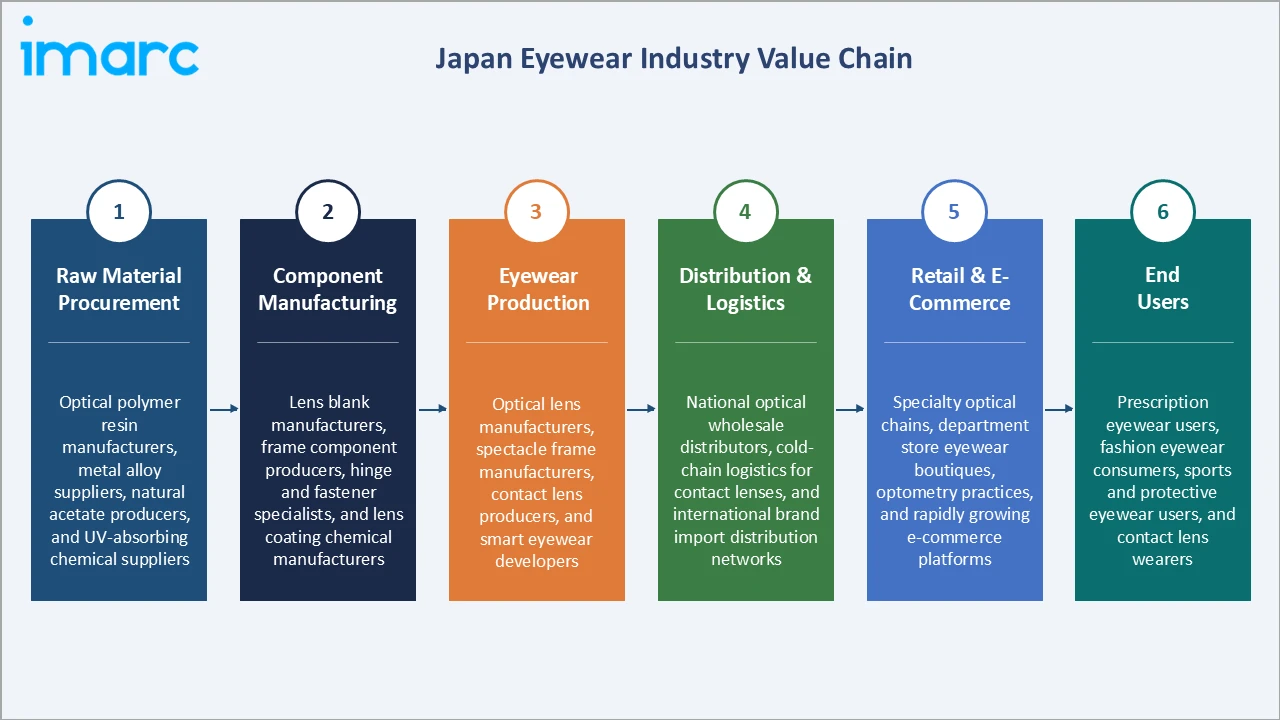
The Japan eyewear market value chain encompasses six integrated stages from raw material supply through end-user consumption. The lens manufacturing and optical retailing stages capture the highest margin concentration, as proprietary lens formulations, precision coating technologies, and branded retail formats define competitive differentiation in the Japanese market.
|
Stage |
Key Players & Description |
|
Raw Material Procurement |
Optical polymer resin manufacturers, metal alloy suppliers, natural acetate producers, and UV-absorbing chemical suppliers. |
|
Component Manufacturing |
Lens blank manufacturers, frame component producers, hinge and fastener specialists, and lens coating chemical manufacturers. |
|
Eyewear Production |
Optical lens manufacturers, spectacle frame manufacturers, contact lens producers, and smart eyewear developers. |
|
Distribution & Logistics |
National optical wholesale distributors, cold-chain logistics for contact lenses, and international brand import distribution networks. |
|
Retail & E-Commerce |
Specialty optical chains, department store eyewear boutiques, optometry practices, and rapidly growing e-commerce platforms. |
|
End Users |
Prescription eyewear users, fashion eyewear consumers, sports and protective eyewear users, and contact lens wearers. |
Eyewear production, encompassing optical lens manufacturing and branded frame production, captures the highest value addition. Proprietary high-index polymer formulations, precision multi-layer anti-reflective coatings, and progressive lens design technologies are core differentiators that are difficult to replicate, enabling manufacturers to command sustained price premiums.
Technology Landscape in the Eyewear Industry
Blue-Light Filtering and Digital Eye Protection
Selective spectral filtering coatings that block high-energy visible blue light while maintaining accurate color perception represent the most commercially significant technology development in Japan's eyewear market in recent years. These technologies are now standard offerings across mainstream optical retail chains, embedded in both premium progressive lenses and entry-level single-vision products.
AI-Powered Virtual Try-On and Vision Assessment
Artificial intelligence and augmented reality technologies integrated into retail and e-commerce platforms enable customers to virtually try on frames using smartphone cameras, receive lens recommendations based on facial measurements, and, on some platforms, conduct preliminary vision screening. These technologies are progressively reducing purchase hesitation in online channels and differentiating advanced optical retailers.
Smart Eyewear and Connected Device Integration
Emerging smart eyewear incorporating lightweight AR displays, activity and health monitoring sensors, voice interaction, and wireless connectivity represents the next technological frontier. Japan's consumer electronics manufacturers are at the forefront of integrating precision optical manufacturing with advanced electronics miniaturization, positioning Japan as a likely early market for commercial smart eyewear adoption.
Market Segmentation Analysis
The report covers the following segments:
| Segment Category | Leading Segment | Market Share | Year |
|---|---|---|---|
| Product | Spectacles | 63.5% | 2025 |
| Gender | Women | 41.8% | 2025 |
| Distribution Channel | 🔒 | 🔒 | 2025 |
| Region | Kanto Region | 36.8% | 2025 |

By Product
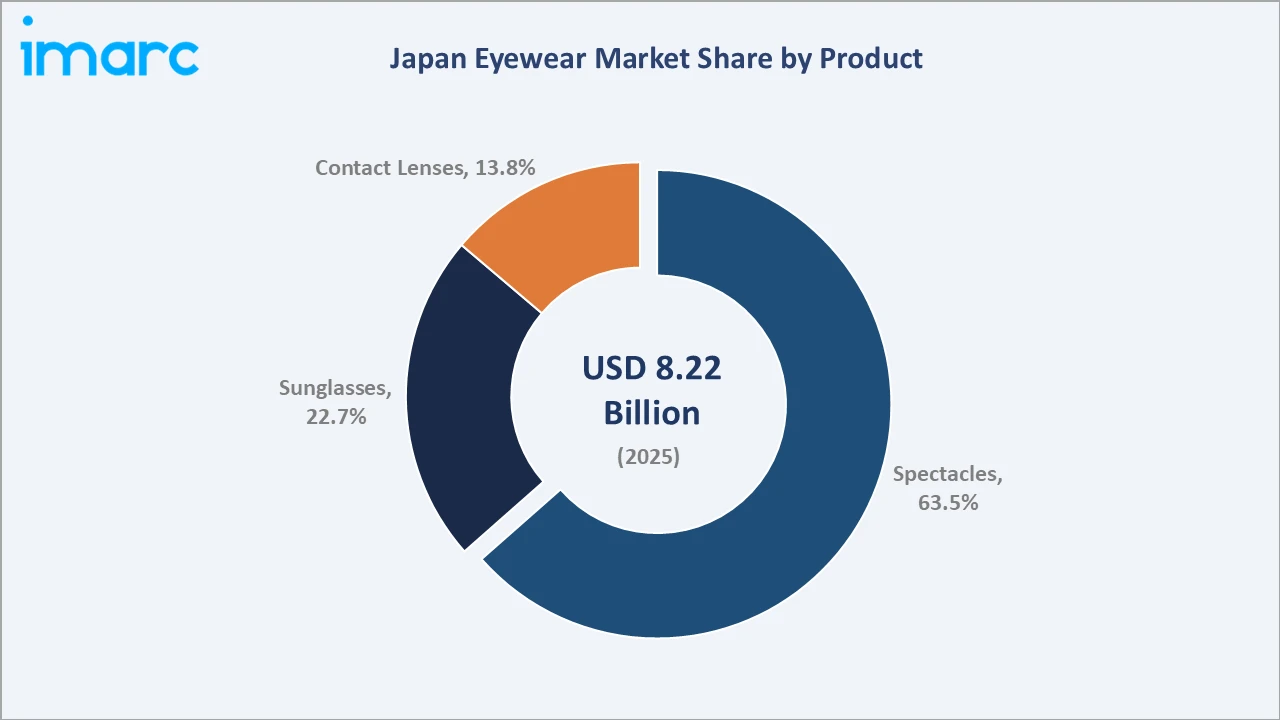
Spectacles lead at 63.5% in 2025, underpinned by Japan's demographic aging and the universal corrective need among the over-45 population experiencing presbyopia. High-quality progressive lenses, premium thin-lens options, and designer frames support strong revenue per unit.
To access detailed market analysis, Request Sample
Sunglasses at 22.7% benefit from Japan's strong fashion culture, UV awareness driven by healthcare messaging, and seasonal demand patterns. Contact lenses at 13.8%, though smallest by share, exhibit the highest growth trajectory at approximately 9.2% CAGR through 2034.
By Gender
Women lead at 41.8% in 2025, reflecting higher fashion accessory purchasing frequency and greater willingness to invest in premium frames and lens upgrades. Japanese female consumers exhibit a multi-pair purchasing pattern, maintaining distinct frames for professional, casual, and evening contexts.
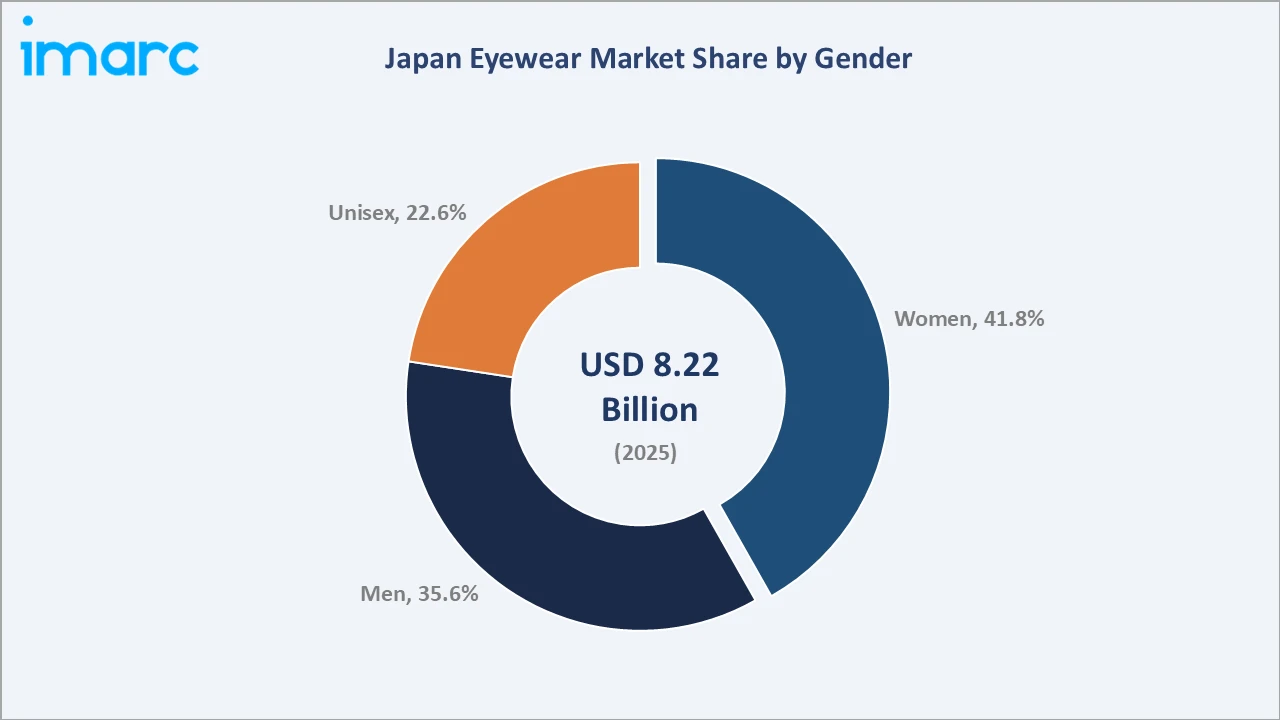
Men represent 35.6%, with increasing premiumization trends driven by corporate professional styling demand. The Unisex segment at 22.6% encompasses gender-neutral frame designs gaining popularity among younger Japanese consumers, inclusive fashion movements, and sports and protective eyewear categories.
Regional Market Insights
|
Region |
Share (2025) |
Key Growth Drivers |
|
Kanto Region |
36.8% |
Largest population concentration, the Greater Tokyo Metropolitan Area anchors Japan's premium eyewear retail ecosystem with the highest optical chain store density. |
|
Kansai/Kinki Region |
20.4% |
Osaka and Kyoto anchor the second-largest regional market, strong domestic tourism drives sunglasses demand, significant optical wholesale infrastructure. |
|
Central/Chubu Region |
13.8% |
Metropolitan area supports industrial and automotive sector workforce demand for prescription and safety eyewear, with a growing specialty retail presence. |
|
Kyushu-Okinawa Region |
9.4% |
Significant UV-driven sunglasses demand, growing e-commerce penetration bridging rural access gaps. |
|
Tohoku Region |
6.7% |
Reconstruction economic development supports market growth, lower optical retail density makes e-commerce channels increasingly important. |
|
Chugoku Region |
5.4% |
Moderate market growth tracking national trends with strong independent optical retailer networks. |
|
Hokkaido Region |
4.6% |
Seasonal outdoor and winter sports eyewear demand, government tourism investment supporting consumer spending growth. |
|
Shikoku Region |
2.9% |
Smallest regional market, highest dependence on e-commerce and traveling optical retail service vans, stable aging population demand. |
The Kanto region holds the dominant position at 36.8% share in 2025, driven by the Greater Tokyo Metropolitan Area's high population density, concentration of premium optical chains, and strong consumer purchasing power. The Kansai/Kinki region accounts for 20.4% in 2025, benefiting from robust domestic tourism that elevates sunglasses and fashion eyewear demand, alongside a well-developed optical wholesale infrastructure serving retailers across western Japan. The Central/Chubu region represents 13.8% of the market; its industrial economy and automotive manufacturing workforce generate significant demand for both prescription eyewear and safety-compliant optical products, supported by a growing specialty retail presence.
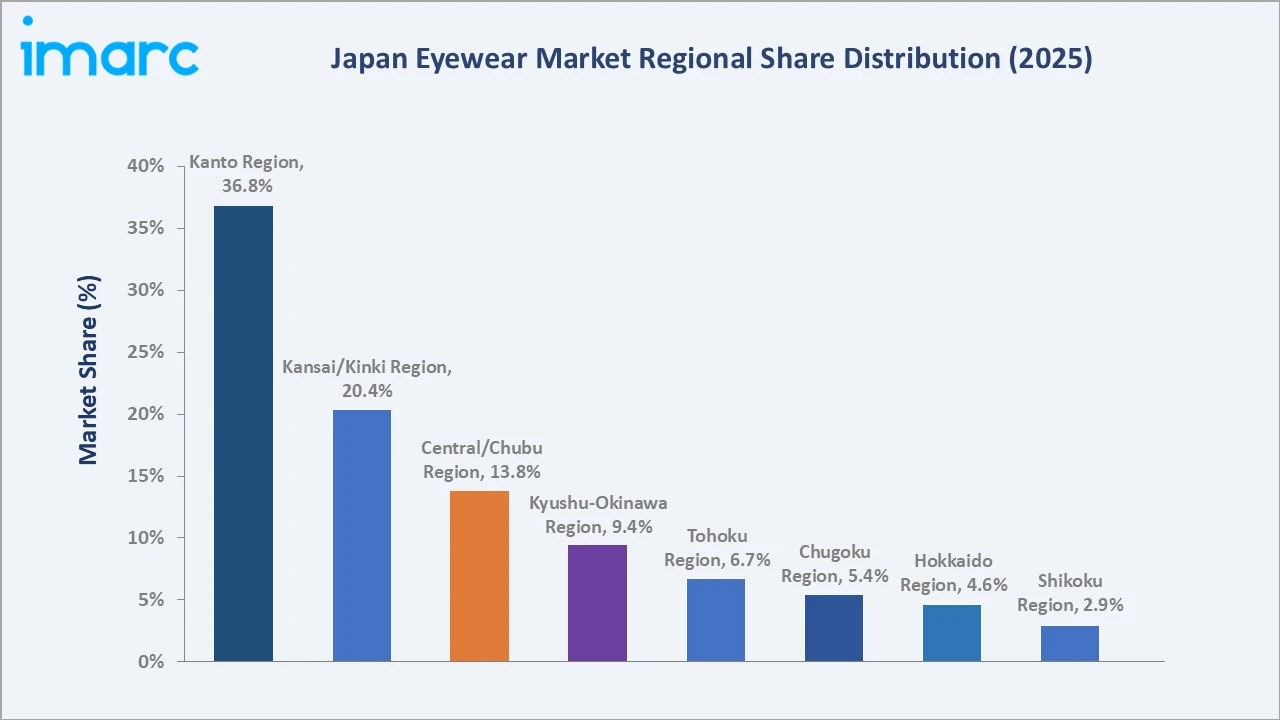
The Kyushu-Okinawa region contributes 9.4% of market share, with high UV exposure levels driving above-average sunglasses demand, and the region shows above-national-average e-commerce penetration bridging the optical retail gaps in its more rural communities. The Tohoku region accounts for 6.7%, driven by post-reconstruction economic development that has gradually improved consumer spending capacity, although lower optical retail store density has made e-commerce a proportionally more important distribution channel compared to other regions. The Chugoku region at 5.4%, Hokkaido region at 4.6%, and Shikoku region at 2.9% are the smaller contributors to Japan's eyewear market.
Competitive Landscape
The Japan eyewear market features a mixed competitive structure combining domestic optical giants with eyewear leaders. Japanese companies hold strong domestic positions supported by brand recognition, optical technology leadership, and extensive retail networks. Global leaders compete primarily in the premium and contact lens segments.
| Company | Key Brands | Market Position | Core Strength |
|---|---|---|---|
| HOYA Corporation | HOYA | Market Leader | HOYA Corporation is a leading manufacturer of advanced eyeglass lenses, prescription vision solutions, and optical technology in Japan. |
| JINS HOLDINGS Inc. | JINS, RIM | Market Leader | JINS HOLDINGS Inc. is a major disrupter and market leader in Japan's eyewear industry, known for pioneering fast fashion, transparent flat-rate pricing, and high-value functional glasses. |
| INTERMESTIC INC. | Zoff | Market Leader | INTERMESTIC INC. is a major Japanese eyewear manufacturer and retailer best known for operating the popular Zoff brand. |
| Menicon | Menicon, Miru | Established Player | Menicon is one of Japan's largest contact lens manufacturers, playing a pioneering role in the country’s vision care and optical industry. |
Companies compete through product innovation, premium designs, advanced lens technologies, brand differentiation, and omnichannel distribution strategies, including online retail and virtual try-on services.
Key Company Profiles
HOYA Corporation
HOYA Corporation is a leading optical lens manufacturer and a leader in high-index, progressive, and specialty lens technologies. HOYA operates through its Vision Care division, which produces a comprehensive range of ophthalmic lenses including single-vision, bifocal, and progressive designs in high-index materials. The company's precision optical manufacturing capabilities and R&D investments in photochromic and blue-light filtering lens technologies position it as the primary premium lens supplier to Japan's optical retail chains.
- Key Brands: HOYA
- Strategic Focus: Premium lens premiumization and digital eyewear health solutions, expanding AI-assisted lens customization systems and sustainable optical material innovations, broadening global distribution partnerships.
JINS HOLDINGS Inc.
JINS HOLDINGS Inc. is one of the largest specialty optical retail chains. The company pioneered the fast-fashion optical retail model in Japan, offering stylish spectacle frames with in-store lens processing at accessible price points. JINS has expanded into functional eyewear categories including blue-light blocking lenses and sports performance eyewear, successfully broadening its customer base beyond price-conscious demographics.
- Key Brands: JINS, RIM
- Strategic Focus: International expansion across Asia, accelerating e-commerce and digital retail integration, developing proprietary smart eyewear technologies for mainstream consumer adoption.
Market Concentration Analysis
The Japan eyewear market exhibits a moderately concentrated structure at the lens manufacturing level, with HOYA Corporation, JINS HOLDINGS Inc., and INTERMESTIC INC., collectively representing a significant portion of domestic precision optical lens production. The retail segment is moderately fragmented, leading the fast-fashion optical chain segment while independent optical stores retain a substantial market share.
The contact lens sub-segment exhibits the highest concentration. The spectacle frame segment remains the most fragmented, with thousands of domestic and international frame brands competing across price points. Consolidation trends favor the large optical chain operators, which benefit from scale economics in lens processing, inventory management, and digital marketing capabilities. The independent optical retailer segment faces margin pressure from fast-fashion chains but retains competitive strength through personalized optometry services and premium frame boutique positioning.
Investment & Growth Opportunities
Highest Growth Segments
Contact lenses is fastest growing segment at 9.2% CAGR, sunglasses at 8.5% CAGR, and men's eyewear at 8.1% CAGR are the highest growth segments.
Investment Themes
- Smart Eyewear and Advanced Lens Technologies: Investment in smart eyewear, AI-enabled glasses, and advanced lens technologies presents opportunities for manufacturers to differentiate their product portfolios. Companies can focus on integrating digital features, lightweight materials, and improved optical performance to address evolving consumer preferences in Japan.
- E-Commerce and Virtual Try-On Solutions: Investments in online eyewear platforms, 3D virtual fitting, and augmented reality tools can improve customer engagement and purchasing convenience. Retailers can strengthen their digital sales channels by offering personalized frame recommendations, virtual fitting services, and integrated online-to-store shopping experiences.
- Premium Eyewear and Innovative Product Design: Japan's established eyewear craftsmanship and consumer demand for distinctive designs create investment opportunities in premium frames, designer collections, and customized products. Manufacturers can focus on durable materials, ergonomic designs, and advanced manufacturing processes to strengthen brand differentiation and expand their presence in higher-value market segments.
Future Market Outlook (2026-2034)
The Japan eyewear market is projected to expand from USD 8.84 Billion in 2026 to USD 15.92 Billion by 2034, exhibiting a CAGR of 7.62% over the forecast period. This sustained growth trajectory is underpinned by Japan's structural demographic aging, progressive myopia expansion across younger cohorts, and the ongoing premiumization of eyewear as a high-involvement consumer purchase category.
Three structural forces will shape the Japan eyewear market through 2034. First, demographic changes and growing awareness of eye health, technological innovation, and the expansion of digital retail channels. Second, Japan’s aging population is expected to sustain demand for prescription glasses, progressive lenses, and specialized vision-correction products. Third, the growing adoption of e-commerce and virtual try-on solutions is also transforming purchasing behavior, encouraging eyewear retailers to strengthen their omnichannel strategies and personalized shopping experiences.
Research Methodology
Primary Research
Primary research comprised structured interviews with optical industry executives, eyewear retail chain managers, optometrists, contact lens distribution specialists, and consumer purchasing panel surveys across Japan's major regional markets. Primary data collection provided ground-level validation of market sizing assumptions, segment growth rates, and competitive dynamics observed in secondary sources.
Secondary Research
Secondary research incorporated analysis of Japan Optical Industry Association (JOIA) statistical publications, healthcare expenditure data, publicly available corporate financial disclosures, trade publications, and patent filings from major optical lens and smart eyewear manufacturers. This layer provided historical market sizing data, regulatory context, and technology development tracking across the forecast period.
Forecasting Models
Market sizing and forecast models applied a combination of top-down macroeconomic and demographic modeling with bottom-up channel and segment-level demand analysis, validated against historical actuals and cross-referenced with comparable regional eyewear market benchmarks. Scenario analysis incorporated optimistic and conservative demand trajectories to bound the central forecast estimates presented in this report.
Japan Eyewear Market Report Coverage:
| Report Features | Details |
|---|---|
| Base Year of the Analysis | 2025 |
| Historical Period | 2020-2025 |
| Forecast Period | 2026-2034 |
| Units | Billion USD |
| Scope of the Report |
Exploration of Historical and Forecast Trends, Industry Catalysts and Challenges, Segment-Wise Historical and Predictive Market Assessment:
|
| Products Covered | Spectacles, Sunglasses, Contact Lenses |
| Genders Covered | Men, Women, Unisex |
| Distribution Channels Covered | Optical Stores, Independent Brand Showrooms, Online Stores, Retail Stores |
| Regions Covered | Kanto Region, Kansai/Kinki Region, Central/ Chubu Region, Kyushu-Okinawa Region, Tohoku Region, Chugoku Region, Hokkaido Region, Shikoku Region |
| Companies Covered | HOYA Corporation, JINS HOLDINGS Inc., INTERMESTIC INC., Menicon, etc. |
| Customization Scope | 10% Free Customization |
| Post-Sale Analyst Support | 10-12 Weeks |
| Delivery Format | PDF and Excel through Email (We can also provide the editable version of the report in PPT/Word format on special request) |
Key Benefits for Stakeholders:
- IMARC’s industry report offers a comprehensive quantitative analysis of various market segments, historical and current market trends, market forecasts, and dynamics of the Japan eyewear market from 2020-2034.
- The research report provides the latest information on the market drivers, challenges, and opportunities in the Japan eyewear market.
- Porter's five forces analysis assist stakeholders in assessing the impact of new entrants, competitive rivalry, supplier power, buyer power, and the threat of substitution. It helps stakeholders to analyze the level of competition within the Japan eyewear industry and its attractiveness.
- Competitive landscape allows stakeholders to understand their competitive environment and provides an insight into the current positions of key players in the market.
Frequently Asked Questions About the Japan Eyewear Market Report
The Japan eyewear market was valued at USD 8.84 Billion in 2026, reflecting consistent demand from aging demographics and growing myopia prevalence.
The Japan eyewear market is projected to reach USD 15.92 Billion by 2034, growing at a CAGR of 7.62% during the 2026-2034 forecast period.
Spectacles dominate the Japan eyewear market with a 63.5% revenue share in 2025, driven by high corrective eyewear demand among Japan's aging and screen-exposed population.
Contact Lenses exhibit the fastest growth at approximately 9.2% CAGR, driven by younger consumers preferring daily disposable soft lenses over traditional spectacle correction formats.
The Kanto region commands 36.8% of Japan's eyewear market in 2025, anchored by the Greater Tokyo metropolitan area's dense specialty optical retail network and premium consumer base.
Key players include HOYA Corporation, JINS HOLDINGS Inc., INTERMESTIC INC., and Menicon, among others.
Women represent 41.8%, men 35.6%, and unisex 22.6% of the Japan eyewear market in 2025, with women driving premium multi-pair purchasing behavior.
The Japan eyewear market grew from USD 5.69 Billion in 2020 to USD 8.22 Billion in 2025, representing consistent expansion driven by demographic aging and premiumization trends.
Need more help?
- Speak to our experienced analysts for insights on the current market scenarios.
- Include additional segments and countries to customize the report as per your requirement.
- Gain an unparalleled competitive advantage in your domain by understanding how to utilize the report and positively impacting your operations and revenue.
- For further assistance, please connect with our analysts.
 Request Customization
 Speak to an Analyst
 Request Brochure
 Inquire Before Buying
Benefits of Customization
- Personalize this research
- Triangulate with your data
- Get data as per your format and definition
- Gain a deeper dive into a specific application, geography, customer, or competitor
- Any level of personalization
Get in Touch With Us
UNITED STATES
Phone: +1-201-971-6302
INDIA
Phone: +91-120-433-0800
UNITED KINGDOM
Phone: +44-753-714-6104
Email: [email protected]
Client Testimonials























Related Reports

Choose your plan
*Please note that the prices mentioned below are starting prices for each bundle type. Kindly contact our team for further details.*
Single User License
- 1 User License, Access on 2 Devices
- PDF Report + Excel Dataset (Password Protected)
- Lifetime Access
- No Printing Rights
- 10% Free Report Customization
- 10–12 Weeks of Analyst Support
Five User License
- Access for 5 Users, 2 Devices per User
- PDF Report + Excel Dataset (Password Protected)
- Lifetime Access
- Dedicated Account Manager
- 12–14 Weeks of Analyst Support
- No Printing Rights
- 15% Free Report Customization
- 25% Discount on Your Next Purchase
Corporate User License
- Unlimited User Access (Within Your Organization)
- PDF Report + Excel Dataset
- Lifetime Access
- Dedicated Account Manager
- 14–20 Weeks of Analyst Support
- No Printing Rights
- 20% Free Report Customization
- 30% Discount on Your Next Purchase
Essential Insights
What's included:
3 reports
- Lifetime Access
- PDF Reports
- Excel Datasets
- 2 Weeks of Free Analyst Support
- 2 User Licenses
- Access on 2 Devices
- Printing Rights
- Complimentary PowerPoint (PPT) Version
- Complimentary License Upgrade
Professional Access
What's included:
5 reports
- Lifetime Access
- PDF Reports
- Excel Datasets
- 8 Weeks of Free Analyst Support
- 2 User Licenses
- Access on 2 Devices
- Printing Rights
- Complimentary PowerPoint (PPT) Version
- Complimentary License Upgrade
Business Advantage
What's included:
8 reports
- Lifetime Access
- PDF Reports
- Excel Datasets
- 14 Weeks of Free Analyst Support
- 2 User Licenses
- Access on 2 Devices
- Printing Rights
- Complimentary PowerPoint (PPT) Version
- Complimentary License Upgrade
Enterprise Intelligence
What's included:
10 reports
- Lifetime Access
- PDF Reports
- Excel Datasets
- 20 Weeks of Free Analyst Support
- 2 User Licenses
- Access on 2 Devices
- Printing Rights
- Complimentary PowerPoint (PPT) Version
- Complimentary License Upgrade