
Japan Lithium-Ion Battery Market Size, Share, Trends and Forecast by Product Type, Power Capacity, Application, and Region, 2026-2034
Japan Lithium-Ion Battery Market Size, Share, Trends & Forecast (2026-2034)
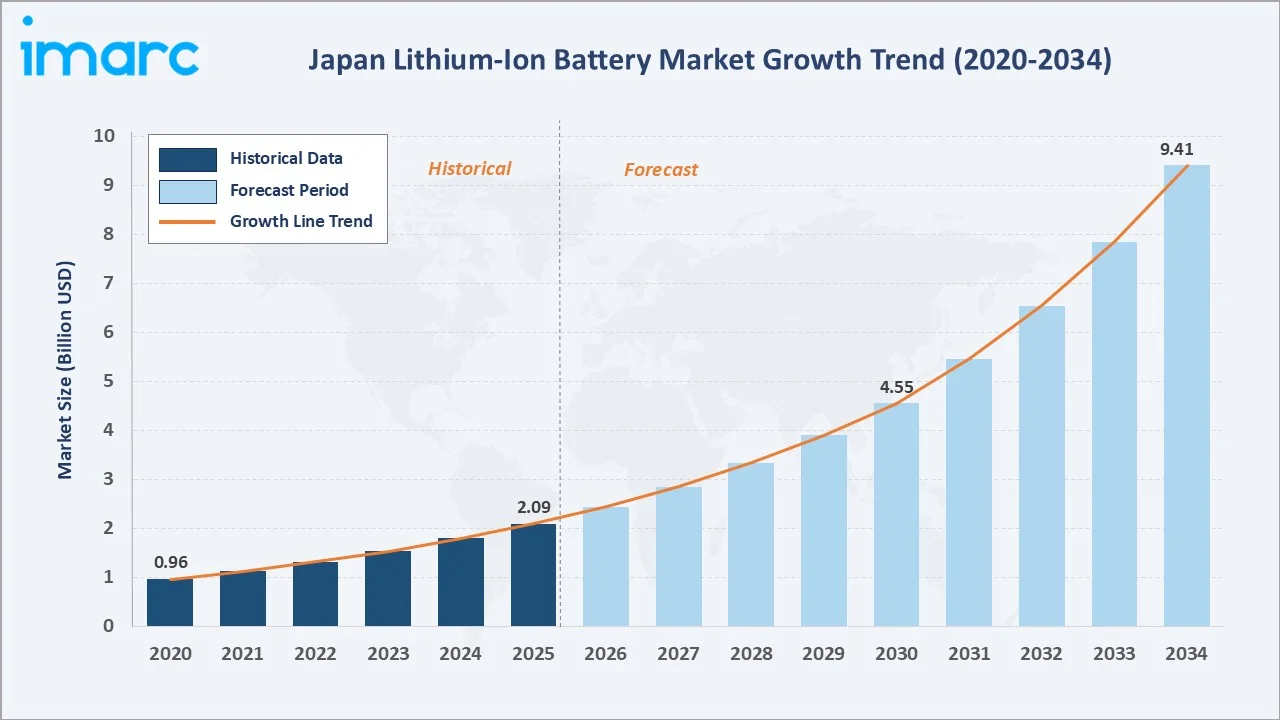
The Japan lithium-ion battery market size increased from USD 2.09 Billion in 2025 to USD 2.71 Billion in 2026 and is projected to reach USD 9.41 Billion by 2034, growing at a CAGR of 16.87% during 2026-2034. The market is driven by accelerating electric vehicle production, the government's carbon neutrality 2050 commitment, and expanding grid-scale energy storage deployment. Lithium Nickel Manganese Cobalt leads product type at 35.2%. Electric Vehicles lead application at 42.5%. Kanto Region commands 38.6% of the national market share.
Market Snapshot
|
Metric |
Value |
|
Base Year Market Size (2025) |
USD 2.09 Billion |
| Market Size (2026) | USD 2.71 Billion |
|
Forecast Market Size (2034) |
USD 9.41 Billion |
|
CAGR (2026-2034) |
16.87% |
|
Base Year |
2025 |
|
Historical Period |
2020-2025 |
|
Forecast Period |
2026-2034 |
|
Dominant Product Type |
Lithium Nickel Manganese Cobalt (35.2%, 2025) |
|
Dominant Application |
Electric Vehicles (42.5%, 2025) |
|
Leading Region |
Kanto Region (38.6%, 2025) |
The Japan lithium-ion battery market expanded from USD 0.96 Billion in 2020 to USD 2.09 Billion in 2025 and an estimated USD 2.71 Billion in 2026, anchored at USD 4.55 Billion in 2030, and forecast to reach USD 9.41 Billion by 2034. Post-pandemic electric vehicle demand recovery and government-backed gigafactory investment sustained above-trend growth through 2022-2025.
To get more information on this market, Request Sample
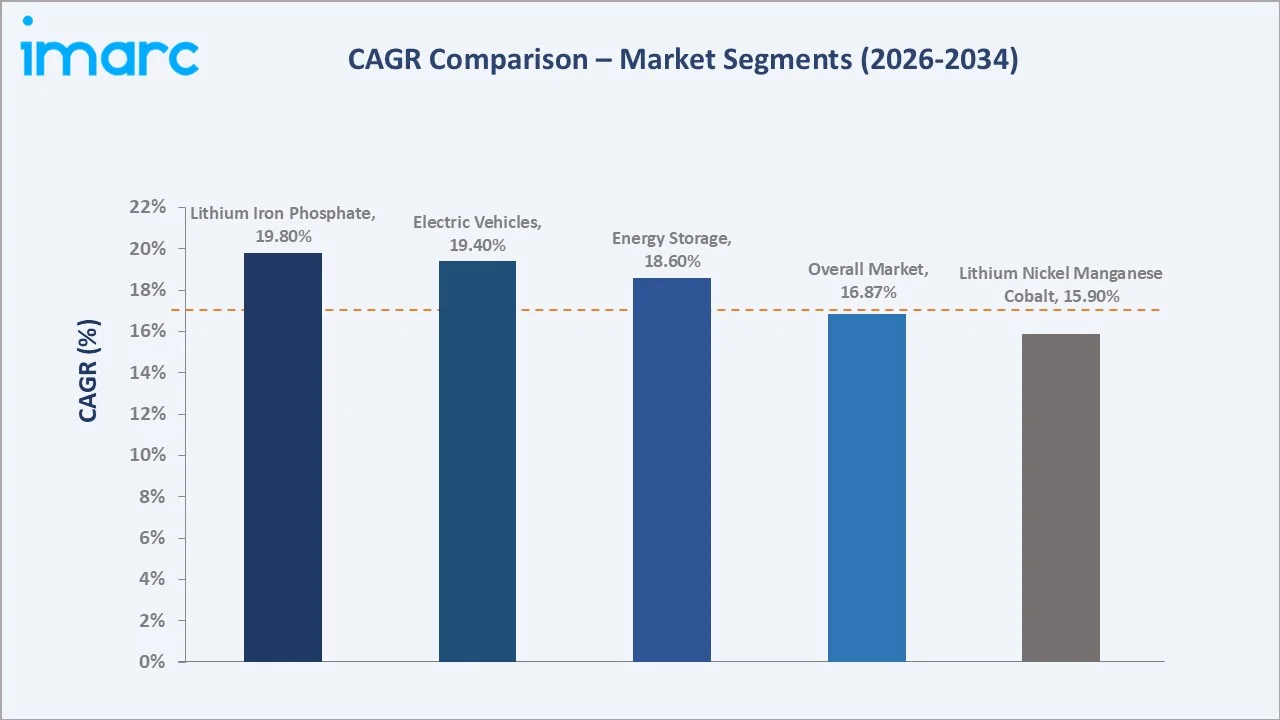
Lithium Iron Phosphate grows fastest among product types at ~19.8% CAGR as domestic cell makers localize LFP production for cost-sensitive energy storage applications. Electric Vehicles as an application segment grows at ~19.4% CAGR, outpacing the overall market on the back of accelerating EV production targets.
Executive Summary
The Japan lithium-ion battery market, which increased from USD 2.09 Billion in 2025 to an estimated USD 2.71 Billion in 2026, anchored by the country's globally dominant cell manufacturing base, deep automotive supply chain integration, and long-standing leadership in battery materials science. The market spans cell chemistry, cell and pack manufacturing, battery management systems, and end-of-life recycling infrastructure that together convert raw lithium and cathode materials into automotive, electronics, and grid-scale energy solutions.
Lithium Nickel Manganese Cobalt at 35.2% dominates through its balanced energy density and cycle life advantages for automotive and premium electronics use. Electric Vehicles at 42.5% lead application through Japan's accelerating EV production and government-backed electrification targets. Kanto Region, at 38.6%, leads through its concentration of automotive OEM headquarters, cell manufacturing plants, and electronics supply chains around Tokyo and Yokohama.
Key Market Insights
|
Insight |
Data |
|
Dominant Product Type |
Lithium Nickel Manganese Cobalt - 35.2% share (2025) |
|
Dominant Application |
Electric Vehicles - 42.5% market share (2025) |
|
Leading Region |
Kanto Region - 38.6% market share |
|
Market Opportunity |
Solid-state battery commercialization; grid-scale and data center energy storage; second-life battery recycling; robotaxi and autonomous mobility cell supply |
Key Analytical Observations Supporting the Above Data:
- Lithium Nickel Manganese Cobalt at 35.2%: This chemistry dominates due to its favorable balance of energy density, thermal stability, and cycle life, making it the preferred choice for automotive traction batteries and premium consumer electronics requiring high performance in compact form factors.
- Electric Vehicles at 42.5%: EVs dominate application demand as Japanese automakers accelerate electrification roadmaps, supported by government purchase incentives, charging infrastructure expansion, and domestic gigafactory investment that secures long-term cell supply.
- Kanto Region at 38.6%: Kanto leads through its concentration of automotive OEM headquarters, consumer electronics manufacturers, and cell production facilities across Tokyo, Kanagawa, and Saitama prefectures, supported by dense logistics and R&D infrastructure.
Japan Lithium-Ion Battery Market Overview
The Japan lithium-ion battery market encompasses cell chemistry formulation, electrode and separator manufacturing, cell and pack assembly, battery management system integration, and end-of-life recycling for automotive, consumer electronics, and stationary energy storage applications.
Macroeconomic factors include rising electric vehicle production targets, government carbon neutrality commitments, and growing investment in domestic battery supply chain resilience. In addition, renewable energy grid integration needs, rising data center power demand, and export competitiveness in battery technology are accelerating market growth.
Market Dynamics
To evaluate market opportunities, Request Sample
Market Drivers
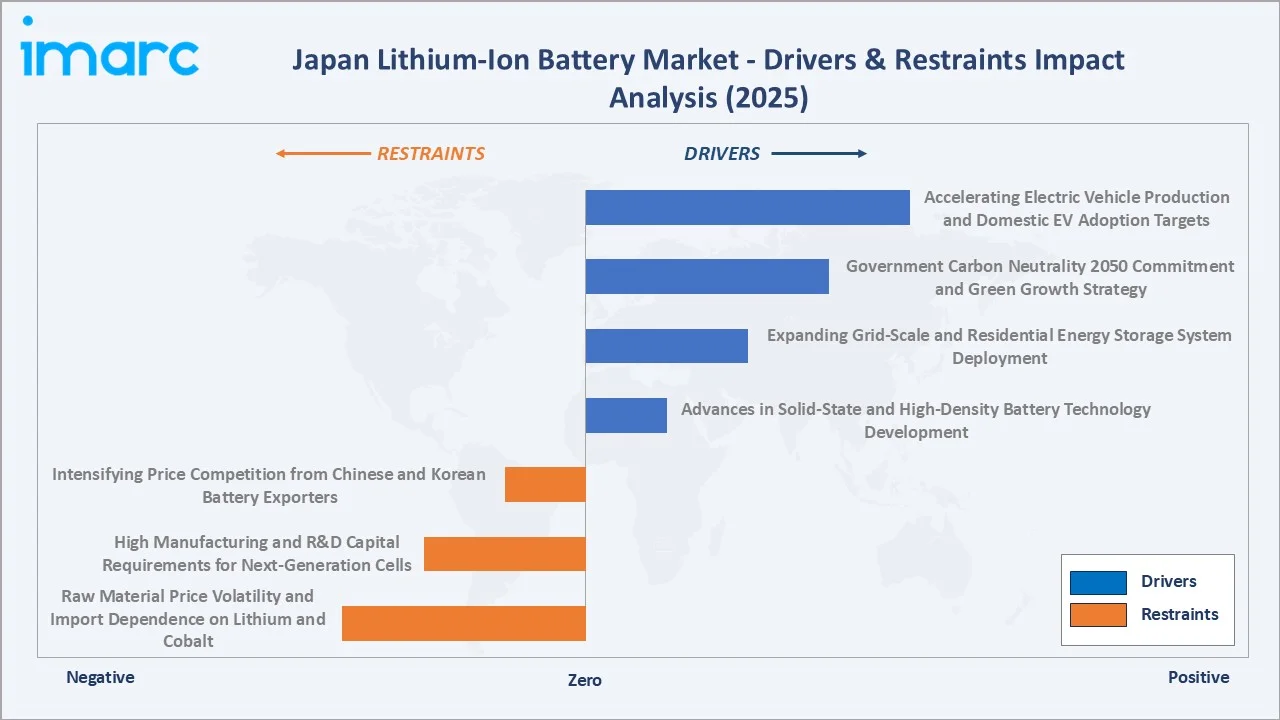
- Accelerating Electric Vehicle Production and Domestic EV Adoption Targets: Japanese automakers are scaling electric and hybrid vehicle production to meet domestic and export electrification targets. In November 2025, Panasonic Energy Co., Ltd. signed a multi-year agreement to supply cylindrical lithium-ion cells to Zoox's robotaxi fleet, beginning deliveries in early 2026, underscoring expanding automotive and mobility demand for Japanese-made cells.
- Government Carbon Neutrality 2050 Commitment and Green Growth Strategy: Japan's carbon neutrality roadmap channels policy support and subsidies into battery manufacturing capacity, raw material security, and charging infrastructure. This sustained policy backing is de-risking large-scale gigafactory investment across the domestic supply chain.
- Expanding Grid-Scale and Residential Energy Storage System Deployment: Utilities and industrial users are deploying lithium-ion storage to stabilize renewable power supply. GS Yuasa International Ltd. is supplying a 50-MWh lithium-ion battery storage system to the Tsunokobaru power storage plant for Tokyo Gas, reflecting rising utility-scale storage investment.
- Advances in Solid-State and High-Density Battery Technology Development: Japanese manufacturers are racing to commercialize solid-state and next-generation high-density cells. Panasonic has indicated its next-generation battery technology is expected to reach market by the end of 2027, reinforcing Japan's technology leadership pipeline.
Market Restraints
- Raw Material Price Volatility and Import Dependence on Lithium and Cobalt: Japan imports the overwhelming majority of lithium, cobalt, and nickel required for cell production, exposing manufacturers to price volatility and geopolitical supply risk that can compress margins and complicate long-term cost planning.
- High Manufacturing and R&D Capital Requirements for Next-Generation Cells: Scaling cylindrical, prismatic, and solid-state cell production requires substantial upfront capital for gigafactory construction, precision equipment, and sustained R&D investment, which can slow capacity expansion among smaller domestic players.
- Intensifying Price Competition from Chinese and Korean Battery Exporters: Large-scale Chinese and South Korean cell manufacturers continue to compete aggressively on price, pressuring Japanese producers to differentiate through quality, safety certification, and technology leadership rather than cost alone.
Market Opportunities
- Second-Life Battery and Recycling Ecosystem Development: Growing end-of-life EV battery volumes are creating opportunities in cell repurposing for stationary storage and closed-loop material recovery, supported by Japan's circular economy policy framework and battery recycling regulations.
- Data Center and Robotaxi Battery Supply Expansion: Rising AI data center power backup needs and the emergence of autonomous robotaxi fleets are opening new lithium-ion cell demand pools beyond traditional automotive and consumer electronics applications.
Market Challenges
- Critical Mineral Supply Chain Localization: Building domestic or allied-nation sourcing for lithium, cobalt, and nickel remains technically and commercially challenging, requiring long-term offtake agreements and processing capacity that take years to establish.
- Skilled Workforce and Technical Talent Shortage: Scaling advanced cell manufacturing and solid-state R&D requires specialized engineering talent that remains in short supply, creating competition for skilled personnel across battery, automotive, and electronics manufacturers.
Emerging Market Trends
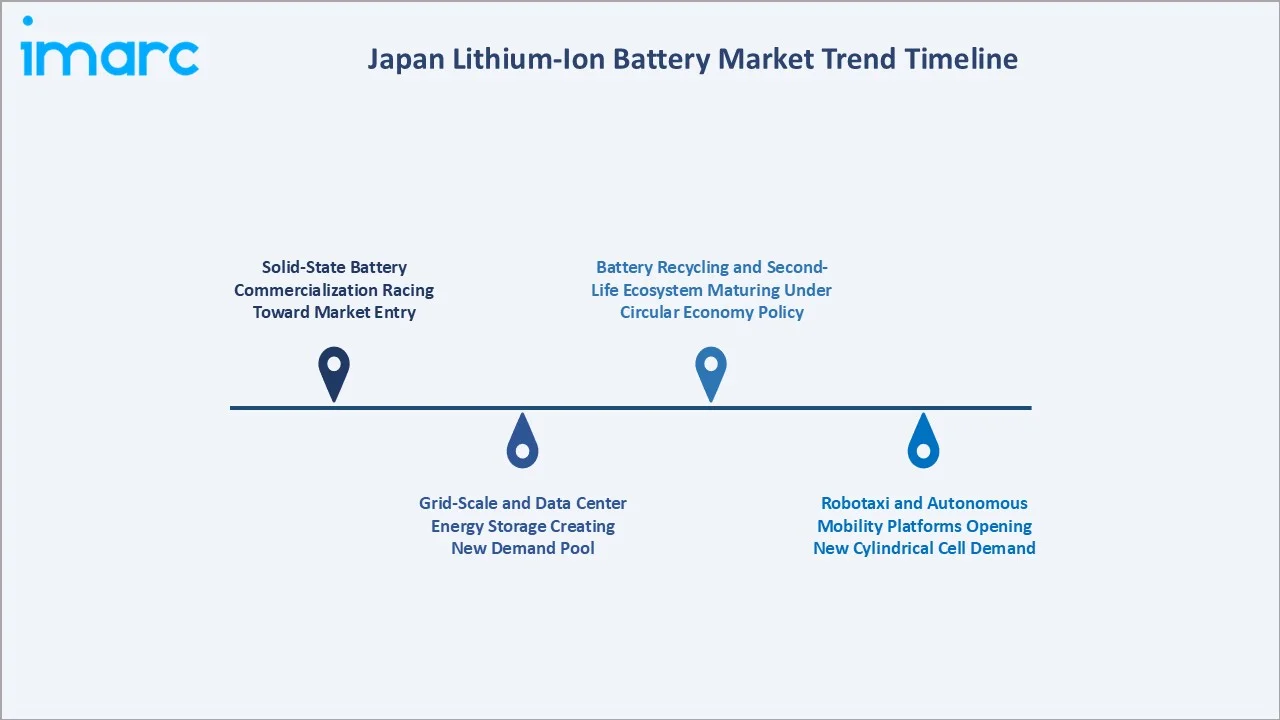
1. Solid-State Battery Commercialization Racing Toward Market Entry
Japanese manufacturers are advancing solid-state and high-density cell technologies toward commercial-scale production. Panasonic has signaled its next-generation battery technology is targeted for market availability by the end of 2027, positioning Japan among the technology leaders competing against solid-state programs from global automakers and battery specialists.
2. Grid-Scale and Data Center Energy Storage Creating New Demand Pool
Rising renewable power integration and AI data center backup needs are driving utility-scale lithium-ion storage deployment. GS Yuasa's 50 MWh battery storage supply for the Tsunokobaru plant illustrates how industrial and utility customers are diversifying lithium-ion demand beyond automotive and consumer electronics.
3. Battery Recycling and Second-Life Ecosystem Maturing Under Circular Economy Policy
Japan's battery recycling and circular economy policies are accelerating investment in cell recovery, material reclamation, and second-life repurposing for retired EV batteries, reducing raw material import dependence while creating new revenue streams for battery makers and recyclers.
4. Robotaxi and Autonomous Mobility Platforms Opening New Cylindrical Cell Demand
The emergence of autonomous robotaxi fleets is creating new cylindrical cell demand, exemplified by Panasonic Energy's multi-year 2170 cell supply agreement with Zoox beginning early 2026, expanding Japanese cell makers' addressable market beyond conventional passenger EVs.
Industry Value Chain Analysis
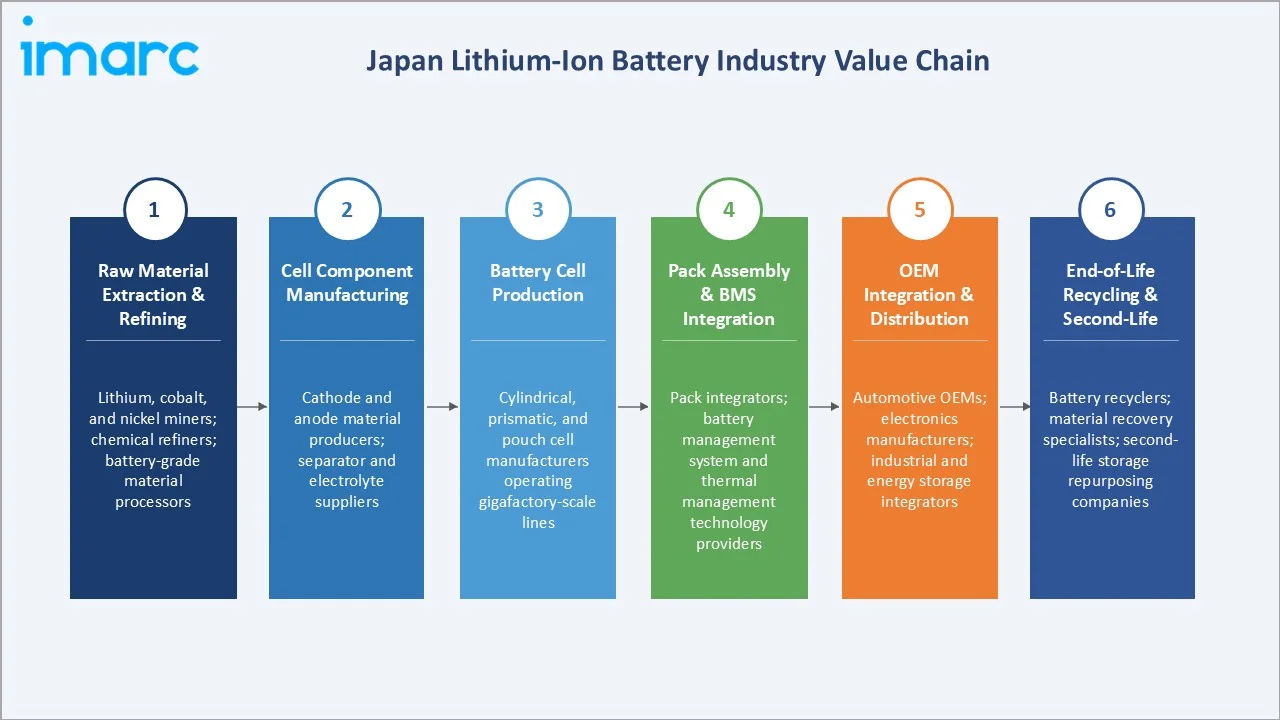
The lithium-ion battery value chain integrates raw material extraction and refining, cell component manufacturing, battery cell production, pack assembly and battery management system integration, OEM integration and distribution, and end-of-life recycling and second-life repurposing.
|
Stage |
Key Participants |
|
Raw Material Extraction & Refining |
Lithium, cobalt, and nickel miners; chemical refiners; battery-grade material processors |
|
Cell Component Manufacturing |
Cathode and anode material producers; separator and electrolyte suppliers |
|
Battery Cell Production |
Cylindrical, prismatic, and pouch cell manufacturers operating gigafactory-scale production lines |
|
Pack Assembly & BMS Integration |
Pack integrators; battery management system and thermal management technology providers |
|
OEM Integration & Distribution |
Automotive OEMs; electronics manufacturers; industrial and energy storage system integrators |
|
End-of-Life Recycling & Second-Life |
Battery recyclers; material recovery specialists; second-life storage repurposing companies |
The battery cell production stage is the value chain's most technically complex and capital-intensive phase. Cathode and electrolyte material innovation sustains the performance premium that Japanese lithium-ion cells command in automotive and premium electronics applications. Recycling and second-life infrastructure increasingly determine long-term raw material cost resilience.
Technology Landscape in the Japan Lithium-Ion Battery Industry
Cylindrical Cell Technology (2170 and 4680 Format)
Cylindrical cell formats, including the established 2170 and next-generation 4680 platforms, deliver high energy density, manufacturing scalability, and proven thermal performance for automotive and mobility applications. Panasonic Energy's continued investment in cylindrical cell capacity across its Japan and North American facilities underscores the format's central role in premium EV and robotaxi battery supply.
Solid-State Electrolyte Technology
Solid-state electrolyte technology replaces liquid electrolytes with solid ceramic or polymer materials, improving energy density and safety while reducing volatility risk. Japanese manufacturers are targeting commercial-scale solid-state cell availability by the end of 2027, positioning the technology as a key differentiator against Chinese and Korean competitors.
AI-Driven Battery Management Systems
AI-driven battery management systems enable real-time state-of-health monitoring, predictive maintenance, and optimized charge-discharge cycling. These systems extend battery lifespan and improve safety across automotive, consumer electronics, and grid-scale storage deployments, supporting Japan's push toward higher-value, software-differentiated battery products.
Market Segmentation Analysis
The report covers the following segments:
|
Segment Category |
Leading Segment |
Market Share |
Year |
|
Product Type |
Lithium Nickel Manganese Cobalt |
35.2% |
2025 |
|
Power Capacity |
10000mAH to 60000mAH |
28.4% |
2025 |
|
Application |
Electric Vehicles |
42.5% |
2025 |
|
Region |
Kanto Region |
38.6% |
2025 |

By Product Type
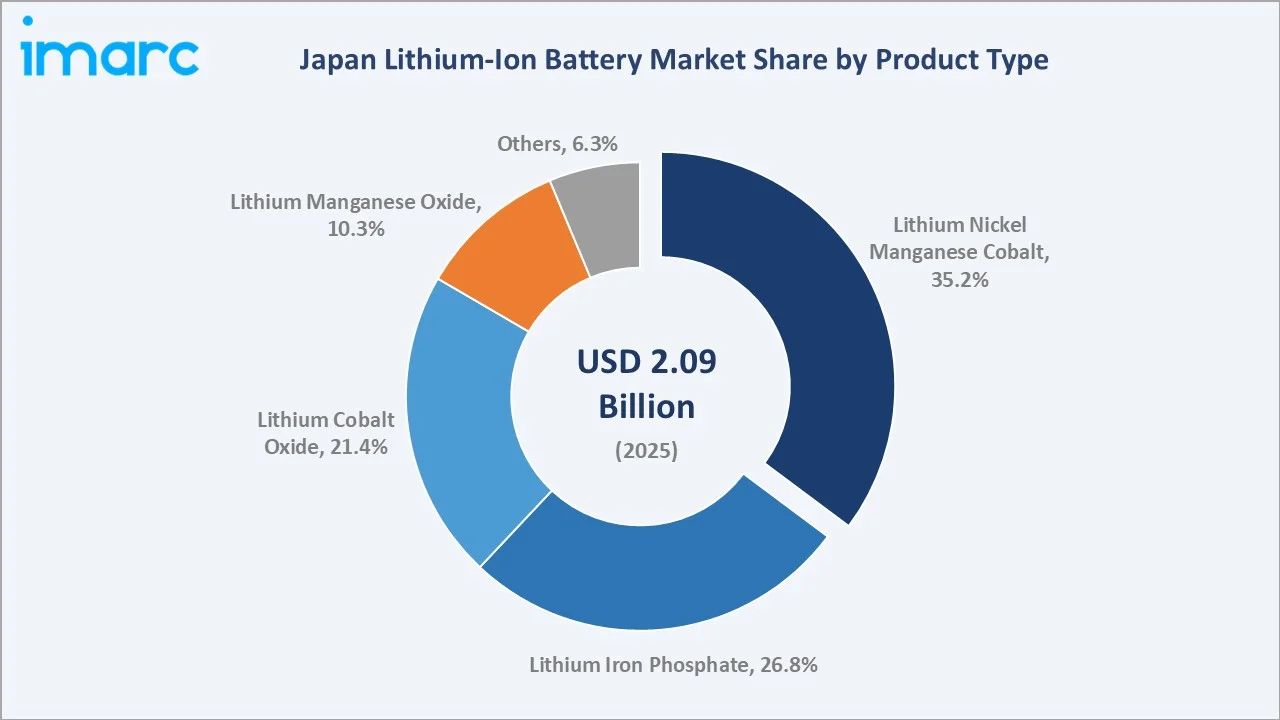
Lithium Nickel Manganese Cobalt leads at 35.2% (2025). The segment encompasses NMC chemistries balancing energy density, cycle life, and thermal stability, widely adopted across automotive traction batteries and premium consumer electronics requiring compact, high-performance cells.
To access detailed market analysis, Request Sample
Lithium Iron Phosphate at 26.8% is gaining share through cost-effective, thermally stable chemistry increasingly favored for energy storage and value-segment EVs. Lithium Cobalt Oxide at 21.4% remains dominant in premium consumer electronics requiring high volumetric energy density, while Lithium Manganese Oxide at 10.3% and Others at 6.3% serve specialized power tool and industrial applications.
By Application
Electric Vehicles lead at 42.5% (2025). The segment encompasses passenger EVs, hybrid vehicles, and emerging autonomous mobility platforms that require high energy density traction batteries supported by long cycle life and fast-charging capability.
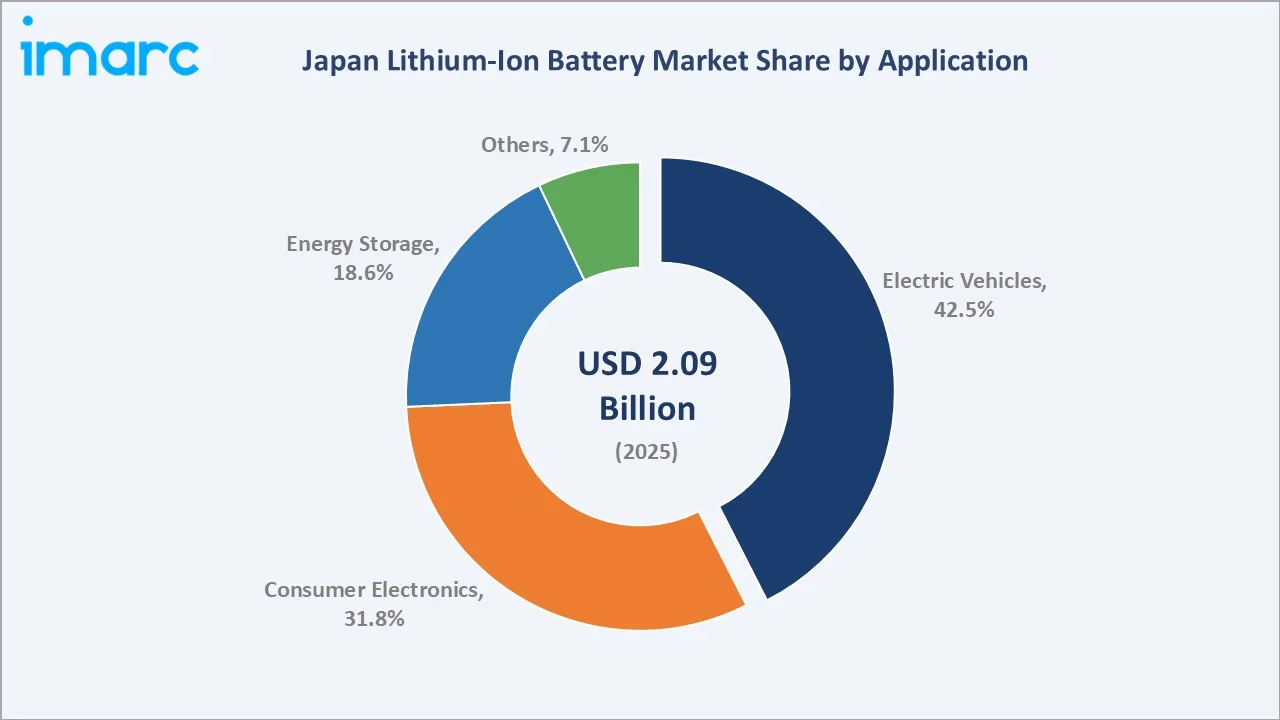
Consumer Electronics at 31.8% remains a stable demand base across smartphones, laptops, and wearable devices. Energy Storage at 18.6% is the fastest-growing application as utility and residential storage deployment accelerates, while Others at 7.1% covers power tools, medical devices, and industrial backup power systems.
Regional Market Insights
|
Region |
Share (2025) |
Key Japan Lithium-Ion Battery Market Drivers & Characteristics |
|
Kanto Region |
38.6% |
Driven by concentration of automotive OEM headquarters, cell manufacturing plants, and electronics supply chains around Tokyo and Yokohama. |
|
Kinki Region |
18.7% |
Supported by Osaka's industrial manufacturing base and established electronics and battery material supply networks. |
|
Central/ Chubu Region |
15.2% |
Anchored by Toyota's automotive manufacturing cluster and associated battery and component supplier ecosystem in Aichi Prefecture. |
|
Kyushu-Okinawa Region |
8.4% |
Driven by expanding semiconductor and electronics manufacturing investment attracting adjacent battery component production. |
|
Tohoku Region |
6.2% |
Supported by growing renewable energy projects and associated grid-scale battery storage deployment. |
|
Chugoku Region |
5.0% |
Backed by established industrial manufacturing infrastructure and automotive component supply chains. |
|
Hokkaido Region |
4.5% |
Driven by renewable energy expansion and emerging data center energy storage investment. |
|
Shikoku Region |
3.4% |
Supported by niche electronics and industrial battery manufacturing activity. |
Kanto Region's 38.6% market leadership is anchored by its dense concentration of automotive OEM headquarters, cell manufacturing plants, and electronics supply chains. Kinki Region's 18.7% reflects Osaka's industrial manufacturing depth and established battery material supply networks.
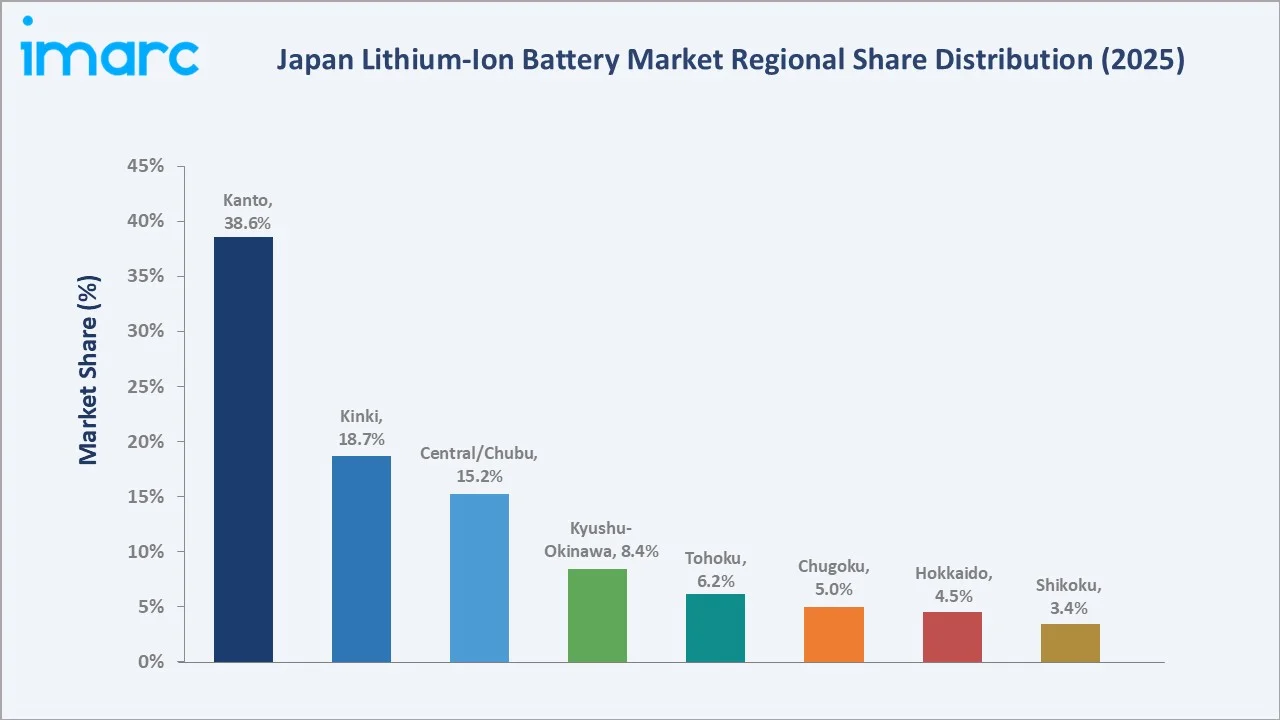
Central/Chubu Region's 15.2% is anchored by Toyota's automotive manufacturing cluster in Aichi Prefecture. Kyushu-Okinawa, at 8.4%, is the fastest-emerging growth region as semiconductor and electronics investment attracts adjacent battery component production.
Competitive Landscape
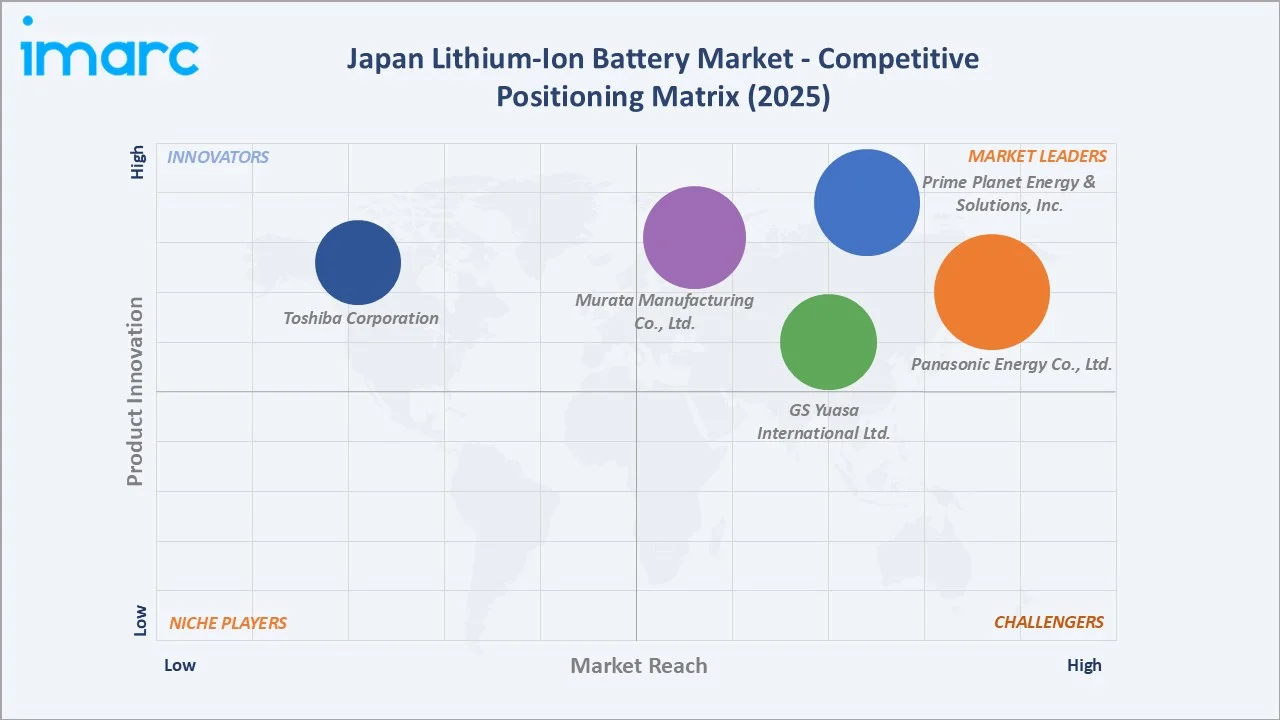
The Japan lithium-ion battery market competitive landscape encompasses distinct tiers: globally integrated cell manufacturers, automotive joint-venture battery producers, electronic component battery specialists, and diversified industrial battery makers.
|
Company Name |
Key Products |
Market Position |
Core Strength |
|
Panasonic Energy Co., Ltd. |
2170 and 4680 cylindrical cells, EV battery packs |
Market Leader |
Panasonic Energy plays a central role in the market through high-energy-density cylindrical cell technology, deep automotive OEM partnerships, and expanding robotaxi and data center battery supply. |
|
Murata Manufacturing Co., Ltd. |
Cylindrical Type Lithium-Ion Secondary Batteries |
Market Leader |
Murata plays a central role in the market by focusing management resources on cylindrical lithium-ion secondary batteries for power tool and energy storage system applications. |
|
Prime Planet Energy & Solutions, Inc. |
Prismatic and cylindrical EV/HEV battery packs |
Market Leader |
Prime Planet Energy & Solutions plays a central role in the market by supplying Toyota's electrified vehicle lineup through vertically integrated battery development and manufacturing. |
|
GS Yuasa International Ltd. |
Automotive lithium-ion batteries, LEPS industrial storage systems |
Established Player |
GS Yuasa plays a central role in the market by providing automotive traction batteries and large-scale industrial energy storage systems for utility customers. |
|
Toshiba Corporation |
Rechargeable battery systems, Energy storage solutions |
Innovator |
Toshiba plays a central role in the market through advanced battery materials research and industrial-grade energy storage system development. |
Cell manufacturing scale and automotive OEM integration sustain the competitive advantage of Japan's largest lithium-ion battery producers. Consolidation reflects customer preference for suppliers offering integrated cell, pack, and battery management system capability, reducing coordination complexity across the automotive and electronics supply chain.
Key Company Profiles
Panasonic Energy Co., Ltd.
Panasonic Energy Co., Ltd., a Panasonic Group company headquartered in Osaka, Japan, is a global leader in cylindrical lithium-ion cell manufacturing for automotive and mobility applications. The company specializes in high-energy-density 2170 and 4680 format cells.
- Key Products: 2170 and 4680 cylindrical lithium-ion cells; EV battery packs; energy storage system components.
- Recent Developments: In November 2025, Panasonic Energy signed a multi-year agreement to supply 2170 cylindrical batteries to Zoox's robotaxi fleet, with deliveries beginning in early 2026, marking its entry into the autonomous mobility battery market.
- Strategic Focus: Focused on cylindrical cell technology leadership, next-generation solid-state battery development targeted for commercial availability by the end of 2027, and expansion into data center and robotaxi battery supply.
GS Yuasa International Ltd.
GS Yuasa International Ltd., headquartered in Kyoto, Japan, is a leading manufacturer of lead-acid and lithium-ion batteries serving automotive, industrial, and energy storage markets, formed through the merger of Japan Storage Battery and Yuasa Battery.
- Key Products: Automotive lithium-ion batteries for hybrid and electric vehicles; LEPS series industrial lithium-ion energy storage systems.
- Recent Developments: In March 2026, GS Yuasa announced its newly developed EHW4GA automotive lithium-ion battery, offering more than a 10% increase in energy density, has been adopted for Toyota's new RAV4 hybrid models for overseas markets.
- Strategic Focus: Focused on expanding automotive battery energy density and utility-scale energy storage deployment, including a 50-MWh lithium-ion storage system supply for Tokyo Gas's Tsunokobaru power storage plant.
Market Concentration Analysis
The Japan lithium-ion battery market is moderately concentrated at the cell manufacturing tier, with Panasonic Energy, Murata Manufacturing, and Prime Planet Energy & Solutions collectively commanding a substantial share of domestic cylindrical and prismatic cell production. Component and material suppliers remain more fragmented. Market concentration is increasing at the automotive-integrated battery tier through joint ventures and long-term OEM supply agreements.
Investment & Growth Opportunities
Highest Growth Segments
Lithium Iron Phosphate product type (~19.8% CAGR), Electric Vehicle application (~19.4% CAGR), grid-scale and data center energy storage (~18.6% CAGR), and solid-state battery technology (high growth from a near-zero base) represent the highest-growth Japan lithium-ion battery investment vectors through 2034.
Emerging Investment Opportunities
Second-life battery repurposing and recycling infrastructure represents the largest near-term opportunity as retired EV battery volumes rise. Companies establishing preferred recycling and material recovery partnerships ahead of the 2030 fleet retirement wave are positioned for above-market revenue growth.
Investment Themes
- Solid-state battery commercialization capturing premium automotive and electronics demand: Solid-state technology combines higher energy density with improved safety. Companies investing in solid-state pilot line scale-up ahead of the targeted 2027 commercial launch window are positioned to capture the premium technology transition.
- Grid-scale and data center energy storage platform development for recurring utility revenue: Utility-scale lithium-ion storage deployment is creating recurring service and maintenance revenue opportunities alongside hardware sales, sustaining higher-margin business models as the installed storage base grows.
Future Market Outlook (2026-2034)
The Japan lithium-ion battery market is projected to grow from USD 2.09 Billion in 2025 to USD 2.71 Billion in 2026, reaching USD 9.41 Billion by 2034, delivering a 16.87% CAGR over the forecast period. The market's anchor value of USD 4.55 Billion in 2030 represents an inflection point at which solid-state cell technology is expected to achieve early commercial deployment, grid-scale energy storage will have scaled substantially, and second-life battery recycling infrastructure will have reached meaningful commercial maturity.
Three structural forces define market growth through 2034 with strong confidence. Electric vehicle electrification as a policy and industrial imperative creates sustained, long-term cell demand that is largely insulated from short-term economic cycles. Japan's carbon neutrality 2050 commitment creates durable policy support for battery manufacturing capacity and grid-scale storage investment. Technology leadership in solid-state and high-density cell chemistry is positioning Japanese manufacturers to defend premium market share against lower-cost Chinese and Korean competitors.
Research Methodology
Primary Research
Primary research comprised structured interviews with industry stakeholders including battery R&D directors, automotive procurement executives, cell manufacturing plant leadership, and regional energy storage market specialists across Japan.
Secondary Research
Secondary research encompassed battery industry publications, Japanese government energy and industrial policy data, automotive OEM annual reports, battery material supply chain statistics, and company press releases and investor disclosures.
Forecasting Models
Market revenue forecasts were developed using a segment bottom-up model: (i) product type component; (ii) power capacity component; (iii) application component.
Japan Lithium-Ion Battery Market Report Coverage:
| Report Features | Details |
|---|---|
| Base Year of the Analysis | 2025 |
| Historical Period | 2020-2025 |
| Forecast Period | 2026-2034 |
| Units | Billion USD |
| Scope of the Report |
Exploration of Historical and Forecast Trends, Industry Catalysts and Challenges, Segment-Wise Historical and Predictive Market Assessment:
|
| Product Types Covered | Lithium Cobalt Oxide, Lithium Iron Phosphate, Lithium Nickel Manganese Cobalt, Lithium Manganese Oxide, Others |
| Power Capacities Covered | 0 to 3000mAH, 3000mAH to 10000mAH, 10000mAH to 60000mAH, More than 60000mAH |
| Applications Covered | Consumer Electronics, Electric Vehicles, Energy Storage, Others |
| Regions Covered | Kanto Region, Kinki Region, Central/ Chubu Region, Kyushu-Okinawa Region, Tohoku Region, Chugoku Region, Hokkaido Region, Shikoku Region |
| Companies Covered | Panasonic Energy Co., Ltd., Murata Manufacturing Co., Ltd., Prime Planet Energy & Solutions, Inc., GS Yuasa International Ltd., Toshiba Corporation, etc. |
| Customization Scope | 10% Free Customization |
| Post-Sale Analyst Support | 10-12 Weeks |
| Delivery Format | PDF and Excel through Email (We can also provide the editable version of the report in PPT/Word format on special request) |
Key Benefits for Stakeholders:
- IMARC’s report offers a comprehensive quantitative analysis of various market segments, historical and current market trends, market forecasts, and dynamics of the Japan lithium-ion battery market from 2020-2034.
- The research study provides the latest information on the market drivers, challenges, and opportunities in the Japan lithium-ion battery market.
- Porter's five forces analysis assist stakeholders in assessing the impact of new entrants, competitive rivalry, supplier power, buyer power, and the threat of substitution. It helps stakeholders to analyze the level of competition within the Japan lithium-ion battery industry and its attractiveness.
- Competitive landscape allows stakeholders to understand their competitive environment and provides an insight into the current positions of key players in the market.
Frequently Asked Questions About the Japan Lithium-Ion Battery Market Report
The Japan lithium-ion battery market size is estimated at USD 2.71 Billion in 2026. The market is driven by accelerating electric vehicle production, carbon neutrality policy support, and expanding grid-scale energy storage deployment.
The market grows at 16.87% CAGR during 2026-2034, reaching USD 9.41 Billion by 2034. Lithium Iron Phosphate grows fastest among product types at ~19.8% CAGR.
Lithium Nickel Manganese Cobalt leads at 35.2% through its balanced energy density, thermal stability, and cycle life advantages for automotive and premium electronics applications.
Electric Vehicles lead at 42.5% through Japan's accelerating EV production and government-backed electrification targets.
Kanto Region leads at 38.6% through its concentration of automotive OEM headquarters, cell manufacturing plants, and electronics supply chains.
Leading companies include Panasonic Energy Co., Ltd., Murata Manufacturing Co., Ltd., Prime Planet Energy & Solutions, Inc., GS Yuasa International Ltd., and Toshiba Corporation, among others.
The market is projected to reach approximately USD 4.55 Billion by 2030, with solid-state battery technology approaching early commercial deployment and grid-scale energy storage adoption scaling substantially.
Autonomous mobility platforms require high-density, long-cycle-life cylindrical cells for continuous fleet operation. Panasonic Energy's multi-year cell supply agreement with Zoox, beginning early 2026, illustrates this emerging demand pool beyond conventional passenger EVs.
Need more help?
- Speak to our experienced analysts for insights on the current market scenarios.
- Include additional segments and countries to customize the report as per your requirement.
- Gain an unparalleled competitive advantage in your domain by understanding how to utilize the report and positively impacting your operations and revenue.
- For further assistance, please connect with our analysts.
 Request Customization
 Speak to an Analyst
 Request Brochure
 Inquire Before Buying
Benefits of Customization
- Personalize this research
- Triangulate with your data
- Get data as per your format and definition
- Gain a deeper dive into a specific application, geography, customer, or competitor
- Any level of personalization
Get in Touch With Us
UNITED STATES
Phone: +1-201-971-6302
INDIA
Phone: +91-120-433-0800
UNITED KINGDOM
Phone: +44-753-714-6104
Email: [email protected]
Client Testimonials




.webp)




.webp)













Related Reports

Choose your plan
*Please note that the prices mentioned below are starting prices for each bundle type. Kindly contact our team for further details.*
Single User License
- 1 User License, Access on 2 Devices
- PDF Report + Excel Dataset (Password Protected)
- Lifetime Access
- No Printing Rights
- 10% Free Report Customization
- 10–12 Weeks of Analyst Support
Five User License
- Access for 5 Users, 2 Devices per User
- PDF Report + Excel Dataset (Password Protected)
- Lifetime Access
- Dedicated Account Manager
- 12–14 Weeks of Analyst Support
- No Printing Rights
- 15% Free Report Customization
- 25% Discount on Your Next Purchase
Corporate User License
- Unlimited User Access (Within Your Organization)
- PDF Report + Excel Dataset
- Lifetime Access
- Dedicated Account Manager
- 14–20 Weeks of Analyst Support
- No Printing Rights
- 20% Free Report Customization
- 30% Discount on Your Next Purchase
Essential Insights
What's included:
3 reports
- Lifetime Access
- PDF Reports
- Excel Datasets
- 2 Weeks of Free Analyst Support
- 2 User Licenses
- Access on 2 Devices
- Printing Rights
- Complimentary PowerPoint (PPT) Version
- Complimentary License Upgrade
Professional Access
What's included:
5 reports
- Lifetime Access
- PDF Reports
- Excel Datasets
- 8 Weeks of Free Analyst Support
- 2 User Licenses
- Access on 2 Devices
- Printing Rights
- Complimentary PowerPoint (PPT) Version
- Complimentary License Upgrade
Business Advantage
What's included:
8 reports
- Lifetime Access
- PDF Reports
- Excel Datasets
- 14 Weeks of Free Analyst Support
- 2 User Licenses
- Access on 2 Devices
- Printing Rights
- Complimentary PowerPoint (PPT) Version
- Complimentary License Upgrade
Enterprise Intelligence
What's included:
10 reports
- Lifetime Access
- PDF Reports
- Excel Datasets
- 20 Weeks of Free Analyst Support
- 2 User Licenses
- Access on 2 Devices
- Printing Rights
- Complimentary PowerPoint (PPT) Version
- Complimentary License Upgrade