
Japan Vending Machine Market Size, Share, Trends and Forecast by Type, Technology, Application, and Region, 2026-2034
Japan Vending Machine Market Size, Share, Trends & Forecast (2026-2034)
The Japan vending machine market grew from USD 1.33 Billion in 2025 to USD 1.38 Billion in 2026 and is projected to reach USD 1.96 Billion by 2034, exhibiting a CAGR of 4.47% during 2026-2034. Japan’s uniquely dense vending machine culture, driven by high urban population density, strong consumer preference for convenience, and expanding product diversification, continues to underpin steady market growth across commercial, transit, and public locations.
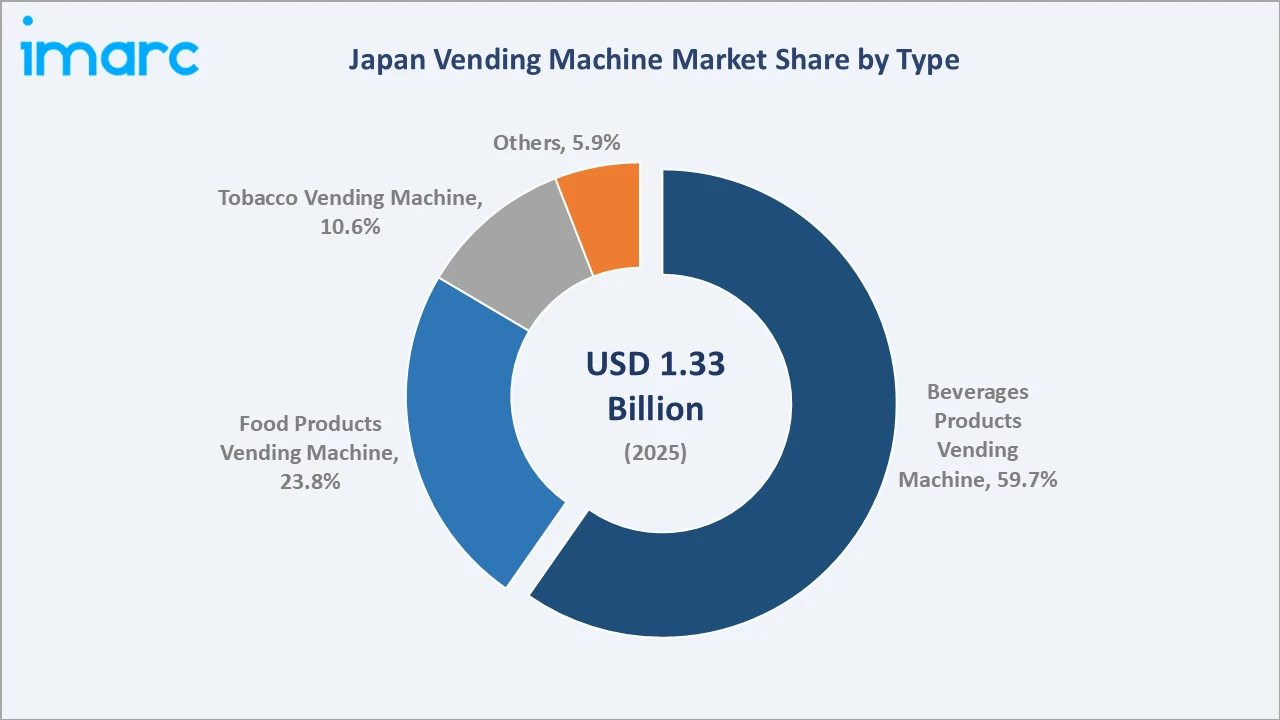
Beverages products vending machine leads the type segment at 59.7%, automatic machine dominates the technology segment at 68.5%, and Kanto Region commands 34.7% of regional share.
Market Snapshot
|
Metric |
Value |
|
Base Year Market Size (2025) |
USD 1.33 Billion |
|
Market Size (2026) |
USD 1.38 Billion |
|
Forecast Market Size (2034) |
USD 1.96 Billion |
|
CAGR (2026-2034) |
4.47% |
|
Base Year |
2025 |
|
Historical Period |
2020-2025 |
|
Forecast Period |
2026-2034 |
|
Largest Region |
Kanto Region (34.7%, 2025) |
|
Second Largest Region |
Kansai/Kinki Region (18.9%, 2025) |
|
Leading Type |
Beverages Products Vending Machine (59.7%, 2025) |
|
Leading Technology |
Automatic Machine (68.5%, 2025) |
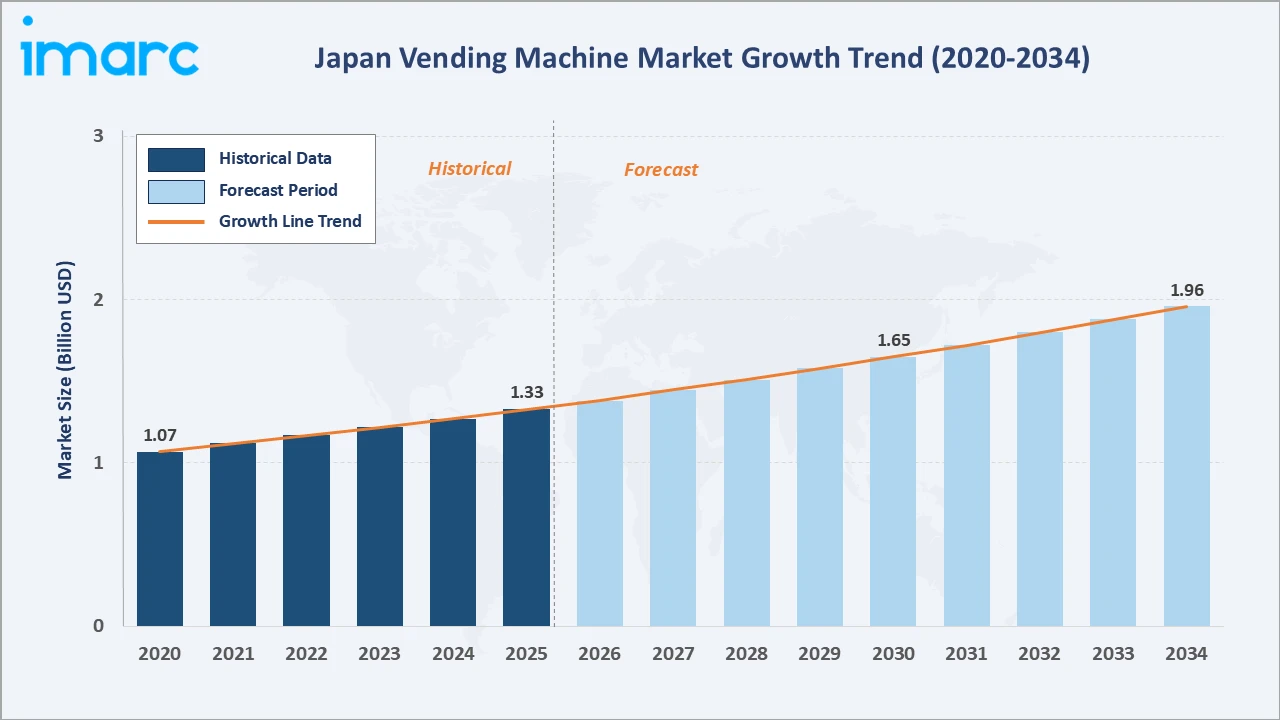
The Japan vending machine market size increased from USD 1.07 Billion in 2020 to USD 1.33 Billion in 2025 and is estimated to reach USD 1.38 Billion in 2026. The market is further expected to grow to USD 1.65 Billion by 2030 and USD 1.96 Billion by 2034. The market’s steady trajectory reflects Japan’s entrenched vending culture, ongoing technology upgrades, and product category expansion into food, healthcare, and specialty items beyond traditional beverage offerings.
To get more information on this market, Request Sample
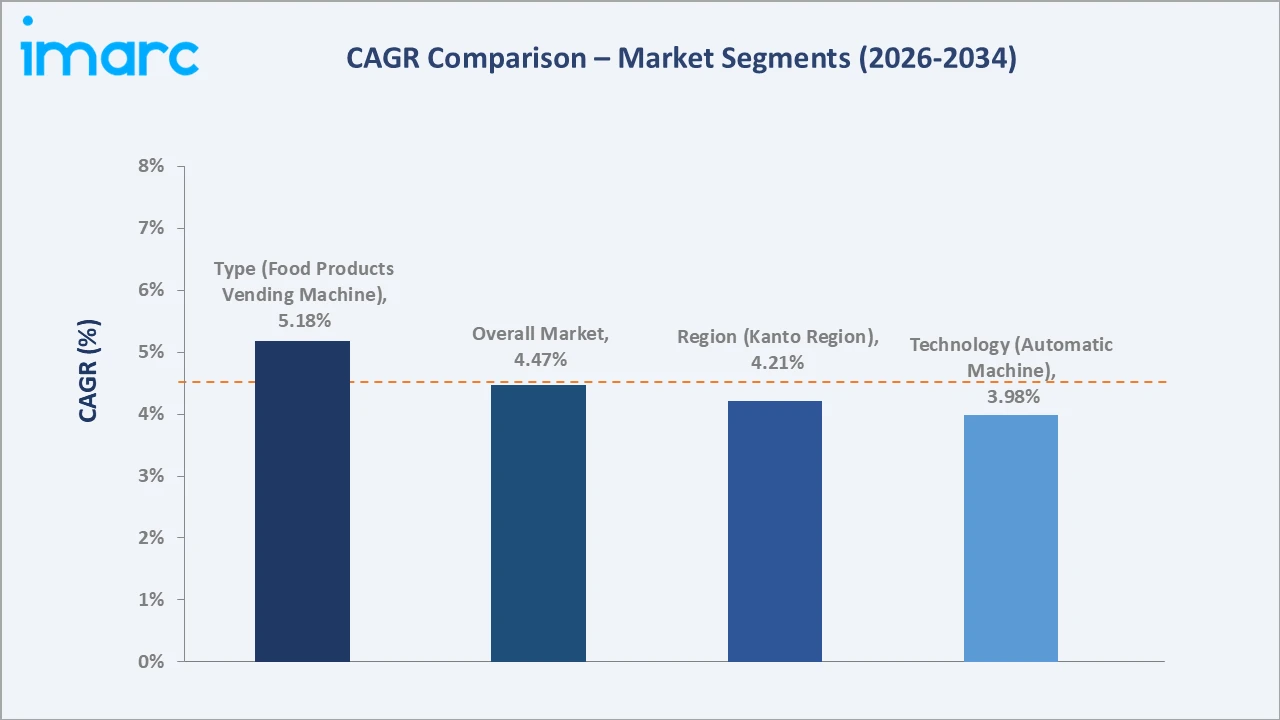
CAGR trajectories across type, technology, and regional sub-segments show smart machine and food products vending machine expanding faster than the overall 4.47% market CAGR, driven by technology investment, product category diversification, and increasing consumer demand for specialty vending solutions.
Executive Summary
The Japan vending machine market expanded from USD 1.33 Billion in 2025 to an estimated USD 1.38 Billion in 2026, supported by Japan’s deeply entrenched vending culture, high urban population density, and growing adoption of cashless payment and smart vending technology. Rising consumer preference for contactless, on-demand access to beverages, food, and specialty products is reinforcing market resilience.
Beverages products vending machine commands 59.7% of the type segment in 2025, driven by high daily consumer demand for ready-to-drink options across offices, transit hubs, and public spaces. Automatic machine leads the technology segment at 68.5%, reflecting its reliability and widespread deployment across Japan’s commercial landscape. Kanto Region commands 34.7% regional share, anchored by Tokyo’s dense commercial infrastructure.
Key Market Insights
|
Insight |
Data |
|
Leading Type |
Beverages Products Vending Machine – 59.7% share (2025) |
|
Second Largest Type |
Food Products Vending Machine – 23.8% share (2025) |
|
Leading Technology |
Automatic Machine – 68.5% share (2025) |
|
Second Largest Technology |
Semi-Automatic Machine – 20.7% share (2025) |
|
Leading Region |
Kanto Region – 34.7% share (2025) |
|
Second Largest Region |
Kansai/Kinki Region – 18.9% share (2025) |
|
Top Companies |
Fuji Electric Co., Ltd., Sanden Retail Systems Corporation, DyDo Group Holdings, Inc. |
Key analytical observations expanding on the data above:
- Beverages products vending machine dominance at 59.7% reflects Japan’s established culture of consuming ready-to-drink beverages on the go, particularly across office buildings, railway stations, and public spaces with high daily foot traffic.
- Food products vending machine share at 23.8% is growing as operators expand snack, meal, and fresh food offerings through vending channels, driven by changing consumer eating habits and demand for convenient meal access in urban locations.
- Automatic machine leadership at 68.5% is driven by its low operational complexity, high uptime, and compatibility with Japan’s high-volume, high-frequency vending environment across both urban and suburban commercial settings.
- Semi-automatic machine share at 20.7% reflects demand from operators deploying machines in lower-traffic locations where full automation capital investment may not be justified by transaction volume.
- Kanto Region at 34.7% leads regional share due to Tokyo’s dense commercial landscape, high urban population concentration, and extensive transit infrastructure driving sustained vending machine placement and throughput.
Japan Vending Machine Market Overview
Vending machines are automated retail devices that dispense products such as beverages, food items, tobacco, and specialty goods in exchange for payment, without requiring direct human interaction at the point of sale. The Japan vending machine market is globally distinctive, characterized by exceptionally high machine density, continuous product innovation, and strong consumer acceptance across all demographics and geographic regions.
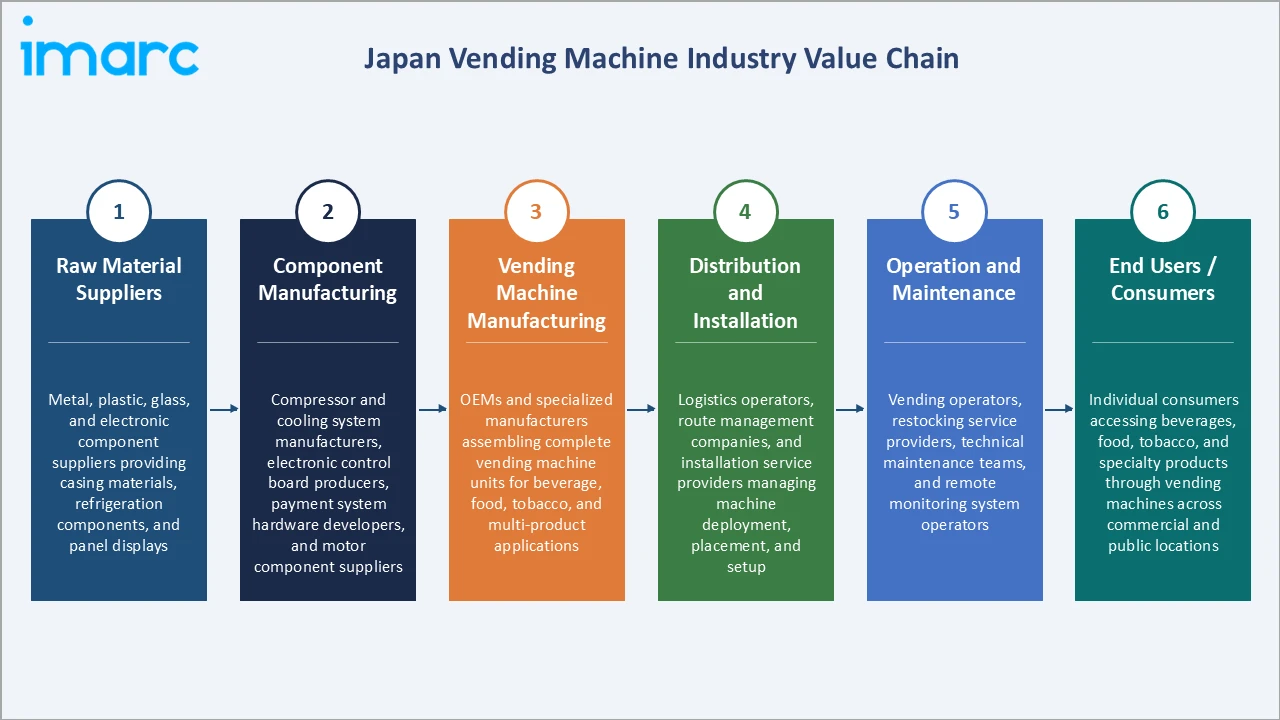
The industry ecosystem integrates raw material suppliers, component manufacturers, vending machine OEMs, distributors, operators, and end users. Supporting layers include technology providers, payment system integrators, logistics companies, and regulatory bodies. Together, they sustain a commercially mature and continuously evolving automated retail infrastructure across Japan’s commercial, transit, and public environments.
Market Dynamics
To evaluate market opportunities, Request Sample
Market Drivers
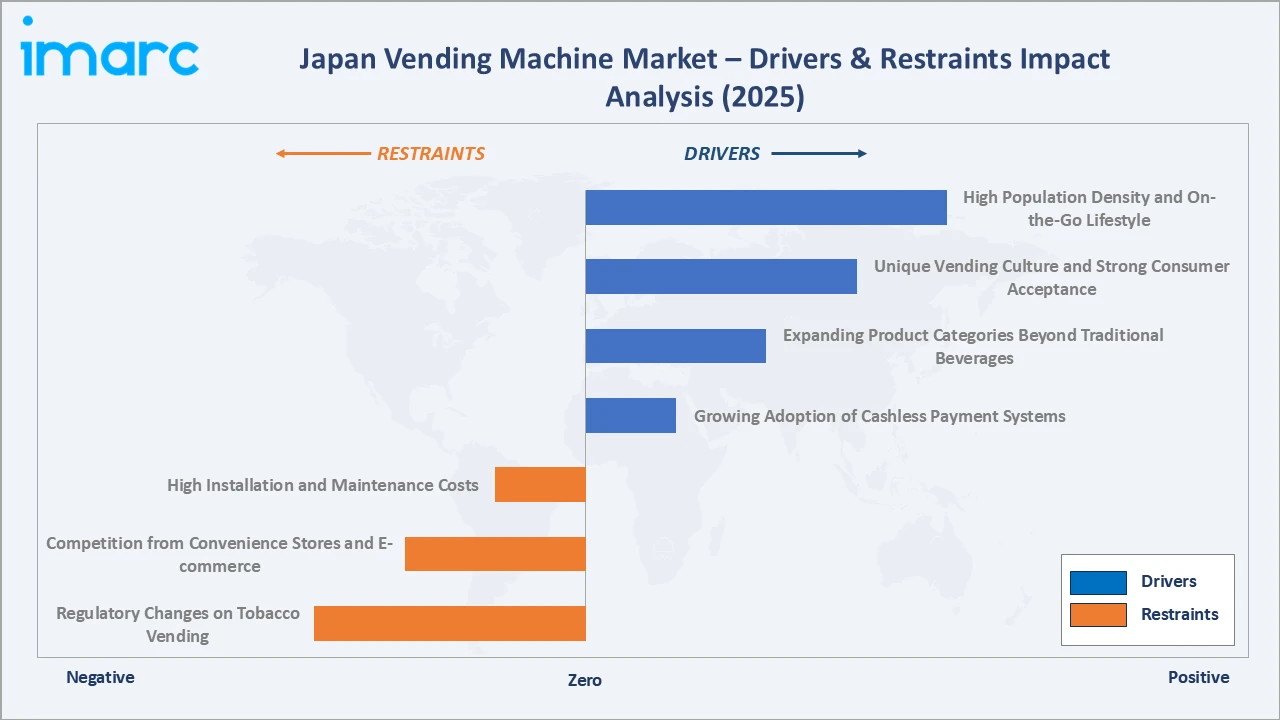
- High Population Density and On-the-Go Lifestyle: Japan’s urban centers support one of the world’s highest vending machine densities, creating a large established base driving ongoing replacement, upgrade, and product category expansion across commercial and public locations.
- Unique Vending Culture and Strong Consumer Acceptance: Japan’s deeply embedded vending culture, cultivated over decades of operator investment, product innovation, and machine placement across every public environment, sustains high transaction frequency and drives consistent consumer demand across all age groups and regions.
- Expanding Product Categories Beyond Traditional Beverages: Operators are broadening vending machine offerings to include hot foods, fresh meals, cosmetics, electronics accessories, and specialty items, opening new revenue streams and increasing machine utilization across diverse commercial and leisure locations.
- Growing Adoption of Cashless Payment Systems: The expansion of IC card, QR code, and mobile payment compatibility across Japan’s vending machine fleet is reducing friction at the point of sale and increasing transaction frequency, particularly among younger, tech-oriented urban consumer segments. As per IMARC Group, the Japan mobile payments market size was valued at USD 213.5 Billion in 2025.
Market Restraints
- High Installation and Maintenance Costs: Deploying and maintaining vending machines in Japan requires significant capital for purchase, placement fees, restocking logistics, and technical servicing, limiting the pace of net new deployments and pressuring margins for smaller operators.
- Competition from Convenience Stores and E-commerce: Japan’s dense convenience store network and growing e-commerce delivery options offer consumers alternative access to many of the same products available through vending machines, creating sustained competitive pressure on vending machine operators in high-footfall urban locations.
- Regulatory Changes on Tobacco Vending: Evolving regulations governing tobacco vending machine placement, age verification requirements, and permitted locations continue to constrain growth in the tobacco vending segment, affecting operators managing tobacco-specific machine networks.
Market Opportunities
- Smart Vending and IoT Integration: Deployment of IoT-connected vending machines with real-time inventory monitoring, remote management, and data analytics capabilities presents operators with significant cost optimization and consumer engagement opportunities across Japan’s large installed machine base.
- Expansion into Specialty and Luxury Product Categories: Consumer interest in premium, convenience-oriented specialty products, including cosmetics, health supplements, electronics accessories, and fresh food, is creating new product placement and margin opportunities for operators willing to invest in category diversification.
Market Challenges
- Supply Chain Complexity and Component Sourcing: The global semiconductor shortage and component supply chain disruptions have affected vending machine manufacturing timelines, increasing lead times for new unit deployment and machine upgrades across Japan’s operator base.
- Demographic Shifts and Changing Consumption Patterns: Japan’s aging population is shifting long-term consumption habits, with older demographics showing different product preferences compared to younger urban consumers, requiring operators to adapt product mix and machine placement strategies over time.
Emerging Market Trends
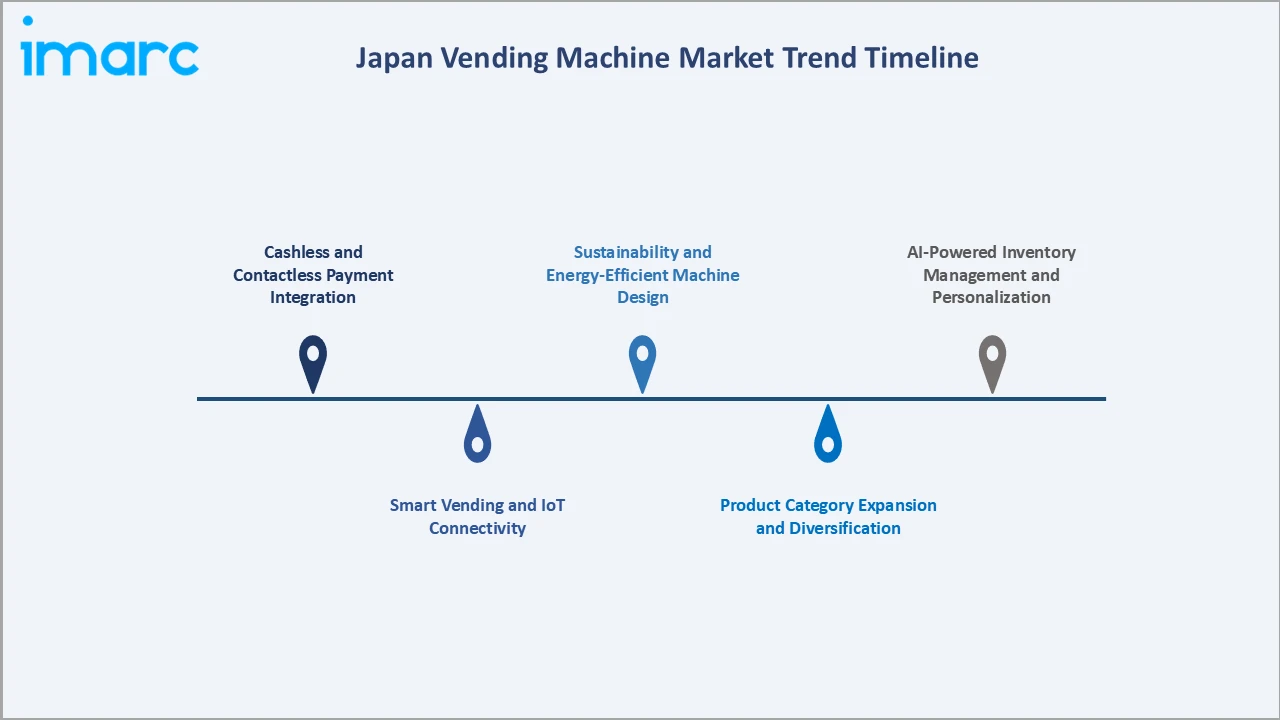
1. Cashless and Contactless Payment Integration
Japan’s transit payment infrastructure has driven rapid cashless payment adoption across vending machines nationwide. Operators are retrofitting existing machines and deploying cashless-native units to align with Japan’s national drive toward a cashless society, reducing consumer friction and increasing purchase frequency in high-footfall locations.
2. Smart Vending and IoT Connectivity
Japanese operators are increasingly adopting connected vending machines to improve inventory management and consumer engagement. IoT-enabled machines support remote diagnostics, predictive restocking, and consumer behavior analysis, helping operators streamline maintenance, reduce operational costs, and improve machine uptime across high-traffic locations.
3. Product Category Expansion and Diversification
Japan’s vending machine operators are actively expanding product offerings beyond beverages and tobacco to include hot meals, fresh food, cosmetics, books, and luxury items. This diversification is increasing average transaction values, attracting new consumer demographics, and improving overall machine revenue per unit across commercial and leisure vending environments.
4. Sustainability and Energy-Efficient Machine Design
Energy consumption in vending machines is a growing focus for operators and regulators in Japan, where the large machine fleet represents significant aggregate power draw. Manufacturers are developing inverter-based cooling systems, LED lighting, sleep mode automation, and solar-assisted units to reduce environmental impact and operating costs, aligning with Japan’s carbon neutrality targets.
5. AI-Powered Inventory Management and Personalization
AI is being integrated into vending machine management platforms to forecast demand by location and time of day, optimize product assortment, and enable adaptive pricing. Leading operators are piloting AI-driven systems that reduce out-of-stock incidents, minimize over-stocking, and tailor product selection to the preferences of each machine’s specific consumer base.
Industry Value Chain Analysis
The Japan vending machine industry value chain spans six stages, from raw material supply through end consumer access. Manufacturing and technology integration stages capture the highest value-add, while operator management and route logistics determine competitive positioning in Japan’s commercially mature, high-density vending environment.
| Stage | Key Players / Examples |
|---|---|
| Raw Material Suppliers | Metal, plastic, glass, and electronic component suppliers providing casing materials, refrigeration components, and panel displays |
| Component Manufacturing | Compressor and cooling system manufacturers, electronic control board producers, payment system hardware developers, and motor component suppliers |
| Vending Machine Manufacturing | OEMs and specialized manufacturers assembling complete vending machine units for beverage, food, tobacco, and multi-product applications |
| Distribution and Installation | Logistics operators, route management companies, and installation service providers managing machine deployment, placement, and setup |
| Operation and Maintenance | Vending operators, restocking service providers, technical maintenance teams, and remote monitoring system operators |
| End Users / Consumers | Individual consumers accessing beverages, food, tobacco, and specialty products through vending machines across commercial and public locations |
Vertically integrated operators controlling machine manufacturing, product supply, and route management are positioned to capture greater margin than single-stage participants. Technology providers enabling IoT connectivity, cashless payment, and AI-driven inventory management are increasingly critical to value chain competitiveness.
Technology Landscape in the Japan Vending Machine Industry
Automatic Machine Technology
Automatic machine remains the dominant technology segment, accounting for 68.5% of the Japan vending machine market. These machines operate through fully automated dispensing mechanisms requiring no manual intervention after product loading, and are deployed extensively across high-traffic commercial locations, transit hubs, and office environments. Advances in compressor efficiency and refrigeration controls are improving energy performance across the installed base.
Semi-Automatic Machine Technology
Semi-automatic machines incorporate partial automation where specific operational steps may require human assistance. These machines are commonly deployed in specialized or lower-volume locations where the cost-benefit of full automation is limited. Operators continue to upgrade semi-automatic installations to full automatic systems as transaction volumes justify the capital investment.
Smart Machine Technology
Smart machines integrate IoT connectivity, digital displays, cashless payment systems, and data communication capabilities. These machines transmit real-time sales, inventory, and diagnostic data to centralized management platforms, enabling operators to optimize routes, reduce stockouts, and engage consumers through dynamic pricing and interactive interfaces. Smart machine adoption is accelerating among Japan’s larger commercial operators.
Cashless Payment and Digital Integration
The integration of IC card readers, QR code scanners, NFC payment terminals, and mobile app connectivity across Japan’s vending machine fleet is reshaping the consumer transaction experience. Payment technology providers are partnering with vending manufacturers and operators to standardize cashless infrastructure, reduce cash handling costs, and unlock new consumer data streams for personalization and targeted product placement.
Market Segmentation Analysis
The report covers the following segments:
| Segment Category | Leading Segment | Market Share | Year |
|---|---|---|---|
| Type | Beverages Products Vending Machine | 59.7% | 2025 |
| Technology | Automatic Machine | 68.5% | 2025 |
| Application | 🔒 | 🔒 | 2025 |
| Region | Kanto Region | 34.7% | 2025 |

By Type
Beverages products vending machine commands a 59.7% majority share in 2025, driven by Japan’s established culture of consuming ready-to-drink beverages from vending machines across daily commute and workplace settings. The segment benefits from Japan’s extensive investment in beverage vending infrastructure and from strong daily transaction volumes in office buildings, railway stations, and convenience-oriented public spaces.
To access detailed market analysis, Request Sample
Food products vending machine at 23.8% is the second-largest segment in 2025, driven by evolving consumer demand for convenient, on-the-go meal and snack access. Expanding product variety, including hot foods, fresh meals, and packaged snacks, is broadening the addressable consumer base and increasing average transaction values for operators investing in food vending infrastructure.
By Technology
Automatic machine represents 68.5% of the technology segment in 2025, directly reflecting Japan’s preference for high-reliability, low-intervention vending solutions across its vast commercial landscape. Its widespread adoption across beverage and food vending operations, combined with advances in energy efficiency and remote monitoring compatibility, reinforces its position as the technology of choice for Japan’s major operators.
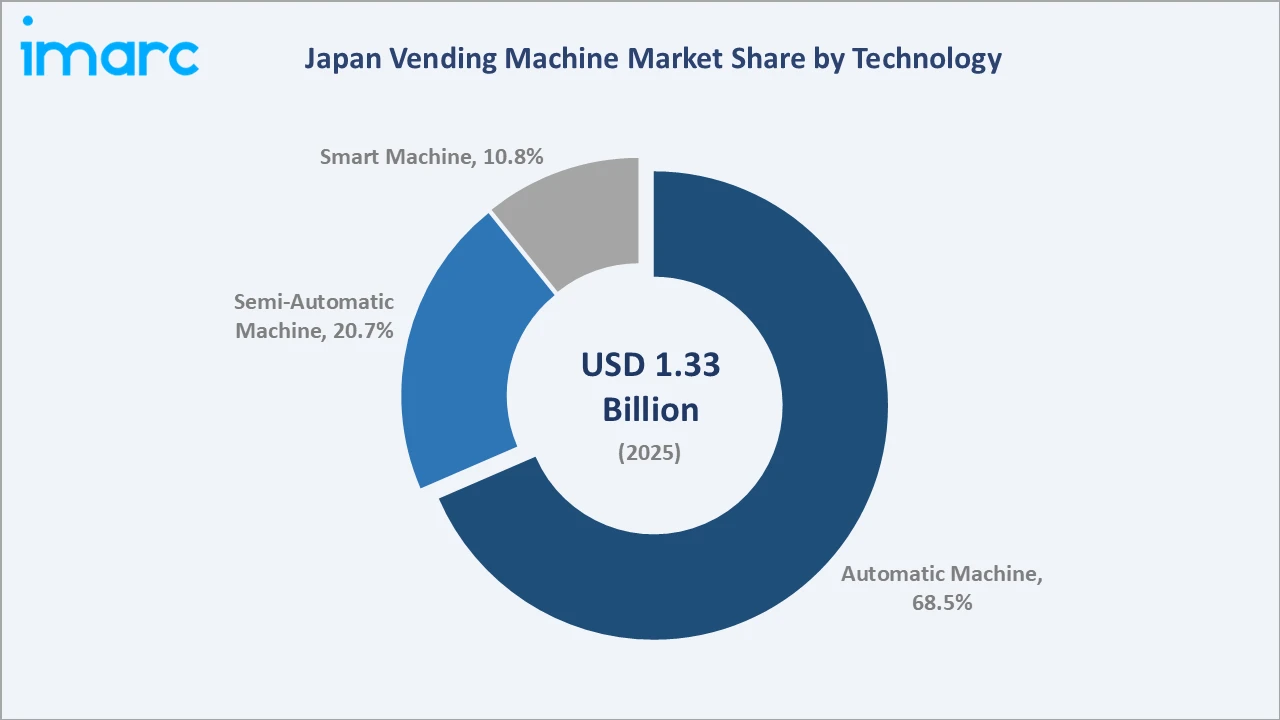
Smart machine at 10.8% is a rapidly growing segment, supported by Japan’s leading operators investing in IoT connectivity, digital consumer engagement, and data-driven inventory management. Its growth is expected to outpace the broader market CAGR, driven by operator demand for operational efficiency and the declining cost of smart vending hardware and connectivity platforms.
Regional Market Insights
|
Region |
Share (2025) |
Key Growth Drivers |
|
Kanto Region |
34.7% |
High population density, extensive commercial and transit infrastructure, large corporate office concentration, and strong consumer foot traffic driving high machine throughput |
|
Kansai/Kinki Region |
18.9% |
Major commercial centers, strong retail activity, significant tourism flow, and well-developed transit networks supporting vending machine placement and utilization |
|
Central/Chubu Region |
15.8% |
Industrial and manufacturing sector presence, commuter population demand, expanding commercial districts, and growing retail infrastructure supporting vending deployment |
|
Kyushu-Okinawa Region |
9.7% |
Growing urbanization, tourism sector expansion, retail development, and improving commercial infrastructure supporting increasing vending machine deployment |
|
Tohoku Region |
6.8% |
Expanding urban centers, infrastructure investment, retail sector development, and growing consumer awareness driving vending machine adoption across commercial locations |
|
Chugoku Region |
6.2% |
Industrial activity, port-related commercial development, growing retail presence, and urban population concentration supporting steady vending demand |
|
Hokkaido Region |
4.5% |
Tourism development, agricultural sector workforce, expanding retail infrastructure, and seasonal consumer demand supporting vending machine deployment |
|
Shikoku Region |
3.4% |
Urban development, infrastructure improvements, growing commercial activity, and increasing retail sector investment driving gradual vending machine expansion |
Kanto Region at 34.7% in 2025 leads the regional landscape, anchored by Tokyo’s unparalleled commercial density and a large daily working population generating consistent vending machine demand across offices, stations, and street-level locations.
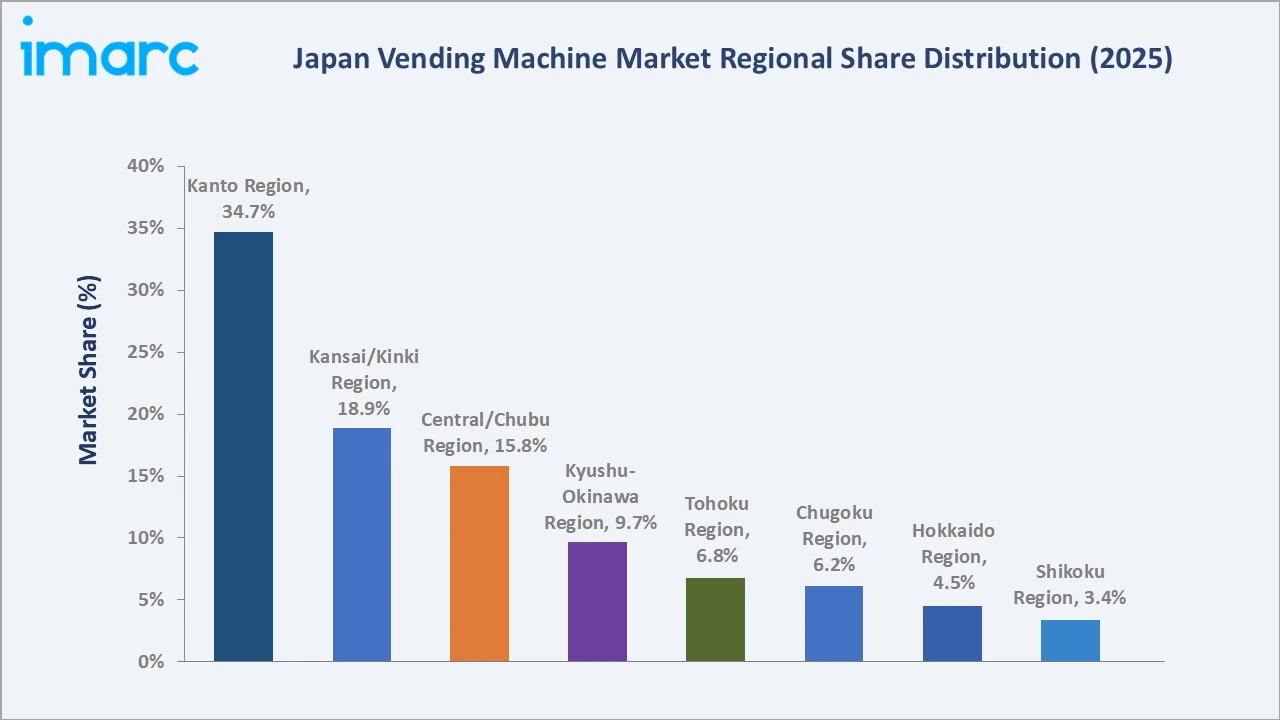
Kansai/Kinki Region at 18.9% is supported by its urban centers, strong commercial activity, and established vending machine infrastructure. The region's busy transport hubs, office districts, and tourist destinations create consistent demand for convenient, on-the-go purchases.
Competitive Landscape
The Japan vending machine market features a mix of domestic manufacturers, global technology providers, and large beverage and tobacco operators competing on machine technology, product offering depth, payment system integration, and operational scale. Machine reliability, energy efficiency, cashless payment compatibility, and proximity to high-footfall commercial locations form the key competitive differentiators across the industry.
| Company Name | Brand / Key Product | Position | Strategic Focus |
|---|---|---|---|
| Fuji Electric Co., Ltd. | Fuji Electric Vending Machines | Leader | Expanding smart vending and IoT-enabled machine portfolio to support operator demand for connected, energy-efficient solutions |
| Sanden Retail Systems Corporation | SDRS | Leader | Strengthening refrigeration technology for beverage vending and advancing energy-efficient machine development for domestic and international markets |
| DyDo Group Holdings, Inc. | DyDo | Challenger | Growing beverage vending footprint through product innovation, route optimization, and expanding partnerships with businesses |
Key players include Fuji Electric Co., Ltd., Sanden Retail Systems Corporation, and DyDo Group Holdings, Inc., among others.
Key Company Profiles
Fuji Electric Co., Ltd.
Fuji Electric Co., Ltd. is a Japanese electrical equipment manufacturer headquartered in Tokyo, Japan. The company is one of Japan’s largest vending machine manufacturers, producing a wide range of beverage and food vending machines along with energy management and industrial equipment for domestic and international markets.
- Product Portfolio: Beverage vending machines, food vending machines, and energy-efficient smart vending systems with integrated cashless payment interfaces and IoT-enabled remote management capabilities for commercial operators.
- Recent Developments: The company continues to develop and upgrade its vending machine product range, supporting operators in Japan with solutions designed for operational efficiency and modern payment capabilities.
- Strategic Focus: Developing next-generation automated retail equipment with integrated connectivity and energy management features, targeting efficiency-focused operators across Japan’s high-density vending network.
Sanden Retail Systems Corporation
Sanden Retail Systems Corporation is a vending machine manufacturer, headquartered in Japan. SDRS specializes in the design, manufacturing, and servicing of beverage vending machines and commercial refrigeration equipment for domestic and international markets.
- Product Portfolio: Beverage vending machines with advanced refrigeration technology, bottle and can vending systems, and commercial cooling equipment supporting beverage storage and dispensing in vending machine applications.
- Recent Developments: The company continues to update its vending machine product lineup and expand its commercial refrigeration offering, supporting beverage operators across Japan and international markets.
- Strategic Focus: Advancing cooling and refrigeration solutions for beverage vending applications, with ongoing investment in machine performance and energy efficiency across domestic and export market requirements.
DyDo Group Holdings, Inc.
DyDo Group Holdings, Inc. is a Japanese beverage holding company headquartered in Osaka. The group focuses on own-brand beverage products, including coffee, health drinks, and soft drinks, distributed primarily through its proprietary vending machine fleet across Japan’s commercial and public locations.
- Product Portfolio: Beverage vending machines dispensing DyDo-branded coffee, soft drinks, health drinks, and specialty beverages, with integrated cashless payment systems and loyalty program capabilities for consumer engagement.
- Recent Developments: The company continues to grow and manage its vending machine network across Japan, developing beverage products and operational capabilities in support of its domestic vending business.
- Strategic Focus: Expanding its beverage vending presence through ongoing product development, operational improvements, and collaborative arrangements with commercial partners across Japan’s beverage and vending sectors.
Market Concentration Analysis
The Japan vending machine market is moderately concentrated, with a small number of large domestic manufacturers and major beverage and tobacco operators accounting for a significant share of machine deployments and transaction volumes.
Barriers to entry include substantial capital requirements for machine manufacturing or fleet deployment, the need for extensive distribution and route management infrastructure, established relationships with high-footfall placement sites, and technical expertise in vending machine maintenance and servicing. These factors favor incumbents with scale, established footprints, and vertically integrated capabilities over new market entrants.
Consolidation is ongoing among smaller operators, as route efficiency and technology upgrade costs create incentives for scale. Strategic partnerships between beverage manufacturers and vending operators, and between technology providers and machine manufacturers, are shaping the market’s competitive dynamics through the forecast period.
Investment & Growth Opportunities
Fastest-Growing Segments
Smart machine is expanding fastest among technology sub-segments, driven by declining IoT hardware costs, growing operator interest in data-driven route and inventory management, and consumer expectations for digital payment and interactive vending experiences. Food products vending machine is expected to grow above the overall market CAGR as operators invest in fresh food and hot meal capabilities to capture emerging demand.
Emerging Markets
Tohoku Region represents meaningful growth opportunities within Japan, supported by ongoing urbanization, infrastructure development, tourism expansion, and government investment driving higher commercial activity and vending machine deployment rates.
Venture & Investment Trends
Investment activity is concentrated in smart vending platform development, cashless payment technology integration, AI-powered inventory management systems, and product category expansion into specialty and premium goods. Capital is also flowing into energy-efficient machine design and sustainability-focused vending infrastructure, reflecting operator demand for lower operating costs and alignment with Japan’s carbon neutrality commitments.
Future Market Outlook (2026-2034)
The Japan vending machine market is projected to grow from USD 1.33 Billion in 2025 to USD 1.38 Billion in 2026, reaching USD 1.96 Billion by 2034, registering a CAGR of 4.47% during 2026-2034.
Four forces will shape the market through 2034: accelerating adoption of smart and IoT-enabled machines; expansion of cashless payment systems across Japan’s existing machine fleet; product category diversification into food, healthcare, and specialty goods; and growing operator investment in AI-driven inventory management and consumer analytics. These dynamics will sustain steady market growth through the forecast period.
By 2034, the Japan vending machine market is expected to feature a higher proportion of connected smart machines, with major operators running fully digitally managed fleets supported by real-time data platforms. Sustained demand from Japan’s large consumer base, combined with continuous machine technology improvement and product innovation, will support the market’s growth trajectory through the forecast period.
Research Methodology
Primary Research
Primary research included structured discussions with vending machine operators, machine manufacturers, technology platform providers, payment system integrators, and industry executives in Japan, validating market sizing, segment mix, and technology adoption trends across the Japan vending machine ecosystem.
Secondary Research
Secondary sources included Japan Vending System Manufacturers Association (JVSMA) publications, Ministry of Economy, Trade and Industry (METI) retail and automation data, Japan Vending Machine Manufacturers Association reports, and public disclosures from listed vending machine manufacturers, beverage operators, and technology providers operating in Japan.
Forecasting Models
Market forecasts used top-down and bottom-up models combining installed base estimates, replacement cycle projections, new deployment rate assumptions, and product category growth rates. Scenario analysis addressed technology adoption pace, product diversification trends, regulatory developments affecting tobacco vending, and macroeconomic conditions influencing consumer spending on convenience retail.
Japan Vending Machine Market Report Scope:
| Report Features | Details |
|---|---|
| Base Year of the Analysis | 2025 |
| Historical Period | 2020-2025 |
| Forecast Period | 2026-2034 |
| Units | Billion USD |
| Scope of the Report |
Exploration of Historical and Forecast Trends, Industry Catalysts and Challenges, Segment-Wise Historical and Predictive Market Assessment:
|
| Types Covered | Food Products Vending Machine, Beverages Products Vending Machine, Tobacco Vending Machine, Others |
| Technologies Covered | Automatic Machine, Semi-Automatic Machine, Smart Machine |
| Applications Covered | Corporate Offices, Shopping Malls and Retail Stores, Educational Institutions, Hotels and Restaurants, Others |
| Regions Covered | Kanto Region, Kansai/Kinki Region, Central/Chubu Region, Kyushu-Okinawa Region, Tohoku Region, Chugoku Region, Hokkaido Region, Shikoku Region |
| Companies Covered | Fuji Electric Co., Ltd., Sanden Retail Systems Corporation, DyDo Group Holdings, Inc., etc. |
| Customization Scope | 10% Free Customization |
| Post-Sale Analyst Support | 10-12 Weeks |
| Delivery Format | PDF and Excel through Email (We can also provide the editable version of the report in PPT/Word format on special request) |
Key Benefits for Stakeholders:
- IMARC’s industry report offers a comprehensive quantitative analysis of various market segments, historical and current market trends, market forecasts, and dynamics of the Japan vending machine market from 2020-2034.
- The research report provides the latest information on the market drivers, challenges, and opportunities in the Japan vending machine market.
- Porter's five forces analysis assist stakeholders in assessing the impact of new entrants, competitive rivalry, supplier power, buyer power, and the threat of substitution. It helps stakeholders to analyze the level of competition within the Japan vending machine industry and its attractiveness.
- Competitive landscape allows stakeholders to understand their competitive environment and provides an insight into the current positions of key players in the market.
Frequently Asked Questions About the Japan Vending Machine Market Report
The Japan vending machine market size is estimated at USD 1.38 Billion in 2026, driven by Japan’s entrenched vending culture, high urban density, and growing adoption of cashless payment and smart vending technology.
The market is projected to grow at a CAGR of 4.47% from 2026-2034, reaching USD 1.96 Billion by 2034, supported by smart vending adoption, cashless payment expansion, and product category diversification.
Beverages products vending machine dominates the market at 59.7% type share in 2025, driven by Japan’s strong daily demand for ready-to-drink options across offices, transit hubs, and public locations.
Automatic machine commands 68.5% of the technology segment in 2025, driven by its operational reliability, high throughput capability, and widespread deployment across Japan’s commercial and transit vending locations.
Kanto Region commands 34.7% share in 2025, led by Tokyo’s dense commercial landscape and large corporate office concentration driving consistent vending demand.
Key players include Fuji Electric Co., Ltd., Sanden Retail Systems Corporation, and DyDo Group Holdings, Inc., among others.
Key drivers include Japan’s high urban population density, deeply established vending culture, expanding product categories, cashless payment adoption, and increasing smart vending and IoT technology deployment.
Key trends include cashless payment integration, smart vending and IoT adoption, product category expansion, sustainability-focused machine design, and AI-powered inventory management and demand forecasting systems.
Significant opportunities exist in smart machine deployment, cashless payment retrofitting, specialty product category expansion, energy-efficient machine development, and AI-powered operational management solutions for commercial vending operators.
Need more help?
- Speak to our experienced analysts for insights on the current market scenarios.
- Include additional segments and countries to customize the report as per your requirement.
- Gain an unparalleled competitive advantage in your domain by understanding how to utilize the report and positively impacting your operations and revenue.
- For further assistance, please connect with our analysts.
 Request Customization
 Speak to an Analyst
 Request Brochure
 Inquire Before Buying
Benefits of Customization
- Personalize this research
- Triangulate with your data
- Get data as per your format and definition
- Gain a deeper dive into a specific application, geography, customer, or competitor
- Any level of personalization
Get in Touch With Us
UNITED STATES
Phone: +1-201-971-6302
INDIA
Phone: +91-120-433-0800
UNITED KINGDOM
Phone: +44-753-714-6104
Email: [email protected]
Client Testimonials























Related Reports

Choose your plan
*Please note that the prices mentioned below are starting prices for each bundle type. Kindly contact our team for further details.*
Single User License
- 1 User License, Access on 2 Devices
- PDF Report + Excel Dataset (Password Protected)
- Lifetime Access
- No Printing Rights
- 10% Free Report Customization
- 10–12 Weeks of Analyst Support
Five User License
- Access for 5 Users, 2 Devices per User
- PDF Report + Excel Dataset (Password Protected)
- Lifetime Access
- Dedicated Account Manager
- 12–14 Weeks of Analyst Support
- No Printing Rights
- 15% Free Report Customization
- 25% Discount on Your Next Purchase
Corporate User License
- Unlimited User Access (Within Your Organization)
- PDF Report + Excel Dataset
- Lifetime Access
- Dedicated Account Manager
- 14–20 Weeks of Analyst Support
- No Printing Rights
- 20% Free Report Customization
- 30% Discount on Your Next Purchase
Essential Insights
What's included:
3 reports
- Lifetime Access
- PDF Reports
- Excel Datasets
- 2 Weeks of Free Analyst Support
- 2 User Licenses
- Access on 2 Devices
- Printing Rights
- Complimentary PowerPoint (PPT) Version
- Complimentary License Upgrade
Professional Access
What's included:
5 reports
- Lifetime Access
- PDF Reports
- Excel Datasets
- 8 Weeks of Free Analyst Support
- 2 User Licenses
- Access on 2 Devices
- Printing Rights
- Complimentary PowerPoint (PPT) Version
- Complimentary License Upgrade
Business Advantage
What's included:
8 reports
- Lifetime Access
- PDF Reports
- Excel Datasets
- 14 Weeks of Free Analyst Support
- 2 User Licenses
- Access on 2 Devices
- Printing Rights
- Complimentary PowerPoint (PPT) Version
- Complimentary License Upgrade
Enterprise Intelligence
What's included:
10 reports
- Lifetime Access
- PDF Reports
- Excel Datasets
- 20 Weeks of Free Analyst Support
- 2 User Licenses
- Access on 2 Devices
- Printing Rights
- Complimentary PowerPoint (PPT) Version
- Complimentary License Upgrade