
Mexico Enterprise Software Market Size, Share, Trends and Forecast by Software, Deployment, Enterprise Size, End Use, and Region, 2026-2034
Mexico Enterprise Software Market Size, Share, Trends & Forecast (2026-2034)
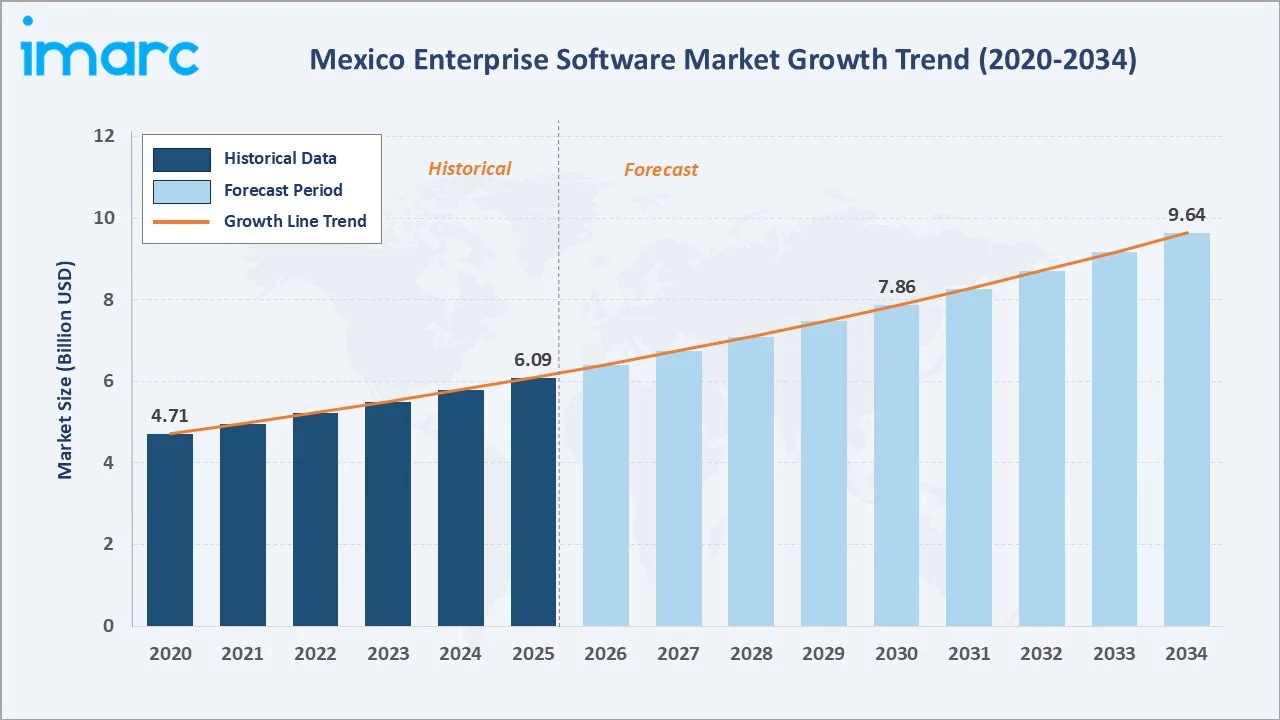
The Mexico enterprise software market reached USD 6.09 Billion in 2025 and is projected to reach USD 9.64 Billion by 2034, growing at a CAGR of 5.25% during 2026-2034. Accelerating digital transformation initiatives across diverse industries, rapid adoption of cloud-based software-as-a-service (SaaS) platforms, and nearshoring-driven foreign direct investment generating new enterprise IT demand are the primary growth catalysts.
Market Snapshot
|
Metric |
Value |
|
Market Size (2025) |
USD 6.09 Billion |
|
Forecast Market Size (2034) |
USD 9.64 Billion |
|
CAGR (2026-2034) |
5.25% |
|
Base Year |
2025 |
|
Historical Period |
2020-2025 |
|
Forecast Period |
2026-2034 |
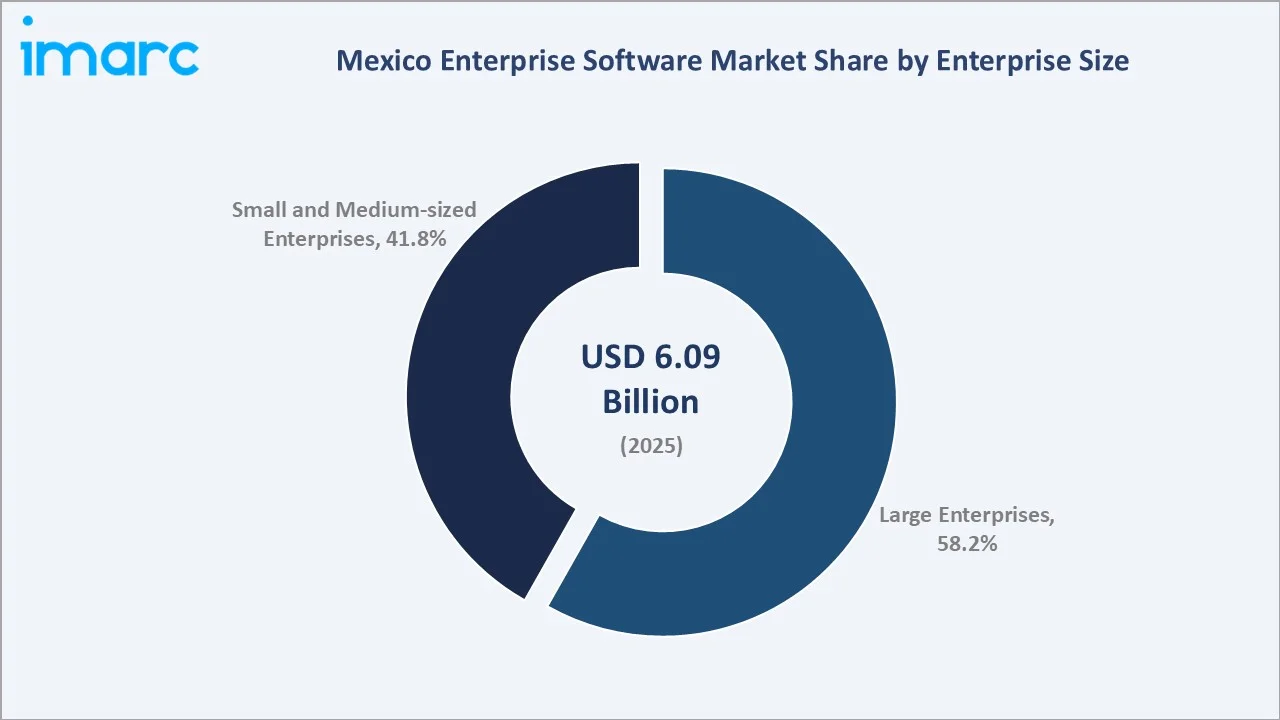
Central Mexico leads regionally with a 43.1% market share in 2025, anchored by Mexico City’s status as the country’s largest corporate technology hub, hosting the headquarters of major Mexican conglomerates, the top six commercial banks, and the regional offices of virtually all global enterprise software vendors. Large enterprises command the enterprise size leadership at 58.2%, reflecting the higher technology budgets, greater complexity of business operations, and more structured IT procurement processes that drive earlier and deeper enterprise software adoption compared to smaller organizations.
To get more information on this market, Request Sample
Mexico’s enterprise software market is underpinned by three structural forces: the accelerating digital transformation of enterprises across all sectors of the economy, the rapid migration from on-premises to cloud-based SaaS delivery models that reduce upfront investment barriers and improve scalability, and the nearshoring wave that is bringing hundreds of new manufacturing and technology enterprises to Mexico that require enterprise-grade software infrastructure from their first day of operations.
Executive Summary
The Mexico enterprise software market is experiencing sustained expansion, driven by the convergence of digital transformation imperatives, cloud technology democratization, and the country’s growing role as a nearshoring hub for North American manufacturing and services. The market was valued at USD 6.09 Billion in 2025 and is forecast to reach USD 9.64 Billion by 2034, growing at a CAGR of 5.25%.
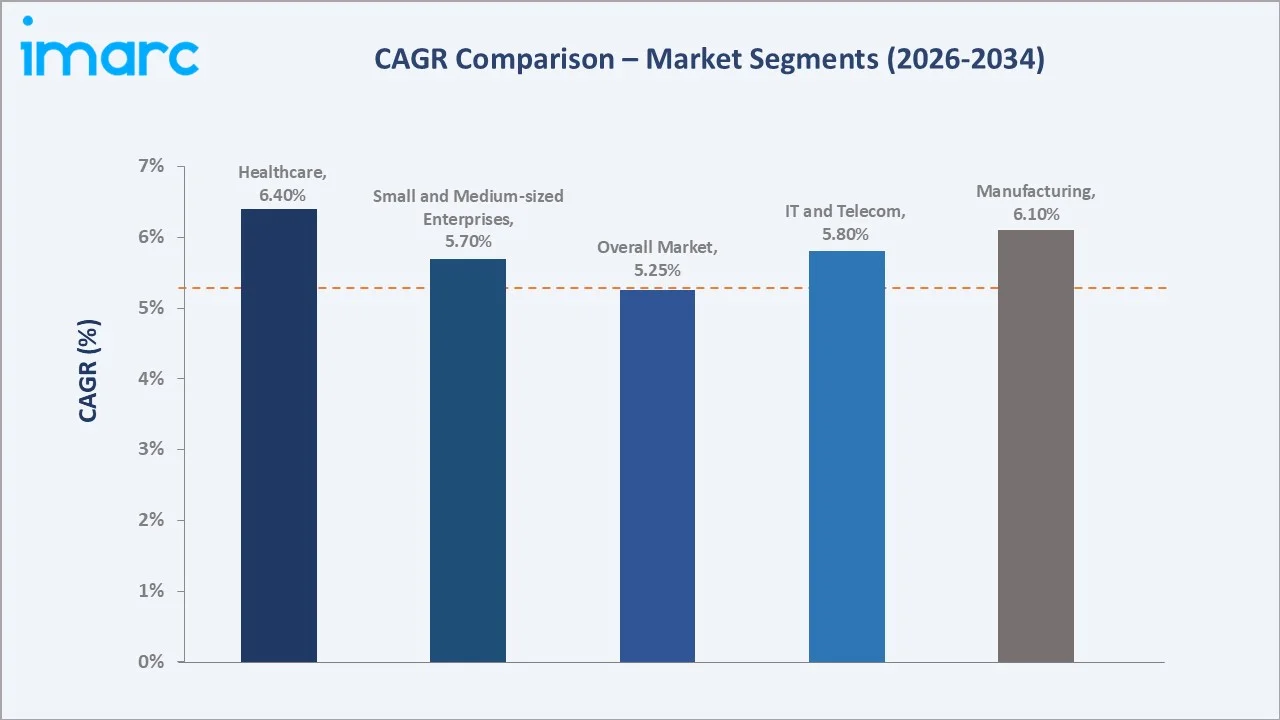
Large enterprises dominate the enterprise size segment with a 58.2% share in 2025, leveraging their larger IT budgets and organizational complexity to invest in comprehensive ERP, CRM, SCM, and business intelligence platforms from global vendors. Small and medium-sized enterprises at 41.8% are expected to be the fastest-growing size segment, as cloud-based SaaS delivery models progressively eliminate the capital expenditure barriers that previously prevented smaller Mexican companies from accessing enterprise-grade software capabilities.
BFSI leads end-use verticals at 22.4%, driven by regulatory compliance requirements, digital banking transformation, and the integration of AI and analytics platforms into risk management and customer experience operations. Manufacturing at 19.6% reflects the sector’s deepening investment in ERP and supply chain management software, particularly from the wave of nearshoring manufacturers establishing operations in Mexico’s industrial corridors. Key global vendors collectively hold the majority of the market through established enterprise customer relationships and comprehensive software suites.
Key Market Insights
|
Insight |
Data |
|
Largest Enterprise Size |
Large Enterprises – 58.2% share (2025) |
|
Fastest Growing Enterprise Size |
SMEs – ~5.7% CAGR (2026-2034) |
|
Largest End-Use Vertical |
BFSI – 22.4% share (2025) |
|
Fastest Growing End Use |
Healthcare – ~6.4% CAGR (2026-2034) |
|
Leading Region |
Central Mexico – 43.1% share (2025) |
|
Top Companies |
SAP SE, Oracle Corporation, Microsoft, Salesforce, Inc., IBM Corporation |
Key Analytical Observations Supporting The Above Data:
- Large enterprises account for 58.2% of Mexico’s enterprise software market in 2025, representing the foundational demand segment built on comprehensive software suites across ERP, CRM, SCM, business intelligence, and content management functions. Mexico’s largest enterprises operate complex multi-entity business structures that generate structural demand for integrated enterprise platforms from global tier-one vendors.
- BFSI at 22.4% share (2025) leads end-use verticals, reflecting the financial sector’s exceptionally high software intensity. Mexican banks, insurance companies, fintech operators, and asset managers face compounded regulatory requirements from CNBV, CNSF, and Banco de México that mandate comprehensive compliance management, anti-money laundering analytics, customer identification systems, and risk monitoring platforms.
- Healthcare at 11.5% share (2025) of the market is expected to grow fastest at approximately 6.4% CAGR, driven by the progressive digitalization of IMSS and ISSSTE healthcare operations, growing private hospital investment in clinical information systems and EHR platforms, and the adoption of telemedicine software that accelerated dramatically post-COVID-19.
- Central Mexico’s 43.1% regional share (2025) reflects Mexico City’s role as the country’s unrivaled corporate technology hub. The metropolitan area hosts the headquarters of all major Mexican enterprise software customers across banking, telecommunications, retail, manufacturing, and government sectors, creating the country’s densest enterprise software sales, implementation, and support ecosystem anchored by global vendor offices and a deep pool of certified technology consultants and system integrators.
Mexico Enterprise Software Market Overview
Enterprise software encompasses the category of business application software designed to address the information needs of complex organizations rather than individual users. Mexico’s enterprise software ecosystem spans ERP, business intelligence, content management, supply chain management, customer relationship management, and specialized vertical software solutions, delivered across on-premises and rapidly growing cloud-based SaaS deployment models.
The digital transformation wave sweeping Mexico’s corporate sector is the single most powerful macro driver of enterprise software demand. Organizations across Mexico, spanning diverse sectors, recognize the value of scalable and customizable software solutions that can cater to their specific operational needs, from customer relationship management to supply chain optimization. The evolving regulatory landscape from multiple federal agencies is compelling organizations to invest in enterprise software infrastructure that can ensure compliance across increasingly complex regulatory environments while simultaneously harnessing actionable business intelligence from their operational data.
Market Dynamics
To evaluate market opportunities, Request Sample
Market Drivers
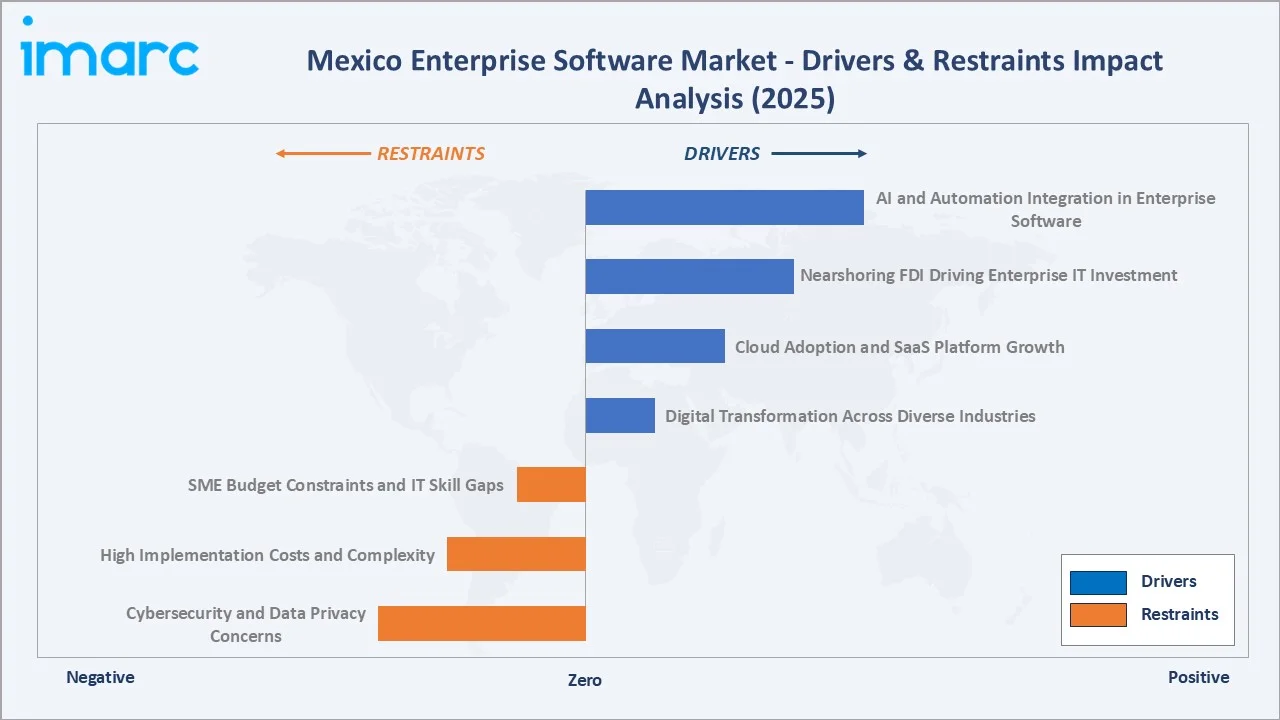
- Digital Transformation Across Diverse Industries: Increasing digital transformation initiatives across diverse industries in Mexico have propelled demand for enhanced enterprise software solutions. This trend has heightened the need for integrated platforms that can streamline business processes and enhance overall operational efficiency. Mexican enterprises across sectors including banking, retail, manufacturing, and healthcare are digitizing core operational workflows that previously depended on manual processes or legacy standalone systems.
- Cloud Adoption and SaaS Platform Growth: The migration from on-premises licensed software to cloud-based SaaS delivery models is accelerating across Mexico’s enterprise software market, progressively lowering adoption barriers for both large enterprises and SMEs. Cloud-based enterprise software eliminates the substantial upfront capital expenditure requirements of traditional on-premises deployment, replacing them with predictable subscription pricing that aligns software costs with business outcomes.
- Nearshoring FDI Driving Enterprise IT Investment: Mexico’s emergence as a premier nearshoring destination for North American manufacturing and services is generating substantial new enterprise software demand. Each new nearshoring manufacturing facility, shared service center, or technology hub established in Mexico requires enterprise software infrastructure for ERP, SCM, HR, and financial management from its first operational day, typically standardizing on the same global platforms used by its parent organizations.
- AI and Automation Integration in Enterprise Software: The integration of artificial intelligence, machine learning, and robotic process automation capabilities into enterprise software platforms is creating a new investment cycle as organizations upgrade existing software to access AI-enhanced functionality. Enterprise software vendors including SAP, Oracle, and Salesforce are progressively embedding AI capabilities into their core product platforms, compelling existing customers to upgrade to newer software versions or cloud editions to access these capabilities.
Market Restraints
- Cybersecurity and Data Privacy Concerns: Mexico’s evolving data privacy regulatory framework under the Ley Federal de Protección de Datos Personales en Posesión de los Particulares (LFPDPPP) and growing concern about cybersecurity vulnerabilities are creating hesitancy around cloud-based enterprise software adoption, particularly for organizations handling sensitive financial or personal data.
- High Implementation Costs and Complexity: Enterprise software implementation, particularly for comprehensive ERP platforms from SAP and Oracle, requires substantial investment in consulting services, business process redesign, data migration, and staff training that can equal or exceed the software licensing cost itself. The complexity of implementing enterprise software across Mexico’s large enterprises creates implementation risk and budget overrun exposure that makes finance committees cautious about approving large-scale enterprise software projects.
- SME Budget Constraints and IT Skill Gaps: Mexico’s micro, small and medium-sized enterprises (MSMEs) sector, representing over 99% of registered businesses, faces persistent constraints in enterprise software adoption, including limited IT budgets relative to software ownership costs, shortage of internal IT talent for software evaluation, implementation management, and ongoing administration, and limited awareness of the software solutions most appropriate for their specific industry and operational context.
Market Opportunities
- SME Digital Enablement through SaaS: The progressive democratization of enterprise software through SaaS pricing models creates a significant opportunity to expand market penetration in Mexico’s large SME sector. Cloud-based ERP platforms including SAP Business One Cloud and Microsoft Dynamics 365 Business Central offer enterprise-grade capabilities at subscription pricing accessible to medium-sized Mexican companies.
- Vertical-Specific Software Solutions: The growing sophistication of Mexico’s enterprise software market is creating demand for industry-specific software solutions that go beyond generic horizontal platforms. Healthcare information systems, manufacturing execution systems (MES), banking core system modernization, and retail omnichannel platforms represent high-value vertical software opportunities where specialized vendors can command premium pricing for deep domain functionality that generic enterprise platforms cannot efficiently replicate.
Market Challenges
- Legacy System Integration Complexity: Many of Mexico’s established large enterprises operate ERP and financial management systems with decades of customizations and integrations that make migration to modern cloud platforms technically complex and organizationally disruptive. The cost and risk of legacy system replacement, combined with organizational resistance to business process change that accompanies enterprise software transitions, creates inertia that slows market growth below its theoretical potential in established large enterprise accounts.
- Talent Shortage in Enterprise Software Implementation: Mexico faces a shortage of experienced enterprise software implementation consultants, system architects, and certified technical resources for platforms including SAP S/4HANA, Oracle Cloud ERP, and Salesforce, relative to the growing implementation demand generated by market expansion. This talent bottleneck extends implementation timelines, increases consulting costs, and creates quality risk on complex software projects that can undermine confidence in enterprise software investments among prospective customers.
Emerging Market Trends
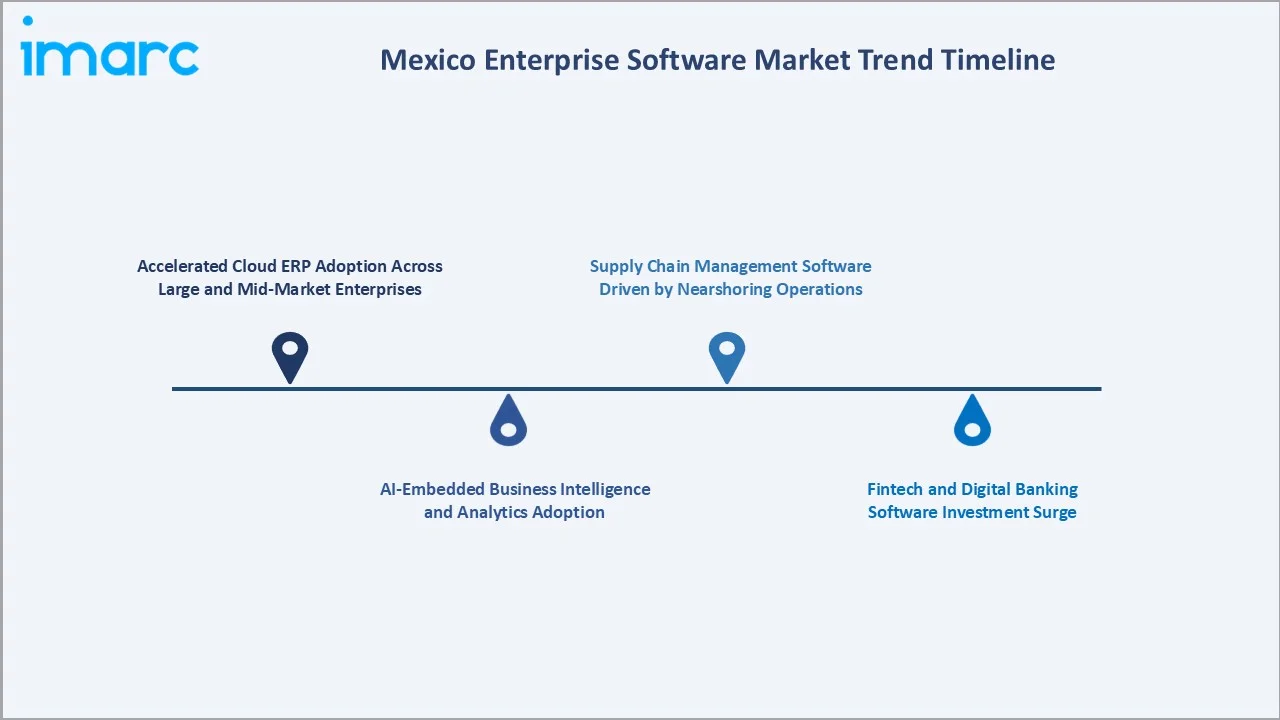
1. Accelerated Cloud ERP Adoption Across Large and Mid-Market Enterprises
Mexico’s enterprise software market is experiencing a structural shift from on-premises licensed software to cloud-based ERP and business application delivery, with SAP S/4HANA Cloud, Oracle Fusion Cloud ERP, and Microsoft Dynamics 365 capturing increasing adoption among large and mid-market Mexican enterprises. The expiration of support for legacy ERP versions is compelling large enterprises to plan and execute cloud ERP migrations within defined timelines, generating a significant implementation wave that is sustaining high demand for both software licenses and consulting services through 2028.
2. AI-Embedded Business Intelligence and Analytics Adoption
Business intelligence and analytics software is the fastest-growing enterprise software category in Mexico’s market, driven by the progressive embedding of artificial intelligence and machine learning capabilities into mainstream BI platforms including Microsoft Power BI, SAP Analytics Cloud, Salesforce Tableau, and Google Looker. Mexican enterprises across BFSI, retail, and manufacturing are investing in data analytics capabilities that convert operational data into actionable business insights for demand forecasting, customer churn prediction, financial risk assessment, and supply chain optimization.
3. Fintech and Digital Banking Software Investment Surge
Mexico’s BFSI sector is experiencing an enterprise software investment surge driven by the intersection of open banking regulatory requirements under Ley Fintech, digital banking customer experience transformation, and the proliferation of fintech companies that compete with traditional banks using technology-enabled financial services. Core banking system modernization programs at BBVA Mexico, Banorte, Santander Mexico, and HSBC Mexico are generating substantial enterprise software investment in digital banking platforms, API middleware, customer data platforms, and AI-driven credit decisioning systems.
4. Supply Chain Management Software Driven by Nearshoring Operations
Mexico’s accelerating nearshoring manufacturing investment is creating exceptional demand for supply chain management (SCM) software that can support complex multi-tier supplier networks, cross-border logistics coordination, and USMCA content compliance tracking. Multinational manufacturers establishing operations in Mexico’s industrial corridors are deploying global SCM platforms including SAP Integrated Business Planning, Oracle Supply Chain Management Cloud, and Blue Yonder to manage the intricate supplier relationships, demand planning, and inventory optimization requirements of their Mexican manufacturing operations.
Industry Value Chain Analysis
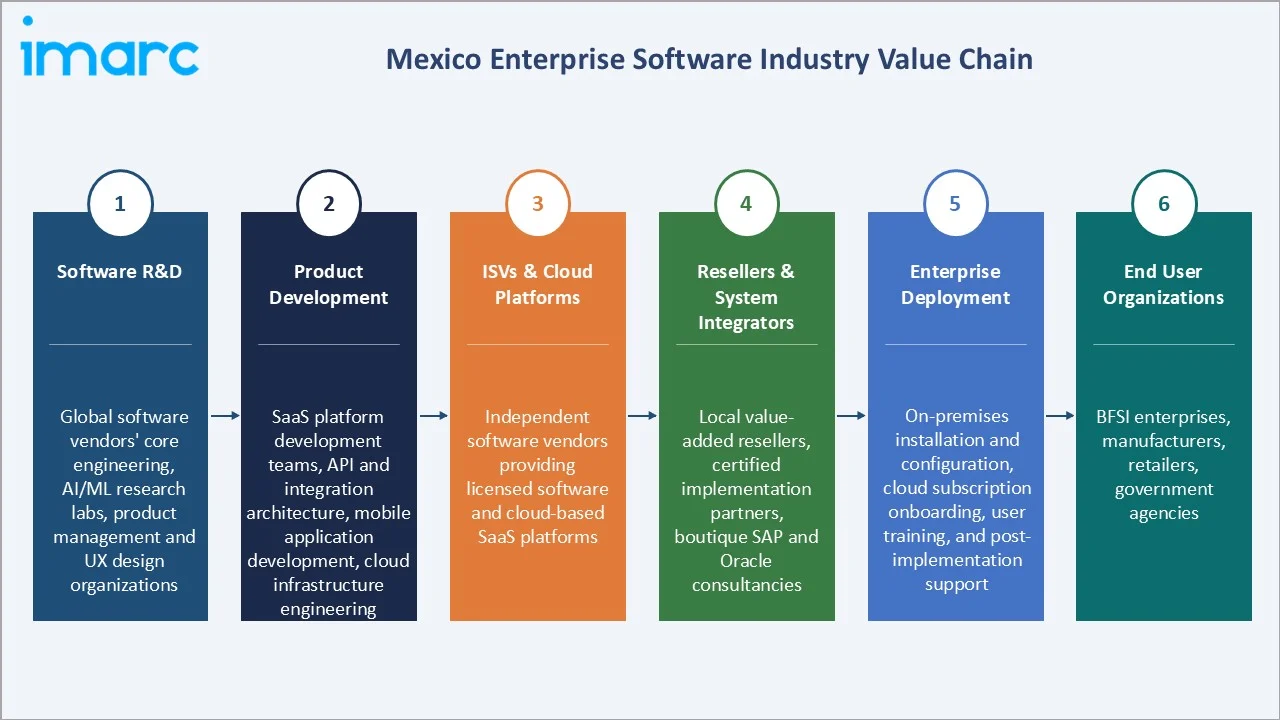
Mexico’s enterprise software value chain spans R&D and product development through end-user organization deployment and ongoing support, with each stage involving specialized participants whose capabilities directly influence software quality, implementation success, and business value realization.
|
Stage |
Key Players |
|
Software R&D |
Global software vendors’ core engineering, AI/ML research labs, product management and UX design organizations |
|
Product Development |
SaaS platform development teams, API and integration architecture, mobile application development, cloud infrastructure engineering |
|
ISVs & Cloud Platforms |
Independent software vendors providing licensed software and cloud-based SaaS platforms |
|
Resellers & System Integrators |
Local value-added resellers (VARs), certified implementation partners, boutique SAP and Oracle consultancies |
|
Enterprise Deployment |
On-premises installation and configuration, cloud subscription onboarding, user training, and post-implementation support |
|
End User Organizations |
BFSI enterprises, manufacturers, retailers, government agencies |
Technology Landscape in the Mexico Enterprise Software Industry
Enterprise Resource Planning (ERP) Software
ERP software represents the foundational enterprise software category in Mexico, integrating finance, HR, procurement, manufacturing, and distribution processes into unified operational platforms. SAP S/4HANA dominates Mexico’s large enterprise ERP market, with its S/4HANA Cloud migration wave creating sustained implementation activity through 2027 as organizations transition from legacy SAP ECC environments. Oracle Fusion Cloud ERP competes strongly in Mexico’s financial services and manufacturing sectors with its cloud-native architecture and embedded AI capabilities.
Customer Relationship Management (CRM) Software
CRM software is among Mexico’s fastest-growing enterprise software categories, driven by the customer experience transformation agendas of Mexican enterprises across BFSI, retail, telecommunications, and consumer goods sectors. Salesforce’s Sales Cloud, Service Cloud, and Marketing Cloud dominate Mexico’s enterprise CRM segment, with a growing ecosystem of Mexican-certified Salesforce implementation partners and developers supporting deployment. Microsoft Dynamics 365 Customer Engagement competes through its seamless integration with Microsoft’s broader productivity and analytics stack.
Business Intelligence and Analytics Platforms
Business intelligence software is experiencing above-average growth in Mexico, as enterprises invest in data visualization, self-service analytics, and AI-powered insight generation capabilities. Microsoft Power BI has achieved the broadest BI adoption in Mexico through its competitive pricing, deep Office 365 integration, and extensive partner ecosystem that has made it the default analytics tool for mid-market Mexican enterprises. Moreover, SAP Analytics Cloud, Salesforce Tableau, and Google Looker serve enterprise segments with more complex analytical requirements.
Supply Chain Management (SCM) Software
SCM software is a priority investment category for Mexico’s manufacturing, retail, and distribution sectors, driven by the supply chain visibility, planning, and optimization requirements of complex cross-border operations in the USMCA environment. SAP Integrated Business Planning (IBP), Oracle SCM Cloud, and Blue Yonder serve Mexico’s large enterprise manufacturing SCM market. The nearshoring manufacturing wave is creating exceptional demand for SCM platforms with USMCA content compliance tracking, multi-tier supplier collaboration, and AI-driven demand sensing capabilities.
Market Segmentation Analysis
The report covers the following segments:
|
Segment Category |
Leading Segment |
Market Share |
Year |
|
Enterprise Size |
Large Enterprises |
58.2% |
2025 |
|
End Use |
BFSI |
22.4% |
2025 |
|
Software |
🔒 |
🔒 |
2025 |
|
Deployment |
🔒 |
🔒 |
2025 |
|
Region |
Central Mexico |
43.1% |
2025 |

By Enterprise Size
Large enterprises dominate with a 58.2% share in 2025. This segment encompasses organizations with 250+ employees that possess the organizational complexity, multi-functional department structures, and IT governance frameworks that drive comprehensive enterprise software adoption across ERP, CRM, SCM, BI, and content management categories.
To access detailed market analysis, Request Sample
SMEs represent 41.8% of the market and are growing faster than large enterprises (~5.7% CAGR) as cloud-based SaaS delivery democratizes access to enterprise software capabilities. Mexico’s 5.4 million+ registered micro, small, and medium enterprises (MSMEs) represent a structurally vast but currently underpenetrated addressable market, with cloud ERP, CRM, and accounting software progressively replacing legacy desktop applications and manual processes as SaaS pricing makes sophisticated software affordable at small business scale.
By End Use
BFSI leads end-use verticals with a 22.4% share in 2025, driven by Mexico’s highly digitalized financial sector that invests proportionally more in enterprise software than any other industry. Banks, insurance companies, investment managers, and fintech platforms collectively represent the highest-intensity enterprise software buyers in Mexico, demanding sophisticated applications for regulatory compliance, customer data management, risk analytics, digital product delivery, and operational efficiency that justify premium software investment levels.
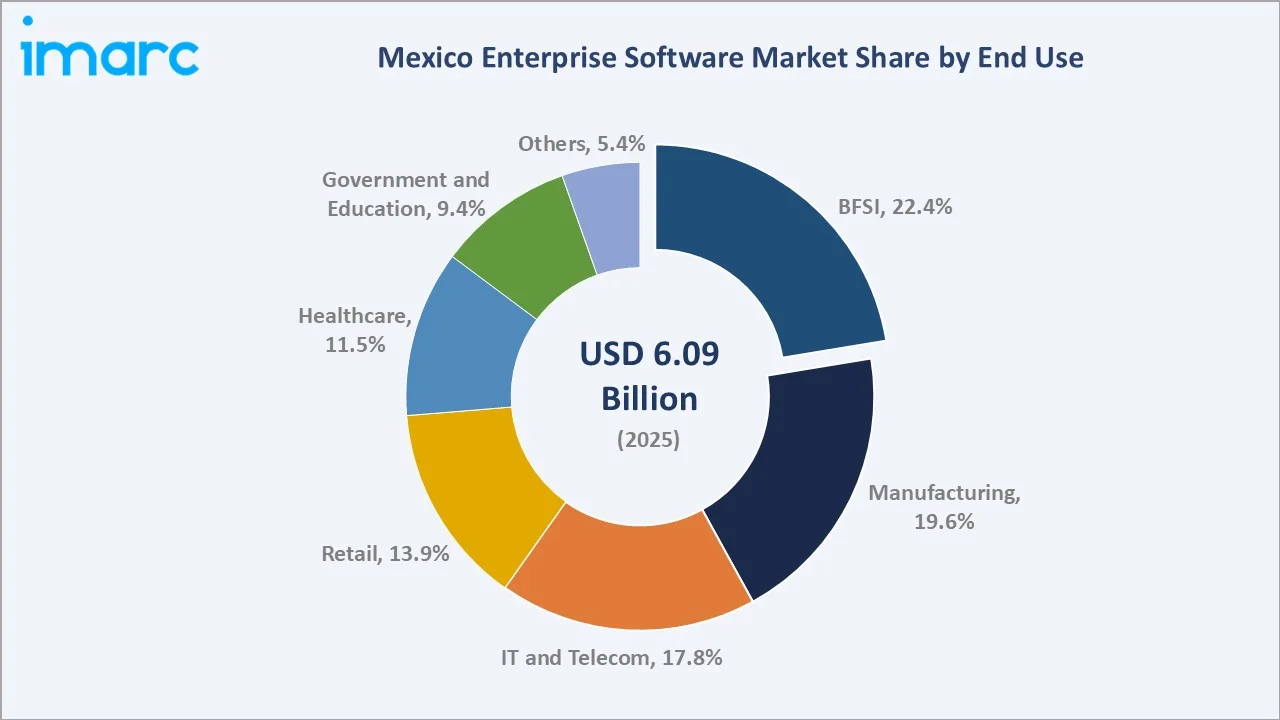
Manufacturing at 19.6% reflects Mexico’s status as Latin America’s largest manufacturing economy, with ERP and SCM software adoption driven by the operational complexity of automotive, electronics, food, and chemical production at multinational scale. IT and Telecom at 17.8% encompasses both the technology sector’s own software investment and the telecommunications operators’ BSS/OSS platform spending. Retail at 13.9% is accelerating with omnichannel retail transformation driving POS, e-commerce, and CRM investment.
Regional Market Insights
Central Mexico’s market leadership (43.1%, 2025) reflects Mexico City’s unrivaled status as the country’s corporate headquarters concentration, technology industry hub, and enterprise software market epicenter. The metropolitan area hosts the Mexican offices of all major global enterprise software vendors (SAP, Oracle, Microsoft, Salesforce, IBM, ServiceNow) alongside a deep ecosystem of certified implementation partners and technology consulting firms that serve the country’s largest enterprise software customers.
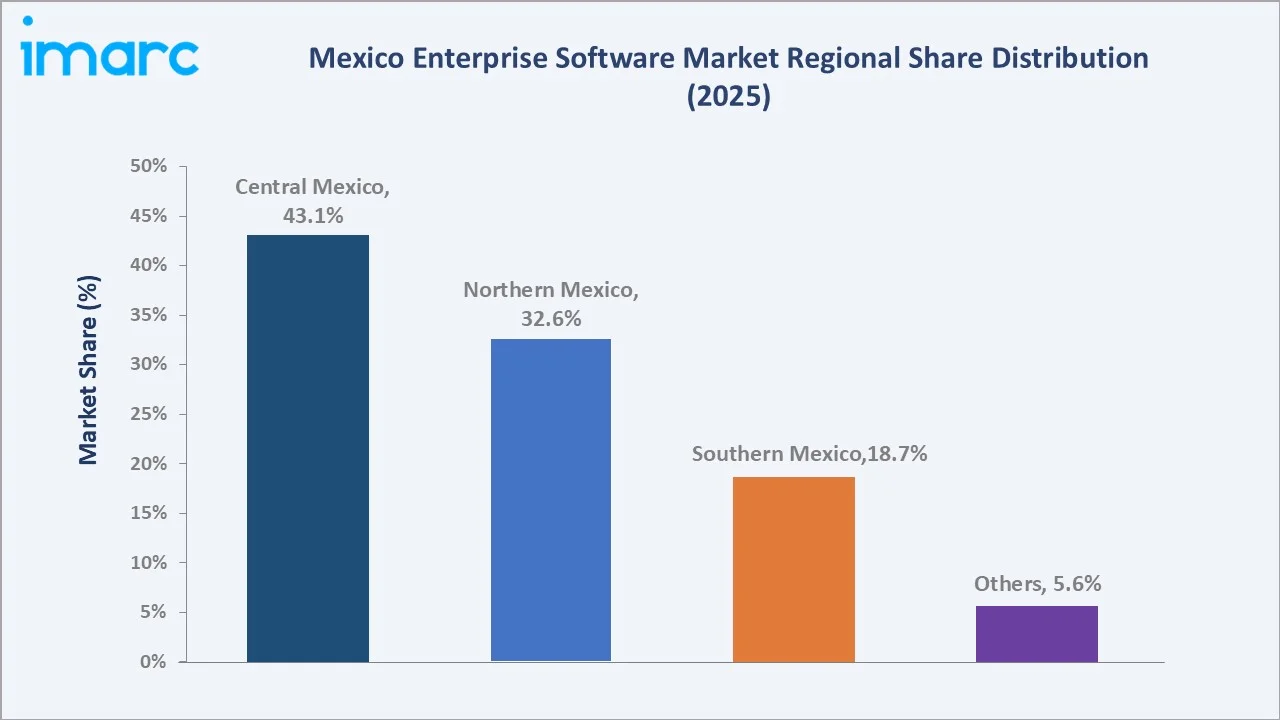
Northern Mexico at 32.6% is the most dynamically growing enterprise software region, driven by the massive nearshoring manufacturing investment wave that is establishing new enterprise software deployment requirements at hundreds of facilities across Monterrey, Saltillo, Chihuahua, Ciudad Juárez, and border zone industrial parks.
|
Region |
Share (2025) |
Key Growth Drivers |
|
Central Mexico |
43.1% |
All major global enterprise software vendor offices; deepest certified implementation partner ecosystem; BFSI sector technology hub; highest enterprise IT budget concentration |
|
Northern Mexico |
32.6% |
Nearshoring manufacturing ERP and SCM demand; USMCA supply chain software investment; Monterrey’s strong BFSI and industrial enterprise software market; technology cluster growth |
|
Southern Mexico |
18.7% |
Guadalajara’s technology hub driving IT sector software demand; tourism and hospitality software investment; government digital transformation programs; growing manufacturing and logistics sector in Pacific corridor |
|
Others |
5.6% |
Secondary city markets with improving cloud infrastructure; agricultural sector ERP adoption; government digitalization programs in state capitals; growing SME SaaS adoption in regional commercial centers |
Competitive Landscape
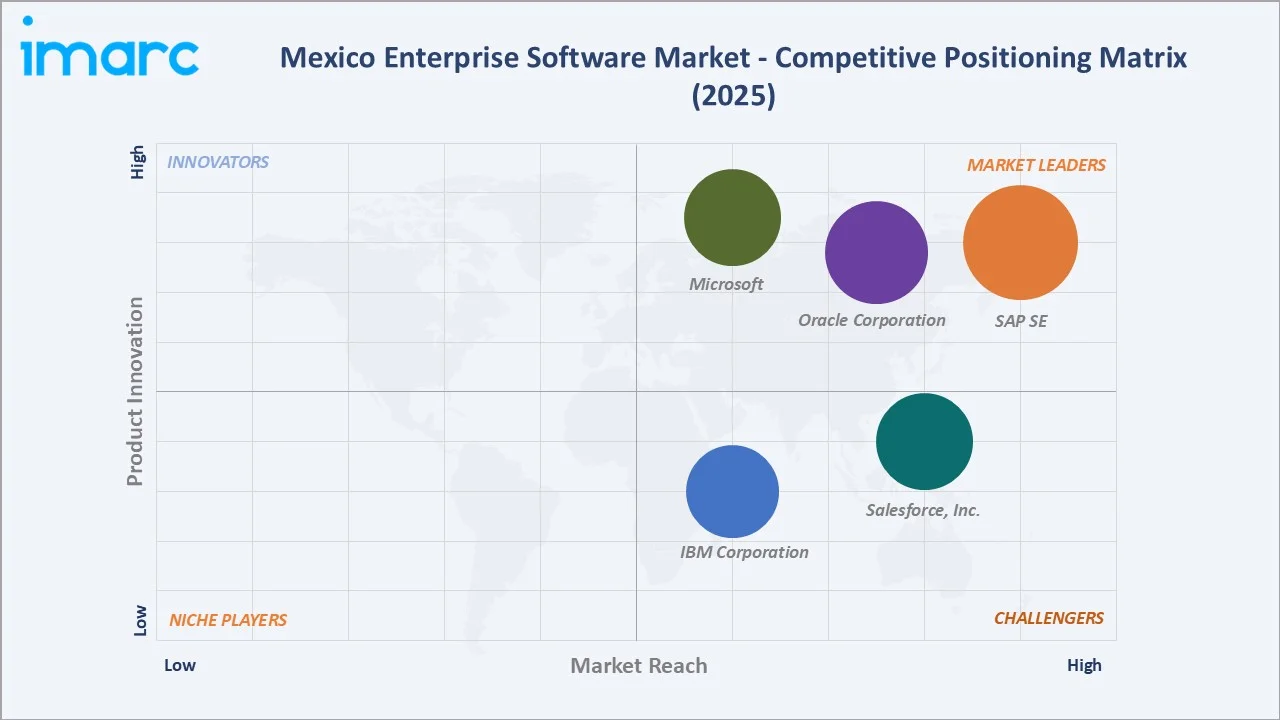
Mexico’s enterprise software market is dominated by global technology multinationals that leverage their comprehensive product portfolios, established enterprise customer relationships, certified partner networks, and global cloud infrastructure to maintain market leadership. The competitive landscape is characterized by a small number of global platforms capturing the majority of large enterprise spending, with a fragmented secondary tier of regional and vertical-specific software vendors serving more specialized needs.
|
Company Name |
Key Products |
Market Position |
Core Strength |
|
SAP SE |
S/4HANA, SAP Analytics Cloud, SuccessFactors, among others |
Market Leader |
ERP market leadership; largest Mexican implementation partner ecosystem; SUGEN community; S/4HANA migration wave |
|
Oracle Corporation |
Oracle Fusion Cloud, Oracle SCM, Oracle HCM, among others |
Market Leader |
Cloud ERP and database leadership; financial services vertical strength; integrated cloud suite; Oracle Mexico partner network |
|
Microsoft |
Dynamics 365, Power BI, Azure, Teams, among others |
Market Leader |
Broadest product footprint; Microsoft 365 ecosystem integration; Power BI BI leadership; Azure cloud infrastructure; SME market penetration |
|
Salesforce, Inc. |
Sales Cloud, Service Cloud, Marketing Cloud |
Strong Challenger |
CRM market leadership; marketing automation strength; growing Mexico partner ecosystem |
|
IBM Corporation |
watsonx Orchestrate, Maximo, Sterling SCM |
Strong Challenger |
AI/Watson platform; IBM Consulting Mexico presence; supply chain software; mainframe and hybrid cloud integration |
Global enterprise software leaders compete primarily on product completeness, ecosystem depth, and cloud platform capabilities that enable comprehensive digital transformation programs. Local and regional system integrators play a critical role in Mexico’s market as implementation partners that bridge global software capabilities with local business process knowledge, regulatory expertise, and Spanish-language support services.
Key Company Profiles
SAP SE
SAP SE is one of the world’s largest enterprise application software companies and holds a dominant position in Mexico’s large enterprise ERP market. SAP Mexico’s operations serve multiple sectors through a combination of direct enterprise sales and an extensive certified partner network of implementation consultancies and value-added resellers.
- Product Portfolio: SAP S/4HANA (ERP), SAP Analytics Cloud (BI and planning), SAP SuccessFactors (HCM), SAP Ariba (procurement), SAP Customer Experience (CRM), SAP Integrated Business Planning (SCM), and SAP Business Technology Platform (BTP) for integration and extension.
- Recent Developments: In January 2026, SAP SE reported Q4 2025 total revenue of EUR 9.68 billion, up 3% and 9% at constant currencies, while FY 2025 total revenue reached EUR 36.80 billion, up 8% and 11% at constant currencies. Moreover, SAP’s Q4 2025 cloud revenue was EUR 5.61 billion, up 19% and 26% at constant currencies, while FY 2025 cloud revenue reached EUR 21.02 billion, up 23% and 26% at constant currencies.
- Strategic Focus: S/4HANA Cloud migration acceleration; SAP Business AI integration across all product lines; SME market expansion through SAP Business One and RISE with SAP programs; SUGEN Mexico community engagement and user group events.
Microsoft
Microsoft holds the broadest enterprise software product footprint in Mexico through its Dynamics 365 ERP and CRM suite, Microsoft Azure cloud platform, Power BI analytics, and Microsoft 365 productivity and collaboration tools.
- Product Portfolio: Microsoft Dynamics 365 (ERP, CRM, SCM, HR), Microsoft Power BI and Power Platform (analytics and automation), Azure Cloud (IaaS, PaaS, AI services), Microsoft 365 (productivity and collaboration), and Microsoft Copilot (AI-embedded productivity features).
- Recent Developments: In September 2024, Microsoft announced a USD 1.3 billion investment over three years in Mexico to expand cloud and AI infrastructure and strengthen local computing capacity. The investment also supports AI skilling for 5 million people, connectivity expansion, and AI adoption by 30,000 SMBs through programs such as the Artificial Intelligence National Skills Initiative and The Bridge Accelerator.
- Strategic Focus: Azure cloud platform adoption; Microsoft Copilot and AI integration across Dynamics 365 and Microsoft 365; Power Platform democratization for SME process automation; Dynamics 365 displacement of legacy ERP in mid-market Mexican enterprises.
Market Concentration Analysis
Mexico’s enterprise software market exhibits high concentration at the top tier, with the three largest global vendors (SAP, Oracle, and Microsoft) collectively estimated to hold 45–50% of total market revenue in 2025. This concentration reflects the structural advantages of comprehensive enterprise platform providers in large enterprise accounts, where switching costs from deeply embedded ERP and core business systems create durable competitive moats that sustain vendor relationships across multi-decade customer lifecycles.
The market is progressively bifurcating between the concentrated large enterprise segment dominated by global platform vendors and a highly fragmented SME segment where dozens of cloud-based vertical and horizontal software providers compete for adoption. SaaS pricing and self-serve onboarding are lowering market entry barriers, enabling innovative SME-focused software vendors to build significant customer bases without the enterprise sales infrastructure required for large account penetration.
Investment & Growth Opportunities
Fastest Growing Segments
Healthcare end use (~6.4% CAGR) and SME enterprise size (~5.7% CAGR) represent the highest-growth investment vectors through 2034. Healthcare’s software transformation is estimated to represent an incremental USD 600–800 Million addressable opportunity by 2030 as IMSS, ISSSTE, and private hospital networks modernize clinical and administrative software infrastructure. SME cloud software adoption could represent an additional USD 1.5–2.0 Billion opportunity as enterprise software penetration among Mexico’s 5.4 million MSMEs progressively expands through SaaS accessibility.
Emerging Market Expansion
Guadalajara is emerging as Mexico’s most dynamic secondary enterprise software market, driven by the city’s established technology industry cluster including a growing ecosystem of technology companies, shared service centers for multinational corporations, and a deepening pool of technology talent from local universities. Enterprise software vendors that establish a dedicated Guadalajara presence can capture a disproportionate share of the region’s rapidly growing enterprise IT investment.
Venture and Institutional Investment Trends
- Mexico’s technology startup ecosystem, centered in Mexico City and Guadalajara, is producing enterprise software companies addressing specifically Mexican regulatory, linguistic, and business context requirements that global platforms incompletely serve, attracting venture capital investment from both Mexican and international technology investors.
- The USMCA digital trade provisions and the nearshoring FDI pipeline create a multi-year structural tailwind for enterprise software investment in Mexico that extends well beyond individual company technology upgrade cycles, providing predictable macro demand growth for enterprise software vendors and implementation partners targeting Mexico’s industrial technology market.
Future Market Outlook (2026-2034)
Mexico’s enterprise software market is positioned for sustained, above-average technology sector growth through 2034. From a base of USD 6.09 Billion in 2025, the market is projected to reach USD 9.64 Billion by 2034, representing total incremental value creation of USD 3.55 Billion at a CAGR of 5.25%. This growth reflects the compound effect of digital transformation depth increasing across established large enterprise customers, the progressive expansion of cloud-based enterprise software into Mexico’s vast SME sector, and the new enterprise software demand generated by nearshoring-driven industrial investment.
The market’s composition will evolve significantly by 2034. Cloud-based SaaS deployment is projected to reach approximately 65–70% of total enterprise software delivery by 2034, up from an estimated 45–50% in 2025. AI-embedded enterprise applications will become standard rather than premium features, creating a new software upgrade cycle as organizations invest in AI-enhanced versions of their core enterprise platforms. Healthcare will grow from 11.5% to approximately 14–16% of the end-use mix as hospital digitalization and telemedicine software adoption matures.
Research Methodology
Primary Research
Primary research comprised structured interviews with over 85 industry participants in 2024–2025, including enterprise software vendor sales and product executives, Mexican CIOs and IT directors at large enterprises, system integrator and implementation consultancy partners, enterprise technology investors, and digital transformation specialists across Mexico’s major enterprise software buyer sectors.
Secondary Research
Secondary research encompassed vendor annual reports and investor presentations, IDC and Gartner Latin America enterprise software market data, Mexican enterprise IT spending surveys, government digital transformation strategy publications, INEGI industrial data, and industry publications covering Mexico’s technology and enterprise software sectors.
Forecasting Models
Market size estimations were derived from top-down and bottom-up forecasting incorporating enterprise IT budget models, software category penetration rates, deployment mix transition assumptions, new market entrant impact, and vendor revenue intelligence. A base-case CAGR of 5.25% reflects consensus estimates validated against vendor Latin America revenue trends and IMARC market tracking from 2020 to 2025.
Mexico Enterprise Software Market Report Coverage:
| Report Features | Details |
|---|---|
| Base Year of the Analysis | 2025 |
| Historical Period | 2020-2025 |
| Forecast Period | 2026-2034 |
| Units | Billion USD |
| Scope of the Report | Exploration of Historical Trends and Market Outlook, Industry Catalysts and Challenges, Segment-Wise Historical and Future Market Assessment:
|
| Softwares Covered | Enterprise Resource Planning (ERP) Software, Business Intelligence Software, Content Management Software, Supply Chain Management Software, Customer Relationship Management Software, Others |
| Deployments Covered | On-premises, Cloud-based |
| Enterprise Sizes Covered | Small and Medium-sized Enterprises, Large Enterprises |
| End Uses Covered | BFSI, Retail, Healthcare, IT and Telecom, Government and Education, Manufacturing, Others |
| Regions Covered | Northern Mexico, Central Mexico, Southern Mexico, Others |
| Companies Covered | SAP SE, Oracle Corporation, Microsoft, Salesforce, Inc., IBM Corporation,etc. |
| Customization Scope | 10% Free Customization |
| Post-Sale Analyst Support | 10-12 Weeks |
| Delivery Format | PDF and Excel through Email (We can also provide the editable version of the report in PPT/Word format on special request) |
Key Benefits for Stakeholders:
- IMARC’s industry report offers a comprehensive quantitative analysis of various market segments, historical and current market trends, market forecasts, and dynamics of the Mexico enterprise software market from 2020-2034.
- The research report provides the latest information on the market drivers, challenges, and opportunities in the Mexico enterprise software market.
- Porter's five forces analysis assist stakeholders in assessing the impact of new entrants, competitive rivalry, supplier power, buyer power, and the threat of substitution. It helps stakeholders to analyze the level of competition within the Mexico enterprise software industry and its attractiveness.
- Competitive landscape allows stakeholders to understand their competitive environment and provides an insight into the current positions of key players in the market.
Frequently Asked Questions About the Mexico Enterprise Software Market Report
The Mexico enterprise software market reached USD 6.09 Billion in 2025 and is projected to reach USD 9.64 Billion by 2034, growing at a CAGR of 5.25% during 2026-2034.
Large enterprises lead with a 58.2% market share in 2025, driven by their greater organizational complexity, higher IT budgets, and more structured technology procurement processes that support comprehensive enterprise software deployment across ERP, CRM, SCM, BI, and content management categories.
BFSI is the largest end use vertical with a 22.4% market share in 2025, driven by regulatory compliance requirements, digital banking transformation, and the integration of AI and analytics into financial risk management and customer experience operations that make the financial sector Mexico’s most intensive enterprise software buyer.
Central Mexico leads with a 43.1% share in 2025, anchored by Mexico City’s concentration of corporate headquarters, financial institutions, technology sector operations, global enterprise software vendor offices, and the country’s deepest certified implementation partner ecosystem.
Some of the leading companies include SAP SE, Oracle Corporation, Microsoft, Salesforce, Inc., and IBM Corporation. Global technology multinationals collectively hold the majority of large enterprise software revenue in Mexico through comprehensive platform portfolios and established enterprise customer relationships.
SME enterprise software adoption is driven by cloud-based SaaS pricing models that eliminate upfront capital expenditure barriers, SAT’s mandatory CFDI electronic invoicing that has digitalized core financial processes, and the growing availability of affordable cloud ERP platforms.
Key challenges include cybersecurity and data privacy concerns delaying cloud migration among regulated industry customers, high implementation costs and complexity constraining ROI visibility for large ERP projects, and enterprise software implementation talent shortages that extend project timelines and increase consulting costs.
Need more help?
- Speak to our experienced analysts for insights on the current market scenarios.
- Include additional segments and countries to customize the report as per your requirement.
- Gain an unparalleled competitive advantage in your domain by understanding how to utilize the report and positively impacting your operations and revenue.
- For further assistance, please connect with our analysts.
 Request Customization
 Speak to an Analyst
 Request Brochure
 Inquire Before Buying
Benefits of Customization
- Personalize this research
- Triangulate with your data
- Get data as per your format and definition
- Gain a deeper dive into a specific application, geography, customer, or competitor
- Any level of personalization
Get in Touch With Us
UNITED STATES
Phone: +1-201-971-6302
INDIA
Phone: +91-120-433-0800
UNITED KINGDOM
Phone: +44-753-714-6104
Email: [email protected]
Client Testimonials




.webp)




.webp)













Related Reports

Choose your plan
*Please note that the prices mentioned below are starting prices for each bundle type. Kindly contact our team for further details.*
Single User License
- 1 User License, Access on 2 Devices
- PDF Report + Excel Dataset (Password Protected)
- Lifetime Access
- No Printing Rights
- 10% Free Report Customization
- 10–12 Weeks of Analyst Support
Five User License
- Access for 5 Users, 2 Devices per User
- PDF Report + Excel Dataset (Password Protected)
- Lifetime Access
- Dedicated Account Manager
- 12–14 Weeks of Analyst Support
- No Printing Rights
- 15% Free Report Customization
- 25% Discount on Your Next Purchase
Corporate User License
- Unlimited User Access (Within Your Organization)
- PDF Report + Excel Dataset
- Lifetime Access
- Dedicated Account Manager
- 14–20 Weeks of Analyst Support
- No Printing Rights
- 20% Free Report Customization
- 30% Discount on Your Next Purchase
Essential Insights
What's included:
3 reports
- Lifetime Access
- PDF Reports
- Excel Datasets
- 2 Weeks of Free Analyst Support
- 2 User Licenses
- Access on 2 Devices
- Printing Rights
- Complimentary PowerPoint (PPT) Version
- Complimentary License Upgrade
Professional Access
What's included:
5 reports
- Lifetime Access
- PDF Reports
- Excel Datasets
- 8 Weeks of Free Analyst Support
- 2 User Licenses
- Access on 2 Devices
- Printing Rights
- Complimentary PowerPoint (PPT) Version
- Complimentary License Upgrade
Business Advantage
What's included:
8 reports
- Lifetime Access
- PDF Reports
- Excel Datasets
- 14 Weeks of Free Analyst Support
- 2 User Licenses
- Access on 2 Devices
- Printing Rights
- Complimentary PowerPoint (PPT) Version
- Complimentary License Upgrade
Enterprise Intelligence
What's included:
10 reports
- Lifetime Access
- PDF Reports
- Excel Datasets
- 20 Weeks of Free Analyst Support
- 2 User Licenses
- Access on 2 Devices
- Printing Rights
- Complimentary PowerPoint (PPT) Version
- Complimentary License Upgrade