
Mexico Real Estate Market Size, Share, Trends and Forecast by Property, Business, Mode, and Region, 2026-2034
Mexico Real Estate Market Size, Share, Trends & Forecast (2026-2034)
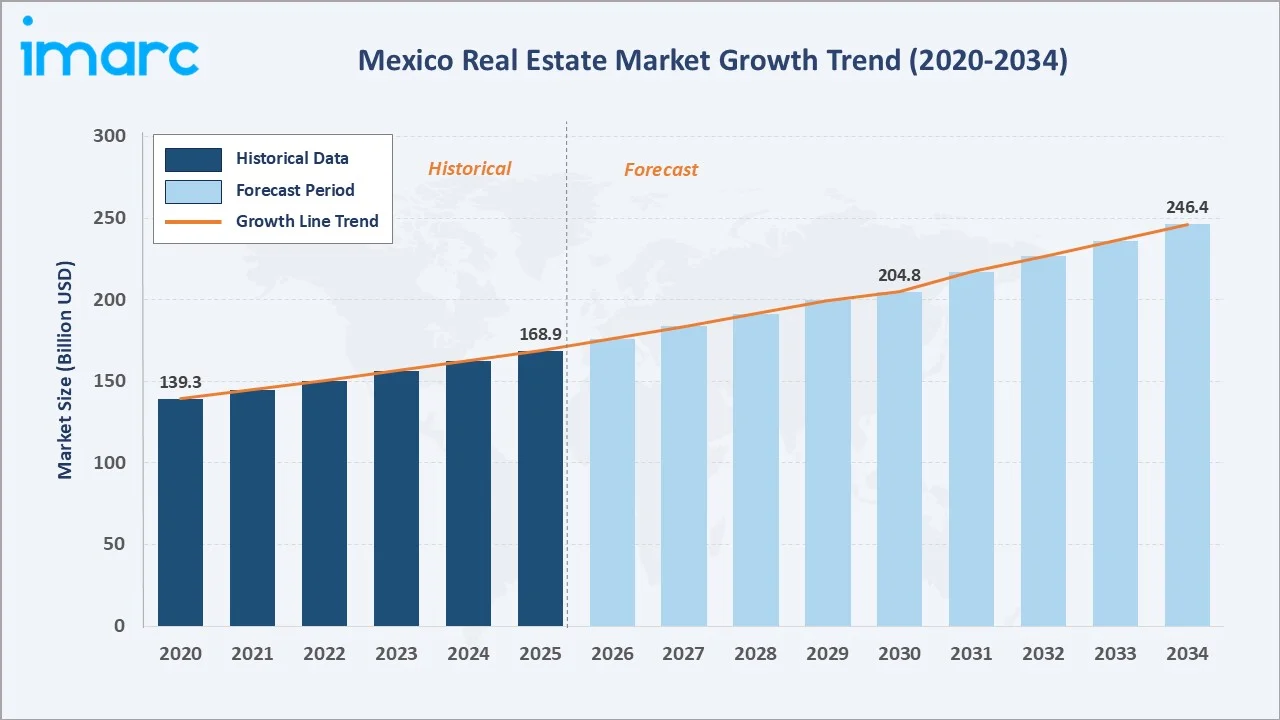
The Mexico real estate market reached USD 168.9 Billion in 2025 and is projected to reach USD 246.4 Billion by 2034, growing at a CAGR of 3.93% during 2026-2034. The market is driven by rapid urbanization, expanding nearshoring-led industrial demand, rising foreign direct investment, and continued government-backed housing finance programs.
Residential property leads the property segmentation at 44.5%, the sales business channel dominates at 64.4%, and Central Mexico commands 51.6% of the national market, anchored by Mexico City's metropolitan density and institutional investment concentration.
Market Snapshot
|
Metric |
Value |
|
Market Size (2025) |
USD 168.9 Billion |
|
Forecast Market Size (2034) |
USD 246.4 Billion |
|
CAGR (2026-2034) |
3.93% |
|
Base Year |
2025 |
|
Historical Period |
2020-2025 |
|
Forecast Period |
2026-2034 |
|
Dominant Property Segment |
Residential (44.5%, 2025) |
|
Dominant Business Segment |
Sales (64.4%, 2025) |
|
Leading Region |
Central Mexico (51.6%, 2025) |
The market expanded from USD 139.3 Billion in 2020 to USD 168.9 Billion in 2025, anchored at USD 204.8 Billion in 2030 and forecast to reach USD 246.4 Billion by 2034. Pandemic-era disruption briefly slowed transaction volumes through 2020-2021, but the structural recovery accelerated sharply from 2022 onward as nearshoring-driven industrial demand and urban housing shortages reinforced the market's growth trajectory.
To get more information on this market, Request Sample
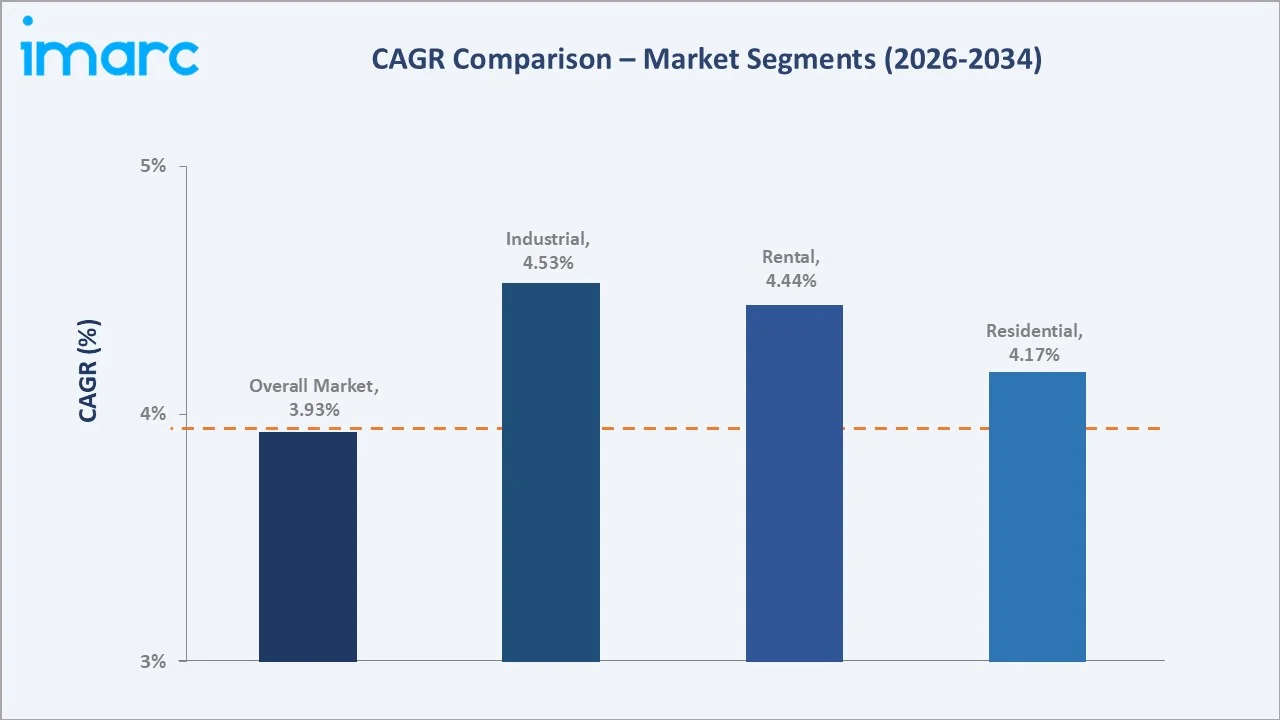
Industrial property and the rental business channel post the fastest forward CAGRs as nearshoring-linked logistics demand and affordability-driven leasing absorption outpace the broader market's expansion rate. Residential property, while not the fastest-growing segment, retains the largest revenue base through 2034 on sustained urban housing formation.
Executive Summary
The Mexico real estate market reached USD 168.9 Billion in 2025, reflecting the sector's central role in national economic activity as urbanization, nearshoring-driven industrial expansion, and a growing middle class converge to sustain property demand across residential, commercial, industrial, and land categories. The market is projected to reach USD 246.4 Billion by 2034, growing at a CAGR of 3.93% during 2026-2034.
Residential property at 44.5% dominates through sustained household formation, population growth, and government-backed mortgage financing programs that continue to expand homeownership access. The sales business channel leads at 64.4%, reflecting deep-rooted ownership aspirations and the comparatively underdeveloped formal rental market outside major metropolitan centers. Central Mexico at 51.6% leads regionally through Mexico City's metropolitan density, institutional capital concentration, and proximity to national infrastructure and transport corridors.
Key Market Insights
|
Insight |
Data |
|
Dominant Property Segment |
Residential - 44.5% share (2025) |
|
Dominant Business Segment |
Sales - 64.4% market share (2025) |
|
Leading Region |
Central Mexico - 51.6% market share (2025) |
|
Market Opportunity |
Industrial nearshoring corridors; PropTech transaction platforms; green-certified residential developments; institutional rental portfolios; mixed-use urban infill |
Key Analytical Observations Supporting The Above Data:
- Residential at 44.5%: the residential segment dominates as Mexico's expanding middle class, population growth, and government-backed mortgage instruments such as INFONAVIT sustain consistent housing demand across metropolitan and secondary cities. Continued urban migration toward Mexico City, Guadalajara, and Monterrey further reinforces residential absorption.
- Sales at 64.4%: the sales leads due to deep-seated homeownership preferences, broad mortgage credit availability through public lenders, and the comparatively informal structure of Mexico's rental market outside core urban centers, which continues to favor outright property transactions over leasing.
- Central Mexico at 51.6%: Central Mexico dominates due to its concentration of population, corporate headquarters, and institutional investment activity in and around Mexico City, alongside strong infrastructure connectivity that continues to attract both residential and commercial development capital.
Mexico Real Estate Market Overview
The Mexico real estate market encompasses the development, transaction, and management of tangible property across residential, commercial, industrial, and land categories nationwide. The market spans new construction and resale transactions, outright sales and rental leasing, and engages a broad ecosystem of developers, brokers, institutional investors, and regulatory bodies overseeing land use and property transfer.
The ecosystem integrates land and property owners, real estate developers and homebuilders, institutional and FIBRA (Mexican REIT) investors, brokers and digital property portals, regulatory and financing bodies including notaries and mortgage lenders, and the end occupiers who ultimately purchase or lease developed space. Macroeconomic factors shaping the market include interest rate trends, remittance-driven household liquidity, nearshoring-linked industrial investment, and government housing policy.
Market Dynamics
To evaluate market opportunities, Request Sample
Market Drivers
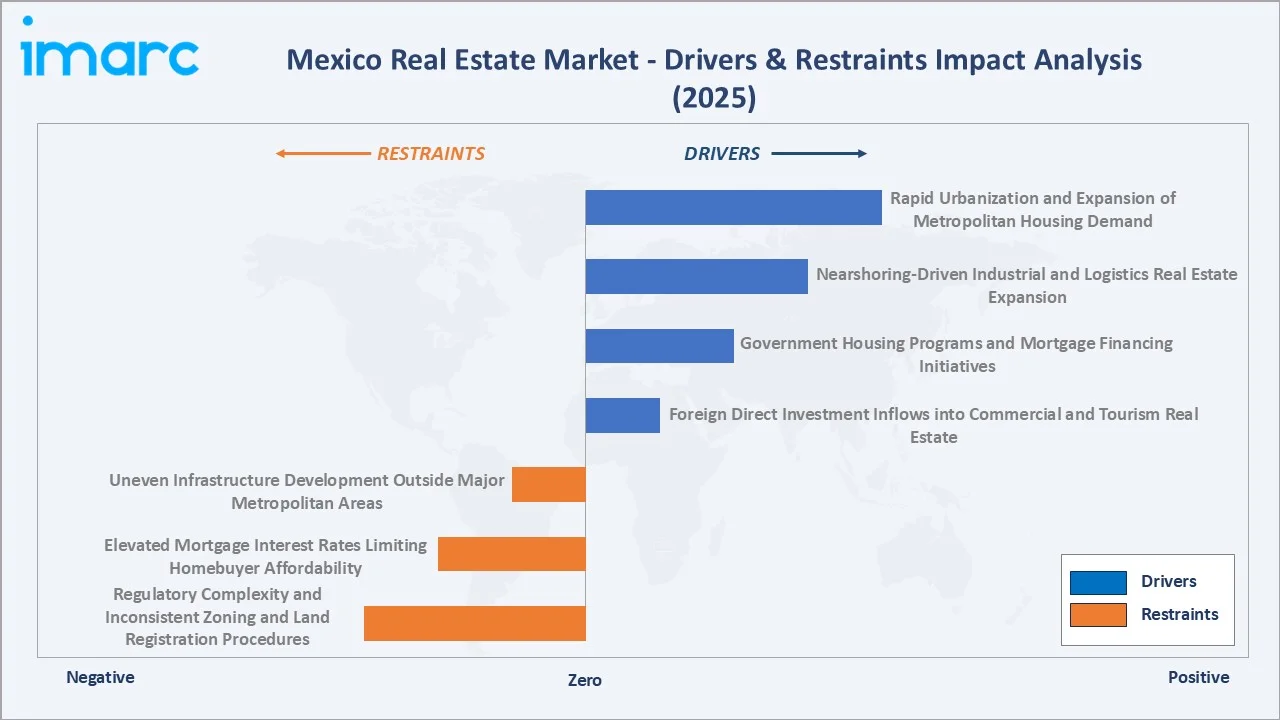
- Rapid Urbanization and Expansion of Metropolitan Housing Demand: continued migration toward Mexico City, Guadalajara, Monterrey, and Querétaro is intensifying demand for urban and suburban residential development. Expanding household formation and a growing middle-class population base are sustaining new construction activity across metropolitan submarkets, while developers increasingly prioritize vertical, transit-linked residential formats to accommodate density constraints.
- Nearshoring-Driven Industrial and Logistics Real Estate Expansion: the relocation of North American manufacturing and supply chain operations to Mexico under USMCA is generating substantial demand for industrial parks, warehousing, and logistics facilities, particularly across northern border regions such as Monterrey, Tijuana, and Ciudad Juárez, where vacancy rates remain historically low.
- Government Housing Programs and Mortgage Financing Initiatives: public lending institutions, including INFONAVIT, continue to expand mortgage access for low- and middle-income households, supporting new housing supply and stimulating purchases. Government-backed financing programs are helping offset the effects of elevated private mortgage rates on overall transaction volumes.
- Foreign Direct Investment Inflows into Commercial and Tourism Real Estate: sustained foreign capital inflows into hospitality, retail, and mixed-use commercial developments, particularly across coastal tourism corridors such as Riviera Maya and Los Cabos, are reinforcing commercial property valuations and new development activity.
Market Restraints
- Regulatory Complexity and Inconsistent Zoning and Land Registration Procedures: fragmented zoning regulations, bureaucratic land registration delays, and inconsistent permitting processes across Mexican states increase project timelines and development costs, deterring some institutional and foreign investors from entering secondary markets.
- Elevated Mortgage Interest Rates Limiting Homebuyer Affordability: nominal fixed-rate mortgage interest rates have remained near double digits despite policy rate reductions, constraining affordability for private-sector borrowers and slowing transaction velocity in segments not served by subsidized public lending channels.
- Uneven Infrastructure Development Outside Major Metropolitan Areas: inconsistent transport, utility, and digital infrastructure in secondary cities and rural regions limits large-scale development feasibility, concentrating investment activity within already dense metropolitan corridors and constraining broader market expansion.
Market Opportunities
- Industrial Nearshoring Corridor Development: continued expansion of manufacturing-linked industrial parks along northern border states presents a structural growth avenue for developers and institutional investors targeting long-duration logistics and warehousing assets.
- PropTech and Digital Transaction Platform Expansion: growing adoption of online property platforms, virtual tours, and digital mortgage processing is streamlining transactions and creating new value-added service opportunities for technology-enabled brokerages and developers.
Emerging Market Trends
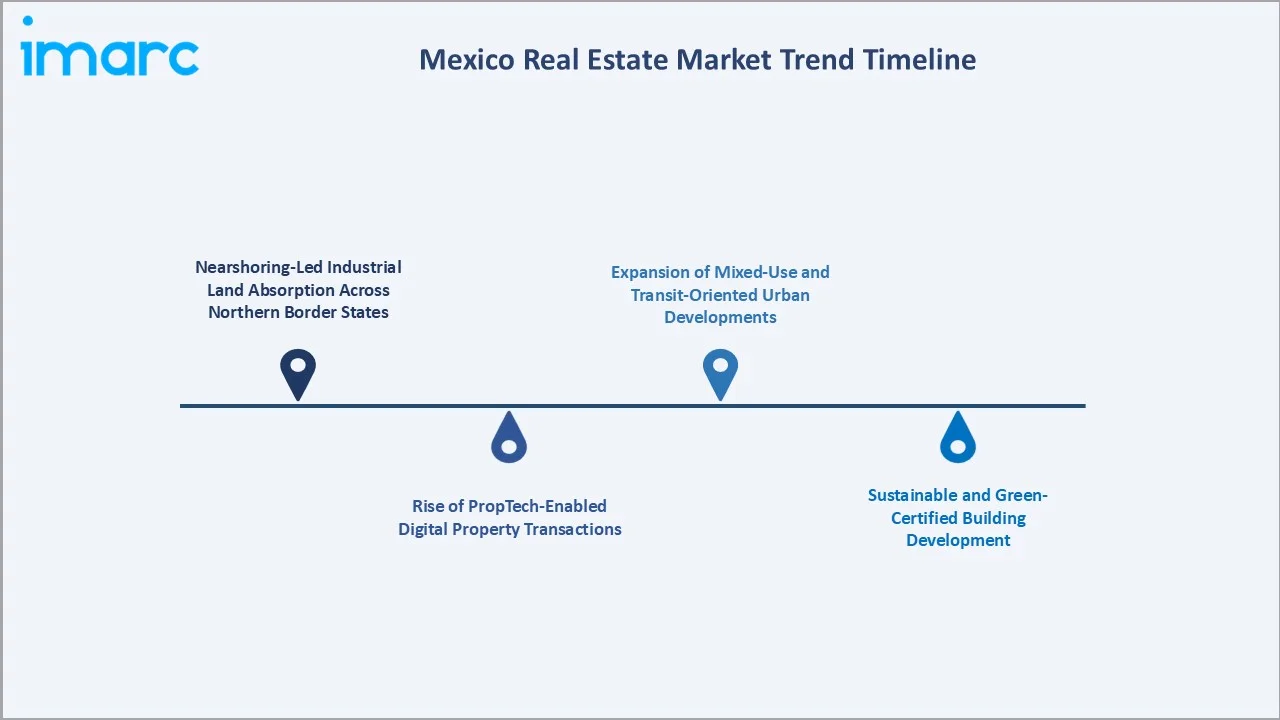
1. Nearshoring-Led Industrial Land Absorption Across Northern Border States
The relocation of manufacturing capacity from Asia toward North America is driving sustained absorption of industrial land and warehousing space across Monterrey, Tijuana, and Ciudad Juárez. Developers are responding with build-to-suit industrial parks tailored to automotive, electronics, and logistics tenants, supporting one of the market's fastest-growing commercial property categories.
2. Rise of PropTech-Enabled Digital Property Transactions
Digital property platforms are expanding their role in property discovery, virtual tours, and transaction facilitation. Growing consumer comfort with digital mortgage applications and e-signature processes is gradually compressing traditional transaction timelines across both residential and commercial segments.
3. Sustainable and Green-Certified Building Development
Developers are increasingly pursuing green building certification to meet institutional investor ESG mandates and rising tenant demand for energy-efficient properties. This trend is most pronounced in Class A office and industrial developments targeting multinational corporate tenants and FIBRA-held portfolios.
4. Expansion of Mixed-Use and Transit-Oriented Urban Developments
Mixed-use developments combining residential, retail, and office components are gaining traction in dense urban submarkets as developers respond to land scarcity and shifting consumer preference for live-work-play environments near transit infrastructure in Mexico City, Guadalajara, and Monterrey.
Industry Value Chain Analysis
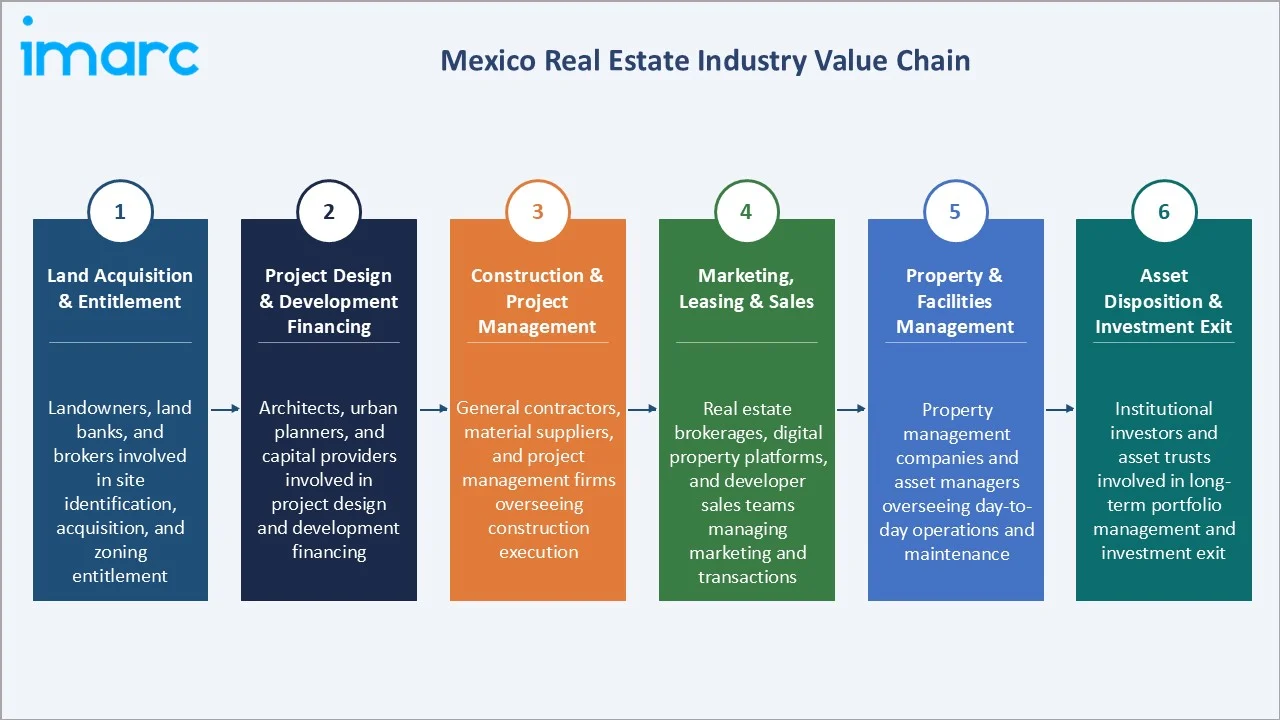
The Mexico real estate value chain integrates land acquisition and entitlement, project design and development financing, construction and project management, marketing and sales or leasing, property and facilities management, and eventual asset disposition or investment exit. The value chain's commercial structure increasingly favors vertically integrated developers capable of managing assets from acquisition through long-term operation, particularly within the institutional FIBRA segment.
|
Stage |
Key Participants |
|
Land Acquisition & Entitlement |
Landowners, land banks, and brokers involved in site identification, acquisition, and zoning entitlement |
|
Project Design & Development Financing |
Architects, urban planners, and capital providers involved in project design and development financing |
|
Construction & Project Management |
General contractors, material suppliers, and project management firms overseeing construction execution |
|
Marketing, Leasing & Sales |
Real estate brokerages, digital property platforms, and developer sales teams managing marketing and transactions |
|
Property & Facilities Management |
Property management companies and asset managers overseeing day-to-day operations and maintenance |
|
Asset Disposition & Investment Exit |
Institutional investors and asset trusts involved in long-term portfolio management and investment exit |
The land acquisition and entitlement stage remains the value chain's most commercially sensitive phase given Mexico's fragmented zoning regulations and variable land registration timelines. The asset disposition and investment exit stage is experiencing the most rapid structural evolution as FIBRA trusts and institutional investors increasingly consolidate stabilized income-generating assets.
Technology Landscape in the Mexico Real Estate Industry
PropTech Digital Transaction Platforms
PropTech digital transaction platforms offer property search, virtual tours, digital contracts, and online mortgage processing, streamlining the buying, selling, and leasing experience. These platforms improve price transparency, reduce transaction timelines, and broaden buyer access to listings across metropolitan and secondary markets. Their growing adoption by brokerages and developers is accelerating the shift from traditional in-person transactions toward digitally enabled real estate commerce.
Smart Building and Building Automation Technology
Smart building and building automation technology integrates IoT sensors, centralized energy management, and automated HVAC, lighting, and security systems to optimize operating costs and occupant comfort. These systems enable real-time monitoring and predictive maintenance, helping developers and asset managers reduce energy consumption and extend asset life. Their adoption is expanding fastest in Class A commercial and industrial developments targeting multinational corporate tenants.
Green Building Certification and Energy Efficiency Systems
Smart buildings are increasingly defined as highly efficient, fully digitalized, and capable of interacting autonomously with the power grid, reflecting the built environment's growing role in climate and decarbonization strategy. In 2025, an industrial facility in Nuevo León achieved LEED Platinum certification after integrating digital monitoring platforms, automation systems, and renewable energy generation, reducing energy consumption by approximately 40% relative to comparable facilities. This supports the wider adoption of green building certification and energy efficiency systems by demonstrating measurable cost and emissions reductions, encouraging developers to pursue similar digitally enabled, sustainability-certified building designs across commercial and industrial real estate.
Market Segmentation Analysis
The report covers the following segments:
|
Segment Category |
Leading Segment |
Market Share |
Year |
|
Property |
Residential |
44.5% |
2025 |
|
Business |
Sales |
64.4% |
2025 |
|
Mode |
Offline |
72.3% |
2025 |
|
Region |
Central Mexico |
51.6% |
2025 |

By Property
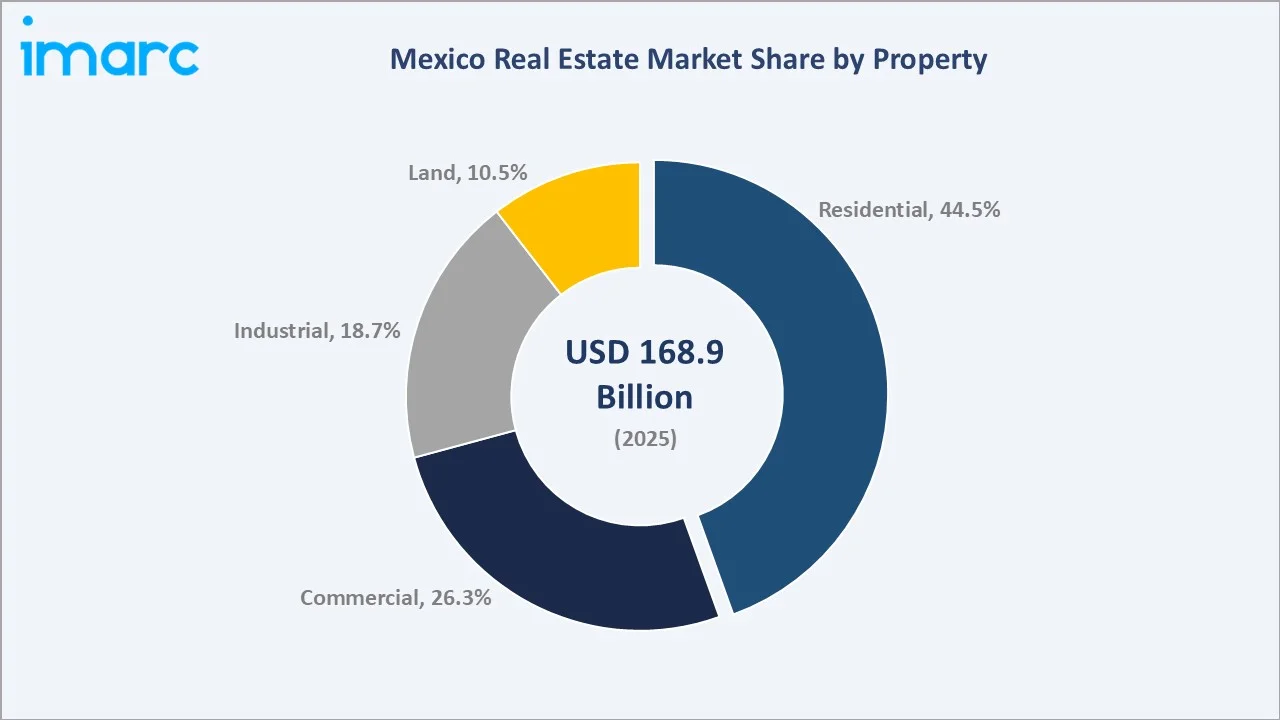
Residential property leads at 44.5% in 2025, encompassing single-family homes, apartments, and condominiums and representing the market's largest and most commercially competitive property category.
To access detailed market analysis, Request Sample
Commercial property at 26.3% captures office, retail, and hospitality assets concentrated in major metropolitan business districts and tourism corridors. Industrial property at 18.7% reflects nearshoring-driven warehousing and logistics demand, representing the segment's fastest-growing forward CAGR. Land at 10.5% represents undeveloped parcels held for future residential, commercial, or industrial development.
By Business
The sales leads at 64.4% through entrenched homeownership preferences and broad mortgage credit access via public and private lending institutions across the residential and land segments.
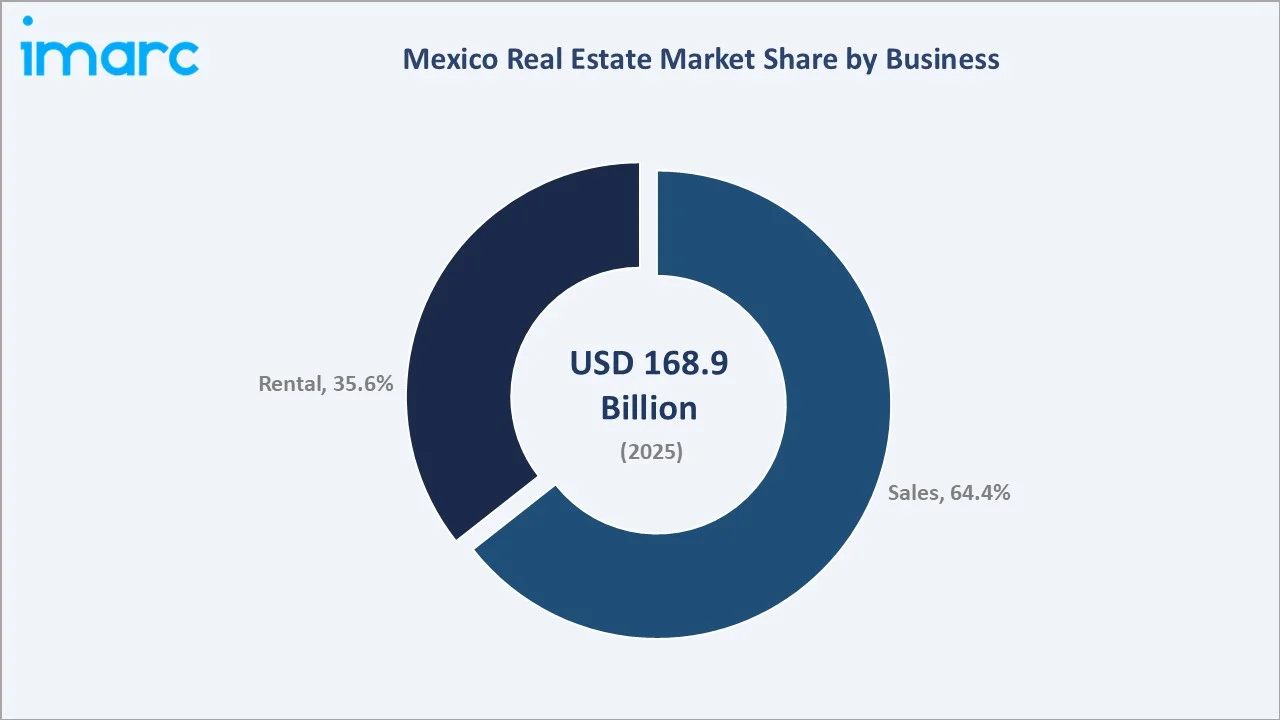
The rental segment at 35.6% is gaining structural relevance as affordability constraints in major metropolitan markets and growing institutional interest in stabilized income-generating residential and commercial assets support above-market rental growth, particularly within FIBRA-held commercial portfolios.
Regional Market Insights
|
Region |
Share (2025) |
Key Mexico Real Estate Market Drivers & Characteristics |
|
Central Mexico |
51.6% |
Driven by high population density, concentrated institutional investment activity, strong corporate presence, and well-developed transport and urban infrastructure |
|
Northern Mexico |
19.7% |
Supported by expanding industrial and logistics development, growing manufacturing investment, and improving cross-border trade infrastructure |
|
Southern Mexico |
16.8% |
Driven by tourism-linked hospitality and residential development, expanding coastal infrastructure, and growing secondary city investment activity |
|
Others |
11.9% |
Emerging markets supported by gradual infrastructure development and increasing residential and commercial investment interest |
Central Mexico, at 51.6%, leads through its high concentration of population, institutional investment activity, and corporate real estate demand. Northern Mexico, at 19.7%, reflects sustained industrial relocation and the region's position as a principal manufacturing and logistics corridor.
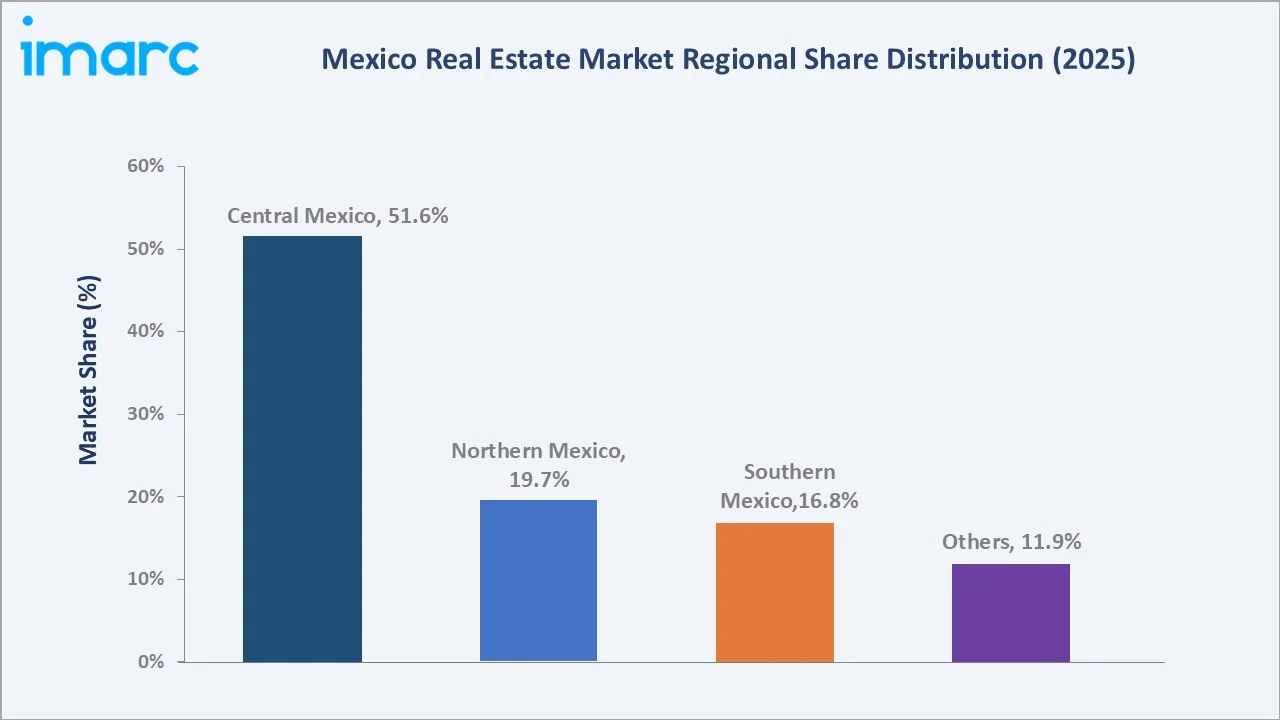
Southern Mexico, at 16.8%, is anchored by coastal tourism real estate demand and emerging secondary city development. The Others category, at 11.9%, represents the country's remaining states, where infrastructure development remains at an earlier stage relative to the three core regions.
Competitive Landscape
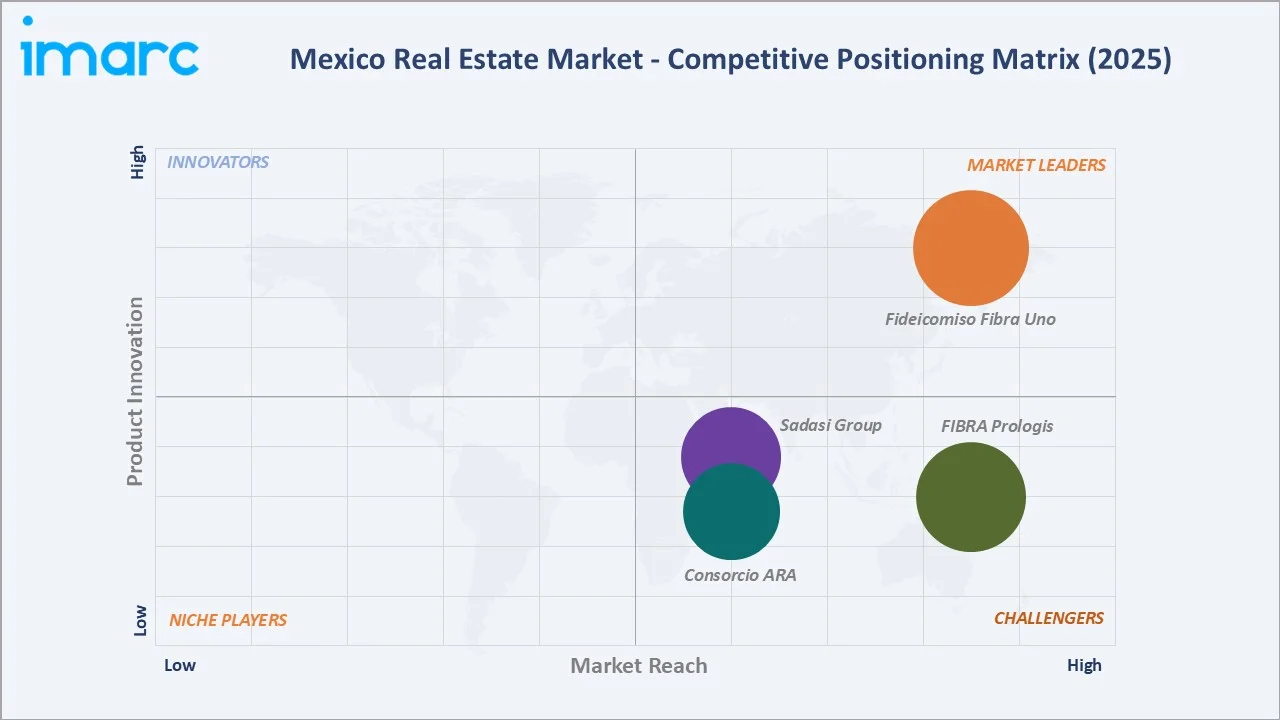
The Mexico real estate market competitive landscape is moderately fragmented, comprising large institutional FIBRA trusts holding diversified income-generating portfolios, specialized industrial developers serving nearshoring tenants, and large-scale private homebuilders focused on residential housing supply.
|
Company Name |
Key Products |
Market Position |
Core Strength |
|
Fideicomiso Fibra Uno |
Industrial, Retail & Office FIBRA Portfolio |
Market Leader |
Fideicomiso Fibra Uno is Mexico's largest real estate investment trust by portfolio size, with a diversified holding spanning industrial, retail, and office assets nationwide. |
|
FIBRA Prologis |
Industrial & Logistics Facilities |
Strong Challenger |
FIBRA Prologis develops and operates Class A industrial and logistics facilities, leveraging its global Prologis platform to serve multinational supply chain tenants in Mexico. |
|
Sadasi Group |
Residential Housing Development |
Strong Challenger |
Sadasi Group is one of Mexico's largest private homebuilders, developing large-scale residential communities targeting middle-income households nationwide. |
|
Consorcio ARA |
Residential Housing Development |
Strong Challenger |
Consorcio ARA is a long-established publicly listed homebuilder specializing in affordable and middle-income housing developments across major Mexican metropolitan areas. |
Key players include Fideicomiso Fibra Uno, FIBRA Prologis, Sadasi Group, Consorcio ARA, and others.
Key Company Profiles
Fideicomiso Fibra Uno
Fideicomiso Fibra Uno is Mexico's largest real estate investment trust, with a diversified national portfolio spanning industrial, retail, and office properties leased to corporate and institutional tenants.
- Key Products: Industrial, retail, and office leasing portfolio across major Mexican metropolitan markets.
- Strategic Focus: Expanding diversified income-generating real estate holdings while increasing exposure to nearshoring-linked industrial assets nationwide.
FIBRA Prologis
FIBRA Prologis is a leading Mexican real estate investment trust externally managed and sponsored by Prologis, focused on acquiring, owning, and operating Class-A industrial and logistics properties across the country's core manufacturing and trade corridors.
- Key Products: Industrial & Logistics Facilities
- Recent Developments: In February 2026, FIBRA Prologis entered into a binding agreement with Macquarie Asset Management to acquire the management rights of FIBRA Macquarie, subject to regulatory approvals and the successful completion of a tender offer. The proposed transaction is expected to strengthen Prologis' presence in Mexico's industrial real estate market by expanding its logistics portfolio, enhancing operational scale, and improving long-term value creation for investors.
- Strategic Focus: Consolidating its position as a leading Class-A industrial landlord through portfolio expansion and platform integration, capturing sustained nearshoring-driven manufacturing and logistics tenant demand nationwide.
Market Concentration Analysis
The Mexico real estate market is moderately fragmented at the institutional level, with the top five key players collectively representing a meaningful share of institutionally held income-generating commercial and industrial real estate. Residential housing supply remains comparatively fragmented, with large publicly listed homebuilders competing alongside numerous regional private developers.
Investment & Growth Opportunities
Highest Growth Segments
Industrial property (~4.95% CAGR), the rental business channel (~4.85% CAGR), and Northern Mexico's nearshoring-linked logistics corridor represent the highest-growth investment vectors through 2034, supported by sustained USMCA-driven manufacturing relocation and institutional appetite for stabilized industrial income streams.
Investment Themes
- Institutional industrial portfolio expansion along nearshoring corridors: FIBRA trusts and developers expanding industrial land banks in Monterrey, Tijuana, and Ciudad Juárez are positioned to capture sustained multinational manufacturing tenant demand through the forecast period.
- Affordable residential development scale-up supported by public mortgage financing: homebuilders with strong land banks and INFONAVIT financing partnerships are well positioned to capture continued middle-income housing demand as urbanization and household formation persist nationwide.
Future Market Outlook (2026-2034)
The Mexico real estate market is projected to grow from USD 168.9 Billion in 2025 to USD 246.4 Billion by 2034, delivering a 3.93% CAGR over the forecast period. The market's anchor value of USD 204.8 Billion in 2030 represents a real estate sector increasingly shaped by institutional FIBRA consolidation, sustained nearshoring-driven industrial demand, and continued government-supported residential housing finance.
Three structural forces define market growth through 2034. Nearshoring-driven industrial relocation continues to compound demand for logistics and manufacturing real estate along northern border states. Urbanization and household formation sustain residential development activity across core metropolitan markets. Institutional capital consolidation through FIBRA trusts continues to professionalize the market's commercial and industrial asset base, supporting long-term structural growth.
Research Methodology
Primary Research
Primary research comprised structured interviews with industry stakeholders including real estate developers, FIBRA portfolio managers, mortgage finance executives, and institutional investment analysts active in the Mexican market.
Secondary Research
Secondary research encompassed company annual reports and investor disclosures, Banco de México and CNBV housing finance data, INEGI national statistics, Sociedad Hipotecaria Federal price index reports, and industry association publications covering Mexican real estate market trends.
Forecasting Models
Market revenue forecasts were developed using a bottom-up estimation model incorporating historical transaction volume trends by property type, average price per square meter by region, mortgage origination growth rates, and institutional investment flow projections across the forecast period.
Mexico Real Estate Market Report Coverage:
| Report Features | Details |
|---|---|
| Base Year of the Analysis | 2025 |
| Historical Period | 2020-2025 |
| Forecast Period | 2026-2034 |
| Units | Billion USD |
| Scope of the Report | Exploration of Historical Trends and Market Outlook, Industry Catalysts and Challenges, Segment-Wise Historical and Future Market Assessment:
|
| Properties Covered | Residential, Commercial, Industrial, Land |
| Business Covered | Sales, Rental |
| Modes Covered | Online, Offline |
| Regions Covered | Northern Mexico, Central Mexico, Southern Mexico, Others |
| Companies Covered | Fideicomiso Fibra Uno, FIBRA Prologis, Sadasi Group, Consorcio ARA, etc. |
| Customization Scope | 10% Free Customization |
| Post-Sale Analyst Support | 10-12 Weeks |
| Delivery Format | PDF and Excel through Email (We can also provide the editable version of the report in PPT/Word format on special request) |
Key Benefits for Stakeholders:
- IMARC’s industry report offers a comprehensive quantitative analysis of various market segments, historical and current market trends, market forecasts, and dynamics of the Mexico real estate market from 2020-2034.
- The research report provides the latest information on the market drivers, challenges, and opportunities in the Mexico real estate market.
- Porter's five forces analysis assist stakeholders in assessing the impact of new entrants, competitive rivalry, supplier power, buyer power, and the threat of substitution. It helps stakeholders to analyze the level of competition within the Mexico real estate industry and its attractiveness.
- Competitive landscape allows stakeholders to understand their competitive environment and provides an insight into the current positions of key players in the market.
Frequently Asked Questions About the Mexico Real Estate Market Report
The Mexico real estate market reached USD 168.9 Billion in 2025, driven by residential property's dominant 44.5% share, the sales leading at 64.4%, and Central Mexico commanding 51.6% of national market share through Mexico City's metropolitan concentration.
The market grows at a 3.93% CAGR during 2026-2034, reaching USD 246.4 Billion by 2034, supported by nearshoring-driven industrial demand, sustained urbanization, and continued government-backed mortgage financing programs.
Residential property leads at 44.5%, driven by population growth, household formation, and government-backed mortgage financing access through public lending institutions.
The sales leads at 64.4% through entrenched homeownership preferences and broad mortgage credit access, while the rental segment at 35.6% is gaining share amid affordability constraints in major metropolitan markets.
Central Mexico leads at 51.6% through Mexico City's metropolitan density, institutional capital concentration, and strong transport infrastructure connectivity.
Leading companies include Fideicomiso Fibra Uno, FIBRA Prologis, Sadasi Group, Consorcio ARA, and others.
The market is projected to reach approximately USD 204.8 Billion by 2030, with nearshoring-driven industrial demand and institutional FIBRA consolidation continuing to shape the sector's growth trajectory.
Priority investment opportunities include institutional industrial portfolio expansion along nearshoring corridors and affordable residential development scale-up supported by public mortgage financing programs.
Need more help?
- Speak to our experienced analysts for insights on the current market scenarios.
- Include additional segments and countries to customize the report as per your requirement.
- Gain an unparalleled competitive advantage in your domain by understanding how to utilize the report and positively impacting your operations and revenue.
- For further assistance, please connect with our analysts.
 Request Customization
 Speak to an Analyst
 Request Brochure
 Inquire Before Buying
Benefits of Customization
- Personalize this research
- Triangulate with your data
- Get data as per your format and definition
- Gain a deeper dive into a specific application, geography, customer, or competitor
- Any level of personalization
Get in Touch With Us
UNITED STATES
Phone: +1-201-971-6302
INDIA
Phone: +91-120-433-0800
UNITED KINGDOM
Phone: +44-753-714-6104
Email: [email protected]
Client Testimonials




.webp)




.webp)













Related Reports

Choose your plan
*Please note that the prices mentioned below are starting prices for each bundle type. Kindly contact our team for further details.*
Single User License
- 1 User License, Access on 2 Devices
- PDF Report + Excel Dataset (Password Protected)
- Lifetime Access
- No Printing Rights
- 10% Free Report Customization
- 10–12 Weeks of Analyst Support
Five User License
- Access for 5 Users, 2 Devices per User
- PDF Report + Excel Dataset (Password Protected)
- Lifetime Access
- Dedicated Account Manager
- 12–14 Weeks of Analyst Support
- No Printing Rights
- 15% Free Report Customization
- 25% Discount on Your Next Purchase
Corporate User License
- Unlimited User Access (Within Your Organization)
- PDF Report + Excel Dataset
- Lifetime Access
- Dedicated Account Manager
- 14–20 Weeks of Analyst Support
- No Printing Rights
- 20% Free Report Customization
- 30% Discount on Your Next Purchase
Essential Insights
What's included:
3 reports
- Lifetime Access
- PDF Reports
- Excel Datasets
- 2 Weeks of Free Analyst Support
- 2 User Licenses
- Access on 2 Devices
- Printing Rights
- Complimentary PowerPoint (PPT) Version
- Complimentary License Upgrade
Professional Access
What's included:
5 reports
- Lifetime Access
- PDF Reports
- Excel Datasets
- 8 Weeks of Free Analyst Support
- 2 User Licenses
- Access on 2 Devices
- Printing Rights
- Complimentary PowerPoint (PPT) Version
- Complimentary License Upgrade
Business Advantage
What's included:
8 reports
- Lifetime Access
- PDF Reports
- Excel Datasets
- 14 Weeks of Free Analyst Support
- 2 User Licenses
- Access on 2 Devices
- Printing Rights
- Complimentary PowerPoint (PPT) Version
- Complimentary License Upgrade
Enterprise Intelligence
What's included:
10 reports
- Lifetime Access
- PDF Reports
- Excel Datasets
- 20 Weeks of Free Analyst Support
- 2 User Licenses
- Access on 2 Devices
- Printing Rights
- Complimentary PowerPoint (PPT) Version
- Complimentary License Upgrade