
Mexico Renewable Energy Storage Market Size, Share, Trends and Forecast by Source, Technology, Application, and Region, 2026-2034
Mexico Renewable Energy Storage Market Size, Share, Trends & Forecast (2026-2034)
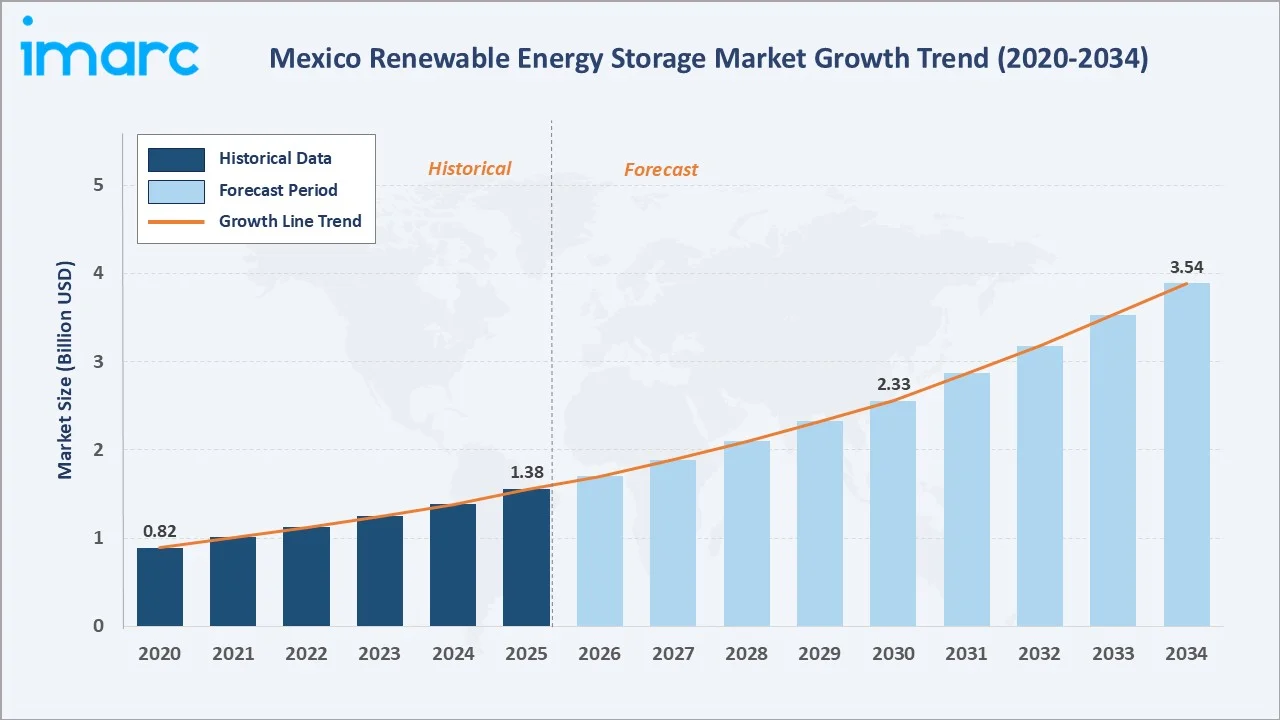
The Mexico renewable energy storage market reached USD 1.38 Billion in 2025 and is projected to reach USD 3.54 Billion by 2034, growing at a CAGR of 11.00% during 2026-2034. The market is driven by expanding solar and wind power capacity, growing electricity demand, and the need for grid stability and energy reliability. Mexico’s National Power System Development Program (Programa de Desarrollo del Sistema Eléctrico Nacional or PRODESEN) reported total electricity generation of 351,695 GWh in 2023, with clean energy accounting for 24.32% and fossil fuels contributing around 75%. Clean energy capacity, led by hydro, wind, and solar PV, is projected to rise to 62.4% by 2038. This is driving the market as higher solar and wind penetration increases the need for battery storage to balance intermittent power supply, stabilize the grid, and improve renewable energy integration. Solar leads source at 42.8%. Industrial leads application at 47.3%. Northern Mexico leads regionally at 39.6%.
Market Snapshot
|
Metric |
Value |
|
Market Size (2025) |
USD 1.38 Billion |
|
Forecast Market Size (2034) |
USD 3.54 Billion |
|
CAGR (2026-2034) |
11.00% |
|
Base Year |
2025 |
|
Historical Period |
2020-2025 |
|
Forecast Period |
2026-2034 |
|
Dominant Source |
Solar (42.8%, 2025) |
|
Dominant Application |
Industrial (47.3%, 2025) |
|
Leading Region |
Northern Mexico (39.6%, 2025) |
The Mexico renewable energy storage market grew from USD 0.82 Billion in 2020 to USD 1.38 Billion in 2025, reflecting rising deployment of solar, wind, and grid-support storage systems. It is expected to reach USD 2.33 Billion by 2030, supported by renewable energy integration and demand for reliable power supply. By 2034, the market is forecast to attain USD 3.54 Billion, driven by battery storage adoption, grid modernization, and clean energy targets. Overall, the market shows strong long-term growth as Mexico increases its share of renewable and clean energy generation.
To get more information on this market, Request Sample
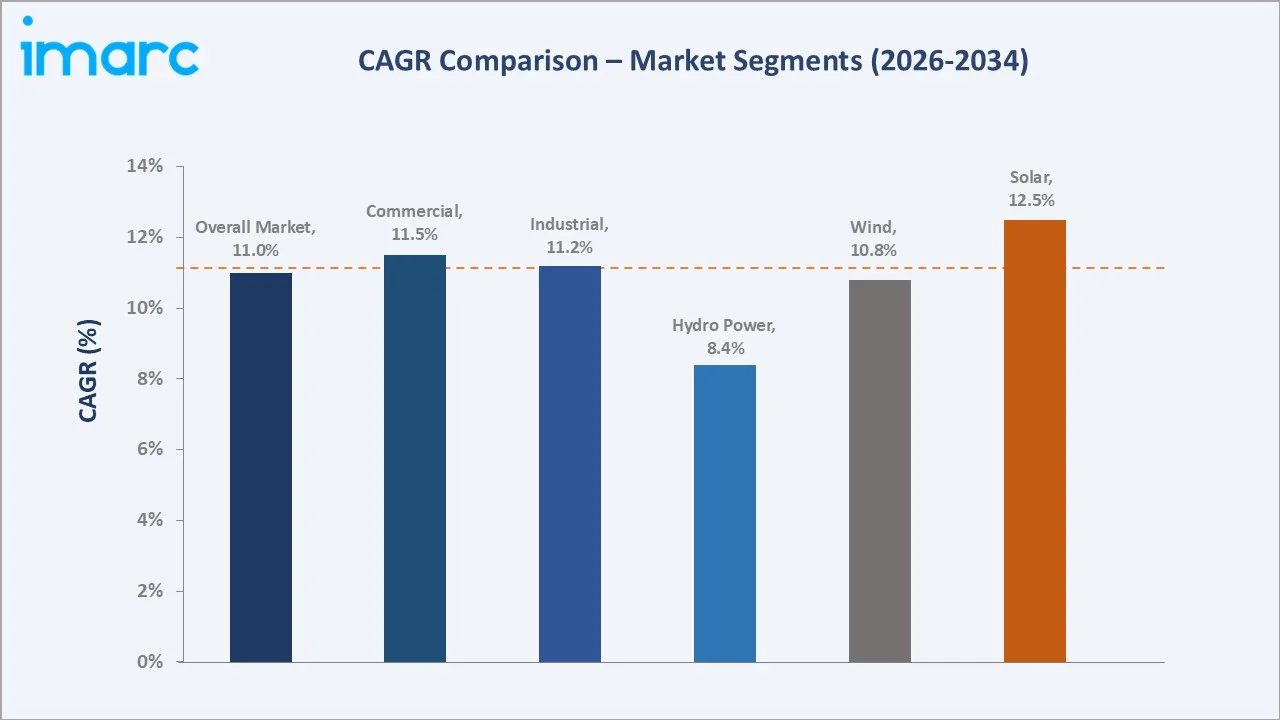
Solar grows fastest at ~12.5% CAGR through co-located solar BESS. Commercial application grows at ~11.5% CAGR through C&I demand charge reduction. Industrial grows at ~11.2% CAGR through nearshoring factory, solar BESS.
Executive Summary
The Mexico renewable energy storage market is growing steadily, supported by rising solar and wind capacity, grid modernization, and increasing clean energy integration. The market expanded from USD 0.82 Billion in 2020 to USD 1.38 Billion in 2025 and is projected to reach USD 3.54 Billion by 2034. Battery energy storage systems are gaining traction to manage renewable intermittency, improve grid stability, and support peak demand. Growth is further driven by industrial power reliability needs, distributed energy projects, and long-term clean energy targets. Overall, Mexico offers strong opportunities for utility-scale, commercial, and hybrid renewable storage solutions. Solar at 42.8% leads through the region’s solar belt. Industrial at 47.3% leads through nearshoring C&I. Northern Mexico leads regionally at 39.6%.
Key Market Insights
|
Insight |
Data |
|
Dominant Source |
Solar - 42.8% share (2025) |
|
Dominant Application |
Industrial - 47.3% market share (2025) |
|
Leading Region |
Northern Mexico - 39.6% share (2025) |
|
Market Opportunity |
PRODESEN grid-scale BESS mandate; Sonora solar belt utility-scale; green hydrogen storage; rural electrification off-grid solar storage; long-duration storage emerging |
Key Analytical Observations Supporting the Above Data:
- Solar at 42.8%: Solar source leads the market as Mexico has strong solar irradiation and expanding photovoltaic capacity across utility-scale and distributed projects. Since solar generation is intermittent, it creates a strong demand for battery storage to shift power, manage peaks, and improve grid stability.
- Industrial at 47.3%: Industrial application leads the market as factories, mining operations, and large commercial facilities require reliable backup power and peak-load management. Renewable energy storage helps reduce outage risks, stabilize energy costs, and support cleaner captive power use.
- Northern Mexico at 39.6%: Northern Mexico leads the market due to its strong industrial base, high electricity demand, and proximity to major solar and wind resources. The region’s manufacturing clusters and grid reliability need support for higher adoption of renewable energy storage systems.
Mexico Renewable Energy Storage Market Overview
The Mexico renewable energy storage market encompasses battery energy storage systems, thermal storage, pumped hydro, and other technologies used to store electricity generated from solar, wind, hydro, and hybrid renewable projects. It serves utility-scale grids, industrial facilities, commercial buildings, and residential users by improving power reliability and managing intermittent renewable generation. The market supports applications such as peak shaving, load shifting, frequency regulation, backup power, and grid stabilization. Rising renewable penetration, industrial electricity demand, and clean energy targets are expanding the role of energy storage across Mexico. Macroeconomic factors include rising electricity demand, industrial expansion, foreign direct investment (FDI), renewable energy capacity additions, and government support for energy transition initiatives.
Market Dynamics
To evaluate market opportunities, Request Sample
Market Drivers
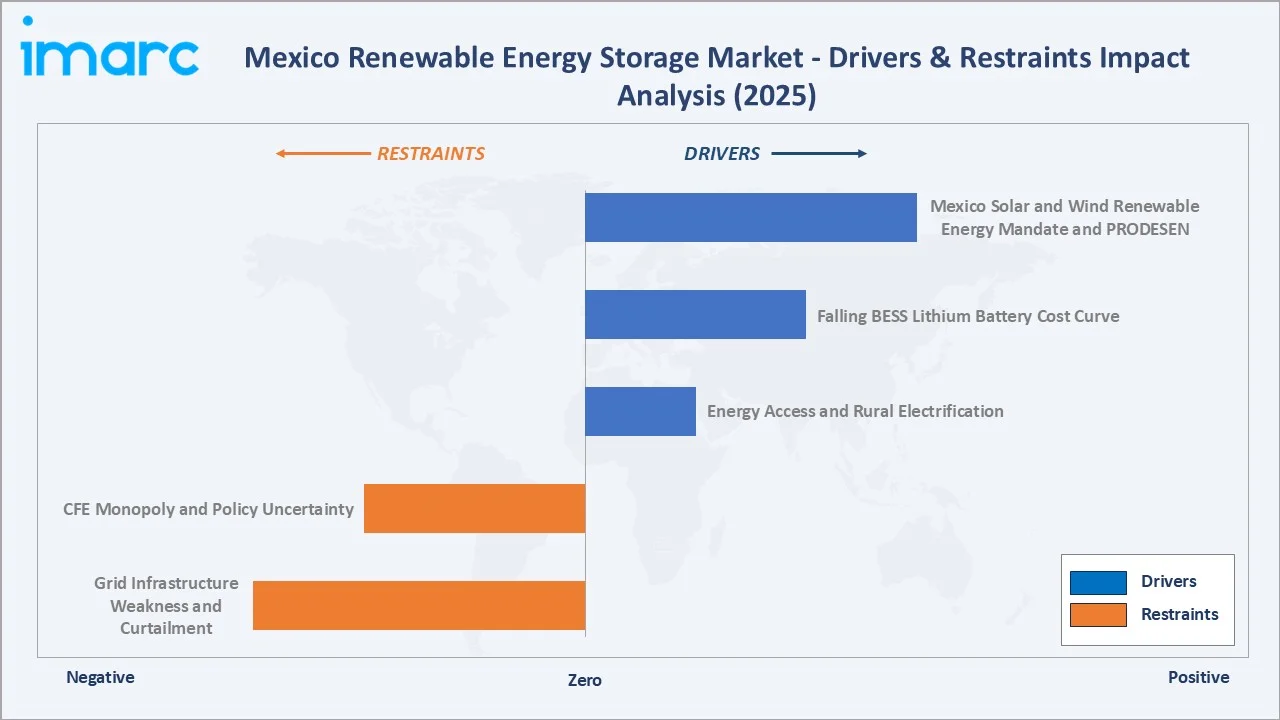
- Mexico Solar and Wind Renewable Energy Mandate and PRODESEN: PRODESEN reported Mexico’s total power generation at 351,695 GWh in 2023, with clean energy contributing 24.32% and fossil fuels accounting for around 75%. Clean energy capacity, mainly from hydro, wind, and solar PV, is projected to rise to 62.4% by 2038. The 2024–2038 PRODESEN also outlines future needs for generation, transmission, distribution, and commercialization under the National Electrical System. PRODESEN projects a significant increase in clean energy capacity, led by solar and wind power, over the coming years. As renewable penetration rises, battery energy storage becomes essential for load balancing, peak shaving, and frequency regulation. Additionally, storage solutions help maximize renewable energy utilization, reduce curtailment, and support Mexico's long-term energy transition objectives.
- Falling BESS Lithium Battery Cost Curve: The falling BESS lithium battery cost curve is making renewable energy storage increasingly affordable and commercially viable across Mexico. Declining battery prices have reduced the upfront cost of utility-scale, commercial, and industrial storage projects, improving project economics and investment returns. Lower storage costs enable greater integration of solar and wind power by providing cost-effective solutions for energy shifting, peak demand management, and grid stabilization. As battery systems become more economical, deployment is accelerating across renewable energy projects, microgrids, and industrial facilities throughout the country.
- Energy Access and Rural Electrification: Energy access and rural electrification support a reliable power supply in remote and underserved communities. Renewable energy systems paired with batteries can reduce dependence on diesel generators and extend electricity access where grid connectivity is weak or costly. Storage enables solar and wind power to be used during evening hours or periods of low generation. This creates opportunities for microgrids, off-grid systems, and community-scale renewable storage projects across rural Mexico.
Market Restraints
- CFE Monopoly and Policy Uncertainty: CFE monopoly and policy uncertainty create uncertainty around private-sector participation and project development. Regulatory changes, permitting delays, and shifting energy policies can discourage long-term investment in battery storage and renewable infrastructure. The dominant role of the Federal Electricity Commission (CFE) may limit opportunities for independent power producers and private storage operators. As a result, some renewable energy and storage projects face financing challenges, delayed implementation, and slower market expansion.
- Grid Infrastructure Weakness and Curtailment: Grid infrastructure weakness and curtailment reduce the efficiency of renewable power integration. In several regions, transmission and distribution networks lack sufficient capacity to absorb increasing volumes of solar and wind generation, leading to congestion and renewable energy curtailment. While energy storage can help address these issues, inadequate grid infrastructure and delayed transmission upgrades can slow project deployment and increase investment risks. These constraints reduce revenue certainty for developers and hinder the pace of renewable energy and storage expansion.
Market Opportunities
- Green Hydrogen Storage: Green hydrogen storage represents a major opportunity as the country seeks to utilize abundant solar and wind resources for clean hydrogen production. Energy storage systems are essential for providing stable renewable power to electrolyzers, improving hydrogen production efficiency and reliability. Growing investments in green hydrogen projects for industrial use, exports, and transportation are expected to increase demand for large-scale battery and hybrid storage solutions. This trend supports long-duration energy storage deployment while strengthening Mexico’s position in the emerging clean hydrogen value chain.
- EV Charging Infrastructure with Energy Storage: Mexico’s Electromobility Association (EMA) reported 59,602 charging positions nationwide by the end of Q1 2026, including 4,378 public and more than 55,000 private charging points. Battery storage systems integrated with EV charging stations can reduce grid stress, manage peak electricity demand, and enable greater use of solar and wind power for vehicle charging. Energy storage also improves charging reliability in regions with grid constraints and supports the development of fast-charging networks. As Mexico expands its EV ecosystem, demand for distributed battery storage solutions is expected to grow alongside charging infrastructure investments.
Market Challenges
- Limited Revenue Certainty for Storage Projects: Limited revenue certainty for storage projects remains a key challenge as clear and stable compensation mechanisms for storage services are still evolving. Many projects face uncertainty regarding revenue streams from grid balancing, frequency regulation, capacity services, and energy arbitrage. This makes it difficult for developers to secure financing and accurately assess long-term returns on investment. As a result, some storage projects are delayed or scaled back despite growing demand for grid flexibility and renewable integration.
- Dependence on Imported Battery Components: Dependence on imported battery components exposes projects to global supply chain disruptions, currency fluctuations, and price volatility. Key components such as lithium-ion cells, battery management systems, inverters, and power electronics are often sourced from international suppliers. This can increase project costs, lengthen delivery timelines, and reduce procurement flexibility for developers. Limited domestic manufacturing capacity also makes Mexico more vulnerable to trade restrictions, logistics delays, and competition for battery supply from larger global markets.
Emerging Market Trends
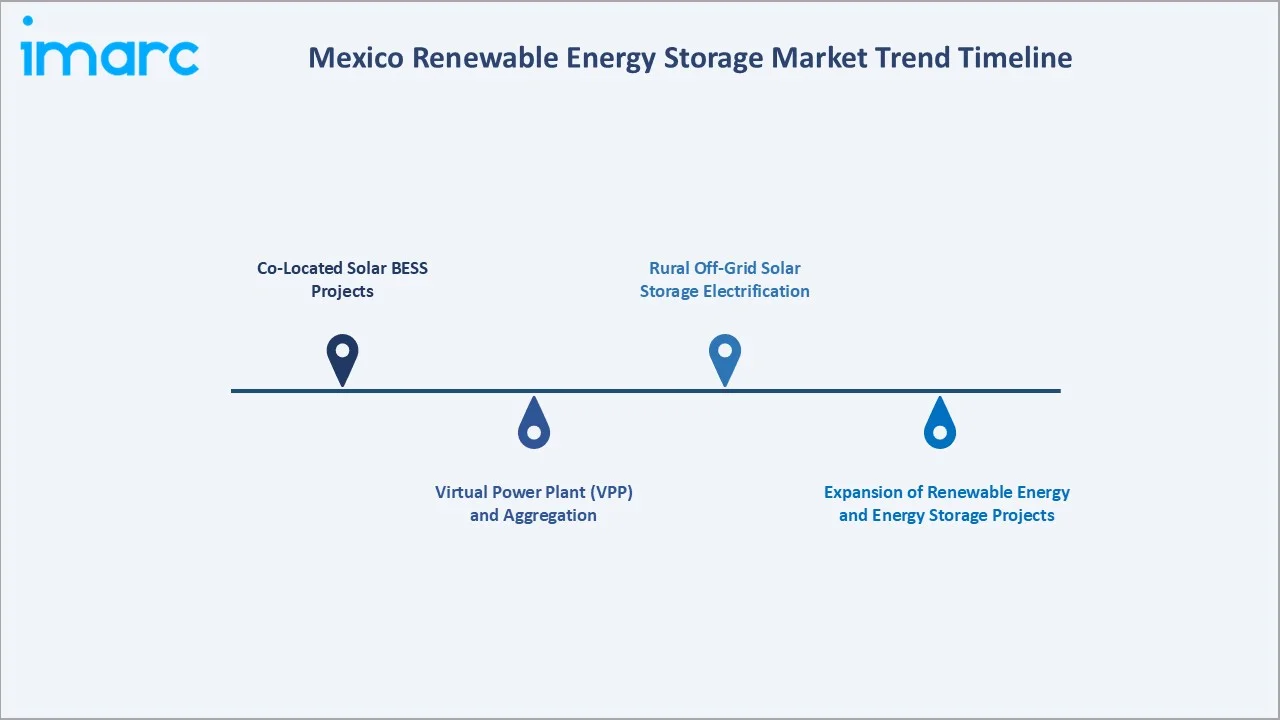
1. Co-Located Solar BESS Projects
Co-located solar BESS projects are emerging as developers pair solar PV plants with battery systems to improve power reliability and dispatchability. These projects allow excess daytime solar generation to be stored and supplied during evening peak demand periods. Co-location also helps reduce renewable curtailment, optimize grid connection capacity, and improve project economics. As Mexico expands solar capacity, integrated solar-plus-storage models are expected to gain wider adoption across utility-scale and industrial applications.
2. Virtual Power Plant (VPP) and Aggregation
Virtual power plant (VPP) and aggregation are emerging as distributed batteries, solar systems, EV chargers, and flexible loads are digitally connected and managed as one coordinated energy resource. This model improves grid flexibility by enabling demand response, peak shaving, and frequency support without relying only on large centralized plants. VPPs also help commercial and industrial users monetize distributed storage assets and reduce electricity costs. As Mexico expands distributed solar and EV infrastructure, aggregation platforms are expected to gain importance in balancing renewable power and improving grid resilience.
3. Expansion of Renewable Energy and Energy Storage Projects
Expansion of renewable energy and energy storage projects is emerging as solar, wind, and hybrid power developments continue to grow. In May 2026, the Ministry of Energy’s package includes private and CFE-partnered renewable generation projects, non-co-owned energy storage systems, and a Single Window mechanism for self-consumption projects ranging from 0.7 MW to 20 MW. Under the generation tender, companies can submit fully private proposals or mixed projects with CFE participation. However, standalone storage projects will be limited to partnerships with the state-owned utility. Developers are increasingly pairing storage with renewable projects to improve dispatchability and strengthen project economics.
4. Rural Off-Grid Solar Storage Electrification
Rural off-grid solar storage electrification is emerging as remote communities seek reliable electricity access without costly grid expansion. Solar panels paired with battery storage can provide stable power for households, schools, health centers, and small businesses in underserved areas. These systems reduce dependence on diesel generators while lowering fuel and maintenance costs. As rural electrification programs and decentralized energy models expand, demand for small-scale solar-plus-storage solutions is expected to grow.
Industry Value Chain Analysis
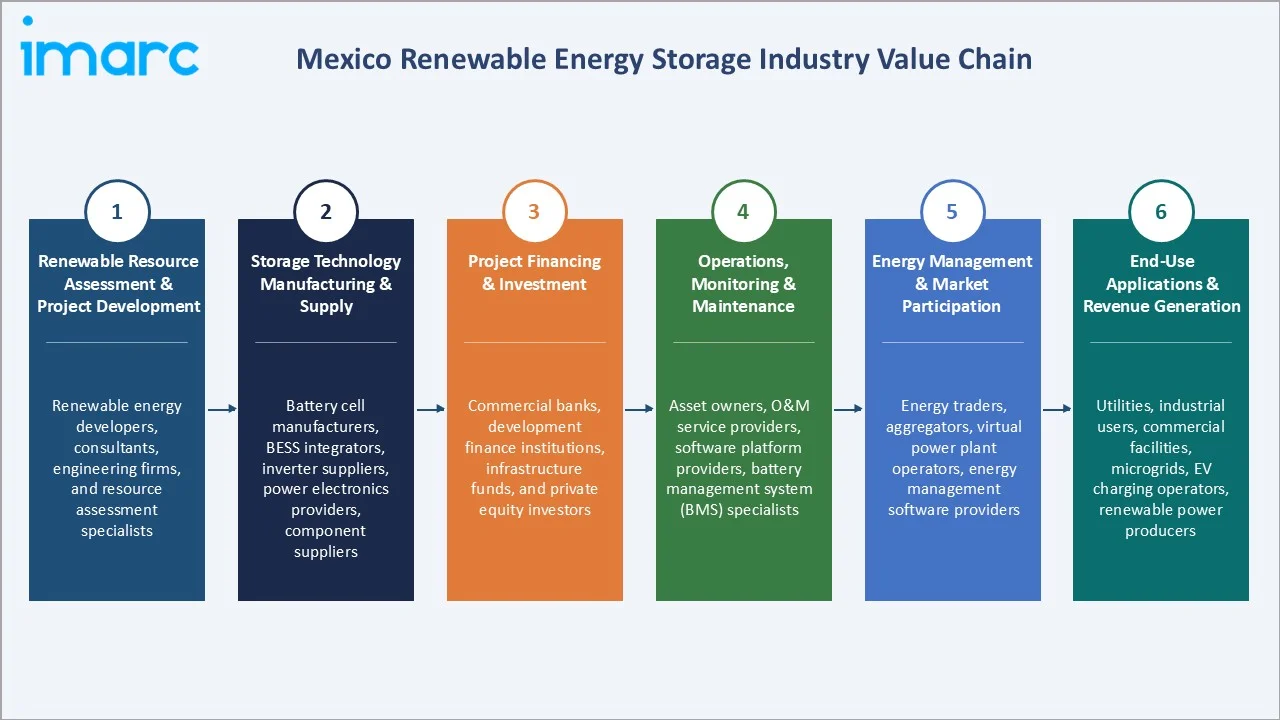
Mexico renewable energy storage value chain integrates renewable resource assessment & project development, storage technology manufacturing & supply, project financing & investment, operations, monitoring & maintenance, energy management & market participation, and end-use applications & revenue generation.
|
Stage |
Key Participants |
|
Renewable Resource Assessment & Project Development |
Renewable energy developers, consultants, engineering firms, and resource assessment specialists |
|
Storage Technology Manufacturing & Supply |
Battery cell manufacturers, BESS integrators, inverter suppliers, power electronics providers, component suppliers |
|
Project Financing & Investment |
Commercial banks, development finance institutions, infrastructure funds, and private equity investors |
|
Operations, Monitoring & Maintenance |
Asset owners, O&M service providers, software platform providers, battery management system (BMS) specialists |
|
Energy Management & Market Participation |
Energy traders, aggregators, virtual power plant operators, energy management software providers |
|
End-Use Applications & Revenue Generation |
Utilities, industrial users, commercial facilities, microgrids, EV charging operators, renewable power producers |
The highest value addition typically occurs in storage technology integration and EPC system design, where batteries, inverters, energy management software, and grid controls are combined into a fully optimized storage solution. This stage largely determines project performance, efficiency, safety, and long-term revenue generation.
Technology Landscape in the Mexico Renewable Energy Storage Industry
Battery Energy Storage System (BESS) Technology
Battery energy storage system (BESS) technology provides fast-response, scalable, and modular energy storage solutions for solar and wind integration. Advances in lithium-ion batteries, battery management systems (BMS), and energy management software are improving system efficiency, safety, and lifecycle performance. BESS deployments are increasingly being used for peak shaving, frequency regulation, renewable energy shifting, and backup power applications. As battery costs continue to decline and grid flexibility needs increase, BESS is becoming the dominant storage technology across utility-scale, commercial, and industrial projects in Mexico.
Grid Integration and EMS Technology
Grid integration and energy management system (EMS) technology enable real-time monitoring, optimization, and control of distributed energy resources. Advanced EMS platforms help coordinate batteries, solar plants, wind farms, and grid assets to improve system efficiency and reliability. These technologies support functions such as load forecasting, peak demand management, frequency regulation, and energy arbitrage. As renewable penetration increases across Mexico, grid integration and intelligent EMS solutions are becoming essential for maximizing storage value, reducing curtailment, and maintaining grid stability.
Solar-Plus-Storage Integration Technology
Solar-plus-storage integration technology combines solar PV generation with battery systems to deliver more reliable and dispatchable clean power. It enables excess daytime solar output to be stored and supplied during evening peak demand or periods of low generation. This improves grid stability, reduces renewable curtailment, and increases the commercial value of solar projects. In June 2026, Mexican developer Balam Solar advanced with a USD 225 million solar power project in Quintana Roo on the Yucatán Peninsula. The planned 202 MW Balam Solar project will include 60 MW of battery storage, capable of supplying power to the grid continuously for four hours.
Market Segmentation Analysis
The report covers the following segments:
|
Segment Category |
Leading Segment |
Market Share |
Year |
|
Source |
Solar |
42.8% |
2025 |
|
Technology |
🔒 |
🔒 |
2025 |
|
Application |
Industrial |
47.3% |
2025 |
|
Region |
Northern Mexico |
39.6% |
2025 |

By Source
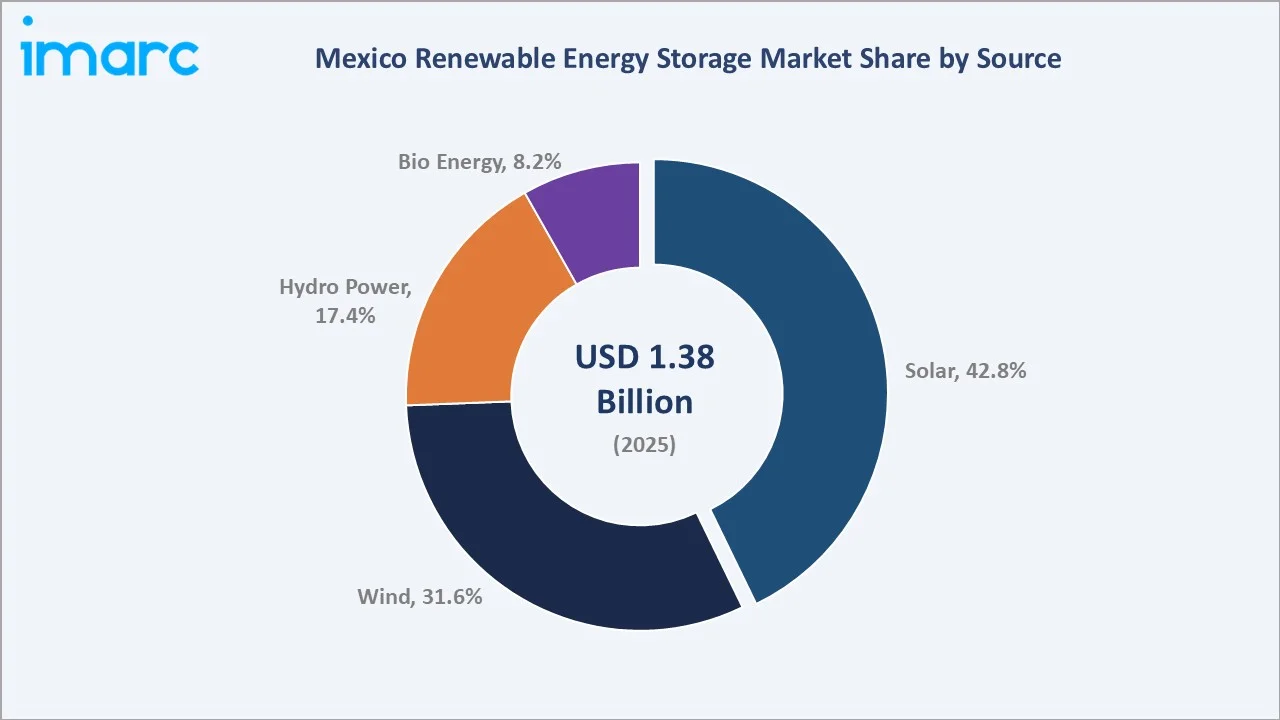
Solar leads at 42.8% (2025), through utility-scale solar BESS, co-located solar BESS for industrial factories, and grid-connected solar-storage hybrid projects.
To access detailed market analysis, Request Sample
Wind at 31.6% reflects Mexico’s strong wind resource base and significant deployment of onshore wind farms. Hydro power at 17.4% reflects hydroelectric complementary battery and emerging pumped hydro. Bio energy at 8.2% reflects biomass cogeneration and biogas storage.
By Application
Industrial leads at 47.3% (2025), through nearshoring factories, mining, energy storage, automotive manufacturing, and large industrial demand charge management.
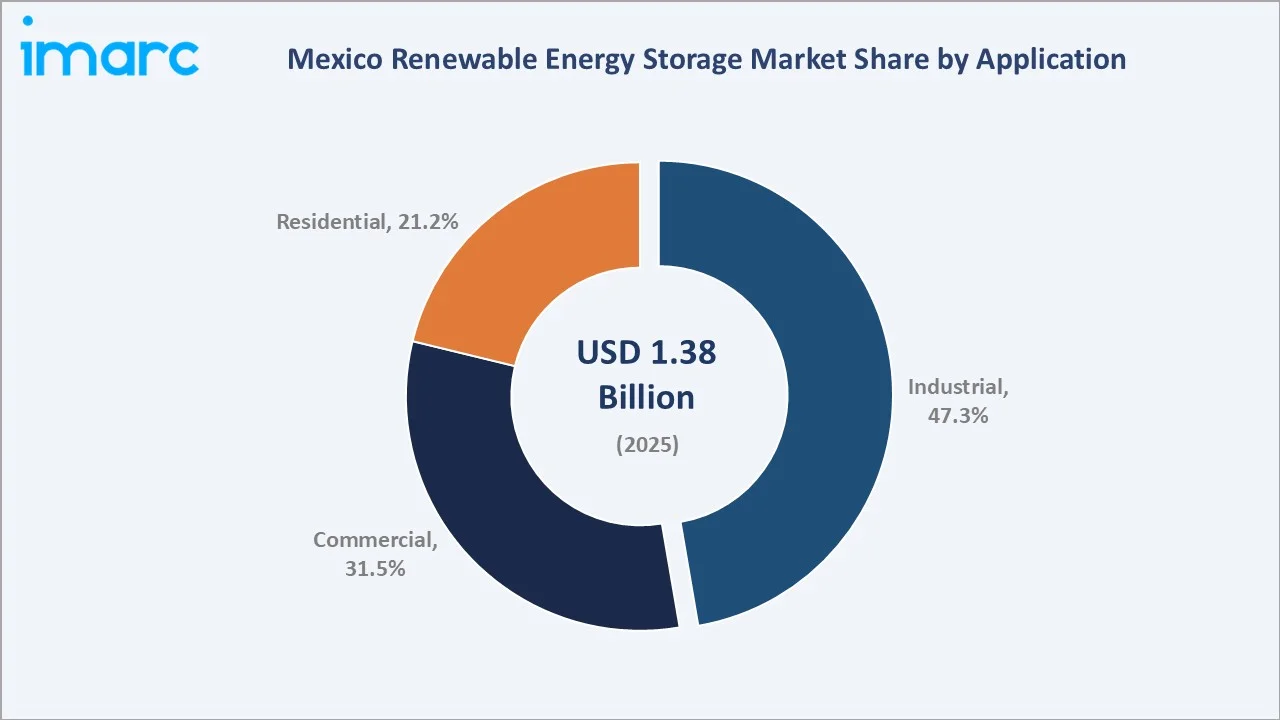
Commercial at 31.5% grows fastest at ~11.5% CAGR through C&I solar BESS, commercial microgrid, and retail demand charge reduction. Residential at 21.2% reflects residential BESS and rural off-grid solar storage electrification.
Regional Market Insights
|
Region |
Share (2025) |
Key Mexico RES Market Drivers & Characteristics |
|
Northern Mexico |
39.6% |
Driven by large-scale solar and wind installations, industrial electricity demand, grid modernization initiatives, and growing cross-border clean energy investments. |
|
Central Mexico |
34.2% |
Benefits from high electricity consumption, commercial and industrial energy storage adoption, distributed solar deployment, and increasing demand for grid stability and backup power solutions. |
|
Southern Mexico |
18.4% |
Supported by renewable energy expansion, rural electrification projects, wind power development, and the growing deployment of solar-plus-storage systems in underserved regions. |
|
Others |
7.8% |
Other regions, including the Bajío, Gulf Coast, and Pacific Coast, are witnessing gradual storage adoption through industrial projects, distributed energy resources, microgrids, and renewable integration initiatives. |
Northern Mexico's 39.6% dominance is supported by large-scale solar and wind projects, strong industrial electricity demand, and proximity to major manufacturing and export hubs. Central Mexico's 34.2% follows with the growing deployment of commercial and industrial energy storage systems to enhance grid reliability and energy resilience.
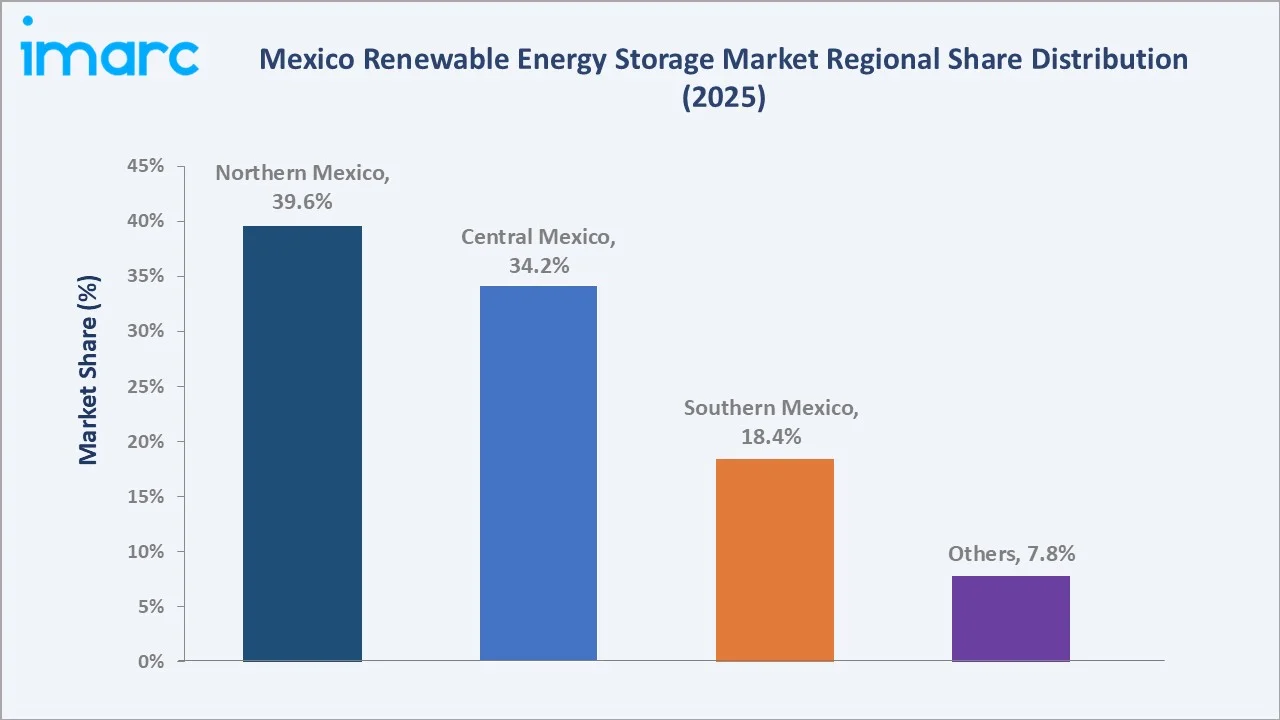
Southern Mexico's 18.4% benefits from renewable energy expansion, particularly wind and rural electrification projects that increasingly incorporate battery storage. Others at 7.8% witnessing rising adoption of distributed storage, microgrids, and solar-plus-storage solutions.
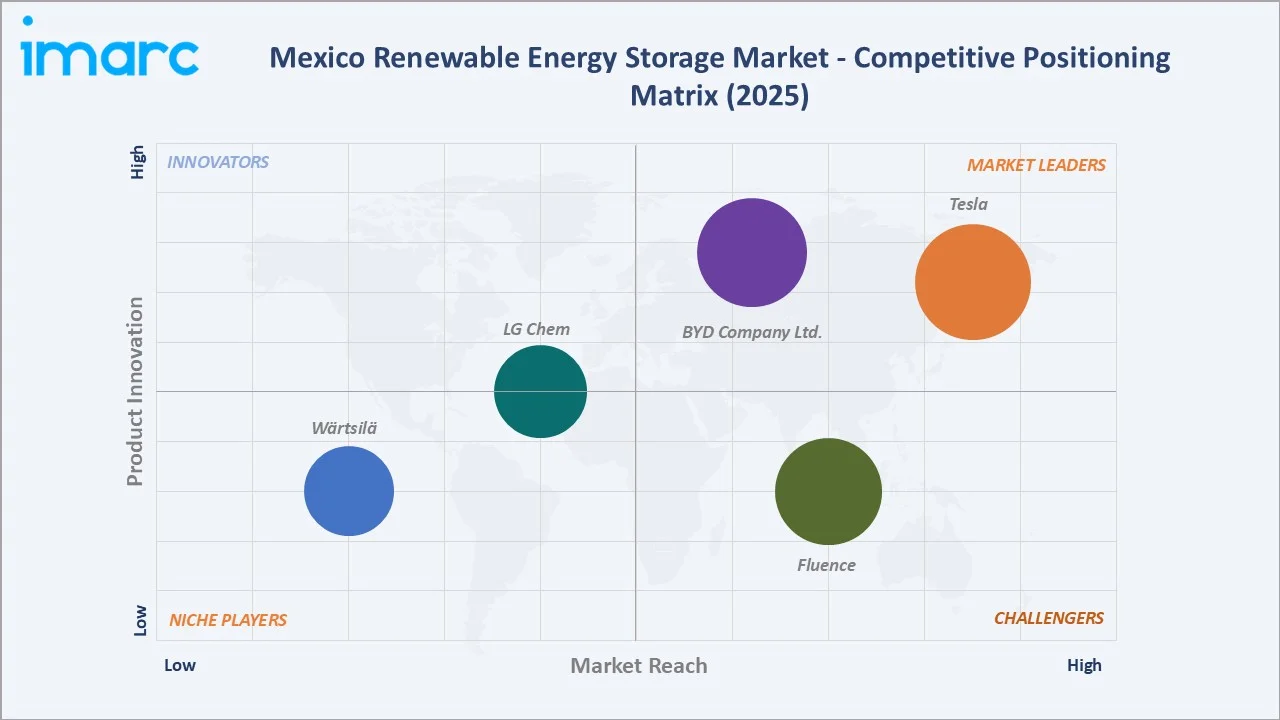
Competitive Landscape
The Mexico renewable energy storage market is moderately concentrated, with participation from global battery manufacturers, power electronics providers, system integrators, renewable energy developers, and utility stakeholders. Major companies are focusing on utility-scale BESS deployments, solar-plus-storage projects, grid stabilization solutions, and industrial energy storage applications. International players leverage advanced lithium-ion technologies, energy management systems, and strong project execution capabilities to strengthen their market position.
|
Company |
Key Products |
Market Position |
Core Strength |
|
Tesla |
Solar Panels, Solar Roof, Powerwall, Megapack |
Market Leader |
Tesla supports Mexico's renewable energy goals by establishing manufacturing infrastructure and deploying battery technology. The company integrates industrial-scale Megapack systems to stabilize solar and wind grid intermittency. |
|
BYD Company Ltd. |
BYD Haohan, MC Cube-T BESS |
Market Leader |
BYD Company Ltd. plays a foundational role in Mexico's renewable energy storage by supplying utility-scale, commercial, and industrial Battery Energy Storage Systems (BESS). |
|
Fluence |
Smartstack, Gridstack Pro, Gridstack |
Strong Challenger |
Fluence (a joint venture between Siemens and AES Corp) plays a crucial role in Mexico's renewable energy sector. |
|
LG Chem |
2170 and 1865 Cylindrical Batteries |
Established Player |
LG Chem, with its subsidiary, LG Energy Solution, is a major vendor in the Mexican lithium-ion battery energy storage market. Its key roles and market activities include: |
|
Wärtsilä |
GridSolve BESS (Quantum High Energy, Quantum2, Quantum3) |
Niche Player |
Wärtsilä acts as a critical technology provider and priority hub. Wärtsilä sees Mexico as a priority and a regional BESS hub in Mexico’s energy storage market. |
Strategic partnerships with renewable energy developers, utilities, and industrial customers are becoming increasingly important as the market expands. Competition is intensifying around system performance, project financing, software capabilities, and long-term service offerings, while new government initiatives are creating additional opportunities for both domestic and international participants.
Key Company Profiles
Tesla
Tesla is a leader in battery energy storage solutions and plays an increasingly important role in Mexico’s renewable energy storage market through its utility-scale and commercial storage technologies. The company’s energy portfolio includes the Megapack utility-scale battery system and Powerwall residential storage solution, which support renewable energy integration, grid stabilization, and backup power applications.
- Key Products: Solar Panels, Solar Roof, Powerwall, Megapack
- Strategic Focus: Expanding the deployment of Megapack utility-scale battery systems and integrated solar-plus-storage solutions to support grid reliability and renewable energy integration.
BYD Company Ltd.
BYD Company Ltd. is one of the leading manufacturers of rechargeable batteries, energy storage systems, and electric vehicles, with a growing presence in Mexico’s renewable energy storage market. The company offers a broad portfolio of Battery Energy Storage System (BESS) solutions for utility-scale, commercial, industrial, and renewable energy integration applications.
- Key Products: BYD Haohan, MC Cube-T BESS.
- Strategic Focus: Expanding utility-scale Battery Energy Storage Systems (BESS), solar-plus-storage projects, and commercial and industrial energy storage solutions to support the country's growing renewable energy capacity.
Market Concentration Analysis
The Mexico renewable energy storage market exhibits a moderately concentrated competitive structure, with a mix of global battery manufacturers, energy storage integrators, power electronics suppliers, and renewable energy developers. Leading players compete through technology innovation, project execution capabilities, and integrated energy management platforms. Market leadership is driven by expertise in utility-scale BESS deployments, solar-plus-storage solutions, and grid integration technologies. While established international firms currently dominate large-scale projects, growing renewable energy investments and supportive policy developments are creating opportunities for new entrants and regional system integrators. Competition is increasingly focused on battery performance, lifecycle costs, software optimization, and long-term service agreements.
Investment & Growth Opportunities
Highest Growth Segments
Solar (~12.5% CAGR), commercial (~11.5% CAGR), industrial (~11.2% CAGR through nearshoring), residential (rural off-grid ~13% CAGR from lower base), green hydrogen storage (~15-18% CAGR from emerging), and Northern Mexico Sonora solar belt (~13% CAGR) represent Mexico renewable energy storage highest-growth investment vectors through 2034.
Investment Themes
- Green hydrogen storage: Growing investments in green hydrogen production create demand for long-duration energy storage systems that can store excess renewable electricity and support industrial decarbonization, offering significant growth opportunities for advanced storage providers.
- Rural off-grid solar storage electrification: Expanding solar-plus-storage systems in remote and underserved communities presents a strong investment opportunity by improving energy access, reducing diesel dependence, and supporting Mexico’s rural electrification initiatives.
Future Market Outlook (2026-2034)
Mexico's renewable energy storage market is projected to grow from USD 1.38 Billion in 2025 to USD 3.54 Billion by 2034, delivering an 11.00% CAGR over the forecast period through PRODESEN renewable mandate, nearshoring industrial demand, falling LFP BESS costs, solar BESS co-location scale, and emerging green hydrogen storage. The market's anchor value of USD 2.33 Billion in 2030 represents Mexico's renewable energy storage market at grid-scale BESS and green hydrogen inflection.
Three structural forces define Mexico's renewable energy storage market growth through 2034. First, the rapid expansion of solar and wind generation is increasing demand for battery storage to manage intermittency and improve grid reliability. Second, ongoing grid modernization, electrification of industry, and EV adoption are creating a greater need for flexible energy storage solutions for peak shaving and load balancing. Third, declining battery costs and advances in energy management technologies are improving project economics, accelerating deployment across utility-scale, commercial, industrial, and off-grid applications.
Research Methodology
Primary Research
Primary research comprised interviews with renewable energy developers, BESS integrators, EPC contractors, utility stakeholders, and industrial power users. Discussions focused on project pipelines, storage adoption trends, technology preferences, pricing, and grid integration challenges. Inputs from industry participants helped validate market assumptions, demand outlook, competitive positioning, and investment opportunities in Mexico’s renewable energy storage market.
Secondary Research
Secondary research encompassed the review of government publications, energy ministry reports, CENACE and CFE data, renewable energy policies, industry association publications, and company annual reports. Additional insights were gathered from energy storage project announcements, technology white papers, investor presentations, and international energy databases. This research helped assess market size, technology trends, regulatory developments, competitive dynamics, and long-term growth prospects for Mexico’s renewable energy storage market.
Forecasting Models
Forecasting models combined bottom-up project pipeline analysis with top-down electricity demand and renewable capacity expansion forecasts to estimate future storage deployments. The methodology incorporated factors such as battery cost declines, renewable energy additions, grid modernization investments, and policy developments. Scenario-based forecasting was applied to assess different adoption rates across utility-scale, commercial, industrial, and off-grid storage segments through 2034.
Mexico Renewable Energy Storage Market Report Coverage:
| Report Features | Details |
|---|---|
| Base Year of the Analysis | 2025 |
| Historical Period | 2020-2025 |
| Forecast Period | 2026-2034 |
| Units | Billion USD |
| Scope of the Report |
Exploration of Historical Trends and Market Outlook, Industry Catalysts and Challenges, Segment-Wise Historical and Future Market Assessment:
|
| Sources Covered | Wind, Hydro Power, Solar, Bio Energy |
| Technologies Covered | Pumped Hydroelectric Storage, Battery Energy Storage, Flywheel Energy Storage, Compressed Air Energy Storage, Thermal Energy Storage, Hydrogen Energy Storage |
| Applications Covered | Residential, Commercial, Industrial |
| Regions Covered | Northern Mexico, Central Mexico, Southern Mexico, Others |
| Companies Covered | Tesla, BYD Company Ltd., Fluence, LG Chem, Wärtsilä, etc. |
| Customization Scope | 10% Free Customization |
| Post-Sale Analyst Support | 10-12 Weeks |
| Delivery Format | PDF and Excel through Email (We can also provide the editable version of the report in PPT/Word format on special request) |
Key Benefits for Stakeholders:
- IMARC's industry report offers a comprehensive quantitative analysis of various market segments, historical and current market trends, market forecasts, and dynamics of the Mexico renewable energy storage market from 2020-2034.
- The research report provides the latest information on the market drivers, challenges, and opportunities in the Mexico renewable energy storage market.
- Porter's five forces analysis assist stakeholders in assessing the impact of new entrants, competitive rivalry, supplier power, buyer power, and the threat of substitution. It helps stakeholders to analyze the level of competition within the Mexico renewable energy storage industry and its attractiveness.
- Competitive landscape allows stakeholders to understand their competitive environment and provides an insight into the current positions of key players in the market.
Frequently Asked Questions About the Mexico Renewable Energy Storage Market Report
The Mexico renewable energy storage market reached USD 1.38 Billion in 2025, driven by rising solar and wind capacity, increasing need for grid stability, and growing demand for battery systems to manage renewable intermittency. Falling BESS costs, industrial power reliability needs, and expanding EV charging and off-grid solar applications are further supporting market growth.
The Mexico renewable energy storage market grows at 11.00% CAGR during 2026-2034, reaching USD 3.54 Billion by 2034. The CAGR reflects PRODESEN mandate, nearshoring, LFP cost, solar BESS co-location, and green hydrogen emerging.
Solar leads at 42.8% due to Mexico’s strong solar irradiation and expanding utility-scale PV capacity. Its intermittent generation profile increases the need for battery storage to shift excess daytime power and support grid stability.
Industrial leads at 47.3% as manufacturing, mining, and large commercial facilities require reliable power, peak-load management, and backup energy solutions. Storage systems help reduce outage risks, manage electricity costs, and support renewable energy use in industrial operations.
Northern Mexico leads at 39.6% due to its strong solar and wind resource base, high industrial electricity demand, and concentration of manufacturing hubs. The region’s need for reliable power and grid flexibility supports higher adoption of renewable energy storage systems.
Leading companies include Tesla, BYD Company Ltd., Fluence, LG Chem, and Wärtsilä, among others.
The market is projected to reach approximately USD 2.33 Billion by 2030, supported by rising solar and wind integration, grid modernization, and expanding BESS deployment. Growth will be further driven by industrial power reliability needs and increasing adoption of solar-plus-storage projects.
Three priority investment opportunities stand out in Mexico’s renewable energy storage market. Utility-scale solar-plus-storage projects offer significant potential as developers seek to improve renewable energy dispatchability and grid reliability. Green hydrogen storage infrastructure presents a long-term opportunity by enabling the storage of excess renewable electricity for industrial decarbonization applications. Additionally, rural off-grid electrification and microgrid systems are attracting investment as solar-plus-storage solutions provide reliable and cost-effective power to underserved communities.
Need more help?
- Speak to our experienced analysts for insights on the current market scenarios.
- Include additional segments and countries to customize the report as per your requirement.
- Gain an unparalleled competitive advantage in your domain by understanding how to utilize the report and positively impacting your operations and revenue.
- For further assistance, please connect with our analysts.
 Request Customization
 Speak to an Analyst
 Request Brochure
 Inquire Before Buying
Benefits of Customization
- Personalize this research
- Triangulate with your data
- Get data as per your format and definition
- Gain a deeper dive into a specific application, geography, customer, or competitor
- Any level of personalization
Get in Touch With Us
UNITED STATES
Phone: +1-201-971-6302
INDIA
Phone: +91-120-433-0800
UNITED KINGDOM
Phone: +44-753-714-6104
Email: [email protected]
Client Testimonials




.webp)




.webp)













Related Reports

Choose your plan
*Please note that the prices mentioned below are starting prices for each bundle type. Kindly contact our team for further details.*
Single User License
- 1 User License, Access on 2 Devices
- PDF Report + Excel Dataset (Password Protected)
- Lifetime Access
- No Printing Rights
- 10% Free Report Customization
- 10–12 Weeks of Analyst Support
Five User License
- Access for 5 Users, 2 Devices per User
- PDF Report + Excel Dataset (Password Protected)
- Lifetime Access
- Dedicated Account Manager
- 12–14 Weeks of Analyst Support
- No Printing Rights
- 15% Free Report Customization
- 25% Discount on Your Next Purchase
Corporate User License
- Unlimited User Access (Within Your Organization)
- PDF Report + Excel Dataset
- Lifetime Access
- Dedicated Account Manager
- 14–20 Weeks of Analyst Support
- No Printing Rights
- 20% Free Report Customization
- 30% Discount on Your Next Purchase
Essential Insights
What's included:
3 reports
- Lifetime Access
- PDF Reports
- Excel Datasets
- 2 Weeks of Free Analyst Support
- 2 User Licenses
- Access on 2 Devices
- Printing Rights
- Complimentary PowerPoint (PPT) Version
- Complimentary License Upgrade
Professional Access
What's included:
5 reports
- Lifetime Access
- PDF Reports
- Excel Datasets
- 8 Weeks of Free Analyst Support
- 2 User Licenses
- Access on 2 Devices
- Printing Rights
- Complimentary PowerPoint (PPT) Version
- Complimentary License Upgrade
Business Advantage
What's included:
8 reports
- Lifetime Access
- PDF Reports
- Excel Datasets
- 14 Weeks of Free Analyst Support
- 2 User Licenses
- Access on 2 Devices
- Printing Rights
- Complimentary PowerPoint (PPT) Version
- Complimentary License Upgrade
Enterprise Intelligence
What's included:
10 reports
- Lifetime Access
- PDF Reports
- Excel Datasets
- 20 Weeks of Free Analyst Support
- 2 User Licenses
- Access on 2 Devices
- Printing Rights
- Complimentary PowerPoint (PPT) Version
- Complimentary License Upgrade