
Modal Fiber Market Size, Share, Trends and Forecast by Type, Application, and Region, 2026-2034
Modal Fiber Market Size and Share:
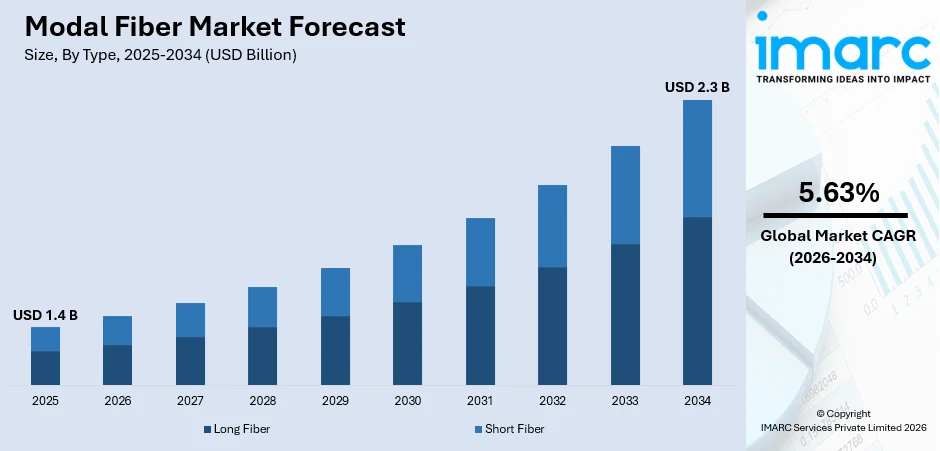
The global modal fiber market size was valued at USD 1.4 Billion in 2025. Looking forward, IMARC Group estimates the market to reach USD 2.3 Billion by 2034, exhibiting a CAGR of 5.63% from 2026-2034. North America currently dominates the market, holding a market share of 38% in 2025. The region benefits from a well-established textile manufacturing infrastructure, rising consumer preference for sustainable and premium-quality fabrics, and the growing adoption of cellulose-based fibers in fashion and home textile segments, contributing to the modal fiber market share.
The rising global awareness regarding sustainable and eco-friendly textile materials is a primary factor driving the market growth. Modal fiber, derived from beechwood pulp through a resource-efficient manufacturing process, is increasingly preferred over conventional synthetic and cotton-based alternatives due to its biodegradable nature and lower water consumption during production. The expanding fashion and apparel industry worldwide, coupled with the growing inclination towards premium-quality innerwear, loungewear, and activewear made from soft and breathable fabrics, is further propelling demand. Additionally, the increasing integration of modal fibers in home textile applications, including bedding, towels, and upholstery, is supporting the modal fiber market outlook.
The United States has emerged as a major region in the modal fiber market owing to many factors. The country has witnessed a significant shift in consumer preferences towards sustainable and responsibly sourced textile materials, driving demand for cellulose-based fibers, such as modal. The well-developed retail and e-commerce infrastructure in the United States facilitates widespread distribution of modal fiber-based apparel and home textiles. As per IMARC Group, the United States e-commerce market size reached USD 1,236.5 Billion in 2025. Furthermore, the emphasis on innovation in textile manufacturing technologies and the adoption of closed-loop production processes by domestic manufacturers are supporting market penetration.
To get more information on this market Request Sample
Modal Fiber Market Trends:
Rising Demand for Sustainable Textiles
The escalating global demand for sustainable and environmentally responsible textile materials is serving as a key trend in the modal fiber market. Consumers across developed and emerging economies are increasingly prioritizing eco-friendly products, driven by heightened awareness about the ecological impact associated with conventional textile production. Modal fiber, produced from sustainably sourced beechwood pulp using a closed-loop manufacturing process, presents a compelling alternative to petroleum-based synthetic fibers and resource-intensive natural fibers. The growing adoption of circular economy principles by leading fashion brands, combined with regulatory initiatives promoting responsible textile sourcing and production, is further reinforcing consumer confidence in modal fiber as a preferred sustainable fabric choice. Additionally, increasing transparency in supply chains and the use of sustainability certifications are strengthening the credibility of modal fiber, aligning it more closely with consumer expectations for ethically produced and environmentally responsible textiles.
Technological Advancements in Fiber Production
The continuous technological advancements in cellulose fiber production processes are contributing significantly to the modal fiber market trends. Manufacturers are investing in innovative spinning techniques, including micro technology that enables the production of finer and softer yarns with enhanced drape and comfort characteristics. These innovations are expanding the application scope of modal fibers across premium apparel categories, such as lingerie, activewear, and luxury home textiles. For instance, in February 2026, the Lenzing Group and KARL MAYER debuted a joint innovation project during Premiere Vision Paris, demonstrating scalable methods for processing modal fibers with Micro Technology on warp knitting machines for high-quality textile applications. The emergence of dope dyeing technologies that integrate color directly during the fiber spinning process is reducing water consumption and chemical usage in downstream finishing operations, further enhancing the sustainability credentials of modal fiber products.
Growing Athleisure and Comfort Apparel Adoption
The expanding global athleisure and comfort apparel segment is impelling the modal fiber market growth. The shift in consumer preferences towards versatile clothing that seamlessly transitions between casual, fitness, and work environments has amplified demand for fabrics offering superior softness, breathability, and moisture management capabilities. Modal fiber, with its inherent moisture-wicking properties and silk-like texture, is increasingly utilized in athleisure garments, loungewear, and performance innerwear. This trend is particularly pronounced among urban consumers seeking all-day comfort without compromising on style. Apparel brands are increasingly blending modal fiber with cotton, elastane, and other fibers to enhance stretch, durability, and fit in athleisure products. The rise of remote and hybrid work culture has further boosted demand for comfortable yet presentable clothing, supporting greater modal fiber usage. The ETHRWorld Workplace Trends 2025 Report, based on insights from more than 250 HR leaders throughout India and Asia, stated that 53% of organizations officially adopted a hybrid work model.
Modal Fiber Industry Segmentation:
IMARC Group provides an analysis of the key trends in each segment of the global modal fiber market, along with forecast at the global and regional levels from 2026-2034. The market has been categorized based on type and application.

Analysis by Type:
- Long Fiber
- Short Fiber
Long fiber holds 62% of the market share. Long modal fiber is a specialized variant of cellulose-based fiber characterized by its extended staple length, high tensile strength, and superior drape characteristics. Because of these qualities, it is the perfect material for high-end textile applications, such as fashion clothing, home furnishings, and premium apparel. Long fiber modal provides improved color retention and durability, allowing consistent performance across numerous cycles of washing and use. The segment gains from the growing demand in the luxury and mid-range fashion industries for cozy and attractive fabrics. The market potential within the segment is being further expanded by consumers' growing desire for blended fabrics, which combine long modal fiber with cotton and other natural materials.
Analysis by Application:
Access the comprehensive market breakdown Request Sample
- Textile
- Others
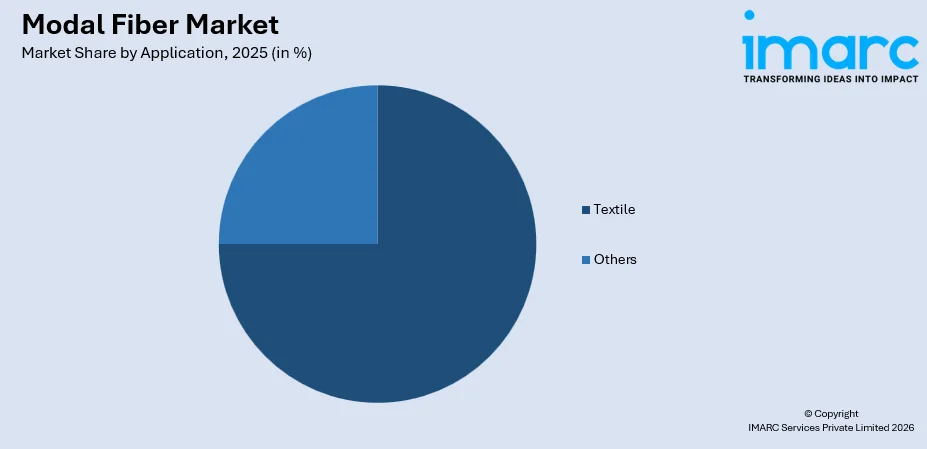
Textile leads the market with a share of 75%. The textile segment encompasses the utilization of modal fiber in the manufacturing of a diverse range of fabric-based products, including apparel, innerwear, home textiles, and industrial fabrics. Because of modal fiber’s remarkable softness, lightweight feel, and moisture-management properties, it is highly prized in the textile industry and is used for high-end home textile applications as well as next-to-skin clothing. Modal fiber is becoming more popular in this segment, as consumers move towards sustainable and biodegradable textile products. The performance and adaptability of textiles made from modal fibers are being improved in international markets through the incorporation of cutting-edge mixing and coloring methods. Additionally, increasing capacity expansion projects and expenditures by textile manufacturers in sustainable fiber substitutes are solidifying the textile segment's leading position in the market.
Regional Analysis:
To get more information on the regional analysis of this market Request Sample
- North America
- Asia-Pacific
- Europe
- Latin America
- Middle East and Africa
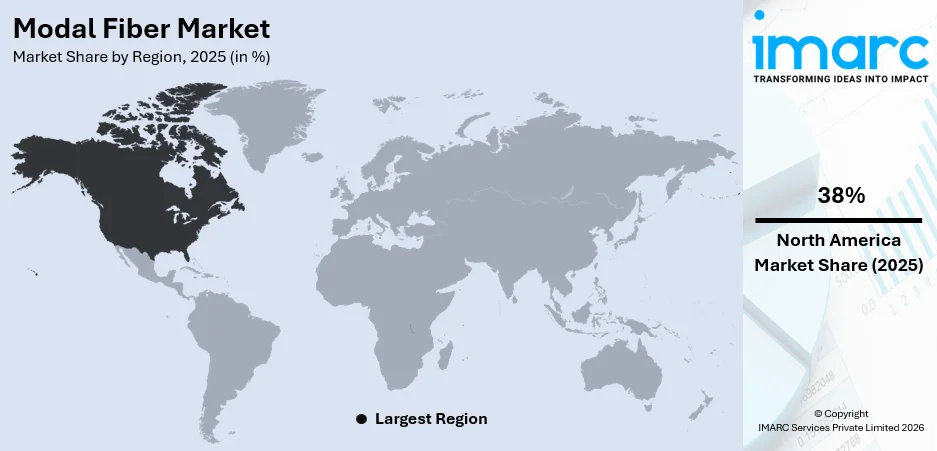
North America, accounting for 38% of the share, enjoys the leading position in the market. The region benefits from a mature textile manufacturing ecosystem, strong retail and e-commerce distribution channels, and a growing consumer base that prioritizes sustainable and premium-quality fabric products. As per IMARC Group, the United States textile market size reached USD 196.0 Billion in 2025. The presence of leading fashion and home textile brands that have integrated modal fiber into their product lines is further reinforcing regional demand. Additionally, increasing investments in advanced cellulose fiber processing technologies and the expansion of domestic manufacturing capabilities for semi-synthetic fibers are strengthening the overall market positioning of North America in the global modal fiber landscape. Furthermore, supportive sustainability-focused regulations and brand commitments to reduce carbon footprints are accelerating the adoption of modal fiber across apparel and home textile applications in the region.
Key Regional Takeaways:
United States Modal Fiber Market Analysis
The United States represents a significant contributor to the market, driven by a combination of evolving consumer preferences and robust industrial infrastructure. The country has experienced a notable shift towards sustainable textile consumption, with consumers increasingly seeking garments and home textiles made from eco-friendly and biodegradable materials. The well-established retail landscape, complemented by a rapidly expanding e-commerce sector, facilitates widespread availability of modal fiber-based products across diverse price segments. The growing demand for premium innerwear, loungewear, and athleisure apparel made from soft and breathable fabrics is particularly driving modal fiber adoption in the country. Furthermore, the emphasis on supply chain transparency and certification programs for sustainably sourced fibers is enhancing consumer trust and supporting long-term market growth. The presence of advanced research and development (R&D) facilities focused on cellulose fiber innovation continues to strengthen the modal fiber market forecast across the United States.
Europe Modal Fiber Market Analysis
Europe represents a substantial market for modal fiber, supported by the region's strong tradition in textile manufacturing and its leadership in implementing sustainability-focused regulatory frameworks. The European Union's Strategy for Sustainable and Circular Textiles, which mandates that textile products placed on the EU market must be durable, repairable, and recyclable by 2030, is accelerating the adoption of cellulose-based fibers, including modal. The region is home to leading modal fiber producers, most notably in Austria, where advanced closed-loop production technologies have been developed and refined over decades. The growing emphasis on Digital Product Passports and ecodesign requirements for textiles is further encouraging brands to incorporate transparently sourced modal fiber into their product portfolios, strengthening market demand across European consumer segments.
Asia-Pacific Modal Fiber Market Analysis
The Asia-Pacific region is experiencing robust growth in the modal fiber market, driven by the rapid expansion of the textile and apparel manufacturing industry across key economies. Countries, such as China, India, and Southeast Asian nations, serve as major production hubs for textile goods, creating significant demand for high-quality cellulose-based fibers. The rising disposable incomes, accelerating urbanization, and growing middle-class populations across the region are fueling consumer spending on premium and sustainable fabric products. As per Trading Economics, in 2023, disposable personal income in India rose to 296383300 INR Million. The increasing adoption of modern textile processing technologies and expanding domestic consumption markets across Asia-Pacific economies are supporting sustained modal fiber demand growth.
Latin America Modal Fiber Market Analysis
Latin America is emerging as a promising market for modal fiber, driven by the gradual expansion of the regional textile industry and increasing consumer awareness regarding sustainable fabric alternatives. Countries, such as Brazil and Argentina, are witnessing growing demand for premium and eco-friendly textile products, supported by rising disposable incomes and evolving fashion trends. The improving manufacturing infrastructure and expanding distribution networks across Latin American economies are expected to facilitate broader market penetration for modal fiber-based products.
Middle East and Africa Modal Fiber Market Analysis
The Middle East and Africa region presents emerging growth opportunities for the modal fiber market, supported by the expanding textile import sector and gradually evolving consumer preferences. The region is witnessing increasing demand for high-quality fabric products driven by urbanization, population growth, and improving living standards across key economies. The development of textile manufacturing capabilities and growing investment in retail infrastructure across the region are expected to create incremental market opportunities for modal fiber products.
Competitive Landscape:
The global modal fiber market is characterized by the presence of several established players that are actively investing in production capacity expansion, technological innovation, and sustainable manufacturing practices to strengthen their competitive positioning. Key market participants are focusing on developing advanced cellulose fiber variants with enhanced properties, such as finer titers, improved moisture management, and superior color retention, to address the evolving requirements of the textile industry. Strategic partnerships between fiber producers and downstream textile manufacturers are enabling the development of scalable, industrial solutions that broaden the application scope of modal fiber across premium apparel, home textile, and nonwoven categories. Additionally, companies are prioritizing the adoption of closed-loop production processes, certified sustainable wood sourcing, and reduced carbon emission technologies to align with global environmental standards and meet the increasing consumer demand for responsibly manufactured fiber products.
The report provides a comprehensive analysis of the competitive landscape in the modal fiber market with detailed profiles of all major companies.
Modal Fiber Report Scope:
| Report Features | Details |
|---|---|
| Base Year of the Analysis | 2025 |
| Historical Period | 2020-2025 |
| Forecast Period | 2026-2034 |
| Units | Billion USD |
| Scope of the Report |
Exploration of Historical Trends and Market Outlook, Industry Catalysts and Challenges, Segment-Wise Historical and Future Market Assessment:
|
| Types Covered | Long Fiber, Short Fiber |
| Applications Covered | Textile, Others |
| Region Covered | North America, Asia Pacific, Europe, Latin America, Middle East and Africa |
| Customization Scope | 10% Free Customization |
| Post-Sale Analyst Support | 10-12 Weeks |
| Delivery Format | PDF and Excel through Email (We can also provide the editable version of the report in PPT/Word format on special request) |
Key Benefits for Stakeholders:
- IMARC's report offers a comprehensive quantitative analysis of various market segments, historical and current market trends, market forecasts, and dynamics of the modal fiber market from 2020-2034.
- The research study provides the latest information on the market drivers, challenges, and opportunities in the global modal fiber market.
- The study maps the leading, as well as the fastest-growing, regional markets.
- Porter's Five Forces analysis assists stakeholders in assessing the impact of new entrants, competitive rivalry, supplier power, buyer power, and the threat of substitution. It helps stakeholders to analyze the level of competition within the modal fiber industry and its attractiveness.
- Competitive landscape allows stakeholders to understand their competitive environment and provides an insight into the current positions of key players in the market.
Frequently Asked Questions About the Modal Fiber Market Report
The modal fiber market was valued at USD 1.4 Billion in 2025.
The modal fiber market is projected to exhibit a CAGR of 5.63% during 2026-2034, reaching a value of USD 2.3 Billion by 2034.
The key factors driving the modal fiber market include the rising global demand for sustainable and eco-friendly textile materials, increasing consumer preferences for premium-quality innerwear and apparel made from soft and breathable fabrics, and the expanding adoption of cellulose-based fibers in home textile and athleisure applications.
North America currently dominates the modal fiber market, accounting for a share of 38%. The region benefits from a well-established textile manufacturing infrastructure, strong consumer preference for sustainable fabric products, and growing investments in advanced cellulose fiber processing technologies.
Need more help?
- Speak to our experienced analysts for insights on the current market scenarios.
- Include additional segments and countries to customize the report as per your requirement.
- Gain an unparalleled competitive advantage in your domain by understanding how to utilize the report and positively impacting your operations and revenue.
- For further assistance, please connect with our analysts.
 Request Customization
 Speak to an Analyst
 Request Brochure
 Inquire Before Buying
Benefits of Customization
- Personalize this research
- Triangulate with your data
- Get data as per your format and definition
- Gain a deeper dive into a specific application, geography, customer, or competitor
- Any level of personalization
Get in Touch With Us
UNITED STATES
Phone: +1-201-971-6302
INDIA
Phone: +91-120-433-0800
UNITED KINGDOM
Phone: +44-753-714-6104
Email: [email protected]
Client Testimonials




.webp)




.webp)













Related Reports

Choose your plan
*Please note that the prices mentioned below are starting prices for each bundle type. Kindly contact our team for further details.*
Single User License
- 1 User License, Access on 2 Devices
- PDF Report + Excel Dataset (Password Protected)
- Lifetime Access
- No Printing Rights
- 10% Free Report Customization
- 10–12 Weeks of Analyst Support
Five User License
- Access for 5 Users, 2 Devices per User
- PDF Report + Excel Dataset (Password Protected)
- Lifetime Access
- Dedicated Account Manager
- 12–14 Weeks of Analyst Support
- No Printing Rights
- 15% Free Report Customization
- 25% Discount on Your Next Purchase
Corporate User License
- Unlimited User Access (Within Your Organization)
- PDF Report + Excel Dataset
- Lifetime Access
- Dedicated Account Manager
- 14–20 Weeks of Analyst Support
- No Printing Rights
- 20% Free Report Customization
- 30% Discount on Your Next Purchase
Essential Insights
What's included:
3 reports
- Lifetime Access
- PDF Reports
- Excel Datasets
- 2 Weeks of Free Analyst Support
- 2 User Licenses
- Access on 2 Devices
- Printing Rights
- Complimentary PowerPoint (PPT) Version
- Complimentary License Upgrade
Professional Access
What's included:
5 reports
- Lifetime Access
- PDF Reports
- Excel Datasets
- 8 Weeks of Free Analyst Support
- 2 User Licenses
- Access on 2 Devices
- Printing Rights
- Complimentary PowerPoint (PPT) Version
- Complimentary License Upgrade
Business Advantage
What's included:
8 reports
- Lifetime Access
- PDF Reports
- Excel Datasets
- 14 Weeks of Free Analyst Support
- 2 User Licenses
- Access on 2 Devices
- Printing Rights
- Complimentary PowerPoint (PPT) Version
- Complimentary License Upgrade
Enterprise Intelligence
What's included:
10 reports
- Lifetime Access
- PDF Reports
- Excel Datasets
- 20 Weeks of Free Analyst Support
- 2 User Licenses
- Access on 2 Devices
- Printing Rights
- Complimentary PowerPoint (PPT) Version
- Complimentary License Upgrade