Asia vs Europe Barium Carbonate Prices: India at USD 500/MT Trails Belgium’s USD 734/MT
07-Jan-2026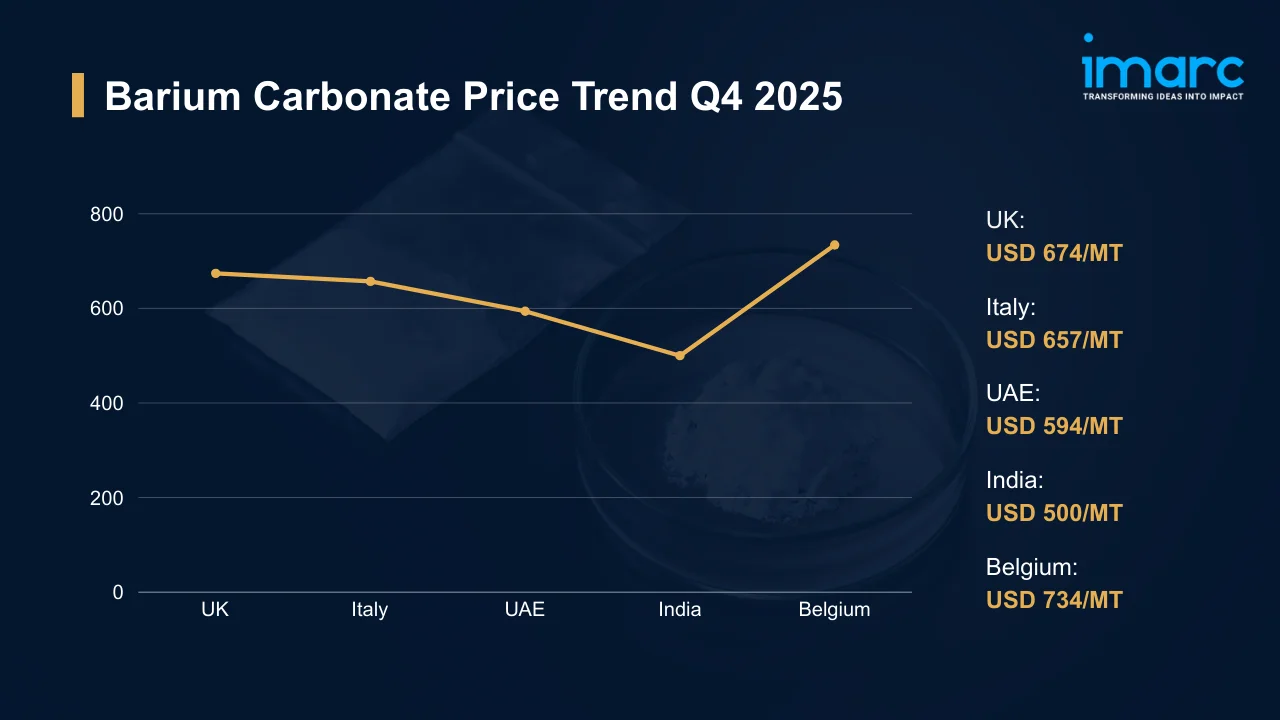
Barium carbonate is a white crystalline inorganic powder characterized by its insolubility in water and solubility in acidic solutions, with a high melting point. The compound serves critical functions across ceramics, specialty glass, electronics, brick and tile manufacturing, and chemical synthesis. Its pricing sensitivity is primarily governed by fluctuations in upstream barite ore and soda ash costs, energy expenditure during thermal processing, freight logistics on key trade lanes, and demand cycles within the construction and ceramics industries.
Global Market Overview:
Globally, the barium carbonate industry was valued at USD 733.10 Million in 2025. Market projections indicate steady growth, with the industry expected to reach USD 1,125.01 Million by 2034, with a compound annual growth rate (CAGR) of 4.87% during 2026-2034. Escalating consumption from the glass manufacturing sector remains a principal catalyst, as producers increasingly rely on barium carbonate to enhance optical clarity and thermal resilience in specialty glass formulations. Parallel expansion within the ceramics industry, driven by urbanization and infrastructure modernization across emerging economies, sustains robust procurement volumes. Stricter environmental mandates worldwide are further accelerating adoption, as the compound facilitates cleaner production processes and waste neutralization. Advances in electronics-grade applications and the proliferation of electric vehicle (EV) components continue to diversify end use demand, reinforcing positive long-term market trajectories.
Barium Carbonate Price Trend Q4 2025:
Regional prices (USD per MT) and QoQ changes vs Q3 2025:
| Region | Price (USD/MT) | QoQ Change | Direction |
|---|---|---|---|
| UK | 674 | -1.89% | ↓ |
| Italy | 657 | -2.09% | ↓ |
| UAE | 594 | -1.82% | ↓ |
| India | 500 | -0.99% | ↓ |
| Belgium | 734 | -2.00% | ↓ |
To access real-time prices Request Sample
What Moved Prices:
- UK: Barium carbonate prices in the UK fell to USD 674/MT in Q4 2025, due to the continued muted demand for downstream ceramics and specialty glass. Buyers' eagerness to refill was reduced by having adequate inventory locations throughout important distribution hubs. While inland cost pressures were lessened by moderating ocean freight prices on Asia-Europe corridors, local supplier margins were constrained by the ongoing availability of competitively priced 500 Chinese-origin commodities. Stable natural gas storage levels reduced energy-related surcharges included in production cost structures, and normalized port operations enabled more seamless import flows, which contributed to the quarter's lower pricing trend.
- Italy: Due to cautious buying practices by producers of tile, sanitaryware, and glaze, barium carbonate prices in Italy fell to USD 657/MT in Q4 2025. Energy-related cost pass-throughs that had previously supported higher price floors were balanced by improved European gas systems. While softening container spot pricing on major shipping routes swung contract discussions in favor of buyers, steady import volumes from Asian suppliers kept market availability satisfactory. Frit manufacturers implemented conservative procurement practices in line with shortened seasonal production schedules, and traders' competitive tendering activity also aided in the quarterly decline in assessed values.
- UAE: In the fourth quarter of 2025, barium carbonate prices in the UAE eased to USD 594/MT as distributors navigated ample supply conditions coupled with aggressive pricing from Asian producers. The pegged-currency framework maintained predictable import parity, while declining spot freight on Asia-Gulf shipping lanes trimmed CIF cost components. Although construction and ceramics consumption held at stable levels, demand expansion remained limited, prompting leaner inventory replenishment cycles among major distributors. Efficient free-zone throughput and reduced port dwell charges further alleviated logistical cost burdens, enabling buyers to negotiate more favorable terms.
- India: During Q4 2025, barium carbonate prices in India softened to USD 500/MT as ceramic manufacturers moderated raw material intake following the extended monsoon-season slowdown. Comfortable import availability, bolstered by consistent Chinese-origin supply flows, prevented any tightening of domestic inventories. Declining container spot rates improved landed cost economics for importers operating through western and southern port gateways. Procurement activity concentrated on short-cycle purchases rather than long-term contractual commitments, suppressing upward price momentum. Domestic logistics networks stabilized after earlier weather-related disruptions, ensuring uninterrupted distribution to key ceramic manufacturing clusters.
- Belgium: In Q4 2025, barium carbonate prices in Belgium fell to USD 734/MT as European ceramics and specialty glass demand sustained its conservative posture. Sufficient inventory levels across wholesale channels reduced purchasing urgency, while steady import flows through major seaports ensured reliable material availability. Moderating freight costs and increasingly predictable natural gas balances lowered risk premiums incorporated into supplier offers. Buyers prioritized just-in-time procurement with tighter quality specifications, intensifying competitive pressure among traders. The cumulative effect of disciplined purchasing patterns and favorable logistics economics drove assessed prices downward relative to preceding quarter benchmarks.
Drivers Influencing the Market:
Several factors continue to shape barium carbonate pricing and market behavior:
- Ceramics and Glass Sectors Demand: Sustained consumption from ceramics and specialty glass manufacturers underpins baseline procurement volumes for barium carbonate globally. Urbanization initiatives and residential construction programs across emerging markets generate consistent orders, while seasonal production cycles in tile and sanitaryware facilities introduce periodic variability in purchasing patterns across wholesale distribution channels.
- Upstream Barite and Soda Ash Costs: Fluctuations in barite ore extraction economics and soda ash pricing directly influence barium carbonate production expenses. Mining disruptions, permitting delays at key extraction sites, and supply-chain bottlenecks in precursor chemical delivery amplify cost volatility, compelling manufacturers to adjust finished product valuations in response to shifting upstream raw material market conditions.
- Energy Expenditure in Thermal Processing: Natural gas and electricity costs remain critical determinants of barium carbonate production economics, particularly in energy-intensive calcination and carbonation stages. Regional disparities in gas pricing, seasonal storage dynamics, and renewable energy integration rates create differentiated cost structures that shape competitive positioning among producers operating across distinct geographic markets.
- Ocean Freight and Logistics Economics: Container shipping rates on major Asia-Europe and Asia-Gulf trade corridors exert measurable influence on landed barium carbonate costs in import-dependent markets. Port congestion levels, vessel scheduling reliability, and terminal handling efficiency collectively determine transportation cost components that suppliers embed within contract pricing and spot market quotations.
- Environmental and Regulatory Compliance: Tightening environmental regulations governing barium compound handling, storage, and disposal protocols raise operational compliance expenditures for producers and distributors. Registration and evaluation requirements under chemical safety frameworks impose additional administrative and testing costs, which progressively filter into market pricing across jurisdictions with stringent regulatory enforcement mechanisms.
- Trade Policy and Currency Dynamics: Export restrictions from major producing nations, tariff adjustments, and currency fluctuations reshape competitive trade flows within global barium carbonate markets. Pegged-currency regimes in Gulf economies stabilize import parity, while exchange-rate volatility in emerging markets introduces procurement cost uncertainty that influences buyer hedging strategies and contract negotiation approaches.
Recent Highlights & Strategic Developments:
Recent strategic moves within the industry further illustrate evolving dynamics:
- In January 2025, researchers unveiled a novel one-step synthesis method employing amino acid mediation for the direct conversion of carbon dioxide into barium carbonate nanoparticles. The technique utilized glycine to facilitate CO2 absorption and subsequent mineralization under mild reaction conditions, yielding high-purity barium carbonate as a value-added inorganic product. This advancement presented a promising pathway for carbon capture and utilization initiatives.
Outlook & Strategic Takeaways:
Looking ahead, the barium carbonate market is expected to maintain gradual expansion through 2034, supported by sustained ceramics and glass industry consumption alongside emerging electronics-grade applications. Feedstock cost trajectories will remain the pivotal variable influencing supplier margin structures.
To navigate this complex landscape, stakeholders should:
- Monitor Regional Price Differentials: Track quarterly pricing variations across key supply regions to identify cost-saving procurement windows. Establish benchmarking protocols that compare landed costs against prevailing contract rates for optimal sourcing decisions.
- Assess Freight Market Developments: Monitor container shipping rate trends on Asia-Europe and Asia-Gulf corridors to anticipate landed cost movements. Negotiate flexible logistics contracts that incorporate rate adjustment mechanisms tied to prevailing spot market conditions.
- Evaluate Downstream Demand Indicators: Track construction activity indices, ceramics production output, and specialty glass order books across principal consumption regions. Correlate demand signals with procurement planning cycles to optimize inventory positioning and avoid overstocking.
- Review Regulatory Compliance Expenditures: Audit current compliance costs associated with barium compound handling, storage, and environmental discharge requirements. Identify operational efficiencies that reduce regulatory burden without compromising adherence to chemical safety obligations.
- Strengthen Currency Exposure Management: Implement hedging strategies for procurement denominated in volatile currencies to stabilize landed cost projections. Coordinate treasury and procurement functions to align foreign exchange coverage with anticipated import payment timelines.
- Explore Emerging Application Segments: Investigate growth potential within electronics-grade barium carbonate and carbon capture utilization markets for portfolio diversification. Engage with research partners to assess commercial viability of novel applications that may expand addressable demand.
Subscription Plans & Customization:
IMARC offers flexible subscription models to suit varying needs:
- Monthly Updates — 12 deliverables/year
- Quarterly Updates — 4 deliverables/year
- Biannual Updates — 2 deliverables/year
Each includes detailed datasets (Excel + PDF) and post-report analyst support.
Get in Touch With Us
UNITED STATES
Phone: +1-201-971-6302
INDIA
Phone: +91-120-433-0800
UNITED KINGDOM
Phone: +44-753-714-6104
Email: [email protected]
Client Testimonials




.webp)




.webp)












