Bulk Oxygen Price Update: Sustained Growth Across Key Markets in Q1 2026
12-Feb-2026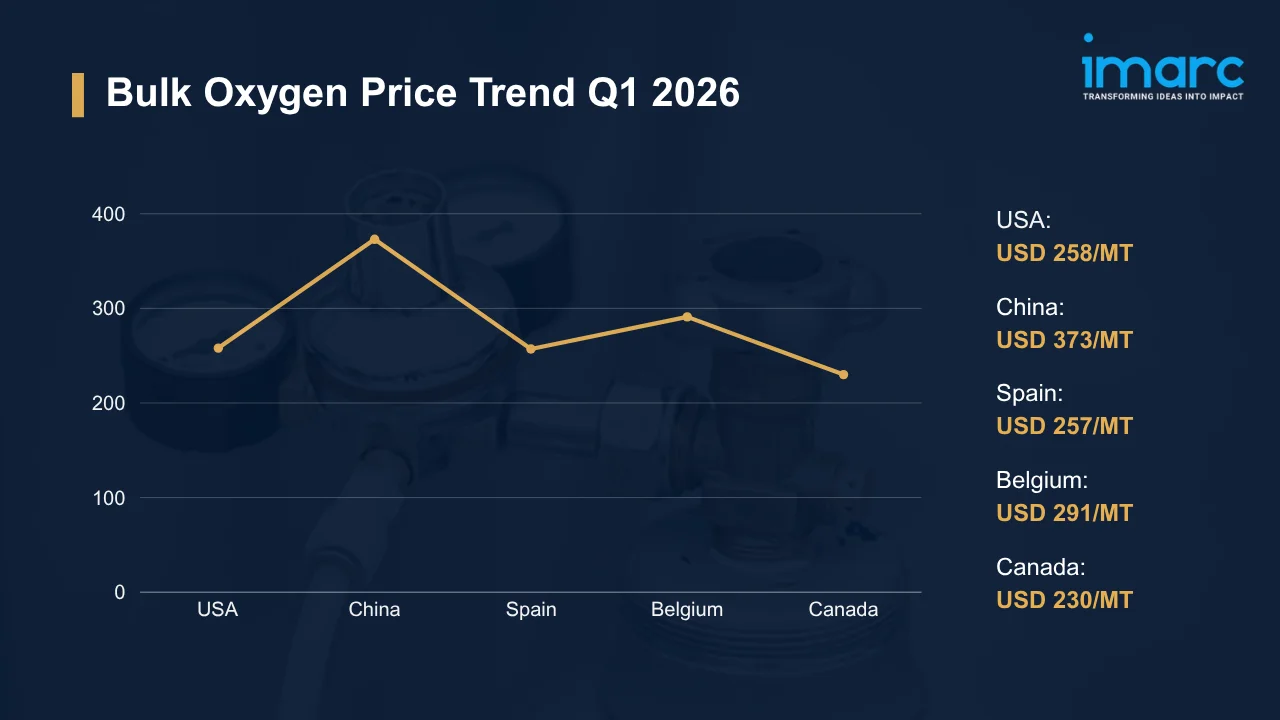
At 99.5%-plus purity, bulk oxygen is a cryogenically separated industrial gas that reaches customers through dedicated insulated tanker fleets or fixed pipeline connections. Steel furnaces, hospital wards, and chemical plants absorb most output. Governing bulk oxygen prices are the electricity and natural gas costs underpinning air separation plant economics, the logistics burden of temperature-controlled tanker operations, and cyclical demand patterns tied to industrial output and seasonal medical consumption.
Global Market Overview:
Globally, the bulk oxygen industry was valued at USD 35.3 Billion in 2025. Market projections indicate steady growth, with the industry expected to reach USD 59.7 Billion by 2034, with a compound annual growth rate (CAGR) of 5.71% during 2026-2034. Healthcare facility buildouts across South and Southeast Asia drive incremental demand. Reshaping the bulk oxygen price trend dynamics, rising on-site generation adoption increasingly undercuts conventional delivered-supply margins across key markets.
Bulk Oxygen Price Trend Q1 2026:
Regional prices (USD per MT) and QoQ changes Q1 2026 vs Q4 2025:
| Region | Price (USD/MT) | QoQ Change | Direction |
|---|---|---|---|
| USA | 258 | +3.11% | ↑ |
| China | 373 | +0.89% | ↑ |
| Spain | 257 | +2.24% | ↑ |
| Belgium | 291 | +2.83% | ↑ |
| Canada | 230 | +3.01% | ↑ |
To access real-time prices Request Sample
What Moved Prices:
USA:
- At USD 258/MT in Q1 2026, USA bulk oxygen prices posted their firmest quarter-end reading since energy costs began climbing. Metal shops and hospitals held steady volumes. With air separation units facing elevated natural gas costs across Gulf Coast and Midwest hubs, suppliers passed through delivery surcharges without meaningful pushback from industrial or medical buyers.
- Hospital inventories ran lean through February. Coinciding with contract renewal windows, that timing shift gave suppliers leverage to embed energy surcharges before industrial and hospital buyers could consolidate a counter-position. The bulk oxygen price chart for the USA through Q1 2026 confirmed the outcome, with upward movement holding through the final weeks of March.
China:
- USD 373/MT made Q1 2026 China's highest bulk oxygen pricing quarter in recent cycles, with blast furnace runs across Hebei and Shanxi consuming disproportionate volumes. Air separation output fell short. Tighter power availability and stricter emission enforcement in several industrial clusters compressed production scheduling flexibility, leaving spot volumes thin through the quarter.
- Spot market participation stayed thin through Q1 2026, with CNY depreciation adding currency risk atop existing supply constraints that limited production flexibility at key air separation facilities. Moving early to lock contracted volumes before summer demand could absorb remaining capacity, procurement managers at steel plants and chemical facilities bypassed spot channels entirely. Spot liquidity stayed persistently thin.
Spain:
- In Q1 2026, bulk oxygen prices in Spain climbed to USD 257/MT as delivered costs rose across Catalonia and the Basque Country. Two overlapping pressures drove the move: Iberian electricity tariff increases eroded producer margins, and scheduled maintenance at facilities around Barcelona cut available supply. Steady throughout was procurement from healthcare and metallurgy buyers.
- French and Portuguese buyers competing for the same Spanish supply buffers left domestic distributors with thinner inventory margins than usual. Arriving with no real price advantage, import volumes from major European gas producers offered little relief, as peer producers across Germany and Belgium faced the same electricity cost squeeze. Upward price pressure had nowhere to release.
Belgium:
- At USD 291/MT, Belgium recorded the highest bulk oxygen price among European tracked markets in Q1 2026. Chemical manufacturing, refining, and healthcare held procurement stable. Running near full utilization under normal conditions, regional air separation capacity offered little upside, and energy cost pressures further limited the output expansion that would have capped price gains.
- Spot availability ran short. Pulled thin by cross-border European demand, Belgian supply was already strained before continental natural gas benchmarks rose and gave producers grounds for invoice revisions at contract renewal. Procurement managers in Antwerp port clusters and Ghent industrial zones had secured volumes before quarter close, anticipating further tightening into Q2 2026.
Canada:
- Mining sites and hospitals across Alberta and Ontario kept procurement steady, pulling bulk oxygen prices in Canada to USD 230/MT in Q1 2026. Reaching that figure required suppliers to pass through energy cost increases accumulated across a production and delivery chain spanning thousands of kilometers. Schedule flexibility in that network is limited.
- Winter loading conditions at Prairie distribution depots ran hard. Across inland corridors stretching from British Columbia to Ontario, transportation added logistics premiums that compounded the energy cost base for suppliers serving remote mine sites and rural hospitals. Contract renegotiations closed out Q1 2026 with higher delivered cost structures locked in.
Drivers Influencing the Market:
Several factors continue to shape bulk oxygen pricing and market behavior:
- Healthcare and Steel Sector Demand: Global crude steel output reached 1,849.4 Million Tons in 2025 per the World Steel Association, with basic oxygen furnaces consuming bulk oxygen at scale across major mill sites. Adding the other procurement leg, hospital expansions across South Asia and sub-Saharan Africa generate medical consumption requirements independent of industrial cycles. Neither demand stream softens at the same time.
- Energy Expenditure in Cryogenic Production: At USD 3.52 per Million Btu averaged across 2025 per the EIA, Henry Hub natural gas ran 56% above 2024 levels, when prices were at inflation-adjusted record lows. Air separation is electricity-intensive. Transmitting quickly into contract tariff structures, those cost increases left producers with limited hedging exposure little choice but to revise pricing rather than absorb margin compression.
- Ocean Freight and Logistics Economics: Cryogenic tanker logistics bear little resemblance to conventional freight economics. Pushed higher by strict handling protocols, specialized equipment requirements, and utilization volatility tied to industrial output cycles, cost structures move faster than standard chemical freight benchmarks would suggest. In Canada and the USA, remote delivery adds substantial per-unit cost that hub pricing rarely reflects.
- Environmental and Regulatory Compliance: Compliance costs are rising faster than producers can fold into standard contract terms. For cryogenic oxygen, audits and certifications add real overhead. Landing hardest on Belgium and Spain, EU carbon reporting obligations and energy efficiency mandates added administrative layers that are now visible in Q1 2026 supply contract pricing structures.
- Trade Policy and Currency Dynamics: Import parity math shifts with every currency move. Sourcing internationally, buyers contend with CAD, EUR, and CNY volatility that distorts landed cost assessments, while tariff schedules on cross-border gas supply agreements layer additional price variability on top. Reflected in the bulk oxygen price index, these adjustments compound underlying supply-demand dynamics and widen regional differentials in ways unrelated to production economics.
- Production Capacity and Infrastructure Constraints: Air separation unit (ASU) age and efficiency shape production economics. With aging fleet operators facing higher maintenance costs and lower output ratios than modern pressure swing adsorption installations, capital reinvestment cycles and unplanned outages periodically constrain supply availability during peak consumption windows. Major industrial gas producers set pricing with one eye on utilization rates and one eye on repair queues.
Recent Highlights & Strategic Developments:
Recent strategic moves within the industry further illustrate evolving dynamics:
- In July 2025, MedAccess, in partnership with Unitaid and the Clinton Health Access Initiative, finalized a volume guarantee agreement with Synergy Gases Ltd to broaden affordable medical oxygen availability across sub-Saharan Africa. The arrangement marked the first regional program in East Africa dedicated to improving medical oxygen supply reliability and access.
Outlook & Strategic Takeaways:
Looking ahead, the bulk oxygen market is expected to expand, driven by hospital infrastructure buildouts across Asia and Africa, sustained steel and chemical manufacturing output, and water treatment capacity expansions across high-growth markets. Energy remains the pivotal variable shaping the bulk oxygen price forecast: cryogenic air separation costs and ASU reinvestment cycles will exert more pricing influence through the period than end-use demand trends alone.
To navigate this complex landscape, stakeholders should:
- Monitor Regional Price Differentials: Track quarterly pricing across the USA, China, Belgium, Spain, and Canada to catch timing gaps where one region offers a cost advantage over contracted alternatives. Build landed-cost benchmarking into procurement reviews so freight and tariff components are visible at contract negotiations.
- Assess Freight and Logistics Costs: Monitor cryogenic tanker utilization rates and inland distribution costs on North American and transatlantic corridors to identify delivery cost tightening before it flows into final pricing. Build rate review clauses into logistics agreements so adjustments proceed without full contract renegotiation.
- Evaluate Healthcare and Industrial Demand Indicators: Track hospital procurement volumes, steel mill run rates, and construction pipeline data across principal consuming regions to anticipate supply tightening before it reaches the spot market. Align procurement planning cycles to these demand signals so inventory positions reflect actual consumption rather than lagged assumptions.
- Review Regulatory Compliance Expenditures: Audit cryogenic oxygen handling, storage, and discharge compliance costs annually against regulatory updates, since EU mandates in particular have been adding expense faster than contracts can absorb them. Surface efficiencies in audit scheduling and certification cycles to contain overhead without creating safety gaps.
- Strengthen Currency Exposure Management: Hedge procurement in CAD, CNY, and EUR to contain landed cost volatility, particularly on transactions that close several weeks after spot rate pricing is locked. Integrate treasury and procurement calendars so coverage windows align with import payment timelines rather than operating independently.
- Explore On-Site Generation Alternatives: Investigate pressure swing adsorption (PSA) installations at high-consumption sites to determine whether on-site generation can reduce exposure to delivered bulk oxygen price per MT volatility. Run capital expenditure projections against five-year contracted supply scenarios to identify the payback threshold.
Subscription Plans & Customization:
IMARC offers flexible subscription models to suit varying needs:
- Monthly Updates: 12 deliverables/year
- Quarterly Updates: 4 deliverables/year
- Biannual Updates: 2 deliverables/year
Each includes detailed datasets (Excel + PDF) and post-report analyst support.

Get in Touch With Us
UNITED STATES
Phone: +1-201-971-6302
INDIA
Phone: +91-120-433-0800
UNITED KINGDOM
Phone: +44-753-714-6104
Email: [email protected]
Client Testimonials




.webp)




.webp)












