Cocoa Butter Price Increases 2.2% in USA, Falls 3.2% in India – Q1 2026 Update
06-Apr-2026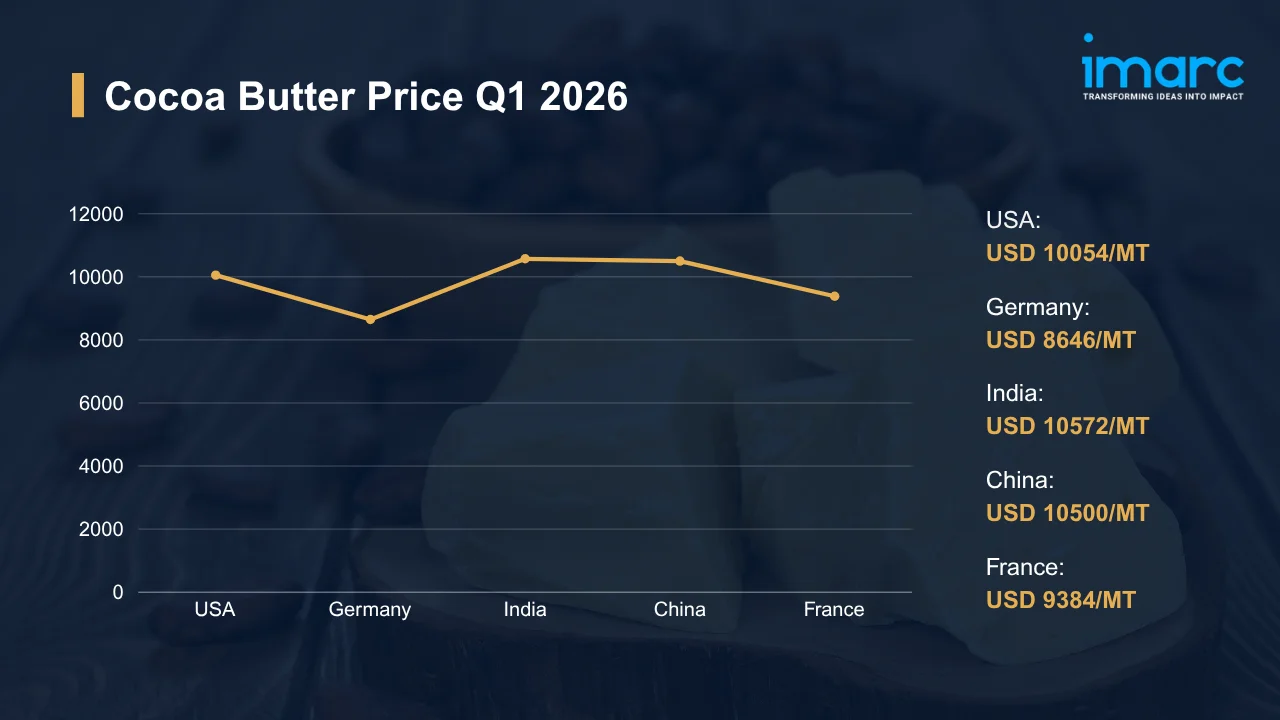
Summary:
Q1 2026 tested cocoa ingredient markets hard, with supply chains across West Africa tightening just as downstream manufacturers in confectionery and personal care locked in early-year production runs. Cocoa butter prices ranged from a 3.2% decline to a 2.2% gain across tracked markets, a spread wide enough to signal structural divergence between regions with domestic processing access and those fully dependent on imports. The broader cost picture is further complicated by the Israel–Iran–USA conflict. On March 31, 2026, Brent crude soared to USD 118.2 a barrel, triggering cost shocks that feed directly into commodity logistics and production expenses worldwide.
Cocoa Butter Price Q1 2026:
Regional prices (USD per MT) and QoQ changes Q1 2026 vs Q4 2025:
| Region | Price (USD/MT) | QoQ Change | Direction |
|---|---|---|---|
| USA | 10054 | +2.2% | ↑ Growth |
| Germany | 8646 | +1.2% | ↑ Growth |
| India | 10572 | −3.2% | ↓ Decline |
| China | 10500 | −2.2% | ↓ Decline |
| France | 9384 | +1.0% | ↑ Growth |
To access real-time prices Request Sample
Kindly note: IMARC's pricing database tracks cocoa butter price movements across major global markets.
What Moved Prices:
USA:
- During Q1 2026, USD 10054/MT marked the March settlement for cocoa butter in the USA — a 2.2% QoQ gain built on two compounding forces: firm downstream pull from confectionery and personal care buyers, and a shrinking pool of available supply as global cocoa bean harvests disappointed. The cocoa butter price chart for the USA market showed a step-wise climb through January and February before locking in the March peak, with import dependency and tightening spot liquidity underpinning each upward move.
- Spot market activity dried up considerably as buyers pivoted to forward contracts and long-term sourcing arrangements, a shift that compressed near-term availability further and insulated contract holders from the worst of the cost escalation. Warehousing and domestic freight expenses added another layer of pressure, particularly for distributors running lean inventories ahead of the quarter-end production rush. Procurement desks managing just-in-time schedules found the margin for error essentially gone by late February, with lead times stretching and suppliers holding firmer on price.
Germany:
- In Q1 2026, USD 8646/MT was Germany's March cocoa butter settlement, a 1.2% QoQ rise squeezed out of a market grappling with reduced bean arrivals into European ports and processing disruptions at facilities dependent on West African raw material inflows. Chocolate manufacturers kept order volumes steady as they pushed into seasonal production cycles, but that demand did nothing to ease the supply-side pressure; it amplified it. Compliance-related costs and elevated industrial energy tariffs added further weight to processor margins, leaving little scope for contract price relief.
- Germany's outsized reliance on imported cocoa derivatives left regional buyers fully exposed when global supply tightened, a vulnerability that procurement teams with existing long-term contracts weathered better than spot buyers. The cocoa butter price trend across Europe broadly tracked the same dynamics: constrained raw material inflows, elevated operational costs, and steady seasonal demand converging to lock prices at firm levels. Sourcing premiums on the open market climbed as the quarter progressed, and processors chose to absorb the added input costs rather than risk production gaps heading into the highest-demand weeks of the year.
India:
- In Q1 2026, USD 10572/MT reflected India's March cocoa butter price, shaped by a collision of strong end user pull from confectionery and cosmetics producers and severely restricted import access through major entry ports. Logistics delays compounded the shortfall: longer vessel transit times and elevated freight charges on the India-sourcing corridor inflated landed costs well beyond what the underlying commodity price alone would suggest. Domestic processors struggled to source raw materials in adequate volumes, and spot availability essentially vanished by mid-quarter.
- What keeps India structurally exposed is its near-total dependence on imported cocoa butter, depicting a vulnerability that every global supply tightening cycle amplifies into a more acute local price spike than peer markets experience. Buyers who had established inventory buffers absorbed Q1 demand without major disruption; those running lean found procurement both expensive and unreliable. Currency variability stacked on top of freight cost increases through the quarter, and the combination kept India's price at a persistent premium to European benchmarks even as the raw material scarcity driving that gap remained stubbornly in place.
China:
- During Q1 2026, USD 10500/MT was the March cocoa butter price in China, declining QoQ as food processors and personal care manufacturers adjusted procurement intensity following the intense year-end production cycle of Q4 2025. Cautious output levels from key exporting regions continued to limit the global pool of available supply, and Chinese importers entered Q1 still managing tighter-than-usual inventory positions. Procurement competition in the domestic market eased slightly from Q4 peaks, though buyers continued accepting above-trend costs rather than risk production gaps.
- Restocking demand absorbed a meaningful share of what little spot availability existed through January and February, reducing the buffer that market participants typically maintain heading into March. Constrained by limited alternative origin options and transit timelines that had stretched relative to prior quarters, importers locked in volumes at elevated CIF levels without the usual negotiating leverage that looser supply conditions would normally provide. This dynamic, where stabilizing industrial demand met a structurally tight import market, kept China’s cocoa butter prices below Q4 2025 levels while remaining historically firm.
France:
- In Q1 2026, USD 9384/MT marked France's March cocoa butter price, a 1.0% QoQ gain that looks modest against the backdrop of the supply pressures driving it. Premium chocolate producers, which comprised the dominant end use segment in the French market, maintained purchasing activity through the quarter as they prepared for spring season output, and that steady demand met a European supply base offering fewer volumes than normal. Higher input costs from reduced West African bean arrivals and elevated processing expenses flowed through the value chain with little resistance.
- Broadly across Europe, West African cocoa bean arrivals ran below seasonal norms, leaving processors with tighter raw material inventories and less flexibility to negotiate on cocoa derivative pricing. Compliance and energy costs pushed processor margins lower, and those additional expenses were passed down to chocolate manufacturers rather than absorbed. Buyers holding long-term supply agreements absorbed Q1 demand at predetermined terms; those returning to spot procurement each quarter paid meaningful premiums over contract equivalents, and that gap widened as the quarter progressed toward the March close.
Cocoa Butter Price Outlook After the Israel–Iran–USA Conflict:
Rising Energy Costs and Feedstock Price Pressure for Cocoa Butter: Energy costs sit at the core of cocoa butter production economics, and the ongoing Middle East conflict is driving them in one direction. From drying and roasting at origin to refining and tempering at consumer-market facilities, every stage of processing burns fuel or draws on power grids increasingly priced against higher crude and natural gas benchmarks. As of March 1, 2026, major carriers, including Maersk, MSC, Hapag-Lloyd, and CMA CGM, suspended Strait of Hormuz transits and rerouted vessels around the Cape of Good Hope, adding 10 to 14 days to transit times and materially increasing freight costs — a logistics surcharge that might translate directly into higher landed costs for cocoa butter buyers across Asia and Europe, layering transportation inflation on top of the processing cost pressure already working through the supply chain.
Regional Price Volatility and Demand Uncertainty for Cocoa Butter: The conflict is not producing a clear directional signal for cocoa butter prices; instead, it is injecting volatility, making forward planning increasingly complex. Procurement teams in markets like India and China, already operating with thin spot availability from Q4 2025, are navigating added uncertainty over logistics costs for future replenishment shipments. Higher household energy bills and weakening currencies in oil-importing economies might erode discretionary spending, softening demand for premium chocolate and cosmetic products that depend heavily on natural cocoa butter. Manufacturers caught between compressed margins and formulation commitments might reduce order volumes or accelerate substitution toward deodorized variants, a shift that could introduce localized downward pressure even as freight and input costs push structural price floors higher.
Immediate Market Reaction:
Markets do not wait for clarity; instead, they price in risk the moment it becomes visible, and cocoa butter is no exception. Freight capacity on Asia–Europe corridors is already tightening as major carriers pull back from Gulf routing, and the supply lanes through which cocoa butter and its upstream processing inputs regularly move are currently subject to war-risk insurance surcharges that add cost before the cargo even loads. The cocoa butter price index might push higher in the near term as those surcharges work through to buyer-side landed cost calculations, particularly in import-reliant markets where procurement teams have little pricing leverage. Forward contract interest will likely increase as buyers seek cost certainty before further freight escalation materializes.
Impact on Cocoa Butter Prices:
The conflict might trigger several key changes in the cocoa butter market:
- Energy-Driven Cost Escalation: Crude oil and natural gas price increases translate into higher running costs at every energy-intensive stage of cocoa butter production. Roasting, pressing, refining, and controlled-temperature storage consume fuel or power priced against the same benchmarks that are currently climbing on conflict risk. Processing facilities in major consumer markets will see utility and fuel expenses compress margins on finished cocoa butter, and those costs will move through the value chain toward buyers. Even if downstream demand were to ease, the cost-of-production floor rises independently, which means price support persists without needing demand to carry the load.
- Freight Rate and Logistics Cost Surge: Rerouting around the Cape of Good Hope does not just increase transit days but also adds dollars. On the trade lanes serving cocoa butter flows between processing hubs and consuming markets, those dollars add up quickly. War-risk surcharges, tighter vessel capacity, and the longer fuel burn on Africa diversions all layer on top of base freight rates, inflating the landed cost of every shipment that cannot find a shorter route. These logistics cost increases will persist well beyond any ceasefire, given the weeks required for shipping networks to realign. Buyers in Asia and Europe sourcing cocoa butter from distant processing hubs will carry this freight burden through at least mid-2026 regardless of how quickly hostilities ease.
- Demand Disruption in Price-Sensitive Markets: Oil-importing economies running weaker currencies against a surging energy import bill are vulnerable to consumer spending pullbacks, particularly in discretionary categories. Premium chocolate and cosmetic-grade personal care products sit squarely in that frame, and both depend on natural cocoa butter as a key formulation input. Manufacturers facing margin pressure from higher input and logistics costs might pull back procurement volumes or substitute toward deodorized cocoa butter or alternative fats where product specifications allow, introducing localized price softness. That substitution pressure might coexist with continued price firmness in higher-specification segments, fragmenting the market rather than delivering a clean price correction.
Energy inflation, freight cost escalation, and demand-side uncertainty will not resolve at the same pace or in the same direction across all markets. This asymmetry is the defining feature of the pricing environment cocoa butter buyers are facing. Markets with domestic processing capacity or shorter supply routes will absorb the disruption at lower cost than heavily import-reliant buyers, widening regional price spreads that were already meaningful in Q4 2025. Through mid-2026, cocoa butter pricing will likely remain structurally elevated, with the sharpest volatility concentrated in markets like India, China, and parts of Southeast Asia that are most exposed to both the freight cost shock and the energy-linked input cost inflation the conflict is generating.
Supply Chain Disruptions:
Cocoa beans ship from West Africa, but the logistics infrastructure that moves processed cocoa butter into the hands of European and Asian manufacturers runs through freight networks that the conflict has severely disrupted. The Strait of Hormuz is not a direct route for most West Africa–to–Europe cocoa trade, but the cascading effect on global freight capacity, war-risk insurance premiums, and carrier scheduling is not geographically contained. Shipping traffic through the Strait of Hormuz has dropped, triggering Cape of Good Hope diversions that add 10 to 14 days per voyage and push landed cost calculations well above pre-conflict benchmarks for cocoa butter importers across Asia and Europe.
Buyers who relied on predictable replenishment cycles will need to rebuild their procurement planning around longer lead times and less reliable vessel scheduling. Processors maintaining just-in-time inventory practices are the most exposed. A single delayed shipment in this environment means a production gap rather than a manageable buffer drawdown. Freight forwarders are quoting Cape-routed alternatives as the default rather than the exception, and the surcharges embedded in those quotes will remain even after active hostilities ease, given how long it takes for vessel rotations and carrier capacity to normalize after major route disruptions. Buyers willing to commit to longer forward windows might secure better cost certainty, but they do so by locking in what are already elevated freight-inclusive landed costs.
Global Market Overview:
Globally, the cocoa butter industry was valued at USD 2.6 Billion in 2025. Market projections indicate steady growth, with the industry expected to reach USD 3.7 Billion by 2034, with a compound annual growth rate (CAGR) of 3.68% during 2026–2034. Confectionery consumption in emerging markets is pulling volume demand upward, while the cosmetics and personal care industries are drawing on cocoa butter for a growing share of moisturizer, lip balm, and skincare formulations that previously relied on synthetic alternatives. Clean-label sourcing preferences among premium food brands are reinforcing demand for natural, undeodorized cocoa butter specifically, narrowing the field of acceptable substitutes and sustaining pricing power for quality-certified suppliers as the market expands through the forecast period.
Recent Highlights & Strategic Developments:
Recent strategic moves within the industry further illustrate evolving dynamics:
- In October 2025, Mondelez-backed cocoa technology company Celleste Bio unveiled a novel cell-cultured cocoa butter formulated for commercial chocolate applications, announcing the product as a major step forward in cocoa ingredient innovation for the confectionery sector.
Cocoa Butter Price Forecast (2026):
Q2 and the remainder of 2026 will put cocoa butter buyers in a position they have not had to manage in recent cycles: navigating supply scarcity and geopolitical freight inflation at the same time. Upstream cocoa bean availability remains structurally tight, and the logistics cost shock from Strait of Hormuz disruptions will not dissipate quickly even if hostilities wind down. Vessel scheduling, insurance market repricing, and carrier capacity rebalancing operate on timelines measured in months, not weeks. Confectionery and personal care demand is holding, which means there is no demand-side softening to provide relief. The market is priced into a corner where input costs are rising and consumers are not retreating fast enough to offset them.
Two scenarios frame how the rest of 2026 resolves. If hostilities escalate or drag on past mid-year, freight rates will stay elevated, energy costs will remain a structural price floor, and procurement costs in import-dependent markets will push materially above Q1 2026 levels, particularly for buyers in India and Southeast Asia who lack alternative sourcing options. Contract structures without price reopener provisions will leave buyers absorbing the full cost of that escalation. If the conflict de-escalates and shipping lanes normalize, freight cost relief will gradually flow through to landed prices, allowing cocoa butter markets to drift back toward fundamentals-driven levels through H2 2026. The cocoa butter price forecast for the full year ultimately turns on one variable above all others: how long the Strait of Hormuz remains effectively closed to commercial traffic.
Strategic Takeaways:
Looking ahead, the cocoa butter market is expected to operate under sustained cost pressure through 2026, with geopolitical disruption, tight upstream supply, and freight cost inflation converging on a market that entered the year with little buffer to absorb them. Stakeholders who build procurement flexibility and supply chain redundancy will be better placed to protect margins and maintain continuity when the next shock arrives without warning.
To navigate this complex landscape, stakeholders should:
- Monitor Geopolitical Risk Exposure: Track how the Israel–Iran–USA conflict evolves week to week and map the direct pathways from escalation events to cocoa butter pricing, feedstock costs, and freight rate movements. Internal alert thresholds tied to Brent crude benchmarks and war-risk insurance premium levels might trigger procurement action before spot prices fully reflect the shift. Waiting for published price revisions means paying them.
- Diversify Supply Chain Routes: Dependence on a single shipping corridor or a narrow supplier base becomes a liability the moment that corridor faces disruption. The current crisis has demonstrated exactly how fast that can happen. Secondary supplier agreements across multiple origin geographies, combined with pre-negotiated contingency freight arrangements, will provide the routing flexibility that primary-only supply chains cannot. Map concentration risks by geography before the next disruption forces the decision.
- Track Freight and Logistics Cost Movements: War-risk insurance premiums, Cape of Good Hope surcharges, and container availability indexes are leading indicators of landed cost pressure that move faster than published commodity benchmarks. The cocoa butter price per MT already embeds freight and insurance costs that the headline commodity price does not capture, and those embedded costs will widen further if Hormuz routing remains disrupted. Freight index monitoring gives procurement teams an earlier read on where total cost is heading.
- Evaluate End Use Demand Resilience: Oil-importing economies absorbing higher energy costs and currency depreciation will not all protect discretionary consumer spending equally, and cocoa-intensive product categories, including premium chocolate, cosmetic formulations, and specialty confectionery, sit near the top of the substitution risk list when household budgets tighten. Assess where demand might soften ahead of procurement cycles and use those windows to negotiate better forward pricing rather than waiting for market-wide acknowledgment of a slowdown.
- Engage in Forward Contract Planning: Locking in Q2 and Q3 2026 forward contracts at current levels enables buyers to secure costs before freight normalization is fully priced in, providing a defensible procurement position if the conflict persists and logistics expenses escalate further. In contrast, deferring forward commitments in anticipation of price corrections presents a high-risk strategy, particularly as structural supply tightness continues to anchor price floors. Volumes should be committed selectively, aligned with production schedules that offer sufficient visibility and certainty.
Subscription Plans & Customization:
IMARC offers flexible subscription models to suit varying needs:
- Monthly Updates — 12 deliverables/year
- Quarterly Updates — 4 deliverables/year
- Biannual Updates — 2 deliverables/year
Each includes detailed datasets (Excel + PDF) and post-report analyst support.

.webp)
Get in Touch With Us
UNITED STATES
Phone: +1-201-971-6302
INDIA
Phone: +91-120-433-0800
UNITED KINGDOM
Phone: +44-753-714-6104
Email: [email protected]
Client Testimonials




.webp)




.webp)












