Cold Rolled Coil Price Increases 4.6% in Brazil, 3.5% in China — Q1 2026 Update
15-Jan-2026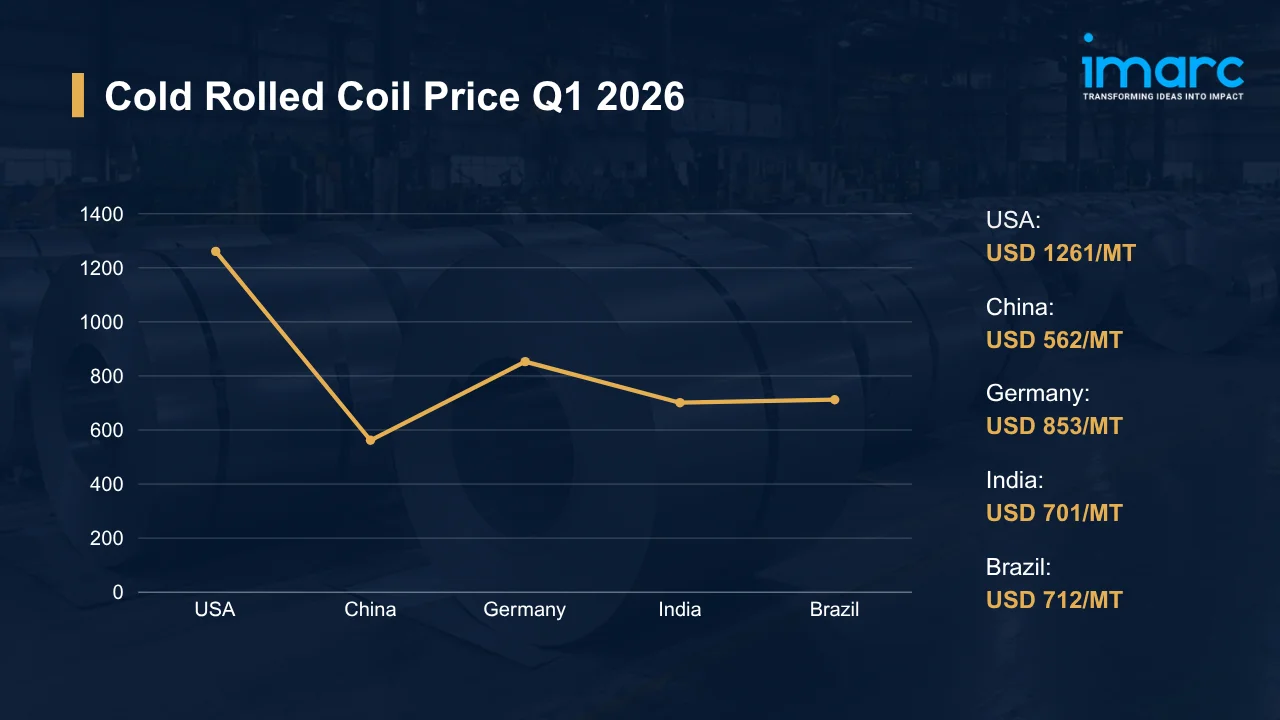
Summary:
Disciplined mill output and firm automotive demand pushed all five tracked cold rolled coil markets higher through Q1 2026. Cold rolled coil prices advanced between 1.4% and 4.6% QoQ, as tightened domestic supply conditions across major producing regions coincided with limited import inflows to reinforce pricing leverage through the quarter. Across all regions, gains remained measured. Adding to forward uncertainty, the Israel–Iran–USA conflict has amplified energy volatility, with oil prices surpassing USD 100 per barrel on March 12, 2026.
Cold Rolled Coil Price Q1 2026:
Regional prices (USD per MT) and QoQ changes Q1 2026 vs Q4 2025:
| Region | Price (USD/MT) | QoQ Change | Direction |
|---|---|---|---|
| USA | 1261 | +2.4% | ↑ Growth |
| China | 562 | +3.5% | ↑ Growth |
| Germany | 853 | +2.2% | ↑ Growth |
| India | 701 | +1.4% | ↑ Growth |
| Brazil | 712 | +4.6% | ↑ Growth |
To access real-time prices Request Sample
Kindly note: IMARC’s pricing database tracks cold rolled coil price movements across major global markets.
What Moved Prices:
USA:
- In Q1 2026, cold rolled coil prices in the USA climbed to USD 1261/MT, a 2.4% QoQ gain driven by firm procurement from automotive assembly lines and appliance manufacturers operating at near-capacity run rates across the Midwest, as reflected in the cold rolled coil price chart for this period. Tariff protection limited import competition. Mills held firm on offer levels throughout.
- Constrained by tight Great Lakes integrated mill output schedules, service centers found limited spot availability and shifted toward forward contracting to secure second-quarter volumes. Inland logistics costs from mill to fabricator remained stable, preventing freight-driven price distortion and keeping landed cost calculations predictable for downstream buyers.
China:
- During Q1 2026, cold rolled coil prices in China reached USD 562/MT, gaining 3.5% from Q4 2025 as government-backed infrastructure spending accelerated and downstream white goods manufacturers in Guangdong and Zhejiang resumed procurement after a cautious year-end. Tangshan production controls held supply in check. Export inquiries from Southeast Asian buyers strengthened on competitive CNY-denominated pricing.
- Supported by stable Dalian futures pricing for iron ore and domestic coking coal, mills maintained firm offer levels without resorting to aggressive spot discounting. Real estate weakness persisted, yet absorption rates from FMCG packaging and export-oriented automotive stamping activity offset that drag on total domestic consumption volumes.
Germany:
- In Q1 2026, cold rolled coil prices in Germany advanced to USD 853/MT, a 2.2% QoQ increase as European auto OEM production schedules normalized and order activity from Mittelstand machinery fabricators picked up after a subdued Q4 period. Ruhr Valley integrated mills held capacity utilization steady. Reduced Asian import pressure supported firmer quarterly contract negotiations.
- With energy costs across German steelmaking operations stabilizing near post-crisis lows, producers recaptured some margin that had eroded through 2025. Duisburg flat steel distribution channels reported balanced inventory levels, and buyers re-entered contract discussions to lock in second-quarter volumes rather than risk spot market exposure.
India:
- In the first quarter of 2026, cold rolled coil prices in India rose to USD 701/MT, a measured 1.4% QoQ advance supported by steady pull from automotive stamping operations, white goods manufacturing hubs in Gujarat, and engineering fabrication demand tied to infrastructure development in Tier 2 cities. Mills held firm on domestic offers. Export inquiries from the Middle East provided supplementary support.
- Controlled inventory levels at major distribution nodes in Mumbai and Chennai reduced the need for aggressive price concessions during the quarter. Post-monsoon restocking across FMCG packaging segments had largely wound down, yet replacement buying from appliance manufacturers kept order books active enough to prevent any meaningful softening.
Brazil:
- During Q1 2026, cold rolled coil prices in Brazil rose sharply to USD 712/MT, posting a 4.6% QoQ gain as Usiminas and CSN maintained disciplined output strategies that limited excess spot availability across distribution channels. São Paulo automotive assembly activity accelerated. Constrained domestic supply gave local mills firm pricing leverage over imported alternatives.
- BRL exchange rate stability through most of the quarter reduced import parity pressure from Asian-origin material, keeping landed costs uncompetitive against domestic offers. Construction and infrastructure-related procurement strengthened as public spending programs advanced, and distributors replenished inventories after drawing down stocks through Q4.
Cold Rolled Coil Price Outlook After the Israel–Iran–USA Conflict:
Rising Energy Costs and Steelmaking Input Price Pressure: The conflict’s disruption to Persian Gulf energy flows is transmitting directly into steelmaking cost structures, where electricity expenses for EAF operators and coke-oven fuel costs at integrated blast furnace mills might climb as crude oil benchmarks remain elevated. Higher bunker fuel costs for seaborne raw material shipments will compound this pressure, inflating landed coking coal and iron ore procurement costs for producers dependent on Gulf-origin feedstock.
Regional Demand Uncertainty and Cold Rolled Coil Price Volatility: Geopolitical risk premiums are rising faster than underlying cost structures across key cold rolled coil consuming regions, where automotive and construction buyers might defer volume commitments as project budget reassessments accumulate through mid-2026. Across industrial purchasing departments, this hesitation could extend the cautious procurement cycle well beyond seasonal norms and compress order visibility for mills.
Immediate Market Reaction:
Through its dependence on energy-intensive production processes and seaborne raw material supply routes, the cold rolled coil market faces direct exposure to the unfolding conflict. Persian Gulf trade corridors channeling coking coal, iron ore, and DRI pellets to steelmakers in Asia and Europe are experiencing severe throughput restrictions that might persist for weeks. Cold rolled coil price index readings will remain under pressure as conflict-driven energy cost volatility reshapes procurement decisions across every major consuming region. Faced with tightening supply visibility, buyers will likely adopt defensive stocking positions while producers in conflict-adjacent zones consider output curtailment.
Impact on Cold Rolled Coil Prices:
The conflict might trigger several key changes in the cold rolled coil market:
- Rising Energy and Production Costs: Rising crude oil prices are feeding directly into electricity costs for EAF steelmakers and processing expenses at integrated BF-BOF mills where margins were already thin heading into the conflict. Should energy prices remain elevated through mid-2026, producers will face a binary choice between absorbing cost escalation or raising offers into a market where downstream demand might not sustain higher pricing levels.
- Feedstock Supply Disruption: War risk premiums and port throughput constraints at Hormuz-adjacent terminals are already forcing rerouting around the Cape of Good Hope, adding 10 to 14 days to voyage times. Premium spot pricing in non-Gulf origin markets will narrow mill margins for producers reliant on open-market purchasing rather than pre-contracted supply.
- Demand-Side Hesitation and Procurement Delays: Downstream consumers in automotive and construction segments might defer large-volume cold rolled coil commitments as input cost uncertainty mounts, compressing order visibility for mills and reducing forward booking rates. Yet this hesitation will not necessarily push prices lower, because rising production costs on the supply side could simultaneously establish a firmer floor beneath spot market levels.
Taken together, these pressures will create a complex pricing environment for cold rolled coil through mid-2026. Rising input costs might push offer levels higher while softening demand simultaneously limits producers’ ability to pass through the full extent of cost escalation. Neither signal is straightforward, and procurement teams must monitor both fronts actively.
Supply Chain Disruptions:
Cold rolled coil supply chains face direct disruption through their dependence on seaborne coking coal, iron ore, and energy feedstock flows that transit the Strait of Hormuz and adjacent Persian Gulf shipping lanes. In early March 2026, the effective halt of traffic through the Strait prevented 15 Million barrels per day of crude oil from reaching global markets, a blockage that transmits directly into steelmaking energy and freight costs. For producers across Asia and Europe, this bottleneck will elevate CIF pricing for imported feedstock as rerouting surcharges and war risk insurance premiums compound.
Pushed toward alternative sourcing from Australian, Mozambican, and Canadian origins, producers face premium spot pricing that might compress margins for mills lacking pre-contracted supply arrangements. Rerouting vessels around the Cape of Good Hope adds 10 to 14 days of voyage time, stretching raw material delivery windows and forcing procurement teams to hold larger safety stocks. Across integrated steelmaking operations, cold rolled coil output schedules will face growing coordination challenges as these supply chain delays ripple through production planning.
Global Market Overview:
Globally, the cold rolled coil industry was valued at USD 143.2 Billion in 2025. Market projections indicate steady growth, with the industry expected to reach USD 170.7 Billion by 2034, with a compound annual growth rate (CAGR) of 1.98% during 2026-2034. Manufacturing demand from the automotive and appliance sectors continues to anchor consumption globally, while disciplined steelmaker inventory management shapes supply availability. The evolving cold rolled coil price trend reflects how trade policies influencing import patterns and regional competitiveness are driving long-term market dynamics across both developed and emerging economies.
Recent Highlights & Strategic Developments:
Recent strategic moves within the industry further illustrate evolving dynamics:
- In December 2025, China’s General Administration of Customs introduced an export quota system covering more than 100 steel and steel-containing products, effective January 2026. Implemented jointly with the Ministry of Commerce, this measure spanned multiple Harmonized System codes for products, including pig iron, ferrous alloys, hot and cold rolled coil, rebar, wire, billets, slabs, and steel scrap, aiming to regulate export volumes and strengthen tax compliance.
Cold Rolled Coil Price Forecast (2026):
Through early 2026, cold rolled coil prices will remain sensitive to conflict-driven energy cost movements and shifting downstream demand from automotive and construction segments. Procurement caution is likely to persist among key buyers in major consuming regions. Should geopolitical risk ease before mid-year, a window for gradual price stabilization might open as supply chains begin normalizing.
If hostilities intensify, cold rolled coil prices will face renewed upward pressure as energy and logistics costs climb and risk premiums widen across seaborne trade routes, potentially pushing producers in conflict-exposed zones to curtail output. Conversely, a diplomatic resolution might restore feedstock supply flows and ease freight rates, allowing prices to trend downward toward pre-conflict levels. These combined dynamics will continue to shape the cold rolled coil price forecast throughout the year ahead.
Strategic Takeaways:
Looking ahead, the cold rolled coil market is expected to navigate a complex interplay of rising input costs, geopolitical supply chain risks, and evolving downstream demand patterns across automotive and construction sectors through 2026. Stakeholders will need to balance cost management with supply security as conflict-driven energy volatility reshapes procurement and pricing strategies globally.
To navigate this complex landscape, stakeholders should:
- Monitor Regional Price Differentials: Track quarterly pricing variations across key supply regions to identify cost-saving procurement windows and arbitrage opportunities. Establish benchmarking protocols that compare landed costs, including the cold rolled coil price per MT, against prevailing contract rates for optimal sourcing.
- Monitor Geopolitical Risk Exposure: Track escalation dynamics in the current conflict and assess how shifts in hostility levels might affect cold rolled coil pricing, feedstock availability, and logistics costs. Establish internal alert thresholds that trigger procurement or hedging action.
- Diversify Feedstock Supply Channels: Evaluate alternative coking coal and iron ore suppliers beyond current vendor portfolios to mitigate concentration risk effectively. Secure secondary supply agreements that activate during periods of primary source disruption or extended capacity constraint.
- Diversify Supply Chain Routes: Evaluate alternative sourcing geographies and shipping corridors to reduce dependence on conflict-exposed trade lanes. Secondary supplier agreements and contingency freight arrangements will provide critical resilience if primary routes face disruption.
- Adjust Procurement Strategy for Conflict Conditions: Adopt flexible contract structures with price reopener clauses and force majeure provisions to protect against geopolitical price spikes. Precautionary inventory buffers might reduce exposure if supply tightens abruptly.
- Track Upstream Feedstock Cost Movements: Monitor coking coal, iron ore, and HRC feedstock pricing on a monthly basis to anticipate cold rolled coil cost pressures early. Proactive detection of raw material price shifts will enable timely contract renegotiation.
Subscription Plans & Customization:
IMARC offers flexible subscription models to suit varying needs:
- Monthly Updates — 12 deliverables/year
- Quarterly Updates — 4 deliverables/year
- Biannual Updates — 2 deliverables/year
Each includes detailed datasets (Excel + PDF) and post-report analyst support.

Get in Touch With Us
UNITED STATES
Phone: +1-201-971-6302
INDIA
Phone: +91-120-433-0800
UNITED KINGDOM
Phone: +44-753-714-6104
Email: [email protected]
Client Testimonials




.webp)




.webp)












