Fish Oil Price Increases 3.9% in Belgium, 3.3% in United Kingdom — Q1 2026 Update
20-Jan-2026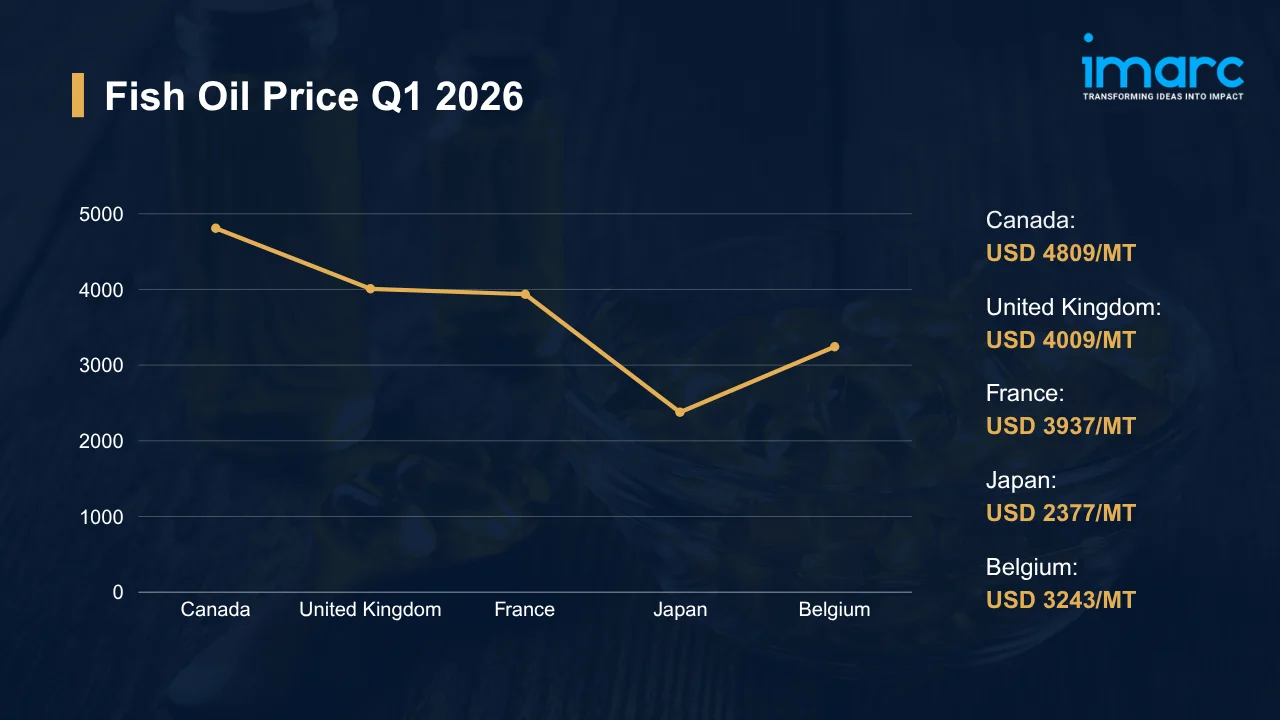
Summary:
Q1 2026 showed increases in all five monitored fish oil markets. Constrained by reduced Atlantic catch volumes, firmer sourcing costs, and rising aquafeed procurement, fish oil prices moved between 2.2% and 3.9% higher QoQ, with omega-3 supplement restocking from health-product distributors amplifying the broader upward bias. Against this broader backdrop, the ongoing Israel–Iran–USA conflict led to the suspension of roughly one-fifth of worldwide crude oil and natural gas supply, as of March 8, 2026, compounding input cost pressure across the sector.
Fish Oil Price Q1 2026:
Regional prices (USD per MT) and QoQ changes Q1 vs Q4 2025:
| Region | Price (USD/MT) | QoQ Change | Direction |
|---|---|---|---|
| Canada | 4809 | +2.2% | ↑ Growth |
| United Kingdom | 4009 | +3.3% | ↑ Growth |
| France | 3937 | +3.1% | ↑ Growth |
| Japan | 2377 | +2.8% | ↑ Growth |
| Belgium | 3243 | +3.9% | ↑ Growth |
To access real-time prices Request Sample
Kindly note: IMARC’s pricing database tracks fish oil price movements across major global markets.
What Moved Prices:
Canada:
- In Q1 2026, Canadian fish oil reached USD 4809/MT, posting a 2.2% QoQ gain. Raw material supply tightened across the period. Reduced South American anchovy catch volumes drove procurement costs higher for refiners, while health supplement and aquafeed buyers accelerated purchases as the fish oil price chart traced a consistent upward path through the quarter.
- Inland logistics costs stayed elevated. Locking in favorable terms, bulk buyers secured better landed pricing than spot purchasers, who absorbed wider cost variance throughout the period. CAD softness against the US dollar added a marginal import cost increment through Q1, keeping delivered prices firm despite inventory levels remaining broadly adequate across the main health supplement and aquafeed channels.
United Kingdom:
- In Q1 2026, UK fish oil reached USD 4009/MT. The 3.3% QoQ gain placed it among the period's stronger moves. Reduced North Sea catches constrained import flows from Norway and Iceland, driving sustained buying pressure as dietary supplement manufacturers accelerated restocking after Q4 destocking cycles ended and seasonal demand from health-product retailers picked up.
- GBP remained broadly stable against USD. Port handling costs at major UK receiving terminals stayed elevated throughout Q1, narrowing the spread between spot and contract purchasing options available to blenders and refiners who lacked sufficient forward coverage. Pharmaceutical and nutraceutical buyers maintained steady procurement, prioritizing shorter-term coverage as cost uncertainty reduced appetite for extended commitments.
France:
- During Q1 2026, French fish oil climbed to USD 3937/MT. Constrained by tighter import flows from Scandinavian producers and reduced North Sea fishery output, prices posted a 3.1% QoQ rise as pharmaceutical and nutraceutical buyers stepped up procurement following Q4 inventory drawdowns and a seasonal pickup in functional food formulation demand.
- Euro exchange rate dynamics remained a moderating factor through Q1. Within the French refiner base, currency gains against the US dollar limited import cost escalation for blenders sourcing from outside the eurozone. EU packaging sustainability mandates contributed a modest but measurable compliance cost increment, with label traceability requirements adding processing overhead for certified fish oil handlers.
Japan:
- In the first quarter of 2026, Japanese fish oil advanced to USD 2377/MT. Pushed higher by firmer aquaculture sector demand and reduced South American import availability, prices gained 2.8% QoQ as health supplement procurement recovered from Q4 softness and higher vessel operating costs compressed the supply buffer that had moderated prices in prior periods.
- The yen remained broadly stable, though marginal depreciation introduced incremental import cost pressure. Across processors reliant on overseas raw material, forward coverage revisions became common. High carry-forward inventories from earlier quarters diminished steadily as aquafeed producers accelerated buying, tightening the domestic market and driving the fish oil price trend upward through the full Q1 period.
Belgium:
- In Q1 2026, Belgian fish oil reached USD 3243/MT. Supported by recovering animal nutrition demand and tighter import availability from Norway and Denmark, where reduced North Sea catches had cut supply flows that had kept prices under pressure in Q4 2025, Belgian prices posted the period's strongest QoQ gain at 3.9%.
- Euro appreciation against the US dollar, which provided import cost relief in Q4, reversed slightly in Q1, incrementally raising acquisition costs for Belgian refiners. Across the aquaculture sector, demand growth continued to expand in Europe. Steady energy costs at processing facilities provided partial cost offset, while aquafeed procurement growth across EU markets reinforced the upward price momentum that had been building since early January.
Fish Oil Price Outlook After the Israel–Iran–USA Conflict:
Rising Marine Fuel Costs and Feedstock Price Pressure for Fish Oil: Marine fuel costs present immediate risks for fish oil producers. As of March 2, 2026, VLCC freight rates surged to an all-time high of USD 423,736 per day, directly raising the cost of hauling crude oil and marine feedstocks across key global trade routes. Fishing vessel operating costs might rise sharply in coming months.
Regional Price Volatility and Demand Uncertainty for Fish Oil: Geopolitical uncertainty is reshaping fish oil procurement across European and Asian import markets, with buyers reassessing source availability and cost exposure amid rapidly shifting freight economics that could widen regional price differentials considerably. Across currency-weak markets, price divergence might intensify further. Buyers facing exchange rate headwinds will encounter compounding pressure from both rising raw material costs and elevated logistics expenses.
Immediate Market Reaction:
The fish oil market is actively repricing procurement risk across all major sourcing and import corridors. Supplying Atlantic and South American fisheries, vessel operators face fuel cost structures materially above Q4 2025 benchmarks, compressing producer margins, constraining spot supply flows, and placing upward pressure on the CIF costs faced by European and Asian importers. The fish oil price index reflects this shift, with buyers revising cost-per-unit assumptions as freight economics continue to deteriorate. Across procurement departments, forward coverage windows are shortening in response.
Impact on Fish Oil Prices:
The conflict might trigger several key changes in the fish oil market:
- Marine Fuel Cost Escalation: Fishing vessels operating in the Atlantic, Pacific, and Southern Oceans face materially elevated bunker fuel costs as global energy prices surge in response to the conflict, with VLCC freight rates rising sharply. These cost pressures will translate into higher producer offers, leading to tighter margins for downstream buyers and processors over time.
- Logistics and Freight Cost Pressure: Fish oil shipments from South American origins reach European and Asian markets via freight corridors currently carrying elevated war-risk premiums and significant route surcharges. Under these conditions, traditional cost advantages erode. This shift is likely to prompt buyers to reassess sourcing strategies and explore alternative supply routes.
- Supply Concentration Risk: Fish oil production from Northern European fisheries is concentrated in Norway, Iceland, and Denmark, regions dependent on seaborne trade routes increasingly affected by conflict-related freight disruption and elevated insurance costs. At present, substitution options remain limited. Comparable-grade fish oil from alternative origins is scarce, which will sustain elevated price levels as buyers attempt to identify cost-neutral sourcing alternatives.
The combined weight of rising marine fuel costs, elevated freight premiums, and concentrated supply geography along key Northern European and South American corridors might push fish oil prices above Q1 2026 levels through mid-year. Building broader cost contingency into buying decisions will be essential. These compounding pressures make passive sourcing increasingly costly.
Supply Chain Disruptions:
Fish oil supply chains face compounding disruption across key transport corridors as Middle East hostilities escalate. Carrying South American product to European refiners, vessels transit routes subject to elevated war-risk surcharges and materially extended transit times, raising delivered costs for importers dependent on imported crude oil. These logistical constraints are also reducing shipment frequency and tightening near-term supply availability in key destination markets.
Northern European fish oil producers from Norway, Iceland, and Denmark are actively exploring alternative freight arrangements to reduce exposure to war-risk surcharges, with some operators routing shipments via extended Cape of Good Hope corridors that add weeks to delivery schedules. Throughout these corridors, lead times are extending noticeably. Buyers building precautionary buffer stock will face higher carrying costs, compounding the procurement challenge across both spot and contract purchasing segments in all major destination markets.
Global Market Overview:
Globally, the fish oil industry was valued at USD 2.6 Billion in 2025. Market projections indicate steady growth, with the industry expected to reach USD 4.1 Billion by 2034, with a compound annual growth rate (CAGR) of 5.27% during 2026-2034. Aquaculture sector expansion remains the primary demand engine globally, with Atlantic salmon and trout farming absorbing substantial volumes. Rising omega-3 health awareness across dietary supplement and pharmaceutical channels broadens the end use base, while sustainability certification requirements are reshaping supply patterns.
Recent Highlights & Strategic Developments:
Recent strategic moves within the industry further illustrate evolving dynamics:
- In March 2026, the Global Organization for EPA and DHA Omega-3s revealed the launch of a new online database designed to enhance transparency within the omega-3 supply chain. The platform will be available to members and will offer comprehensive details on businesses engaged in fish oil, krill oil, algae oil, and genetically engineered seed oils. The initiative aims to foster collaboration among industries in human nutrition, pet nutrition, and aquafeed sectors.
- In June 2025, MegaFood revealed the introduction of three new formulas aimed at promoting daily wellness, which included Sea Moss Complex, Collagen Peptides with Hyaluronic Acid & Vitamin C, and Omega-3 Fish Oil. Supported by scientific studies and in line with MegaFood's enduring dedication to premium ingredients, these products offered essential support in crucial wellness areas, such as skin, gut, joint, heart, and immune health.
Fish Oil Price Forecast (2026):
Near-term fish oil prices will stay sensitive to rising logistics costs and raw material tightening. Across import markets, procurement caution is clearly setting in. Aquafeed producers and nutraceutical manufacturers across key markets are revising sourcing strategies in response to rapidly evolving freight and energy cost dynamics that look likely to persist well into Q2 2026.
If geopolitical hostilities intensify further, fish oil prices will face sustained upward pressure as marine fuel costs and freight premiums compound procurement burdens for European and Asian buyers, squeezing landed cost margins across all major import markets. Should conditions de-escalate, prices might recover. Stabilizing energy and freight costs would allow prices to normalize, with the trajectory for the fish oil price forecast depending heavily on the conflict’s duration and resolution throughout the year.
Strategic Takeaways:
Looking ahead, the fish oil market is expected to sustain its growth trajectory through 2026, supported by expanding aquaculture operations, rising omega-3 health awareness, and growing adoption in dietary supplement and nutraceutical formulations globally. Geopolitical disruption and marine fuel cost volatility will remain the most pressing near-term procurement risk factors.
To navigate this complex landscape, stakeholders should:
- Track Raw Material Availability: Monitor anchovy and sardine catch volumes across South American and Northern European fisheries to detect early supply tightening. Build lead time buffers into sourcing plans whenever availability indicators deteriorate across key supply origins and regions.
- Benchmark Procurement Against Regional Differentials: Benchmark fish oil price per MT against regional contract and spot rates quarterly to identify cost-saving procurement windows. Establish regular pricing comparisons to avoid overpaying during periods of market disruption or supply tightness across markets.
- Diversify Supply Chain Routes: Evaluate alternative sourcing geographies and shipping corridors to reduce dependence on conflict-exposed trade lanes. Secondary supplier agreements and contingency freight arrangements will provide critical operational resilience if primary routes face disruption in the coming months.
- Adjust Procurement Strategy for Conflict Conditions: Adopt flexible contract structures with price reopener clauses and force majeure provisions to protect against geopolitical price spikes. Precautionary inventory buffers might reduce exposure if fish oil supply tightens abruptly across key global markets.
- Monitor Sustainable Sourcing Regulations: Monitor evolving EU sustainability regulations affecting fish oil sourcing, as stricter traceability mandates will increase compliance costs and constrain supply from certain origins. Evaluate supplier certification and compliance levels regularly to maintain full regulatory alignment.
Subscription Plans & Customization:
IMARC offers flexible subscription models to suit varying needs:
- Monthly Updates — 12 deliverables/year
- Quarterly Updates — 4 deliverables/year
- Biannual Updates — 2 deliverables/year
Each includes detailed datasets (Excel + PDF) and post-report analyst support.

Get in Touch With Us
UNITED STATES
Phone: +1-201-971-6302
INDIA
Phone: +91-120-433-0800
UNITED KINGDOM
Phone: +44-753-714-6104
Email: [email protected]
Client Testimonials




.webp)




.webp)












