H Acid Price Update: Sustained Growth Across Key Markets in Q1 2026
27-May-2026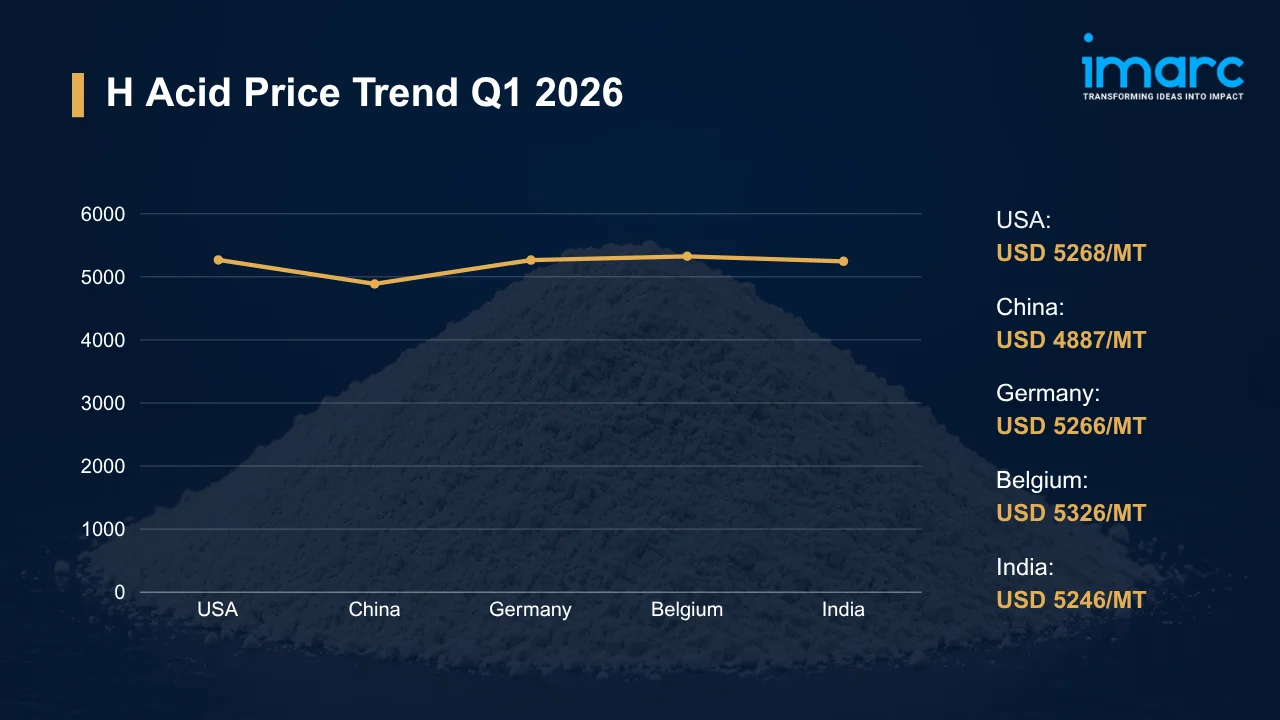
H acid is a sulfonated aromatic intermediate carrying dual sulfonate groups and an alkaline-reactive amine moiety central to azo dye coupling reactions in industrial synthesis. Textile dyeing mills, leather tanneries, and specialty pigment producers account for the majority of global demand. H acid prices move with naphthalene feedstock costs at coal-tar refineries, sulfonation-stage energy outlays, container freight economics on Asia-Europe corridors, and procurement cycles at Indian and Chinese dye facilities.
Global Market Overview:
Globally, the H acid industry reached a volume of 234.5 Thousand Tons in 2025. Market projections indicate steady growth, with the industry expected to reach a volume of 321.6 Thousand Tons by 2034, with a compound annual growth rate (CAGR) of 3.57% during 2026-2034. Anchoring this expansion is textile sector growth across Bangladesh, Vietnam, and India, which channels azo dye output toward record volumes and directly reinforces the H acid price trend. Leather finishing applications in South Asia and specialty coatings in Europe supply secondary but consistent demand, while evolving compliance standards in production hubs progressively filter into pricing.
H Acid Price Trend Q1 2026:
Regional prices (USD per MT) and QoQ changes Q1 2026 vs Q4 2025:
| Region | Price (USD/MT) | QoQ Change | Direction |
|---|---|---|---|
| USA | 5,268 | +1.89% | ↑ |
| China | 4,887 | +3.44% | ↑ |
| Germany | 5,266 | +3.09% | ↑ |
| Belgium | 5,326 | +2.11% | ↑ |
| India | 5,246 | +4.23% | ↑ |
To access real-time prices Request Sample
What Moved Prices:
USA:
- At USD 5,268/MT in Q1 2026, the USA market advanced 1.89% QoQ as dye and pigment manufacturers held active procurement schedules across all three months of the period. Domestic producers ran disciplined output programs. Elevated specialty chemical facility costs kept price floors intact against downward pressure from buyers seeking concessions.
- Indian imports kept arriving but at higher CIF landed costs, as Asia-Pacific freight adjustments eroded the price advantage buyers had built procurement strategies around. Distributor restocking tracked routine cycles. Stable azo dye order books across regional mills gave sellers no reason to soften assessed values or negotiate.
China:
- Coal-tar processing adjustments squeezed naphthalene intermediate availability, pushing H acid prices in China to USD 4,887/MT by end of Q1 2026, a 3.44% QoQ advance. European buyers hunting cost-competitive material placed sustained export inquiries that strengthened order commitments at major Chinese facilities. Spot tonnage tightened through March.
- Compliance curtailments across Zhejiang and Jiangsu specialty chemical plants cut productive capacity with no near-term recovery in sight. The H acid price chart through Q1 2026 tracked successive monthly gains. Firming power tariffs raised unit costs, and producers favored contract allocations over spot market sales, denying spot buyers any meaningful price relief.
Germany:
- Specialty chemical and textile converter procurement in Germany strengthened through Q1 2026, lifting H acid prices to USD 5,266/MT, up 3.09% QoQ, against a supply backdrop tightened by restricted Asian inflows. Buyers pushed purchasing schedules forward ahead of spring production ramp-ups at downstream dye facilities. The advance was front-loaded, with January accounting for the steepest single-month gain.
- Asian supply arrived, though not on favorable terms. Container freight firming on Asia-Europe lanes inflated CIF landed costs, stripping away the margin advantage import-reliant distributors had relied on through Q4 2025. Leaner inventory positions entering the quarter compelled more active restocking than usual, while energy-related cost pressure at Western European processors capped any willingness to concede on price.
Belgium:
- Robust azo dye demand and lean buffer stocks drove H acid prices in Belgium to USD 5,326/MT, up 2.11% QoQ in Q1 2026, with distributors contracting import volumes aggressively from opening weeks of January. Sellers held firm positions throughout the quarter. Higher freight-adjusted CIF offers from Asian origins and limited European spot availability left buyers with restricted room to negotiate downward.
- Container rate increases on Asia-Europe trade lanes drove CIF import costs higher, narrowing the traditional cost differential between Asian-origin and European-origin supply. Upstream cost pressure compelled sellers to maintain firm pricing postures without concession. Consistent export demand from Belgian chemical and textile users absorbed available volumes steadily through March.
India:
- At 4.23% QoQ, India logged the steepest price advance across all five tracked markets in Q1 2026, H acid prices reaching USD 5,246/MT as textile dye manufacturers front-loaded procurement ahead of the spring-summer production season. Post-monsoon destocking through Q4 2025 had stripped inventories thin at Gujarat and Maharashtra dye clusters. First-quarter replenishment demand ran unusually hot.
- Bhageria Industries’ Tarapur capacity expansion announcement injected forward supply optimism but offered no near-term inventory relief to Q1 spot assessments. Export inquiries from European and Middle Eastern buyers competed directly with domestic purchases, tightening available spot volumes. Sellers faced limited pressure to discount.
Drivers Influencing the Market:
Several factors continue to shape H acid pricing and market behavior:
- Textile Dye and Pigment Sector Demand: Azo dye and reactive dye manufacturing absorb the dominant share of global H acid output, with textile mills and leather tanneries forming the structural demand base. Faster fashion cycles in emerging Asian consumer markets and rising home furnishing consumption amplify procurement frequency. Seasonal demand peaks at Indian and Chinese dye facilities generate order patterns that shift the H acid price index markedly. Capacity additions at major Indian producers have progressively deepened the domestic consumption base beyond the export channel.
- Upstream Naphthalene and Feedstock Cost Dynamics: Naphthalene extracted from coal-tar distillation at coke ovens is the sole viable precursor for H acid synthesis at industrial scale. Supply disruptions at coal-based processing units translate with near-immediacy into higher production costs. Sulfuric acid and alkali reagent requirements compound feedstock economics. Periodic blast furnace output curtailments in China cut coal-tar yields and trigger naphthalene tightening, a dynamic that propagates toward finished H acid valuations within weeks of any disruption event.
- Energy Expenditure in Sulfonation Processing: Sulfonation and reduction, the two most energy-demanding process stages in H acid manufacturing, make natural gas and electricity costs a first-tier production variable. The US Henry Hub natural gas spot price averaged USD 3.52 per Million Btu in 2025. That benchmark shapes cost floors for specialty chemical processors across North America. Regional energy price gaps between China, India, and Europe keep H acid production economics in constant competitive flux.
- Ocean Freight and Logistics Economics: H acid’s primary trade pattern, Asian production into European and North American import markets, makes container freight rates a direct determinant of landed import costs. Drewry’s World Container Index recorded USD 2,557 per 40ft container in mid-January 2026, as carriers pushed rate adjustments through on Transpacific and Asia-Europe corridors. At that level, freight-adjusted CIF offers left European buyers with limited cost arbitrage. Contracted procurement offered partial insulation; spot buyers absorbed the full increase.
- Environmental and Regulatory Compliance: Wastewater discharge controls, REACH chemical inventories, and naphthalene-specific emission standards are tightening simultaneously across China, India, and the EU, compressing the compliance cost envelope for producers and distributors. Chinese facilities have faced permit-violation shutdowns at a frequency that reduces productive capacity in measurable increments. Each additional compliance layer adds capex and administrative overhead. Marginal-cost producers unable to absorb those costs exit or curtail, tightening supply and providing structural price support without any formal market mechanism.
- Trade Policy and Currency Dynamics: Specialty chemical tariff schedules, dye intermediate export licensing, and currency movements intersect to shift H acid’s competitive landscape faster than supply fundamentals alone would suggest. A weaker rupee lowers the effective import cost of Indian-origin material for European buyers, improving India’s pricing competitiveness against Chinese suppliers and supporting higher export volumes. US import duties and EU chemical registration costs create further asymmetries. Procurement teams that ignore these policy layers regularly misread their effective landed prices.
Recent Highlights & Strategic Developments:
Recent strategic moves within the industry further illustrate evolving dynamics:
- In October 2025, Bhageria Industries Limited announced plans to expand H acid production capacity at its Tarapur facility from 400 MT per month to 500 MT per month. The INR 5 Crore investment, funded through internal resources, was projected to reach completion within a six-month timeframe.
Outlook & Strategic Takeaways:
Looking ahead, the H acid market is expected to register expansion through 2034, driven by azo dye demand growth across Bangladesh, Vietnam, and India, specialty pigment broadening, and rising leather finishing consumption in South Asia. Naphthalene feedstock costs and production-region energy pricing will remain the pivotal variables governing the H acid price forecast as environmental compliance standards progressively reshape the global cost structure.
To navigate this complex landscape, stakeholders should:
- Assess Freight Market Developments: Monitor container rate movements on Asia-Europe and Asia-North America corridors to anticipate landed cost shifts before they reach contract renewal cycles. Negotiate freight agreements with index-linked adjustment clauses that cap exposure when spot rates surge on high-demand trade lanes.
- Evaluate Downstream Demand Indicators: Track order book depth at Indian and Chinese textile dye manufacturers and European pigment producers across Q2 and Q3 to anticipate demand surges. Correlate purchasing cycle timing with inventory positioning to reduce overstocking risk during seasonal demand troughs.
- Review Regulatory Compliance Expenditures: Audit costs associated with naphthalene derivative handling, wastewater treatment, and environmental discharge obligations across production and distribution facilities. Identify workflow adjustments that cut compliance overhead without relaxing chemical handling and storage safety standards.
- Monitor Regional Price Differentials: Track quarterly price assessments across the USA, India, China, Germany, and Belgium to identify procurement cost windows. Establish a benchmarking protocol that aligns the current H acid price per MT with prevailing contract baselines, enabling procurement teams to identify cost-saving sourcing opportunities before they close.
- Strengthen Currency Exposure Management: Implement hedging instruments for procurement contracted in USD, CNY, or INR to protect landed cost projections against currency swings that can move effective prices by several percentage points within a single quarter. Align treasury and procurement calendars to synchronize foreign exchange coverage with import payment schedules.
- Explore Emerging Application Segments: Investigate demand potential for high-purity H acid grades in specialty pharmaceutical intermediates and advanced functional pigments, both segments showing above-average margin profiles relative to textile dye applications. Engage with R&D partners to assess commercial-scale feasibility of novel dye chemistry routes that could broaden the addressable application base.
Subscription Plans & Customization:
IMARC offers flexible subscription models to suit varying needs:
- Monthly Updates: 12 deliverables/year
- Quarterly Updates: 4 deliverables/year
- Biannual Updates: 2 deliverables/year
Each includes detailed datasets (Excel + PDF) and post-report analyst support.

Get in Touch With Us
UNITED STATES
Phone: +1-201-971-6302
INDIA
Phone: +91-120-433-0800
UNITED KINGDOM
Phone: +44-753-714-6104
Email: [email protected]
Client Testimonials




.webp)




.webp)












