Paraffin Price Update: Sustained Growth Across Key Markets in Q2 2026
21-Aug-2026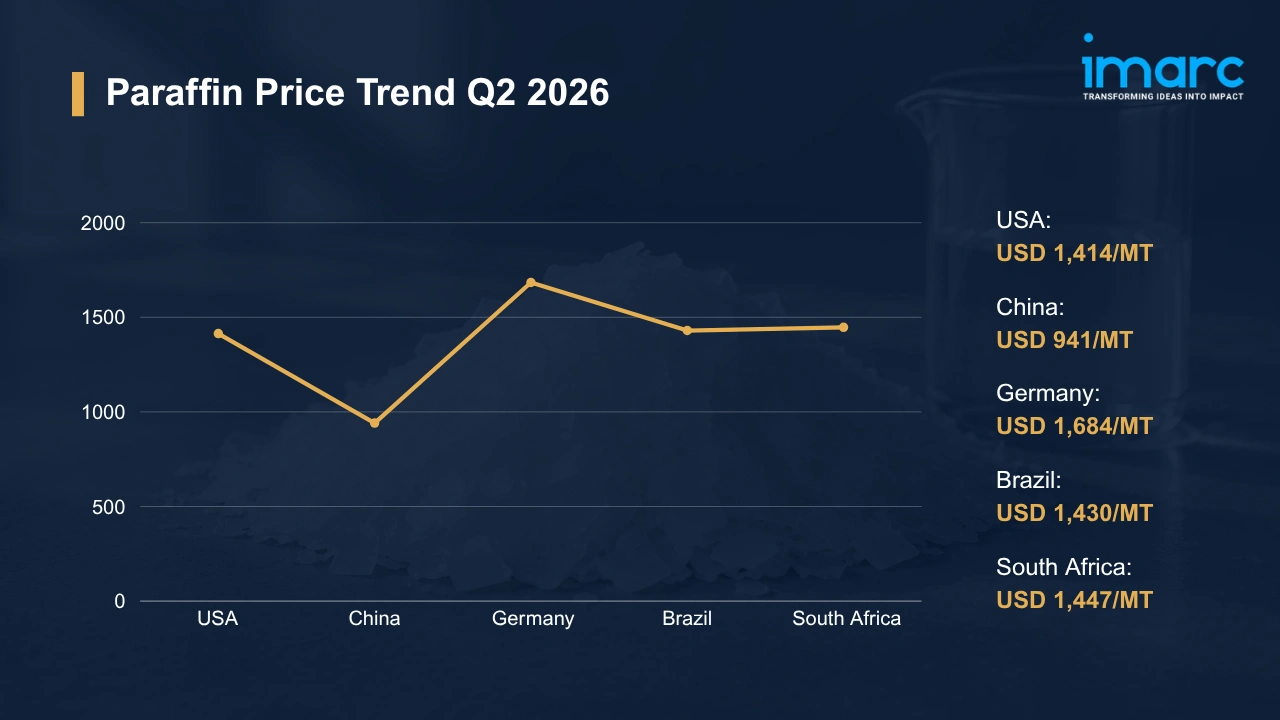
Paraffin is a mixture of saturated aliphatic hydrocarbons derived from petroleum refining. Depending on molecular chain length and the degree of refining, the output ranges from a refined semi-solid wax to a lighter semi-liquid fraction suited to diverse industrial applications. Paraffin prices are primarily governed by upstream crude oil feedstock costs, refining energy expenditure, freight logistics, and demand cycles within candle manufacturing, packaging, cosmetics, pharmaceutical formulations, and rubber processing sectors.
Global Market Overview:
Globally, the paraffin industry reached a volume of 2.35 Million Tons in 2025. Market projections indicate steady growth, with the industry expected to reach a volume of 3.09 Million Tons by 2034, with a compound annual growth rate (CAGR) of 3.05% during 2026-2034. Anchored by candle manufacturing and packaging sector requirements, baseline demand holds steady across consuming regions. Feedstock cost variability continues shaping the paraffin price trend.
Paraffin Price Trend Q2 2026:
Regional prices (USD per MT) and QoQ changes Q2 2026 vs Q1 2026:
| Region | Price (USD/MT) | QoQ Change | Direction |
|---|---|---|---|
| USA | 1,414 | +1.21% | ↑ |
| China | 941 | +2.34% | ↑ |
| Germany | 1,684 | +3.11% | ↑ |
| Brazil | 1,430 | +5.43% | ↑ |
| South Africa | 1,447 | +3.21% | ↑ |
To access real-time prices Request Sample
What Moved Prices:
USA:
- In Q2 2026, paraffin prices in the USA rose to USD 1,414/MT. Candle and packaging demand held steady throughout. Constrained by periodic refinery output variability and import scheduling delays, domestic availability tightened gradually, adding incremental upward pressure across key regional distribution networks throughout the quarter.
- Gulf Coast production hubs maintained steady supply. Supported by consistent e-commerce fulfillment and food-packaging wax coating requirements, spot procurement schedules remained active through the quarter, with seasonal candle manufacturing demand gathering momentum ahead of Q3 2026. The paraffin price chart for the period reflected broadening upward pressure.
China:
- During Q2 2026, paraffin prices in China climbed to USD 941/MT. Improved industrial activity and stronger packaging sector consumption drove demand recovery. Constrained by periodic maintenance at key domestic refining facilities, supply tightened intermittently, while export orders from neighboring Asian markets absorbed additional volumes and reinforced the upward price movement.
- Candle wax export activity to Southeast Asian and Middle Eastern buyers gained traction. With logistics from Guangzhou and Yiwu operating efficiently, board coating and rubber processing applications absorbed available supply steadily, reinforcing market equilibrium through the quarter. CNY exchange rate stability provided modest procurement cost advantages.
Germany:
- In Q2 2026, paraffin prices in Germany rose firmly to USD 1,684/MT. Cosmetics, pharmaceutical, and specialty coating manufacturers maintained consistent procurement schedules. Shaped by European refinery limitations and shipping schedule variability, import-reliant supply conditions kept the market firm through the quarter and reinforced the upward pricing movement into June.
- Across Central European refining operations, energy costs trended upward through Q2 2026. Margin pressure on domestic producers held firm. With EU cosmetics and pharmaceutical manufacturers preserving quality-grade specification requirements, pricing premiums remained intact, and import-side buyers encountered no significant freight softening to reduce landed costs across Asian sourcing corridors.
Brazil:
- In Q2 2026, paraffin prices in Brazil surged to USD 1,430/MT, the sharpest quarterly advance among all tracked regions. Packaging and rubber processing demand remained firm. Amplified by BRL currency depreciation and rising freight costs on Asia–Latin America corridors, landed cost pressures pushed the domestic pricing advance well beyond peer market levels through the quarter.
- Import flows remained essential for meeting domestic supply requirements. With São Paulo-based industrial buyers maintaining active spot purchasing schedules despite elevated freight rates from Asian origin ports, candle manufacturers and rubber processors prioritized consistent volume coverage and supply security through the period. Market inventory discipline remained intact throughout.
South Africa:
- In Q2 2026, paraffin prices in South Africa advanced to USD 1,447/MT. Industrial demand from wax-based product manufacturers and packaging converters stayed consistent. Shaped by the region’s import dependency and periodic shipping schedule variability from major supply origins, market availability dynamics remained sensitive to freight timing adjustments throughout Q2 2026.
- Downstream candle and household wax manufacturers reinforced regional demand. With Johannesburg and Durban-based converter activity driving spot volumes at key distribution points, free-zone port throughput stayed steady and international supply logistics contributed to sustained pricing firmness through the quarter. Procurement schedules navigated variable import arrival windows throughout.
Drivers Influencing the Market:
Several factors continue to shape paraffin pricing and market behavior:
- Candle Manufacturing and Packaging Sector Demand: Global candle production remains a cornerstone of paraffin consumption. Sustained by seasonal demand peaks and expanding retail distribution networks, volume procurement cycles remain active across both Western and emerging markets at various points throughout the year. Packaging material converters represent another consistent demand layer, relying on moisture-resistant coatings for paper and cardboard food packaging substrates. Across Asia and Africa, urbanization trends steadily broaden the addressable demand base.
- Upstream Crude Oil Feedstock Costs: Crude oil is the primary feedstock for paraffin production. Directly linking petroleum price movements to finished wax valuations, refinery distillation economics make feedstock cost shifts immediately visible at the market level. Per the EIA’s July 2025 Short-Term Energy Outlook, Brent crude oil averaged approximately USD 66 per barrel in 2025, establishing the global cost baseline for refinery-origin pricing. Crude grade availability and yield adjustments at key refining hubs shape producer margin structures.
- Energy Expenditure in Refining Operations: Electricity and natural gas costs are critical production variables. Their influence runs across dewaxing, hydrofinishing, and blending stages where consistent energy throughput is non-negotiable. Driven by divergent energy pricing between North America, Europe, and Asia, production cost structures vary significantly across producer regions, lifting price floors in high-energy-cost markets. These regional disparities shape the paraffin price index in independent market assessments.
- Ocean Freight and Logistics Economics: Ocean freight costs fundamentally shape paraffin landed prices in import-dependent markets. Directly determining CIF valuations on Asia-to-Europe and Asia-to-Americas corridors, container rate movements set the cost framework for regional procurement decisions.
- Environmental and Regulatory Compliance: Environmental regulations add measurable compliance costs across paraffin supply chains. Compelling producers to invest in handling protocols, emission controls, and upgraded storage infrastructure, European and Asia-Pacific environmental standards progressively lift the operational cost floor. In jurisdictions where enforcement rigor has intensified recently, smaller operators with limited compliance infrastructure face proportionally higher cost pressures.
- Trade Policy and Currency Dynamics: Tariff structures and import duties shape paraffin cross-border trade flows. Adding a second layer of procurement variability, currency exchange rate movements affect buyers in Brazil, South Africa, and China sourcing from USD-denominated markets. BRL, ZAR, and CNY fluctuations directly amplify or cushion landed cost exposure, depending on directional positioning. With unfavorable positioning, cost pressures can magnify well beyond what freight or feedstock shifts alone generate.
Recent Highlights & Strategic Developments:
Recent strategic moves within the industry further illustrate evolving dynamics:
- In November 2025, researchers introduced a technique for uniformly dispersing and encapsulating paraffin droplets within a porous graphene oxide framework using Pickering emulsion and freeze-drying methods. The resulting composite film demonstrated enhanced thermal regulation, improved electrical conductivity, and strong phase-change stability, with the graphene oxide skeleton preventing material leakage above the melting threshold.
Outlook & Strategic Takeaways:
Looking ahead, the paraffin market is expected to maintain steady volume growth through 2034, with candle manufacturing expansion in emerging economies, rising pharmaceutical and cosmetics requirements, and broadening packaging applications sustaining baseline demand across the forecast horizon. Upstream crude oil feedstock cost trajectories and regional energy pricing will remain the pivotal variables shaping the paraffin price forecast across all major producing and importing regions.
To navigate this complex landscape, stakeholders should:
- Monitor Regional Price Differentials: Track quarterly pricing variations across the five tracked regions to identify cost-saving procurement windows across candle and packaging supply chains. Establish benchmarking protocols comparing landed costs against prevailing contract rates for optimal sourcing decisions.
- Assess Freight Market Developments: Monitor container shipping rate trends on Asia-Europe and Asia-Americas trade corridors to anticipate landed cost shifts affecting import-reliant markets. Negotiate logistics contracts incorporating rate adjustment mechanisms tied to prevailing spot market indices.
- Evaluate Downstream Demand Indicators: Track candle manufacturing, packaging, and pharmaceutical sector activity indices across principal consuming regions. Correlate demand signals with procurement cycles to optimize inventory positioning and avoid overstocking during demand troughs.
- Review Regulatory Compliance Expenditures: Audit current compliance costs associated with paraffin handling, storage, and environmental discharge requirements in each active sourcing jurisdiction. Identify efficiencies that reduce regulatory burden without compromising chemical safety obligations or market access.
- Strengthen Currency Exposure Management: Implement hedging strategies for procurement denominated in BRL, ZAR, or CNY to stabilize landed cost projections. Coordinating forex coverage with import payment timelines allows treasury teams to monitor paraffin price per MT movements against currency exposure effectively.
- Explore Emerging Application Segments: Investigate growth potential within thermal energy storage, cosmetics innovation, and pharmaceutical specialty formulation sectors for portfolio diversification. Engage with research partners to assess the commercial viability of novel applications that could expand the addressable demand base over the medium term.
Subscription Plans & Customization:
IMARC offers flexible subscription models to suit varying needs:
- Monthly Updates: 12 deliverables/year
- Quarterly Updates: 4 deliverables/year
- Biannual Updates: 2 deliverables/year
Each includes detailed datasets (Excel + PDF) and post-report analyst support.

Get in Touch With Us
UNITED STATES
Phone: +1-201-971-6302
INDIA
Phone: +91-120-433-0800
UNITED KINGDOM
Phone: +44-753-714-6104
Email: [email protected]
Client Testimonials




.webp)




.webp)












