Synthetic Rubber Price in the USA Holds Firm at USD 2,600/MT Amid Global Market Adjustments
02-Jan-2026.webp)
Synthetic rubber is a man-made elastomer produced from petrochemical feedstocks and mineral resources via industrial polymerization techniques. It provides a flexible alternative to natural rubber in industries that require enhanced performance properties. Compared with natural rubber, synthetic variants exhibit greater resistance to chemical solvents, oxygen, petroleum oils, and certain corrosive substances, while maintaining remarkable durability across extreme temperatures, from freezing cold to intense heat, without losing flexibility. Its production is not limited by natural resource availability, allowing for large-scale, consistent manufacturing that ensures a steady supply, making it cost-effective for sectors dependent on reliable material access. Moreover, synthetic rubber typically outlasts natural rubber, offering longer service life in demanding applications.
Global Market Overview:
Globally, the synthetic rubber industry reached a value of USD 33.9 Billion in 2025. Market projections indicate sustained expansion, with the industry anticipated to reach USD 45.0 Billion by 2034, representing a compound annual growth rate (CAGR) of 3.20% from 2026-2034. This growth trajectory is fundamentally supported by accelerating tire production volumes, expanding automotive and industrial manufacturing capacity worldwide, and broadening applications across engineered rubber goods, adhesive formulations, and polymer modification technologies. The convergence of rising vehicle production, infrastructure development initiatives, and increasing demand for high-performance elastomers across diverse industrial applications continues to drive sustained market expansion globally.
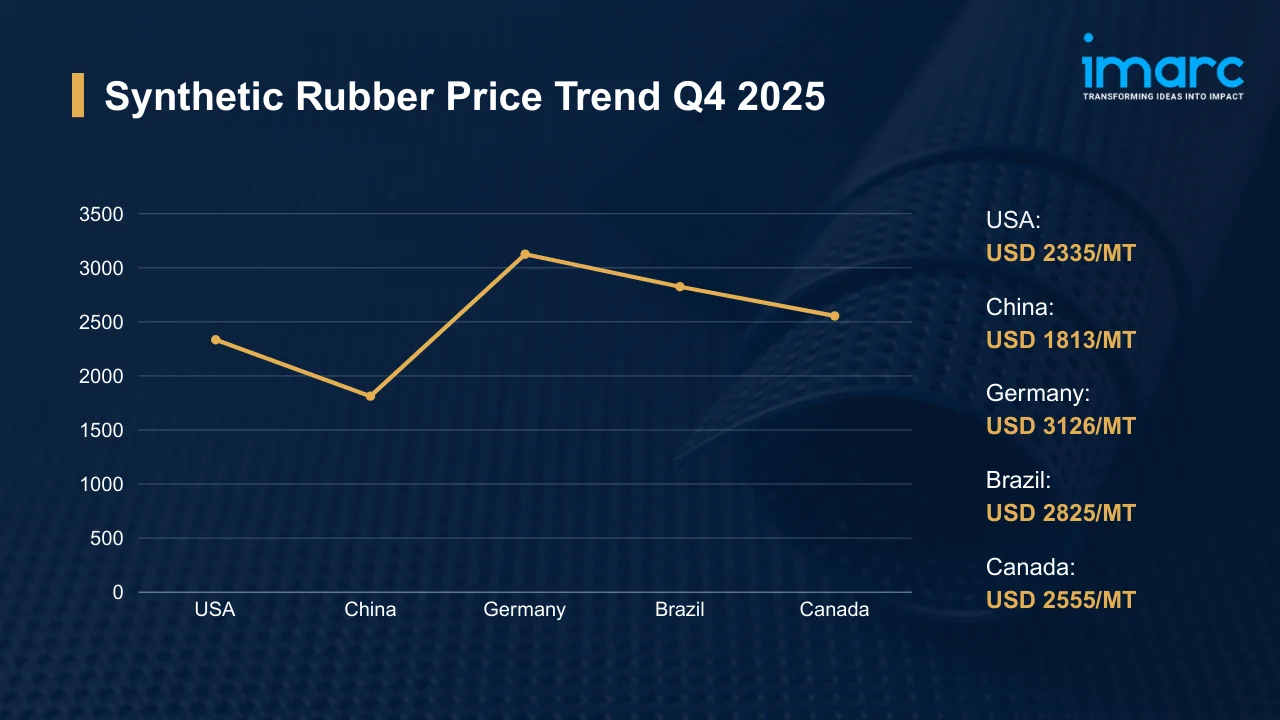
Synthetic Rubber Price Trend Q3 2025:
Regional prices (USD per MT) and QoQ changes vs Q2 2025:
| Region | Price (USD/MT) | QoQ Change | Direction |
|---|---|---|---|
| USA | 2600 | +2.08% | ↑ |
| China | 1893 | -5.92% | ↓ |
| Germany | 3028 | +1.88% | ↑ |
| Brazil | 2763 | +2.52% | ↑ |
| Canada | 2671 | +1.91% | ↑ |
To access real-time prices Request Sample
What Moved Prices:
- USA: During the third quarter of 2025, synthetic rubber prices in the USA climbed to USD 2600/MT in September. This increase was driven by heightened buying from tire and automotive component producers, who boosted their material orders while downstream facilities maintained stable operating levels. Although domestic supply chains continued to provide steady flows, occasional tightness in specific feedstock markets affected procurement strategies. Efficient logistics across key industrial routes ensured timely delivery to manufacturing hubs, allowing end-users to obtain the materials needed to support the quarter’s increasing production output.
- China: In September, synthetic rubber prices in China fell to around 1,893 USD/MT during the third quarter of 2025. The decline was driven by weaker demand from footwear, industrial rubber, and tire manufacturers, alongside abundant domestic supply. While output levels at key production centers remained steady, the plentiful feedstock inventory capped any potential price gains. Exports continued at normal levels, but muted domestic consumption kept overall market sentiment soft.
- Germany: Synthetic rubber prices surged to about 3028 USD/MT in September during the third quarter of 2025. Strong buying activity from the automotive, specialty rubber, and engineering sectors drove the market higher, while persistent demand across Central Europe supported more vigorous purchasing activity. Rising energy costs further pressured suppliers to increase their offers. Although imports from Asia bolstered overall availability, they were not enough to offset the upward push from heightened consumption.
- Brazil: During the third quarter of 2025, synthetic rubber prices in Brazil rose to USD 2763/MT in September. The rise was driven by increased purchasing from the domestic industrial rubber and automotive industries. While feedstock markets stayed largely stable, higher downstream processing activity helped bolster market confidence. Efficient regional logistics, including port handling and inland transport, ensured smooth distribution to manufacturing centers, prompting end users to procure inventories to maintain uninterrupted production.
- Canada: During the third quarter of 2025, synthetic rubber prices in Canada moved upward to USD 2671/MT in September. The uptick reflected heightened demand from tire makers, industrial component producers, and polymer processing companies. Reliable feedstock supplies from the United States helped sustain material availability, while manufacturing hubs drew on efficient transit channels to maintain stock levels in step with increased production activity.
Drivers Influencing the Market:
Several factors continue to shape synthetic rubber pricing and market behavior:
- Expanding Global Tire Production and Automotive Manufacturing
Accelerating vehicle production volumes across major automotive markets continue to drive substantial synthetic rubber consumption for tire manufacturing and automotive components. The sustained expansion of passenger and commercial vehicle assembly operations, coupled with growing aftermarket tire replacement demand in mature markets, generates consistent material offtake that underpins fundamental market strength and influences regional pricing dynamics.
- Feedstock Cost Fluctuations and Petrochemical Supply Dynamics
Variations in butadiene, styrene, and other key petrochemical feedstock prices significantly impact synthetic rubber production costs and supplier pricing strategies. Shifts in crude oil markets, naphtha availability, and regional petrochemical capacity utilization rates create periodic cost pressures that manufacturers pass through to downstream buyers. These feedstock dynamics remain a primary driver of short-term price volatility across global markets.
- Broadening Industrial Applications and Performance Material Demand
Growing adoption of synthetic rubber in engineered goods, adhesive systems, polymer modification applications, and high-performance sealing solutions expands total market demand beyond traditional tire applications. Infrastructure development, industrial equipment manufacturing, and consumer goods production increasingly incorporate specialized synthetic rubber grades with enhanced properties, driving diversified consumption patterns that support market expansion and influence pricing across multiple product segments.
- Regional Supply Chain Efficiency and Logistics Infrastructure
Transportation network performance, port operational efficiency, and intermodal logistics capabilities significantly affect material availability and regional price formation. Regions with robust logistics infrastructure benefit from improved supply continuity and reduced distribution costs, while areas experiencing transportation bottlenecks or port congestion face periodic supply constraints that can elevate local pricing. Cross-border trade flows and shipping route reliability remain critical factors influencing regional market dynamics.
- Energy Costs and Environmental Regulatory Developments
Manufacturing synthetic rubber requires substantial energy inputs for polymerization processes, making energy price movements a significant cost factor. Additionally, evolving environmental regulations regarding emissions, waste management, and sustainable production practices influence operational costs and capacity planning decisions. These regulatory developments, particularly in regions with stringent environmental standards, contribute to production cost variations that affect supplier pricing strategies and regional competitiveness.
Recent Highlights & Strategic Developments:
Recent strategic moves within the industry further illustrate evolving dynamics:
- In November 2025, Goodyear Tire & Rubber transferred ownership of its Polymer Chemical Business to Gemspring Capital Management, a private equity firm. The agreement covers production sites in Houston and Beaumont, Texas, along with a research and development center in Akron, Ohio. This move represents a notable reshaping of Goodyear’s operations within the synthetic rubber sector.
Outlook & Strategic Takeaways:
Looking ahead, the synthetic rubber market is expected to sustain its growth trajectory supported by expanding tire production, broadening industrial applications, and continued automotive manufacturing expansion across emerging economies. Regional pricing dynamics will likely remain influenced by feedstock cost movements, logistics infrastructure efficiency, and demand patterns from key consumption sectors.
To navigate this complex landscape, stakeholders should:
- Implement Comprehensive Price Monitoring Systems: Establish real-time tracking mechanisms for synthetic rubber pricing across multiple regional markets and product grades to identify emerging trends early. Integrate feedstock price monitoring, currency movement analysis, and logistics cost tracking to develop holistic visibility into factors influencing landed material costs and competitive pricing positioning.
- Optimize Procurement Timing and Contract Strategies: Develop flexible procurement approaches that balance spot market purchases with term contracts to capitalize on favorable pricing opportunities while managing supply continuity risks. Consider forward purchasing arrangements during periods of market softness and maintain strategic inventory buffers to navigate price volatility while minimizing carrying costs.
- Monitor Key End-Use Sector Developments: Track automotive production trends, tire manufacturing capacity expansions, and industrial rubber goods demand patterns across major consumption regions. Understanding downstream sector dynamics enables proactive demand forecasting and informed inventory management decisions. Pay particular attention to emerging market automotive sector growth and developed market replacement tire demand cycles.
- Diversify Supply Chain and Regional Sourcing Options: Cultivate supplier relationships across multiple geographic regions to mitigate risks associated with regional supply disruptions, logistics bottlenecks, or policy changes affecting specific markets. Evaluate opportunities to source from established Asian, North American, and European production hubs while considering emerging manufacturing capacity in other regions.
- Analyze Feedstock Market Dynamics and Cost Transmission: Maintain close surveillance of butadiene, styrene, and other critical petrochemical feedstock price movements, crude oil market trends, and regional naphtha availability. Understanding cost transmission mechanisms from feedstock markets through to finished synthetic rubber pricing enables better anticipation of supplier pricing adjustments and more effective cost management strategies.
- Evaluate Opportunities in Specialty and High-Performance Grades: Investigate growing demand for specialty synthetic rubber formulations tailored to specific performance requirements in advanced automotive applications, industrial sealing systems, and engineered goods. These segments often demonstrate stronger pricing resilience and margins compared to commodity grades, offering strategic opportunities for differentiation and value creation.
Subscription Plans & Customization:
IMARC offers flexible subscription models to suit varying needs:
- Monthly Updates — 12 deliverables/year
- Quarterly Updates — 4 deliverables/year
- Biannual Updates — 2 deliverables/year
Each includes detailed datasets (Excel + PDF) and post-report analyst support.

Get in Touch With Us
UNITED STATES
Phone: +1-201-971-6302
INDIA
Phone: +91-120-433-0800
UNITED KINGDOM
Phone: +44-753-714-6104
Email: sales@imarcgroup.com
Client Testimonials




.webp)




.webp)












