
Nylon Cable Ties Market Size, Share, Trends and Forecast by Type, Sales Channel, Application, and Region, 2026-2034
Nylon Cable Ties Market Size, Share, Trends & Forecast (2026-2034)
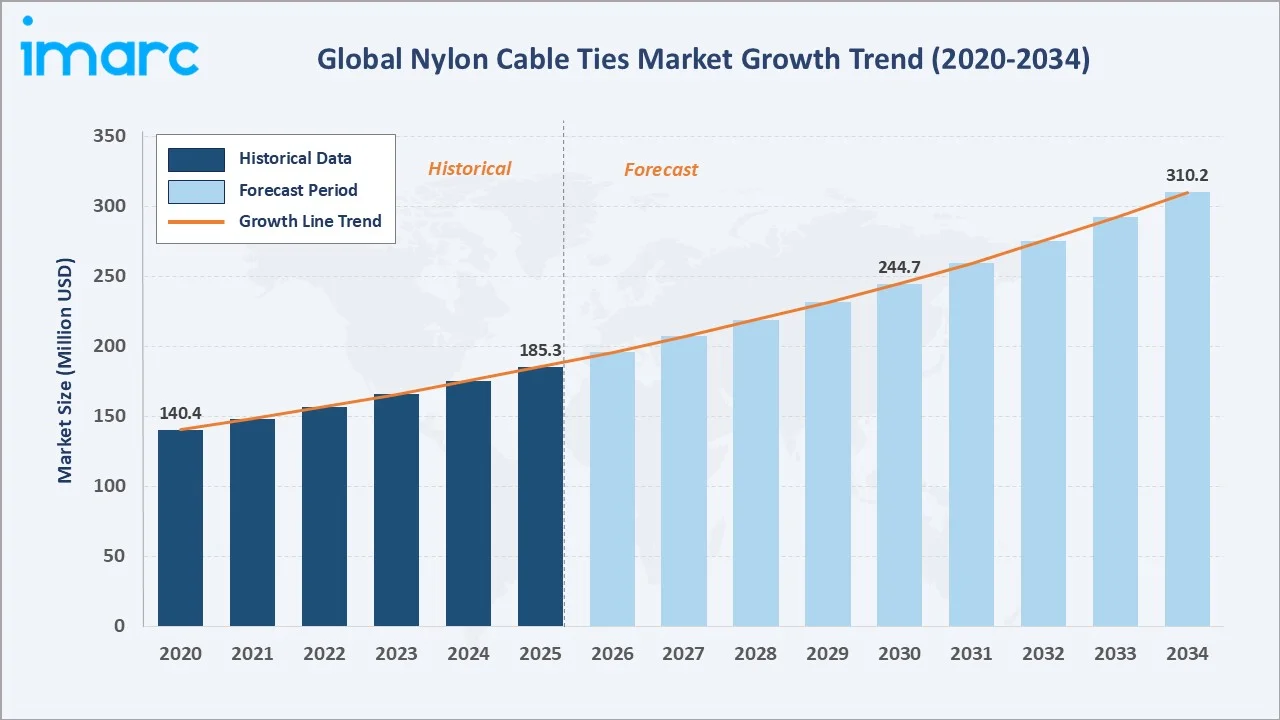
The global nylon cable ties market reached USD 185.3 Million in 2025 and is projected to reach USD 310.2 Million by 2034, expanding at a CAGR of 5.71% during 2026-2034. Widespread adoption across industrial sectors, rapid expansion in food and beverage packaging, and continuous technological advancements in metal detectable cable ties are the primary growth catalysts.
Market Snapshot
|
Metric |
Value |
|
Market Size (2025) |
USD 185.3 Million |
|
Forecast Market Size (2034) |
USD 310.2 Million |
|
CAGR (2026-2034) |
5.71% |
|
Base Year |
2025 |
|
Historical Period |
2020-2025 |
|
Forecast Period |
2026-2034 |
Asia-Pacific leads the global nylon cable ties landscape, holding a 38.4% share in 2025, anchored by the region's expansive manufacturing base and rising industrialization. Nylon 6 commands the largest share of the type mix at 52.4%, reflecting sustained demand for its balanced flexibility and tensile strength across diverse applications.
To get more information on this market, Request Sample
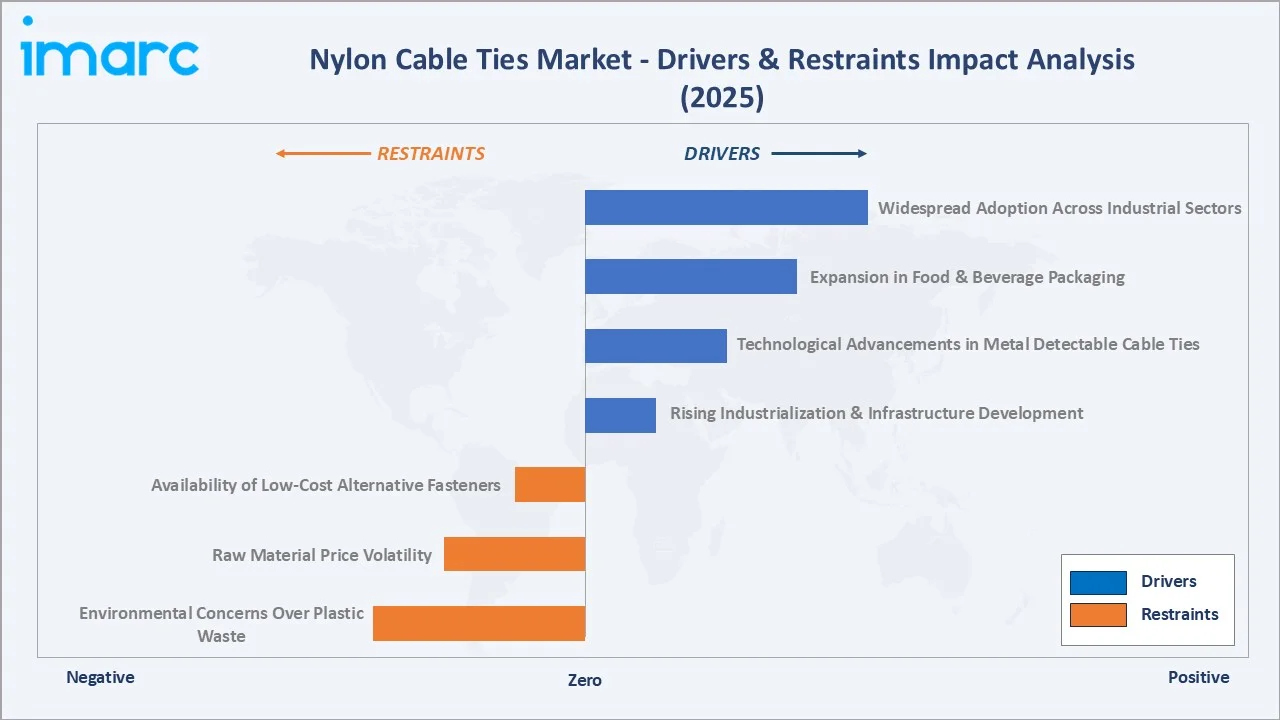
The global nylon cable ties market is underpinned by three structural forces: widespread adoption across industrial sectors, rapid expansion in food and beverage packaging applications, and continuous technological advancements including metal detectable and one-piece self-lock designs. Each force independently reinforces category growth, sustaining steady CAGR expansion through 2034 despite competition from low-cost alternative fasteners.
Executive Summary
The global nylon cable ties market is experiencing steady expansion, driven by widespread adoption across industrial sectors, rapid growth in food and beverage packaging applications, and continuous technological advancements in cable tie design. The market was valued at USD 185.3 Million in 2025 and is forecast to reach USD 310.2 Million by 2034, growing at a CAGR of 5.71%.
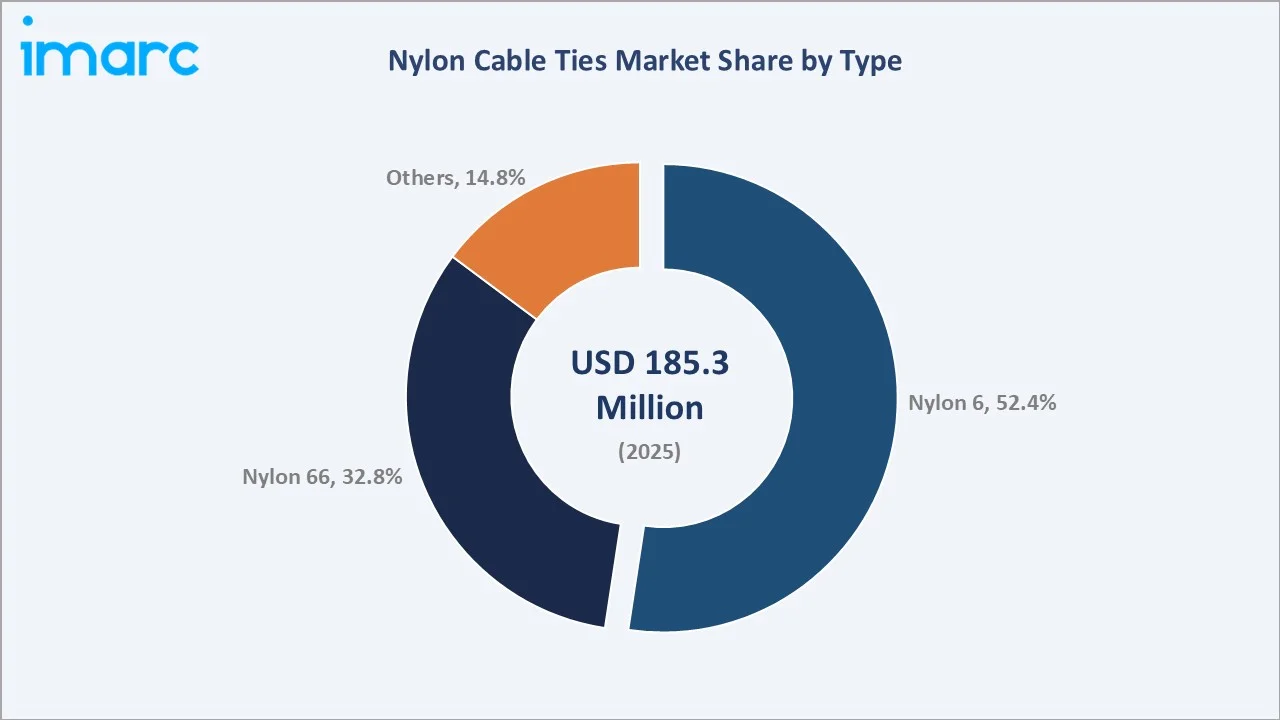
Nylon 6 dominates the type segment with a 52.4% share in 2025, encompassing the traditional core material offering balanced stiffness and flexibility, while nylon 66 accounts for 32.8%, reflecting demand for its superior tensile strength and heat resistance in demanding applications.
Electronics and electrical leads the application mix at 30.2% share, supported by rising demand for cable management in electronic assemblies, while industrial (18.1%), automotive (15.3%), building and construction (11.8%), consumer goods (9.8%), and agriculture (7.6%) serve varied bundling and fastening needs. Asia-Pacific leads regionally at 38.4%, anchored by the region's expansive manufacturing base.
Key Market Insights
|
Insight |
Data |
|
Largest Type Segment |
Nylon 6 – 52.4% share (2025) |
|
Fastest Growing Type Segment |
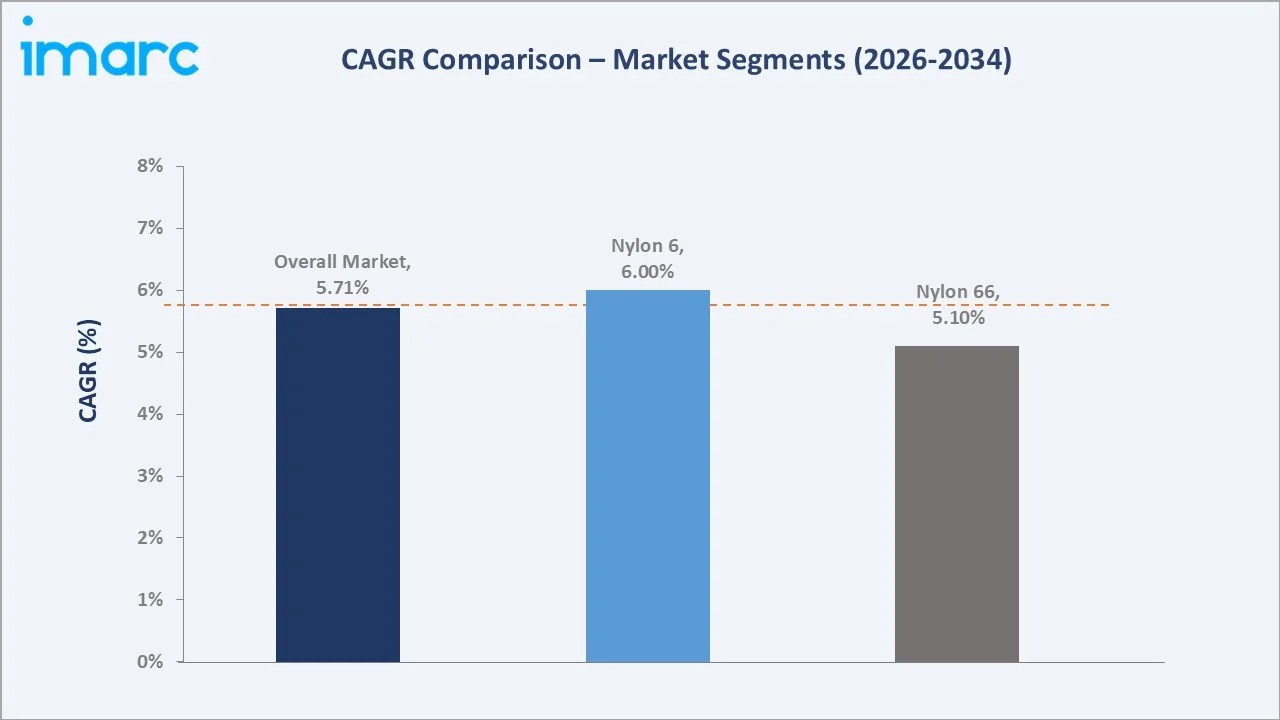
Nylon 6 – ~6.0% CAGR (2026-2034) |
|
Largest Application Segment |
Electronics and Electrical – 30.2% share (2025) |
|
Leading Region |
Asia-Pacific – 38.4% share (2025) |
|
Top Companies |
3M Company, Panduit Corp., Aptiv, ABB Ltd, Advanced Cable Ties Inc. |
Key Analytical Observations Supporting The Above Data:
- Nylon 6 accounts for 52.4% of the global nylon cable ties market in 2025. This dominance reflects sustained demand for its balanced stiffness, flexibility, and cost-effectiveness across mass-market applications.
- Electronics and electrical remains the leading application segment at 30.2% share (2025), supported by rising demand for organized cable management in electronic assemblies and data infrastructure.
- Industrial applications are expanding steadily at 18.1% share (2025), as manufacturers increasingly rely on cable ties for bundling and securing components across production facilities.
- Asia-Pacific's 38.4% share (2025) reflects the region's expansive manufacturing base, rising industrialization, and growing electronics production capacity.
- Rising adoption of metal detectable and one-piece self-lock cable ties is broadening the addressable market across food processing and safety-critical industrial applications.
Nylon Cable Ties Market Overview
The nylon cable ties market encompasses fastening products molded from Nylon 6, Nylon 66, and other polyamide resins, offering moderate stiffness and flexibility, high tensile strength, and optimal toughness along with flame-retardant and chemical-resistant properties for bundling and securing cables and components. The global nylon cable ties ecosystem spans resin suppliers, compounding and molding manufacturers, and an expanding distribution network across direct and distributor sales channels.
Macroeconomic drivers include rising global industrialization and manufacturing sector expansion, growing electronics and automotive production, and expanding food and beverage packaging activity requiring secure bundling solutions. Manufacturers are simultaneously investing in metal detectable formulations and one-piece self-lock designs to improve installation efficiency and safety compliance, positioning the global nylon cable ties sector for continued innovation-led growth through 2034 despite competition from low-cost alternative fasteners.
Market Dynamics
To evaluate market opportunities, Request Sample
Market Drivers
- Widespread Adoption Across Industrial Sectors: Industrial sectors contributed approximately one-fifth of global GDP and expanded by 2.5% in 2024. Growing use of cable ties across construction, agriculture, automotive, consumer goods, and electronics is driving sustained demand for reliable bundling solutions.
- Expansion in Food & Beverage Packaging: The global food packaging market was valued at USD 425.1 billion in 2025 and is expected to reach USD 662.6 billion by 2034. Rapid growth in food and beverage packaging is accelerating demand for cable ties used to secure products and ensure safety during assembly processes.
- Technological Advancements in Metal Detectable Cable Ties: Introduction of metal detectable, one-piece, self-lock features is improving installation efficiency and expanding adoption across safety-critical applications.
- Rising Industrialization & Infrastructure Development: Growing industrialization and infrastructure investment globally are improving accessibility and enabling broader nylon cable tie adoption. For instance, Asia-Pacific infrastructure spending is projected to increase from USD 2.3 trillion in 2024 to USD 3.6 trillion by 2050, representing growth of approximately 57%.
Market Restraints
- Availability of Low-Cost Alternative Fasteners: Alternative bundling and fastening solutions can offer comparable performance at potentially lower costs, creating competitive pressure on nylon cable tie adoption.
- Raw Material Price Volatility: Fluctuations in nylon resin prices can impact manufacturing costs and profit margins across the value chain. In 2026, nylon resin prices are expected to face stronger upward pressure due to tight supply, rising feedstock costs, and persistent logistics constraints.
- Environmental Concerns Over Plastic Waste: According to OECD data, approximately 400 million tons of plastic waste were generated worldwide in 2024. The growing environmental awareness regarding plastic waste is prompting scrutiny of single-use nylon products, requiring manufacturers to address sustainability concerns.
Market Opportunities
- Sustainable & Recyclable Nylon Innovation: Rising demand for environmentally responsible products presents opportunities for manufacturers investing in recyclable and bio-based nylon formulations.
- Automotive Wire Harness Demand Expansion: Growing automotive production and electrification trends create opportunities for cable tie manufacturers serving wire harness applications. Global automotive production is expected to grow moderately, reaching the milestone of 100 million units by 2030.
- Emerging Market Manufacturing Expansion: Expanding manufacturing infrastructure across Southeast Asia and Latin America offers producers new distribution and production opportunities. For instance, the National Mission on Manufacturing (NMM) in India is expected to accelerate manufacturing’s contribution to GDP to 25% by 2035.
Market Challenges
- Balancing Cost and Performance: Manufacturers must balance raw material costs with the need to remain competitive against lower-cost fastening alternatives.
- Addressing Environmental Sustainability: Ensuring product formulations meet evolving environmental expectations requires ongoing R&D investment and material innovation.
Emerging Market Trends
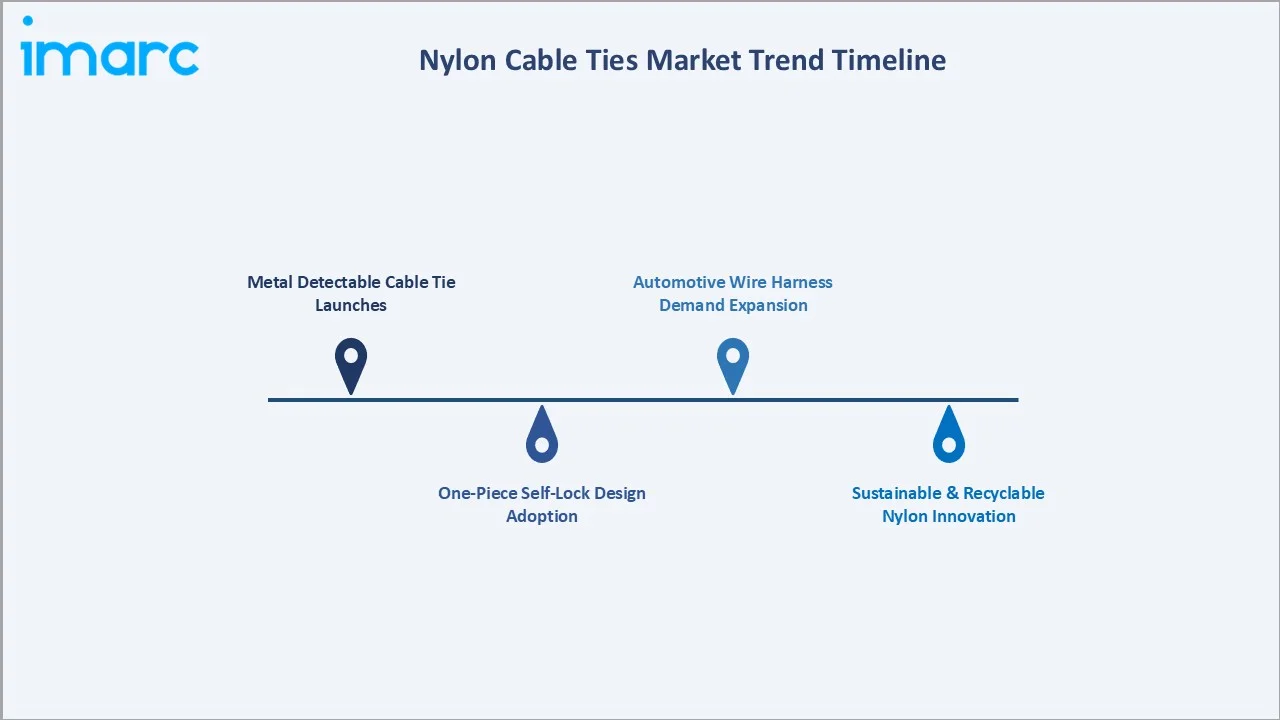
1. Metal Detectable Cable Tie Launches
Manufacturers are increasingly launching metal detectable cable ties, leveraging the technology to enhance safety compliance across food processing and pharmaceutical manufacturing environments. In September 2023, Ascend Performance Materials launched pre-colored, metal-detectable Vydyne PA66 compounds for cable ties and fasteners used in food and pharmaceutical processing environments.
2. One-Piece Self-Lock Design Adoption
Growing demand for simplified installation is driving adoption of one-piece, self-lock cable tie designs that reduce assembly time and improve handling efficiency. Hua Wei manufactures one-piece polyamide cable ties featuring an integrated pawl-and-serration locking mechanism that delivers secure fastening and rated tensile strength.
3. Automotive Wire Harness Demand Expansion
Rising automotive production and electrification trends are accelerating demand for nylon cable ties used in wire harness bundling and securing applications. According to the International Organization of Motor Vehicle Manufacturers (OICA), global vehicle production increased by 3.9%, rising from 92.7 million units in 2024 to 96.4 million units in 2025.
4. Sustainable & Recyclable Nylon Innovation
In April 2026, Epoch Biodesign announced plans to open Europe’s first and the world’s largest nylon 6,6 biorecycling demonstration plant in London in Q3 2026. The facility will use AI-engineered enzymes to convert hundreds of tons of post-consumer nylon waste annually into virgin-quality monomers through a low-energy, low-emission process.
Industry Value Chain Analysis
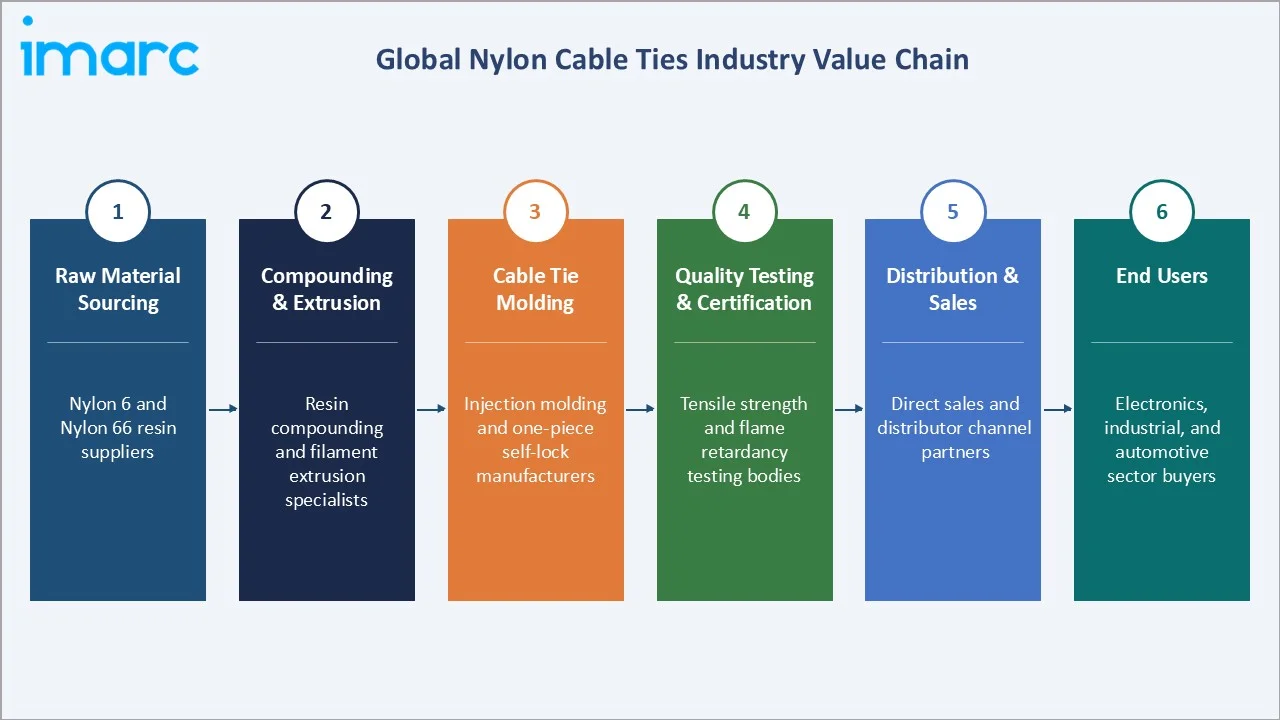
The global nylon cable ties value chain spans raw material sourcing through end-user delivery, with each stage occupied by specialized resin suppliers, compounding and molding manufacturers, and distribution partners whose performance directly influences product quality, durability, and cost efficiency.
|
Stage |
Key Players / Examples |
|
Raw Material Sourcing |
Nylon 6 and Nylon 66 resin suppliers |
|
Compounding & Extrusion |
Resin compounding and filament extrusion specialists |
|
Cable Tie Molding |
Injection molding and one-piece self-lock manufacturers |
|
Quality Testing & Certification |
Tensile strength and flame retardancy testing bodies |
|
Distribution & Sales |
Direct sales and distributor channel partners |
|
End Users |
Electronics, industrial, and automotive sector buyers |
Technology Landscape in the Nylon Cable Ties Industry
Metal Detectable Formulations
Manufacturers are advancing metal detectable nylon compounding techniques to improve safety compliance, supporting broader adoption among food processing and pharmaceutical facilities. The integration of barium sulfate and iron oxide detectable compounds into nylon 66 base resins is enabling fragment identification through both metal detection and X-ray inspection systems simultaneously.
One-Piece Self-Lock Molding
Growing investment in one-piece self-lock molding technology is expanding installation efficiency, addressing rising demand for simplified cable management solutions. Advances in precision injection molding tooling and gate design are enabling manufacturers to produce self-locking pawl mechanisms with tighter dimensional tolerances and more consistent locking force.
Sustainable Nylon Development
Providers are adopting recyclable and bio-based nylon formulations to extend sustainability across the product lifecycle, meeting rising demand for environmentally responsible fastening solutions. Partially bio-based polyamide compounds derived from castor oil feedstocks are being validated as drop-in replacements for petroleum-derived nylon 66, offering comparable tensile strength and UV resistance while reducing carbon footprint per unit.
Enhanced Tensile Strength Engineering
Expanding research into resin compounding and reinforcement techniques is strengthening tensile performance, supporting premium positioning across demanding industrial applications. Glass fiber reinforcement at 15–30% loading levels and the incorporation of heat stabilizer additive packages are being applied to standard nylon 66 formulations to achieve tensile strengths exceeding 550 N in standard widths.
Market Segmentation Analysis
The report covers the following segments:
|
Segment Category |
Leading Segment |
Market Share |
Year |
|
Type |
Nylon 6 |
52.4% |
2025 |
|
Application |
Electronics and Electrical |
30.2% |
2025 |
|
Sales Channel |
🔒 |
🔒 |
2025 |
|
Region |
Asia-Pacific |
38.4% |
2025 |

By Type
Nylon 6 dominates with a 52.4% share in 2025. This segment encompasses the traditional core material offering balanced stiffness and flexibility, supported by sustained demand for its cost-effectiveness and versatility across mass-market applications.
To access detailed market analysis, Request Sample
Nylon 66 represents 32.8% of the market, reflecting demand for its superior tensile strength and heat resistance in demanding applications, a segment expected to expand steadily as automotive and industrial adoption grows.
By Application
Electronics and electrical leads the application mix at 30.2% share (2025), supported by rising demand for organized cable management across electronic assemblies and data infrastructure.
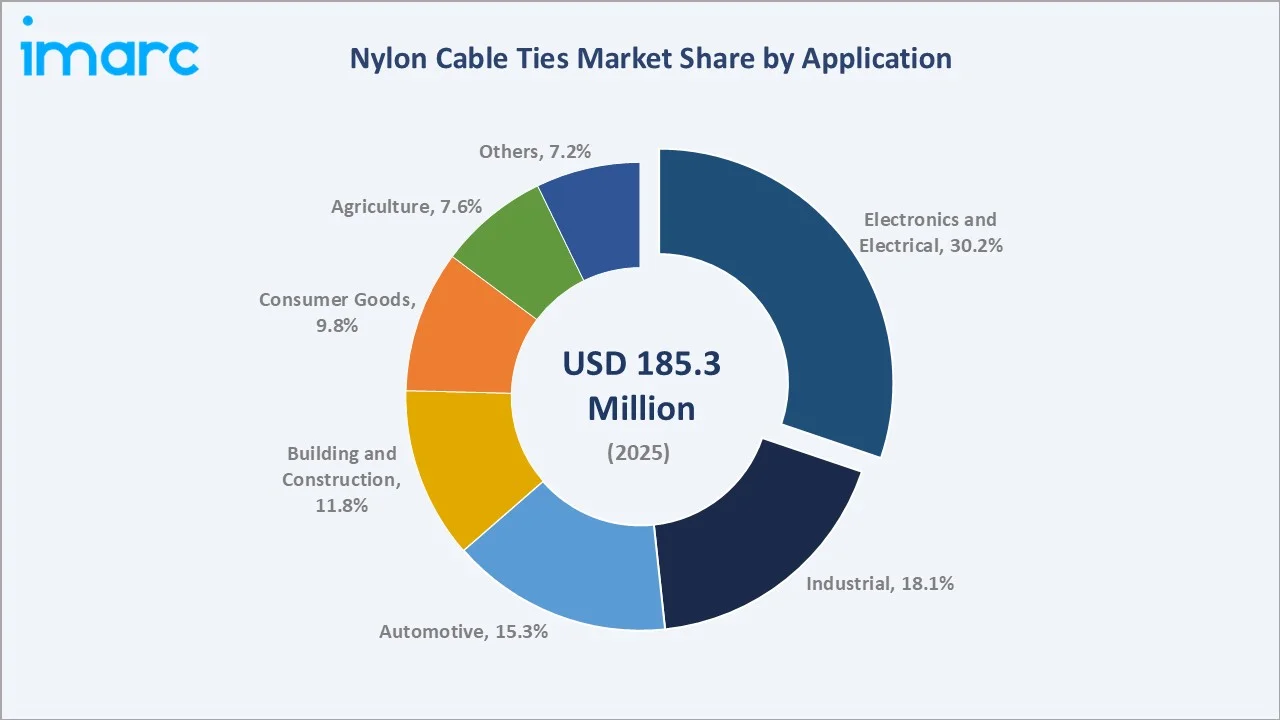
Industrial (18.1%), automotive (15.3%), building and construction (11.8%), consumer goods (9.8%), and agriculture (7.6%) continue to serve varied bundling and fastening needs, with Industrial applications expanding steadily as manufacturers prioritize secure component management.
Regional Market Insights
Asia-Pacific's market leadership (38.4%, 2025) reflects the region's expansive manufacturing base and rising industrialization across electronics and automotive production. Growing infrastructure investment and expanding export-oriented manufacturing combine to sustain its dominant position through 2034.
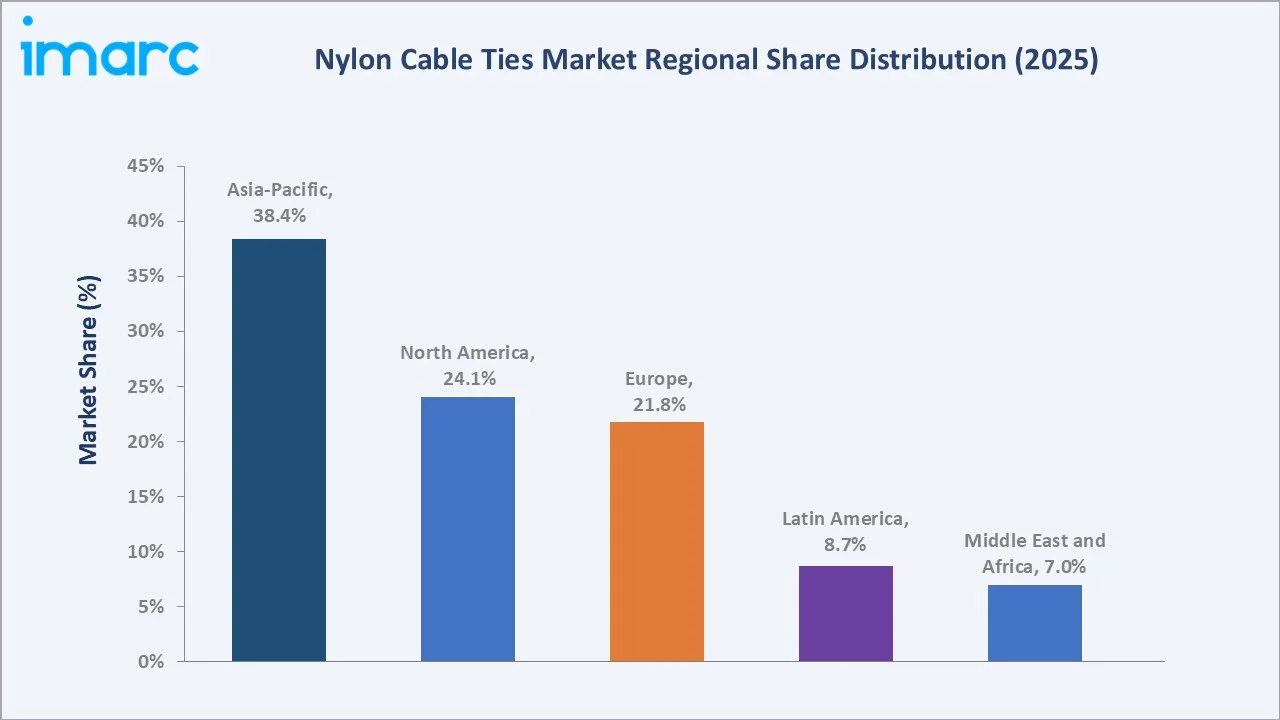
North America at 24.1% (2025) represents the second-largest nylon cable ties market globally. Strong industrial and electronics manufacturing infrastructure is sustaining steady growth, positioning the region as a key contributor alongside Asia-Pacific through the forecast period.
|
Region |
Share (2025) |
Key Growth Drivers |
|
Asia-Pacific |
38.4% |
Expansive manufacturing base and rising industrialization |
|
North America |
24.1% |
Strong industrial and electronics manufacturing infrastructure |
|
Europe |
21.8% |
Stringent quality standards and expanding automotive production |
|
Latin America |
8.7% |
Emerging industrialization and expanding manufacturing infrastructure |
|
Middle East and Africa |
7.0% |
Growing interest in industrial applications and gradual infrastructure expansion |
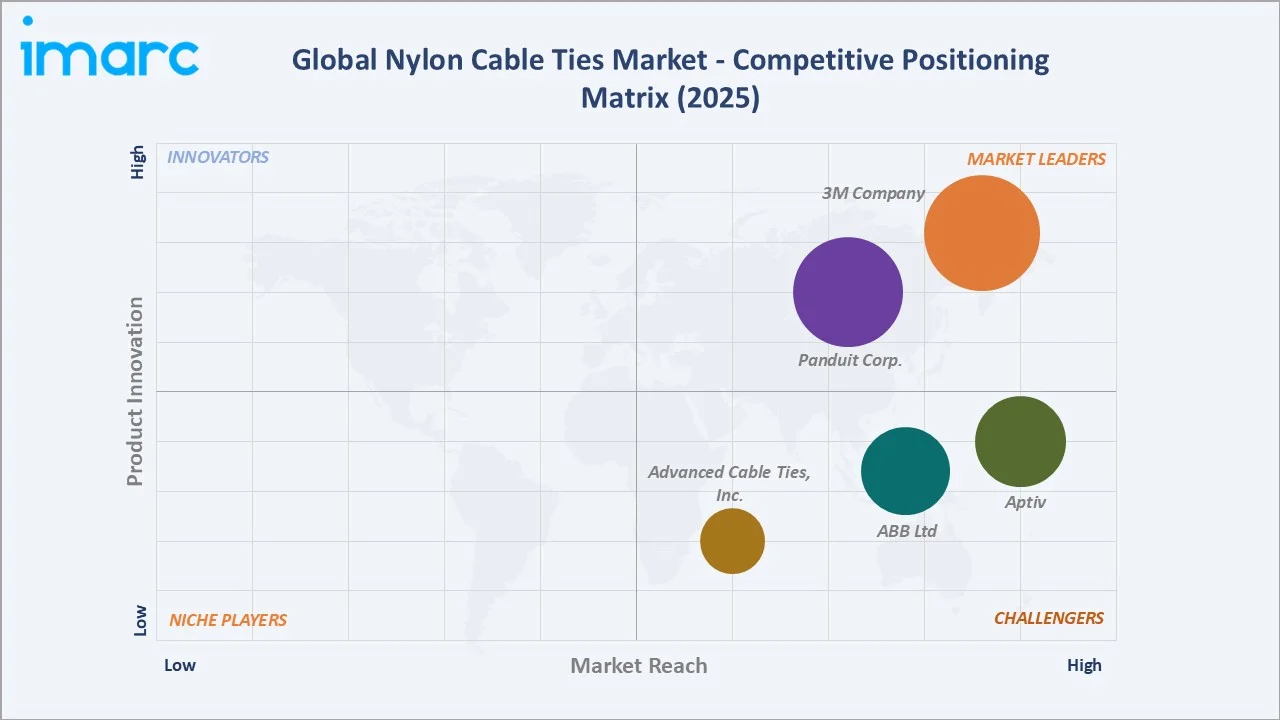
Competitive Landscape
The global nylon cable ties market exhibits moderate concentration, with leading manufacturers collectively holding a significant share of market revenue in 2025, reflecting sustained investment in product innovation and distribution reach.
|
Company Name |
Brands/Products |
Market Position |
Core Strength |
|
3M Company |
3M Scotchflex Cable Tie, 3M Standard Nylon Cable Ties
|
Market Leader |
Extensive global distribution network and cable management innovation pipeline |
|
Panduit Corp. |
Panduit Post-Industrial Recycled Nylon 6.6 Cable Ties and Mounts, Pan-Ty, Dome-Top, Contour-Ty
|
Market Leader |
Broad industrial and electrical cable tie portfolio |
|
Aptiv |
HellermannTyton |
Strong Challenger |
Premium cable management and automotive wire harness positioning |
|
ABB Ltd |
Ty-Rap, Ty-Met, Col-Ty, Deltec |
Strong Challenger |
Pioneer industrial automation and electrical component heritage |
|
Advanced Cable Ties, Inc. |
Advanced Cable Ties |
Challenger |
Specialty cable tie manufacturing expertise |
3M Company and Panduit Corp. dominate through comprehensive product portfolios and extensive global distribution networks, supported by continuous R&D investment. Aptiv, ABB Ltd, and Advanced Cable Ties Inc. compete through targeted premium positioning, industrial heritage, and specialty material differentiation, respectively.
Key Company Profiles
3M Company
3M Company is a global diversified manufacturer with an extensive cable management product portfolio spanning electrical and industrial applications distributed across global retail and distributor networks.
- Product Portfolio: Nylon cable ties, cable management accessories, and industrial fastening solutions under multiple 3M brands.
- Recent Developments: In January 2026, 3M Company reported full-year 2025 sales of USD 24.9 billion, up 1.5%, while adjusted EPS rose 10% to USD 8.06. For 2026, the company expects approximately 4% adjusted sales growth and adjusted EPS of USD 8.50–8.70.
- Strategic Focus: Strengthening product innovation; expanding distribution reach across emerging markets.
Panduit Corp.
Panduit Corp. is a leading global provider of electrical and network infrastructure solutions with a growing cable tie portfolio serving both industrial and electrical distribution channels worldwide.
- Product Portfolio: Panduit Post-industrial recycled nylon 6.6 cable ties and mounts, pan-ty, dome-top, contour-ty nylon cable ties, and cable management accessories distributed through industrial and electrical distributor partnerships.
- Recent Developments: In May 2026, Panduit introduced a 20-year manufacturer’s warranty for its DuraTy acetal and Nylon 612 cable ties used in selected solar, renewable energy, and utility applications. The products are engineered to withstand prolonged UV exposure, weathering, chemicals, and mechanical stress, helping reduce maintenance and replacement costs.
- Strategic Focus: Scaling product innovation; deepening industrial and electrical distribution partnerships.
Market Concentration Analysis
The global nylon cable ties market exhibits moderate concentration, with 3M Company, Panduit Corp., and Aptiv collectively accounting for a significant share of total category revenue in 2025, reflecting sustained R&D investment, brand loyalty, and extensive distribution infrastructure worldwide.
Consolidation pressure remains limited as leading manufacturers maintain distinct strategic positioning: 3M Company and Panduit Corp. through comprehensive multi-category portfolios, Aptiv and ABB Ltd through premium and industrial heritage positioning, and Advanced Cable Ties Inc. through specialty and material technology differentiation, rather than pursuing direct M&A consolidation.
Investment & Growth Opportunities
Fastest Growing Segments
Nylon 6 (~6.0% CAGR) represents the highest-growth investment vector through 2034, driven by expanding electronics and industrial manufacturing demand and continuous innovation across compounding and molding technologies. This subcategory addresses a rapidly expanding addressable market within the global manufacturing and cable management ecosystem.
Emerging Market Expansion
Latin America and the Middle East and Africa collectively represent an incremental growth opportunity beyond Asia-Pacific and North America by 2034, as rising industrialization and expanding manufacturing infrastructure accelerate category penetration in these secondary regional markets.
Venture and Institutional Investment Trends
- Manufacturer investment toward sustainable and recyclable nylon innovation is creating opportunities for material technology vendors serving the cable ties sector.
- Growing automotive wire harness demand is sustaining institutional interest in specialty cable management manufacturing platforms.
- Metal detectable and one-piece self-lock innovation, led by major manufacturers, is opening opportunities for material technology and molding vendors serving the global industrial fastening industry.
Future Market Outlook (2026-2034)
The global nylon cable ties market is positioned for steady, industrialization-driven expansion through 2034. From a base of USD 185.3 Million in 2025, the market is projected to reach USD 310.2 Million by 2034, representing substantial incremental value creation at a CAGR of 5.71%. This growth is underpinned by widespread industrial adoption, expanding food and beverage packaging demand, and continuous innovation across the cable management sector.
The type mix will continue evolving through 2034, with Nylon 6 gaining further share as cost-effective, versatile fastening demand accelerates. This shift creates opportunities for manufacturers investing in metal detectable formulations, one-piece self-lock designs, and sustainable nylon innovation to capture the next phase of the global nylon cable ties market growth.
Research Methodology
Primary Research
Primary research comprised structured interviews with industry participants across 2024-2025, including cable tie manufacturer executives, industrial procurement managers, materials specialists, and electronics analysts globally. Expert input validated market sizing, segmentation trends, and regional consumption patterns.
Secondary Research
Secondary research encompassed manufacturer annual reports, industrial materials association publications, and electronics trade press covering nylon cable tie innovation, regulatory trends, and regional manufacturing dynamics across major markets.
Forecasting Models
Market size estimations were derived using top-down and bottom-up forecasting, incorporating type and application mix transitions and manufacturer capacity disclosures. A base-case CAGR of 5.71% reflects consensus estimates validated against announced production expansion timelines and manufacturer strategic investment plans.
Report Coverage:
| Report Features | Details |
|---|---|
| Base Year of the Analysis | 2025 |
| Historical Period | 2020-2025 |
| Forecast Period | 2026-2034 |
| Units | Million USD |
| Scope of the Report | Exploration of Historical Trends and Market Outlook, Industry Catalysts and Challenges, Segment-Wise Historical and Predictive Market Assessment:
|
| Types Covered | Nylon 6, Nylon 66, Others |
| Sales Channel Covered | Direct Sales, Distributor |
| Applications Covered | Electronics and Electrical, Building and Construction, Automotive, Agriculture, Consumer Goods, Industrial, Others |
| Region Covered | Asia Pacific, Europe, North America, Latin America, Middle East and Africa |
| Countries Covered | United States, Canada, Germany, France, United Kingdom, Italy, Spain, Russia, China, Japan, India, South Korea, Australia, Indonesia, Brazil, Mexico |
| Companies Covered | 3M Company, Panduit Corp., Aptiv, ABB Ltd, Advanced Cable Ties Inc., etc. |
| Customization Scope | 10% Free Customization |
| Post-Sale Analyst Support | 10-12 Weeks |
| Delivery Format | PDF and Excel through Email (We can also provide the editable version of the report in PPT/Word format on special request) |
Frequently Asked Questions About the Nylon Cable Ties Market Report
The global nylon cable ties market reached USD 185.3 Million in 2025 and is projected to reach USD 310.2 Million by 2034.
The market is expected to grow at a CAGR of 5.71% during 2026-2034, driven by widespread industrial adoption and expanding food and beverage packaging demand.
Asia-Pacific leads with a 38.4% share in 2025, anchored by the region's expansive manufacturing base and rising industrialization.
Nylon 6 dominates with a 52.4% share in 2025, driven by sustained demand for its balanced stiffness, flexibility, and cost-effectiveness.
Electronics and electrical leads with a 30.2% share in 2025, supported by rising demand for organized cable management.
Some of the key players include 3M Company, Panduit Corp., Aptiv, ABB Ltd, and Advanced Cable Ties Inc.
Nylon 6 is growing fastest at an estimated 6.0% CAGR as electronics and industrial manufacturing demand accelerates.
Key challenges include availability of low-cost alternative fasteners, raw material price volatility, and environmental concerns over plastic waste.
Sustainable and recyclable nylon innovation, automotive wire harness demand expansion, and emerging market manufacturing growth represent leading investment opportunities.
Automotive, at 15.3% share, is expanding steadily as rising vehicle production and electrification trends drive demand for wire harness bundling solutions.
Need more help?
- Speak to our experienced analysts for insights on the current market scenarios.
- Include additional segments and countries to customize the report as per your requirement.
- Gain an unparalleled competitive advantage in your domain by understanding how to utilize the report and positively impacting your operations and revenue.
- For further assistance, please connect with our analysts.
 Request Customization
 Speak to an Analyst
 Request Brochure
 Inquire Before Buying
Benefits of Customization
- Personalize this research
- Triangulate with your data
- Get data as per your format and definition
- Gain a deeper dive into a specific application, geography, customer, or competitor
- Any level of personalization
Get in Touch With Us
UNITED STATES
Phone: +1-201-971-6302
INDIA
Phone: +91-120-433-0800
UNITED KINGDOM
Phone: +44-753-714-6104
Email: [email protected]
Client Testimonials




.webp)




.webp)













Related Reports

Choose your plan
*Please note that the prices mentioned below are starting prices for each bundle type. Kindly contact our team for further details.*
Single User License
- 1 User License, Access on 2 Devices
- PDF Report + Excel Dataset (Password Protected)
- Lifetime Access
- No Printing Rights
- 10% Free Report Customization
- 10–12 Weeks of Analyst Support
Five User License
- Access for 5 Users, 2 Devices per User
- PDF Report + Excel Dataset (Password Protected)
- Lifetime Access
- Dedicated Account Manager
- 12–14 Weeks of Analyst Support
- No Printing Rights
- 15% Free Report Customization
- 25% Discount on Your Next Purchase
Corporate User License
- Unlimited User Access (Within Your Organization)
- PDF Report + Excel Dataset
- Lifetime Access
- Dedicated Account Manager
- 14–20 Weeks of Analyst Support
- No Printing Rights
- 20% Free Report Customization
- 30% Discount on Your Next Purchase
Essential Insights
What's included:
3 reports
- Lifetime Access
- PDF Reports
- Excel Datasets
- 2 Weeks of Free Analyst Support
- 2 User Licenses
- Access on 2 Devices
- Printing Rights
- Complimentary PowerPoint (PPT) Version
- Complimentary License Upgrade
Professional Access
What's included:
5 reports
- Lifetime Access
- PDF Reports
- Excel Datasets
- 8 Weeks of Free Analyst Support
- 2 User Licenses
- Access on 2 Devices
- Printing Rights
- Complimentary PowerPoint (PPT) Version
- Complimentary License Upgrade
Business Advantage
What's included:
8 reports
- Lifetime Access
- PDF Reports
- Excel Datasets
- 14 Weeks of Free Analyst Support
- 2 User Licenses
- Access on 2 Devices
- Printing Rights
- Complimentary PowerPoint (PPT) Version
- Complimentary License Upgrade
Enterprise Intelligence
What's included:
10 reports
- Lifetime Access
- PDF Reports
- Excel Datasets
- 20 Weeks of Free Analyst Support
- 2 User Licenses
- Access on 2 Devices
- Printing Rights
- Complimentary PowerPoint (PPT) Version
- Complimentary License Upgrade