
Saudi Arabia Flat Glass Market Size, Share, Trends, and Forecast by Technolog, Product Type, Raw Material, Application, Type, End Use Industry, and Region, 2026-2034
Saudi Arabia Flat Glass Market Size, Share, Trends & Forecast (2026-2034)
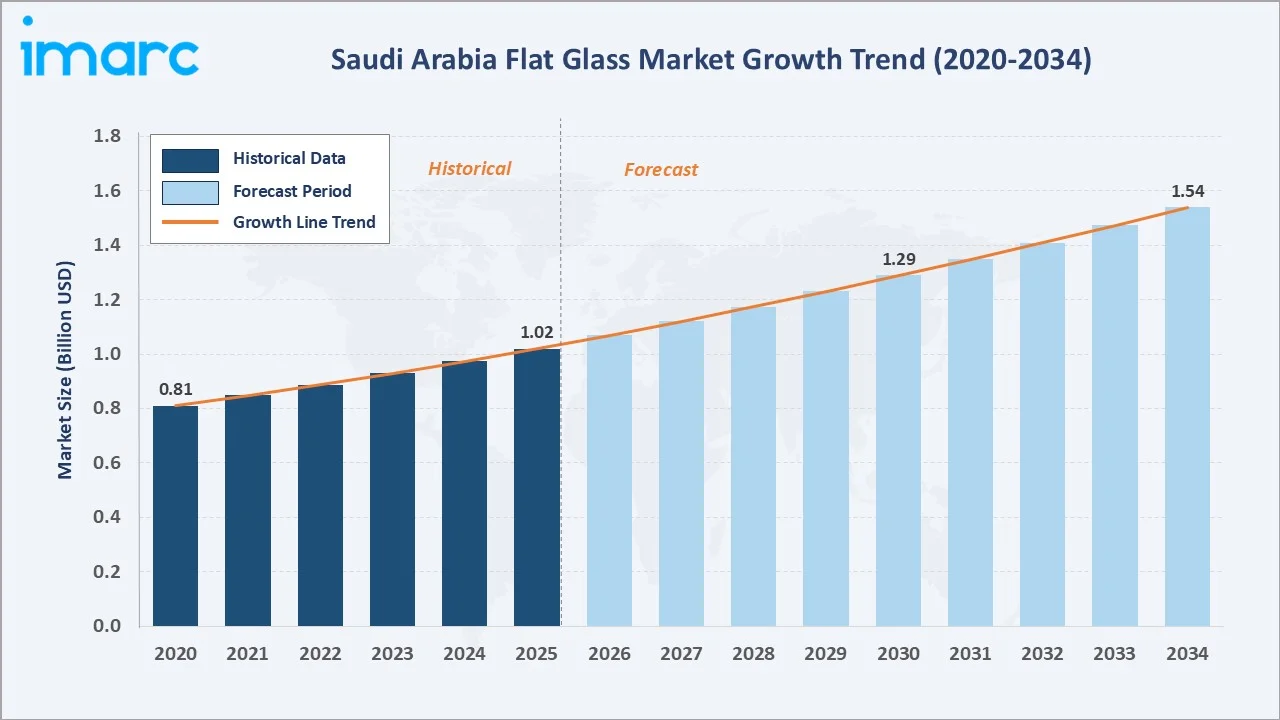
The Saudi Arabia flat glass market size increased from USD 1.02 Billion in 2025 to USD 1.07 Billion in 2026 and is projected to reach USD 1.54 Billion by 2034, growing at a CAGR of 4.69% during 2026-2034.
Market Snapshot
|
Metric |
Value |
| Base Year Market Size (2025) |
USD 1.02 Billion |
| Market Size (2026) | USD 1.07 Billion |
|
Forecast Market Size (2034) |
USD 1.54 Billion |
|
CAGR (2026-2034) |
4.69% |
|
Base Year |
2025 |
|
Historical Period |
2020-2025 |
|
Forecast Period |
2026-2034 |
|
Dominant Technology |
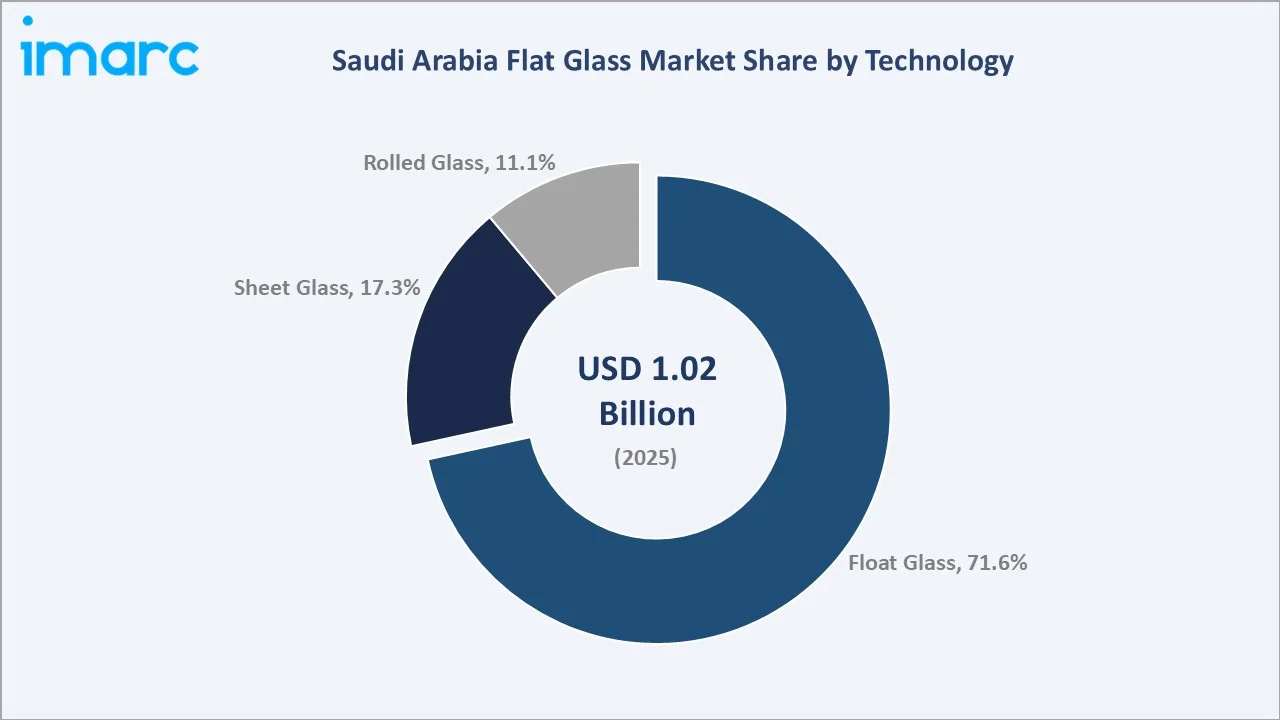
Float Glass (71.6%, 2025) |
|
Dominant Application |
Safety and Security (58.7%, 2025) |
|
Leading Region |
Northern and Central Region (41.8%, 2025) |
The Saudi Arabia flat glass market expanded from USD 0.81 Billion in 2020 to USD 1.02 Billion in 2025 and an estimated USD 1.07 Billion in 2026, fueled by Vision 2030 construction projects, growing solar energy investments, and increasing demand for energy-efficient building materials. Float glass dominates at 71.6%, while safety and security applications lead at 58.7%.
To get more information on this market, Request Sample
Float glass at 71.6% underpins market leadership through its superior quality and widespread construction application. Safety and security at 58.7% reflects the dominant architectural demand driven by giga-projects and commercial real estate development across Saudi Arabia.
Executive Summary
The Saudi Arabia flat glass market, which increased from USD 1.02 Billion in 2025 to an estimated USD 1.07 Billion in 2026. Saudi Arabia's Vision 2030 construction boom, expanding solar energy capacity, and growing automotive production are the primary catalysts driving the market toward USD 1.54 Billion by 2034.
Float glass at 71.6% dominates through superior optical quality and large-scale manufacturing efficiency. Safety and security applications at 58.7% lead demand, driven by architectural glass requirements in giga-projects and commercial developments. The Northern and Central Region at 41.8% anchors market growth through Riyadh's construction concentration.
Key Market Insights
|
Insight |
Data |
|
Dominant Technology |
Float Glass — 71.6% share (2025) |
|
Dominant Application |
Safety and Security — 58.7% market share (2025) |
|
Leading Region |
Northern and Central Region — 41.8% market share (2025) |
|
Market Opportunity |
Smart glass, solar photovoltaic glass, energy-efficient low-E coated glass |
Key Analytical Observations Supporting the Above Data:
- Float Glass at 71.6%: The float glass process delivers the highest optical clarity and uniform thickness required for architectural and automotive applications, making it the preferred technology for Saudi Arabia's large-scale construction projects. Obeikan Glass Company's second float line at Yanbu, with 650 tons daily capacity, underscores domestic production ambition aligned with Vision 2030 localization objectives.
- Safety and Security at 58.7%: Saudi Arabia's giga-projects, including NEOM and The Red Sea Project, require large volumes of tempered, laminated, and coated safety glass for facades, partitions, and windows, underpinning this segment's dominant position. Stringent building codes and safety regulations further reinforce demand for certified safety glass products across the Kingdom's expanding commercial real estate portfolio.
- Northern and Central Region at 41.8%: Riyadh's concentration of mega-projects, government construction programs, and commercial real estate developments drives dominant regional market share in the flat glass market. The capital's rapid urban expansion and giga-project spillover effects from NEOM planning activities concentrated in the central administrative corridor reinforce this regional leadership.
Saudi Arabia Flat Glass Market Overview
The Saudi Arabia flat glass market encompasses float glass, sheet glass, and rolled glass production, processing, and distribution across construction, automotive, solar energy, and electronics end-use industries. The ecosystem integrates raw material suppliers, glass manufacturers, fabricators, distributors, and end-user sectors.
Saudi Arabia's Vision 2030 program, giga-project construction pipeline, and renewable energy expansion create a multi-year structural demand driver for flat glass across all technology and application categories. The Kingdom's geographic diversification across four distinct regions creates varied demand characteristics and growth opportunities.
Market Dynamics
To evaluate market opportunities, Request Sample
Market Drivers
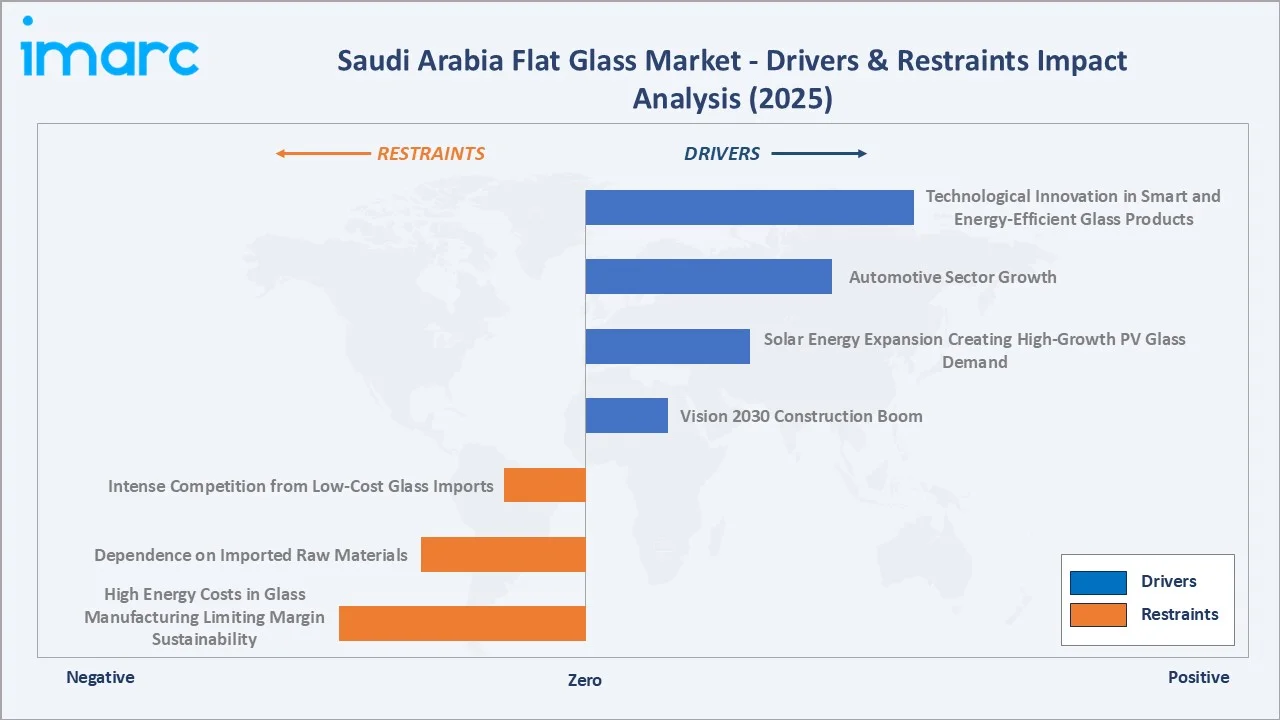
- Vision 2030 Construction Boom: Saudi Arabia's Vision 2030 development agenda is driving substantial investment in residential, commercial, tourism, and infrastructure projects, creating sustained demand for flat glass used in facades, windows, partitions, and interior applications. The expansion of large-scale urban developments and modernization of existing buildings is further increasing the use of architectural glass. Continued construction activity across major cities is expected to provide a stable demand base for flat glass manufacturers over the forecast period.
- Solar Energy Expansion Creating High-Growth Photovoltaic Glass Demand: Saudi Arabia's focus on renewable energy and solar power development is creating new opportunities for photovoltaic and solar-control glass products. The country's favorable solar conditions and expanding utility-scale and distributed solar installations are supporting demand for glass used in solar modules and energy-efficient building applications. Growing investment in renewable energy projects is expected to make photovoltaic glass one of the faster-growing application areas within the flat glass market.
- Automotive Sector Growth: The development of Saudi Arabia's automotive manufacturing and assembly ecosystem is supporting demand for automotive flat glass, including windshields, side windows, and rear windows. Rising vehicle production, fleet expansion, and increasing adoption of advanced safety and comfort features are encouraging the use of laminated, tempered, and other higher-performance automotive glass products. Continued localization of automotive manufacturing is expected to provide additional demand opportunities.
- Technological Innovation in Smart and Energy-Efficient Glass Products: Growing emphasis on energy efficiency and sustainable building practices is increasing the adoption of advanced flat glass products, including low-emissivity, solar-control, electrochromic, and other high-performance glazing solutions. These products help reduce heat gain and energy consumption while improving building comfort and aesthetics. Increasing demand from premium residential, commercial, hospitality, and institutional projects is supporting product innovation and creating opportunities for higher-value flat glass applications.
Market Restraints
- High Energy Costs in Glass Manufacturing Limiting Margin Sustainability: Glass manufacturing is highly energy-intensive, with melting and tempering processes consuming significant electricity and natural gas. The Saudi Glass Manufacturers Association reported a rise in production costs due to higher energy and raw material expenses, compressing margins for local manufacturers. While Saudi Arabia offers competitive natural gas pricing for industrial use, global energy price volatility creates cost unpredictability for manufacturers with export exposure.
- Dependence on Imported Raw Materials: Despite abundant domestic sand reserves, Saudi Arabia relies on imports for key glass manufacturing inputs, including high-purity soda ash and specialty chemicals. Import dependence creates supply chain risk during global logistics disruptions and exposes manufacturers to exchange rate fluctuations. The Kingdom's Vision 2030 domestic content requirements create pressure to develop local supply chains that may face quality and availability limitations in the near term.
- Intense Competition from Low-Cost Glass Imports: Saudi Arabia's open trade environment allows the import of flat glass from China, Egypt, and other lower-cost producers, creating pricing pressure on domestic manufacturers across commodity product categories. Chinese and Egyptian glass exports to the Gulf have increased competitive intensity, particularly in the standard float glass and sheet glass segments. Local manufacturers must continually invest in product differentiation through value-added processing to maintain competitive positioning.
Market Opportunities
- Smart Glass and Electrochromic Technology Adoption in Giga-Projects: NEOM's technology-first design mandate creates a high-value market for smart glass, including electrochromic, thermochromic, and photovoltaic integrated glass solutions. Various companies are actively collaborating to supply cutting-edge glass products for NEOM's glass-intensive architectural requirements. This premium segment commands significantly higher price points and margins compared to standard flat glass, creating differentiated growth opportunities for technology-leading manufacturers.
- Green Building Standards Driving Low-E and Coated Glass Adoption: Saudi Arabia's mandatory green building requirements under the Saudi Green Building Code are driving specification of energy-efficient glass, including low-emissivity coatings and solar control glass across new construction projects. As the construction pipeline executing under green building compliance expands, low-E and coated glass demand is expected to grow disproportionately relative to standard flat glass, creating higher-value market segments for manufacturers with advanced coating capabilities.
Market Challenges
- Skilled Labor Shortage in Advanced Glass Processing and Installation: Saudi Arabia's flat glass fabrication and installation sector faces a shortage of skilled workers in advanced glass processing, tempering, laminating, and curtain wall installation. The Vision 2030 Saudization program limits reliance on expatriate workers in some categories, while domestic training capacity for specialized glass skills remains limited. This constraint slows the pace of quality advanced glass project execution and can drive higher labor costs across the fabrication value chain.
- Technical Complexity of Large-Format and Smart Glass Projects: The increasing scale of glass panel sizes demanded by NEOM and other giga-projects requires specialized handling, transport, and installation equipment not widely available in Saudi Arabia. Large-format glass panels exceeding conventional transport dimensions require custom logistics solutions and specialized lifting equipment, increasing project costs and lead times. This technical barrier limits the supplier pool capable of serving the most demanding architectural glass specifications in the Kingdom.
Emerging Market Trends
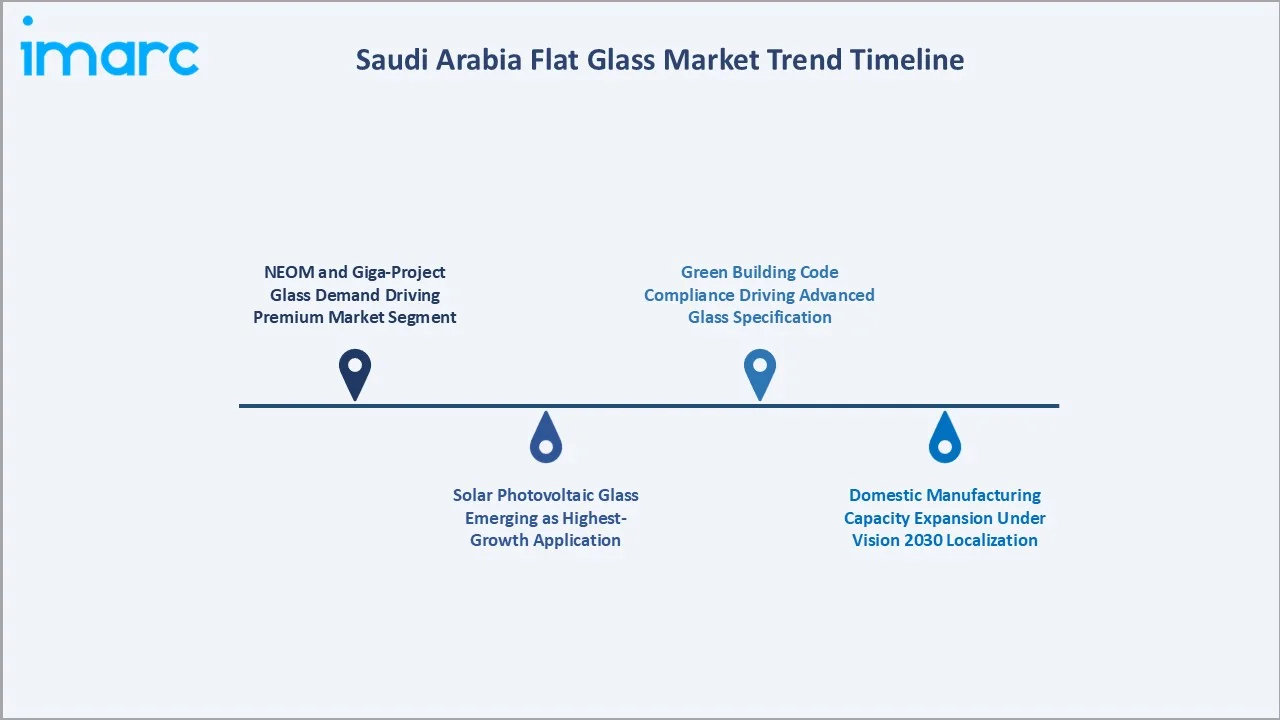
1. NEOM and Giga-Project Glass Demand Driving Premium Market Segment
NEOM's THE LINE and Sindalah Island projects represent unprecedented architectural glass requirements, including ultra-large format panels, mirror glass facades, and smart glass integration at previously unseen scale. These projects are attracting global glass technology leaders to the Saudi market and establishing new benchmarks for glass specification in the region.
2. Solar Photovoltaic Glass Emerging as Highest-Growth Application
Saudi Arabia's renewable energy deployment targets are driving demand for low-iron photovoltaic glass, anti-reflective coated glass, and bifacial solar module glass. The Kingdom's solar irradiance advantage makes it ideal for large-scale PV installations, creating sustained demand for specialized solar glass products through the forecast period.
3. Domestic Manufacturing Capacity Expansion Under Vision 2030 Localization
Obeikan Glass Company revealed plans for a second float glass manufacturing line at Yanbu with 650 tons daily production capacity, reflecting Saudi Arabia's Vision 2030 industrial localization agenda. Domestic glass manufacturing expansion reduces import dependence and supports local content compliance for government-funded construction projects.
4. Green Building Code Compliance Driving Advanced Glass Specification
Saudi Arabia's mandatory green building standards are increasingly specifying minimum glass thermal performance requirements, driving adoption of low-emissivity, triple-glazed, and solar control glass products. Compliance-driven glass upgrading across both new construction and retrofit markets is creating incremental demand for value-added glass products beyond standard float glass.
Industry Value Chain Analysis
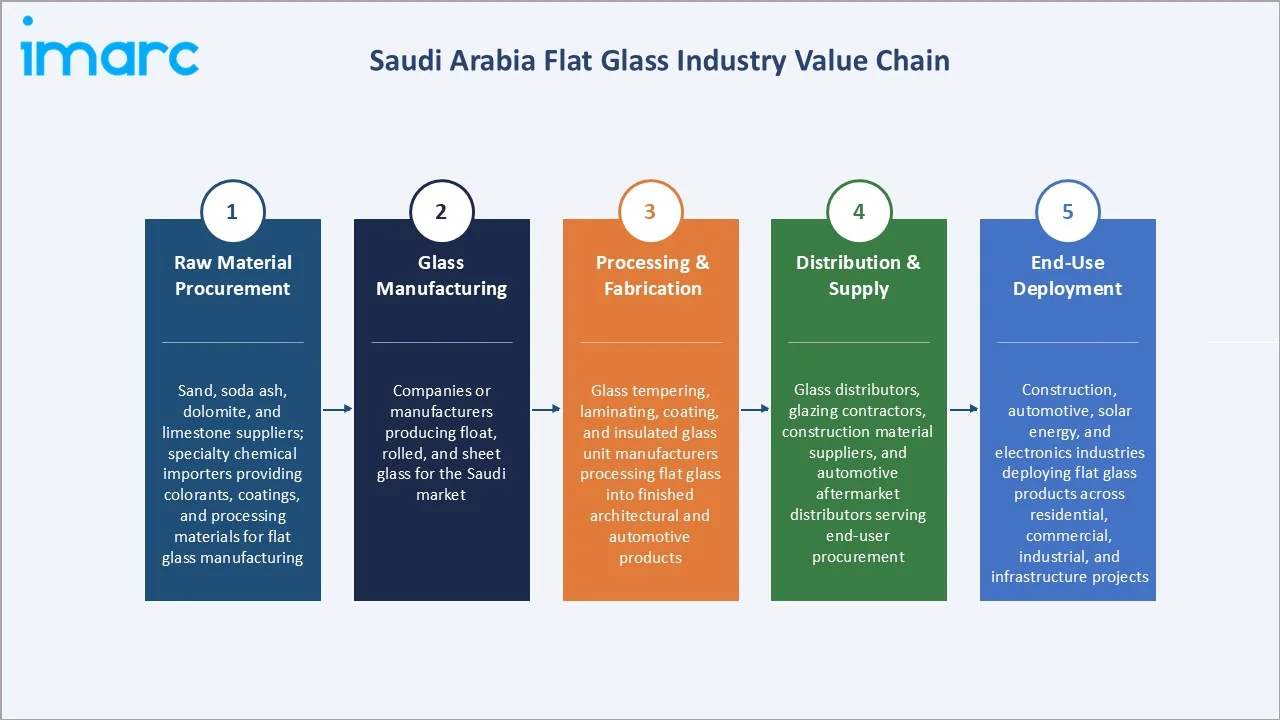
The Saudi Arabia flat glass value chain integrates raw material procurement, glass manufacturing, processing and coating, distribution networks, and end-use deployment across construction, automotive, solar energy, and electronics sectors.
|
Stage |
Key Participants |
|
Raw Material Procurement |
Sand, soda ash, dolomite, and limestone suppliers; specialty chemical importers providing colorants, coatings, and processing materials for flat glass manufacturing |
|
Glass Manufacturing |
Companies or manufacturers producing float, rolled, and sheet glass for the Saudi market |
|
Processing & Fabrication |
Glass tempering, laminating, coating, and insulated glass unit manufacturers processing flat glass into finished architectural and automotive glass products |
|
Distribution & Supply |
Glass distributors, glazing contractors, construction material suppliers, and automotive aftermarket distributors serving end-user procurement |
|
End-Use Deployment |
Construction, automotive, solar energy, and electronics industries deploying flat glass products across residential, commercial, industrial, and infrastructure projects |
The processing and fabrication tier represents the highest value-added layer, converting basic float glass into tempered, laminated, coated, and insulated glass unit products commanding significant price premiums. Vision 2030 construction projects are accelerating investment in domestic glass fabrication capacity to reduce processing lead times and import dependence.
Technology Landscape in the Saudi Arabia Flat Glass Industry
Float Glass Technology
Float glass technology, involving molten glass floating on a bed of molten tin to produce a continuous ribbon of uniform thickness and optical clarity, dominates at 71.6% of the Saudi market. This technology produces the highest quality glass substrate for downstream processing into tempered, laminated, coated, and insulated glass products serving construction and automotive applications.
Low-Emissivity and Solar Control Coating Technology
Magnetron sputtering and pyrolytic coating technologies applying low-emissivity and solar control coatings to float glass represent the fastest-growing technology segment in Saudi Arabia's flat glass market. Saint-Gobain's Yanbu capacity expansion for next-generation low-E glass reflects the growing institutional demand for energy-efficient glass aligned with Saudi green building code requirements.
Smart Glass and Electrochromic Technology
Electrochromic and photochromic smart glass technologies, enabling dynamic light and heat control through electrically switchable tint levels, are emerging as a premium technology segment driven by NEOM and giga-project specifications. AGC Inc.'s strategic MoU with a Saudi developer to introduce smart glass technologies into commercial developments in Riyadh and Jeddah signals growing commercial adoption of this high-value glass category.
Market Segmentation Analysis
The report covers the following segments:
|
Segment Category |
Leading Segment |
Market Share |
Year |
|
Technology |
Float Glass |
71.6% |
2025 |
|
Product Type |
🔒 |
🔒 |
2025 |
|
Raw Material |
🔒 |
🔒 |
2025 |
|
Application |
Solar Control |
28.4% |
2025 |
|
Type |
🔒 |
🔒 |
2025 |
|
End Use Industry |
🔒 |
🔒 |
2025 |
|
Region |
Northern & Central Region |
41.8% |
2025 |

By Technology
Float glass leads at 71.6% in 2025, capturing the broadest application range from architectural facades to automotive windshields through its superior optical quality, uniform thickness, and large-format production capability. Float glass serves as the primary substrate for all downstream processing technologies deployed in Saudi Arabia's construction and automotive sectors.
To access detailed market analysis, Request Sample
Sheet glass at 17.3% serves smaller commercial and residential applications where float glass quality is not required. Rolled glass at 11.1% serves specialized applications including patterned architectural glass, solar collector cover glass, and certain industrial applications where surface texture is a functional requirement rather than a quality deficiency.
By Application
Safety and security applications lead at 58.7%, encompassing tempered, laminated, and toughened glass for building facades, windows, partitions, and doors across Saudi Arabia's expanding commercial and residential construction market. Giga-project architectural glass specifications predominantly specify safety-rated glass products driving this segment's dominant position.
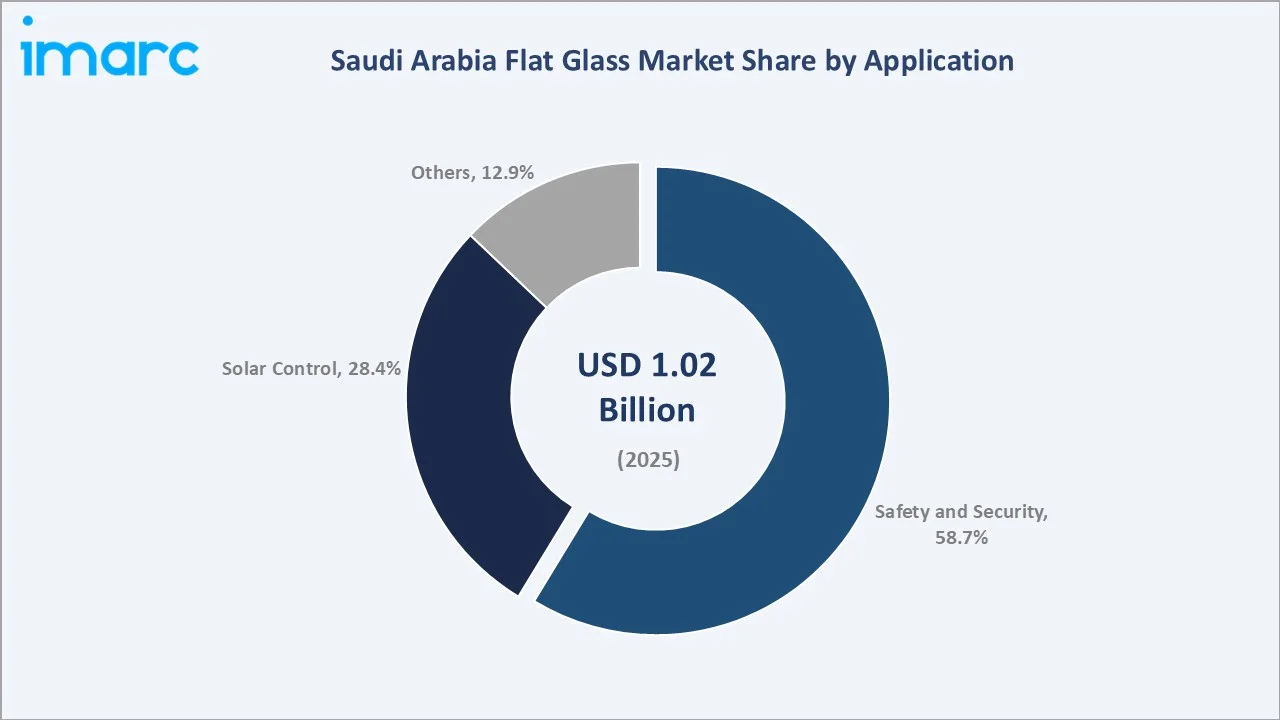
Solar control applications at 28.4% reflect significant and growing demand for reflective, tinted, and low-emissivity coated glass in Saudi Arabia's extreme climate, where solar heat gain management is a critical building performance requirement. The Others segment at 12.9% includes photovoltaic glass, electronic display glass, and specialty optical glass applications.
Regional Market Insights
|
Region |
Share (2025) |
Key Flat Glass Market Drivers & Characteristics |
|
Northern & Central Region |
41.8% |
Anchored by Riyadh's giga-project construction activity, government infrastructure programs, and commercial real estate development; highest concentration of glass fabrication and distribution capacity. |
|
Western Region |
25.3% |
Driven by Jeddah's commercial construction, Red Sea Project coastal developments, and Makkah's hospitality infrastructure expansion requiring large volumes of architectural glass. |
|
Eastern Region |
21.6% |
Dominated by industrial and petrochemical facility construction, Dammam commercial development, and proximity to Yanbu manufacturing corridor housing Obeikan's float glass production facility. |
|
Southern Region |
11.3% |
Emerging market driven by regional infrastructure development programs, residential construction growth, and Vision 2030 economic diversification projects across the Southern Province. |
The Northern and Central Region at 41.8% leads through Riyadh's concentration of Vision 2030 giga-projects, government construction programs, and commercial real estate development. NEOM, while geographically located in the Tabuk region, generates procurement demand channeled through Riyadh administrative offices, reinforcing the region's dominance.
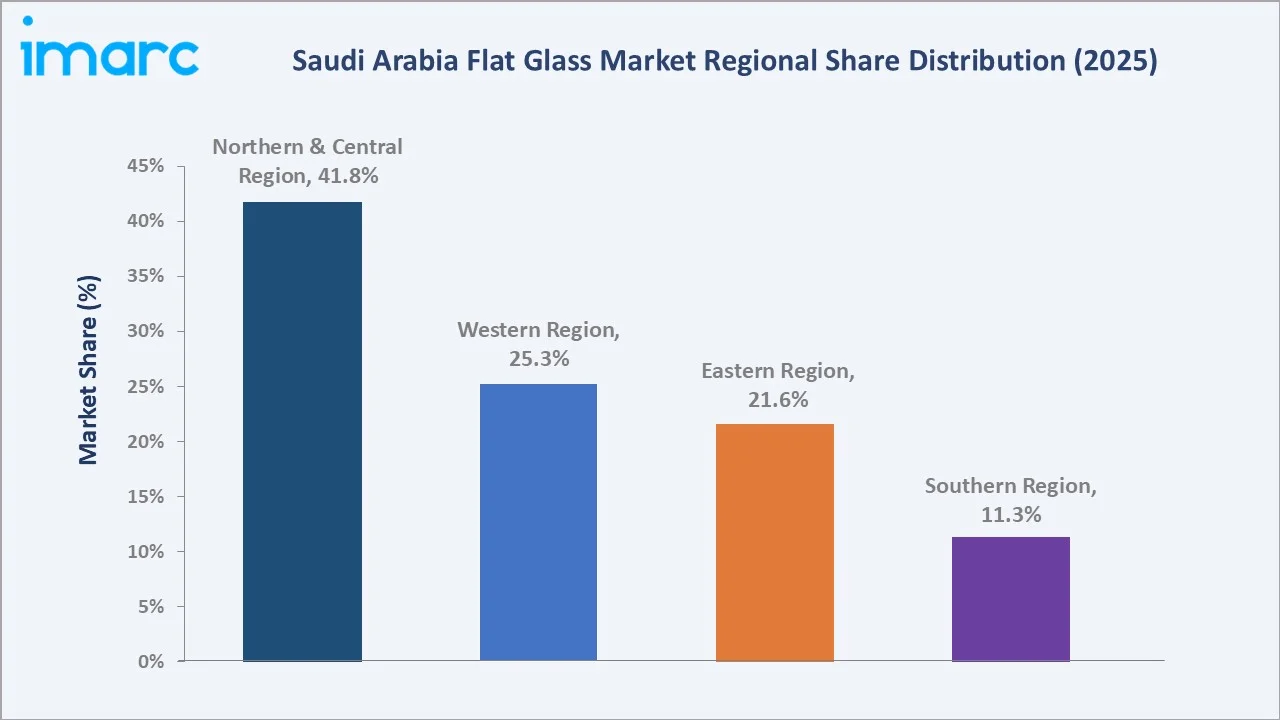
The Eastern Region at 21.6% benefits from proximity to Obeikan's Yanbu float glass manufacturing capacity and industrial construction demand from petrochemical and oil sector facility projects. The Southern Region at 11.3% represents an emerging growth market as Vision 2030 regional development programs expand infrastructure investment beyond the Kingdom's primary urban centers.
Competitive Landscape
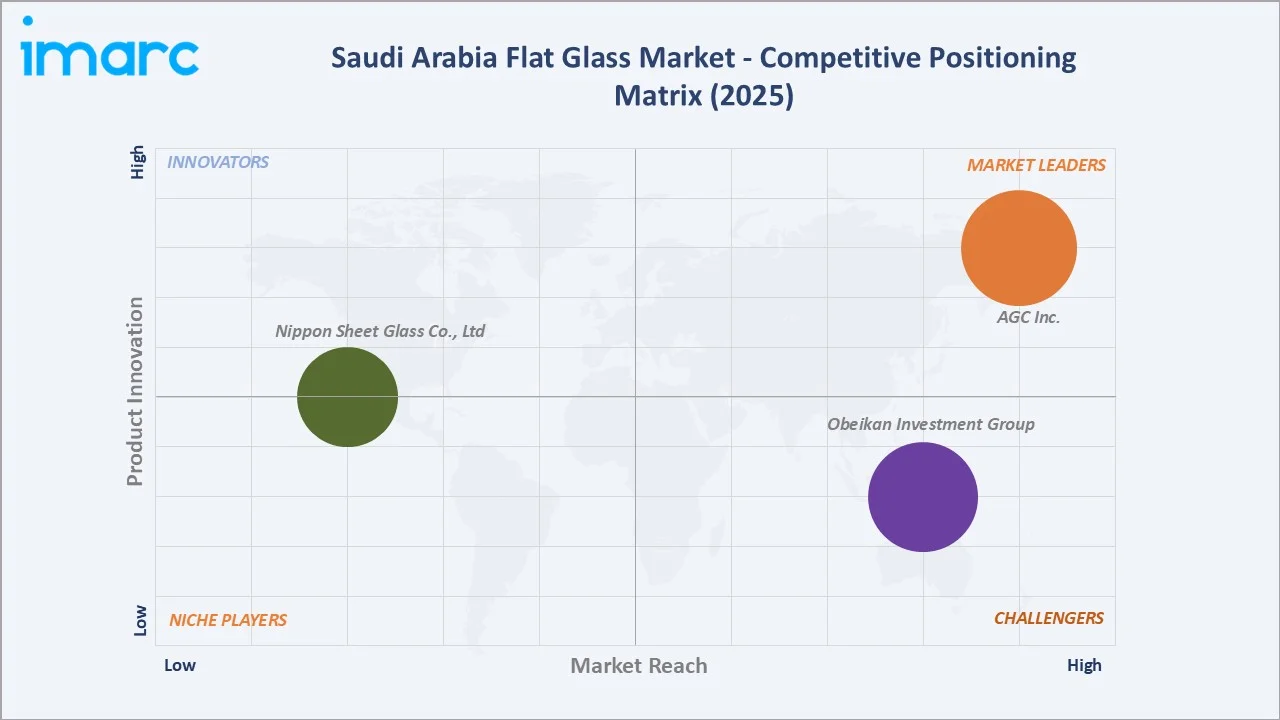
The Saudi Arabia flat glass market features a moderately concentrated competitive landscape with global leaders holding significant positions alongside prominent local manufacturers, which hold approximately 50% of Saudi float glass production capacity.
|
Company Name |
Key Products |
Market Position |
Core Strength |
|
AGC Inc. |
Float glass, coated glass, solar glass, smart glass, Wired glass, Toughened Glass |
Market Leader |
Global technology leader in advanced glass manufacturing with smart glass and PV glass innovation for Saudi giga-projects. |
|
Obeikan Investment Group |
Float glass, Laminated Glass |
Strong Challenger |
Leading Saudi domestic glass manufacturer |
|
Nippon Sheet Glass Co., Ltd |
Float glass, automotive glass, architectural glass |
Established Player |
Global glass manufacturer with automotive and architectural glass expertise serving Saudi construction and vehicle markets. |
Key players include AGC Inc., Obeikan Investment Group, Nippon Sheet Glass Co., Ltd, and others.
Key Company Profiles
AGC Inc.
AGC Inc. is a Japan-based global leader in glass, chemicals, and high-tech materials manufacturing with a growing presence in the Saudi Arabia flat glass market through its advanced coated glass, solar glass, and smart glass technologies targeting NEOM and premium commercial construction projects in Riyadh and Jeddah.
- Key Products: Float glass, coated glass, solar photovoltaic glass, electrochromic smart glass, M100/200 series glass substrates for advanced display and AR/MR applications.
- Strategic Focus: Expanding smart glass and photovoltaic glass technology adoption across Saudi Arabia's giga-project portfolio, targeting NEOM's technology-driven architectural specifications and premium commercial real estate developers through clinical evidence-based performance demonstrations, engineering consultancy partnerships, and specification-stage engagement programs.
Obeikan Investment Group
Obeikan Investment Group, operating through Obeikan Glass Company, is a Saudi Arabia-based glass manufacturer with a dominant domestic market position, holding approximately 50% of Saudi float glass production capacity through its operations at the Royal Commission for Yanbu industrial city. The company serves as the primary domestic supplier for Saudi construction and industrial glass procurement.
- Key Products: Float glass, toughened safety glass, laminated glass, insulated glass units, reflective coated glass for architectural and commercial construction applications across Saudi Arabia.
- Strategic Focus: Strengthening domestic float glass production capacity to serve Saudi Arabia's growing construction market demand, reducing import dependence, achieving Vision 2030 local content compliance across government-funded projects, and developing value-added glass processing capabilities to capture higher-margin fabricated glass market segments.
Market Concentration Analysis
The Saudi Arabia flat glass market is moderately concentrated, with the key players holding significant combined market positions through established manufacturing presence, SASO-certified product portfolios, and strong project specification relationships with Saudi construction developers.
Market concentration is expected to evolve as various companies’ second production lines increase domestic manufacturing capacity, and international glass technology leaders expand their Saudi presence through smart glass and low-E glass technology investments targeting Vision 2030 giga-project specifications.
Investment & Growth Opportunities
Highest Growth Segments
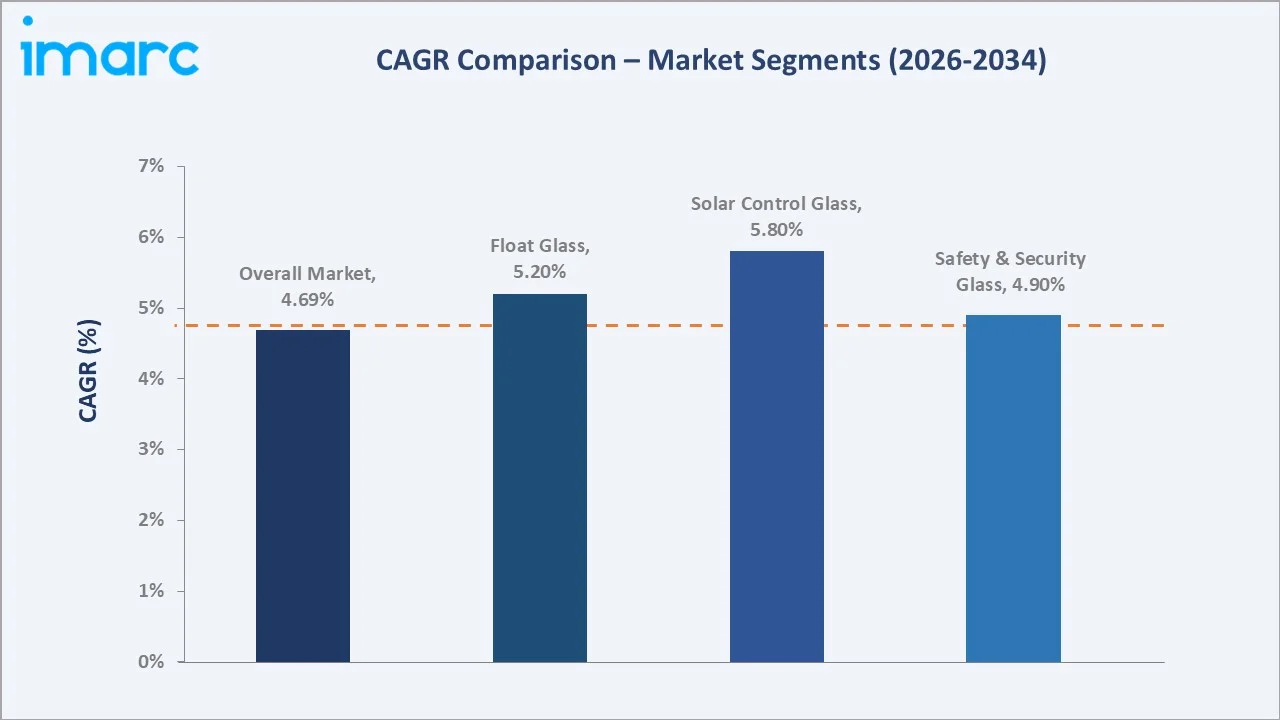
Solar control glass (~5.8% CAGR), photovoltaic glass, smart glass platforms, float glass for giga-projects (~5.2% CAGR), and low-emissivity coated glass represent the highest commercial growth opportunities through 2034 in Saudi Arabia's expanding flat glass market.
Emerging Investment Opportunities
Photovoltaic and solar energy glass represents the Saudi flat glass market's highest-value emerging investment opportunity, driven by Vision 2030's 50% renewable energy target and the Kingdom's unmatched solar irradiance. Smart glass technology partnerships with NEOM and giga-project developers create high-margin specification opportunities for technology-leading glass manufacturers seeking to establish premium positions in Saudi Arabia's architectural glass market.
Investment Themes
- Domestic glass fabrication capacity investment aligned with Vision 2030 local content requirements: reducing Saudi Arabia's dependence on imported processed glass products and capturing value from the fabrication premium across the flat glass value chain serving the Kingdom's construction projects.
- Smart glass and low-E coating technology partnerships with Saudi giga-project developers: driving glass technology specification into Vision 2030 flagship projects and establishing precedent for energy-efficient glass adoption in Saudi Arabia's evolving green building regulatory environment through 2034.
Future Market Outlook (2026-2034)
The Saudi Arabia flat glass market is projected to grow from USD 1.02 Billion in 2025 to USD 1.07 Billion in 2026 and further to USD 1.54 Billion by 2034, delivering a 4.69% CAGR over the forecast period, sustained by Vision 2030 construction momentum, solar energy expansion, and advancing smart and energy-efficient glass adoption.
Three structural forces define market growth through 2034: Vision 2030's multi-year giga-project construction pipeline sustaining architectural glass demand, Saudi Arabia's renewable energy expansion creating specialized solar glass market, and green building code evolution driving specification upgrade from standard to value-added glass products across all construction segments.
Research Methodology
Primary Research
Primary research comprised structured interviews with 40+ industry stakeholders (2025), including glass manufacturers, construction developers, glazing contractors, architectural specification consultants, and Saudi Standards Authority (SASO) certification specialists across the Kingdom's key commercial construction markets.
Secondary Research
Secondary research encompassed SASO product certification data, Saudi Ministry of Industry reports, Vision 2030 construction program publications, company press releases and investor presentations, trade association data from the Saudi Glass Manufacturers Association, and market intelligence from construction project databases covering Saudi Arabia's giga-project pipeline.
Forecasting Models
Market revenue forecasts developed using a bottom-up model incorporating: (i) construction activity volume estimates by project type and region, (ii) glass intensity coefficients by construction category, (iii) technology and application mix projections based on regulatory and specification trends, and (iv) pricing trend analysis by glass product category through the 2034 forecast period.
Saudi Arabia Flat Glass Market Report Coverage:
| Report Features | Details |
|---|---|
| Base Year of the Analysis | 2025 |
| Historical Period | 2020-2025 |
| Forecast Period | 2026-2034 |
| Units | Billion USD |
| Scope of the Report | Exploration of Historical and Forecast Trends, Industry Catalysts and Challenges, Segment-Wise Historical and Predictive Market Assessment:
|
| Technologies Covered | Float Glass, Sheet Glass, Rolled Glass |
| Product Types Covered | Basic Float Glass, Toughened Glass, Coated Glass, Laminated Glass, Insulated, Extra Clear Glass, Others |
| Raw Materials Covered | Sand, Soda Ash, Recycled Glass, Dolomite, Limestone, Others |
| Applications Covered | Safety and Security, Solar Control, Others |
| Types Covered | Fabricated, Non-Fabricated |
| End Use Industries Covered | Construction, Automotive, Solar Energy, Electronics, Others |
| Regions Covered | Northern and Central Region, Western Region, Eastern Region, Southern Region |
| Companies Covered | AGC Inc., Obeikan Investment Group, Nippon Sheet Glass Co., Ltd, etc. |
| Customization Scope | 10% Free Customization |
| Post-Sale Analyst Support | 10-12 Weeks |
| Delivery Format | PDF and Excel through Email (We can also provide the editable version of the report in PPT/Word format on special request) |
Key Benefits for Stakeholders:
- IMARC’s industry report offers a comprehensive quantitative analysis of various market segments, historical and current market trends, market forecasts, and dynamics of the Saudi Arabia flat glass market from 2020-2034.
- The research report provides the latest information on the market drivers, challenges, and opportunities in the Saudi Arabia flat glass market.
- Porter's five forces analysis assist stakeholders in assessing the impact of new entrants, competitive rivalry, supplier power, buyer power, and the threat of substitution. It helps stakeholders to analyze the level of competition within the Saudi Arabia flat glass industry and its attractiveness.
- Competitive landscape allows stakeholders to understand their competitive environment and provides an insight into the current positions of key players in the market.
Frequently Asked Questions About the Saudi Arabia Flat Glass Market Report
The Saudi Arabia flat glass market size is estimated at USD 1.07 Billion in 2026, driven by float glass at 71.6%, safety and security applications at 58.7%, and the Northern and Central Region at 41.8%. Vision 2030 construction activity and solar energy expansion are the primary market drivers.
The market grows at a CAGR of 4.69% during 2026-2034, reaching USD 1.54 Billion by 2034. This growth reflects Vision 2030 construction momentum, solar energy expansion, and increasing adoption of energy-efficient and smart glass products across Saudi Arabia's construction and energy sectors.
Float glass leads at 71.6%, capturing the broadest application range through its superior optical quality, large-format capability, and compatibility with downstream processing into tempered, laminated, and coated glass products serving Saudi Arabia's construction and automotive sectors.
Safety and security applications lead at 58.7% through Saudi Arabia's extensive giga-project architectural glass requirements for tempered, laminated, and toughened glass in facades, windows, and partitions. Solar control at 28.4% reflects significant demand for solar heat management glass in the Kingdom's extreme climate.
The Northern and Central Region leads at 41.8% through Riyadh's concentration of giga-projects, government construction programs, and commercial real estate development. The Western Region at 25.3% and Eastern Region at 21.6% follow as key commercial construction markets.
Leading companies include AGC Inc., Obeikan Investment Group, Nippon Sheet Glass Co., Ltd, and others.
The Saudi Arabia flat glass market is projected to reach approximately USD 1.29 Billion by 2030, with solar control glass, smart glass, and photovoltaic glass emerging as primary growth drivers through the midpoint of the 2026-2034 forecast period.
Three priority investment opportunities: domestic glass fabrication capacity expansion aligned with Vision 2030 local content requirements, smart glass technology partnerships with giga-project developers, and photovoltaic glass supply positioning for Saudi Arabia's expanding renewable energy installation program through 2034.
Need more help?
- Speak to our experienced analysts for insights on the current market scenarios.
- Include additional segments and countries to customize the report as per your requirement.
- Gain an unparalleled competitive advantage in your domain by understanding how to utilize the report and positively impacting your operations and revenue.
- For further assistance, please connect with our analysts.
 Request Customization
 Speak to an Analyst
 Request Brochure
 Inquire Before Buying
Benefits of Customization
- Personalize this research
- Triangulate with your data
- Get data as per your format and definition
- Gain a deeper dive into a specific application, geography, customer, or competitor
- Any level of personalization
Get in Touch With Us
UNITED STATES
Phone: +1-201-971-6302
INDIA
Phone: +91-120-433-0800
UNITED KINGDOM
Phone: +44-753-714-6104
Email: [email protected]
Client Testimonials




.webp)




.webp)













Related Reports

Choose your plan
*Please note that the prices mentioned below are starting prices for each bundle type. Kindly contact our team for further details.*
Single User License
- 1 User License, Access on 2 Devices
- PDF Report + Excel Dataset (Password Protected)
- Lifetime Access
- No Printing Rights
- 10% Free Report Customization
- 10–12 Weeks of Analyst Support
Five User License
- Access for 5 Users, 2 Devices per User
- PDF Report + Excel Dataset (Password Protected)
- Lifetime Access
- Dedicated Account Manager
- 12–14 Weeks of Analyst Support
- No Printing Rights
- 15% Free Report Customization
- 25% Discount on Your Next Purchase
Corporate User License
- Unlimited User Access (Within Your Organization)
- PDF Report + Excel Dataset
- Lifetime Access
- Dedicated Account Manager
- 14–20 Weeks of Analyst Support
- No Printing Rights
- 20% Free Report Customization
- 30% Discount on Your Next Purchase
Essential Insights
What's included:
3 reports
- Lifetime Access
- PDF Reports
- Excel Datasets
- 2 Weeks of Free Analyst Support
- 2 User Licenses
- Access on 2 Devices
- Printing Rights
- Complimentary PowerPoint (PPT) Version
- Complimentary License Upgrade
Professional Access
What's included:
5 reports
- Lifetime Access
- PDF Reports
- Excel Datasets
- 8 Weeks of Free Analyst Support
- 2 User Licenses
- Access on 2 Devices
- Printing Rights
- Complimentary PowerPoint (PPT) Version
- Complimentary License Upgrade
Business Advantage
What's included:
8 reports
- Lifetime Access
- PDF Reports
- Excel Datasets
- 14 Weeks of Free Analyst Support
- 2 User Licenses
- Access on 2 Devices
- Printing Rights
- Complimentary PowerPoint (PPT) Version
- Complimentary License Upgrade
Enterprise Intelligence
What's included:
10 reports
- Lifetime Access
- PDF Reports
- Excel Datasets
- 20 Weeks of Free Analyst Support
- 2 User Licenses
- Access on 2 Devices
- Printing Rights
- Complimentary PowerPoint (PPT) Version
- Complimentary License Upgrade