
Saudi Arabia Rare Earth Elements Market Size, Share, Trends and Forecast by Application and Region, 2026-2034
Saudi Arabia Rare Earth Elements Market Size, Share, Trends & Forecast (2026-2034)
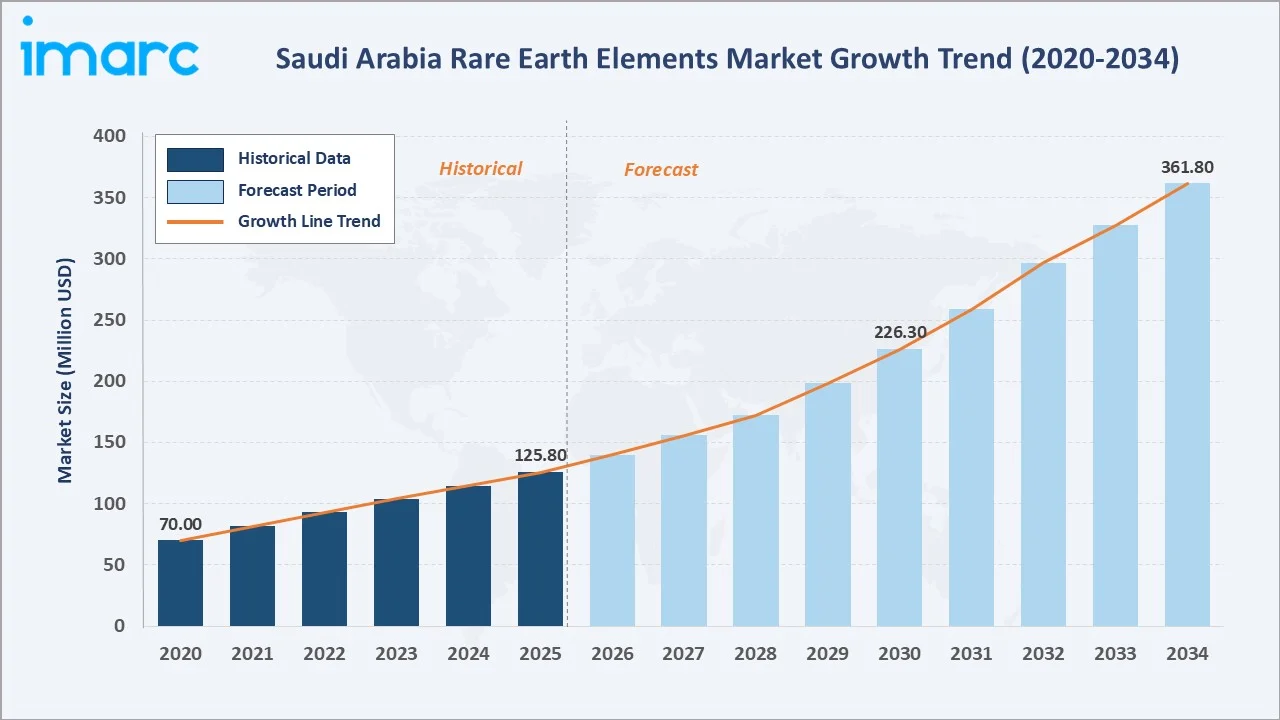
The Saudi Arabia rare earth elements market reached USD 125.8 Million in 2025 and is projected to reach USD 361.8 Million by 2034, growing at a CAGR of 12.45% during 2026-2034. The market is driven by Vision 2030 industrial diversification, expanding EV and clean energy sectors, and growing defense manufacturing demand. Magnets dominate at 29.8%. The Eastern Region commands 38.7% of the market share.
Market Snapshot
|
Metric |
Value |
|
Market Size (2025) |
USD 125.8 Million |
|
Forecast Market Size (2034) |
USD 361.8 Million |
|
CAGR (2026-2034) |
12.45% |
|
Base Year |
2025 |
|
Historical Period |
2020-2025 |
|
Forecast Period |
2026-2034 |
|
Dominant Application |
Magnets (29.8%, 2025) |
|
Leading Region |
Eastern Region (38.7%, 2025) |
The Saudi Arabia rare earth elements market expanded from USD 70.0 Million in 2020 to USD 125.8 Million in 2025, anchored at USD 226.3 Million in 2030, and forecast to reach USD 361.8 Million by 2034. Vision 2030 industrial transformation established structured REE demand across clean energy and advanced manufacturing, while post-2022 investment acceleration sustained above-trend market growth.
To get more information on this market, Request Sample
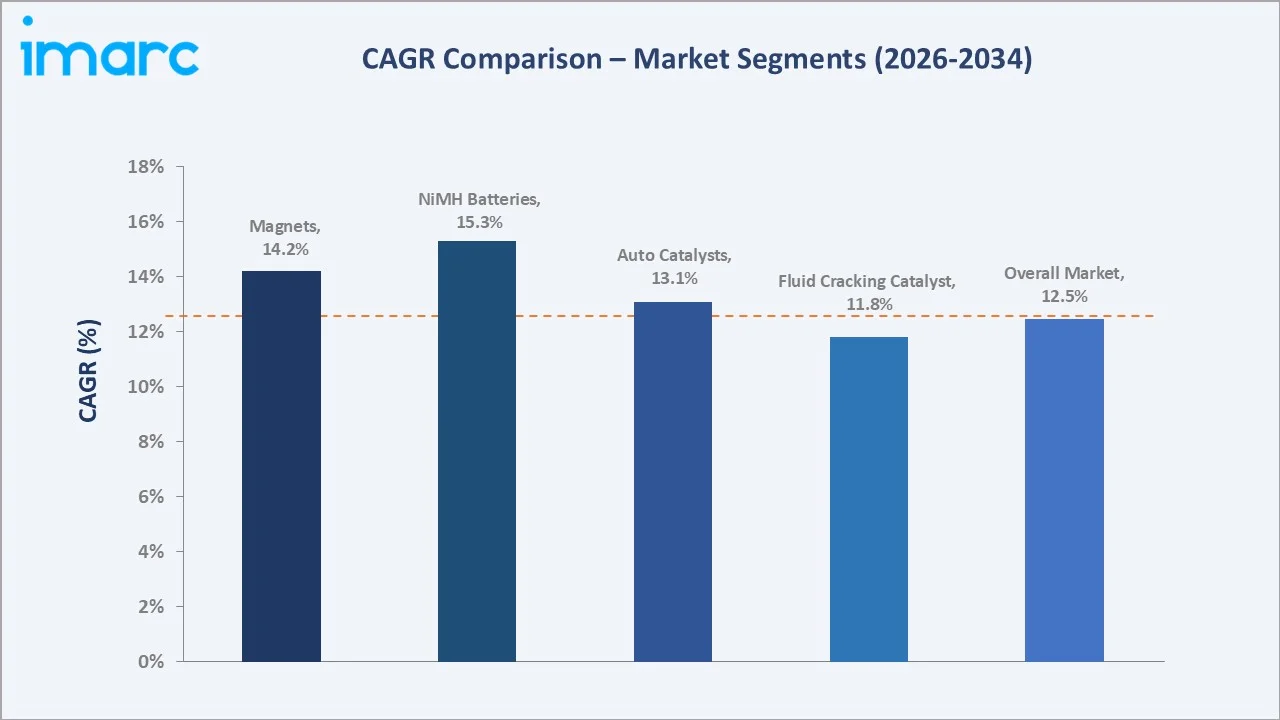
The NiMH segment grows fastest at ~15.3% CAGR as Saudi Arabia's EV and industrial motor manufacturing ambitions expand under Vision 2030. NiMH Batteries grow at ~15.3% CAGR driven by stationary energy storage and hybrid vehicle adoption across the Kingdom.
Executive Summary
The Saudi Arabia rare earth elements market reached USD 125.8 Million in 2025, positioning the Kingdom as a strategically significant REE consumer in the global landscape. The market spans REE procurement, separation, and downstream application across magnets, catalysts, glass, batteries, and advanced industrial materials.
Magnets at 29.8% dominate through the critical role of NdFeB permanent magnets in EV motors, wind turbines, and defense systems. Fluid Cracking Catalysts at 17.6% lead industrial applications through Saudi Arabian Oil Co.'s extensive refining operations. The Eastern Region, at 38.7%, leads through concentration of Aramco's industrial ecosystem in Jubail and Dammam.
Key Market Insights
|
Insight |
Data |
|
Dominant Application |
Magnets – 29.8% share (2025) |
|
Second Largest Application |
Fluid Cracking Catalyst – 17.6% market share (2025) |
|
Leading Region |
Eastern Region – 38.7% market share |
|
Market Opportunity |
EV magnet supply chain localization; domestic REE processing; NEOM giga-project demand; defense modernization |
Key Analytical Observations Supporting the Above Data:
- Magnets at 29.8%: The magnets segment dominates due to the critical role of NdFeB permanent magnets in EV drivetrains, industrial automation, and defense precision systems. Saudi Arabia's Vision 2030 EV adoption targets and manufacturing localization programs are creating structured, growing magnet-grade REE demand.
- Fluid Cracking Catalyst at 17.6%: FCC catalysts dominate industrial REE use through Saudi Arabian Oil Co.'s world-scale refining operations. REE-based catalysts improve hydrocarbon conversion efficiency and selectivity, making them indispensable in the Kingdom's petrochemical complex.
- Eastern Region at 38.7%: The Eastern Region leads due to concentration of Aramco's refining and petrochemical facilities and manufacturing hubs in Jubail Industrial City, creating the Kingdom's highest REE demand density across industrial operations.
Saudi Arabia Rare Earth Elements Market Overview
The Saudi Arabia rare earth elements market encompasses the procurement, processing, and industrial application of 17 lanthanide elements across high-technology and industrial sectors. The market spans REE concentrate imports, downstream compound manufacturing, and end-use industrial integration across the Kingdom's rapidly expanding manufacturing economy.
Macroeconomic factors include Vision 2030 industrial diversification, national defense modernization, clean energy transition targets, and growing downstream manufacturing investment. Government initiatives to reduce critical material import dependency and establish domestic REE processing capacity are further accelerating market development.
Market Dynamics
To evaluate market opportunities, Request Sample
Market Drivers
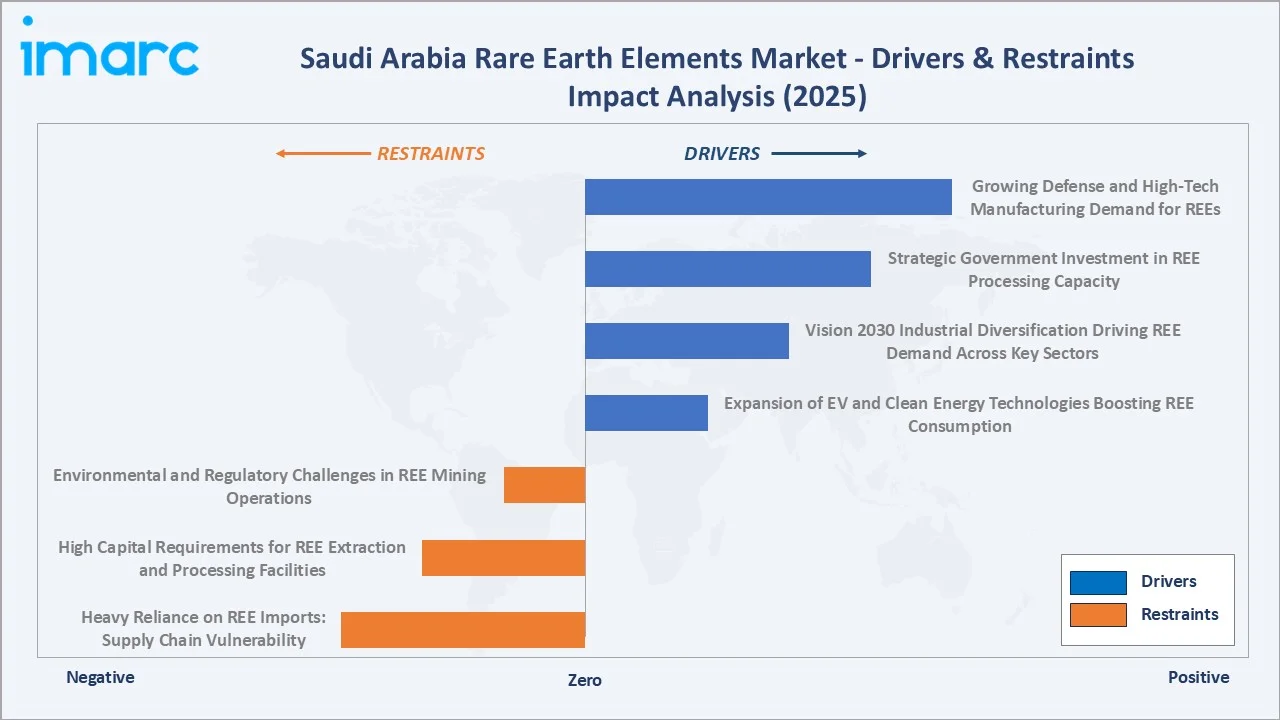
- Vision 2030 Industrial Diversification Driving REE Demand Across Key Sectors: Vision 2030 is accelerating domestic manufacturing across automotive, defense, electronics, and clean energy sectors. Government-backed industrial cities including NEOM and expanded Jubail are creating structured demand for REE-based magnets, catalysts, and specialty materials. These initiatives establish the Kingdom as a high-technology manufacturing hub requiring consistent REE supply across multiple application segments.
- Expansion of EV and Clean Energy Technologies Boosting REE Consumption: Saudi Arabia's National Renewable Energy Program and EV adoption targets are increasing demand for NdFeB magnets and lanthanum battery materials. The Kingdom's solar expansion targeting 50% renewables by 2030 requires REE-intensive wind turbines and inverter motors, while domestic EV production ambitions are creating new magnet-grade REE demand channels.
- Strategic Government Investment in Domestic REE Processing Capacity: Saudi Arabia is investing in domestic rare earth processing through Maaden partnerships and NEOM industrial clusters. Government-backed feasibility studies for phosphate-linked REE extraction from Al-Jalamid and Umm Wu'al deposits represent significant upstream development. Domestic processing capacity reduces import dependency and creates value-added industrial capability aligned with Vision 2030 strategic materials policy.
- Growing Defense and High-Tech Manufacturing Demand for REEs: Saudi Arabia's military modernization and defense manufacturing ambitions under Vision 2030 are increasing demand for REEs in precision-guided systems, radar, sonar, and advanced communications. The Kingdom's defense sector is among the world's largest by procurement value, with growing localization targets creating domestic REE demand through SAMI manufacturing partnerships.
Market Restraints
- Heavy Reliance on REE Imports Creating Supply Chain Vulnerability: Saudi Arabia currently imports the majority of processed rare earth materials, primarily from China, creating significant supply chain concentration risk. Geopolitical disruptions, trade policy changes, or Chinese export controls could severely impact Saudi industries dependent on REE inputs, constraining industrial planning and creating cost volatility for downstream manufacturers.
- High Capital Requirements for REE Extraction and Processing Facilities: Establishing domestic REE mining and processing infrastructure requires substantial upfront capital investment in specialized equipment, chemical processing facilities, and environmental management systems. The technical complexity of REE separation and long mine development timelines create significant barriers for domestic supply chain development.
- Environmental and Regulatory Challenges in REE Mining Operations: REE mining generates radioactive thorium and uranium byproducts requiring specialized waste management and environmental controls. Saudi Arabia's evolving environmental regulatory framework and limited historical REE processing experience create compliance challenges and project development uncertainty for new domestic production initiatives.
Market Opportunities
- Phosphate-Linked REE Extraction from Existing Mining Operations: Saudi Arabia's extensive phosphate mining at Al-Jalamid contains recoverable REE concentrations. Co-extraction from phosphate processing streams represents a low-incremental-cost pathway to domestic REE supply. Maaden's phosphate expertise positions the company as the natural first-mover in phosphate-linked REE recovery investment.
- NEOM Smart City and Industrial Zone REE Demand Creation: NEOM's infrastructure development creates large-scale demand for REE-intensive technologies including smart grid magnets, LED phosphors, EV charging systems, and advanced building materials. This concentration of technology investment creates a captive REE demand center capable of anchoring a domestic supply chain development business case.
Market Challenges
- Technical Skill Gap in REE Processing and Separation: REE hydrometallurgical processing requires specialized chemical engineering expertise currently scarce in Saudi Arabia. Building domestic technical capability requires multi-year investment in personnel training, technology transfer agreements, and institutional knowledge development that extends project timelines significantly.
- Price Volatility of REE Commodities Affecting Industrial Planning: Global REE prices exhibit significant volatility driven by Chinese supply policy, demand fluctuations, and speculative trading. Price uncertainty complicates long-term industrial planning for Saudi manufacturers dependent on REE inputs and reduces the investment case for domestic processing projects.
Emerging Market Trends
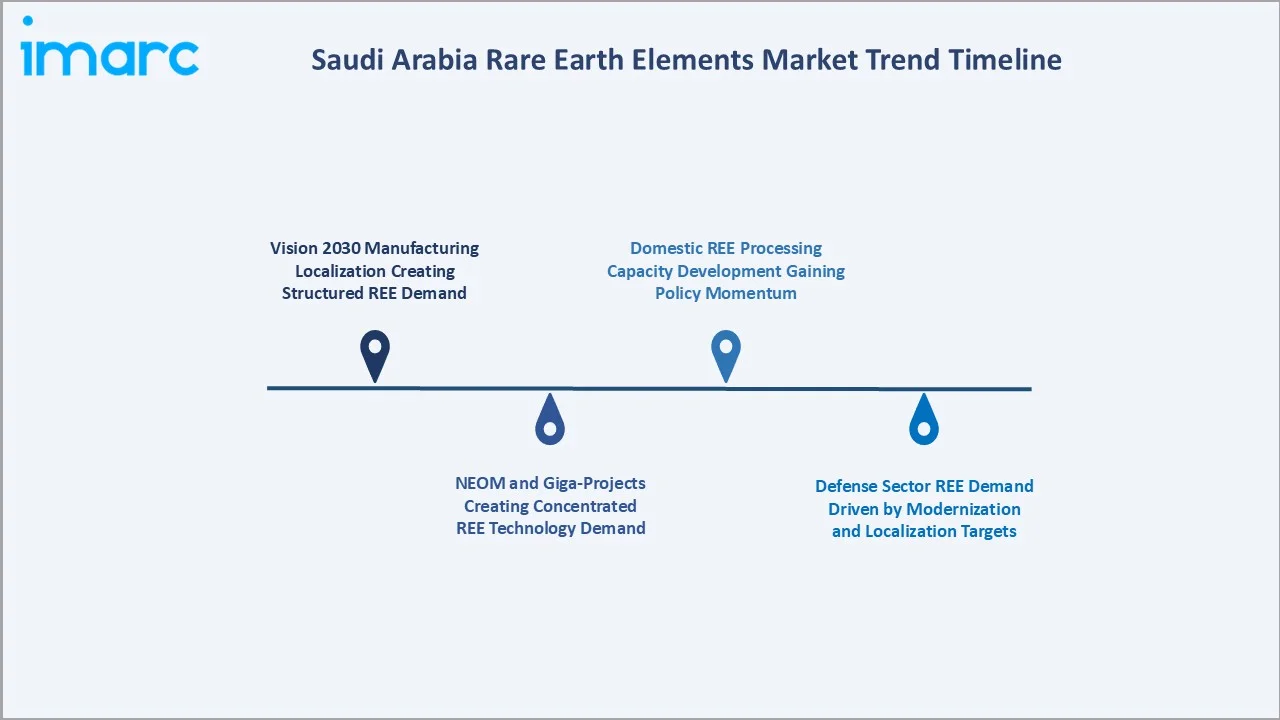
1. Vision 2030 Manufacturing Localization Creating Structured REE Demand
Saudi Arabia's Vision 2030 industrial diversification is creating structured REE demand through targeted manufacturing localization in automotive, defense, electronics, and clean energy sectors. Government-mandated local content requirements and industrial investment incentives are establishing domestic manufacturing clusters requiring reliable REE supply chains. The Kingdom's industrial transformation is creating a self-reinforcing cycle of REE demand growth directly tied to national development targets.
2. NEOM and Giga-Projects Creating Concentrated REE Technology Demand
Saudi Arabia's unprecedented giga-project investments including NEOM, Red Sea Project, Qiddiya, and Diriyah Gate are concentrating advanced technology deployment in discrete geographic clusters. These projects require REE-intensive technologies including smart city lighting systems, EV fleet infrastructure, renewable energy installations, and advanced building automation, creating a multi-decade, government-backed REE demand trajectory.
3. Domestic REE Processing Capacity Development Gaining Policy Momentum
Saudi Arabia's strategic minerals policy is prioritizing domestic REE processing capacity to reduce critical material import dependency. Maaden's phosphate operations and Aramco's refining expertise provide foundational capabilities for REE separation and compound manufacturing. Bilateral technology partnerships with Japan, South Korea, and European nations are accelerating knowledge transfer for domestic REE processing infrastructure.
4. Defense Sector REE Demand Driven by Modernization and Localization Targets
Saudi Arabia's military modernization program and defense manufacturing ambitions are driving consistent REE demand for precision guidance systems, radar equipment, and advanced communications technology. The Kingdom's Vision 2030 defense localization target of 50% by 2030 is incentivizing domestic defense manufacturing that requires locally sourced REE materials through SAMI manufacturing partnerships.
Industry Value Chain Analysis
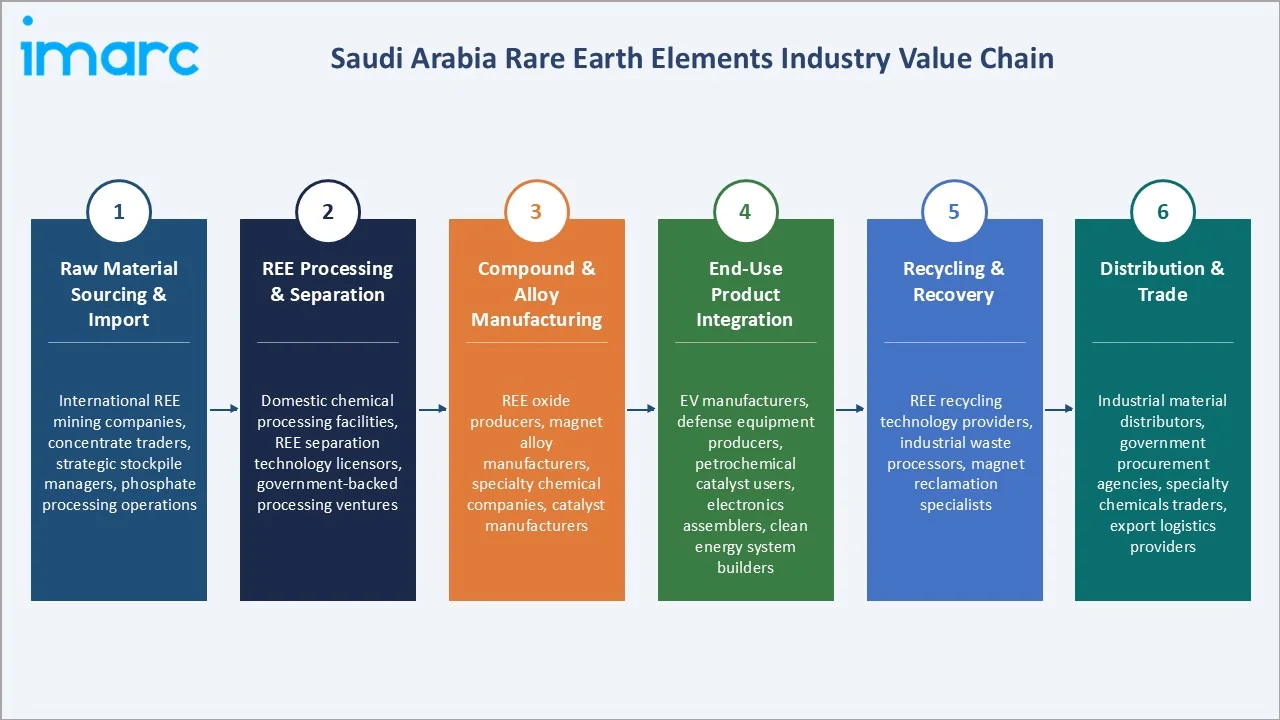
The Saudi Arabia rare earth elements value chain integrates raw material sourcing and import, primary REE processing and separation, downstream compound manufacturing, end-use product integration, and industrial and commercial distribution across the Kingdom's rapidly expanding manufacturing sectors.
|
Stage |
Key Participants |
|
Raw Material Sourcing & Import |
International REE mining companies, concentrate traders, strategic stockpile managers, phosphate processing operations |
|
REE Processing & Separation |
Domestic chemical processing facilities, REE separation technology licensors, government-backed processing ventures |
|
Compound & Alloy Manufacturing |
REE oxide producers, magnet alloy manufacturers, specialty chemical companies, catalyst manufacturers |
|
End-Use Product Integration |
EV manufacturers, defense equipment producers, petrochemical catalyst users, electronics assemblers, clean energy system builders |
|
Recycling & Recovery |
REE recycling technology providers, industrial waste processors, magnet reclamation specialists |
|
Distribution & Trade |
Industrial material distributors, government procurement agencies, specialty chemicals traders, export logistics providers |
The REE processing and separation stage is the value chain's most strategically critical and currently underdeveloped phase in Saudi Arabia. Building domestic separation capacity represents the highest-value-add development opportunity. End-use integration in petrochemical catalysts and industrial magnets currently represents the highest-volume REE consumption stage in the Kingdom.
Technology Landscape in the Saudi Arabia Rare Earth Elements Industry
Solvent Extraction and Separation Technology
Solvent extraction technology enables high-purity REE separation from mixed concentrates through selective chemical extraction processes. The technology supports production of individual REE oxides at purity levels required for magnet, catalyst, and electronic applications. As Saudi Arabia develops domestic processing ambitions, solvent extraction technology acquisition through licensing or joint venture represents the critical capability gap to address for supply chain independence.
Neodymium-Iron-Boron Magnet Manufacturing Technology
NdFeB magnet manufacturing technology converts REE alloys into permanent magnets used across EV motors, wind turbines, industrial equipment, and defense systems. Sintered NdFeB magnets represent the highest-value REE application by unit revenue and the fastest-growing demand vector globally. Saudi Arabia's EV ambitions and industrial motor manufacturing targets make NdFeB magnet technology the highest-priority REE application for domestic development.
REE-Based Fluid Catalytic Cracking Technology
REE-based fluid catalytic cracking (FCC) catalyst technology uses lanthanum and cerium to improve hydrocarbon conversion selectivity and catalyst stability in oil refining. Saudi Arabian Oil Co.'s world-scale refining operations represent the largest single REE consumption application in the Kingdom. Advanced FCC catalyst formulations incorporating higher REE loadings improve gasoline yield and reduce coke formation, driving ongoing catalyst technology investment.
Market Segmentation Analysis
The report covers the following segments:
|
Segment Category |
Leading Segment |
Market Share |
Year |
|
Application |
Magnets |
29.8% |
2025 |
|
Region |
Eastern Region |
38.7% |
2025 |

By Application
Magnets lead at 29.8% (2025). The magnets segment encompasses neodymium-iron-boron permanent magnets used in EV motors, industrial servo systems, wind turbine generators, and defense precision equipment. Magnets' ~14.2% CAGR reflects Vision 2030 industrial diversification, creating magnet-grade REE demand across electric vehicles, renewable energy, and defense manufacturing sectors.
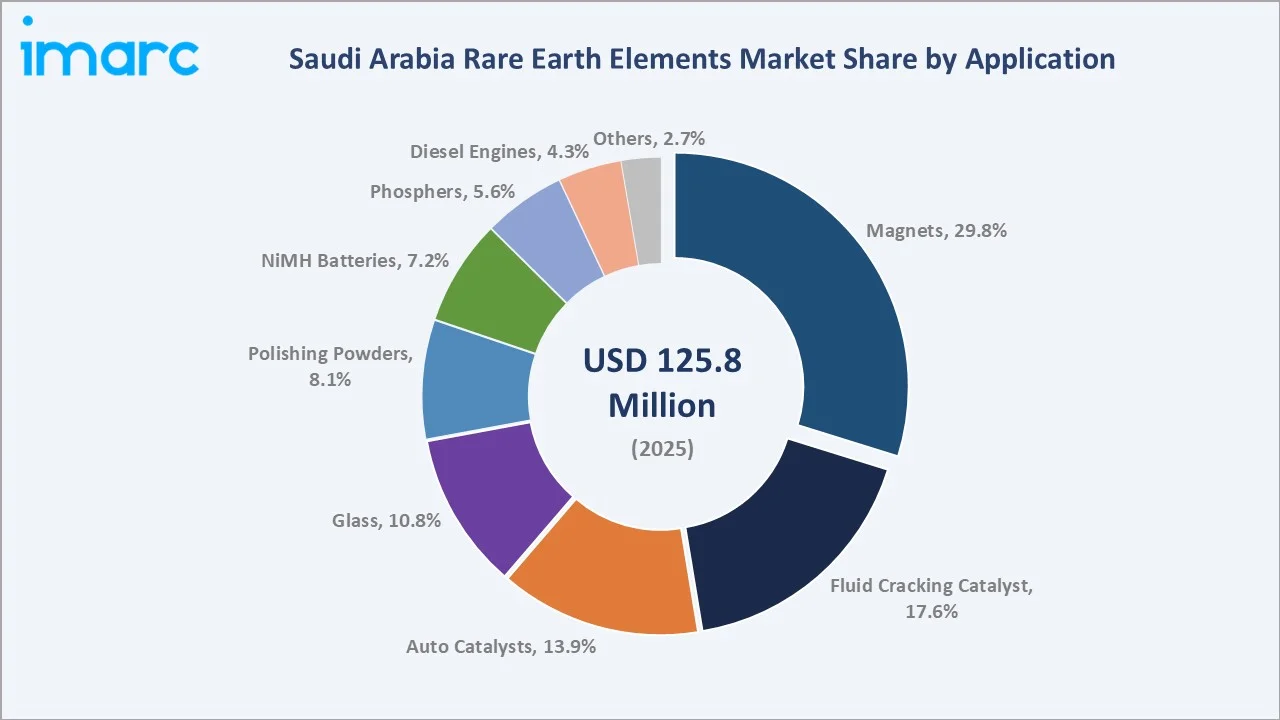
Fluid Cracking Catalyst at 17.6% grows at ~11.8% CAGR through ongoing refinery capacity expansions and catalyst technology upgrades across the Kingdom's petrochemical complex. Auto Catalysts at 13.9%, Glass at 10.8%, Polishing Powders at 8.1%, NiMH Batteries at 7.2%, Phosphers at 5.6%, Diesel Engines at 4.3%, and Others at 2.7% represent the remaining application segments.
Regional Market Insights
|
Region |
Share (2025) |
Key Saudi Arabia Rare Earth Elements Market Drivers & Characteristics |
|
Eastern Region |
38.7% |
Driven by Saudi Arabian Oil Co.'s refining operations, petrochemical complexes in Jubail Industrial City, and concentration of downstream manufacturing requiring REE-based catalysts and specialty materials. |
|
Northern and Central Region |
28.9% |
Supported by Riyadh's growing industrial base, defense manufacturing clusters, technology sector development, and government procurement of REE-intensive equipment and systems. |
|
Western Region |
21.4% |
Driven by Jeddah's industrial zone development, Red Sea Project construction, and NEOM mega-project infrastructure requiring REE-intensive technologies and clean energy installations. |
|
Southern Region |
11.0% |
Supported by Jizan Economic City industrial development, growing mining activity, and early-stage manufacturing investment requiring foundational REE material inputs. |
The Eastern Region's 38.7% market leadership is anchored by Saudi Arabian Oil Co.'s world-scale integrated energy operations requiring vast volumes of FCC catalysts, auto catalysts, and phosphor materials. The Northern and Central Region's 28.9% reflects Riyadh's position as the Kingdom's government, defense, and technology hub with growing industrial REE consumption across multiple sectors.
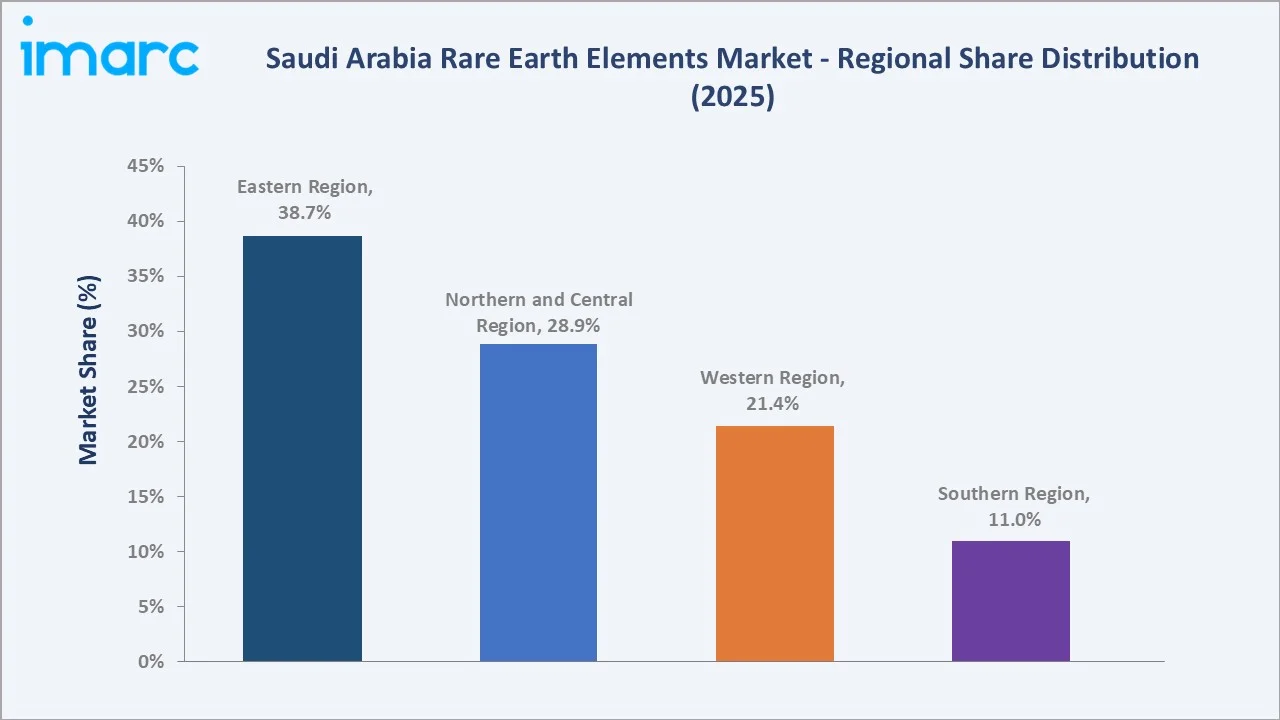
The Western Region's 21.4% reflects Jeddah's established industrial base and enormous REE demand embedded in NEOM, Red Sea Project, and Diriyah Gate infrastructure development. The Southern Region, at 11.0%, is the most commercially dynamic growth region by CAGR, driven by Jizan Economic City industrial zone expansion and ongoing resource development projects.
Competitive Landscape
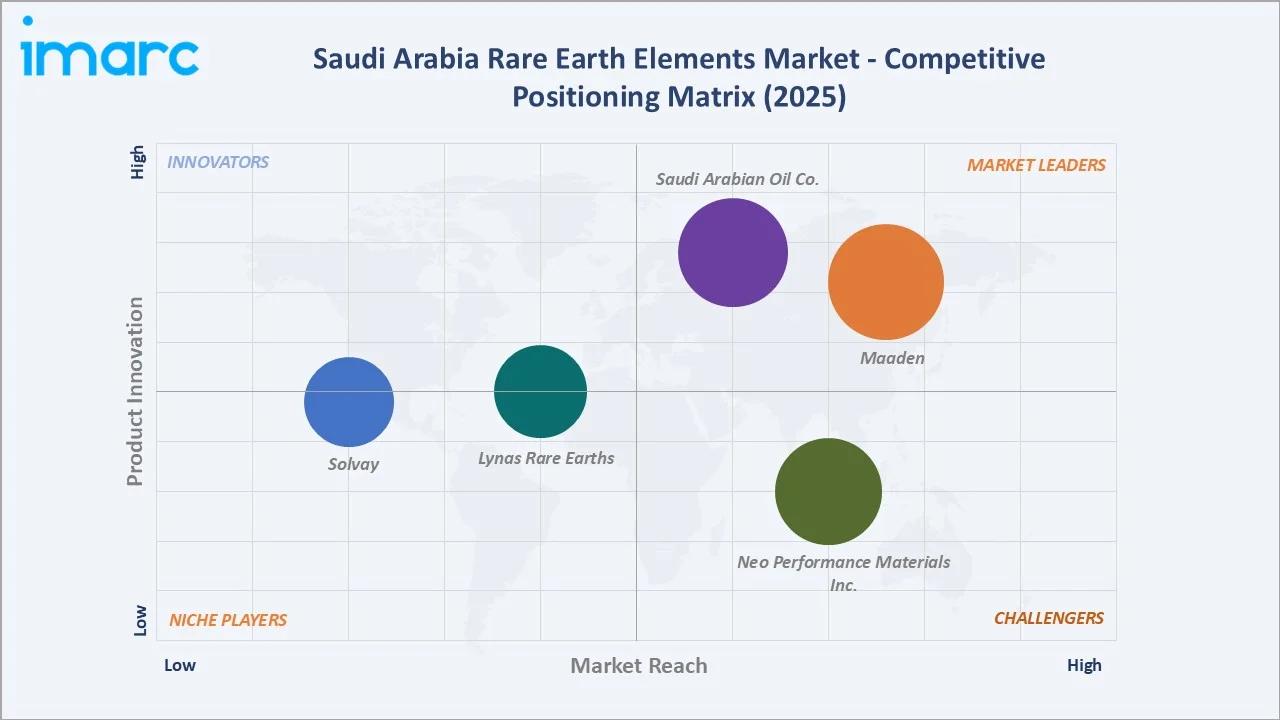
The Saudi Arabia rare earth elements market competitive landscape encompasses international REE producers and processors, domestic industrial conglomerates with REE consumption interests, and government-backed entities positioning for strategic material supply chain development.
|
Company Name |
Key Products |
Market Position |
Core Strength |
|
Saudi Arabian Oil Co. |
FCC catalysts, specialty refining materials |
Market Leader |
Saudi Arabian Oil Co. plays a central role in REE consumption through world-scale FCC catalyst procurement and industrial chemical demand across its vast integrated energy operations. |
|
Maaden |
Rare Earth Elements |
Market Leader |
Maaden plays a strategic role in domestic REE supply chain development through its phosphate mining operations at Al-Jalamid, which contain recoverable REE concentrations. |
|
Lynas Rare Earths |
Lanthanum or La (57), Cerium or Ce (58) |
Established Player |
Lynas Rare Earths plays a central role as a leading ex-China REE supplier providing Saudi industrial consumers with diversified, non-China REE supply options for magnets, catalysts, and specialty applications. |
|
Solvay |
Rare Earth and Metal oxides |
Established Player |
Solvay plays a central role supplying advanced REE-based catalysts and specialty chemicals to Saudi Arabia's refining and petrochemical sector, supporting Aramco's catalyst performance requirements. |
|
Neo Performance Materials Inc |
Magnequench NdFeB powders |
Established Player |
Neo Performance Materials Inc plays a central role providing magnet powders and REE specialty chemicals to Saudi manufacturers, supporting the Kingdom's growing industrial motor and EV-related magnet material requirements. |
International REE technology suppliers and processors dominate market supply, while Saudi industrial conglomerates anchor domestic demand. Government strategic minerals policy is progressively creating conditions for domestic supply chain development, with Maaden and Aramco positioned as the primary domestic anchors for REE supply chain investment.
Key Company Profiles
Saudi Arabian Oil Co.
Saudi Arabian Oil Co. is the world's largest integrated energy company and a dominant REE consumer in Saudi Arabia through its world-scale refining and petrochemical operations. The company's extensive downstream industrial complex creates consistent, high-volume demand for REE-based catalysts, specialty materials, and industrial chemicals.
- Key Products: FCC catalysts (lanthanum and cerium-based), auto catalysts, specialty refining chemicals, industrial materials.
- Recent Developments: In 2026, Saudi Aramco and Ma’aden signed a shareholders’ agreement to establish a joint venture focused on mineral exploration and hard-rock mining in Saudi Arabia. The venture will primarily target copper but will also explore for rare earth elements, along with zinc and lead. Aramco will contribute its extensive geological data, subsurface expertise, and advanced AI and computational capabilities, while Ma’aden will provide mining and exploration expertise. The initiative is intended to accelerate the discovery and development of Saudi Arabia’s energy-transition minerals and strengthen the Kingdom’s position in global critical-mineral supply chains.
- Strategic Focus: Focuses on supply chain security for critical industrial materials including REE-based catalysts, downstream manufacturing localization, and sustainable industrial operations aligned with Saudi Vision 2030.
Maaden
Maaden is Saudi Arabia's national mining company and the Kingdom's most strategically positioned entity for domestic REE supply chain development. The company's phosphate mining operations contain REE-bearing materials, and its industrial minerals expertise provides a foundation for REE recovery and processing development.
- Key Products: Phosphate fertilizers, specialty industrial minerals, aluminum products, and developing REE-related processing capabilities.
- Recent Developments: In May 2025, Saudi Arabian Mining Company (Ma’aden) signed a memorandum of understanding with U.S.-based MP Materials to explore the development of a fully integrated rare-earth supply chain in Saudi Arabia. The collaboration covers potential activities across rare-earth mining, separation, refining and magnet production, while also supporting the exploration and development of potential REE deposits in the Kingdom. The partnership represents a significant step in Saudi Arabia’s efforts to establish domestic capabilities in critical minerals and develop a globally integrated rare-earth value chain.
- Strategic Focus: Centered on expanding Saudi Arabia's domestic mineral processing capabilities, developing REE co-extraction technology, and positioning Maaden as the Kingdom's anchor for critical mineral supply chain development.
Lynas Rare Earths
Lynas Rare Earths is the world's largest rare earth producer outside China and a critical supply partner for Saudi industrial consumers seeking to diversify REE procurement away from Chinese-dominated supply channels. The company provides separated REE oxides and advanced materials to industrial customers globally, including in the Middle East.
- Key Products: NdPr oxide, lanthanum carbonate, cerium oxide, heavy REE concentrates, advanced REE compounds.
- Strategic Focus: Focused on becoming the preferred non-China REE supply alternative for industrial nations seeking supply chain security, with expanding relationships in Middle East, Japanese, and European markets.
Market Concentration Analysis
The Saudi Arabia rare earth elements market is highly concentrated on the supply side, with the majority of REE materials imported from a small number of international producers. Saudi Arabian Oil Co. and SABIC collectively represent the largest domestic REE consumption base, anchoring demand for catalyst and industrial chemical applications. The domestic supply chain remains underdeveloped, with Maaden's phosphate operations representing the primary near-term domestic production opportunity.
Investment & Growth Opportunities
Highest Growth Segments
NiMH Batteries (~15.3% CAGR), Magnets (~14.2% CAGR), Auto Catalysts (~13.1% CAGR), and Fluid Cracking Catalyst (~11.8% CAGR) represent the highest-growth Saudi Arabia REE application investment vectors through 2034. The Southern Region (~14.2% CAGR) and Western Region (~13.5% CAGR) represent the highest-growth regional markets.
Emerging Investment Opportunities
Saudi Arabia's phosphate-linked REE co-extraction represents the largest near-term domestic supply chain investment opportunity. REE technology companies establishing joint development agreements with Maaden for phosphate REE recovery are positioned for long-term strategic partnerships with government backing as domestic supply security becomes a national policy priority.
Investment Themes
- NdFeB magnet manufacturing capacity development for Saudi EV and industrial motor markets: Saudi Arabia's Vision 2030 EV manufacturing and industrial automation targets create a clear demand trajectory for high-performance NdFeB magnets. Investment in domestic magnet manufacturing through joint ventures with Japanese or European producers positions investors to capture the full downstream value-add while supporting Vision 2030 localization targets.
- REE supply chain security partnership with Saudi industrial conglomerates: Saudi Arabian Oil Co., SABIC, and Maaden collectively represent billion-dollar annual REE procurement. Long-term supply agreements with off-take commitments from anchor industrial customers provide the demand certainty required to justify investment in dedicated REE supply chain development for the Saudi market.
Future Market Outlook (2026-2034)
The Saudi Arabia rare earth elements market is projected to grow from USD 125.8 Million in 2025 to USD 361.8 Million by 2034, delivering a 12.45% CAGR over the forecast period. The market's anchor value of USD 226.3 Million in 2030 represents a Saudi REE industry at a commercial transformation inflection point where domestic processing ambitions will have transitioned from feasibility to early operational stages.
Three structural forces define market growth through 2034 with high confidence. Vision 2030 industrial diversification creates government-mandated, budget-committed REE demand growth tied to manufacturing localization targets. Saudi Arabia's unprecedented giga-project pipeline creates multi-decade REE technology demand across NEOM and associated development zones. Strategic critical minerals policy creates governmental support for domestic REE supply chain investment reducing import dependency and creating new value-added industrial capability.
Research Methodology
Primary Research
Primary research comprised structured interviews with 45+ industry stakeholders (2025) including REE procurement managers at Saudi industrial companies, Vision 2030 program officials, Maaden mining development executives, defense sector procurement specialists, and regional rare earth market specialists.
Secondary Research
Secondary research encompassed Saudi Vision 2030 industrial development publications, Maaden annual reports, Saudi Arabian Oil Co. sustainability and operations reports, global REE market data, critical minerals policy documents, company annual reports, and regional market statistics. Over 55 secondary sources reviewed.
Forecasting Models
Market revenue forecasts developed using a segment bottom-up model: (i) application segment demand drivers; (ii) regional consumption patterns; (iii) policy-driven demand acceleration factors. Forecasts validated against Vision 2030 industrial output targets and government investment commitments.
Saudi Arabia Rare Earth Elements Market Report Coverage:
| Report Features | Details |
|---|---|
| Base Year of the Analysis | 2025 |
| Historical Period | 2020-2025 |
| Forecast Period | 2026-2034 |
| Units | Million USD |
| Scope of the Report |
Exploration of Historical Trends and Market Outlook, Industry Catalysts and Challenges, Segment-Wise Historical and Future Market Assessment:
|
| Applications Covered | Magnets, NiMH Batteries, Auto Catalysts, Diesel Engines, Fluid Cracking Catalyst, Phosphers, Glass, Polishing Powders, Others |
| Regions Covered | Northern and Central Region, Western Region, Eastern Region, Southern Region |
| Companies Covered | Saudi Arabian Oil Co., Maaden, Lynas Rare Earths, Solvay, Neo Performance Materials Inc, etc. |
| Customization Scope | 10% Free Customization |
| Post-Sale Analyst Support | 10-12 Weeks |
| Delivery Format | PDF and Excel through Email (We can also provide the editable version of the report in PPT/Word format on special request) |
Key Benefits for Stakeholders:
- IMARC’s industry report offers a comprehensive quantitative analysis of various market segments, historical and current market trends, market forecasts, and dynamics of the Saudi Arabia rare earth elements market from 2020-2034.
- The research report provides the latest information on the market drivers, challenges, and opportunities in the Saudi Arabia rare earth elements market.
- Porter's five forces analysis assist stakeholders in assessing the impact of new entrants, competitive rivalry, supplier power, buyer power, and the threat of substitution. It helps stakeholders to analyze the level of competition within the Saudi Arabia rare earth elements industry and its attractiveness.
- Competitive landscape allows stakeholders to understand their competitive environment and provides an insight into the current positions of key players in the market.
Frequently Asked Questions About the Saudi Arabia Rare Earth Elements Market Report
The Saudi Arabia rare earth elements market reached USD 125.8 Million in 2025. The market is driven by industrial demand from petrochemical operations, defense modernization, and growing clean energy and EV sector investments under Vision 2030.
The market grows at 12.45% CAGR during 2026-2034, reaching USD 361.8 Million by 2034. NiMH Batteries grow fastest at ~15.3% CAGR through Saudi Arabia's energy storage expansion and EV adoption targets. Magnets grow at ~14.2% CAGR driven by Vision 2030 industrial motor and EV manufacturing ambitions.
Magnets lead at 29.8% (2025), growing at ~14.2% CAGR, through the foundational role of NdFeB permanent magnets in EV motors, industrial automation, wind turbines, and defense systems. Vision 2030 manufacturing targets are directly accelerating magnet-grade REE demand across the Kingdom.
The Eastern Region leads at 38.7% (2025) through Saudi Arabian Oil Co.'s world-scale refining and petrochemical operations in Jubail and Dammam. The Southern Region is the fastest-growing at ~14.2% CAGR driven by Jizan Economic City industrial zone expansion.
Leading companies include Saudi Arabian Oil Co., Maaden, Lynas Rare Earths, Solvay, and Neo Performance Materials Inc., among others.
The market is projected to reach approximately USD 226.3 Million by 2030, with domestic REE processing feasibility studies having progressed to pilot stage, EV manufacturing localization creating structured magnet-grade demand, and giga-project construction at peak REE technology installation rates.
Phosphate-linked REE co-extraction from Maaden's Al-Jalamid operations represents the largest near-term domestic supply opportunity. NdFeB magnet manufacturing for Vision 2030 EV and industrial motor markets represents the highest-value downstream investment opportunity through 2034.
Need more help?
- Speak to our experienced analysts for insights on the current market scenarios.
- Include additional segments and countries to customize the report as per your requirement.
- Gain an unparalleled competitive advantage in your domain by understanding how to utilize the report and positively impacting your operations and revenue.
- For further assistance, please connect with our analysts.
 Request Customization
 Speak to an Analyst
 Request Brochure
 Inquire Before Buying
Benefits of Customization
- Personalize this research
- Triangulate with your data
- Get data as per your format and definition
- Gain a deeper dive into a specific application, geography, customer, or competitor
- Any level of personalization
Get in Touch With Us
UNITED STATES
Phone: +1-201-971-6302
INDIA
Phone: +91-120-433-0800
UNITED KINGDOM
Phone: +44-753-714-6104
Email: [email protected]
Client Testimonials




.webp)




.webp)













Related Reports

Choose your plan
*Please note that the prices mentioned below are starting prices for each bundle type. Kindly contact our team for further details.*
Single User License
- 1 User License, Access on 2 Devices
- PDF Report + Excel Dataset (Password Protected)
- Lifetime Access
- No Printing Rights
- 10% Free Report Customization
- 10–12 Weeks of Analyst Support
Five User License
- Access for 5 Users, 2 Devices per User
- PDF Report + Excel Dataset (Password Protected)
- Lifetime Access
- Dedicated Account Manager
- 12–14 Weeks of Analyst Support
- No Printing Rights
- 15% Free Report Customization
- 25% Discount on Your Next Purchase
Corporate User License
- Unlimited User Access (Within Your Organization)
- PDF Report + Excel Dataset
- Lifetime Access
- Dedicated Account Manager
- 14–20 Weeks of Analyst Support
- No Printing Rights
- 20% Free Report Customization
- 30% Discount on Your Next Purchase
Essential Insights
What's included:
3 reports
- Lifetime Access
- PDF Reports
- Excel Datasets
- 2 Weeks of Free Analyst Support
- 2 User Licenses
- Access on 2 Devices
- Printing Rights
- Complimentary PowerPoint (PPT) Version
- Complimentary License Upgrade
Professional Access
What's included:
5 reports
- Lifetime Access
- PDF Reports
- Excel Datasets
- 8 Weeks of Free Analyst Support
- 2 User Licenses
- Access on 2 Devices
- Printing Rights
- Complimentary PowerPoint (PPT) Version
- Complimentary License Upgrade
Business Advantage
What's included:
8 reports
- Lifetime Access
- PDF Reports
- Excel Datasets
- 14 Weeks of Free Analyst Support
- 2 User Licenses
- Access on 2 Devices
- Printing Rights
- Complimentary PowerPoint (PPT) Version
- Complimentary License Upgrade
Enterprise Intelligence
What's included:
10 reports
- Lifetime Access
- PDF Reports
- Excel Datasets
- 20 Weeks of Free Analyst Support
- 2 User Licenses
- Access on 2 Devices
- Printing Rights
- Complimentary PowerPoint (PPT) Version
- Complimentary License Upgrade