
Saudi Arabia Solar Energy Market Size, Share, Trends and Forecast by Type, and Region 2026-2034
Saudi Arabia Solar Energy Market Size, Share, Trends & Forecast (2026-2034)
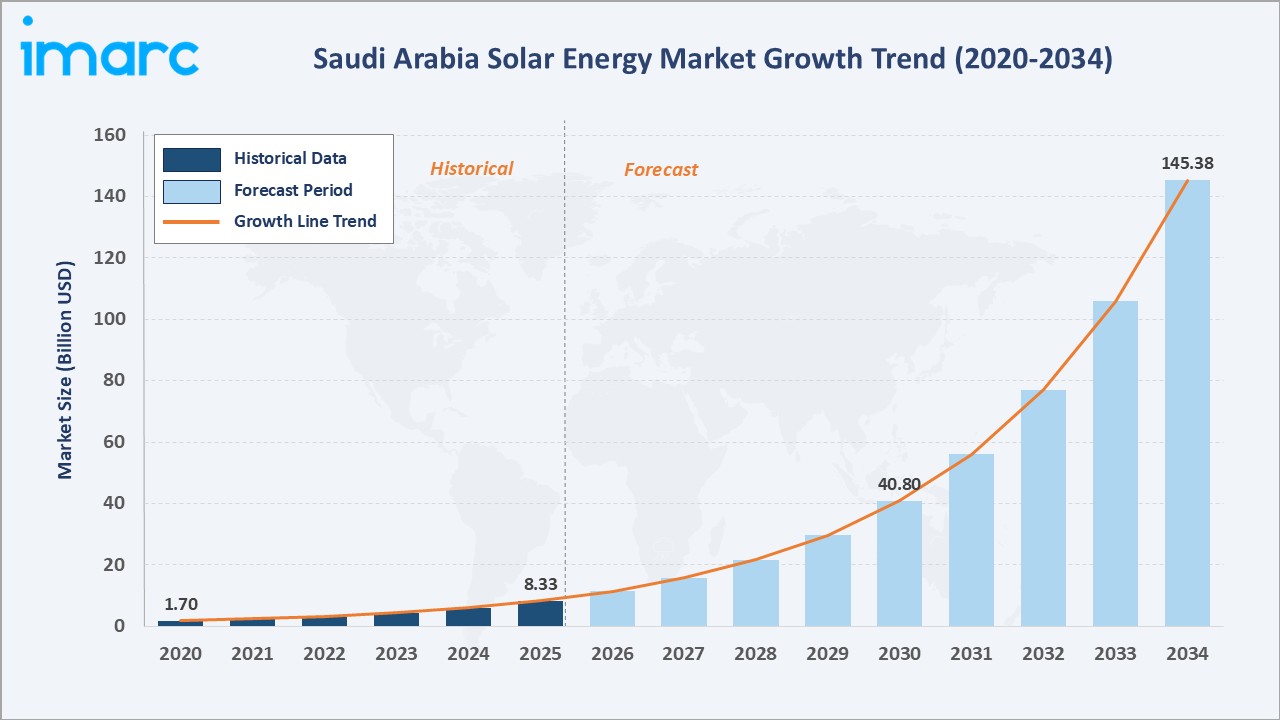
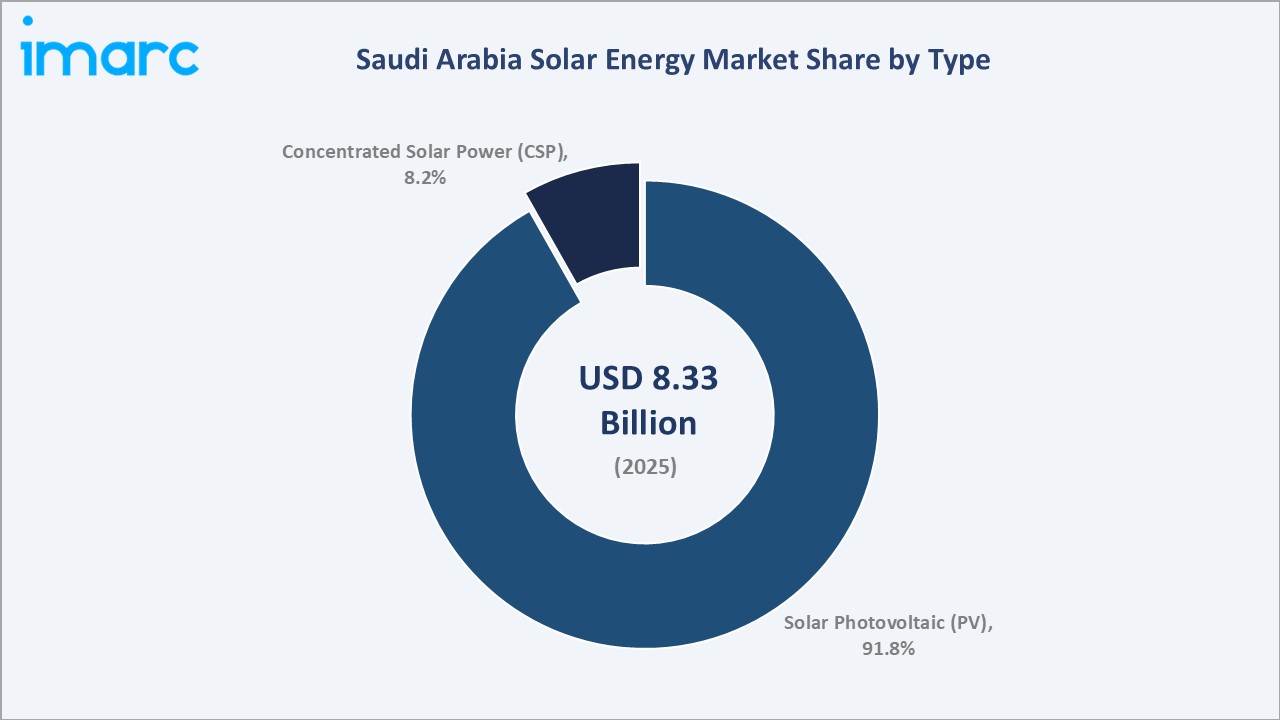
The Saudi Arabia solar energy market size increased from USD 8.33 Billion in 2025 to USD 11.45 Billion in 2026 and is projected to reach USD 145.38 Billion by 2034, growing at a CAGR of 37.39% during 2026-2034. The market is driven by Saudi Arabia's Vision 2030 renewable energy mandate targeting 50% renewable electricity by 2030, record-breaking low-cost solar bids, massive government-backed giga-project solar deployments, and rapidly falling photovoltaic module costs enabling globally competitive power generation. Solar photovoltaic (PV) leads with a 91.8% market share, and the Northern and Central region commands the largest regional share at 37.6%.
Market Snapshot
|
Metric |
Value |
| Base Year Market Size (2025) |
USD 8.33 Billion |
| Market Size (2026) | USD 11.45 Billion |
|
Forecast Market Size (2034) |
USD 145.38 Billion |
|
CAGR (2026-2034) |
37.39% |
|
Base Year |
2025 |
|
Historical Period |
2020-2025 |
|
Forecast Period |
2026-2034 |
|
Dominant Type |
Solar Photovoltaic - PV (91.8%, 2025) |
|
Leading Region |
Northern and Central Region (37.6%, 2025) |
The Saudi Arabia solar energy market has accelerated from USD 1.70 Billion in 2020 to USD 8.33 Billion in 2025 and an estimated USD 11.45 Billion in 2026, reflecting the early phases of the Kingdom's transformative renewable energy buildout. The market is projected to reach USD 40.80 Billion by 2030 and USD 145.38 Billion by 2034, representing one of the most explosive energy market growth trajectories.
To get more information on this market, Request Sample
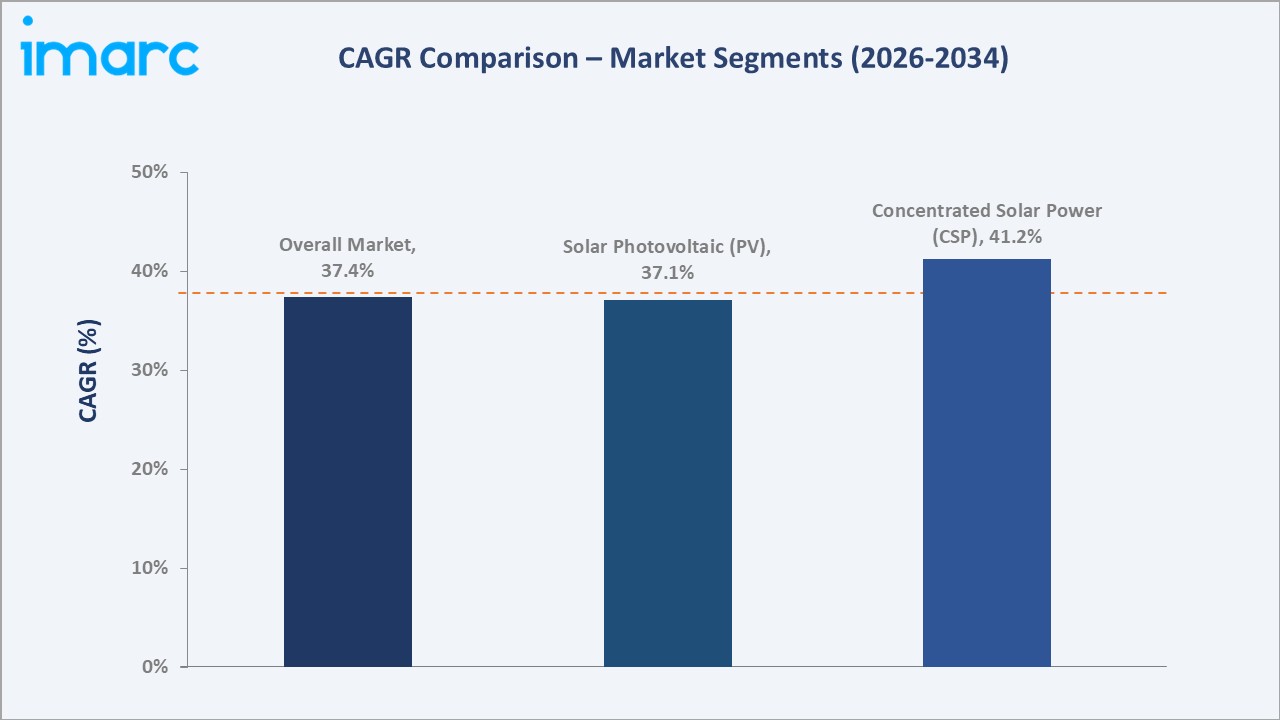
Solar PV grows at ~37.1% CAGR through utility-scale and distributed rooftop deployment. CSP grows at ~41.2% CAGR from a lower base as the NEOM CSP projects enter commercial operation. The overall market CAGR of 37.39% reflects accelerating deployment across both technologies, with PV volumes driving market size and CSP contributing strategic value through dispatchable solar-plus-storage capability.
Executive Summary
The Saudi Arabia solar energy market is experiencing one of the most rapid and consequential energy transitions of any economy, driven by the intersection of Vision 2030's national transformation mandate, the Kingdom's extraordinary solar natural resource endowment, and the global collapse of photovoltaic module costs to historic lows. Saudi Arabia possesses exceptional structural advantages for solar power: the country's desert geography provides among the highest direct normal irradiance (DNI) values, minimal cloud cover, and vast available land area at zero opportunity cost, enabling utility-scale solar plants to achieve capacity factors that substantially exceed global averages. Solar PV at 91.8% leads through utility-scale deployment and record-low tariff procurement. Northern & Central region leads regionally at 37.6%.
Key Market Insights
|
Insight |
Data |
|
Dominant Type |
Solar PV - 91.8% market share (2025) |
|
Leading Region |
Northern & Central Region - 37.6% (2025) |
|
Key Strategic Opportunity |
Green hydrogen production and clean energy export |
Key Analytical Observations Supporting the Above Data:
- Solar PV at 91.8%: Solar photovoltaic technology dominates through its combination of lowest capital cost per megawatt, fastest deployment timeline, proven technology bankability, and continued module price decline trajectory. Saudi Arabia's flat desert terrain, minimal shading obstructions, and high direct solar irradiance maximize PV capacity factors.
- Northern & Central Region at 37.6%: The Northern and Central region's leadership reflects the strategic concentration of Saudi Arabia's largest solar projects in areas with optimal land availability, highest solar irradiance, and proximity to the main national grid transmission infrastructure. Riyadh's energy transition and the planned development of the NEOM city also concentrate solar investment in this region.
Saudi Arabia Solar Energy Market Overview
The Saudi Arabia solar energy market encompasses the development, installation, and operation of utility-scale solar photovoltaic (PV) power plants, concentrated solar power (CSP) facilities, distributed rooftop and commercial PV systems, and associated infrastructure including grid connection, battery energy storage systems (BESS), solar-to-hydrogen electrolyzers, and operation and maintenance services. The combination of these physical advantages with the government's financial commitment through PIF-backed entities and project financing creates what is arguably the most favorable combination of natural and policy conditions for solar energy investment.
Market Dynamics
To evaluate market opportunities, Request Sample
Market Drivers
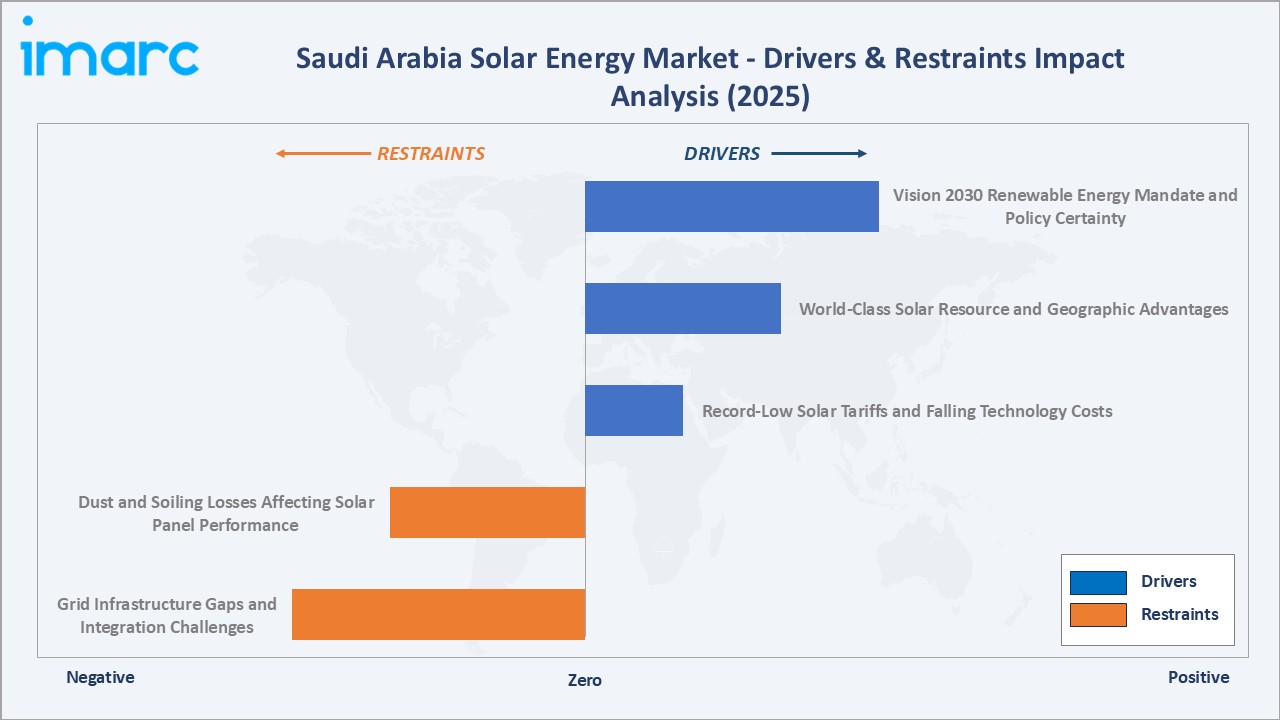
- Vision 2030 Renewable Energy Mandate and Policy Certainty: Saudi Arabia's Vision 2030 targets 50% of electricity generation from renewable sources by 2030, requiring an estimated 58.7 GW of solar capacity installation. This policy commitment, backed by the highest levels of government, provides investment-grade revenue certainty for project developers and financiers through long-term PPAs.
- World-Class Solar Resource and Geographic Advantages: Saudi Arabia's solar irradiance provides exceptional generation economics. Vast, flat, low-cost desert land is available at minimal opportunity cost. The country's latitude provides optimal solar angles for both fixed-tilt and single-axis tracker PV configurations. These physical advantages translate into capacity factors for utility PV and for CSP, creating some of the most competitive solar generation economics.
- Record-Low Solar Tariffs and Falling Technology Costs: The combination of Saudi Arabia's solar resource and competitive international bidding has produced some of the world's lowest solar power tariffs. Al Shuaiba's USD 0.0104/kWh tariff demonstrates the extraordinary cost competitiveness achievable, far below the operating cost of conventional oil and gas generation. Global PV module prices have fallen and continue declining, making solar the lowest-cost electricity source across Saudi Arabia and eliminating the economic case for fossil fuel power generation.
Market Restraints
- Grid Infrastructure Gaps and Integration Challenges: Saudi Arabia's transmission and distribution infrastructure was designed for centralized fossil fuel generation and requires substantial investment to accommodate the distributed and variable nature of renewable energy. Grid reinforcement, smart grid technology deployment, and BESS integration are needed to absorb increasing solar generation without curtailment.
- Dust and Soiling Losses Affecting Solar Panel Performance: Saudi Arabia's desert environment creates significant dust and soiling challenges for solar panel performance. Unclean panels can lose efficiency in high-dust conditions, requiring frequent cleaning that consumes water resources and increases O&M costs. Robotic cleaning technologies are being adopted at scale to address this challenge, but the water and cost requirements of maintaining optimal panel cleanliness in arid desert environments represent a genuine operational challenge that affects project economics.
Market Opportunities
- Green Hydrogen Production and Clean Energy Export: Saudi Arabia's combination of world-class solar resource, vast land area, and existing hydrocarbon export infrastructure positions the Kingdom uniquely for green hydrogen production and export. The USD 5 billion NEOM Green Hydrogen Project (HELIOS) utilize over 4 GW of renewable energy to produce around 650 tonnes of green hydrogen daily, exemplifying this strategic vision. Green hydrogen and green ammonia exports represent a potential new multi-billion-dollar export commodity that transforms solar energy from a domestic cost-reduction tool into a new global competitive advantage.
- Distributed and Rooftop Solar Market Development: Saudi Arabia's residential and commercial rooftop solar market is in its early stages but growing rapidly as net metering regulations enable building owners to offset electricity costs. The combination of high solar irradiance, high electricity prices for commercial consumers, and declining rooftop system costs is creating compelling economics for distributed solar.
Market Challenges
- Skilled Workforce Development for Renewable Energy Operations: Scaling Saudi Arabia's solar sector from gigawatts to hundreds of gigawatts requires developing a large domestic skilled workforce in solar engineering, installation, commissioning, and operation and maintenance. While international EPC contractors bring expertise for project construction, building sustainable domestic O&M capabilities through Saudi professionals requires sustained investment in technical training programs aligned with Vision 2030's employment localization objectives.
- Water Scarcity Constraints for CSP and Panel Cleaning: CSP plants typically require cooling water, and both PV and CSP plants require panel and mirror cleaning to maintain performance in Saudi Arabia's dusty environment. In a country where water is an increasingly precious resource, the water demand of large-scale solar installations requires careful management through dry-cooling technology for CSP, waterless robotic panel cleaning, and advanced dust-mitigation coatings that are still maturing commercially.
Emerging Market Trends
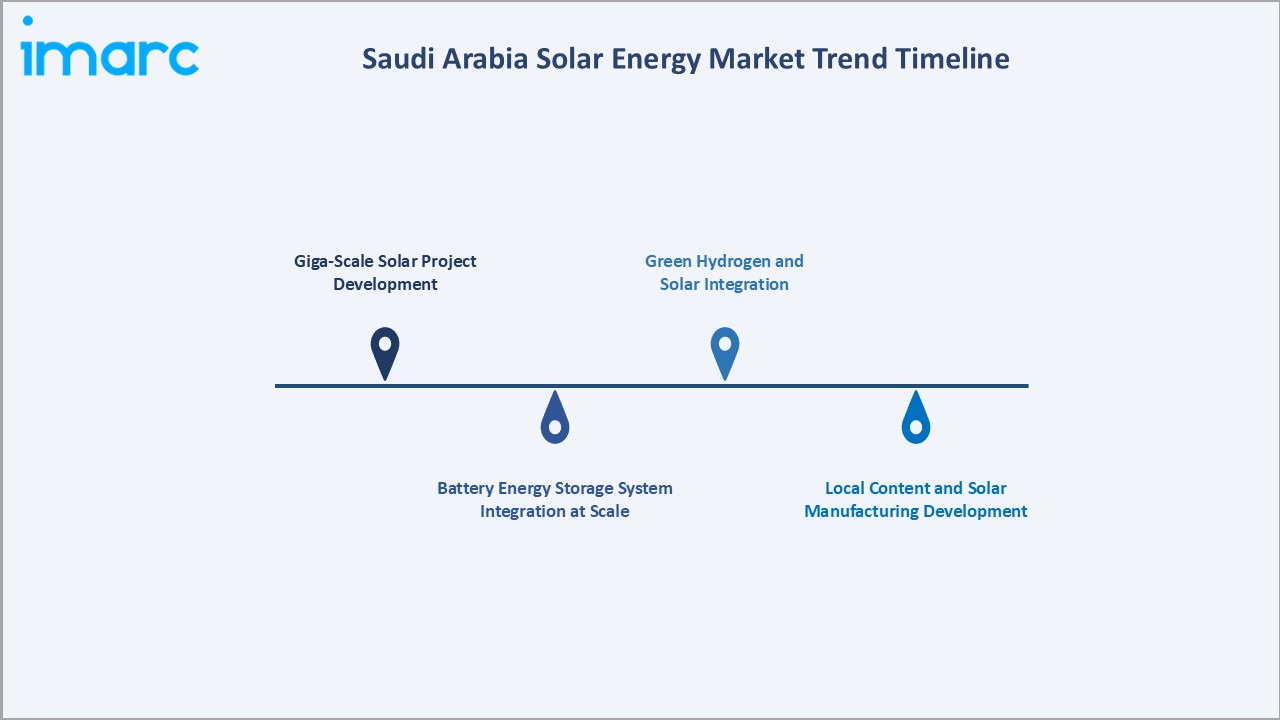
1. Giga-Scale Solar Project Development
Saudi Arabia is rapidly expanding its solar energy capacity through major projects such as the 1.5 GW Sudair Solar Plant, the 2.6 GW Shuaibah Solar Project, and the 300 MW Sakaka Solar Plant. These mega-projects achieve significant economies of scale in procurement, grid connection, and O&M that further reduce the levelized cost of energy and enable Saudi Arabia's solar tariffs to remain among the world's lowest.
2. Battery Energy Storage System Integration at Scale
Battery energy storage systems are increasingly being procured alongside solar projects to address the inherent intermittency of solar generation and enable dispatchable renewable electricity delivery. The combination of solar-plus-storage enables firm renewable capacity that can match the operational characteristics of conventional power plants, accelerating the transition from fossil fuel generation.
3. Green Hydrogen and Solar Integration
NEOM's Helios green hydrogen project represents the strategic integration of Saudi Arabia's solar development with the emerging global green hydrogen economy. The project targets producing 650 tonnes of green hydrogen daily using 4 GW of renewable energy, with hydrogen converted to green ammonia for export. This project model, solar as a feedstock for chemical export commodities, could establish a new industrial paradigm that multiplies Saudi Arabia's solar deployment scale as green hydrogen demand grows globally post-2030.
4. Local Content and Solar Manufacturing Development
Saudi Arabia's Vision 2030 industrial strategy includes developing domestic solar manufacturing capabilities through joint ventures and technology transfer agreements. The Saudi Industrial Development Fund is supporting local PV module assembly, racking and mounting system manufacturing, and inverter production facilities.
Industry Value Chain Analysis
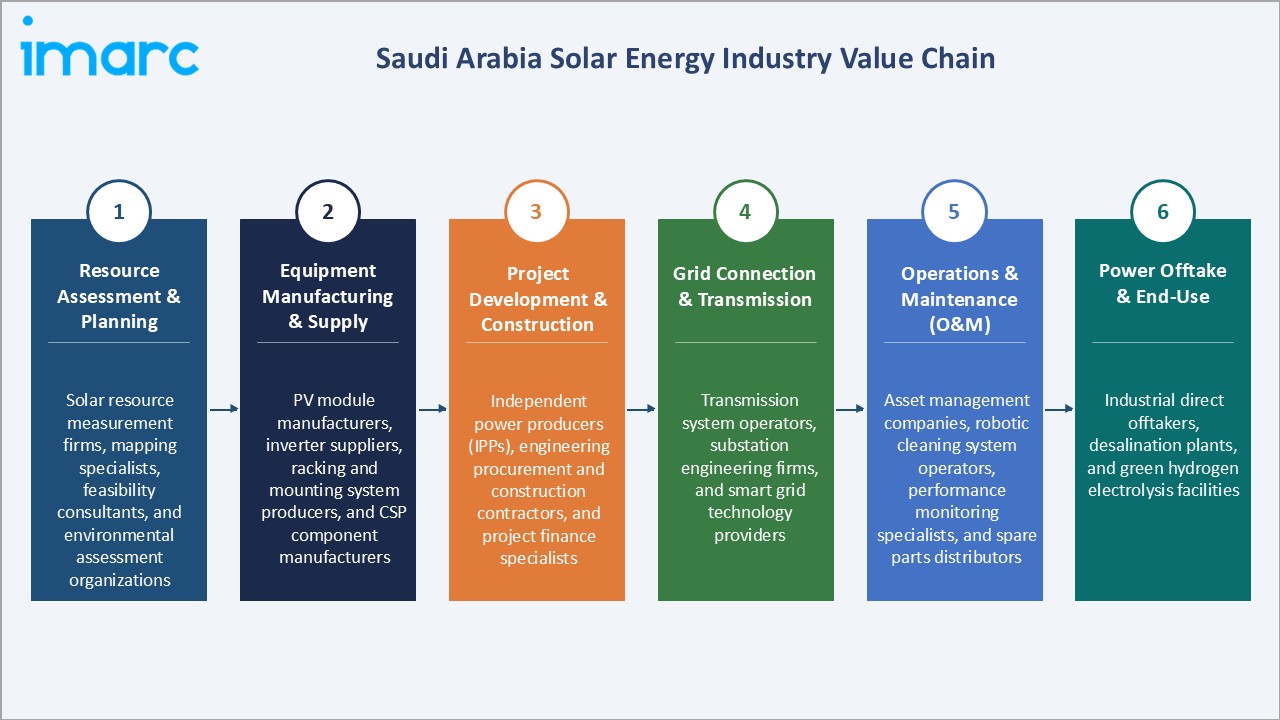
The Saudi Arabia solar energy value chain integrates resource assessment and project planning, equipment manufacturing and supply, project development and EPC construction, grid connection and transmission, operations and maintenance, and power offtake and end-use across utility-scale and distributed solar applications.
|
Stage |
Key Participants |
|
Resource Assessment & Planning |
Solar resource measurement firms, mapping specialists, feasibility consultants, and environmental assessment organizations. |
|
Equipment Manufacturing & Supply |
PV module manufacturers, inverter suppliers, racking and mounting system producers, and CSP component manufacturers. |
|
Project Development & Construction |
Independent power producers (IPPs), engineering procurement and construction contractors, and project finance specialists. |
|
Grid Connection & Transmission |
Transmission system operators, substation engineering firms, and smart grid technology providers. |
|
Operations & Maintenance (O&M) |
Asset management companies, robotic cleaning system operators, performance monitoring specialists, and spare parts distributors. |
|
Power Offtake & End-Use |
Industrial direct offtakers, desalination plants, and green hydrogen electrolysis facilities. |
Project development and construction represent the most capital-intensive and strategically critical stage in Saudi Arabia's solar value chain. Leading IPPs have established strong project track records, robust financing relationships, and technical execution capabilities that command the strongest competitive positions. Their ability to consistently deliver projects at record-low tariffs while maintaining financial returns positions them for the largest share of Saudi Arabia's growing project pipeline through 2034.
Technology Landscape in the Saudi Arabia Solar Energy Industry
Advanced Solar PV Technology
Saudi Arabia's utility-scale solar projects are deploying the most advanced commercially available PV technologies to maximize generation at world-record low tariffs. High-efficiency monocrystalline PERC (passivated emitter rear contact) and TOPCon (tunnel oxide passivated contact) modules delivering high cell efficiency are the standard specification for large Saudi projects. Single-axis solar trackers that follow the sun's daily path improve energy yield compared to fixed-tilt systems and are standard in Saudi utility projects.
Concentrated Solar Power Technology
Saudi Arabia's CSP deployment focuses on parabolic trough and power tower technologies that achieve high-capacity factors when integrated with molten salt thermal energy storage. Molten salt storage enables CSP plants to deliver firm, dispatchable solar electricity after sunset, providing the reliability characteristics needed for baseload power supply that solar PV alone cannot achieve without expensive battery storage.
Battery Energy Storage and Grid Integration Technology
Lithium-ion battery energy storage systems at grid scale are being deployed to complement solar generation in Saudi Arabia, enabling time-shifted power delivery and frequency regulation services. Utility-scale BESS projects paired with solar PV facilities are being procured under storage-integrated renewable energy tenders. Smart grid investment programs include advanced metering infrastructure, distributed energy resource management systems, and power electronics that enable high-penetration renewable energy integration without grid stability compromise.
Market Segmentation Analysis
The report covers the following segments:
|
Segment Category |
Leading Segment |
Market Share |
Year |
|
Type |
Solar Photovoltaic (PV) |
91.8% |
2025 |
|
Region |
Northern and Central Region |
37.6% |
2025 |

By Type
Solar photovoltaic (PV) leads with 91.8% (2025), driven by its lowest capital cost, fastest deployment, and continued technology price decline that enables world-record tariffs through Saudi Arabia's competitive bidding programs.
To access detailed market analysis, Request Sample
Concentrated solar power (CSP) at 8.2% represents a strategically important smaller share, with CSP's thermal energy storage capability enabling dispatchable solar electricity without battery systems. CSP is expected to grow at a higher CAGR of ~41.2% from its smaller base as NEOM's planned CSP capacity comes online, and Saudi Arabia's grid requires firm renewable capacity to balance large PV volumes.
Regional Market Insights
|
Region |
Share (2025) |
Key Saudi Arabia Solar Energy Market Drivers & Characteristics |
|
Northern & Central Region |
37.6% |
Reflecting the concentration of Saudi Arabia's largest utility-scale solar projects, combined with optimal land availability, highest DNI values, and proximity to the national grid backbone. |
|
Western Region |
29.8% |
Reflecting significant solar capacity serving Jeddah's power needs, the Makkah and Madinah electricity demand for religious tourism infrastructure, and Red Sea coastal project development. |
|
Eastern Region |
21.3% |
Reflecting solar energy deployment supporting Saudi Aramco's operational energy transition targets, the refining and petrochemical industrial complex electrification, and expanding grid-scale storage integration with industrial demand centers. |
|
Southern Region |
11.3% |
Reflecting growing solar deployment, driven by Vision 2030 regional development investment, and off-grid agricultural and water pumping applications. |
The Northern and Central region's 37.6% leadership is anchored by solar energy projects and the extraordinary scale of NEOM's planned renewable energy infrastructure. Riyadh's transition to solar-powered electricity is simultaneously creating distributed and commercial solar market development in the capital. The Western region's 29.8% reflects the Red Sea Project's commitment to renewable energy, Jeddah's large electricity demand base, and the strategic importance of reliable power supply for the Makkah and Madinah pilgrimage infrastructure.
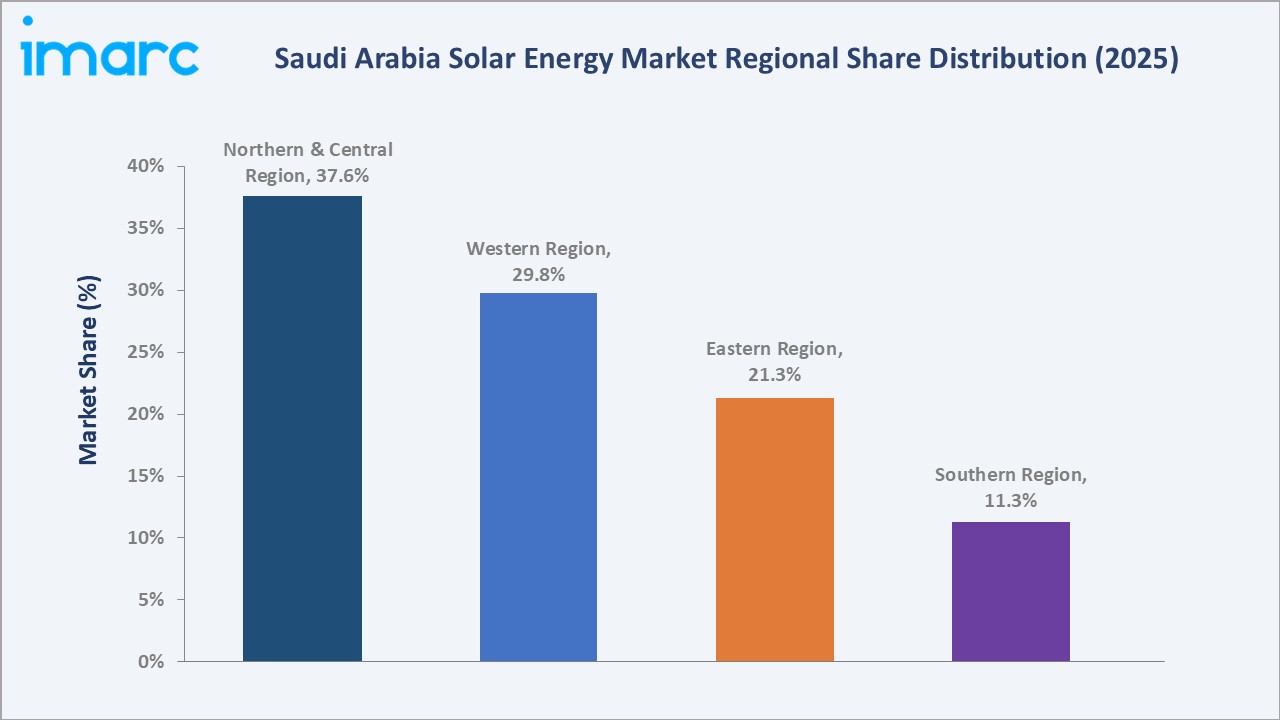
The Eastern region's 21.3% is set to grow as Saudi Aramco accelerates its operational carbon reduction targets, the Jubail and Yanbu industrial cities transition to renewable power, and the Acwa pipeline of Eastern Province projects deliver. The Southern region at 11.3% represents growing government investment in regional development, with the tourism development creating new electricity demand centers that are increasingly targeted for solar supply.
Competitive Landscape
The Saudi Arabia solar energy market is concentrated around a small number of internationally experienced IPPs and EPC developers who have established project track records through competitive bidding rounds. Competition is intensifying as global solar developers recognize Saudi Arabia's exceptional project pipeline scale and competitive economics.
|
Company |
Key Projects |
Market Position |
Core Strength |
|
Acwa |
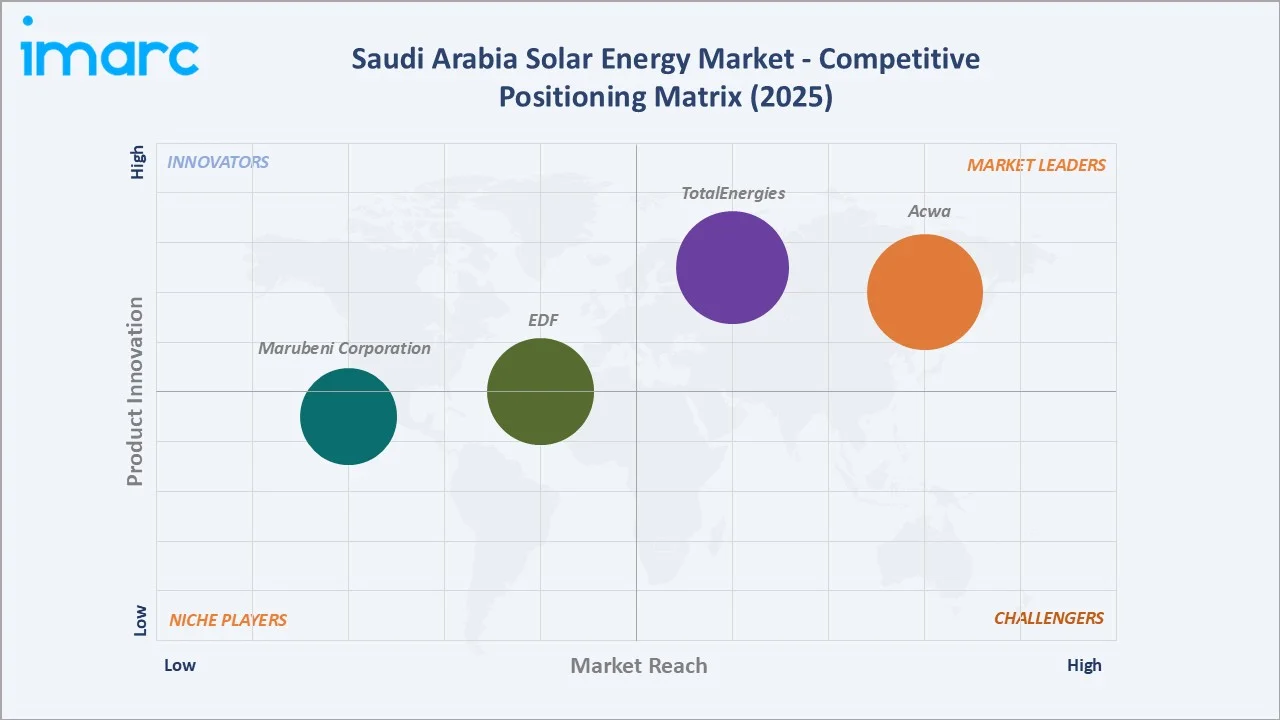
Al Kahfah PV IPP, Ar Rass 2 Solar PV IPP, Laylaa Solar PV IPP, Sakaka PV IPP, Shuaibah PV IPP, Sudair PV IPP |
Market Leader |
ACWA is the principal execution partner and national clean energy champion driving Saudi Arabia's solar energy transformation under Vision 2030 |
|
EDF |
Al Henakiyah |
Established Player |
EDF Renewables partnered with Masdar and Nesma Company to develop a massive Al Henakiyah Solar Plant. |
|
Marubeni Corporation |
Rabigh Solar PV IPP |
Established Player |
Marubeni Corporation plays a key role in Saudi Arabia's renewable energy sector through major utility-scale solar photovoltaic (PV) developments and rooftop solar systems. |
|
TotalEnergies |
Wadi Al Dawasir solar power plant, Rabigh 2 project |
Market Leader |
TotalEnergies develops major photovoltaic projects in Saudi Arabia to support the Kingdom's goal of reaching a renewable energy mix. |
Companies across the competitive landscape are pursuing Saudi Arabia's transformational solar project pipeline as the Kingdom's NEOM development and corporate renewable energy procurement create one of the largest solar investment opportunities. The market is expected to see additional international IPP entries as project scale and pipeline certainty justify market development investment.
Key Company Profiles
Acwa
Acwa is one of Saudi Arabia's largest private water and power developers, majority-owned by Saudi Arabia's Public Investment Fund (PIF), and the undisputed leader in Saudi Arabia's solar energy market. The company has played a pivotal role in establishing Saudi Arabia's reputation as the global solar cost benchmark through its development of various solar projects.
- Key Projects: Al Kahfah PV IPP, Ar Rass 2 Solar PV IPP, Laylaa Solar PV IPP, Sakaka PV IPP, Shuaibah PV IPP, Sudair PV IPP.
- Strategic Focus: Consolidating Saudi Arabia's position as the lowest-cost solar generator through continued bid participation, advancing green hydrogen project development through NEOM partnerships, expanding solar O&M capabilities to manage growing operational asset portfolio, and developing CSP-plus-storage projects that provide dispatchable renewable electricity.
EDF
EDF has established a competitive presence in Saudi Arabia's solar energy market through bid participation and strategic partnership development. EDF brings global renewable energy project experience, sophisticated project finance capabilities, and the operational excellence of EDF Group's nuclear and renewable energy O&M expertise. The company's long-term commitment to Middle East market development reflects its recognition of Saudi Arabia's scale of solar opportunity.
- Key Projects: Al Henakiyah.
- Strategic Focus: Building a substantial Saudi Arabia solar project portfolio through continued competitive bid participation, developing direct PPA relationships with Saudi industrial offtakers including petrochemical companies and water desalination operators, and positioning EDF for the strategic CSP and green hydrogen project opportunities that leverage EDF thermal energy technology expertise.
Market Concentration Analysis
The Saudi Arabia solar energy market exhibits high concentration at the project developer level, with Acwa commanding the largest single-company project pipeline and market share through its project track record and PIF backing. Market concentration at the developer level is offset by increasing competition at each bidding round, with international firms typically competing for each project. Module and equipment supply is served by a diversified international supplier base, with international manufacturers accounting for the majority of module supply to Saudi projects.
Investment & Growth Opportunities
Highest Growth Segments
Green hydrogen solar integration (~50%+ CAGR from emerging base), battery energy storage paired with solar, utility-scale PV across all Saudi regions, rooftop and commercial distributed solar, and solar O&M services for growing operational plant portfolios represent the highest-growth investment vectors in the Saudi Arabia solar energy market through 2034.
Investment Themes
- Project pipeline participation: Saudi Arabia's ongoing competitive bidding rounds represent the primary investment opportunity, with multiple rounds planned through 2030 covering the remaining energy needed to meet Vision 2030 targets. International developers with strong balance sheets, project finance capabilities, and EPC execution track records in Middle East markets are best positioned to compete successfully and build multi-gigawatt Saudi project portfolios.
- Solar manufacturing and local content development: Vision 2030's local content requirements in bidding create opportunity for solar module assembly, inverter manufacturing, and BOS component production facilities in Saudi Arabia. Financing and industrial zone incentives support manufacturing investment, with local production enabling compliance with increasing local content thresholds and preferred bidder status advantages in future rounds.
Future Market Outlook (2026-2034)
The Saudi Arabia solar energy market is projected to grow from USD 8.33 Billion in 2025 to USD 11.45 Billion in 2026, reaching USD 145.38 Billion by 2034, exhibiting an exceptional CAGR of 37.39% during 2026-2034. The market is projected to reach an anchor value of USD 40.80 Billion by 2030, representing the mid-period milestone at which Saudi Arabia approaches its Vision 2030 renewable energy target of 50% renewable electricity and the first green hydrogen export projects begin commercial operations.
Three structural forces will define the Saudi Arabia solar energy market through 2034. First, Vision 2030's renewable energy mandate provides an unwavering policy foundation that makes Saudi Arabia's solar deployment trajectory the most policy-certain of any major market. Second, falling technology costs will continually expand the economics-driven market beyond policy-mandated deployment. Third, Saudi Arabia's ambition to become a global clean energy exporter transforms the solar market from domestic-demand-driven to export-revenue-driven.
Research Methodology
Primary Research
Primary research comprised in-depth interviews with solar project developers, EPC contractors, bidding participants, procurement specialists, investment representatives, and energy market analysts. These discussions validated market size estimates, assessed project pipeline visibility, evaluated competitive dynamics, and provided insights into regulatory developments, technology adoption, and long-term market evolution in the Saudi Arabia solar energy market.
Secondary Research
Secondary research encompassed project award announcements, company annual reports, renewable energy program publications, portfolio disclosures, NEOM project documentation, Saudi Arabia renewable energy country profiles, international solar developer investor presentations, and industry publications tracking Middle East renewable energy market developments.
Forecasting Models
Forecasting models incorporated Vision 2030 renewable energy capacity targets, project award timelines, technology cost decline trajectories, green hydrogen demand projections, and macroeconomic indicators including oil price scenarios affecting solar substitution economics. Exponential growth modeling was applied to reflect the accelerating deployment dynamics characteristic of policy-driven energy transition markets at early-to-mid adoption phases.
Saudi Arabia Solar Energy Market Report Scope:
| Report Features | Details |
|---|---|
| Base Year of the Analysis | 2025 |
| Historical Period | 2020-2025 |
| Forecast Period | 2026-2034 |
| Units | Billion USD |
| Scope of the Report |
Exploration of Historical Trends and Market Outlook, Industry Catalysts and Challenges, Segment-Wise Historical and Future Market Assessment:
|
| Types Covered | Solar Photovoltaic (PV), Concentrated Solar Power (CSP) |
| Regions Covered | Northern and Central Region, Western Region, Eastern Region, Southern Region |
| Companies Covered | Acwa, EDF, Marubeni Corporation, TotalEnergies, etc. |
| Customization Scope | 10% Free Customization |
| Post-Sale Analyst Support | 10-12 Weeks |
| Delivery Format | PDF and Excel through Email (We can also provide the editable version of the report in PPT/Word format on special request) |
Key Benefits for Stakeholders:
- IMARC’s industry report offers a comprehensive quantitative analysis of various market segments, historical and current market trends, market forecasts, and dynamics of the Saudi Arabia solar energy market from 2020-2034.
- The research report provides the latest information on the market drivers, challenges, and opportunities in the Saudi Arabia solar energy market.
- Porter's five forces analysis assists stakeholders in assessing the impact of new entrants, competitive rivalry, supplier power, buyer power, and the threat of substitution. It helps stakeholders to analyze the level of competition within the Saudi Arabia solar energy industry and its attractiveness.
- The competitive landscape allows stakeholders to understand their competitive environment and provides an insight into the current positions of key players in the market.
Frequently Asked Questions About the Saudi Arabia Solar Energy Market Report
The Saudi Arabia solar energy market size is estimated at USD 11.45 Billion in 2026, driven by Vision 2030's 50% renewable energy target by 2030, world-class solar irradiance enabling record-low tariffs, competitive project procurement programs, and massive government-backed deployment of utility-scale solar projects.
The Saudi Arabia solar energy market is projected to grow at an exceptional CAGR of 37.39% during 2026-2034, representing one of the fastest energy market growth trajectories sustained by Vision 2030 policy mandate, falling technology costs, green hydrogen integration, and the Kingdom's potential to become a global clean energy exporter.
The market is projected to reach approximately USD 40.80 Billion by 2030, representing the mid-period milestone at which Saudi Arabia approaches its Vision 2030 renewable energy target and first green hydrogen export projects reach commercial operation, establishing a new export commodity alongside conventional hydrocarbons.
The Saudi Arabia solar energy market is projected to reach USD 145.38 Billion by 2034, sustained by capacity target ambitions, green hydrogen production scale-up, potential clean electricity export programs, and continued technology cost reductions enabling new application economics.
Solar photovoltaic (PV) leads with a 91.8% share in 2025, driven by its lowest capital cost, fastest deployment, and continued module price decline enabling world-record tariffs.
The Northern and Central region leads with a 37.6% share in 2025, driven by the concentration of Saudi Arabia's largest solar projects and NEOM-linked renewable development in areas with the optimal combination of land availability, solar irradiance, and grid access.
Key players include Acwa, EDF, Marubeni Corporation, and TotalEnergies, among others.
Top opportunities include competitive bid project participation, green hydrogen and green ammonia production facilities powered by Saudi solar, solar manufacturing and local content development eligible for financing, and solar O&M services for the rapidly growing operational plant portfolio.
Need more help?
- Speak to our experienced analysts for insights on the current market scenarios.
- Include additional segments and countries to customize the report as per your requirement.
- Gain an unparalleled competitive advantage in your domain by understanding how to utilize the report and positively impacting your operations and revenue.
- For further assistance, please connect with our analysts.
 Request Customization
 Speak to an Analyst
 Request Brochure
 Inquire Before Buying
Benefits of Customization
- Personalize this research
- Triangulate with your data
- Get data as per your format and definition
- Gain a deeper dive into a specific application, geography, customer, or competitor
- Any level of personalization
Get in Touch With Us
UNITED STATES
Phone: +1-201-971-6302
INDIA
Phone: +91-120-433-0800
UNITED KINGDOM
Phone: +44-753-714-6104
Email: [email protected]
Client Testimonials




.webp)




.webp)













Related Reports

Choose your plan
*Please note that the prices mentioned below are starting prices for each bundle type. Kindly contact our team for further details.*
Single User License
- 1 User License, Access on 2 Devices
- PDF Report + Excel Dataset (Password Protected)
- Lifetime Access
- No Printing Rights
- 10% Free Report Customization
- 10–12 Weeks of Analyst Support
Five User License
- Access for 5 Users, 2 Devices per User
- PDF Report + Excel Dataset (Password Protected)
- Lifetime Access
- Dedicated Account Manager
- 12–14 Weeks of Analyst Support
- No Printing Rights
- 15% Free Report Customization
- 25% Discount on Your Next Purchase
Corporate User License
- Unlimited User Access (Within Your Organization)
- PDF Report + Excel Dataset
- Lifetime Access
- Dedicated Account Manager
- 14–20 Weeks of Analyst Support
- No Printing Rights
- 20% Free Report Customization
- 30% Discount on Your Next Purchase
Essential Insights
What's included:
3 reports
- Lifetime Access
- PDF Reports
- Excel Datasets
- 2 Weeks of Free Analyst Support
- 2 User Licenses
- Access on 2 Devices
- Printing Rights
- Complimentary PowerPoint (PPT) Version
- Complimentary License Upgrade
Professional Access
What's included:
5 reports
- Lifetime Access
- PDF Reports
- Excel Datasets
- 8 Weeks of Free Analyst Support
- 2 User Licenses
- Access on 2 Devices
- Printing Rights
- Complimentary PowerPoint (PPT) Version
- Complimentary License Upgrade
Business Advantage
What's included:
8 reports
- Lifetime Access
- PDF Reports
- Excel Datasets
- 14 Weeks of Free Analyst Support
- 2 User Licenses
- Access on 2 Devices
- Printing Rights
- Complimentary PowerPoint (PPT) Version
- Complimentary License Upgrade
Enterprise Intelligence
What's included:
10 reports
- Lifetime Access
- PDF Reports
- Excel Datasets
- 20 Weeks of Free Analyst Support
- 2 User Licenses
- Access on 2 Devices
- Printing Rights
- Complimentary PowerPoint (PPT) Version
- Complimentary License Upgrade