
Singapore Bakery Products Market Size, Share, Trends and Forecast by Product Type, Distribution Channel, and Region, 2026-2034
Singapore Bakery Products Market Size, Share, Trends & Forecast (2026-2034)
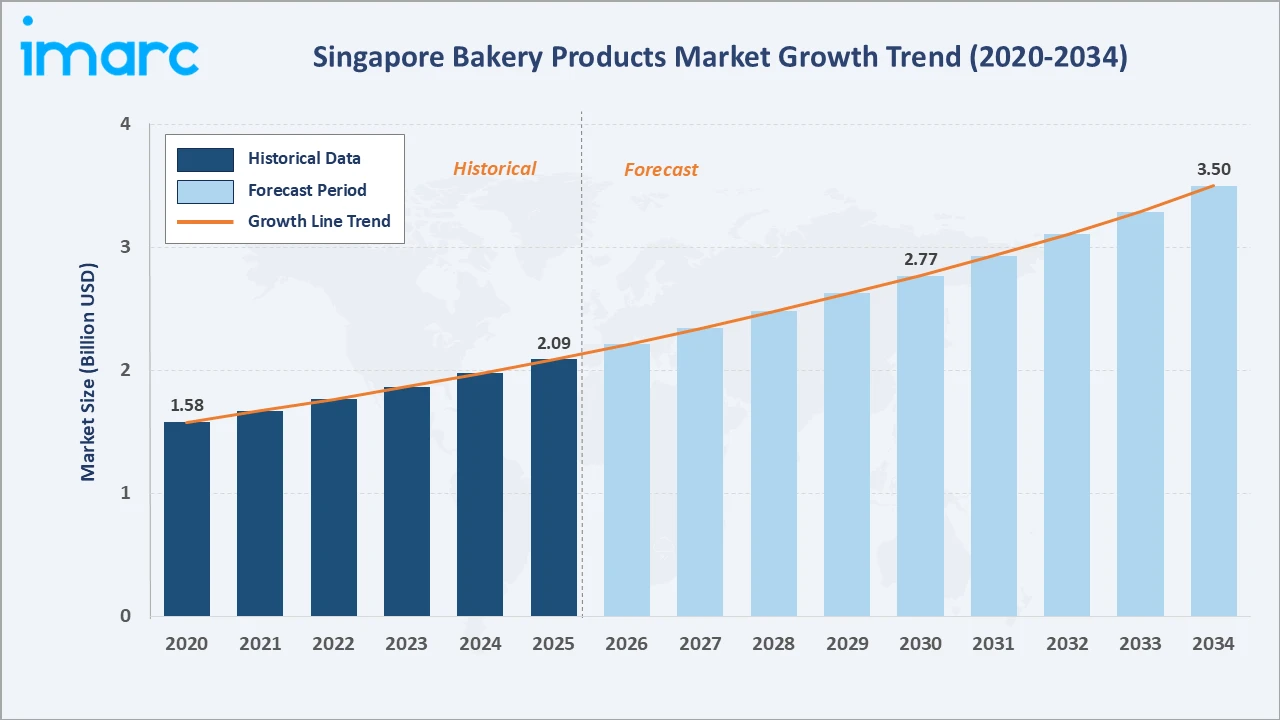
The Singapore bakery products market grew from USD 2.09 Billion in 2025 to USD 2.21 Billion in 2026 and is projected to reach USD 3.50 Billion by 2034, growing at a CAGR of 5.75% during 2026-2034. The market is driven by rising health consciousness, expanding café culture, premiumization of baked goods, and growing e-commerce food channels. Biscuits lead product type at 34.8%, supermarkets and hypermarkets lead distribution at 28.6%, and Central Singapore commands the largest regional share at 37.6% in 2025.
Market Snapshot
|
Metric |
Value |
|
Base Year Market Size (2025) |
USD 2.09 Billion |
|
Market Size (2026) |
USD 2.21 Billion |
|
Forecast Market Size (2034) |
USD 3.50 Billion |
|
CAGR (2026-2034) |
5.75% |
|
Base Year |
2025 |
|
Historical Period |
2020-2025 |
|
Forecast Period |
2026-2034 |
|
Dominant Product Type |
Biscuits (34.8%, 2025) |
|
Leading Distribution Channel |
Supermarkets and Hypermarkets (28.6%, 2025) |
|
Leading Region |
Central (37.6%, 2025) |
The Singapore bakery products market grew from USD 1.58 Billion in 2020 to USD 2.09 Billion in 2025, and further to USD 2.21 Billion in 2026, reflecting steady consumer demand for packaged and artisanal bakery goods across all major product categories. The market is projected to reach USD 2.77 Billion by 2030 and USD 3.50 Billion by 2034.
To get more information on this market, Request Sample
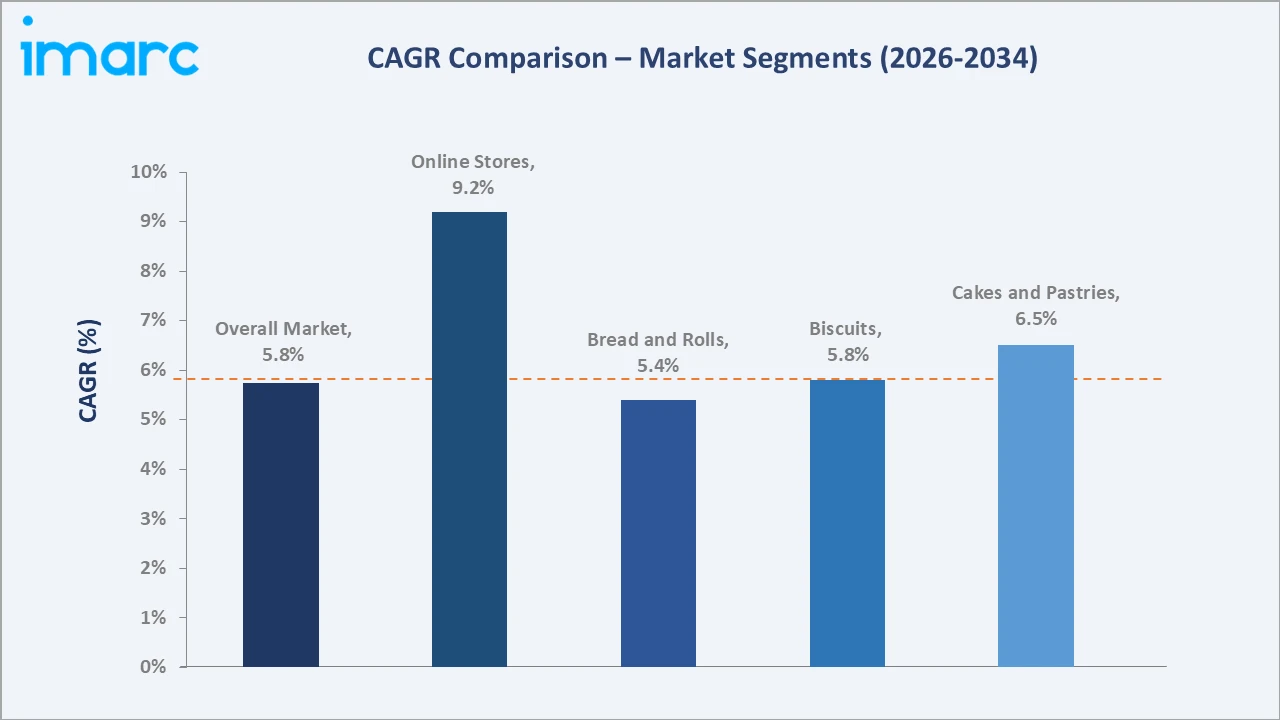
Cakes and pastries are growing at a 6.5% CAGR during 2026–2034, driven by premiumization and occasion gifting demand. Biscuits at 5.8% CAGR benefit from broad retail reach and innovation in health-oriented and fusion flavors. Online stores are the fastest-growing distribution channel at 9.2% CAGR as digital food commerce and direct-to-consumer bakery models expand rapidly.
Executive Summary
The Singapore bakery products market is on a steady growth trajectory, underpinned by strong consumer demand for premium bakery products, expansion of modern retail and e-commerce channels, and a vibrant food culture that values artisanal quality and innovative flavors. The market has expanded consistently since 2020, supported by rising disposable incomes, urbanization, and a tourism-driven food services sector that sustains demand for specialty baked goods.
Biscuits lead at 34.8% in 2025 through broad retail availability and impulse purchase behavior. Supermarkets and hypermarkets lead distribution at 28.6% through Singapore's dense modern retail network, while Online Stores at 10.3% are the fastest-growing channel. The Central region leads at 37.6%, driven by high commercial and tourism density.
Key Market Insights
|
Insight |
Data |
|
Dominant Product Type |
Biscuits – 34.8% share (2025) |
|
Dominant Distribution Channel |
Supermarkets and Hypermarkets – 28.6% share (2025) |
|
Leading Region |
Central – 37.6% (2025) |
|
Key Market Opportunity |
Growing demand for health-oriented and artisanal bakery products, expanding digital retail channels, and rising interest in locally inspired fusion flavors present strong investment opportunities across Singapore's bakery sector. |
Key Analytical Observations Supporting the Above Data:
- Biscuits at 34.8%: Biscuits hold the largest product type share due to their broad retail penetration, high purchase frequency, and strong brand loyalty. The segment benefits from ongoing innovation in reduced-sugar, whole grain, and premium flavored variants that expand consumer relevance across health-conscious demographics.
- Supermarkets and Hypermarkets at 28.6%: Modern grocery formats provide the widest product assortment and consumer reach, enabling both domestic and multinational bakery brands to access Singapore's mass-market consumer base. Premium chilled and ambient bakery sections in hypermarkets are expanding to accommodate artisanal and specialty products.
- Central Region at 37.6%: The Central region's market leadership reflects the highest concentration of cafés, premium retail bakeries, hotels, and tourism-driven food service venues. Commercial density and tourist traffic generate consistently high-volume, above-average-value bakery product demand.
Singapore Bakery Products Market Overview
The Singapore bakery products market encompasses the manufacturing, distribution, and retail sale of biscuits, bread, rolls, cakes, pastries, and rusks across all consumer and food service channels. Singapore's compact, affluent market supports a diverse bakery ecosystem spanning large-scale packaged goods manufacturers, multinational bakery chains, artisanal independent bakeries, and specialty patisseries. The food and beverage sector is growing, with bakery products representing a significant consumer goods sub-category. The industry serves household consumers, cafés, hotels, quick-service restaurants, institutional catering operations, and corporate food services.
Market Dynamics
To evaluate market opportunities, Request Sample
Market Drivers
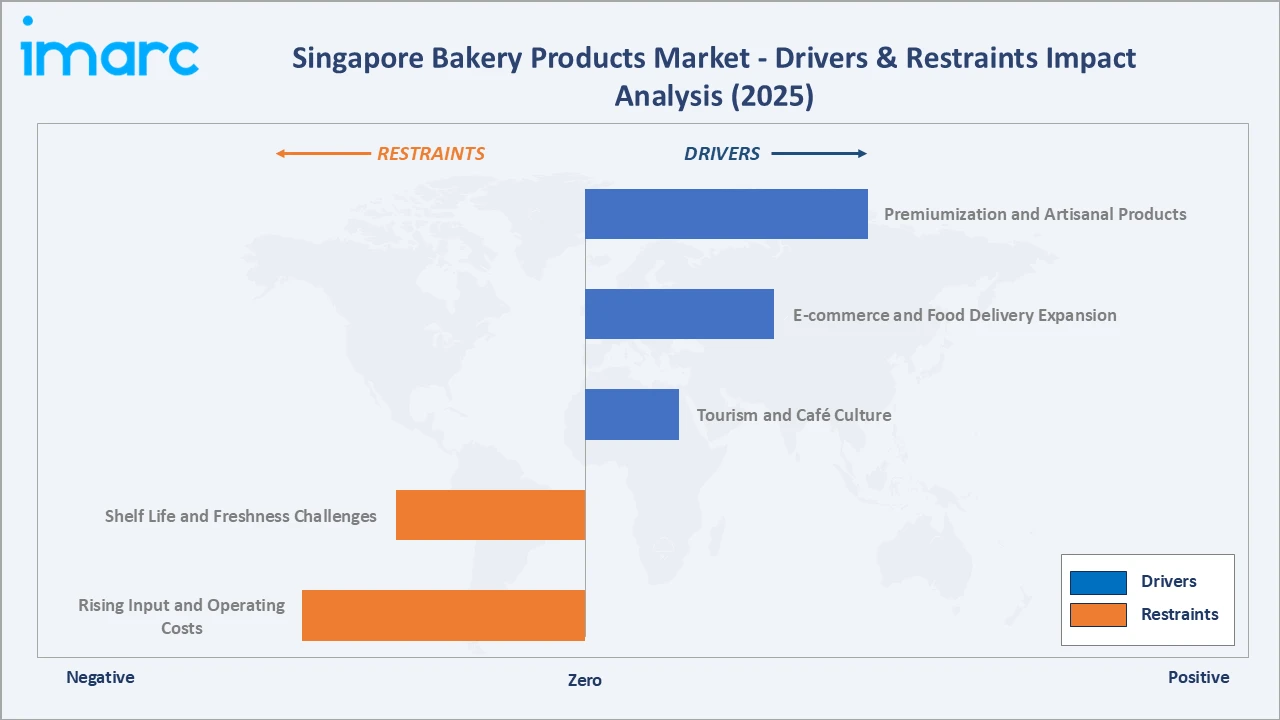
- Premiumization and Artisanal Products: In Singapore, personal disposable income (PDI) recorded 6.9% year-on-year growth in Q2 2026, rising from 5.4% in Q1 2026. Rising disposable incomes and a sophisticated food culture drive consumer willingness to pay premium prices for handcrafted bakery products. Artisanal bakeries featuring pandan, gula melaka, durian, and black sesame flavors have created a fast-growing premium sub-segment within both bread and pastry categories that commands above-average pricing and consumer loyalty.
- E-commerce and Food Delivery Expansion: Online bakery platforms, food delivery apps, and direct-to-consumer subscription models create new demand channels. E-commerce enables artisanal producers to scale without physical retail investment, while larger brands use digital channels to offer limited-edition and premium SKUs.
- Tourism and Café Culture: Singapore's food tourism sector and established café dining culture sustain consistent demand for premium pastries, specialty cakes, and artisan breads. Singapore’s tourism sector reached a record S$32.8 billion in receipts in 2025, surpassing the previous high of S$29.8 billion in 2024, creating substantial hospitality-sector demand for specialty bakery products and supporting continued investment in premium bakery retail locations.
Market Restraints
- Rising Input and Operating Costs: Escalating prices of wheat, flour, butter, and sugar compress bakery manufacturer margins. Singapore's high commercial real estate costs add additional pressure, particularly for artisanal operators maintaining premium retail locations, limiting profitability and constraining capacity investment for smaller market participants.
- Shelf Life and Freshness Challenges: The inherent perishability of bakery products creates supply chain complexity for producers serving multiple retail and food service locations. Freshness requirements limit production volumes, restrict delivery radius, and elevate logistics costs, creating operational challenges that constrain market expansion for fresh bakery operators.
Market Opportunities
- Functional and Fortified Bakery Products: Growing interest in probiotics, high-fiber, high-protein, and low-GI formulations presents a significant product development opportunity. Bakeries introducing validated functional benefits can command premium pricing and differentiation from conventional ranges.
- Cloud Kitchen and Dark Kitchen Bakery Models: Virtual bakery brands operating through food delivery platforms offer a capital-efficient entry route for new operators. Cloud kitchen models eliminate premium retail rent costs while enabling large-scale digital demand aggregation across Singapore's hyper-connected consumer population.
Market Challenges
- High Commercial Real Estate Costs: Singapore's premium commercial real estate costs represent a structural barrier for independent artisanal bakeries operating physical retail outlets. Rent burdens as a proportion of revenue can compress margins to unsustainable levels, limiting the viability of premium location expansion for smaller operators and constraining overall market geographic coverage.
- Consumer Loyalty Fragmentation: The proliferation of bakery brands, formats, and channels has fragmented consumer loyalty, making sustained repeat purchase behavior increasingly difficult to achieve. Maintaining product quality consistency, brand relevance, and multichannel accessibility requires ongoing investment in marketing and innovation that challenges smaller market participants.
Emerging Market Trends
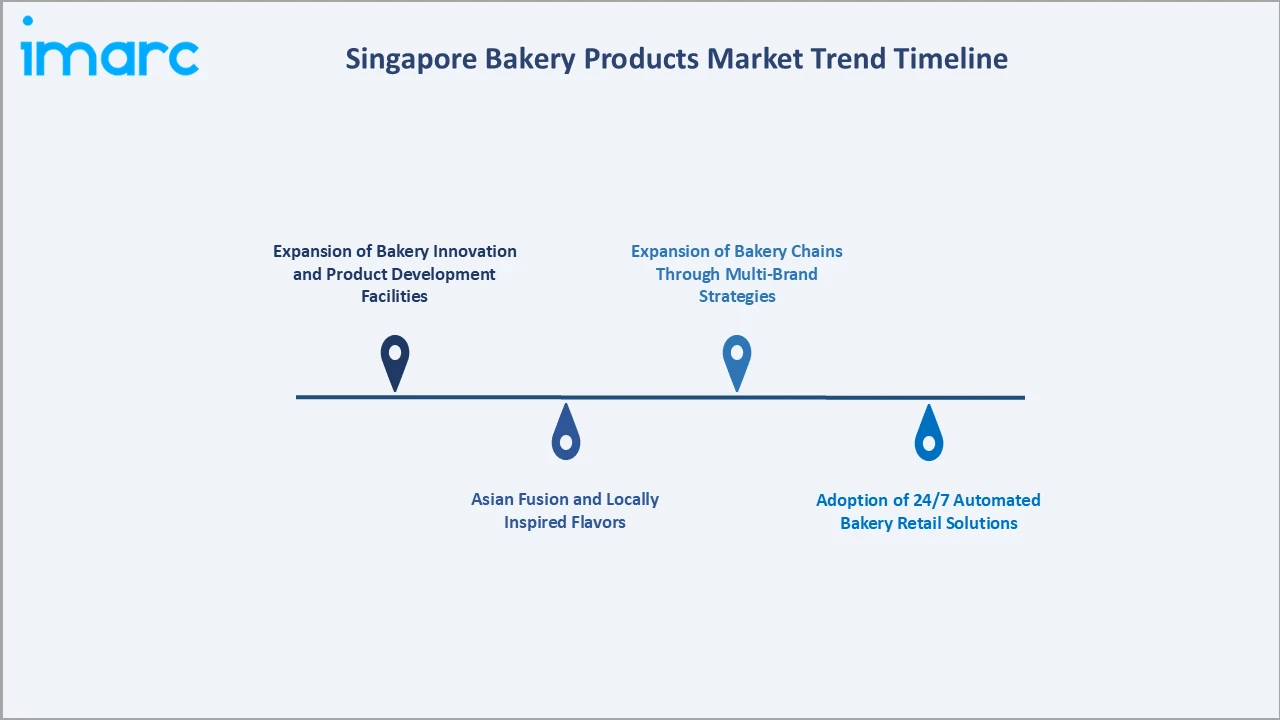
1. Expansion of Bakery Innovation and Product Development Facilities
In May 2024, Mondelēz International inaugurated a Regional Biscuit and Baked Snacks Lab and Innovation Kitchen in Singapore, strengthening its focus on product innovation and development. Such investments support the development of new flavors, improved formulations, and innovative baked snacks to meet evolving consumer preferences across Singapore and the wider Asia-Pacific region.
2. Asian Fusion and Locally Inspired Flavors
Integration of Southeast Asian flavors into contemporary bakery formats is a strong differentiation strategy. Pandan, gula melaka, durian, taro, black sesame, and Hokkaido milk formulations are gaining mainstream acceptance. These locally inspired flavors represent a convergence of cultural heritage and artisanal aesthetics that resonates with both resident consumers and Singapore's large international food tourism visitor base.
3. Expansion of Bakery Chains Through Multi-Brand Strategies
Singapore’s bakery products market is witnessing expansion through the introduction of new bakery concepts and specialized brands. In July 2024, Swee Heng, an established bakery brand in Singapore, expanded its product and business portfolio with the launch of Toast & Roll, marking the sixth brand under its corporate umbrella. The launch highlights how established bakery operators are diversifying their portfolios to reach new consumer segments, broaden product offerings, and strengthen their market presence.
4. Adoption of 24/7 Automated Bakery Retail Solutions
In February 2025, Cakebar Katong launched Singapore’s first 24/7 self-pickup cake kiosk, allowing customers to collect artisan cakes and desserts anytime through a refrigerated pickup station. This initiative highlights the growing adoption of automated retail solutions and round-the-clock convenience in Singapore’s bakery market. The launch highlights the growing use of automated, refrigerated pickup stations, enabling bakeries to serve customers beyond traditional operating hours and meet rising demand for flexible purchasing options.
Industry Value Chain Analysis
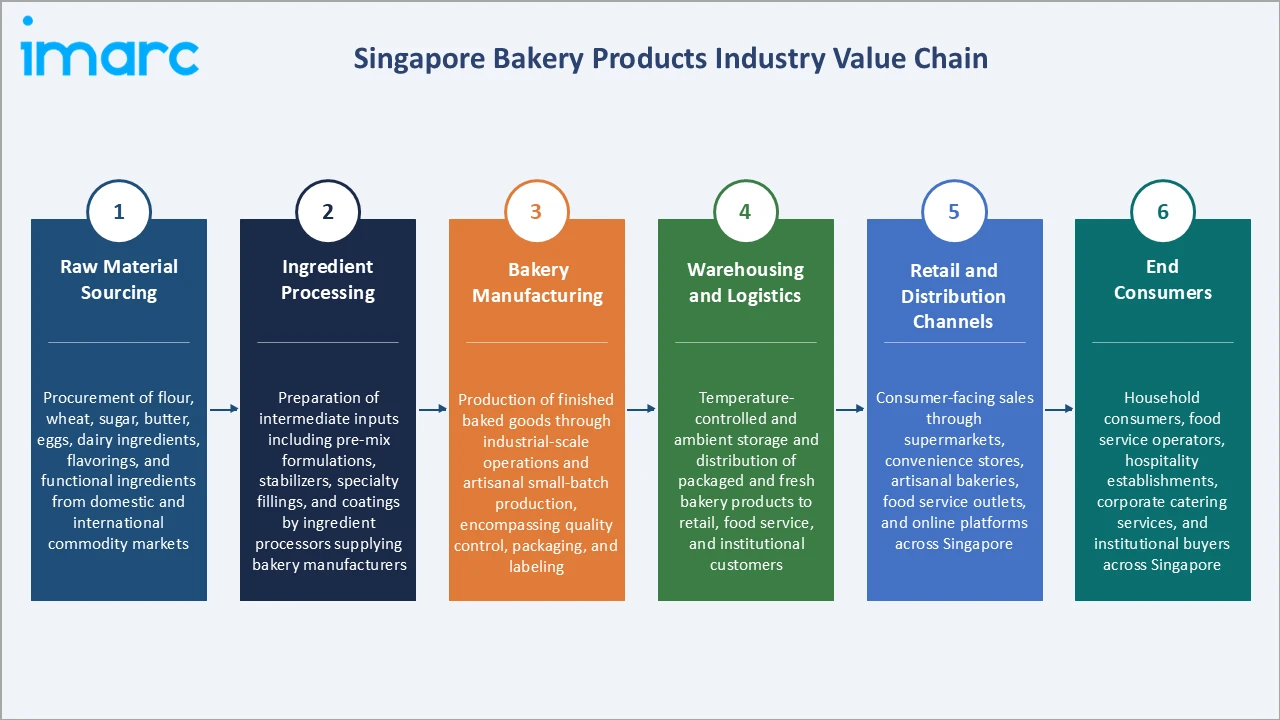
The Singapore bakery products value chain spans six integrated stages from raw material sourcing through the end consumer. The bakery manufacturing and production stage generates the highest value-addition, where product formulation, quality assurance, and brand differentiation create the most durable competitive advantages in the market.
| Stage | Description |
|---|---|
| Raw Material Sourcing | Procurement of flour, wheat, sugar, butter, eggs, dairy ingredients, flavorings, and functional ingredients from domestic and international commodity markets. |
| Ingredient Processing | Preparation of intermediate inputs including pre-mix formulations, stabilizers, specialty fillings, and coatings by ingredient processors supplying bakery manufacturers. |
| Bakery Manufacturing | Production of finished baked goods through industrial-scale operations and artisanal small-batch production, encompassing quality control, packaging, and labeling. |
| Warehousing and Logistics | Temperature-controlled and ambient storage and distribution of packaged and fresh bakery products to retail, food service, and institutional customers. |
| Retail and Distribution Channels | Consumer-facing sales through supermarkets, convenience stores, artisanal bakeries, food service outlets, and online platforms across Singapore. |
| End Consumers | Household consumers, food service operators, hospitality establishments, corporate catering services, and institutional buyers across Singapore. |
The manufacturing stage holds the greatest strategic significance in the value chain, as producers investing in product innovation, food safety certifications, and brand equity development establish long-term competitive advantages. Distribution channel integration is increasingly critical as digital and direct-to-consumer models reduce reliance on traditional retail intermediaries and enable producers to capture margin from distribution layers.
Technology Landscape in the Singapore Bakery Products Industry
Advanced Baking and Food Processing Technology
Industrial-scale automated baking lines with precision temperature control, humidity management, and conveyor systems enable high-volume production with consistent quality outcomes. Tunnel ovens, automated dough dividers, and continuous proofing systems are enabling bakery manufacturers to scale production while reducing labor costs. Artisanal producers are adopting deck ovens with digital control systems that replicate traditional baking techniques with reproducible precision.
Clean-Label and Functional Ingredient Innovation
Advances in food science enable reformulation of conventional bakery products with natural preservatives, plant-based functional ingredients, and alternative sweeteners meeting clean-label requirements. Enzymatic bread improvers, whole grain processing technologies, and naturally derived emulsifiers allow manufacturers to improve nutritional profiles without compromising sensory quality. These innovations support Healthier Choice Symbol qualification and premium positioning.
Digital Order Management and Delivery Technology
Technology integration across digital ordering platforms, automated order management systems, and last-mile cold-chain delivery enables bakery operators to serve direct-to-consumer channels efficiently. AI-powered demand forecasting reduces food waste by optimizing production volumes for perishable fresh bakery products. Real-time inventory management systems enable artisanal bakeries to manage multi-location operations with minimal central production overhead.
Smart Packaging and Product Traceability
Modified atmosphere packaging, active freshness indicators, and QR code-enabled ingredient traceability are becoming standard expectations in premium bakery categories. Smart packaging technologies extend shelf life, reduce food waste, and provide consumer digital engagement touchpoints. These technologies support premium brand positioning and meet transparency requirements from health-conscious Singapore consumers seeking verifiable ingredient and sourcing information.
Market Segmentation Analysis
The report covers the following segments:
| Segment Category | Leading Segment | Market Share | Year |
|---|---|---|---|
| Product Type | Biscuits | 34.8% | 2025 |
| Distribution Channel | Supermarkets and Hypermarkets | 28.6% | 2025 |
| Region | Central | 37.6% | 2025 |

By Product Type
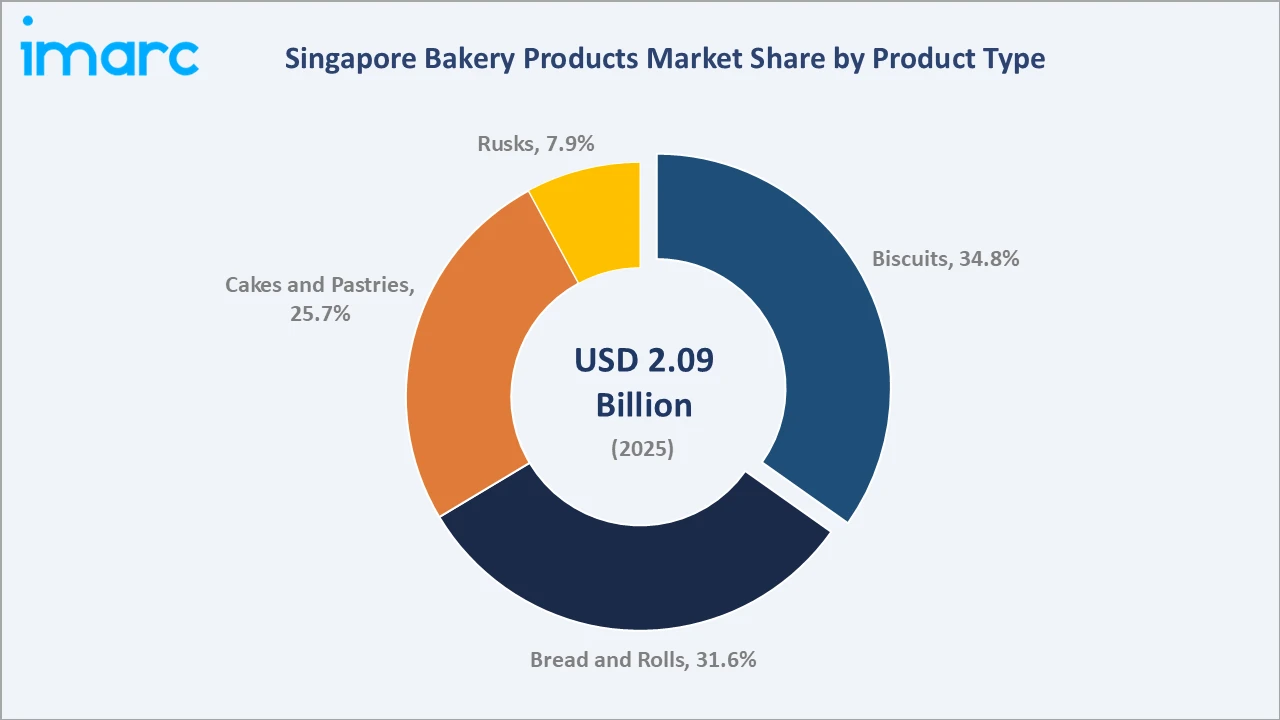
Biscuits lead with a 34.8% share in 2025, reflecting broad retail penetration, high purchase frequency, and strong brand presence across modern grocery and convenience channels. The segment encompasses cookies, cream biscuits, glucose biscuits, and cracker variants, with innovation concentrated in reduced-sugar, whole grain, and premium locally inspired flavors.
To access detailed market analysis, Request Sample
Bread and rolls at 31.6% remain a daily household essential, anchored by consistent demand for sandwich breads and specialty rolls in household and food service settings. Whole grain, multigrain, and fortified variants are the primary premium innovation frontiers. Cakes and pastries at 25.7% are the fastest-growing product type at 6.5% CAGR, driven by premiumization, occasion gifting, and artisanal patisserie expansion. Rusks at 7.9% serve a stable niche in health-snacking and infant nutrition applications.
By Distribution Channel
Supermarkets and hypermarkets dominate at 28.6% in 2025, providing the broadest product range from ambient packaged biscuits to chilled fresh-baked goods. Singapore's modern grocery network combines international supermarket chains with domestic operators, offering bakery brands unparalleled consumer access through high-frequency shopping occasions. Convenience stores at 22.4% capture impulse purchase demand across Singapore's extensive convenience retail network, one of the highest store-per-capita densities in Southeast Asia.
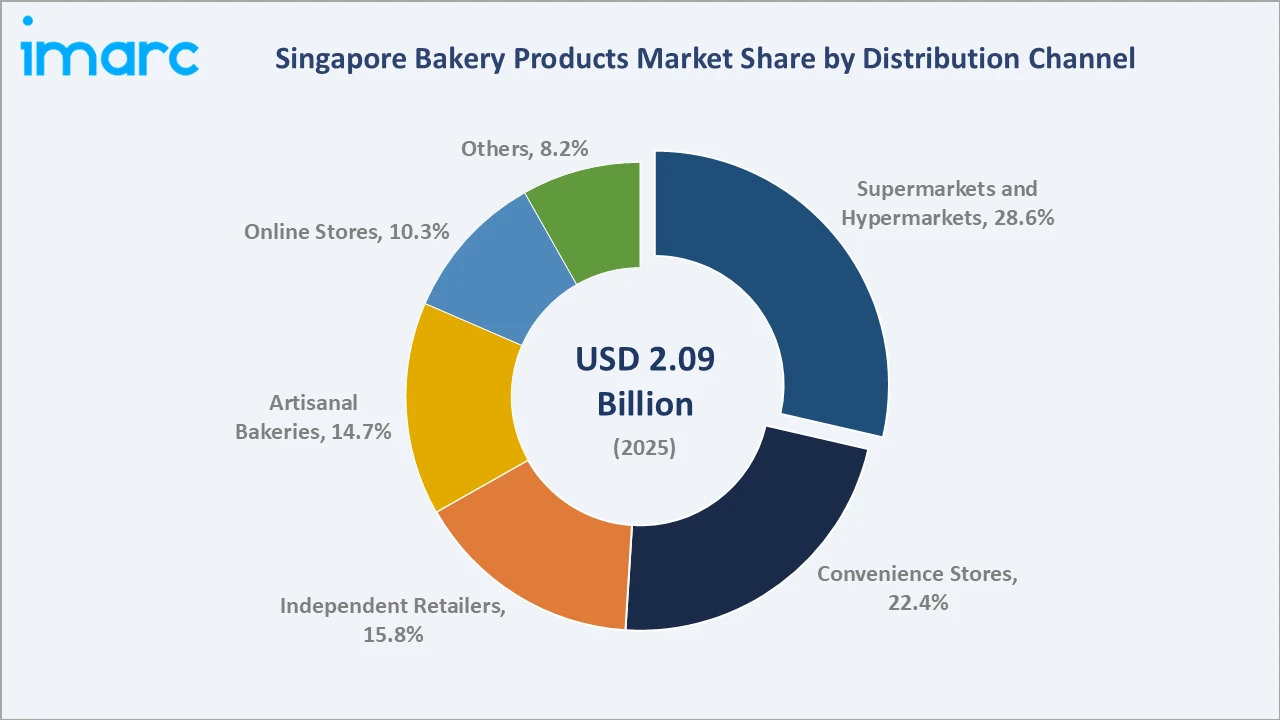
Independent retailers at 15.8% and artisanal bakeries at 14.7% together serve premium and neighborhood demand, with artisanal bakeries concentrated in central and affluent residential districts. Online stores at 10.3% represent the fastest-growing channel at 9.2% CAGR, driven by food delivery platform integration and direct-to-consumer digital storefronts. The others category at 8.2% encompasses hotel food service, corporate catering, and institutional supply channels.
Regional Market Insights
|
Region |
Share (2025) |
Key Drivers and Characteristics |
|
Central |
37.6% |
Highest commercial and tourist density, with strong demand from cafés, hotels, premium bakeries, and food service outlets. |
|
West |
22.8% |
Large residential population with established supermarket and convenience store networks supporting consistent household bakery demand across high-density housing estates. |
|
East |
15.9% |
Mixed-use development combining residential communities, airport catchment zones, and food-centric neighborhoods generating broad cross-format bakery demand. |
|
North-East |
13.8% |
Growing residential and commercial areas with increasing modern retail penetration supporting rising bakery consumption among a young urban consumer base. |
|
North |
9.9% |
Primarily residential, served by neighborhood supermarkets and convenience stores meeting everyday household bakery needs with standard product ranges. |
Central region holds the dominant regional share at 37.6% in 2025, driven by the highest concentration of premium retail bakeries, cafés, five-star hotels, and tourism-oriented food service venues in the country. West region accounts for 22.8% of the market in 2025, anchored by one of Singapore's largest residential population bases.
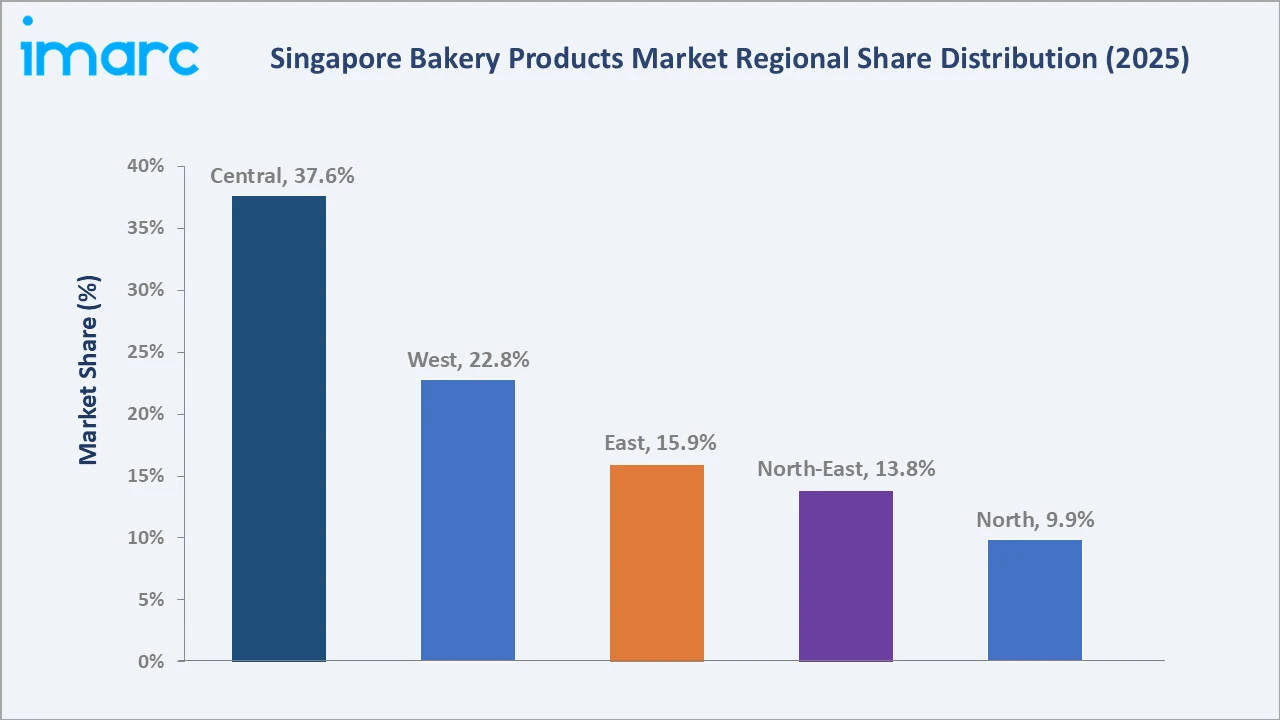
East region contributes 15.9% of market revenue in 2025, supported by diverse residential neighborhoods and food-centric communities. North-East region holds a 13.8% share in 2025 and represents a growing bakery demand zone due to residential and commercial developments. North region accounted for 9.9% of the market in 2025, the smallest regional share, primarily reflecting the area's predominantly residential character.
Competitive Landscape
The Singapore bakery products market features a moderately fragmented competitive structure, combining dominant domestic chain operators, multinational packaged goods companies, and a growing base of artisanal and premium independent producers. The market's compact geography and highly discerning consumer base create competitive dynamics that reward brand authenticity, product innovation, and multichannel distribution capability.
| Company | Key Brands | Market Position | Core Strength |
|---|---|---|---|
| QAF Limited | Gardenia, Bonjour | Market Leader | QAF Limited is a dominant manufacturer and distributor of bakery products in Singapore, operating automated production plants and managing leading consumer brands like Gardenia and Bonjour. |
| Bengawan Solo Pte Ltd | Bengawan Solo | Innovator | Bengawan Solo Pte Ltd defines the local confectionery market by mass-producing and retailing authentic cakes, pineapple tarts, and its iconic Pandan Chiffon cakes. |
| Swee Heng Bakery | Swee Heng | Established Player | Swee Heng Bakery is a pillar of Singapore’s heartland bakery scene, pioneering affordable, Halal-certified breads, pastries, and custom cakes. |
| Mondelēz International | BournVita, Oreo, Tiger, Triscuit | Established Player | Mondelēz International acts as a strategic regional hub and center of excellence for bakery and biscuit innovation in Singapore. |
| Polar Puffs & Cakes Pte. Ltd. | Polar Puffs & Cakes | Challenger | Polar Puffs & Cakes Pte. Ltd. is a historic homegrown Singaporean bakery that plays a major role as a heritage manufacturer and retailer of halal-certified artisanal puff pastries, chicken pies, sugar rolls, and celebration cakes. |
Multinational players compete primarily in the packaged biscuit segment with globally recognized brands, while artisanal and heritage operators serve premium and gifting demand segments with distinctive local product propositions.
Key Company Profiles
QAF Limited
QAF Limited is a Singapore-listed diversified food group with bakery manufacturing operations under the Gardenia brand, one of Singapore's most recognized bread producers. The group serves mass-market household and retail segments through extensive supermarket distribution.
- Key Brands: Gardenia, Bonjour.
- Strategic Focus: Strengthening mass-market bread distribution, expanding local flavor innovation across bread and roll formats, and improving production efficiency to maintain competitive retail pricing.
Bengawan Solo Pte Ltd
Bengawan Solo Pte Ltd is a homegrown Singapore confectionery and bakery company celebrated for its traditional Southeast Asian kueh, cakes, and pastries. The brand serves the local gifting market and food tourism segment, with outlets concentrated in central Singapore and retail locations.
- Key Brands: Bengawan Solo.
- Strategic Focus: Preserving Singapore's traditional confectionery heritage while capturing gifting and food tourism demand through premium product presentation and strategic placement in airport and tourist district retail locations.
Market Concentration Analysis
The Singapore bakery products market exhibits a moderately fragmented competitive structure, with a mix of established chain operators, multinational packaged goods companies, and a large base of independent artisanal bakeries and specialty confectionery producers. No single company commands a dominant majority share across all bakery product categories, reflecting the diversity of consumer preferences and the commercial viability of multiple competing formats from mass-market packaged biscuits to premium artisanal bakery chains.
The packaged biscuit and bread sub-segments are more consolidated, with established producers and internationally recognized brands holding significant shelf positions in modern grocery channels. Artisanal and specialty bakery sub-segments remain highly fragmented, presenting ongoing market entry opportunities for new producers with distinctive product propositions, strong local flavor credentials, or innovative digital distribution models that bypass traditional retail cost structures.
Investment & Growth Opportunities
Fastest Growing Segments
Cakes and pastries at 6.5% CAGR represent the fastest-growing product type, driven by occasion gifting culture, premiumization, and artisanal patisserie expansion. Online stores at 9.2% CAGR represent the fastest-growing distribution channel, supported by food delivery platform expansion, direct-to-consumer digital storefronts, and growing consumer comfort with purchasing fresh bakery products through digital channels.
Investment Themes
- Health and Functional Bakery Innovation: Consumer demand for nutritionally superior, clean-label, and functional bakery products presents a high-growth opportunity. Companies developing certified products, working with certified natural ingredient suppliers, and communicating transparent nutritional credentials are well positioned to capture premium pricing and a growing health-conscious consumer base.
- Asian Heritage and Fusion Flavor Products: Singapore's position as a globally recognized food innovation hub creates an opportunity to develop Asian-inspired bakery products for regional export markets. Singapore-origin brands can command premium positioning in Southeast Asian retail markets and among the Singaporean diaspora, supported by the country's food safety reputation and distinctive culinary identity.
Future Market Outlook (2026-2034)
The Singapore bakery products market grew from USD 2.09 Billion in 2025 to USD 2.21 Billion in 2026 and is projected to reach USD 3.50 Billion by 2034, exhibiting a CAGR of 5.75% during 2026-2034. The market is expected to reach approximately USD 2.77 Billion by 2030, as digital distribution channels reach scale, health-oriented product penetration deepens, and premium bakery categories expand across Singapore's growing base of affluent consumers.
Three structural forces will define the Singapore bakery products market through 2034. First, the progressive shift toward health and wellness-oriented bakery consumption will drive reformulation investment and create a durable premium sub-segment for functional, clean-label, and nutritionally enhanced products. Second, accelerating growth of digital and direct-to-consumer channels will reshape competitive dynamics by enabling new-format operators to scale without legacy retail cost structures, intensifying competition from digitally native bakery brands. Third, Singapore's deepening food culture will sustain above-average demand growth for premium artisanal and occasion bakery products that command higher unit values through 2034.
Research Methodology
Primary Research
Primary research included structured consultations with bakery manufacturing executives, food retail procurement managers, artisanal bakery operators, food delivery platform representatives, and food industry association officials. These engagements validated market sizing estimates, verified segment share data, assessed competitive dynamics, and provided qualitative insights into consumer behavior trends and channel development strategies across the Singapore bakery products market.
Secondary Research
Secondary research drew upon Singapore Food Agency data, Singapore Tourism Board statistics, company annual reports and investor presentations, industry association publications, food retail trade media, and academic research on consumer food behavior. Historical market data spanning 2020 through 2025 was cross-validated across primary and secondary sources to ensure accuracy and consistency.
Forecasting Models
Market forecasts were developed using bottom-up and top-down modeling approaches incorporating historical consumption growth rates, channel expansion projections, demographic and income growth drivers, product innovation pipeline analysis, competitive capacity investment data, and macroeconomic indicators including Singapore GDP growth and household food expenditure benchmarks through 2034.
Singapore Bakery Products Market Report Scope:
| Report Features | Details |
|---|---|
| Base Year of the Analysis | 2025 |
| Historical Period | 2020-2025 |
| Forecast Period | 2026-2034 |
| Units | Billion USD |
| Scope of the Report |
Exploration of Historical Trends and Market Outlook, Industry Catalysts and Challenges, Segment-Wise Historical and Future Market Assessment:
|
| Product Types Covered |
|
| Distribution Channels Covered | Convenience Stores, Supermarkets and Hypermarkets, Independent Retailers, Artisanal Bakeries, Online Stores, Others |
| Regions Covered | North-East, Central, West, East, North |
| Companies Covered | QAF Limited, Bengawan Solo Pte Ltd, Swee Heng Bakery, Mondelēz International, Polar Puffs & Cakes Pte. Ltd., etc. |
| Customization Scope | 10% Free Customization |
| Post-Sale Analyst Support | 10-12 Weeks |
| Delivery Format | PDF and Excel through Email (We can also provide the editable version of the report in PPT/Word format on special request) |
Key Benefits for Stakeholders:
- IMARC’s report offers a comprehensive quantitative analysis of various market segments, historical and current market trends, market forecasts, and dynamics of the Singapore bakery products market from 2020-2034.
- The research study provides the latest information on the market drivers, challenges, and opportunities in the Singapore bakery products market.
- Porter's Five Forces analysis assists stakeholders in assessing the impact of new entrants, competitive rivalry, supplier power, buyer power, and the threat of substitution. It helps stakeholders to analyze the level of competition within the Singapore bakery products industry and its attractiveness.
- Competitive landscape allows stakeholders to understand their competitive environment and provides an insight into the current positions of key players in the market.
Frequently Asked Questions About the Singapore Bakery Products Market Report
The Singapore bakery products market reached USD 2.21 Billion in 2026, driven by growing health-conscious consumption, café culture expansion, and premiumization across biscuits, pastries, and bread categories.
The market is projected to grow at a CAGR of 5.75% during 2026-2034, supported by health and wellness product trends, digital channel expansion, and rising demand for premium artisanal bakery products.
The market is projected to reach approximately USD 2.77 Billion by 2030, driven by online distribution growth, health-oriented product innovation, and steady premiumization across bakery categories.
Biscuits lead with a 34.8% share in 2025, reflecting broad retail penetration, strong brand presence, and high purchase frequency across modern grocery and convenience store channels.
Supermarkets and hypermarkets lead with a 28.6% share in 2025, anchored by Singapore's dense modern retail network and extensive ambient and chilled bakery product sections.
Central Singapore leads with a 37.6% share in 2025, reflecting the highest commercial, tourist, and residential density with strong demand from cafés, hotels, and premium retail outlets.
Key players include QAF Limited, Bengawan Solo Pte Ltd, Swee Heng Bakery, Mondelēz International, and Polar Puffs & Cakes Pte. Ltd., among others.
The market is projected to reach USD 3.50 Billion by 2034, supported by sustained consumer demand, digital channel maturation, and ongoing health and premium bakery product innovation.
Need more help?
- Speak to our experienced analysts for insights on the current market scenarios.
- Include additional segments and countries to customize the report as per your requirement.
- Gain an unparalleled competitive advantage in your domain by understanding how to utilize the report and positively impacting your operations and revenue.
- For further assistance, please connect with our analysts.
 Request Customization
 Speak to an Analyst
 Request Brochure
 Inquire Before Buying
Benefits of Customization
- Personalize this research
- Triangulate with your data
- Get data as per your format and definition
- Gain a deeper dive into a specific application, geography, customer, or competitor
- Any level of personalization
Get in Touch With Us
UNITED STATES
Phone: +1-201-971-6302
INDIA
Phone: +91-120-433-0800
UNITED KINGDOM
Phone: +44-753-714-6104
Email: [email protected]
Client Testimonials






















Related Reports

Choose your plan
*Please note that the prices mentioned below are starting prices for each bundle type. Kindly contact our team for further details.*
Single User License
- 1 User License, Access on 2 Devices
- PDF Report + Excel Dataset (Password Protected)
- Lifetime Access
- No Printing Rights
- 10% Free Report Customization
- 10–12 Weeks of Analyst Support
Five User License
- Access for 5 Users, 2 Devices per User
- PDF Report + Excel Dataset (Password Protected)
- Lifetime Access
- Dedicated Account Manager
- 12–14 Weeks of Analyst Support
- No Printing Rights
- 15% Free Report Customization
- 25% Discount on Your Next Purchase
Corporate User License
- Unlimited User Access (Within Your Organization)
- PDF Report + Excel Dataset
- Lifetime Access
- Dedicated Account Manager
- 14–20 Weeks of Analyst Support
- No Printing Rights
- 20% Free Report Customization
- 30% Discount on Your Next Purchase
Essential Insights
What's included:
3 reports
- Lifetime Access
- PDF Reports
- Excel Datasets
- 2 Weeks of Free Analyst Support
- 2 User Licenses
- Access on 2 Devices
- Printing Rights
- Complimentary PowerPoint (PPT) Version
- Complimentary License Upgrade
Professional Access
What's included:
5 reports
- Lifetime Access
- PDF Reports
- Excel Datasets
- 8 Weeks of Free Analyst Support
- 2 User Licenses
- Access on 2 Devices
- Printing Rights
- Complimentary PowerPoint (PPT) Version
- Complimentary License Upgrade
Business Advantage
What's included:
8 reports
- Lifetime Access
- PDF Reports
- Excel Datasets
- 14 Weeks of Free Analyst Support
- 2 User Licenses
- Access on 2 Devices
- Printing Rights
- Complimentary PowerPoint (PPT) Version
- Complimentary License Upgrade
Enterprise Intelligence
What's included:
10 reports
- Lifetime Access
- PDF Reports
- Excel Datasets
- 20 Weeks of Free Analyst Support
- 2 User Licenses
- Access on 2 Devices
- Printing Rights
- Complimentary PowerPoint (PPT) Version
- Complimentary License Upgrade