
South East Asia Cloud Migration Services Market Size, Share, Trends and Forecast by Service Type, Enterprise Size, Deployment Mode, Application, Industry Vertical, and Country, 2026-2034
South East Asia Cloud Migration Services Market Size, Share, Trends & Forecast (2026-2034)
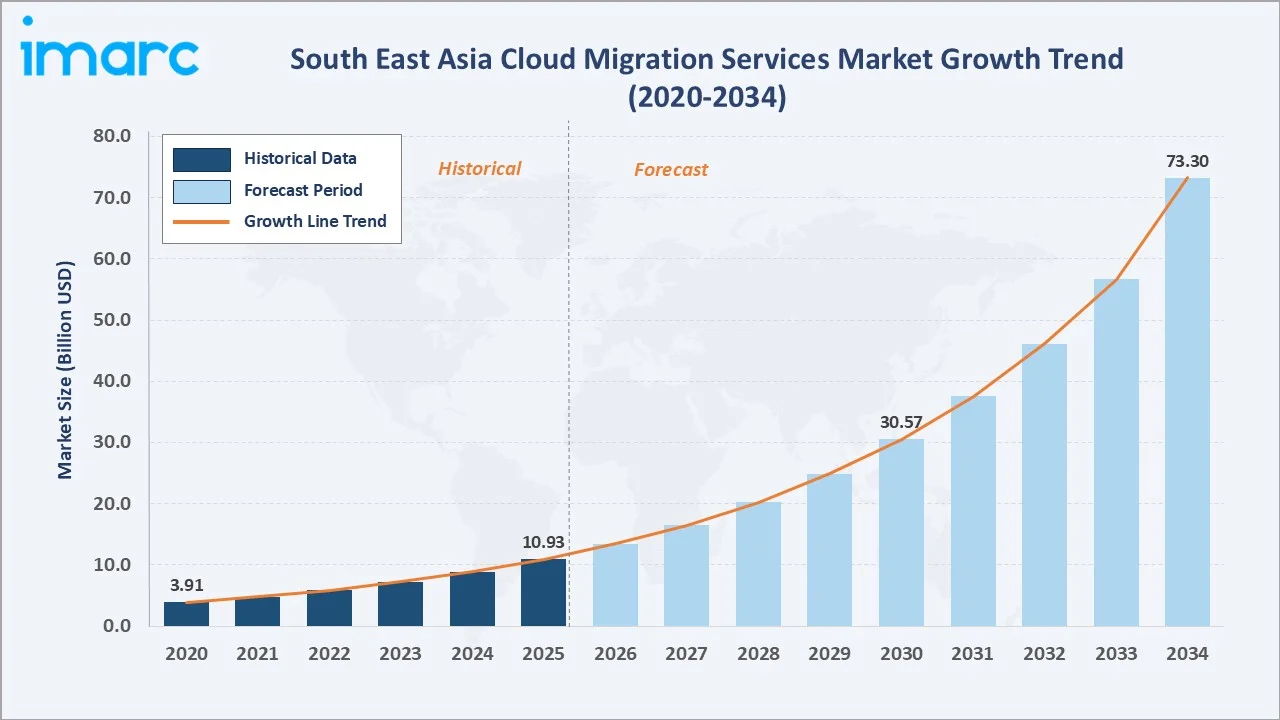
The South East Asia cloud migration services market reached USD 10.93 Billion in 2025 and is projected to reach USD 73.30 Billion by 2034, growing at a CAGR of 22.84% during 2026-2034. The market is driven by growing concerns about data security and compliance, rising utilization in telehealth services, and increasing strategic partnerships between service providers and local information technology firms.
The Managed Services segment from the service type breakup dominates at 55.8%. Large Enterprises lead the enterprise size breakup at 57.3%. Singapore commands 24.7% of the national market share.
Market Snapshot
|
Metric |
Value |
|
Market Size (2025) |
USD 10.93 Billion |
|
Forecast Market Size (2034) |
USD 73.30 Billion |
|
CAGR (2026-2034) |
22.84% |
|
Base Year |
2025 |
|
Historical Period |
2020-2025 |
|
Forecast Period |
2026-2034 |
|
Dominant Service Type |
Managed Services (55.8%, 2025) |
|
Dominant Enterprise Size |
Large Enterprises (57.3%, 2025) |
|
Leading Country |
Singapore (24.7%, 2025) |
The market expanded from USD 3.91 Billion in 2020 to USD 10.93 Billion in 2025 - growing by nearly 180% in five years - anchored at USD 30.57 Billion in 2030 and forecast to reach USD 73.30 Billion by 2034. The COVID-19 pandemic accelerated digital transformation initiatives across the region as remote work adoption drove urgent cloud infrastructure investment, a trend that has continued to compound through the historical period.
To get more information on this market, Request Sample
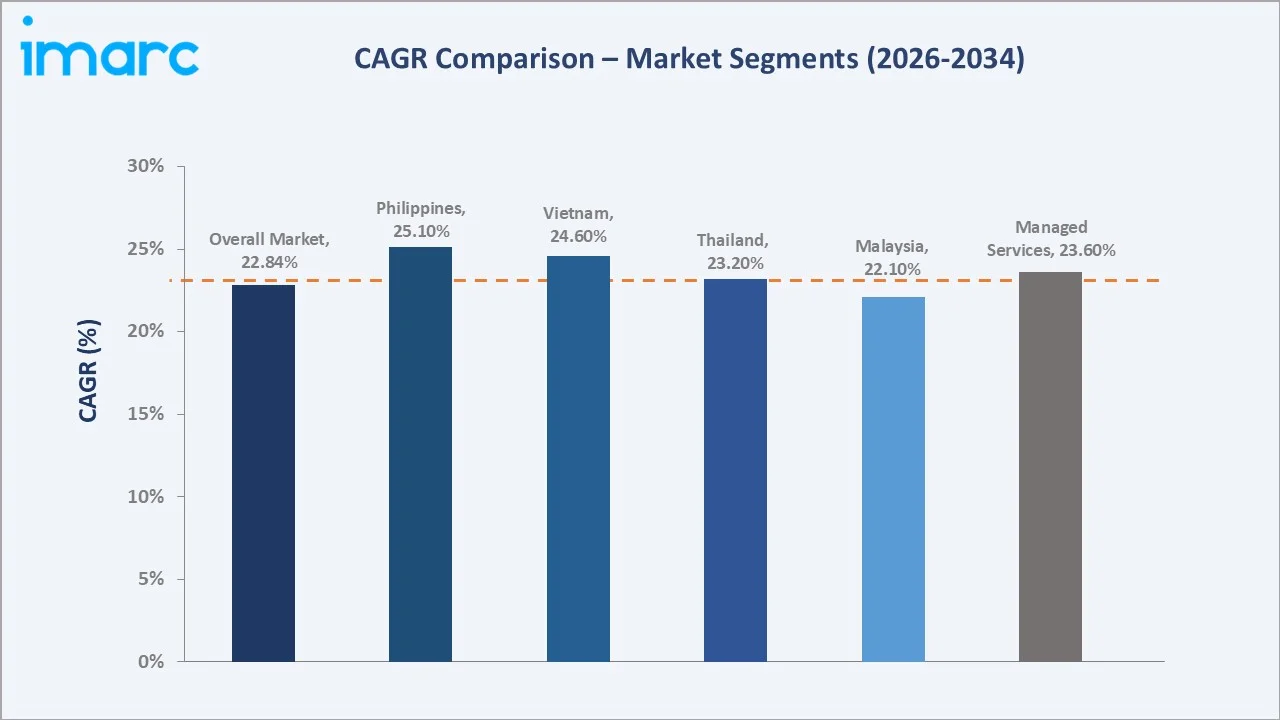
The Philippines grows fastest at approximately 25.1% CAGR as enterprises accelerate digital infrastructure investment from a smaller base. Managed Services grows at approximately 23.6% CAGR as organizations increasingly outsource ongoing cloud operations and optimization to specialized providers.
Executive Summary
The South East Asia cloud migration services market reached USD 10.93 Billion in 2025, representing one of the region's fastest-growing technology services segments, driven by the structural shift toward cloud-based IT infrastructure across enterprises of all sizes. Cloud migration services enable organizations to transfer data, applications, and workloads from on-premises systems to cloud environments, providing improved scalability, cost efficiency, and disaster recovery capabilities. The market is projected to reach USD 73.30 Billion by 2034.
The Managed Services segment at 55.8% dominates by capturing ongoing operational support, monitoring, and optimization services that organizations increasingly outsource post-migration. Large Enterprises at 57.3% lead through their greater IT budgets, more complex legacy infrastructure requiring migration, and stronger regulatory compliance requirements driving structured migration engagements. Singapore at 24.7% leads nationally through its advanced digital infrastructure, concentration of regional headquarters, and position as South East Asia's leading financial and technology hub.
Key Market Insights
|
Insight |
Data |
|
Dominant Service Type |
Managed Services - 55.8% share (2025) |
|
Dominant Enterprise Size |
Large Enterprises - 57.3% market share (2025) |
|
Leading Country |
Singapore - 24.7% market share (2025) |
|
Market Opportunity |
AI/ML workload migration; telehealth cloud adoption; hybrid and multi-cloud strategies; SME cloud adoption acceleration; local IT partnership expansion |
Key Analytical Observations Supporting the Above Data:
- Managed Services at 55.8%: The Managed Services segment dominates as enterprises increasingly outsource ongoing cloud operations, monitoring, and optimization to specialized providers following initial migration, reducing the burden on internal IT teams. Its recurring revenue structure and expanding scope covering security, performance tuning, and cost optimization further reinforce segment demand. Continued growth in multi-cloud complexity is sustaining long-term managed service engagement across enterprise customers.
- Large Enterprises at 57.3%: The Large Enterprises segment dominates due to greater IT budgets, more complex legacy infrastructure requiring migration, and stronger regulatory compliance requirements driving structured, well-resourced migration engagements. With regional digital transformation initiatives continuing to expand, large enterprise cloud spending is generating substantial and sustained demand for migration and managed services. Multinational corporations with regional headquarters in South East Asia are further expanding cloud infrastructure investment across the market.
- Singapore at 24.7%: Singapore dominates the cloud migration services market due to its advanced digital infrastructure, concentration of regional corporate headquarters, and position as South East Asia's leading financial and technology hub. Strong government support for digital transformation and a mature regulatory framework for data governance are generating substantial demand for advanced cloud migration and managed services across the country.
South East Asia Cloud Migration Services Market Overview
The South East Asia cloud migration services market encompasses the planning, assessment, and execution of transferring organizational data, applications, and workloads from on-premises infrastructure to cloud-based environments, spanning rehosting, replatforming, and refactoring approaches deployed across public, private, and hybrid cloud deployment models.
The ecosystem integrates hyperscale cloud providers, managed and professional service firms, system integrators, local IT partners, and regulatory bodies overseeing data protection compliance. Macroeconomic factors include rising digital transformation investment, expanding e-commerce and fintech sectors, and continued government support for regional digital infrastructure.
Market Dynamics
To evaluate market opportunities, Request Sample
Market Drivers
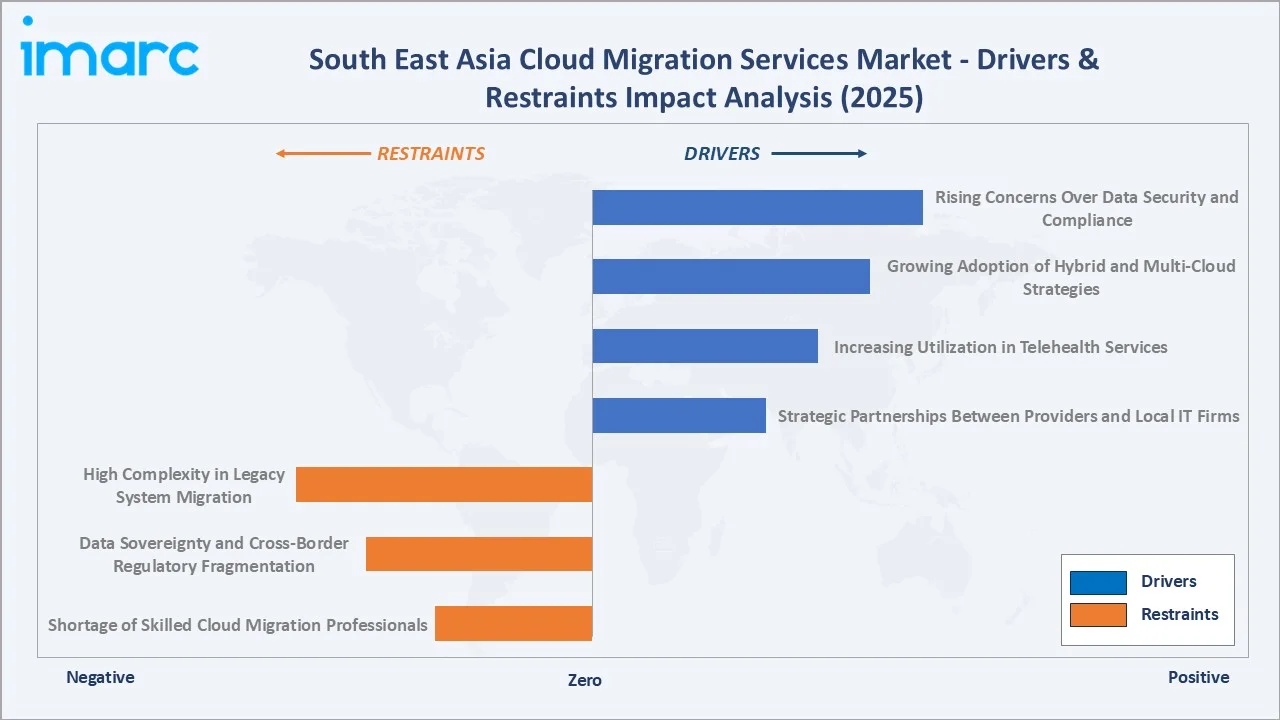
- Rising Concerns Over Data Security and Compliance: Growing concerns about data security and regulatory compliance across South East Asia are encouraging cloud migration service providers to offer robust security measures and compliance certifications tailored to regional requirements. This heightened focus on security is translating into higher demand for professional migration services that can navigate complex regulatory frameworks across multiple jurisdictions, widening the addressable market for compliance-focused expertise.
- Growing Adoption of Hybrid and Multi-Cloud Strategies: The increasing adoption of hybrid and multi-cloud strategies by businesses to balance on-premises and cloud-based infrastructure while avoiding vendor lock-in is driving sustained demand for migration and integration services. Enterprises are increasingly seeking providers capable of seamlessly integrating multiple cloud platforms to optimize workloads and improve resilience, generating consistent demand for specialized migration expertise.
- Increasing Utilization in Telehealth Services: The rising use of cloud-based telehealth services to enable remote consultations and improve healthcare access in remote areas is driving cloud migration demand across the healthcare sector. Electronic health record systems increasingly require secure, accessible cloud infrastructure to support remote patient care, a demand expected to sustain migration services growth well beyond the current forecast period.
- Strategic Partnerships Between Providers and Local IT Firms: Growing strategic partnerships and alliances between global cloud service providers and local IT firms are enabling regional businesses to access wider migration expertise and accelerate digital transformation. These partnerships are widening service availability beyond major metro markets, encouraging investment in cloud adoption and positioning alliance-building as a durable structural growth driver.
Market Restraints
- High Complexity in Legacy System Migration: The technical complexity of migrating deeply embedded legacy systems limits the pace of cloud adoption among organizations operating on outdated infrastructure across the region. This complexity barrier is particularly pronounced among established enterprises with decades of accumulated custom systems, causing migration timelines and costs to exceed those of younger, cloud-native businesses.
- Data Sovereignty and Cross-Border Regulatory Fragmentation: Varying data sovereignty requirements and regulatory frameworks across South East Asian countries constrain seamless cross-border cloud deployment and complicate multi-country migration projects. This fragmentation creates a structural bottleneck limiting the pace of multinational migration projects, requiring sustained investment in region-specific compliance expertise.
- Shortage of Skilled Cloud Migration Professionals: A limited pool of trained cloud architects and migration specialists across South East Asia constrains project delivery capacity and extends implementation timelines for enterprise customers. This talent shortage creates meaningful capacity constraints for both global providers and local system integrators, extending project timelines and raising service costs across the industry.
Market Opportunities
- AI and Machine Learning Workload Migration: The growing enterprise adoption of AI and machine learning workloads is creating substantial demand for cloud migration services optimized for high-performance computing and data-intensive applications. Organizations across the region are increasingly seeking cloud infrastructure capable of supporting advanced analytics and AI model training at scale, positioning specialized providers to capture incremental demand.
- SME Cloud Adoption Acceleration: Rising cloud adoption among small and medium-sized enterprises, supported by increasingly accessible pay-as-you-go pricing models, represents a substantial growth opportunity for migration service providers. This shift is particularly relevant as SMEs across the region seek to modernize IT infrastructure without significant upfront capital investment, favoring providers with simplified, cost-effective packages.
Market Challenges
- Intensifying Price Competition Among Providers: The growing number of global and regional cloud migration service providers is intensifying price competition, particularly for standardized rehosting projects with limited differentiation. This dynamic is compressing margins for providers while expanding market access for price-sensitive SME customers, making the balance of pricing and expertise investment an ongoing challenge.
- Post-Migration Cost Overrun Management: Enterprises frequently encounter unexpected post-migration cloud costs due to inadequate workload optimization, creating client satisfaction challenges for service providers. This challenge is prompting providers to invest more heavily in cost governance and optimization tooling, making total cost of ownership management an important competitive differentiator.
Emerging Market Trends
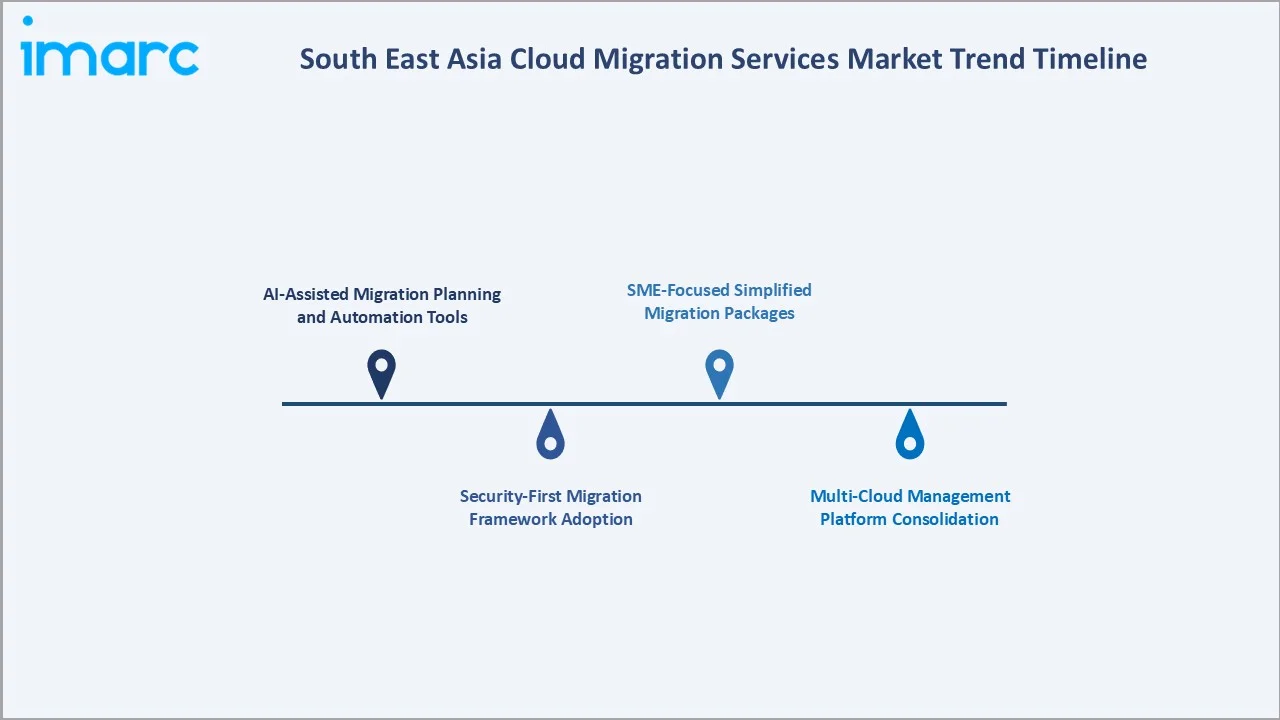
1. AI-Assisted Migration Planning and Automation Tools
Artificial intelligence integration into migration planning platforms is enabling automated application dependency mapping and workload assessment, reducing manual effort and improving migration accuracy. Leading regional system integrators are expanding AI-assisted migration tooling to accelerate project timelines for enterprise customers. This technology is expected to become a standard feature across premium managed service offerings as adoption accumulates over the forecast period.
2. Security-First Migration Framework Adoption
Security-first migration frameworks are emerging as organizations prioritize compliance and data protection throughout the migration lifecycle rather than as a post-migration consideration. This design shift can enhance regulatory compliance, reduce breach risk, and simplify audit processes for enterprise customers. As providers expand validated security-first methodologies, wider adoption is expected across both large enterprises and regulated industries.
3. Multi-Cloud Management Platform Consolidation
Multi-cloud management platforms are consolidating fragmented cloud environments into unified operational dashboards, offering enhanced visibility and reduced administrative overhead for enterprises operating across multiple providers. These platforms can improve cost governance and enable more consistent security policy enforcement across cloud environments. As development matures, multi-cloud management adoption is expected to gain traction among large regional enterprises.
4. SME-Focused Simplified Migration Packages
Simplified, packaged migration offerings tailored to small and medium-sized enterprises are gaining prominence as providers seek to capture the region's large underserved SME customer base. Their rapid expansion creates new procurement opportunities for standardized, cost-efficient migration services tailored to lower-complexity IT environments. As providers expand SME-focused offerings, service providers benefit from a broadening customer base beyond traditional large enterprise channels.
Industry Value Chain Analysis
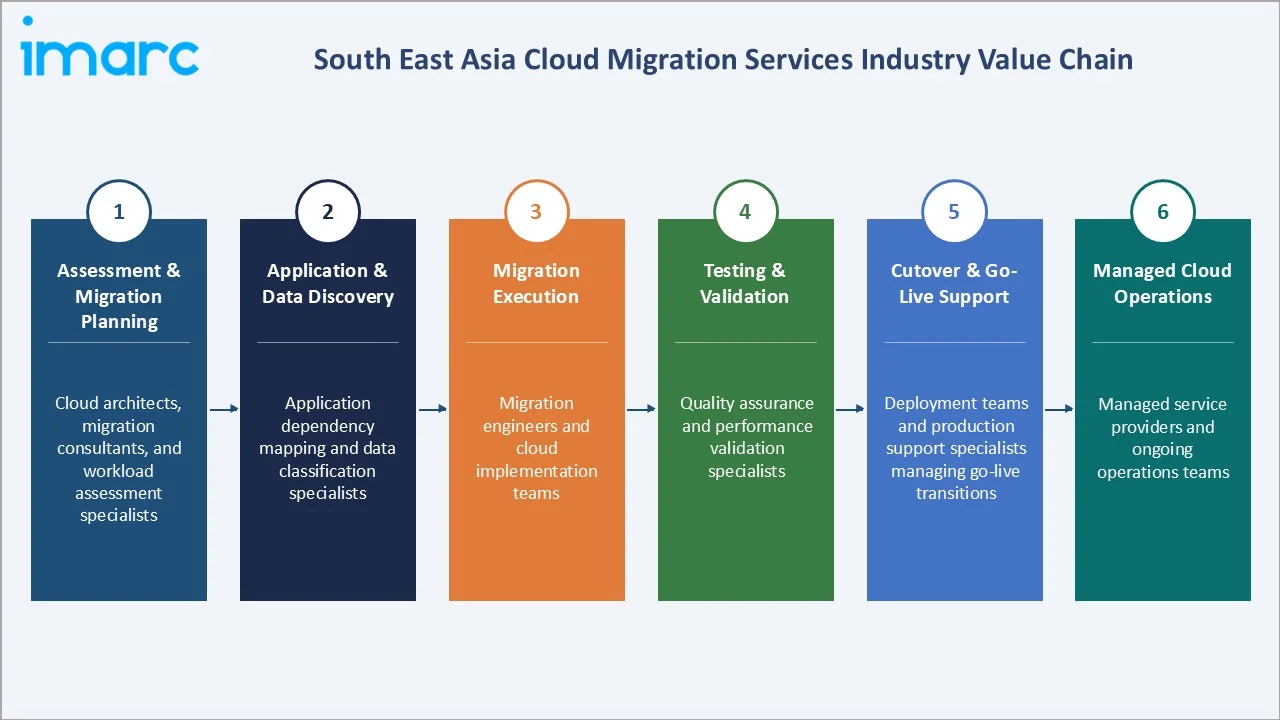
The South East Asia cloud migration services value chain integrates assessment and migration planning, application and data discovery, migration execution, testing and validation, cutover and go-live support, and managed cloud operations. The value chain's commercial architecture is anchored around enterprise procurement cycles, with system integrators and local IT partners playing an increasingly important role in supporting delivery capacity across the region.
|
Stage |
Key Participants |
|
Assessment & Migration Planning |
Cloud architects, migration consultants, and workload assessment specialists |
|
Application & Data Discovery |
Application dependency mapping and data classification specialists |
|
Migration Execution |
Migration engineers and cloud implementation teams |
|
Testing & Validation |
Quality assurance and performance validation specialists |
|
Cutover & Go-Live Support |
Deployment teams and production support specialists |
|
Managed Cloud Operations |
Managed service providers and ongoing operations teams |
The migration execution stage remains the value chain's most technically demanding segment, requiring specialized engineering expertise across diverse legacy environments. The managed cloud operations stage is experiencing growing importance as enterprises increasingly outsource ongoing optimization to specialized providers rather than internal IT teams.
Technology Landscape in the South East Asia Cloud Migration Services Industry
Automated Migration Assessment Platforms
Automated migration assessment platforms offer comprehensive application dependency mapping and workload profiling, enabling more accurate migration planning and reduced project risk. These platforms support improved cost estimation and timeline forecasting, making them the preferred choice for leading enterprise migration engagements. Their widespread adoption is accelerating replacement demand for manual, spreadsheet-based assessment approaches across the region.
Hybrid and Multi-Cloud Orchestration Technology
Hybrid and multi-cloud orchestration technology offers enhanced workload portability, unified management, and vendor flexibility compared to single-cloud deployments. These platforms provide reliable performance across public, private, and hybrid cloud environments, supporting their broad adoption among large enterprises with complex regulatory and operational requirements across South East Asia.
AI-Integrated Migration Automation Tools
Numerous leading regional system integrators expanded pilot programs for AI-assisted migration planning aimed at improving project accuracy and reducing manual assessment effort. These tools use machine learning algorithms trained on large migration project datasets to flag dependency risks and optimization opportunities in real time, supporting migration teams in reducing project overruns. Continued validation is expected to drive broader adoption of AI-integrated migration automation across premium and mid-tier service offerings.
Market Segmentation Analysis
The report covers the following segments:
|
Segment Category |
Leading Segment |
Market Share |
Year |
|
Service Type |
Managed Services |
55.8% |
2025 |
|
Enterprise Size |
Large Enterprises |
57.3% |
2025 |
|
Deployment Mode |
🔒 |
🔒 |
2025 |
|
Application |
🔒 |
🔒 |
2025 |
|
Industry Vertical |
🔒 |
🔒 |
2025 |
|
Country |
Singapore |
24.7% |
2025 |

By Service Type
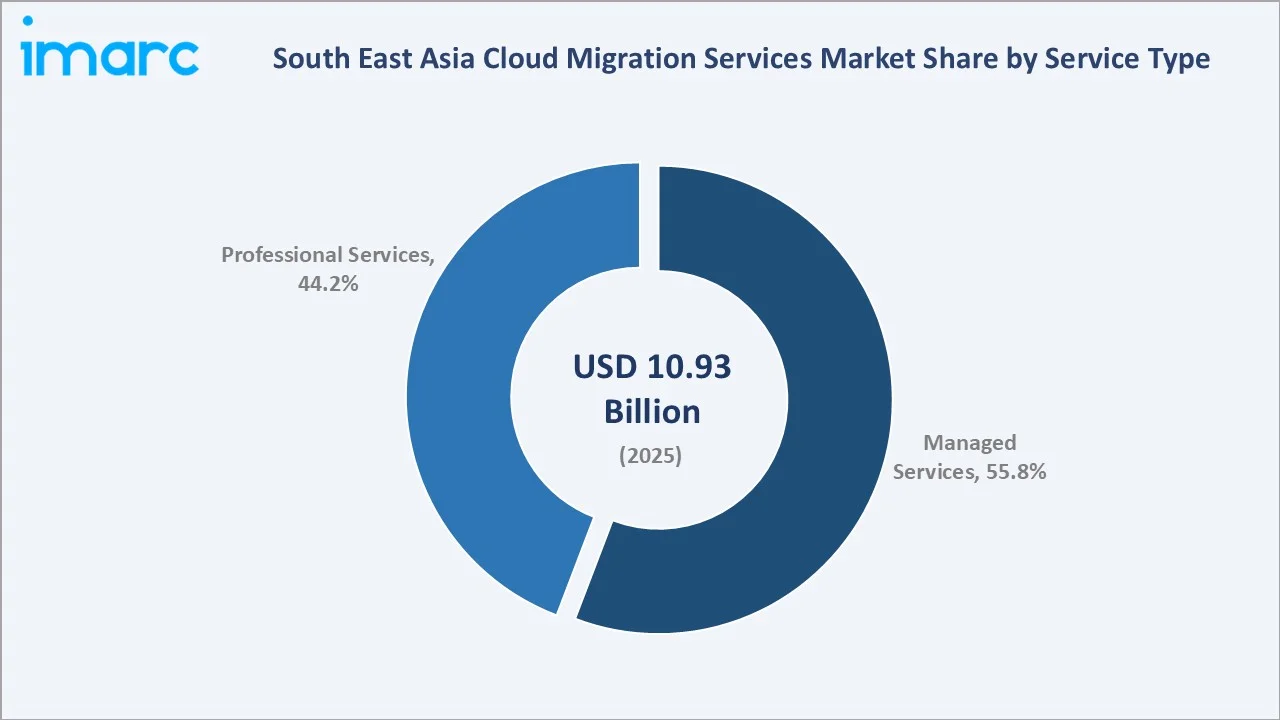
The Managed Services segment leads at 55.8% in 2025, encompassing ongoing operational support, monitoring, and optimization services, the most commercially significant and highest-revenue service category in the South East Asia cloud migration services market.
To access detailed market analysis, Request Sample
Professional Services at 44.2% capture project-based assessment, planning, and migration execution engagements. These services typically represent the initial engagement phase before organizations transition to ongoing managed service relationships as their cloud environments mature and stabilize.
By Enterprise Size
Large Enterprises dominate enterprise size at 57.3%, reflecting their greater IT budgets, more complex legacy infrastructure requiring migration, and stronger regulatory compliance requirements driving structured engagements.
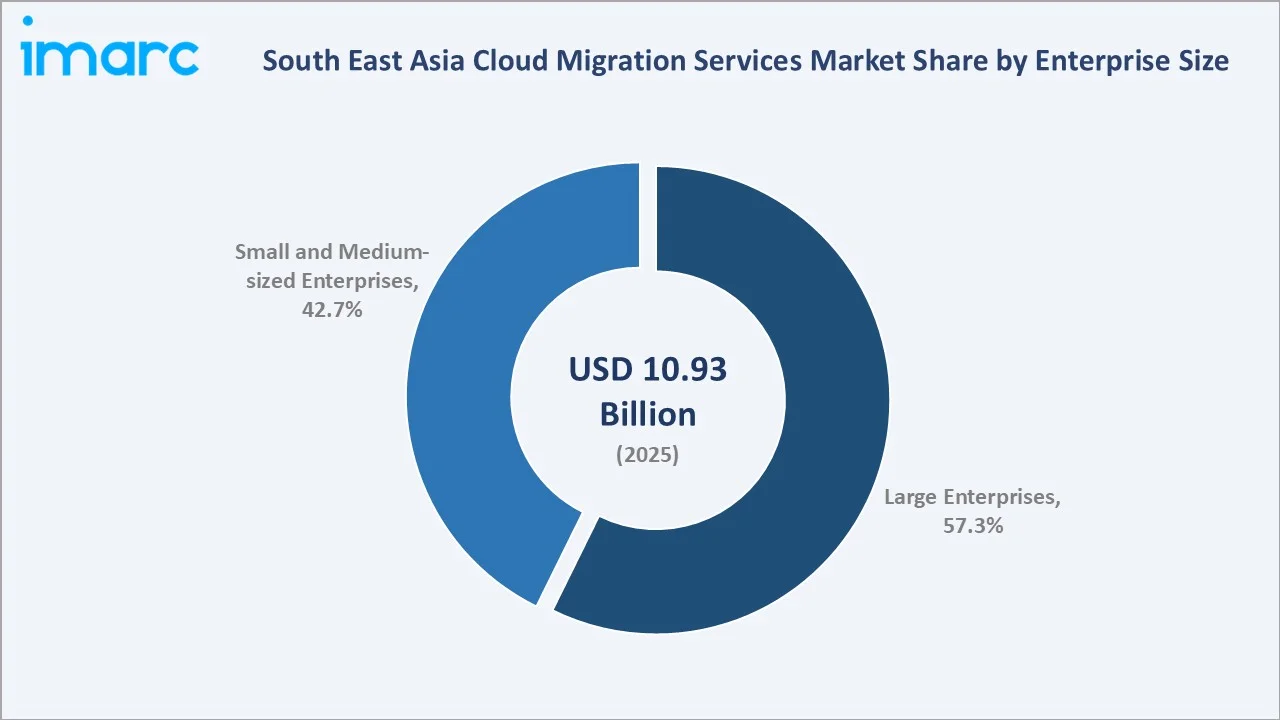
Small and Medium-sized Enterprises account for 42.7%, gaining share as pay-as-you-go pricing models and simplified migration packages lower barriers to cloud adoption. This segment is expected to grow steadily as digital transformation extends beyond large corporate customers across the region.
Regional Market Insights
|
Country |
Share (2025) |
Key Market Drivers & Characteristics |
|
Singapore |
24.7% |
Driven by advanced digital infrastructure, regional corporate headquarters concentration, and mature data governance regulatory framework |
|
Indonesia |
22.8% |
Driven by rapid digital economy expansion, growing e-commerce sector, and rising enterprise IT modernization investment |
|
Malaysia |
15.6% |
Supported by government-led digital transformation initiatives and expanding financial services cloud adoption |
|
Thailand |
13.8% |
Driven by growing manufacturing and retail sector cloud adoption and expanding regional data center investment |
|
Vietnam |
10.9% |
Emerging with strong technology sector growth and increasing foreign direct investment in digital infrastructure |
|
Philippines |
8.1% |
Supported by expanding business process outsourcing sector demand for scalable cloud infrastructure |
|
Others |
4.1% |
Includes remaining South East Asian markets with developing cloud infrastructure and gradual digital adoption |
Singapore, at 24.7%, leads through its advanced digital infrastructure and concentration of regional corporate headquarters. Indonesia, at 22.8%, reflects rapid digital economy expansion and rising enterprise IT modernization investment across the country's growing consumer and business markets.
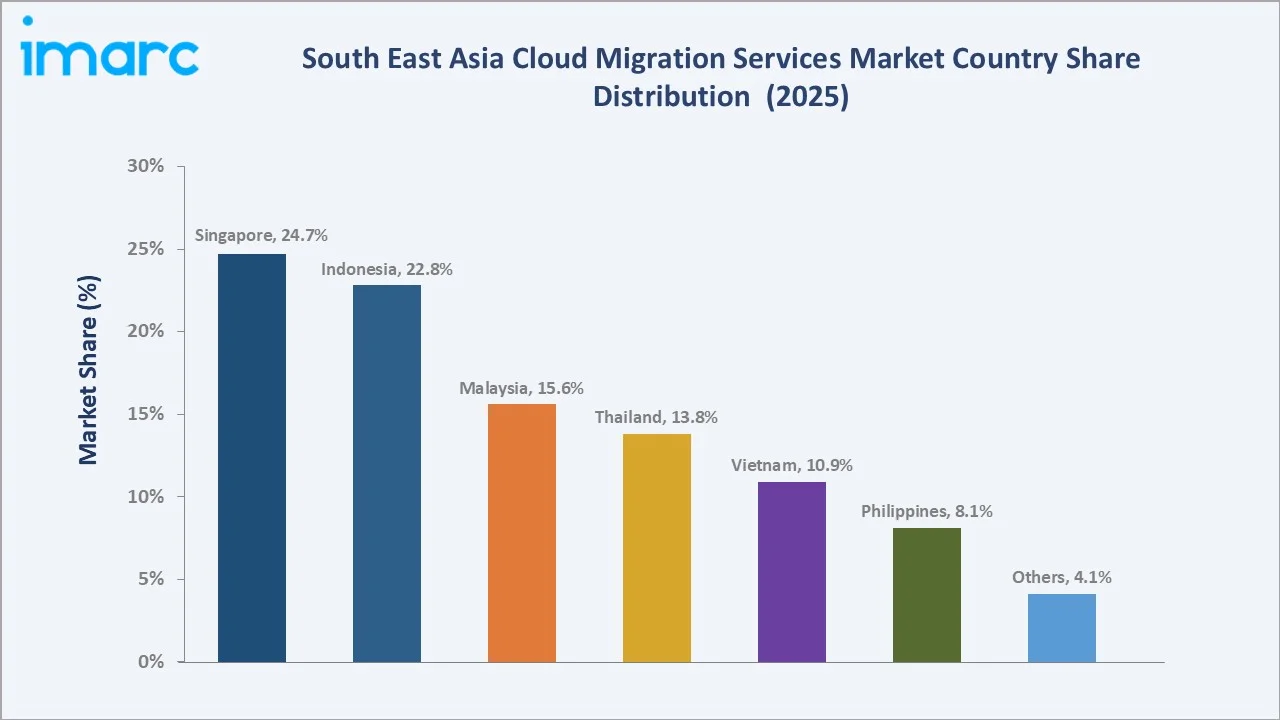
Malaysia, at 15.6%, benefits from government-led digital transformation initiatives and expanding financial services adoption. Thailand, Vietnam, and the Philippines collectively represent emerging markets as regional data center investment and foreign direct investment continue to expand digital infrastructure access across underserved segments.
Competitive Landscape
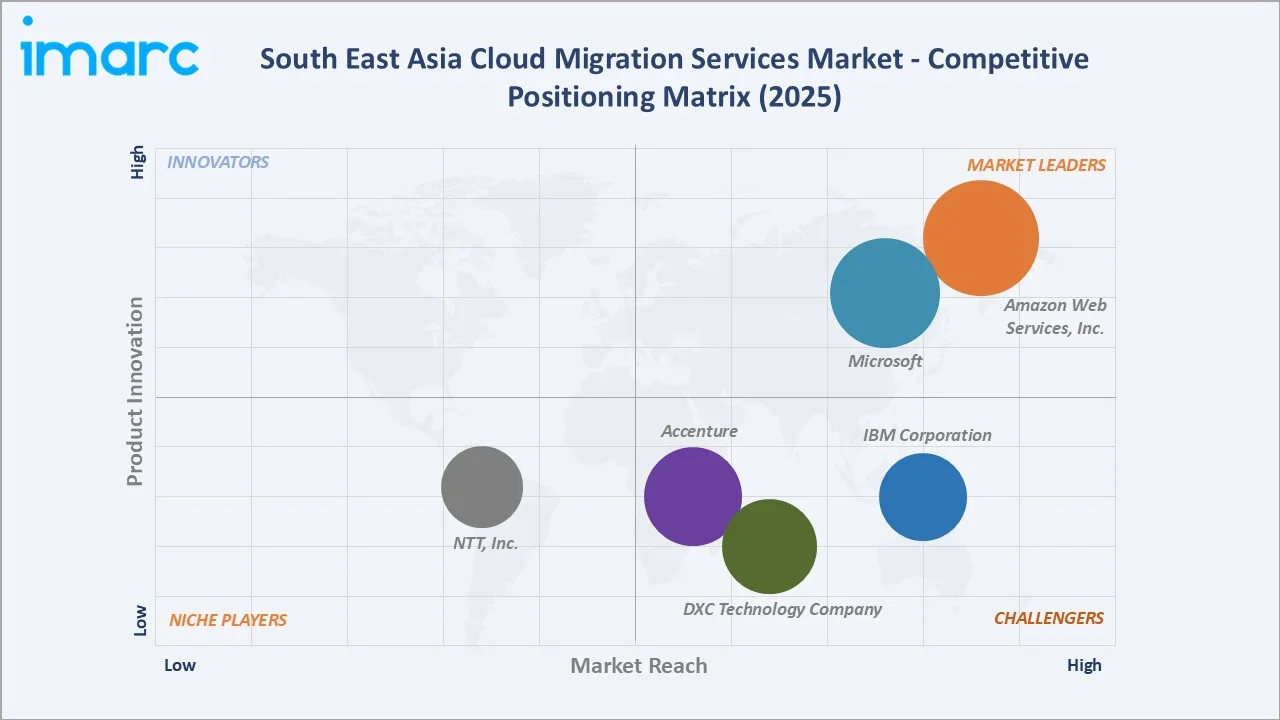
The South East Asia cloud migration services market competitive landscape is moderately concentrated, comprising established global hyperscale cloud providers and professional services firms alongside specialized regional system integrators competing on technical expertise, service reach, and local regulatory knowledge suited to the region's fragmented compliance environment.
|
Company Name |
Key Products |
Market Position |
Core Strength |
|
Amazon Web Services, Inc. |
AWS Transform, AWS Application Migration Service |
Market Leader |
Leading global cloud infrastructure provider with extensive regional data center presence across South East Asia |
|
Microsoft |
Azure Migrate, Azure Arc hybrid management |
Market Leader |
Broad enterprise cloud and hybrid infrastructure portfolio with established regional distribution |
|
IBM Corporation |
Cloud Migration Services |
Strong Challenger |
Diversified managed services and enterprise consulting portfolio serving regulated industries |
|
Accenture |
Cloud migration consulting |
Strong Challenger |
Advanced professional services and systems integration expertise across enterprise transformation |
|
DXC Technology Company |
Cloud Migration Services |
Strong Challenger |
Comprehensive managed IT services and legacy system migration expertise |
|
NTT, Inc. |
Cloud Migration Services |
Niche Player |
Regional telecommunications and IT infrastructure heritage supporting local enterprise migration |
Key players include Amazon Web Services, Inc., Microsoft, IBM Corporation, Accenture, DXC Technology Company, NTT, Inc., and others.
Key Company Profiles
Amazon Web Services, Inc.
Amazon Web Services, Inc. is a global leader in cloud infrastructure, maintaining a strong presence in the South East Asia cloud migration services market through its extensive regional data center network and comprehensive migration tooling.
- Key Products: AWS Application Migration Service, AWS Database Migration Service.
- Strategic Focus: Expanding regional cloud infrastructure capacity and strengthening local partner network training programs across South East Asia. The company is also investing in regional partner certification programs, including additional technical training centers, to build a larger pool of AWS-certified migration specialists.
Microsoft
Microsoft is a global technology company with a strong presence in the South East Asia cloud migration services market through its Azure cloud platform and hybrid infrastructure management portfolio.
- Key Products: Azure Migrate, Azure Arc, Azure Site Recovery.
- Strategic Focus: Growing adoption of hybrid cloud management tools and expanding managed service offerings for regional enterprise and government customers. The company is prioritizing partnerships with leading regional system integrators to accelerate hybrid cloud adoption, while expanding technical training support to scale partner delivery capacity.
Market Concentration Analysis
The South East Asia cloud migration services market is moderately concentrated at the hyperscale infrastructure level, with the key players collectively accounting for a significant share of underlying cloud platform revenue. Professional and managed services delivery remains more fragmented, with global consulting firms, regional system integrators, and specialized local IT firms each capturing meaningful shares of migration and operations engagements. Market concentration at the services layer is expected to gradually shift as regional system integrators expand technical capacity and compliance expertise across the forecast period.
Investment & Growth Opportunities
Highest Growth Segments
The Philippines (approximately 25.1% CAGR), Vietnam (approximately 24.6% CAGR), Managed Services (approximately 23.6% CAGR), AI/ML workload migration services, and SME-focused simplified migration packages represent the highest-growth investment vectors through 2034.
Emerging Investment Opportunities
SME-focused migration packages represent the market's fastest-growing emerging opportunity, as pay-as-you-go pricing models and simplified onboarding expand cloud adoption among the region's large underserved small and medium-sized enterprise base through 2034.
Investment Themes
- AI-Integrated Migration Automation Platform Development Through 2034: AI-assisted migration planning represents a meaningful investment opportunity for providers seeking to differentiate premium enterprise offerings. Companies that achieve validated accuracy improvements in dependency mapping and cost forecasting can create a durable competitive advantage in the high-value enterprise procurement segment.
- Regional System Integrator Capacity Expansion Capturing SME and Compliance-Sensitive Growth: South East Asia's fragmented regulatory landscape and large underserved SME base create a structurally growing addressable market for regional system integrators offering localized compliance expertise and simplified migration packages.
Future Market Outlook (2026-2034)
The South East Asia cloud migration services market is projected to grow from USD 10.93 Billion in 2025 to USD 73.30 Billion by 2034, delivering a 22.84% CAGR over the forecast period. The market's anchor value of USD 30.57 Billion in 2030 represents a significant enterprise adoption inflection point, with AI-assisted migration tooling, security-first frameworks, and SME-focused packages expected to see wider adoption. Rising digital transformation investment and expanding regional data center infrastructure together define a durable growth trajectory through 2034.
Research Methodology
Primary Research
Primary research comprised structured interviews with enterprise IT decision-makers, cloud migration consultants, managed service providers, and regional system integrator executives across South East Asia's major technology markets.
Secondary Research
Secondary research encompassed company annual reports, national digital economy development authority publications, industry association data, and peer-reviewed enterprise cloud adoption studies. Over 50 secondary sources were reviewed.
Forecasting Models
Market revenue forecasts were developed using a project-volume-based bottom-up model incorporating enterprise IT modernization spending by country, average migration project scope and duration by enterprise size, and recurring managed service revenue per migrated workload across the forecast period.
South East Asia Cloud Migration Services Market Report Coverage:
| Report Features | Details |
|---|---|
| Base Year of the Analysis | 2025 |
| Historical Period | 2020-2025 |
| Forecast Period | 2026-2034 |
| Units | Billion USD |
| Scope of the Report | Exploration of Historical and Forecast Trends, Industry Catalysts and Challenges, Segment-Wise Historical and Predictive Market Assessment:
|
| Service Types Covered | Managed Services, Professional Services |
| Enterprise Sizes Covered | Small and Medium-sized Enterprises, Large Enterprises |
| Deployment Modes Covered | Public Cloud, Private Cloud, Hybrid Cloud |
| Applications Covered | Project Management, Infrastructure Management, Security and Compliance Management, Others |
| Industry Verticals Covered | BFSI, Manufacturing, Healthcare and Life Sciences, IT and Telecommunications, Consumer Goods and Retail, Government and Public Sector, Media and Entertainment, Others |
| Countries Covered | Indonesia, Thailand, Singapore, Philippines, Vietnam, Malaysia, Others |
| Companies Covered | Amazon Web Services, Inc., Microsoft, IBM Corporation, Accenture, DXC Technology Company, NTT, Inc., etc. |
| Customization Scope | 10% Free Customization |
| Post-Sale Analyst Support | 10-12 Weeks |
| Delivery Format | PDF and Excel through Email (We can also provide the editable version of the report in PPT/Word format on special request) |
Key Benefits for Stakeholders:
- IMARC’s industry report offers a comprehensive quantitative analysis of various market segments, historical and current market trends, market forecasts, and dynamics of the South East Asia cloud migration services market from 2020-2034.
- The research report provides the latest information on the market drivers, challenges, and opportunities in the South East Asia cloud migration services market.
- Porter's five forces analysis assist stakeholders in assessing the impact of new entrants, competitive rivalry, supplier power, buyer power, and the threat of substitution. It helps stakeholders to analyze the level of competition within the South East Asia cloud migration services industry and its attractiveness.
- Competitive landscape allows stakeholders to understand their competitive environment and provides an insight into the current positions of key players in the market.
Frequently Asked Questions About the South East Asia Cloud Migration Services Market Report
The South East Asia cloud migration services market reached USD 10.93 Billion in 2025, driven by Managed Services dominant at 55.8%, Large Enterprises leading enterprise size at 57.3%, and Singapore commanding 24.7% market share through its advanced digital infrastructure.
The market grows at 22.84% CAGR during 2026-2034, reaching USD 73.30 Billion by 2034, reflecting rising data security concerns, growing telehealth cloud utilization, and expanding strategic partnerships between global providers and local IT firms.
Managed Services lead at 55.8%, capturing ongoing operational support and optimization services, growing at approximately 23.6% CAGR through expanding multi-cloud complexity and recurring enterprise engagement demand.
Large Enterprises lead at 57.3% through greater IT budgets and more complex legacy infrastructure requiring migration, driving structured and well-resourced engagement demand across the region.
Singapore leads at 24.7% through its advanced digital infrastructure, regional corporate headquarters concentration, and mature data governance regulatory framework.
Leading companies include Amazon Web Services, Inc., Microsoft, IBM Corporation, Accenture, DXC Technology Company, NTT, Inc., and others.
The market is projected to reach approximately USD 30.57 Billion by 2030, with AI-assisted migration tooling becoming more standard for enterprise deployments, security-first frameworks gaining broader adoption, and SME-focused migration packages expanding across the region.
Three priority opportunities: AI-integrated migration automation platform development, regional system integrator capacity expansion for SME and compliance-sensitive segments, and telehealth and healthcare-focused cloud migration services.
Need more help?
- Speak to our experienced analysts for insights on the current market scenarios.
- Include additional segments and countries to customize the report as per your requirement.
- Gain an unparalleled competitive advantage in your domain by understanding how to utilize the report and positively impacting your operations and revenue.
- For further assistance, please connect with our analysts.
 Request Customization
 Speak to an Analyst
 Request Brochure
 Inquire Before Buying
Benefits of Customization
- Personalize this research
- Triangulate with your data
- Get data as per your format and definition
- Gain a deeper dive into a specific application, geography, customer, or competitor
- Any level of personalization
Get in Touch With Us
UNITED STATES
Phone: +1-201-971-6302
INDIA
Phone: +91-120-433-0800
UNITED KINGDOM
Phone: +44-753-714-6104
Email: [email protected]
Client Testimonials




.webp)




.webp)













Related Reports

Choose your plan
*Please note that the prices mentioned below are starting prices for each bundle type. Kindly contact our team for further details.*
Single User License
- 1 User License, Access on 2 Devices
- PDF Report + Excel Dataset (Password Protected)
- Lifetime Access
- No Printing Rights
- 10% Free Report Customization
- 10–12 Weeks of Analyst Support
Five User License
- Access for 5 Users, 2 Devices per User
- PDF Report + Excel Dataset (Password Protected)
- Lifetime Access
- Dedicated Account Manager
- 12–14 Weeks of Analyst Support
- No Printing Rights
- 15% Free Report Customization
- 25% Discount on Your Next Purchase
Corporate User License
- Unlimited User Access (Within Your Organization)
- PDF Report + Excel Dataset
- Lifetime Access
- Dedicated Account Manager
- 14–20 Weeks of Analyst Support
- No Printing Rights
- 20% Free Report Customization
- 30% Discount on Your Next Purchase
Essential Insights
What's included:
3 reports
- Lifetime Access
- PDF Reports
- Excel Datasets
- 2 Weeks of Free Analyst Support
- 2 User Licenses
- Access on 2 Devices
- Printing Rights
- Complimentary PowerPoint (PPT) Version
- Complimentary License Upgrade
Professional Access
What's included:
5 reports
- Lifetime Access
- PDF Reports
- Excel Datasets
- 8 Weeks of Free Analyst Support
- 2 User Licenses
- Access on 2 Devices
- Printing Rights
- Complimentary PowerPoint (PPT) Version
- Complimentary License Upgrade
Business Advantage
What's included:
8 reports
- Lifetime Access
- PDF Reports
- Excel Datasets
- 14 Weeks of Free Analyst Support
- 2 User Licenses
- Access on 2 Devices
- Printing Rights
- Complimentary PowerPoint (PPT) Version
- Complimentary License Upgrade
Enterprise Intelligence
What's included:
10 reports
- Lifetime Access
- PDF Reports
- Excel Datasets
- 20 Weeks of Free Analyst Support
- 2 User Licenses
- Access on 2 Devices
- Printing Rights
- Complimentary PowerPoint (PPT) Version
- Complimentary License Upgrade