
South Korea Smart Cities Market Report by Focus Area (Smart Transportation, Smart Buildings, Smart Utilities, Smart Citizen Services), and Region 2026-2034
Market Overview:
South Korea smart cities market size reached USD 29,805.7 Million in 2025. Looking forward, IMARC Group expects the market to reach USD 66,827.4 Million by 2034, exhibiting a growth rate (CAGR) of 9.10% during 2026-2034. The rising need for creating a sophisticated ecosystem that enables real-time information gathering and intelligent decision-making by local authorities is primarily driving the market growth.
|
Report Attribute
|
Key Statistics
|
|---|---|
|
Base Year
|
2025 |
|
Forecast Years
|
2026-2034
|
|
Historical Years
|
2020-2025
|
| Market Size in 2025 | USD 29,805.7 Million |
| Market Forecast in 2034 | USD 66,827.4 Million |
| Market Growth Rate (2026-2034) | 9.10% |
Access the full market insights report Request Sample
Smart cities are metropolitan regions that leverage information and communication technology (ICT) to elevate the well-being of their residents and streamline the effectiveness of diverse services. They integrate the Internet of Things (IoT) devices, sensors, and data analytics to collect and analyze real-time information, facilitating intelligent decision-making for local authorities. Their primary areas of concentration include energy management, transportation, healthcare, waste management, and public safety. Additionally, smart cities play a crucial role in curbing resource consumption, alleviating traffic congestion, promoting sustainability, and enhancing the overall infrastructure of urban areas.
South Korea Smart Cities Market Trends:
The South Korea smart cities market stands at the forefront of urban innovation, harnessing information and communication technology (ICT) to redefine the landscape of urban living and enhance the quality of life for its residents. Key focus areas within the market include energy management, transportation, healthcare, waste management, and public safety. Additionally, by leveraging cutting-edge technologies, these cities aim to optimize resource allocation, improve infrastructure efficiency, and provide residents with a seamless urban experience, which is acting as another significant growth-inducing factor. Besides this, the integration of smart technologies plays a pivotal role in reducing resource consumption, mitigating traffic congestion, promoting sustainability, and enhancing overall urban infrastructure. South Korea's commitment to smart cities aligns with the broader trend of urbanization and the need for sustainable and efficient urban development. The implementation of smart city initiatives contributes not only to the well-being of citizens but also positions South Korea as a leader in technological innovation and urban planning. Furthermore, the South Korea smart cities market embraces the transformative potential of technology, fostering an environment where innovation and connectivity thrive. As these smart cities continue to evolve, they serve as a testament to South Korea's dedication to leveraging ICT to create smarter, more sustainable, and citizen-centric urban environments that pave the way for the future of urban living in the digital age. This, in turn, is expected to fuel the regional market over the forecasted period.
South Korea Smart Cities Market Segmentation:
IMARC Group provides an analysis of the key trends in each segment of the market, along with forecasts at the country level for 2026-2034. Our report has categorized the market based on focus area.
Focus Area Insights:
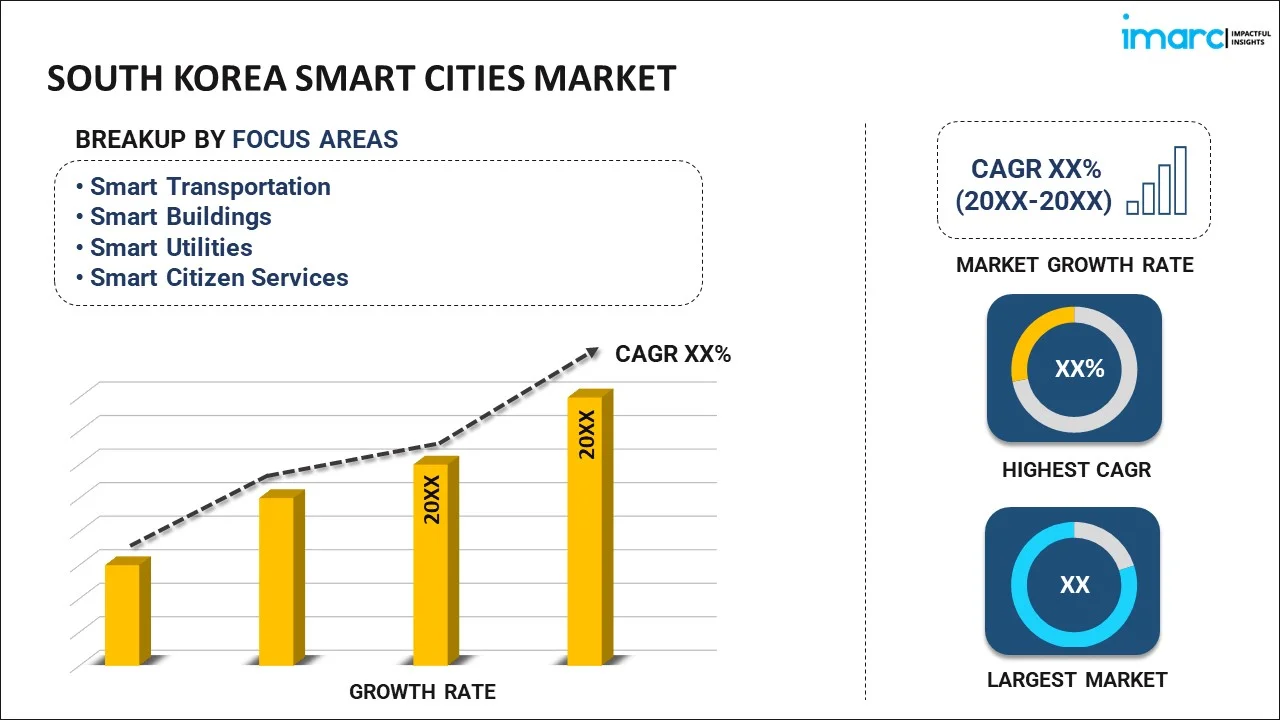
To get detailed segment analysis of this market Request Sample
- Smart Transportation
- Smart Ticketing
- Traffic Management System
- Passenger Information Management System
- Freight Information System
- Connected Vehicles
- Others
- Smart Buildings
- Building Energy Optimization
- Emergency Management System
- Parking Management System
- Others
- Smart Utilities
- Advanced Metering Infrastructure
- Distribution Management System
- Substation Automation
- Others
- Smart Citizen Services
- Smart Education
- Smart Healthcare
- Smart Public Safety
- Smart Street Lighting
- Others
The report has provided a detailed breakup and analysis of the market based on the focus area. This includes smart transportation (smart ticketing, traffic management system, passenger information management system, freight information system, connected vehicles, and others), smart buildings (building energy optimization, emergency management system, parking management system, and others), smart utilities (advanced metering infrastructure, distribution management system, substation automation, and others), and smart citizen services (smart education, smart healthcare, smart public safety, smart street lighting, and others).
Regional Insights:
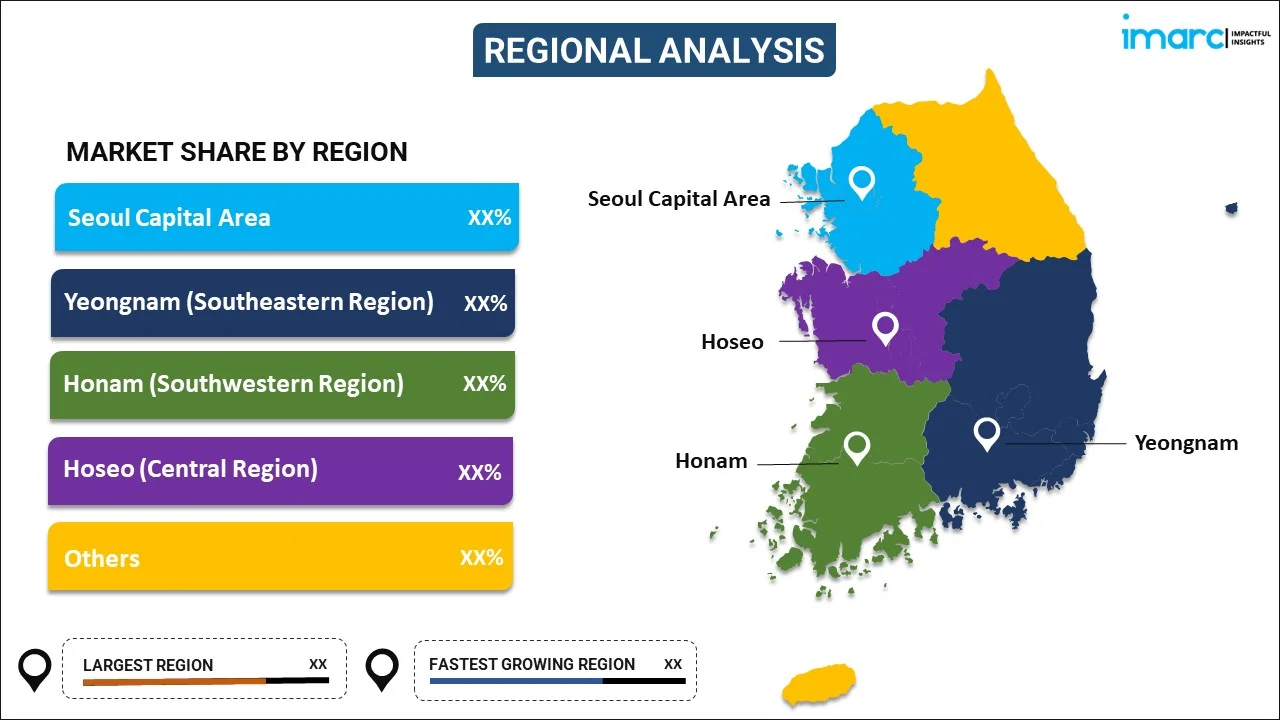
To get detailed regional analysis of this market Request Sample
- Seoul Capital Area
- Yeongnam (Southeastern Region)
- Honam (Southwestern Region)
- Hoseo (Central Region)
- Others
The report has also provided a comprehensive analysis of all the major regional markets, which include Seoul Capital Area, Yeongnam (Southeastern Region), Honam (Southwestern Region), Hoseo (Central Region), and Others.
Competitive Landscape:
The market research report has also provided a comprehensive analysis of the competitive landscape in the market. Competitive analysis such as market structure, key player positioning, top winning strategies, competitive dashboard, and company evaluation quadrant has been covered in the report. Also, detailed profiles of all major companies have been provided.
South Korea Smart Cities Market Report Coverage:
| Report Features | Details |
|---|---|
| Base Year of the Analysis | 2025 |
| Historical Period | 2020-2025 |
| Forecast Period | 2026-2034 |
| Units | Million USD |
| Scope of the Report | Exploration of Historical Trends and Market Outlook, Industry Catalysts and Challenges, Segment-Wise Historical and Future Market Assessment:
|
| Focus Areas Covered |
|
| Regions Covered | Seoul Capital Area, Yeongnam (Southeastern Region), Honam (Southwestern Region), Hoseo (Central Region), Others |
| Customization Scope | 10% Free Customization |
| Post-Sale Analyst Support | 10-12 Weeks |
| Delivery Format | PDF and Excel through Email (We can also provide the editable version of the report in PPT/Word format on special request) |
Key Questions Answered in This Report:
- How has the South Korea smart cities market performed so far and how will it perform in the coming years?
- What is the breakup of the South Korea smart cities market on the basis of focus area?
- What are the various stages in the value chain of the South Korea smart cities market?
- What are the key driving factors and challenges in the South Korea smart cities?
- What is the structure of the South Korea smart cities market and who are the key players?
- What is the degree of competition in the South Korea smart cities market?
Key Benefits for Stakeholders:
- IMARC’s industry report offers a comprehensive quantitative analysis of various market segments, historical and current market trends, market forecasts, and dynamics of the South Korea smart cities market from 2020-2034.
- The research report provides the latest information on the market drivers, challenges, and opportunities in the South Korea smart cities market.
- Porter's five forces analysis assist stakeholders in assessing the impact of new entrants, competitive rivalry, supplier power, buyer power, and the threat of substitution. It helps stakeholders to analyze the level of competition within the South Korea smart cities industry and its attractiveness.
- Competitive landscape allows stakeholders to understand their competitive environment and provides an insight into the current positions of key players in the market.
Need more help?
- Speak to our experienced analysts for insights on the current market scenarios.
- Include additional segments and countries to customize the report as per your requirement.
- Gain an unparalleled competitive advantage in your domain by understanding how to utilize the report and positively impacting your operations and revenue.
- For further assistance, please connect with our analysts.
 Request Customization
 Speak to an Analyst
 Request Brochure
 Inquire Before Buying
Benefits of Customization
- Personalize this research
- Triangulate with your data
- Get data as per your format and definition
- Gain a deeper dive into a specific application, geography, customer, or competitor
- Any level of personalization
Get in Touch With Us
UNITED STATES
Phone: +1-201-971-6302
INDIA
Phone: +91-120-433-0800
UNITED KINGDOM
Phone: +44-753-714-6104
Email: [email protected]
Client Testimonials




.webp)




.webp)













Related Reports

Choose your plan
*Please note that the prices mentioned below are starting prices for each bundle type. Kindly contact our team for further details.*
Single User License
- 1 User License, Access on 2 Devices
- PDF Report + Excel Dataset (Password Protected)
- Lifetime Access
- No Printing Rights
- 10% Free Report Customization
- 10–12 Weeks of Analyst Support
Five User License
- Access for 5 Users, 2 Devices per User
- PDF Report + Excel Dataset (Password Protected)
- Lifetime Access
- Dedicated Account Manager
- 12–14 Weeks of Analyst Support
- No Printing Rights
- 15% Free Report Customization
- 25% Discount on Your Next Purchase
Corporate User License
- Unlimited User Access (Within Your Organization)
- PDF Report + Excel Dataset
- Lifetime Access
- Dedicated Account Manager
- 14–20 Weeks of Analyst Support
- No Printing Rights
- 20% Free Report Customization
- 30% Discount on Your Next Purchase
Essential Insights
What's included:
3 reports
- Lifetime Access
- PDF Reports
- Excel Datasets
- 2 Weeks of Free Analyst Support
- 2 User Licenses
- Access on 2 Devices
- Printing Rights
- Complimentary PowerPoint (PPT) Version
- Complimentary License Upgrade
Professional Access
What's included:
5 reports
- Lifetime Access
- PDF Reports
- Excel Datasets
- 8 Weeks of Free Analyst Support
- 2 User Licenses
- Access on 2 Devices
- Printing Rights
- Complimentary PowerPoint (PPT) Version
- Complimentary License Upgrade
Business Advantage
What's included:
8 reports
- Lifetime Access
- PDF Reports
- Excel Datasets
- 14 Weeks of Free Analyst Support
- 2 User Licenses
- Access on 2 Devices
- Printing Rights
- Complimentary PowerPoint (PPT) Version
- Complimentary License Upgrade
Enterprise Intelligence
What's included:
10 reports
- Lifetime Access
- PDF Reports
- Excel Datasets
- 20 Weeks of Free Analyst Support
- 2 User Licenses
- Access on 2 Devices
- Printing Rights
- Complimentary PowerPoint (PPT) Version
- Complimentary License Upgrade