
Tanzania Spirits Market Size, Share, Trends and Forecast by Product Type and Distribution Channel, 2026-2034
Tanzania Spirits Market Summary:
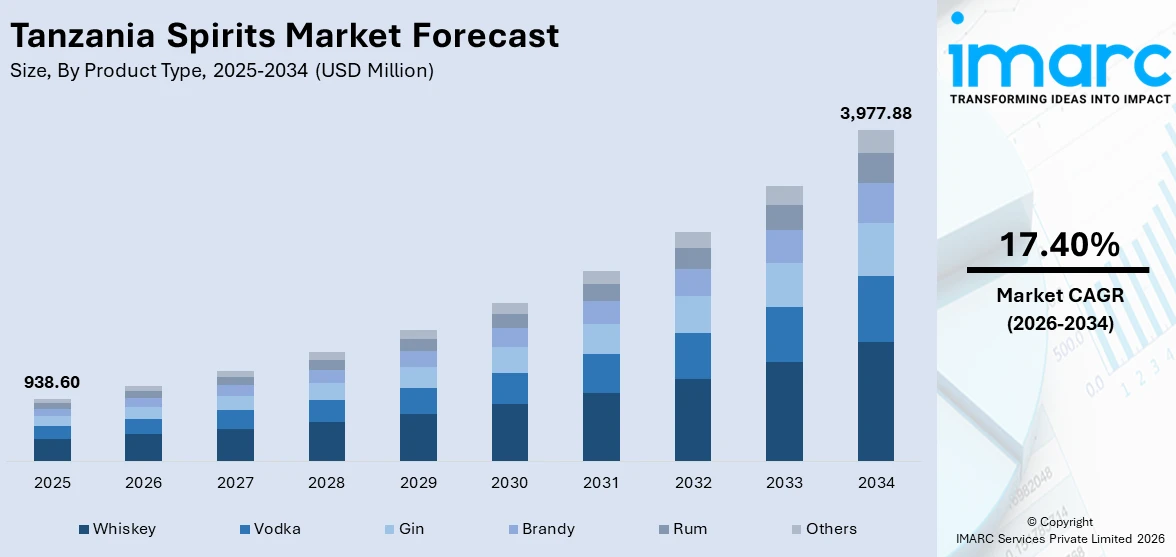
The Tanzania spirits market size was valued at USD 938.60 Million in 2025 and is projected to reach USD 3,977.88 Million by 2034, growing at a compound annual growth rate of 17.40% from 2026-2034.
The Tanzania spirits market is expanding rapidly, as urbanization intensifies and consumer preferences evolve towards premium alcoholic beverages. A growing middle-class population, increased tourism activity, and vibrant nightlife culture are strengthening demand. Rising disposable incomes and strategic brand investments by domestic and international producers are reshaping consumption patterns, positioning the country as an emerging hub for spirits distribution across East Africa.
Key Takeaways and Insights:
- By Product Type: Whiskey dominates the market with a share of 32% in 2025, owing to expanding middle-class aspirations, growing cocktail culture in urban centers, and enhanced distribution through on-trade and digital channels. Rising consumer preferences for premium and blended variants are fueling the segment expansion.
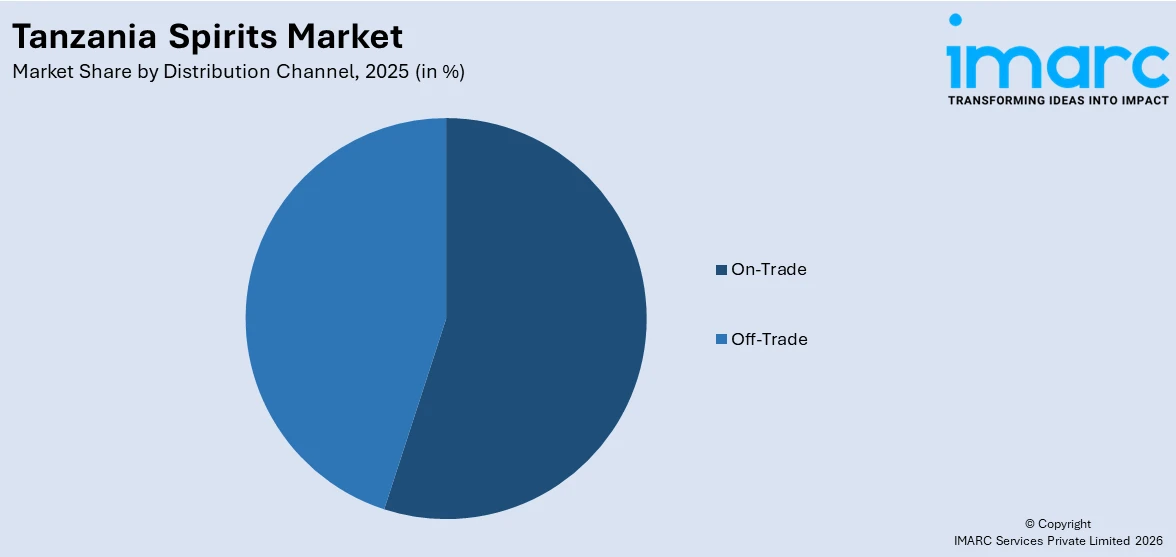
- By Distribution Channel: On-trade leads the market with a share of 55% in 2025. This dominance is driven by Tanzania's vibrant bar, restaurant, and nightclub culture, where experiential consumption and social gatherings remain the primary occasions for spirits purchases.
- Key Players: Key players drive the Tanzania spirits market by diversifying product portfolios, investing in local manufacturing capabilities, strengthening nationwide distribution networks, and partnering with hospitality providers. Their investments in marketing, premiumization strategies, and sustainability initiatives boost awareness, accelerate adoption, and ensure consistent product availability across diverse consumer segments. Some of the key players operating in the market include Anheuser-Busch InBev, East Africa Spirits (T) Limited (EASTL), Edward Snell & Co. Ltd., HEINEKEN Beverages, La Martiniquaise, Pernod Ricard, Serengeti Breweries Limited (East African Breweries Limited), and William Grant & Sons.
To get more information on this market Request Sample
The Tanzania spirits market is advancing, as evolving consumer lifestyles and economic expansion converge to reshape the beverage landscape. The country's rapid urbanization, with the urban population share reaching 36% in 2024 according to the World Bank Group, is creating dense consumer hubs where bars, restaurants, and entertainment venues thrive. A growing young population is increasingly embracing premium spirits and diverse flavor profiles, driven by social media influence and Western cultural integration. Strategic investments by major producers in local manufacturing, brand development, and distribution infrastructure are strengthening overall market capacity, while experiential marketing initiatives, such as cocktail mixology sessions, brand-sponsored music festivals, and themed promotional events, are deepening consumer engagement. Improved supply chain logistics and modern retail penetration are also broadening product accessibility across urban and peri-urban markets. These intersecting forces are underpinning sustained Tanzania spirits market growth.
Tanzania Spirits Market Trends:
Rising premiumization and craft spirit culture
Tanzanian consumers are increasingly gravitating towards premium and craft spirits, seeking distinctive flavor profiles and higher quality over economy-grade alternatives. Urban professionals and younger demographics are willing to pay a premium for imported whiskeys, artisan gins, and boutique vodkas that convey sophistication and status. In October 2025, Serengeti Breweries Limited launched TZEE, a fresh gin brand that honored Tanzanian creativity, togetherness, and national pride. The gin, crafted at SBL's contemporary facilities, captures the vibrant and expressive essence of Tanzania with the tagline ‘TZEE ni SISI,’ which translates to ‘TZEE is us.’
Digital commerce and modern retail integration
The adoption of e-commerce platforms and digital payment solutions is expanding consumer access to a wider range of spirits beyond traditional retail channels. Online delivery services are enabling consumers to explore diverse brands and purchase premium products from the convenience of their homes. Tanzania's expanding mobile money ecosystem, which processes billions of transactions annually, is facilitating seamless digital purchases and creating new distribution pathways for spirits manufacturers targeting tech-savvy urban consumers.
Local production investments and regulatory support
Government efforts to encourage local value addition and formalization are supporting the Tanzania spirits market growth. Investments by multinational and regional producers in local bottling, distillation, and packaging are improving product availability while moderating prices. Clearer excise structures, improved enforcement against illicit alcohol, and quality standardization are strengthening consumer confidence in branded spirits. As informal alcohol consumption gradually shifts towards regulated products, licensed manufacturers benefit from expanding volumes, improved brand trust, and broader penetration across semi-urban and secondary cities.
Market Outlook 2026-2034:
The Tanzania spirits market is poised for robust expansion over the forecast period, driven by accelerating urbanization, a youthful demographic profile, and rising disposable incomes across the country's growing middle class. The market generated a revenue of USD 938.60 Million in 2025 and is projected to reach a revenue of USD 3,977.88 Million by 2034, growing at a compound annual growth rate of 17.40% from 2026-2034. The continued expansion of hospitality infrastructure, increasing international tourist arrivals, and deepening penetration of modern retail and e-commerce channels are expected to sustain momentum. Strategic investments by both domestic and multinational producers in local manufacturing, brand innovation, and targeted marketing campaigns will further strengthen the competitive landscape, ensuring consistent supply and diversified product availability across both on-trade and off-trade channels throughout the forecast period.
Tanzania Spirits Market Report Segmentation:
|
Segment Category |
Leading Segment |
Market Share |
|
Product Type |
Whiskey |
32% |
|
Distribution Channel |
On-Trade |
55% |
Product Type Insights:
- Whiskey
- Vodka
- Gin
- Brandy
- Rum
- Others
Whiskey dominates the market with a share of 32% of the total Tanzania spirits market in 2025.
Whiskey holds the leading position in the Tanzania spirits market, driven by the growing middle-class population that is adopting Western drinking habits and demonstrating willingness to experiment with premium and blended variants. Tanzania's economy grew by 5.5% in 2024, underpinning stronger consumer purchasing power and willingness to explore premium alcoholic beverages. The expanding cocktail culture in urban centers, such as Dar es Salaam and Arusha, where whiskey serves as a preferred base spirit for mixologists, is reinforcing demand.
Market penetration is being supported by the availability of a variety of whiskey brands through growing off-trade retail channels and on-trade hospitality locations. Whiskey products are becoming more easily accessible to consumers, owing to advancements in distribution logistics, such as the growth of online marketplaces and home delivery services. Furthermore, in urban and semi-urban regions, aggressive brand marketing by local distributors and foreign whiskey makers is raising consumer awareness and aspirational appeal.
Distribution Channel Insights:
Access the comprehensive market breakdown Request Sample
- On-Trade
- Off-Trade
- Specialty Retailers
- Supermarkets and Hypermarkets
- Online
- Others
On-trade leads with a share of 55% of the total Tanzania spirits market in 2025.
On-trade dominates the Tanzania spirits market, reflecting the deeply rooted social aspect of drinking in bars, restaurants, nightclubs, and hotels in the country. Increasing consumer propensity towards socializing and dining out, along with a thriving nightlife environment in major cities like Dar es Salaam and Arusha, fuels sustained demand from on-trade channels. Tourism contributed 17.2% to Tanzania's GDP in 2024, while hotel occupancy rates rose to 74.5%, reflecting strong activity in the hospitality industry that, in turn, underpins on-trade spirits consumption across the country.
The on-trade channel is evolving through premiumization and experience-driven offers, beyond traditional bars and hotels. Upscale lounges, rooftop bars, beach clubs, and theme restaurants are increasingly attracting affluent locals and foreign tourists, who are offered signature cocktails, premium spirits menus, and strategically planned sampling activities. The quality of consumption and average spend per visit are enhancing due to investments in mixology contests, bartender training, and brand-sponsored events.
Market Dynamics:
Growth Drivers:
Why is the Tanzania Spirits Market Growing?
Rapid urbanization and expanding middle-class consumer base
Cities like Dar es Salaam, Dodoma, and Arusha are witnessing a concentrated consumer market, owing to the high rate of urbanization in the country. The increase in number of bars, restaurants, nightclubs, and entertainment spots, which act as a hub for the consumption of spirits, is fueled by the growing urbanization. A tremendous shift is being witnessed in the consumption of spirits, largely influenced by the expanding middle class, as younger, urban customers seek more upscale and varied alcoholic beverages. With people wanting to try imported whiskeys, gins, and vodkas, the influence of global culture, along with a unique blend of traditions, is acting as a catalyst for the changing tastes of alcohol consumers. Besides this, better retail support and the influence of the media on global lifestyles are raising brand awareness for city dwellers to try expensive spirits.
Thriving tourism and hospitality sectors
Tanzania's tourism industry is a powerful catalyst for spirits market growth. The broadening of the hospitality sector, fueled by a record 2.14 Million international visitors generating USD 3.9 Billion in tourism earnings in 2024, is further accelerating on-trade spirits consumption. This influx of international travelers directly boosts demand for premium spirits through hotels, resorts, safari lodges, and beachfront establishments across destinations, such as Serengeti, Zanzibar, and Mount Kilimanjaro. In addition to volume growth, tourism is influencing the spirits market's premiumization trends. Due to the established drinking habits of foreign guests, hospitality operators are encouraged to offer carefully crafted cocktail menus, in addition to internationally renowned whiskey, rum, vodka, and gin brands. Five-star resorts and upscale safari camps are placing emphasis on experiential drinking through mixology-led concepts, themed bars, and tastings.
Strategic brand investments and local manufacturing expansion
Major players, especially those manufacturing spirits, are investing heavily in brand development, local manufacturing capacity, and distribution infrastructure to capture the ever-expanding spirits market in Tanzania. Players are employing advanced marketing strategies that integrate cultural activities, sponsoring music events, and launching online platforms for engaging with the youth audience and promoting brand loyalty. At the same time, investments in local manufacturing infrastructure for bottling are helping brands reduce their dependence on major import costs. This ensures consistency of supplies, thus providing products to the market at reasonable prices without compromising brands' positioning. This is supplemented by improving the overall market accessibility of the brands with distributors expanding their reach to cover peri-urban areas. Additionally, partnering with local players and ensuring compliance with nationwide standards aid in enhancing the image of the brands, thus formalizing demand growth.
Market Restraints:
What Challenges the Tanzania Spirits Market is Facing?
High taxation and regulatory burden
The Tanzanian government levies relatively high excise duties on spirits, which raise production costs and final retail prices across the category. When combined with value-added tax and import duties on inputs, these fiscal pressures squeeze margins for manufacturers and distributors. Elevated pricing can also discourage price-sensitive consumers from trading up, slowing the shift towards premium spirits and limiting broader category value growth despite rising consumer interest.
Prevalence of illicit and informal alcohol
The widespread availability of illicit, unregulated, and counterfeit alcoholic beverages presents a significant challenge to the formal spirits market. These products undercut legitimate brands on price, create unfair competitive dynamics, and pose serious health risks to consumers. Despite the introduction of Electronic Tax Stamps for track-and-trace enforcement, the informal alcohol economy continues to capture a meaningful share of overall consumption, limiting revenue potential for licensed manufacturers and distributors.
Cultural and religious consumption restrictions
Tanzania's diverse cultural and religious landscape, including a significant Muslim population, creates geographic and demographic variations in alcohol consumption patterns. Certain regions and communities maintain restrictions on the sale and consumption of alcoholic beverages, limiting market penetration in those areas. These cultural dynamics require producers to adopt nuanced marketing and distribution strategies that respect local sensitivities while identifying receptive consumer segments, adding operational complexity and constraining uniform nationwide market expansion.
Competitive Landscape:
The Tanzania spirits market features a competitive landscape, shaped by both domestic manufacturers and international brand owners. Leading producers are intensifying efforts to diversify product portfolios, improve production quality, and strengthen distribution reach across urban and peri-urban areas. Competition is driven by investments in local manufacturing capacity, premiumization strategies, and culturally aligned marketing campaigns that resonate with Tanzania's young and aspirational consumer base. Strategic partnerships between global spirits companies and local distributors are enhancing brand accessibility, while collaborations with hospitality providers and entertainment platforms are deepening consumer engagement. Innovations in packaging, flavor development, and sustainable sourcing are emerging as a key differentiator, as market participants refine their strategies to capture greater share in a rapidly expanding spirits landscape.
Some of the key players include:
- Anheuser-Busch InBev
- East Africa Spirits (T) Limited (EASTL)
- Edward Snell & Co. Ltd.
- HEINEKEN Beverages
- La Martiniquaise
- Pernod Ricard
- Serengeti Breweries Limited (East African Breweries Limited)
- William Grant & Sons
Tanzania Spirits Market Report Scope:
| Report Features | Details |
|---|---|
| Base Year of the Analysis | 2025 |
| Historical Period | 2020-2025 |
| Forecast Period | 2026-2034 |
| Units | Million USD, Million Litres |
| Scope of the Report | Exploration of Historical and Forecast Trends, Industry Catalysts and Challenges, Segment-Wise Historical and Predictive Market Assessment:
|
| Product Types Covered | Whiskey, Vodka, Gin, Brandy, Rum, Others |
| Distribution Channels Covered |
|
| Companies Covered | Anheuser-Busch InBev, East Africa Spirits (T) Limited (EASTL), Edward Snell & Co. Ltd., HEINEKEN Beverages, La Martiniquaise, Pernod Ricard, Serengeti Breweries Limited (East African Breweries Limited), William Grant & Sons. etc. |
| Customization Scope | 10% Free Customization |
| Post-Sale Analyst Support | 10-12 Weeks |
| Delivery Format | PDF and Excel through Email (We can also provide the editable version of the report in PPT/Word format on special request) |
Frequently Asked Questions About the Tanzania Spirits Market Report
The Tanzania spirits market size was valued at USD 938.60 Million in 2025.
The Tanzania spirits market is expected to grow at a compound annual growth rate of 17.40% from 2026-2034 to reach USD 3,977.88 Million by 2034.
Whiskey dominated the market with a share of 32%, driven by rising middle-class aspirations, expanding cocktail culture in urban centers, growing consumer preferences for premium and blended variants, and enhanced accessibility through diverse distribution channels.
Key factors driving the Tanzania spirits market include rapid urbanization, rising disposable incomes, thriving tourism and hospitality sectors, expanding nightlife culture, strategic brand investments by domestic and international producers, and growing consumer preferences for premium spirits.
Major challenges include high excise duties and taxation on spirits, prevalence of illicit and unregulated alcohol products, cultural and religious consumption restrictions, limited modern retail penetration in rural areas, and supply chain constraints affecting distribution efficiency.
Need more help?
- Speak to our experienced analysts for insights on the current market scenarios.
- Include additional segments and countries to customize the report as per your requirement.
- Gain an unparalleled competitive advantage in your domain by understanding how to utilize the report and positively impacting your operations and revenue.
- For further assistance, please connect with our analysts.
 Request Customization
 Speak to an Analyst
 Request Brochure
 Inquire Before Buying
Benefits of Customization
- Personalize this research
- Triangulate with your data
- Get data as per your format and definition
- Gain a deeper dive into a specific application, geography, customer, or competitor
- Any level of personalization
Get in Touch With Us
UNITED STATES
Phone: +1-201-971-6302
INDIA
Phone: +91-120-433-0800
UNITED KINGDOM
Phone: +44-753-714-6104
Email: [email protected]
Client Testimonials




.webp)




.webp)













Related Reports

Choose your plan
*Please note that the prices mentioned below are starting prices for each bundle type. Kindly contact our team for further details.*
Single User License
- 1 User License, Access on 2 Devices
- PDF Report + Excel Dataset (Password Protected)
- Lifetime Access
- No Printing Rights
- 10% Free Report Customization
- 10–12 Weeks of Analyst Support
Five User License
- Access for 5 Users, 2 Devices per User
- PDF Report + Excel Dataset (Password Protected)
- Lifetime Access
- Dedicated Account Manager
- 12–14 Weeks of Analyst Support
- No Printing Rights
- 15% Free Report Customization
- 25% Discount on Your Next Purchase
Corporate User License
- Unlimited User Access (Within Your Organization)
- PDF Report + Excel Dataset
- Lifetime Access
- Dedicated Account Manager
- 14–20 Weeks of Analyst Support
- No Printing Rights
- 20% Free Report Customization
- 30% Discount on Your Next Purchase
Essential Insights
What's included:
3 reports
- Lifetime Access
- PDF Reports
- Excel Datasets
- 2 Weeks of Free Analyst Support
- 2 User Licenses
- Access on 2 Devices
- Printing Rights
- Complimentary PowerPoint (PPT) Version
- Complimentary License Upgrade
Professional Access
What's included:
5 reports
- Lifetime Access
- PDF Reports
- Excel Datasets
- 8 Weeks of Free Analyst Support
- 2 User Licenses
- Access on 2 Devices
- Printing Rights
- Complimentary PowerPoint (PPT) Version
- Complimentary License Upgrade
Business Advantage
What's included:
8 reports
- Lifetime Access
- PDF Reports
- Excel Datasets
- 14 Weeks of Free Analyst Support
- 2 User Licenses
- Access on 2 Devices
- Printing Rights
- Complimentary PowerPoint (PPT) Version
- Complimentary License Upgrade
Enterprise Intelligence
What's included:
10 reports
- Lifetime Access
- PDF Reports
- Excel Datasets
- 20 Weeks of Free Analyst Support
- 2 User Licenses
- Access on 2 Devices
- Printing Rights
- Complimentary PowerPoint (PPT) Version
- Complimentary License Upgrade