
United States Cable Accessories Market Size, Share, Trends and Forecast by Voltage, Installation, End User, and Region, 2026-2034
United States Cable Accessories Market Size, Share, Trends & Forecast (2026-2034)
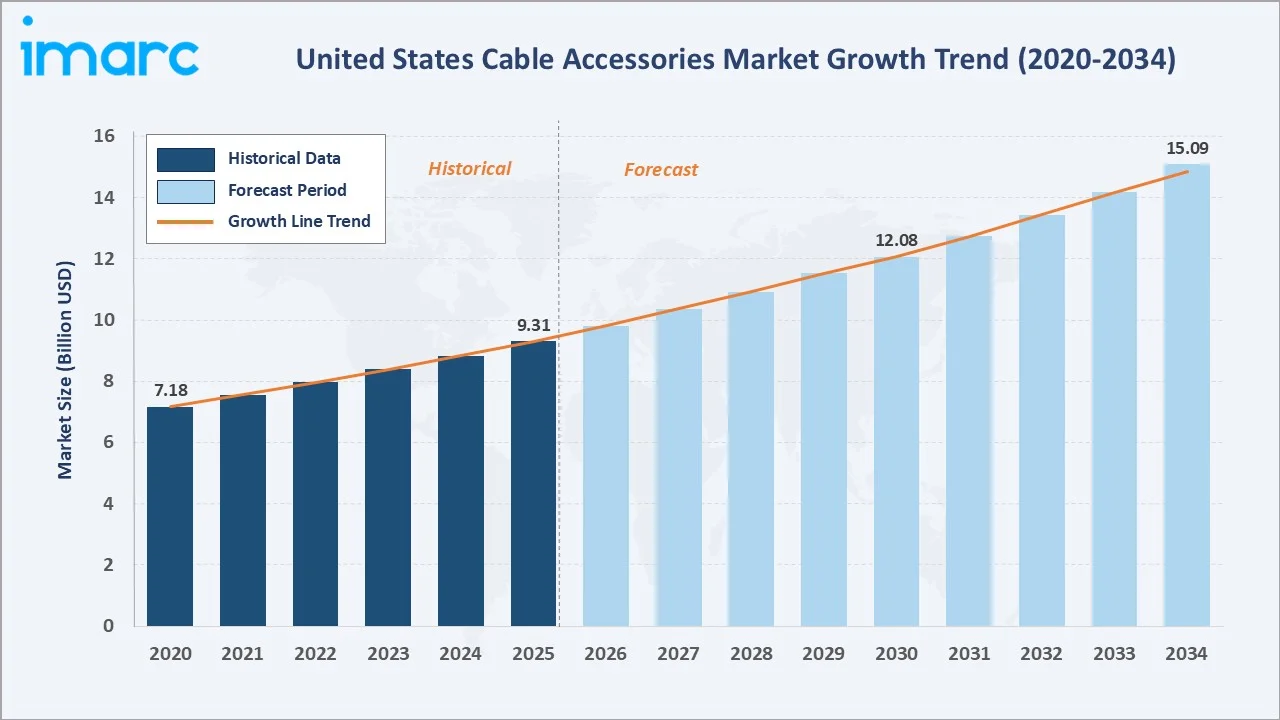
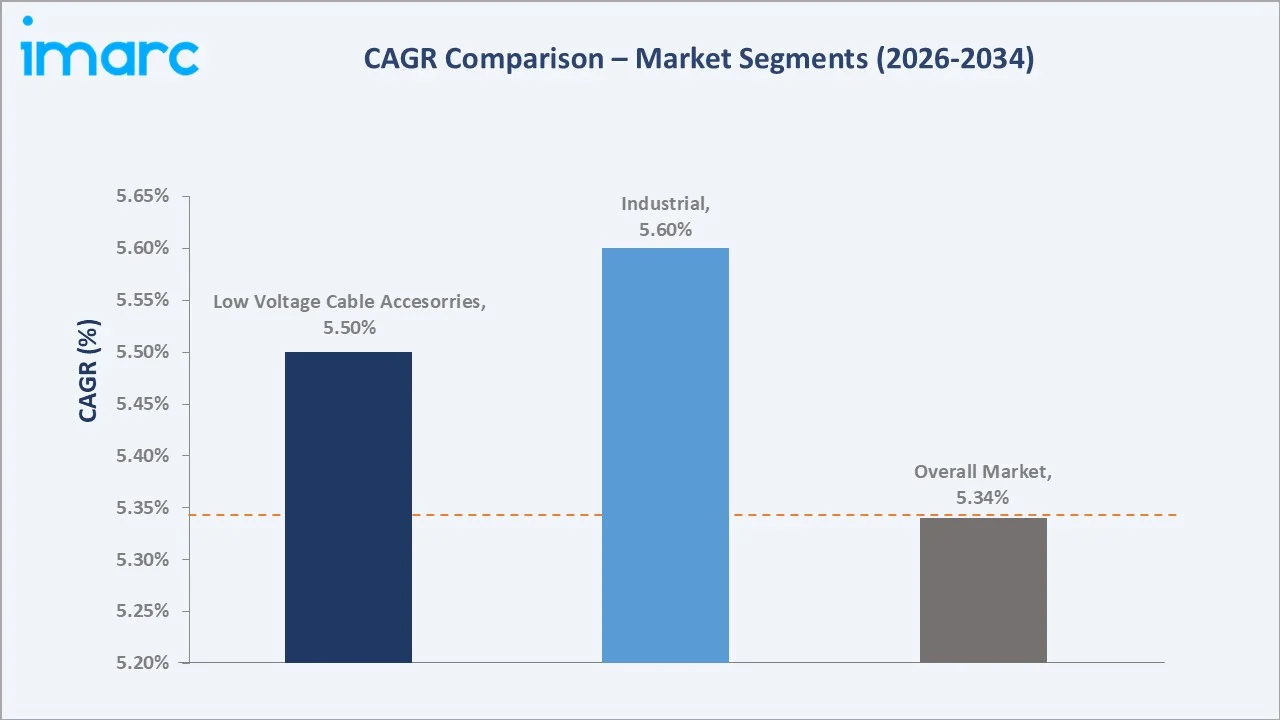
The United States cable accessories market size increased from USD 9.31 Billion in 2025 to USD 9.81 Billion in 2026 and is projected to reach USD 15.09 Billion by 2034, growing at a CAGR of 5.34% during 2026-2034. The Infrastructure Investment and Jobs Act (IIJA) mobilizing USD 65 Billion for grid modernization, large-scale renewable energy grid integration, creating MV and HV cable accessory demand, industrial electrification, and EV charging infrastructure rollout, and rapid data center capacity expansion are the primary growth catalysts.
Market Snapshot
|
Metric |
Value |
|
Base Year Market Size (2025) |
USD 9.31 Billion |
|
Market Size (2026) |
USD 9.81 Billion |
|
Forecast Market Size (2034) |
USD 15.09 Billion |
|
CAGR (2026-2034) |
5.34% |
|
Base Year |
2025 |
|
Historical Period |
2020-2025 |
|
Forecast Period |
2026-2034 |
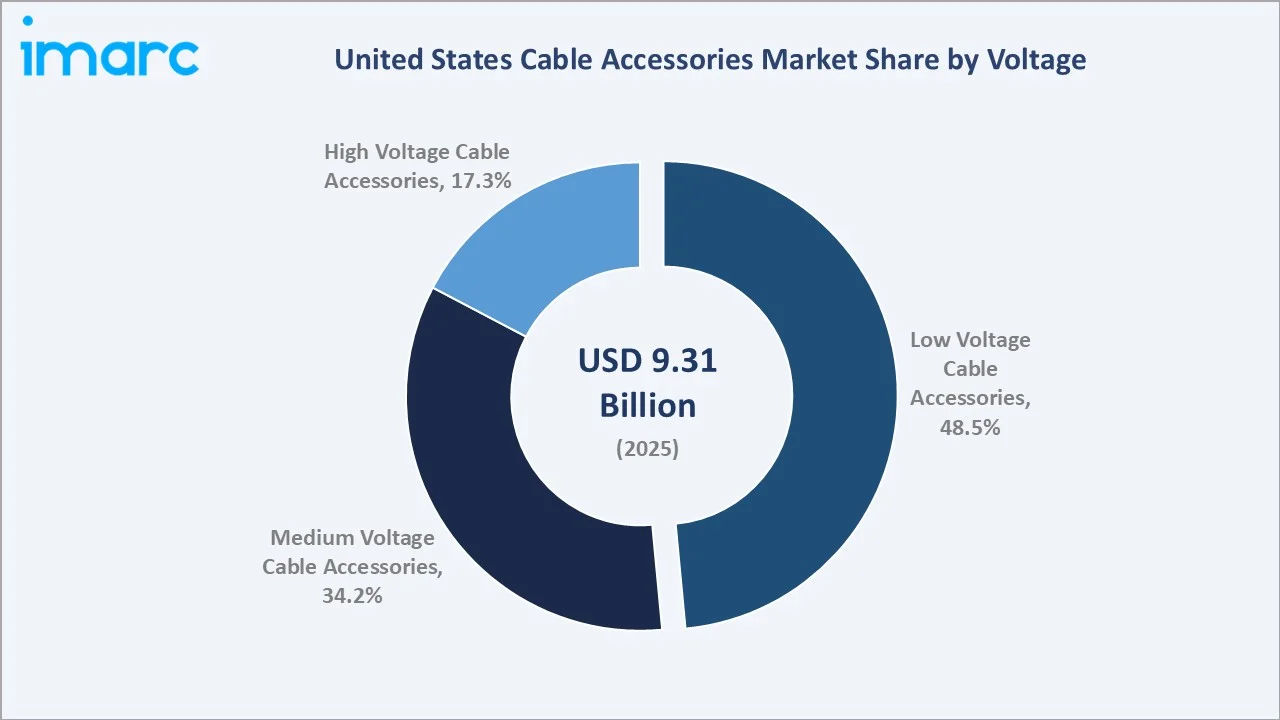
The South leads regionally with a 38.7% share in 2025, driven by the region’s large electric utility transmission and distribution infrastructure base, significant oil and gas and petrochemical industrial complex, major renewable energy build-out across Texas’s wind and solar corridors, and growing data center and advanced manufacturing investment in Texas, Florida, Georgia, and the Carolinas. Low voltage cable accessories at 48.5% lead the voltage segment, reflecting the broad deployment of LV cable systems across commercial construction, industrial facilities, and distributed energy connections.
To get more information on this market, Request Sample
The US cable accessories market is driven by three structural demand forces: the federal grid modernization investment wave mobilized by the IIJA that is creating multi-year procurement programs for transmission and distribution cable accessories across utility upgrade projects; the renewable energy transition that is requiring extensive new MV and HV cable infrastructure for solar and wind farm interconnection, creating sustained accessory demand across every new gigawatt of renewable capacity added to the US grid; and industrial electrification that is converting thermal process heat, compressed air, and mechanical drive systems to electric alternatives requiring new electrical infrastructure investments that deploy cable accessories at every connection point.
Executive Summary
The United States cable accessories market is experiencing robust growth, driven by the largest federal investment in electrical grid infrastructure in US history, the rapid expansion of renewable energy generating capacity requiring extensive new cable system infrastructure, and the structural transformation of the US industrial sector toward electrification. The market grew from USD 9.31 Billion in 2025 to USD 9.81 Billion in 2026 and is forecast to reach USD 15.09 Billion by 2034, growing at a CAGR of 5.34%.
Low voltage cable accessories account for 48.5% of the voltage segment in 2025, reflecting the broad commercial and industrial deployment of LV cable systems across building electrical infrastructure, industrial plant distribution, and distributed energy resource connections. Industrial at 71.4% of the end user segment reflects the structural dominance of manufacturing, utility, petrochemical, and data center customers in US cable accessory procurement.
The South leads regionally at 38.7%, driven by strong investments in power transmission and distribution infrastructure, rapid industrial expansion, utility-scale renewable energy projects, and sustained growth in construction activity across states such as Texas, Florida, Georgia, and the Carolinas. Key players compete across voltage range coverage, product certification depth, project execution capability, and application engineering support.
Key Market Insights
|
Insight |
Data |
|
Largest Voltage |
Low Voltage Cable Accessories – 48.5% share (2025) |
|
Second Largest Voltage |
Medium Voltage Cable Accessories – 34.2% share (2025) |
|
Largest End User |
Industrial – 71.4% share (2025) |
|
Second Largest End User |
Renewables – 28.6% share (2025) |
|
Leading Region |
South – 38.7% share (2025) |
|
Key Market Players |
Prysmian Group, ABB Ltd, Nexans, Eaton Corporation plc, TE Connectivity Corporation |
Key Analytical Observations Supporting The Above Data:
- Low voltage cable accessories at 48.5% share (2025) lead the voltage segment as LV cable systems are deployed in the largest number of cable terminations and joint points across all end-use sectors. Every commercial building, industrial facility, and residential installation requires multiple LV accessories at service entrances, panel connections, motor feeder terminations, and distribution points.
- Medium voltage cable accessories at 34.2% share (2025) are expected to be one of the fastest-growing voltage categories, driven by the large-scale deployment of MV cable collector systems in solar and wind farms, MV underground distribution cable upgrades in utility grid hardening programs, and MV service entrances for large industrial facilities and data centers.
- Industrial at 71.4% share (2025) dominates the end user segment as utility, manufacturing, petrochemical, mining, and data center customers collectively represent the largest procurement organizations for cable accessories, typically deploying in large volumes across major capital projects with multi-year procurement pipelines.
- The South’s 38.7% share (2025) reflects the region’s structural advantages in both industrial cable accessory demand and renewable energy cable accessory demand, with Texas alone representing the largest state-level wind energy market and a rapidly growing solar energy market requiring extensive MV cable infrastructure.
United States Cable Accessories Market Overview
Cable accessories are specialized components used at the termination points, transition points, and connection points of power cable systems across all voltage classes. They encompass a broad range of products, including cable joints, cable terminations, cable connectors and lugs, cable cleats and support systems, insulating sleeves, heat shrink and cold shrink components, stress control components, and cable management and protection accessories.
Macroeconomic drivers include the IIJA’s USD 65 Billion grid investment, creating the largest US transmission and distribution upgrade program in decades, with the Department of Energy’s Grid Deployment Office administering multi-billion-dollar grants for transmission line and underground cable system upgrades that each require substantial cable accessory procurement. The US Inflation Reduction Act’s USD 370 Billion clean energy investment is creating structural demand for renewable energy interconnection cable accessories through 2032.
Market Dynamics
To evaluate market opportunities, Request Sample
Market Drivers
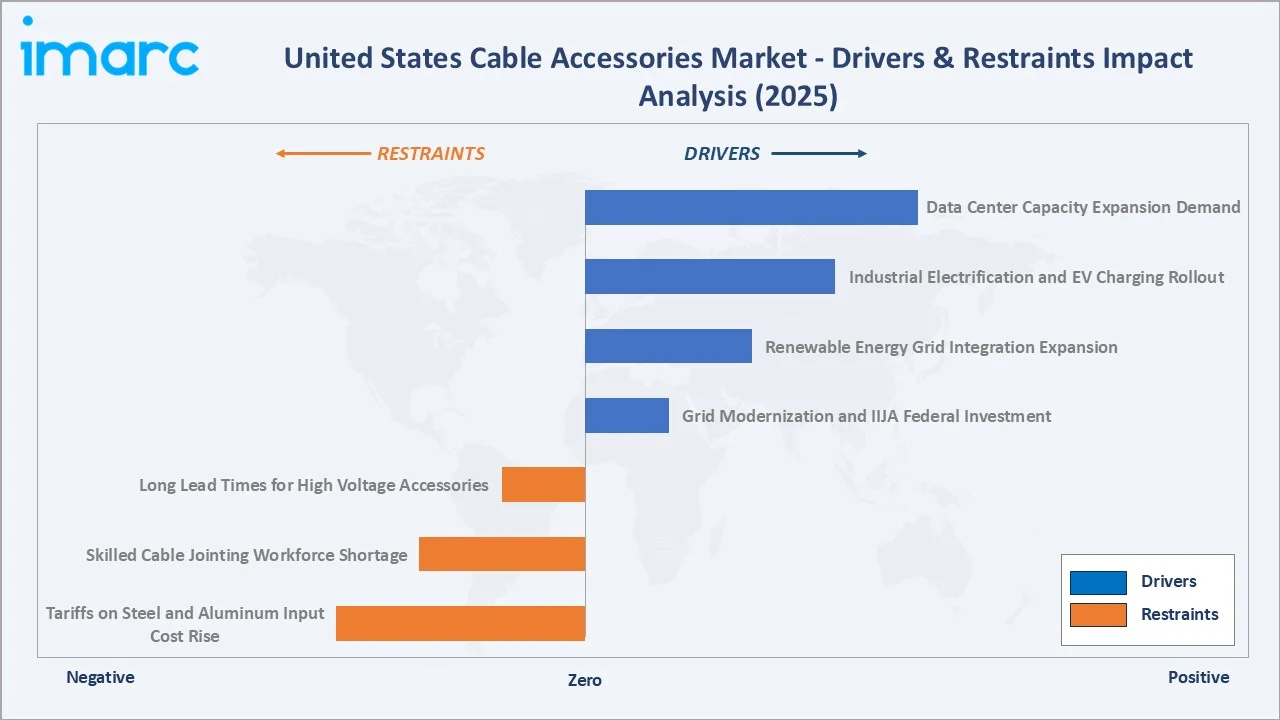
- Grid Modernization and IIJA Federal Investment: In August 2024, the U.S. Department of Energy (DOE) announced a USD 2.2 billion grid investment covering eight projects across 18 states. The funding aims to improve resilience against extreme weather, reduce community energy costs, and expand grid capacity to support rising demand from manufacturing and data centers. This creates multi-year cable accessory procurement demand across the US.
- Renewable Energy Grid Integration Expansion: The US’s commitment to a 100% clean electricity grid by 2035 is creating unprecedented demand for MV cable collector system accessories in solar and wind farms and HV cable accessories for long-distance transmission interconnection. Each GW of new solar capacity requires approximately 400–600 km of MV collector cable with associated joints and terminations.
- Industrial Electrification and EV Charging Rollout: The US industrial sector’s progressive electrification of heating, cooling, and process drive systems, combined with the nationwide EV charging infrastructure build-out under NEVI and private investment programs, is creating sustained LV and MV cable accessory demand. Each new DC fast charging station requires cable terminations and connectors at the electrical service entrance, with highway corridor charging hub facilities requiring significant MV distribution cable accessory investment for the dedicated electrical service infrastructure.
- Data Center Capacity Expansion Demand: The AI and cloud computing investment wave is driving the construction of hyperscale data centers at an unprecedented rate, with each 100+ MW facility requiring substantial HV cable accessories for the utility transmission service entrance and MV cable accessories for the internal distribution system. The concentration of data center development in Northern Virginia, Texas, Iowa, Phoenix, and Oregon creates geographic clusters of high-value MV and HV cable accessory demand within these regional markets.
Market Restraints
- Tariffs on Steel and Aluminum Input Cost Rise: The U.S. significantly tightened its metals trade policy in 2025, reinstating and expanding Section 232 tariffs on steel and aluminum imports. Effective March 12, 2025, the U.S. imposed a 25% tariff on all steel imports and increased the aluminum tariff from 10% to 25%, while also broadening coverage to include numerous steel and aluminum derivative products. These tariff-driven input cost increases are being partially passed through to customers, creating friction in project procurement and potentially compressing manufacturer margins where competitive pressure limits full cost pass-through.
- Skilled Cable Jointing Workforce Shortage: High-voltage cable accessory installation requires licensed cable jointing technicians with specialized training in XLPE cable preparation, stress cone installation, and pressurization testing that takes years to develop. The US faces a structural shortage of certified cable jointers, with utility and EPC contractor demand for skilled cable jointing crews significantly exceeding available workforce supply.
- Long Lead Times for High Voltage Accessories: Complex HV cable accessories, including pre-molded high-field stress control joints and GIS-connected terminations for 115kV–500kV transmission systems, have manufacturing lead times of 20–52 weeks from order, creating procurement planning challenges for major transmission infrastructure projects.
Market Opportunities
- Offshore Wind Cable Infrastructure: The US offshore wind development pipeline requires specialized submarine power cable accessories, including subsea joints, transition joints, J-tube terminations, and beach pull-in terminations that represent the highest-value cable accessory category by unit price. Each offshore wind farm requires custom-engineered HV submarine cable accessory packages per project.
- Data Center MV Distribution Upgrades: The hyperscale data center construction boom is driving a secondary wave of MV distribution upgrade demand as utility electrical service entrance capacity is expanded to serve the power requirements of new and expanded data center campuses. Each data center expansion requiring primary voltage service entrance upgrades creates demand for MV switchgear-connected cable terminations, MV distribution joints, and associated protection and monitoring accessories.
Market Challenges
- Supply Chain Concentration for Specialized Components: The manufacturing of specialized cable accessories is concentrated among a small number of global manufacturers, creating supply chain concentration risk during periods of demand acceleration. US utility procurement programs stimulated by IIJA funding are straining the available supply of complex MV and HV accessories, creating delivery delays that affect project execution schedules across the utility and renewable energy sectors.
- Domestic Manufacturing Capacity Constraints: While US cable accessory manufacturing capacity exists for standard LV and some MV accessory categories, specialized HV accessories are predominantly imported from European and Asian manufacturing facilities. The desire to support domestic content requirements in IIJA-funded projects and Build America Buy America provisions creates procurement challenges where domestically manufactured HV accessories are unavailable or insufficient to meet project demand timelines.
Emerging Market Trends
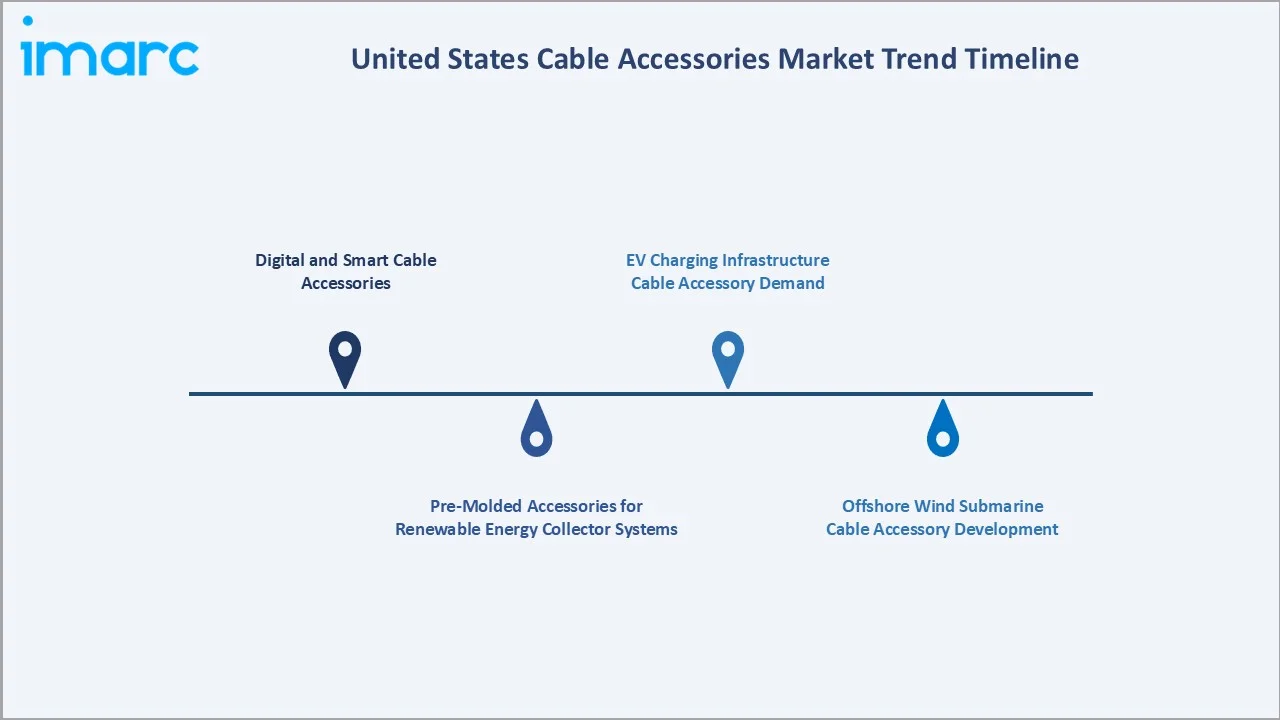
1. Digital and Smart Cable Accessories
The integration of sensing and monitoring technology into cable accessories is creating a new category of smart cable accessories that provide real-time condition monitoring data for temperature, partial discharge, and insulation condition assessment. ABB’s cable monitoring systems exemplify the commercial smart accessory products entering the US utility market, enabling predictive maintenance approaches that reduce unplanned cable system outages.
2. Pre-Molded Accessories for Renewable Energy Collector Systems
Utility-scale solar and wind farm development has driven the standardization and commercialization of pre-molded cold-shrink and push-on MV cable accessories that can be installed by trained electrical contractors without the specialized cable jointing skills required for traditional field-molded accessories. This democratization of MV cable accessory installation technology is accelerating renewable energy project installation timelines and reducing the skilled workforce constraint's impact on project execution.
3. Offshore Wind Submarine Cable Accessory Development
The US offshore wind industry’s development is creating demand for specialized submarine cable accessories that are technically distinct from land-based products, requiring hydraulic pressure resistance, seawater corrosion resistance, and deep-water installation compatibility. Prysmian, Nexans, and NKT are developing US-market qualified offshore wind cable accessory packages that meet BOEM regulatory requirements and are compatible with the HV XLPE submarine cables being installed in US Atlantic offshore wind development zones.
4. EV Charging Infrastructure Cable Accessory Demand
The nationwide NEVI-funded EV charging corridor build-out is creating a new and growing LV and MV cable accessory demand category at EV charging station electrical service entrances, transformer cable connections, and power distribution within charging hub facilities. Each Level 3 DC fast charging station requires cable connectors and terminations at the service entrance, with highway corridor charging hub facilities requiring MV distribution cable accessories for dedicated 480V or 12kV service entrances.
Industry Value Chain Analysis
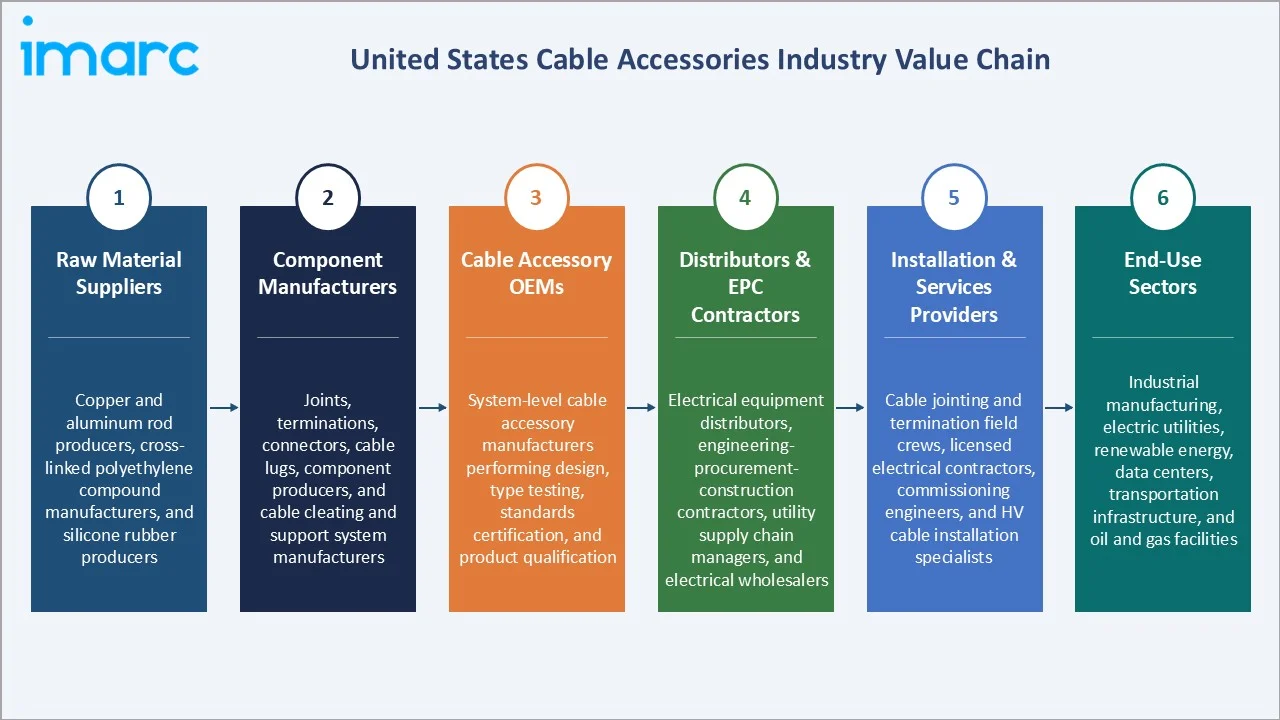
The US cable accessories value chain spans from raw material suppliers providing copper, aluminum, polymers, and insulation compounds through component manufacturers, cable accessory OEMs performing system-level design and qualification, distribution channels serving installer and EPC contractor procurement, and field installation specialists deploying accessories in utility and industrial electrical infrastructure projects.
|
Stage |
Key Players / Examples |
|
Raw Material Suppliers |
Copper and aluminum rod producers, cross-linked polyethylene compound manufacturers, and silicone rubber producers |
|
Component Manufacturers |
Joints, terminations, connectors, cable lugs, component producers, and cable cleating and support system manufacturers |
|
Cable Accessory OEMs |
System-level cable accessory manufacturers performing design, type testing, standards certification, and product qualification |
|
Distributors & EPC Contractors |
Electrical equipment distributors, engineering-procurement-construction (EPC) contractors, utility supply chain managers, and electrical wholesalers |
|
Installation & Services Providers |
Cable jointing and termination field crews, licensed electrical contractors, commissioning engineers, and specialized high-voltage cable system installation specialists |
|
End-Use Sectors |
Industrial manufacturing, electric utilities, renewable energy, data centers, transportation infrastructure, and oil and gas facilities |
Technology Landscape in the United States Cable Accessories Industry
XLPE Cable Accessory Technology
Cross-linked polyethylene (XLPE) insulated cable systems have become the standard for MV and HV underground cable installations in the US, replacing oil-paper insulated cables in all new installations and upgrades. XLPE cable accessories are technically complex, requiring precision stress control components that manage the electrical field at the cable termination and joint to prevent partial discharge and insulation breakdown. Pre-molded silicone rubber stress cones, geometric field control layers, and elastomeric outer sheaths collectively provide the insulation and field management function in modern XLPE cable accessories.
Cold Shrink and Heat Shrink Technology
Cold shrink and heat shrink cable accessory technologies provide simplified installation alternatives to field-molded and pre-molded accessories, enabling faster installation by workers with less specialized training. Cold shrink accessories use pre-expanded elastomeric components that are held in an expanded state by removable cores, shrinking onto the cable when the core is removed. Heat shrink accessories use thermally-responsive polymer components that contract when heated with a hot air gun or torch.
Gas-Insulated Switchgear Connected Terminations
Gas-insulated switchgear (GIS) connected cable terminations for high-voltage cable connections at substation GIS equipment represent a specialized and growing cable accessory category driven by the US transmission grid’s transition from air-insulated to GIS-based substations in constrained urban environments. SF6-insulated and eco-gas alternatives for GIS-connected cable terminations at 115kV–500kV require precision engineering and factory testing before shipment, with lead times of 12–52 weeks.
Market Segmentation Analysis
The report covers the following segments:
|
Segment Category |
Leading Segment |
Market Share |
Year |
|
Voltage |
Low Voltage Cable Accessories |
48.5% |
2025 |
|
End User |
Industrial |
71.4% |
2025 |
|
Installation |
Overhead Cable Accessories |
🔒 |
2025 |
|
Region |
South |
38.7% |
2025 |

By Voltage
Low voltage cable accessories lead with a 48.5% share of the market in 2025. LV accessories serve the broadest range of applications across commercial, industrial, and residential electrical infrastructure at voltages below 1kV. The LV accessory market is characterized by high volume and standardization, with connectors, lugs, cable glands, heat shrink tubing, and insulation tape collectively representing the most commonly deployed accessories across every electrical installation in the US.
To access detailed market analysis, Request Sample
Medium voltage cable accessories at 34.2% serve utility distribution systems, renewable energy collector systems (typically 15kV–35kV), and industrial primary voltage service entrances. MV accessories are the fastest-growing voltage category, driven by underground cable conversion programs at electric utilities, renewable energy farm collector system build-out, and industrial facility primary voltage service upgrades for large power consumers, including data centers and EV charging hub facilities.
By End User
Industrial leads with a 71.4% share of the end user segment in 2025, reflecting the structural primacy of utility, manufacturing, petrochemical, mining, and data center customers as cable accessory procurement organizations, typically deploying in large volumes across major capital projects with multi-year procurement pipelines. The utility sub-sector represents the largest individual industrial end-user category, with US electric utilities’ combined annual capital expenditure above USD 150 Billion including substantial cable system upgrade investment.
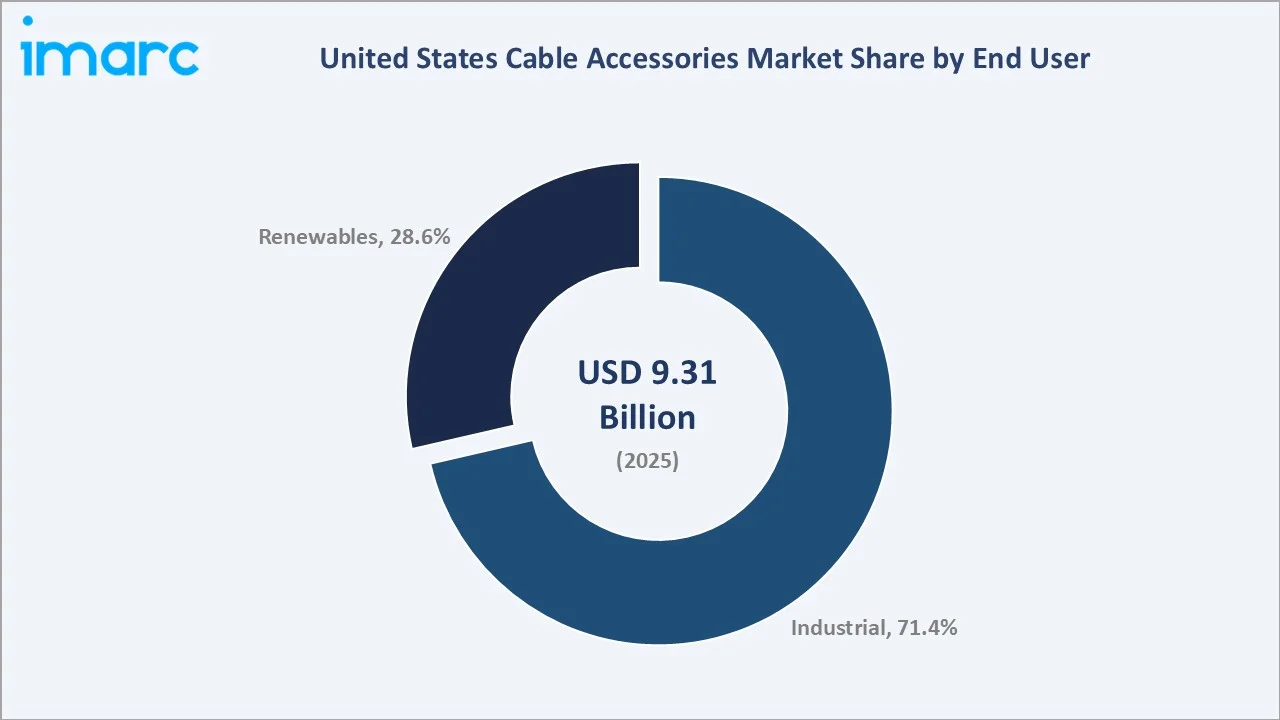
Renewables at 28.6% is projected to be one of the fastest-growing end user segments, driven by the US’s unprecedented renewable energy capacity addition program requiring extensive MV collector system cable accessories and HV transmission interconnection accessories for each new project. At 70–100 GW of new renewable additions annually projected through 2030, the renewables end user segment is creating the largest structural demand growth within the cable accessories market over the forecast period.
Regional Market Insights
The South’s dominant position (38.7%, 2025) reflects the region’s combination of the largest electric utility transmission and distribution infrastructure base, the largest US wind energy installed capacity in Texas, rapidly growing Gulf Coast solar development, and the highest concentration of petrochemical and industrial facility cable infrastructure.
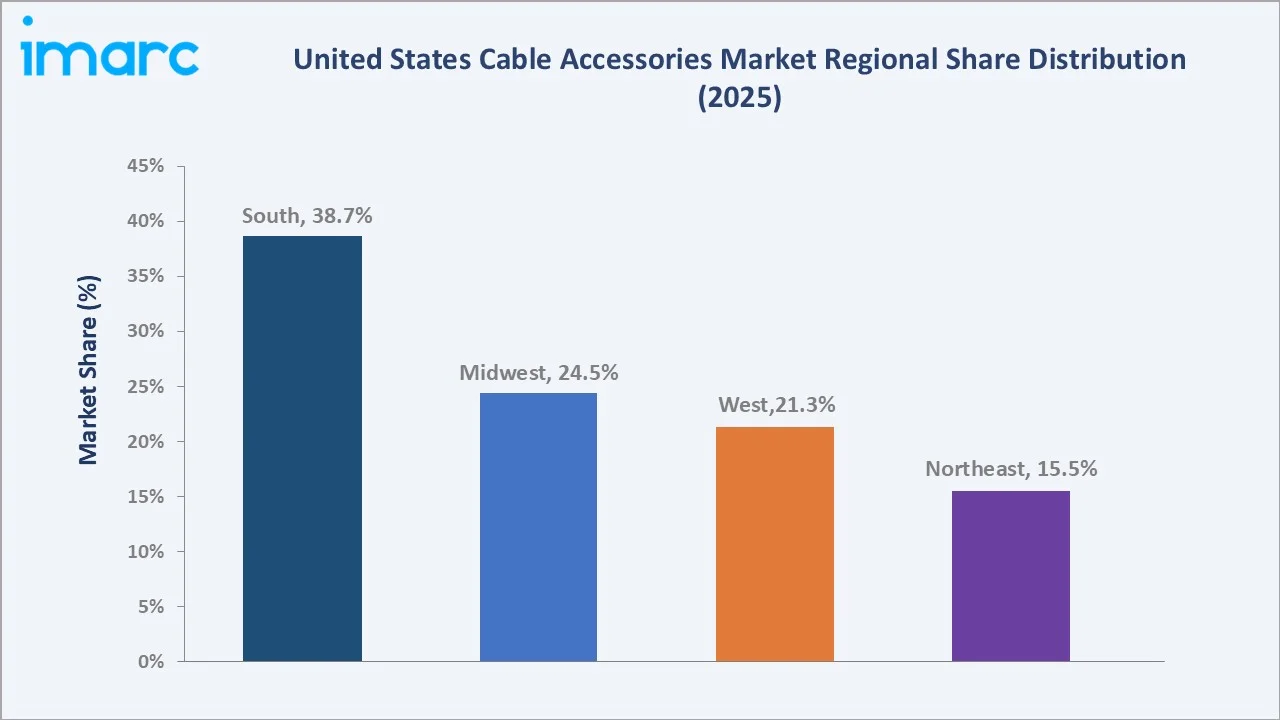
The Midwest at 24.5% benefits from its large industrial manufacturing base, creating consistent MV cable accessory demand and major electric utility grid upgrade programs in the PJM Interconnection service territory. The West at 21.3% is experiencing above-market growth driven by California’s accelerated solar deployment, the Four Corners renewable energy development zone across Arizona, New Mexico, and Colorado, and the rapid growth of data center clusters in the Pacific Northwest.
|
Region |
Share (2025) |
Key Growth Drivers |
|
South |
38.7% |
Largest concentration of US electric utility transmission and distribution infrastructure, significant oil and gas and petrochemical industrial complex, major renewable energy investment in Texas, Florida, Georgia, and the Carolinas |
|
Midwest |
24.5% |
Large industrial manufacturing base creating sustained MV cable accessory demand, major electric utility grid upgrade programs, growing wind energy installations, and automotive electrification plant expansion driving industrial electrical infrastructure investment |
|
West |
21.3% |
Rapid solar and wind energy expansion creating HV and MV cable accessory demand, major data center cluster development, state-level grid decarbonization investment, and significant utility-scale battery storage interconnection cable accessory requirements |
|
Northeast |
15.5% |
Offshore wind port infrastructure and submarine cable landing station cable accessory demand, significant utility grid hardening investment following major storm events, and concentrated data center and pharmaceutical industrial facility cable infrastructure demand |
The Northeast at 15.5% is characterized by the highest density of underground cable systems in the US, concentrated offshore wind development along the Atlantic coast, and dense urban cable upgrade requirements.
Competitive Landscape
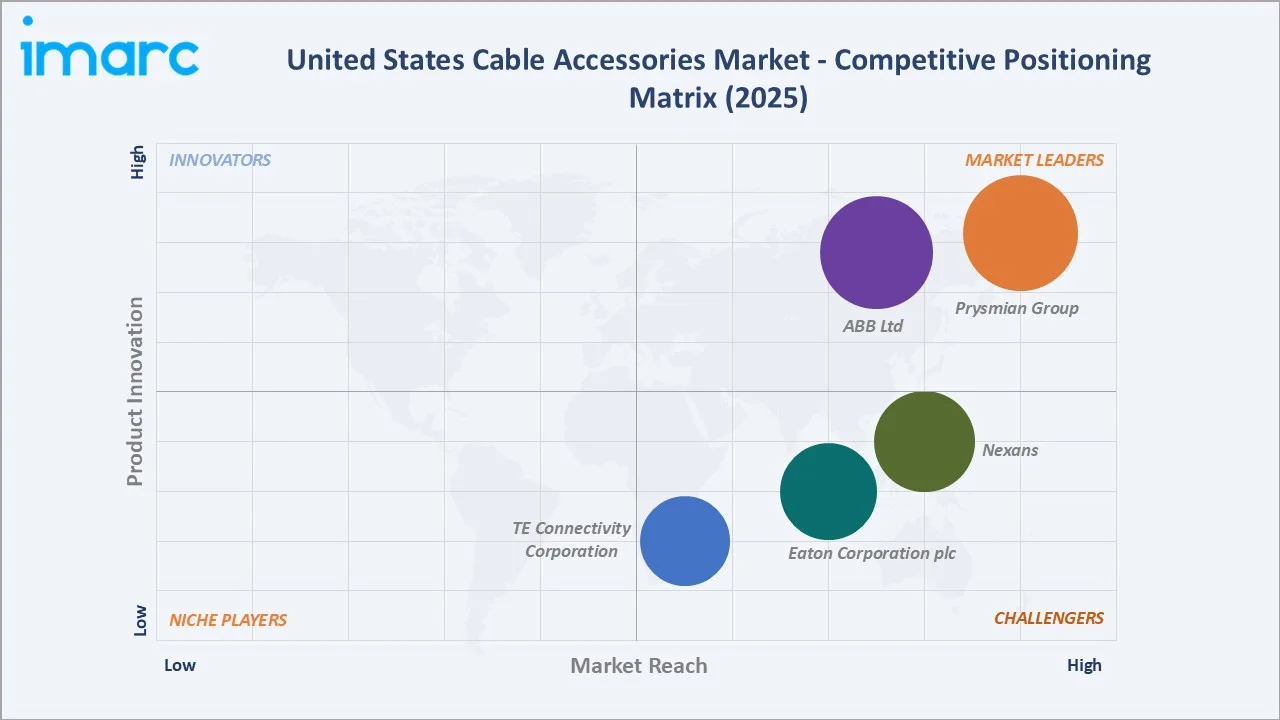
The United States cable accessories market exhibits moderate-to-high concentration among global electrical infrastructure companies that combine cable and cable accessory manufacturing into integrated product platforms.
|
Company Name |
Key Products |
Market Position |
Core Strength |
|
Prysmian Group |
High Voltage & Extra High Voltage Cable Accessories, Low Voltage & Medium Voltage Cable Accessories |
Market Leader |
Broadest HV and MV cable accessory portfolio; strong US utility and renewable relationships |
|
ABB Ltd |
Elastimold Cable Accessories |
Market Leader |
Strong utility and industrial customer relationships; advanced XLPE cable accessory systems |
|
Nexans |
Reliable Joints, Reliable Grids, Nexans Cold Shrink Joints Easy Tech |
Strong Challenger |
Strong offshore wind and submarine cable accessory capability; growing US renewable energy market presence |
|
Eaton Corporation plc |
Contacts, Connectors, Cable assemblies, and Other Accessories |
Strong Challenger |
Strong industrial and data center customer base; US-headquartered with domestic manufacturing |
|
TE Connectivity Corporation |
Cable Tie Mounts & Accessories, Cable Ties, RAYCHEM Cable Assemblies |
Challenger |
Broad industrial and utility cable accessory connectivity portfolio; strong MV cold shrink and heat shrink termination capability |
The competitive landscape is evolving as the IIJA funding wave and renewable energy build-out create demand acceleration that is straining established supply chains and creating opportunity for new entrants with US manufacturing capability.
Key Company Profiles
Prysmian Group
Prysmian Group is one of the world’s largest cable manufacturers and one of the leading cable accessory providers globally, with significant US operations through its Prysmian Americas division.
- Product Portfolio: MV cable joints and terminations, HV cable terminations and joints for 69kV–500kV applications, submarine cable accessories for offshore applications, LV connectors and cable protection systems, and Prysmian Pry-Cam digital cable monitoring accessories.
- Recent Developments: In June 2025, Prysmian Group, with Invenergy’s support, completed a 51,000 sq. ft. expansion of its Williamsport, Pennsylvania facility, strengthening U.S. energy supply-chain manufacturing. The facility will support the Grain Belt Express transmission project, use U.S. steel and aluminum for conductor cables, and double U.S. manufacturing capacity for certain advanced transmission conductors.
- Strategic Focus: US manufacturing expansion for domestic content compliance; offshore wind cable accessory development for US Atlantic wind projects; digital cable monitoring accessory integration; HV transmission accessory supply for IIJA grid upgrade projects.
ABB Ltd
ABB Ltd is one of the global technology leaders in electrification and automation with a significant cable accessories business through its High Voltage Products division, serving utility and industrial customers with type-tested HV cable terminations and joints for transmission infrastructure applications.
- Product Portfolio: HV cable terminations for GIS and outdoor applications (69kV–765kV), HV cable joints including prefabricated straight and cross bonding joints, medium voltage cable accessories, and cable condition monitoring systems.
- Recent Developments: In April 2025, ABB opened a USD 40+ million, 90,000-square-foot manufacturing facility in Albuquerque, New Mexico, to support electric utility, renewable energy, grid hardening, and U.S. infrastructure projects. The facility will double production capacity for ABB Elastimold cable accessories and Fisher Pierce circuit solutions, while creating over 150 full-time jobs and adding automation-led manufacturing capabilities.
- Strategic Focus: HV cable termination leadership for US transmission upgrade projects; eco-insulation GIS-connected termination development; digital monitoring integration for condition-based maintenance; US utility direct relationships for major transmission projects.
Market Concentration Analysis
The US cable accessories market exhibits moderate-to-high concentration at the specialized HV accessory tier and moderate concentration in the MV accessory tier, where key players compete alongside regional specialists. The LV accessory market is considerably more fragmented, with hundreds of smaller manufacturers and importers competing across connector, lug, gland, and protection accessory categories.
The IIJA funding wave and Build America Buy America provisions are creating incentives for domestic manufacturing investment that may shift competitive dynamics, with companies able to manufacture accessories domestically gaining preferential procurement status for federally funded grid modernization projects. This policy environment is encouraging existing US manufacturers to evaluate capacity expansion in cable accessory product categories previously served primarily by imported products.
Investment & Growth Opportunities
Fastest Growing Segments
Renewables end user (~7–8% CAGR), Medium voltage cable accessories (~6% CAGR), offshore wind specialized accessories (~12–15% annual growth), and data center MV service entrance accessories represent the highest-growth investment vectors within the US cable accessories market through 2034. Underground cable conversion program, MV accessories, and IIJA-funded transmission HV accessories represent the highest-volume procurement categories over the near-term 2025–2028 period.
Emerging Trends
The digitalization of cable accessories through embedded monitoring technology is creating a new premium product category where smart accessories command significant price premiums above standard accessories. Domestic content preferences under the IIJA and Buy Clean America initiatives are driving US manufacturing investment interest in cable accessory categories currently served by imported products, potentially reshaping the competitive landscape toward more domestic manufacturing over the forecast period.
Technology Investment Trends
- Smart cable accessory monitoring system investment is attracting venture and corporate R&D capital as utility customers’ interest in condition-based cable maintenance grows, with partial discharge detection, temperature monitoring, and insulation resistance measurement integrated into cable accessory form factors, enabling non-invasive cable condition assessment without service interruption.
- Pre-molded MV accessory manufacturing capacity investment is being driven by renewable energy project demand acceleration, with cable accessory manufacturers expanding production of cold shrink and push-on MV accessories that enable faster and less skill-dependent installation in the high-volume renewable energy project market.
Future Market Outlook (2026-2034)
The United States cable accessories market is positioned for sustained above-GDP growth through 2034. From USD 9.31 Billion in 2025 to USD 9.81 Billion in 2026, the market is projected to reach USD 15.09 Billion by 2034, representing total incremental value creation of USD 5.78 Billion at a CAGR of 5.34%.
This growth is underpinned by the multi-year federal grid investment wave creating sustained utility procurement demand, the renewable energy capacity addition program creating non-discretionary MV cable accessory demand for each new GW of solar and wind capacity, and the industrial electrification megatrend creating structural above-historical-average cable accessory demand in manufacturing, data center, and transportation infrastructure.
The market’s competitive dynamics will evolve as domestic manufacturing capability development alters competitive positioning in federally funded project procurement, digital smart accessory products create new premium revenue opportunities above standard accessory pricing, and the offshore wind sector’s development creates a structurally new high-value HV submarine cable accessory market category in the US.
Research Methodology
Primary Research
Primary research comprised structured interviews with over 60 industry participants in 2024–2025, including cable accessory manufacturer executives, US electric utility project and procurement engineers, EPC contractor electrical infrastructure project managers, renewable energy developer electrical BOS procurement specialists, and electrical equipment distributor executives. Expert input validated market sizing, segment growth rates, and regional demand estimates.
Secondary Research
Secondary research encompassed cable accessory company annual reports and investor presentations, US Department of Energy Grid Deployment Office IIJA program data, FERC transmission infrastructure investment statistics, American Clean Power Association renewable energy capacity addition data, Edison Electric Institute utility capital expenditure surveys, NERC reliability assessment data, and industry publications including Transmission & Distribution World, Electric Light & Power, and IEEE Power & Energy Magazine.
Forecasting Models
Market size estimations were derived using top-down and bottom-up forecasting, incorporating US electric utility transmission and distribution capital expenditure projections, renewable energy capacity addition volume modelling, industrial electrification investment trend data, data center electrical service entrance demand analysis, and IIJA and IRA program procurement timeline modelling.
Report Coverage:
| Report Features | Details |
|---|---|
| Base Year of the Analysis | 2025 |
| Historical Period | 2020-2025 |
| Forecast Period | 2026-2034 |
| Units | Billion USD |
| Scope of the Report | Exploration of Historical Trends and Market Outlook, Industry Catalysts and Challenges, Segment-Wise Historical and Future Market Assessment:
|
| Voltages Covered | Low Voltage Cable Accessories, Medium Voltage Cable Accessories, High Voltage Cable Accessories |
| Installations Covered | Overhead Cable Accessories, Underground Accessories |
| End Users Covered | Industrial, Renewables |
| Regions Covered | Northeast, Midwest, South, West |
| Companies Covered | Prysmian Group, ABB Ltd, Nexans, Eaton Corporation plc, TE Connectivity Corporation, etc. |
| Customization Scope | 10% Free Customization |
| Post-Sale Analyst Support | 10-12 Weeks |
| Delivery Format | PDF and Excel through Email (We can also provide the editable version of the report in PPT/Word format on special request) |
Frequently Asked Questions About the United States Cable Accessories Market Report
The United States cable accessories market size is estimated at USD 9.81 Billion in 2026 and is projected to reach USD 15.09 Billion by 2034.
The market is expected to grow at a CAGR of 5.34% during 2026-2034, driven by IIJA grid modernization investment, renewable energy grid integration, industrial electrification, and data center capacity expansion.
The South leads with a 38.7% share in 2025, driven by the region’s large electric utility infrastructure base, significant oil and gas and industrial complex, Texas wind and solar energy development, and growing data center and advanced manufacturing investment.
Low voltage cable accessories lead with a 48.5% share in 2025, reflecting broad deployment across commercial, industrial, and residential electrical infrastructure. Medium Voltage is the fastest-growing voltage segment, driven by renewable energy collector systems and utility distribution upgrade demand.
Industrial leads with a 71.4% share in 2025, reflecting the structural primacy of utility, manufacturing, petrochemical, and data center customers.
Some of the key players include Prysmian Group, ABB Ltd, Nexans, Eaton Corporation plc, and TE Connectivity Corporation.
Key drivers include the IIJA’s grid modernization investment, creating multi-year utility procurement demand, and renewable energy grid integration.
Key opportunities include offshore wind submarine cable accessories, utility underground cable conversion program MV accessories, data center MV service entrance accessories, and US domestic manufacturing investment for Build America Buy America qualification in federally funded grid projects.
Need more help?
- Speak to our experienced analysts for insights on the current market scenarios.
- Include additional segments and countries to customize the report as per your requirement.
- Gain an unparalleled competitive advantage in your domain by understanding how to utilize the report and positively impacting your operations and revenue.
- For further assistance, please connect with our analysts.
 Request Customization
 Speak to an Analyst
 Request Brochure
 Inquire Before Buying
Benefits of Customization
- Personalize this research
- Triangulate with your data
- Get data as per your format and definition
- Gain a deeper dive into a specific application, geography, customer, or competitor
- Any level of personalization
Get in Touch With Us
UNITED STATES
Phone: +1-201-971-6302
INDIA
Phone: +91-120-433-0800
UNITED KINGDOM
Phone: +44-753-714-6104
Email: [email protected]
Client Testimonials




.webp)




.webp)













Related Reports

Choose your plan
*Please note that the prices mentioned below are starting prices for each bundle type. Kindly contact our team for further details.*
Single User License
- 1 User License, Access on 2 Devices
- PDF Report + Excel Dataset (Password Protected)
- Lifetime Access
- No Printing Rights
- 10% Free Report Customization
- 10–12 Weeks of Analyst Support
Five User License
- Access for 5 Users, 2 Devices per User
- PDF Report + Excel Dataset (Password Protected)
- Lifetime Access
- Dedicated Account Manager
- 12–14 Weeks of Analyst Support
- No Printing Rights
- 15% Free Report Customization
- 25% Discount on Your Next Purchase
Corporate User License
- Unlimited User Access (Within Your Organization)
- PDF Report + Excel Dataset
- Lifetime Access
- Dedicated Account Manager
- 14–20 Weeks of Analyst Support
- No Printing Rights
- 20% Free Report Customization
- 30% Discount on Your Next Purchase
Essential Insights
What's included:
3 reports
- Lifetime Access
- PDF Reports
- Excel Datasets
- 2 Weeks of Free Analyst Support
- 2 User Licenses
- Access on 2 Devices
- Printing Rights
- Complimentary PowerPoint (PPT) Version
- Complimentary License Upgrade
Professional Access
What's included:
5 reports
- Lifetime Access
- PDF Reports
- Excel Datasets
- 8 Weeks of Free Analyst Support
- 2 User Licenses
- Access on 2 Devices
- Printing Rights
- Complimentary PowerPoint (PPT) Version
- Complimentary License Upgrade
Business Advantage
What's included:
8 reports
- Lifetime Access
- PDF Reports
- Excel Datasets
- 14 Weeks of Free Analyst Support
- 2 User Licenses
- Access on 2 Devices
- Printing Rights
- Complimentary PowerPoint (PPT) Version
- Complimentary License Upgrade
Enterprise Intelligence
What's included:
10 reports
- Lifetime Access
- PDF Reports
- Excel Datasets
- 20 Weeks of Free Analyst Support
- 2 User Licenses
- Access on 2 Devices
- Printing Rights
- Complimentary PowerPoint (PPT) Version
- Complimentary License Upgrade