
United States Machine Learning Market Size, Share, Trends and Forecast by Component, Deployment, Enterprise Size, End Use, and Region, 2026-2034
United States Machine Learning Market Size, Share, Trends & Forecast (2026-2034)
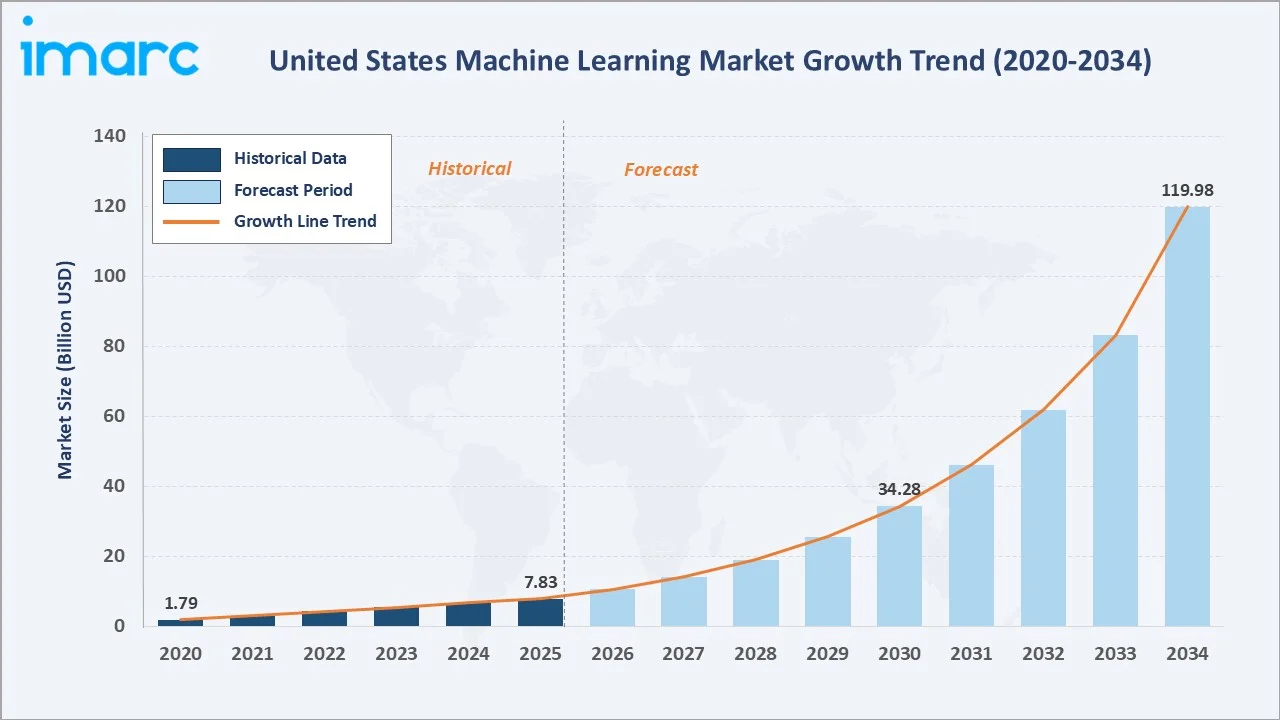
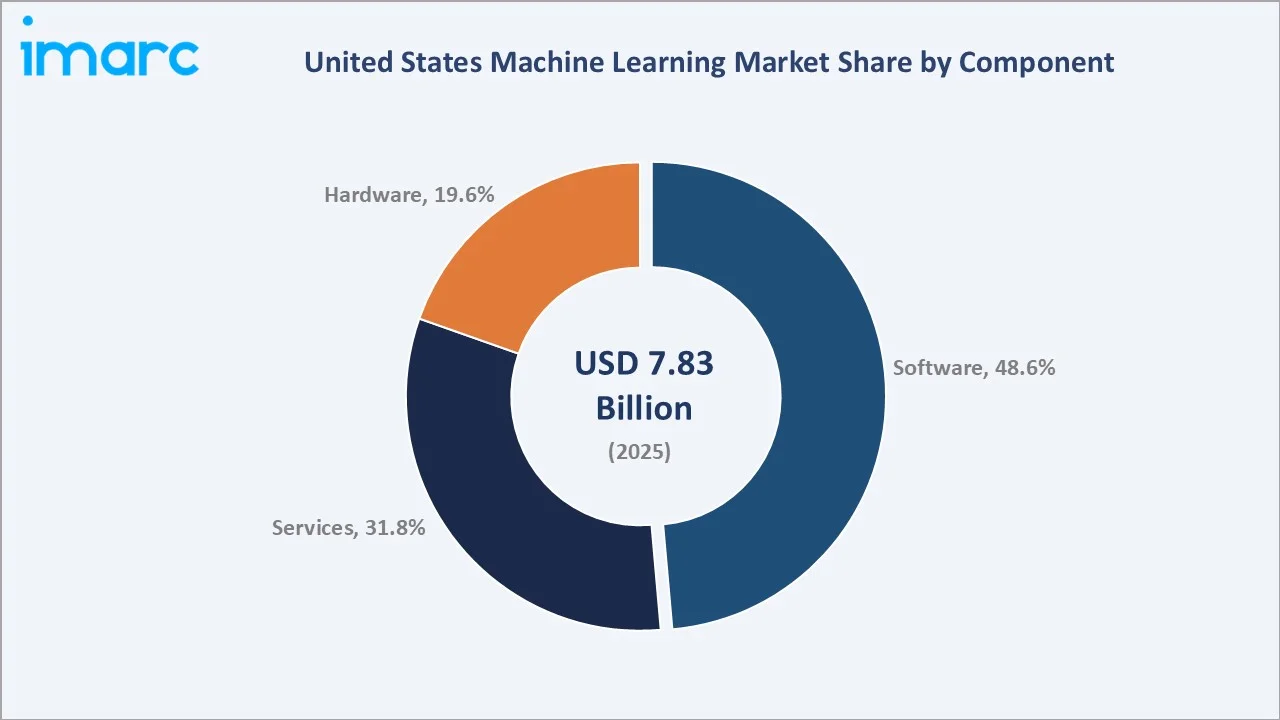
The US machine learning market grew from USD 7.83 Billion in 2025 and is estimated to reach USD 10.52 Billion in 2026. The market is further projected to reach USD 119.98 Billion by 2034, growing at a CAGR of 34.37% during 2026-2034. The market is driven by rapid enterprise AI adoption across healthcare, BFSI, and manufacturing, exponential growth in big data generation, and sustained cloud infrastructure investment. Generative AI commercialization and edge ML deployment are further accelerating market expansion. Software dominates Component at 48.6%. Cloud-based leads Deployment at 68.4%. The West commands 37.5% of the national market share.
Market Snapshot
|
Metric |
Value |
|
Base Year Market Size (2025) |
USD 7.83 Billion |
|
Market Size (2026) |
USD 10.52 Billion |
|
Forecast Market Size (2034) |
USD 119.98 Billion |
|
CAGR (2026-2034) |
34.37% |
|
Base Year |
2025 |
|
Historical Period |
2020-2025 |
|
Forecast Period |
2026-2034 |
|
Dominant Deployment |
Cloud-based (68.4%, 2025) |
|
Dominant Component |
Software (48.6%, 2025) |
|
Leading Region |
West (37.5%, 2025) |
The US machine learning market size increased from USD 1.79 Billion in 2020 to USD 7.83 Billion in 2025 and is estimated to reach USD 10.52 Billion in 2026. The market is further expected to grow to USD 34.28 Billion by 2030 and USD 119.98 Billion by 2034, at a CAGR of 34.37% during 2026-2034. The US machine learning market is commercially significant globally, driven by enterprise AI adoption, cloud scalability, and generative AI commercialization across high-value industry verticals.
To get more information on this market, Request Sample
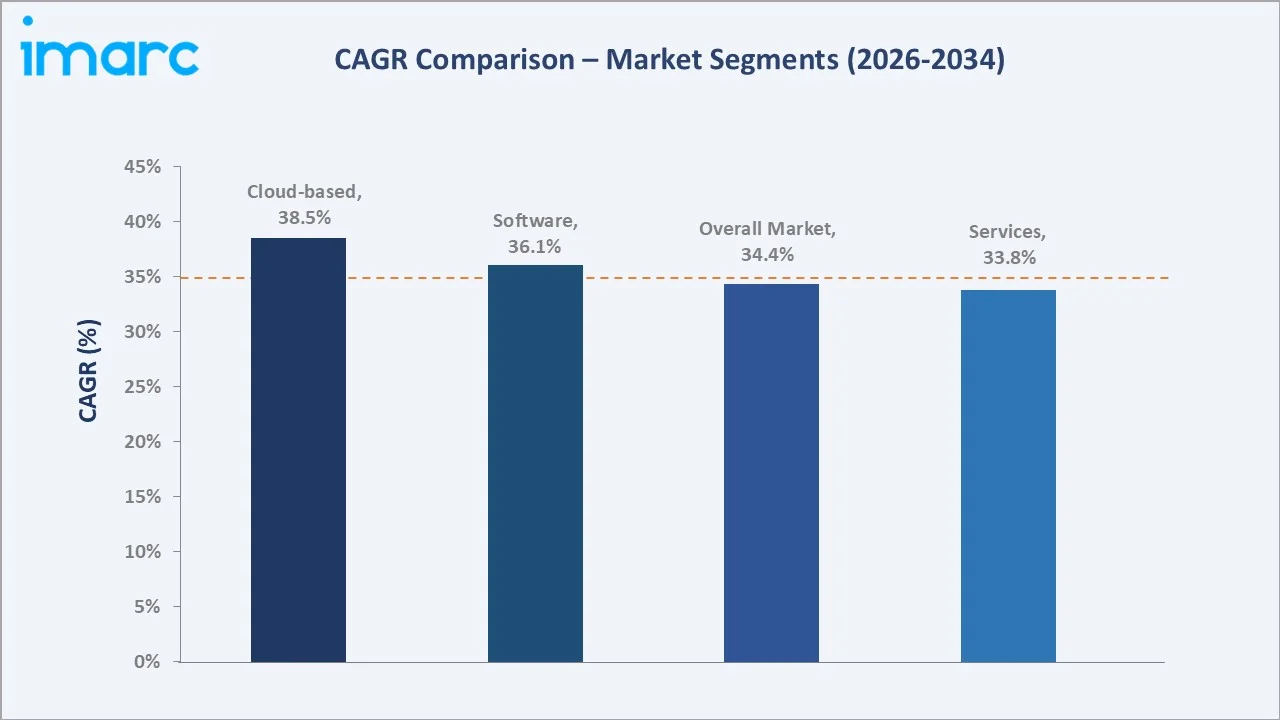
The Software component segment grows fastest at ~36.1% CAGR through enterprise AI platform subscriptions and API-based ML service consumption, while Cloud-based deployment accelerates market accessibility at ~38.5% CAGR. Hardware grows at ~28.4% CAGR through GPU accelerator demand from hyperscalers and enterprise data centers.
Executive Summary
The US machine learning market expanded from USD 7.83 Billion in 2025 to an estimated USD 10.52 Billion in 2026, positioning it among the world's fastest-growing national AI markets by value. The market's scale is underpinned by enterprise digital transformation across healthcare, BFSI, and manufacturing, sustained cloud infrastructure investment by hyperscalers, and the commercial scaling of generative AI applications. The market is projected to reach USD 119.98 Billion by 2034.
Cloud-based deployment at 68.4% leads through cost-effective scalability and managed ML service accessibility. Software at 48.6% reflects the dominant component for ML platform subscriptions and AI application development. The West at 37.5% leads regionally due to Silicon Valley and Seattle tech hub concentration.
Key Market Insights
|
Insight |
Data |
|
Dominant Deployment |
Cloud-based – 68.4% share (2025) |
|
Dominant Component |
Software – 48.6% market share (2025) |
|
Leading Region |
West – 37.5% share (2025) |
|
Market Opportunity |
Edge AI; Healthcare & FinTech ML integration; Enterprise GenAI |
Key Analytical Observations Supporting the Above Data:
- Cloud-based at 68.4%: This segment dominates due to its critical role in enabling scalable, cost-efficient ML deployment across large enterprises and SMBs. Managed GPU infrastructure and hyperscaler-provided ML APIs ensure sustained procurement above on-premises demand through 2034.
- Software at 48.6%: Software leads component share due to recurring subscription revenue from ML platforms, widespread open-source framework commercialization, and growing enterprise demand for AutoML tools and AI application software growing at ~36.1% CAGR.
- West at 37.5%: The West leads regionally due to Silicon Valley's concentration of AI-native companies, hyperscaler headquarters, and the highest density of ML research institutions and venture-backed AI startups driving the national ML market.
United States Machine Learning Market Overview
The US machine learning market is commercially positioned at the convergence of enterprise digital transformation, cloud infrastructure expansion, and generative AI adoption. The market's commercial structure is characterized by high software platform growth, enterprise end-user vertical penetration, and accelerating cloud consumption across large enterprises and SMBs in all end-use industries.
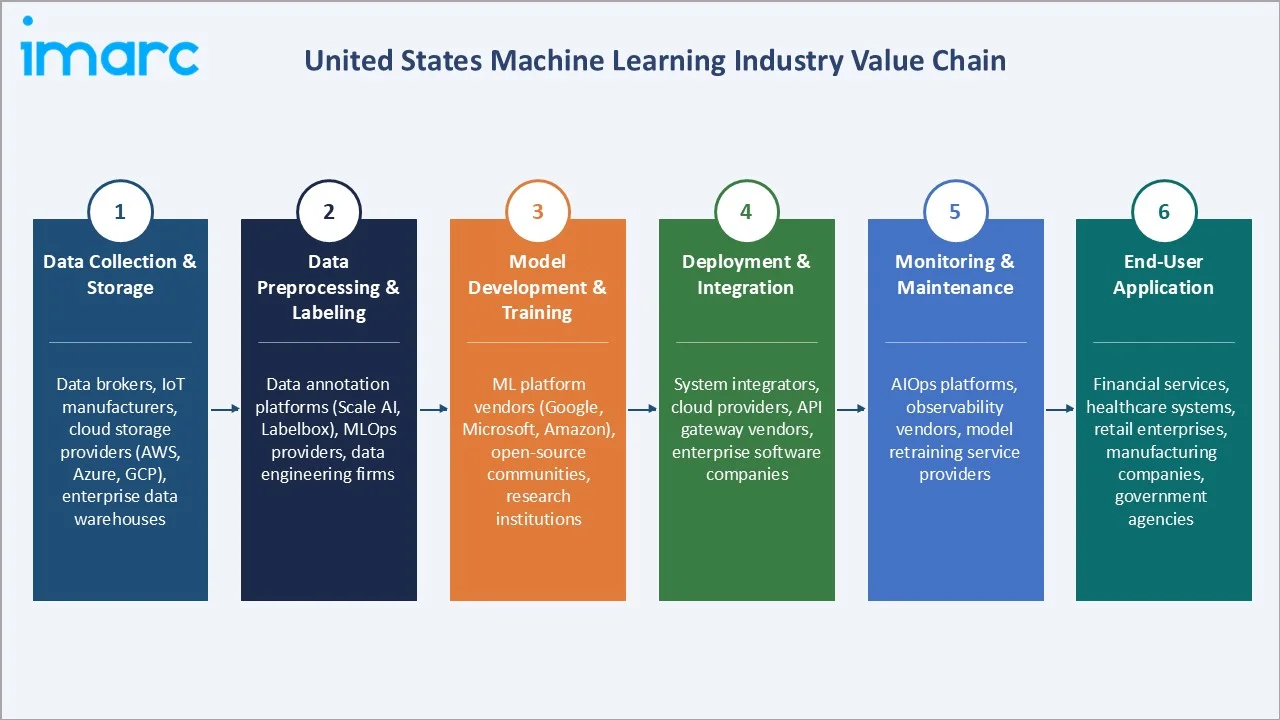
The US ML ecosystem integrates hyperscaler cloud platforms, specialized software vendors, hardware accelerator providers, data annotation services, and system integrators serving enterprise deployment requirements across healthcare, BFSI, retail, manufacturing, advertising and media, and automotive end-use verticals.
Market Dynamics
To evaluate market opportunities, Request Sample
Market Drivers
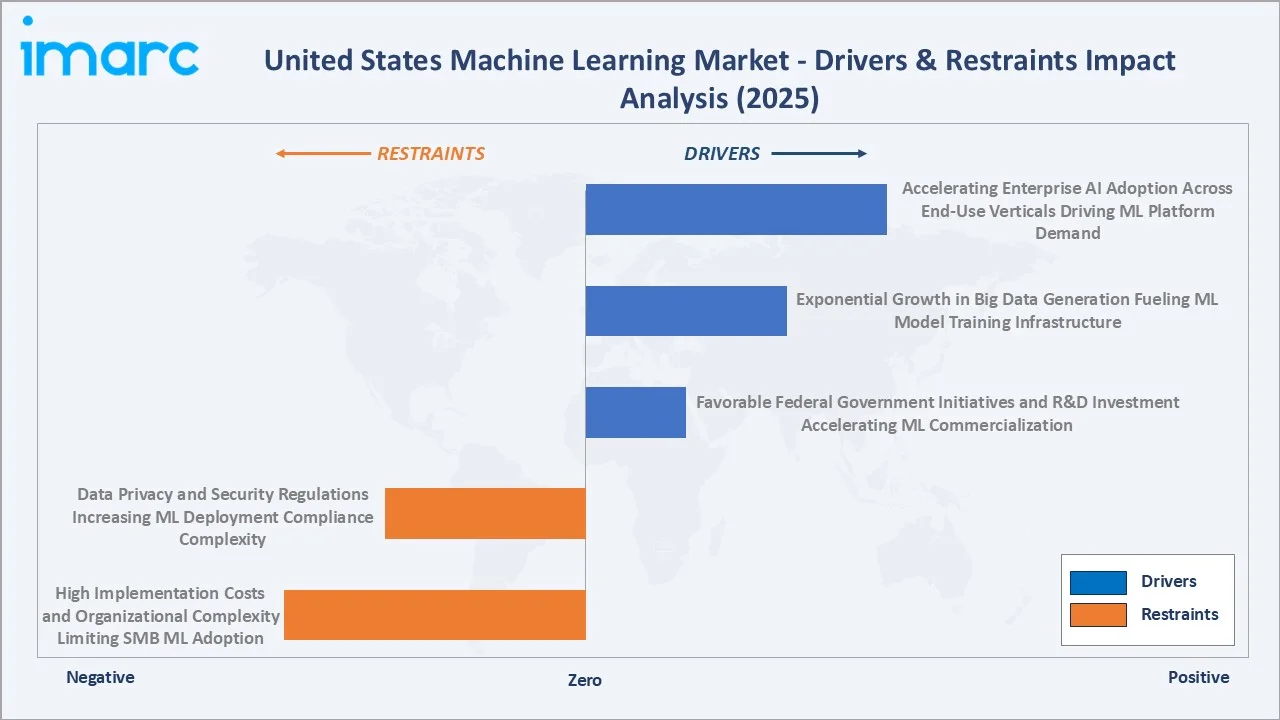
- Accelerating Enterprise AI Adoption Across End-Use Verticals Driving ML Platform Demand: US enterprises across healthcare, BFSI, retail, and manufacturing are systematically integrating ML into core business processes, creating sustained demand for ML platforms, tools, and managed services. Ongoing capital investments in enterprise AI programs and digital transformation initiatives are driving procurement of cloud-based and on-premises ML solutions. Generative AI productivity tool deployment is further amplifying ML software consumption across large enterprises and SMBs.
- Exponential Growth in Big Data Generation Fueling ML Model Training Infrastructure: The proliferation of IoT devices, digital transactions, social media platforms, and enterprise applications generates unprecedented data volumes, providing the training foundation for increasingly accurate ML models. Healthcare electronic records, BFSI transaction streams, and retail customer data assets are creating specialized training datasets that sustain demand for large-scale cloud ML training infrastructure and data preprocessing services.
- Favorable Federal Government Initiatives and R&D Investment Accelerating ML Commercialization: Federal AI investment through the CHIPS Act, National AI Initiative, and DARPA programs funds foundational ML research, talent development, and early-stage commercialization pathways. Government-sponsored ML programs in healthcare diagnostics, defense applications, and agriculture optimization create anchor demand that accelerates commercial ML market development and validates enterprise AI investment decisions across end-use sectors.
- Cloud Infrastructure Expansion by Hyperscalers Reducing ML Deployment Barriers: Hyperscaler investments in GPU-enabled cloud infrastructure, managed ML services, and API-based AI access substantially lower the technical and capital barriers for enterprise ML adoption. AWS, Google Cloud, and Azure ML platform expansions are enabling mid-market and SMB organizations to access enterprise-grade ML capabilities without private data center infrastructure investment requirements.
Market Restraints
- Data Privacy and Security Regulations Increasing ML Deployment Compliance Complexity: Federal and state data privacy regulations, including HIPAA in healthcare, GLBA in BFSI, and emerging state AI regulations, increase ML deployment complexity and compliance costs for enterprises. Training data governance, model audit requirements, and sensitive data handling restrictions create structured compliance burdens that slow ML deployment velocity across regulated end-use industry sectors.
- High Implementation Costs and Organizational Complexity Limiting SMB ML Adoption: Enterprise ML implementation requires significant investment in data infrastructure, model development, system integration, and organizational change management. The total cost of ML deployment is particularly burdensome for small and medium-sized enterprises, where constrained technology budgets and limited internal ML expertise create adoption barriers despite growing commercial ML service accessibility.
- Persistent Shortage of Skilled ML Talent Constraining Enterprise Deployment Velocity: Demand for ML engineers, data scientists, and AI architects significantly exceeds available talent supply across the United States. An accelerating skills gap and intense compensation competition among hyperscalers, AI-native companies, and enterprise organizations create deployment bottlenecks that limit the pace of enterprise ML rollout across all end-use verticals.
Market Opportunities
- Healthcare and Life Sciences AI Creating High-Value ML Application Market: US healthcare digitization and precision medicine investment is creating expanding demand for ML-powered diagnostic imaging, drug discovery acceleration, clinical decision support, and patient outcome prediction applications. FDA regulatory pathway development for AI medical devices and healthcare system procurement programs are creating structured, high-value ML application markets growing at above-overall-market CAGR through 2034.
- Generative AI Commercialization Expanding ML Market Total Addressable Revenue: The commercial scaling of enterprise generative AI applications — copilots, automated content generation, code assistance, and AI-native workflows — is substantially expanding the ML market's total addressable revenue well beyond traditional predictive analytics and classification model deployment use cases across all end-use industry verticals.
Market Challenges
- Model Explainability and Bias Risks Impeding Regulated Industry ML Adoption: ML model opacity and demonstrated algorithmic bias risks create regulatory scrutiny and institutional trust barriers that impede adoption in high-stakes regulated environments including BFSI credit decisions, healthcare clinical applications, and law enforcement analytics. Explainable AI technical requirements add development overhead that increases regulated-sector ML deployment timelines and costs.
- Rapid AI Platform Evolution Creating Technology Lock-in Risk for Enterprise Buyers: The accelerating pace of ML framework updates, foundation model releases, and cloud platform evolution creates migration risk and technical debt concerns for enterprise organizations, constraining long-term commitment to proprietary ML platforms and slowing large-scale production ML deployment investment decisions.
Emerging Market Trends
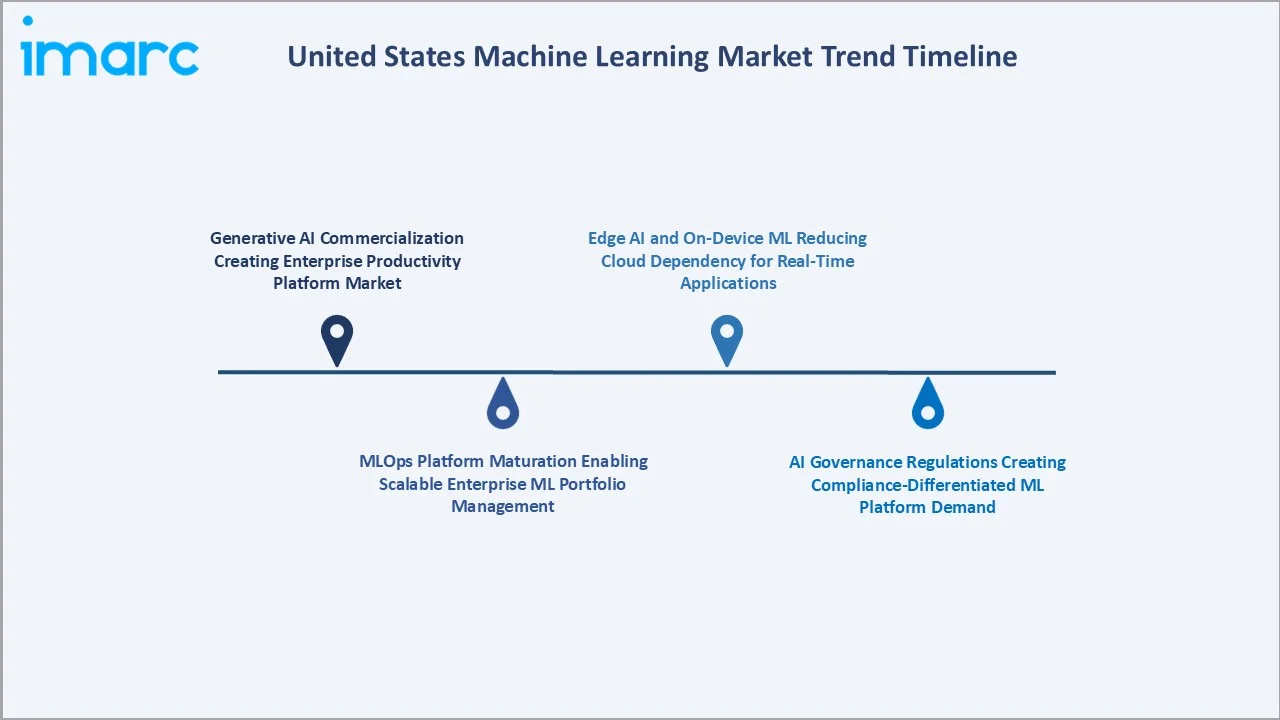
1. Generative AI Commercialization Creating Enterprise Productivity Platform Market
Enterprise generative AI adoption is creating a distinct productivity platform market above traditional ML infrastructure, with AI copilots, writing assistants, and automated workflow tools generating new recurring ML revenue streams. Vendors including Microsoft, Google, Salesforce, and AI-native companies are monetizing generative AI through seat-based subscription models growing at above-market CAGR across large enterprise and SMB customer segments.
2. Edge AI and On-Device ML Reducing Cloud Dependency for Real-Time Applications
Deployment of ML inference models on edge devices — automotive ADAS processors, industrial IoT sensors, medical diagnostic equipment, and mobile platforms — is creating a high-growth ML market segment. Specialized edge ML frameworks, inference-optimized chips from NVIDIA, Qualcomm, and Apple, and on-device AI software platforms are driving this architectural shift across manufacturing, healthcare, and automotive end-use verticals.
3. MLOps Platform Maturation Enabling Scalable Enterprise ML Portfolio Management
The MLOps category — encompassing model versioning, automated retraining pipelines, performance drift monitoring, and multi-cloud deployment orchestration — is maturing into a structured enterprise software market growing at approximately 38% CAGR. Organizations scaling from single ML pilots to portfolio deployment across BFSI risk models, retail recommendation engines, and healthcare diagnostic tools are driving structured MLOps platform investment and vendor consolidation.
4. AI Governance Regulations Creating Compliance-Differentiated ML Platform Demand
Emerging federal executive orders on AI safety and state-level AI regulation frameworks are driving enterprise demand for ML platforms with integrated explainability, bias testing, audit trail documentation, and regulatory reporting capabilities. This compliance requirement creates differentiated market opportunity for governance-first ML platform vendors serving healthcare, BFSI, and law end-use sectors that face the most stringent regulatory oversight in the United States.
Industry Value Chain Analysis
The US machine learning value chain is one of the most technically sophisticated knowledge-economy supply chains globally, spanning raw data collection and infrastructure through enterprise AI application delivery and ongoing model lifecycle management. High value concentration occurs at the model development and orchestration stages where competitive differentiation among platform vendors and specialist providers is most commercially significant.
|
Stage |
Key Participants |
|
Data Collection & Storage |
Data brokers, IoT manufacturers, cloud storage providers (AWS, Azure, GCP), enterprise data warehouses |
|
Data Preprocessing & Labeling |
Data annotation platforms (Scale AI, Labelbox), MLOps providers, data engineering firms |
|
Model Development & Training |
ML platform vendors (Google, Microsoft, Amazon), open-source communities, research institutions |
|
Deployment & Integration |
System integrators, cloud providers, API gateway vendors, enterprise software companies |
|
Monitoring & Maintenance |
AIOps platforms, observability vendors, model retraining service providers |
|
End-User Application |
Financial services, healthcare systems, retail enterprises, manufacturing companies, government agencies |
The model governance and compliance stage is emerging as the value chain's most commercially consequential regulatory checkpoint, as enterprise risk management requirements and evolving AI governance regulations create structured demand for auditable, explainable ML deployment frameworks. Healthcare, BFSI, and law end-use verticals represent the highest-value customer segments for governance-integrated ML platform solutions in the United States.
Technology Landscape in the United States Machine Learning Industry
Conventional Machine Learning Technologies
Conventional supervised, unsupervised, and reinforcement learning algorithms — including gradient boosting, random forests, support vector machines, and clustering methods — continue to serve foundational enterprise analytics requirements across BFSI fraud detection, retail demand forecasting, and manufacturing predictive maintenance applications. Established vendors and open-source frameworks including scikit-learn, XGBoost, and LightGBM maintain procurement stability through integration with enterprise data warehouse and BI platform ecosystems.
Deep Learning and Neural Network Technologies
Deep learning architectures including convolutional neural networks, transformer models, and large language models are integrating conventional ML pipelines with generative AI capabilities, driving the primary ML market growth wave at above 34% CAGR. Healthcare imaging analysis, advertising and media content generation, automotive perception systems, and BFSI document processing are being transformed through deep learning model deployment at commercial scale across enterprise customer segments.
Federated Learning and Privacy-Preserving ML Technologies
Federated learning, differential privacy, and secure multi-party computation technologies enable ML model training on distributed, sensitive datasets without centralizing raw data — creating critical regulatory-compliant deployment pathways for healthcare patient data, BFSI financial records, and government sensitive information. These privacy-preserving ML architectures are accelerating enterprise adoption in regulated verticals where traditional centralized ML training was previously infeasible due to data sovereignty and privacy compliance requirements.
Market Segmentation Analysis
The report covers the following segments:
|
Segment Category |
Leading Segment |
Market Share |
Year |
|
Component |
Software |
48.6% |
2025 |
|
Deployment |
Cloud-based |
68.4% |
2025 |
|
Enterprise Size |
🔒 |
🔒 |
2025 |
|
End Use |
🔒 |
🔒 |
2025 |
|
Region |
West |
37.5% |
2025 |

By Component
Software leads at 48.6% (2025), growing at ~36.1% CAGR during 2026-2034. This segment encompasses the most commercially essential ML capabilities, including development platforms, AutoML tools, model management solutions, and AI application software. Subscription-based SaaS delivery and API-based ML service consumption drive predictable recurring revenue growth across large enterprise and SMB customers in all end-use industry verticals across the United States.
To access detailed market analysis, Request Sample
Services at 31.8%, growing at ~33.8% CAGR, encompasses ML consulting, system integration, model training, and managed ML operations serving enterprise deployment requirements across all end-use verticals. Hardware at 19.6%, growing at ~28.4% CAGR, includes GPU accelerators, ML-optimized processors, and AI-dedicated server infrastructure from NVIDIA, AMD, and hyperscaler-custom silicon providers including Google TPUs and AWS Trainium.
By Deployment
Cloud-based leads at 68.4% (2025), growing at ~38.5% CAGR during 2026-2034. Cloud deployment serves the US machine learning market's highest-growth and broadest-adoption requirements across healthcare, BFSI, retail, and manufacturing end-use verticals. Elastic GPU compute scalability, hyperscaler-managed ML services, and pay-as-you-go cost structures align with enterprise procurement preferences and the agile, iterative development methodologies required for effective ML model development and deployment.
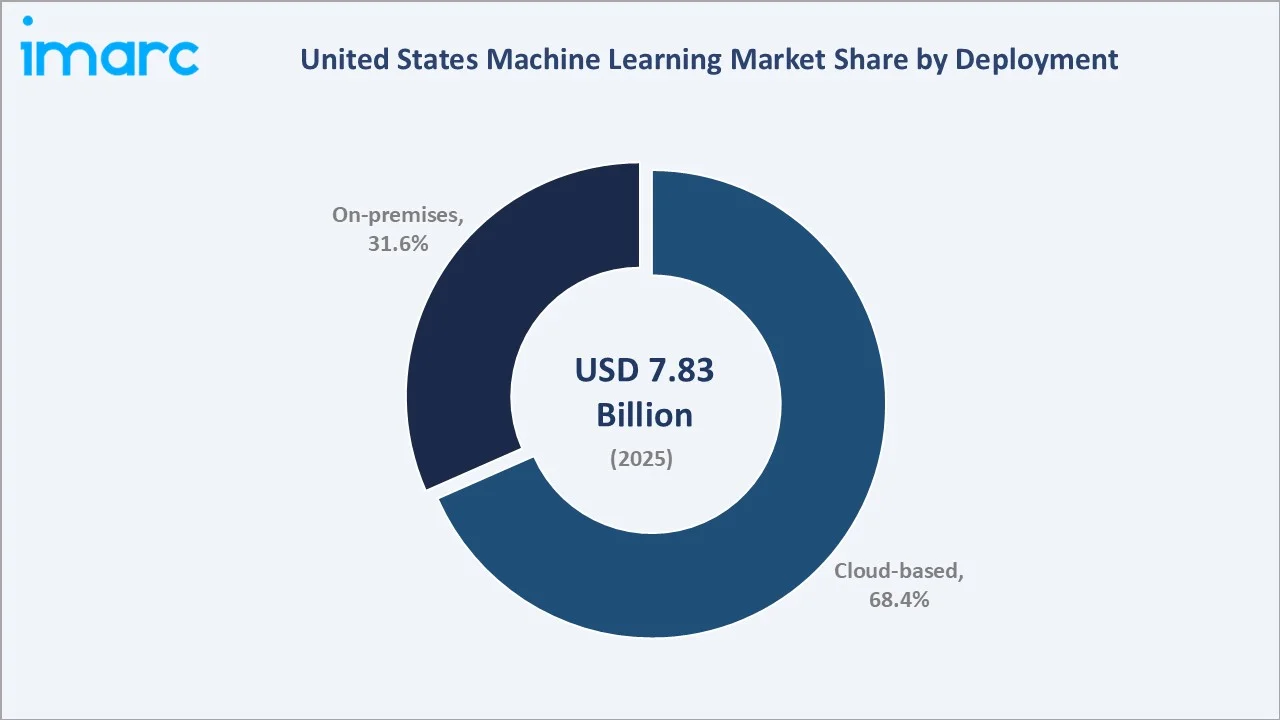
On-premises at 31.6%, growing at ~26.2% CAGR, serves regulated industry requirements for data sovereignty, latency-sensitive applications, and organizations with established private data center infrastructure and compliance mandates. Financial institutions, defense contractors, healthcare systems, and law firms represent the primary on-premises ML deployment segments, where data governance requirements prevent cloud-based ML training and inference workload migration.
Regional Market Insights
|
Region |
Share (2025) |
Key United States Machine Learning Market Drivers |
|
West |
37.5% |
Home to Silicon Valley and Seattle tech hubs; highest concentration of hyperscalers, AI startups, and ML R&D investment in the United States |
|
South |
28.6% |
Growing tech corridors in Texas and Florida; energy sector AI adoption and expanding data center infrastructure driving market growth |
|
Northeast |
20.1% |
Financial services AI leadership in New York City; pharma and biotech ML adoption in the Boston-Cambridge corridor |
|
Midwest |
13.8% |
Manufacturing automation and predictive maintenance ML; agricultural AI and supply chain optimization across industrial states |
The West's 37.5% market leadership reflects Silicon Valley's AI-native startup concentration, the Bay Area headquarters of Google, Apple, Meta, and NVIDIA, and Seattle's emergence as Microsoft's and Amazon's primary AI R&D hub, collectively generating the largest regional ML revenue and venture investment concentration in the United States.
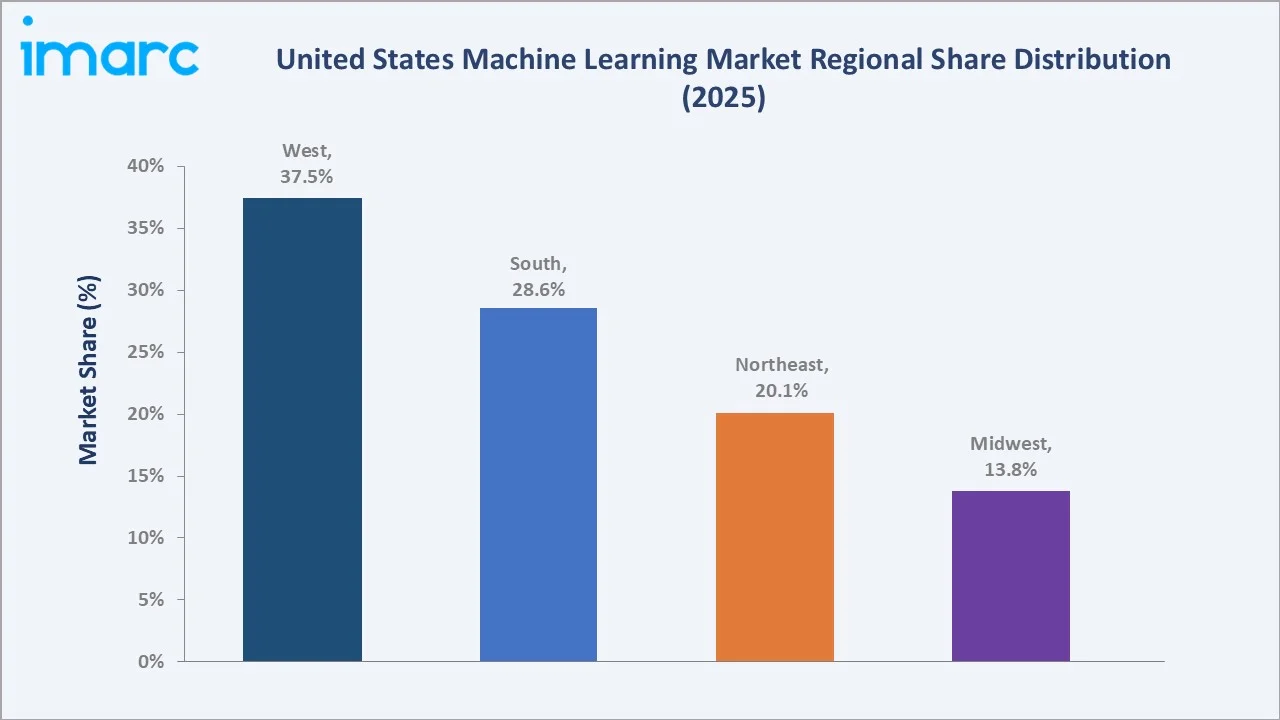
The Midwest's 13.8% reflects Illinois, Ohio, and Michigan's manufacturing automation and supply chain ML adoption, Chicago's financial services AI investment programs, Detroit's automotive ADAS ML deployment, and agricultural AI optimization initiatives spanning precision farming, livestock monitoring, and agri-supply-chain intelligence across the nation's central agricultural and industrial production states.
Competitive Landscape
The US machine learning market competitive landscape is technically differentiated by platform ecosystem breadth, foundation model quality benchmarks, enterprise integration capability, and cloud infrastructure scale. Competitive advantage accrues to players combining the largest curated training datasets, the most efficient GPU infrastructure, and the deepest enterprise software integration ecosystems across healthcare, BFSI, and manufacturing verticals.
|
Company |
Key Brands |
Market Position |
Core Strength |
|
Amazon Web Services Inc. |
SageMaker, Bedrock, Rekognition, Trainium |
Market Leader |
AWS SageMaker leads cloud ML deployment; Bedrock expands foundation model access for enterprise customers across healthcare, BFSI, retail, and manufacturing sectors |
|
Apple Inc. |
Core ML, Create ML, Neural Engine, Apple Intelligence |
Niche Player |
Focused on on-device ML via Neural Engine; Core ML enables privacy-preserving AI across the Apple device ecosystem targeting healthcare and advertising verticals |
|
Hewlett Packard Enterprise Dev. LP |
HPE Ezmeral, GreenLake AI, HPE Machine Learning Ops |
Strong Challenger |
AI and ML platform for hybrid cloud and edge environments; GreenLake delivers consumption-based ML infrastructure across manufacturing and BFSI customers |
|
International Business Machines Corp. |
Watson, watsonx, IBM Cloud Pak for Data |
Strong Challenger |
IBM watsonx targets enterprise governance-focused ML in regulated BFSI, healthcare, and law sectors; Watson remains embedded in legacy enterprise systems |
|
Microsoft Corporation |
Azure ML, Cognitive Services |
Market Leader |
Deep OpenAI partnership drives enterprise Copilot ecosystem across Microsoft 365; Azure ML leads enterprise ML platform adoption across large enterprises |
The competitive landscape's most significant dynamic is the foundation model and generative AI platform differentiation race, where Google, Microsoft, Amazon, and Meta invest billions annually in model development to establish platform positions capturing downstream enterprise AI application revenue through API consumption, copilot subscription contracts, and managed service agreements.
Key Company Profiles
Amazon Web Services Inc.
Amazon Web Services Inc. is the leading cloud ML infrastructure and platform provider in the United States, with a dominant position in the machine learning market through its SageMaker managed ML platform and Bedrock foundation model access service.
- Key Brands: Amazon SageMaker, Amazon Bedrock, Amazon Rekognition, Amazon Comprehend, Amazon Forecast, AWS Trainium, AWS Inferentia.
- Recent Developments: In 2025, AWS unveiled Trainium3, its next-generation AI training chip offering significantly higher performance efficiency for large-scale ML model training workloads. AWS also expanded Amazon Bedrock's foundation model catalog with Anthropic's Claude 3, Meta's Llama 3, and Mistral models, strengthening its multi-vendor enterprise generative AI platform position across healthcare, BFSI, and retail verticals.
- Strategic Focus: Expanding SageMaker's managed ML operations capabilities and scaling Bedrock's foundation model marketplace to capture enterprise generative AI adoption across AWS's broad customer base spanning healthcare, BFSI, retail, manufacturing, and advertising and media end-use sectors.
Apple Inc.
Apple Inc. is a global technology leader playing a significant role in the US machine learning market through on-device AI capabilities embedded across iPhone, Mac, iPad, and Apple Watch, deploying ML through a distinctive privacy-first architecture using Neural Engine silicon and Core ML software frameworks.
- Key Brands: Core ML, Create ML, Neural Engine, Apple Intelligence, Siri, Vision Pro ML, Natural Language framework.
- Recent Developments: In June 2026, Apple introduced the next generation of Apple Intelligence, bringing new AI capabilities across iPhone, iPad, Mac, Apple Watch, AirPods, and Apple Vision Pro. The update includes enhanced Siri AI, improved photo editing, smarter Safari tools, and new Image Playground features. Apple said the system uses its latest Foundation Models with on-device processing and Private Cloud Compute to maintain a privacy-focused architecture.
- Strategic Focus: Expanding Apple Intelligence capabilities across the device ecosystem through Neural Engine optimization and Private Cloud Compute infrastructure, while maintaining privacy-preserving on-device ML differentiation targeting healthcare monitoring, advertising and media personalization, and automotive integration through CarPlay ML features.
Market Concentration Analysis
The US machine learning market is highly concentrated at the cloud ML infrastructure and foundation model layers, with Google LLC, Microsoft Corporation, and Amazon Web Services collectively commanding the majority of enterprise ML platform revenue through their dominant hyperscaler cloud positions, proprietary AI research investments, and deep enterprise software integration advantages across healthcare, BFSI, retail, and manufacturing end-use customer segments in the United States.
Market concentration is evolving through two opposing forces: leading players' foundation model and cloud infrastructure investments create defensible platform moats, while open-source ML ecosystem expansion through PyTorch, Meta's Llama models, and Mistral enables specialized application-layer vendors to compete across end-use verticals without proprietary model infrastructure investment.
Investment & Growth Opportunities
Highest Growth Segments
Cloud-based ML services (~38.5% CAGR), Software platforms (~36.1% CAGR), and Healthcare AI applications (~41% CAGR through precision medicine ML integration) represent the three highest-growth investment priority segments. Enterprise generative AI software subscriptions, MLOps platform licenses, and healthcare diagnostic AI solutions are generating the highest revenue per dollar of ML platform investment across all end-use industry verticals in the United States.
Emerging Investment Opportunities
The US edge AI and on-device ML market, growing at above-market CAGR from an expanding base, represents the highest-return emerging investment opportunity as automotive ADAS, industrial IoT, and medical device manufacturers integrate ML inference capabilities directly into hardware platforms across manufacturing, healthcare, and automotive end-use verticals.
Investment Themes
- Foundation model infrastructure investment for enterprise generative AI platform capture across end-use verticals: Enterprise generative AI adoption is accelerating across healthcare, BFSI, retail, and advertising verticals, creating sustained demand for foundation model infrastructure, API-based AI access services, and application-layer AI integration capabilities growing at above-market CAGR through 2034.
- MLOps and AI governance platform investment for regulated enterprise ML operations: Enterprise organizations in BFSI, healthcare, and law end-use sectors scaling from ML pilots to production portfolio deployments are creating structured demand for MLOps platforms, model performance monitoring, and AI governance tools enabling compliant, auditable ML operations at commercial scale.
Future Market Outlook (2026-2034)
The US machine learning market is projected to grow from USD 7.83 Billion in 2025 to USD 10.52 Billion in 2026, reaching USD 34.28 Billion by 2030 and USD 119.98 Billion by 2034, growing at a CAGR of 34.37% during 2026-2034. The market's growth trajectory is among the strongest of any technology sector, powered by generative AI commercialization, cloud ML infrastructure expansion, and deep vertical AI adoption across healthcare, BFSI, manufacturing, retail, and automotive end-use industries.
Three structural forces define US machine learning market growth through 2034: generative AI platform commercialization creating new enterprise productivity software revenue streams above traditional ML infrastructure, edge AI and on-device ML deployment expanding the addressable market to device-level inference across automotive and industrial verticals, and AI governance regulation creating compliance-differentiated ML platform premium pricing opportunities in healthcare, BFSI, and law sectors.
Research Methodology
Primary Research
Primary research comprised structured interviews with US machine learning industry stakeholders, including Chief AI Officers, ML Platform Engineering Directors, Enterprise AI Procurement Managers, and Venture Capital investors focused on AI infrastructure across healthcare, BFSI, and manufacturing end-use verticals, conducted through primary data collection programs in Q1-Q2 2025.
Secondary Research
Secondary research encompassed US AI investment data, cloud computing market statistics, patent filing analysis, federal AI budget allocations, company earnings disclosures, ML framework adoption surveys, and academic publication analysis across NeurIPS, ICML, and ICLR research conferences for 2020-2025.
Forecasting Models
Market revenue forecasts were developed using an enterprise AI adoption expenditure model: US enterprise technology spending by end-use vertical, cloud ML service consumption growth rates, GPU infrastructure investment trajectories, and AI talent compensation market dynamics — calibrated against actual hyperscaler ML service revenue disclosures for the 2020-2025 historical period.
United States Machine Learning Market Report Coverage:
| Report Features | Details |
|---|---|
| Base Year of the Analysis | 2025 |
| Historical Period | 2020-2025 |
| Forecast Period | 2026-2034 |
| Units | Billion USD |
| Scope of the Report | Exploration of Historical and Forecast Trends, Industry Catalysts and Challenges, Segment-Wise Historical and Predictive Market Assessment:
|
| Components Covered | Hardware, Software, Services |
| Deployments Covered | Cloud-based, On-premises |
| Enterprise Sizes Covered | Large Enterprises and Small and Medium-sized Enterprises |
| End Uses Covered | Healthcare, BFSI, Law, Retail, Advertising and Media, Automotive and Transportation, Agriculture, Manufacturing, Others |
| Regions Covered | Northeast, Midwest, South, West |
| Companies Covered | Amazon Web Services Inc., Apple Inc., Hewlett Packard Enterprise Dev. LP, International Business Machines Corp., Microsoft Corporation, etc. |
| Customization Scope | 10% Free Customization |
| Post-Sale Analyst Support | 10-12 Weeks |
| Delivery Format | PDF and Excel through Email (We can also provide the editable version of the report in PPT/Word format on special request) |
Key Benefits for Stakeholders:
- IMARC’s industry report offers a comprehensive quantitative analysis of various market segments, historical and current market trends, market forecasts, and dynamics of the United States machine learning market from 2020-2034.
- The research report provides the latest information on the market drivers, challenges, and opportunities in the United States machine learning market.
- Porter's five forces analysis assist stakeholders in assessing the impact of new entrants, competitive rivalry, supplier power, buyer power, and the threat of substitution. It helps stakeholders to analyze the level of competition within the United States machine learning industry and its attractiveness.
- Competitive landscape allows stakeholders to understand their competitive environment and provides an insight into the current positions of key players in the market.
Frequently Asked Questions About the United States Machine Learning Market Report
The US machine learning market size is estimated at USD 10.52 Billion in 2026, driven by expanding enterprise AI platform adoption, generative AI commercialization, and cloud ML infrastructure investment across healthcare, BFSI, retail, advertising and media, and manufacturing end-use verticals throughout the United States.
The US machine learning market grows at 34.37% CAGR during 2026-2034, reaching USD 119.98 Billion by 2034. Cloud-based deployment grows at ~38.5% CAGR and Software component at ~36.1% CAGR, both exceeding the overall market growth rate through the forecast period.
Cloud-based leads at 68.4% through the critical role of hyperscaler ML platforms in enabling scalable, cost-efficient ML deployment across large enterprises and SMBs. Elastic GPU compute, managed ML services, and pay-as-you-go pricing sustain cloud-based deployment's dominant market position through the 2034 forecast period.
Software leads at 48.6% through the dominant requirement for ML development platforms, AutoML tools, and AI application software across healthcare, BFSI, retail, and manufacturing verticals. Subscription-based SaaS delivery and API consumption drive recurring Software component revenue growing at ~36.1% CAGR through 2034.
The West leads at 37.5% through Silicon Valley's AI startup ecosystem concentration, Bay Area hyperscaler headquarters, and Seattle's emergence as Microsoft's and Amazon's primary AI R&D and cloud ML services hub in the United States.
Leading companies include Amazon Web Services Inc., Apple Inc., Hewlett Packard Enterprise Dev. LP, International Business Machines Corp. and Microsoft Corporation, among others.
The US machine learning market is projected to reach approximately USD 34.28 Billion by 2030, with generative AI platform maturation, enterprise MLOps adoption, edge AI deployment scaling, and healthcare and BFSI vertical AI integration serving as the primary drivers of mid-forecast growth through the period.
Three priority investment opportunities: foundation model infrastructure and enterprise AI platform development for generative AI adoption capture across healthcare and BFSI; MLOps and AI governance platforms for regulated-sector ML operations; and edge AI deployment for automotive, industrial, and medical device ML integration growing at above-market CAGR through 2034.
Need more help?
- Speak to our experienced analysts for insights on the current market scenarios.
- Include additional segments and countries to customize the report as per your requirement.
- Gain an unparalleled competitive advantage in your domain by understanding how to utilize the report and positively impacting your operations and revenue.
- For further assistance, please connect with our analysts.
 Request Customization
 Speak to an Analyst
 Request Brochure
 Inquire Before Buying
Benefits of Customization
- Personalize this research
- Triangulate with your data
- Get data as per your format and definition
- Gain a deeper dive into a specific application, geography, customer, or competitor
- Any level of personalization
Get in Touch With Us
UNITED STATES
Phone: +1-201-971-6302
INDIA
Phone: +91-120-433-0800
UNITED KINGDOM
Phone: +44-753-714-6104
Email: [email protected]
Client Testimonials























Related Reports

Choose your plan
*Please note that the prices mentioned below are starting prices for each bundle type. Kindly contact our team for further details.*
Single User License
- 1 User License, Access on 2 Devices
- PDF Report + Excel Dataset (Password Protected)
- Lifetime Access
- No Printing Rights
- 10% Free Report Customization
- 10–12 Weeks of Analyst Support
Five User License
- Access for 5 Users, 2 Devices per User
- PDF Report + Excel Dataset (Password Protected)
- Lifetime Access
- Dedicated Account Manager
- 12–14 Weeks of Analyst Support
- No Printing Rights
- 15% Free Report Customization
- 25% Discount on Your Next Purchase
Corporate User License
- Unlimited User Access (Within Your Organization)
- PDF Report + Excel Dataset
- Lifetime Access
- Dedicated Account Manager
- 14–20 Weeks of Analyst Support
- No Printing Rights
- 20% Free Report Customization
- 30% Discount on Your Next Purchase
Essential Insights
What's included:
3 reports
- Lifetime Access
- PDF Reports
- Excel Datasets
- 2 Weeks of Free Analyst Support
- 2 User Licenses
- Access on 2 Devices
- Printing Rights
- Complimentary PowerPoint (PPT) Version
- Complimentary License Upgrade
Professional Access
What's included:
5 reports
- Lifetime Access
- PDF Reports
- Excel Datasets
- 8 Weeks of Free Analyst Support
- 2 User Licenses
- Access on 2 Devices
- Printing Rights
- Complimentary PowerPoint (PPT) Version
- Complimentary License Upgrade
Business Advantage
What's included:
8 reports
- Lifetime Access
- PDF Reports
- Excel Datasets
- 14 Weeks of Free Analyst Support
- 2 User Licenses
- Access on 2 Devices
- Printing Rights
- Complimentary PowerPoint (PPT) Version
- Complimentary License Upgrade
Enterprise Intelligence
What's included:
10 reports
- Lifetime Access
- PDF Reports
- Excel Datasets
- 20 Weeks of Free Analyst Support
- 2 User Licenses
- Access on 2 Devices
- Printing Rights
- Complimentary PowerPoint (PPT) Version
- Complimentary License Upgrade