
United States Marketing Automation Market Size, Share, Trends and Forecast by Component Type, Deployment Type, End User, Application, Vertical, and Region, 2026-2034
United States Marketing Automation Market Size, Share, Trends & Forecast (2026-2034)
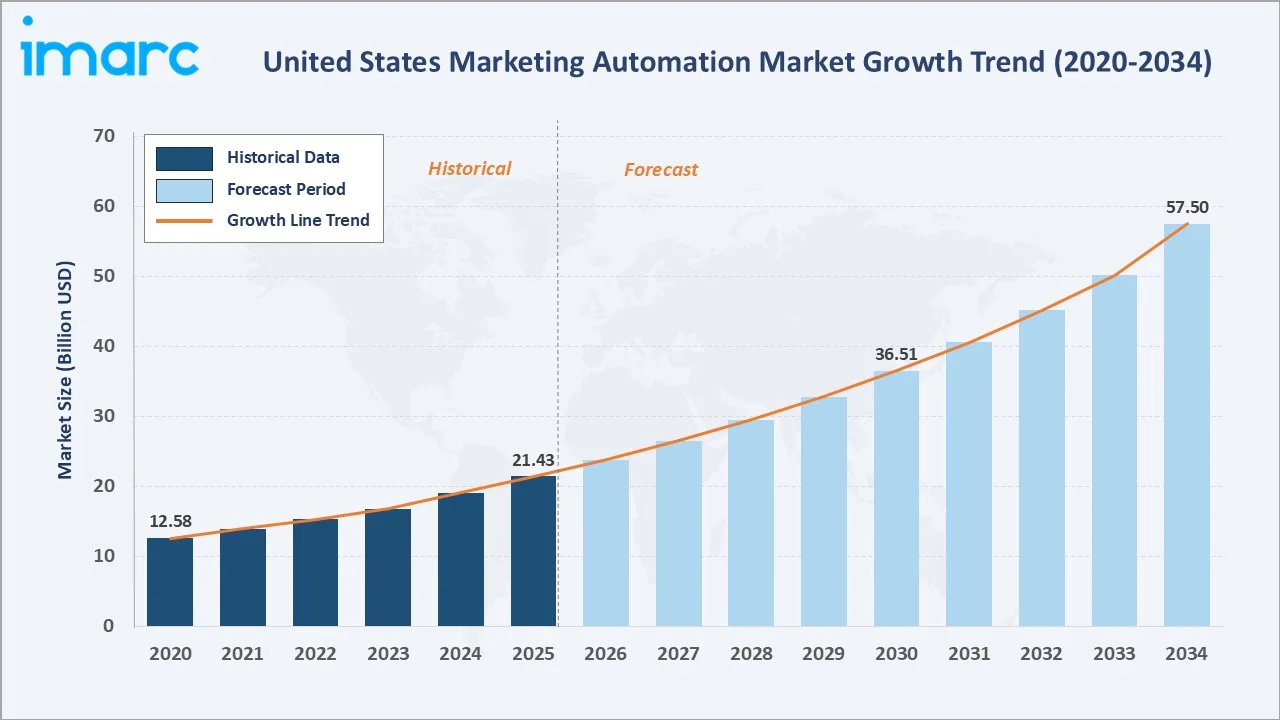
The United States marketing automation market size increased from USD 21.43 Billion in 2025 to USD 24.52 Billion in 2026 and is projected to reach USD 57.50 Billion by 2034, growing at a CAGR of 11.24% during 2026-2034. The market is driven by growing demand for personalized customer engagement, lead nurturing, and data-driven marketing campaigns across digital channels. The United States has around 2.5 million marketers, 6 million counting marketing-adjacent roles like sales, public relations, fundraising, user experience, and graphic design. As marketing teams handle more digital channels and data-driven tasks, automation platforms help improve productivity, personalization, and campaign efficiency. Software leads the component type at 68.4%. Cloud-based leads deployment at 72.5%. West leads regionally at 34.5%.
Market Snapshot
|
Metric |
Value |
|
Base Year Market Size (2025) |
USD 21.43 Billion |
| Market Size (2026) | USD 24.52 Billion |
|
Forecast Market Size (2034) |
USD 57.50 Billion |
|
CAGR (2026-2034) |
11.24% |
|
Base Year |
2025 |
|
Historical Period |
2020-2025 |
|
Forecast Period |
2026-2034 |
|
Dominant Component Type |
Software (68.4%, 2025) |
|
Dominant Deployment Type |
Cloud-based (72.5%, 2025) |
|
Leading Region |
West (34.5%, 2025) |
The United States marketing automation market has grown strongly from USD 12.58 Billion in 2020 to USD 21.43 Billion in 2025 and an estimated USD 24.52 Billion in 2026, driven by rising digital marketing adoption and demand for customer personalization. The market is expected to reach USD 36.51 Billion by 2030, reflecting wider use of AI, CRM integration, lead nurturing, and omnichannel campaign tools. By 2034, it is forecast to reach USD 57.50 Billion, supported by automation-led productivity gains, data-driven customer engagement, and growing adoption among enterprises and SMEs.
To get more information on this market, Request Sample
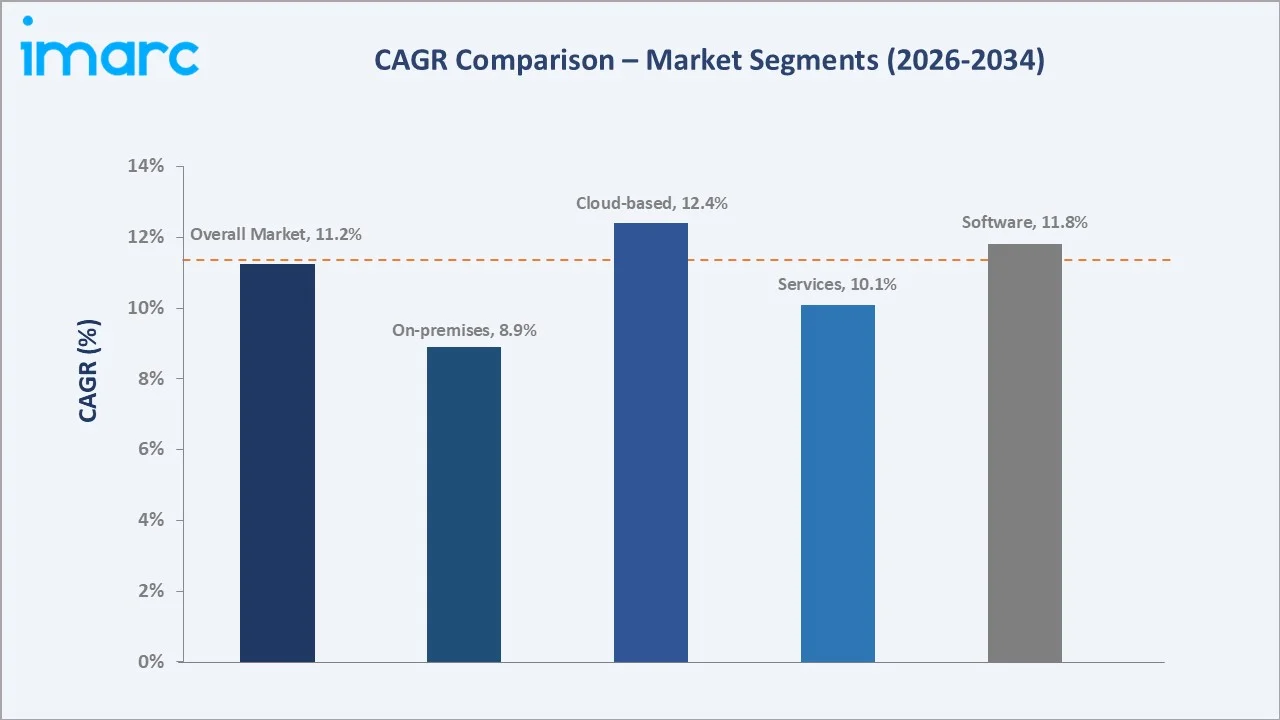
Software component grows fastest at ~11.8% CAGR through GenAI-native MA platform, predictive lead scoring, and agentic AI autonomous campaign execution. Cloud-based deployment grows at ~12.4% CAGR through AWS, Azure, GCP-hosted SaaS MA and serverless marketing workload.
Executive Summary
The United States marketing automation market, which increased from USD 21.43 Billion in 2025 to an estimated USD 24.52 Billion in 2026, driven by rising demand for personalized customer engagement, lead management, and omnichannel campaign execution. Businesses are increasingly adopting AI, analytics, CRM integration, and automated workflows to improve marketing efficiency and conversion rates. Growth is supported by the large US marketing workforce, expanding digital channels, and the rising need for data-driven decision-making. The market is projected to reach USD 57.50 Billion by 2034. Software at 68.4% leads through the SaaS MA platform. Cloud-based at 72.5% leads deployment type. West leads regionally at 34.5%.
Key Market Insights
|
Insight |
Data |
|
Dominant Component Type |
Software - 68.4% share (2025) |
|
Dominant Deployment Type |
Cloud-based - 72.5% market share (2025) |
|
Leading Region |
West - 34.5% share (2025) |
|
Market Opportunity |
Generative AI content automation; agentic AI autonomous campaign manager; B2B ABM intent data MA; conversational AI chatbot-MA integration |
Key Analytical Observations Supporting The Above Data:
- Software at 68.4%: The software leads as businesses rely on automation platforms for campaign management, CRM integration, customer segmentation, analytics, and lead nurturing. Rising AI adoption and demand for omnichannel personalization further strengthen software demand.
- Cloud-based at 72.5%: The cloud-based segment leads because it offers scalability, lower upfront costs, easy deployment, and remote access for marketing teams. Its ability to integrate with CRM, analytics, AI tools, and omnichannel platforms makes it the preferred choice for enterprises and SMEs.
- West Region at 34.5%: The West region leads due to its strong concentration of technology companies, SaaS providers, startups, and digital-first enterprises, especially in states such as California and Washington.
United States Marketing Automation Market Overview
The United States marketing automation market operates as a technology-driven ecosystem that helps businesses automate customer engagement, campaign execution, lead nurturing, and performance analytics. It is strongly shaped by the country’s advanced digital economy, high SaaS adoption, and large base of enterprises, SMEs, and marketing professionals. The market is increasingly shifting toward AI-enabled personalization, cloud-based platforms, CRM integration, and omnichannel customer journey management. As competition for customer attention intensifies, companies are using automation to improve efficiency, conversion rates, and marketing return on investment.
The United States marketing automation market encompasses email automation, CRM-integrated lead nurturing, social media automation, SMS and mobile push, account-based marketing ABM, and AI content generation. Macroeconomic factors include rising digital ad spending, strong SaaS adoption, and growing demand for data-driven customer engagement.
Market Dynamics
To evaluate market opportunities, Request Sample
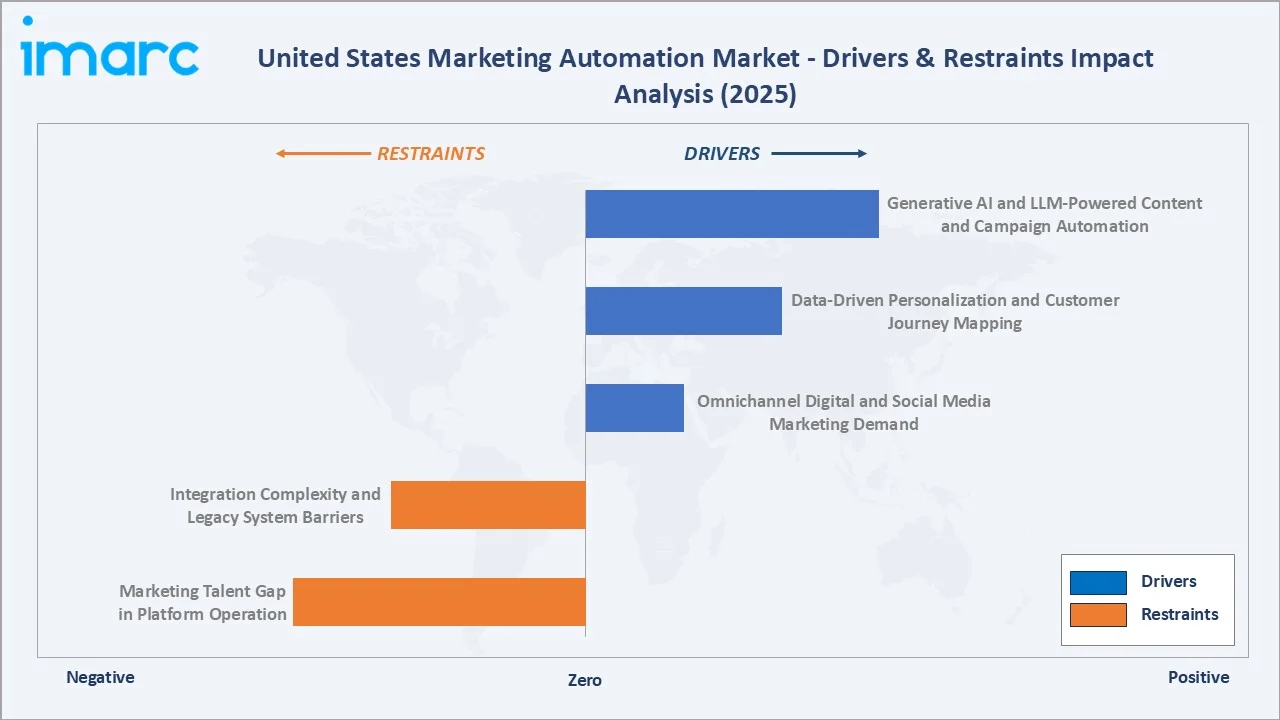
Market Drivers
- Generative AI and LLM-Powered Content and Campaign Automation: Generative AI and LLM-powered content and campaign automation enable faster creation of emails, social posts, ads, landing pages, and customer messages. These tools help marketers personalize content at scale, optimize campaign timing, and automate audience-specific communication. AI also improves lead scoring, customer segmentation, and performance insights, helping businesses increase conversions and reduce manual workload. As companies prioritize productivity and real-time engagement, AI-enabled marketing automation adoption is accelerating.
- Data-Driven Personalization and Customer Journey Mapping: Data-driven personalization and customer journey mapping are driving the market as businesses increasingly use customer data to deliver targeted messages across email, social media, websites, and ads. Automation platforms help track customer behavior, segment audiences, and personalize campaigns based on buying stage, preferences, and engagement history. This improves lead conversion, customer retention, and marketing ROI. As brands compete to deliver seamless omnichannel experiences, demand for advanced marketing automation tools continues to rise.
- Omnichannel Digital and Social Media Marketing Demand: Omnichannel digital and social media marketing demand is driving the market as businesses need to manage customer engagement across email, websites, mobile apps, search, and social platforms. Automation tools help brands deliver consistent messaging, schedule campaigns, track interactions, and optimize performance across multiple channels. Around 36,400 job openings for advertising, promotions, and marketing managers are expected each year on average over the decade. As marketing teams expand, businesses are increasingly adopting automation platforms to streamline campaign execution, improve personalization, and track performance across multiple digital touchpoints.
Market Restraints
- Integration Complexity and Legacy System Barriers: Integration complexity and legacy system barriers are hampering the market as many companies still operate older CRM, ERP, email, and customer data systems that are difficult to connect with modern automation platforms. Poor data quality, fragmented customer records, and incompatible software increase implementation time and cost. These challenges can delay automation adoption, especially among SMEs and traditional enterprises. As a result, businesses may struggle to achieve seamless omnichannel execution and real-time personalization.
- Marketing Talent Gap in Platform Operation: The marketing talent gap in platform operation is hampering the market as businesses need skilled professionals who can manage workflows, CRM integration, segmentation, analytics, and campaign optimization. Many organizations lack teams with both marketing strategy and technical platform expertise. This creates implementation delays, underused software features, and lower campaign ROI. As a result, companies may hesitate to invest in advanced automation platforms without adequate training and operational support.
Market Opportunities
- B2B Account-Based Marketing (ABM): B2B Account-Based Marketing (ABM) represents a significant opportunity as enterprises increasingly focus on targeting high-value accounts with personalized campaigns. Marketing automation platforms enable account-level segmentation, intent data analysis, lead scoring, and coordinated engagement across multiple decision-makers. AI-powered ABM tools help improve conversion rates, sales alignment, and customer acquisition efficiency. As B2B organizations prioritize quality leads over volume, demand for advanced ABM automation solutions is expected to grow.
- Automated Partner and Channel Marketing Platforms: Automated partner and channel marketing platforms present a strong opportunity as businesses increasingly rely on distributors, resellers, and channel partners to expand market reach. Marketing automation solutions help streamline co-branded campaigns, lead distribution, content syndication, and partner performance tracking across large partner networks. In June 2026, eTrigue launched eTrigue Insights, a new platform designed to enhance digital partner marketing through AI-driven personalization. The platform uses Lead & Company Insights to analyze a prospect’s background, industry, social media activity, news, and company information, then generates highly tailored, context-specific messaging. It also automates partner branding and co-branded content delivery to ensure timely and consistent outreach. As partner ecosystems become more complex, demand for scalable channel marketing automation platforms is expected to rise.
Market Challenges
- GenAI Content Quality and Brand Safety: GenAI content quality and brand safety are challenging as AI-generated emails, ads, and social posts may produce inaccurate, generic, or off-brand messaging. Poorly reviewed content can create reputational risks, compliance issues, and customer trust concerns. Brands must invest in human review, governance workflows, approved content libraries, and quality controls before scaling GenAI campaigns. These added safeguards increase implementation complexity and may slow adoption among risk-sensitive enterprises.
- Cybersecurity Risks in Customer Data Management: Cybersecurity risks in customer data management are a major challenge as automation platforms collect, store, and process large volumes of sensitive customer information across multiple channels. Data breaches, unauthorized access, phishing attacks, and API vulnerabilities can expose personal and business data, leading to financial losses and reputational damage. Companies must invest heavily in encryption, identity management, access controls, and continuous monitoring to protect customer information. Increasing regulatory scrutiny and consumer expectations around data privacy further raise compliance and security requirements for marketing automation providers.
Emerging Market Trends
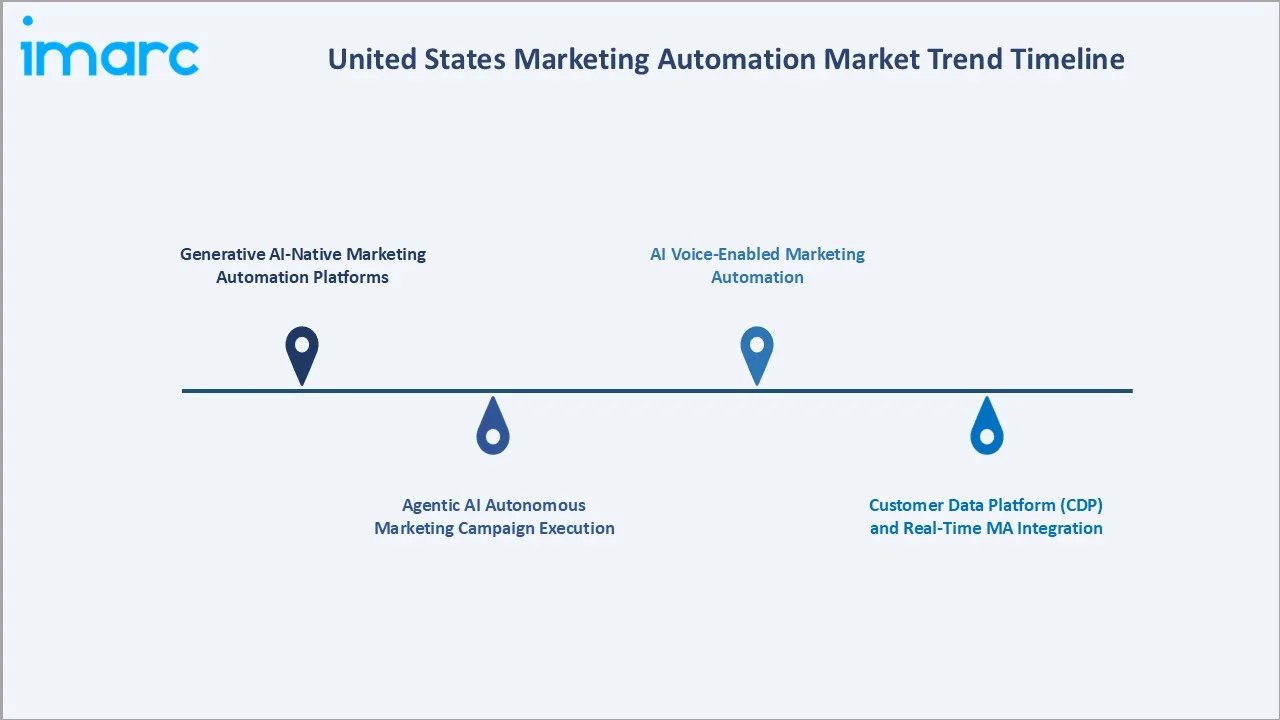
1. Generative AI-Native Marketing Automation Platforms
Generative AI-native marketing automation platforms are emerging as brands seek faster, more personalized, and scalable campaign execution. These platforms combine content generation, customer segmentation, predictive analytics, and journey orchestration to create emails, ads, landing pages, and recommendations with limited manual effort. This trend helps US marketers improve productivity, reduce content turnaround time, and deliver hyper-personalized customer experiences across channels.
2. Agentic AI Autonomous Marketing Campaign Execution
Agentic AI-driven autonomous marketing campaign execution is emerging as enterprises seek to reduce manual intervention and improve campaign performance. These AI agents can independently analyze customer behavior, create audience segments, generate content, optimize budgets, trigger personalized interactions, and adjust campaigns in real time based on performance data. In December 2025, PubMatic and Butler/Till launched a fully autonomous agentic advertising campaign on CTV for Clubtails, a flavored malt beverage brand by Geloso Beverage Group. Powered by PubMatic’s agentic application within Butler/Till’s GenAI environment, the campaign uses AdCP to enable transparent agent-to-system communication. The initiative demonstrates a new agent-led media activation model using real brand assets, premium programmatic inventory, and real-time decision-making. The trend is accelerating as organizations focus on improving marketing efficiency, enhancing personalization, and achieving higher returns on marketing investments through intelligent automation.
3. Customer Data Platform (CDP) and Real-Time MA Integration
Customer Data Platform (CDP) and real-time marketing automation integration are emerging as businesses seek a unified, continuously updated view of customer interactions across channels. By combining CDPs with marketing automation platforms, organizations can activate customer data instantly, enabling real-time segmentation, personalized messaging, and dynamic campaign orchestration. This integration helps marketers respond immediately to customer behaviors such as website visits, purchases, or app activity, improving engagement and conversion rates. As customer expectations for personalized experiences continue to rise, real-time CDP integration is becoming essential for delivering relevant, data-driven marketing at scale.
4. AI Voice-Enabled Marketing Automation
AI voice-enabled marketing automation is emerging as businesses shift toward more interactive and human-like customer engagement. AI voice agents can automate lead qualification, appointment scheduling, follow-ups, customer support, and campaign responses through natural conversations. In June 2025, LocaliQ, Gannett’s Digital Marketing Solutions business, introduced a next-generation conversational AI Voice Agent within Dash by LocaliQ. The AI-powered platform helps businesses attract, engage, and convert prospects through automated, intelligent conversations. Building on Dash’s existing AI SMS agent, the new voice capability enables a more seamless omnichannel customer engagement experience. This helps brands engage prospects faster across the sales funnel while reducing manual workload for marketing and sales teams.
Industry Value Chain Analysis
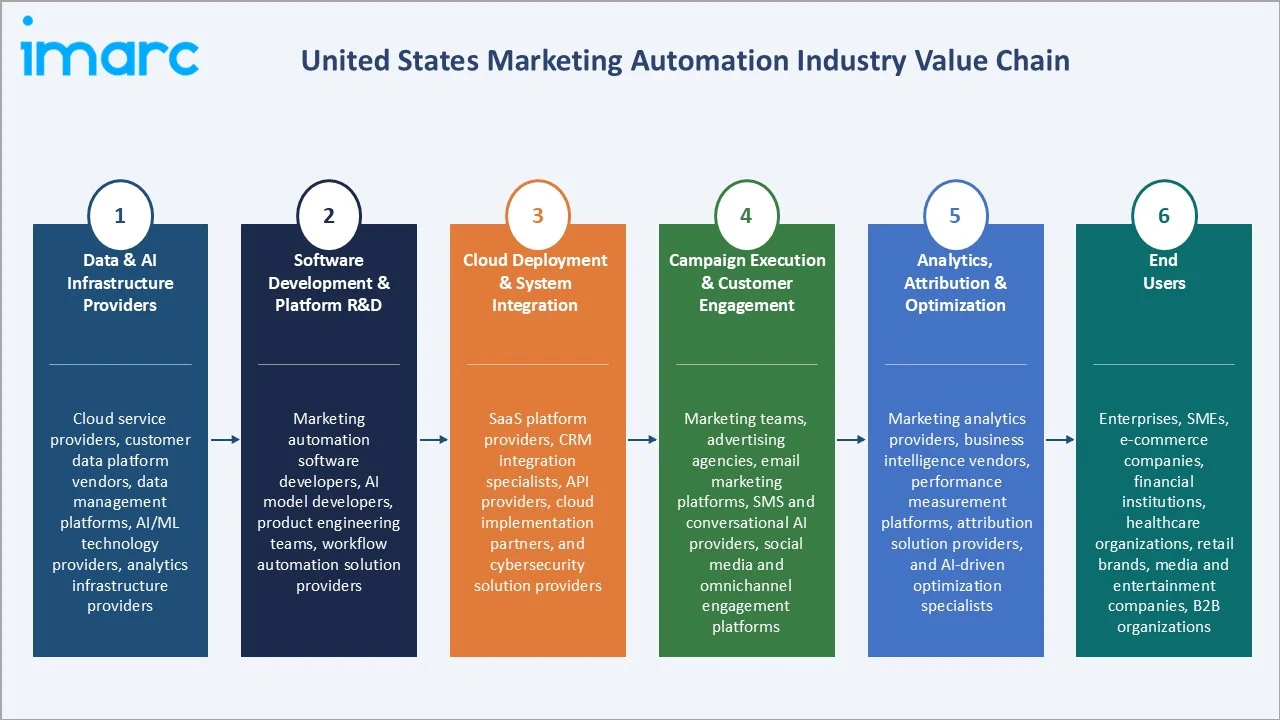
The US marketing automation value chain integrates data & AI infrastructure providers, software development & platform R&D, cloud deployment & system integration, campaign execution & customer engagement, analytics, attribution & optimization, and end users.
|
Stage |
Key Participants |
|
Data & AI Infrastructure Providers |
Cloud service providers, customer data platform vendors, data management platforms, AI/ML technology providers, analytics infrastructure providers |
|
Software Development & Platform R&D |
Marketing automation software developers, AI model developers, product engineering teams, workflow automation solution providers |
|
Cloud Deployment & System Integration |
SaaS platform providers, CRM integration specialists, API providers, cloud implementation partners, and cybersecurity solution providers |
|
Campaign Execution & Customer Engagement |
Marketing teams, advertising agencies, email marketing platforms, SMS and conversational AI providers, social media and omnichannel engagement platforms |
|
Analytics, Attribution & Optimization |
Marketing analytics providers, business intelligence vendors, performance measurement platforms, attribution solution providers, and AI-driven optimization specialists |
|
End Users |
Enterprises, SMEs, e-commerce companies, financial institutions, healthcare organizations, retail brands, media and entertainment companies, B2B organizations |
The campaign execution & customer engagement stage is the most value-added segment in the US marketing automation value chain. This is where customer data, AI-driven insights, personalization engines, and omnichannel communication capabilities are converted into measurable business outcomes such as lead generation, customer acquisition, retention, and revenue growth. Advanced capabilities such as generative AI content creation, agentic campaign management, real-time personalization, and conversational AI significantly enhance campaign effectiveness and marketing ROI, making this the primary source of competitive differentiation for vendors and users alike.
Technology Landscape in the United States Marketing Automation Industry
Generative AI and Large Language Model (LLM) Integration
Generative AI and Large Language Model (LLM) Integration enables automated content creation, audience segmentation, campaign planning, and customer engagement at scale. LLM-powered platforms can generate personalized emails, advertisements, social media content, and customer responses in real time, significantly improving marketing efficiency. These technologies also support conversational interfaces, predictive analytics, and natural language campaign management, allowing marketers to interact with platforms using simple prompts. As a result, marketing automation is evolving from rule-based workflows to intelligent, AI-driven systems capable of delivering highly personalized customer experiences and autonomous campaign optimization.
Machine Learning Predictive Analytics and Lead Scoring
Machine learning predictive analytics and lead scoring enable data-driven customer acquisition and conversion strategies. Advanced machine learning models analyze customer behavior, engagement patterns, purchase history, and demographic data to predict buying intent and identify high-value prospects. Automated lead scoring helps sales and marketing teams prioritize opportunities with the highest likelihood of conversion, improving resource allocation and campaign effectiveness. As predictive capabilities become more sophisticated, organizations are increasingly leveraging real-time insights to personalize outreach, enhance customer journeys, and maximize marketing ROI.
Modern Marketing Cloud Platforms
Modern marketing cloud platforms integrate campaign management, customer data, analytics, attribution, and AI-driven workflows into one unified ecosystem. These platforms help marketers break down data silos and manage omnichannel engagement across mobile, web, email, social media, and connected TV. In November 2025, AppsFlyer launched eight new products to help businesses turn complex marketing data into clearer insights and growth opportunities. The launch highlights AppsFlyer’s shift from a mobile attribution specialist to a Modern Marketing Cloud that connects omnichannel measurement, deep linking, data collaboration, and autonomous AI workflows. The platform aims to help brands eliminate data silos, make faster decisions, and achieve privacy-first, AI-driven marketing growth. This shift is moving marketing automation from standalone tools toward connected, cloud-based platforms that support end-to-end customer growth.
Market Segmentation Analysis
The report covers the following segments:
|
Segment Category |
Leading Segment |
Market Share |
Year |
|
Component Type |
Software |
68.4% |
2025 |
|
Deployment Type |
Cloud-based |
72.5% |
2025 |
|
End User |
🔒 |
🔒 |
2025 |
|
Application |
🔒 |
🔒 |
2025 |
|
Vertical |
🔒 |
🔒 |
2025 |
|
Region |
West |
34.5% |
2025 |

By Component Type
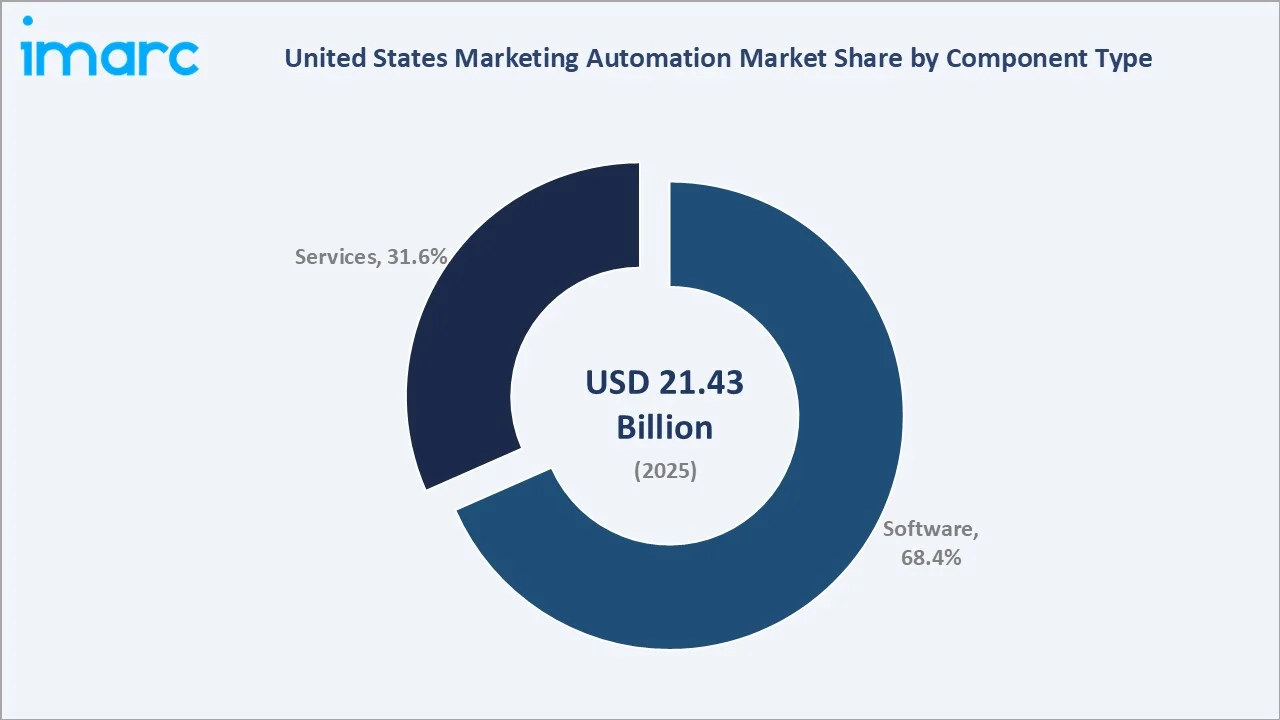
Software leads at 68.4% (2025), as businesses rely on platforms for campaign management, customer segmentation, lead scoring, analytics, and omnichannel engagement. Its dominance is driven by rising adoption of cloud-based SaaS tools, AI-powered automation, and real-time personalization capabilities.
To access detailed market analysis, Request Sample
Services at 31.6% reflects marketing automation implementation, strategy consulting, RevOps, training, and managed services.
By Deployment Type
Cloud-based leads at 72.5% (2025), as US businesses prefer scalable, flexible, and cost-efficient marketing automation solutions. Its dominance is driven by easy integration with CRM, CDP, analytics, and AI tools, along with remote access and faster software updates.
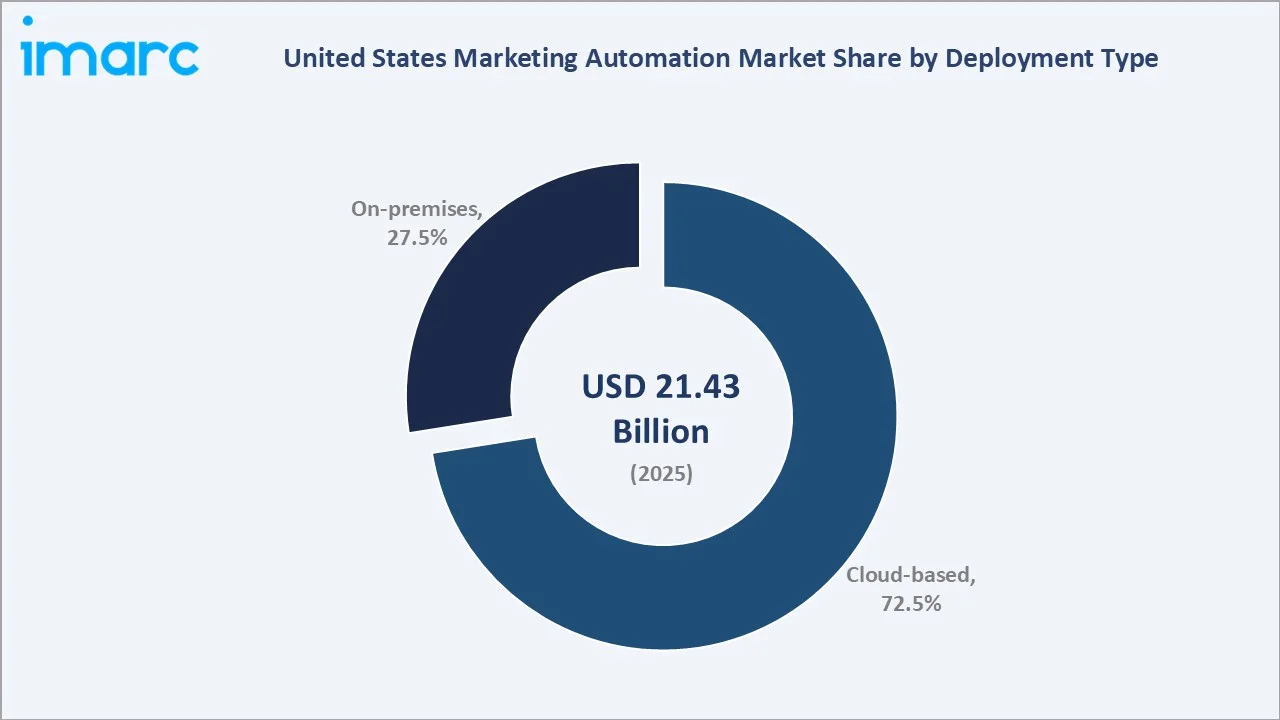
On-premises at 27.5%, driven by large enterprises that require stronger control over customer data, security, and compliance. It is preferred in regulated sectors such as BFSI, healthcare, and government, where data privacy and internal IT governance remain critical.
Regional Market Insights
|
Region |
Share (2025) |
Key US Marketing Automation Market Drivers & Characteristics |
|
West |
34.5% |
Reflecting the region's concentration of technology companies, digital-first enterprises, and marketing software innovators. |
|
South |
30.2% |
Driven by the rapid digital transformation of enterprises across retail, healthcare, financial services, and e-commerce sectors. |
|
Northeast |
20.1% |
Driven by the strong presence of financial institutions, media companies, healthcare organizations, and large enterprises that rely on sophisticated marketing automation, analytics, and customer data platforms to improve campaign performance and customer acquisition. |
|
Midwest |
15.2% |
Reflects increasing adoption of marketing automation among manufacturing, logistics, healthcare, and business services organizations. |
West's 34.5% market leadership is supported by the strong presence of technology companies, SaaS providers, digital advertising platforms, and AI innovators in states such as California and Washington. South's 30.2% driven by rapid digital transformation across retail, healthcare, financial services, and e-commerce industries.
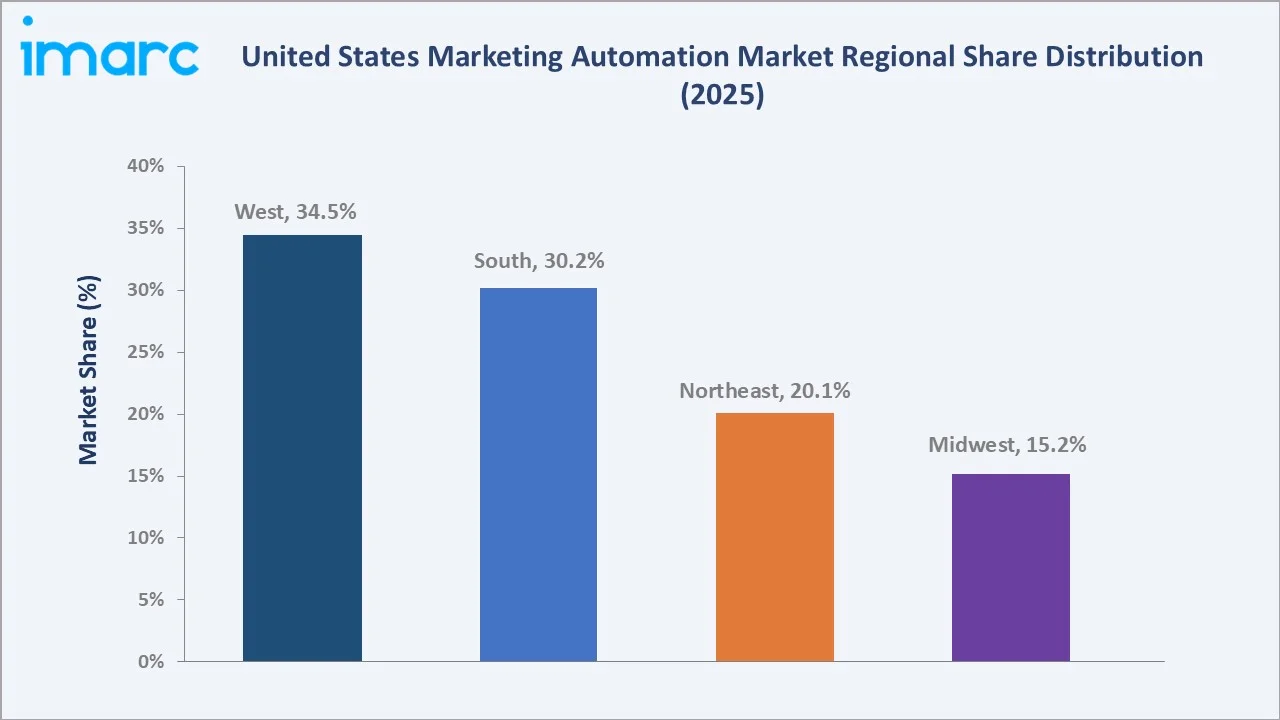
Northeast's 20.1% due to the concentration of large enterprises, financial institutions, media companies, and advanced marketing technology adopters. Midwest's 15.2% witnessing steady growth as manufacturing, logistics, healthcare, and business service organizations increasingly invest in marketing automation to improve customer engagement, lead generation, and operational efficiency.
Competitive Landscape
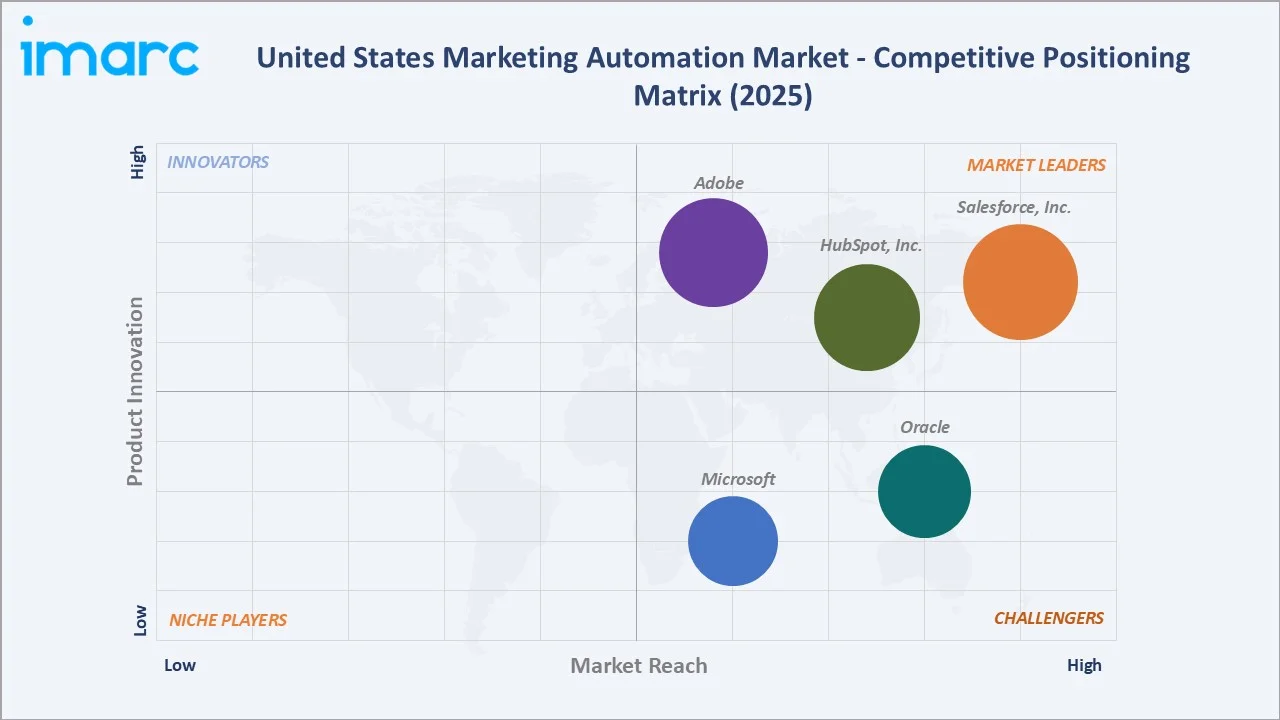
The US marketing automation market is moderately consolidated, with leading vendors competing through AI innovation, omnichannel engagement capabilities, customer data integration, and analytics-driven automation. Major players are increasingly embedding generative AI, predictive analytics, conversational AI, and autonomous campaign management into their platforms to strengthen competitive positioning.
|
Company |
Key Products |
Market Position |
Core Strength |
|
Salesforce, Inc. |
Marketing Cloud Next |
Market Leader |
Salesforce, Inc. acts as a foundational pillar in US marketing automation. It provides omnichannel journey management, AI-driven personalization, and cross-channel campaign execution directly linked to customer relationship data. |
|
HubSpot, Inc. |
Marketing Automation Software |
Market Leader |
HubSpot, Inc. is a dominant industry leader in the US marketing automation sector, recognized for pioneering "inbound marketing" and unifying Smart CRM data with multi-channel automation. |
|
Adobe |
Marketo Engage |
Market Leader |
Adobe drives US marketing automation by providing industry-leading, AI-powered tools that streamline cross-channel campaigns, B2B lead management, and personalization at scale. |
|
Oracle |
Oracle Eloqua Marketing Automation |
Strong Challenger |
Oracle shapes US B2B marketing automation through Oracle Eloqua Marketing Automation, an enterprise-grade platform. It automates cross-channel campaigns, lead nurturing, and sales handoffs while unifying customer data to drive revenue for major US firms. |
|
Microsoft |
Microsoft Dynamics 365 Customer Insights |
Strong Challenger |
Microsoft drives US marketing automation through Microsoft Dynamics 365 Customer Insights, an end-to-end platform recognized as a Leader by Gartner. The company enables businesses to automate customer journeys, score leads and personalize multi-channel campaigns at scale. |
Strategic partnerships, cloud-based platform expansion, and acquisitions remain key growth strategies as vendors seek to broaden their product ecosystems. Competition is further intensifying as enterprises demand unified marketing clouds that combine customer data, campaign orchestration, attribution, and real-time personalization within a single platform.
Key Company Profiles
Salesforce, Inc.
Salesforce, Inc. is a leading provider of cloud-based customer relationship management (CRM) and marketing automation solutions in the United States. The company offers a comprehensive suite of marketing technologies through its Marketing Cloud platform, enabling businesses to manage customer journeys, campaign automation, personalization, analytics, and customer engagement across multiple channels.
- Key Products: Marketing Cloud Next.
- Strategic Focus: Investing heavily in AI-driven marketing, real-time customer data platforms, agentic AI, and omnichannel customer engagement.
HubSpot, Inc.
HubSpot, Inc. is a leading provider of cloud-based CRM and marketing automation solutions, serving small and medium-sized businesses (SMBs) as well as mid-market enterprises across the United States. The company is recognized for its user-friendly, all-in-one platform that integrates marketing, sales, customer service, content management, and operations tools within a unified ecosystem.
- Key Products: Marketing Automation Software.
- Strategic Focus: Expanding its AI-powered customer platform by integrating marketing automation, CRM, sales, service, and content management capabilities into a unified cloud ecosystem.
Market Concentration Analysis
The US marketing automation market exhibits a moderately concentrated competitive structure, with a handful of large vendors accounting for a significant share of market revenues. Major players such as Salesforce, Inc., HubSpot, Inc., Adobe, Oracle, and Microsoft dominate the enterprise segment through comprehensive marketing clouds, CRM integration, and AI-powered automation capabilities. However, the market also features numerous specialized and emerging vendors focused on conversational AI, customer data platforms, email marketing, and niche automation solutions. Competition is increasingly driven by innovation in generative AI, predictive analytics, omnichannel orchestration, and autonomous marketing workflows. As enterprises seek unified customer engagement platforms, consolidation through partnerships, acquisitions, and platform expansion continues to shape the competitive landscape.
Investment & Growth Opportunities
Highest Growth Segments
Cloud-based deployment (~12.4% CAGR), software (~11.8% CAGR), West region (~12% CAGR), agentic AI autonomous MA (~20-25% CAGR), B2B ABM intent-data MA (~13-15% CAGR), and conversational AI-chatbot MA (~15-18% CAGR) represent the US marketing automation highest-growth investment vectors through 2034.
Investment Themes
- Generative AI-native MA platform: Investment in GenAI-native marketing automation platforms is attractive as brands seek tools that can automate content creation, campaign planning, audience targeting, and performance optimization. These platforms reduce manual workload and enable faster, hyper-personalized campaign execution at scale.
- CDP-MA real-time personalization platform: CDP-MA integration is an investment theme as companies need unified customer data and real-time activation across channels. These platforms help brands personalize offers, messages, and customer journeys instantly, improving engagement, conversion, and retention.
Future Market Outlook (2026-2034)
The US marketing automation market is projected to grow from USD 21.43 Billion in 2025 to USD 24.52 Billion in 2026, reaching USD 57.50 Billion by 2034, delivering an 11.24% CAGR over the forecast period, driven by generative AI content automation, agentic AI autonomous campaign execution, CDP-MA real-time personalization integration, SMB all-in-one AI MA platform democratization, and e-commerce D2C brand MA expansion. The market's anchor value of USD 36.51 Billion in 2030 represents US MA at GenAI-and-agentic-AI inflection.
Three structural forces define the US marketing automation market growth through 2034: rising adoption of AI-native platforms, stronger demand for unified customer data, and the shift toward omnichannel engagement. Enterprises are investing in generative AI, predictive analytics, and agentic workflows to automate campaign creation and optimization. At the same time, CDP integration and privacy-first data management are becoming critical for real-time personalization. Growing use of cloud-based platforms across SMEs and enterprises will further support scalable marketing automation adoption.
Research Methodology
Primary Research
Primary research comprised interviews with marketing automation vendors, SaaS providers, system integrators, digital agencies, and enterprise marketing leaders. Inputs were gathered on adoption trends, AI use cases, deployment preferences, pricing models, and customer demand. The findings were validated through expert discussions and cross-checked with market participants across key US regions.
Secondary Research
Secondary research encompassed company websites, annual reports, press releases, product launches, investor presentations, and industry databases. Public sources were reviewed to assess market trends, competitive positioning, technology adoption, and regional demand patterns. Findings were cross-verified with credible publications, government sources, and third-party market intelligence platforms.
Forecasting Models
Market forecasts were developed using a combination of time-series analysis, adoption-rate modeling, and demand-side trend assessment. Historical market performance, technology adoption patterns, enterprise IT spending, and digital marketing investments were evaluated to project future growth. The forecasting framework also incorporated macroeconomic indicators, AI adoption trends, cloud migration rates, and competitive developments to ensure robust market estimates through 2034.
United States Marketing Automation Market Report Coverage:
| Report Features | Details |
|---|---|
| Base Year of the Analysis | 2025 |
| Historical Period | 2020-2025 |
| Forecast Period | 2026-2034 |
| Units | Billion USD |
| Scope of the Report | Exploration of Historical and Forecast Trends, Industry Catalysts and Challenges, Segment-Wise Historical and Predictive Market Assessment:
|
| Component Types Covered | Software, Services |
| Deployment Types Covered | On-premises, Cloud-based |
| End Users Covered | SMEs, Large Enterprises |
| Applications Covered | Campaign Management, Email Marketing, Lead Nurturing and Lead Scoring, Social Media Marketing, Inbound Marketing, Others |
| Verticals Covered | BFSI, Retail, Healthcare, IT and Telecom, Government, Entertainment and Media, Education, Others |
| Regions Covered | Northeast, Midwest, South, West |
| Companies Covered | Salesforce, Inc., HubSpot, Inc., Adobe, Oracle, Microsoft, etc. |
| Customization Scope | 10% Free Customization |
| Post-Sale Analyst Support | 10-12 Weeks |
| Delivery Format | PDF and Excel through Email (We can also provide the editable version of the report in PPT/Word format on special request) |
Key Benefits for Stakeholders:
- IMARC’s industry report offers a comprehensive quantitative analysis of various market segments, historical and current market trends, market forecasts, and dynamics of the United States marketing automation market from 2020-2034.
- The research report provides the latest information on the market drivers, challenges, and opportunities in the United States marketing automation market.
- Porter's five forces analysis assist stakeholders in assessing the impact of new entrants, competitive rivalry, supplier power, buyer power, and the threat of substitution. It helps stakeholders to analyze the level of competition within the United States marketing automation industry and its attractiveness.
- Competitive landscape allows stakeholders to understand their competitive environment and provides an insight into the current positions of key players in the market.
Frequently Asked Questions About the United States Marketing Automation Market Report
The US marketing automation market size is estimated at USD 24.52 Billion in 2026, driven by rising demand for AI-powered personalization, omnichannel campaign management, and real-time customer engagement. Growing adoption of cloud-based SaaS platforms, CDP integration, predictive analytics, and generative AI is helping enterprises automate workflows and improve marketing ROI.
The US marketing automation market grows at 11.24% CAGR during 2026-2034, reaching USD 57.50 Billion by 2034. The CAGR reflects generative AI content automation, agentic AI autonomous campaign execution, CDP-MA real-time personalization, SMB all-in-one AI MA platform, and e-commerce D2C brand MA.
Software leads at 68.4% as businesses depend on platforms for campaign automation, lead scoring, customer segmentation, analytics, and omnichannel engagement. Its dominance is supported by rising adoption of AI-enabled SaaS tools, CRM/CDP integration, and real-time personalization features.
Cloud-based leads at 72.5% due to its scalability, lower upfront cost, and faster implementation compared to on-premises systems. It enables easy integration with CRM, CDP, analytics, AI, and omnichannel marketing tools, making it highly preferred by both SMEs and large enterprises.
West leads at 34.5% due to its strong concentration of technology companies, SaaS vendors, digital advertising platforms, and AI innovators. High adoption of cloud-based tools, data-driven marketing, and advanced automation across California and Washington further supports regional dominance.
Leading companies include Salesforce, Inc., HubSpot, Inc., Adobe, Oracle, and Microsoft, among others.
The market is projected to reach approximately USD 36.51 Billion by 2030, reflecting strong adoption of AI-enabled campaign automation and cloud-based marketing platforms. Growth will be supported by rising demand for real-time personalization, customer data integration, and omnichannel engagement.
Three priority investment opportunities:generative AI-native marketing platforms are attracting investment due to their ability to automate content creation, campaign execution, and customer engagement at scale. CDP-integrated real-time personalization solutions offer strong growth potential by enabling unified customer data activation and highly targeted marketing experiences. Additionally, agentic AI and autonomous campaign management platforms are gaining traction as enterprises seek intelligent systems that can independently optimize marketing performance, improve efficiency, and maximize return on investment.
Need more help?
- Speak to our experienced analysts for insights on the current market scenarios.
- Include additional segments and countries to customize the report as per your requirement.
- Gain an unparalleled competitive advantage in your domain by understanding how to utilize the report and positively impacting your operations and revenue.
- For further assistance, please connect with our analysts.
 Request Customization
 Speak to an Analyst
 Request Brochure
 Inquire Before Buying
Benefits of Customization
- Personalize this research
- Triangulate with your data
- Get data as per your format and definition
- Gain a deeper dive into a specific application, geography, customer, or competitor
- Any level of personalization
Get in Touch With Us
UNITED STATES
Phone: +1-201-971-6302
INDIA
Phone: +91-120-433-0800
UNITED KINGDOM
Phone: +44-753-714-6104
Email: [email protected]
Client Testimonials




.webp)




.webp)













Related Reports

Choose your plan
*Please note that the prices mentioned below are starting prices for each bundle type. Kindly contact our team for further details.*
Single User License
- 1 User License, Access on 2 Devices
- PDF Report + Excel Dataset (Password Protected)
- Lifetime Access
- No Printing Rights
- 10% Free Report Customization
- 10–12 Weeks of Analyst Support
Five User License
- Access for 5 Users, 2 Devices per User
- PDF Report + Excel Dataset (Password Protected)
- Lifetime Access
- Dedicated Account Manager
- 12–14 Weeks of Analyst Support
- No Printing Rights
- 15% Free Report Customization
- 25% Discount on Your Next Purchase
Corporate User License
- Unlimited User Access (Within Your Organization)
- PDF Report + Excel Dataset
- Lifetime Access
- Dedicated Account Manager
- 14–20 Weeks of Analyst Support
- No Printing Rights
- 20% Free Report Customization
- 30% Discount on Your Next Purchase
Essential Insights
What's included:
3 reports
- Lifetime Access
- PDF Reports
- Excel Datasets
- 2 Weeks of Free Analyst Support
- 2 User Licenses
- Access on 2 Devices
- Printing Rights
- Complimentary PowerPoint (PPT) Version
- Complimentary License Upgrade
Professional Access
What's included:
5 reports
- Lifetime Access
- PDF Reports
- Excel Datasets
- 8 Weeks of Free Analyst Support
- 2 User Licenses
- Access on 2 Devices
- Printing Rights
- Complimentary PowerPoint (PPT) Version
- Complimentary License Upgrade
Business Advantage
What's included:
8 reports
- Lifetime Access
- PDF Reports
- Excel Datasets
- 14 Weeks of Free Analyst Support
- 2 User Licenses
- Access on 2 Devices
- Printing Rights
- Complimentary PowerPoint (PPT) Version
- Complimentary License Upgrade
Enterprise Intelligence
What's included:
10 reports
- Lifetime Access
- PDF Reports
- Excel Datasets
- 20 Weeks of Free Analyst Support
- 2 User Licenses
- Access on 2 Devices
- Printing Rights
- Complimentary PowerPoint (PPT) Version
- Complimentary License Upgrade