
United States Metal Casting Market Size, Share, Trends and Forecast by Process, Material Type, End Use, Component, Vehicle Type, Electric and Hybrid Type, Application, and Region, 2026-2034
United States Metal Casting Market Size, Share, Trends & Forecast (2026-2034)
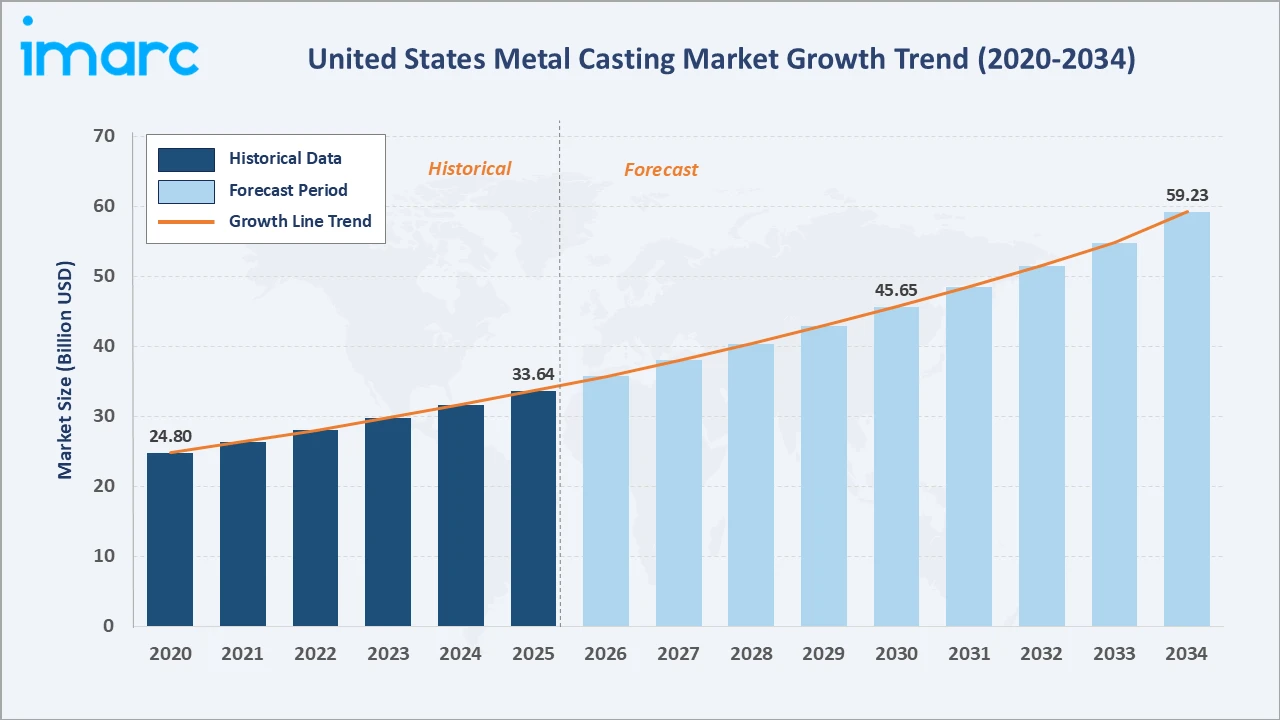
The United States metal casting market grew from USD 33.64 Billion in 2025 to USD 36.35 Billion in 2026 and is projected to reach USD 59.23 Billion by 2034, growing at a CAGR of 6.29% during 2026-2034. The market is driven by sustained automotive production, defense spending, and industrial infrastructure investments.
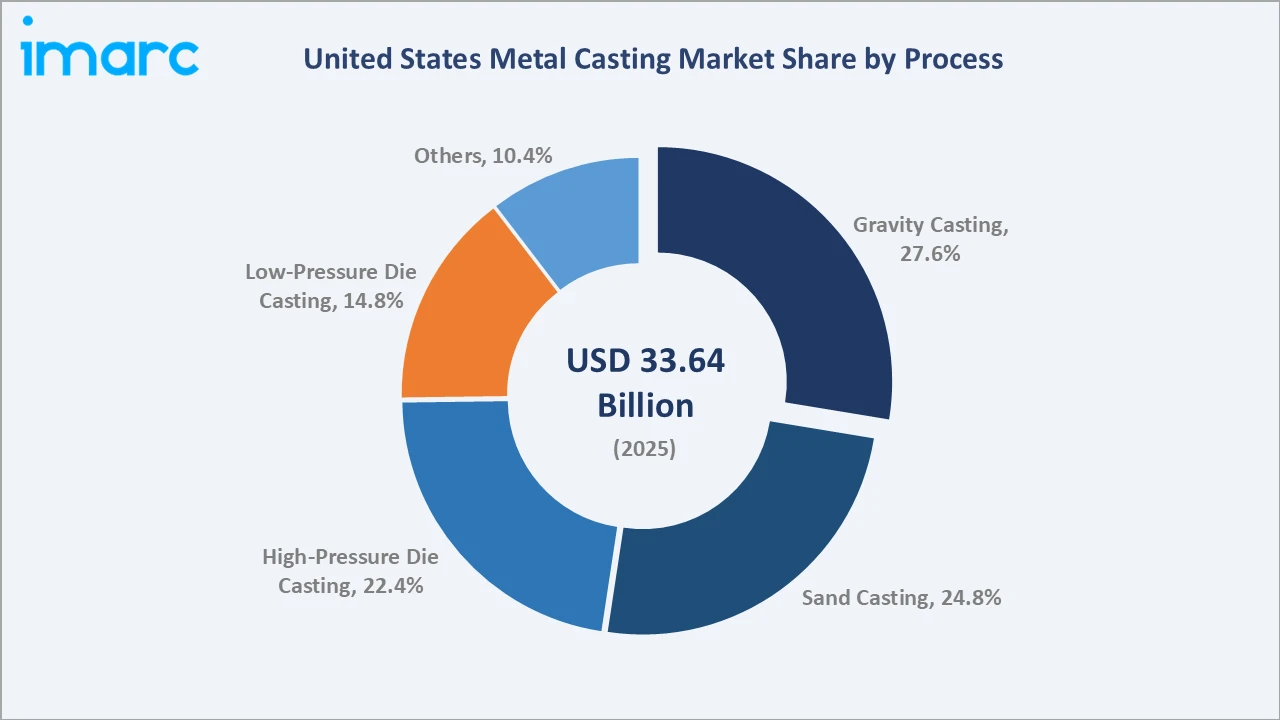
Gravity casting leads the process segment at 27.6% in 2025, passenger cars command 62.8% of the vehicle type segment, and South accounts for 34.7% of the national market share.
Market Snapshot
|
Metric |
Value |
|
Base Year Market Size (2025) |
USD 33.64 Billion |
|
Market Size (2026) |
USD 36.35 Billion |
|
Forecast Market Size (2034) |
USD 59.23 Billion |
|
CAGR (2026-2034) |
6.29% |
|
Base Year |
2025 |
|
Historical Period |
2020-2025 |
|
Forecast Period |
2026-2034 |
|
Largest Region |
South (34.7%, 2025) |
|
Second Largest Region |
Midwest (26.8%, 2025) |
|
Leading Process |
Gravity Casting (27.6%, 2025) |
|
Leading Vehicle Type |
Passenger Cars (62.8%, 2025) |
The United States metal casting market size increased from USD 24.80 Billion in 2020 to USD 33.64 Billion in 2025 and is estimated to reach USD 36.35 Billion in 2026. The market is further expected to grow to USD 45.65 Billion by 2030 and USD 59.23 Billion by 2034. The industry has evolved from traditional gray iron foundry production to a diversified mix of high-precision aluminum die castings, investment castings for aerospace, and gravity castings for general industrial use.
To get more information on this market, Request Sample
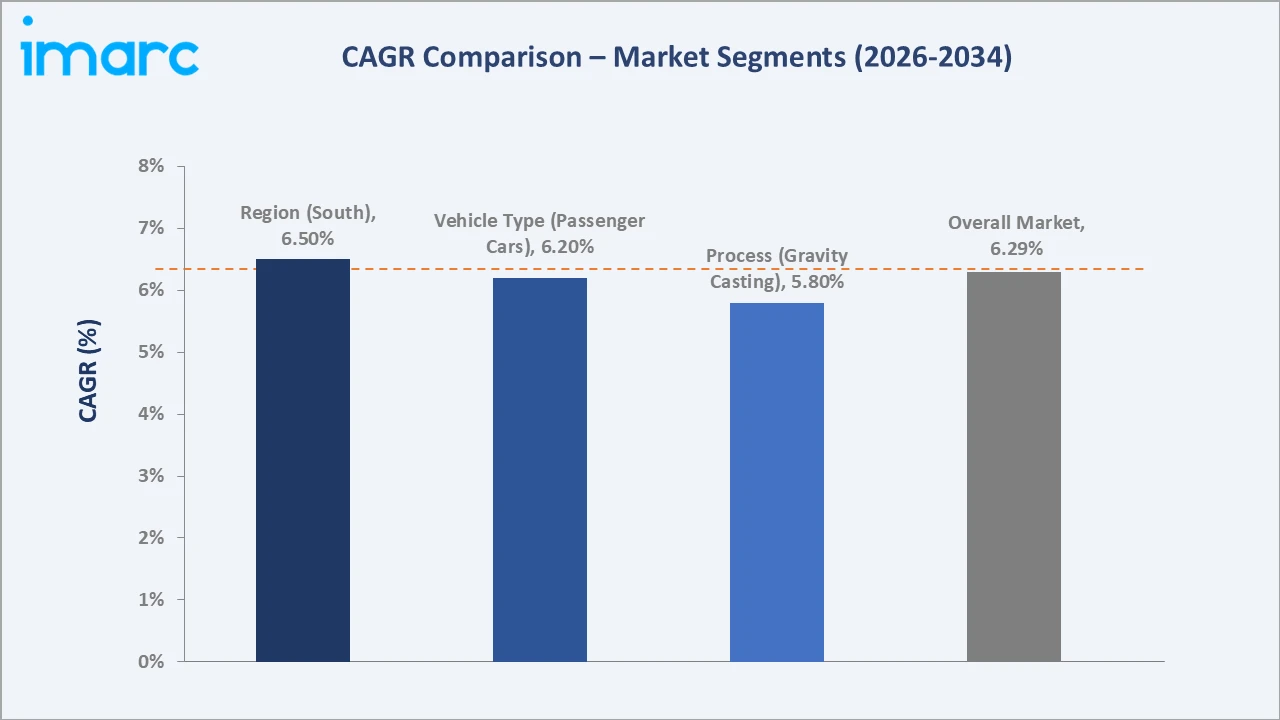
CAGR trajectories across process and vehicle type segments, together with regional growth patterns, reveal that high-pressure die casting and West are expanding faster than the overall 6.29% market CAGR, driven by automotive lightweighting mandates and growing advanced manufacturing investments.
Executive Summary
The United States metal casting market expanded from USD 33.64 Billion in 2025 to an estimated USD 36.35 Billion in 2026, positioning it among the world's largest national metal casting markets by value. The market is supported by sustained automotive production, defense modernization, and infrastructure investment cycles.
Gravity casting leads the process segment at 27.6%, reflecting its continued relevance for automotive and industrial applications. Passenger cars prevail over the vehicle type segment at 62.8%, driven by high automotive production volumes, sustained consumer demand, and the extensive use of cast components in engine, transmission, and structural applications. South dominates with 34.7% regional share in 2025, anchored by a dense concentration of automotive assembly plants, steel mills, and foundries across Texas, Alabama, Tennessee, and Georgia.
Key Market Insights
|
Insight |
Data |
|
Leading Process |
Gravity Casting – 27.6% share (2025) |
|
Second Largest Process |
Sand Casting – 24.8% share (2025) |
|
Leading Vehicle Type |
Passenger Cars – 62.8% share (2025) |
|
Second Largest Vehicle Type |
Light Commercial Vehicles – 21.7% share (2025) |
|
Leading Region |
South – 34.7% share (2025) |
|
Second Largest Region |
Midwest – 26.8% share (2025) |
|
Top Companies |
Precision Castparts Corp., Alcoa Corporation, Waupaca Foundry, Inc. |
Key Analytical Observations Expanding On the Data Above:
- Gravity casting dominance at 27.6% is underpinned by its wide applicability across automotive engine components, industrial valves, and pump housings, where dimensional accuracy and surface finish are primary requirements.
- Sand casting at 24.8% serves a broad array of heavy industrial, construction, and energy applications. Sand casting also offers cost efficiency and flexibility in producing complex components across a wide range of sizes and materials.
- Passenger cars dominance at 62.8% reflects deep integration of metal castings across powertrain, suspension, braking, and structural systems throughout passenger vehicle manufacturing.
- Light commercial vehicles at 21.7% are supported by demand for commercial transportation, last mile delivery, and utility vehicles, which require cast components for engine, transmission, braking, and chassis systems.
- South at 34.7% leads regional share due to a high concentration of automotive assembly plants and industrial foundries in states including Texas, Alabama, Georgia, and Tennessee, supported by strong infrastructure and logistics networks.
United States Metal Casting Market Overview
Metal casting refers to the manufacturing process of pouring molten metal into a mold or die to produce complex-shaped components with high dimensional accuracy. Processes include sand casting, gravity casting, high-pressure die casting, low-pressure die casting, and others, each suited to specific alloys, tolerances, and production volumes.
The United States metal casting ecosystem integrates raw material suppliers, alloy producers, foundries and die casting facilities, tooling and mold manufacturers, post-processing service providers, and end-market OEMs across automotive, aerospace, defense, industrial machinery, energy, and construction sectors. Macroeconomic factors including manufacturing output, infrastructure spending, defense appropriations, and consumer vehicle demand directly shape the industry's growth cycle.
Market Dynamics
To evaluate market opportunities, Request Sample
Market Drivers
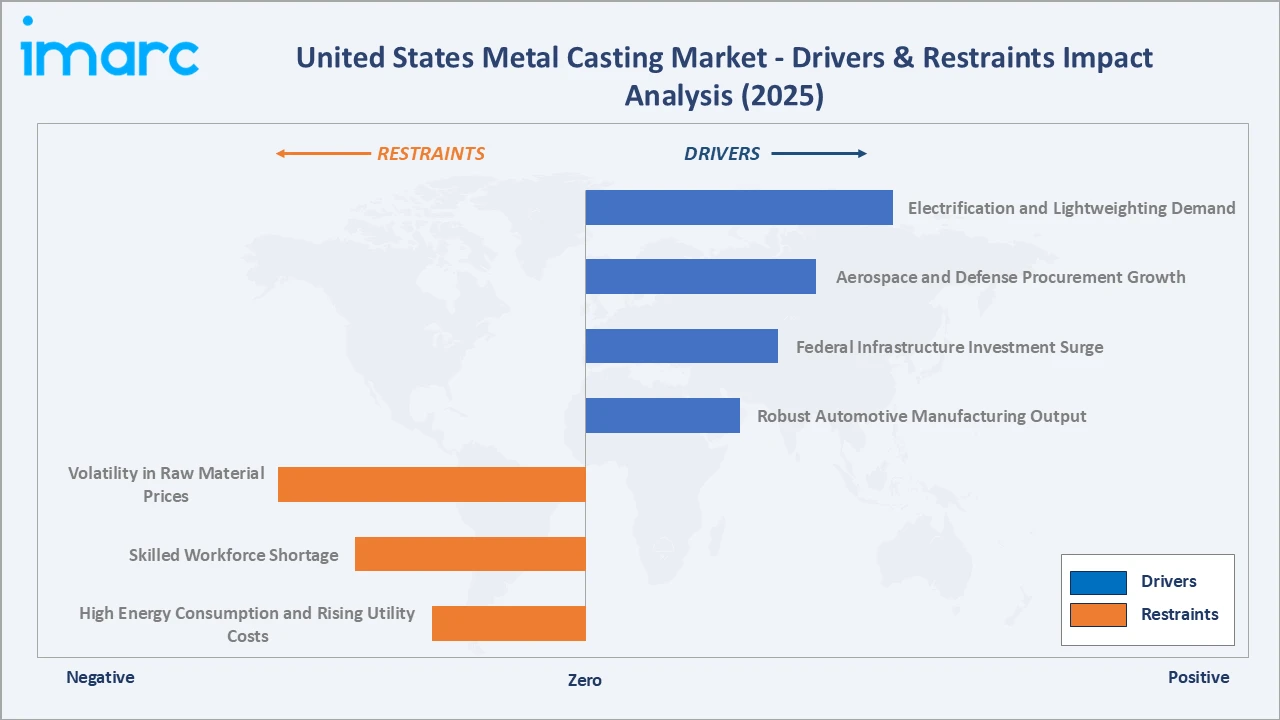
- Robust Automotive Manufacturing Output: Sustained vehicle production across domestic assembly plants is the primary demand driver for metal castings, encompassing engine blocks, transmission cases, brake calipers, wheel hubs, and suspension components. As stated by the International Organization of Motor Vehicles, in 2024, the United States manufactured 10.6 Million motor vehicles, and motor vehicle sales hit 16.3 Million.
- Federal Infrastructure Investment Surge: Ongoing federal and state investment in roads, bridges, ports, water systems, and rail infrastructure supports demand for structural iron and steel castings used in bridge components, valve bodies, and utility infrastructure. These infrastructure development initiatives continue to create opportunities for the US metal casting market through public works projects and the modernization of aging infrastructure.
- Aerospace and Defense Procurement Growth: Rising United States defense spending and expanding commercial aerospace production are driving demand for high-precision investment castings and aluminum die castings used in turbine blades, airframe structures, and propulsion system components.
- Electrification and Lightweighting Demand: The rapid adoption of battery EVs is accelerating demand for aluminum high-pressure die castings used in structural battery enclosures, motor housings, and chassis components, where weight reduction is critical for range optimization.
Market Restraints
- High Energy Consumption and Rising Utility Costs: Foundry operations are energy-intensive, with melting, heating, and post-processing stages demanding substantial electricity and natural gas inputs, creating operating cost pressure during periods of elevated energy pricing.
- Skilled Workforce Shortage: A growing shortage of qualified foundry workers, toolmakers, and metallurgical engineers is creating production capacity constraints, particularly among small and mid-size foundries with limited resources for workforce development and automation investment.
- Volatility in Raw Material Prices: Fluctuations in the prices of iron, steel, aluminum, and other casting alloys increase production costs and complicate procurement planning, creating margin pressures for US metal casting manufacturers and affecting pricing stability across end-use industries.
Market Opportunities
- EV Structural Casting Demand: The transition to EVs presents a structural growth opportunity, as EV platforms integrate large-format aluminum castings including mega-cast underbody structures that consolidate multiple traditional stampings and castings into single components.
- Reshoring and Supply Chain Localization: Ongoing reshoring of industrial and automotive production to the United States is expanding the domestic foundry customer base, as manufacturers reduce supply chain exposure to geopolitically sensitive import sources.
Market Challenges
- Raw Material Price Volatility: Fluctuations in aluminum, iron, copper, and nickel prices introduce margin uncertainty for foundries operating on fixed-price contracts, requiring active hedging and procurement strategies to maintain profitability.
- Competition from Alternative Manufacturing Processes: Additive manufacturing, metal injection molding, and advanced stamping processes are increasingly viable for specific casting applications, requiring foundries to differentiate on cost, quality, and complexity to defend market share.
Emerging Market Trends
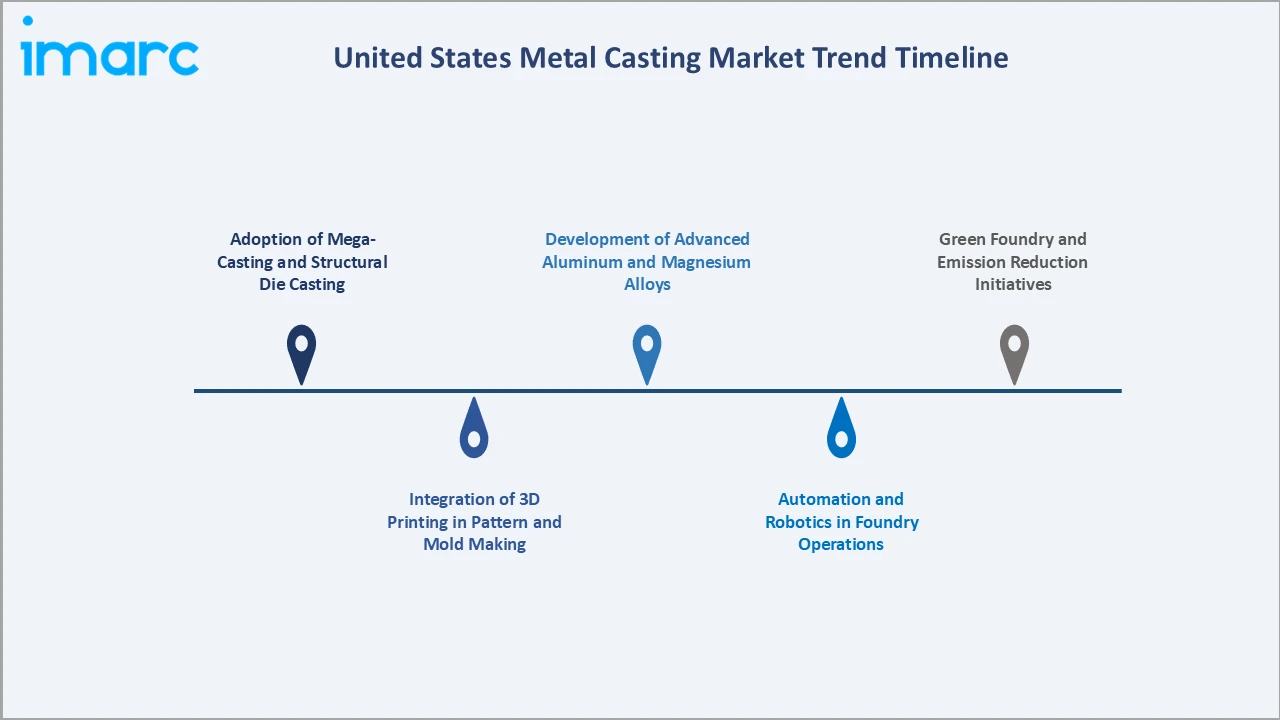
1. Adoption of Mega-Casting and Structural Die Casting
Automotive OEMs are adopting large-format, single-piece aluminum die casting processes to consolidate rear and front underbody structures, reducing part count, assembly complexity, and weight. This trend is expanding the addressable market for high-pressure die casting equipment manufacturers and aluminum alloy suppliers serving the EV segment.
2. Integration of 3D Printing in Pattern and Mold Making
Additive manufacturing is being adopted for sand mold and investment casting pattern production, significantly reducing lead times for prototype and low-volume casting runs. This digital integration is improving process flexibility and enabling foundries to serve shorter product development cycles across aerospace, defense, and industrial applications.
3. Automation and Robotics in Foundry Operations
Foundries are deploying robotic pouring, automated mold handling, and AI-driven quality inspection systems to address labor shortages and improve process consistency. These technologies also help reduce material waste, enhance workplace safety, and improve production efficiency across casting operations.
4. Development of Advanced Aluminum and Magnesium Alloys
Specialty alloy development for EV and aerospace applications is driving investment in new casting-grade aluminum and magnesium alloys with improved thermal conductivity, corrosion resistance, and strength-to-weight ratios. These developments are enabling foundries to access premium-priced, high-complexity casting programs.
5. Green Foundry and Emission Reduction Initiatives
Regulatory and corporate sustainability commitments are accelerating investment in electric induction furnaces, closed-loop water recycling, low-binder sand systems, and emissions capture technologies across United States foundry facilities. These capital investments are reshaping foundry operating models toward lower environmental footprint profiles while reducing long-term regulatory compliance risk.
Industry Value Chain Analysis
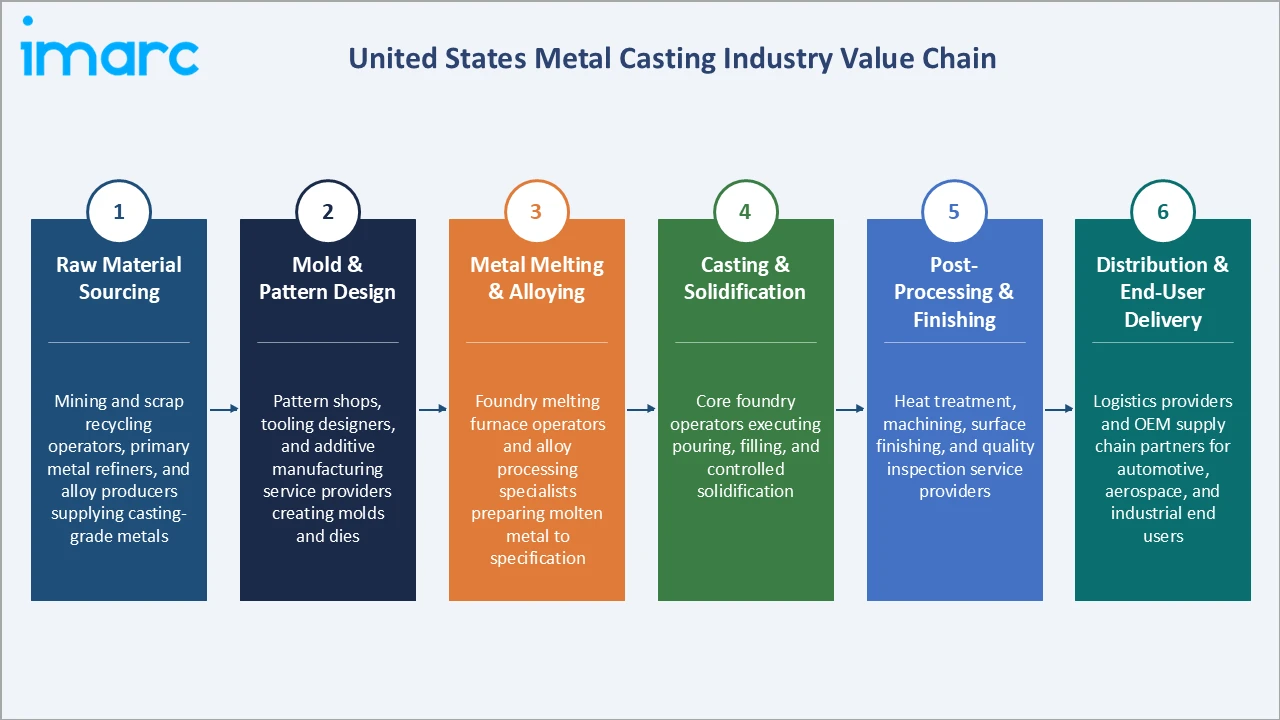
The United States metal casting value chain spans six stages, from raw material sourcing through end-user delivery. Casting and solidification, together with mold and pattern design, capture the highest value-add, as these stages determine the dimensional accuracy, metallurgical properties, and structural integrity of the final component.
|
Stage |
Key Players / Examples |
|
Raw Material Sourcing |
Mining and scrap recycling operators, primary metal refiners, and alloy producers supplying casting-grade metals |
|
Mold & Pattern Design |
Pattern shops, tooling designers, and additive manufacturing service providers creating molds and dies |
|
Metal Melting & Alloying |
Foundry melting furnace operators and alloy processing specialists preparing molten metal to specification |
|
Casting & Solidification |
Core foundry operators executing pouring, filling, and controlled solidification to achieve final geometry |
|
Post-Processing & Finishing |
Heat treatment, machining, surface finishing, and quality inspection service providers |
|
Distribution & End-User Delivery |
Logistics providers and OEM supply chain partners distributing finished castings to automotive, aerospace, and industrial end users |
Casting and solidification represents the highest-complexity and highest-value stage, as process control decisions made during pouring and cooling directly determine the mechanical performance of the finished component. Foundries with proprietary process expertise and advanced simulation capabilities command significant competitive advantages.
Technology Landscape in the United States Metal Casting Industry
Advanced Die Casting Systems
High-pressure die casting machines with enhanced clamping forces and real-time process monitoring are enabling production of larger, more complex aluminum structural castings for EVs, reducing assembly steps and improving part consistency.
Simulation and Digital Twin Technology
Casting simulation software and digital twin platforms allow foundries to optimize mold fill patterns, solidification rates, and thermal gradients before physical tooling is produced, reducing scrap rates and shortening development cycles.
Induction Melting and Energy Efficiency Systems
Electric induction furnaces are increasingly replacing cupola and gas-fired furnaces in iron and aluminum foundries, offering improved energy efficiency, lower emissions, and better temperature control during the melting and holding stages.
Robotics and Automated Quality Inspection
Vision-based automated inspection systems and robotic post-processing cells are being integrated into foundry production lines to enforce dimensional and surface quality standards while reducing labor dependency in repetitive inspection tasks.
Market Segmentation Analysis
The report covers the following segments:
| Segment Category | Leading Segment | Market Share | Year |
|---|---|---|---|
| Process | Gravity Casting | 27.6% | 2025 |
| Material Type | Cast Iron | 🔒 | 2025 |
| End Use | Automotive and Transportation | 🔒 | 2025 |
| Component | Alloy Wheel | 🔒 | 2025 |
| Vehicle Type | Passenger Cars | 62.8% | 2025 |
| Electric and Hybrid Type | 🔒 | 🔒 | 2025 |
| Application | Body Assemblies | 🔒 | 2025 |
| Region | South | 34.7% | 2025 |

By Process
Gravity casting commands a 27.6% majority share in 2025, driven by its suitability for producing medium-to-large aluminum and iron components with good surface finish and mechanical properties. The process is widely used in automotive engine, transmission, and structural applications, where dimensional repeatability and moderate production volumes make it economically favorable.
To access detailed market analysis, Request Sample
Sand casting at 24.8% in 2025 serves a diverse industrial base spanning pumps, valves, compressors, heavy equipment, and construction machinery. The process offers exceptional geometric flexibility and is compatible with virtually all casting alloys, making it the preferred method for complex, low-to-medium volume industrial castings.
By Vehicle Type
Passenger cars dominate the vehicle type segment at 62.8% in 2025, driven by the sheer volume of passenger vehicles assembled annually in the United States and the high casting content per vehicle across powertrain, braking, suspension, and structural systems.
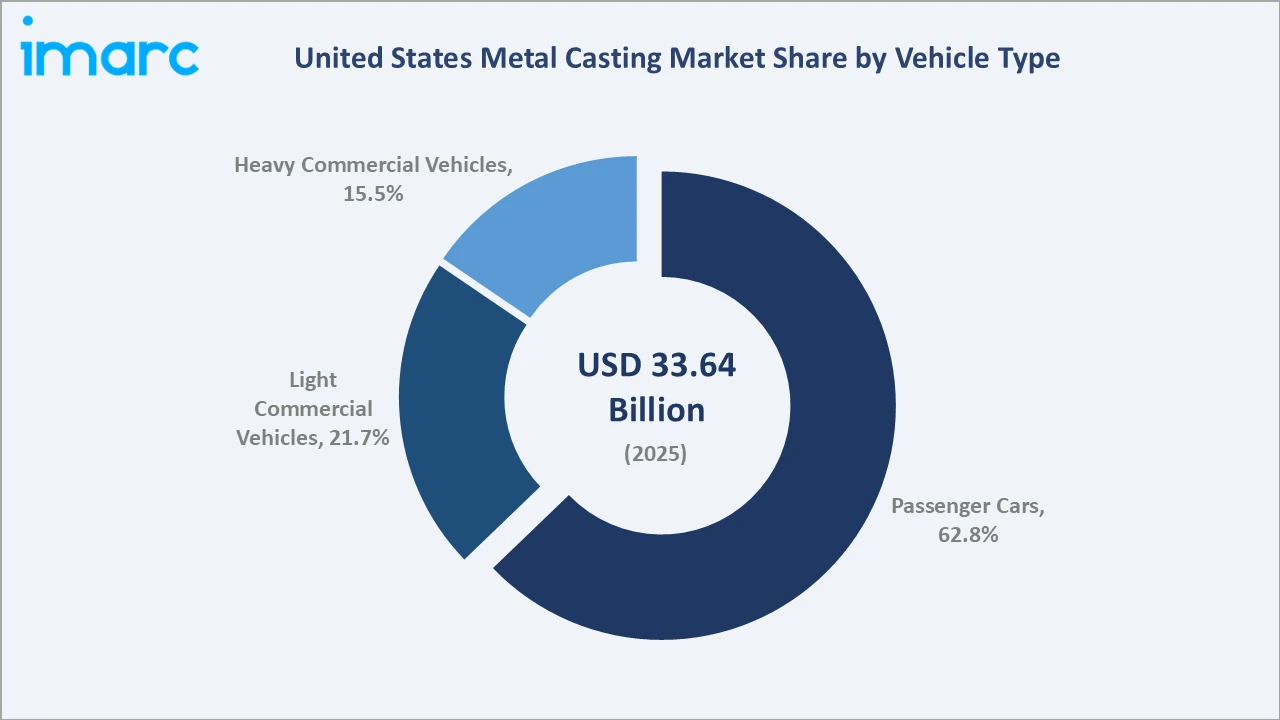
Light commercial vehicles account for 21.7% in 2025, supported by sustained pickup truck and light van production from major domestic OEMs.
Regional Market Insights
| Region | Share (2025) | Key Growth Drivers |
|---|---|---|
| South | 34.7% | Large concentration of automotive assembly plants, foundries, and steel processing facilities; strong industrial base and favorable logistics networks |
| Midwest | 26.8% | Legacy automotive and heavy manufacturing footprint; proximity to major OEMs; skilled foundry workforce; strong industrial machinery demand |
| Northeast | 21.4% | Defense and aerospace casting demand; presence of specialty foundries; industrial equipment and energy sector applications |
| West | 17.1% | Growing aerospace and defense casting programs; emerging EV supply chain investment; technology-driven manufacturing adoption |
South at 34.7% in 2025 leads the regional landscape, anchored by a high density of automotive assembly facilities and integrated foundry operations across Texas, Alabama, Tennessee, and Georgia. Favorable operating environments, lower energy costs, and proximity to major OEM customers support continued regional leadership through 2034.
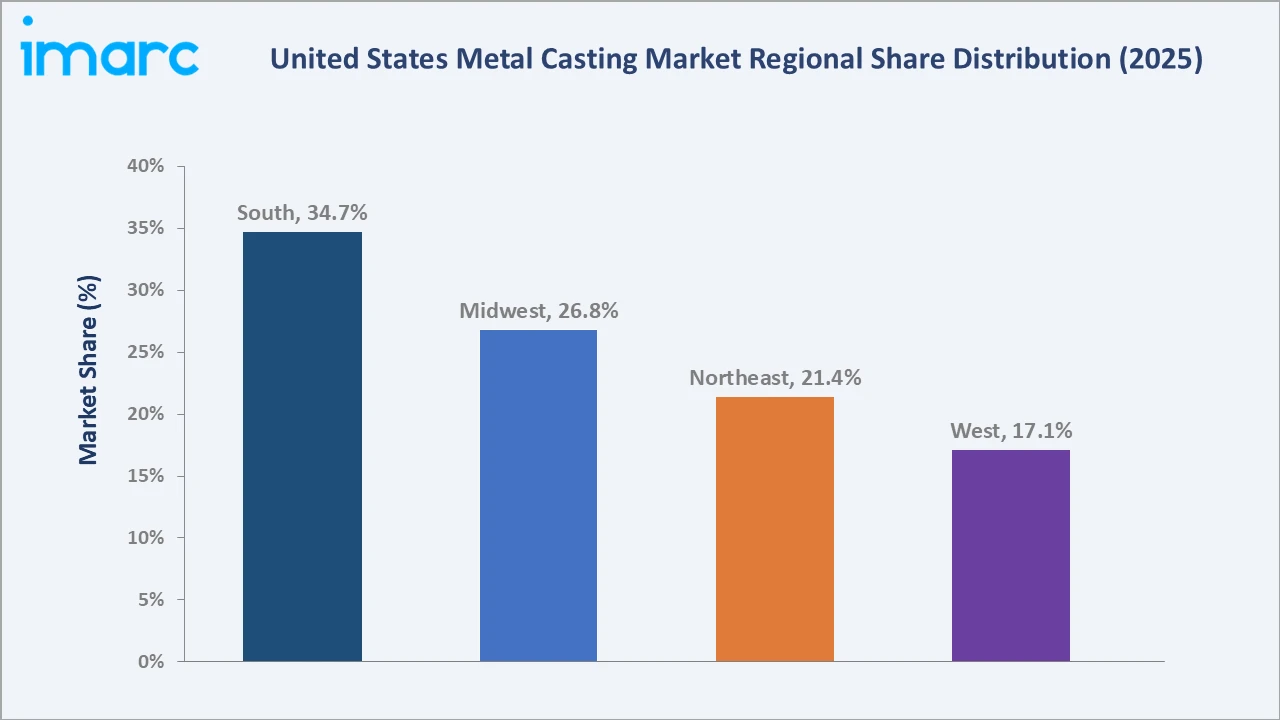
Midwest at 26.8% sustains its position through legacy automotive and heavy manufacturing infrastructure concentrated in Ohio, Michigan, Indiana, and Illinois, serving major powertrain and structural casting programs.
Competitive Landscape
The United States metal casting market is moderately concentrated, with established players holding competitive positions across specific end markets, alloy systems, and casting processes. Technology depth, metallurgical expertise, customer program depth, and process automation capabilities form the key competitive differentiators.
|
Company Name |
Key Offerings |
Market Position |
Strategic Focus |
| Precision Castparts Corp. | Investment / Structural Castings | Leader | Deepening aerospace and defense casting capabilities through advanced alloy development |
| Alcoa Corporation | Aluminum Castings | Leader | Expanding lightweight aluminum casting portfolio for automotive and aerospace applications |
| Waupaca Foundry, Inc. | Ductile Iron Castings | Challenger | Strengthening iron casting production for automotive and commercial vehicle customers |
Key players include Precision Castparts Corp., Alcoa Corporation, and Waupaca Foundry, Inc., among others.
Key Company Profiles
Precision Castparts Corp.
Precision Castparts Corp. is a leading United States manufacturer of complex structural castings, forged components, and fastener products serving the aerospace, defense, and industrial gas turbine markets. The company operates an extensive network of investment casting facilities across the United States and internationally.
- Product Portfolio: Investment castings, structural castings, and forged components for aerospace airframes, turbine engines, defense systems, and industrial power generation.
- Recent Developments: The company continues to strengthen its aerospace casting capabilities through process technology investment and program expansion with leading airframe and engine OEM customers, supporting next-generation aircraft and defense platforms.
- Strategic Focus: Expanding aerospace and defense casting depth through advanced superalloy development and precision manufacturing process investment.
Alcoa Corporation
Alcoa Corporation is a global producer of bauxite, alumina, and aluminum products headquartered in Pittsburgh, Pennsylvania, with a significant presence in casting-grade aluminum supply for automotive, aerospace, and packaging applications.
- Product Portfolio: Casting-grade aluminum alloys, rolled aluminum products, and specialty aluminum solutions serving automotive lightweighting, aerospace structural, and industrial markets.
- Recent Developments: Alcoa Corporation continues to invest in low-carbon aluminum production and casting-grade alloy development programs targeting the EV and sustainable packaging sectors, aligning its product portfolio with long-term decarbonization demand trends.
- Strategic Focus: Expanding low-carbon aluminum casting portfolio for automotive and aerospace lightweighting applications with a focus on sustainable production technologies.
Waupaca Foundry, Inc.
Waupaca Foundry, Inc. is one of North America's largest iron casting producers, operating multiple gray and ductile iron foundries in the United States and serving automotive, commercial vehicle, and industrial machinery customers.
- Product Portfolio: Gray iron and ductile iron castings for automotive powertrain, braking, and suspension components, as well as industrial and commercial vehicle applications.
- Recent Developments: The company continues to invest in green sand foundry modernization, automation, and process efficiency improvements to enhance casting quality and production throughput across its foundry network.
- Strategic Focus: Strengthening iron casting production capabilities for automotive and commercial vehicle customers through foundry modernization and automation investment.
Market Concentration Analysis
The United States metal casting market exhibits moderate concentration, with leading producers maintaining competitive positions across specific process technologies, alloy systems, and end-market verticals. The market supports a large number of regional foundries and specialty casters alongside the larger integrated producers, creating a layered competitive structure that spans a wide range of casting complexity, volume, and application requirements.
Barriers to entry include high capital requirements for foundry equipment and tooling, the need for deep metallurgical and process engineering expertise, and long customer qualification cycles in aerospace and defense applications. These structural factors support the continued competitive positioning of established players while limiting rapid market entry by new producers.
Ongoing investment in process automation, simulation technology, and alloy development is gradually increasing the scale advantages of larger casting groups, supporting incremental consolidation trends across the industry.
Investment & Growth Opportunities
Fastest-Growing Segments
High-pressure die casting is the fastest-growing process segment, driven by automotive electrification and growing demand for large-format aluminum structural components. The segment's expansion is supported by OEM investment in mega-casting technology and the proliferation of EV platforms requiring lightweight structural assemblies.
Emerging Markets
West represents the fastest-growing regional opportunity, with expanding aerospace casting programs and growing EV supply chain investments in California, Arizona, and Nevada driving foundry demand. Defense modernization programs concentrated in Northeast are also creating sustained growth in investment casting for complex aerospace and hypersonic applications.
Venture & Investment Trends
Investment activity in the United States metal casting ecosystem is concentrated in automation and robotics for foundry operations, advanced die casting equipment for EV structural components, and digital simulation platforms for process optimization. Capital is also flowing into green foundry technology, including electric induction melting systems, zero-emission binder systems, and closed-loop recycling infrastructure, as sustainability commitments drive foundry modernization.
Future Market Outlook (2026-2034)
The United States metal casting market is projected to grow from USD 33.64 Billion in 2025 to USD 36.35 Billion in 2026, reaching USD 59.23 Billion by 2034, registering a CAGR of 6.29% during 2026-2034.
Four forces will shape market trajectory through 2034: continued transition to aluminum die casting in automotive electrification programs; growing aerospace and defense investment casting demand; federal infrastructure spending driving structural iron casting requirements; and progressive automation and process digitization improving foundry competitiveness.
By 2034, high-pressure die casting is expected to narrow the gap with gravity and sand casting in process share, reflecting the structural shift toward aluminum in vehicle programs. Reshoring trends are expected to add incremental foundry demand as domestic manufacturing base expands, particularly in industrial machinery, defense components, and semiconductor equipment casting applications.
Research Methodology
Primary Research
Primary research included structured interviews with foundry executives, process engineers, automotive OEM procurement specialists, aerospace casting program managers, and investment casting technology providers, validating market sizing, segment dynamics, and regional demand trends.
Secondary Research
Secondary sources included American Foundry Society industry data, United States Geological Survey mineral production statistics, United States Census Bureau manufacturing output data, Department of Defense procurement reports, and annual reports, investor presentations, and press releases from leading casting companies and automotive OEMs.
Forecasting Models
Market forecasts used top-down and bottom-up models combining domestic vehicle production volumes, infrastructure spending projections, defense appropriation trends, casting content per vehicle estimates, and process adoption rate assumptions. Scenario analysis addressed EV adoption pace, raw material price trajectories, and automation investment trends.
Report Coverage:
| Report Features | Details |
|---|---|
| Base Year of the Analysis | 2025 |
| Historical Period | 2020-2025 |
| Forecast Period | 2026-2034 |
| Units | Billion USD |
| Scope of the Report | Exploration of Historical Trends and Market Outlook, Industry Catalysts and Challenges, Segment-Wise Historical and Future Market Assessment:
|
| Processes Covered | Sand Casting, Gravity Casting, High-Pressure Die Casting, Low-Pressure Die Casting, Others |
| Material Types Covered | Cast Iron, Aluminum, Steel, Zinc, Magnesium, Others |
| End Uses Covered | Automotive and Transportation, Equipment and Machine, Building and Construction, Aerospace and Military, Others |
| Components Covered | Alloy Wheels, Clutch Casing, Cylinder Head, Cross Car Beam, Crank Case, Battery Housing, Others |
| Vehicle Types Covered | Passenger Cars, Light Commercial Vehicles, Heavy Commercial Vehicles |
| Electric and Hybrid Types Covered | Hybrid Electric Vehicles, Battery Electric Vehicles, Plug-In Hybrid Electric Vehicles |
| Applications Covered | Body Assemblies, Engine Parts, Transmission Parts, Others |
| Regions Covered | Northeast, Midwest, South, West |
| Companies Covered | Precision Castparts Corp., Alcoa Corporation, Waupaca Foundry, Inc., etc. |
| Customization Scope | 10% Free Customization |
| Post-Sale Analyst Support | 10-12 Weeks |
| Delivery Format | PDF and Excel through Email (We can also provide the editable version of the report in PPT/Word format on special request) |
Frequently Asked Questions About the United States Metal Casting Market Report
The United States metal casting market size is estimated at USD 36.35 Billion in 2026, driven by automotive production, infrastructure investment, and growing aerospace and defense casting demand across domestic foundries.
The market is projected to grow at a CAGR of 6.29% from 2026-2034, reaching USD 59.23 Billion, supported by automotive electrification, infrastructure spending, and defense modernization programs.
Gravity casting leads the process segment at 27.6% share in 2025, driven by automotive engine and structural applications where dimensional accuracy and surface quality are critical requirements.
Passenger cars dominate the vehicle type segment at 62.8% share in 2025, driven by high casting content per vehicle across powertrain, braking, suspension, and structural systems.
South commands 34.7% regional share in 2025, supported by a dense concentration of automotive assembly plants, integrated foundries, and industrial manufacturing facilities.
Leading players include Precision Castparts Corp., Alcoa Corporation, and Waupaca Foundry, Inc., among others.
EV adoption is accelerating demand for aluminum high-pressure die castings used in structural battery enclosures, motor housings, and chassis components, driving process share shifts.
Primary growth drivers include automotive production volumes, federal infrastructure investment, aerospace and defense casting demand, and lightweighting requirements in EV programs.
Key challenges include high energy costs, environmental compliance requirements, skilled workforce shortages, raw material price volatility, and competition from alternative manufacturing processes.
Need more help?
- Speak to our experienced analysts for insights on the current market scenarios.
- Include additional segments and countries to customize the report as per your requirement.
- Gain an unparalleled competitive advantage in your domain by understanding how to utilize the report and positively impacting your operations and revenue.
- For further assistance, please connect with our analysts.
 Request Customization
 Speak to an Analyst
 Request Brochure
 Inquire Before Buying
Benefits of Customization
- Personalize this research
- Triangulate with your data
- Get data as per your format and definition
- Gain a deeper dive into a specific application, geography, customer, or competitor
- Any level of personalization
Get in Touch With Us
UNITED STATES
Phone: +1-201-971-6302
INDIA
Phone: +91-120-433-0800
UNITED KINGDOM
Phone: +44-753-714-6104
Email: [email protected]
Client Testimonials























Related Reports

Choose your plan
*Please note that the prices mentioned below are starting prices for each bundle type. Kindly contact our team for further details.*
Single User License
- 1 User License, Access on 2 Devices
- PDF Report + Excel Dataset (Password Protected)
- Lifetime Access
- No Printing Rights
- 10% Free Report Customization
- 10–12 Weeks of Analyst Support
Five User License
- Access for 5 Users, 2 Devices per User
- PDF Report + Excel Dataset (Password Protected)
- Lifetime Access
- Dedicated Account Manager
- 12–14 Weeks of Analyst Support
- No Printing Rights
- 15% Free Report Customization
- 25% Discount on Your Next Purchase
Corporate User License
- Unlimited User Access (Within Your Organization)
- PDF Report + Excel Dataset
- Lifetime Access
- Dedicated Account Manager
- 14–20 Weeks of Analyst Support
- No Printing Rights
- 20% Free Report Customization
- 30% Discount on Your Next Purchase
Essential Insights
What's included:
3 reports
- Lifetime Access
- PDF Reports
- Excel Datasets
- 2 Weeks of Free Analyst Support
- 2 User Licenses
- Access on 2 Devices
- Printing Rights
- Complimentary PowerPoint (PPT) Version
- Complimentary License Upgrade
Professional Access
What's included:
5 reports
- Lifetime Access
- PDF Reports
- Excel Datasets
- 8 Weeks of Free Analyst Support
- 2 User Licenses
- Access on 2 Devices
- Printing Rights
- Complimentary PowerPoint (PPT) Version
- Complimentary License Upgrade
Business Advantage
What's included:
8 reports
- Lifetime Access
- PDF Reports
- Excel Datasets
- 14 Weeks of Free Analyst Support
- 2 User Licenses
- Access on 2 Devices
- Printing Rights
- Complimentary PowerPoint (PPT) Version
- Complimentary License Upgrade
Enterprise Intelligence
What's included:
10 reports
- Lifetime Access
- PDF Reports
- Excel Datasets
- 20 Weeks of Free Analyst Support
- 2 User Licenses
- Access on 2 Devices
- Printing Rights
- Complimentary PowerPoint (PPT) Version
- Complimentary License Upgrade