
United States Multi-factor Authentication Market Size, Share, Trends and Forecast by Model, Deployment Type, Application, Vertical, and Region, 2026-2034
United States Multi-Factor Authentication Market Size, Share, Trends & Forecast (2026-2034)
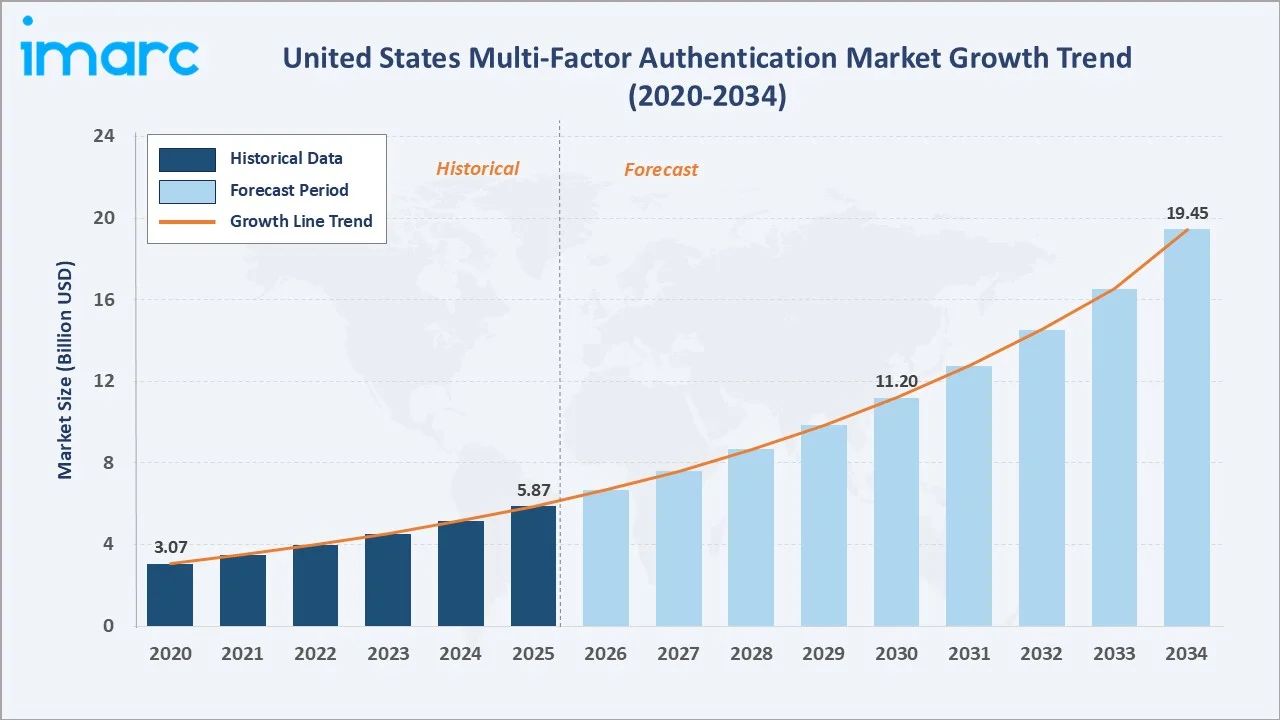
The United States multi-factor authentication market grew from USD 5.87 Billion in 2025 to USD 6.68 Billion in 2026 and is projected to reach USD 19.45 Billion by 2034, growing at a CAGR of 13.82% during 2026-2034. The market is driven by escalating cyber threats, mandatory federal zero-trust and MFA directives under Executive Order 14028, and widespread enterprise cloud migration requiring robust identity verification. On-Cloud deployment commands 69.7%. Phone-Based Authentication leads at 54.6%. The West region holds 33.5% of national market share.
Market Snapshot
|
Metric |
Value |
|
Base Year Market Size (2025) |
USD 5.87 Billion |
|
Market Size (2026) |
USD 6.68 Billion |
|
Forecast Market Size (2034) |
USD 19.45 Billion |
|
CAGR (2026-2034) |
13.82% |
|
Base Year |
2025 |
|
Historical Period |
2020-2025 |
|
Forecast Period |
2026-2034 |
|
Dominant Deployment Type |
On-Cloud (69.7%, 2025) |
|
Dominant Application |
Phone-Based Authentication (54.6%, 2025) |
|
Leading Region |
West (33.5%, 2025) |
The U.S. multi-factor authentication market size increased from USD 3.07 Billion in 2020 to USD 5.87 Billion in 2025 and is estimated to reach USD 6.68 Billion in 2026. The market is further expected to grow to USD 11.20 Billion by 2030 and USD 19.45 Billion by 2034.
To get more information on this market, Request Sample
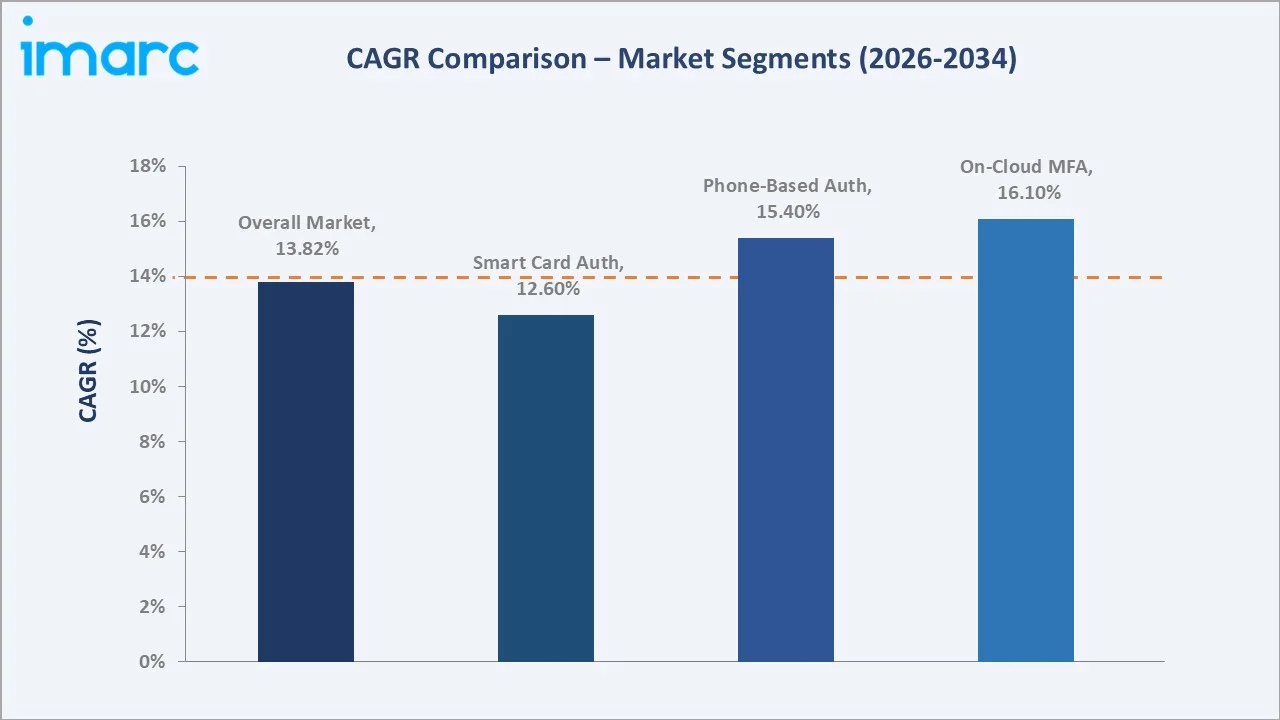
On-Cloud MFA is the fastest-growing deployment type at ~16.1% CAGR through cloud-native enterprise migration and SaaS application proliferation. Phone-Based Authentication grows at ~15.4% CAGR through smartphone-native authenticator app adoption. Smart Card Authentication expands at ~12.6% CAGR through government and defense mandate compliance.
Executive Summary
The U.S. multi-factor authentication market expanded from USD 5.87 Billion in 2025 to an estimated USD 6.68 Billion in 2026, establishing the U.S. as the world's largest national MFA market by value. The market is underpinned by CISA's mandatory MFA directives for federal agencies, FFIEC authentication guidance for banking, HIPAA security rules for healthcare, and the pervasive enterprise recognition that password-only authentication is commercially and securitywise unacceptable.
On-Cloud deployment at 69.7% leads through enterprise cloud migration. Phone-Based Authentication at 54.6% dominates through consumer-scale smartphone adoption. The West region commands 33.5%.
Key Market Insights
|
Insight |
Data |
|
Dominant Deployment Type |
On-Cloud – 69.7% share (2025) |
|
Dominant Application |
Phone-Based Authentication – 54.6% share (2025) |
|
Leading Region |
West – 33.5% share (2025) |
|
Market Opportunity |
CISA MFA mandates; passwordless adoption; BFSI & healthcare compliance; zero-trust expansion |
Key Analytical Observations Supporting the Above Data:
- On-Cloud at 69.7%: Cloud deployment leads through enterprise SaaS adoption requiring cloud-native identity integration, MSSP-delivered MFA scalability, and zero-capital MFA deployment models that enable rapid employee onboarding without hardware token provisioning overhead across distributed enterprise environments.
- Phone-Based Authentication at 54.6%: Phone-based MFA dominates through smartphone ubiquity, authenticator app zero-cost provisioning, and FIDO2 passkey adoption that eliminates shared secrets, offering superior security and user experience compared to hardware token and smart card alternatives in most enterprise deployment contexts.
- West at 33.5%: The West leads through Silicon Valley technology sector density, California's stringent data privacy regulations creating mandatory MFA adoption pressure, and significant federal defense contractor MFA compliance obligations in Washington and Colorado creating above-national enterprise MFA investment intensity.
United States Multi-Factor Authentication Market Overview
The U.S. multi-factor authentication market occupies the most strategically consequential position in global identity security: the nation with the largest enterprise cybersecurity spend, the most structured federal MFA mandate environment, and the deepest integration of MFA into regulatory compliance frameworks across BFSI, healthcare, government, and critical infrastructure sectors.
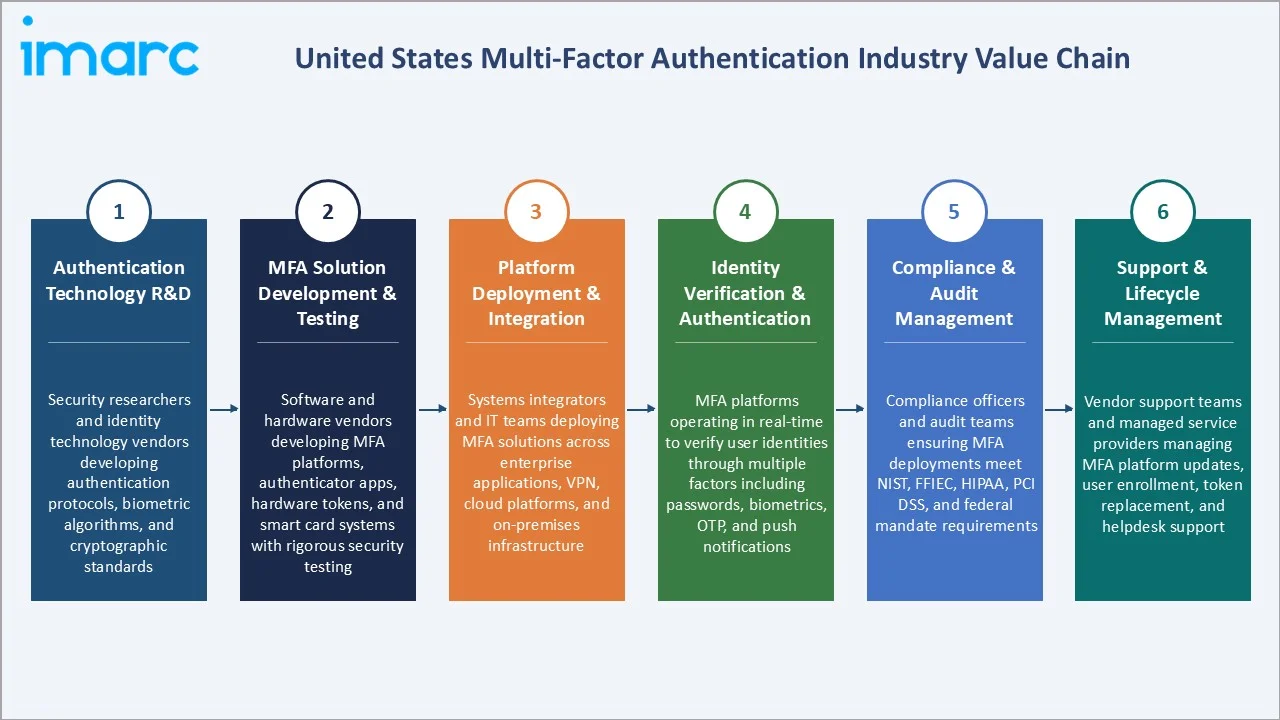
The market ecosystem integrates authentication technology R&D, MFA platform development, enterprise deployment, identity verification operations, and compliance management across software, hardware, and cloud delivery models. The commercial structure creates layered demand from password replacement for consumer access through to hardware-anchored cryptographic authentication for classified government systems.
Market Dynamics
To evaluate market opportunities, Request Sample
Market Drivers
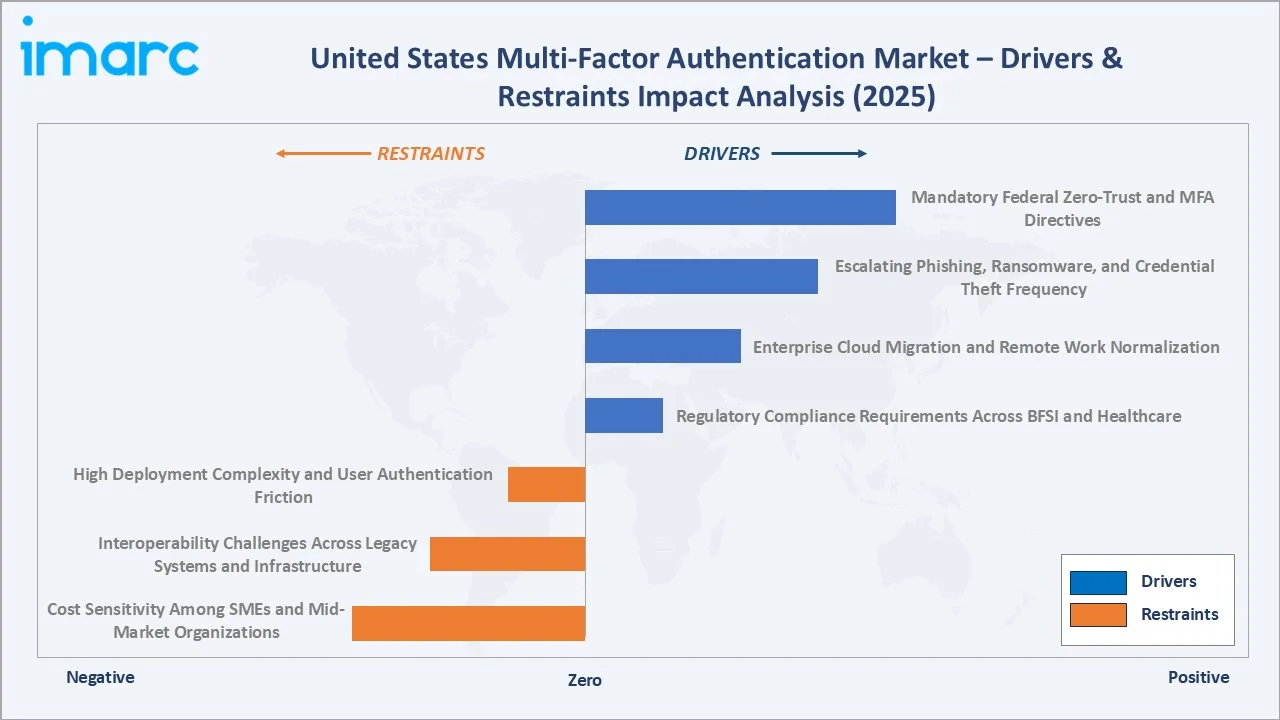
- Mandatory Federal Zero-Trust and MFA Directives: Executive Order 14028 on Improving the Nation's Cybersecurity mandated federal agencies to implement MFA as a foundational zero-trust security requirement, creating structured non-discretionary demand across government agencies and the thousands of contractors supplying federal systems. CISA's binding operational directives extending MFA requirements to critical infrastructure sectors are systematically converting commercial MFA adoption from discretionary security investment to compliance obligation, sustaining demand above commercial economic cycle variability. The Cybersecurity and Infrastructure Security Agency's continued MFA guidance expansion through 2026 is creating new mandate-driven demand cohorts across sectors that were previously exempt from mandatory MFA requirements.
- Escalating Phishing, Ransomware, and Credential Theft Frequency: Credential-based attacks representing over 80% of U.S. enterprise data breaches are creating direct commercial pressure for MFA adoption as organizations experience the financial consequences of password-only authentication failure. Ransomware attacks routinely exploiting stolen credentials for initial access have created board-level mandates for MFA deployment across enterprise VPN, email, and privileged access management systems. The average cost of a U.S. data breach exceeding USD 9 million provides a compelling ROI justification for MFA investment that compresses enterprise sales cycles and increases average MFA contract value as organizations deploy MFA comprehensively rather than selectively.
- Enterprise Cloud Migration and Remote Work Normalization: Enterprise cloud migration eliminating the traditional corporate network perimeter has made identity-based authentication the primary security control, creating structural demand for MFA across all cloud application access. Remote and hybrid work normalization post-pandemic has extended the enterprise authentication perimeter to personal devices and home networks, requiring MFA capable of verifying identity without network-level trust anchors. Cloud-native MFA platforms delivered as SaaS enable zero-capital deployment at per-user subscription pricing, removing capital expenditure barriers that previously limited MFA adoption to large enterprises, opening the mid-market as a major growth segment.
- Regulatory Compliance Requirements Across BFSI and Healthcare: FFIEC authentication guidance mandating layered security for banking applications and HIPAA security rules requiring access control verification are creating sector-specific non-discretionary MFA demand in the two largest regulated industry verticals by cybersecurity spend. PCI DSS 4.0 requirements mandating MFA for all access to the cardholder data environment have extended MFA compliance obligations to retail and e-commerce organizations, creating a new commercial demand cohort. State-level regulations including New York DFS cybersecurity rules and California Consumer Privacy Act enforcement pressure are supplementing federal mandates with overlapping state compliance requirements that sustain enterprise MFA investment above federal mandate requirements alone.
Market Restraints
- High Deployment Complexity and User Authentication Friction: Enterprise MFA deployment across heterogeneous application portfolios, legacy systems, and diverse workforce demographics creates significant integration complexity and project cost that extends time-to-value and compresses MFA procurement ROI. User authentication friction from MFA step-up challenges, push notification fatigue, and authenticator app enrollment failures creates helpdesk support burden and user resistance that slows enterprise MFA rollout timelines, particularly for organizations with large non-technical workforces unfamiliar with authentication app management and device registration procedures.
- Interoperability Challenges Across Legacy Systems and Infrastructure: Legacy enterprise applications lacking modern authentication protocol support including SAML 2.0 and OAuth/OIDC create integration barriers that require costly middleware development or application modernization before MFA can be deployed. Hardware OTP token systems requiring manual provisioning and physical distribution create operational overhead that limits MFA deployment velocity for distributed enterprise workforces, particularly government agencies managing hundreds of thousands of users requiring physical credential issuance and replacement across geographically dispersed locations.
- Cost Sensitivity Among SMEs and Mid-Market Organizations: Per-user MFA subscription pricing that is commercially manageable for large enterprises becomes a significant budget challenge for small and medium enterprises evaluating MFA for the first time. Hardware security key and smart card programs requiring physical device procurement, distribution logistics, and replacement management create capital expenditure requirements that are prohibitive for budget-constrained mid-market organizations evaluating the total cost of MFA ownership beyond software licensing.
Market Opportunities
- Passwordless Authentication and FIDO2 Passkey Adoption: The industry transition to passwordless authentication anchored by FIDO2 passkeys, biometric authentication, and hardware security keys is creating a new MFA market cycle above the traditional OTP and push notification authentication installed base. Passkey adoption by companies for consumer authentication is normalizing cryptographic authentication user experiences that enterprise MFA vendors are commercializing for workforce authentication, creating replacement demand for existing MFA infrastructure as enterprises modernize to phishing-resistant authentication methods mandated by CISA guidance.
- AI-Powered Adaptive and Risk-Based Authentication: Machine learning-driven adaptive authentication analyzing device posture, location, behavior patterns, and network context to dynamically adjust authentication requirements is creating commercially compelling premium MFA offerings above static authentication products. AI-native risk-based authentication enabling step-up authentication only when risk signals exceed thresholds reduces authentication friction for low-risk access while maintaining security for high-risk scenarios, resolving the user experience versus security tradeoff that previously limited enterprise MFA deployment breadth.
Market Challenges
- MFA Bypass and SIM-Swapping Attack Sophistication: Increasingly sophisticated MFA bypass techniques including SIM-swapping for SMS-based OTP interception, push notification fatigue attacks, and adversary-in-the-middle phishing toolkits are undermining weaker MFA factors, creating urgency for migration to phishing-resistant FIDO2 and hardware-anchored authentication that requires significant enterprise re-enrollment investment and user change management.
- Authentication Experience Consistency Across Mobile, Desktop, and IoT: Delivering consistent MFA experiences across diverse device types including mobile devices, desktop workstations, shared kiosk environments, and OT/IoT systems requires platform-specific authentication implementations that increase development and support costs for MFA vendors and enterprise IT teams, limiting deployment breadth in complex multi-device enterprise environments.
Emerging Market Trends
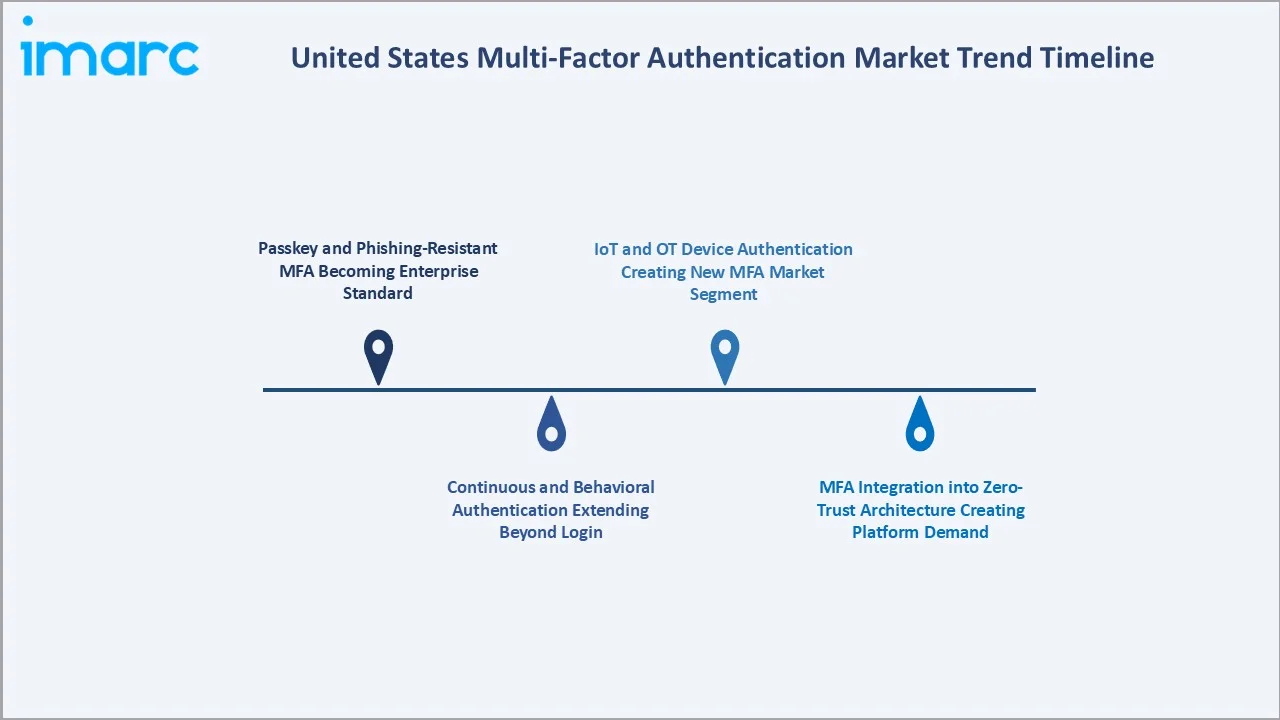
1. Passkey and Phishing-Resistant MFA Becoming Enterprise Standard
FIDO2 passkeys replacing SMS OTP and push notification MFA as the authentication standard are creating a structural MFA upgrade cycle across U.S. enterprises. CISA's explicit guidance recommending phishing-resistant MFA over SMS-based authentication is creating replacement demand for legacy MFA systems and driving enterprise procurement toward hardware security keys and platform authenticators embedded in modern devices.
2. Continuous and Behavioral Authentication Extending Beyond Login
Continuous authentication monitoring user behavior, keystrokes, and device signals throughout sessions is extending MFA beyond point-of-login verification to ongoing session validation. This behavioral biometric approach addresses the security gap between initial MFA authentication and session duration, creating new MFA product categories including continuous authorization and user entity behavior analytics integration with MFA platforms.
3. MFA Integration into Zero-Trust Architecture Creating Platform Demand
Zero-trust architecture implementation requiring continuous identity verification for every access request is creating demand for MFA deeply integrated with identity governance, privileged access management, and network access control platforms. This architectural shift is elevating MFA from a standalone authentication tool to a foundational component of unified identity security platforms, increasing per-user MFA contract value as organizations adopt integrated identity security suites.
4. IoT and OT Device Authentication Creating New MFA Market Segment
Industrial IoT and operational technology device authentication is emerging as a distinct MFA market segment as manufacturing, energy, and utilities sector digitization connects previously unauthenticated devices to enterprise networks. Certificate-based machine identity authentication and hardware security module integration for IoT devices is creating new MFA product categories that extend the market above traditional human user authentication, expanding the total addressable market for MFA vendors with industrial authentication capabilities.
Industry Value Chain Analysis
The U.S. multi-factor authentication value chain spans authentication technology research, MFA platform development, enterprise deployment integration, identity verification operations, compliance management, and lifecycle support. The value chain structure creates compounding intellectual property advantages for established MFA vendors who develop proprietary authentication algorithms, hardware security elements, and enterprise integration frameworks through sustained R&D investment.
|
Stage |
Key Participants |
|
Authentication Technology R&D |
Security researchers and identity technology vendors developing authentication protocols, biometric algorithms, and cryptographic standards |
|
MFA Solution Development & Testing |
Software and hardware vendors developing MFA platforms, authenticator apps, hardware tokens, and smart card systems with rigorous security testing |
|
Platform Deployment & Integration |
Systems integrators and IT teams deploying MFA solutions across enterprise applications, VPN, cloud platforms, and on-premises infrastructure |
|
Identity Verification & Authentication |
MFA platforms operating in real-time to verify user identities through multiple factors including passwords, biometrics, OTP, and push notifications |
|
Compliance & Audit Management |
Compliance officers and audit teams ensuring MFA deployments meet NIST, FFIEC, HIPAA, PCI DSS, and federal mandate requirements |
|
Support & Lifecycle Management |
Vendor support teams and managed service providers managing MFA platform updates, user enrollment, token replacement, and helpdesk support |
The platform deployment and integration stage is the most commercially intensive, where MFA vendors' pre-built connectors, SDKs, and professional services capabilities create competitive differentiation. Enterprise customers selecting MFA platforms evaluate integration breadth across their application portfolio as the primary procurement criterion, making connector ecosystem depth a structural competitive moat for established MFA vendors with large integration libraries above new entrants.
Technology Landscape in the U.S. Multi-Factor Authentication Industry
FIDO2 and Passkey Authentication Standards
FIDO2 and WebAuthn standards enabling cryptographic passwordless authentication through platform authenticators and hardware security keys represent the most significant authentication technology transition since the introduction of OTP tokens. Passkeys built on FIDO2 eliminate shared secrets, are phishing-resistant by design, and provide superior user experience through biometric unlock of device-bound cryptographic credentials, making them the authentication technology of choice for enterprise MFA modernization programs through 2034.
Adaptive MFA and AI-Driven Risk-Based Authentication
Machine learning-driven adaptive authentication analyzing contextual risk signals including device posture, location anomalies, behavioral patterns, and network risk indicators to dynamically adjust authentication requirements is transforming MFA from binary step-up to continuous risk-calibrated verification. Okta, Inc.'s ThreatInsight and Microsoft Corporation's Identity Protection machine learning models exemplify the commercial adoption of AI-driven adaptive MFA that is becoming the enterprise authentication standard for organizations managing complex hybrid access environments.
Hardware Security Keys and Smart Card Evolution
FIDO2-compliant USB, NFC, and Bluetooth hardware security keys providing the highest-assurance MFA method are experiencing above-market growth as CISA's phishing-resistant MFA guidance drives government and critical infrastructure adoption. Smart card technology evolution toward contactless and mobile credential delivery through NFC-enabled smartphones is extending smart card authentication reach beyond traditional desktop workstation environments, creating new smart card market applications in mobile workforce and field service authentication scenarios.
Market Segmentation Analysis
The report covers the following segments:
|
Segment Category |
Leading Segment |
Market Share |
Year |
|
Model |
🔒 |
🔒 |
2025 |
|
Deployment Type |
On-Cloud |
69.7% |
2025 |
|
Application |
Phone-Based Authentication |
54.6% |
2025 |
|
Vertical |
🔒 |
🔒 |
2025 |
|
Region |
West |
33.5% |
2025 |

By Deployment Type
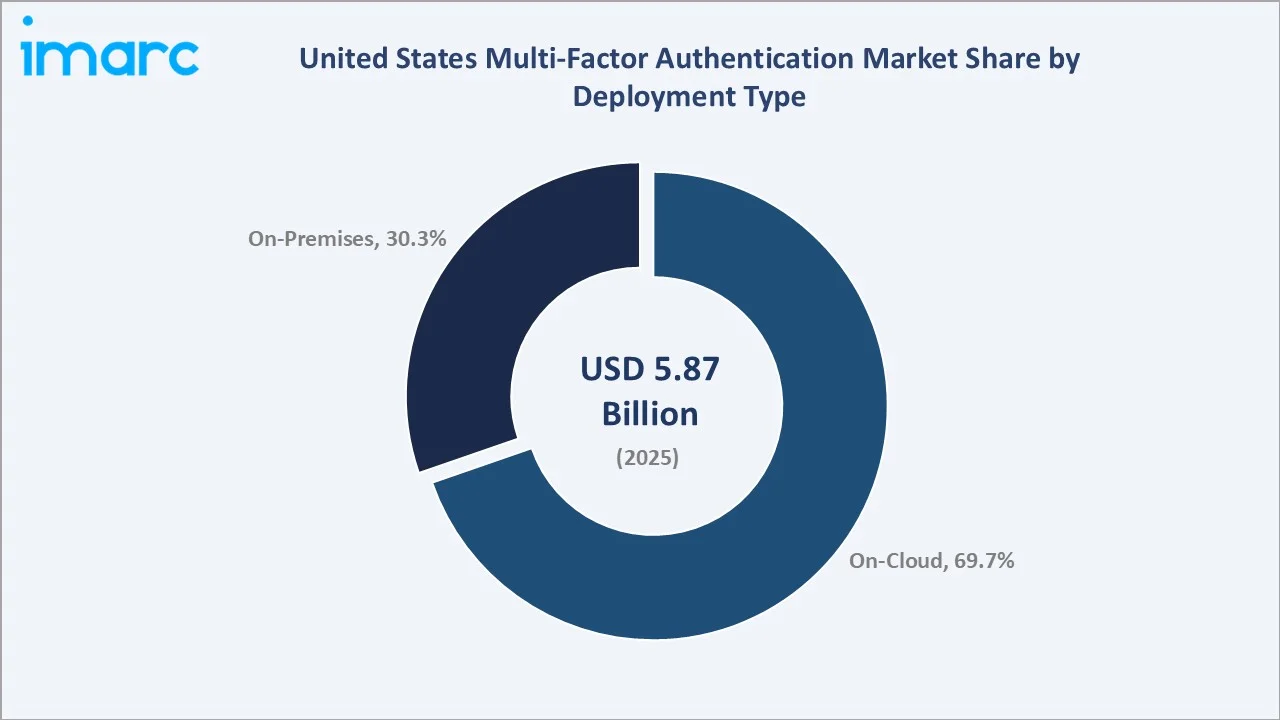
On-Cloud leads at 69.7% in 2025. Cloud-delivered MFA as a service provides elastic scaling, rapid user onboarding, built-in high availability, and continuous feature updates without enterprise infrastructure investment. Cloud MFA platforms including Microsoft Entra ID, Okta, Inc., and Cisco Duo have made enterprise-grade adaptive authentication accessible to organizations of all sizes through per-user subscription pricing.
To access detailed market analysis, Request Sample
On-Premises deployment at 30.3% persists through government, defense, and financial services data sovereignty requirements mandating local authentication processing without cloud dependencies.
By Application
Phone-Based Authentication leads at 54.6% in 2025. Smartphone-native authenticator applications delivering TOTP codes, push notifications, and FIDO2 passkeys provide frictionless MFA at zero hardware cost, enabling rapid enterprise deployment across distributed workforces with employee-owned devices.
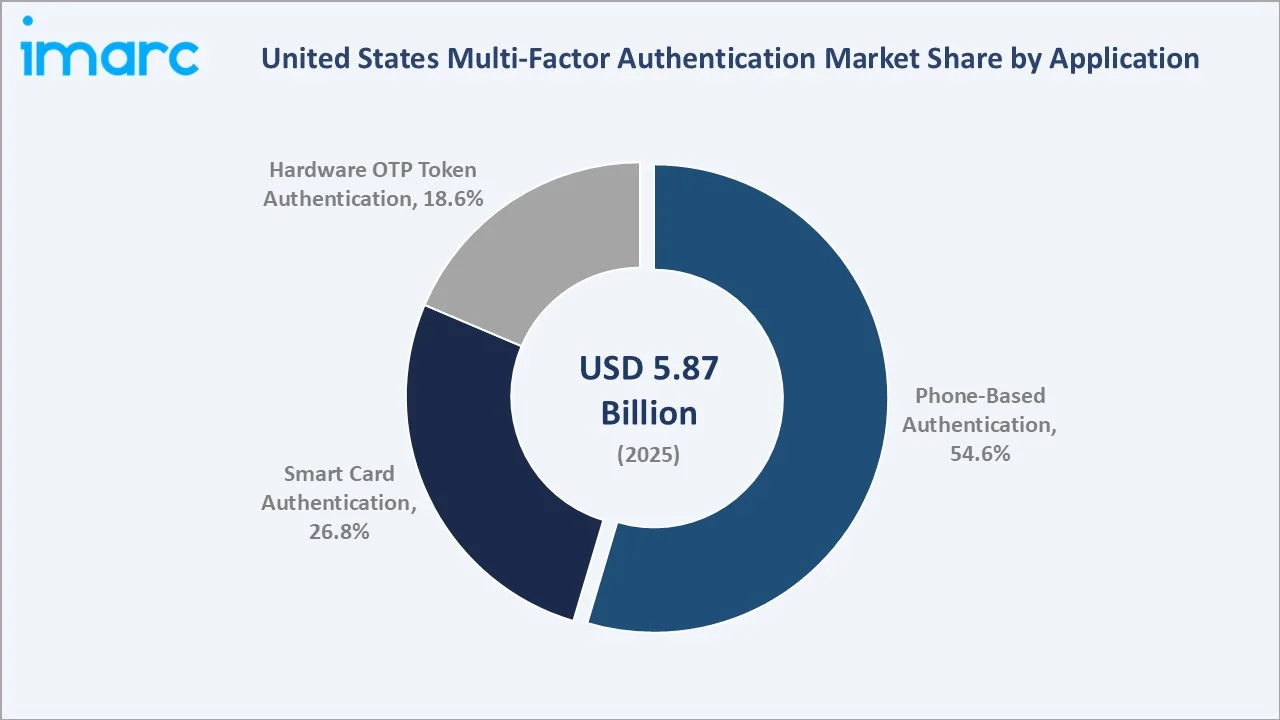
Smart Card Authentication at 26.8% is driven by government, defense, and financial services sector requirements for PKI-based strong authentication through PIV cards, CAC cards, and banking smart cards. Hardware OTP Token Authentication at 18.6% persists through regulated industry requirements for offline authentication capability, privileged access management, and environments where smartphone-based authentication is restricted for operational security reasons.
Regional Market Insights
|
Region |
Share (2025) |
Key U.S. MFA Market Drivers & Characteristics |
|
West |
33.5% |
Driven by Silicon Valley technology sector density, high cloud-native enterprise adoption, and significant federal and defense contractor presence in California, Washington, and Colorado demanding robust MFA compliance. |
|
South |
29.4% |
Supported by large BFSI, healthcare, and energy sector concentrations in Texas and Florida driving regulatory MFA adoption, alongside growing fintech and cybersecurity startup ecosystems in Atlanta and Austin. |
|
Northeast |
21.6% |
Reflects dense BFSI and healthcare concentration in New York and Boston, where FFIEC and HIPAA compliance mandates create non-discretionary MFA demand, particularly for phone-based and smart card authentication solutions. |
|
Midwest |
15.5% |
Driven by manufacturing, automotive, and utilities sector digital transformation, government agency MFA compliance in state capitals, and growing enterprise cloud adoption creating demand for cloud-based MFA platforms. |
The West's 33.5% leadership reflects California's high-technology enterprise density with above-average MFA adoption maturity, significant federal defense and intelligence contractor MFA compliance requirements in Washington and Colorado, and Silicon Valley's identity security vendor concentration creating high proximity MFA expertise. The South's 29.4% reflects Texas's large BFSI and energy sector base driving regulatory MFA adoption, Florida's healthcare sector creating HIPAA-driven phone-based MFA demand, and Atlanta's growing cybersecurity industry creating MFA expertise concentration.
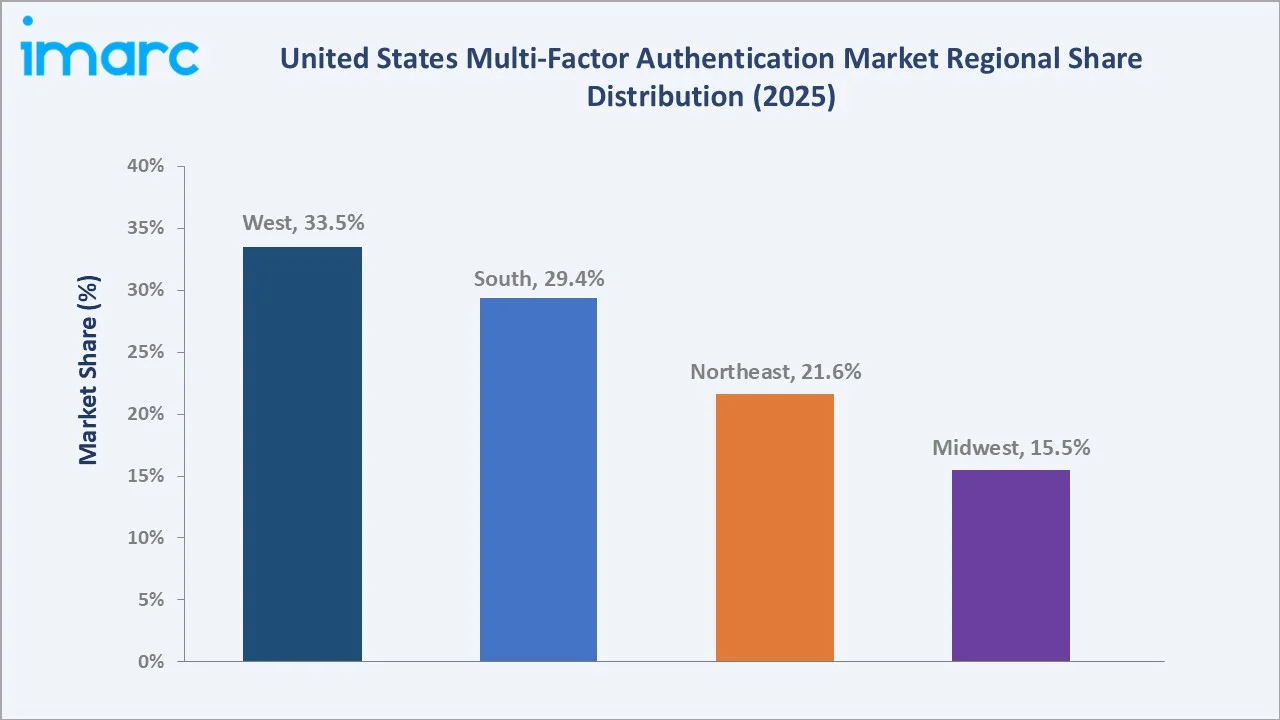
The Northeast's 21.6% reflects New York's extraordinary BFSI density where FFIEC and New York DFS cybersecurity regulations create non-discretionary MFA demand, and Boston's healthcare and biotech sector generating HIPAA-compliant authentication requirements. The Midwest's 15.5% is growing through manufacturing and utilities sector OT/IT convergence creating new machine identity authentication demand, government agency compliance mandates in state capitals, and enterprise cloud migration creating smart card to cloud MFA transition opportunities.
Competitive Landscape
The U.S. multi-factor authentication competitive landscape is moderately concentrated at the enterprise tier. Competition is intensifying through passwordless authentication differentiation, AI-driven adaptive authentication capability, and zero-trust identity platform consolidation.
|
Company |
Key Products |
Market Position |
Core Strength |
|
Microsoft |
Microsoft Entra ID MFA, Authenticator App, FIDO2 Passkeys |
Market Leader |
Microsoft Corporation dominates MFA through Microsoft Entra ID, offering seamlessly integrated MFA across the Microsoft 365 and Azure ecosystem, with over 345 million monthly active users benefiting from conditional access and passwordless authentication. |
|
Okta |
Okta Adaptive MFA, FastPass Passwordless, Workforce & Customer Identity |
Innovator |
Okta, Inc. leads cloud-native adaptive MFA with AI-driven risk-based authentication, offering 7,000+ pre-built integrations and serving over 19,000 enterprise customers through its Okta Identity Cloud platform. |
|
Cisco Systems, Inc. |
Cisco Duo MFA, Cisco Identity Services Engine, Passwordless Auth, ZTNA |
Strong Challenger |
Cisco Systems, Inc. delivers user-friendly MFA through Cisco Duo, combining push-based authentication, device health checks, and zero-trust network access to secure hybrid enterprise environments across all device types. |
|
Thales |
SafeNet Trusted Access, Smart Card Solutions |
Strong Challenger |
Thales Group provides enterprise and government-grade MFA through SafeNet Trusted Access, offering hardware token, smart card, and cloud MFA solutions with compliance capabilities for BFSI, defense, and critical infrastructure customers. |
Key players include Microsoft, Okta, Cisco Systems, Inc., Thales, and others.
Key Company Profiles
Microsoft
Microsoft is the world's leading technology company providing multi-factor authentication through Microsoft Entra ID, formerly Azure Active Directory, serving as the dominant enterprise identity platform through deep integration with Microsoft 365, Azure, and the broader Microsoft ecosystem across enterprise and government customers globally.
- Key Products: Microsoft Entra ID MFA, Microsoft Authenticator app, FIDO2 passkey support, Windows Hello for Business, Azure AD Conditional Access, and Microsoft Entra Verified ID digital credential platform.
- Strategic Focus: Accelerating passkey and passwordless authentication adoption across the Microsoft 365 and Azure ecosystem, positioning Microsoft Entra ID as the unified enterprise identity security platform that combines MFA, identity governance, privileged access management, and workload identity in a single integrated platform that reduces enterprise authentication infrastructure complexity and vendor count.
Okta
Okta is the leading independent cloud-native identity company, providing adaptive multi-factor authentication through the Okta Identity Cloud platform that serves over 19,000 enterprise customers globally with workforce and customer identity security solutions across all major cloud and on-premises application environments.
- Key Products: Okta Adaptive MFA, Okta FastPass passwordless authentication, Okta Workforce Identity Cloud, Okta Customer Identity Cloud (formerly Auth0), and Okta Identity Threat Protection with AI-driven risk signals.
- Strategic Focus: Deepening AI-driven adaptive authentication capabilities through machine learning risk signal integration, while expanding Okta Customer Identity Cloud to capture the consumer-facing authentication market above workforce identity, and growing its security partner ecosystem to position Okta as the identity security orchestration layer across the enterprise security platform stack.
Market Concentration Analysis
The U.S. multi-factor authentication market is moderately concentrated, with Microsoft holding an estimated 30-40% of enterprise MFA users, creating a structural market position that standalone MFA vendors must differentiate against through superior adaptive authentication capabilities, multi-cloud identity neutrality, or specialized vertical compliance features.
Market concentration dynamics are being reshaped by the platform consolidation trend, as enterprises reduce standalone MFA vendors in favor of integrated identity security platforms. This is creating bifurcated competitive dynamics where large platform vendors with bundled MFA gain share through subscription consolidation, while specialized MFA vendors with superior phishing-resistant authentication, behavioral biometrics, or regulated industry compliance capabilities defend and expand share through differentiated capability positioning.
Investment & Growth Opportunities
Highest Growth Segments
On-Cloud MFA at ~16.1% CAGR through SaaS enterprise migration, Phone-Based Authentication at ~15.4% CAGR through passkey adoption, AI-powered adaptive MFA at above-market growth through risk-based authentication adoption, passwordless authentication through phishing-resistant MFA mandate compliance, and SME MFA penetration through per-user SaaS pricing accessibility represent the highest-growth U.S. MFA investment opportunities through 2034.
Emerging Investment Opportunities
The passwordless authentication transition creating replacement demand across the existing MFA installed base represents the largest near-term investment opportunity, as organizations migrate from SMS OTP and push notification systems to FIDO2 passkeys and hardware security keys under CISA phishing-resistant MFA guidance. Federal government MFA compliance modernization programs creating structured, multi-year procurement cycles represent the most commercially predictable demand segment.
Investment Themes
- FIDO2 passkey and hardware security key adoption investment: Capturing the phishing-resistant MFA upgrade cycle as CISA guidance and Microsoft Corporation's mandatory MFA enforcement drive enterprise migration from legacy OTP-based authentication to FIDO2 cryptographic authentication, creating replacement demand above the base market growth rate for MFA vendors with strong hardware security key and passkey authentication platforms.
- AI-native adaptive MFA platform investment: Addressing the enterprise demand for MFA that dynamically adjusts authentication requirements based on real-time risk signals, capturing premium pricing above static MFA products through demonstrated reduction in both security incidents and authentication friction that creates measurable ROI justification for adaptive MFA procurement above baseline compliance-driven MFA investment.
Future Market Outlook (2026-2034)
The U.S. multi-factor authentication market is projected to grow from USD 5.87 Billion in 2025 to USD 6.68 Billion in 2026, reaching USD 19.45 Billion by 2034, registering a CAGR of 13.82% during 2026–2034. The market's anchor value of approximately USD 11.20 Billion in 2030 represents a structural inflection point where passkey authentication achieves mainstream enterprise adoption, AI-powered adaptive MFA becomes the enterprise authentication standard, and federal zero-trust mandate implementation drives above-commercial-cycle government sector MFA procurement.
Three structural forces define U.S. MFA market growth through 2034: mandatory federal zero-trust and phishing-resistant MFA directives creating non-discretionary demand above commercial security investment cycles; the continuing escalation of credential-based cyberattacks creating direct financial pressure for MFA adoption across all enterprise segments; and the passkey authentication transition creating a replacement demand cycle above the base market growth rate as organizations migrate from legacy MFA to phishing-resistant cryptographic authentication through 2030.
Research Methodology
Primary Research
Primary research comprised structured interviews with U.S. multi-factor authentication market stakeholders including CISO and VP of Identity executives, MFA product managers, enterprise IT security architects, federal agency cybersecurity compliance officers, and channel partners serving BFSI, healthcare, government, and enterprise commercial segments.
Secondary Research
Secondary research encompassed CISA MFA guidance publications, NIST Special Publication 800-63B digital identity guidelines, FFIEC authentication guidance, company investor presentations, SEC filings, patent database analysis, and cybersecurity industry association data. Over 50 primary and secondary sources were reviewed and cross-referenced.
Forecasting Models
Market revenue forecasts were developed using a demand-side penetration model: enterprise MFA user base expansion multiplied by per-user MFA revenue across deployment type and application categories, with regulatory mandate adoption timelines applied as demand acceleration factors for government, BFSI, and healthcare verticals contributing above-market segment growth rates.
United States Multi-factor Authentication Market Report Coverage:
| Report Features | Details |
|---|---|
| Base Year of the Analysis | 2025 |
| Historical Period | 2020-2025 |
| Forecast Period | 2026-2034 |
| Units | Billion USD |
| Scope of the Report |
Exploration of Historical and Forecast Trends, Industry Catalysts and Challenges, Segment-Wise Historical and Predictive Market Assessment:
|
| Models Covered | Two-Factor Authentication, Three-Factor Authentication, Four-Factor Authentication, Five-Factor Authentication |
| Deployment Types Covered | On-Premises, On-Cloud |
| Applications Covered | Smart Card Authentication, Phone-Based Authentication, Hardware OTP Token Authentication |
| Verticals Covered | Banking and Finance, Government, Travel and Immigration, Military and Defence, IT and Telecom, Healthcare, Retail and Ecommerce, Others |
| Regions Covered | Northeast, Midwest, South, West |
| Companies Covered | Microsoft, Okta, Cisco Systems, Inc., Thales, etc. |
| Customization Scope | 10% Free Customization |
| Post-Sale Analyst Support | 10-12 Weeks |
| Delivery Format | PDF and Excel through Email (We can also provide the editable version of the report in PPT/Word format on special request) |
Key Benefits for Stakeholders:
- IMARC’s industry report offers a comprehensive quantitative analysis of various market segments, historical and current market trends, market forecasts, and dynamics of the United States multi-factor authentication market from 2020-2034.
- The research report provides the latest information on the market drivers, challenges, and opportunities in the United States multi-factor authentication market.
- Porter's five forces analysis assist stakeholders in assessing the impact of new entrants, competitive rivalry, supplier power, buyer power, and the threat of substitution. It helps stakeholders to analyze the level of competition within the United States multi-factor authentication industry and its attractiveness.
- Competitive landscape allows stakeholders to understand their competitive environment and provides an insight into the current positions of key players in the market.
Frequently Asked Questions About the United States Multi-factor Authentication Market Report
The U.S. multi-factor authentication market size is estimated at USD 6.68 Billion in 2026, driven by mandatory federal zero-trust MFA directives under Executive Order 14028, escalating credential-based cyber threats, and enterprise cloud migration requiring cloud-native identity verification across BFSI, healthcare, government, and IT sectors.
The U.S. multi-factor authentication market grows at a CAGR of 13.82% during 2026-2034, reaching USD 19.45 Billion by 2034. Growth is sustained by passkey and passwordless authentication adoption, AI-driven adaptive MFA expansion, regulatory mandate compliance across BFSI and healthcare, and SME market penetration through accessible cloud-native MFA subscription platforms.
On-Cloud deployment leads at 69.7% through enterprise SaaS application proliferation, cloud-native identity platform adoption, and zero-capital subscription MFA pricing that enables rapid enterprise and SME deployment. Cloud MFA platforms from Microsoft Corporation, Okta, Inc., and Cisco Systems, Inc. have made adaptive MFA accessible across all organization sizes through per-user monthly subscription models.
Phone-Based Authentication leads at 54.6% through smartphone-native authenticator app adoption, FIDO2 passkey rollout by major platform vendors, and push notification authentication providing superior user experience compared to hardware token alternatives. The zero hardware cost of phone-based MFA enables rapid enterprise deployment at organizational scale without physical device provisioning overhead.
The West region leads at 33.5% through Silicon Valley technology sector MFA adoption maturity, California state privacy regulation creating mandatory MFA adoption pressure, and significant federal defense and intelligence contractor MFA compliance requirements in Washington and Colorado creating the highest per-enterprise MFA investment intensity in the U.S. national market.
Leading companies include Microsoft, Okta, Cisco Systems, Inc., Thales, and others.
Need more help?
- Speak to our experienced analysts for insights on the current market scenarios.
- Include additional segments and countries to customize the report as per your requirement.
- Gain an unparalleled competitive advantage in your domain by understanding how to utilize the report and positively impacting your operations and revenue.
- For further assistance, please connect with our analysts.
 Request Customization
 Speak to an Analyst
 Request Brochure
 Inquire Before Buying
Benefits of Customization
- Personalize this research
- Triangulate with your data
- Get data as per your format and definition
- Gain a deeper dive into a specific application, geography, customer, or competitor
- Any level of personalization
Get in Touch With Us
UNITED STATES
Phone: +1-201-971-6302
INDIA
Phone: +91-120-433-0800
UNITED KINGDOM
Phone: +44-753-714-6104
Email: [email protected]
Client Testimonials




.webp)




.webp)













Related Reports

Choose your plan
*Please note that the prices mentioned below are starting prices for each bundle type. Kindly contact our team for further details.*
Single User License
- 1 User License, Access on 2 Devices
- PDF Report + Excel Dataset (Password Protected)
- Lifetime Access
- No Printing Rights
- 10% Free Report Customization
- 10–12 Weeks of Analyst Support
Five User License
- Access for 5 Users, 2 Devices per User
- PDF Report + Excel Dataset (Password Protected)
- Lifetime Access
- Dedicated Account Manager
- 12–14 Weeks of Analyst Support
- No Printing Rights
- 15% Free Report Customization
- 25% Discount on Your Next Purchase
Corporate User License
- Unlimited User Access (Within Your Organization)
- PDF Report + Excel Dataset
- Lifetime Access
- Dedicated Account Manager
- 14–20 Weeks of Analyst Support
- No Printing Rights
- 20% Free Report Customization
- 30% Discount on Your Next Purchase
Essential Insights
What's included:
3 reports
- Lifetime Access
- PDF Reports
- Excel Datasets
- 2 Weeks of Free Analyst Support
- 2 User Licenses
- Access on 2 Devices
- Printing Rights
- Complimentary PowerPoint (PPT) Version
- Complimentary License Upgrade
Professional Access
What's included:
5 reports
- Lifetime Access
- PDF Reports
- Excel Datasets
- 8 Weeks of Free Analyst Support
- 2 User Licenses
- Access on 2 Devices
- Printing Rights
- Complimentary PowerPoint (PPT) Version
- Complimentary License Upgrade
Business Advantage
What's included:
8 reports
- Lifetime Access
- PDF Reports
- Excel Datasets
- 14 Weeks of Free Analyst Support
- 2 User Licenses
- Access on 2 Devices
- Printing Rights
- Complimentary PowerPoint (PPT) Version
- Complimentary License Upgrade
Enterprise Intelligence
What's included:
10 reports
- Lifetime Access
- PDF Reports
- Excel Datasets
- 20 Weeks of Free Analyst Support
- 2 User Licenses
- Access on 2 Devices
- Printing Rights
- Complimentary PowerPoint (PPT) Version
- Complimentary License Upgrade