
United States Solar Microinverter Market Size, Share, Trends and Forecast by Connectivity Component, Communication Channel, Type, Application, and Region, 2026-2034
United States Solar Microinverter Market Size, Share, Trends & Forecast (2026-2034)
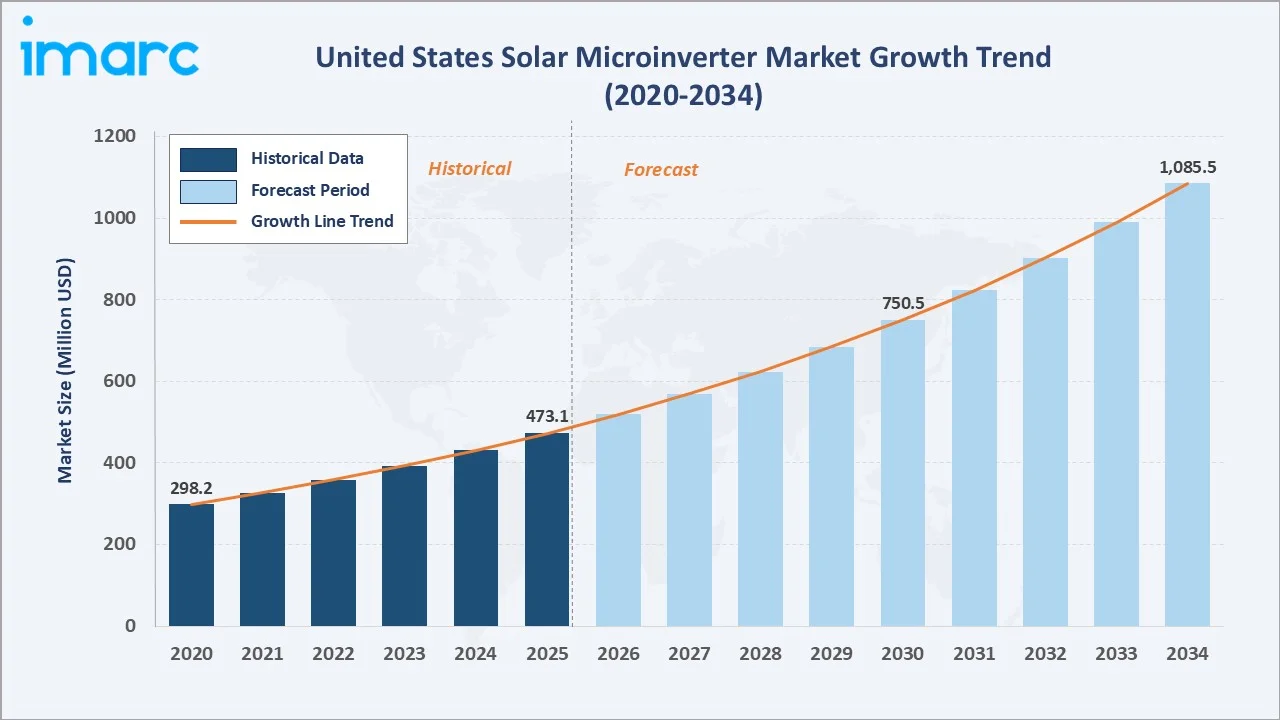
The United States solar microinverter market was valued at USD 473.1 Million in 2025 and is projected to reach USD 1,085.5 Million by 2034, exhibiting a CAGR of 9.67% during 2026-2034. Rising rooftop solar adoption, module-level power electronics upgrades, and continued federal clean-energy incentives are the primary drivers shaping the market growth.
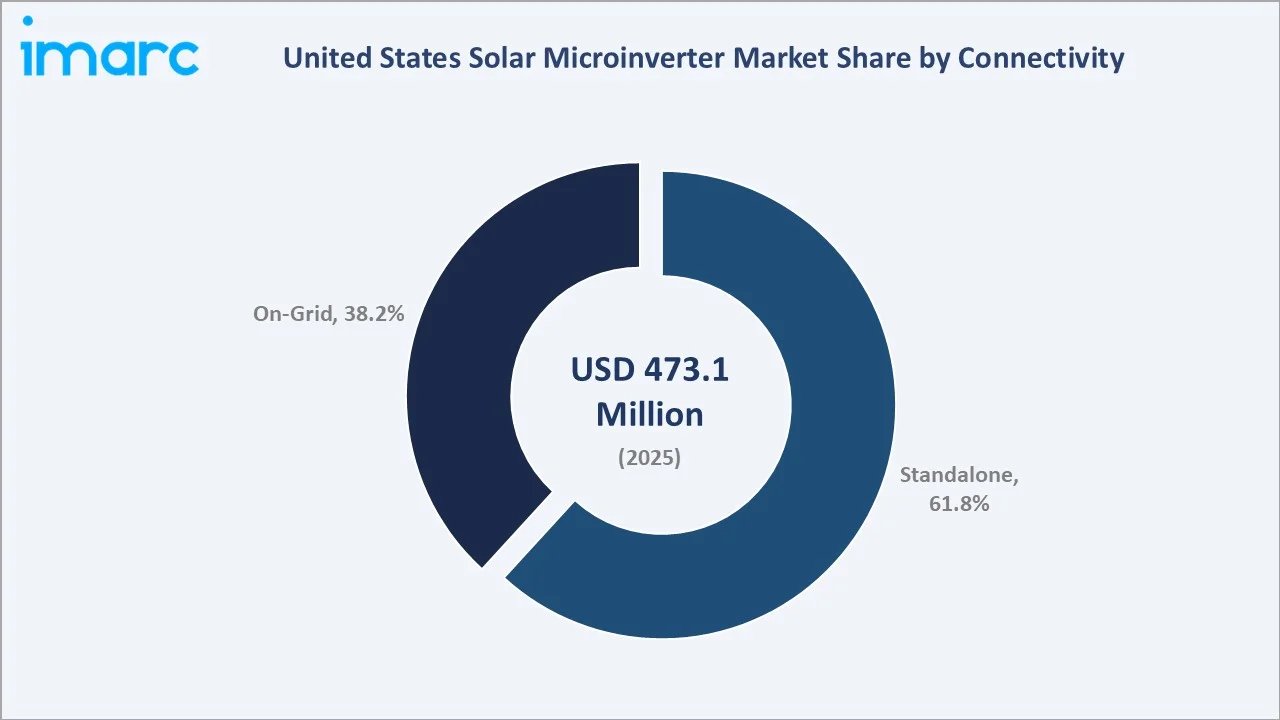
Standalone leads the connectivity segment at 61.8%, hardware commands 72.6% of the component segment, and Northeast commands 34.8% regional share.
Market Snapshot
|
Metric |
Value |
|
Market Size (2025) |
USD 473.1 Million |
|
Forecast Market Size (2034) |
USD 1,085.5 Million |
|
CAGR (2026-2034) |
9.67% |
|
Base Year |
2025 |
|
Historical Period |
2020-2025 |
|
Forecast Period |
2026-2034 |
|
Largest Region |
Northeast (34.8%, 2025) |
|
Second Largest Region |
South (28.6%, 2025) |
|
Leading Connectivity |
Standalone (61.8%, 2025) |
|
Leading Component |
Hardware (72.6%, 2025) |
The United States solar microinverter market expanded from USD 298.2 Million in 2020 to USD 473.1 Million in 2025, driven by widening residential rooftop adoption, falling module-level electronics costs, and steady growth in distributed solar installations across suburban and rural markets. Anchored at USD 750.5 Million in 2030, the forecast to USD 1,085.5 Million by 2034 is supported by accelerating grid-interactive inverter mandates, expanding commercial rooftop deployment, and continued improvement in module-level monitoring software.
To get more information on this market, Request Sample
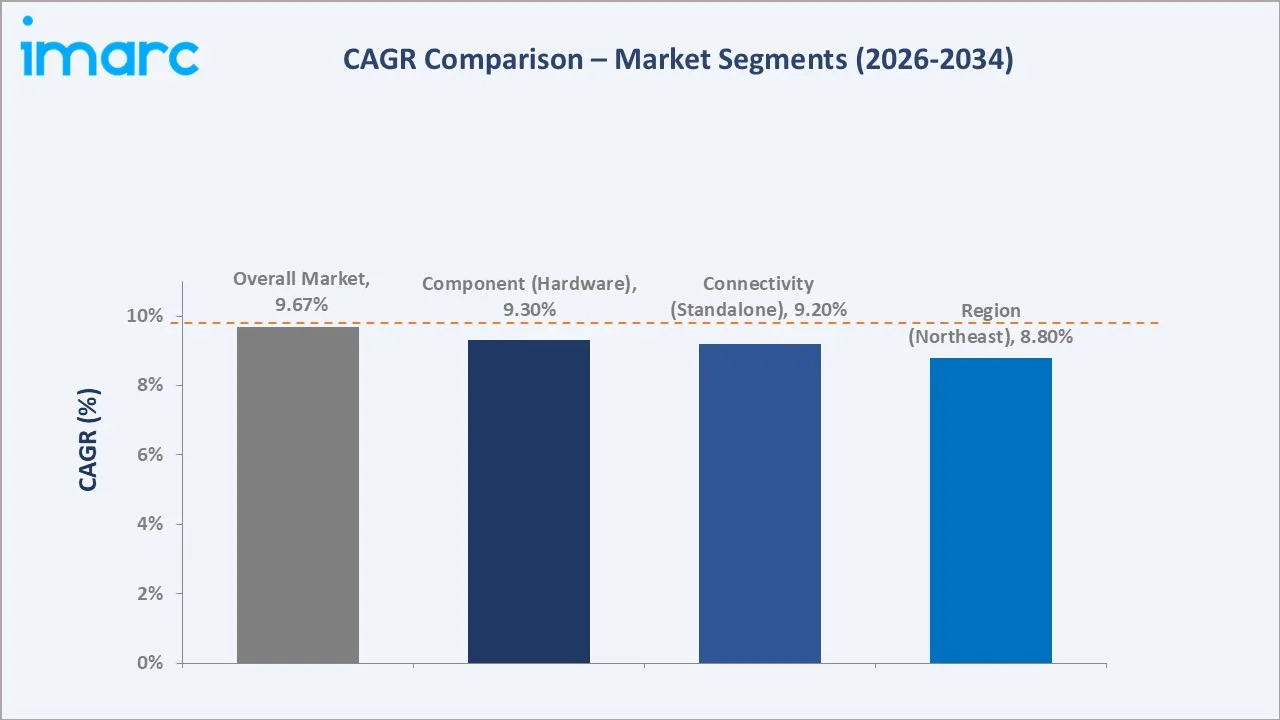
CAGR trajectories across connectivity, component, and regional sub-segments show on-grid, software, and South expanding faster than the overall 9.67% market CAGR, driven by grid-interconnection requirements, rising demand for real-time diagnostics, and accelerating rooftop solar adoption in warm-climate states.
Executive Summary
The United States solar microinverter market is on a steady growth trajectory from USD 298.2 Million in 2020 to USD 1,085.5 Million by 2034. The industry has moved from string-inverter-dominated residential installations toward module-level power electronics that improve energy harvest, safety, and system-level visibility across single-family homes, multifamily buildings, and small commercial rooftops.
Standalone dominates the connectivity segment at 61.8% in 2025, supported by simplified permitting, panel-level shutdown compliance, and improved reliability under partial shading conditions. Hardware leads the component segment at 72.6%, driven by strong demand for microinverter units, power electronics, and integrated monitoring devices across residential and commercial rooftop installations. Northeast commands 34.8% of regional share, led by dense rooftop solar penetration and strong state-level clean-energy mandates.
Key Market Insights
|
Insight |
Data |
|
Leading Connectivity |
Standalone - 61.8% share (2025) |
|
Second Largest Connectivity |
On-Grid - 38.2% share (2025) |
|
Leading Component |
Hardware - 72.6% share (2025) |
|
Second Largest Component |
Software - 27.4% share (2025) |
|
Leading Region |
Northeast - 34.8% share (2025) |
|
Second Largest Region |
South - 28.6% share (2025) |
|
Top Companies |
Enphase Energy, SolarEdge, Altenergy Power System Inc., Hoymiles Power Electronics Inc., Darfon Electronics Corp. |
Key Analytical Observations Expanding On The Data Above:
- Standalone dominance at 61.8% is supported by simplified single-panel installation, strong resilience under partial shading, and compliance with rapid-shutdown safety codes that favor module-level electronics over central string architectures.
- On-grid share at 38.2% is expanding as utilities extend net-metering programs and grid-interactive requirements that reward systems capable of real-time communication with distribution infrastructure.
- Hardware leadership at 72.6% reflects continued unit volume growth in inverter modules, connectors, and mounting hardware across new residential and small commercial installations.
- Software share at 27.4% is growing the fastest, as installers and asset owners increasingly pay for panel-level monitoring, diagnostics, and remote fault detection platforms bundled with inverter hardware.
- Northeast at 34.8% dominates regional share, anchored by Massachusetts, New York, and New Jersey, supported by dense residential solar penetration and some of the strongest state-level renewable portfolio standards in the country.
United States Solar Microinverter Market Overview
A solar microinverter is a compact power electronics device mounted on or near an individual solar panel that converts direct current output into grid-compatible alternating current at the module level, rather than centralizing conversion through a single string inverter. The market spans standalone and on-grid connectivity configurations, along with hardware components and companion monitoring software.
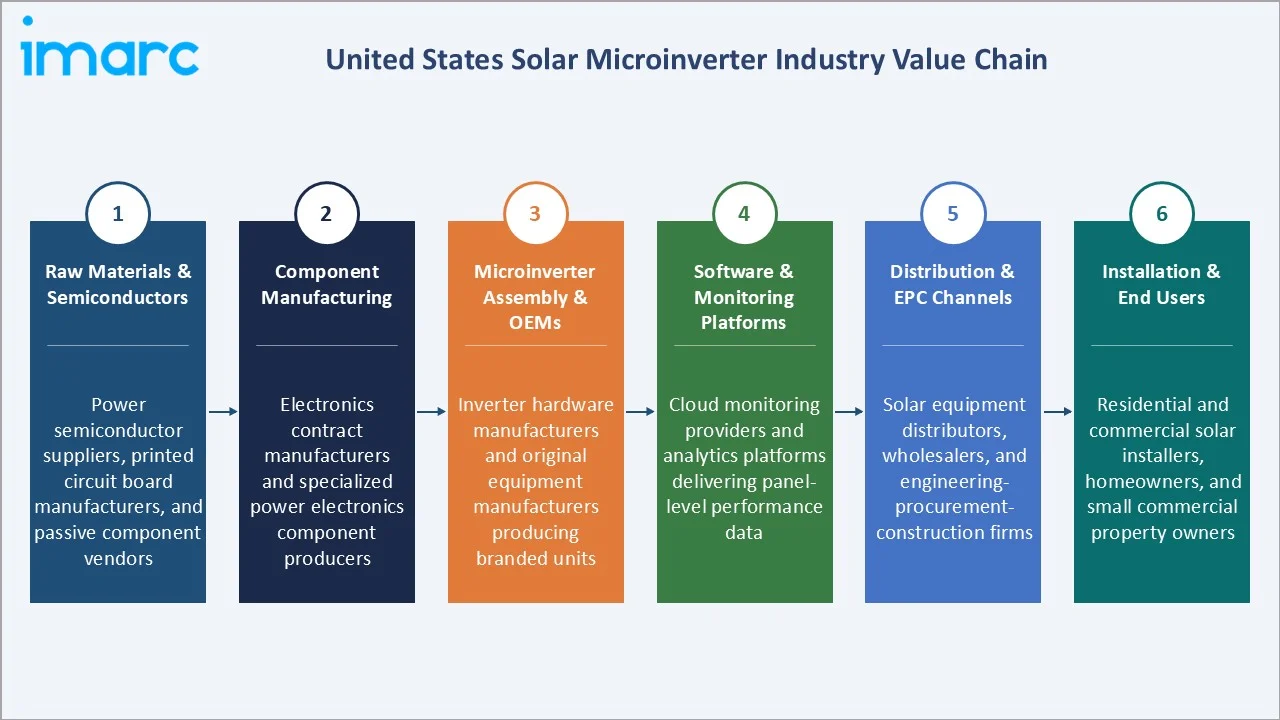
The United States ecosystem integrates semiconductor and component manufacturers, inverter assemblers and original equipment manufacturers, solar installation and engineering-procurement-construction firms, monitoring software providers, utility interconnection bodies, and residential and commercial end users. Together they enable safer, more granular solar energy conversion within an evolving grid-modernization framework.
Market Dynamics
To evaluate market opportunities, Request Sample
Market Drivers
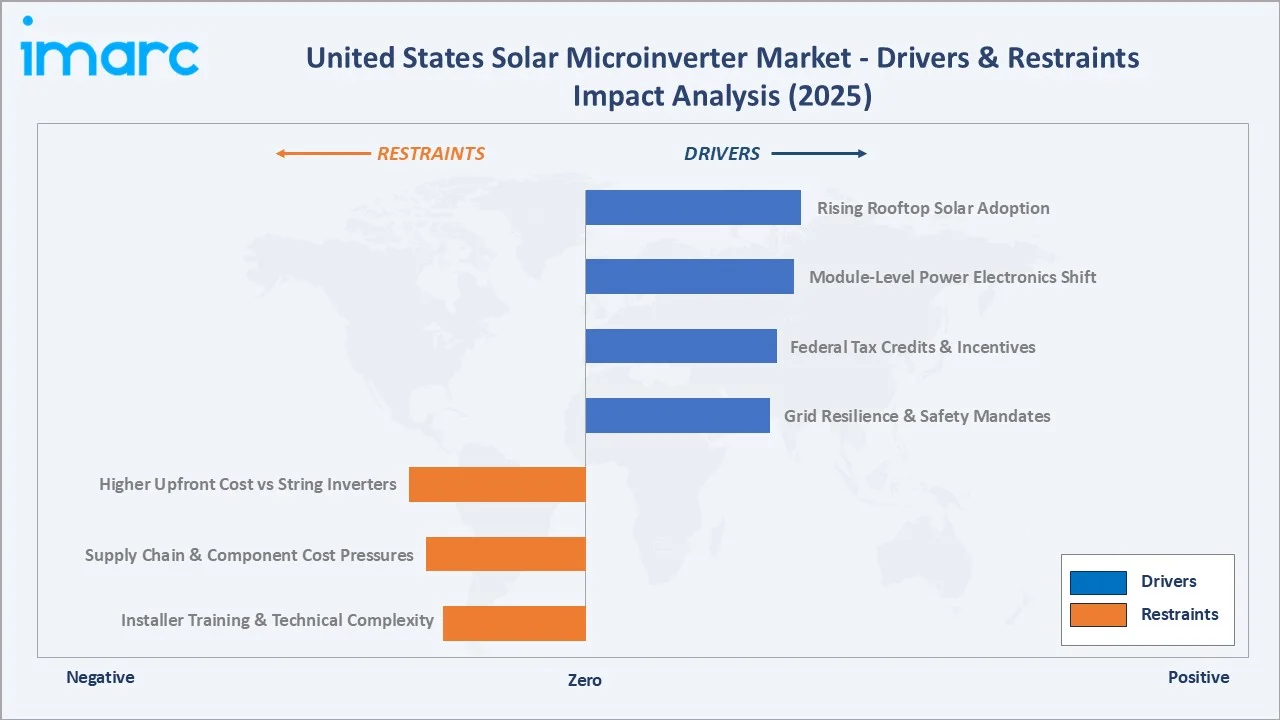
- Rising Rooftop Solar Adoption: Continued growth in single-family and multifamily rooftop installations across suburban and rural markets is sustaining consistent unit demand for module-level power electronics across connectivity formats.
- Module-Level Power Electronics Shift: Installers are increasingly favoring microinverters and power optimizers over central string inverters due to improved energy harvest under partial shading and simpler system design for complex roof layouts.
- Federal Tax Credits and Incentives: According to the US Department of Energy, systems installed through 2032 remain eligible for a 30% federal investment tax credit, a policy structure that has historically supported steady residential solar demand and, by extension, microinverter hardware attach rates.
- Grid Resilience and Safety Mandates: Expanding state-level rapid-shutdown and arc-fault protection codes are favoring module-level electronics that can de-energize individual panels rather than entire strings during emergencies.
Market Restraints
- Higher Upfront Cost versus String Inverters: Microinverter systems typically carry a higher per-watt hardware cost than centralized string inverter configurations, which can weigh on price-sensitive residential buyers.
- Supply Chain and Component Cost Pressures: Dependence on semiconductor components and specialized power electronics exposes manufacturers to periodic supply constraints and input-cost volatility.
- Installer Training and Technical Complexity: Proper installation and commissioning of microinverter systems require trained installers and familiarity with module-level power electronics. Limited installer expertise in some regions can increase installation time, raise labor costs, and slow adoption.
Market Opportunities
- Commercial Rooftop Expansion: Growing adoption of module-level electronics in small and mid-size commercial rooftop projects presents a meaningful adjacent growth avenue beyond the core residential base.
- Software and Monitoring Upsell: Rising demand for panel-level diagnostics and remote performance monitoring creates recurring revenue opportunities layered on top of hardware sales.
Market Challenges
- Interconnection and Permitting Delays: Inconsistent utility interconnection timelines across states can slow project completion and delay hardware revenue recognition for manufacturers and installers alike.
- Price Competition Among Established Brands: Intensifying competition among established hardware manufacturers is compressing margins, particularly in the standalone connectivity segment.
Emerging Market Trends
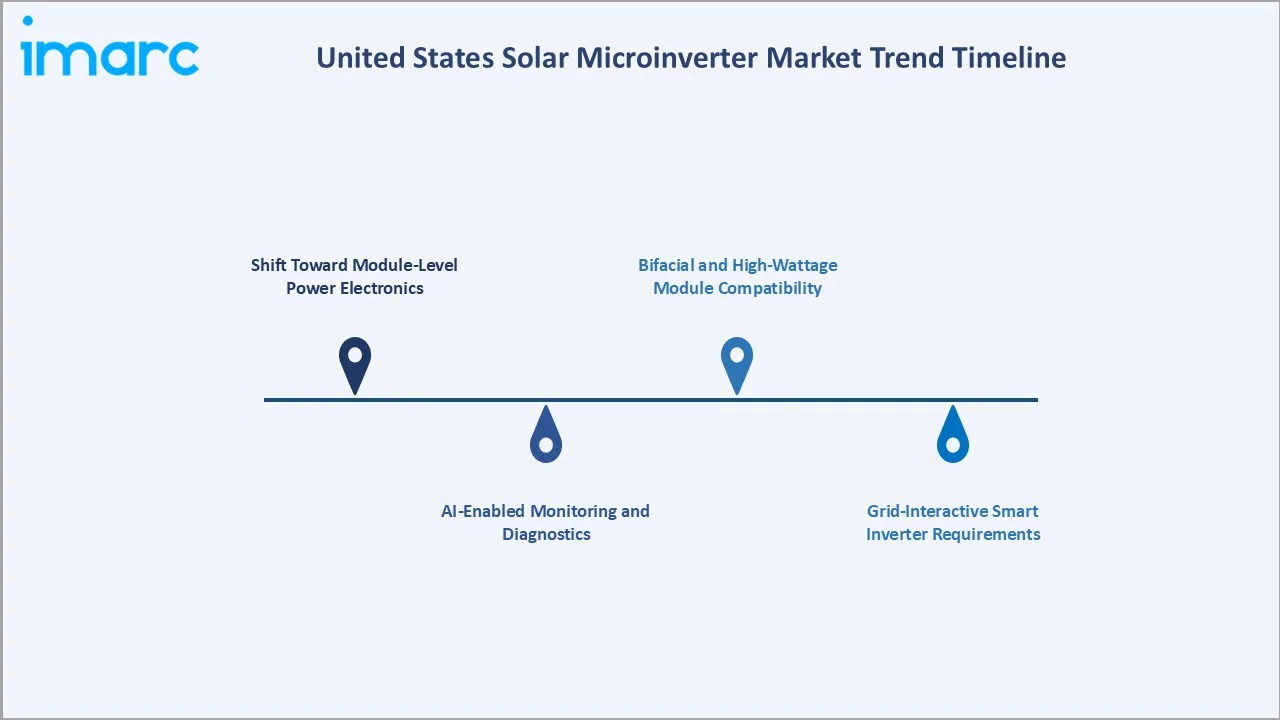
1. Shift Toward Module-Level Power Electronics
Installers are increasingly specifying microinverters and power optimizers over central string inverters for new residential projects, particularly on roofs with partial shading or multiple orientations. The transition is also accelerating investment in compact, high-efficiency semiconductor components designed for panel-level integration.
2. AI-Enabled Monitoring and Diagnostics
Cloud-connected monitoring platforms use machine learning (ML) models to detect underperforming panels, predict component failures, and automate maintenance scheduling. These capabilities help improve system uptime, optimize energy generation, and reduce long-term maintenance costs for residential and commercial solar installations.
3. Grid-Interactive Smart Inverter Requirements
A growing number of state utility commissions are mandating smart inverter functionality, including voltage-ride-through and remote curtailment capability, for new grid-connected residential systems. Compliance requirements are reshaping product roadmaps for on-grid connectivity hardware.
4. Bifacial and High-Wattage Module Compatibility
Rising adoption of higher-wattage and bifacial solar panels is prompting manufacturers to redesign microinverter hardware for higher current handling and improved thermal management, supporting compatibility with next-generation module formats.
Industry Value Chain Analysis
The United States solar microinverter market value chain spans six stages from component supply through installation and end use. Component manufacturing, microinverter assembly, and software and monitoring platforms capture the highest value-add, while distribution and installation increasingly determine competitive position as installers standardize on preferred hardware brands.
|
Stage |
Key Players / Examples |
|
Raw Materials & Semiconductors |
Power semiconductor suppliers, printed circuit board manufacturers, and passive component vendors |
|
Component Manufacturing |
Electronics contract manufacturers and specialized power electronics component producers |
|
Microinverter Assembly & OEMs |
Inverter hardware manufacturers and original equipment manufacturers producing branded units |
|
Software & Monitoring Platforms |
Cloud monitoring providers and analytics platforms delivering panel-level performance data |
|
Distribution & EPC Channels |
Solar equipment distributors, wholesalers, and engineering-procurement-construction firms |
|
Installation & End Users |
Residential and commercial solar installers, homeowners, and small commercial property owners |
Vertically integrated manufacturers, particularly those combining proprietary hardware, monitoring software, and direct installer relationships, are positioned to capture greater value than component suppliers reliant on third-party assembly and distribution.
Technology Landscape in the United States Solar Microinverter Industry
Power Electronics and Semiconductor Design
Manufacturers are adopting higher-efficiency semiconductor topologies to reduce conversion losses and improve thermal performance in compact, panel-mounted enclosures, extending hardware lifespan under continuous outdoor exposure.
Software Monitoring and Data Analytics
Cloud-based monitoring platforms are increasingly bundled with hardware to provide panel-level performance data, fault alerts, and remote diagnostics, supporting the growing software share of the component segment.
Grid Connectivity and Smart Communication
On-grid systems are integrating standardized communication protocols that allow utilities to remotely manage voltage support and curtailment, aligning hardware design with evolving grid-interactive requirements.
Automation in Manufacturing
Automated surface-mount assembly and in-line testing are improving unit consistency and throughput for hardware manufacturers scaling production to meet residential demand.
Market Segmentation Analysis
The report covers the following segments:
|
Segment Category |
Leading Segment |
Market Share |
Year |
|
Connectivity |
Standalone |
61.8% |
2025 |
|
Component |
Hardware |
72.6% |
2025 |
|
Communication Channel |
Wired |
🔒 |
2025 |
|
Type |
Single Phase |
🔒 |
2025 |
|
Application |
Residential |
🔒 |
2025 |
|
Region |
Northeast |
34.8% |
2025 |

By Connectivity
Standalone commands a 61.8% majority share in 2025, driven by simplified single-panel installation, resilience under partial shading, and compliance with rapid-shutdown safety codes. The segment benefits from lower system design complexity and broad compatibility across roof configurations.
To access detailed market analysis, Request Sample
On-grid at 38.2% in 2025 covers systems designed for direct utility interconnection and net-metering participation. The segment is expanding as utilities extend smart inverter and grid-interactive requirements to new residential and commercial installations.
By Component
Hardware dominates with 72.6% share in 2025, reflecting steady unit volume growth in inverter modules, connectors, and mounting equipment across new installations. The segment remains the primary revenue base for manufacturers.
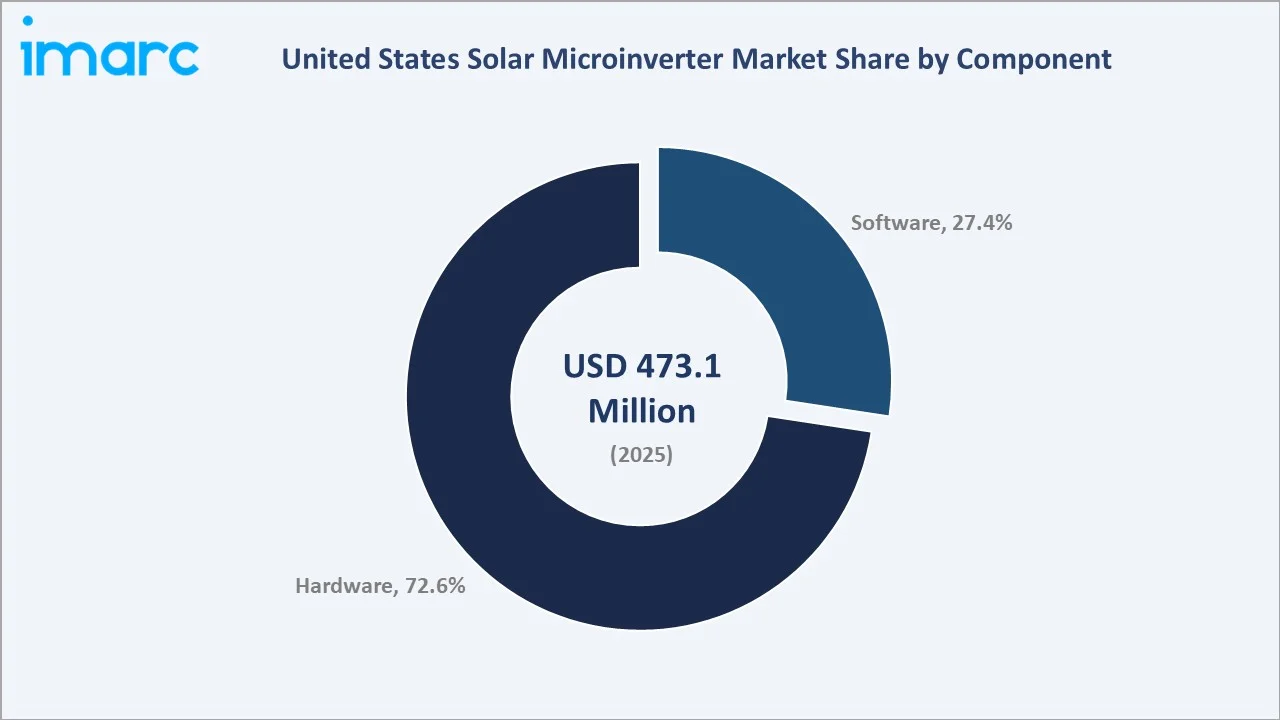
Software at 27.4% is growing through expanding demand for panel-level monitoring, diagnostics, and remote fault detection platforms, supported by rising installer and homeowner preference for granular performance visibility.
Regional Market Insights
|
Region |
Share (2025) |
Key Growth Drivers |
|
Northeast |
34.8% |
Strong state clean-energy mandates, dense rooftop solar penetration, established installer networks, and high electricity rates supporting solar payback |
|
South |
28.6% |
Expanding residential construction, rising utility rates, favorable solar resource availability, and growing demand for resilient power electronics |
|
West |
21.4% |
Mature solar installer base, supportive state incentive programs, high historical adoption rates, and expanding commercial rooftop activity |
|
Midwest |
15.2% |
Emerging residential adoption, growing community solar programs, expanding grid-modernization initiatives, and rising awareness of distributed generation |
Northeast at 34.8% in 2025 leads the regional landscape, anchored by Massachusetts, New York, and New Jersey. Dense rooftop solar penetration, strong renewable portfolio standards, and an established base of experienced installers support sustained leadership across both standalone and on-grid connectivity formats.
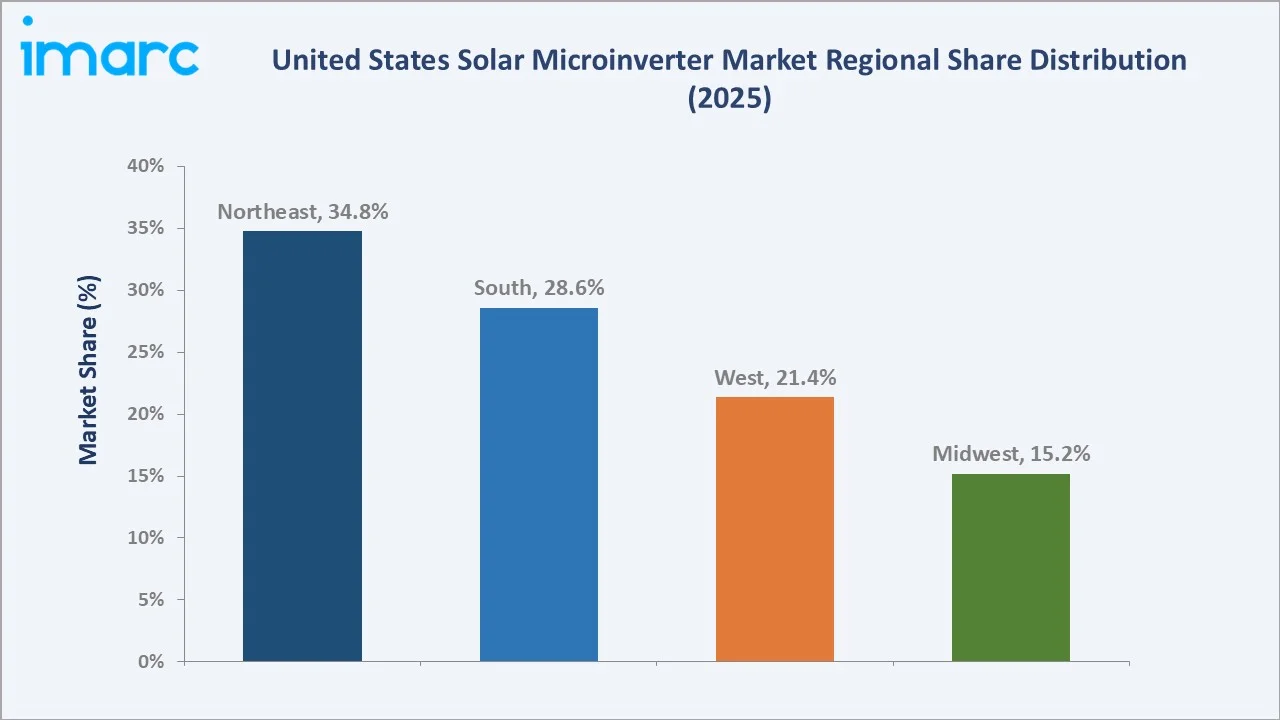
South at 28.6% is the second largest region. Rapid residential construction growth, expanding rooftop solar adoption in Texas and Florida, and rising demand for resilient power electronics in storm-prone coastal markets are accelerating regional expansion through 2034.
Competitive Landscape
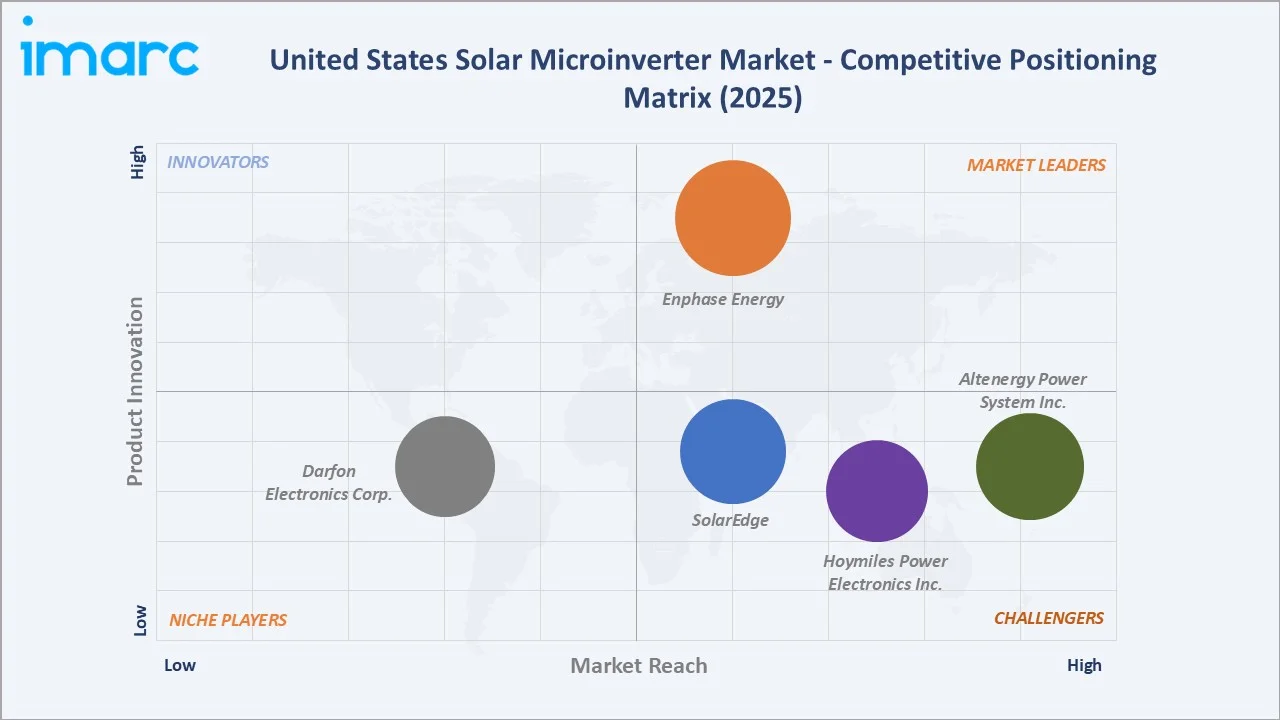
The United States solar microinverter market is moderately consolidated, with established hardware manufacturers leading unit shipments and installer relationships while emerging entrants compete on price and niche product features. Brand reliability, monitoring software quality, and installer partnerships form the key competitive moats in this hardware-intensive category.
|
Company Name |
Brand / Key Product |
Position |
Strategic Focus |
|
Enphase Energy |
Enphase IQ Microinverters |
Leader |
Technology-driven hardware and software platform provider |
|
SolarEdge |
Residential Power Optimizers, Nexis |
Challenger |
Integrated power electronics and monitoring platform provider |
|
Altenergy Power System Inc. |
APsystems Microinverters |
Challenger |
Multi-panel microinverter manufacturer expanding installer base |
|
Hoymiles Power Electronics Inc. |
Hoymiles Microinverter |
Challenger |
Cost-competitive hardware manufacturer scaling distribution |
|
Darfon Electronics Corp. |
Darfon Off-Grid Microinverter |
Niche Player |
Diversified electronics manufacturer expanding its solar hardware line |
Key players include Enphase Energy, SolarEdge, Altenergy Power System Inc., Hoymiles Power Electronics Inc., and Darfon Electronics Corp., among others.
Key Company Profiles
Enphase Energy
Enphase Energy is a United States-based energy technology company offering module-level power electronics and home energy solutions, including microinverters, battery storage, and energy management software.
- Product Portfolio: Enphase IQ Microinverter systems integrated with a cloud-based monitoring application, alongside battery storage and electric vehicle charging solutions.
- Recent Developments: The company has continued expanding its microinverter product line and broadening installer network coverage across the United States.
- Strategic Focus: Deepening its integrated home energy ecosystem, expanding software-enabled monitoring services, and reinforcing its position in the standalone connectivity segment.
SolarEdge
SolarEdge is a global energy technology company offering power optimizer and inverter solutions alongside monitoring software for residential and commercial installations.
- Product Portfolio: Residential power optimizers paired with string inverters, and Nexis, an integrated solar-plus-storage platform, supported by a cloud-based monitoring application.
- Recent Developments: The company has continued expanding its residential and commercial product portfolio for United States installers.
- Strategic Focus: Growing its commercial and residential installer base, enhancing monitoring software capabilities, and expanding its on-grid connectivity product portfolio.
Altenergy Power System Inc.
Altenergy Power System Inc. is a multi-panel microinverter manufacturer supporting residential and light commercial installations across the United States.
- Product Portfolio: Multi-panel microinverter units designed to convert output from several modules through a single compact device, along with companion monitoring software.
- Recent Developments: The company has continued expanding its installer network and broadening its hardware lineup across the United States.
- Strategic Focus: Scaling installer partnerships, growing its United States distribution footprint, and enhancing multi-panel hardware efficiency.
Market Concentration Analysis
The United States solar microinverter market is moderately concentrated, with the top three manufacturers, Enphase Energy, SolarEdge, and Altenergy Power System Inc., accounting for a substantial share of hardware shipments across standalone and on-grid connectivity formats.
Barriers to entry include the need for established installer relationships, proven field reliability across varied climate conditions, and compliance with evolving grid-interactive and rapid-shutdown safety codes. These factors favor incumbents with long operating histories and diversified product portfolios.
Consolidation is gradual, with smaller manufacturers competing on price in the standalone segment while larger players invest in software-enabled monitoring platforms to differentiate on total system value rather than hardware cost alone.
Investment & Growth Opportunities
Fastest-Growing Segments
On-grid is expanding faster than the overall market, as utilities extend smart inverter and net-metering requirements to new installations. Software is also outpacing hardware growth, supported by rising demand for panel-level monitoring and diagnostics.
Emerging Markets
South is the fastest growing market, anchored by expanding residential construction, rising rooftop solar adoption in Texas and Florida, and increasing demand for resilient power electronics in storm-prone coastal areas. The region represents meaningful untapped opportunity for manufacturers able to deliver climate-resilient hardware.
Venture & Investment Trends
Investment is concentrated in software-enabled monitoring platforms, next-generation semiconductor design for higher-wattage module compatibility, and manufacturing automation aimed at improving unit consistency and reducing production costs.
Future Market Outlook (2026-2034)
The United States solar microinverter market is forecast to expand from USD 473.1 Million in 2025 to USD 1,085.5 Million by 2034 at a CAGR of 9.67%, adding roughly USD 612.4 Million in incremental market value over the forecast period.
Four forces will shape the market through 2034: continued residential rooftop solar adoption; the rise of grid-interactive and smart inverter requirements; deeper integration between hardware and monitoring software; and gradual expansion into commercial rooftop applications.
By 2034, the market is expected to be defined by software-integrated hardware platforms, with on-grid connectivity and software components collectively accounting for a meaningfully higher share of overall market value. Grid-modernization requirements and rising homeowner demand for panel-level visibility are expected to further accelerate the evolution of module-level power electronics.
Research Methodology
Primary Research
Primary research included structured interviews with inverter hardware manufacturers, solar installation firms, monitoring software providers, and utility interconnection specialists, validating market sizing, connectivity mix, and regional demand patterns.
Secondary Research
Secondary sources included United States Energy Information Administration publications, Solar Energy Industries Association market insight reports, state-level utility interconnection filings, and annual reports and investor presentations from listed hardware manufacturers.
Forecasting Models
Market forecasts used top-down and bottom-up models combining residential and commercial installation counts, connectivity and component mix evolution, incentive policy scenarios, and macroeconomic variables. Scenario analysis addressed federal tax-credit timelines and grid-interconnection policy pacing.
Report Coverage:
| Report Features | Details |
|---|---|
| Base Year of the Analysis | 2025 |
| Historical Period | 2020-2025 |
| Forecast Period | 2026-2034 |
| Units | Million USD |
| Scope of the Report | Exploration of Historical Trends and Market Outlook, Industry Catalysts and Challenges, Segment-Wise Historical and Future Market Assessment:
|
| Connectivities Covered | Standalone, On-Grid |
| Components Covered | Hardware, Software, |
| Communication Channels Covered | Wired, Wireless |
| Types Covered | Single Phase, Three Phase |
| Applications Covered | Residential, Commercial, Others |
| Region Covered | Northeast, Midwest, South, West |
| Companies Covered | Enphase Energy, SolarEdge, Altenergy Power System Inc., Hoymiles Power Electronics Inc., Darfon Electronics Corp., etc. |
| Customization Scope | 10% Free Customization |
| Post-Sale Analyst Support | 10-12 Weeks |
| Delivery Format | PDF and Excel through Email (We can also provide the editable version of the report in PPT/Word format on special request) |
Frequently Asked Questions About the United States Solar Microinverter Market Report
The United States solar microinverter market was valued at USD 473.1 Million in 2025, driven by rising rooftop solar adoption, module-level power electronics upgrades, and continued federal clean-energy incentives.
The market is projected to grow at a CAGR of 9.67% from 2026 to 2034, reaching USD 1,085.5 Million, supported by grid-interactive inverter mandates and expanding commercial rooftop deployment.
Standalone leads at 61.8% in 2025, driven by simplified installation and rapid-shutdown safety compliance.
Hardware dominates at 72.6% in 2025, reflecting steady unit volume growth. The segment continues to benefit from ongoing investments in distributed solar infrastructure.
Northeast commands 34.8% in 2025, led by dense rooftop solar penetration and strong state-level clean-energy mandates across Massachusetts, New York, and New Jersey.
Leading players include Enphase Energy, SolarEdge, Altenergy Power System Inc., Hoymiles Power Electronics Inc. and Darfon Electronics Corp., among others.
Cloud-based monitoring and diagnostic software is increasingly bundled with hardware, enabling panel-level performance visibility and creating recurring revenue opportunities for manufacturers.
Interconnection and permitting delays, supply chain dependence on specialized semiconductor components, and intensifying price competition among established brands remain key challenges.
Need more help?
- Speak to our experienced analysts for insights on the current market scenarios.
- Include additional segments and countries to customize the report as per your requirement.
- Gain an unparalleled competitive advantage in your domain by understanding how to utilize the report and positively impacting your operations and revenue.
- For further assistance, please connect with our analysts.
 Request Customization
 Speak to an Analyst
 Request Brochure
 Inquire Before Buying
Benefits of Customization
- Personalize this research
- Triangulate with your data
- Get data as per your format and definition
- Gain a deeper dive into a specific application, geography, customer, or competitor
- Any level of personalization
Get in Touch With Us
UNITED STATES
Phone: +1-201-971-6302
INDIA
Phone: +91-120-433-0800
UNITED KINGDOM
Phone: +44-753-714-6104
Email: [email protected]
Client Testimonials




.webp)




.webp)













Related Reports

Choose your plan
*Please note that the prices mentioned below are starting prices for each bundle type. Kindly contact our team for further details.*
Single User License
- 1 User License, Access on 2 Devices
- PDF Report + Excel Dataset (Password Protected)
- Lifetime Access
- No Printing Rights
- 10% Free Report Customization
- 10–12 Weeks of Analyst Support
Five User License
- Access for 5 Users, 2 Devices per User
- PDF Report + Excel Dataset (Password Protected)
- Lifetime Access
- Dedicated Account Manager
- 12–14 Weeks of Analyst Support
- No Printing Rights
- 15% Free Report Customization
- 25% Discount on Your Next Purchase
Corporate User License
- Unlimited User Access (Within Your Organization)
- PDF Report + Excel Dataset
- Lifetime Access
- Dedicated Account Manager
- 14–20 Weeks of Analyst Support
- No Printing Rights
- 20% Free Report Customization
- 30% Discount on Your Next Purchase
Essential Insights
What's included:
3 reports
- Lifetime Access
- PDF Reports
- Excel Datasets
- 2 Weeks of Free Analyst Support
- 2 User Licenses
- Access on 2 Devices
- Printing Rights
- Complimentary PowerPoint (PPT) Version
- Complimentary License Upgrade
Professional Access
What's included:
5 reports
- Lifetime Access
- PDF Reports
- Excel Datasets
- 8 Weeks of Free Analyst Support
- 2 User Licenses
- Access on 2 Devices
- Printing Rights
- Complimentary PowerPoint (PPT) Version
- Complimentary License Upgrade
Business Advantage
What's included:
8 reports
- Lifetime Access
- PDF Reports
- Excel Datasets
- 14 Weeks of Free Analyst Support
- 2 User Licenses
- Access on 2 Devices
- Printing Rights
- Complimentary PowerPoint (PPT) Version
- Complimentary License Upgrade
Enterprise Intelligence
What's included:
10 reports
- Lifetime Access
- PDF Reports
- Excel Datasets
- 20 Weeks of Free Analyst Support
- 2 User Licenses
- Access on 2 Devices
- Printing Rights
- Complimentary PowerPoint (PPT) Version
- Complimentary License Upgrade