
Vietnam Drone Logistics and Transportation Market Size, Share, Trends and Forecast by Platform, Range, Sector, and Region, 2026-2034
Vietnam Drone Logistics and Transportation Market Summary:
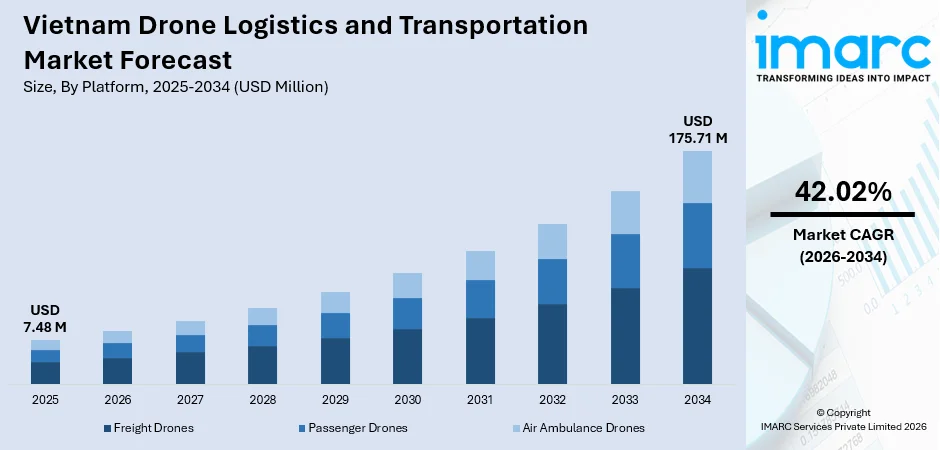
The Vietnam drone logistics and transportation market size was valued at USD 7.48 Million in 2025 and is projected to reach USD 175.71 Million by 2034, growing at a compound annual growth rate of 42.02% from 2026-2034.
The Vietnam drone logistics and transportation market is gaining strong momentum as the country accelerates digital transformation across its rapidly expanding logistics ecosystem. Rising e-commerce demand, growing interest in low-altitude economy applications, and increasing adoption of unmanned aerial vehicles for last-mile delivery and cargo transport are fueling market expansion. Advancements in drone technology, expanding commercial use cases, and supportive policy frameworks are reshaping Vietnam’s logistics landscape, expanding the Vietnam drone logistics and transportation market share.
Key Takeaways and Insights:
- By Platform: Freight drones dominate the market with a revenue share of 69.2% in 2025, driven by the rising demand for efficient cargo transport across urban and remote areas, supporting last-mile delivery and time-sensitive logistics operations.
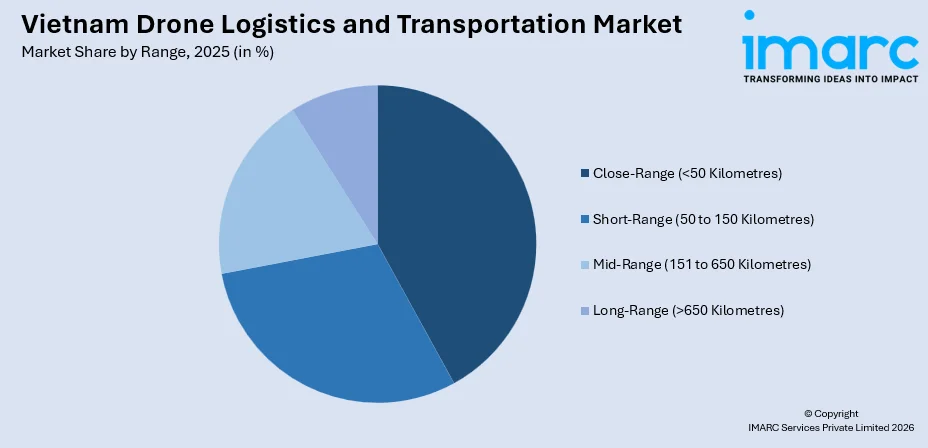
- By Range: Short-range (50 to 150 km) leads the market with a share of 37.5% in 2025, reflecting the strong adoption of drones for regional deliveries and inter-city logistics within accessible corridors.
- By Sector: Civil and commercial holds the largest share at 73.8% in 2025, underscoring growing adoption of drones in e-commerce delivery, agricultural logistics, healthcare transport, and emergency response applications.
- By Region: Southern Vietnam represents the leading region with approximately 46.4% market share in 2025, benefiting from advanced urban infrastructure, high e-commerce activity, and concentration of technology-driven logistics operations.
- Key Players: The Vietnam drone logistics and transportation market features a dynamic mix of domestic technology firms and international drone manufacturers competing through innovation, payload optimization, local production capabilities, and strategic partnerships to strengthen their positions across freight and delivery segments.
To get more information on this market Request Sample
The drone logistics and transportation industry in Vietnam is moving forward as more and more businesses, logistics companies, and government agencies are exploring drone technology to improve supply chain efficiency. One of the major factors driving the drone logistics and transportation industry in Vietnam is the increasing e-commerce industry in the country. The geography of Vietnam is such that there are islands, mountains, and a high density of population in certain areas. All these factors are a challenge for traditional transportation networks. Drones are proving to be a solution to these problems. Drones can bypass traffic and transport goods to remote locations quickly. The increasing focus on digital transformation, smart logistics infrastructure, and green transport solutions is adding to the momentum of introducing drone-based delivery solutions in Vietnam. In 2025, the UAV Innovation Contest 2025, titled “Skies of the Homeland,” commenced on September 9, aiming to explore practical UAV uses to promote research, innovation, and the commercialization of drones produced in Vietnam. The competition is jointly organized by the Institute for Space and Underwater Technology at Hanoi University of Science and Technology and PetroVietnam Gas Corporation.
Vietnam Drone Logistics and Transportation Market Trends:
Emergence of the Low-Altitude Economy Ecosystem
Vietnam is rapidly adopting the low altitude economy as a new frontier for economic growth, with drones playing a central role. In June 2025, the Vietnamese government promulgated the decision no. 1131/QD-TTg, which classified unmanned aerial vehicles as part of the three leading products in the national group of aviation and space technology. In this respect, Vietnam adopted the Vietnam Low Altitude Economy Partnership (LAEP) in October 2025, which indicates a high level of institutional support for the Vietnam drone logistics and transportation market.
Growing Adoption of Drones for Last-Mile E-Commerce Delivery
The rapid growth of Vietnam’s electronic commerce industry, which exceeded USD 25 billion in 2024, has created a surge in the need for efficient last-mile logistics. Drone delivery pilot programs have already been conducted in the provinces of Thai Nguyen, Tuyen Quang, and Lang Son, which have shown the potential of reducing delivery times, especially when navigating difficult terrain. These programs are laying the groundwork for the development of a drone-based logistics infrastructure, both in urban centers and the countryside.
Advancement of Domestic UAV Manufacturing and Technology
Vietnam is taking notable steps in the development of its indigenous capabilities in drone manufacturing, with some of its enterprises recording high levels of localization, ranging from 85-90%, in the products they manufacture. The UAV industry in Vietnam, currently estimated at about 100 million dollars, is growing rapidly with huge investments in research, development, and specialized production. Vietnam is looking to create a huge market for UAVs by 2030, with the country recording notable advancements in the control systems, propulsion, and artificial intelligence of drones.
Market Outlook 2026-2034:
Vietnam’s drone logistics and transportation market is poised for significant expansion, supported by growing e-commerce demand, advancing UAV technology, and increasing government commitment to the low-altitude economy. The market generated a revenue of USD 7.48 Million in 2025 and is projected to reach a revenue of USD 175.71 Million by 2034, growing at a compound annual growth rate of 42.02% from 2026-2034. Rising investments in domestic drone manufacturing, expanding commercial pilot programs, and the development of supportive regulatory frameworks are expected to accelerate market maturation and drive sustained revenue growth across freight, passenger, and emergency logistics segments.
Vietnam Drone Logistics and Transportation Market Report Segmentation:
|
Segment Category |
Leading Segment |
Market Share |
|
Platform |
Freight Drones |
69.2% |
|
Range |
Short-Range (50 to 150 km) |
37.5% |
|
Sector |
Civil and Commercial |
73.8% |
|
Region |
Southern Vietnam |
46.4% |
Platform Insights:
- Freight Drones
- Passenger Drones
- Air Ambulance Drones
Freight drones dominate the Vietnam drone logistics and transportation market with a revenue share of 69.2% in 2025.
Freight drones are at the heart of Vietnam’s drone logistics market, and this is because they are capable of carrying more weight over different types of terrain and are ideal for time-sensitive delivery services. The need for efficient goods delivery, especially in areas where land routes are limited or are experiencing congestion, has made freight drones the most preferred for both mid-mile and last-mile delivery services in Vietnam.
The rise of e-commerce and increasing customer expectations for timely deliveries will only add to the need for freight drones in Vietnam. Advances in propulsion technology, battery life, and cargo handling capabilities will only make freight drones more commercially viable. As the logistics industry continues to develop and include unmanned aircraft technology, freight drones will play an integral part in the modernization of the country’s infrastructure and help address the challenges associated with the country’s topography.
Range Insights:
Access the comprehensive market breakdown Request Sample
- Close-Range (<50 Kilometres)
- Short-Range (50 to 150 Kilometres)
- Mid-Range (151 to 650 Kilometres)
- Long-Range (>650 Kilometres)
Short-range (50 to 150 km) leads the market with a share of 37.5% of the total Vietnam drone logistics and transportation market in 2025.
Short-range drones are the most popular form of drones in the Vietnamese drone logistics market, as they provide the best balance in terms of payload capacity, flight duration, and cost-effectiveness in the country’s regional delivery needs. The range of short-range drones is quite useful in the transportation of goods between cities, agricultural supplies, and the connection of distribution centers and delivery points in the country.
The increased focus on last-mile and mid-mile delivery efficiency is also contributing to the continued uptake of short-range drones. The ability of short-range drones to access and deliver goods to hard-to-reach places in crowded cities makes them ideal for Vietnam’s logistics needs. As drone technology develops and flight corridors are established, short-range drones are set to become the backbone of Vietnam’s emerging drone logistics network.
Sector Insights:
- Civil and Commercial
- Military
Civil and commercial is the largest segment, accounting for 73.8% of the Vietnam drone logistics and transportation market in 2025.
The civil and commercial sector is the dominant end-use segment in Vietnam’s drone logistics market, encompassing a wide array of applications including e-commerce delivery, agricultural logistics, medical supply transport, infrastructure inspection, and disaster relief operations. The sector’s growth is fueled by the rapid digitalization of commerce, expanding consumer expectations for faster delivery services, and the increasing recognition of drones as viable alternatives to traditional ground-based transport.
Commercial adoption is being further accelerated by pilot programs across provinces, the development of designated testing zones in major cities, and the growing interest of logistics providers in integrating aerial delivery into their operations. As regulatory frameworks evolve to accommodate commercial drone flights and businesses invest in scalable aerial logistics systems, the civil and commercial segment is expected to remain the primary growth driver for the market.
Regional Insights:
- Northern Vietnam
- Central Vietnam
- Southern Vietnam
Southern Vietnam holds the largest share at approximately 46.4% of the Vietnam drone logistics and transportation market in 2025.
Southern Vietnam leads the drone logistics and transportation market, anchored by Ho Chi Minh City’s position as the country’s commercial and technological hub. The region benefits from advanced urban infrastructure, a high concentration of e-commerce activity, and a thriving industrial base that demands efficient logistics solutions. The city has approved pilot UAV operations and is actively developing controlled testing environments for drone technologies and management systems within its high-tech parks.
The region’s dense population, extensive manufacturing clusters, and established distribution networks create strong demand for aerial logistics solutions. Southern Vietnam’s strategic focus on developing low-altitude economic activities, simplifying flight licensing procedures, and establishing designated trial zones is positioning the region as the primary testing ground and adoption center for drone-based transport and delivery services across the country.
Market Dynamics:
Growth Drivers:
Why is the Vietnam Drone Logistics and Transportation Market Growing?
Rapid Expansion of E-Commerce and Last-Mile Delivery Demand
Vietnam’s e-commerce sector has emerged as one of the fastest-growing in Southeast Asia, generating an unprecedented surge in parcel volumes and intensifying the need for efficient last-mile delivery solutions. Traditional logistics networks, while expanding, face persistent challenges in managing the sheer volume of online orders, particularly during peak shopping seasons and promotional events. Road congestion in major urban centers, coupled with rising consumer expectations for same-day and next-day delivery, is creating a compelling case for drone-based logistics alternatives. The ability of drones to bypass traffic bottlenecks, operate along dedicated aerial corridors, and deliver goods directly to consumers is transforming how logistics providers conceptualize last-mile fulfillment across both metropolitan and peri-urban areas. IMARC Group predicts that the Vietnam e-commerce market is projected to attain USD 250.2 Billion by 2034.
Government Policy Support and Digital Transformation Initiatives
The Vietnamese government is actively fostering an enabling environment for drone logistics through policy initiatives, regulatory modernization, and strategic technology prioritization. Institutional frameworks are being developed to manage unmanned aircraft operations, establish airspace regulations, and create experimental sandbox environments for testing commercial drone applications. Broader digital transformation strategies are reinforcing the integration of advanced technologies, including autonomous aerial systems, into national logistics and transport planning. The government aims to develop a sustainable, efficient, and high value-added logistics industry with strong competitiveness, leveraging Vietnam's strengths in global supply and value chains. The plan also seeks to increase the outsourcing level of logistics services to 70–80 percent while lowering logistics expenses by 12–15 percent of GDP.
Geographic and Infrastructure Challenges Driving Alternative Transport Solutions
Vietnam’s diverse geography, featuring mountainous terrain in the north, extensive coastlines, numerous islands, and low-lying delta regions, presents inherent challenges for conventional ground-based logistics. Many rural and remote communities remain difficult to access, particularly during monsoon seasons and natural disasters that frequently disrupt road and waterway networks. These infrastructure limitations create strong demand for aerial delivery solutions capable of reaching isolated areas quickly and reliably. Drones offer a practical means of bridging connectivity gaps, delivering essential supplies to disaster-affected zones, and maintaining logistics continuity in areas where traditional transport methods face seasonal or structural constraints, making them an increasingly attractive component of Vietnam’s evolving logistics infrastructure.
Market Restraints:
What Challenges the Vietnam Drone Logistics and Transportation Market is Facing?
Stringent Regulatory Framework and Airspace Management Constraints
Vietnam’s regulatory environment for drone operations remains complex and evolving, with all commercial drone flights requiring advance approval from the Ministry of Defense. The absence of a fully streamlined licensing framework, combined with strict no-fly zones near sensitive installations and urban areas, limits the speed and scale at which logistics operators can deploy drone-based delivery services. Navigating these regulatory requirements adds operational complexity, increases lead times, and creates uncertainty for commercial operators seeking to establish routine drone logistics operations.
Limited Payload Capacity and Battery Performance Constraints
Current drone technology faces inherent limitations in payload capacity and flight endurance, restricting the types and volumes of goods that can be transported efficiently. Most commercial delivery drones are limited to relatively lightweight shipments, and battery performance constrains operational range and frequency. These technical limitations reduce the cost-effectiveness of drone logistics for heavier or bulkier cargo, requiring continued investment in propulsion systems, energy storage solutions, and airframe design improvements before drone-based transport can achieve broader commercial scalability.
High Deployment and Operational Cost Barriers
The initial capital required for drone fleet acquisition, infrastructure development including vertiports and charging stations, maintenance systems, and specialized personnel training presents a significant financial barrier for logistics operators. Operational costs related to regulatory compliance, insurance, flight coordination, and ongoing technical maintenance further add to the total cost of ownership. These financial constraints disproportionately affect smaller logistics providers and limit the pace of market-wide adoption, particularly in cost-sensitive delivery segments where traditional transport options remain more economically competitive.
Competitive Landscape:
The Vietnam drone logistics and transportation market is characterized by a dynamic and rapidly evolving competitive landscape, featuring a mix of established technology conglomerates, specialized UAV manufacturers, and emerging startup enterprises. Market participants are competing through innovation in payload capacity, flight endurance, navigation autonomy, and integration with existing logistics networks. The competitive environment is further shaped by the growing emphasis on domestic manufacturing capabilities, with several industry players achieving significant localization rates and developing proprietary technologies across flight control, propulsion, and artificial intelligence systems. Strategic partnerships with international technology firms, participation in government-sponsored pilot programs, and expansion into export markets are key strategies being employed to gain competitive advantage. As the regulatory framework continues to evolve and commercial drone applications expand, competition is expected to intensify across both hardware and software-based logistics solutions.
Recent Developments:
- In February 2026, Vietnam Post, in collaboration with CT UAV and the Ho Chi Minh City Department of Science and Technology, officially launched a UAV delivery route connecting Can Gio and Vung Tau. The drone completes the 12 km journey in approximately 15 minutes, which is roughly six times more efficient than road transport, significantly shortening delivery time between two geographically challenging coastal areas.
Vietnam Drone Logistics and Transportation Market Report Coverage:
|
Report Features |
Details |
|
Base Year of the Analysis |
2025 |
|
Historical Period |
2020-2025 |
|
Forecast Period |
2026-2034 |
|
Units |
USD Million |
|
Scope of the Report |
Exploration of Historical Trends and Market Outlook, Industry Catalysts and Challenges, Segment-Wise Historical and Future Market Assessment:
|
|
Platforms Covered |
Freight Drones, Passenger Drones, Air Ambulance Drones |
|
Ranges Covered |
Close-Range (<50 Kilometres), Short-Range (50 to 150 Kilometres), Mid-Range (151 to 650 Kilometres), Long-Range (>650 Kilometres) |
|
Sectors Covered |
Civil and Commercial, Military |
|
Regions Covered |
Northern Vietnam, Central Vietnam, Southern Vietnam |
|
Customization Scope |
10% Free Customization |
|
Post-Sale Analyst Support |
10-12 Weeks |
|
Delivery Format |
PDF and Excel through Email (We can also provide the editable version of the report in PPT/Word format on special request) |
Frequently Asked Questions About the Vietnam Drone Logistics and Transportation Market Report
The Vietnam drone logistics and transportation market size was valued at USD 7.48 Million in 2025.
The market is expected to grow at a compound annual growth rate of 42.02% from 2026-2034 to reach USD 175.71 Million by 2034.
Freight drones, holding the largest revenue share of 69.2%, remain pivotal for Vietnam’s drone logistics adoption, enabling efficient cargo transport, last-mile delivery, and time-sensitive logistics operations across diverse geographic and urban settings.
Key factors driving the Vietnam drone logistics and transportation market include rapid e-commerce expansion, government support for low-altitude economy development, geographic challenges driving alternative transport demand, advancing UAV technology, and growing commercial pilot programs.
Major challenges include stringent regulatory and airspace management requirements, limited payload capacity and battery endurance, high deployment and operational costs, underdeveloped supporting infrastructure, and evolving legal frameworks for commercial drone operations.
Need more help?
- Speak to our experienced analysts for insights on the current market scenarios.
- Include additional segments and countries to customize the report as per your requirement.
- Gain an unparalleled competitive advantage in your domain by understanding how to utilize the report and positively impacting your operations and revenue.
- For further assistance, please connect with our analysts.
 Request Customization
 Speak to an Analyst
 Request Brochure
 Inquire Before Buying
Benefits of Customization
- Personalize this research
- Triangulate with your data
- Get data as per your format and definition
- Gain a deeper dive into a specific application, geography, customer, or competitor
- Any level of personalization
Get in Touch With Us
UNITED STATES
Phone: +1-201-971-6302
INDIA
Phone: +91-120-433-0800
UNITED KINGDOM
Phone: +44-753-714-6104
Email: [email protected]
Client Testimonials




.webp)




.webp)













Related Reports

Choose your plan
*Please note that the prices mentioned below are starting prices for each bundle type. Kindly contact our team for further details.*
Single User License
- 1 User License, Access on 2 Devices
- PDF Report + Excel Dataset (Password Protected)
- Lifetime Access
- No Printing Rights
- 10% Free Report Customization
- 10–12 Weeks of Analyst Support
Five User License
- Access for 5 Users, 2 Devices per User
- PDF Report + Excel Dataset (Password Protected)
- Lifetime Access
- Dedicated Account Manager
- 12–14 Weeks of Analyst Support
- No Printing Rights
- 15% Free Report Customization
- 25% Discount on Your Next Purchase
Corporate User License
- Unlimited User Access (Within Your Organization)
- PDF Report + Excel Dataset
- Lifetime Access
- Dedicated Account Manager
- 14–20 Weeks of Analyst Support
- No Printing Rights
- 20% Free Report Customization
- 30% Discount on Your Next Purchase
Essential Insights
What's included:
3 reports
- Lifetime Access
- PDF Reports
- Excel Datasets
- 2 Weeks of Free Analyst Support
- 2 User Licenses
- Access on 2 Devices
- Printing Rights
- Complimentary PowerPoint (PPT) Version
- Complimentary License Upgrade
Professional Access
What's included:
5 reports
- Lifetime Access
- PDF Reports
- Excel Datasets
- 8 Weeks of Free Analyst Support
- 2 User Licenses
- Access on 2 Devices
- Printing Rights
- Complimentary PowerPoint (PPT) Version
- Complimentary License Upgrade
Business Advantage
What's included:
8 reports
- Lifetime Access
- PDF Reports
- Excel Datasets
- 14 Weeks of Free Analyst Support
- 2 User Licenses
- Access on 2 Devices
- Printing Rights
- Complimentary PowerPoint (PPT) Version
- Complimentary License Upgrade
Enterprise Intelligence
What's included:
10 reports
- Lifetime Access
- PDF Reports
- Excel Datasets
- 20 Weeks of Free Analyst Support
- 2 User Licenses
- Access on 2 Devices
- Printing Rights
- Complimentary PowerPoint (PPT) Version
- Complimentary License Upgrade