
Water Recycle and Reuse Market Size, Share, Trends and Forecast by Technology, End User, and Region, 2026-2034
Water Recycle and Reuse Market Size and Share:
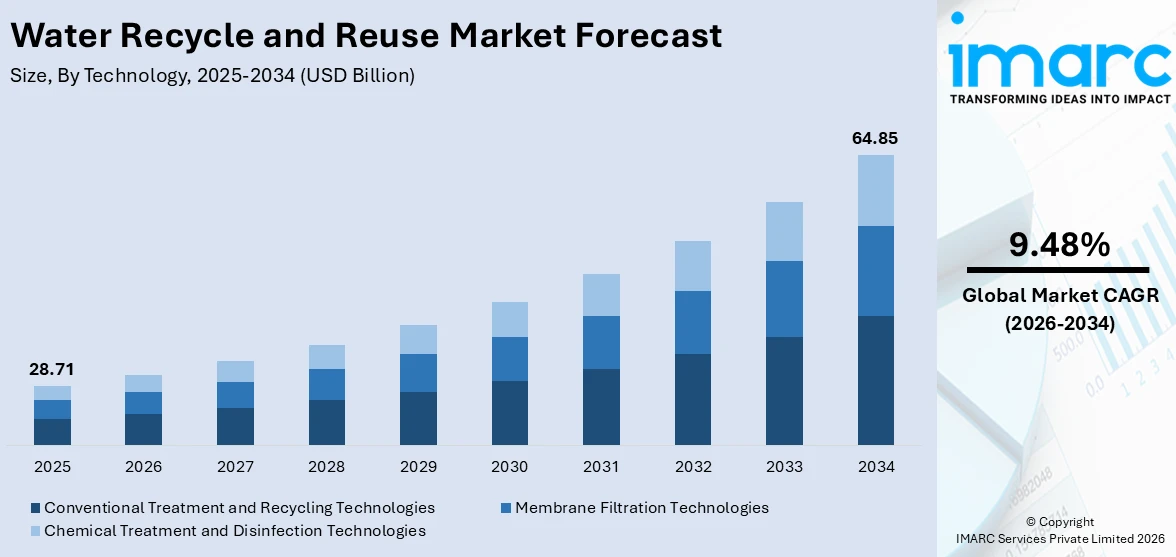
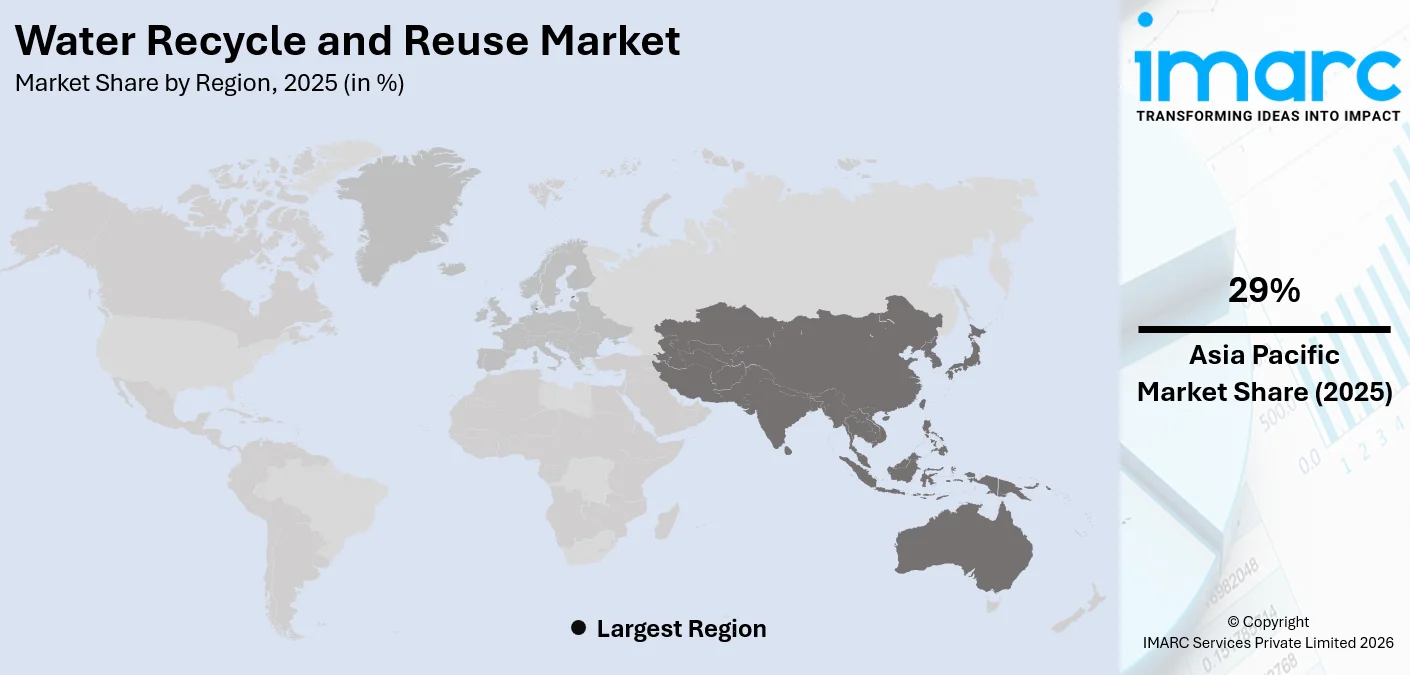
The global water recycle and reuse market size was valued at USD 28.71 Billion in 2025. Looking forward, IMARC Group estimates the market to reach USD 64.85 Billion by 2034, exhibiting a CAGR of 9.48% from 2026-2034. Asia Pacific currently dominates the market, holding a market share of 29% in 2025. Rapid urbanization, large-scale industrial expansion, high population density driving freshwater demand, and extensive government-backed investments in wastewater treatment infrastructure, are some of the factors contributing to the water recycle and reuse market share.
The rising global water scarcity driven by climate change, population growth, and rapid industrialization is catalyzing the demand for water recycling and reuse solutions. Governments and regulatory bodies across the world are enforcing stricter wastewater discharge standards and water conservation mandates, encouraging industries and municipalities to invest in advanced treatment technologies. Additionally, technological advancements in membrane filtration, ultraviolet disinfection, and advanced oxidation processes are making water recycling systems more efficient and cost-effective, broadening their applicability across municipal, industrial, and agricultural sectors. The growing adoption of circular water management strategies, including zero-liquid discharge systems and closed-loop recycling, is further influencing the market.
The United States is emerging as a vital region in the water recycling and reuse market, supported by a strong regulatory framework, substantial federal funding, and active public-private partnerships (PPP) that encourage sustainable water management. Increasing drought risks and rising demand from municipalities and commercial developments are accelerating adoption of decentralized recycling systems. In 2025, Epic Cleantec introduced the OneWater Rain system at Greenbuild 2025, offering a modular solution that captures and purifies rainwater and HVAC condensate for non-potable uses, such as irrigation and toilet flushing. With early projects underway in California and Texas, the system demonstrated practical circular water applications within the built environment. Such innovations highlight the country’s commitment to resilient infrastructure and efficient resource utilization, reinforcing the United States’ leadership in advancing modern water recycling and reuse technologies.
To get more information on this market Request Sample
Water Recycle and Reuse Market Trends:
Government Policy Support for Circular Water Economy Adoption
As water demand rises across urban, industrial, and agricultural sectors, public authorities are increasingly prioritizing treated wastewater reuse to reduce pressure on freshwater resources and improve environmental outcomes. Policy-driven investments are accelerating the development of infrastructure required for large-scale recycling systems. For instance, in 2025, Maharashtra’s cabinet approved a circular economy policy to process and reuse sewage and wastewater across 424 urban local bodies, supporting non-drinking applications, such as industrial operations and agricultural irrigation. The state allocated INR 500 Crore for implementation, reflecting a significant commitment to sustainable water management and pollution reduction. Such initiatives demonstrate how regulatory backing and public funding can expand reuse capacity and encourage municipalities to adopt modern treatment technologies. Continued policy support at regional and national levels is bolstering the market growth and accelerate long-term adoption of water recycling solutions.
Industrial Water Reuse in Resource-Intensive Manufacturing
The rising need for sustainable water management in resource-intensive industries is a major factor impelling the market growth. Sectors like textiles use substantial volumes of freshwater and face increasing regulatory scrutiny, environmental pressure, and supply constraints. As a result, manufacturers are investing in advanced wastewater treatment and reuse systems to reduce freshwater dependency and improve operational efficiency. In 2025, Bangladesh’s Ready-Made Garment industry established the country’s largest Water Reuse and Wastewater Management Demonstration Site at Fakir Knitwears Ltd, targeting a 30% reduction in freshwater extraction and the reuse of 438,000 cubic meters of water annually in line with national sustainability objectives. This initiative highlights how large-scale industrial reuse projects can support environmental targets while maintaining production capacity. The growing emphasis on responsible manufacturing and water efficiency in export-driven industries is accelerating adoption of recycling technologies across emerging economies.
Corporate Water Stewardship and Community-Based Recycling Initiatives
Industrial organizations are recognizing the importance of sustainable water management to reduce operational risks, ensure regulatory compliance, and strengthen environmental commitments. Beyond internal efficiency improvements, companies are expanding their focus to community engagement and resource conservation initiatives that promote long-term water security. For example, in 2025, Chandra Asri Group launched a comprehensive Water Stewardship Program aimed at reducing water usage and advancing recycling practices. The initiative included the installation of wastewater treatment systems in schools and villages, as well as rainwater harvesting systems in public parks, contributing to meaningful reductions in clean water usage. Such programs demonstrate how corporate-led investments in decentralized treatment and conservation infrastructure can generate environmental benefits while supporting local communities. The growing emphasis on responsible water governance is encouraging wider adoption of recycling technologies across industrial and public sectors.
Water Recycle and Reuse Industry Segmentation:
IMARC Group provides an analysis of the key trends in each segment of the global water recycle and reuse market, along with forecast at the global, regional, and country levels from 2026-2034. The market has been categorized based on technology and end user.

Analysis by Technology:
- Conventional Treatment and Recycling Technologies
- Membrane Filtration Technologies
- Chemical Treatment and Disinfection Technologies
Conventional treatment and recycling technologies represent 40% of the market share, highlighting their established position in managing municipal and industrial wastewater. These systems encompass established methods, including primary sedimentation, activated sludge treatment, trickling filters, and secondary clarification, which together deliver dependable and scalable solutions for treating large volumes of wastewater. Their broad acceptance is credited to demonstrated operational efficiency, relatively reduced capital investment needs, and compatibility with centralized treatment systems. Numerous municipalities and industrial operators still depend on these technologies to guarantee regulatory adherence and sustain uniform effluent quality. Demand continues to be especially robust in developing regions where governments are focusing on enhancing basic sanitation systems and essential wastewater infrastructure. With increasing urban populations and the rising importance of water reuse goals, traditional treatment systems remain vital elements in facilitating extensive recycling and sustainable water resource management initiatives.
Analysis by End User:
Access the comprehensive market breakdown Request Sample
- Industrial
- Agricultural
- Domestic and Commercial
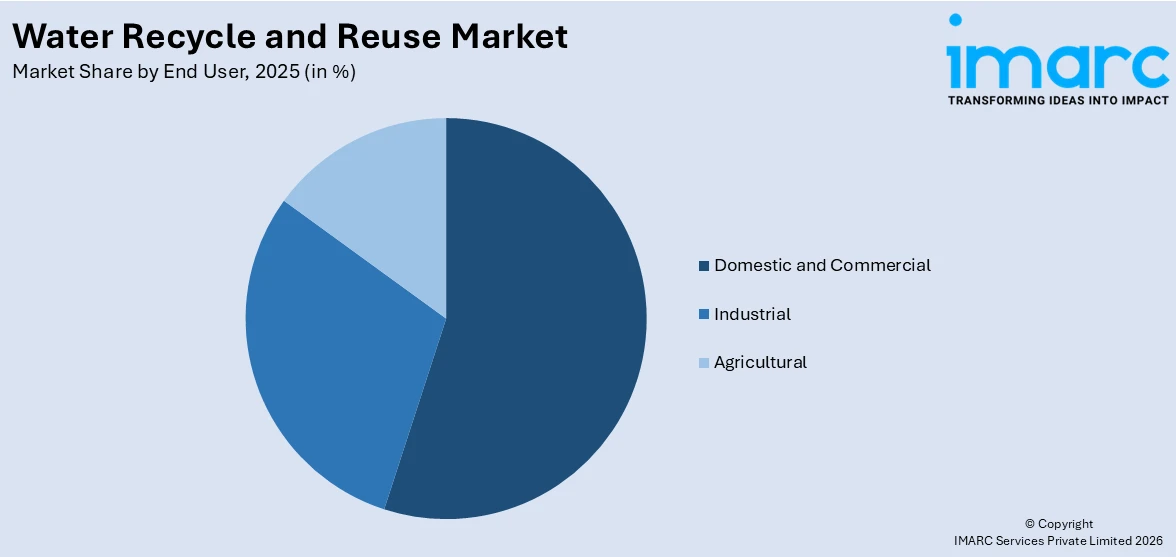
The domestic and commercial segment leads the water recycling and reuse market, accounting for 51% of the total share. This segment encompasses uses in residential structures, commercial centers, hospitality venues, healthcare facilities, and retail spaces, where water conservation and efficiency are becoming more emphasized. Accelerated urban growth, increased population density, and soaring household water consumption are amplifying the need for sustainable water management systems. The increasing use of greywater recycling systems for non-drinking applications, such as toilet flushing, landscape irrigation, and cooling processes, is further boosting the market demand. Regulatory assistance is crucial, as authorities establish building code standards, green certification systems, and financial incentives that promote the adoption of on-site recycling systems. Property developers and facility managers are incorporating decentralized treatment technologies to lower operational expenses and improve environmental sustainability. These interconnected elements persist in strengthening the leading role of residential and industrial uses in the water recycling and reuse market.
Regional Analysis:
To get more information on the regional analysis of this market Request Sample
- North America
- United States
- Canada
- Asia-Pacific
- China
- Japan
- India
- South Korea
- Australia
- Indonesia
- Others
- Europe
- Germany
- France
- United Kingdom
- Italy
- Spain
- Russia
- Others
- Latin America
- Brazil
- Mexico
- Others
- Middle East and Africa
Asia Pacific, accounting for 29% of the market share, holds a leading position supported by rapid urbanization, expanding industrial activity, and severe water stress across major economies. The growing population density and rising municipal demand are increasing the urgency for sustainable wastewater treatment solutions that can supplement limited freshwater resources. Governments and utilities are increasingly encouraging innovation to enhance recycling capacity and improve treatment efficiency. In 2025, the Bangalore Water Supply and Sewerage Board opened its wastewater treatment plants to start-ups to accelerate development of advanced recycling technologies. The first collaboration with Boson Whitewater at the Kadubeesanahalli plant was designed to test purification systems under real operating conditions and support Bengaluru’s reuse expansion by supplying up to 70,000 liters of high-quality treated water daily. Such initiatives reflect the region’s proactive approach to strengthening long-term water security through recycling investments. The water recycle and reuse market forecast estimates the dominance of Asia Pacific region owing to increasing innovation, expanding recycling capacity, and rising investments in long-term water security solutions.
Key Regional Takeaways:
United States Water Recycle and Reuse Market Analysis
The United States represents a key market for water recycling and reuse, supported by stringent environmental regulations, expanding federal funding initiatives, and increasing awareness about sustainable water resource management. The growing water scarcity concerns, coupled with rising industrial and municipal demand, are accelerating investments in advanced treatment technologies that enable efficient reuse across multiple sectors. Regulatory compliance requirements are particularly influential in industries with high water usage, such as energy production, manufacturing, and agriculture. In this context, WaterTectonics, in collaboration with Clearvale Capital, launched WT Oil & Gas in 2025 to deliver high-performance water treatment solutions for the oil and gas sector. Based in Midland, Texas, the subsidiary focused on high-volume produced water recycling and reuse across the Permian and Delaware Basins, addressing the operational and environmental challenges of large-scale oilfield activity. Such developments reflect the growing integration of scalable water management systems into industrial operations. These initiatives are expected to significantly contribute to water recycling and reuse market growth by expanding large-scale industrial adoption of sustainable water management solutions.
Europe Water Recycle and Reuse Market Analysis
Europe constitutes a substantial market for water recycling and reuse, supported by stringent environmental standards, strong sustainability commitments, and coordinated regulatory frameworks that promote treated wastewater reuse across member states. Increasing pressure on freshwater resources, coupled with climate-related drought risks, is encouraging municipalities and industries to invest in advanced treatment technologies that ensure safe and reliable reuse. Public sector initiatives are playing a central role in accelerating adoption, particularly in urban water supply and agricultural applications. In 2024, Les Sables-d'Olonne in France launched a pioneering water recycling project designed to deliver treated wastewater to household taps by 2025, with the system expected to recycle 25% of the town’s water through advanced filtration, reverse osmosis, and disinfection processes. Such projects highlight Europe’s commitment to innovative reuse solutions and reinforce the region’s leadership in sustainable water management practices.
Asia-Pacific Water Recycle and Reuse Market Analysis
Asia-Pacific leads the water recycling and reuse market, driven by rapid urbanization, large-scale industrial expansion, and severe water stress affecting key economies across the region. Governments and industries are increasingly prioritizing innovative reuse technologies to strengthen water resilience and ensure reliable supply for municipal and industrial needs. In 2024, following the Noto Peninsula Earthquake, Japan deployed the portable WOTA BOX system, capable of recycling over 98% of wastewater and supporting up to 6,000 showers and 50,000 hand washings daily in evacuation centers. Such advancements demonstrate the region’s commitment to adaptable, high-efficiency solutions that address both emergency response requirements and long-term infrastructure limitations, reinforcing Asia-Pacific’s dominant position in sustainable water management practices worldwide. These developments strongly reflect the evolving water recycle and reuse market trends shaping sustainable water management strategies across the Asia-Pacific region.
Latin America Water Recycle and Reuse Market Analysis
Latin America is experiencing growth in the water recycling and reuse market, supported by rising industrial water demand, accelerating urbanization, and government-led sustainability programs. Investments in wastewater treatment infrastructure across countries, such as Brazil and Mexico, are helping address water quality concerns while enabling agricultural and industrial reuse. In 2025, Veolia partnered with PetStar in Mexico to advance water neutrality through advanced reuse technologies, enabling the recovery of 370 cubic meters of water per day, equivalent to half the surrounding community’s utilization. This reflects the region’s increasing focus on sustainable water management.
Middle East and Africa Water Recycle and Reuse Market Analysis
The Middle East and Africa region is witnessing increasing adoption of water recycling and reuse solutions, driven by severe water scarcity, arid climatic conditions, and the implementation of national water security strategies. For instance, in 2025, SATORP partnered with Marafiq, Veolia, and Lamar to develop a USD 500 Million wastewater recycling project in Jubail, Saudi Arabia, designed to treat and reuse 8.76 million cubic meters of industrial wastewater annually. Scheduled for completion in 2028, this initiative aligns with Vision 2030 goals by supporting sustainable resource management and circular economy practices. The sustained investment in long-term water security and resource optimization strategies is offering a favorable the water recycle and reuse market outlook in the Middle East and Africa region.
Competitive Landscape:
The global water recycle and reuse market features a moderately fragmented competitive landscape, with key players focusing on strategic acquisitions, technological innovations, and global expansion to strengthen their market positions. Leading companies are investing heavily in advanced membrane technologies, digital water management solutions, and integrated treatment platforms to address the growing demand for efficient water recycling systems. Major players are also forming strategic partnerships with municipalities, industrial operators, and government agencies to secure large-scale water reuse contracts. The increasing emphasis on sustainability, zero-liquid discharge compliance, and circular economy principles is encouraging companies to develop more energy-efficient and cost-effective solutions. Additionally, companies are leveraging AI and IoT-based monitoring systems to enhance operational efficiency and offer predictive maintenance capabilities to their customers.
The report provides a comprehensive analysis of the competitive landscape in the water recycle and reuse market with detailed profiles of all major companies, including:
- Alfa Laval AB
- Aquatech International LLC
- DeLoach Industries Inc.
- Ecolab Inc.
- Element Solutions Inc.
- Evoqua Water Technologies LLC
- Fluence Corporation Limited
- Hitachi Zosen Corporation
- Industrial Water Equipment Ltd.
- Lenntech B.V.
- Praj Industries Limited
- Samco Technologies Inc.
- Siemens AG
- Veolia Environnement S.A.
Latest News and Developments:
- In November 2025, Transition Industries' Pacifico Mexinol project, in collaboration with Veolia, has launched one of the world’s largest industrial wastewater reuse initiatives in Ahome, Mexico. This partnership aimed to treat 32,300 cubic meters of municipal wastewater daily, preserving local freshwater for other uses while supporting industrial water needs. The advanced water treatment plant, set to become the largest ultra-low carbon chemical facility globally, represents a major step forward in water circularity and sustainable resource management.
- In August 2025, Veolia has partnered with Brazil to launch an advanced water reuse system in Vitória, designed to recycle 85% of the region's wastewater for industrial use. The facility planned to process 450 liters per second, providing reclaimed water equivalent to the needs of 200,000 people, supporting sustainability and water conservation efforts. This pioneering project marked a significant step towards addressing water scarcity and establishing a new standard for water reuse in Brazil.
- In March 2025, El Paso Water has begun construction on the $295 million Pure Water Center in El Paso, Texas, the nation’s first direct-to-distribution wastewater reuse facility. This innovative facility planned to treat wastewater for direct reuse, providing a sustainable source of drinking water for the community. The project was a significant step toward enhancing water resilience and sustainability in the region.
Water Recycle and Reuse Market Report Scope:
| Report Features | Details |
|---|---|
| Base Year of the Analysis | 2025 |
| Historical Period | 2020-2025 |
| Forecast Period | 2026-2034 |
| Units | Billion USD |
| Scope of the Report |
Exploration of Historical Trends and Market Outlook, Industry Catalysts and Challenges, Segment-Wise Historical and Future Market Assessment:
|
| Technologies Covered | Conventional Treatment and Recycling Technologies, Membrane Filtration Technologies, Chemical Treatment and Disinfection Technologies |
| End Users Covered | Industrial, Agricultural, Domestic and Commercial |
| Regions Covered | North America, Asia-Pacific, Europe, Latin America, Middle East and Africa |
| Countries Covered | United States, Canada, China, Japan, India, South Korea, Australia, Indonesia, Germany, France, United Kingdom, Italy, Spain, Russia, Brazil, Mexico |
| Companies Covered | Alfa Laval AB, Aquatech International LLC, DeLoach Industries Inc., Ecolab Inc., Element Solutions Inc., Evoqua Water Technologies LLC, Fluence Corporation Limited, Hitachi Zosen Corporation, Industrial Water Equipment Ltd., Lenntech B.V., Praj Industries Limited, Samco Technologies Inc., Siemens AG, Veolia Environnement S.A., etc. |
| Customization Scope | 10% Free Customization |
| Post-Sale Analyst Support | 10-12 Weeks |
| Delivery Format | PDF and Excel through Email (We can also provide the editable version of the report in PPT/Word format on special request) |
Key Benefits for Stakeholders:
- IMARC’s report offers a comprehensive quantitative analysis of various market segments, historical and current market trends, market forecasts, and dynamics of the water recycle and reuse market from 2020-2034.
- The research study provides the latest information on the market drivers, challenges, and opportunities in the global water recycle and reuse market.
- The study maps the leading, as well as the fastest-growing, regional markets. It further enables stakeholders to identify the key country-level markets within each region.
- Porter’s Five Forces analysis assists stakeholders in assessing the impact of new entrants, competitive rivalry, supplier power, buyer power, and the threat of substitution. It helps stakeholders to analyze the level of competition within the water recycle and reuse industry and its attractiveness.
- Competitive landscape allows stakeholders to understand their competitive environment and provides an insight into the current positions of key players in the market.
Frequently Asked Questions About the Water Recycle and Reuse Market Report
The water recycle and reuse market was valued at USD 28.71 Billion in 2025.
The water recycle and reuse market is projected to exhibit a CAGR of 9.48% during 2026-2034, reaching a value of USD 64.85 Billion by 2034.
The water recycle and reuse market is primarily driven by stronger government policies supporting circular water economies, rising industrial demand for wastewater reuse in water-intensive manufacturing, and increasing corporate stewardship initiatives focused on conservation. Public funding accelerates infrastructure development, industries invest to reduce freshwater dependency, and companies adopt community-based recycling programs, collectively strengthening sustainable water management adoption worldwide.
Asia Pacific dominates the water recycle and reuse market, accounting for a share of 29%. The region benefits from rapid urbanization, severe water stress across major economies, large-scale government investments in treatment infrastructure, and growing adoption of advanced recycling technologies.
Some of the major players in the water recycle and reuse market include Alfa Laval AB, Aquatech International LLC, DeLoach Industries Inc., Ecolab Inc., Element Solutions Inc., Evoqua Water Technologies LLC, Fluence Corporation Limited, Hitachi Zosen Corporation, Industrial Water Equipment Ltd., Lenntech B.V., Praj Industries Limited, Samco Technologies Inc., Siemens AG, Veolia Environnement S.A., etc.
Need more help?
- Speak to our experienced analysts for insights on the current market scenarios.
- Include additional segments and countries to customize the report as per your requirement.
- Gain an unparalleled competitive advantage in your domain by understanding how to utilize the report and positively impacting your operations and revenue.
- For further assistance, please connect with our analysts.
 Request Customization
 Speak to an Analyst
 Request Brochure
 Inquire Before Buying
Benefits of Customization
- Personalize this research
- Triangulate with your data
- Get data as per your format and definition
- Gain a deeper dive into a specific application, geography, customer, or competitor
- Any level of personalization
Get in Touch With Us
UNITED STATES
Phone: +1-201-971-6302
INDIA
Phone: +91-120-433-0800
UNITED KINGDOM
Phone: +44-753-714-6104
Email: [email protected]
Client Testimonials




.webp)




.webp)













Related Reports

Choose your plan
*Please note that the prices mentioned below are starting prices for each bundle type. Kindly contact our team for further details.*
Single User License
- 1 User License, Access on 2 Devices
- PDF Report + Excel Dataset (Password Protected)
- Lifetime Access
- No Printing Rights
- 10% Free Report Customization
- 10–12 Weeks of Analyst Support
Five User License
- Access for 5 Users, 2 Devices per User
- PDF Report + Excel Dataset (Password Protected)
- Lifetime Access
- Dedicated Account Manager
- 12–14 Weeks of Analyst Support
- No Printing Rights
- 15% Free Report Customization
- 25% Discount on Your Next Purchase
Corporate User License
- Unlimited User Access (Within Your Organization)
- PDF Report + Excel Dataset
- Lifetime Access
- Dedicated Account Manager
- 14–20 Weeks of Analyst Support
- No Printing Rights
- 20% Free Report Customization
- 30% Discount on Your Next Purchase
Essential Insights
What's included:
3 reports
- Lifetime Access
- PDF Reports
- Excel Datasets
- 2 Weeks of Free Analyst Support
- 2 User Licenses
- Access on 2 Devices
- Printing Rights
- Complimentary PowerPoint (PPT) Version
- Complimentary License Upgrade
Professional Access
What's included:
5 reports
- Lifetime Access
- PDF Reports
- Excel Datasets
- 8 Weeks of Free Analyst Support
- 2 User Licenses
- Access on 2 Devices
- Printing Rights
- Complimentary PowerPoint (PPT) Version
- Complimentary License Upgrade
Business Advantage
What's included:
8 reports
- Lifetime Access
- PDF Reports
- Excel Datasets
- 14 Weeks of Free Analyst Support
- 2 User Licenses
- Access on 2 Devices
- Printing Rights
- Complimentary PowerPoint (PPT) Version
- Complimentary License Upgrade
Enterprise Intelligence
What's included:
10 reports
- Lifetime Access
- PDF Reports
- Excel Datasets
- 20 Weeks of Free Analyst Support
- 2 User Licenses
- Access on 2 Devices
- Printing Rights
- Complimentary PowerPoint (PPT) Version
- Complimentary License Upgrade