
Asia Pacific Gaming Peripherals Market Size, Share, Trends and Forecast by Product Type, Gaming Device Type, Technology, Distribution Channel, and Country, 2026-2034
Asia Pacific Gaming Peripherals Market Size, Share, Trends & Forecast (2026-2034)
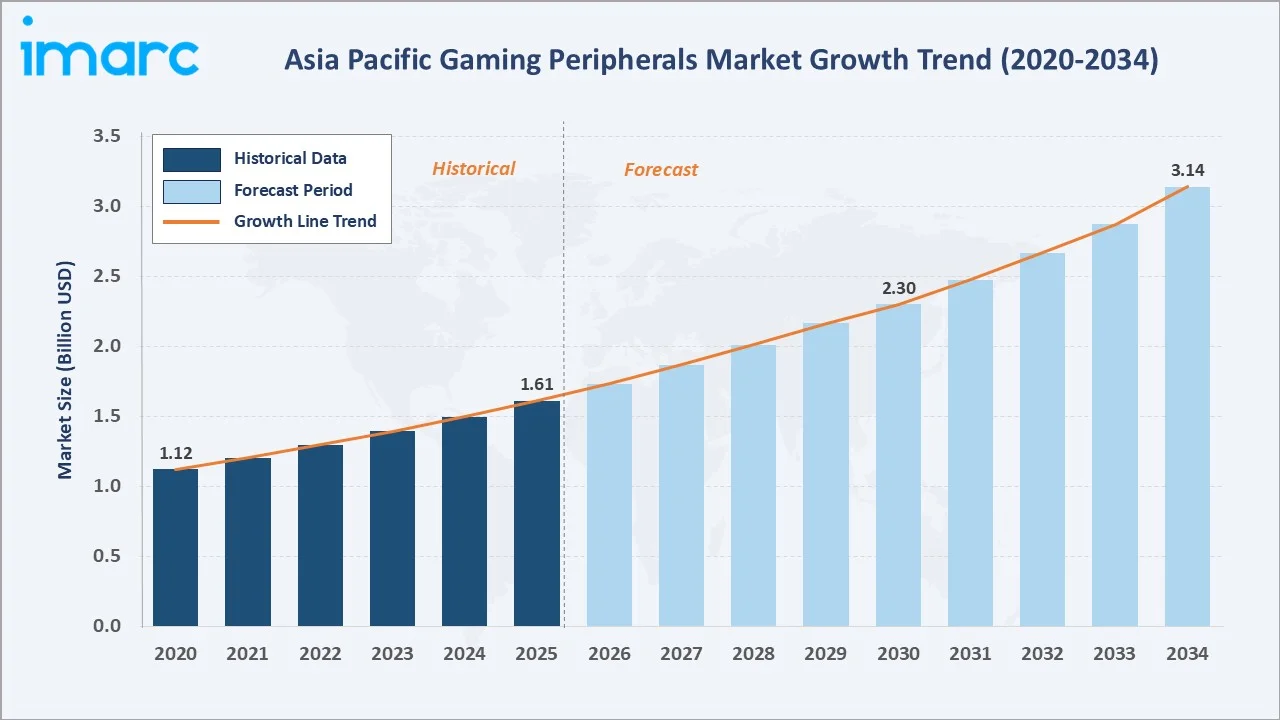
The Asia Pacific gaming peripherals market grew from USD 1.61 Billion in 2025 to USD 1.76 Billion in 2026 and is projected to reach USD 3.14 Billion by 2034, growing at a CAGR of 7.49% during 2026-2034. The market is driven by rising esports participation, expanding livestreaming culture, and increasing PC and console gaming adoption across China, Japan, and India. Gaming peripherals sales are further supported by the region's growing base of professional and semi-professional gamers who demand precision-engineered, low-latency hardware for competitive play. Gaming consoles lead the device type segment at 56.7% share, while wireless technology dominates at 61.4%, reflecting growing consumer preference for cable-free, low-latency gaming setups across the region.
Market Snapshot
|
Metric |
Value |
|
Base Year Market Size (2025) |
USD 1.61 Billion |
| Market Size (2026) | USD 1.76 Billion |
|
Forecast Market Size (2034) |
USD 3.14 Billion |
|
CAGR (2026-2034) |
7.49% |
|
Base Year |
2025 |
|
Historical Period |
2020-2025 |
|
Forecast Period |
2026-2034 |
|
Dominant Gaming Device Type |
Gaming Consoles (56.7%, 2025) |
|
Dominant Technology |
Wireless (61.4%, 2025) |
|
Leading Country |
China (32.6%, 2025) |
The market expanded from USD 1.12 Billion in 2020 to USD 1.61 Billion in 2025 and an estimated USD 1.76 Billion in 2026, supported by rising esports viewership and gaming hardware upgrades, anchored at USD 2.30 Billion in 2030 and forecast to reach USD 3.14 Billion by 2034 as wireless technology adoption and console gaming continue to accelerate demand across the region.
To get more information on this market, Request Sample
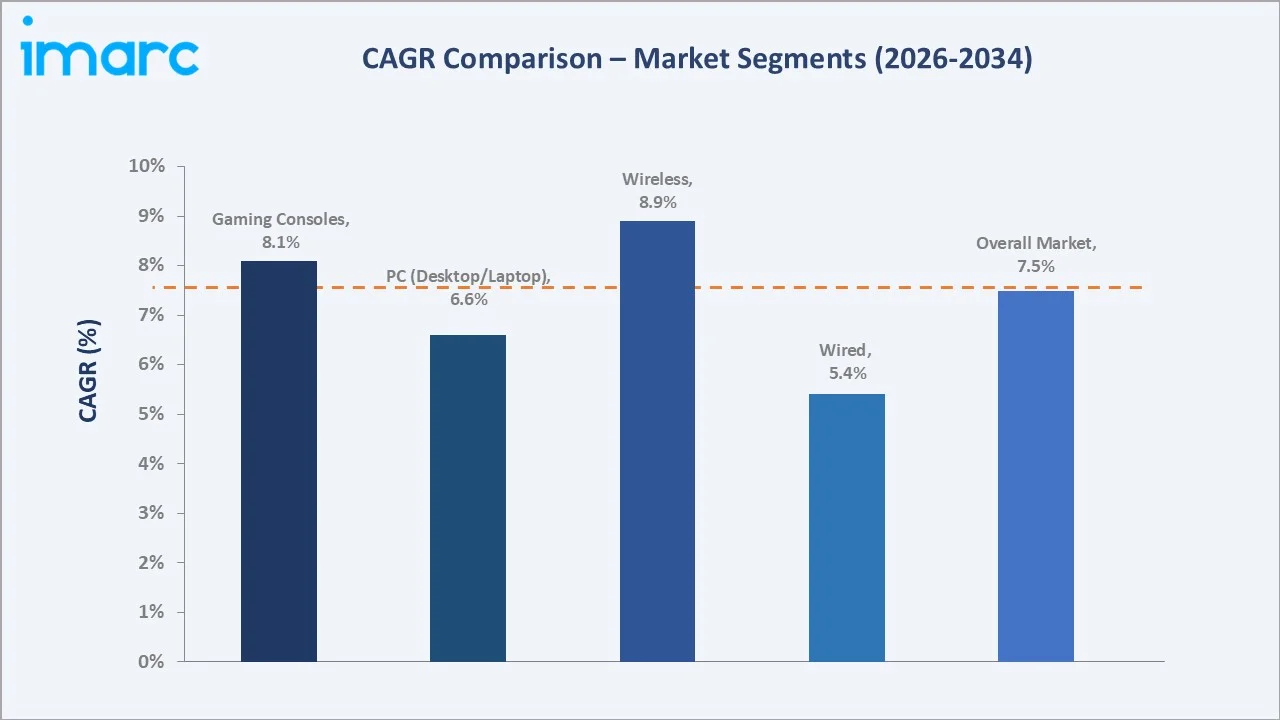
Gaming console peripherals grow fastest at approximately 8.1% CAGR as first-party title releases and expanded regional console distribution multiply accessory attachment rates across Japan and South Korea. Wireless technology peripherals grow at approximately 8.9% CAGR as low-latency wireless protocols increasingly match wired-grade responsiveness, prompting a structural shift away from cabled setups across both console and PC gaming segments.
Executive Summary
The Asia Pacific gaming peripherals market, which increased from USD 1.61 Billion in 2025 to an estimated USD 1.76 Billion in 2026, representing the region's position as a global hub for competitive gaming, esports, and digital content creation. The gaming peripheral is the defining interface layer of the modern gaming experience, performing the precision input and immersive output functions that connect players to increasingly sophisticated game titles and virtual environments. The market is projected to reach USD 3.14 Billion by 2034.
Gaming consoles at 56.7% dominate through strong adoption in Japan and South Korea, supported by continued first-party title investment from major console manufacturers. Wireless technology at 61.4% leads through consumer demand for clutter-free, high-performance setups and continuous advances in low-latency transmission protocols. China at 32.6% leads regionally through its massive gaming population, thriving esports ecosystem, and strong domestic peripheral manufacturing base supplying both local and export markets.
Key Market Insights
|
Insight |
Data |
|
Dominant Gaming Device Type |
Gaming Consoles - 56.7% share (2025) |
|
Dominant Technology |
Wireless - 61.4% share (2025) |
|
Leading Country |
China - 32.6% share (2025) |
|
Market Opportunity |
Wireless low-latency peripherals; esports-grade accessories; regional e-commerce expansion |
Key Analytical Observations Supporting the Above Data:
- Gaming Consoles at 56.7%: Console gaming dominates due to widespread adoption in Japan and South Korea, supported by strong first-party titles and continued investment from major console manufacturers in regional gaming ecosystems. Its widespread adoption across living-room and portable console platforms by major OEMs further strengthens segment demand. Rising subscription-based gaming services are also expanding the installed console base across price-sensitive markets.
- Wireless at 61.4%: Wireless peripherals lead as gamers increasingly favor cable-free convenience without compromising performance, aided by advances in low-latency 2.4GHz and Bluetooth transmission technologies. Improved battery life and rapid-charging capabilities have further reduced the historical performance gap between wireless and wired setups. Leading manufacturers continue to expand wireless product lines across mice, keyboards, and headsets to capture this shift.
- China at 32.6%: China leads through its massive gaming population, thriving esports ecosystem, and strong domestic peripheral manufacturing base supplying both local and export markets. In 2025, China's expanding livestreaming and content creation economy generated substantial additional demand for premium peripherals. This highlights how domestic manufacturing scale and content-driven demand are reinforcing China's structural leadership position.
Asia Pacific Gaming Peripherals Market Overview
The Asia Pacific gaming peripherals market encompasses the design, manufacture, and supply of all input-output hardware used to enhance the gaming experience across vehicle categories of gaming devices, such as gaming consoles, desktop PCs, and gaming laptops, spanning product types including headsets, keyboards, joysticks, mice, and gamepads.
The ecosystem integrates component suppliers, peripheral manufacturers, brand OEMs and design houses, distribution and retail partners, and regulatory bodies overseeing product safety and import standards across the region. Macroeconomic factors include rising internet penetration, growth of livestreaming and content creation platforms, increasing consumer disposable income, and continued investment in regional esports infrastructure.
Market Dynamics
To evaluate market opportunities, Request Sample
Market Drivers
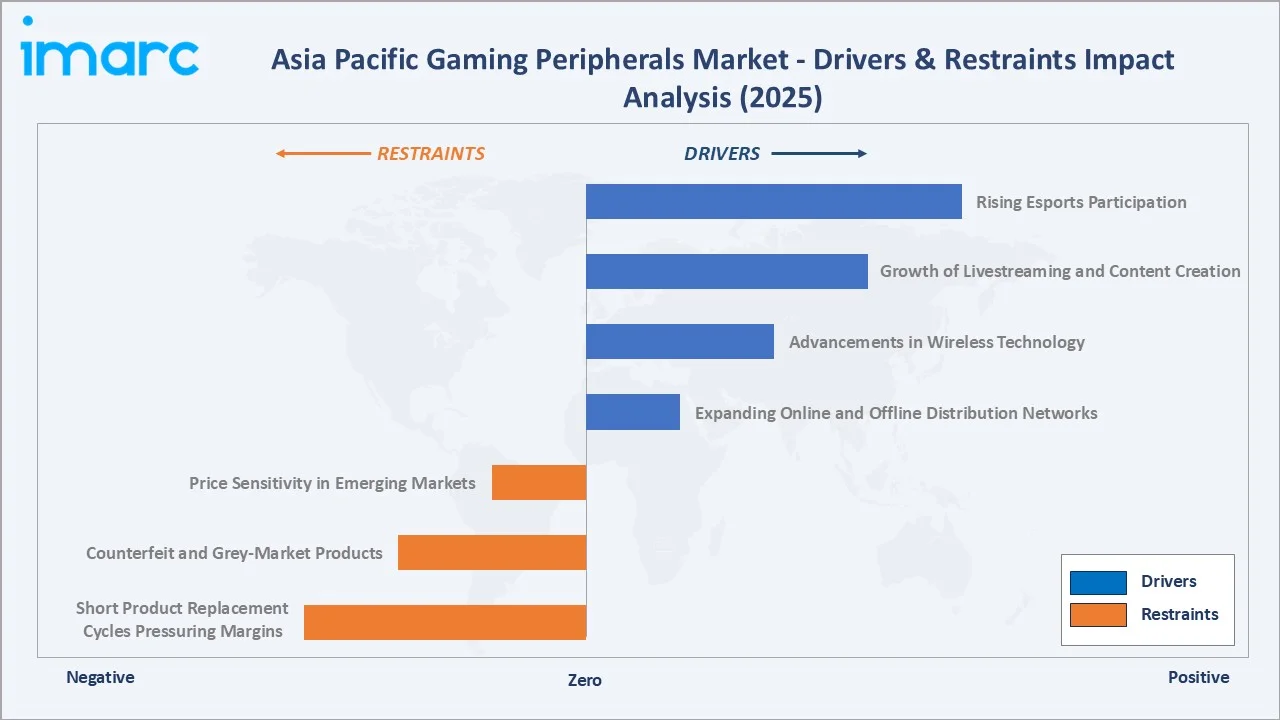
- Rising Esports Participation: The increasing number of professional gamers and esports tournaments across China, South Korea, and Japan is boosting demand for high-precision gaming peripherals. Competitive gamers require low-latency mice, mechanical keyboards, and premium headsets, driving sustained hardware upgrade cycles across the region. Regional esports prize pools and sponsorship investment have grown substantially, further incentivizing manufacturers to develop tournament-grade peripheral lines. Universities and gaming academies across South Korea and China are also formalizing esports curricula, expanding the long-term addressable base of competitive gamers.
- Growth of Livestreaming and Content Creation: Various platforms have expanded content creator ecosystems across Asia Pacific, increasing demand for high-fidelity microphones, webcams, and RGB peripherals that enhance streaming quality and production value. The proliferation of short-form gaming content on regional social platforms has further diversified the creator base beyond traditional streaming. As monetization opportunities for creators expand, reinvestment in premium peripheral setups continues to rise across both amateur and professional tiers.
- Advancements in Wireless Technology: Continuous improvements in low-latency wireless transmission are enabling gaming-grade wireless peripherals to match wired performance, encouraging a broad consumer shift toward wireless setups across both console and PC gaming segments. Manufacturers are increasingly integrating proprietary low-latency dongles and adaptive frequency-hopping technology to minimize input lag. This technological convergence is narrowing the performance gap that historically kept competitive gamers tied to wired accessories.
- Expanding Online and Offline Distribution Networks: The proliferation of e-commerce platforms alongside expanding specialty gaming retail across India, Indonesia, and Australia is improving product accessibility, driving higher peripheral sales volumes across urban and emerging markets. Regional marketplaces are increasingly offering localized payment options and faster last-mile delivery, reducing purchase friction for first-time buyers. Brand-owned flagship stores on major e-commerce platforms are also improving product authenticity assurance for consumers.
Market Restraints
- Price Sensitivity in Emerging Markets: High price points for premium wireless and mechanical peripherals limit adoption among cost-conscious consumers in markets such as India and Indonesia, favoring lower-cost wired alternatives and slowing premiumization. Currency volatility in several regional markets further amplifies the effective price gap between imported premium peripherals and domestically manufactured budget alternatives. This dynamic continues to sustain a large addressable market for value-tier and entry-level peripheral brands.
- Counterfeit and Grey-Market Products: The prevalence of counterfeit gaming peripherals across regional online marketplaces undermines brand trust, pressures margins for genuine manufacturers, and creates quality-perception challenges for the broader market. Counterfeit products often lack proper safety certifications, creating downstream liability and consumer-safety concerns for the wider industry. Enforcement inconsistency across jurisdictions makes it difficult for genuine manufacturers to fully mitigate this risk.
- Short Product Replacement Cycles Pressuring Margins: Rapid iteration in gaming peripheral technology shortens product lifecycles, compelling manufacturers to sustain continuous R&D investment while facing inventory depreciation risk on prior-generation hardware across price-sensitive regional markets. This dynamic requires manufacturers to maintain elevated marketing spend to sustain visibility for each new product generation. Smaller regional brands with limited R&D budgets are particularly exposed to margin compression from this accelerating cycle.
Market Opportunities
- Esports-Grade Peripheral Customization: Growing demand for tournament-grade, fully customizable peripherals presents an opportunity for manufacturers to develop modular hardware platforms tailored to professional and semi-professional gamers. Customizable weight systems, programmable macro layouts, and swappable switch modules are increasingly differentiating premium product lines. Manufacturers that build strong esports team partnerships can capture outsized brand visibility relative to marketing spend.
- India's Expanding PC and Mobile-to-PC Gaming Transition: India's rapidly growing base of PC gamers migrating from mobile platforms presents a substantial volume opportunity for entry-level and mid-tier peripheral manufacturers. Rising smartphone-to-PC gaming conversion, supported by falling PC hardware prices, is expanding the addressable consumer base considerably. Regional manufacturers with localized pricing strategies are well positioned to capture this emerging demand pool.
Market Challenges
- Intensifying Price Competition from Regional Manufacturers: Local and regional peripheral manufacturers are increasingly offering cost-competitive alternatives to established global brands, compressing pricing power and margins for international Tier-1 players operating across Asia Pacific markets. This has heightened competitive intensity in the mid-tier price segment where differentiation on features alone is increasingly difficult. Global brands are responding by accelerating regional manufacturing localization to maintain price competitiveness.
- Supply Chain Dependency on Semiconductor and Component Availability: Gaming peripherals increasingly rely on specialized sensors, wireless chipsets, and microcontrollers, making manufacturers vulnerable to semiconductor supply disruptions that can delay product launches and increase input costs across the value chain. Diversifying component sourcing across multiple suppliers has become a strategic priority for leading manufacturers. Extended lead times for premium optical sensors continue to constrain high-end product availability during periods of peak demand.
Emerging Market Trends
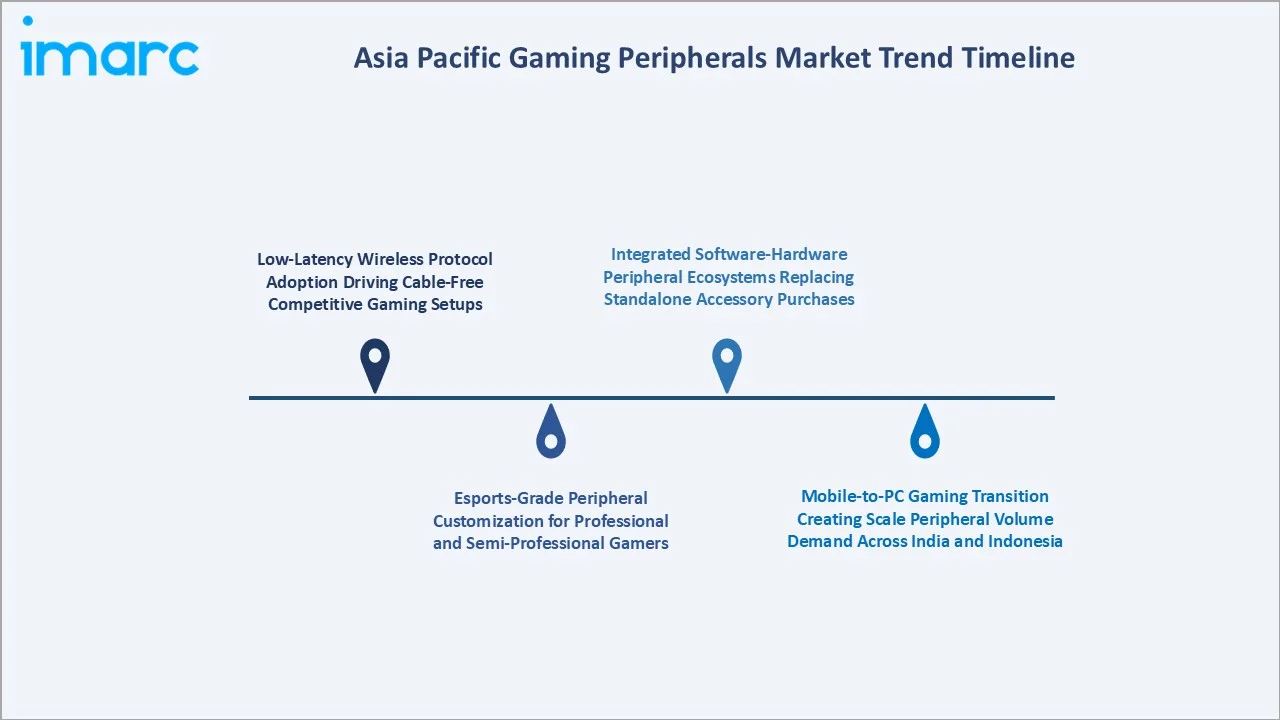
1. Low-Latency Wireless Protocol Adoption Driving Cable-Free Competitive Gaming Setups
Adoption of low-latency wireless transmission protocols enables gaming-grade peripherals to match wired-level responsiveness, eliminating the historical performance trade-off that kept competitive gamers tied to cabled setups. This is driving the integration of proprietary 2.4GHz dongles and adaptive frequency-hopping technology across premium mice, keyboards, and headsets, which reduce interference and input lag in high-density gaming environments. Improved battery efficiency and rapid-charging capabilities also support extended wireless use during long gaming and streaming sessions, increasing demand for advanced wireless peripheral technologies.
2. Esports-Grade Peripheral Customization for Professional and Semi-Professional Gamers
Esports-grade peripheral customization is emerging as tournament ecosystems mature across China, South Korea, and Japan, creating sustained demand for modular, fully adjustable hardware platforms. This design trend can enhance grip comfort, actuation precision, and player-specific performance tuning. As professional and semi-professional gamer communities continue to expand, customizable weight systems and swappable switch modules are gaining attention for competitive mice and keyboards.
3. Integrated Software-Hardware Peripheral Ecosystems Replacing Standalone Accessory Purchases
Integrated software-hardware peripheral ecosystems are emerging as brands shift from standalone accessory sales toward unified companion-app platforms covering sensitivity, lighting, and macro programming. These systems improve cross-device consistency, simplify firmware updates, and strengthen brand lock-in across a gamer's full peripheral set. As manufacturers seek recurring engagement and higher switching costs, demand is rising for suppliers offering complete integrated hardware-software ecosystems.
4. Mobile-to-PC Gaming Transition Creating Scale Peripheral Volume Demand Across India and Indonesia
Mobile-to-PC gaming transition is emerging as these markets generate high-volume entry-level peripheral demand, especially across India and Indonesia. Their rapid adoption creates large-scale sales opportunities for compact, cost-efficient gaming mice and keyboards. As manufacturers expand regional distribution, peripheral suppliers benefit from economies of scale, lower unit costs, and wider market penetration.
Industry Value Chain Analysis
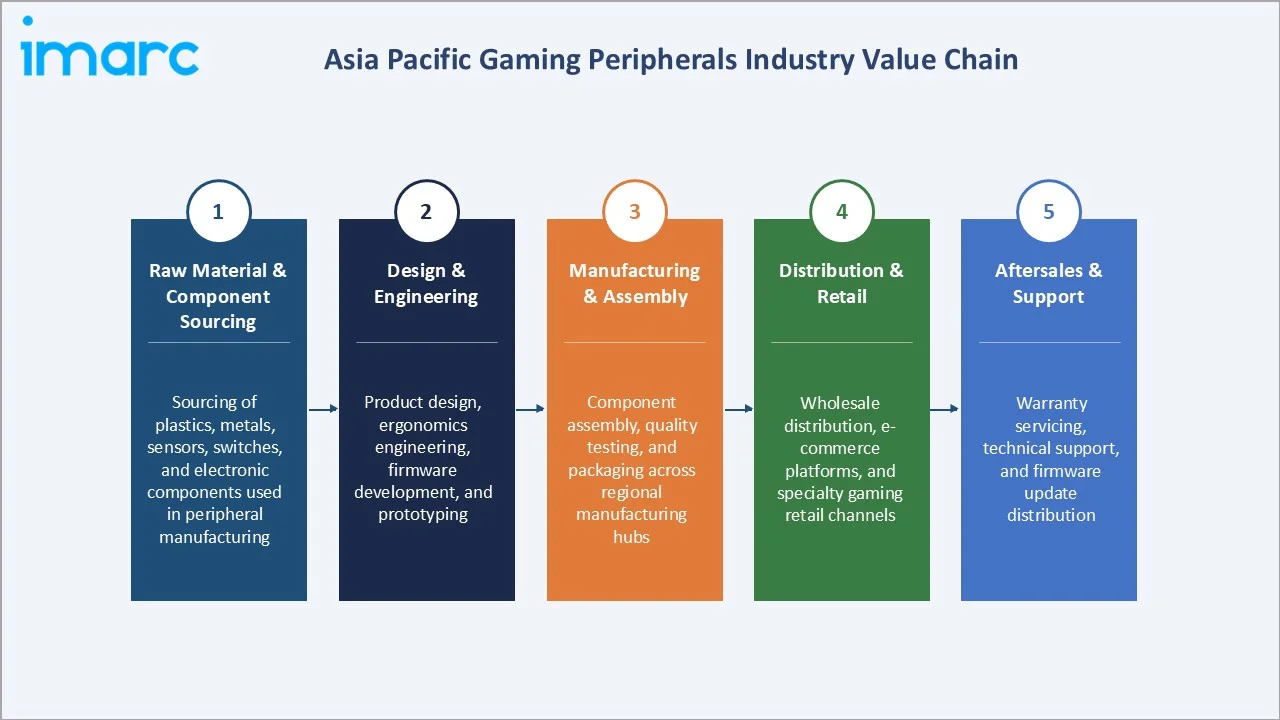
The Asia Pacific gaming peripherals value chain integrates raw material and component sourcing, product design and engineering, manufacturing and assembly, distribution and retail, and aftersales support and servicing.
|
Stage |
Key Participants |
|
Raw Material & Component Sourcing |
Sourcing of plastics, metals, sensors, switches, and electronic components used in peripheral manufacturing |
|
Design & Engineering |
Product design, ergonomics engineering, firmware development, and prototyping |
|
Manufacturing & Assembly |
Component assembly, quality testing, and packaging across regional manufacturing hubs |
|
Distribution & Retail |
Wholesale distribution, e-commerce platforms, and specialty gaming retail channels |
|
Aftersales & Support |
Warranty servicing, technical support, and firmware update distribution |
The value chain's commercial architecture continues to consolidate toward vertically integrated manufacturing and design models as leading brands seek greater control over product quality and innovation cycles.
Technology Landscape in the Asia Pacific Gaming Peripherals Industry
Low-Latency Wireless Transmission Technology
Low-latency wireless transmission technology offers high responsiveness, stable connectivity, and reduced input lag, enabling wireless peripherals to match wired-grade performance for competitive gaming applications. These solutions increasingly incorporate proprietary 2.4GHz dongles and adaptive frequency-hopping to minimize interference in high-density gaming environments. Leading manufacturers are also integrating dual-mode connectivity, allowing seamless switching between wireless and wired operation depending on battery status or competitive requirements, further broadening the appeal of wireless-first product design.
Optical and Mechanical Switch Technology
Optical and mechanical switch technologies provide durable, high-precision actuation for gaming keyboards and mice, offering faster response times and longer product lifespans compared to conventional membrane-based alternatives. Their growing adoption across mid-tier and premium product lines is enhancing overall competitive performance for regional gaming communities. Hot-swappable switch architectures are also gaining traction, allowing users to customize actuation feel and response characteristics without replacing the entire keyboard unit.
Sensor and Software Integration Technology
Advanced optical sensor technology paired with companion software platforms is enabling granular customization of sensitivity, polling rate, and macro programming across gaming mice and keyboards. This integration allows gamers to fine-tune peripheral behavior for specific game genres, from high-sensitivity first-person shooters to precision-oriented strategy titles and is increasingly viewed as a key differentiator among premium regional brands.
Market Segmentation Analysis
The report covers the following segments:
|
Segment Category |
Leading Segment |
Market Share |
Year |
|
Product Type |
🔒 |
🔒 |
2025 |
|
Gaming Device Type |
Gaming Consoles |
56.7% |
2025 |
|
Technology |
Wireless |
61.4% |
2025 |
|
Distribution Channel |
🔒 |
🔒 |
2025 |
|
Country |
China |
32.6% |
2025 |

By Gaming Device Type
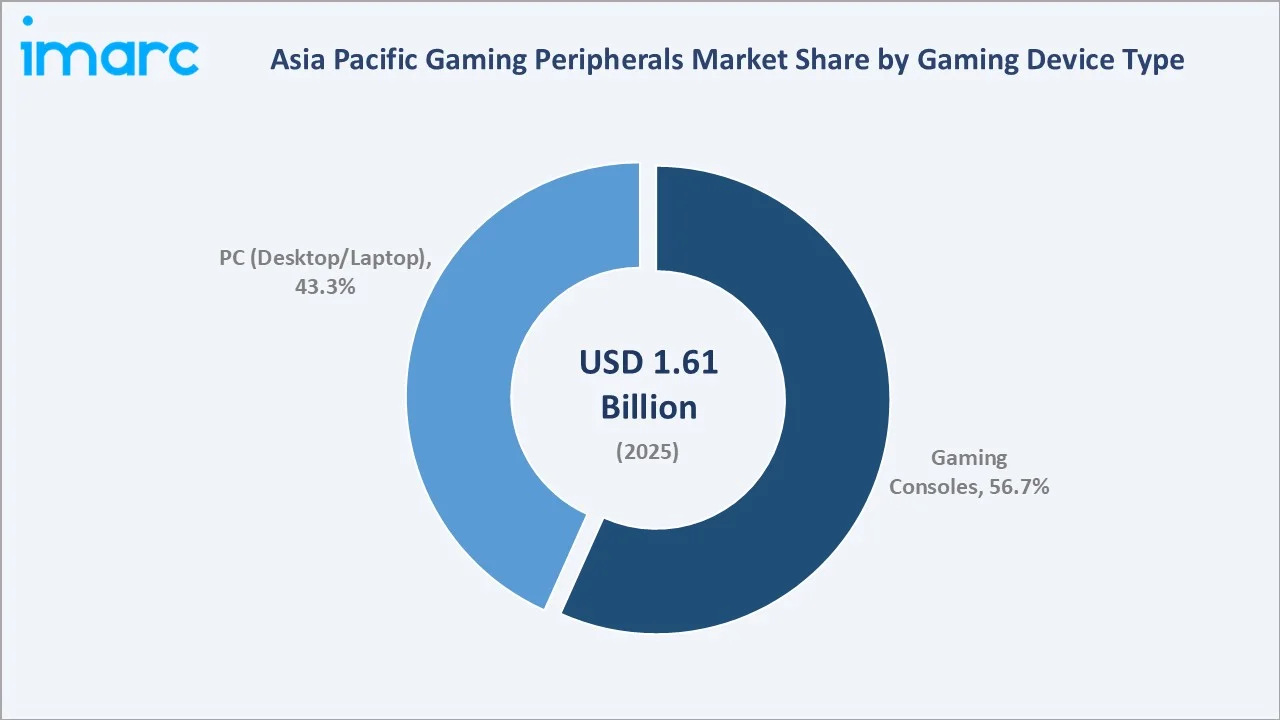
Gaming consoles lead the device type segment at 56.7% in 2025, driven by strong console penetration in Japan and South Korea and continued new title releases supporting accessory attachment rates.
To access detailed market analysis, Request Sample
PC (Desktop/Laptop) gaming holds 43.3% share, supported by China's large PC gaming café culture and India's growing base of budget gaming laptop users adopting peripherals for improved competitive performance.
By Technology
Wireless technology leads at 61.4% in 2025, reflecting the region's rapid shift toward cable-free gaming setups enabled by improved low-latency wireless protocols matching wired-grade responsiveness.
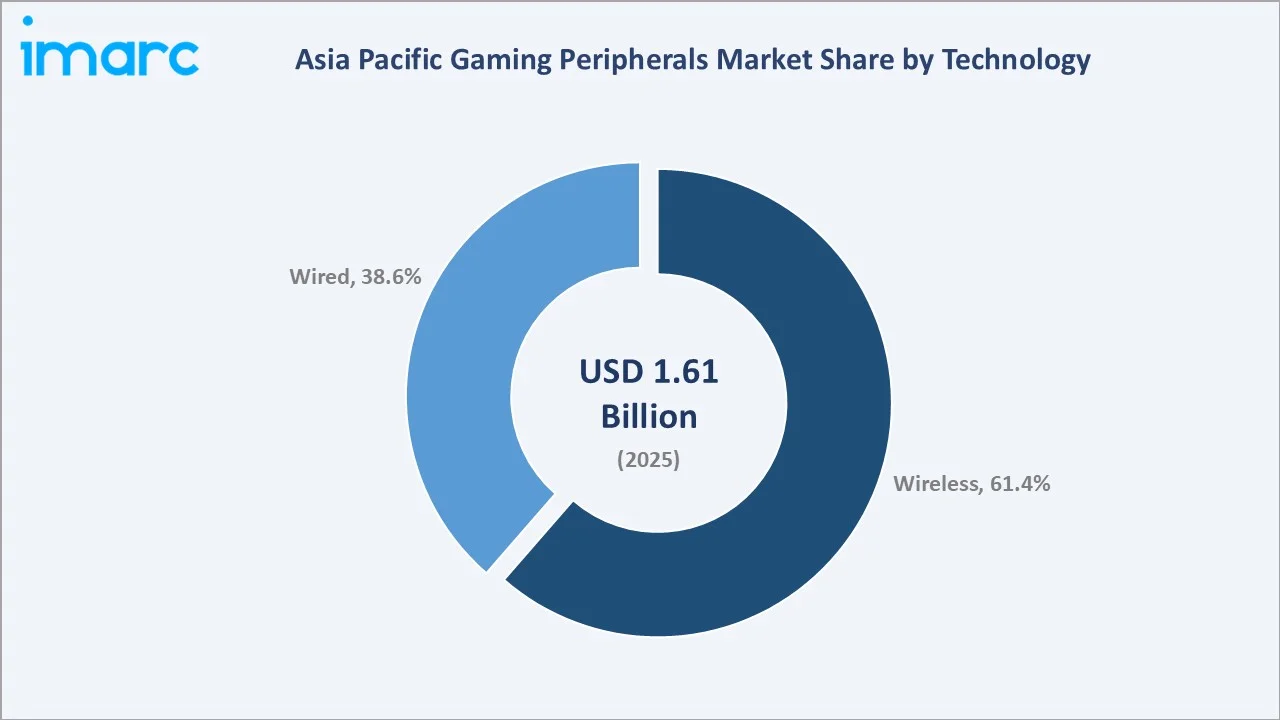
Wired peripherals retain 38.6% share, remaining the preferred choice among competitive and professional gamers who prioritize zero-latency input response for tournament-grade performance.
Regional Market Insights
|
Country |
Share (2025) |
Key Market Characteristics |
|
China |
32.6% |
Leading market driven by strong domestic manufacturing capacity, a large gaming population, and continued esports ecosystem investment |
|
Japan |
18.7% |
Driven by high console penetration, strong consumer preference for precision-engineered hardware, and mature retail infrastructure |
|
India |
16.4% |
Supported by rapid mobile-to-PC gaming transition, expanding e-commerce access, and rising disposable income |
|
South Korea |
11.8% |
Driven by mature esports culture, high per-capita gaming spend, and strong professional gaming infrastructure |
|
Australia |
8.2% |
Supported by high disposable income, strong console and PC gaming penetration, and established retail networks |
|
Indonesia |
7.6% |
Driven by rapidly expanding mobile and PC gaming adoption and growing e-commerce accessibility |
|
Others |
4.7% |
Emerging gaming markets across the wider Asia Pacific region with rising digital infrastructure investment |
China, at 32.6%, leads through its massive gaming population and robust domestic peripheral supply chain. Japan, at 18.7%, reflects console-linked accessory demand and continued technology leadership among regional manufacturers.
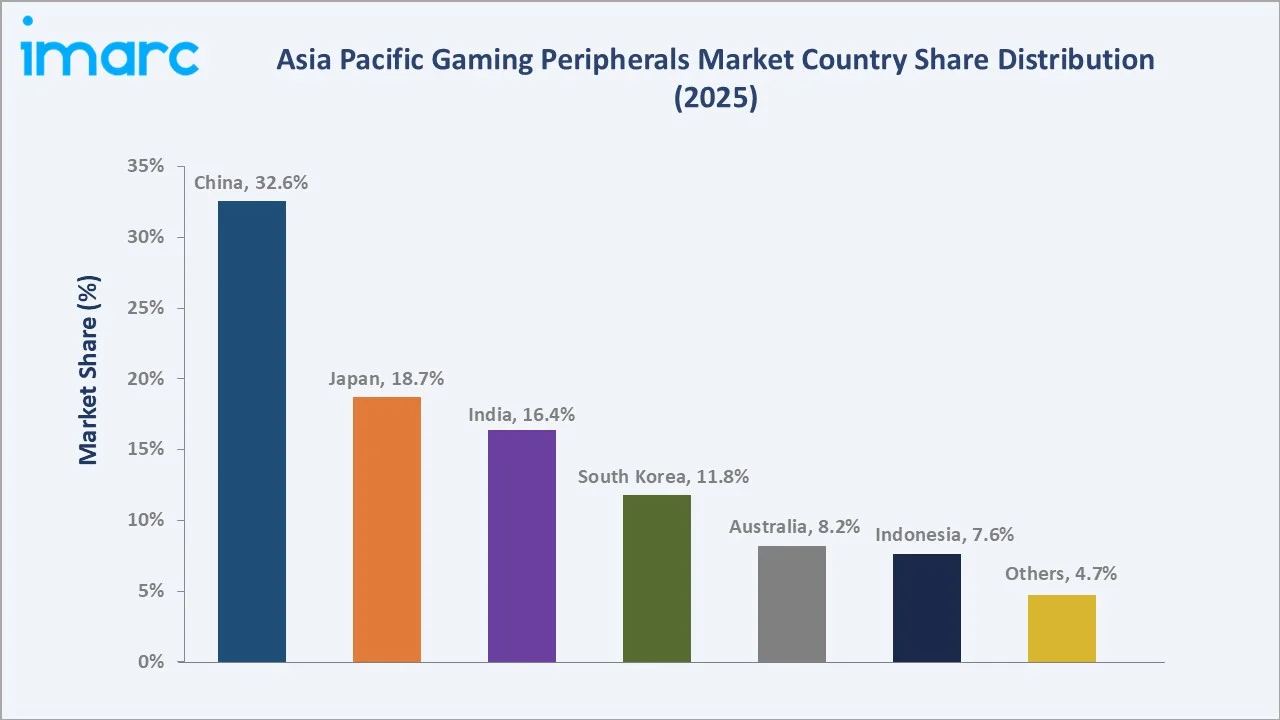
India, at 16.4%, and South Korea, at 11.8%, represent structurally important growth markets driven by mobile-to-PC gaming transition and mature esports infrastructure, respectively. Australia, Indonesia, and other regional markets collectively contribute the remaining share through steady console and PC gaming penetration.
Competitive Landscape
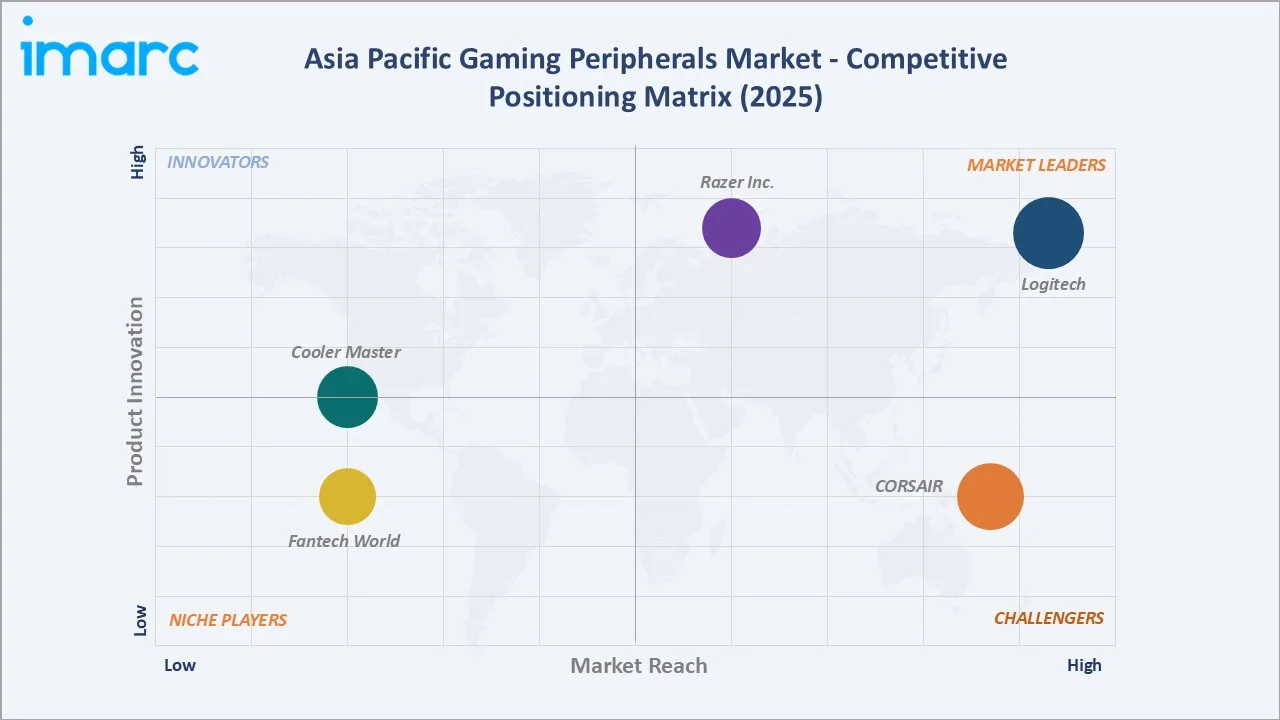
The Asia Pacific gaming peripherals market competitive landscape is moderately fragmented, comprising global brands, regional specialists, and cost-competitive local manufacturers competing across multiple product tiers and price points.
|
Company Name |
Key Products |
Market Position |
Core Strength |
|
Logitech |
Gaming Mice, Mechanical Keyboards, Wireless Headsets |
Market Leader |
Global leader in gaming mice, keyboards, and headsets with strong regional distribution |
|
CORSAIR |
Mechanical Keyboards, Gaming Mice, Gaming Headsets |
Strong Challenger |
Premium mechanical keyboards and high-performance gaming peripherals |
|
Razer Inc. |
Gaming Mice, Mechanical Keyboards, Gaming Headsets |
Market Leader |
Esports-focused peripherals with strong brand recognition among competitive gamers |
|
Cooler Master |
Gaming Keyboards, Mice, Cooling-Integrated Gear |
Established Player |
Diverse peripheral portfolio spanning keyboards, mice, and cooling-integrated gaming gear |
|
Fantech World |
Keyboards, Headsets, Mice, Speaker |
Niche Player |
Cost-competitive gaming gear with strong regional penetration across Indonesia, Malaysia, and the Philippines |
Key players include Logitech, CORSAIR, Razer Inc., Cooler Master, Fantech World, and others.
Key Company Profiles
Logitech
Logitech is a global leader in computer peripherals with an extensive gaming portfolio spanning mice, keyboards, and headsets sold across Asia Pacific through both online and offline retail channels.
- Key Products: Gaming Mice, Mechanical Keyboards, Wireless Headsets.
- Recent Developments: In May 2025, Logitech G, the gaming brand of Logitech, announced the launch of the G522 Gaming Headset. The G522 features redesigned ear cups with additional memory foam cushioning and a softer, more durable fabric. Its reversible suspension headband is designed to distribute pressure more evenly and improve breathability during extended gaming sessions. Logitech also states that its player-fit testing included users who wear glasses and earrings.
- Strategic Focus: Expanding low-latency wireless gaming peripheral lineups tailored to esports and competitive gaming audiences across the region. The company continues to deepen partnerships with regional esports organizations to strengthen brand visibility among professional gaming communities. It is also investing in localized manufacturing and distribution to improve cost competitiveness against regional players.
CORSAIR
CORSAIR is a US-based gaming hardware company with a strong presence in the premium peripherals segment, offering mechanical keyboards, mice, and headsets targeted at performance-focused gamers.
- Key Products: Mechanical Keyboards, Gaming Mice, Gaming Headsets.
- Recent Developments: In April 2024, CORSAIR announced the launch of its HS35 v2 and HS35 SURROUND v2 gaming headsets, expanding its gaming audio portfolio with products designed to deliver enhanced sound across multiple gaming platforms. Both models feature custom-tuned 50mm neodymium drivers and universal 3.5mm connectivity, enabling compatibility with PC, PlayStation, Xbox, Nintendo Switch, and other devices.
- Strategic Focus: Strengthening its wireless product range and expanding distribution across China, Japan, and South Korea's premium gaming segments. The company is prioritizing partnerships with regional retailers to improve product availability and after-sales support. Continued investment in proprietary low-latency wireless technology remains central to its competitive positioning.
Market Concentration Analysis
The Asia Pacific gaming peripherals market is moderately fragmented, with the key players collectively accounting for a meaningful share of premium and mid-tier segment revenue. Regional and local manufacturers account for a substantial share of entry-level and value-tier volume, particularly across India and Indonesia. Market concentration is expected to remain broadly stable over the forecast period as regional manufacturers continue to gain share in price-sensitive segments while global brands retain leadership in the premium and esports-grade product tiers. Continued brand investment in esports sponsorships and community engagement is likely to reinforce the position of established players within the premium segment, even as new entrants target underserved price points across emerging Southeast Asian markets.
Investment & Growth Opportunities
Highest Growth Segments
Wireless technology peripherals (~8.9% CAGR), gaming console accessories (~8.1% CAGR), esports-grade premium peripherals, and India's expanding PC gaming base represent the highest-growth investment vectors through 2034.
Emerging Investment Opportunities
Esports-grade customizable peripherals represent the market's highest per-unit-value emerging opportunity, as tournament-grade mice, keyboards, and headsets command significant price premiums over standard consumer-grade equivalents, with regional esports ecosystem expansion creating a structurally growing demand pool through 2034.
Future Market Outlook (2026-2034)
The Asia Pacific gaming peripherals market is projected to grow from USD 1.61 Billion in 2025 to USD 1.76 Billion in 2026, reaching USD 3.14 Billion by 2034, delivering a 7.49% CAGR over the forecast period. The market's anchor value of USD 2.30 Billion in 2030 represents an inflection point at which wireless technology is expected to have become the dominant specification across mid-tier and premium product segments, India's PC gaming transition will have reached greater scale, and esports-grade peripheral customization will have achieved wider mainstream adoption across the region's leading gaming economies.
Two structural forces define market growth through 2034 with strong confidence. The region's compounding esports and livestreaming ecosystem creates a self-reinforcing demand cycle where content creation investment begets audience growth, which begets further peripheral demand. The mobile-to-PC gaming transition across India and Indonesia creates an additive demand pool above the already substantial console and PC gaming peripheral base across China, Japan, and South Korea.
Research Methodology
Primary Research
Primary research comprised structured interviews with industry stakeholders, including product managers, regional distribution partners, esports industry representatives, and retail channel executives across China, Japan, India, and South Korea.
Secondary Research
Secondary research encompassed company annual reports, regional esports industry association data, e-commerce platform sales trend reports, and gaming hardware industry publications covering the Asia Pacific region.
Forecasting Models
Market revenue forecasts were developed using a bottom-up model incorporating regional gaming population estimates, average peripheral spend per gamer by device type and technology, and premiumization trend adjustments across the historical and forecast periods.
Report Coverage:
| Report Features | Details |
|---|---|
| Base Year of the Analysis | 2025 |
| Historical Period | 2020-2025 |
| Forecast Period | 2026-2034 |
| Units | Billion USD |
| Scope of the Report | Exploration of Historical Trends and Market Outlook, Industry Catalysts and Challenges, Segment-Wise Historical and Future Market Assessment:
|
| Product Types Covered | Headsets, Keyboards, Joysticks, Mice, Gamepads, Others |
| Gaming Device Types Covered | PC (Desktop/Laptop), Gaming Consoles |
| Technologies Covered | Wired, Wireless |
| Distribution Channels Covered | Online, Offline |
| Countries Covered | China, Japan, India, South Korea, Australia, Indonesia, Others |
| Companies Covered | Logitech, CORSAIR, Razer Inc., Cooler Master, Fantech World, etc. |
| Customization Scope | 10% Free Customization |
| Post-Sale Analyst Support | 10-12 Weeks |
| Delivery Format | PDF and Excel through Email (We can also provide the editable version of the report in PPT/Word format on special request) |
Frequently Asked Questions About the Asia Pacific Gaming Peripherals Market Report
The Asia Pacific gaming peripherals market size is estimated at USD 1.76 Billion in 2026, driven by the gaming console segment dominant at 56.7%, wireless technology leading at 61.4%, and China commanding the largest country share at 32.6% through its large gaming population and strong domestic manufacturing base.
The market grows at a 7.49% CAGR during 2026-2034, reaching USD 3.14 Billion by 2034. This growth reflects rising esports participation, expanding livestreaming and content creation ecosystems, and continued wireless technology adoption across the region.
Gaming consoles lead at 56.7% share, driven by strong console penetration in Japan and South Korea. This segment grows at approximately 8.1% CAGR through continued first-party title investment and expanding accessory attachment rates.
Wireless technology leads at 61.4% through consumer demand for clutter-free, high-performance setups, creating sustained procurement expansion. Wireless grows fastest at approximately 8.9% CAGR through continued low-latency transmission technology advancement.
China leads at 32.6% through its massive gaming population, strong domestic peripheral manufacturing base, and thriving esports and livestreaming ecosystem.
Leading companies include Logitech, CORSAIR, Razer Inc., Cooler Master, Fantech World, and others.
The market is projected to reach approximately USD 2.30 Billion by 2030, with wireless technology becoming the dominant specification across mid-tier and premium peripheral segments and esports-grade customization achieving wider mainstream adoption.
Priority investment opportunities include esports-grade customizable peripheral development, wireless low-latency technology innovation, and expansion into India's rapidly growing mobile-to-PC gaming transition market.
Need more help?
- Speak to our experienced analysts for insights on the current market scenarios.
- Include additional segments and countries to customize the report as per your requirement.
- Gain an unparalleled competitive advantage in your domain by understanding how to utilize the report and positively impacting your operations and revenue.
- For further assistance, please connect with our analysts.
 Request Customization
 Speak to an Analyst
 Request Brochure
 Inquire Before Buying
Benefits of Customization
- Personalize this research
- Triangulate with your data
- Get data as per your format and definition
- Gain a deeper dive into a specific application, geography, customer, or competitor
- Any level of personalization
Get in Touch With Us
UNITED STATES
Phone: +1-201-971-6302
INDIA
Phone: +91-120-433-0800
UNITED KINGDOM
Phone: +44-753-714-6104
Email: [email protected]
Client Testimonials




.webp)




.webp)













Related Reports

Choose your plan
*Please note that the prices mentioned below are starting prices for each bundle type. Kindly contact our team for further details.*
Single User License
- 1 User License, Access on 2 Devices
- PDF Report + Excel Dataset (Password Protected)
- Lifetime Access
- No Printing Rights
- 10% Free Report Customization
- 10–12 Weeks of Analyst Support
Five User License
- Access for 5 Users, 2 Devices per User
- PDF Report + Excel Dataset (Password Protected)
- Lifetime Access
- Dedicated Account Manager
- 12–14 Weeks of Analyst Support
- No Printing Rights
- 15% Free Report Customization
- 25% Discount on Your Next Purchase
Corporate User License
- Unlimited User Access (Within Your Organization)
- PDF Report + Excel Dataset
- Lifetime Access
- Dedicated Account Manager
- 14–20 Weeks of Analyst Support
- No Printing Rights
- 20% Free Report Customization
- 30% Discount on Your Next Purchase
Essential Insights
What's included:
3 reports
- Lifetime Access
- PDF Reports
- Excel Datasets
- 2 Weeks of Free Analyst Support
- 2 User Licenses
- Access on 2 Devices
- Printing Rights
- Complimentary PowerPoint (PPT) Version
- Complimentary License Upgrade
Professional Access
What's included:
5 reports
- Lifetime Access
- PDF Reports
- Excel Datasets
- 8 Weeks of Free Analyst Support
- 2 User Licenses
- Access on 2 Devices
- Printing Rights
- Complimentary PowerPoint (PPT) Version
- Complimentary License Upgrade
Business Advantage
What's included:
8 reports
- Lifetime Access
- PDF Reports
- Excel Datasets
- 14 Weeks of Free Analyst Support
- 2 User Licenses
- Access on 2 Devices
- Printing Rights
- Complimentary PowerPoint (PPT) Version
- Complimentary License Upgrade
Enterprise Intelligence
What's included:
10 reports
- Lifetime Access
- PDF Reports
- Excel Datasets
- 20 Weeks of Free Analyst Support
- 2 User Licenses
- Access on 2 Devices
- Printing Rights
- Complimentary PowerPoint (PPT) Version
- Complimentary License Upgrade