
Brazil Courier Express and Parcel Market Size, Share, Trends and Forecast by Service Type, Destination, Type, End-Use Sector, and Region, 2026-2034
Brazil Courier Express and Parcel Market Summary:
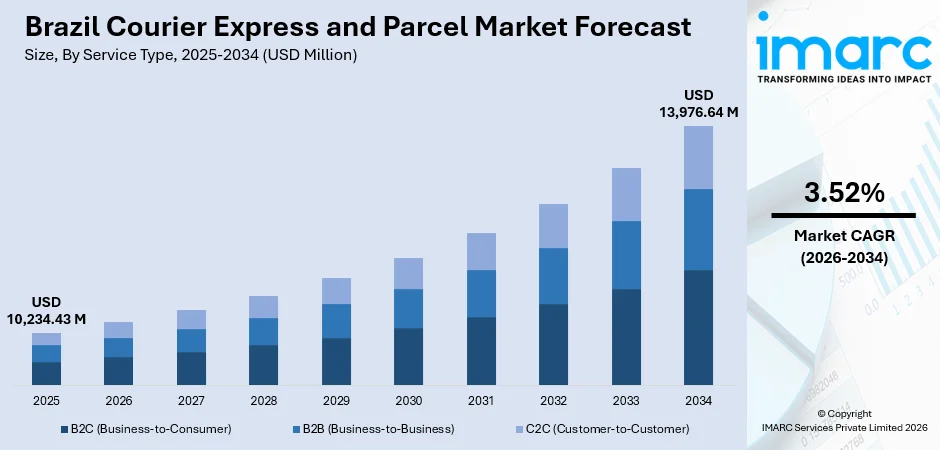
The Brazil courier express and parcel market size was valued at USD 10,234.43 Million in 2025 and is projected to reach USD 13,976.64 Million by 2034, growing at a compound annual growth rate of 3.52% from 2026-2034.
The market is registering steady growth due to the growth in e-commerce, the rise in consumer demands for faster delivery, and the development of digital payment systems. Urbanization, the adoption of omnichannel retail, and the development of road and air transport connectivity are enhancing the efficiency of parcel flows. Development in fulfillment infrastructure, route optimization solutions, and last-mile delivery solutions are further enhancing operational capabilities, contributing to the expansion of Brazil courier express and parcel market share.
Key Takeaways and Insights:
- By Service Type: B2C (business-to-consumer) dominates the market with 48.6% revenue share in 2025, driven by the growth in direct-to-consumer e-commerce deliveries and the increasing demand for convenient doorstep parcel delivery services in the urban and suburban areas.
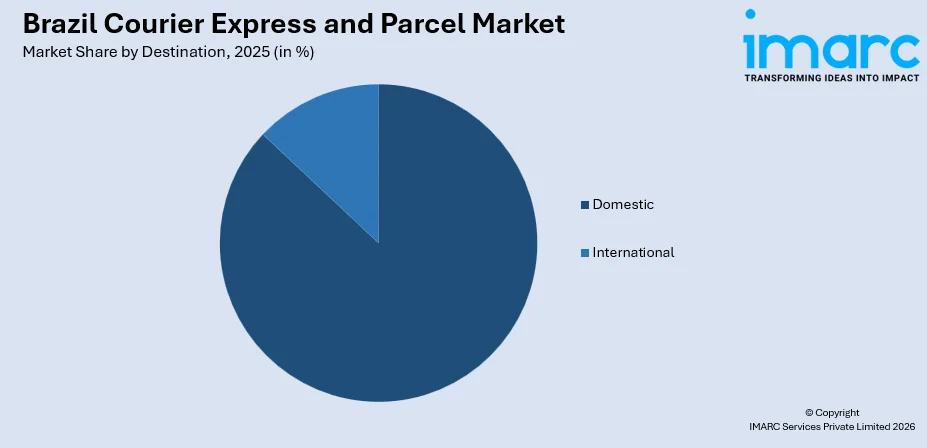
- By Destination: Domestic shipments lead the market with a share of 86.9% in 2025, reflecting the high volume of domestic parcel flows driven by the growth in online retailing platforms and the enhanced connectivity of logistics networks across the country.
- By Type: Road holds the largest share at 61.4% in 2025, underpinned by extensive highway networks and affordable trucking solutions that enable the vast majority of parcel deliveries.
- By End-Use Sector: Wholesale and retail trade (e-commerce) accounts for the highest revenue share of 52.7% in 2025, propelled by the rapid adoption of digital commerce, the growth of marketplaces, and the evolving preference for online shopping and home delivery.
- By Region: Southeast represents the largest segment with a 45.3% market share in 2025, due to the presence of key economic centers, sophisticated logistics infrastructure, and the highest population density to support strong parcel demand.
- Key Players: The Brazil courier express and parcel market is characterized by a competitive environment with the presence of postal players, global logistics companies, and new technology-based delivery services competing for market share through infrastructure development, diversification of services, and operational efficiencies.
To get more information on this market Request Sample
The Brazil courier express and parcel market is moving forward as the growing digital e-commerce penetration, changing consumer purchasing behavior, and developing logistics infrastructure are transforming the parcel delivery industry. One of the key drivers propelling the Brazil courier express and parcel market is the country’s growing e-commerce industry, fueled by the widespread adoption of smartphones, digital instant payment systems, and consumers’ increasing acceptance of online transactions. The Brazilian government’s initiatives to upgrade infrastructure, such as the development of multimodal corridors and ports, are also enhancing freight connectivity and eliminating transit-related inefficiencies. For example, the Novo PAC initiative has invested heavily in infrastructure projects related to road, rail, and water transport infrastructure development to enhance logistics efficiency in unserved areas. Increasing investments in automated sorting facilities, electric delivery vehicles, and AI-based route optimization solutions are improving delivery speed and efficiency, while omnichannel retailing and micro-fulfillment centers are lowering last-mile delivery costs and paving the way for market expansion.
Brazil Courier Express and Parcel Market Trends:
Increasing Adoption of Same-Day and Express Delivery Services
The growing consumer demand for fast delivery is also driving the adoption of same-day and express parcel delivery services in large cities. Micro-fulfillment centers and dark stores are being located closer to cities to hold fast-moving items and reduce last-mile distances. In 2026, Tata Consultancy Services (TCS) announced plans to establish its largest delivery center in Londrina, Brazil, with initial investment of USD 37 million. The delivery center campus is expected to be completed by 2027 and will create more than 1,600 new jobs. The new delivery center will serve as an important hub that will help support clients across different industries in Brazil and the Latin America region. Dynamic route optimization and time-slot delivery options are making it possible for companies to address the increased speed requirement while containing costs.
Growing Integration of Digital and Automation Technologies
Logistics companies in Brazil are quickly embracing digital technology and automation solutions to enhance sorting capacity, visibility, and route optimization. AI-powered delivery management platforms, automated parcel sorting systems, and real-time tracking interfaces are becoming the norm in major logistics companies. The Brazil e-commerce logistics automation market was estimated at USD 12,037.21 Million in 2025, which is indicative of the extent of technology adoption that is revolutionizing the logistics industry. The technology adoption is resulting in fewer errors in delivery, faster delivery times, and the ability to manage higher parcel volumes.
Rapid E-Commerce-Driven Parcel Volume Expansion
The Brazilian e-commerce market is experiencing a dramatic increase in parcel volume as the penetration of online shopping continues to grow in tier-one and tier-two cities. The adoption of mobile-first shopping behavior, instant payments via Pix, and social commerce is expanding the customer base and driving repeat business. Online sales in Brazil increased dramatically in the first half of 2024, reaching about BRL 160.3 billion, according to the Brazilian E-Commerce Association. This trend is forcing the logistics industry to upgrade fulfillment infrastructure and reduce delivery times, driving the growth of the Brazilian courier express and parcel market.
Market Outlook 2026-2034:
The Brazil courier express and parcel market is poised for steady expansion, supported by continued e-commerce growth, improving logistics infrastructure, and rising consumer expectations for faster and more flexible delivery solutions. The market generated a revenue of USD 10,234.43 Million in 2025 and is projected to reach a revenue of USD 13,976.64 Million by 2034, growing at a compound annual growth rate of 3.52% from 2026-2034. Government-led infrastructure modernization programs, expanding multimodal connectivity, and investment in automated fulfillment technologies are expected to drive greater operational efficiency and service quality. Growing adoption of electric delivery vehicles, green logistics initiatives, and digital payment integration will further support market maturation, creating a more resilient and competitive parcel delivery landscape across the country.
Brazil Courier Express and Parcel Market Report Segmentation:
|
Segment Category |
Leading Segment |
Market Share |
|
Service Type |
B2C (Business-to-Consumer) |
48.6% |
|
Destination |
Domestic |
86.9% |
|
Type |
Road |
61.4% |
|
End-Use Sector |
Wholesale and Retail E-commerce |
52.7% |
|
Region |
Southeast |
45.3% |
Service Type Insights:
- B2B (Business-to-Business)
- B2C (Business-to-Consumer)
- C2C (Customer-to-Customer)
B2C (business-to-consumer) dominates the market with a revenue share of 48.6% of the total Brazil courier express and parcel market in 2025.
The B2C market is the major revenue-generating segment in the courier, express, and parcel industry in Brazil, due to the fast growth of direct online e-commerce between consumers and retailers. The increasing number of internet and smartphone users, along with the adoption of instant digital payment services, has completely changed the way consumers shop. In addition, the trend among online marketplaces and online retailers to use parcel delivery networks for the delivery of goods is also contributing to the high B2C parcel volumes in urban and rural regions.
The transition towards home delivery rather than in-store pickup, driven by convenience-driven shopping behavior and flexible return policies, is also set to sustain the dominance of the B2C market. Omnichannel retailing approaches, which use physical stores as mini-distribution centers, are also making way for faster delivery and expanding the reach of delivery services. Besides, social commerce on messaging and social media platforms is also expanding the online shopping base, thereby adding to the parcel demand.
Destination Insights:
Access the comprehensive market breakdown Request Sample
- Domestic
- International
Domestic shipments lead the market with a share of 86.9% of the total Brazil courier express and parcel market in 2025.
The domestic market represents the predominant share of parcel traffic in Brazil, which is a natural consequence of the country’s trade flows and the development of domestic e-commerce platforms. The high population density in large cities, as well as the growing use of e-commerce in secondary and interior regions, ensures a stable demand for domestic parcel delivery services. The country’s logistics infrastructure is well-developed and relies on road transport for delivery.
The extension of fulfillment infrastructure into new, previously underserved areas, such as the Northeast and Central-West regions, is extending the domestic delivery footprint and shrinking delivery times for inland parcels. Parcel lockers and partner locations are proving to be attractive, lower-cost alternatives to traditional door delivery, which can mitigate failed delivery issues and enhance first-pass success rates. Such trends are solidifying the domestic market leadership position.
Type Insights:
- Air
- Ship
- Subway
- Road
Road transport is the largest segment, accounting for 61.4% of the total Brazil courier express and parcel market in 2025.
The parcel delivery market in Brazil is dominated by road transport due to the country's well-developed road network and the economic viability of road transport, whether for short-distance transport in urban areas or long-distance transport between cities. The adaptability of road logistics makes it possible to deliver parcels to a large number of destinations, including large cities and rural municipalities. Upgrades in road logistics are improving efficiency.
Notwithstanding the infrastructure difficulties faced in some areas, such as the lack of paved roads in the northern territories, road transport remains the mainstay of parcel delivery. Government efforts to invest in the expansion of highways, the construction of bridges, and the development of multimodal corridors are continually enhancing connectivity. The use of electric and alternative-fuel delivery vans in urban areas is helping to support sustainability plans while ensuring that cost competitiveness is maintained.
End-Use Sector Insights:
- Services (BFSI- Banking, Financial Services and Insurance)
- Wholesale and Retail Trade (E-commerce)
- Manufacturing, Construction and Utilities
- Others
Wholesale and retail e-commerce holds the largest share at 52.7% of the total Brazil courier express and parcel market in 2025.
The wholesale and retail e-commerce sector is the dominant end-use driver of Brazil's courier, express, and parcel market, reflecting the rapid shift toward digital commerce across consumer and business segments. Marketplace platforms and independent online retailers generate the highest volumes of parcel shipments, with categories spanning electronics, fashion, beauty, food and beverages, and household goods. The proliferation of promotional shopping events throughout the year sustains elevated order volumes and delivery demand.
Free shipping incentives, lower delivery thresholds, and subscription-based loyalty programs offered by leading platforms are driving higher purchase frequency and expanding the addressable consumer base. Fulfillment strategies that combine centralized warehousing with decentralized micro-fulfillment and store-based shipping models enable faster delivery promises while managing logistics costs. The integration of instant payment solutions and conversational commerce through messaging platforms is further accelerating e-commerce parcel generation.
Regional Insights:
- Southeast
- South
- Northeast
- North
- Central-West
The Southeast region accounts for the highest revenue share of 45.3% of the total Brazil courier express and parcel market in 2025.
The Southeast region commands the largest share of Brazil's courier, express, and parcel market, anchored by the economic powerhouses of São Paulo and Rio de Janeiro. The region benefits from superior logistics infrastructure, the highest concentration of fulfillment centers and distribution hubs, and the most extensive road and air transport connectivity. High population density and elevated internet penetration translate into robust e-commerce activity that generates significant B2C parcel volumes.
Advanced last-mile delivery networks, including automated sorting facilities, parcel locker systems, and electric vehicle fleets, are most developed in the Southeast, enabling same-day and next-day delivery at scale. The region also serves as the primary gateway for international parcel flows, with major air cargo hubs processing cross-border e-commerce shipments. Continued investment in urban fulfillment infrastructure and technology integration is reinforcing the Southeast's dominant position in the national market.
Market Dynamics:
Growth Drivers:
Why is the Brazil Courier Express and Parcel Market Growing?
Expanding E-Commerce Ecosystem and Digital Consumer Adoption
The rapid expansion of digital commerce in Brazil is one of the most significant drivers of growth in the courier, express, and parcel market. Rising smartphone penetration, increasing internet connectivity in previously underserved regions, and the deepening adoption of instant digital payment platforms are collectively expanding the online shopper base. Consumers across income segments are increasingly shifting purchasing habits toward online channels, generating higher volumes of parcel shipments that require efficient last-mile delivery. The proliferation of marketplace platforms, independent online retailers, and social commerce channels is diversifying order flows and creating sustained demand for delivery services. IMARC Group predicts that the Brazil e-commerce market is projected to attain USD 1,501.8 Billion by 2034.
Government-Led Infrastructure Modernization and Logistics Investment
Federal and state-level infrastructure investment programs are playing a pivotal role in strengthening logistics connectivity across Brazil. Highway expansion, multimodal corridor development, port modernization, and railway construction initiatives are reducing freight bottlenecks and improving transit efficiency between major production centers and consumption hubs. Road network improvements in interior and underserved regions are enabling courier operators to extend service coverage and reduce delivery timelines. Investments in airport infrastructure and air cargo capacity are also enhancing express delivery capabilities for time-sensitive shipments. These infrastructure advancements are creating a more integrated and reliable national logistics framework that directly supports higher parcel throughput, faster transit times, and broader delivery coverage across the country. According to data from the Ministry of Transport, rail freight transport in Brazil hit a record 555.48 million metric tons in 2025, representing a 2.57% rise from 2024. The volumes represent goods transported through the nation's rail system for both local distribution and global commerce. In 2026, the government aims to conduct eight rail auctions, anticipating investments of 140 billion reais ($27.7 billion). Total sector investments are projected to arrive at 600 billion reais eventually.
Rising Consumer Expectations for Speed and Convenience
Evolving consumer expectations regarding delivery speed, flexibility, and convenience are driving structural changes in the courier, express, and parcel market. Urban consumers increasingly demand same-day and next-day delivery options, compelling logistics providers to invest in micro-fulfillment infrastructure, dynamic route optimization, and flexible delivery scheduling. The desire for real-time shipment visibility, multiple delivery attempt options, and convenient collection alternatives such as parcel lockers and partner pickup points is reshaping service models. These expectations are pushing operators to adopt technology-driven solutions that enhance the end-to-end delivery experience. As competitive pressures intensify among e-commerce platforms to offer superior fulfillment promises, the downstream effect on courier and parcel service demand remains a powerful growth catalyst.
Market Restraints:
What Challenges the Brazil Courier Express and Parcel Market is Facing?
Inadequate Road Infrastructure in Remote and Interior Regions
Despite significant investment in logistics modernization, vast portions of Brazil's interior and northern territories continue to suffer from limited paved road coverage and inadequate transport infrastructure. Poor road conditions increase vehicle maintenance costs, extend transit times, and reduce delivery reliability. These challenges make it difficult for courier operators to offer consistent service quality outside major urban corridors, limiting market penetration in regions with growing but underserved consumer demand.
Volatile Fuel Costs and Complex Taxation
Fluctuating fuel prices represent a persistent challenge for road-dependent parcel delivery operations in Brazil. Rising diesel costs directly inflate last-mile and long-haul transport expenses, squeezing operator margins and complicating pricing strategies. Additionally, the complexity of interstate taxation, including varying state-level tax rates on freight services, creates administrative burdens and pricing disparities that hinder efficient cross-regional parcel movement and add operational friction for logistics providers managing nationwide delivery networks.
Last-Mile Delivery Challenges in Dense Urban Areas
Major Brazilian cities face severe traffic congestion, restricted vehicle access zones, and complex addressing systems that significantly complicate last-mile parcel delivery. Low average delivery speeds in metropolitan areas inflate labor and fuel costs per stop, while high rates of failed first delivery attempts add reverse logistics expenses. Security concerns in certain neighborhoods also increase operational risk and insurance costs, requiring additional safety protocols that further constrain delivery efficiency and profitability in urban environments.
Competitive Landscape:
The Brazil courier express and parcel market exhibits a moderately consolidated competitive structure, with established national postal operators and international logistics providers holding significant market presence alongside a growing tier of technology-driven delivery startups and regional carriers. Competition is intensifying as operators invest in expanding fulfillment center networks, upgrading automated sorting capabilities, and deploying advanced route optimization technologies to capture rising parcel volumes. Service differentiation through express delivery options, flexible time-slot scheduling, and real-time tracking visibility has become a critical competitive lever. Strategic partnerships between e-commerce platforms and logistics providers are reshaping market dynamics, as integrated fulfillment ecosystems enable faster delivery promises and lower shipping costs. Consolidation activity, including acquisitions of regional delivery specialists, is accelerating as larger players seek to fill geographic coverage gaps and strengthen service portfolios across both domestic and cross-border parcel segments.
Recent Developments:
- In November 2025, CEVA Logistics, an international frontrunner in third-party logistics, has opened a new Amazon fulfilment hub in Santa Maria, Federal District, Brazil. Situated approximately 30 kilometers from the capital city, Brasilia, the facility enhances the area’s role as an important logistics center in central-west Brazil. The new 67,000 m² fulfillment center will handle up to 135,000 packages each day, aiding Amazon Brazil in efficiently and dependably delivering to its customers.
Brazil Courier Express and Parcel Market Report Coverage:
|
Report Features |
Details |
|
Base Year of the Analysis |
2025 |
|
Historical Period |
2020-2025 |
|
Forecast Period |
2026-2034 |
|
Units |
USD Million |
|
Scope of the Report |
Exploration of Historical Trends and Market Outlook, Industry Catalysts and Challenges, Segment-Wise Historical and Future Market Assessment:
|
|
Service Types Covered |
B2B (Business-to-Business), B2C (Business-to-Consumer), C2C (Customer-to-Customer) |
|
Destinations Covered |
Domestic, International |
|
Types Covered |
Air, Ship, Subway, Road |
|
End-Use Sectors Covered |
Services (BFSI- Banking, Financial Services and Insurance), Wholesale and Retail Trade (E-commerce), Manufacturing, Construction and Utilities, Others |
|
Regions Covered |
Southeast, South, Northeast, North, Central-West |
|
Customization Scope |
10% Free Customization |
|
Post-Sale Analyst Support |
10-12 Weeks |
|
Delivery Format |
PDF and Excel through Email (We can also provide the editable version of the report in PPT/Word format on special request) |
Frequently Asked Questions About the Brazil Courier Express and Parcel Market Report
The Brazil courier express and parcel market size was valued at USD 10,234.43 Million in 2025.
The market is expected to grow at a compound annual growth rate of 3.52% from 2026-2034 to reach USD 13,976.64 Million by 2034.
B2C (business-to-consumer), holding the largest revenue share of 48.6%, remains the leading service type in Brazil's courier, express, and parcel market, driven by surging e-commerce order volumes and growing consumer preference for direct home delivery.
Key factors driving the Brazil courier express and parcel market include expanding e-commerce penetration, government-led logistics infrastructure investments, rising consumer demand for faster delivery, digital payment adoption, growing fulfillment automation, and increasing omnichannel retail strategies.
Major challenges include inadequate road infrastructure in remote regions, volatile fuel costs, complex interstate taxation, severe urban traffic congestion, high failed-delivery rates, last-mile security concerns, and labor-intensive manual processes in underserved corridors.
Need more help?
- Speak to our experienced analysts for insights on the current market scenarios.
- Include additional segments and countries to customize the report as per your requirement.
- Gain an unparalleled competitive advantage in your domain by understanding how to utilize the report and positively impacting your operations and revenue.
- For further assistance, please connect with our analysts.
 Request Customization
 Speak to an Analyst
 Request Brochure
 Inquire Before Buying
Benefits of Customization
- Personalize this research
- Triangulate with your data
- Get data as per your format and definition
- Gain a deeper dive into a specific application, geography, customer, or competitor
- Any level of personalization
Get in Touch With Us
UNITED STATES
Phone: +1-201-971-6302
INDIA
Phone: +91-120-433-0800
UNITED KINGDOM
Phone: +44-753-714-6104
Email: [email protected]
Client Testimonials




.webp)




.webp)













Related Reports

Choose your plan
*Please note that the prices mentioned below are starting prices for each bundle type. Kindly contact our team for further details.*
Single User License
- 1 User License, Access on 2 Devices
- PDF Report + Excel Dataset (Password Protected)
- Lifetime Access
- No Printing Rights
- 10% Free Report Customization
- 10–12 Weeks of Analyst Support
Five User License
- Access for 5 Users, 2 Devices per User
- PDF Report + Excel Dataset (Password Protected)
- Lifetime Access
- Dedicated Account Manager
- 12–14 Weeks of Analyst Support
- No Printing Rights
- 15% Free Report Customization
- 25% Discount on Your Next Purchase
Corporate User License
- Unlimited User Access (Within Your Organization)
- PDF Report + Excel Dataset
- Lifetime Access
- Dedicated Account Manager
- 14–20 Weeks of Analyst Support
- No Printing Rights
- 20% Free Report Customization
- 30% Discount on Your Next Purchase
Essential Insights
What's included:
3 reports
- Lifetime Access
- PDF Reports
- Excel Datasets
- 2 Weeks of Free Analyst Support
- 2 User Licenses
- Access on 2 Devices
- Printing Rights
- Complimentary PowerPoint (PPT) Version
- Complimentary License Upgrade
Professional Access
What's included:
5 reports
- Lifetime Access
- PDF Reports
- Excel Datasets
- 8 Weeks of Free Analyst Support
- 2 User Licenses
- Access on 2 Devices
- Printing Rights
- Complimentary PowerPoint (PPT) Version
- Complimentary License Upgrade
Business Advantage
What's included:
8 reports
- Lifetime Access
- PDF Reports
- Excel Datasets
- 14 Weeks of Free Analyst Support
- 2 User Licenses
- Access on 2 Devices
- Printing Rights
- Complimentary PowerPoint (PPT) Version
- Complimentary License Upgrade
Enterprise Intelligence
What's included:
10 reports
- Lifetime Access
- PDF Reports
- Excel Datasets
- 20 Weeks of Free Analyst Support
- 2 User Licenses
- Access on 2 Devices
- Printing Rights
- Complimentary PowerPoint (PPT) Version
- Complimentary License Upgrade