
Brazil Packaging Market Size, Share, Trends and Forecast by Material Type, End Use Industry, and Region 2026-2034
Brazil Packaging Market Size, Share, Trends & Forecast (2026-2034)
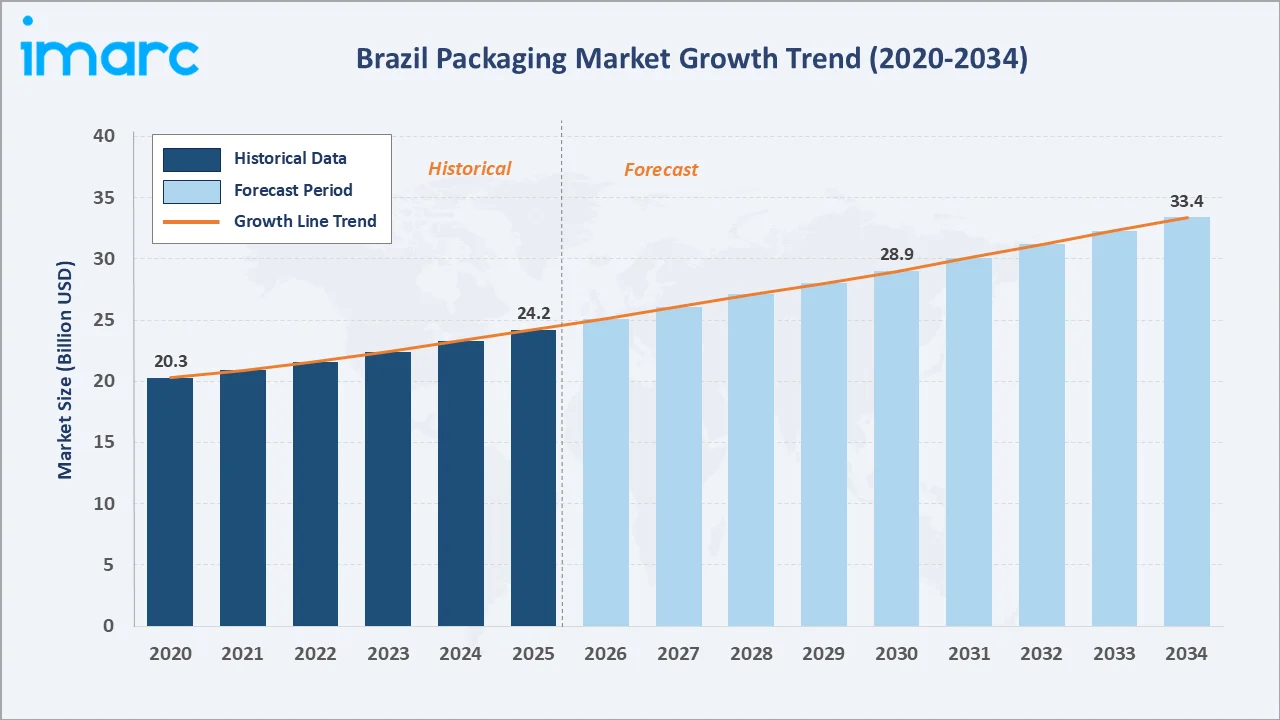
The Brazil packaging market grew from USD 24.2 Billion in 2025 to USD 25.1 Billion in 2026 and is projected to reach USD 33.4 Billion by 2034, exhibiting a CAGR of 3.62% during 2026-2034. Rising consumer goods production, expanding food and beverage manufacturing, and increasing pharmaceutical output are key forces shaping the market growth.
Plastic leads the material type segment at 46.8%, food commands 38.5% of the end-use industry segment, and Southeast accounts for 45.3% of regional share.
Market Snapshot
|
Metric |
Value |
|
Base Year Market Size (2025) |
USD 24.2 Billion |
|
Market Size (2026) |
USD 25.1 Billion |
|
Forecast Market Size (2034) |
USD 33.4 Billion |
|
CAGR (2026-2034) |
3.62% |
|
Base Year |
2025 |
|
Historical Period |
2020-2025 |
|
Forecast Period |
2026-2034 |
|
Largest Region |
Southeast (45.3%, 2025) |
|
Second Largest Region |
South (22.6%, 2025) |
|
Leading Material Type |
Plastic (46.8%, 2025) |
|
Leading End-Use Industry |
Food (38.5%, 2025) |
The Brazil packaging market size increased from USD 20.3 Billion in 2020 to USD 24.2 Billion in 2025 and is estimated to reach USD 25.1 Billion in 2026. The market is further expected to grow to USD 28.96 Billion by 2030 and USD 33.4 Billion by 2034. Brazil's agri-food export pipeline, expanding consumer goods manufacturing, and deepening e-commerce penetration are collectively sustaining packaging demand.
To get more information on this market, Request Sample
CAGR trajectories across material type and end-use industry segments, together with regional patterns, show Northeast and pharmaceutical expanding faster than the overall 3.62% market CAGR, driven by rising healthcare spending, expanding distribution infrastructure, and growing e-commerce penetration in secondary cities.
.webp)
Executive Summary
The Brazil packaging market expanded from USD 24.2 Billion in 2025 to an estimated USD 25.1 Billion in 2026, reinforcing its position as one of the largest packaging markets in Latin America. The industry has evolved from conventional rigid packaging into a multi-material ecosystem spanning flexible plastics, sustainable paperboard, smart active formats, and lightweight metals.
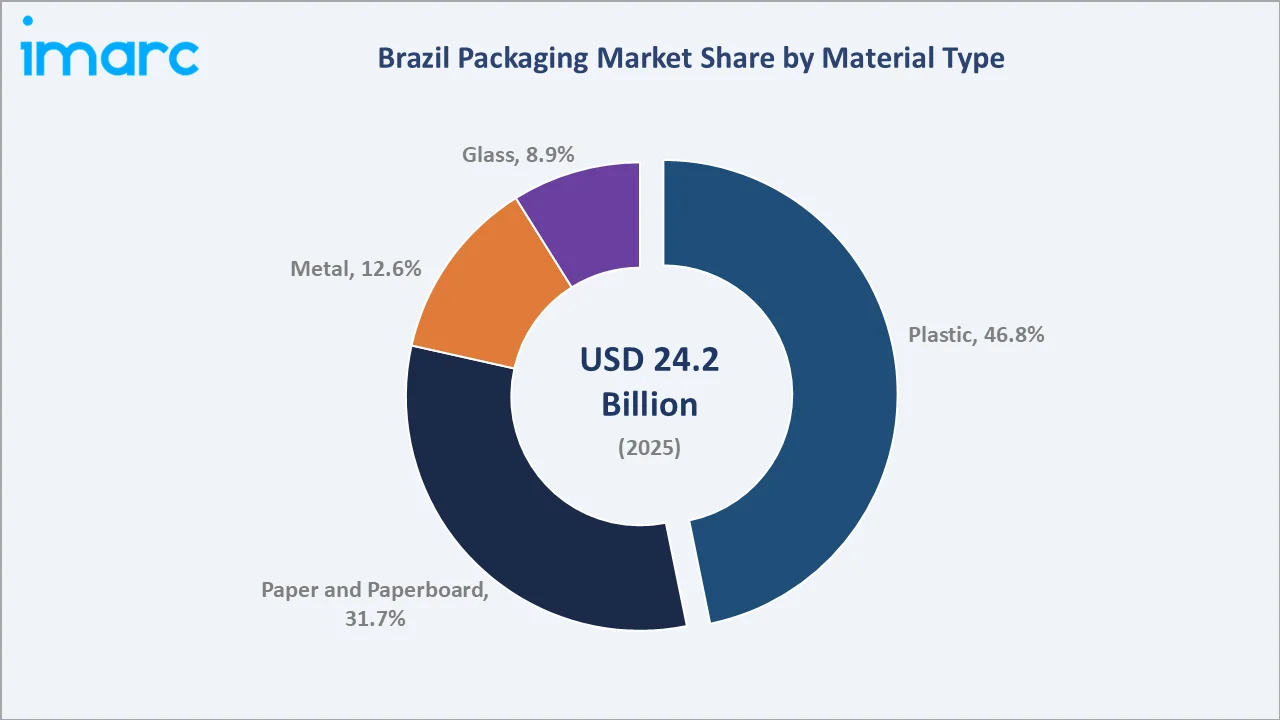
Plastic dominates the material type segment at 46.8% in 2025, supported by its versatility, cost efficiency, and wide processability across food and beverage manufacturing lines. Food commands 38.5% of the end-use industry segment, reflecting Brazil's status as one of the world's largest agricultural exporters. Southeast accounts for 45.3% of regional share, anchored by São Paulo's concentration of consumer goods manufacturers and packaging converters.
Key Market Insights
|
Insight |
Data |
|
Leading Material Type |
Plastic – 46.8% share (2025) |
|
Second Largest Material Type |
Paper and Paperboard – 31.7% share (2025) |
|
Leading End-Use Industry |
Food – 38.5% share (2025) |
|
Second Largest End-Use Industry |
Beverage – 23.4% share (2025) |
|
Leading Region |
Southeast – 45.3% share (2025) |
|
Second Largest Region |
South – 22.6% share (2025) |
|
Top Companies |
Amcor plc, Smurfit WestRock, Sealed Air Corporation, Sonoco Products Company |
Key Analytical Observations Expanding on the Data Above:
- Plastic dominance at 46.8% is supported by its lightweight properties, barrier performance, and compatibility with high-speed filling lines used extensively across food and beverage manufacturing in Brazil.
- Paper and paperboard at 31.7% is gaining traction as consumer goods brands accelerate transitions toward fiber-based packaging to meet retailer sustainability mandates and regulatory pressures on single-use plastics.
- Food at 38.5% reflects Brazil's role as a top global exporter of meat, soybeans, sugar, and processed foods, all requiring high-performance primary and secondary packaging formats.
- Beverage share at 23.4% is expanding, supported by strong demand for packaged water, soft drinks, beer, and other ready-to-consume beverages, which rely heavily on bottles, cans, cartons, and flexible packaging formats.
- Southeast at 45.3% leads regional share, anchored by São Paulo's dense concentration of packaging converters, consumer goods manufacturers, and retail distribution centers.
Brazil Packaging Market Overview
Packaging encompasses the design, production, and application of containers, wraps, and protective formats used to preserve, transport, and display goods across consumer, industrial, and export supply chains. In Brazil, the packaging industry serves a broad ecosystem spanning food processing, beverage production, pharmaceutical manufacturing, consumer goods, and electronics, providing both functional protection and brand communication at point of sale.
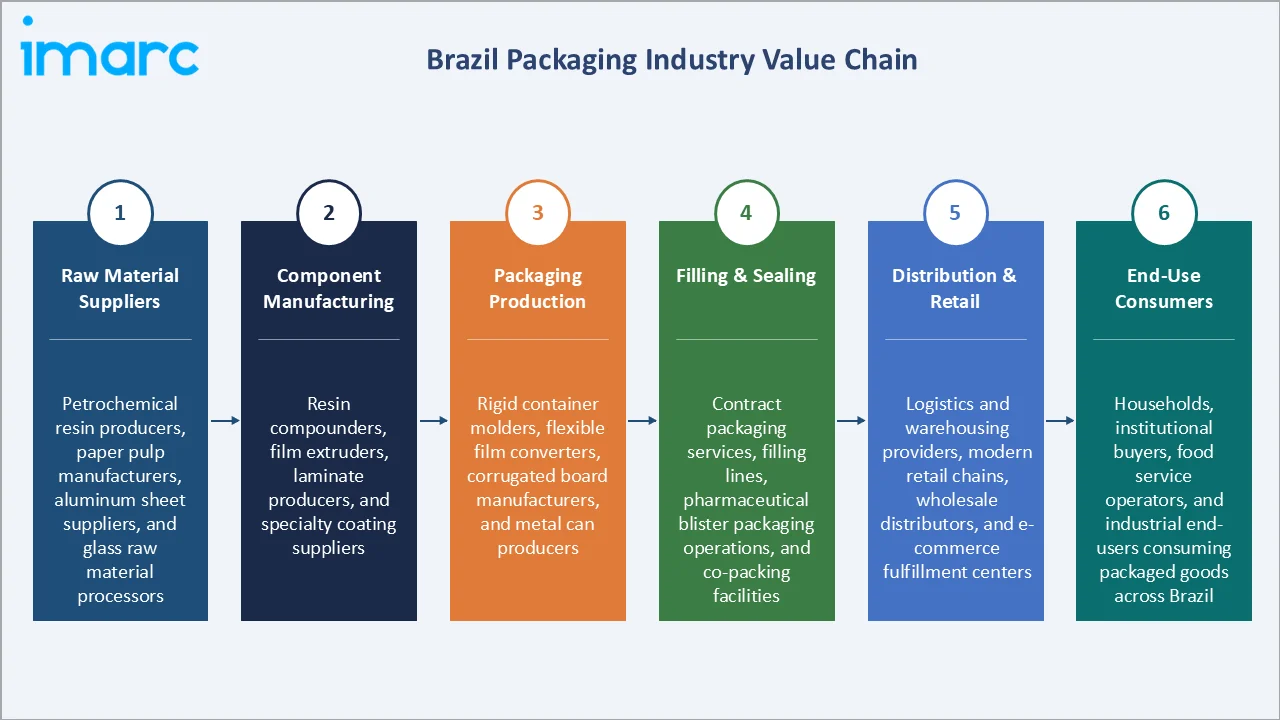
The Brazil packaging ecosystem integrates raw material producers supplying resins, paper pulp, aluminum, and glass; packaging converters and manufacturers producing finished formats; contract packaging and co-packing service providers; distribution and logistics networks managing physical flows; and end-use customers spanning FMCG, pharma, agri-food, and industrial sectors.
Market Dynamics
To evaluate market opportunities, Request Sample
Market Drivers
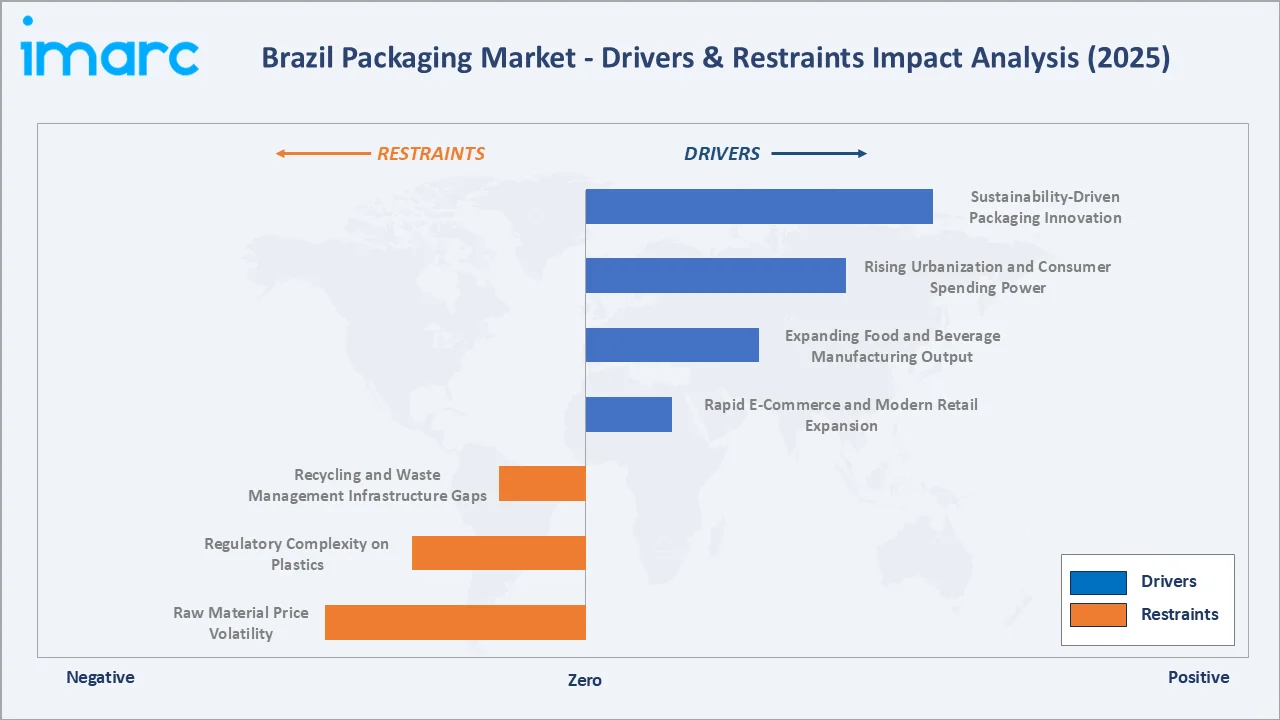
- Rapid E-Commerce and Modern Retail Expansion: Growing online retail penetration is driving demand for durable, lightweight, and printable packaging formats optimized for last-mile delivery and direct-to-consumer shipments across Brazil's major metropolitan regions. As per IMARC Group, the Brazil e-commerce market is projected to reach USD 1,501.78 Billion by 2034, growing at a CAGR of 12.14% during 2026-2034.
- Expanding Food and Beverage Manufacturing Output: Brazil's position as a leading global exporter of processed foods, beverages, and agri-products is generating sustained demand for primary, secondary, and tertiary packaging across both domestic and export supply chains.
- Rising Urbanization and Consumer Spending Power: Growing middle-class populations in urban and semi-urban areas are shifting toward convenience, portion-packaged, and premium branded food and personal care products, supporting higher per-capita packaging consumption.
- Sustainability-Driven Packaging Innovation: Increasing pressure from global retailers and brand owners is accelerating adoption of recyclable, mono-material, and reduced-weight packaging formats, stimulating investment in new material development and converter equipment upgrades.
Market Restraints
- Raw Material Price Volatility: Fluctuations in petrochemical feedstock prices, paper pulp costs, and aluminum input prices create margin pressure for packaging converters and add procurement uncertainty for downstream brand owners.
- Regulatory Complexity on Plastics: Evolving state-level and federal restrictions on single-use plastics and mandatory recycled content requirements are increasing compliance costs and creating substitution pressure on certain packaging formats without adequate infrastructure for transition.
- Recycling and Waste Management Infrastructure Gaps: Limited formal recycling collection networks and material recovery facility capacity outside major metropolitan areas constrain circularity goals and slow progress toward industry sustainability targets.
Market Opportunities
- Pharmaceutical Packaging Growth: Expanding generic medicine production, over-the-counter product portfolios, and government health program distribution are creating rising demand for compliant pharmaceutical primary and secondary packaging formats.
- Bio-Based and Compostable Packaging: Growing brand owner commitments to sustainability goals and emerging regulatory incentives for bio-based materials are creating an addressable market for renewable-feedstock packaging alternatives across food and personal care end-uses.
Market Challenges
- Currency and Macroeconomic Volatility: Brazil's exposure to currency fluctuations affects the import cost of packaging-grade resins and specialized inputs, creating pricing instability for converters dependent on imported materials.
- Technology Adoption Barriers for SMEs: Smaller packaging converters and filling operations face capital constraints in adopting newer sustainable packaging production equipment, limiting the pace of transition from conventional to next-generation packaging formats.
Emerging Market Trends
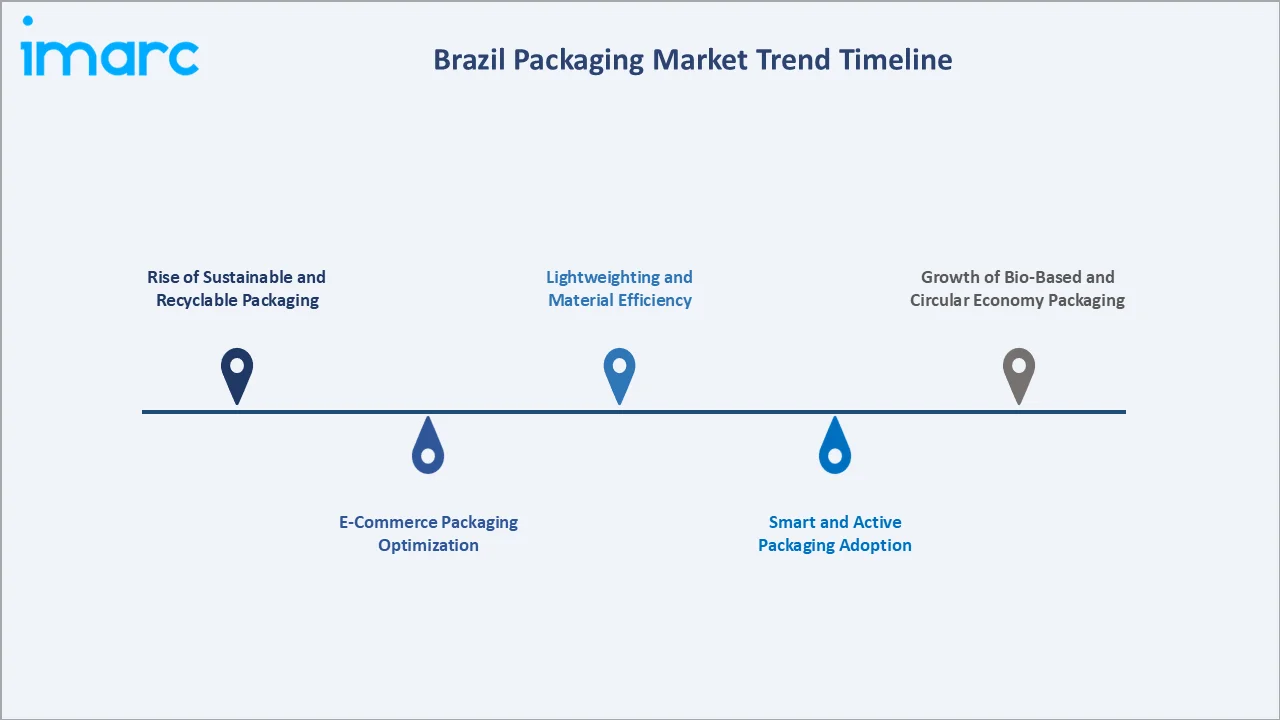
1. Rise of Sustainable and Recyclable Packaging
Consumer goods companies operating in Brazil are accelerating transitions to recyclable mono-material flexible films, recycled PET formats, and fiber-based alternatives as retailer sustainability mandates and brand commitments intensify. This trend is reshaping material selection across food, beverage, and personal care packaging lines.
2. E-Commerce Packaging Optimization
As Brazil's digital retail channel grows, packaging converters and brand owners are developing formats designed for transit durability, compact dimensioning, and unboxing experience. Secondary packaging redesigns focused on reduced void fill and protective performance are increasingly common across consumer electronics and FMCG categories.
3. Smart and Active Packaging Adoption
Active packaging technologies incorporating oxygen scavengers, moisture control, and antimicrobial agents are gaining traction across premium food and pharmaceutical segments, extending shelf life and reducing product waste while supporting compliance with food safety standards.
4. Lightweighting and Material Efficiency
Converters and OEMs are investing in lightweighting programs that reduce the material content of rigid containers, closures, and flexible films without compromising performance, supporting sustainability goals and reducing per-unit material cost across high-volume food and beverage applications.
5. Growth of Bio-Based and Circular Economy Packaging
Investment in bio-based resins, sugarcane-derived PE, and compostable film materials is growing as brand owners seek packaging formats aligned with circular economy commitments. Brazil's abundant sugarcane and agricultural feedstock base provides a structural advantage in scaling domestic bio-based polymer supply.
Industry Value Chain Analysis
The Brazil packaging value chain spans six stages, from raw material extraction through end-use consumption and post-use recovery. Packaging manufacturing and converting stages capture the highest value-add, while sustainability compliance and post-consumer material recovery capabilities are increasingly influencing competitive positioning across the value chain.
|
Stage |
Key Players / Examples |
|
Raw Material Suppliers |
Petrochemical resin producers, paper pulp and board manufacturers, aluminum sheet suppliers, and glass raw material processors supplying inputs to packaging converters |
|
Component Manufacturing |
Resin compounders, film extruders, laminate producers, and specialty coating suppliers converting raw materials into packaging-grade substrates |
|
Packaging Production |
Rigid container molders, flexible film converters, carton and corrugated board manufacturers, and metal can producers delivering finished packaging formats |
|
Filling & Sealing |
Contract packaging services, food and beverage filling lines, pharmaceutical blister packaging operations, and co-packing facilities handling product integration |
|
Distribution & Retail |
Logistics and warehousing providers, modern retail chains, wholesale distributors, and e-commerce fulfillment centers managing packaged goods flows |
|
End-Use Consumers |
Households, institutional buyers, food service operators, and industrial end-users consuming packaged goods across Brazil's urban and rural markets |
Vertically integrated converters owning proprietary material compounds and direct brand relationships are positioned to capture greater value than commodity-focused packaging manufacturers relying on standard input materials and contract volumes.
Technology Landscape in the Brazil Packaging Industry
Advanced Polymer and Barrier Material Development
Packaging converters in Brazil are adopting high-barrier multilayer film structures and coextrusion technologies that extend product shelf life while reducing material weight. Development of mono-material barrier films compatible with mechanical recycling is a priority for suppliers serving the food and beverage segments.
Automation and Smart Manufacturing
Automated filling, labeling, and palletizing systems are being widely adopted across large-format food and beverage packaging operations in Brazil, improving throughput efficiency and reducing labor dependency. Machine vision and inline quality inspection systems are enabling real-time defect detection across high-speed packaging lines.
Digital Printing and Variable Data Packaging
Short-run digital printing capabilities are enabling brand owners to produce regionalized, seasonal, and personalized packaging variants without conventional plate tooling, supporting faster time-to-market and greater marketing flexibility across consumer goods categories.
Market Segmentation Analysis
The report covers the following segments:
|
Segment Category |
Leading Segment |
Market Share |
Year |
|
Material Type |
Plastic |
46.8% |
2025 |
|
End-Use Industry |
Food |
38.5% |
2025 |
|
Region |
Southeast |
45.3% |
2025 |
.webp)
By Material Type
Plastic commands a 46.8% majority share in 2025, driven by its versatility across rigid containers, flexible pouches, wraps, and shrink films used widely in food, beverage, and personal care packaging applications.
To access detailed market analysis, Request Sample
Paper and paperboard at 31.7% is supported by strong demand for corrugated secondary packaging across food, beverage, and retail distribution, combined with growing adoption of paperboard-based formats as alternatives to plastic in premium FMCG segments.
By End-Use Industry
Food leads the end-use industry segment at 38.5% in 2025, underpinned by Brazil's position as one of the world's largest processors and exporters of meat, poultry, sugar, coffee, and processed food products, all requiring compliant primary and secondary packaging across domestic and export supply chains.
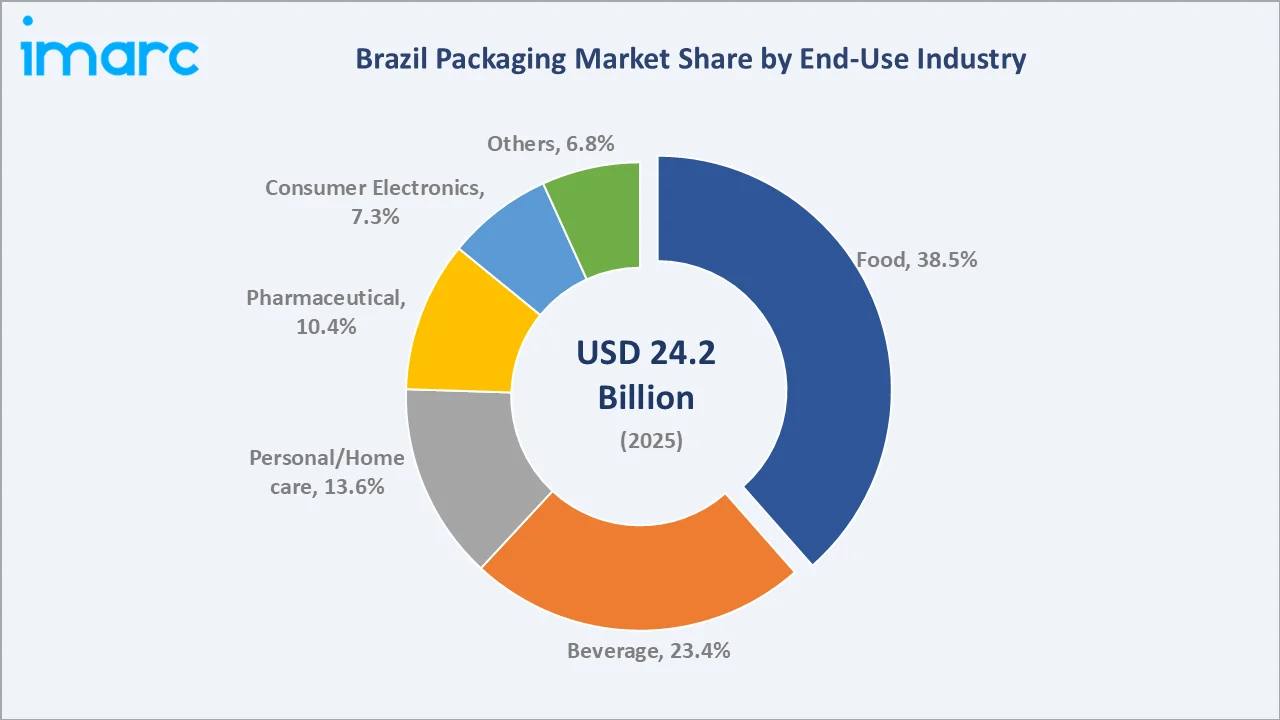
Beverage at 23.4% reflects strong domestic consumption of carbonated drinks, bottled water, juices, and alcoholic beverages, supported by robust packaging demand for PET bottles, aluminum cans, and glass formats.
Regional Market Insights
|
Region |
Share (2025) |
Key Growth Drivers |
|
Southeast |
45.3% |
Dense concentration of consumer goods manufacturers, packaging converters, and modern retail chains; high urbanization and consumer purchasing power |
|
South |
22.6% |
Strong food and beverage processing sector, established agri-food export infrastructure, and growing personal care and pharmaceutical manufacturing base |
|
Northeast |
15.7% |
Expanding logistics and distribution infrastructure, rising consumer purchasing power, and improving access to formal retail and packaged goods distribution channels |
|
Central-West |
9.2% |
Growing agri-food processing volumes tied to grain and protein production, expanding packaging demand for export-grade formats across soybean, corn, and meat supply chains |
|
North |
7.2% |
Emerging consumer market with growing packaged food demand, improving logistics connectivity, and rising retail penetration in secondary cities across the Amazon region |
Southeast at 45.3% in 2025 leads the regional landscape, anchored by São Paulo's position as Brazil's industrial and commercial hub and home to a dense concentration of FMCG manufacturers, packaging converters, and modern retail distribution networks. High urbanization, strong consumer spending power, and the presence of multinational packaged goods companies sustain regional leadership.
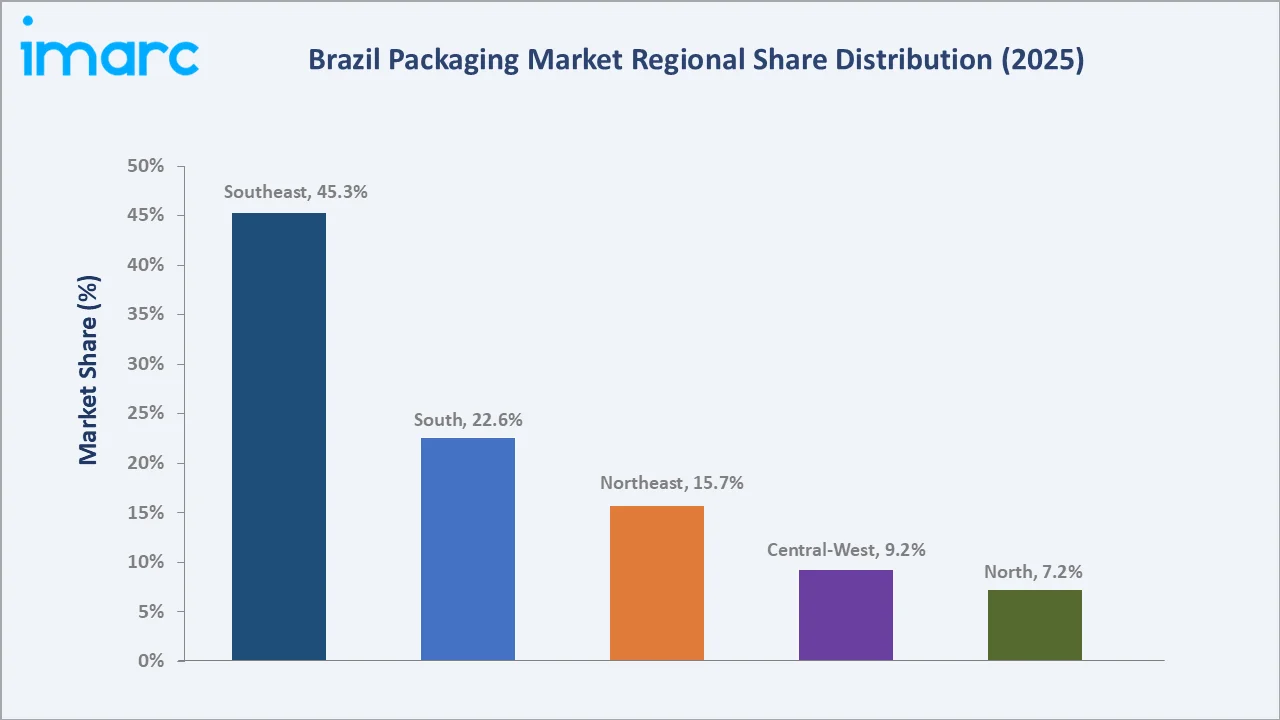
Northeast, while currently the third-largest regional contributor at 15.7%, is the fastest growing region as improving road and logistics infrastructure, rising consumer income levels, and expanding modern retail penetration drive demand for packaged food, beverage, and personal care products across the region's rapidly urbanizing cities.
Competitive Landscape
The Brazil packaging market is moderately concentrated, with global packaging majors and regional converters competing across material-specific and end-use-focused segments. Scale of production, material innovation capability, sustainability credentials, and customer-specific application expertise form the key competitive differentiators.
|
Company Name |
Brand / Key Product |
Position |
Strategic Focus |
|
Amcor plc |
AmLite |
Leader |
Strengthening flexible and rigid packaging capabilities through continued investment in sustainable material innovations |
|
Smurfit WestRock |
Smurfit WestRock Corrugated Packaging Solutions |
Leader |
Expanding sustainable corrugated and fiber-based packaging across Latin America including significant Brazil operations |
|
Sealed Air Corporation |
Cryovac, Bubble Wrap |
Leader |
Growing presence in food protection and e-commerce packaging through platform investment and automation-compatible format development |
|
Sonoco Products Company |
Sonoco Packaging Solutions |
Challenger |
Expanding diversified packaging solutions across consumer, industrial, and healthcare packaging segments globally |
Key players include Amcor plc, Smurfit WestRock, Sealed Air Corporation, and Sonoco Products Company, among others.
Key Company Profiles
Amcor plc
Amcor plc is a global packaging company headquartered in Zürich, Switzerland, supplying flexible and rigid packaging solutions to customers across food, beverage, pharmaceutical, and personal care sectors worldwide, including significant operations across Brazil.
- Product Portfolio: Flexible packaging films, pouches, laminates, rigid containers, closures, and specialty packaging for food, pharmaceutical, and consumer goods applications.
- Recent Developments: Amcor plc has continued strengthening its global packaging portfolio through strategic business combinations and capacity investments, expanding its presence across flexible and rigid packaging segments in key growth markets.
- Strategic Focus: Broadening its flexible and rigid packaging capabilities through ongoing investments in sustainable materials, recyclable packaging solutions, and innovative formats.
Smurfit WestRock
Smurfit WestRock is a global leader in sustainable paper-based packaging headquartered in Dublin, Ireland. The company operates across North America, South America, Europe, Asia, Africa, and Australia with a significant and growing presence in Brazil.
- Product Portfolio: Corrugated containers, retail-ready packaging, bag-in-box solutions, and fiber-based consumer packaging solutions for food, beverage, FMCG, and e-commerce customers through Smurfit WestRock Corrugated Packaging Solutions.
- Recent Developments: Smurfit WestRock has continued advancing its Latin American operations through capital investment programs, plant modernization initiatives, and technology upgrades across its Brazilian manufacturing network.
- Strategic Focus: Expanding sustainable corrugated and fiber-based packaging capabilities across Latin America, with continued emphasis on Brazil and the growing demand for recyclable paper-based packaging solutions.
Sealed Air Corporation
Sealed Air Corporation is a leading global provider of packaging solutions headquartered in Charlotte, North Carolina, United States, designing and delivering packaging products across food, protective, and automation-integrated packaging formats for customers in several countries.
- Product Portfolio: Cryovac food packaging films; Bubble Wrap protective packaging.
- Recent Developments: Sealed Air Corporation has continued investing in its food and protective packaging capabilities, advancing sustainable material development and automation-compatible packaging formats across its global customer base.
- Strategic Focus: Expanding food protection and e-commerce packaging capabilities through investments in packaging platforms, sustainable material development, and automation-compatible solutions.
Market Concentration Analysis
The Brazil packaging market is moderately concentrated, with the leading global packaging majors and regional converters accounting for a meaningful share of total market revenue. Concentration levels vary by material type, with flexible plastics and corrugated packaging exhibiting higher fragmentation than metal and glass packaging, where capital barriers and scale requirements favor a smaller set of established producers.
Barriers to entry are moderate to high depending on the packaging subsegment. Capital-intensive forming, extrusion, and converting equipment, the need for food-grade and pharmaceutical-grade certifications, and established customer relationships with major FMCG manufacturers limit new entrant growth, particularly in high-barrier and specialty packaging formats.
Consolidation is increasing as packaging companies pursue acquisitions, capacity expansion, and strategic partnerships to strengthen their geographic reach, broaden product portfolios, and improve production efficiency. This trend is particularly relevant in specialized and capital-intensive packaging segments, where scale supports investment in advanced manufacturing capabilities and sustainability-focused solutions.
Investment & Growth Opportunities
Fastest-Growing Segments
Paper and paperboard is the fastest growing material type, supported by brand-owner-driven sustainability transitions and regulatory pressure on single-use plastics. It is further supported by growing adoption of recyclable and fiber-based formats across food, beverage, and consumer goods applications.
Emerging Markets
Northeast is the fastest growing region, supported by infrastructure improvements, rising consumer income, and expanding modern retail penetration across secondary cities in Bahia, Pernambuco, and Ceará.
Venture & Investment Trends
Investment activity is concentrated in sustainable packaging material innovation, bio-based polymer development, digital printing capabilities, and active and intelligent packaging technologies. Capital is also flowing into packaging automation and smart manufacturing systems that improve output efficiency and product quality compliance across high-volume food and pharmaceutical packaging operations.
Future Market Outlook (2026-2034)
The Brazil packaging market is projected to grow from USD 24.2 Billion in 2025 to USD 25.1 Billion in 2026, reaching USD 33.4 Billion by 2034, registering a CAGR of 3.62% during 2026-2034. The market's anchor value of USD 28.96 Billion in 2030 reflects sustained structural demand growth driven by food sector expansion, sustainability-led material transitions, and rising pharmaceutical and personal care packaging requirements.
Four forces will shape the market through 2034: continued growth in food and beverage manufacturing output underpinning primary and secondary packaging demand; accelerating sustainable material transitions driven by regulatory and brand owner mandates; expanding pharmaceutical and personal care end-use packaging driven by demographic and income growth; and the growing influence of e-commerce on packaging format requirements across consumer goods categories.
By 2034, the Brazil packaging market is expected to be defined by a higher share of recyclable and bio-based materials, greater adoption of active and smart packaging formats in pharmaceutical and premium food segments, and increasing automation of packaging production and filling operations.
Research Methodology
Primary Research
Primary research included structured interviews with packaging industry executives, material suppliers, packaging converters, and end-use customer procurement and sustainability managers, validating market sizing, segment mix, material demand trends, and regional demand patterns across Brazil.
Secondary Research
Secondary sources included Brazilian Association of Packaging (ABRE) publications, ANVISA regulatory filings, INMETRO standards documentation, Ministry of Environment reports on solid waste, and annual reports, press releases, and investor presentations from listed packaging companies operating in Brazil.
Forecasting Models
Market forecasts used top-down and bottom-up models combining material consumption data, end-use sector output trends, trade flow analysis, and macroeconomic variables including GDP growth, consumer spending, and industrial production indices. Scenario analysis addressed regulatory changes, sustainability transitions, and raw material price trajectories.
Brazil Packaging Market Report Coverage:
| Report Features | Details |
|---|---|
| Base Year of the Analysis | 2025 |
| Historical Period | 2020-2025 |
| Forecast Period | 2026-2034 |
| Units | Billion USD |
| Scope of the Report | Exploration of Historical and Forecast Trends, Industry Catalysts and Challenges, Segment-Wise Historical and Predictive Market Assessment:
|
| Material Types Covered | Paper and Paperboard, Plastic, Metal, Glass |
| End Use Industries Covered | Food, Beverage, Pharmaceutical, Consumer Electronics, Personal/Homecare, Others |
| Regions Covered | Southeast, South, Northeast, North, Central-West |
| Companies Covered | Amcor plc, Smurfit WestRock, Sealed Air Corporation, Sonoco Products Company, etc. |
| Customization Scope | 10% Free Customization |
| Post-Sale Analyst Support | 10-12 Weeks |
| Delivery Format | PDF and Excel through Email (We can also provide the editable version of the report in PPT/Word format on special request) |
Key Benefits for Stakeholders:
- IMARC’s industry report offers a comprehensive quantitative analysis of various market segments, historical and current market trends, market forecasts, and dynamics of the Brazil packaging market from 2020-2034.
- The research report provides the latest information on the market drivers, challenges, and opportunities in the Brazil packaging market.
- Porter's five forces analysis assist stakeholders in assessing the impact of new entrants, competitive rivalry, supplier power, buyer power, and the threat of substitution. It helps stakeholders to analyze the level of competition within the Brazil packaging industry and its attractiveness.
- Competitive landscape allows stakeholders to understand their competitive environment and provides an insight into the current positions of key players in the market.
Frequently Asked Questions About the Brazil Packaging Market Report
The Brazil packaging market size is estimated at USD 25.1 Billion in 2026, driven by expanding food and beverage manufacturing, e-commerce growth, and rising demand for pharmaceutical and personal care packaging formats.
The market is projected to grow at a CAGR of 3.62% from 2026 to 2034, reaching USD 33.4 Billion, supported by sustainable packaging adoption, food sector expansion, and pharmaceutical packaging demand.
Plastic leads the material type segment at 46.8% in 2025, driven by its versatility, cost efficiency, and wide adoption across food, beverage, and personal care packaging applications.
Food leads the end-use industry segment at 38.5% in 2025, reflecting Brazil's position as a top global exporter of processed food, meat, and agri-products requiring compliant primary and secondary packaging.
Southeast accounts for 45.3% of regional share in 2025, anchored by São Paulo's concentration of consumer goods manufacturers, packaging converters, and modern retail distribution networks.
Leading players include Amcor plc, Smurfit WestRock, Sealed Air Corporation, and Sonoco Products Company, among others.
Global retailer mandates, brand owner sustainability commitments, regulatory pressure on single-use plastics, and growing consumer awareness are collectively accelerating adoption of recyclable, bio-based, and fiber-based packaging formats.
Growing e-commerce penetration is driving demand for optimized transit-durable packaging formats, including corrugated boxes, protective films, and lightweight rigid containers designed to maintain product integrity across last-mile delivery operations.
Need more help?
- Speak to our experienced analysts for insights on the current market scenarios.
- Include additional segments and countries to customize the report as per your requirement.
- Gain an unparalleled competitive advantage in your domain by understanding how to utilize the report and positively impacting your operations and revenue.
- For further assistance, please connect with our analysts.
 Request Customization
 Speak to an Analyst
 Request Brochure
 Inquire Before Buying
Benefits of Customization
- Personalize this research
- Triangulate with your data
- Get data as per your format and definition
- Gain a deeper dive into a specific application, geography, customer, or competitor
- Any level of personalization
Get in Touch With Us
UNITED STATES
Phone: +1-201-971-6302
INDIA
Phone: +91-120-433-0800
UNITED KINGDOM
Phone: +44-753-714-6104
Email: [email protected]
Client Testimonials




.webp)




.webp)













Related Reports

Choose your plan
*Please note that the prices mentioned below are starting prices for each bundle type. Kindly contact our team for further details.*
Single User License
- 1 User License, Access on 2 Devices
- PDF Report + Excel Dataset (Password Protected)
- Lifetime Access
- No Printing Rights
- 10% Free Report Customization
- 10–12 Weeks of Analyst Support
Five User License
- Access for 5 Users, 2 Devices per User
- PDF Report + Excel Dataset (Password Protected)
- Lifetime Access
- Dedicated Account Manager
- 12–14 Weeks of Analyst Support
- No Printing Rights
- 15% Free Report Customization
- 25% Discount on Your Next Purchase
Corporate User License
- Unlimited User Access (Within Your Organization)
- PDF Report + Excel Dataset
- Lifetime Access
- Dedicated Account Manager
- 14–20 Weeks of Analyst Support
- No Printing Rights
- 20% Free Report Customization
- 30% Discount on Your Next Purchase
Essential Insights
What's included:
3 reports
- Lifetime Access
- PDF Reports
- Excel Datasets
- 2 Weeks of Free Analyst Support
- 2 User Licenses
- Access on 2 Devices
- Printing Rights
- Complimentary PowerPoint (PPT) Version
- Complimentary License Upgrade
Professional Access
What's included:
5 reports
- Lifetime Access
- PDF Reports
- Excel Datasets
- 8 Weeks of Free Analyst Support
- 2 User Licenses
- Access on 2 Devices
- Printing Rights
- Complimentary PowerPoint (PPT) Version
- Complimentary License Upgrade
Business Advantage
What's included:
8 reports
- Lifetime Access
- PDF Reports
- Excel Datasets
- 14 Weeks of Free Analyst Support
- 2 User Licenses
- Access on 2 Devices
- Printing Rights
- Complimentary PowerPoint (PPT) Version
- Complimentary License Upgrade
Enterprise Intelligence
What's included:
10 reports
- Lifetime Access
- PDF Reports
- Excel Datasets
- 20 Weeks of Free Analyst Support
- 2 User Licenses
- Access on 2 Devices
- Printing Rights
- Complimentary PowerPoint (PPT) Version
- Complimentary License Upgrade