
Europe Steel Market Size, Share, Trends and Forecast by Type, Product, Application, and Country, 2026-2034
Europe Steel Market Size, Share, Trends & Forecast (2026-2034)
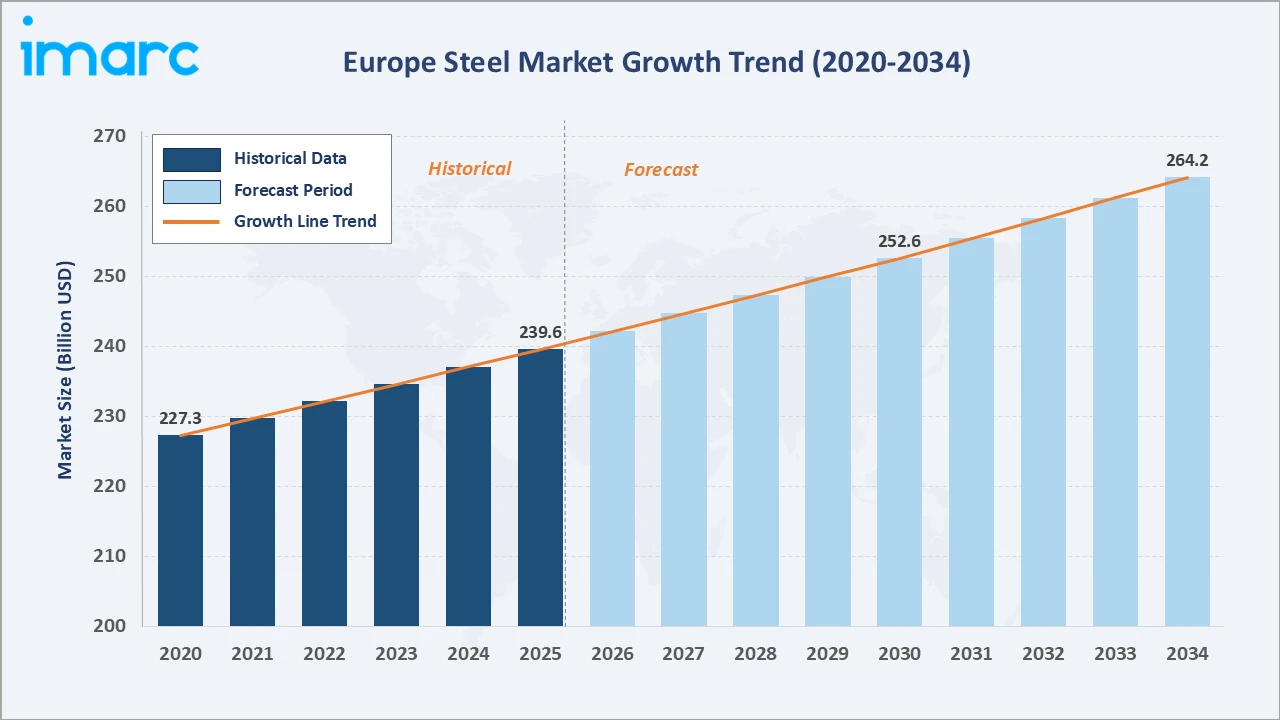
The Europe steel market grew from USD 239.6 Billion in 2025 to USD 242.9 Billion in 2026 and is projected to reach USD 264.2 Billion by 2034, growing at a CAGR of 1.06% during 2026-2034. Growth is supported by construction activity, automotive production, and mechanical equipment manufacturing across the region, alongside the industry's ongoing shift toward decarbonized, electric-arc-furnace-based production. Flat steel dominates by type at 64.5%, building and construction leads application demand at 32.2%, and Germany commands the largest country share at 30.0%. The EU's Carbon Border Adjustment Mechanism, which entered its definitive phase in January 2026, is reshaping trade flows and reinforcing demand for domestically produced, low-carbon steel.
Market Snapshot
|
Metric |
Value |
|
Base Year Market Size (2025) |
USD 239.6 Billion |
|
Market Size (2026) |
USD 242.9 Billion |
|
Forecast Market Size (2034) |
USD 264.2 Billion |
|
CAGR (2026-2034) |
1.06% |
|
Base Year |
2025 |
|
Historical Period |
2020-2025 |
|
Forecast Period |
2026-2034 |
|
Dominant Type |
Flat Steel (64.5%, 2025) |
|
Dominant Application |
Building and Construction (32.2%, 2025) |
|
Leading Country |
Germany (30.0%, 2025) |
The market advanced steadily from USD 227.3 Billion in 2020 to USD 239.6 Billion in 2025 and an estimated USD 242.9 Billion in 2026, supported by post-pandemic industrial recovery and infrastructure investment, and is anchored at USD 252.6 Billion in 2030 en route to USD 264.2 Billion by 2034. Energy cost volatility and import competition tempered growth, but demand from construction and automotive electrification has kept the trajectory positive through the forecast period.
To get more information on this market, Request Sample
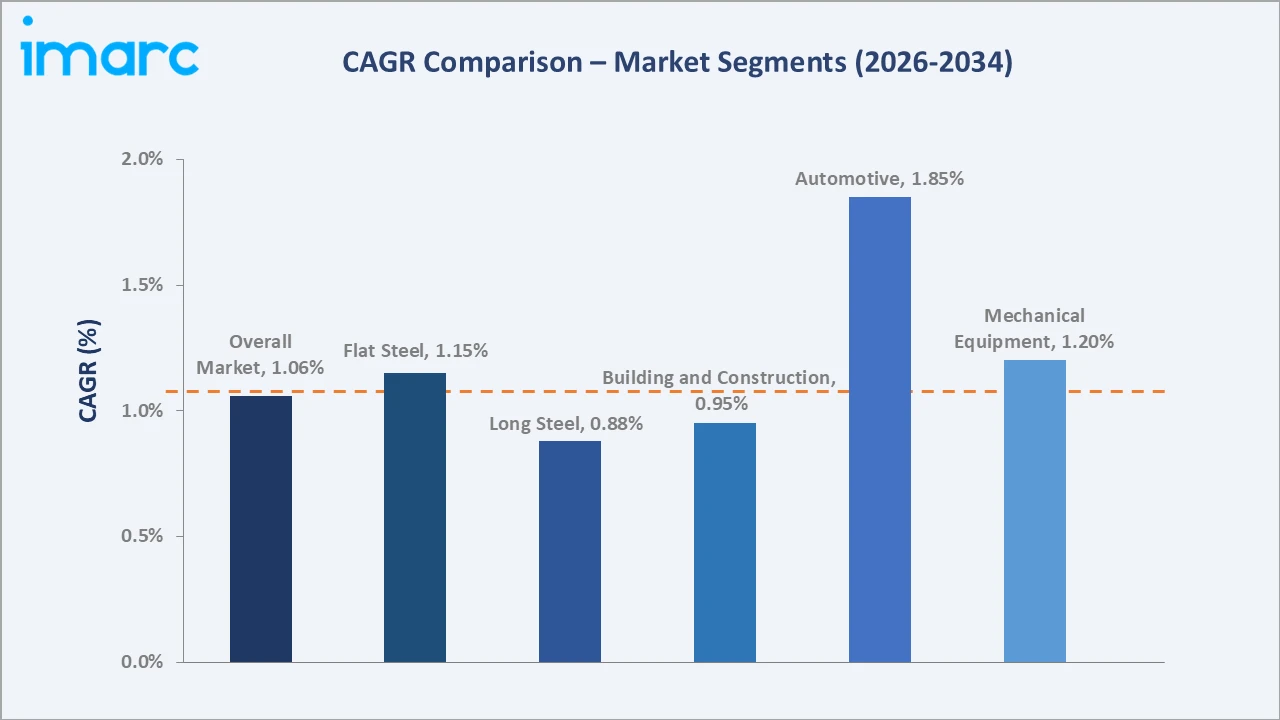
Automotive applications are expected to grow fastest at approximately 1.85% CAGR as electric vehicle production scales and advanced high-strength steels gain share in vehicle lightweighting programmes, while building and construction grows steadily as the highest-volume application supported by continued infrastructure renewal across Germany, France, and Italy.
Executive Summary
The Europe steel market expanded from USD 239.6 Billion in 2025 to an estimated USD 242.9 Billion in 2026, reflecting the region's position as a mature but strategically vital steel-producing bloc undergoing structural decarbonization. Steel remains foundational to European construction, automotive manufacturing, and industrial equipment production, and the market is projected to reach USD 264.2 Billion by 2034.
Flat steel at 64.5% dominates through its widespread use in automotive body panels, appliances, and industrial equipment manufacturing, making the europe flat steel market the single largest contributor to overall regional revenue. Building and construction at 32.2% leads application demand through sustained infrastructure investment and renovation activity. Germany at 30.0% leads country-level demand through its large automotive and machinery manufacturing base, followed by France and Italy.
Key Market Insights
|
Insight |
Data |
|
Dominant Type |
Flat Steel - 64.5% share (2025) |
|
Dominant Application |
Building and Construction - 32.2% market share (2025) |
|
Leading Country |
Germany - 30.0% market share (2025) |
|
Market Opportunity |
Green/low-carbon steel; hydrogen-based direct reduction; electric arc furnace capacity expansion; CBAM-driven import substitution |
Key Analytical Observations Supporting the Above Data:
- Flat Steel at 64.5%: The flat steel segment dominates as it serves the highest-volume end uses, including automotive body panels, appliances, and industrial machinery, where surface quality and formability are prioritized by major manufacturers such as thyssenkrupp AG and ArcelorMittal.
- Building and Construction at 32.2%: The building and construction segment dominates due to Europe's continuous infrastructure renewal, residential construction, and renewable-energy project pipeline, which sustains high-volume structural and reinforcing steel demand.
- Germany at 30.0%: Germany dominates the Europe steel market owing to its large automotive, mechanical equipment, and industrial manufacturing base, with EU-27 crude steel production data showing Germany as the single largest national contributor.
Europe Steel Market Overview
The europe steel industry encompasses the production, processing, and distribution of flat and long steel products used across building and construction, automotive, mechanical equipment, metal products, transportation, electrical appliances, and domestic appliances applications.
The ecosystem integrates iron ore and scrap metal suppliers, integrated and electric-arc-furnace steelmakers, rolling and finishing mills, service centres, and downstream OEM manufacturers across Germany, France, Italy, the United Kingdom, and Spain. Macroeconomic factors shaping the market include EU decarbonization policy, the Carbon Border Adjustment Mechanism, energy price volatility, and infrastructure investment cycles, all of which are central to the european steel industry outlook through 2034.
Market Dynamics
To evaluate market opportunities, Request Sample
Market Drivers
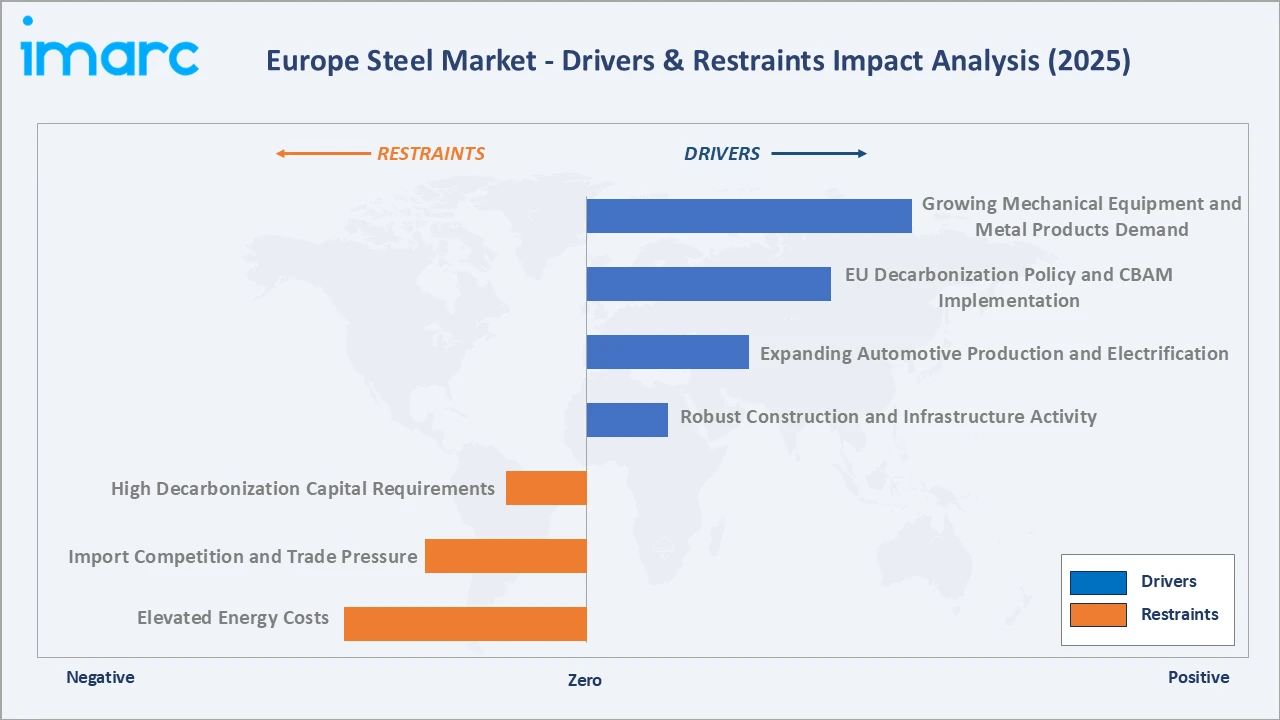
- Robust Construction and Infrastructure Activity: Sustained construction sector demand across residential, commercial, and infrastructure projects continues to drive high-volume consumption of structural and reinforcing steel products. Renovation activity and public infrastructure programmes across Germany, France, and the United Kingdom are reinforcing baseline demand for long steel products used in bridges, rail networks, and utility structures. Government-backed housing and energy-transition construction pipelines are expected to sustain steady flat and long steel offtake through the forecast period, cushioning the market against cyclical downturns in other end-use sectors.
- Expanding Automotive Production and Electrification: Growing automotive production, including electric vehicle manufacturing, is increasing demand for advanced high-strength flat steel used in vehicle body structures and battery enclosures. Automakers' focus on lightweighting while maintaining crash safety is expanding demand for specialized flat steel grades, including advanced high-strength steel and electrical steel for EV motor laminations. European OEMs are increasingly qualifying domestic low-carbon steel suppliers to meet Scope 3 emissions targets, reinforcing long-term offtake agreements between automakers and regional steelmakers.
- EU Decarbonization Policy and CBAM Implementation: EU decarbonization targets and the Carbon Border Adjustment Mechanism, which entered its definitive phase, are incentivizing investment in electric arc furnace capacity and hydrogen-based direct reduction. CBAM financial obligations are reinforcing the competitiveness of domestic low-carbon steel production by raising the effective cost of high-carbon imports entering the European market. Producers are accelerating capital allocation toward green steel certification and emissions-reporting infrastructure to capture premium pricing from environmentally conscious industrial buyers.
- Growing Mechanical Equipment and Metal Products Demand: Rising demand for machinery, industrial equipment, and metal products across manufacturing hubs in Germany and Italy is sustaining flat and long steel consumption. Capital investment in production automation and industrial modernization is expanding steel intensity per unit of manufacturing output across the mechanical equipment sector. Renewable-energy equipment manufacturing, including wind turbine components, is emerging as an incremental demand source for specialized long and flat steel products across several European markets.
Market Restraints
- Elevated Energy Costs: High and volatile electricity and natural gas prices across Europe raise operating costs for both blast-furnace and electric-arc-furnace steelmakers, compressing margins and slowing capacity investment decisions. Energy-intensive steelmaking processes remain structurally exposed to European wholesale power price volatility, which has periodically spiked well above levels seen in competing steel-producing regions. Producers lacking long-term renewable power purchase agreements face greater cost uncertainty, which can delay final investment decisions on new electric arc furnace or hydrogen-based capacity.
- Import Competition and Trade Pressure: Continued inflows of lower-priced imported steel, despite EU safeguard measures and reduced liberalisation rates, create pricing pressure on domestic producers and complicate capacity utilization planning. Quota reallocation restrictions limiting access to unused import allowances from certain countries have only partially offset the broader competitive pressure from global overcapacity in steelmaking. Persistent import pressure can compress domestic mill utilization rates, delaying the return on recently commissioned low-carbon production assets across several European facilities.
- High Decarbonization Capital Requirements: The capital intensity of transitioning from blast-furnace to electric-arc-furnace and hydrogen-based production requires multi-billion-euro investment per facility, creating financing and execution risk. Smaller and mid-tier producers face disproportionate difficulty securing financing for green steel conversion relative to larger integrated players with stronger balance sheets. Extended construction timelines for hydrogen direct-reduction facilities increase exposure to policy, commodity price, and interest-rate risk over the multi-year build-out period.
Market Opportunities
- Green and Low-Carbon Steel Certification: Rising demand from automotive and construction buyers pursuing Scope 3 emissions targets is creating a growing market for certified low-carbon steel commanding premium pricing over conventional grades. Producers that establish credible, independently verified emissions accounting for their green steel output are positioned to capture long-term supply agreements with OEMs and infrastructure developers seeking to decarbonize their own supply chains. Early movers in green steel certification can also benefit from preferential access to public procurement contracts, as several European governments begin incorporating embodied-carbon criteria into infrastructure tendering processes.
- Hydrogen-Based Direct Reduction Technology Scale-Up: Continued development of hydrogen direct-reduction ironmaking presents a significant opportunity for producers to achieve near-zero-emission primary steelmaking as green hydrogen costs decline over the forecast period. Strategic partnerships between steelmakers and renewable energy or hydrogen infrastructure providers can help de-risk the capital investment required for large-scale hydrogen direct-reduction facilities. Producers that successfully commercialize hydrogen-based production at scale stand to gain a durable cost and compliance advantage as EU carbon pricing mechanisms tighten further through 2034.
Market Challenges
- Balancing Legacy Asset Depreciation with New Capacity Investment: Producers must manage the financial and operational complexity of phasing out blast-furnace assets while simultaneously funding new electric-arc-furnace and hydrogen-based capacity, creating a challenging capital allocation environment. Premature closure of still-productive blast-furnace assets can trigger significant impairment charges, while delayed closure risks stranding capital in assets facing rising carbon compliance costs. Workforce transition and retraining requirements associated with shifting production technologies add further operational complexity to the decarbonization timeline for many producers.
- Securing Reliable Green Hydrogen and Renewable Power Supply: The scale-up of hydrogen-based and electric arc furnace production is constrained by the current limited availability and high cost of green hydrogen and dedicated renewable power supply across much of Europe. Grid connection delays and renewable power auction backlogs in several European markets are slowing the pace at which producers can secure the clean energy volumes needed for large-scale decarbonized production. Producers without direct access to renewable generation or long-term hydrogen supply contracts face heightened exposure to spot market price volatility, complicating long-term cost planning for green steel output.
Emerging Market Trends
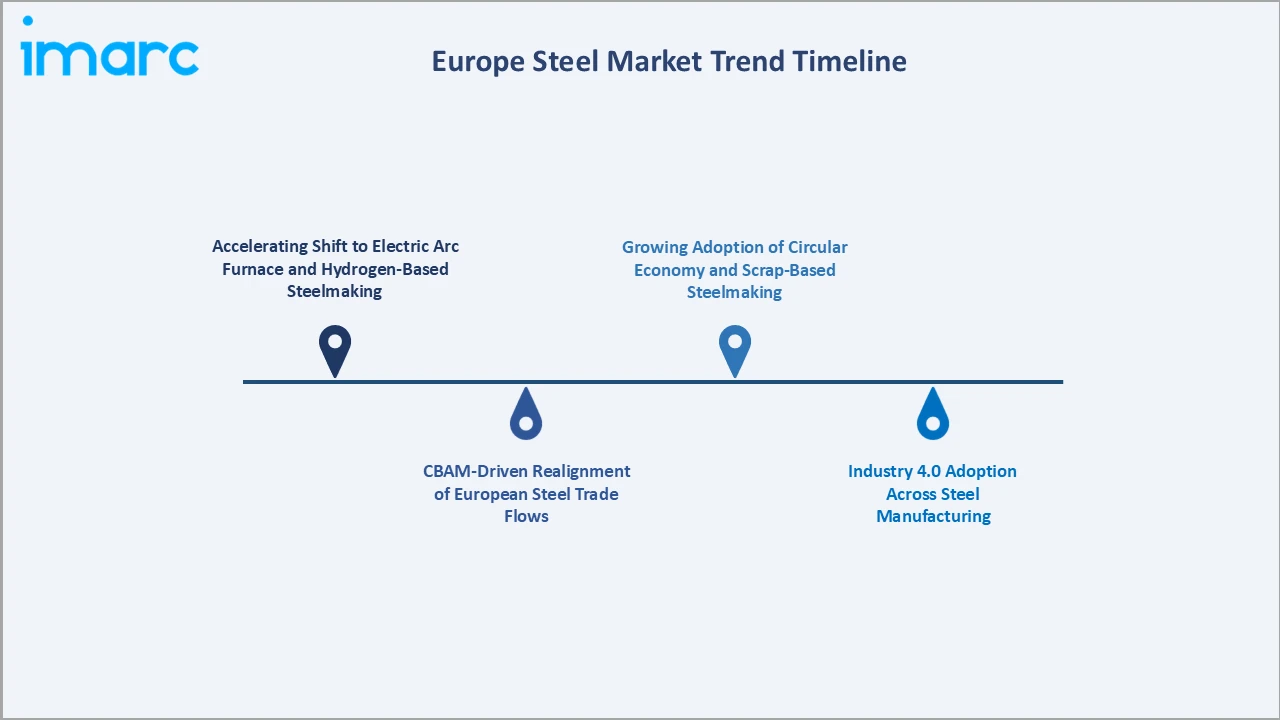
1. Accelerating Shift to Electric Arc Furnace and Hydrogen-Based Steelmaking
European producers, including ArcelorMittal and Salzgitter AG, are converting blast furnace capacity to electric arc furnaces and piloting hydrogen-based direct reduction to cut carbon intensity in line with EU climate targets, reshaping the region's production cost and emissions profile.
2. CBAM-Driven Realignment of European Steel Trade Flows
The EU Carbon Border Adjustment Mechanism's definitive phase, effective January 2026, is prompting importers and domestic buyers to reassess sourcing strategies, favouring low-carbon domestic steel and reshaping competitive dynamics between European and imported product.
3. Industry 4.0 Adoption Across Steel Manufacturing
AI, IoT, and automation are being deployed across European steel mills for predictive maintenance, real-time quality control, and yield optimization, improving efficiency and product consistency across flat and long steel production lines.
4. Growing Adoption of Circular Economy and Scrap-Based Steelmaking
European producers are increasingly prioritizing scrap-based electric arc furnace production to reduce reliance on virgin raw materials and lower embodied carbon, supported by expanding scrap collection and processing infrastructure across the region's major steel-producing countries.
Industry Value Chain Analysis
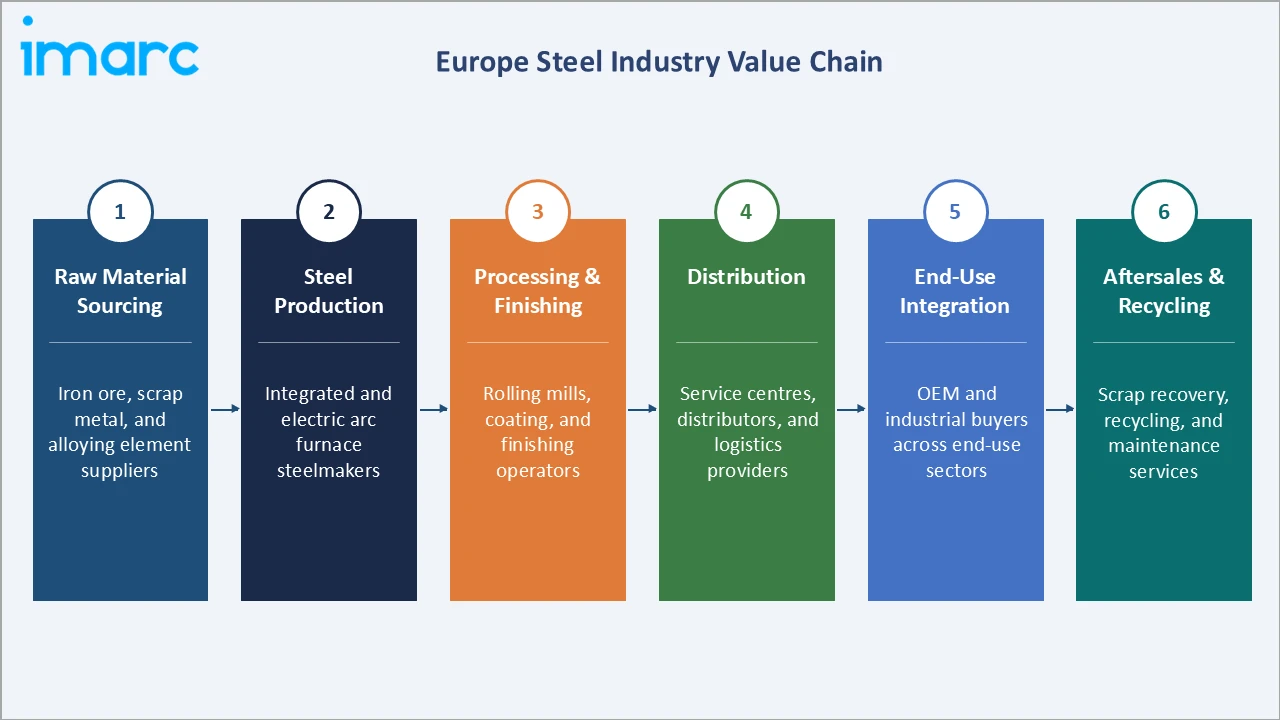
The Europe steel value chain integrates raw material and scrap sourcing, ironmaking and steelmaking, casting and hot rolling, cold rolling and finishing, distribution through service centres, and aftersales and recycling activities across the region's integrated and electric-arc-furnace producers.
|
Stage |
Key Participants |
|
Raw Material Sourcing |
Iron ore, scrap metal, and alloying element suppliers |
|
Steel Production |
Integrated and electric arc furnace steelmakers |
|
Processing & Finishing |
Rolling mills, coating, and finishing operators |
|
Distribution |
Service centres, distributors, and logistics providers |
|
End-Use Integration |
OEM and industrial buyers across end-use sectors |
|
Aftersales & Recycling |
Scrap recovery, recycling, and maintenance services |
The steel production stage represents the value chain's most capital-intensive and strategically significant point, as the choice between blast-furnace and electric-arc-furnace routes determines a producer's cost structure, emissions profile, and long-term competitiveness under tightening EU climate regulation.
Technology Landscape in the Europe Steel Industry
Blast Furnace-Basic Oxygen Furnace (BF-BOF) Technology
Blast furnace-basic oxygen furnace technology remains the dominant production route for high-volume flat steel output across several major European integrated mills, offering established process reliability and consistent product quality. Producers operating BF-BOF assets are increasingly pairing them with carbon capture and efficiency upgrades as an interim decarbonization measure while longer-term hydrogen-based conversion projects progress toward commercial scale.
Electric Arc Furnace (EAF) Technology
Electric arc furnace technology is rapidly expanding across the Europe steel market as producers convert legacy blast-furnace capacity to lower-emission, scrap-based production. EAF technology offers substantially lower carbon intensity than conventional blast-furnace routes and greater production flexibility, making it a central pillar of the region's decarbonization strategy across both flat and long steel product lines.
Hydrogen-Based Direct Reduction (H-DRI) Technology
Hydrogen-based direct reduction technology is emerging as the leading pathway toward near-zero-emission primary steelmaking in Europe, with producers including thyssenkrupp AG and Salzgitter AG advancing pilot and early commercial-scale facilities. Wider adoption of H-DRI technology depends on continued declines in green hydrogen production costs and expansion of dedicated renewable power and hydrogen supply infrastructure across the region.
Market Segmentation Analysis
The report covers the following segments:
|
Segment Category |
Leading Segment |
Market Share |
Year |
|
Type |
Flat Steel |
64.5% |
2025 |
|
Product |
Structural Steel |
🔒 |
2025 |
|
Application |
Building and Construction |
32.2% |
2025 |
|
Country |
Germany |
30.0% |
2025 |

By Type
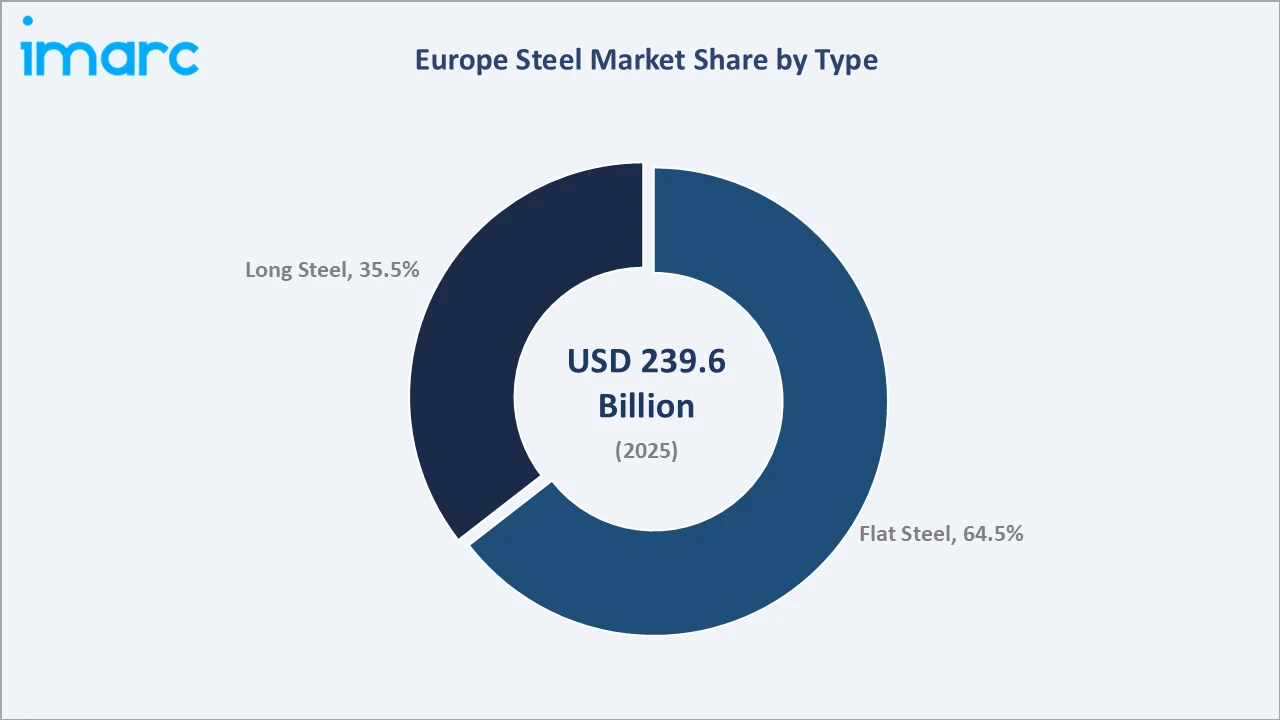
Flat steel leads at 64.5% in 2025, driven by its extensive use in automotive body panels, appliances, and industrial machinery, representing the highest-value product category and confirming the europe flat steel market as the dominant type segment within the broader industry.
To access detailed market analysis, Request Sample
Long steel at 35.5% serves structural construction, reinforcing bar, and rail applications, maintaining stable demand through Europe's ongoing infrastructure renewal and renovation activity.
By Application
Building and construction leads applications at 32.2%, driven by continuous infrastructure investment, residential construction, and renovation activity across major European economies.
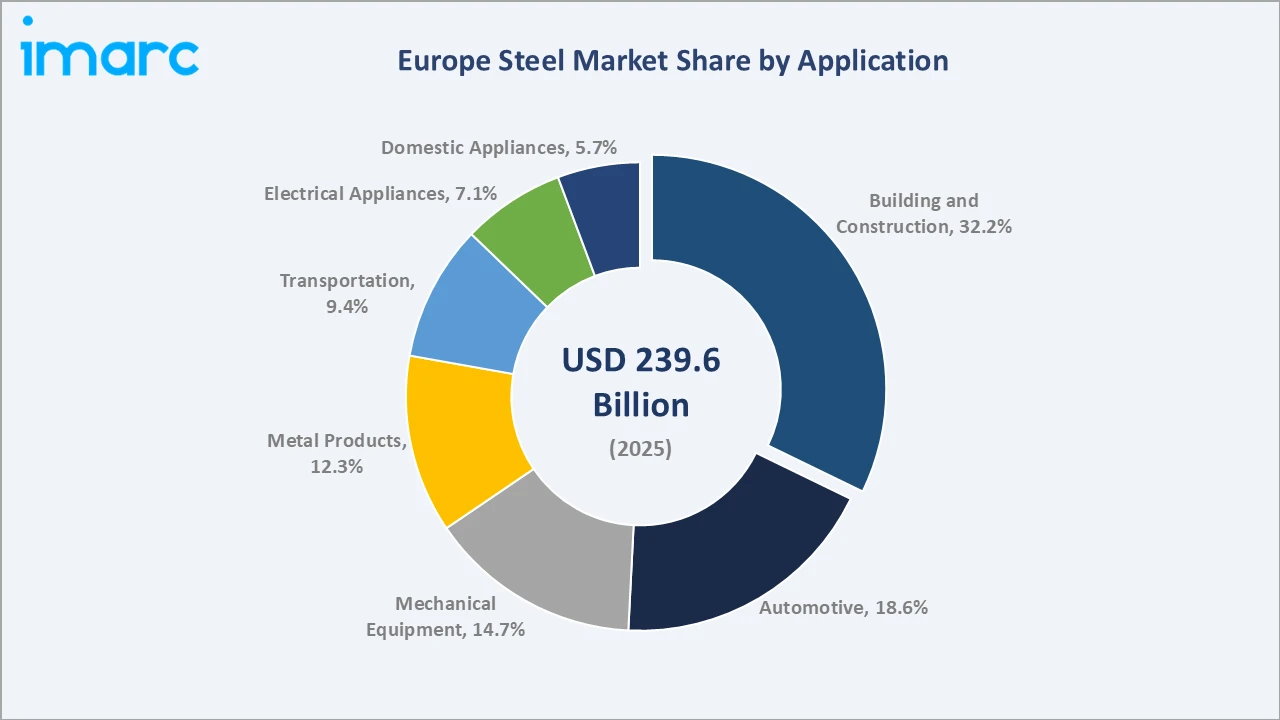
Automotive at 18.6% and mechanical equipment at 14.7% follow, reflecting the region's large vehicle manufacturing base and industrial machinery sector, while metal products, transportation, electrical appliances, and domestic appliances collectively account for the remaining share.
Regional Market Insights
|
Country |
Share (2025) |
Key Market Drivers & Characteristics |
|
Germany |
30.0% |
Driven by a large industrial manufacturing base, established infrastructure, and significant investment in production capacity and technology upgrades |
|
France |
20.6% |
Supported by steady construction activity, manufacturing output, and ongoing infrastructure modernization programmes |
|
Italy |
16.8% |
Reflects a strong domestic production base and consistent demand across construction and industrial applications |
|
United Kingdom |
14.2% |
Driven by construction, transportation, and industrial equipment applications alongside infrastructure modernization |
|
Spain |
9.7% |
Growing through sector recovery and increased investment in supporting infrastructure |
|
Others |
8.7% |
Reflects combined demand across remaining markets within the region |
Germany, at 30.0%, leads through its large automotive and machinery manufacturing base and substantial EU-27 crude steel production, followed by France at 20.6% and Italy at 16.8%, both benefiting from established construction and industrial demand.
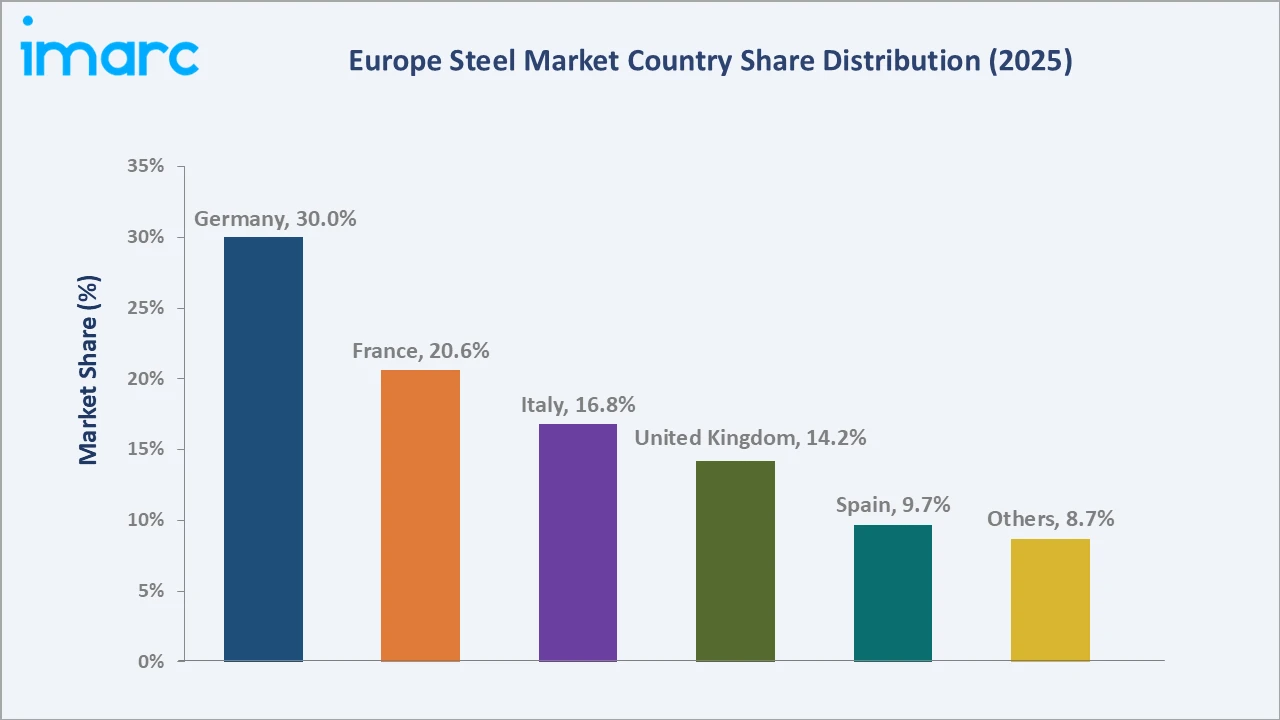
The United Kingdom, at 14.2%, and Spain, at 9.7%, round out regional demand, supported by infrastructure modernization and renewable-energy initiatives, while other European markets collectively contribute 8.7% of regional demand. Across all major markets, the relative ranking of country shares has remained broadly stable over the historical period, with incremental shifts driven primarily by differences in construction cycle timing and automotive production volumes rather than structural changes in underlying industrial capacity.
Competitive Landscape
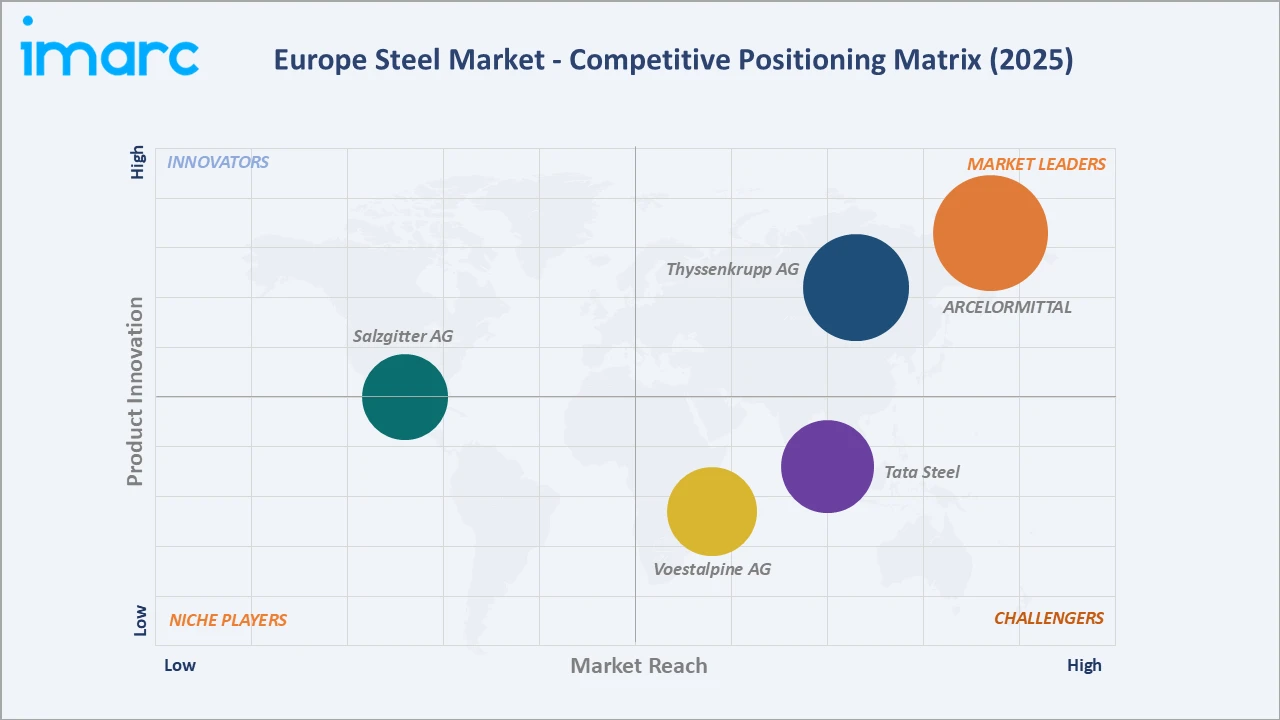
The Europe steel market competitive landscape is moderately concentrated with distinct competitive tiers: large-scale integrated Tier-1 producers, national champion mid-tier producers, and speciality steelmakers competing primarily on decarbonization capability and specialized product offerings for automotive, construction, and industrial customers.
|
Company Name |
Key Products |
Market Position |
Core Strength |
|
ARCELORMITTAL |
Structural steel, flat steel products, long steel products, wire products, plates |
Market Leader |
ARCELORMITTAL is the world's leading integrated steel producer with extensive flat and long steel manufacturing capacity across Europe. |
|
Thyssenkrupp AG |
Flat steel products, automotive-grade steel, specialty steel grades |
Market Leader |
Thyssenkrupp AG is a leading Tier-1 European steel producer advancing hydrogen-based direct reduction for its German steelmaking operations. |
|
Voestalpine AG |
High-quality flat and long steel, railway systems, automotive components |
Strong Challenger |
Voestalpine AG specializes in high-quality, technologically advanced steel products for automotive, railway, and industrial applications. |
|
Tata Steel |
Flat steel products, automotive and packaging steel grades |
Strong Challenger |
Tata Steel is a major flat steel producer serving automotive, construction, and packaging sectors across the United Kingdom and Netherlands. |
|
Salzgitter AG |
Flat and long steel products, tubes, steel trading and packaging systems |
Established Player |
Salzgitter AG is a diversified German steel producer advancing its SALCOS low-carbon steelmaking transformation programme. |
Key players include ARCELORMITTAL, Thyssenkrupp AG, Voestalpine AG, Tata Steel, Salzgitter AG, and others.
Key Company Profiles
ARCELORMITTAL
ARCELORMITTAL is a Luxembourg-headquartered global steel producer with extensive integrated flat and long steel manufacturing operations across Germany, France, Spain, and other European markets.
- Key Products: Structural steel, flat steel products, long steel products, wire products, and plates.
- Recent Developments: In August 2024, ArcelorMittal launched HyMatch, a new range of steel grades designed for the construction of hydrogen-ready transmission pipelines, supporting the development of hydrogen gas infrastructure. The product family has been developed to address the challenges associated with transporting hydrogen at high pressure, with its grades featuring a fine, homogeneous microstructure and high cleanliness to reduce the risk of hydrogen embrittlement.
- Strategic Focus: Expanding decarbonized steelmaking capacity and strengthening its European flat steel portfolio for automotive and construction customers. The company is prioritizing electric arc furnace conversions at its largest European sites, pairing them with renewable power procurement agreements to reduce Scope 2 emissions across its production footprint.
Thyssenkrupp AG
Thyssenkrupp AG is a Germany-based steel and industrial technology company with a strong presence in the Europe steel market through its flat steel and automotive-grade steel operations.
- Key Products: Flat steel products, automotive-grade steel, and specialty steel grades.
- Strategic Focus: Transitioning toward hydrogen-based and electric-arc-furnace steel production while maintaining its automotive-grade flat steel leadership. Thyssenkrupp is sequencing its hydrogen direct-reduction rollout to align with expected green hydrogen availability, minimizing exposure to early-stage hydrogen supply and cost volatility. The company continues to invest in automotive-grade steel research and development to retain its position as a preferred supplier to premium German and European vehicle manufacturers.
Market Concentration Analysis
The Europe steel market is moderately concentrated, with the key players collectively accounting for a substantial share of regional flat and long steel production capacity. Mid-tier national champions maintain strong domestic positions, while smaller regional producers compete primarily on specialized product offerings and local service. Market concentration is expected to evolve gradually over the forecast period as decarbonization capital requirements favour larger, better-capitalized producers capable of funding electric arc furnace and hydrogen-based conversions.
Investment & Growth Opportunities
Highest Growth Segments
Automotive applications (~1.85% CAGR), mechanical equipment (~1.20% CAGR), and building and construction (~0.95% CAGR) represent the highest-growth investment vectors through 2034, supported by vehicle electrification, industrial automation, and sustained infrastructure investment across major European economies.
Emerging Investment Opportunities
Green and low-carbon steel represents the Europe steel market's highest-value emerging opportunity, as CBAM-driven demand for verified low-carbon product allows domestic producers to command premium pricing over carbon-intensive imports, creating a structurally growing demand pool through 2034.
Investment Themes
- Electric arc furnace and hydrogen direct-reduction capacity expansion as a structural cost and compliance advantage through 2034: The transition to low-carbon steelmaking represents a multi-billion-euro investment programme for any European producer seeking full decarbonization.
- Automotive-grade advanced high-strength steel development for EV lightweighting and battery enclosure applications: Europe's expanding electric vehicle production base creates sustained demand for specialized flat steel grades tailored to vehicle electrification requirements.
Future Market Outlook (2026-2034)
The Europe steel market is projected to grow from USD 239.6 Billion in 2025 to USD 242.9 Billion in 2026, reaching USD 264.2 Billion by 2034, delivering a 1.06% CAGR over the forecast period. Growth will be shaped by continued electric arc furnace capacity expansion, CBAM-driven import substitution, and sustained construction and automotive demand, with the market anchored at USD 252.6 Billion in 2030.
Decarbonization will remain the defining structural theme through 2034, with producers progressively adopting hydrogen-based direct reduction and electric arc furnace technology, while automotive electrification and continued infrastructure investment sustain baseline steel demand across the region. Taken together, these dynamics point to a stable but transformative european steel market outlook, in which competitiveness is increasingly determined by decarbonization progress rather than volume growth alone.
Research Methodology
Primary Research
Primary research comprised structured interviews with industry stakeholders, including steel producers, automotive OEM procurement leads, and construction sector executives across Germany, France, Italy, and the United Kingdom.
Secondary Research
Secondary research encompassed company annual reports, EU steel production statistics, European Commission trade and CBAM policy documentation, and industry association data across the European steel value chain.
Forecasting Models
Market revenue forecasts were developed using a bottom-up model incorporating country-level steel consumption by application, production capacity trends, and CBAM-adjusted trade flow projections.
Europe Steel Market Report Coverage:
| Report Features | Details |
|---|---|
| Base Year of the Analysis | 2025 |
| Historical Period | 2020-2025 |
| Forecast Period | 2026-2034 |
| Units | Billion USD |
| Scope of the Report | Exploration of Historical and Forecast Trends, Industry Catalysts and Challenges, Segment-Wise Historical and Predictive Market Assessment:
|
| Types Covered | Flat Steel, Long Steel |
| Products Covered | Structural Steel, Prestressing Steel, Bright Steel, Welding Wire and Rod, Iron Steel Wire, Ropes, Braids |
| Applications Covered | Building and Construction, Electrical Appliances, Metal Products, Automotive, Transportation, Mechanical Equipment, Domestic Appliances |
| Countries Covered | Germany, France, United Kingdom, Italy, Spain, Others |
| Companies Covered | ARCELORMITTAL, Thyssenkrupp AG, Voestalpine AG, Tata Steel, Salzgitter AG, etc. |
| Customization Scope | 10% Free Customization |
| Post-Sale Analyst Support | 10-12 Weeks |
| Delivery Format | PDF and Excel through Email (We can also provide the editable version of the report in PPT/Word format on special request) |
Key Benefits for Stakeholders:
- IMARC’s report offers a comprehensive quantitative analysis of various market segments, historical and current market trends, market forecasts, and dynamics of the Europe steel market from 2020-2034.
- The research study provides the latest information on the market drivers, challenges, and opportunities in the Europe steel market.
- Porter's five forces analysis assist stakeholders in assessing the impact of new entrants, competitive rivalry, supplier power, buyer power, and the threat of substitution. It helps stakeholders to analyze the level of competition within the Europe steel industry and its attractiveness.
- Competitive landscape allows stakeholders to understand their competitive environment and provides an insight into the current positions of key players in the market.
Frequently Asked Questions About the Europe Steel Market Report
The Europe steel market size is estimated at USD 242.9 Billion in 2026, driven by flat steel dominance at 64.5%, building and construction leading applications at 32.2%, and Germany commanding the largest country share at 30.0%.
The Europe steel market grows at a 1.06% CAGR during 2026-2034, reaching USD 264.2 Billion by 2034, supported by construction demand, automotive electrification, and EU decarbonization policy.
Flat steel leads at 64.5%, driven by its extensive use in automotive body panels, appliances, and industrial machinery manufacturing.
Building and construction leads at 32.2%, supported by continuous infrastructure investment and renovation activity across major European economies.
Germany leads at 30.0%, followed by France at 20.6% and Italy at 16.8%, reflecting the region's largest automotive and industrial manufacturing bases.
Leading companies include ARCELORMITTAL, Thyssenkrupp AG, Voestalpine AG, Tata Steel, Salzgitter AG, and others.
The Europe steel market is projected to reach approximately USD 252.6 Billion by 2030, with continued electric arc furnace capacity expansion and CBAM-driven demand for low-carbon domestic steel.
Three priority investment opportunities: electric arc furnace and hydrogen direct-reduction capacity expansion, automotive-grade advanced high-strength steel development, and green/low-carbon steel certification to capture CBAM-driven premium pricing.
Need more help?
- Speak to our experienced analysts for insights on the current market scenarios.
- Include additional segments and countries to customize the report as per your requirement.
- Gain an unparalleled competitive advantage in your domain by understanding how to utilize the report and positively impacting your operations and revenue.
- For further assistance, please connect with our analysts.
 Request Customization
 Speak to an Analyst
 Request Brochure
 Inquire Before Buying
Benefits of Customization
- Personalize this research
- Triangulate with your data
- Get data as per your format and definition
- Gain a deeper dive into a specific application, geography, customer, or competitor
- Any level of personalization
Get in Touch With Us
UNITED STATES
Phone: +1-201-971-6302
INDIA
Phone: +91-120-433-0800
UNITED KINGDOM
Phone: +44-753-714-6104
Email: [email protected]
Client Testimonials




.webp)




.webp)













Related Reports

Choose your plan
*Please note that the prices mentioned below are starting prices for each bundle type. Kindly contact our team for further details.*
Single User License
- 1 User License, Access on 2 Devices
- PDF Report + Excel Dataset (Password Protected)
- Lifetime Access
- No Printing Rights
- 10% Free Report Customization
- 10–12 Weeks of Analyst Support
Five User License
- Access for 5 Users, 2 Devices per User
- PDF Report + Excel Dataset (Password Protected)
- Lifetime Access
- Dedicated Account Manager
- 12–14 Weeks of Analyst Support
- No Printing Rights
- 15% Free Report Customization
- 25% Discount on Your Next Purchase
Corporate User License
- Unlimited User Access (Within Your Organization)
- PDF Report + Excel Dataset
- Lifetime Access
- Dedicated Account Manager
- 14–20 Weeks of Analyst Support
- No Printing Rights
- 20% Free Report Customization
- 30% Discount on Your Next Purchase
Essential Insights
What's included:
3 reports
- Lifetime Access
- PDF Reports
- Excel Datasets
- 2 Weeks of Free Analyst Support
- 2 User Licenses
- Access on 2 Devices
- Printing Rights
- Complimentary PowerPoint (PPT) Version
- Complimentary License Upgrade
Professional Access
What's included:
5 reports
- Lifetime Access
- PDF Reports
- Excel Datasets
- 8 Weeks of Free Analyst Support
- 2 User Licenses
- Access on 2 Devices
- Printing Rights
- Complimentary PowerPoint (PPT) Version
- Complimentary License Upgrade
Business Advantage
What's included:
8 reports
- Lifetime Access
- PDF Reports
- Excel Datasets
- 14 Weeks of Free Analyst Support
- 2 User Licenses
- Access on 2 Devices
- Printing Rights
- Complimentary PowerPoint (PPT) Version
- Complimentary License Upgrade
Enterprise Intelligence
What's included:
10 reports
- Lifetime Access
- PDF Reports
- Excel Datasets
- 20 Weeks of Free Analyst Support
- 2 User Licenses
- Access on 2 Devices
- Printing Rights
- Complimentary PowerPoint (PPT) Version
- Complimentary License Upgrade