
GCC Circuit Breaker Market Size, Share, Trends and Forecast by Product Type, Voltage, Technology, End-Use, and Country, 2026-2034
GCC Circuit Breaker Market Size, Share, Trends & Forecast (2026-2034)
The GCC circuit breaker market reached USD 174.5 Million in 2025 and is projected to reach USD 278.9 Million by 2034, growing at a CAGR of 5.19% during 2026-2034. The market is driven by rising investments in power transmission and distribution infrastructure, renewable energy integration, and smart grid modernization across the region. Saudi Arabia’s transmission network reached about 95,563 circuit km across 132 kV to 380 kV voltage levels by December 2023. This large and expanding high-voltage grid supports demand for circuit breakers, as substations and transmission lines require reliable protection, fault isolation, and switching equipment to ensure a stable power supply. Outdoor circuit breakers lead the product type at 58.4%. Medium voltage leads voltage at 46.8%. Saudi Arabia leads regionally at 39.2%.
Market Snapshot
|
Metric |
Value |
|
Market Size (2025) |
USD 174.5 Million |
|
Forecast Market Size (2034) |
USD 278.9 Million |
|
CAGR (2026-2034) |
5.19% |
|
Base Year |
2025 |
|
Historical Period |
2020-2025 |
|
Forecast Period |
2026-2034 |
|
Dominant Product Type |
Outdoor Circuit Breakers (58.4%, 2025) |
|
Dominant Voltage |
Medium Voltage (46.8%, 2025) |
|
Leading Country |
Saudi Arabia (39.2%, 2025) |
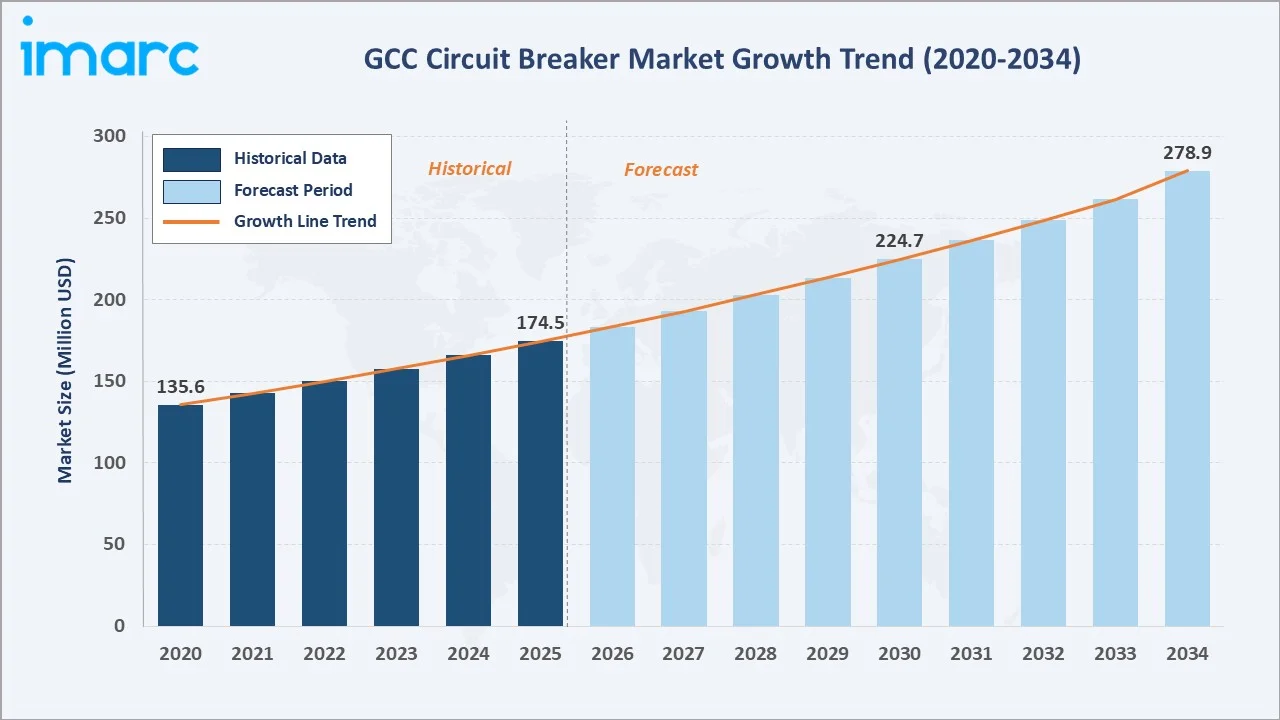
The GCC circuit breaker market grew from USD 135.6 Million in 2020 to USD 174.5 Million in 2025, supported by rising investments in power infrastructure, utilities, and industrial projects. The market is expected to reach USD 224.7 Million by 2030 as grid modernization, renewable energy integration, and urban development accelerate demand. By 2034, it is projected to attain USD 278.9 Million, reflecting steady long-term expansion. Growth will be driven by increasing electricity consumption, smart city projects, and the need for reliable electrical protection systems across the GCC.
To get more information on this market, Request Sample
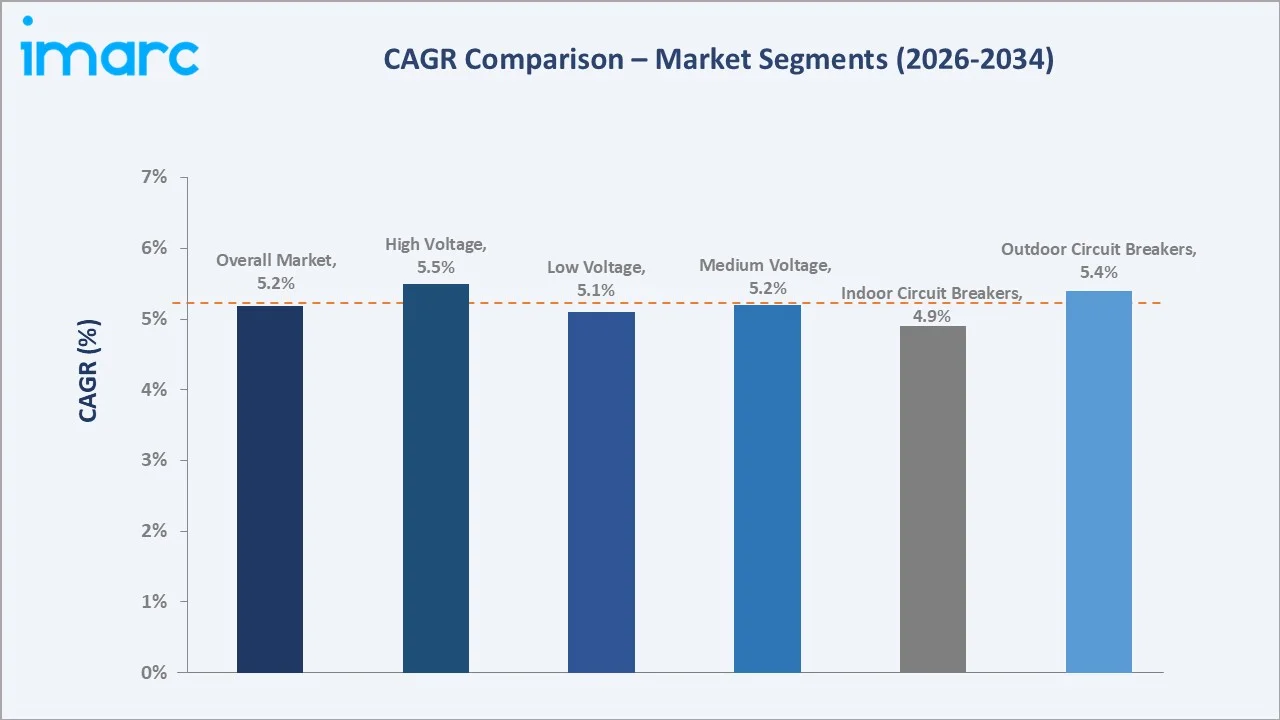
High voltage grows fastest at ~5.5% CAGR through the NEOM project and UAE-Saudi renewable grid interconnection. Outdoor circuit breakers grow at ~5.4% CAGR through T&D substation and overhead line protection. Medium voltage at ~5.2% CAGR through GCC industrial and commercial distribution expansion.
Executive Summary
The GCC circuit breaker market is growing steadily, supported by expanding power transmission networks, grid modernization, and rising electricity demand. Investments in renewable energy, smart cities, industrial zones, and utility infrastructure are increasing the need for reliable electrical protection systems. Saudi Arabia remains a key market due to its large high-voltage transmission network and ongoing power sector expansion. Demand is also supported by substation upgrades, commercial construction, and industrial electrification. Overall, the market outlook remains positive as GCC countries strengthen grid reliability and energy security. Outdoor circuit breakers at 58.4% lead through the T&D substation outdoors. Medium voltage at 46.8% leads through GCC 11kV/33kV distribution. Saudi Arabia leads regionally at 39.2%.
Key Market Insights
|
Insight |
Data |
|
Dominant Product Type |
Outdoor Circuit Breakers - 58.4% share (2025) |
|
Dominant Voltage |
Medium Voltage - 46.8% market share (2025) |
|
Leading Country |
Saudi Arabia - 39.2% share (2025) |
|
Market Opportunity |
NEOM transmission backbone; Saudi Vision 2030; UAE solar farm; Qatar grid upgrade; eco-friendly CB regulation; digital smart CB IoT; data center GCC CB |
Key Analytical Observations Supporting The Above Data:
- Outdoor Circuit Breakers at 58.4%: Outdoor circuit breakers dominate due to their extensive use in transmission substations, utility grids, renewable energy plants, and high-voltage distribution networks. Their durability in harsh GCC climates and suitability for large-scale power infrastructure make them the preferred installation type.
- Medium Voltage at 46.8%: Medium-voltage circuit breakers lead the market due to their widespread deployment in commercial buildings, industrial facilities, utilities, and distribution networks. Their cost-effectiveness, operational reliability, and suitability for GCC power distribution infrastructure make them the dominant voltage segment.
- Saudi Arabia at 39.2%: Saudi Arabia dominates regionally due to its large transmission and distribution network, rising electricity demand, and ongoing grid expansion projects. Strong investments in utilities, renewable energy, and industrial infrastructure further support its leading position.
GCC Circuit Breaker Market Overview
The GCC circuit breaker market encompasses low-, medium-, and high-voltage circuit breakers used across transmission, distribution, industrial, commercial, and residential power systems. It includes outdoor and indoor installations for substations, renewable energy plants, utilities, data centers, and infrastructure projects. The market is supported by grid expansion, electrical safety requirements, and rising demand for reliable power protection equipment. Macroeconomic factors supporting the GCC circuit breaker market include rising investments in power infrastructure, rapid urbanization, and sustained industrial diversification under national development programs.
Market Dynamics
To evaluate market opportunities, Request Sample
Market Drivers
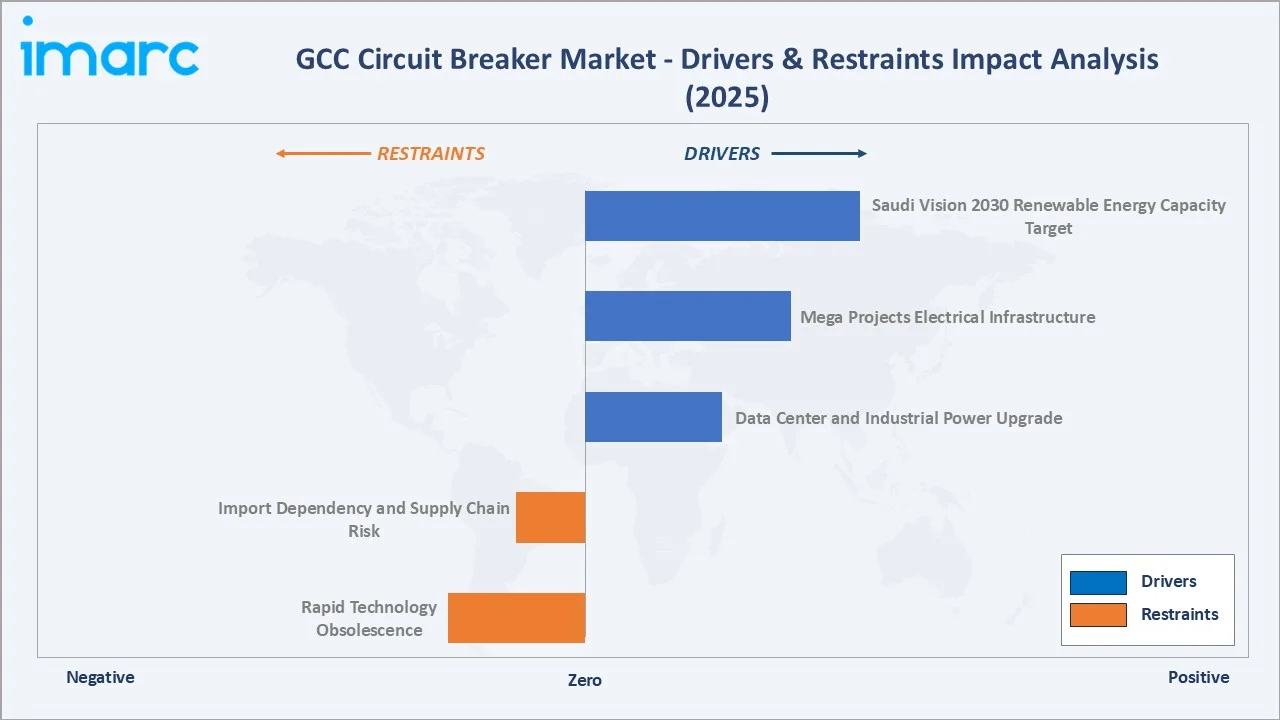
- Saudi Vision 2030 Renewable Energy Capacity Target: Saudi Arabia aims to reach around 130 GW of renewable energy capacity by 2030, supporting its goal of generating 50% of electricity from renewable sources under Vision 2030. As renewable capacity expands, utilities require advanced medium- and high-voltage circuit breakers to ensure safe grid integration, fault protection, and operational reliability. The construction of new substations, grid interconnections, and energy storage facilities further increases equipment deployment. Consequently, the Kingdom's clean energy transition is a major driver of growth for the GCC circuit breaker market.
- Mega Projects Electrical Infrastructure: THE LINE is an advanced urban development within Saudi Arabia’s NEOM project, planned as a 100-mile linear city with net-zero emissions. The project will include extensive underground utility infrastructure, covering telecom and fibre optic networks, power distribution systems, water and waste management facilities, and smart-city IoT installations. These projects require reliable medium- and high-voltage circuit breakers to protect substations, switchgear, and power distribution systems from electrical faults. As GCC governments continue investing in mega infrastructure projects, the deployment of circuit breakers is expected to grow steadily across the region.
- Data Center and Industrial Power Upgrade: Data center and industrial power upgrades are driving the market as these facilities require highly reliable electrical protection for continuous operations. Rising investments in cloud infrastructure, manufacturing plants, petrochemicals, and logistics hubs are increasing demand for medium- and low-voltage circuit breakers. These systems help prevent equipment damage, isolate faults, and reduce downtime in energy-intensive operations.
Market Restraints
- Import Dependency and Supply Chain Risk: Import dependency and supply chain risk hamper the market as a significant share of advanced components and finished products are sourced from international manufacturers. Global disruptions, shipping delays, semiconductor shortages, and fluctuating freight costs can extend project timelines and increase procurement expenses. Dependence on imported high-voltage equipment also exposes utilities and contractors to currency fluctuations and geopolitical risks.
- Rapid Technology Obsolescence: Rapid technology obsolescence hampers the market as utilities and industrial users increasingly shift toward smart, digital, and automation-enabled protection systems. Conventional circuit breakers may require frequent upgrades or replacement to meet new grid reliability, monitoring, and safety requirements. This raises lifecycle costs for end users and creates uncertainty in long-term procurement decisions. Manufacturers also face pressure to continuously invest in R&D and update product portfolios to remain competitive.
Market Opportunities
- Adoption of Smart and Digital Circuit Breakers: The adoption of smart and digital circuit breakers presents a significant opportunity as utilities modernize transmission and distribution networks with intelligent grid technologies. These advanced breakers enable real-time monitoring, predictive maintenance, remote operation, and faster fault detection, improving grid reliability and reducing downtime. Growing investments in smart cities, renewable energy integration, and digital substations are accelerating demand for intelligent protection systems.
- Expansion of Electric Vehicle Charging Infrastructure: The expansion of electric vehicle (EV) charging infrastructure presents a strong opportunity as governments accelerate EV adoption under their clean mobility strategies. Every charging station requires reliable low- and medium-voltage circuit breakers to ensure electrical protection, fault isolation, and safe operation. As EV infrastructure expands across the GCC, circuit breaker manufacturers are expected to benefit from sustained growth in power distribution and charging applications.
Market Challenges
- Compliance with Evolving Grid Safety and Technical Standards: Compliance with evolving grid safety and technical standards is challenging as utilities and contractors must meet stricter requirements for reliability, fault protection, and equipment performance. Frequent updates to smart grid, renewable integration, and high-voltage safety standards can increase testing, certification, and design costs. Manufacturers must continuously upgrade products to remain compliant across different GCC jurisdictions. This can extend approval timelines and create complexity for large infrastructure and utility projects.
- Complex Installation and Maintenance Requirements for High-Voltage Systems: Complex installation and maintenance requirements for high-voltage systems challenge the market as these units require skilled engineers, specialized tools, and strict safety procedures. Any installation error or delayed maintenance can increase fault risks, downtime, and equipment damage. Harsh GCC operating conditions, including heat, dust, and humidity, further raise maintenance complexity. This increases lifecycle costs and can slow deployment across large utility and industrial projects.
Emerging Market Trends
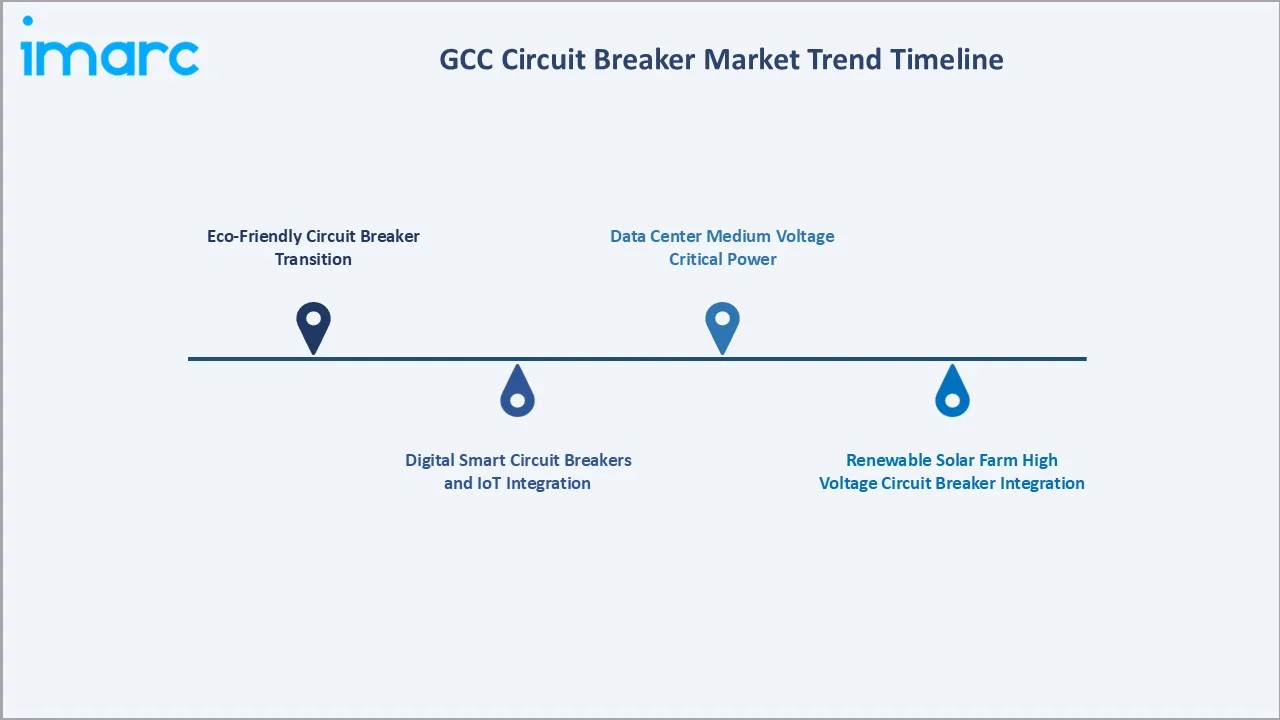
1. Eco-Friendly Circuit Breaker Transition
Eco-friendly circuit breaker transition is emerging as GCC utilities shift away from SF₆-based equipment due to environmental concerns. Manufacturers are introducing vacuum, dry-air, and alternative gas-insulated circuit breakers to reduce greenhouse gas emissions. This trend is supported by renewable energy projects, smart grid upgrades, and stricter sustainability targets. As utilities prioritize low-emission electrical infrastructure, demand for greener circuit breaker technologies is expected to rise.
2. Digital Smart Circuit Breakers and IoT Integration
Digital smart circuit breakers and IoT integration are emerging as utilities and industries adopt intelligent power management systems. Modern circuit breakers equipped with IoT sensors enable real-time monitoring, remote diagnostics, predictive maintenance, and faster fault detection, improving grid reliability and operational efficiency. Integration with smart grids, building management systems, and industrial automation platforms further enhances asset performance and reduces maintenance costs. As digitalization accelerates across the GCC, demand for connected and intelligent circuit protection solutions is expected to grow steadily.
3. Renewable Solar Farm High Voltage Circuit Breaker Integration
Renewable solar farm high-voltage circuit breaker integration is emerging as GCC countries expand utility-scale solar power capacity. Solar farms require high-voltage circuit breakers for grid connection, fault isolation, substation protection, and safe power evacuation. As renewable projects become larger and more grid-connected, demand is rising for reliable breakers that can handle variable generation and switching requirements. This trend is strengthening opportunities for advanced high-voltage and smart circuit breaker solutions across the region.
4. Data Center Medium Voltage Critical Power
Saudi Arabia ranked as the second most attractive data center market globally after the United States. The Kingdom’s operational data center capacity expanded from 68 MW in 2021 to 440 MW in 2025, reflecting nearly sixfold growth in four years. This momentum continued in Q1 2026, with capacity reaching 467 MW, up more than 6% since the start of the year. Data centers require highly reliable medium-voltage circuit breakers to protect switchgear, UPS systems, backup power, and distribution networks. These breakers support fault isolation, uptime protection, and safe load management in mission-critical facilities.
Industry Value Chain Analysis
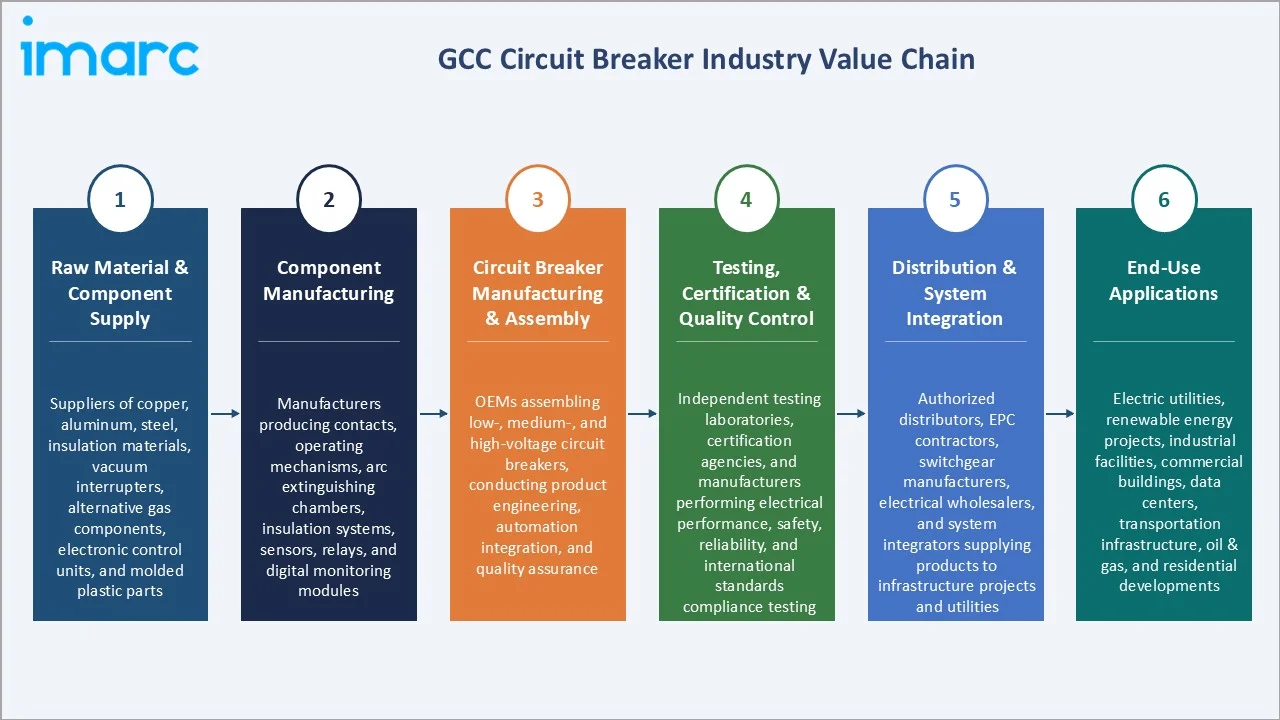
The GCC circuit breaker value chain integrates raw material & component supply, component manufacturing, circuit breaker manufacturing & assembly, testing, certification & quality control, distribution & system integration, and end-use applications
|
Stage |
Key Participants |
|
Raw Material & Component Supply |
Suppliers of copper, aluminum, steel, insulation materials, vacuum interrupters, alternative gas components, electronic control units, and molded plastic parts. |
|
Component Manufacturing |
Manufacturers producing contacts, operating mechanisms, arc extinguishing chambers, insulation systems, sensors, relays, and digital monitoring modules. |
|
Circuit Breaker Manufacturing & Assembly |
OEMs assembling low-, medium-, and high-voltage circuit breakers, conducting product engineering, automation integration, and quality assurance. |
|
Testing, Certification & Quality Control |
Independent testing laboratories, certification agencies, and manufacturers performing electrical performance, safety, reliability, and international standards compliance testing. |
|
Distribution & System Integration |
Authorized distributors, EPC contractors, switchgear manufacturers, electrical wholesalers, and system integrators supplying products to infrastructure projects and utilities. |
|
End-Use Applications |
Electric utilities, renewable energy projects, industrial facilities, commercial buildings, data centers, transportation infrastructure, oil & gas, and residential developments. |
The circuit breaker manufacturing and assembly stage is the most value-added segment of the GCC circuit breaker value chain. This stage involves product design, precision engineering, integration of protection and digital monitoring technologies, rigorous testing, and compliance with international standards, significantly enhancing product performance, reliability, and commercial value.
Technology Landscape in the GCC Circuit Breaker Industry
Interrupting Medium Technology
Interrupting medium technology improves fault interruption capability, operational reliability, and equipment lifespan while minimizing maintenance requirements. Growing investments in renewable energy, digital substations, and high-voltage transmission networks are accelerating the deployment of advanced interrupting media. The transition toward eco-friendly insulating and interrupting technologies is further supporting innovation across the regional circuit breaker market.
Digital and Smart Technology
Digital and smart technology is transforming industry through the integration of IoT sensors, intelligent electronic devices (IEDs), and cloud-based monitoring platforms. Smart circuit breakers enable real-time condition monitoring, remote operation, predictive maintenance, and faster fault detection, improving grid reliability and operational efficiency. Utilities are increasingly deploying these technologies in smart grids, digital substations, data centers, and industrial facilities. As power systems become more automated and connected, digital circuit breakers are becoming a key element of the region's evolving electrical infrastructure.
Remote Switching and Automation Technology
Remote switching and automation technology enable utilities to operate and monitor electrical networks from centralized control centers. Automated switching reduces fault response time, minimizes service interruptions, and improves grid reliability without requiring manual intervention. Integration with SCADA, substation automation, and smart grid platforms enhances operational efficiency and asset management. As the GCC expands digital power infrastructure, demand for remotely controlled and automated circuit breakers continues to increase.
Market Segmentation Analysis
The report covers the following segments:
|
Segment Category |
Leading Segment |
Market Share |
Year |
|
Product Type |
Outdoor Circuit Breakers |
58.4% |
2025 |
|
Voltage |
Medium Voltage |
46.8% |
2025 |
|
Technology |
🔒 |
🔒 |
2025 |
|
End-Use |
🔒 |
🔒 |
2025 |
|
Country |
Saudi Arabia |
39.2% |
2025 |

By Product Type
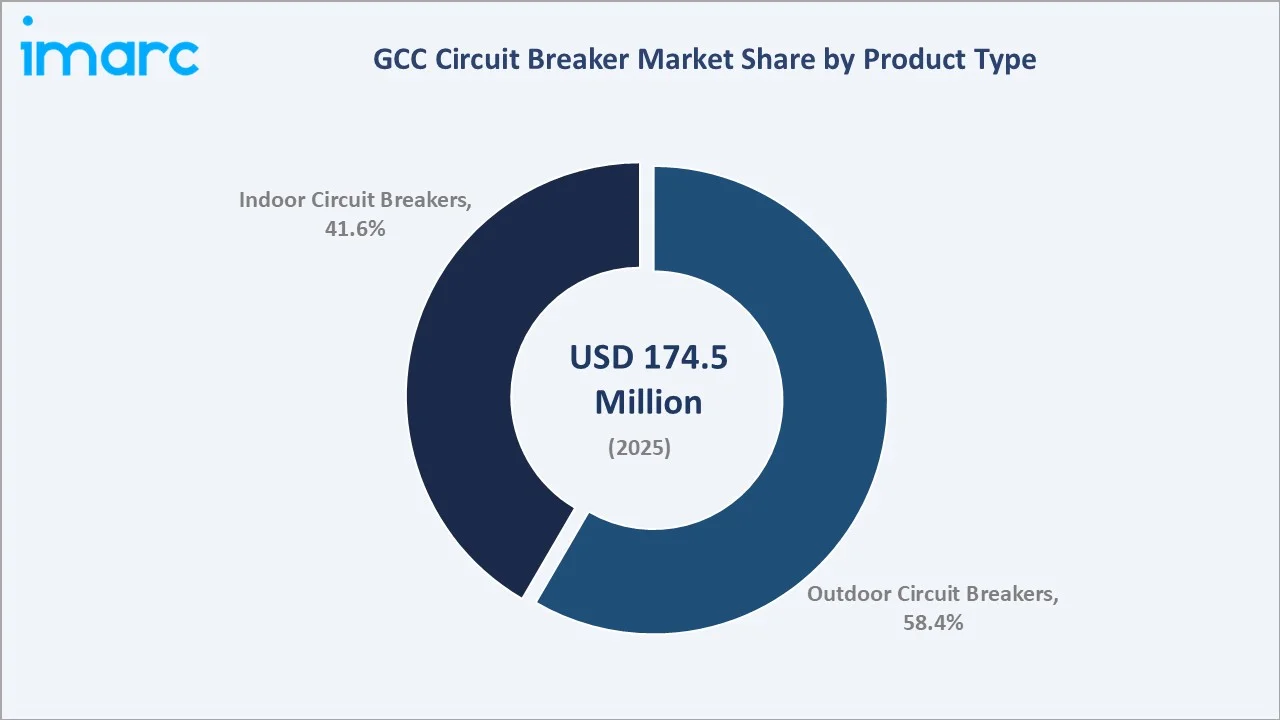
Outdoor circuit breakers lead at 58.4% (2025) due to their extensive use in transmission substations, grid interconnections, renewable energy plants, and high-voltage distribution networks. Their ability to withstand harsh outdoor conditions, including heat, dust, and humidity, makes them highly suitable for GCC power infrastructure.
To access detailed market analysis, Request Sample
Indoor circuit breakers at 41.6% reflect MV VCB indoor switchgear, LV MCB and MCCB distribution boards, ACB main incomer, and gas-insulated switchgear compact indoor for constrained urban substations.
By Voltage
Medium voltage leads at 46.8% (2025), as they are widely used in distribution networks, industrial facilities, commercial buildings, and utility substations. Their balance of cost, reliability, and suitability for expanding power infrastructure makes them the preferred voltage segment across the region.
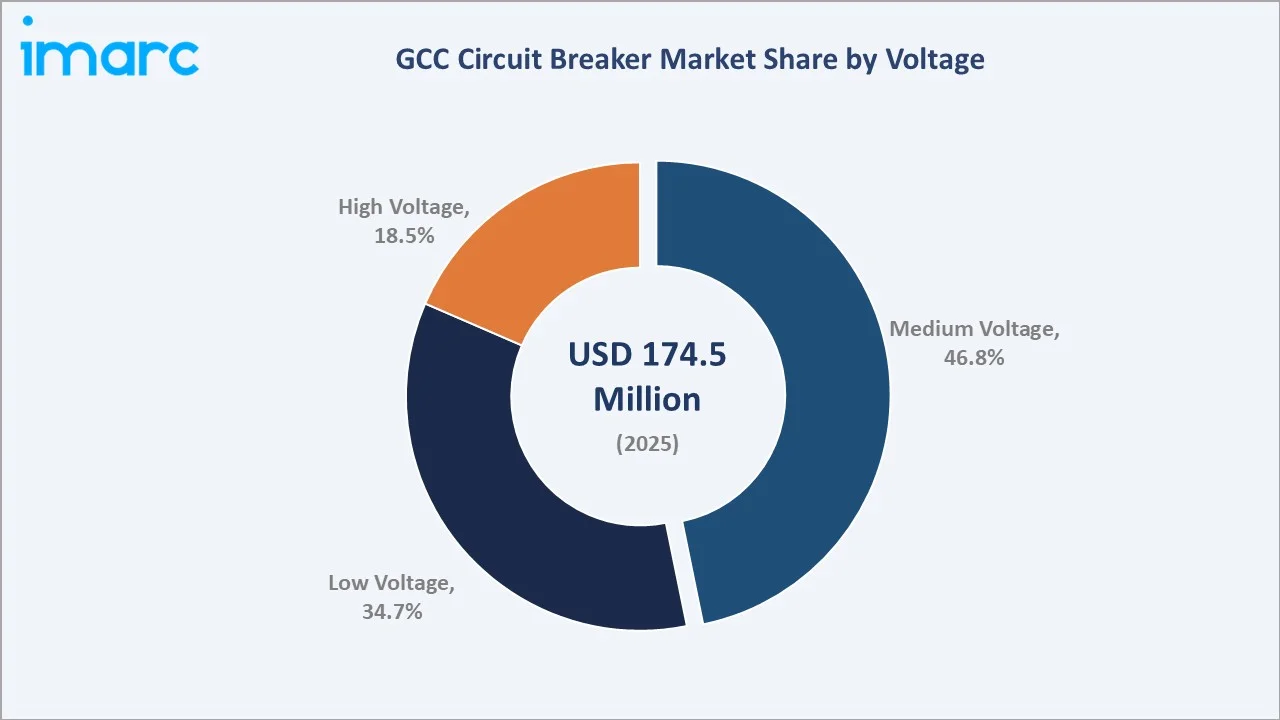
Low voltage at 34.7% due to their widespread use in residential, commercial, retail, and light industrial electrical distribution. High voltage at 18.5% in transmission grids, substations, renewable energy plants, and utility-scale power infrastructure.
Regional Market Insights
|
Country |
Share (2025) |
Key GCC Circuit Breaker Market Drivers & Characteristics |
|
Saudi Arabia |
39.2% |
Reflecting large-scale investments in transmission and distribution infrastructure, renewable energy projects, industrial expansion, and Vision 2030-driven grid modernization. |
|
UAE |
23.8% |
Reflecting strong demand from smart cities, commercial developments, renewable energy integration, data centers, and advanced utility infrastructure. |
|
Qatar |
11.7% |
Reflecting continuous investments in power transmission, LNG-related infrastructure, urban development, and high-reliability electrical networks. |
|
Kuwait |
9.4% |
Reflecting ongoing substation upgrades, electricity network expansion, government infrastructure projects, and industrial power demand. |
|
Oman |
8.7% |
Reflecting investments in renewable energy projects, transmission network expansion, industrial zones, and utility modernization initiatives. |
|
Bahrain |
7.2% |
Reflecting demand from commercial construction, grid reliability enhancement, industrial facilities, and ongoing power distribution upgrades. |
Saudi Arabia's 39.2% dominance is supported by extensive investments in transmission and distribution networks, renewable energy projects, and large-scale infrastructure development under Vision 2030. UAE's 23.8% follows with strong demand driven by smart cities, data centers, commercial construction, and utility modernization.
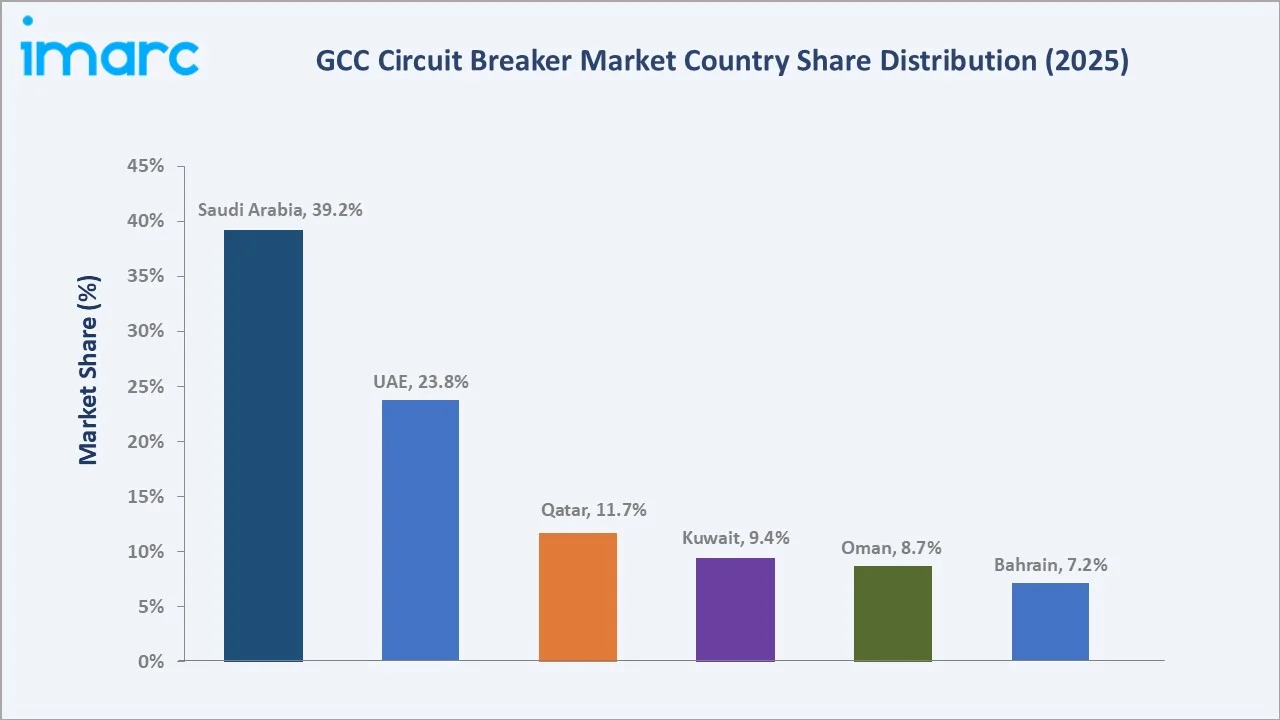
Qatar's 11.7% continues to expand its electrical infrastructure through power grid upgrades and industrial development projects. Kuwait's 9.4% and Oman's 8.7% are witnessing steady growth through substation expansion, renewable energy investments, and industrial diversification initiatives. Bahrain's 7.2% contributes through ongoing distribution network enhancements and commercial infrastructure development, supporting balanced regional market growth.
Competitive Landscape
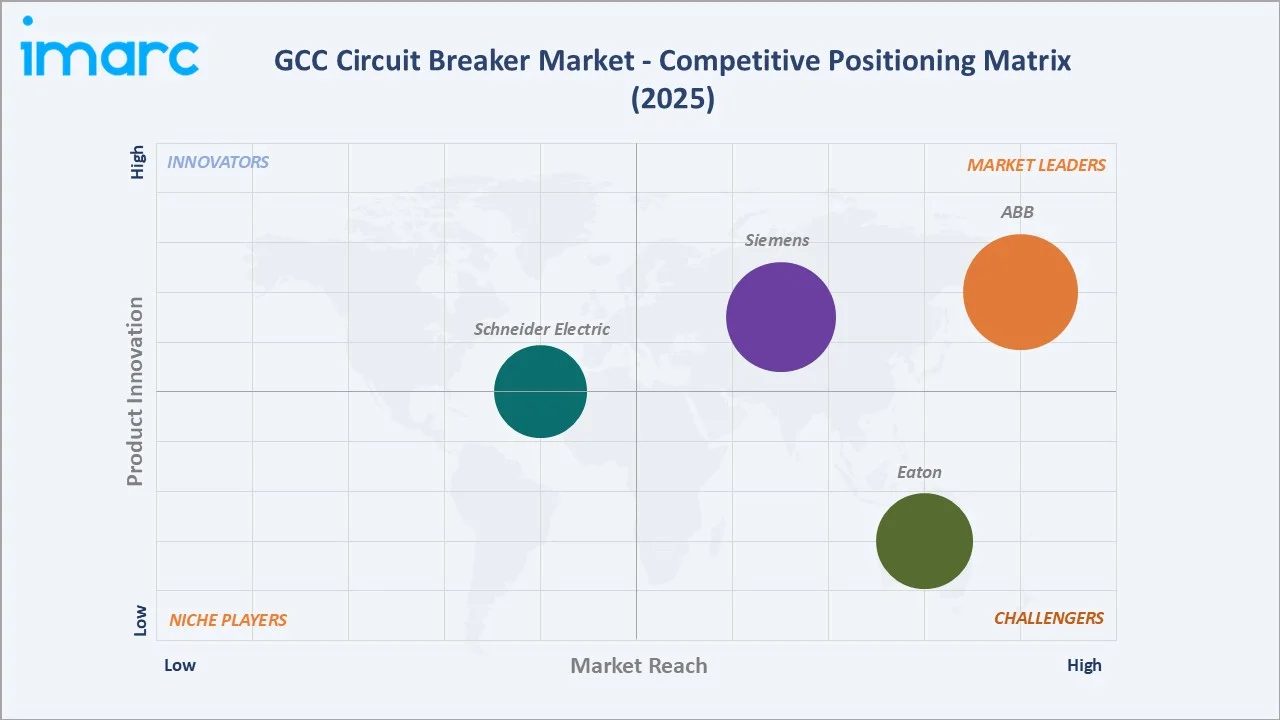
The GCC circuit breaker market is moderately concentrated, with competition led by established global electrical equipment manufacturers alongside regional suppliers and system integrators. Companies compete on product reliability, technological innovation, voltage range, compliance with international standards, and after-sales service capabilities. Strategic priorities include expanding portfolios of smart and digital circuit breakers, strengthening local manufacturing and service networks, and supporting renewable energy and grid modernization projects.
|
Company |
Key Products |
Market Position |
Core Strength |
|
ABB |
Emax 3, Emax 2, Tmax XT, SACE Infinitus |
Market Leader |
ABB is a critical technology partner for the GCC region, playing a fundamental role in supplying highly reliable circuit breakers. These solutions safeguard the region's electrical infrastructure across massive utility grids, industrial plants, and AI-powered data centers. |
|
Siemens |
SENTRON miniature circuit breakers (MCB), SENTRON 3VA molded case circuit breakers (MCCBs) |
Market Leader |
Siemens plays a foundational role in the GCC circuit breaker market. The company has been a primary infrastructure developer, providing critical power transmission and distribution technologies across Saudi Arabia, the UAE, and the broader GCC. |
|
Schneider Electric |
MasterPacT MTZ Active, MasterPact MTZ |
Established Player |
Schneider Electric is a technology leader, electrifying and digitalizing energy management. In the GCC region, the company plays a vital role by providing high-performance, climate-resilient circuit breakers and switchgear designed specifically to handle extreme desert heat, high fault levels, and strict regional safety standards. |
|
Eaton |
CEAG Ex-protected Power Circuit Breakers, Encapsulated IEC Molded Case Circuit Breakers, Encapsulated NEC Miniature Circuit Breakers |
Strong Challenger |
Eaton is a premier provider of critical power management solutions and plays a critical role in the GCC region. Their circuit breakers deliver reliable overload and short-circuit protection across the Middle East's commercial, residential, oil & gas, and industrial sectors. |
Partnerships with utilities, EPC contractors, and infrastructure developers remain critical for securing large-scale projects. Continuous investment in environmentally friendly technologies, digital substations, and intelligent protection solutions is further shaping the competitive landscape across the GCC.
Key Company Profiles
ABB
ABB is a leading provider of electrification and automation solutions with a strong presence across the GCC circuit breaker market. The company offers a comprehensive portfolio of low-, medium-, and high-voltage circuit breakers for utilities, industrial facilities, commercial buildings, renewable energy projects, data centers, and infrastructure developments. ABB supports the region's power sector through advanced grid protection technologies, digital substations, and smart electrical distribution solutions. Its established regional sales, engineering, and service network enables the company to participate in major transmission, distribution, and renewable energy projects across Saudi Arabia, the UAE, Qatar, Oman, Kuwait, and Bahrain.
- Key Products: Emax 3, Emax 2, Tmax XT, SACE Infinitus.
- Strategic Focus: Centers on supporting grid modernization, renewable energy integration, and industrial electrification through advanced low-, medium-, and high-voltage circuit breaker solutions. The company is expanding its portfolio of digital and smart circuit breakers with IoT-enabled monitoring, predictive maintenance, and remote operation capabilities to enhance grid reliability.
Siemens
Siemens is a leading provider of electrical infrastructure and grid technologies with a well-established presence in the GCC circuit breaker market. The company offers an extensive portfolio of low-, medium-, and high-voltage circuit breakers for utilities, industrial plants, commercial buildings, renewable energy projects, and transportation infrastructure. Its solutions support power transmission, distribution, digital substations, and smart grid applications across the region.
- Key Products: SENTRON miniature circuit breakers (MCB), SENTRON 3VA molded case circuit breakers (MCCBs).
- Strategic Focus: Centered on grid digitalization, renewable energy integration, and the deployment of intelligent power distribution systems. The company is expanding its portfolio of smart low-, medium-, and high-voltage circuit breakers with digital monitoring, predictive maintenance, and remote switching capabilities to improve grid reliability and operational efficiency.
Market Concentration Analysis
The GCC circuit breaker market is moderately concentrated, with a few global multinational companies accounting for a significant share of regional revenues alongside several regional suppliers and system integrators. Leading players compete through broad product portfolios spanning low-, medium-, and high-voltage circuit breakers, supported by strong engineering expertise and after-sales services. Competition is increasingly focused on digital and smart circuit breaker technologies and grid automation capabilities. Companies are strengthening partnerships with utilities, EPC contractors, and renewable energy developers to secure large infrastructure projects. Continuous investment in local service capabilities, product innovation, and sustainable electrical solutions is expected to intensify competition across the GCC.
Investment & Growth Opportunities
Highest Growth Segments
High voltage renewable CB (~5.5% CAGR), eco CB (~6% CAGR), Saudi Arabia Vision 2030 renewable (~5.8% CAGR), data center MV CB (~6% CAGR), NEOM (~7% CAGR), and digital IoT CB (~5.5% CAGR) represent the GCC circuit breaker's highest-growth investment vectors through 2034.
Investment Themes
- Eco-friendly circuit breaker regulatory transition: Growing environmental regulations and utility decarbonization goals are driving investments in alternative gas-insulated circuit breakers, creating opportunities for sustainable grid infrastructure.
- Data center and hyperscaler MV critical power circuit breakers: Rapid expansion of hyperscale data centers and AI infrastructure across the GCC is increasing investment in high-reliability medium-voltage circuit breakers to ensure uninterrupted power distribution, fault protection, and operational resilience.
Future Market Outlook (2026-2034)
The GCC circuit breaker market is projected to grow from USD 174.5 Million in 2025 to USD 278.9 Million by 2034, delivering a 5.19% CAGR over the forecast period through Saudi Vision 2030, eco CB regulatory transition, GCC data center MV critical power, and digital IoT smart CB integration. The market's anchor value of USD 224.7 Million in 2030 represents GCC CB at NEOM Phase 1 operational and SF6-free mainstream inflection.
Three structural forces define GCC circuit breaker market growth through 2034. First, sustained investments in transmission and distribution infrastructure are expanding demand for reliable protection equipment across utility networks. Second, rapid deployment of renewable energy projects and smart grid modernization is accelerating the adoption of advanced medium- and high-voltage circuit breakers. Third, the expansion of data centers, industrial electrification, and smart city developments is increasing the need for intelligent, digital, and eco-friendly circuit breaker solutions.
Research Methodology
Primary Research
Primary research comprised interviews with circuit breaker manufacturers, electrical equipment distributors, EPC contractors, utilities, and industrial project developers across the GCC. Discussions focused on procurement trends, voltage demand, smart breaker adoption, pricing, and project pipelines. Inputs from power transmission, renewable energy, data center, and construction stakeholders were used to validate market estimates and growth assumptions.
Secondary Research
Secondary research encompassed company reports, government energy publications, utility investment plans, industry databases, press releases, and technical standards. It also covered GCC grid expansion, renewable energy targets, smart city projects, data center growth, and electrical equipment trade trends. These sources helped validate market sizing, technology trends, competitive positioning, and long-term demand forecasts.
Forecasting Models
Forecasting models combined historical market performance with projected investments in power transmission and distribution, renewable energy, industrial electrification, and commercial infrastructure across the GCC. The analysis incorporated macroeconomic indicators, electricity demand, grid modernization initiatives, and technology adoption trends. Scenario-based forecasting and data triangulation were applied to generate robust market estimates and long-term forecasts through 2034.
GCC Circuit Breaker Market Report Coverage:
| Report Features | Details |
|---|---|
| Base Year of the Analysis | 2025 |
| Historical Period | 2020-2025 |
| Forecast Period | 2026-2034 |
| Units | Million USD |
| Scope of the Report | Exploration of Historical and Forecast Trends, Industry Catalysts and Challenges, Segment-Wise Historical and Predictive Market Assessment:
|
| Product Types Covered | Indoor Circuit Breaker, Outdoor Circuit Breaker |
| Voltages Covered | Low Voltage, Medium Voltage, High Voltage |
| Technologies Covered | Air, Vacuum, Oil, SF6 |
| End-Uses Covered | Transmission and Distribution, Renewable, Power Generation, Railways |
| Countries Covered | Saudi Arabia, UAE, Qatar, Bahrain, Kuwait, and Oman |
| Companies Covered | ABB, Siemens, Schneider Electric, Eaton, etc. |
| Customization Scope | 10% Free Customization |
| Post-Sale Analyst Support | 10-12 Weeks |
| Delivery Format | PDF and Excel through Email (We can also provide the editable version of the report in PPT/Word format on special request) |
Key Benefits for Stakeholders:
- IMARC’s report offers a comprehensive quantitative analysis of various market segments, historical and current market trends, market forecasts, and dynamics of the GCC circuit breaker market from 2020-2034.
- The research study provides the latest information on the market drivers, challenges, and opportunities in the GCC circuit breaker market.
- Porter's five forces analysis assist stakeholders in assessing the impact of new entrants, competitive rivalry, supplier power, buyer power, and the threat of substitution. It helps stakeholders to analyze the level of competition within the GCC circuit breaker industry and its attractiveness.
- Competitive landscape allows stakeholders to understand their competitive environment and provides an insight into the current positions of key players in the market.
Frequently Asked Questions About the GCC Circuit Breaker Market Report
The GCC circuit breaker market reached USD 174.5 Million in 2025, driven by rising investments in power transmission and distribution networks, renewable energy integration, and smart grid modernization. Expanding data centers, industrial facilities, EV charging infrastructure, and mega construction projects are further increasing demand for reliable electrical protection systems.
The GCC circuit breaker market grows at 5.19% CAGR during 2026-2034, reaching USD 278.9 Million by 2034. The CAGR reflects Vision 2030 renewable CB, NEOM HV backbone, SF6-free eco transition, data center MV, and Saudi grid expansion structural demand.
Outdoor circuit breakers lead at 58.4% due to their widespread use in transmission substations, renewable energy plants, and high-voltage grid infrastructure. Their ability to withstand harsh GCC conditions makes them suitable for large-scale utility applications.
Medium voltage leads at 46.8% due to their extensive use in utility distribution networks, industrial facilities, commercial buildings, and renewable energy substations. Their reliability, cost-effectiveness, and suitability for expanding GCC power infrastructure make them the preferred voltage segment.
Saudi Arabia leads at 39.2% due to its large transmission network, rising electricity demand, and ongoing investments in grid expansion and renewable energy projects. Vision 2030-led infrastructure, data center, and industrial developments further strengthen its market dominance.
Leading companies include ABB, Siemens, Schneider Electric, and Eaton, among others.
The market is projected to reach approximately USD 224.7 Million by 2030, supported by grid modernization, renewable energy integration, and expanding transmission and distribution infrastructure. Rising demand from smart cities, data centers, and industrial electrification will further strengthen market growth.
Three priority investment opportunities include SF6-free and eco-friendly circuit breaker technologies to support sustainability and regulatory compliance, medium-voltage circuit breakers for hyperscale data centers and AI infrastructure driven by digital transformation, and high-voltage circuit breakers for renewable energy integration and transmission network expansion as GCC countries accelerate grid modernization and clean energy investments.
Need more help?
- Speak to our experienced analysts for insights on the current market scenarios.
- Include additional segments and countries to customize the report as per your requirement.
- Gain an unparalleled competitive advantage in your domain by understanding how to utilize the report and positively impacting your operations and revenue.
- For further assistance, please connect with our analysts.
 Request Customization
 Speak to an Analyst
 Request Brochure
 Inquire Before Buying
Benefits of Customization
- Personalize this research
- Triangulate with your data
- Get data as per your format and definition
- Gain a deeper dive into a specific application, geography, customer, or competitor
- Any level of personalization
Get in Touch With Us
UNITED STATES
Phone: +1-201-971-6302
INDIA
Phone: +91-120-433-0800
UNITED KINGDOM
Phone: +44-753-714-6104
Email: [email protected]
Client Testimonials




.webp)




.webp)













Related Reports

Choose your plan
*Please note that the prices mentioned below are starting prices for each bundle type. Kindly contact our team for further details.*
Single User License
- 1 User License, Access on 2 Devices
- PDF Report + Excel Dataset (Password Protected)
- Lifetime Access
- No Printing Rights
- 10% Free Report Customization
- 10–12 Weeks of Analyst Support
Five User License
- Access for 5 Users, 2 Devices per User
- PDF Report + Excel Dataset (Password Protected)
- Lifetime Access
- Dedicated Account Manager
- 12–14 Weeks of Analyst Support
- No Printing Rights
- 15% Free Report Customization
- 25% Discount on Your Next Purchase
Corporate User License
- Unlimited User Access (Within Your Organization)
- PDF Report + Excel Dataset
- Lifetime Access
- Dedicated Account Manager
- 14–20 Weeks of Analyst Support
- No Printing Rights
- 20% Free Report Customization
- 30% Discount on Your Next Purchase
Essential Insights
What's included:
3 reports
- Lifetime Access
- PDF Reports
- Excel Datasets
- 2 Weeks of Free Analyst Support
- 2 User Licenses
- Access on 2 Devices
- Printing Rights
- Complimentary PowerPoint (PPT) Version
- Complimentary License Upgrade
Professional Access
What's included:
5 reports
- Lifetime Access
- PDF Reports
- Excel Datasets
- 8 Weeks of Free Analyst Support
- 2 User Licenses
- Access on 2 Devices
- Printing Rights
- Complimentary PowerPoint (PPT) Version
- Complimentary License Upgrade
Business Advantage
What's included:
8 reports
- Lifetime Access
- PDF Reports
- Excel Datasets
- 14 Weeks of Free Analyst Support
- 2 User Licenses
- Access on 2 Devices
- Printing Rights
- Complimentary PowerPoint (PPT) Version
- Complimentary License Upgrade
Enterprise Intelligence
What's included:
10 reports
- Lifetime Access
- PDF Reports
- Excel Datasets
- 20 Weeks of Free Analyst Support
- 2 User Licenses
- Access on 2 Devices
- Printing Rights
- Complimentary PowerPoint (PPT) Version
- Complimentary License Upgrade