
India Autoclaved Aerated Concrete Blocks Market Size, Share, Trends and Forecast by Product Type, Application, End User, and Region, 2026-2034
India Autoclaved Aerated Concrete Blocks Market Size, Share, Trends & Forecast (2026-2034)
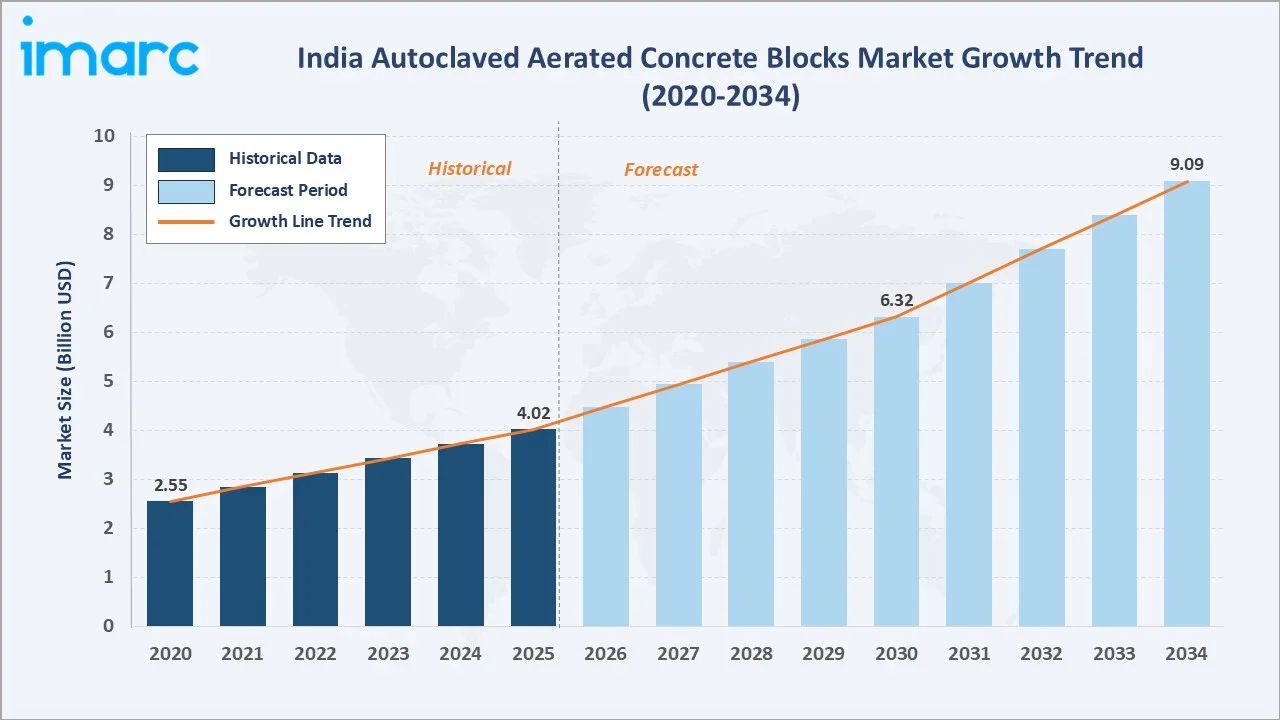
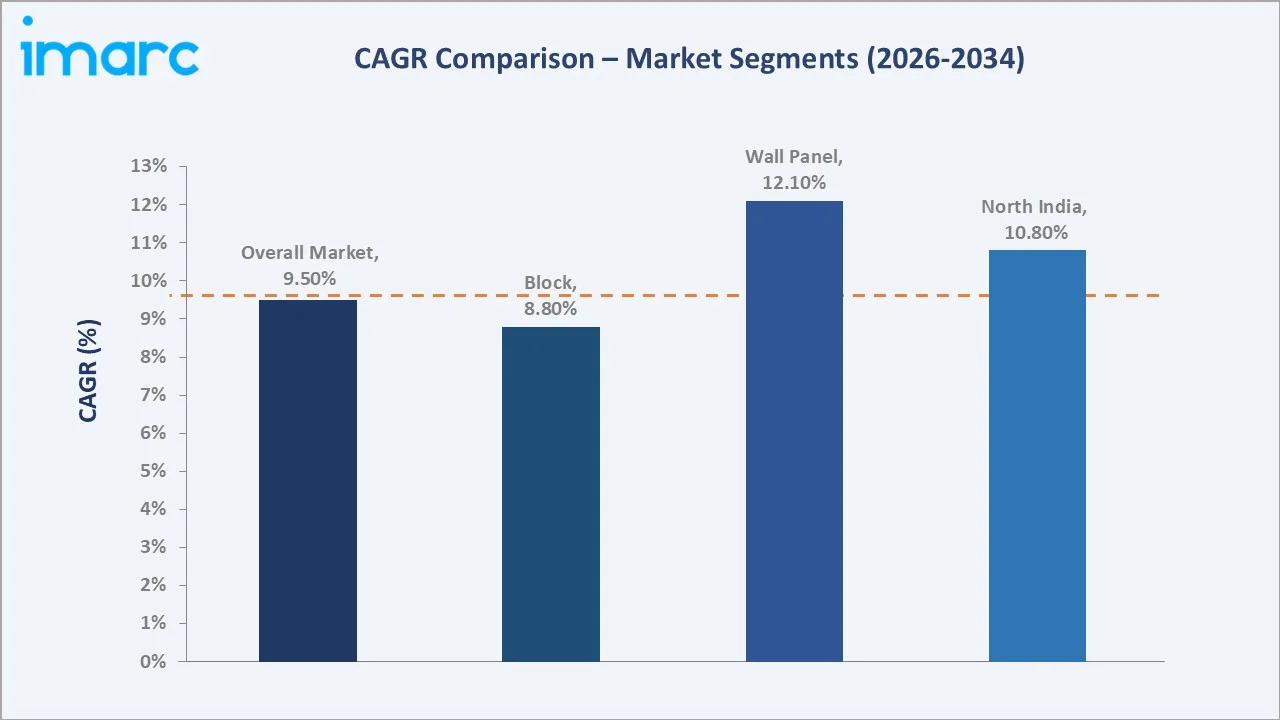
The India autoclaved aerated concrete (AAC) blocks market grew from USD 4.02 Billion in 2025 to USD 4.40 Billion in 2026 and is projected to reach USD 9.09 Billion by 2034, growing at a CAGR of 9.50% during 2026-2034. The market is driven by rapid urbanisation, PMAY affordable housing, green building mandates, and growing substitution of traditional clay bricks. Block product type dominates at 61.8%. Residential end use leads at 48.6%. North India commands 34.7% share.
Market Snapshot
|
Metric |
Value |
|
Base Year Market Size (2025) |
USD 4.02 Billion |
|
Market Size (2026) |
USD 4.40 Billion |
|
Forecast Market Size (2034) |
USD 9.09 Billion |
|
CAGR (2026-2034) |
9.50% |
|
Base Year |
2025 |
|
Historical Period |
2020-2025 |
|
Forecast Period |
2026-2034 |
|
Dominant Product Type |
Block (61.8%, 2025) |
|
Dominant End User |
Residential (48.6%, 2025) |
|
Leading Region |
North India (34.7%, 2025) |
The market expanded from USD 2.55 Billion in 2020 to USD 4.02 Billion in 2025 and an estimated USD 4.40 Billion in 2026, growing consistently through urbanisation and government housing investment. The market is anchored at USD 6.32 Billion in 2030 and forecast to reach USD 9.09 Billion by 2034.
To get more information on this market, Request Sample
Residential application grows steadily as PMAY and urban migration fuel housing starts across Tier-2 and Tier-3 cities. Commercial construction grows as AAC blocks gain acceptance in IT parks, retail, and hospitality projects across India's major metros.
Executive Summary
The India AAC blocks market size increased from USD 4.02 Billion in 2025 to USD 4.40 Billion in 2026, representing one of the construction sector's highest-growth segments driven by India's fundamental shift toward lightweight, sustainable walling solutions. The Block product type dominates at 61.8% as the standard walling unit across all construction categories.
Residential end use at 48.6% leads through PMAY-driven affordable housing and rapid urban expansion. North India at 34.7% leads regionally through Delhi-NCR construction activity and UP infrastructure investment. The market is projected to reach USD 9.09 Billion by 2034.
Key Market Insights
|
Insight |
Data |
|
Dominant Product Type |
Block – 61.8% share (2025) |
|
Dominant End User |
Residential – 48.6% market share (2025) |
|
Leading Region |
North India – 34.7% market share (2025) |
|
Market Opportunity |
Green building mandates; PMAY-driven housing; prefab AAC panels; industrial & infra expansion |
Key Analytical Observations Supporting the Above Data:
- Block at 61.8%: The Block segment dominates as it provides optimal strength, thermal insulation, and dimensional consistency for residential and commercial walling applications, making it the default AAC walling unit across India's construction industry. It offers superior compressive strength compared to traditional clay bricks and is widely specified in both affordable and premium housing projects.
- Residential at 48.6%: The residential segment leads through rapid urbanisation, government housing schemes, and growing developer preference for AAC blocks due to their faster construction speed and lower lifecycle cost versus clay bricks. PMAY has directly catalysed this adoption by incentivising use of green building materials in state-funded housing projects.
- North India at 34.7%: North India leads through concentrated construction activity in Delhi-NCR, Uttar Pradesh, and Rajasthan, supported by Smart Cities Mission, PMAY, and large-scale real estate project launches by national developers. The region's high concentration of AAC manufacturing capacity further supports supply adequacy and competitive pricing.
India AAC Blocks Market Overview
The India AAC blocks market encompasses the manufacture, distribution, and installation of autoclaved aerated concrete products across residential, commercial, industrial, and infrastructure construction applications throughout the country.
The ecosystem integrates fly ash suppliers, cement and lime producers, aluminium powder suppliers, AAC block manufacturers, equipment providers, quality testing bodies, distributors, and end-user builders. Macroeconomic factors include rising urbanisation, government infrastructure investment, energy efficiency mandates, and GST rationalisation for AAC products at 12%.
Market Dynamics
To evaluate market opportunities, Request Sample
Market Drivers
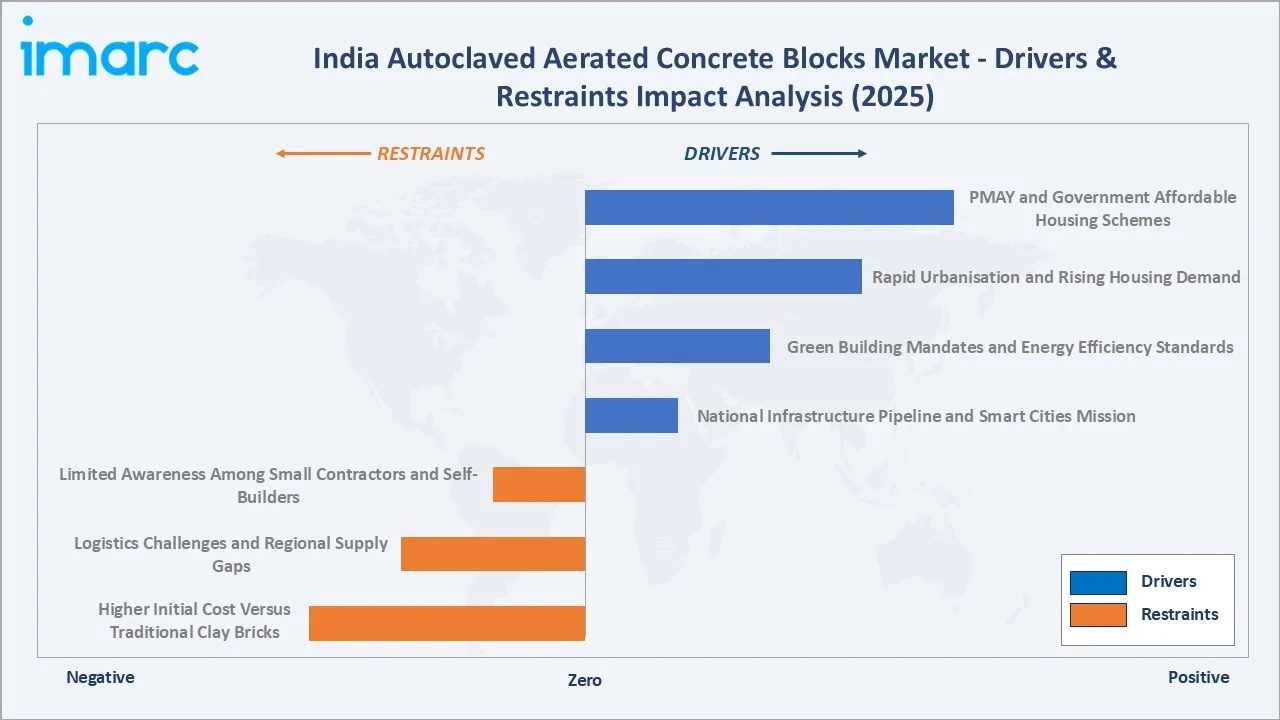
- PMAY and Government Affordable Housing Schemes: Pradhan Mantri Awas Yojana (PMAY) and associated state housing schemes are creating large-scale, sustained demand for AAC blocks across India. The programme mandates the use of green and energy-efficient building materials, directly driving AAC adoption in affordable housing construction across Tier-2 and Tier-3 cities. As of 2025, PMAY has sanctioned over 118 lakh houses under PMAY-Urban, generating significant volumes of walling material demand.
- Rapid Urbanisation and Rising Housing Demand: India's urban population exceeding 500 million by 2025 is driving sustained demand for residential and commercial construction. AAC blocks' faster installation speed and lower structural load versus clay bricks make them preferred for multi-storey and high-rise urban construction. India adds over 10 million urban households annually, each representing direct incremental demand for walling materials.
- Green Building Mandates and Energy Efficiency Standards: Stricter Bureau of Energy Efficiency (BEE) guidelines and GRIHA, LEED India, and IGBC green building rating system adoption are incentivising AAC block use for their superior thermal insulation, which is 3x better than clay bricks, reducing building energy consumption. India has over 10,000 green building projects registered under IGBC, all requiring energy-efficient walling materials.
- National Infrastructure Pipeline and Smart Cities Mission: India's National Infrastructure Pipeline of over USD 1.4 Trillion and Smart Cities Mission are driving large-scale commercial, institutional, and industrial construction, broadening the AAC blocks addressable market beyond residential applications. Smart Cities Mission projects across 100 cities are generating institutional and public building demand for AAC blocks.
Market Restraints
- Higher Initial Cost Versus Traditional Clay Bricks: AAC blocks carry a 10-15% price premium over conventional clay bricks, limiting adoption among low-income housing builders and small contractors with tight budgets, particularly in rural markets and smaller Tier-3 cities where clay brick availability remains high. The premium widens in regions with sparse AAC manufacturing plants, as logistics costs add to the delivered price differential.
- Logistics Challenges and Regional Supply Gaps: AAC blocks' bulk nature and fragility during transport increase logistics costs over long distances, limiting effective supply radius to 200-300 km from manufacturing plants. Sparse plant coverage in East India and remote areas creates supply gaps that restrict market penetration despite growing construction activity.
- Limited Awareness Among Small Contractors and Self-Builders: A significant share of India's construction activity is executed by small contractors and self-builders with limited awareness of AAC block technical advantages and proper installation methods, slowing adoption in unorganised residential construction. Incorrect use of traditional cement mortar instead of AAC-specific thin-bed compound is a persistent challenge that undermines thermal performance.
Market Opportunities
- Prefabricated AAC Panel Systems: Rising demand for faster construction timelines is creating a growing opportunity for larger-format prefabricated AAC wall panels, roof panels, and floor elements, which can reduce construction time and labour costs. AAC panels enable 30-40% faster construction versus block-by-block methods, making them highly attractive for RERA-deadline-constrained residential developers.
- Tier-2 and Tier-3 City Expansion: India's construction activity is expanding beyond metros into Tier-2 and Tier-3 cities through PMAY, Smart Cities, and AMRUT programmes, creating greenfield demand pools for AAC block manufacturers. Cities such as Lucknow, Indore, Coimbatore, Nagpur, and Bhubaneswar are experiencing construction booms currently underserved by AAC block supply infrastructure.
Market Challenges
- Fly Ash Availability and Quality Variability: AAC block manufacturing relies heavily on fly ash from coal-fired thermal power plants as the primary siliceous raw material. Regional fly ash availability constraints and competing demand from cement manufacturers can disrupt production planning and increase raw material cost volatility.
- Competition from Cellular Lightweight Concrete (CLC) Blocks: CLC blocks are gaining traction as a lower-capital-expenditure alternative to AAC blocks in some residential segments, creating competitive pressure on AAC manufacturers in price-sensitive markets. CLC block plants require significantly lower initial investment versus AAC autoclaving facilities, enabling regional entrepreneurs to establish competing capacity quickly.
Emerging Market Trends
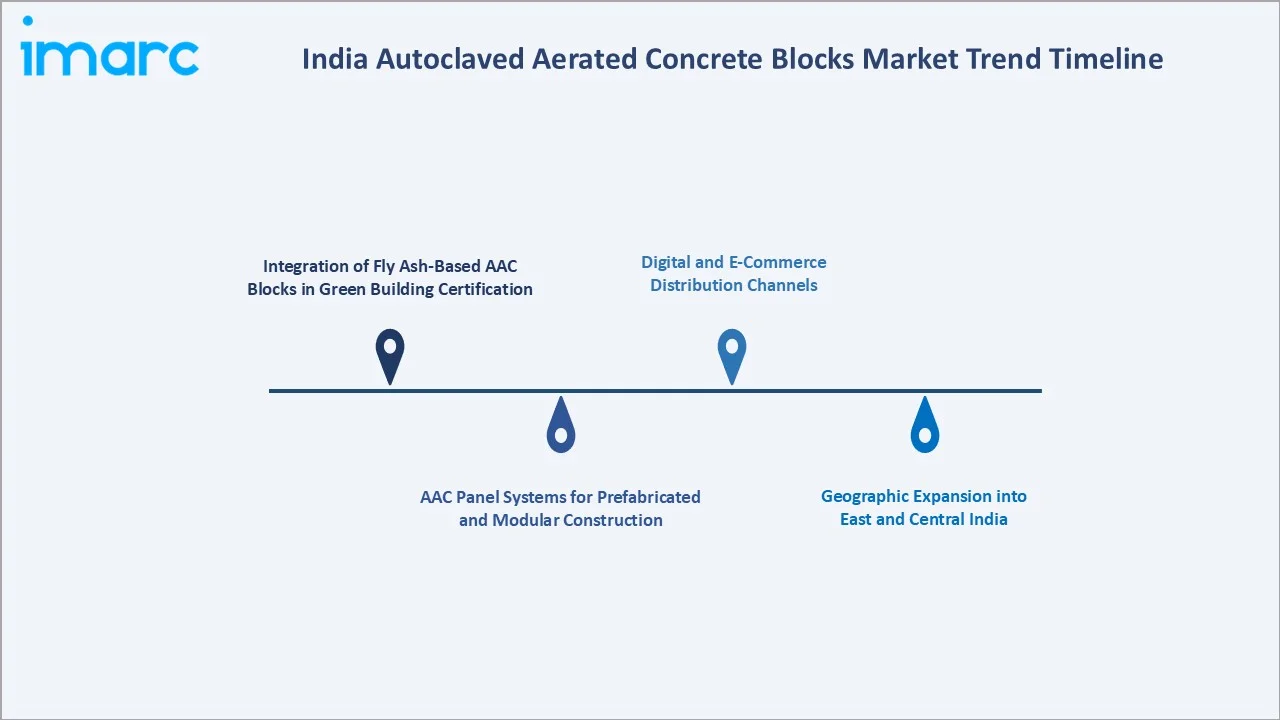
1. Integration of Fly Ash-Based AAC Blocks in Green Building Certification
AAC block manufacturers are increasingly positioning fly ash-based products for GRIHA, LEED India, and IGBC green building ratings, as fly ash utilisation reduces carbon emissions and supports circular economy goals. This creates premium demand from sustainability-focused real estate developers and government project clients requiring certified green building materials.
2. AAC Panel Systems for Prefabricated and Modular Construction
Roof panels, floor elements, and wall panels are emerging as growth segments as India's construction industry moves toward prefabricated building systems, reducing on-site labour intensity and construction timelines. Panel systems command a 15-25% price premium versus block products, improving manufacturer revenue per cubic metre.
3. Geographic Expansion into East and Central India
Leading manufacturers are establishing new plants in underserved states such as Odisha, Jharkhand, Madhya Pradesh, and Chhattisgarh to capture infrastructure-driven demand growth. BigBloc Construction's Indore land acquisition in February 2025 exemplifies this strategic trend toward geographic diversification.
4. Digital and E-Commerce Distribution Channels
Building material e-commerce platforms are creating new direct distribution channels for AAC blocks, enabling smaller manufacturers to reach a broader customer base while providing price transparency. Online specification tools and technical advisory services are emerging as digital engagement channels for architects and engineers.
Industry Value Chain Analysis
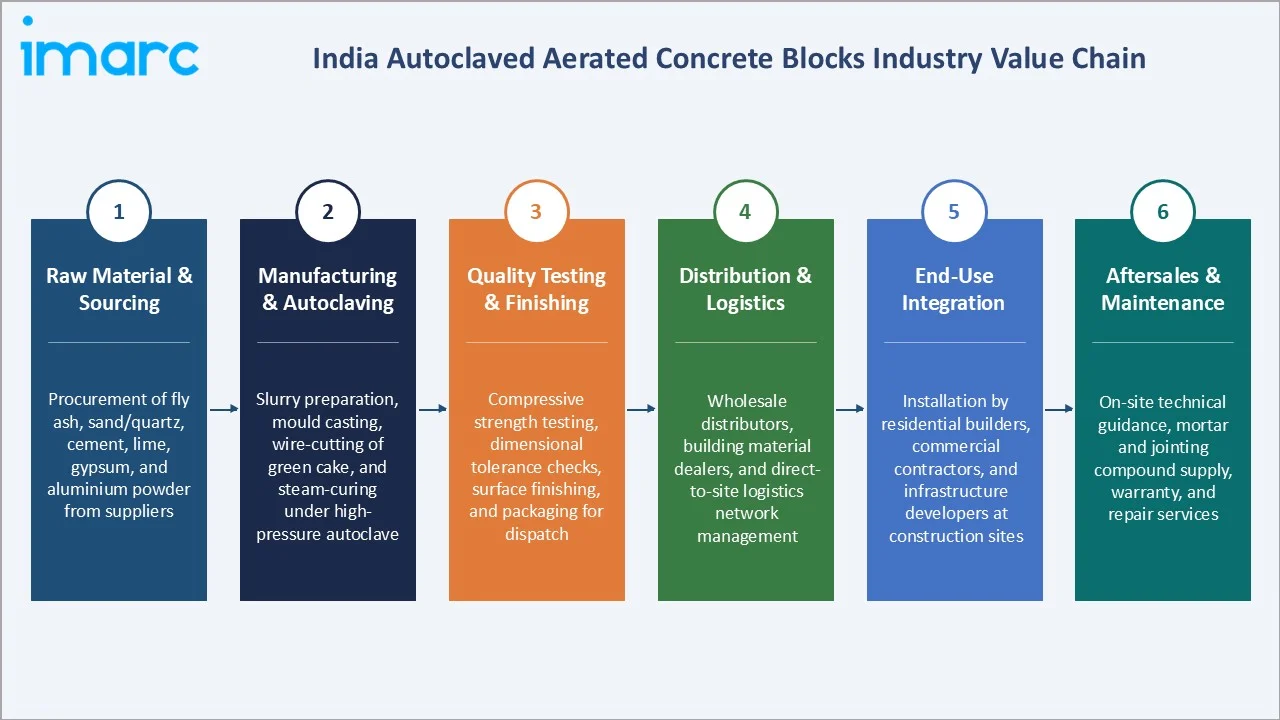
The AAC blocks value chain integrates raw material procurement, manufacturing, quality testing, distribution, and end-use installation. The value chain's commercial structure is consolidating as leading manufacturers integrate distribution and technical support functions to improve service quality and capture higher margins.
|
Stage |
Key Participants |
|
Raw Material & Sourcing |
Procurement of fly ash, sand/quartz, cement, lime, gypsum, and aluminium powder from suppliers |
|
Manufacturing & Autoclaving |
Slurry preparation, mould casting, wire-cutting of green cake, and steam-curing under high-pressure autoclave |
|
Quality Testing & Finishing |
Compressive strength testing, dimensional tolerance checks, surface finishing, and packaging for dispatch |
|
Distribution & Logistics |
Wholesale distributors, building material dealers, and direct-to-site logistics network management |
|
End-Use Integration |
Installation by residential builders, commercial contractors, and infrastructure developers at construction sites |
|
Aftersales & Maintenance |
On-site technical guidance, mortar and jointing compound supply, warranty, and repair services |
The manufacturing and autoclaving tier is the most capital-intensive stage, requiring autoclave pressure vessels and precision cutting equipment with investment of USD 5-20 million per plant. The distribution tier is most commercially sensitive, as logistics costs determine effective supply radius and regional competitive advantage.
Technology Landscape in the India AAC Blocks Industry
Fly Ash-Based AAC Technology
Fly ash-based AAC blocks utilise industrial by-product fly ash from thermal power plants as the primary siliceous material, reducing raw material cost and carbon footprint. This technology dominates India's AAC market and aligns with national fly ash utilisation mandates under the Environment Protection Act.
Sand/Quartz-Based AAC Technology
Sand or quartz powder-based AAC blocks are used in regions with limited fly ash availability, offering uniform raw material quality and dimensional consistency. These blocks typically command a slight price premium and are used in higher-specification commercial and industrial projects.
Autoclave Technology Advances
Modern autoclave systems with higher pressure and temperature precision improve product density uniformity, compressive strength consistency, and production cycle efficiency. Advanced cutting wire systems enable finer dimensional tolerances for large-format panel products, expanding AAC applications in prefab construction.
Market Segmentation Analysis
The report covers the following segments:
|
Segment Category |
Leading Segment |
Market Share |
Year |
|
Product Type |
Block |
61.8% |
2025 |
|
Application |
🔒 |
🔒 |
2025 |
|
End User |
Residential |
48.6% |
2025 |
|
Region |
North India |
34.7% |
2025 |

By Product Type
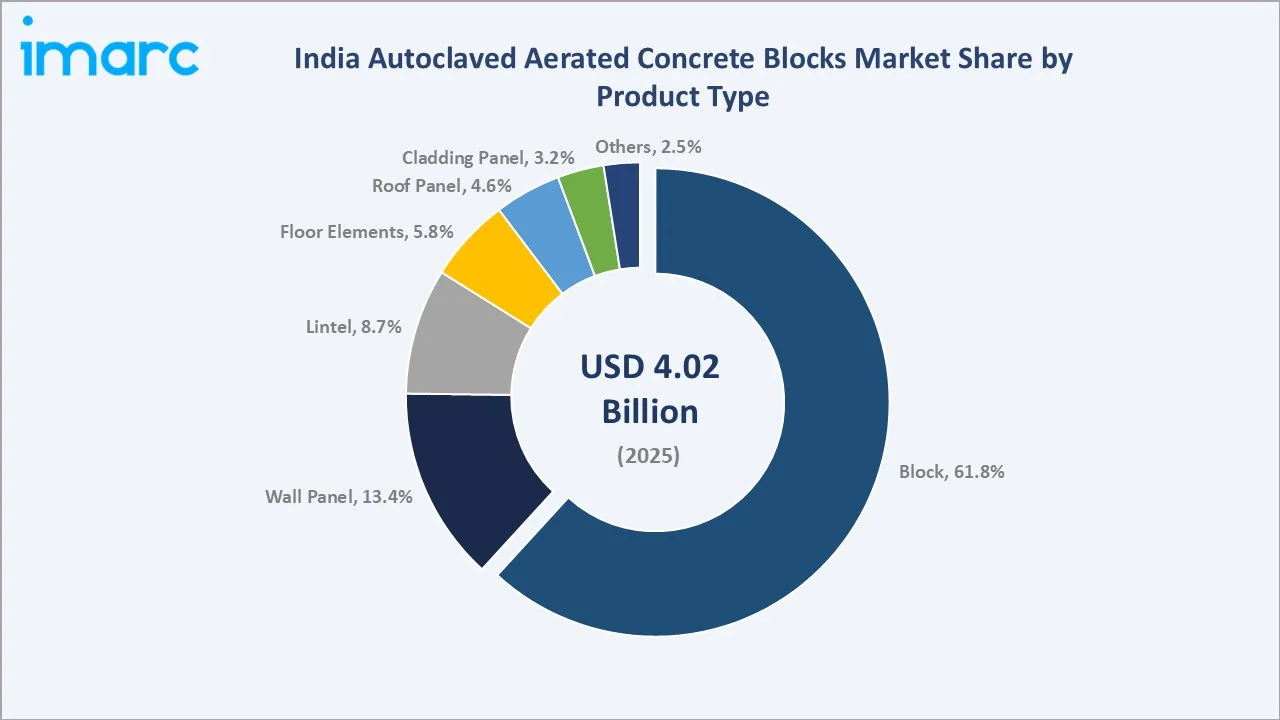
The Block segment leads at 61.8% in 2025, capturing the standard walling unit application across all construction categories as the most commercially mature and widely specified AAC product in India's construction market.
To access detailed market analysis, Request Sample
Wall Panel at 13.4% is the fastest-growing product sub-segment as prefabricated construction adoption increases. Lintel at 8.7% captures structural beam replacement applications. Floor Elements at 5.8% and Roof Panel at 4.6% serve prefab construction, while Cladding Panel at 3.2% addresses facade applications.
By End User
Residential leads at 48.6% through PMAY housing, urban residential development, and self-build market adoption driven by AAC blocks' faster construction and lower structural load advantages versus clay brick alternatives.
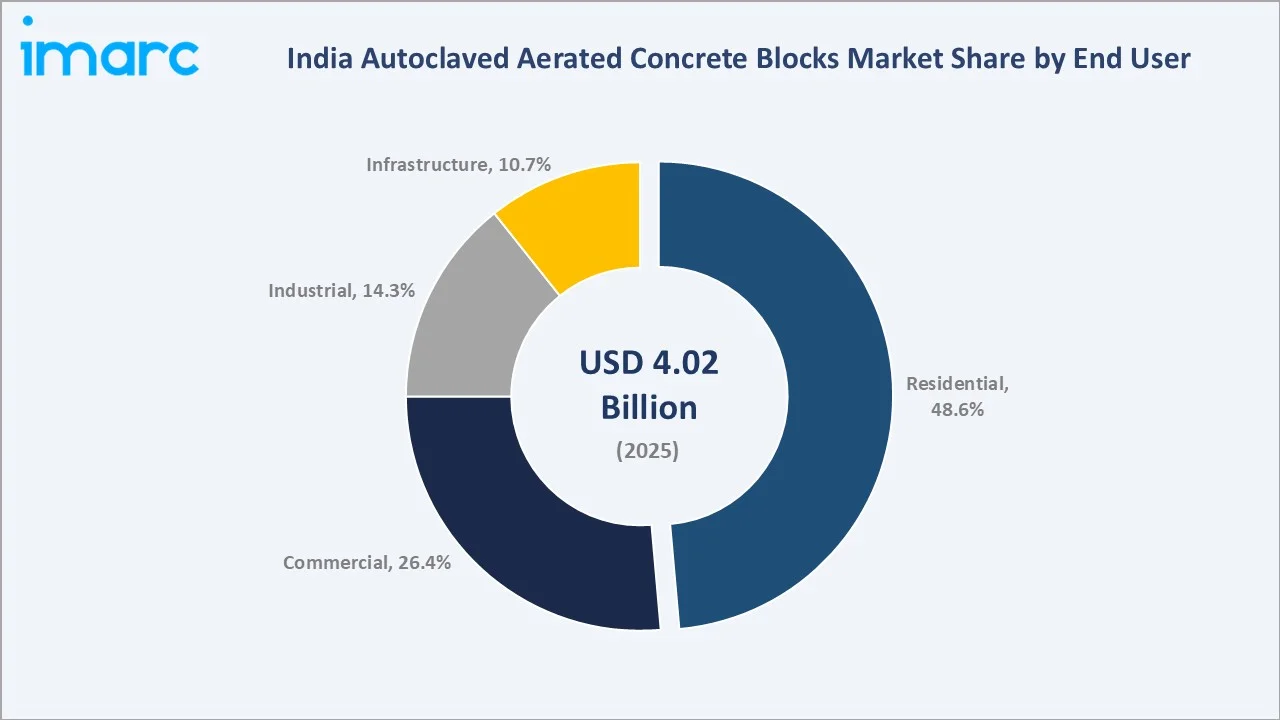
Commercial at 26.4% reflects IT park, retail, and office construction. Industrial at 14.3% captures factory and warehouse construction driven by PLI scheme investments. Infrastructure at 10.7% includes institutional buildings, government facilities, and public sector projects.
Regional Market Insights
|
Region |
Share (2025) |
Key AAC Blocks Market Drivers & Characteristics |
|
North India |
34.7% |
Driven by construction boom in Delhi-NCR, Uttar Pradesh, and Rajasthan; PMAY affordable housing schemes and Smart Cities Mission fuelling sustained demand |
|
South India |
31.8% |
Strong commercial and IT corridor construction in Bengaluru, Hyderabad, and Chennai; growing green building adoption in residential and institutional projects |
|
West India |
20.6% |
Mumbai Metropolitan Region and Pune driving residential demand; Gujarat industrial corridors adding commercial and warehousing construction volume |
|
East India |
12.9% |
Emerging growth led by Kolkata and Bhubaneswar; government infrastructure investment improving AAC block adoption across residential and public sector projects |
North India, at 34.7%, leads through Delhi-NCR's sustained construction volumes and UP, Haryana, Rajasthan infrastructure investment. South India, at 31.8%, reflects Bengaluru and Hyderabad IT corridor construction growth and growing green building adoption.
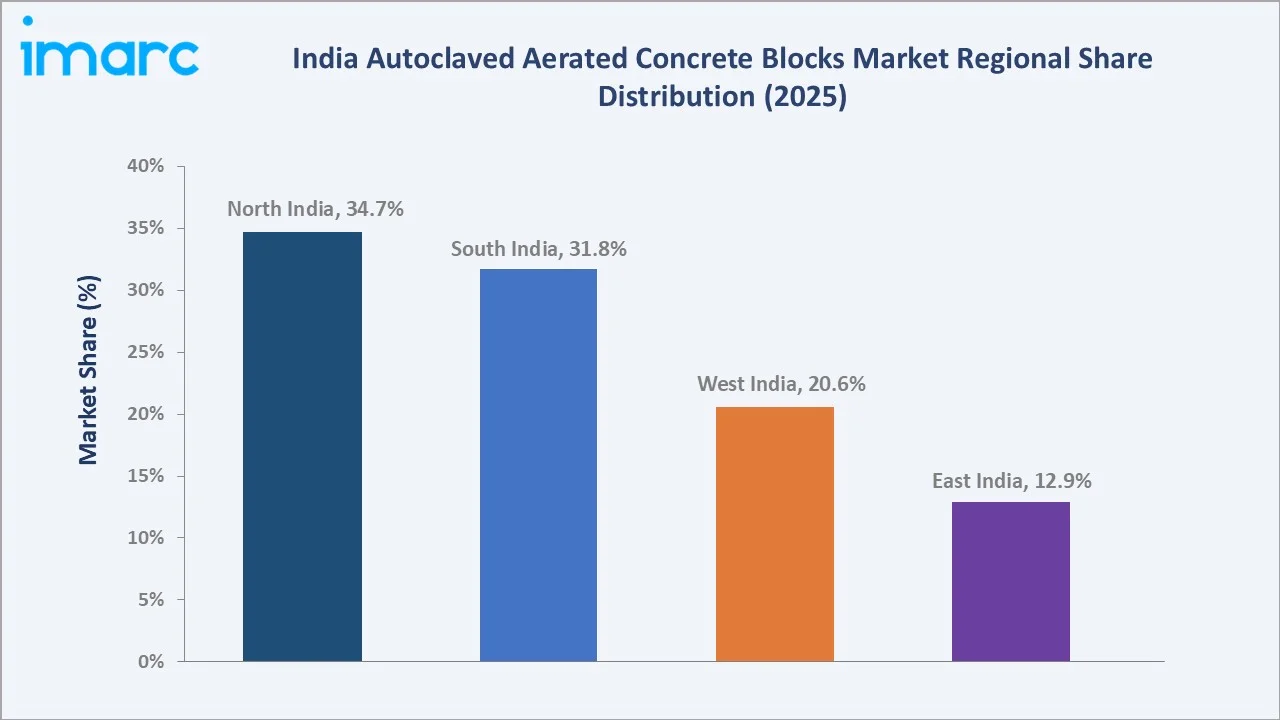
West India, at 20.6%, reflects Mumbai Metropolitan Region housing demand and Gujarat industrial development. East India, at 12.9%, is the fastest-growing region driven by emerging infrastructure investment in Odisha, Jharkhand, and West Bengal under the National Infrastructure Pipeline.
Competitive Landscape
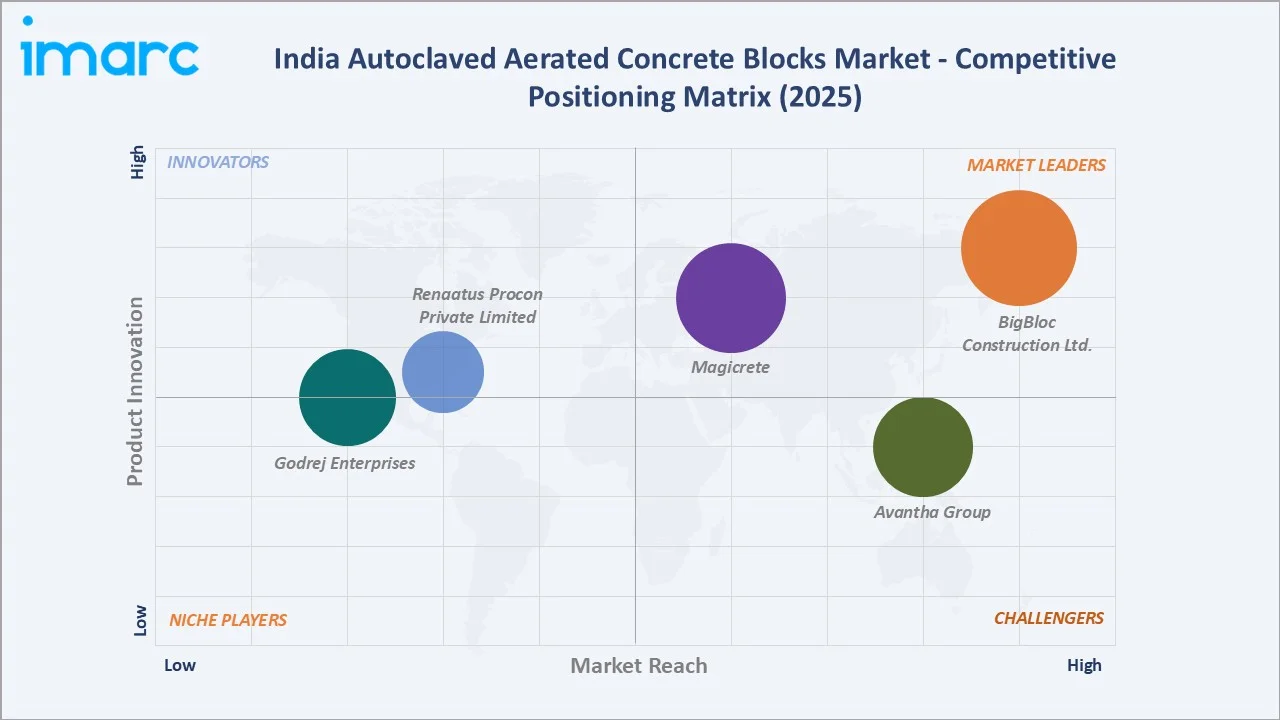
The India AAC blocks market is moderately fragmented, with national market leaders, strong regional challengers, and a large base of local manufacturers. National players hold an estimated combined market share of 35-45% with the remainder shared among regional and local producers operating within limited geographic radii.
|
Company Name |
Key Products |
Market Position |
Core Strength |
|
BigBloc Construction Ltd. |
NXTBLOC Autoclaved Aerated Concrete (AAC) Blocks |
Market Leader |
One of India's largest listed AAC block manufacturers, with pan-India capacity expansion strategy. |
|
Magicrete |
AAC Blocks, AAC Panels |
Market Leader |
Gujarat-based AAC block manufacturer with a vast distribution network |
|
Avantha Group |
AAC Blocks, AAC Wall Panels |
Strong Challenger |
Biltech Building Elements, part of the Avantha Group, with plants across North and South India and a strong presence in government and large real estate projects |
|
Renaatus Procon Private Limited |
Renacon AAC Blocks |
Established Player |
Leading South India-based manufacturer headquartered in Coimbatore with strong presence in Maharashtra, Gujarat, and western India |
|
Godrej Enterprises |
Tuff AAC Blocks |
Established Player |
Godrej manufactures fire-resistant, lightweight AAC blocks |
Key players include BigBloc Construction Ltd., Magicrete, Avantha Group, Renaatus Procon Private Limited, Godrej Enterprises, and others.
Key Company Profiles
BigBloc Construction Ltd.
BigBloc Construction Ltd. is an India-based, listed manufacturer of AAC blocks and panels operating through its subsidiaries StarBigBloc Building Material and other entities, with manufacturing capacity across Gujarat and an expanding pan-India presence through strategic land acquisitions.
- Key Products: AAC Blocks, Wall Panels, Prefabricated AAC Elements, Jointing Mortar.
- Recent Developments: In February 2025, BigBloc Construction's subsidiary StarBigBloc Building Material announced the acquisition of land in Indore, Madhya Pradesh to set up a new AAC block manufacturing plant, strengthening its Central India presence and geographic diversification strategy.
- Strategic Focus: Geographic expansion beyond Gujarat into Central and North India through new plant investments in under-served markets with growing construction demand. The company is deepening its product portfolio into prefabricated AAC panel systems and construction chemicals to capture premium segment revenues. BigBloc is also investing in brand and distributor development programmes to strengthen dealer loyalty in newer geographic markets.
Magicrete
Magicrete is a Gujarat-based leading AAC block and construction chemicals manufacturer with one of India's largest AAC block production capacities.
- Key Products: AAC Blocks, AAC Wall Panels, Construction Chemicals, Tile Adhesives, Waterproofing Solutions.
- Recent Developments: In March 2024, Magicrete completed the acquisition of a majority stake in Maxlite, boosting its total AAC block production capacity to 1.8 million cubic meters annually and establishing a significant manufacturing footprint in South India's rapidly growing construction market.
- Strategic Focus: Pan-India capacity expansion through organic plant investment and strategic acquisitions targeting under-served geographic markets, particularly in South and East India where Magicrete is strengthening distribution networks. The company is extending its product portfolio into AAC panel systems and construction chemicals to diversify revenue streams. Magicrete is also investing in technical training centres to improve mason proficiency in AAC block installation.
Market Concentration Analysis
The India AAC blocks market is moderately fragmented at the national level, with the key players collectively accounting for approximately 35-45% of organised sector revenue. Regional and local manufacturers account for the remaining 55-65% by volume, operating within limited geographic supply radii.
Market concentration is expected to increase modestly over the forecast period as leading national players expand capacity and invest in brand and distribution infrastructure that smaller regional players cannot easily replicate.
Investment & Growth Opportunities
Highest Growth Segments
Wall Panel (~12.1% CAGR), Roof Panel (~11% CAGR), Floor Elements (~10% CAGR), Infrastructure end-use (~13% CAGR), and East India regional market (~14% CAGR) represent the highest-growth investment vectors through 2034 in the India AAC blocks market.
Emerging Investment Opportunities
East India represents the AAC blocks market's highest-growth geographic opportunity, with states such as Odisha, Jharkhand, and West Bengal undergoing rapid infrastructure development under NIP. Current supply capacity in these states is inadequate to address projected demand, creating first-mover advantages for regional plant investors.
Investment Themes
- Integrated prefab AAC panel manufacturing: Investing in larger-format wall and roof panel production lines to capture the growing prefabricated construction segment, which commands a 15-25% price premium above standard block products while reducing on-site labour requirements for developers.
- Tier-2 and Tier-3 city distribution network development: Building logistics and dealer networks in India's rapidly urbanising secondary cities to capture demand pools currently underserved by national AAC block manufacturers, before regional competition intensifies.
Future Market Outlook (2026-2034)
The India AAC blocks market is projected to grow from USD 4.02 Billion in 2025 to USD 4.40 Billion in 2026, reaching USD 9.09 Billion by 2034, delivering a 9.50% CAGR. The market's anchor value of USD 6.32 Billion in 2030 reflects AAC blocks consolidating mainstream status across residential, commercial, industrial, and infrastructure construction categories.
Three structural forces define AAC blocks market growth through 2034. India's housing deficit of over 18 million units creates a structural demand floor for residential construction materials. Infrastructure investment under NIP broadens AAC blocks' addressable market into commercial and institutional construction. Green building mandates accelerate substitution of traditional clay bricks in regulated construction.
Research Methodology
Primary Research
Primary research comprised structured interviews with 45+ industry stakeholders (2025), including AAC block plant managers, construction material procurement heads, real estate developers, government project contractors, and building material distributors across India.
Secondary Research
Secondary research encompassed company annual reports; Ministry of Housing and Urban Affairs PMAY data; Bureau of Indian Standards IS 2185 Part 3; National Infrastructure Pipeline project database; BEE ECBC compliance reports; IGBC and GRIHA green building databases. Over 50 secondary sources reviewed.
Forecasting Models
Market revenue forecasts developed using construction activity-based bottom-up model: (i) national housing start projections by category and region; (ii) AAC block penetration rate by construction type; (iii) average block revenue per square metre of construction; (iv) product mix premium adjustments for panel and speciality products.
India Autoclaved Aerated Concrete Blocks Market Report Coverage:
| Report Features | Details |
|---|---|
| Base Year of the Analysis | 2025 |
| Historical Period | 2020-2025 |
| Forecast Period | 2026-2034 |
| Units | Billion USD |
| Scope of the Report |
Exploration of Historical Trends and Market Outlook, Industry Catalysts and Challenges, Segment-Wise Historical and Future Market Assessment:
|
| Product Types Covered | Block, Lintel, Floor Elements, Roof Panel, Wall Panel, Cladding Panel, Others |
| Applications Covered | Construction Materials, Road Construction, Roof Insulation, Bridge Sub-Structure, Void Filling, Others |
| End Users Covered | Residential, Commercial, Industrial, Infrastructure |
| Regions Covered | North India, South India, East India, West India |
| Companies Covered | BigBloc Construction Ltd., Magicrete, Avantha Group, Renaatus Procon Private Limited, Godrej Enterprises, etc. |
| Customization Scope | 10% Free Customization |
| Post-Sale Analyst Support | 10-12 Weeks |
| Delivery Format | PDF and Excel through Email (We can also provide the editable version of the report in PPT/Word format on special request) |
Key Benefits for Stakeholders:
- IMARC’s industry report offers a comprehensive quantitative analysis of various market segments, historical and current market trends, market forecasts, and dynamics of the India autoclaved aerated concrete blocks market from 2020-2034.
- The research report provides the latest information on the market drivers, challenges, and opportunities in the India autoclaved aerated concrete blocks market.
- Porter's five forces analysis assist stakeholders in assessing the impact of new entrants, competitive rivalry, supplier power, buyer power, and the threat of substitution. It helps stakeholders to analyze the level of competition within the India autoclaved aerated concrete blocks industry and its attractiveness.
- Competitive landscape allows stakeholders to understand their competitive environment and provides an insight into the current positions of key players in the market.
Frequently Asked Questions About the India Autoclaved Aerated Concrete Blocks Market Report
The India AAC blocks market size is estimated at USD 4.40 Billion in 2026, driven by the Block product type dominant at 61.8%, Residential end-use leading at 48.6%, and North India commanding 34.7% regional share. The market is supported by rapid urbanisation, green building mandates, and progressive substitution of traditional clay bricks across India's construction industry.
The India AAC blocks market grows at 9.50% CAGR during 2026-2034, reaching USD 9.09 Billion by 2034. This growth reflects sustained housing demand, National Infrastructure Pipeline investment, expanding green building adoption, and progressive AAC penetration into Tier-2 and Tier-3 city markets.
The Block segment leads at 61.8% in 2025, capturing the standard walling unit application across residential, commercial, and industrial construction as the most commercially mature AAC product in India. The Block format benefits from standardised specifications, widespread contractor familiarity, and established supply chains.
Residential leads at 48.6% through PMAY-driven affordable housing, urban residential development, and growing self-build market adoption. India's ongoing housing deficit of over 18 million units provides a structural demand floor for residential walling materials through the 2034 forecast horizon.
North India leads at 34.7% through concentrated construction activity in Delhi-NCR, Uttar Pradesh, and Rajasthan, supported by Smart Cities Mission, PMAY, and large-scale real estate project launches. The region's high concentration of AAC manufacturing capacity supports competitive supply.
Leading companies include BigBloc Construction Ltd., Magicrete, Avantha Group, Renaatus Procon Private Limited, Godrej Enterprises, and others.
The India AAC blocks market is projected to reach USD 6.32 Billion by 2030, supported by continued urbanisation, green building initiatives, National Infrastructure Pipeline development, and increasing geographic penetration of AAC blocks into East and Central India markets.
Three priority investment opportunities: integrated prefab AAC panel manufacturing targeting RERA-constrained residential developers; Tier-2 and Tier-3 city plant investment capturing under-served geographic demand; and East India regional capacity expansion capturing NIP infrastructure-driven construction demand in Odisha, Jharkhand, and West Bengal.
Need more help?
- Speak to our experienced analysts for insights on the current market scenarios.
- Include additional segments and countries to customize the report as per your requirement.
- Gain an unparalleled competitive advantage in your domain by understanding how to utilize the report and positively impacting your operations and revenue.
- For further assistance, please connect with our analysts.
 Request Customization
 Speak to an Analyst
 Request Brochure
 Inquire Before Buying
Benefits of Customization
- Personalize this research
- Triangulate with your data
- Get data as per your format and definition
- Gain a deeper dive into a specific application, geography, customer, or competitor
- Any level of personalization
Get in Touch With Us
UNITED STATES
Phone: +1-201-971-6302
INDIA
Phone: +91-120-433-0800
UNITED KINGDOM
Phone: +44-753-714-6104
Email: [email protected]
Client Testimonials




.webp)




.webp)













Related Reports

Choose your plan
*Please note that the prices mentioned below are starting prices for each bundle type. Kindly contact our team for further details.*
Single User License
- 1 User License, Access on 2 Devices
- PDF Report + Excel Dataset (Password Protected)
- Lifetime Access
- No Printing Rights
- 10% Free Report Customization
- 10–12 Weeks of Analyst Support
Five User License
- Access for 5 Users, 2 Devices per User
- PDF Report + Excel Dataset (Password Protected)
- Lifetime Access
- Dedicated Account Manager
- 12–14 Weeks of Analyst Support
- No Printing Rights
- 15% Free Report Customization
- 25% Discount on Your Next Purchase
Corporate User License
- Unlimited User Access (Within Your Organization)
- PDF Report + Excel Dataset
- Lifetime Access
- Dedicated Account Manager
- 14–20 Weeks of Analyst Support
- No Printing Rights
- 20% Free Report Customization
- 30% Discount on Your Next Purchase
Essential Insights
What's included:
3 reports
- Lifetime Access
- PDF Reports
- Excel Datasets
- 2 Weeks of Free Analyst Support
- 2 User Licenses
- Access on 2 Devices
- Printing Rights
- Complimentary PowerPoint (PPT) Version
- Complimentary License Upgrade
Professional Access
What's included:
5 reports
- Lifetime Access
- PDF Reports
- Excel Datasets
- 8 Weeks of Free Analyst Support
- 2 User Licenses
- Access on 2 Devices
- Printing Rights
- Complimentary PowerPoint (PPT) Version
- Complimentary License Upgrade
Business Advantage
What's included:
8 reports
- Lifetime Access
- PDF Reports
- Excel Datasets
- 14 Weeks of Free Analyst Support
- 2 User Licenses
- Access on 2 Devices
- Printing Rights
- Complimentary PowerPoint (PPT) Version
- Complimentary License Upgrade
Enterprise Intelligence
What's included:
10 reports
- Lifetime Access
- PDF Reports
- Excel Datasets
- 20 Weeks of Free Analyst Support
- 2 User Licenses
- Access on 2 Devices
- Printing Rights
- Complimentary PowerPoint (PPT) Version
- Complimentary License Upgrade