
India Biomass Market Size, Share, Trends and Forecast by Feedstock, Application, and Region, 2026-2034
India Biomass Market Size, Share, Trends & Forecast (2026-2034)
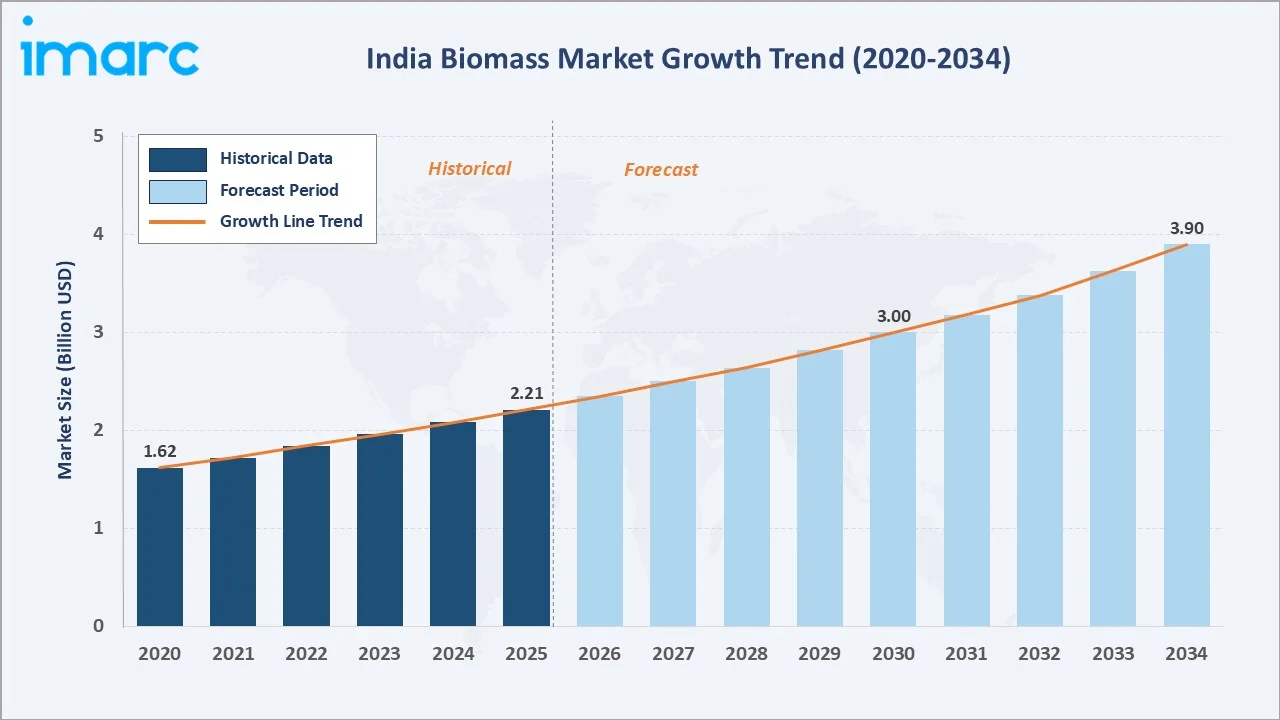
The India biomass market size increased from USD 2.21 Billion in 2025 to USD 2.35 Billion in 2026 and is projected to reach USD 3.90 Billion by 2034, growing at a CAGR of 6.34% during 2026-2034. Government incentives, rising energy demand, abundant biomass availability, technological advancements, and growing environmental concerns are key drivers in the market. Additionally, increased investments in waste-to-energy projects, supportive policies, and the push for sustainable alternatives to fossil fuels are expanding India biomass market share.
Agriculture Waste dominates feedstock at 61.8%, Power Generation leads application at 72.4%, and North India commands 36.8% of the regional share.
Market Snapshot
|
Metric |
Value |
|
Base Year Market Size (2025) |
USD 2.21 Billion |
|
Market Size (2026) |
USD 2.35 Billion |
|
Forecast Market Size (2034) |
USD 3.90 Billion |
|
CAGR (2026-2034) |
6.34% |
|
Base Year |
2025 |
|
Historical Period |
2020-2025 |
|
Forecast Period |
2026-2034 |
|
Dominant Feedstock |
Agriculture Waste (61.8%, 2025) |
|
Dominant Application |
Power Generation (72.4%, 2025) |
|
Leading Region |
North India (36.8%, 2025) |
The India biomass market grew from USD 1.62 Billion in 2020 to USD 2.21 Billion in 2025 and an estimated USD 2.35 Billion in 2026, anchored at USD 3.00 Billion in 2030 and forecast to reach USD 3.90 Billion by 2034. India's surplus biomass availability of approximately 228 MMT per annum provides a strong feedstock foundation, while the National Bio-Energy Mission and SATAT programme underpin structural demand growth across the forecast period.
To get more information on this market, Request Sample
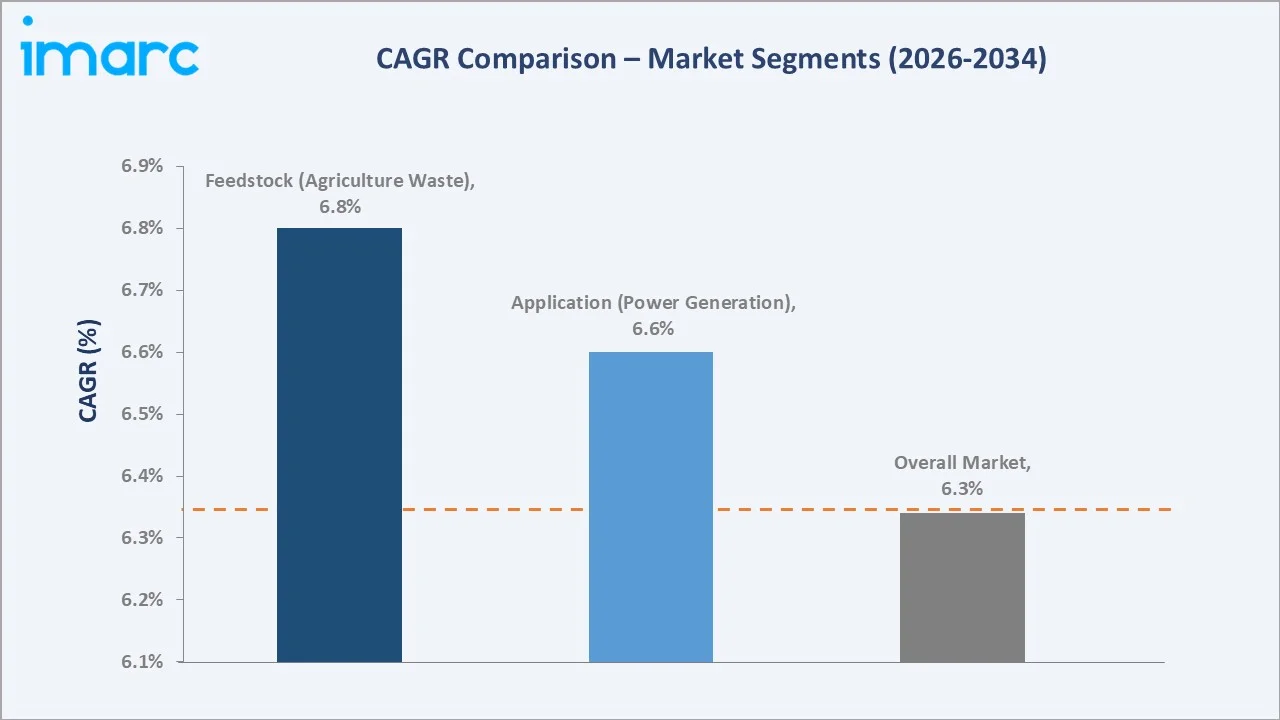
Power Generation application grows at ~6.6% CAGR as India's renewable capacity addition targets mandate increasing biomass contributions. Agriculture Waste feedstock maintains dominance, supported by stubble-burning regulations that redirect crop residue from an environmental liability toward productive energy generation across India's agricultural states.
Executive Summary
The India biomass market expanded from USD 2.21 Billion in 2025 to an estimated USD 2.35 Billion in 2026 representing one of India's most dynamic renewable energy segments driven by the country's vast agricultural residue base and strong policy support framework. The market is projected to reach USD 3.90 Billion by 2034 at a CAGR of 6.34% during 2026-2034.
Agriculture Waste at 61.8% dominates feedstock through India's 228 MMT annual biomass surplus from crop residues, primarily rice straw, wheat stubble, and sugarcane bagasse. Power Generation at 72.4% leads application through biomass-based electricity's dual role in renewable capacity addition and rural electrification. North India at 36.8% leads regionally through Punjab, Haryana, and Uttar Pradesh's concentrated agricultural residue availability and existing power plant infrastructure.
Key Market Insights
|
Insight |
Data |
|
Dominant Feedstock |
Agriculture Waste - 61.8% share (2025) |
|
Dominant Application |
Power Generation - 72.4% market share (2025) |
|
Leading Region |
North India - 36.8% market share (2025) |
|
Market Opportunity |
Bio-CNG under SATAT; biomass co-firing mandates; advanced gasification; green hydrogen integration |
Key Analytical Observations Supporting The Above Data:
- Agriculture Waste at 61.8%: Agriculture Waste dominates as India produces approximately 750 MMT of biomass annually, of which 228 MMT surplus is available for energy conversion, providing a low-cost, decentralized feedstock base across major agricultural states including Punjab, Haryana, Uttar Pradesh, and Maharashtra.
- Power Generation at 72.4%: Power Generation leads as biomass-based electricity offers firm, dispatchable renewable power complementing intermittent solar and wind in India's energy mix, with over 10 GW installed biomass capacity supporting grid stability and rural electrification objectives.
- North India at 36.8%: North India leads due to Punjab, Haryana, and Uttar Pradesh's high crop residue generation, existing biomass power plant concentration, and government programs targeting stubble burning reduction through productive biomass energy utilization.
India Biomass Market Overview
The India biomass market encompasses the production, processing, and utilization of organic materials, including agricultural residues, forestry waste, solid municipal waste, and energy crops, for heat, electricity, and bio-based fuel generation across residential, industrial, and grid-connected applications.
The ecosystem integrates feedstock aggregators, pellet and biogas producers, biomass power plant operators, technology providers, and regulatory bodies under the Ministry of New and Renewable Energy (MNRE). Macroeconomic factors include rising fossil fuel import costs, India's 500 GW renewable energy target by 2030, government subsidies under the National Bio-Energy Mission, and increasing rural electrification demand in underserved regions.
Market Dynamics
To evaluate market opportunities, Request Sample
Market Drivers
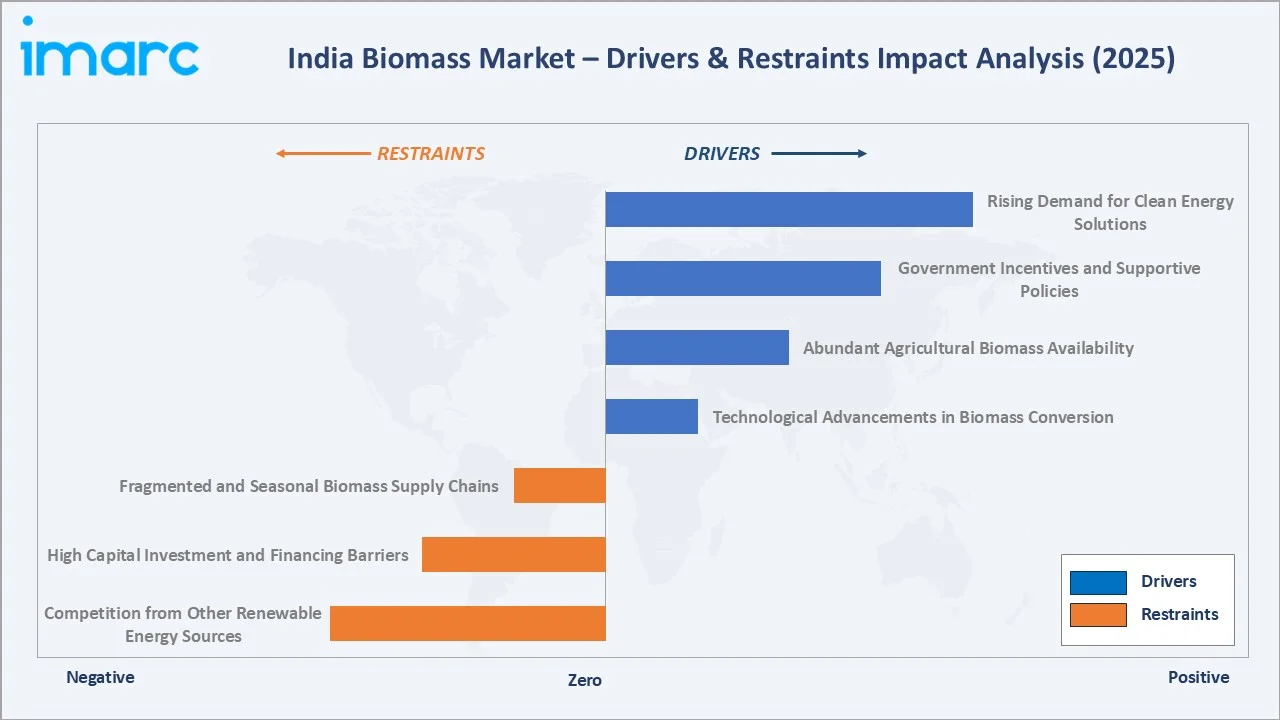
- Rising Demand for Clean Energy Solutions: Rising demand for clean and sustainable energy solutions is driving the India biomass market. India's 500 GW renewable energy target and net-zero 2070 commitment mandate diversified renewable sources. Biomass offers firm, dispatchable power directly supporting grid stability alongside intermittent solar and wind capacity additions across the country.
- Government Incentives and Supportive Policies: Government incentives and supportive policies, including the National Bio-Energy Mission (NBEM), SATAT programme, and MNRE biomass co-firing mandate requiring 5% biomass blending in thermal plants, are structurally expanding biomass demand. Financial incentives such as capital subsidies, viability gap funding, and concessional loans reduce project development barriers and improve bankability.
- Abundant Agricultural Biomass Availability: India produces approximately 750 MMT of biomass annually with 228 MMT surplus available, providing an extensive and low-cost feedstock base. Agricultural residues, including rice straw, wheat stubble, and sugarcane bagasse, are distributed across major farming states, enabling decentralized biomass energy production at competitive costs.
- Technological Advancements in Biomass Conversion: Technological innovations in gasification, anaerobic digestion, and pyrolysis are improving conversion efficiency and reducing operational costs. The DST-IIT Delhi-Thermax collaboration to launch India's first CO2-to-methanol pilot plant represents advanced biomass conversion technology development, supporting broader market expansion.
Market Restraints
- Fragmented and Seasonal Biomass Supply Chains: Biomass feedstock supply chains are fragmented and seasonal, with availability concentrated during post-harvest periods. Inconsistent feedstock quality, high transportation costs, and logistical challenges in aggregating dispersed agricultural residues from smallholder farms increase operational costs and limit plant capacity utilization across the year.
- High Capital Investment and Financing Barriers: Biomass power plants and bio-CNG facilities require significant upfront capital investment, with limited access to project financing in rural areas. High interest rates and limited tenure of debt financing make project economics challenging for smaller developers, restricting overall capacity expansion in India's biomass energy sector.
- Competition from Other Renewable Energy Sources: India's rapidly expanding solar and wind energy capacity, driven by declining installation costs, presents competitive alternatives to biomass energy. While biomass power's dispatchability provides an advantage, declining renewable costs continue to exert pricing pressure on biomass-based electricity tariffs and project returns.
Market Opportunities
- Bio-CNG Expansion under SATAT Programme: The SATAT programme targets establishing 5,000 compressed biogas plants in India, generating 15 MMT of bio-CNG annually. Agri-waste bio-CNG facilities represent high-value opportunities converting agricultural residues into transportation and industrial fuel with government-backed offtake agreements supporting project bankability.
- Biomass Co-firing in Thermal Power Plants: MNRE's biomass co-firing mandate requiring thermal power plants to blend 5% biomass pellets creates large-scale, structured demand for pelletized agricultural residues. NLCIL's biomass co-firing trial at Barsingsar Thermal Power Station demonstrates policy-driven demand potential across India's existing thermal generation fleet.
Market Challenges
- Feedstock Quality Standardization: Ensuring consistent feedstock quality across diverse agricultural residue types requires pre-processing investments in pelletization and drying infrastructure, increasing the complexity and cost of biomass supply chain management and reducing conversion efficiency when feedstock specifications vary between supply batches.
- Regulatory Complexity and Policy Uncertainty: India's biomass energy sector operates under multiple overlapping central and state government regulations, including MNRE guidelines, state electricity commission tariff orders, and environmental clearance requirements. Regulatory complexity and policy uncertainty create project development risks that deter private investment in new biomass capacity.
Emerging Market Trends
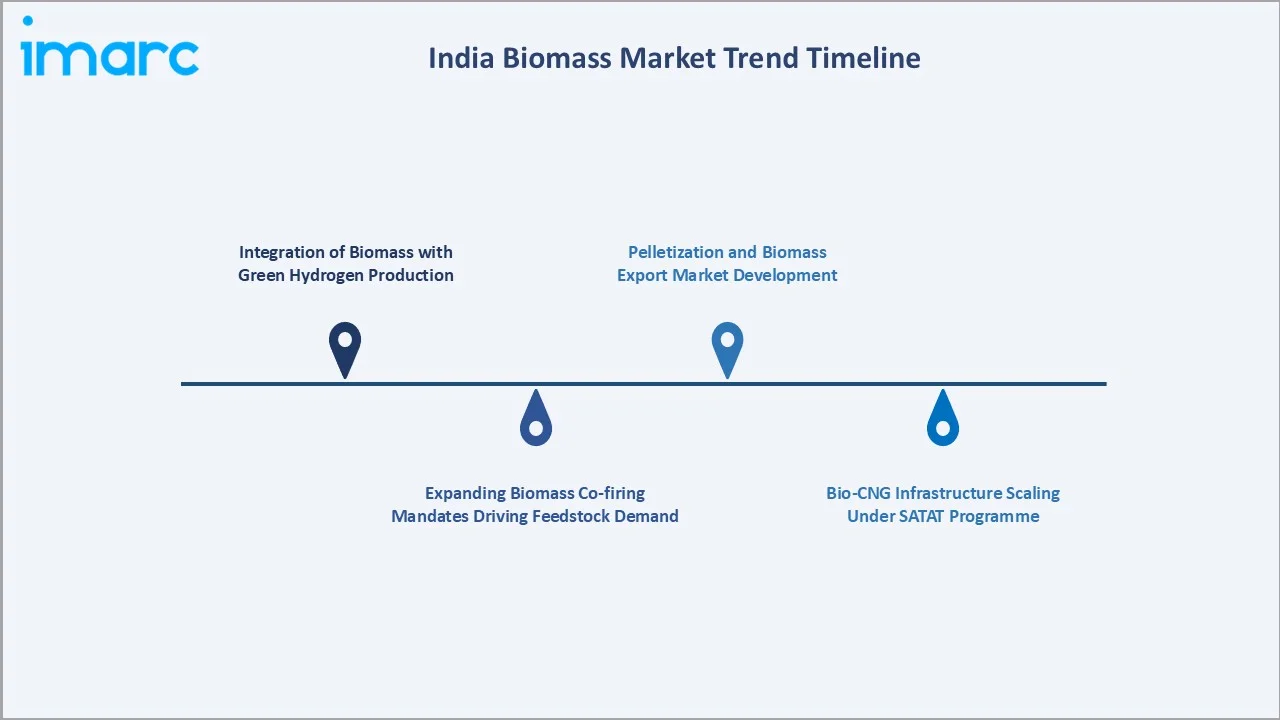
1. Integration of Biomass with Green Hydrogen Production
India's Ministry of New and Renewable Energy launched the Green Hydrogen Certification Scheme in April 2025, formally classifying hydrogen produced via biomass gasification as green when emissions remain below two kilograms of CO2-equivalent per kilogram of hydrogen. This policy integration creates a new, high-value demand channel for biomass gasification capacity linked to India's broader green hydrogen strategy and decarbonization goals.
2. Expanding Biomass Co-firing Mandates Driving Feedstock Demand
India's mandatory biomass co-firing policy creates significant upstream demand for processed biomass pellets, indirectly bolstering the broader biomass ecosystem. NLC India Limited's trial of biomass co-firing at its Barsingsar Thermal Power Station in July 2024 demonstrates the operational feasibility of large-scale co-firing using circulating fluidized bed combustion technology across India's existing thermal fleet.
3. Bio-CNG Infrastructure Scaling Under SATAT Programme
The SATAT programme's target of 5,000 bio-CNG plants is accelerating investment in compressed biogas infrastructure across India's agricultural belt. Agri-waste to bio-CNG projects linking crop residue collection to transportation fuel production create integrated value chains that improve feedstock utilization economics and enhance rural farmer income generation.
4. Pelletization and Biomass Export Market Development
India's biomass pellet production capacity is expanding to serve both domestic co-firing demand and growing export markets in Asia and Europe. Improved pelletization technologies are enhancing pellet durability, calorific consistency, and supply chain logistics, positioning India as a competitive biomass pellet exporter alongside established suppliers in the global market.
Industry Value Chain Analysis
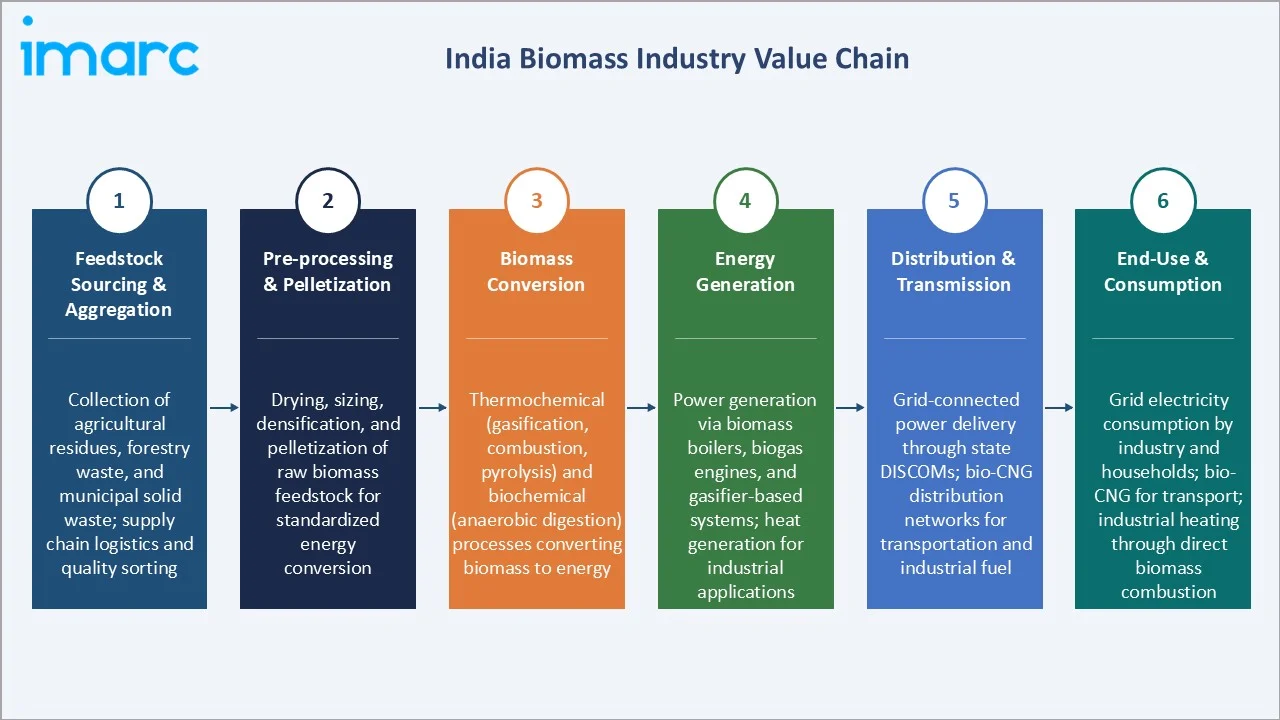
The India biomass value chain integrates agricultural residue and forestry waste aggregation, pre-processing and pelletization, thermochemical and biochemical conversion, energy generation, grid transmission, and end-use consumption. The commercial architecture is progressively integrating from isolated feedstock supply toward vertically organized energy project development models.
|
Stage |
Key Activities |
|
Feedstock Sourcing & Aggregation |
Collection of agricultural residues, forestry waste, and municipal solid waste; supply chain logistics and quality sorting |
|
Pre-processing & Pelletization |
Drying, sizing, densification, and pelletization of raw biomass feedstock for standardized energy conversion |
|
Biomass Conversion |
Thermochemical processes (gasification, combustion, pyrolysis) and biochemical processes (anaerobic digestion) converting biomass to energy |
|
Energy Generation |
Power generation through biomass boilers, biogas engines, and gasifier-based systems; heat generation for industrial applications |
|
Distribution & Transmission |
Grid-connected power delivery through state DISCOMs; bio-CNG distribution networks for transportation and industrial fuel |
|
End-Use & Consumption |
Grid electricity consumption by industry and households; bio-CNG for transport; industrial heating through direct biomass combustion |
The feedstock aggregation tier remains the most operationally complex stage, requiring coordination with millions of smallholder farmers across seasonal availability windows. The energy generation tier is benefiting from MNRE policy mandates creating stable, long-term offtake agreements that improve project bankability for biomass power developers across India.
Technology Landscape in the India Biomass Industry
Direct Combustion Technology
Direct combustion is the most widely deployed biomass energy technology in India, converting agricultural residues and wood into steam for power generation and industrial heating applications. Circulating fluidized bed combustion (CFBC) boilers offer fuel flexibility, handling diverse biomass feedstocks with varying moisture and ash content, making them the preferred technology for grid-connected biomass power plants across India.
Gasification Technology
Biomass gasification converts solid biomass into syngas through thermochemical processes, enabling applications in power generation, heating, and hydrogen production. India's first CO2-to-methanol pilot plant, developed by DST, IIT Delhi, and Thermax at a cost of INR 31 Crore (USD 3.72 Million), represents advanced gasification-adjacent conversion technology at the frontier of India's biomass innovation landscape.
Anaerobic Digestion and Bio-CNG Technology
Anaerobic digestion converts organic waste and agricultural residues into biogas, which is then purified and compressed into bio-CNG for transportation and industrial fuel applications. The SATAT programme's 5,000 bio-CNG plant target is accelerating adoption of anaerobic digestion technology across India's agricultural states, creating a large-scale rural bioenergy infrastructure network.
Market Segmentation Analysis
The report covers the following segments:
|
Segment Category |
Leading Segment |
Market Share |
Year |
|
Feedstock |
Agriculture Waste |
61.8% |
2025 |
|
Application |
Power Generation |
72.4% |
2025 |
|
Region |
North India |
36.8% |
2025 |

By Feedstock
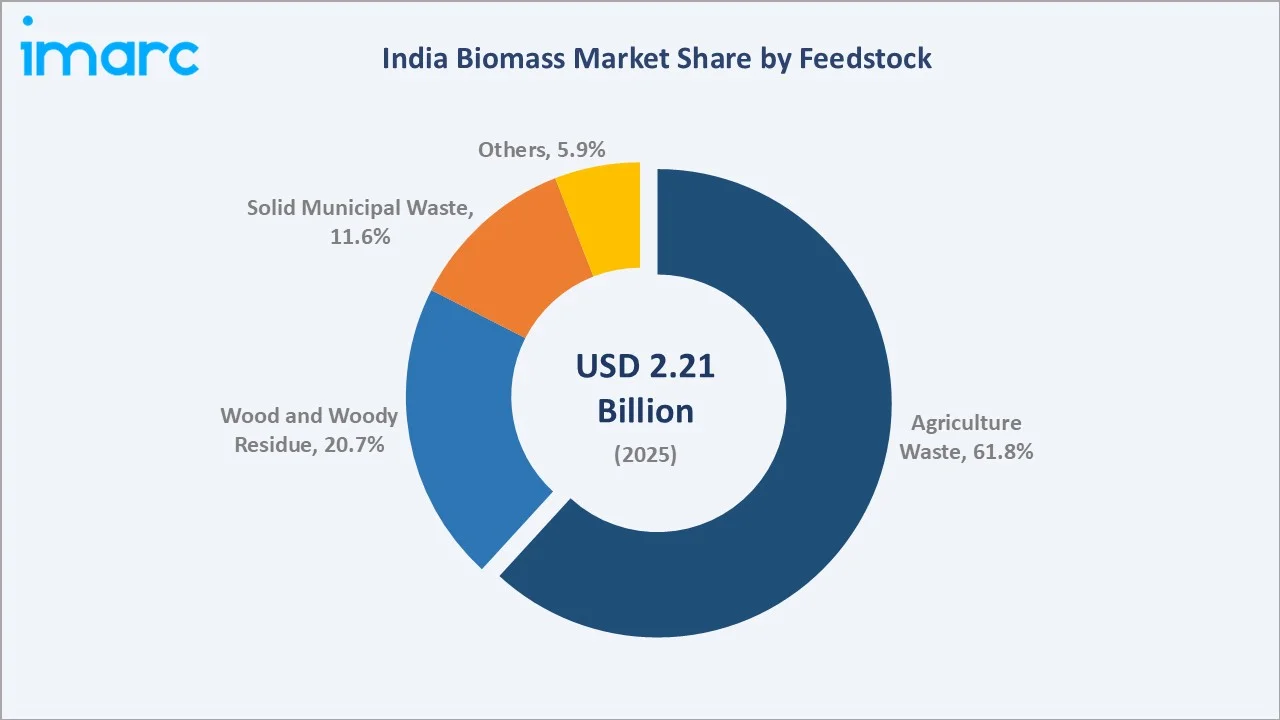
Agriculture Waste leads at 61.8% in 2025, driven by India's 750 MMT annual biomass production with 228 MMT surplus agricultural residue. Rice straw, wheat stubble, sugarcane bagasse, and cotton stalks constitute the primary feedstock base, concentrated in North and West India's major farming states and directly benefiting from stubble-burning restriction policies.
To access detailed market analysis, Request Sample
Wood and Woody Residue at 20.7% serves industrial heating and power applications through forestry by-products and dedicated energy plantations. Solid Municipal Waste at 11.6% is gaining traction under waste-to-energy policy frameworks as urban local bodies increasingly mandate waste processing. Others at 5.9% includes energy crops and animal waste feedstocks representing an emerging feedstock diversification avenue.
By Application
Power Generation leads at 72.4% in 2025, anchored by India's 10+ GW installed biomass electricity capacity serving grid-connected and off-grid rural electrification needs. Biomass power's firm, dispatchable nature complements India's expanding intermittent renewable capacity, supporting grid balancing requirements and underserved rural electrification targets across the country.
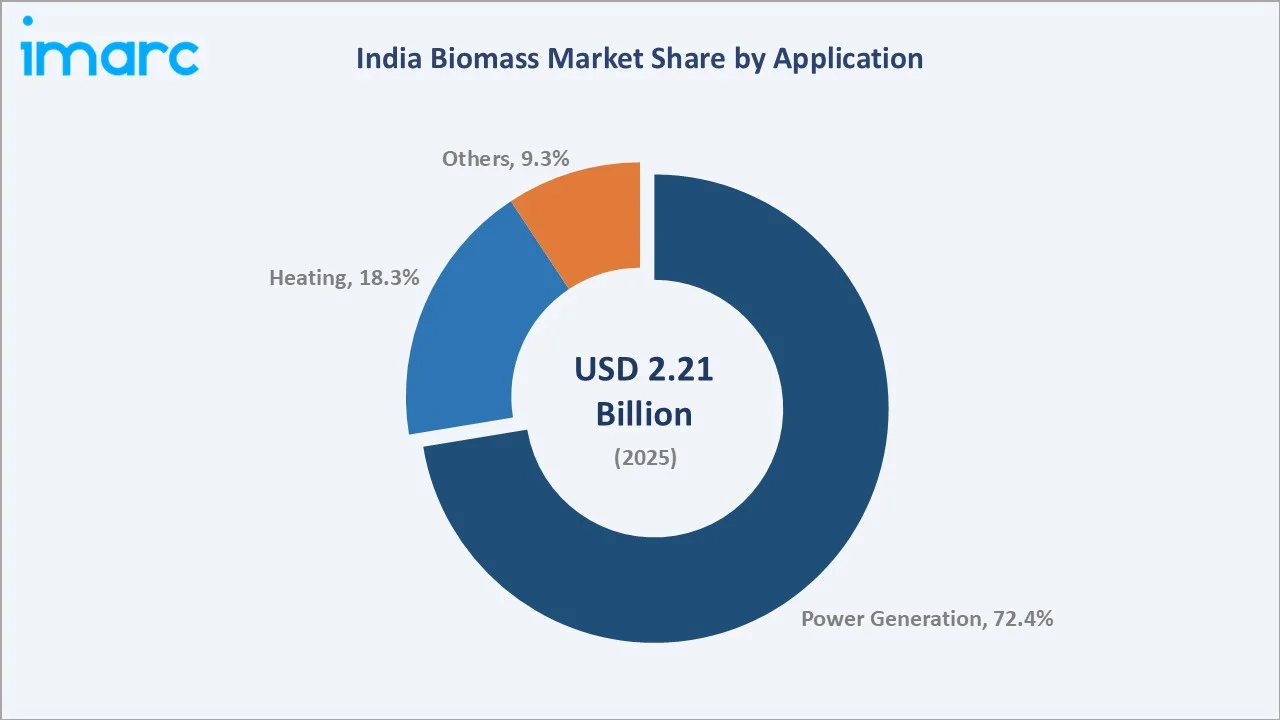
Heating at 18.3% serves industrial boilers, agro-processing facilities, and residential cooking applications across rural and semi-urban India. Industrial biomass heating adoption is driven by rising fossil fuel costs and corporate sustainability commitments requiring low-carbon energy procurement. Others at 9.3% includes bio-CNG production and biochemical applications growing under the SATAT programme.
Regional Market Insights
|
Region |
Share (2025) |
Key Biomass Market Drivers & Characteristics |
|
North India |
36.8% |
High agricultural residue generation from rice, wheat and sugarcane cultivation; concentrated biomass power plant infrastructure; stubble burning regulations driving structured feedstock supply |
|
West India |
25.4% |
Sugarcane bagasse availability from sugar mill co-generation; industrial biomass demand in Gujarat; growing bio-CNG and waste-to-energy project pipeline |
|
South India |
22.1% |
Rice husk and coconut shell biomass resources; established biomass power capacity in Karnataka and Tamil Nadu; decentralized gasification adoption in rural areas |
|
East India |
15.7% |
Rice straw availability in West Bengal and Odisha; emerging biomass power development; significant untapped feedstock potential representing the highest future growth region |
North India, at 36.8%, leads through Punjab, Haryana, and Uttar Pradesh's concentrated agricultural residue generation and existing biomass power plant infrastructure. Stubble burning regulations in Punjab and Haryana are directly converting crop residue from an environmental liability into a structured biomass feedstock supply, supporting both Power Generation and Heating applications across the region.
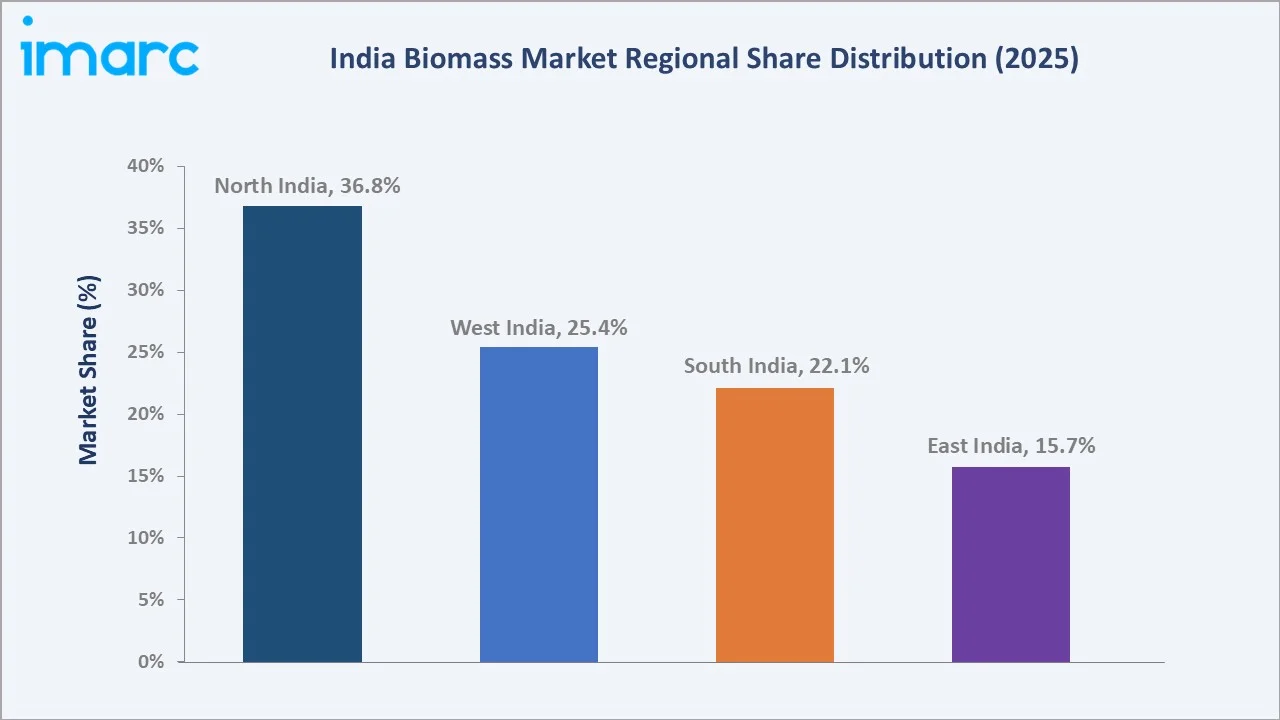
West India, at 25.4%, benefits from Maharashtra's large sugar industry generating substantial sugarcane bagasse feedstock for co-generation power plants. South India, at 22.1%, leverages rice husk, coconut shell, and plantation crop residues for biomass power and decentralized gasification. East India, at 15.7%, represents the market's highest-growth potential region with significant untapped agricultural residue resources in West Bengal, Odisha, and Bihar awaiting organized development.
Competitive Landscape
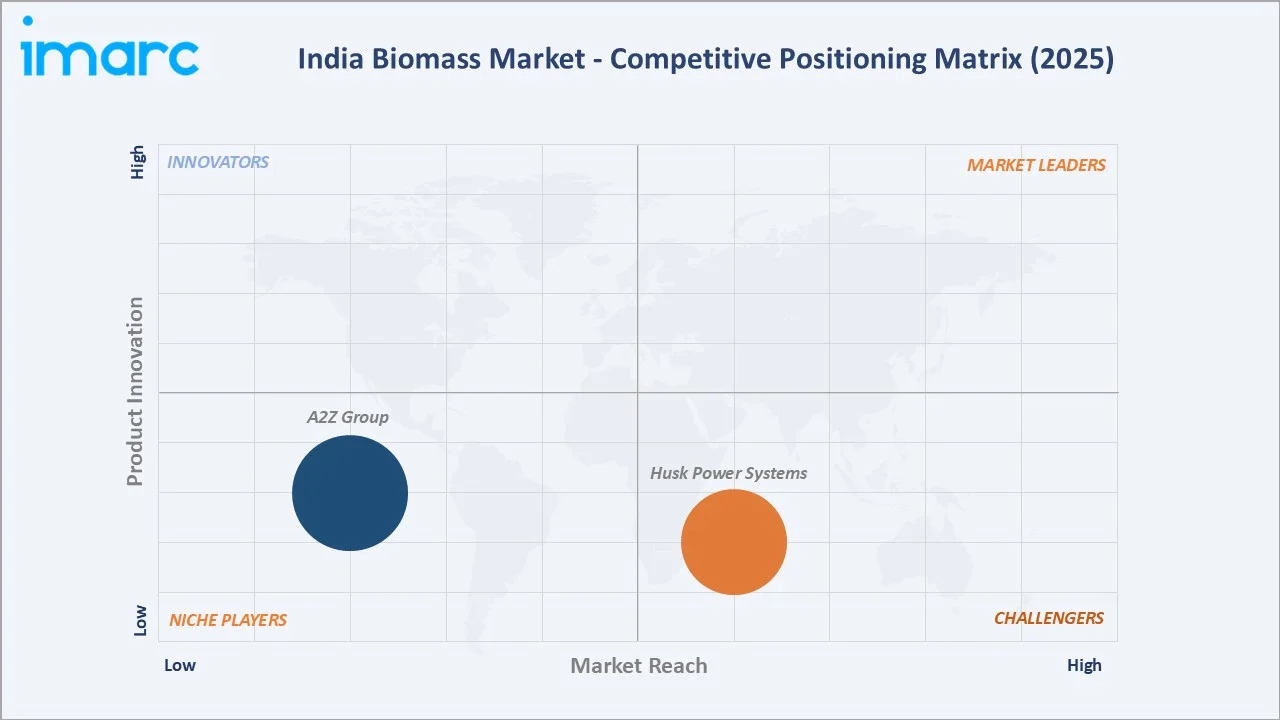
The India biomass market competitive landscape is semi-fragmented, with domestic biomass power developers, technology companies, and feedstock aggregators competing across multiple value chain positions. The landscape is characterized by regional concentration, with major players holding strong positions in specific states based on feedstock availability and power purchase agreement portfolios.
|
Company Name |
Key Products |
Market Position |
Core Strength |
|
Husk Power Systems |
Mini-grid biomass power, hybrid systems |
Strong Challenger |
Decentralized rural biomass mini-grid solutions with hybrid biomass-solar system deployment |
|
A2Z Group |
Waste-to-energy, biomass power |
Niche Player |
Municipal solid waste and biomass integrated energy solutions with multi-city project presence |
Key players include Husk Power Systems, A2Z Group, and others.
Key Company Profiles
Husk Power Systems
Husk Power Systems is a US-incorporated distributed energy resources (DER) company, with strong operational presence in India through solar-hybrid mini-grid systems combining biomass gasification, solar PV, and battery storage to deliver 24/7 renewable electricity to rural and underserved communities.
- Key Products: Mini-grid biomass power, hybrid systems
- Strategic Focus: Scaling its AI-powered distributed energy platform; expanding hybrid solar-biomass-battery mini-grid infrastructure in underserved rural markets across Bihar, Uttar Pradesh, Odisha, and Jharkhand.
A2Z Group
A2Z Infra Engineering Limited is a Gurugram-based infrastructure engineering and services company, with an active presence in India's biomass energy sector through waste-to-energy power generation and municipal solid waste management operations across multiple Indian states.
- Key Products: Waste-to-energy, biomass power
- Strategic Focus: Strengthening integrated municipal solid waste-to-energy value chains linking MSW collection and RDF processing to biomass power generation, while pursuing operational and financial stabilization across its power generation and facility management segments.
Market Concentration Analysis
The India biomass market is semi-fragmented at the project developer level, with no single company dominating more than 10-12% of total installed biomass power capacity. The top three players collectively account for approximately 25-30% of organized biomass energy market revenue. The feedstock aggregation segment is highly fragmented, with thousands of small-scale pellet producers and biomass suppliers serving regional demand pools.
Market concentration is evolving as the MNRE co-firing mandate and SATAT programme create large-scale, policy-driven demand, attracting organized players with capital and technology capabilities. The Asian Development Bank's USD 91.14 million loan to SAEL Industries for biomass energy from agricultural residue demonstrates growing institutional financing interest, supporting organized market consolidation through the forecast period.
Investment & Growth Opportunities
Highest Growth Segments
Power Generation application (~6.6% CAGR), Solid Municipal Waste feedstock (~7.2% CAGR), bio-CNG infrastructure (~12-15% CAGR), advanced gasification for green hydrogen integration, and biomass pellet export market development represent the highest-growth investment vectors through 2034. Solid Municipal Waste's above-market CAGR reflects India's urban waste-to-energy policy framework, creating new project pipelines.
Emerging Investment Opportunities
Biomass co-firing infrastructure represents the near-term highest structured demand opportunity, with MNRE's 5% co-firing mandate creating large-scale pellet procurement from India's thermal power fleet. SATAT bio-CNG plants offer high internal rate of return projects anchored by government offtake agreements and excise duty exemptions, attracting private capital from energy developers and infrastructure funds.
Investment Themes
- Agricultural Residue Value Chain Integration: Integrated feedstock aggregation and pelletization platforms across North India's agricultural belt create defensible, low-cost supply positions for serving both domestic co-firing mandates and growing export markets. Mitsui & Co.'s INR 300 million investment in Punjab Renewable Energy Systems validates the strategic value of organized feedstock supply chains in India's biomass market.
- Bio-CNG Project Development under SATAT: India's 5,000 bio-CNG plant SATAT target creates a large-scale investment opportunity for agri-waste to compressed biogas infrastructure. Projects combining crop residue feedstock, compressed biogas production, and SATAT offtake agreements offer policy-backed revenue visibility with India's growing transportation fuel demand providing structural market support.
Future Market Outlook (2026-2034)
The India biomass market is projected to grow from USD 2.21 Billion in 2025 to USD 2.35 Billion in 2026, reaching USD 3.90 Billion by 2034, delivering a 6.34% CAGR over the forecast period. The anchor value of USD 3.00 Billion in 2030 represents a market at the convergence of policy-mandated co-firing deployment, SATAT bio-CNG infrastructure scaling, and emerging green hydrogen integration driving structural demand expansion.
Three structural forces define India biomass market growth through 2034. India's renewable energy transition creates compounding biomass demand as both direct power generation and industrial feedstock replacement. The SATAT and co-firing mandates create structured, policy-backed demand channels providing revenue visibility for project developers. Advanced conversion technologies, including gasification-based green hydrogen and advanced pelletization, are expanding biomass's addressable market beyond traditional power generation into new high-value applications.
Research Methodology
Primary Research
Primary research comprised structured interviews with 45+ industry stakeholders (2025), including biomass power plant operators, feedstock aggregators, pellet manufacturers, government officials from MNRE and state energy departments, bio-CNG project developers, and biomass technology companies across India's major biomass energy producing states.
Secondary Research
Secondary research encompassed MNRE annual reports, IMARC Group market databases, ADB project financing reports, National Bio-Energy Mission policy documents, SATAT programme data, company annual reports, and biomass market studies from industry associations. Over 50 secondary sources were reviewed to ensure comprehensive market coverage and data triangulation.
Forecasting Models
Market revenue forecasts developed using bottom-up modelling incorporating installed biomass capacity expansion trajectory, average capacity utilization rates by application segment, feedstock cost and conversion efficiency assumptions, and policy-mandated demand baseline from co-firing and SATAT targets across the 2026-2034 forecast period.
India Biomass Market Report Coverage:
| Report Features | Details |
|---|---|
| Base Year of the Analysis | 2025 |
| Historical Period | 2020-2025 |
| Forecast Period | 2026-2034 |
| Units | Billion USD |
| Scope of the Report | Exploration of Historical Trends and Market Outlook, Industry Catalysts and Challenges, Segment-Wise Historical and Future Market Assessment:
|
| Feedstocks Covered | Agriculture Waste, Wood and Woody Residue, Solid Municipal Waste, Others |
| Applications Covered | Power Generation, Heating, Others |
| Regions Covered | North India, South India, East India, West India |
| Companies Covered | Husk Power Systems, A2Z Group, etc. |
| Customization Scope | 10% Free Customization |
| Post-Sale Analyst Support | 10-12 Weeks |
| Delivery Format | PDF and Excel through Email (We can also provide the editable version of the report in PPT/Word format on special request) |
Key Benefits for Stakeholders:
- IMARC’s industry report offers a comprehensive quantitative analysis of various market segments, historical and current market trends, market forecasts, and dynamics of the India biomass market from 2020-2034.
- The research report provides the latest information on the market drivers, challenges, and opportunities in the India biomass market.
- Porter's five forces analysis assist stakeholders in assessing the impact of new entrants, competitive rivalry, supplier power, buyer power, and the threat of substitution. It helps stakeholders to analyze the level of competition within the India biomass industry and its attractiveness.
- Competitive landscape allows stakeholders to understand their competitive environment and provides an insight into the current positions of key players in the market.
Frequently Asked Questions About the India Biomass Market Report
The India biomass market size increased from USD 2.21 Billion in 2025 and USD 2.35 Billion in 2026 driven by Agriculture Waste feedstock dominance at 61.8%, Power Generation application leading at 72.4%, and North India commanding 36.8% regional share through Punjab, Haryana, and Uttar Pradesh's high agricultural residue concentration and existing biomass power infrastructure.
The India biomass market is expected to reach USD 3.90 Billion by 2034, exhibiting a CAGR of 6.34% during 2026-2034, supported by SATAT bio-CNG expansion, MNRE co-firing mandates, and green hydrogen integration opportunities driving structured demand growth across all feedstock and application segments.
Key drivers include rising demand for renewable and sustainable energy sources, abundant agricultural residue availability (~228 MMT surplus annually), government incentives through NBEM and SATAT, and technological advances in gasification, pelletization, and anaerobic digestion improving conversion efficiency and project economics.
Agriculture Waste leads at 61.8% through India's vast crop residue availability from rice, wheat, and sugarcane cultivation. Stubble burning regulations in North India are structurally converting agricultural residues into organized biomass feedstock supply, directly benefiting power generation and heating applications.
Power Generation leads at 72.4% through India's 10+ GW installed biomass electricity capacity, MNRE co-firing mandates, and biomass power's role as firm, dispatchable renewable energy complementing intermittent solar and wind in India's national renewable energy portfolio.
North India leads at 36.8% through concentrated agricultural residue generation in Punjab, Haryana, and Uttar Pradesh, existing biomass power infrastructure, and state-level policy support for stubble burning reduction through productive biomass energy utilization across the agricultural belt.
Leading companies include Husk Power Systems, A2Z Group, and others.
Priority investment opportunities include agricultural residue feedstock aggregation and pelletization platforms in North India, bio-CNG infrastructure under the SATAT programme, biomass co-firing supply chains serving thermal power plants, and advanced gasification technology development for green hydrogen production.
Need more help?
- Speak to our experienced analysts for insights on the current market scenarios.
- Include additional segments and countries to customize the report as per your requirement.
- Gain an unparalleled competitive advantage in your domain by understanding how to utilize the report and positively impacting your operations and revenue.
- For further assistance, please connect with our analysts.
 Request Customization
 Speak to an Analyst
 Request Brochure
 Inquire Before Buying
Benefits of Customization
- Personalize this research
- Triangulate with your data
- Get data as per your format and definition
- Gain a deeper dive into a specific application, geography, customer, or competitor
- Any level of personalization
Get in Touch With Us
UNITED STATES
Phone: +1-201-971-6302
INDIA
Phone: +91-120-433-0800
UNITED KINGDOM
Phone: +44-753-714-6104
Email: [email protected]
Client Testimonials




.webp)




.webp)













Related Reports

Choose your plan
*Please note that the prices mentioned below are starting prices for each bundle type. Kindly contact our team for further details.*
Single User License
- 1 User License, Access on 2 Devices
- PDF Report + Excel Dataset (Password Protected)
- Lifetime Access
- No Printing Rights
- 10% Free Report Customization
- 10–12 Weeks of Analyst Support
Five User License
- Access for 5 Users, 2 Devices per User
- PDF Report + Excel Dataset (Password Protected)
- Lifetime Access
- Dedicated Account Manager
- 12–14 Weeks of Analyst Support
- No Printing Rights
- 15% Free Report Customization
- 25% Discount on Your Next Purchase
Corporate User License
- Unlimited User Access (Within Your Organization)
- PDF Report + Excel Dataset
- Lifetime Access
- Dedicated Account Manager
- 14–20 Weeks of Analyst Support
- No Printing Rights
- 20% Free Report Customization
- 30% Discount on Your Next Purchase
Essential Insights
What's included:
3 reports
- Lifetime Access
- PDF Reports
- Excel Datasets
- 2 Weeks of Free Analyst Support
- 2 User Licenses
- Access on 2 Devices
- Printing Rights
- Complimentary PowerPoint (PPT) Version
- Complimentary License Upgrade
Professional Access
What's included:
5 reports
- Lifetime Access
- PDF Reports
- Excel Datasets
- 8 Weeks of Free Analyst Support
- 2 User Licenses
- Access on 2 Devices
- Printing Rights
- Complimentary PowerPoint (PPT) Version
- Complimentary License Upgrade
Business Advantage
What's included:
8 reports
- Lifetime Access
- PDF Reports
- Excel Datasets
- 14 Weeks of Free Analyst Support
- 2 User Licenses
- Access on 2 Devices
- Printing Rights
- Complimentary PowerPoint (PPT) Version
- Complimentary License Upgrade
Enterprise Intelligence
What's included:
10 reports
- Lifetime Access
- PDF Reports
- Excel Datasets
- 20 Weeks of Free Analyst Support
- 2 User Licenses
- Access on 2 Devices
- Printing Rights
- Complimentary PowerPoint (PPT) Version
- Complimentary License Upgrade