
India Breath Analyzer Market Size, Share, Trends and Forecast by Technology, Application, End User, and Region, 2026-2034
India Breath Analyzer Market Size, Share, Trends & Forecast (2026-2034
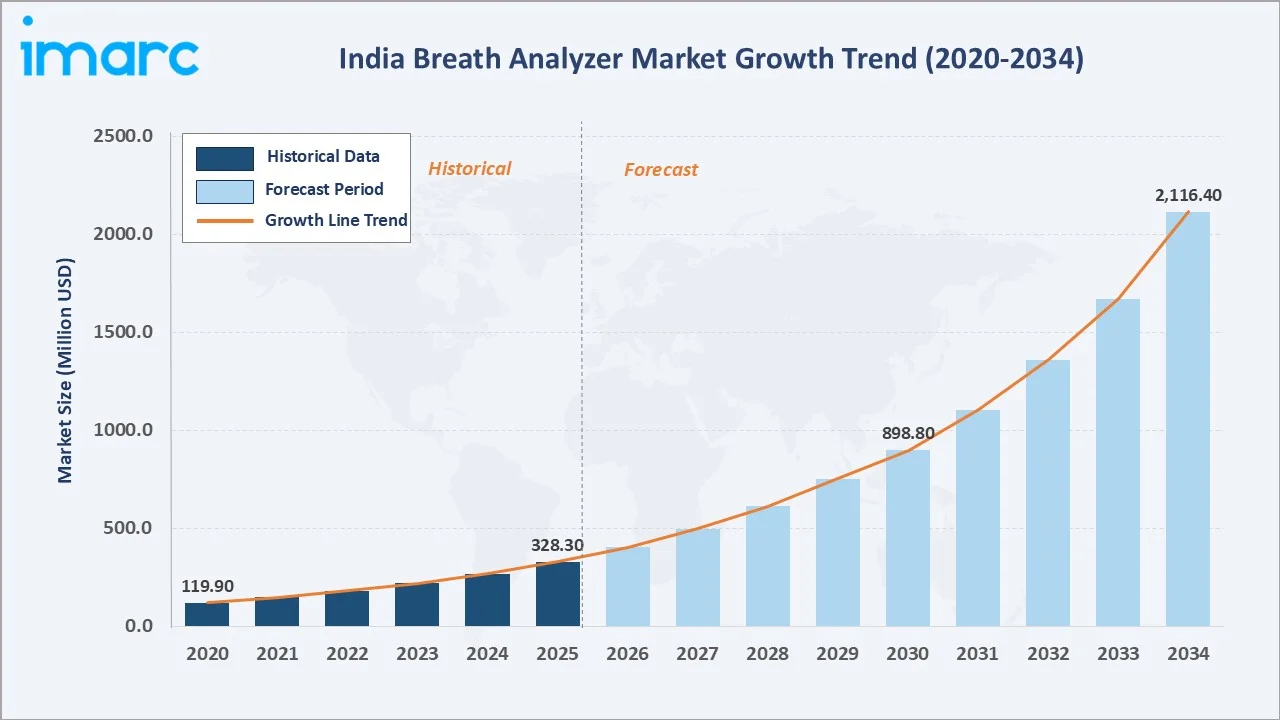
The India breath analyzer market reached USD 328.3 Million in 2025 and is projected to reach USD 2,116.4 Million by 2034, growing at a CAGR of 22.32% during 2026-2034. Growth is driven by rising road accidents, government-led enforcement drives, and expanding adoption of breath testing across healthcare and drug abuse detection applications. Fuel cell technology leads the technology segment at 46.8% in 2025, reflecting its superior accuracy for law-enforcement grade testing. Alcohol detection dominates by application at 61.5%, while North India commands the largest regional share at 33.7%, supported by dense urban policing and higher vehicle ownership.
Market Snapshot
|
Metric |
Value |
|
Market Size (2025) |
USD 328.3 Million |
|
Forecast Market Size (2034) |
USD 2,116.4 Million |
|
CAGR (2026-2034) |
22.32% |
|
Base Year |
2025 |
|
Historical Period |
2020-2025 |
|
Forecast Period |
2026-2034 |
|
Dominant Technology |
Fuel Cell Technology (46.8%, 2025) |
|
Dominant Application |
Alcohol Detection (61.5%, 2025) |
|
Leading Region |
North India (33.7%, 2025) |
The India breath analyzer market expanded from USD 119.9 Million in 2020 to USD 328.3 Million in 2025, is anchored at USD 898.8 Million in 2030, and is forecast to reach USD 2,116.4 Million by 2034. This trajectory reflects one of the fastest-growing breath-testing markets in the Asia Pacific region, propelled by regulatory tightening and technology upgrades across law enforcement and healthcare channels.
To get more information on this market, Request Sample
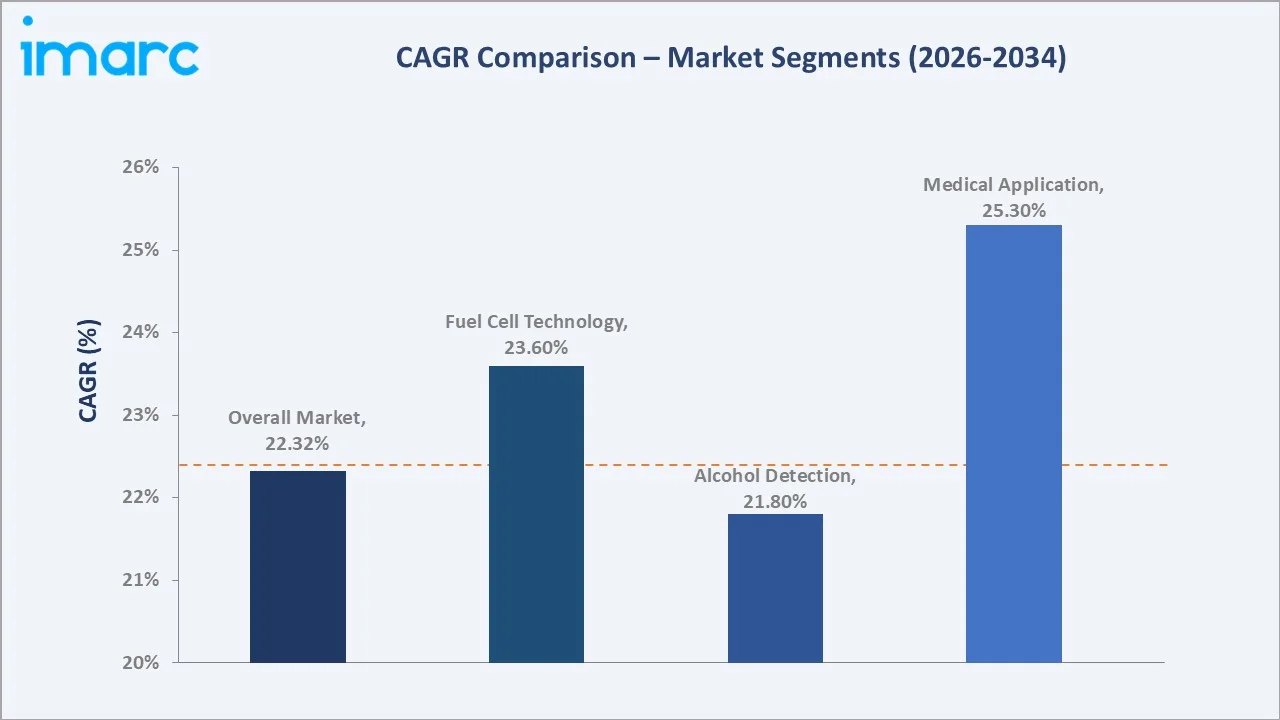
Fuel cell-based devices are estimated to expand at close to 23.6% CAGR through 2034 on strong law-enforcement procurement, while the medical application segment is estimated to post the fastest application-level growth at around 25.3% CAGR as point-of-care breath diagnostics scale up across hospitals and diagnostic chains.
Executive Summary
The India breath analyzer market, valued at USD 328.3 Million in 2025, is one of the fastest-scaling breath-testing markets in South Asia, reflecting the country's large and rapidly motorizing population base. The market's growth is anchored by rising road accidents, with India recording 480,583 road accidents and 172,890 fatalities in 2023, as reported by the Ministry of Road Transport and Highways (MoRTH).
The market is projected to reach USD 2,116.4 Million by 2034, growing at a CAGR of 22.32% during 2026-2034. Fuel cell technology leads the technology mix at 46.8% through superior accuracy demanded by traffic police and excise departments, while alcohol detection remains the dominant application at 61.5%, reflecting sustained enforcement-driven demand.
North India leads regionally at 33.7% share, aided by Delhi-NCR's dense traffic policing infrastructure and higher vehicle density. West and Central India follows closely at 29.8%. The market outlook remains positive as government safety mandates, workplace compliance programs, and medical diagnostic adoption converge to sustain double-digit growth through the forecast period.
Key Market Insights
|
Insight |
Data |
|
Dominant Technology |
Fuel Cell Technology - 46.8% share (2025) |
|
Dominant Application |
Alcohol Detection - 61.5% share (2025) |
|
Leading Region |
North India - 33.7% share (2025) |
|
Market Opportunity |
Medical breath diagnostics expansion; enterprise workplace safety compliance; smart, connected law-enforcement devices |
Key Analytical Observations Supporting The Above Data:
- Fuel Cell Technology at 46.8%: This segment dominates due to its high sensitivity and accuracy in measuring blood alcohol equivalence, making it the preferred choice for law-enforcement grade testing across India's traffic police departments.
- Alcohol Detection at 61.5%: The application leads due to mandatory breath-testing enforcement during road safety drives, supported by the MoRTH's 2023 report citing 172,890 road accident deaths that continue to justify expanded checkpoint deployment.
- North India at 33.7%: The region dominates through Delhi-NCR's concentrated traffic enforcement infrastructure, higher per-capita vehicle ownership, and greater state-level budget allocation toward road safety technology.
- Semiconductor Sensor at 28.4%: This technology serves India's cost-sensitive enterprise and personal-use segments, offering an affordable alternative to fuel cell devices for preliminary screening.
- Medical Application growing fastest: Rising adoption of non-invasive breath diagnostics for metabolic and respiratory screening is expanding the medical application base beyond its current 24.3% share.
- West and Central India at 29.8%: Mumbai and Pune's dense commercial vehicle fleets and corporate safety compliance programs are driving above-average regional demand for enterprise-grade analyzers.
India Breath Analyzer Market Overview
Breath analyzers detect alcohol and drug content in exhaled breath using electrochemical, semiconductor, or infrared sensing technologies, offering rapid, non-invasive, and on-the-spot results for law enforcement, healthcare, and workplace safety applications.
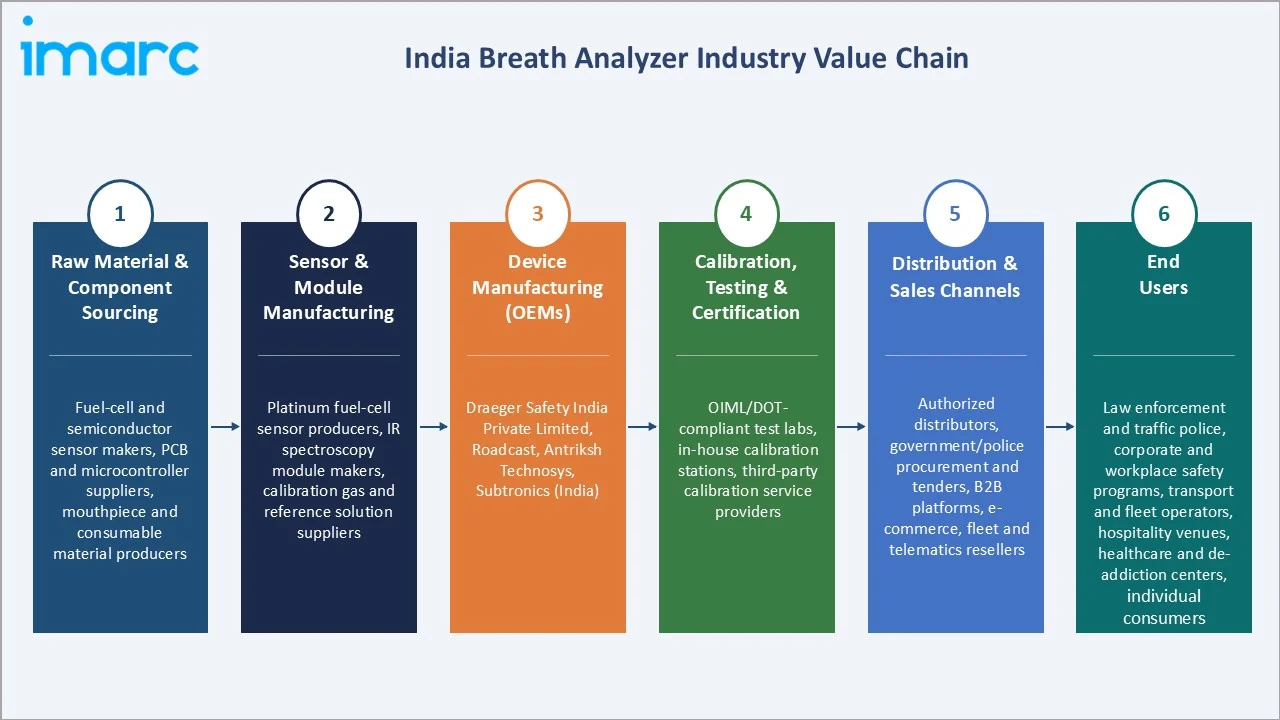
The India breath analyzer ecosystem integrates sensor component suppliers, device manufacturers, calibration and certification bodies, and distribution channels serving government, healthcare, and enterprise end users. Macroeconomic factors including rising vehicle ownership, urbanization, and stricter traffic enforcement are reinforcing structural demand across the value chain.
Market Dynamics
To evaluate market opportunities, Request Sample
Market Drivers
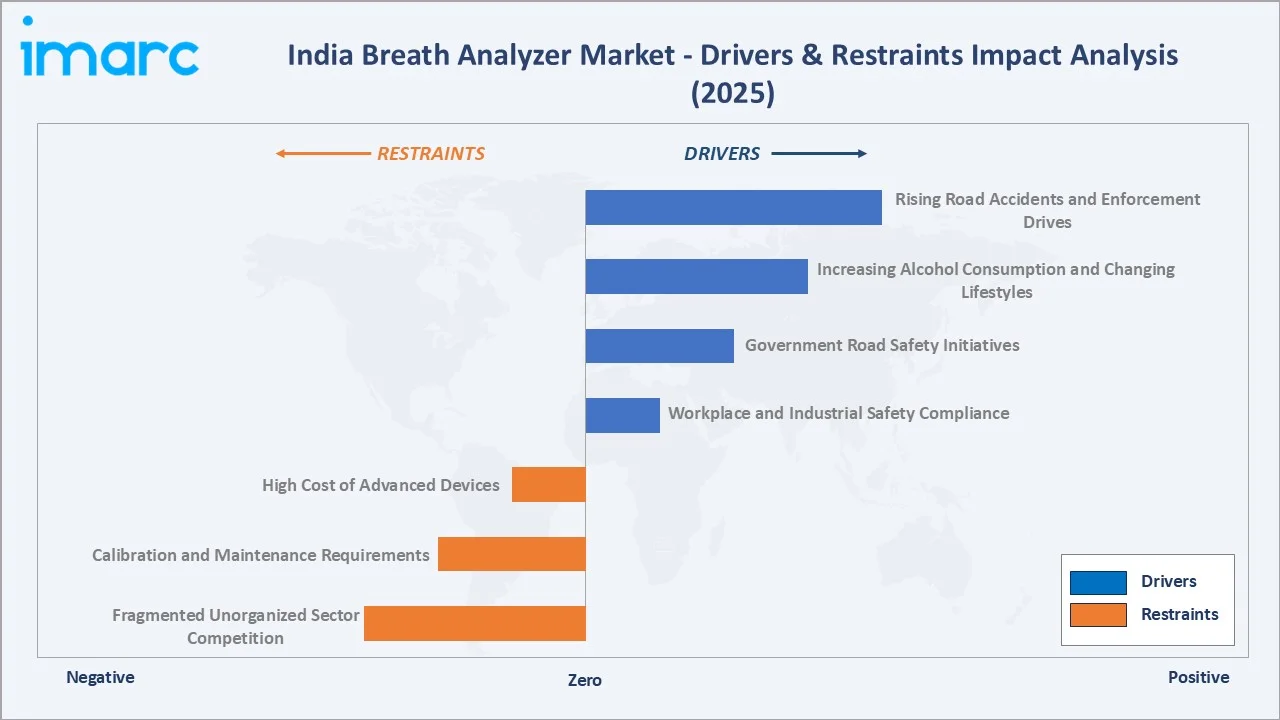
- Rising Road Accidents and Enforcement Drives: India recorded 480,583 road accidents and 172,890 fatalities in 2023, per MoRTH data, prompting state governments to expand mandatory breath-testing checkpoints and procure higher volumes of law-enforcement grade analyzers.
- Increasing Alcohol Consumption and Changing Lifestyles: Rising disposable incomes and evolving urban social habits are increasing alcohol consumption, which is in turn expanding the addressable base for both enforcement and personal-use breath testing devices.
- Government Road Safety Initiatives: Central and state government programs targeting a reduction in road fatalities, aligned with the UN Decade of Action for Road Safety 2021-2030, are driving sustained procurement of certified breath analyzers.
- Workplace and Industrial Safety Compliance: Growing enterprise adoption of zero-tolerance alcohol policies across logistics, mining, and manufacturing sectors is expanding institutional demand for portable and fixed breath testing devices.
Market Restraints
- High Cost of Advanced Devices: Fuel-cell and infrared spectroscopy analyzers carry a meaningfully higher price point than basic semiconductor devices, limiting adoption among smaller enterprises and state police units with constrained budgets.
- Calibration and Maintenance Requirements: Periodic calibration and sensor replacement requirements add recurring costs and downtime, creating a barrier for smaller operators seeking to deploy analyzers at scale.
Market Opportunities
- Medical Breath Diagnostics Expansion: Rising hospital and diagnostic chain adoption of non-invasive breath-based screening for metabolic and respiratory conditions is opening a high-growth revenue stream beyond alcohol testing.
- Smart, Connected Analyzer Adoption: Integration of GPS, cloud reporting, and facial recognition with breath analyzers, as seen in recent India-made product launches, is creating differentiated, higher-margin enterprise and fleet-safety offerings.
Market Challenges
- Fragmented Unorganized Sector Competition: A large base of low-cost, uncertified breath testers sold through online marketplaces pressures pricing and complicates quality standardization across the market.
- Standardization and Certification Gaps: Inconsistent state-level certification requirements for law-enforcement devices create compliance complexity for manufacturers scaling pan-India distribution.
Emerging Market Trends
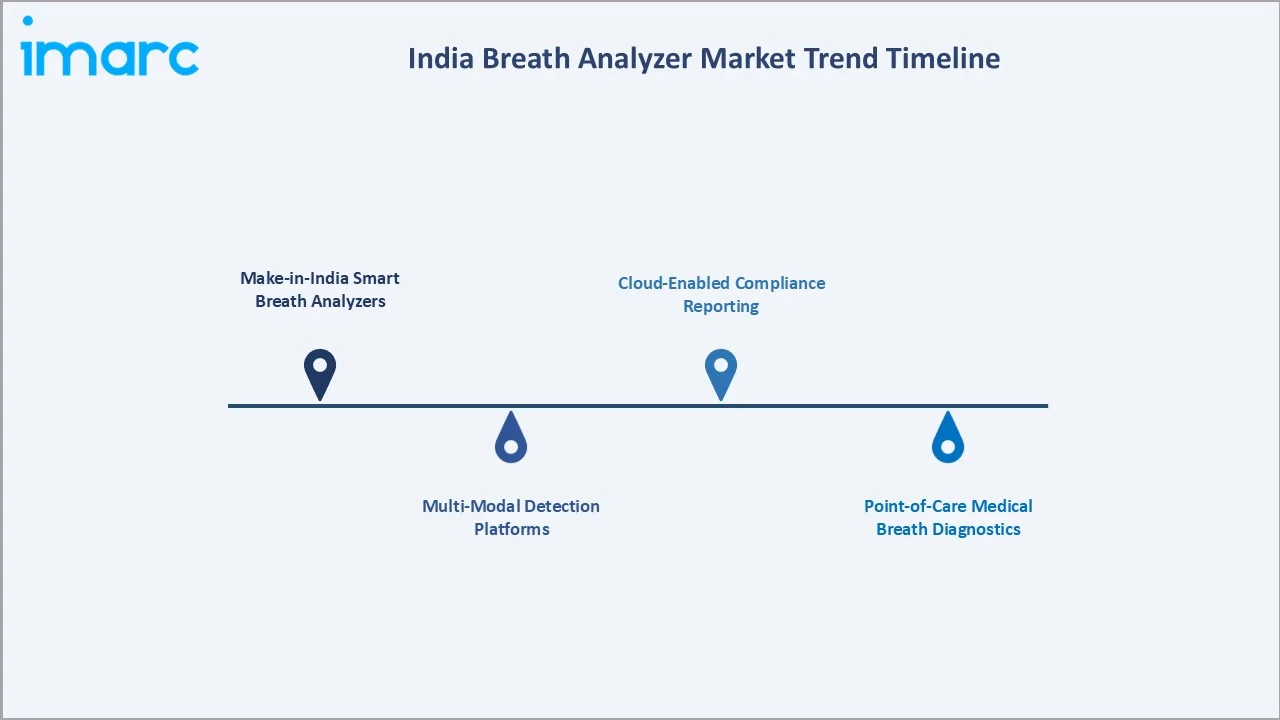
1. Make-in-India Smart Breath Analyzers
Domestic manufacturers are launching indigenously developed, telematics-integrated breath analyzers. In September 2025, Roadcast, backed by Jubilant FoodWorks, launched India's first fully made-in-India alcohol breath analyzer integrated with ignition-interlock and fleet telematics systems, targeting a USD 1 Million revenue milestone within two years.
2. Multi-Modal Detection Platforms
Manufacturers are increasingly combining alcohol and drug biomarker sensing within a single device, reducing per-test costs for law enforcement and enterprise buyers while expanding the addressable use cases for a single hardware platform.
3. Cloud-Enabled Compliance Reporting
Enterprise buyers are prioritizing analyzers with cloud data storage and reporting capabilities, enabling fleet operators and corporates to maintain auditable compliance records for regulatory and insurance purposes.
4. Point-of-Care Medical Breath Diagnostics
Hospitals and diagnostic chains are piloting breath-based screening for metabolic and respiratory conditions, positioning medical application as the fastest-growing use case within the broader breath analyzer market through 2034.
Industry Value Chain Analysis
The India breath analyzer value chain spans component sourcing, device assembly, quality certification, and multi-channel distribution to government, healthcare, and enterprise buyers. Each stage carries distinct compliance and quality-assurance requirements.
|
Stage |
Key Participants |
|
Raw Material & Component Sourcing |
Fuel-cell and semiconductor sensor makers, PCB and microcontroller suppliers, mouthpiece and consumable material producers |
|
Sensor & Module Manufacturing |
Platinum fuel-cell sensor producers, IR spectroscopy module makers, calibration gas and reference solution suppliers |
|
Device Manufacturing (OEMs) |
Draeger Safety India Private Limited, Roadcast, Antriksh Technosys, Subtronics (India) |
|
Calibration, Testing & Certification |
OIML/DOT-compliant test labs, in-house calibration stations, third-party calibration service providers |
|
Distribution & Sales Channels |
Authorized distributors, government/police procurement and tenders, B2B platforms, e-commerce, fleet and telematics resellers
|
|
End Users |
Law enforcement and traffic police, corporate and workplace safety programs, transport and fleet operators, hospitality venues, healthcare and de-addiction centers, individual consumers |
Calibration and certification remain the value chain's most consequential stage, as law-enforcement and medical-grade devices require periodic accuracy verification against national metrology standards before deployment, directly influencing manufacturer reputation and repeat procurement.
Technology Landscape in the India Breath Analyzer Industry
Fuel Cell Sensor Technology
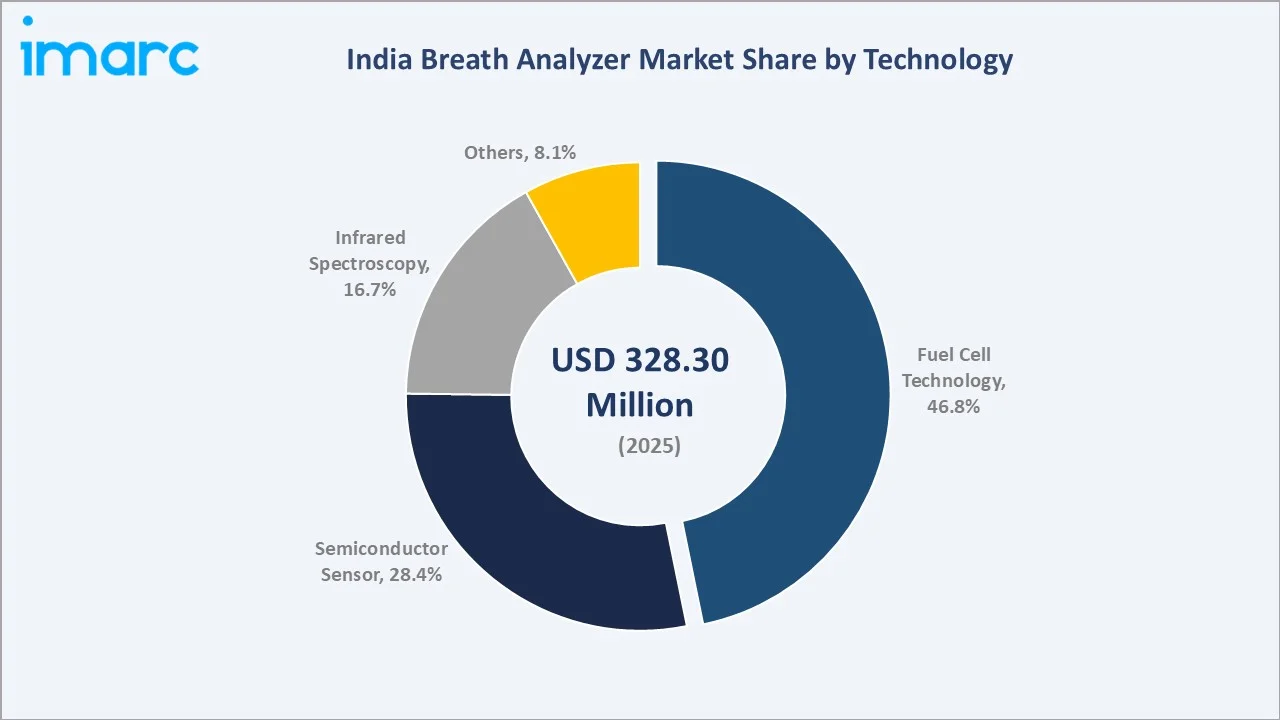
Fuel cell sensors offer the highest accuracy for blood-alcohol equivalence estimation, making them the preferred choice for law-enforcement and medical-grade devices. This technology commanded 46.8% of the market in 2025, reflecting sustained institutional procurement.
Semiconductor Sensor Technology
Semiconductor sensors provide a cost-effective alternative for personal and enterprise screening use, holding 28.4% share in 2025. Their lower cost supports wider penetration across small and mid-sized enterprises and individual consumers.
Infrared Spectroscopy
Infrared spectroscopy-based analyzers, holding 16.7% share in 2025, are gaining traction in high-throughput laboratory and medical diagnostic settings due to their precision in detecting trace-level breath biomarkers.
Connectivity and Data Integration
Smart connectivity features, including GPS tagging, cloud reporting, and facial recognition, are increasingly bundled into India-made devices, enhancing compliance tracking for fleet operators and government procurement programs.
Market Segmentation Analysis
The report covers the following segments:
|
Segment Category |
Leading Segment |
Market Share |
Year |
|
Technology |
Fuel Cell Technology |
46.8% |
2025 |
|
Application |
Alcohol Detection |
61.5% |
2025 |
|
End-User |
Law Enforcement Agencies |
🔒 |
2025 |
|
Region |
North India |
33.7% |
2025 |

By Technology
Fuel cell technology leads at 46.8% (2025). This segment serves India's law-enforcement and medical-grade testing needs, where measurement accuracy directly affects legal and clinical outcomes, sustaining premium pricing and institutional loyalty.
To access detailed market analysis, Request Sample
Semiconductor sensor technology, at 28.4% share, is estimated to grow at close to 22.9% CAGR through 2034, driven by rising enterprise-level workplace safety adoption. Infrared spectroscopy, at 16.7%, is gaining share in medical diagnostic applications requiring high analytical precision, while others are grew at 8.1% in 2025.
By Application
Alcohol detection leads at 61.5% (2025), reflecting India's enforcement-driven demand base across traffic police and excise departments conducting routine roadside and workplace testing.
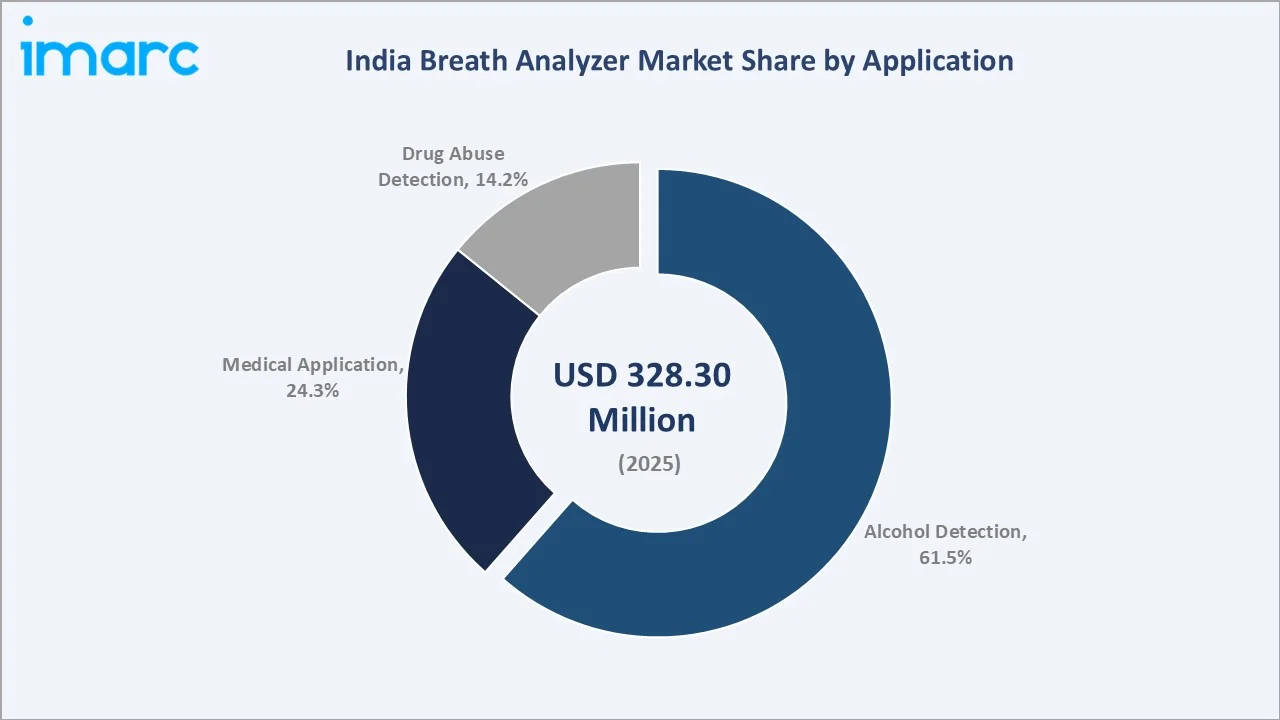
Medical application, at 24.3% share, is estimated to be the fastest-growing use case at approximately 25.3% CAGR through 2034 as hospitals adopt non-invasive breath diagnostics. Drug abuse detection, at 14.2%, is expanding as enterprises and institutions broaden testing protocols beyond alcohol alone.
Regional Market Insights
|
Region |
Share (2025) |
Key India Breath Analyzer Market Drivers & Characteristics |
|
North India |
33.7% |
Driven by Delhi-NCR's dense traffic policing infrastructure, higher vehicle ownership, and strong state-level road safety budget allocation. |
|
West & Central India |
29.8% |
Supported by Mumbai and Pune's dense commercial vehicle fleets and growing corporate workplace safety compliance programs. |
|
South India |
23.4% |
Reflects Bengaluru, Hyderabad, and Chennai's strong enforcement infrastructure and rising adoption of medical breath diagnostics in urban hospitals. |
|
East India |
13.1% |
Rising urbanization and gradual expansion of traffic enforcement infrastructure are supporting steady growth in premium and mid-tier analyzer adoption. |
North India's 33.7% leadership reflects Delhi-NCR's concentrated law-enforcement procurement and Punjab and Haryana's above-national highway checkpoint density. West and Central India's 29.8% share is anchored by Maharashtra and Gujarat's industrial and commercial vehicle safety compliance requirements.
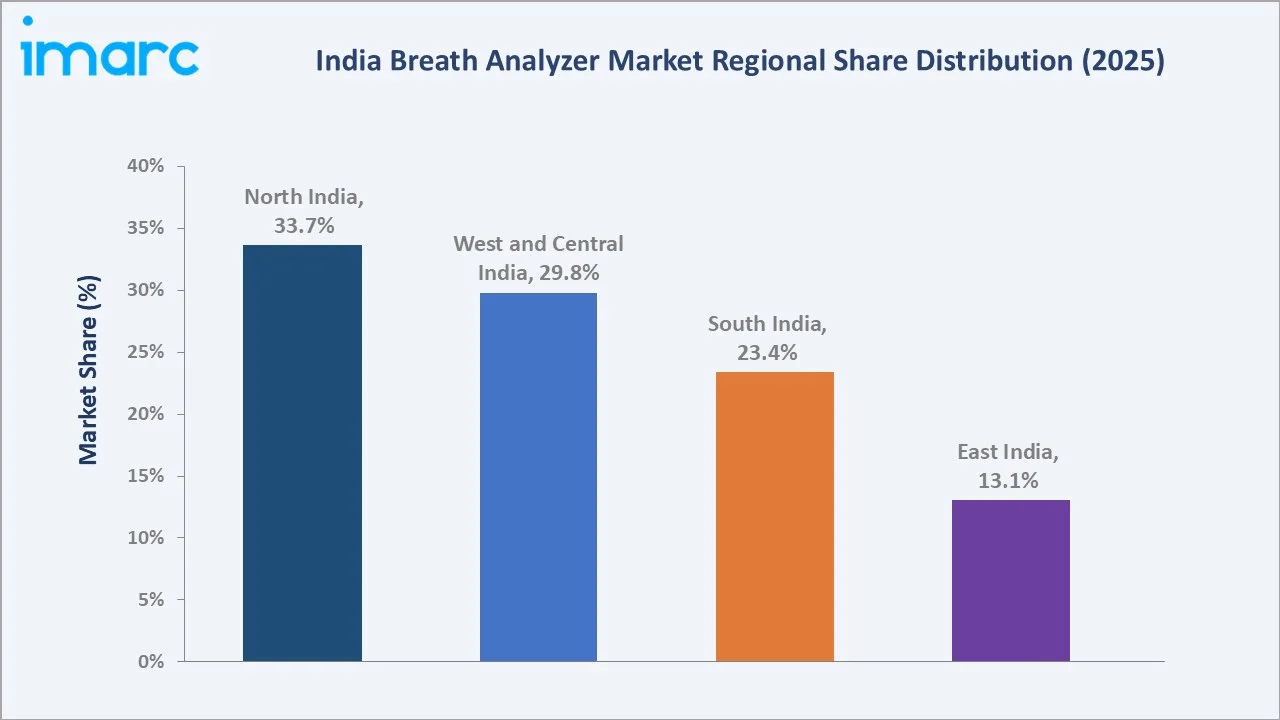
South India's 23.4% share is supported by Karnataka and Tamil Nadu's expanding hospital-based diagnostic adoption, while East India's 13.1% represents the most underpenetrated region, growing above the national CAGR as West Bengal and Odisha scale up enforcement infrastructure.
Competitive Landscape
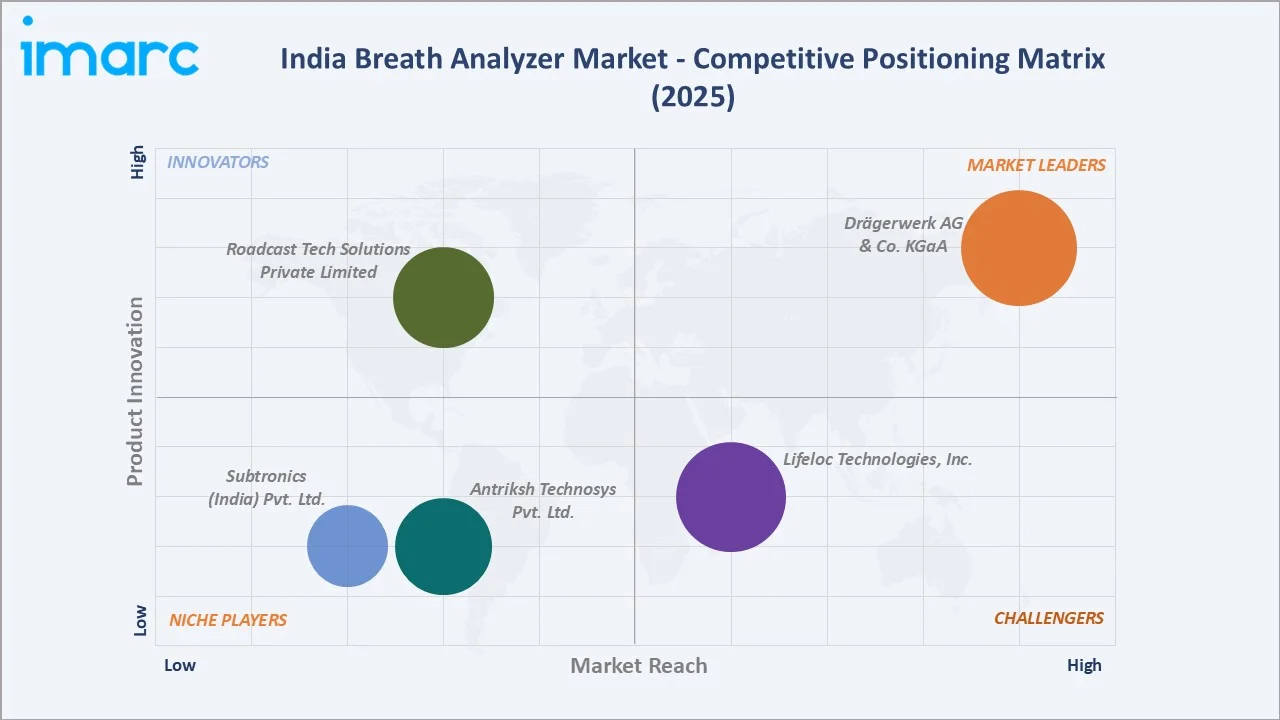
The India breath analyzer competitive landscape includes global medical-device leaders, established international breath-testing specialists, and a growing base of domestic manufacturers building Make-in-India, telematics-integrated devices for fleet and enterprise safety use cases.
|
Company |
Key Brands |
Market Position |
Core Strength |
|
Drägerwerk AG & Co. KGaA |
Dräger Alcotest series, Dräger DrugTest, and Dräger Interlock |
Market Leader |
Globally recognized medical and safety technology company with a strong presence in India's law-enforcement grade breath analyzer segment. |
|
Lifeloc Technologies, Inc. |
FC Series (FC10 / FC20), L Series (LX9) |
Strong Challenger |
Specializes in evidential and workplace breath alcohol testers, supplying enforcement and enterprise customers across multiple geographies including India. |
|
Roadcast Tech Solutions Private Limited |
Roadcast |
Innovator |
Roadcast, backed by Jubilant FoodWorks, launched India's first fully made-in-India, telematics-integrated alcohol breath analyzer in September 2025. |
|
Antriksh Technosys Pvt. Ltd. |
Stark Signals |
Niche Player |
Manufactures GPS and camera-enabled breath analyzers tailored for India's law-enforcement and laboratory testing needs. |
|
Subtronics (India) Pvt. Ltd. |
DBAn Pro, Alco-Booth, SIPL-6 |
Niche Player |
Offers wall-mounted and booth-based breath alcohol analyzers designed for high-throughput workplace and facility entry-point testing. |
Competitive intensity is rising as domestic manufacturers leverage the Make-in-India push to challenge established global brands on price and localization, while global leaders continue to defend share through certified accuracy and law-enforcement procurement relationships.
Key Company Profiles
Drägerwerk AG & Co. KGaA
Drägerwerk AG & Co. KGaA, which operates through its subsidiary- Draeger Safety India Private Limited, is a global medical and safety technology company with a long-standing presence in India's law-enforcement grade breath analyzer segment through its Alcotest product line.
- Key Brands: Dräger Alcotest series, Dräger DrugTest, and Dräger Interlock, and others.
- Strategic Focus: Maintaining leadership in high-accuracy, law-enforcement grade breath testing through continuous sensor and certification innovation.
Lifeloc Technologies, Inc.
Lifeloc Technologies, Inc. is a US-based manufacturer specializing in evidential and workplace breath alcohol testers, serving law-enforcement, corrections, and enterprise customers worldwide. The company operates in India through authorized distributors like the Safety and Health Research Institute (SHRI) and VigVen.
- Key Brands: FC Series (FC10 / FC20), L Series (LX9)
- Strategic Focus: Expanding international distribution of certified, portable breath alcohol testers for institutional and enterprise buyers.
Roadcast Tech Solutions Private Limited
Roadcast is a SaaS-based, hardware-agnostic fleet telematics platform backed by Jubilant FoodWorks, which launched India's first fully made-in-India alcohol breath analyzer in September 2025.
- Key Brands: Roadcast Breath Analyser, integrated with Roadcast telematics.
- Strategic Focus: Expanding into B2B enterprise, transport fleet, and government safety compliance through telematics-integrated breath testing.
Market Concentration Analysis
The India breath analyzer market is moderately fragmented, with global leaders such as Drägerwerk AG & Co. KGaA and Lifeloc Technologies, Inc. commanding a meaningful share of the law-enforcement and evidential testing segment through certified accuracy and long-standing institutional relationships.
Domestic manufacturers, including Roadcast Tech Solutions Private Limited, Antriksh Technosys Pvt. Ltd., and Subtronics (India) Pvt. Ltd., are gradually increasing their combined share through Make-in-India positioning and price-competitive offerings, creating a structural de-concentration pressure on established global brands over the forecast period.
Investment & Growth Opportunities
Highest Growth Segments
Medical application (estimated ~25.3% CAGR through India's diagnostic chain expansion), fuel cell technology (estimated ~23.6% CAGR through law-enforcement procurement), and drug abuse detection (estimated ~23.1% CAGR through broadening enterprise testing protocols) represent the market's highest-growth investment vectors through 2034.
Emerging Investment Opportunities
India's point-of-care medical breath diagnostics segment represents a high-growth, comparatively underpenetrated opportunity, as hospitals and diagnostic chains begin piloting non-invasive breath-based screening for metabolic and respiratory conditions.
Investment Themes
- Make-in-India telematics-integrated analyzers for fleet and enterprise safety compliance, capturing government and corporate procurement above import-dependent competitors.
- Cloud-enabled compliance reporting platforms bundled with breath analyzer hardware, creating recurring software revenue alongside device sales.
Future Market Outlook (2026-2034)
The India breath analyzer market is projected to grow from USD 328.3 Million in 2025 to USD 2,116.4 Million by 2034, delivering a 22.32% CAGR over the forecast period. The market's anchor value of USD 898.8 Million in 2030 represents a structural inflection point as enforcement and medical adoption converge.
Three structural forces define market growth through 2034: sustained government road-safety enforcement following MoRTH's record 2023 fatality data, expanding enterprise workplace safety compliance, and the rise of medical breath diagnostics as a distinct high-growth application within the broader market.
Research Methodology
Primary Research
Primary research comprised structured interviews with India breath analyzer industry stakeholders, including device manufacturers, law-enforcement procurement officials, distributors, and enterprise safety compliance managers across North, West, South, and East India.
Secondary Research
Secondary research encompassed government publications including MoRTH's Road Accidents in India reports, company websites, industry association data, and trade directories covering India's breath analyzer manufacturing and distribution landscape.
Forecasting Models
Market revenue forecasts were developed using a demand-driver stratification model, combining law-enforcement procurement trends, enterprise compliance adoption rates, and medical diagnostic penetration to derive segment-level and total market revenue projections.
India Breath Analyzer Market Report Coverage:
| Report Features | Details |
|---|---|
| Base Year of the Analysis | 2025 |
| Historical Period | 2020-2025 |
| Forecast Period | 2026-2034 |
| Units | Million USD |
| Scope of the Report | Exploration of Historical Trends and Market Outlook, Industry Catalysts and Challenges, Segment-Wise Historical and Future Market Assessment:
|
| Technologies Covered | Fuel Cell Technology, Semiconductor Sensor, Infrared Spectroscopy, and Others |
| Applications Covered | Alcohol Detection, Drug Abuse Detection, Medical Application |
| End Users Covered | Law Enforcement Agencies, Enterprises, and Others |
| Regions Covered | North India, West and Central India, South India, East India |
| Companies Covered | Drägerwerk AG & Co. KGaA, Lifeloc Technologies, Inc., Roadcast Tech Solutions Private Limited, Antriksh Technosys Pvt. Ltd., Subtronics (India) Pvt. Ltd., etc |
| Customization Scope | 10% Free Customization |
| Post-Sale Analyst Support | 10-12 Weeks |
| Delivery Format | PDF and Excel through Email (We can also provide the editable version of the report in PPT/Word format on special request) |
Frequently Asked Questions About the India Breath Analyzer Market Report
The India breath analyzer market reached USD 328.3 Million in 2025, driven by rising road accidents, government enforcement drives, and expanding workplace safety compliance across enterprises.
The market is projected to grow at a 22.32% CAGR during 2026-2034, reaching USD 2,116.4 Million by 2034, supported by enforcement, healthcare, and enterprise safety demand.
Fuel Cell Technology leads at 46.8% share in 2025, owing to its high accuracy for law-enforcement and medical-grade blood alcohol equivalence testing.
Alcohol Detection leads at 61.5% share in 2025, reflecting sustained enforcement-driven demand from traffic police and excise departments across India.
North India leads at 33.7% share, supported by Delhi-NCR's dense traffic enforcement infrastructure and higher regional vehicle ownership levels.
Leading companies include Drägerwerk AG & Co. KGaA, Lifeloc Technologies, Inc., Roadcast Tech Solutions Private Limited, Antriksh Technosys Pvt. Ltd., and Subtronics (India) Pvt. Ltd., among others.
The market is projected to reach approximately USD 898.8 Million by 2030, as enforcement procurement and medical diagnostic adoption continue to scale nationally.
Key drivers include rising road accidents, MoRTH's 2023 report of 172,890 fatalities, government safety mandates, and growing enterprise workplace alcohol-testing compliance.
Medical Application, at 24.3% share in 2025, is the fastest-growing use case as hospitals adopt non-invasive breath diagnostics for metabolic and respiratory screening.
Priority opportunities include point-of-care medical breath diagnostics, Make-in-India telematics-integrated analyzers, and cloud-enabled compliance reporting platforms for enterprises.
Need more help?
- Speak to our experienced analysts for insights on the current market scenarios.
- Include additional segments and countries to customize the report as per your requirement.
- Gain an unparalleled competitive advantage in your domain by understanding how to utilize the report and positively impacting your operations and revenue.
- For further assistance, please connect with our analysts.
 Request Customization
 Speak to an Analyst
 Request Brochure
 Inquire Before Buying
Benefits of Customization
- Personalize this research
- Triangulate with your data
- Get data as per your format and definition
- Gain a deeper dive into a specific application, geography, customer, or competitor
- Any level of personalization
Get in Touch With Us
UNITED STATES
Phone: +1-201-971-6302
INDIA
Phone: +91-120-433-0800
UNITED KINGDOM
Phone: +44-753-714-6104
Email: [email protected]
Client Testimonials




.webp)




.webp)













Related Reports

Choose your plan
*Please note that the prices mentioned below are starting prices for each bundle type. Kindly contact our team for further details.*
Single User License
- 1 User License, Access on 2 Devices
- PDF Report + Excel Dataset (Password Protected)
- Lifetime Access
- No Printing Rights
- 10% Free Report Customization
- 10–12 Weeks of Analyst Support
Five User License
- Access for 5 Users, 2 Devices per User
- PDF Report + Excel Dataset (Password Protected)
- Lifetime Access
- Dedicated Account Manager
- 12–14 Weeks of Analyst Support
- No Printing Rights
- 15% Free Report Customization
- 25% Discount on Your Next Purchase
Corporate User License
- Unlimited User Access (Within Your Organization)
- PDF Report + Excel Dataset
- Lifetime Access
- Dedicated Account Manager
- 14–20 Weeks of Analyst Support
- No Printing Rights
- 20% Free Report Customization
- 30% Discount on Your Next Purchase
Essential Insights
What's included:
3 reports
- Lifetime Access
- PDF Reports
- Excel Datasets
- 2 Weeks of Free Analyst Support
- 2 User Licenses
- Access on 2 Devices
- Printing Rights
- Complimentary PowerPoint (PPT) Version
- Complimentary License Upgrade
Professional Access
What's included:
5 reports
- Lifetime Access
- PDF Reports
- Excel Datasets
- 8 Weeks of Free Analyst Support
- 2 User Licenses
- Access on 2 Devices
- Printing Rights
- Complimentary PowerPoint (PPT) Version
- Complimentary License Upgrade
Business Advantage
What's included:
8 reports
- Lifetime Access
- PDF Reports
- Excel Datasets
- 14 Weeks of Free Analyst Support
- 2 User Licenses
- Access on 2 Devices
- Printing Rights
- Complimentary PowerPoint (PPT) Version
- Complimentary License Upgrade
Enterprise Intelligence
What's included:
10 reports
- Lifetime Access
- PDF Reports
- Excel Datasets
- 20 Weeks of Free Analyst Support
- 2 User Licenses
- Access on 2 Devices
- Printing Rights
- Complimentary PowerPoint (PPT) Version
- Complimentary License Upgrade