
India Business Jet Market Size, Share, Trends and Forecast by Type, Business Model, Range, Point of Sale, and Region, 2026-2034
India Business Jet Market Size, Share, Trends & Forecast (2026-2034)
The India business jet market reached USD 692.3 Million in 2025 and is projected to reach USD 1,206.6 Million by 2034, growing at a CAGR of 6.18% during 2026-2034. Growth is driven by a rapidly expanding base of high-net-worth individuals, wider corporate adoption of charter services, and increasing interest in fractional ownership. Light jets lead the type segmentation with a 44.8% share, reflecting strong demand for cost-efficient short-haul missions. On-demand charter services account for 61.9% of the business model split, ahead of outright ownership at 38.1%. West and Central India leads regionally with a 39.8% share, anchored by Mumbai's concentration of promoter-led enterprises.
Market Snapshot
|
Metric |
Value |
|
Market Size (2025) |
USD 692.3 Million |
|
Forecast Market Size (2034) |
USD 1,206.6 Million |
|
CAGR (2026-2034) |
6.18% |
|
Base Year |
2025 |
|
Historical Period |
2020-2025 |
|
Forecast Period |
2026-2034 |
|
Dominant Type |
Light (44.8%, 2025) |
|
Dominant Business Model |
On-Demand Service (61.9%, 2025) |
|
Leading Region |
West and Central India (39.8%, 2025) |
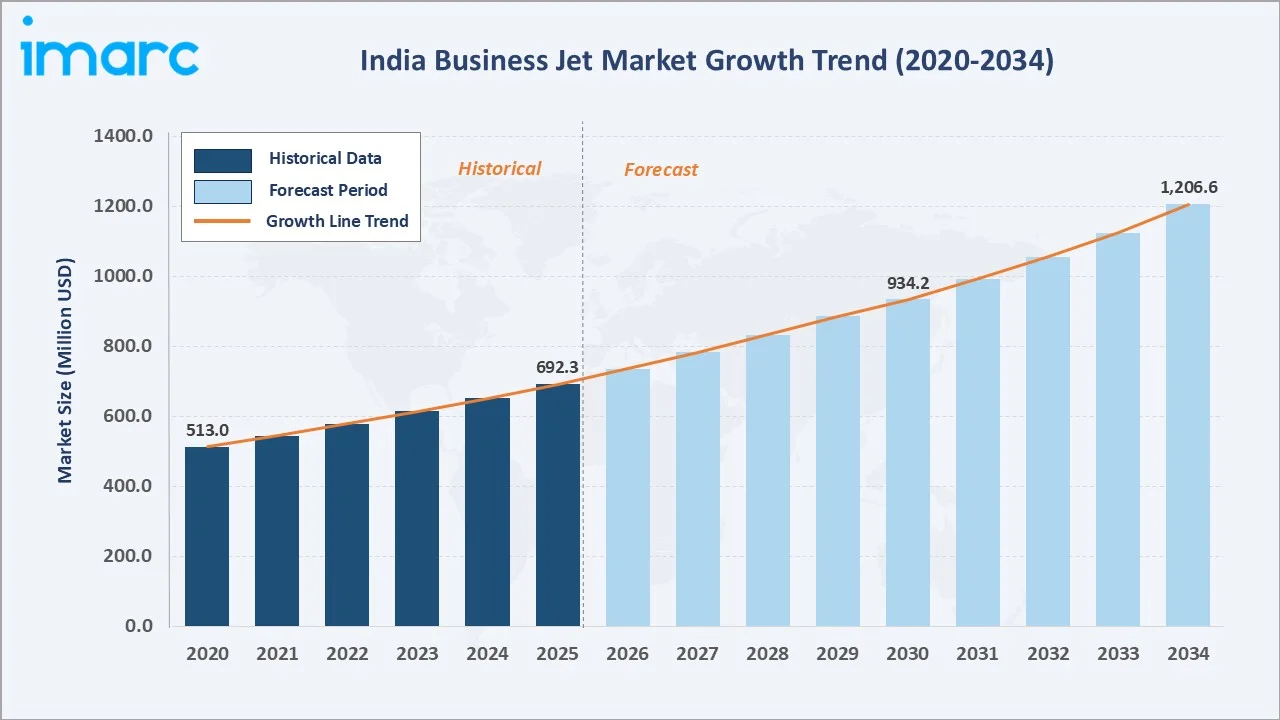
India business jet market expanded from USD 513.0 Million in 2020 to USD 692.3 Million in 2025, anchored at USD 934.2 Million in 2030, and is forecast to reach USD 1,206.6 Million by 2034. The market's steady trajectory reflects India's expanding population of dollar millionaires, a maturing charter ecosystem, and a structural shift away from congested scheduled connectivity toward on-demand private aviation for time-sensitive corporate travel.
To get more information on this market, Request Sample
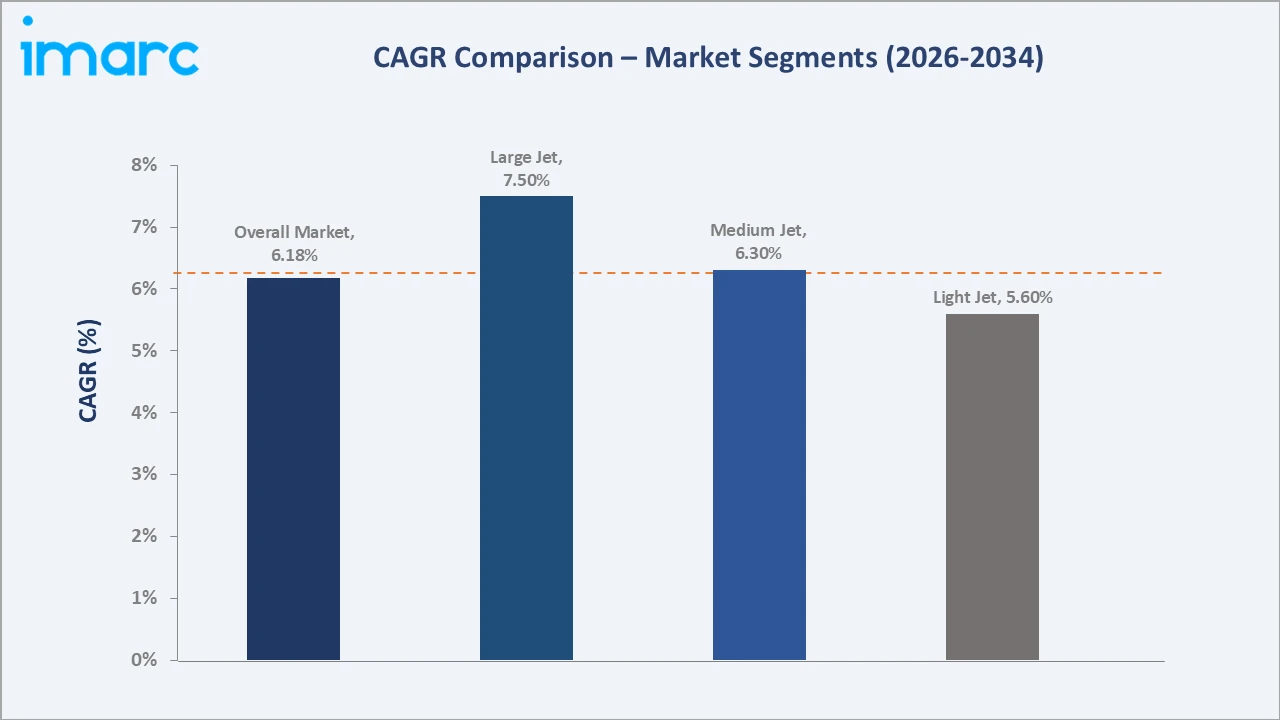
The large jet segment grows fastest at an estimated 7.5% CAGR through 2034, supported by promoter families upgrading to long-range aircraft for international routes. Medium jets expand at approximately 6.3% CAGR, benefiting from their balance of range, cabin comfort, and operating cost for domestic and regional corporate missions across India's metro corridors.
Executive Summary
India business jet market at USD 692.3 Million in 2025 ranks among Asia Pacific's fastest-expanding private aviation markets, reflecting the country's growing high-net-worth population and the rising commercial need for time-efficient travel across a geographically dispersed corporate landscape. The market is projected to reach USD 1,206.6 Million by 2034, delivering a 6.18% CAGR over the forecast period.
Light jets lead the type segmentation at 44.8% share, reflecting affordability and suitability for India's short-haul metro-to-metro routes. On-demand charter services hold 61.9% of the business model split, as companies and individuals increasingly prefer pay-per-use flexibility over the fixed costs of ownership. West and Central India leads regionally at 39.8%, driven by Mumbai's dense concentration of promoter-led enterprises and family offices.
Looking ahead, the market outlook remains constructive as airport infrastructure expands, fractional ownership platforms mature, and India's UHNI population continues to grow at a pace among the fastest globally, sustaining demand across both charter and ownership segments through 2034.
Key Market Insights
|
Insight |
Data |
|
Largest Segment (Type) |
Light - 44.8% share (2025) |
|
Leading Business Model |
On-Demand Service - 61.9% share (2025) |
|
Leading Region |
West and Central India - 39.8% share (2025) |
|
Fastest Growing Segment |
Large jets - approximately 7.5% CAGR (2026-2034) |
|
Top Companies |
JetSetGo Aviation Services Private Limited, Tata Group (Taj Air Limited), Club One Airways Private Limited, Vista Global Holding Limited, and Berkshire Hathaway (NetJets) |
|
Market Opportunity |
Tier-2 city FBO and charter base expansion; fractional ownership platforms; sustainable aviation fuel adoption |
Key Analytical Observations Supporting the Above Data:
- Light Jets at 44.8%: The light jet segment dominates due to lower acquisition and operating costs, making it the preferred entry point for corporates and first-time private aviation users across India's short-haul metro network.
- On-Demand Service at 61.9%: Charter services dominate the business model split as companies avoid the fixed costs, crew management, and hangar overheads associated with outright ownership, favouring flexible pay-per-flight access instead.
- West and Central India at 39.8%: Mumbai's status as India's commercial and financial capital, combined with a dense cluster of promoter-led enterprises and family offices, anchors the region's regional leadership.
- Large jets at approximately 7.5% CAGR: Rising international travel by Indian promoter families and growing demand for long-range, wide-cabin aircraft support this segment's above-market growth rate.
- Fractional ownership expansion: Structured ownership-sharing models are lowering the entry barrier for mid-sized enterprises, widening the addressable customer base beyond ultra-high-net-worth individuals.
- Airport infrastructure development: Government-backed expansion of regional airports and dedicated general aviation terminals is easing operational bottlenecks that have historically constrained charter frequency.
India Business Jet Market Overview
India business jet market encompasses the charter, ownership, management, and maintenance of light, medium, and large business aircraft used for corporate, medical, government, and leisure travel. The ecosystem integrates aircraft manufacturers, charter and fractional ownership operators, fixed-base operators (FBOs), and maintenance, repair and overhaul (MRO) providers.
Macroeconomic tailwinds, including India's rising GDP per capita, an expanding base of listed and unlisted enterprises, and improving airport infrastructure under the government's regional connectivity initiatives, are supporting demand across both metro and emerging Tier-2 markets.
Market Dynamics
To evaluate market opportunities, Request Sample
Market Drivers
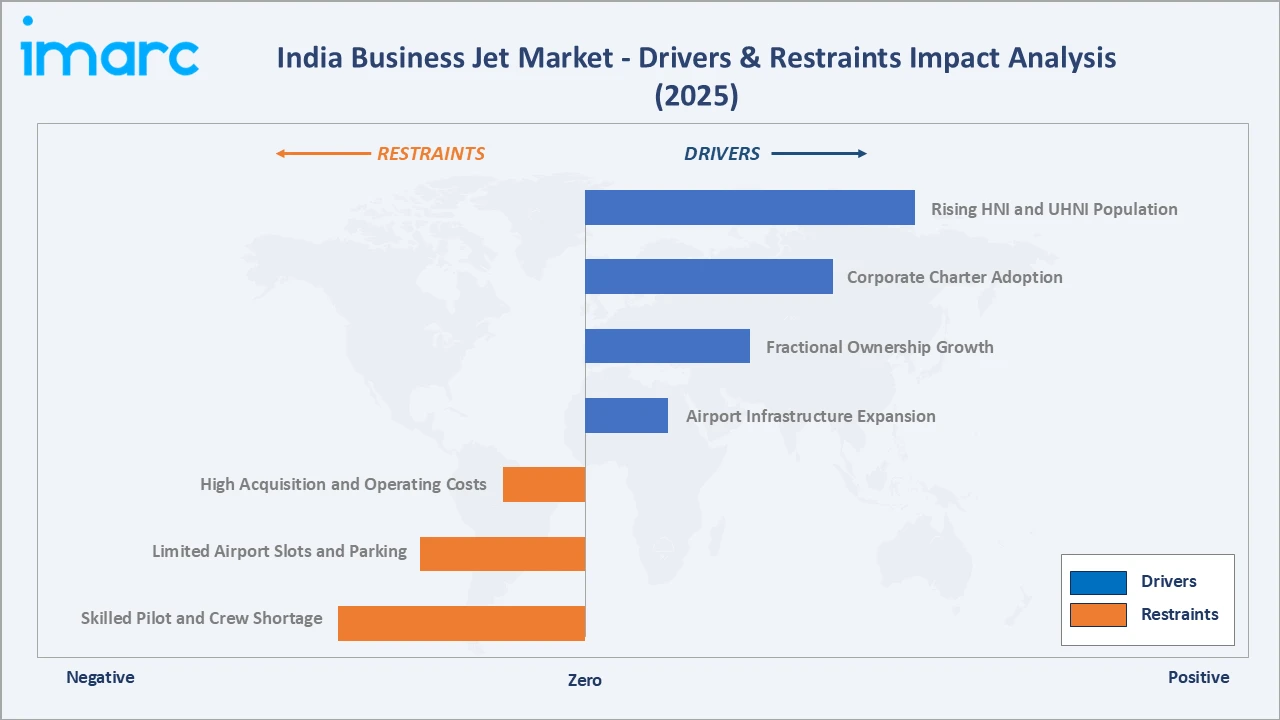
- Rising HNI and UHNI Population: India's growing count of dollar millionaires is directly expanding the addressable base for private aviation, as wealth accumulation increasingly translates into demand for time-efficient, flexible travel options beyond scheduled commercial airlines.
- Corporate Charter Adoption: Enterprises operating across India's dispersed manufacturing and business hubs are increasingly chartering aircraft to reduce travel time between cities that lack convenient direct commercial connectivity.
- Fractional Ownership Growth: Structured shared-ownership programs are lowering the capital threshold for private aviation access, drawing in mid-sized enterprises that previously relied solely on ad-hoc charters.
- Airport Infrastructure Expansion: Government investment in regional airports and dedicated general aviation infrastructure under national connectivity programs is reducing operational bottlenecks and expanding the network of usable airstrips.
Market Restraints
- High Acquisition and Operating Costs: Import duties, maintenance costs, and crew expenses keep total ownership costs high, limiting outright purchase to a narrow band of ultra-high-net-worth buyers and large corporates.
- Limited Airport Slots and Parking: Congestion at India's primary metro airports restricts parking bays and landing slots available to general aviation traffic, constraining charter frequency during peak hours.
Market Opportunities
- Tier-2 City Charter Network Expansion: Growing business activity in cities such as Ahmedabad, Pune, and Indore is creating opportunities for operators to establish new charter bases beyond the traditional metro clusters.
- Digital Booking Platform Growth: App-based charter marketplaces are simplifying price discovery and booking, attracting a new generation of first-time private aviation users.
Market Challenges
- Skilled Pilot and Crew Shortage: Rapid fleet expansion is outpacing the supply of trained pilots and cabin crew certified for business jet operations, pressuring operators' cost structures.
- Regulatory and Customs Complexity: Import clearance procedures and multi-agency approvals for aircraft registration continue to lengthen fleet induction timelines for operators and owners alike.
Emerging Market Trends
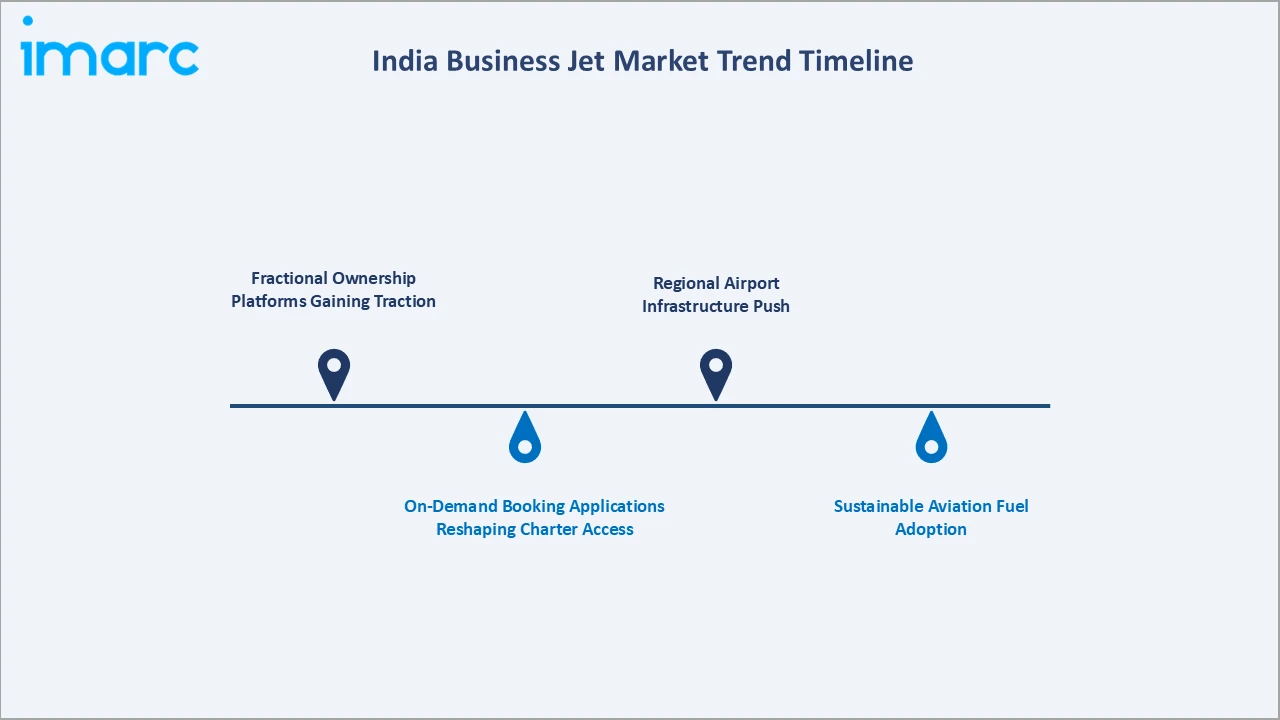
1. Fractional Ownership Platforms Gaining Traction
Structured fractional ownership programs are expanding as mid-sized enterprises seek predictable access to aircraft without the full capital burden of outright purchase. This model is broadening the market's customer base beyond traditional UHNI buyers.
2. On-Demand Booking Applications Reshaping Charter Access
Mobile and web-based charter marketplaces are simplifying aircraft discovery, pricing transparency, and booking speed, mirroring the digitization already seen in India's broader travel and mobility sectors.
3. Regional Airport Infrastructure Push
Government-backed development of Tier-2 airports and dedicated general aviation terminals is expanding the map of viable charter destinations, reducing dependency on India's congested primary metro hubs.
4. Sustainable Aviation Fuel Adoption
Operators are beginning to evaluate sustainable aviation fuel (SAF) blending as global manufacturers push cleaner propulsion options, positioning early adopters favourably as environmental scrutiny of private aviation increases.
Industry Value Chain Analysis
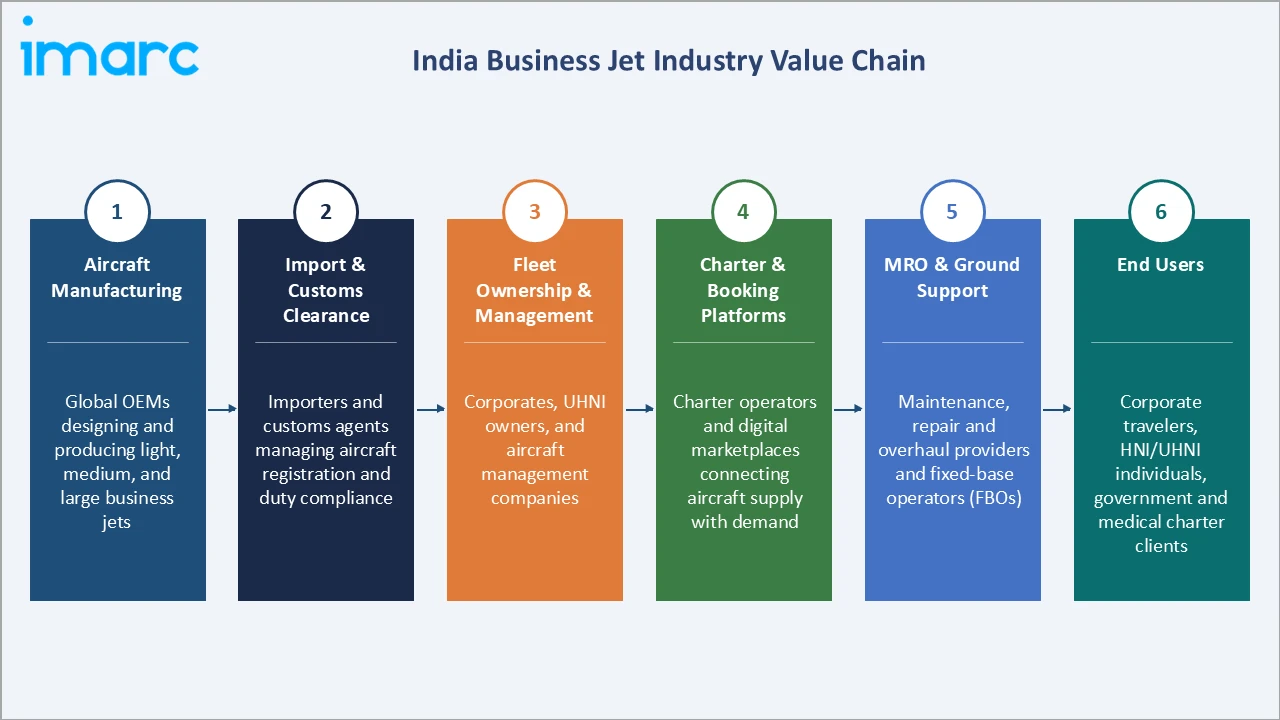
India business jet value chain spans aircraft manufacturing and import, fleet ownership and management, charter and booking intermediation, and after-sales maintenance support. Each stage carries distinct regulatory and capital requirements that shape operator strategy.
|
Stage |
Key Participants |
|
Aircraft Manufacturing |
Global OEMs designing and producing light, medium, and large business jets |
|
Import & Customs Clearance |
Importers and customs agents managing aircraft registration and duty compliance |
|
Fleet Ownership & Management |
Corporates, UHNI owners, and aircraft management companies |
|
Charter & Booking Platforms |
Charter operators and digital marketplaces connecting aircraft supply with demand |
|
MRO & Ground Support |
Maintenance, repair and overhaul providers and fixed-base operators (FBOs) |
|
End Users |
Corporate travelers, HNI/UHNI individuals, government and medical charter clients |
The import and customs clearance stage remains the value chain's most consequential regulatory checkpoint, with operators citing multi-agency approval timelines as a key factor influencing fleet induction planning and total cost of aircraft ownership.
Technology Landscape in the India Business Jet Industry
Cabin & Avionics Technology
Modern business jets increasingly feature satellite connectivity, advanced avionics suites, and noise-reduction cabin engineering. These upgrades are becoming a differentiator for charter operators competing for repeat corporate clients who prioritize in-flight productivity.
Sustainable Aviation Fuel & Propulsion
Manufacturers are progressively certifying aircraft for higher sustainable aviation fuel blend ratios, while Indian operators explore early adoption to align with global environmental, social, and governance (ESG) expectations from corporate clients.
Digital Charter & Fleet Management Platforms
Cloud-based fleet scheduling, predictive maintenance analytics, and app-based booking are streamlining operations for charter companies, reducing aircraft downtime and improving utilization rates across fleets serving India's metro and Tier-2 routes.
Market Segmentation Analysis
The report covers the following segments:
|
Segment Category |
Leading Segment |
Market Share |
Year |
|
Type |
Light |
44.8% |
2025 |
|
Business Model |
On-Demand Service |
61.9% |
2025 |
|
Range |
🔒 |
🔒 |
2025 |
|
Point of Sale |
🔒 |
🔒 |
2025 |
|
Region |
West and Central India |
39.8% |
2025 |

By Type
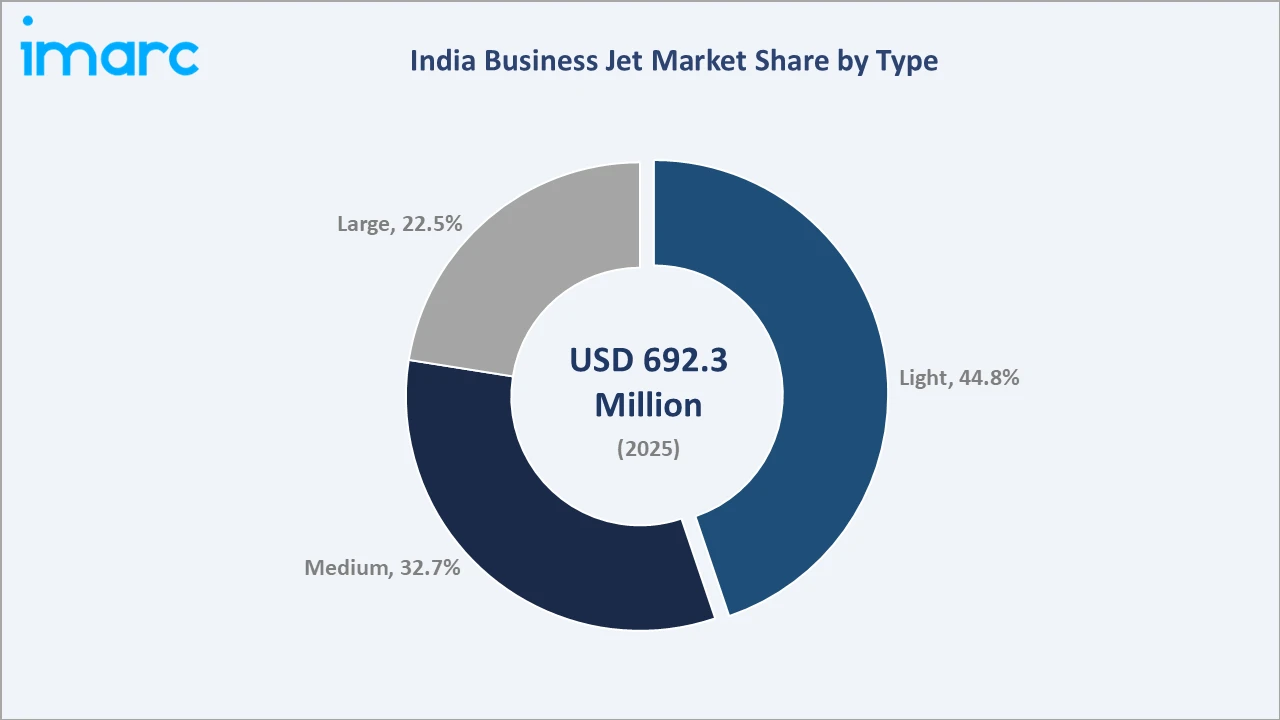
Light jets lead at 44.8% (2025). The segment's affordability, lower per-hour operating cost, and suitability for short-haul metro routes make it the preferred entry point for corporates and first-time charter users across India.
To access detailed market analysis, Request Sample
Medium jets hold 32.7% share, valued for their balance of range and cabin comfort on regional corporate routes. Large jets, at 22.5% share, grow fastest at an estimated 7.5% CAGR through 2034, driven by promoter families upgrading to long-range aircraft for international travel.
By Business Model
On-demand charter service leads at 61.9% (2025). Enterprises and individuals increasingly prefer pay-per-use access over the fixed costs, crew management, and hangar overheads tied to outright aircraft ownership.
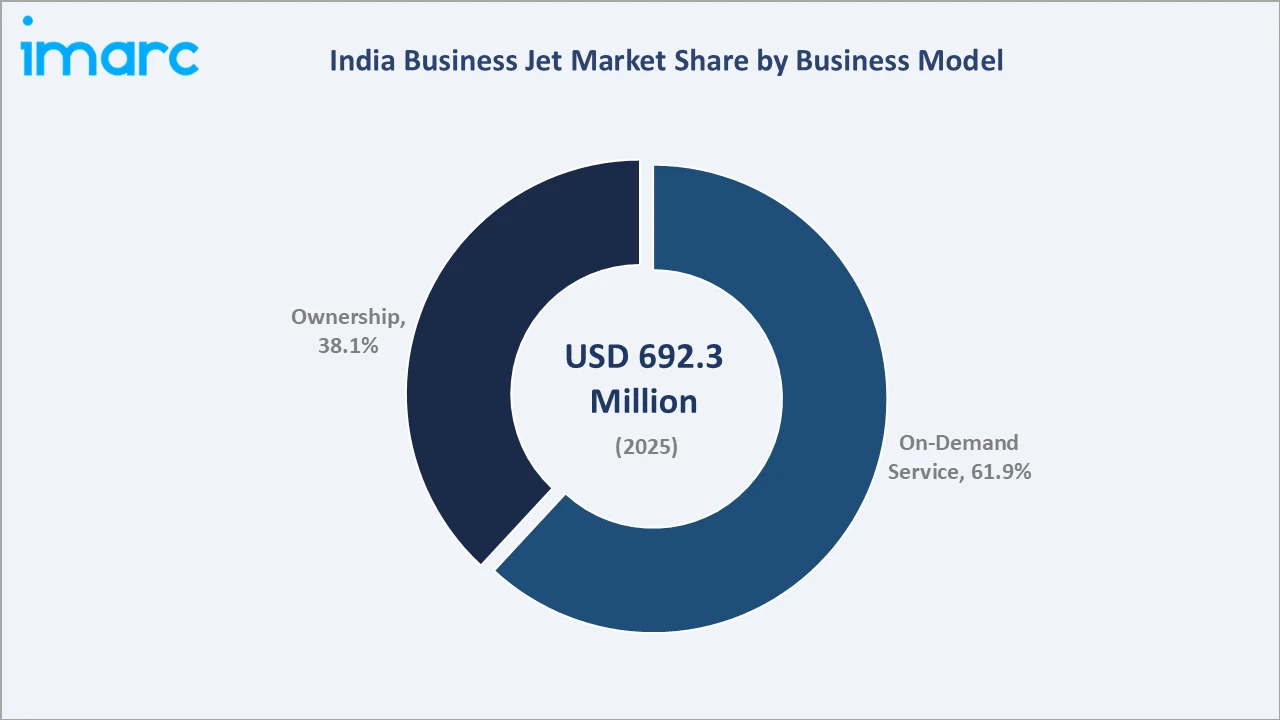
Ownership accounts for the remaining 38.1% share, concentrated among large corporates and UHNI families with sufficiently high annual flying hours to justify the capital outlay of dedicated aircraft.
Regional Market Insights
|
Region |
Share (2025) |
Key India Business Jet Market Drivers & Characteristics |
|
West and Central India |
39.8% |
Anchored by Mumbai's concentration of promoter-led enterprises, family offices, and financial services headquarters driving charter and ownership demand. |
|
North India |
30.4% |
Delhi-NCR's corporate and government charter demand, supported by proximity to policy institutions and a dense HNI population. |
|
South India |
19.2% |
Bengaluru and Hyderabad's technology and pharmaceutical corporate base is driving rising charter adoption for inter-city business travel. |
|
East and Northeast India |
10.6% |
The most nascent region, growing above the overall market CAGR as Kolkata's industrial base and improving regional airport access expand charter demand. |
West and Central India's 39.8% leadership reflects Mumbai's role as India's financial capital, hosting the country's densest cluster of promoter-led enterprises and family offices that sustain both charter and ownership demand. North India's 30.4% share is anchored by Delhi-NCR's concentration of corporate headquarters and government-linked charter activity.
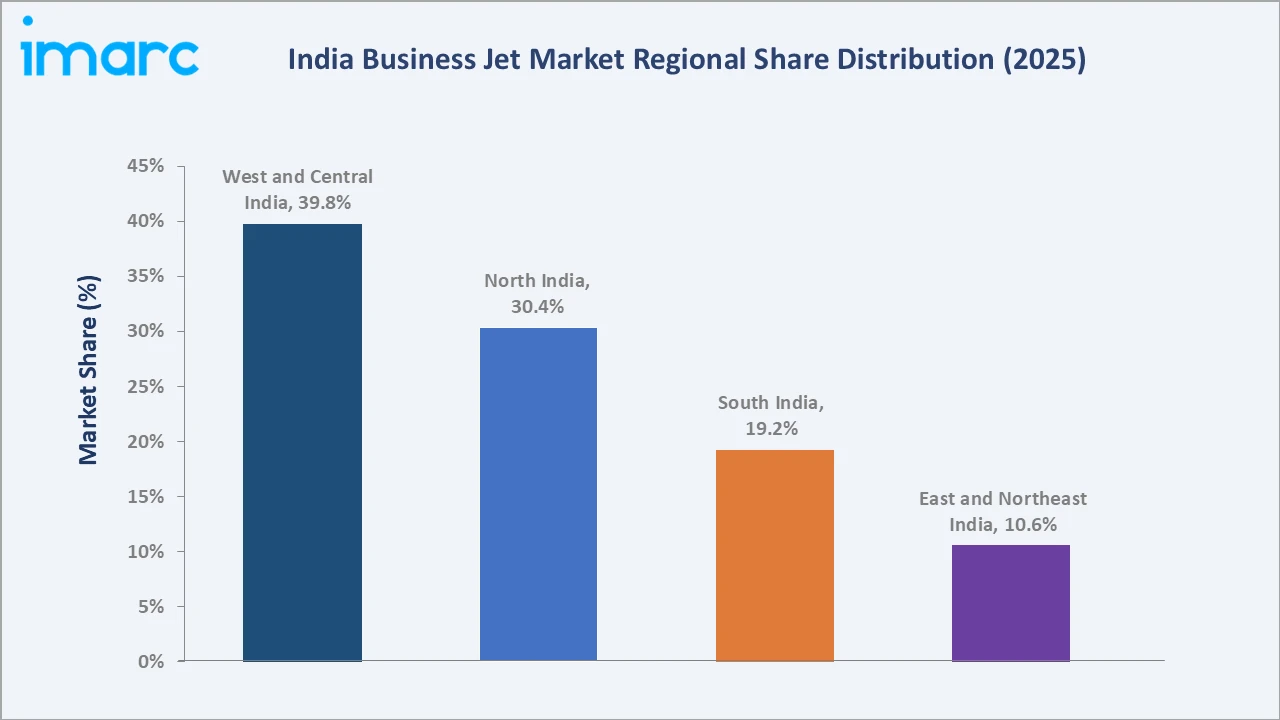
South India's 19.2% share reflects Bengaluru's technology sector wealth and Hyderabad's pharmaceutical corporate base, both of which are driving rising charter adoption. East and Northeast India, at 10.6%, remains the most underdeveloped region but is growing above the overall market CAGR as regional airport connectivity gradually improves.
Competitive Landscape
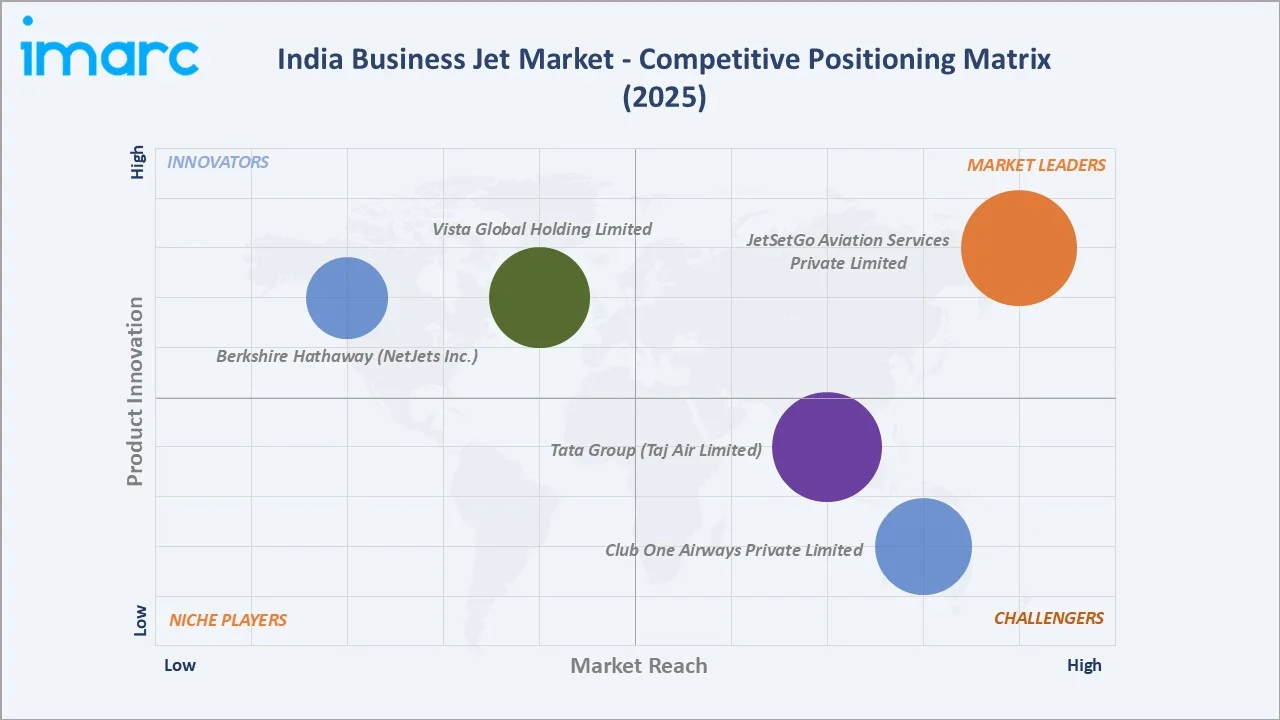
India business jet market competitive landscape features a mix of dedicated Indian charter operators and global fractional ownership groups. Competition is intensifying as digital booking platforms lower switching costs and corporate clients increasingly compare operators on fleet quality, safety record, and pricing transparency.
|
Company |
Brands/Fleet |
Market Position |
Core Strength |
|
JetSetGo Aviation Services Private Limited |
Cessna Citation CJ2, Hawker Beechcraft 750, Dassault Falcon 2000 |
Market Leader |
India's prominent NSOP operator of private jets and helicopters, combining charter, management, and membership programs. |
|
Tata Group (Taj Air Limited) |
Dassault Falcon 2000, Dassault Falcon 2000LX |
Strong Challenger |
Operates Taj Air Limited, running its own hangar and in-house maintenance in Mumbai since 2002. |
|
Club One Airways Private Limited |
Dassault Falcon 2000, Cessna Citation |
Strong Challenger |
India's first aircraft fractional ownership company, operating from Delhi, Mumbai, and Visakhapatnam bases. |
|
Vista Global Holding Limited |
VistaJet, XO |
Innovator |
Global subscription-based charter programme extending membership-style access to Indian UHNI clients. |
|
Berkshire Hathaway (NetJets Inc.) |
Embraer (Phenom series), Bombardier (Challenger and Global series), and Cessna Textron Aviation (Citation series) |
Innovator |
Operates NetJets Inc., a pioneer of the global fractional ownership model, serving Indian clients through its international network. |
The competitive landscape's most significant dynamic is the growing overlap between Indian charter specialists and global fractional ownership groups, both competing for the same base of expanding UHNI and corporate clients seeking reliable, transparent private aviation access.
Key Company Profiles
JetSetGo Aviation Services Private Limited
JetSetGo is India's one of the largest NSOP operators of private jets and helicopters, offering charter, aircraft management, and membership-based access from its Delhi headquarters.
- Fleet: Cessna Citation CJ2, Hawker Beechcraft 750, Falcon 2000 Easy, and others.
- Strategic Focus: Expanding its membership programme and digital booking platform to widen access beyond its core UHNI client base.
Tata Group (Taj Air Limited)
Taj Air Limited is a Tata Group-backed charter operator that has provided exclusive business aviation services from its own Mumbai hangar since 2002.
- Fleet: Dassault Falcon 2000, Dassault Falcon 2000LX, and others.
- Strategic Focus: Leveraging the Tata Group's hospitality heritage to position itself as a premium, service-led charter brand for corporate and leisure clients.
Club One Airways Private Limited
Club One Air is India's first aircraft fractional ownership company, operating charter and fractional programmes from bases in Delhi, Mumbai, and Visakhapatnam since 2005.
- Fleet: Dassault Falcon 2000, Cessna Citation, and others.
- Strategic Focus: Deepening its fractional ownership offering to capture mid-sized enterprise clients seeking predictable aircraft access.
Market Concentration Analysis
India business jet market is moderately concentrated, with JetSetGo Aviation Services Private Limited commanding a leading share of the organized charter and management segment through its scale advantage as the country's largest NSOP operator. Legacy players such as Tata Group (Taj Air Limited) and Club One Airways Private Limited retain meaningful share through long-standing client relationships and dedicated maintenance infrastructure.
Concentration is evolving as global fractional ownership groups such as Vista Global Holding Limited and Berkshire Hathaway (NetJets Inc.) extend their international networks to Indian UHNI clients, while new digital-first charter platforms lower barriers to entry, gradually increasing competitive intensity at the mid-market tier.
Investment & Growth Opportunities
Highest Growth Segments
Large jets (approximately 7.5% CAGR through promoter international travel demand), medium jets (approximately 6.3% CAGR through regional corporate missions), Tier-2 city charter base expansion, and fractional ownership platforms represent India's highest-growth business jet investment vectors through 2034.
Emerging Investment Opportunities
Digital charter booking platforms and fractional ownership marketplaces represent the market's most commercially accessible entry points for new participants, requiring lower capital intensity than direct fleet ownership while capturing rising demand from first-time private aviation users.
Investment Themes
- Tier-2 city FBO and charter base expansion: Establishing fixed-base operator infrastructure in underserved cities such as Ahmedabad, Pune, and Indore addresses a structurally underserved segment of India's growing corporate travel demand.
- Fractional ownership platform investment: Structured shared-ownership models lower the capital barrier for mid-sized enterprises, representing the market's most scalable growth opportunity beyond the traditional UHNI client base.
Future Market Outlook (2026-2034)
India business jet market is projected to grow from USD 692.3 Million in 2025 to USD 1,206.6 Million by 2034, delivering a 6.18% CAGR over the forecast period. The market's anchor value of USD 934.2 Million in 2030 reflects a steady mid-cycle expansion supported by rising HNI wealth and improving airport infrastructure.
Three structural forces will define market growth through 2034: India's expanding UHNI population sustaining both charter and ownership demand, the digitization of charter booking improving price transparency and utilization, and regional airport infrastructure investment widening the map of commercially viable private aviation destinations beyond India's primary metro hubs.
Research Methodology
Primary Research
Primary research comprised structured interviews with India business jet industry stakeholders, including charter operator executives, fleet management company representatives, FBO operators, and corporate travel decision-makers across North, West, South, and East India.
Secondary Research
Secondary research encompassed aviation regulatory filings, company websites and annual disclosures, industry association publications, and airport infrastructure development reports. Multiple secondary sources were reviewed and cross-verified for consistency.
Forecasting Models
Market revenue forecasts were developed using a fleet-and-utilization model: estimated active business jet fleet size multiplied by average annual flying hours and average revenue per flying hour, aggregated across type and business model segments.
India Business Jet Market Report Coverage:
| Report Features | Details |
|---|---|
| Base Year of the Analysis | 2025 |
| Historical Period | 2020-2025 |
| Forecast Period | 2026-2034 |
| Units | Million USD |
| Scope of the Report | Exploration of Historical Trends and Market Outlook, Industry Catalysts and Challenges, Segment-Wise Historical and Future Market Assessment:
|
| Types Covered | Light, Medium, Large |
| Business Models Covered |
|
| Ranges Covered | < 3,000 NM, 3,000 - 5,000 NM, > 5000 NM |
| Point of Sales Covered | OEM, Aftermarket |
| Regions Covered | North India, West and Central India, South India, East and Northeast India |
| Companies Covered | JetSetGo Aviation Services Private Limited, Tata Group (Taj Air Limited), Club One Airways Private Limited, Vista Global Holding Limited, Berkshire Hathaway (NetJets Inc.), etc. |
| Customization Scope | 10% Free Customization |
| Post-Sale Analyst Support | 10-12 Weeks |
| Delivery Format | PDF and Excel through Email (We can also provide the editable version of the report in PPT/Word format on special request) |
Key Benefits for Stakeholders:
- IMARC’s industry report offers a comprehensive quantitative analysis of various market segments, historical and current market trends, market forecasts, and dynamics of the India business jet market from 2020-2034.
- The research report provides the latest information on the market drivers, challenges, and opportunities in the India business jet market.
- Porter's five forces analysis assist stakeholders in assessing the impact of new entrants, competitive rivalry, supplier power, buyer power, and the threat of substitution. It helps stakeholders to analyze the level of competition within the India business jet industry and its attractiveness.
- Competitive landscape allows stakeholders to understand their competitive environment and provides an insight into the current positions of key players in the market.
Frequently Asked Questions About the India Business Jet Market Report
The India business jet market reached USD 692.3 Million in 2025, driven by rising HNI wealth, corporate charter adoption, and expanding airport infrastructure supporting private aviation growth nationwide.
The India business jet market grows at a 6.18% CAGR during 2026-2034, reaching USD 1,206.6 Million by 2034, supported by fractional ownership expansion and rising UHNI travel demand.
Light jets lead at 44.8% share through their affordability and suitability for India's short-haul metro routes, making them the preferred entry point for first-time charter users and corporates.
On-demand charter service leads at 61.9% share, as clients increasingly prefer flexible pay-per-use access over the fixed costs and overheads associated with outright aircraft ownership.
West and Central India leads at 39.8% share, anchored by Mumbai's dense concentration of promoter-led enterprises, family offices, and financial services headquarters.
Leading companies include JetSetGo Aviation Services Private Limited, Tata Group (Taj Air Limited), Club One Airways Private Limited, Vista Global Holding Limited, and Berkshire Hathaway (NetJets Inc.), among others, spanning charter, fractional ownership, and aircraft management services.
The India business jet market is projected to reach approximately USD 934.2 Million by 2030, as fractional ownership platforms mature and regional airport infrastructure continues to expand.
Priority opportunities include Tier-2 city FBO and charter base expansion, fractional ownership platform investment, and digital charter booking marketplace development targeting first-time private aviation users.
Key drivers include a rising HNI and UHNI population, growing corporate charter adoption, fractional ownership expansion, and government-backed airport infrastructure investment easing operational bottlenecks.
High acquisition and operating costs, coupled with limited airport slots and parking capacity at congested metro airports, remain the market's primary structural restraints.
Need more help?
- Speak to our experienced analysts for insights on the current market scenarios.
- Include additional segments and countries to customize the report as per your requirement.
- Gain an unparalleled competitive advantage in your domain by understanding how to utilize the report and positively impacting your operations and revenue.
- For further assistance, please connect with our analysts.
 Request Customization
 Speak to an Analyst
 Request Brochure
 Inquire Before Buying
Benefits of Customization
- Personalize this research
- Triangulate with your data
- Get data as per your format and definition
- Gain a deeper dive into a specific application, geography, customer, or competitor
- Any level of personalization
Get in Touch With Us
UNITED STATES
Phone: +1-201-971-6302
INDIA
Phone: +91-120-433-0800
UNITED KINGDOM
Phone: +44-753-714-6104
Email: [email protected]
Client Testimonials




.webp)




.webp)













Related Reports

Choose your plan
*Please note that the prices mentioned below are starting prices for each bundle type. Kindly contact our team for further details.*
Single User License
- 1 User License, Access on 2 Devices
- PDF Report + Excel Dataset (Password Protected)
- Lifetime Access
- No Printing Rights
- 10% Free Report Customization
- 10–12 Weeks of Analyst Support
Five User License
- Access for 5 Users, 2 Devices per User
- PDF Report + Excel Dataset (Password Protected)
- Lifetime Access
- Dedicated Account Manager
- 12–14 Weeks of Analyst Support
- No Printing Rights
- 15% Free Report Customization
- 25% Discount on Your Next Purchase
Corporate User License
- Unlimited User Access (Within Your Organization)
- PDF Report + Excel Dataset
- Lifetime Access
- Dedicated Account Manager
- 14–20 Weeks of Analyst Support
- No Printing Rights
- 20% Free Report Customization
- 30% Discount on Your Next Purchase
Essential Insights
What's included:
3 reports
- Lifetime Access
- PDF Reports
- Excel Datasets
- 2 Weeks of Free Analyst Support
- 2 User Licenses
- Access on 2 Devices
- Printing Rights
- Complimentary PowerPoint (PPT) Version
- Complimentary License Upgrade
Professional Access
What's included:
5 reports
- Lifetime Access
- PDF Reports
- Excel Datasets
- 8 Weeks of Free Analyst Support
- 2 User Licenses
- Access on 2 Devices
- Printing Rights
- Complimentary PowerPoint (PPT) Version
- Complimentary License Upgrade
Business Advantage
What's included:
8 reports
- Lifetime Access
- PDF Reports
- Excel Datasets
- 14 Weeks of Free Analyst Support
- 2 User Licenses
- Access on 2 Devices
- Printing Rights
- Complimentary PowerPoint (PPT) Version
- Complimentary License Upgrade
Enterprise Intelligence
What's included:
10 reports
- Lifetime Access
- PDF Reports
- Excel Datasets
- 20 Weeks of Free Analyst Support
- 2 User Licenses
- Access on 2 Devices
- Printing Rights
- Complimentary PowerPoint (PPT) Version
- Complimentary License Upgrade