
India Carpet Market Size, Share, Trends and Forecast by Material, Price Point, Sales Channel, End User, and Region, 2026-2034
India Carpet Market Size, Share, Trends & Forecast (2026-2034)
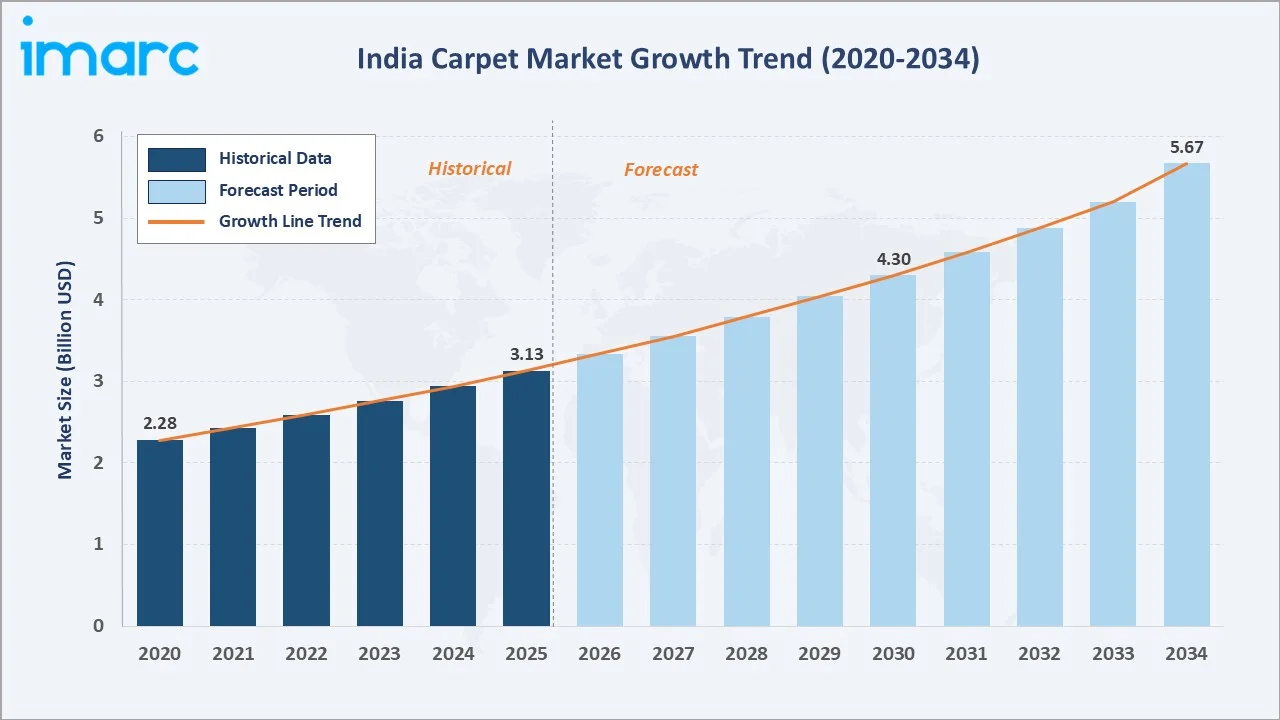
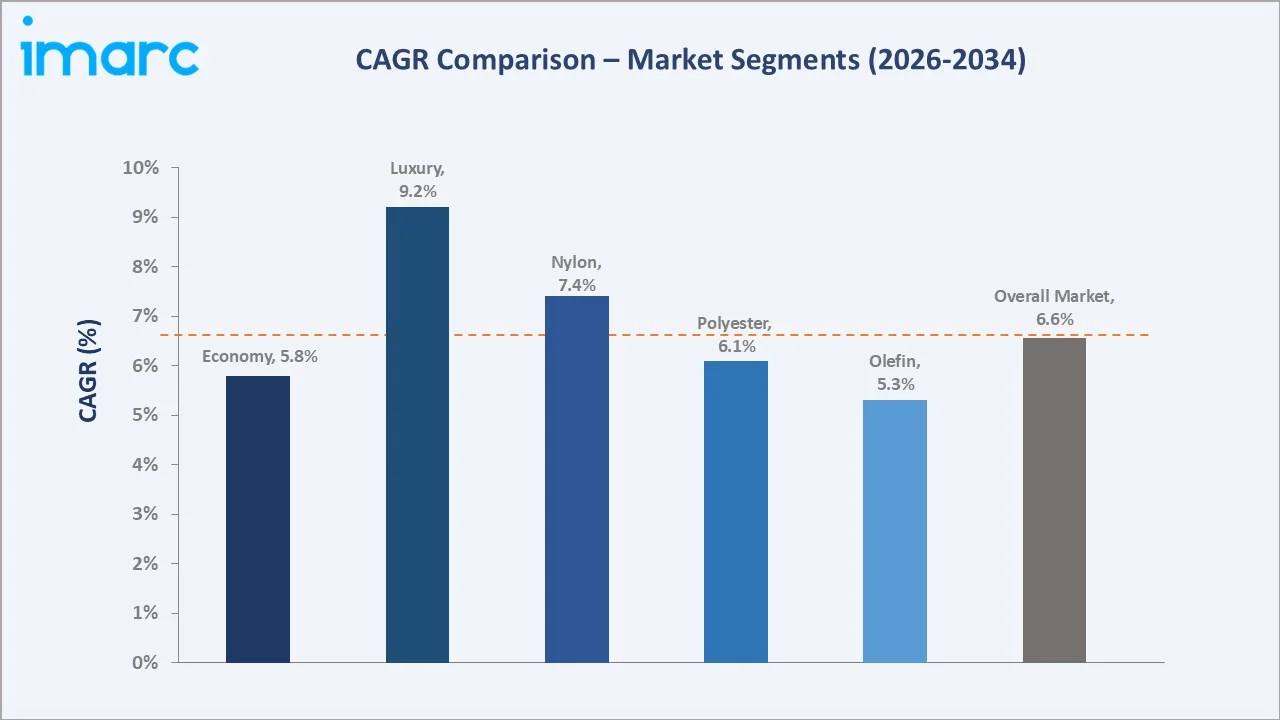
The India carpet market reached USD 3.13 Billion in 2025 and is projected to reach USD 5.67 Billion by 2034, growing at a CAGR of 6.56% during 2026-2034. Rising real estate activity, expanding commercial construction, and a growing middle-class consumer base are the primary drivers. India's carpet exports reached USD 1.54 Billion in FY 2024-25, underscoring strong global demand. Nylon leads material share at 38.6%, Economy dominates price segments at 72.8%, and North India commands 31.8% of regional share. Growing hospitality, housing, and e-commerce channels continue to strengthen the domestic market alongside robust export momentum.
Market Snapshot
|
Metric |
Value |
|
Market Size (2025) |
USD 3.13 Billion |
|
Forecast Market Size (2034) |
USD 5.67 Billion |
|
CAGR (2026-2034) |
6.56% |
|
Base Year |
2025 |
|
Historical Period |
2020-2025 |
|
Forecast Period |
2026-2034 |
|
Dominant Material |
Nylon (38.6%, 2025) |
|
Dominant Price Point |
Economy (72.8%, 2025) |
|
Leading Region |
North India (31.8%, 2025) |
The India carpet market expanded from USD 2.28 Billion in 2020 to USD 3.13 Billion in 2025, with an anchor value of USD 4.30 Billion projected for 2030, before reaching USD 5.67 Billion by 2034. This sustained growth reflects the convergence of domestic consumption growth and India's dominant position as the world's largest exporter of handmade carpets, accounting for approximately 40% of global handmade carpet exports.
To get more information on this market, Request Sample
The luxury price segment is expanding at a faster pace, driven by rising high-net-worth individual (HNI) population growth and premiumization across hospitality and commercial sectors. India's HNI population crossed 850,000 in 2024 and is projected to nearly double to 1.65 million by 2027, creating structural tailwinds for premium carpet demand.
Executive Summary
The India carpet market reached USD 3.13 Billion in 2025 and is positioned at a unique intersection of strong domestic demand and globally competitive manufacturing. India is the world's largest exporter of handmade carpets by value and volume, responsible for approximately 40% of worldwide handmade carpet exports. Carpet exports reached USD 1.54 Billion in FY25, up from USD 1.39 Billion in FY24, driven by robust demand from the USA, Germany, the UK, Australia, and the Netherlands. The domestic market is simultaneously expanding through rapid urbanization, real estate growth, and rising aspirational consumption. The market is projected to grow at a steady 6.56% CAGR to reach USD 5.67 Billion by 2034, supported by e-commerce expansion, tier-2 city demand, and sustainable carpet adoption.
Market growth is driven by three structural forces: India's residential real estate market generates consistent new carpet demand across residential installations. Commercial construction and the hospitality sector further amplify demand. Government support through schemes and the PLI scheme strengthens the competitiveness of Indian carpet manufacturers and exporters through 2034.
Nylon dominates material share at 38.6% (2025) through its superior durability, stain resistance, and performance credentials. The economy segment leads the price point at 72.8%, reflecting India's mass-market consumer scale. North India commands a 31.8% regional share, driven by Uttar Pradesh's Bhadohi-Mirzapur cluster, the largest carpet manufacturing hub in South Asia.
Key Market Insights
|
Insight |
Data |
|
Dominant Material |
Nylon – 38.6% share (2025) |
|
Dominant Price Point |
Economy – 72.8% market share (2025) |
|
Leading Region |
North India – 31.8% share (2025) |
|
Market Opportunity |
Luxury carpets, sustainable fibers, e-commerce expansion, hospitality sector |
Key Analytical Observations Supporting The Data Above:
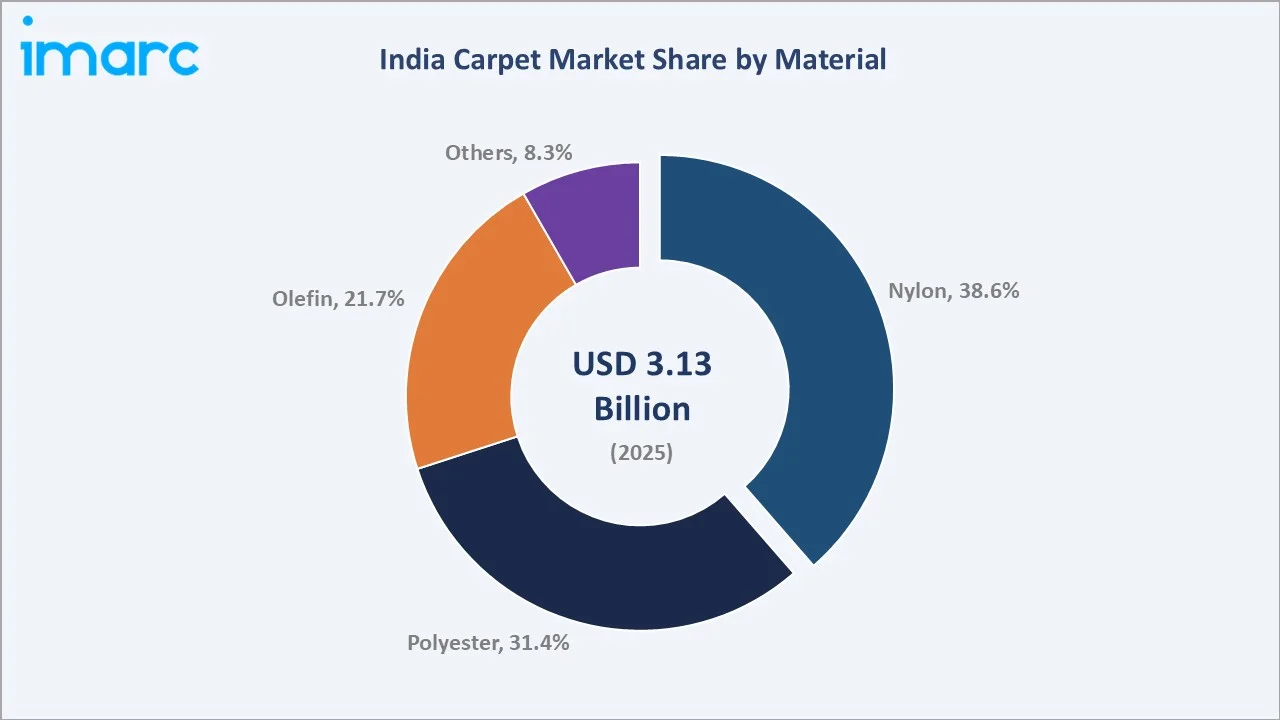
- Nylon at 38.6%: Nylon dominates due to its high tensile strength, resistance to abrasion, and suitability for high-traffic commercial and residential applications. Its performance-to-cost ratio makes it the preferred fiber for both domestic and export-grade carpets.
- Economy at 72.8%: The economy price segment dominates, driven by India's large mass-consumer base, strong demand from the rural and semi-urban population, and broad penetration of affordable woven and tufted carpets across retail channels.
- North India at 31.8%: North India's regional dominance is anchored by the Bhadohi-Mirzapur cluster in Uttar Pradesh, which accounts for a significant share of India's total carpet production and exports, alongside strong retail demand from Delhi-NCR.
India Carpet Market Overview
The India carpet market is a dual-demand economy: a globally pre-eminent handmade carpet export industry with a heritage, and a growing domestic market driven by residential real estate, commercial construction, and hospitality. India ranks first in handmade carpet production and exports globally, providing employment to artisans, predominantly women in rural areas. The market ecosystem integrates raw material suppliers, fiber processors, weaving clusters, organized manufacturers, exporters, domestic retailers, and e-commerce platforms. Macroeconomic factors, including India's urbanization trajectory and rising middle-class incomes, continue to expand domestic carpet demand.
Market Dynamics
To evaluate market opportunities, Request Sample
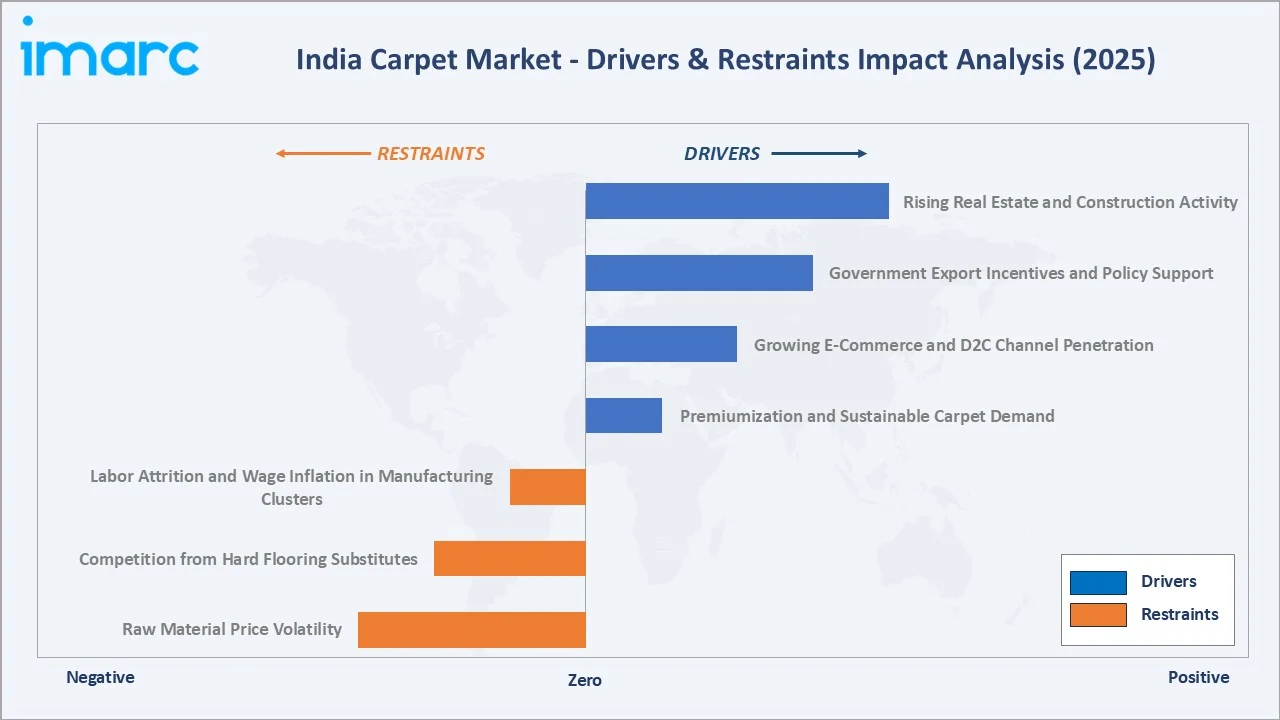
Market Drivers
- Rising Real Estate and Construction Activity: Housing sales across top metros reached an 11-year high of 1.73 lakh units in H1 2024. This sustained construction activity directly fuels demand for floor coverings across residential and commercial segments, making construction the most structurally reliable demand driver for India's carpet market.
- Government Export Incentives and Policy Support: Seven PM MITRA textile parks are slated to generate 3 lakh jobs each. These incentives sharpen India's cost competitiveness relative to Bangladesh and Vietnam, driving sustained export volume growth.
- Growing E-Commerce and D2C Channel Penetration: E-commerce platforms are democratizing carpet distribution across urban and rural segments. Domestic platforms, including Pepperfry and Urban Ladder, have expanded carpet accessibility to tier-2 and tier-3 consumers, broadening the domestic customer base significantly.
- Premiumization and Sustainable Carpet Demand: Urban consumers and international buyers increasingly demand low-carbon, traceable carpets. Welspun Living has pledged carbon neutrality by 2030, leveraging biomass-based energy and recyclable backing. This sustainability trend is driving above-average growth in the premium natural-fiber carpet segment.
Market Restraints
- Raw Material Price Volatility: Polyester staple fiber was quoted at INR 93,000-95,000 per ton in November 2024, remaining stubbornly high despite falling PTA feedstock prices. Oil-linked synthetic fibers remain volatile, bloating yarn costs for manufacturers. This margin pressure is particularly acute for SME exporters who lack hedging capacity and economies of scale.
- Competition from Hard Flooring Substitutes: Ceramic tile, vinyl plank, and laminate suppliers are gaining share in urban housing, offering easy maintenance, modern aesthetics, and antimicrobial surfaces. Competition from hard flooring substitutes also illustrates the scale of substitution pressure facing carpet manufacturers in organized retail channels.
- Labor Attrition and Wage Inflation in Manufacturing Clusters: Gujarat mills and Bhadohi-Mirzapur clusters report seasonal worker attrition and wage inflation as compounding operational stressors. The Textile Production Subsidy offers 15% relief, but adoption lags among cash-constrained clusters, creating cost competitiveness challenges for mid-sized manufacturers.
Market Opportunities
- Premium and Luxury Carpet Segment Expansion: Luxury housing priced above Rs 4 crore recorded 37.8% year-on-year sales growth during January to September 2024. India's HNI population crossed 850,000 in 2024 and is projected to nearly double to 1.65 million by 2027. This wealth expansion creates structural demand for premium, hand-knotted, and designer carpets in both domestic and export markets.
- Hospitality Sector Demand in Tier-2 Cities: India's office leasing across the top 8 cities reached 89 million sq. ft. in 2024, the highest ever, a 19% jump over 2023. New hotel and commercial developments in tier-2 cities are generating significant carpet procurement demand for corridors, lobbies, and meeting rooms, opening new revenue streams for domestic manufacturers.
Market Challenges
- US Tariff Uncertainty and Global Trade Disruptions: The India Carpet Expo 2025 secured export orders worth Rs 200-240 crore, significantly below the Rs 500 crore secured at the previous edition, with reduced participation attributed to US tariffs and global trade disruptions from geopolitical conflicts. Export order volatility creates revenue planning challenges for manufacturers heavily dependent on Western markets.
- GI Certification and Quality Standardization Gaps: Only a few carpet products have Geographical Indication (GI) registration in India, leaving significant craft heritage underprotected. The absence of universal quality standardization limits premiumization potential and makes it difficult for buyers to differentiate authentic artisanal products from lower-quality machine-made alternatives in export markets.
Emerging Market Trends
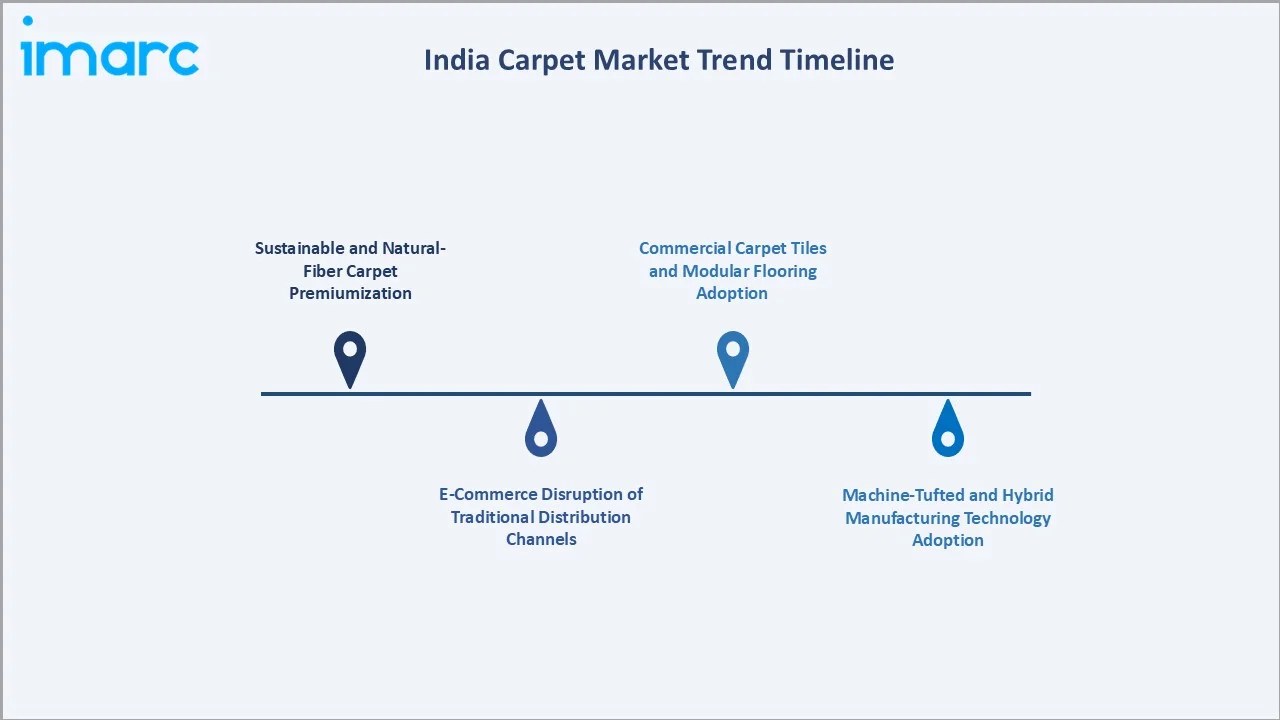
1. Sustainable and Natural-Fiber Carpet Premiumization
Eco-friendly, natural-fiber carpets made from wool, jute, coir, and bamboo silk are gaining significant traction among urban Indian consumers and international buyers. Welspun Living's commitment to carbon neutrality by 2030 reflects the industry's accelerating pivot toward sustainability. Premium natural-fiber carpets command price premiums over synthetic alternatives, expanding revenue margins for forward-looking manufacturers.
2. E-Commerce Disruption of Traditional Distribution Channels
Digital channels are reshaping carpet distribution in India. Mobile apps now aggregate micro-orders, streamline raw-yarn procurement, and ensure timely digital payments for weavers who historically relied on multi-tier intermediaries. Domestic platforms and Amazon India are creating direct market access for cluster-level artisans, reducing distribution costs and improving margins for producers while increasing product variety for consumers.
3. Commercial Carpet Tiles and Modular Flooring Adoption
Commercial properties increasingly adopt carpet tiles for their acoustic insulation, ease of replacement, and aesthetic flexibility. India's office leasing market at 83.3 million sq. ft. in 2025 creates sustained demand for high-performance commercial carpet products across tier-1 and tier-2 cities.
4. Machine-Tufted and Hybrid Manufacturing Technology Adoption
Advanced tufting machinery and computer-aided design tools are enabling Indian manufacturers to produce large-volume commercial orders with consistent quality, reducing lead times significantly. The combination of machine-tufted efficiency with hand-finishing craftsmanship creates a hybrid manufacturing model that balances artisanal heritage with the scale requirements of modern retail and export buyers.
Industry Value Chain Analysis
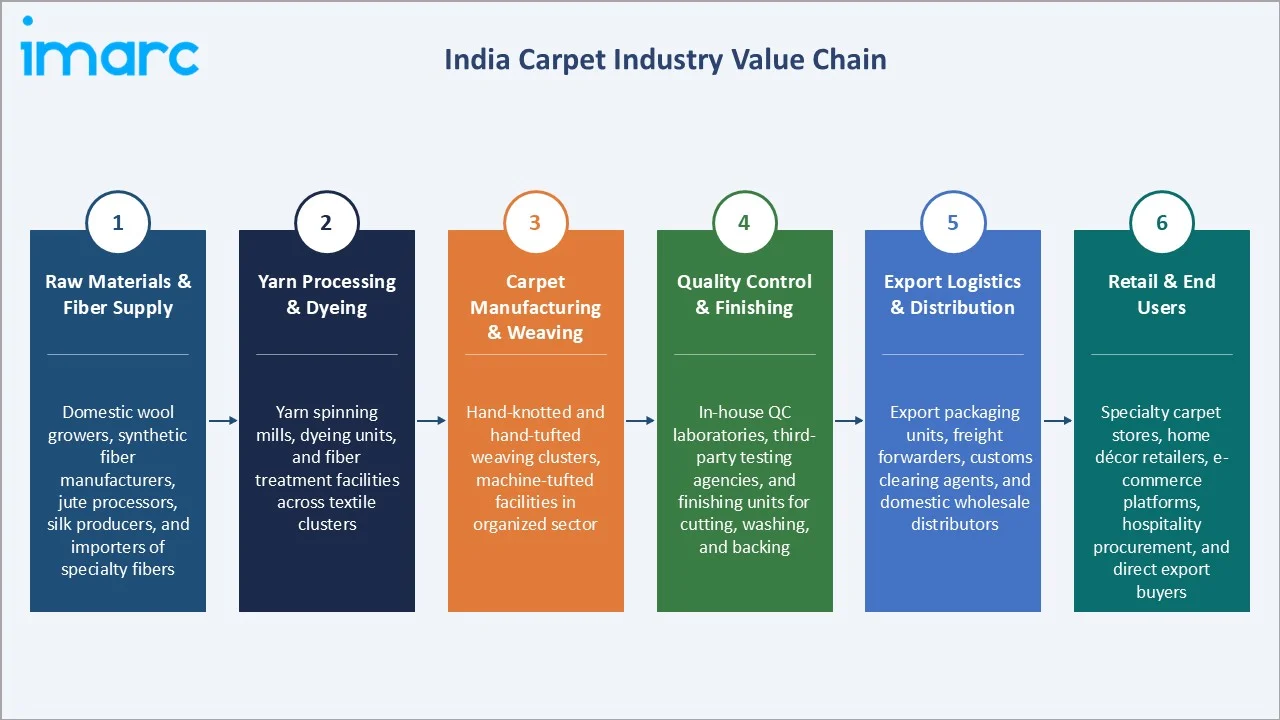
India carpet industry value chain spans from raw material extraction to end consumer delivery. The chain integrates domestic and imported raw materials, highly skilled weaving clusters concentrated in Uttar Pradesh, Rajasthan, Jammu & Kashmir, and other states, organized and semi-organized manufacturers, export intermediaries, and domestic retail channels.
|
Stage |
Key Participants |
|
Raw Materials & Fiber Supply |
Domestic wool growers, synthetic fiber manufacturers, jute processors, silk producers, and importers of specialty fibers |
|
Yarn Processing & Dyeing |
Yarn spinning mills, dyeing units, and fiber treatment facilities across textile clusters |
|
Carpet Manufacturing & Weaving |
Hand-knotted and hand-tufted weaving clusters, machine-tufted facilities in organized sector |
|
Quality Control & Finishing |
In-house QC laboratories, third-party testing agencies, and finishing units for cutting, washing, and backing |
|
Export Logistics & Distribution |
Export packaging units, freight forwarders, customs clearing agents, and domestic wholesale distributors |
|
Retail & End Users |
Specialty carpet stores, home décor retailers, e-commerce platforms, hospitality procurement, and direct export buyers |
The value chain's export dimension is its most commercially significant stage. India exports approximately 85-90% of total carpet production, with the USA alone accounting for ~59% of exports in FY25 at USD 921 Million.
Technology Landscape in the India Carpet Industry
Weaving Technology Innovation
Advanced tufting machines and computer-aided weaving systems are enabling Indian manufacturers to produce complex patterns at commercial scale. Hand-knotted carpets reflecting deep artisanal roots across Bhadohi, Mirzapur, and Kashmir clusters. Hybrid manufacturing, combining machine-tufted base production with hand-finishing, optimizes the cost-quality ratio for mid-range export orders.
Sustainable Fiber Technology
New fiber technologies are reshaping material portfolios. Recycled PET and bio-based nylon fibers are gaining adoption among premium carpet brands targeting sustainability-focused buyers in Germany, the UK, and Australia. Natural fiber carpets using wool, bamboo silk, and organic cotton continue to command significant export premiums.
Digital Commerce and Supply Chain Technology
Mobile-enabled supply chain apps are transforming procurement and order management for artisan clusters. Digital marketing through virtual trade shows and augmented reality product visualization tools is expanding market reach for India's carpet exporters in geographies beyond traditional trade fair exposure.
Market Segmentation Analysis
The report covers the following segments:
|
Segment Category |
Leading Segment |
Market Share |
Year |
|
Material |
Nylon |
38.6% |
2025 |
|
Price Point |
Economy |
72.8% |
2025 |
|
Sales Channel |
🔒 |
🔒 |
2025 |
|
End User |
🔒 |
🔒 |
2025 |
|
Region |
North India |
31.8% |
2025 |

By Material
Nylon leads the India carpet market at 38.6% in 2025. Nylon's dominance is driven by its superior durability, resistance to crushing and matting in high-traffic environments, and ease of maintenance, attributes that align with commercial, hospitality, and premium residential applications.
To access detailed market analysis, Request Sample
Polyester holds a 31.4% share in 2025, valued for its softness, vibrant color retention, and affordability, making it dominant in the residential mid-range segment. Olefin at 21.7% serves outdoor, basement, and marine applications due to its moisture resistance and UV stability. Others, including wool, jute, and coir carpets at 8.3%, serve the handmade and export-premium segment, commanding significant price premiums in international markets.
By Price Point
Economy carpets lead the India market at 72.8% in 2025. The economy segment dominates, driven by India's large price-sensitive consumer base across residential, rural, and semi-urban segments. Economy carpets provide accessible floor covering solutions across a wide price range, supported by broad availability in organized retail, unorganized markets, and e-commerce platforms.
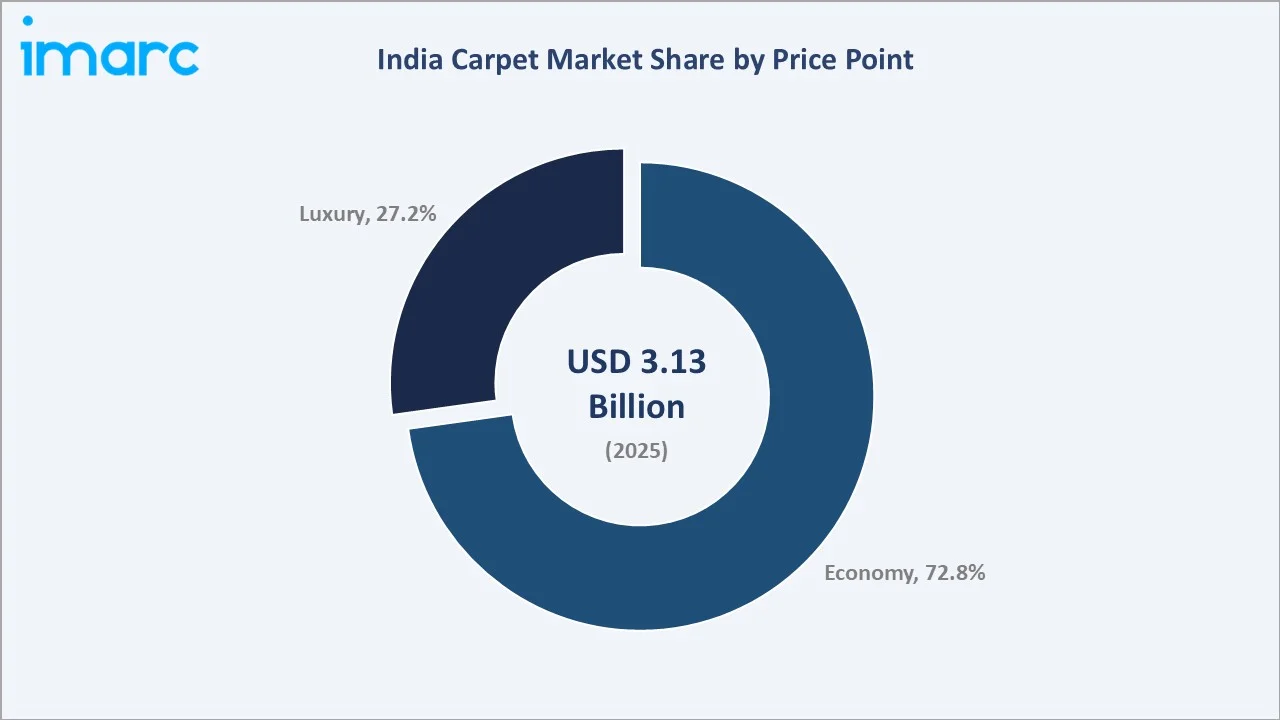
The Luxury segment at 27.2% is the fastest-growing price category, expanding at approximately 9.2% CAGR through India's HNI population growth, rising hotel and commercial project quality standards, and increasing demand for hand-knotted and designer carpets among affluent urban consumers.
Regional Market Insights
|
Region |
Share (2025) |
Key Drivers & Characteristics |
|
North India |
31.8% |
Strong domestic retail demand from Delhi-NCR, high artisan employment density, and dominant export volumes make North India's carpet industry. |
|
South India |
28.7% |
Driven by Bengaluru, Hyderabad, and Chennai's expanding commercial real estate and IT sectors. Strong demand for high-quality carpets in corporate offices, luxury hotels, and premium residential developments. |
|
West & Central India |
25.4% |
Mumbai Metropolitan Region's high-end residential and commercial demand anchors the segment. Pune and Ahmedabad contribute to growing commercial and hospitality carpet demand. |
|
East India |
14.1% |
Rising commercial construction and increasing branded retail penetration are gradually expanding carpet adoption across organized and unorganized channels. |
North India's 31.8% market leadership reflects Uttar Pradesh's position as one of the largest handmade carpet manufacturing clusters, contributing the majority of India's carpet export volume. South India's 28.7% reflects the accelerating commercial real estate sector in Bengaluru, Hyderabad, and Chennai, where India's office leasing reached record highs in 2024 and 2025.
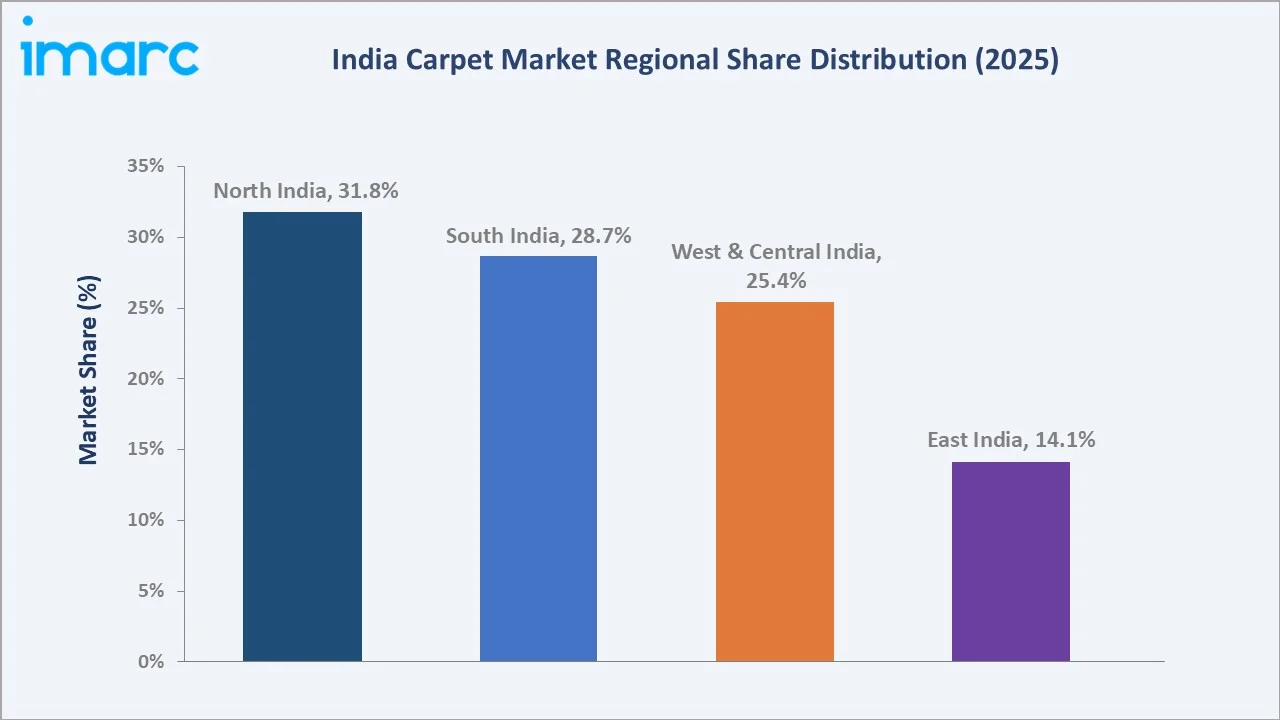
West & Central India at 25.4%. East India at 14.1% represents the most commercially underserved region but is growing above the overall market CAGR as urbanization expands carpet demand.
Competitive Landscape
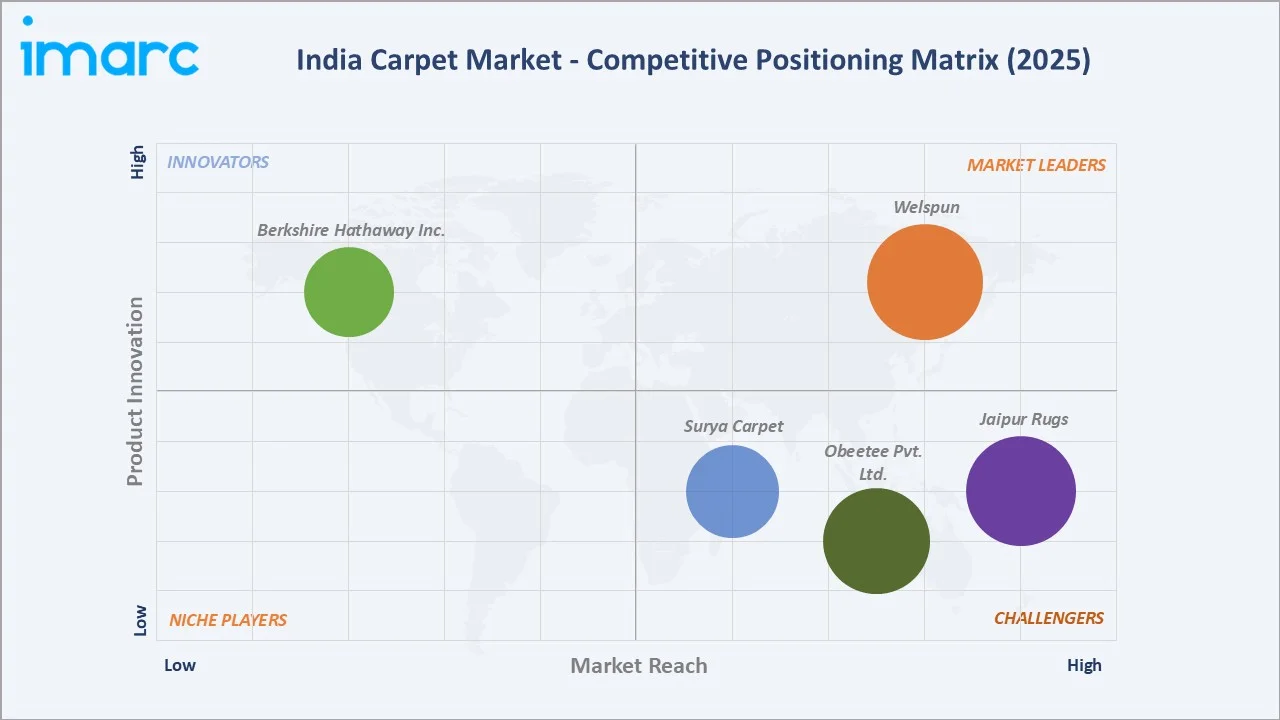
India carpet industry competitive landscape is characterized by a mix of large, organized manufacturers with export capabilities, mid-sized cluster-based producers, and artisanal small enterprises. Competition intensifies through growing e-commerce adoption, sustainability differentiation, and increasing demand for certified, traceable carpet products in international markets.
|
Company |
Key Brands |
Market Position |
Core Strength |
|
Welspun |
Welspun Flooring |
Market Leader |
Largest integrated carpet manufacturer with end-to-end manufacturing, sustainability commitment, and global export network. Carbon neutrality pledged by 2030. |
|
Jaipur Rugs |
Jaipur Rugs |
Strong Challenger |
India's leading artisanal carpet brand connecting artisans to global luxury markets. |
|
Obeetee Pvt. Ltd. |
Obeetee |
Innovator |
Premium hand-knotted carpet manufacturer with over 100 years of heritage and known for custom design capabilities and export quality. |
|
Surya Carpet |
Surya Carpet |
Strong Challenger |
Leading machine-tufted carpet manufacturer with wide domestic retail distribution and growing e-commerce presence. |
|
Berkshire Hathaway Inc. |
Shaw Contract |
Challenger |
Berkshire Hathaway Inc., through its subsidiary Shaw Industries Group, Inc., competes in premium commercial carpet segments. |
Key Company Profiles
Welspun
Welspun is one of the largest integrated home textile manufacturers and a significant player in the carpet and floor covering segment. The company operates state-of-the-art manufacturing facilities with a focus on sustainability.
- Key Brands: Welspun Flooring
- Strategic Focus: Expanding sustainable product portfolio, strengthening international retail partnerships, and scaling D2C capabilities through digital channels.
Jaipur Rugs
Jaipur Rugs is a leading artisanal carpet brand that connects artisans from rural Rajasthan to global luxury markets through a vertically integrated model that combines traditional craftsmanship with modern design.
- Key Brands: Jaipur Rugs
- Strategic Focus: Artisan empowerment, premium positioning in international markets, and new collection development through design partnerships with global architects.
Market Concentration Analysis
India carpet market exhibits moderate fragmentation at the domestic level and high export concentration. The top five organized manufacturers collectively command a significant share of organized sector revenues, while the unorganized and artisanal sector accounts for a substantial portion of handmade carpet production and exports.
Export market concentration is significant: the USA alone accounted for approximately 59% of India's total carpet exports in FY25 at USD 921 Million. Germany and the UK are the next largest markets. This concentration creates vulnerability to US trade policy changes, as evidenced by reduced order volumes at the India Carpet Expo 2025 attributed to US tariff concerns.
The domestic market is evolving through organized retail and e-commerce penetration, which is gradually consolidating demand toward branded manufacturers, while artisanal cluster production maintains its export pre-eminence through quality and heritage differentiation.
Investment & Growth Opportunities
Highest Growth Segments
- Luxury price segment (~9.2% CAGR through HNI population expansion and hospitality growth)
- Premium natural-fiber carpets (20-30% price premiums over synthetic alternatives)
- E-commerce distribution platforms (~15-20% CAGR in online carpet sales)
- Commercial carpet tiles for office and flexible workspace expansion
- Export diversification into Southeast Asia, MENA, and Latin America
Emerging Investment Opportunities
India's sustainable carpet manufacturing segment represents the most commercially dynamic investment opportunity through 2034. Certified sustainable carpets command significant premiums in the German, UK, and Australian markets, and global buyers are increasingly mandating sustainability credentials in procurement. Manufacturing facilities investing in bio-based fibers and recycled materials are positioned to capture above-market revenue growth.
Investment Themes
- Artisan aggregator platforms connecting rural weavers directly with global luxury buyers, reducing intermediary margins and improving artisan income.
- Sustainable fiber R&D investment in recycled nylon, bio-based polyester, and natural wool processing infrastructure.
- Export market diversification investment targeting the MENA hospitality boom and Southeast Asia's growing middle-class carpet demand.
Future Market Outlook (2026-2034)
The India carpet market is projected to grow from USD 3.13 Billion in 2025 to USD 5.67 Billion by 2034, delivering a 6.56% CAGR over the forecast period. The market's anchor value of USD 4.30 Billion in 2030 represents the structural midpoint of India's carpet industry growth trajectory, driven by the convergence of domestic real estate expansion, rising consumer incomes, and sustained export volume growth.
Three structural forces define India carpet market growth through 2034: India's rapid urbanization creates continuous new housing demand that drives floor covering adoption. India's commercial real estate expansion, with office leasing and hospitality sector growth in tier-2 cities, generates significant institutional carpet procurement. Export growth remains a core market driver. The domestic luxury segment's expansion through India's HNI population growth and premiumization trends will support above-market CAGR growth in the premium and luxury carpet categories through 2034.
Research Methodology
Primary Research
Primary research comprised structured interviews with India carpet industry stakeholders, including export directors, cluster-level manufacturers, retail buyers, e-commerce platform managers, and hospitality procurement officers across North, South, West, and East India. Consumer survey data from domestic carpet buyers across price segments informed demand-side analysis.
Secondary Research
Secondary research encompassed India carpet export data from India Brand Equity Foundation (IBEF) industry reports, Ministry of Textiles policy documents, company annual reports, e-commerce sales data, and India real estate construction market reports.
Forecasting Models
Market revenue forecasts were developed using a demand-side model combining India's urbanization trajectory, real estate construction output, per-capita carpet consumption benchmarks, and export volume trend analysis. Segment forecasts applied individual growth drivers and restraints to derive material, price point, and regional growth rates. Historical period data (2020-2025) was validated against published government and industry trade data.
India Carpet Market Report Scope:
| Report Features | Details |
|---|---|
| Base Year of the Analysis | 2025 |
| Historical Period | 2020-2025 |
| Forecast Period | 2026-2034 |
| Units | Billion USD |
| Scope of the Report | Exploration of Historical Trends and Market Outlook, Industry Catalysts and Challenges, Segment-Wise Historical and Future Market Assessment:
|
| Materials Covered | Nylon, Olefin, Polyester, Others |
| Price Points Covered | Economy, Luxury |
| Sales Channels Covered | Supermarkets And Hypermarkets, Specialty Stores, Online Stores |
| End Users Covered | Residential, Commercial |
| Regions Covered | South India, North India, West and Central India, East India |
| Companies Covered | Welspun, Jaipur Rugs, Obeetee Pvt Ltd., Surya Carpet, Berkshire Hathaway Inc., etc. |
| Customization Scope | 10% Free Customization |
| Post-Sale Analyst Support | 10-12 Weeks |
| Delivery Format | PDF and Excel through Email (We can also provide the editable version of the report in PPT/Word format on special request) |
Key Benefits for Stakeholders:
- IMARC’s report offers a comprehensive quantitative analysis of various market segments, historical and current market trends, market forecasts, and dynamics of the India carpet market from 2020-2034.
- The research study provides the latest information on the market drivers, challenges, and opportunities in the India carpet market.
- Porter's Five Forces analysis assists stakeholders in assessing the impact of new entrants, competitive rivalry, supplier power, buyer power, and the threat of substitution. It helps stakeholders to analyze the level of competition within the India carpet industry and its attractiveness.
- Competitive landscape allows stakeholders to understand their competitive environment and provides an insight into the current positions of key players in the market.
Frequently Asked Questions About the India Carpet Market Report
The India carpet market reached USD 3.13 Billion in 2025, driven by strong domestic demand from real estate and construction, growing hospitality sector procurement, and India's position as the world's largest handmade carpet exporter.
The India carpet market grows at a CAGR of 6.56% during 2026-2034, reaching USD 5.67 Billion by 2034. Growth is supported by urbanization, real estate expansion, e-commerce penetration, and sustained export volume growth.
Nylon leads at 38.6% in 2025, driven by superior durability, stain resistance, and performance credentials that make it suitable for high-traffic commercial and premium residential carpet applications.
Economy leads at 72.8% in 2025, driven by India's large price-sensitive consumer base, broad retail availability, and mass-market demand across residential and rural segments nationwide.
North India leads at 31.8% in 2025, anchored by the Bhadohi-Mirzapur carpet manufacturing cluster in Uttar Pradesh, which contributes the majority of India's carpet export volume and domestic supply.
India's carpet exports reached USD 1.54 Billion in FY25, up from USD 1.39 Billion in FY24. India accounts for approximately 40% of global handmade carpet exports, with the USA as the largest buyer at ~59% of total exports.
Leading companies include Welspun, Jaipur Rugs, Obeetee Pvt. Ltd., Surya Carpet, and Berkshire Hathaway Inc., among others.
The India carpet market is projected to reach approximately USD 4.30 Billion by 2030, with growth driven by real estate demand, hospitality expansion, luxury segment growth, and increasing e-commerce distribution.
Top opportunities include sustainable natural-fiber carpet manufacturing, luxury segment expansion through HNI population growth, e-commerce platform investment, and export market diversification into Southeast Asia and MENA.
Need more help?
- Speak to our experienced analysts for insights on the current market scenarios.
- Include additional segments and countries to customize the report as per your requirement.
- Gain an unparalleled competitive advantage in your domain by understanding how to utilize the report and positively impacting your operations and revenue.
- For further assistance, please connect with our analysts.
 Request Customization
 Speak to an Analyst
 Request Brochure
 Inquire Before Buying
Benefits of Customization
- Personalize this research
- Triangulate with your data
- Get data as per your format and definition
- Gain a deeper dive into a specific application, geography, customer, or competitor
- Any level of personalization
Get in Touch With Us
UNITED STATES
Phone: +1-201-971-6302
INDIA
Phone: +91-120-433-0800
UNITED KINGDOM
Phone: +44-753-714-6104
Email: [email protected]
Client Testimonials




.webp)




.webp)













Related Reports

Choose your plan
*Please note that the prices mentioned below are starting prices for each bundle type. Kindly contact our team for further details.*
Single User License
- 1 User License, Access on 2 Devices
- PDF Report + Excel Dataset (Password Protected)
- Lifetime Access
- No Printing Rights
- 10% Free Report Customization
- 10–12 Weeks of Analyst Support
Five User License
- Access for 5 Users, 2 Devices per User
- PDF Report + Excel Dataset (Password Protected)
- Lifetime Access
- Dedicated Account Manager
- 12–14 Weeks of Analyst Support
- No Printing Rights
- 15% Free Report Customization
- 25% Discount on Your Next Purchase
Corporate User License
- Unlimited User Access (Within Your Organization)
- PDF Report + Excel Dataset
- Lifetime Access
- Dedicated Account Manager
- 14–20 Weeks of Analyst Support
- No Printing Rights
- 20% Free Report Customization
- 30% Discount on Your Next Purchase
Essential Insights
What's included:
3 reports
- Lifetime Access
- PDF Reports
- Excel Datasets
- 2 Weeks of Free Analyst Support
- 2 User Licenses
- Access on 2 Devices
- Printing Rights
- Complimentary PowerPoint (PPT) Version
- Complimentary License Upgrade
Professional Access
What's included:
5 reports
- Lifetime Access
- PDF Reports
- Excel Datasets
- 8 Weeks of Free Analyst Support
- 2 User Licenses
- Access on 2 Devices
- Printing Rights
- Complimentary PowerPoint (PPT) Version
- Complimentary License Upgrade
Business Advantage
What's included:
8 reports
- Lifetime Access
- PDF Reports
- Excel Datasets
- 14 Weeks of Free Analyst Support
- 2 User Licenses
- Access on 2 Devices
- Printing Rights
- Complimentary PowerPoint (PPT) Version
- Complimentary License Upgrade
Enterprise Intelligence
What's included:
10 reports
- Lifetime Access
- PDF Reports
- Excel Datasets
- 20 Weeks of Free Analyst Support
- 2 User Licenses
- Access on 2 Devices
- Printing Rights
- Complimentary PowerPoint (PPT) Version
- Complimentary License Upgrade