
UAE Carpet Market Size, Share, Trends and Forecast by Material, Price Point, Sales Channel, End User, and Region, 2026-2034
UAE Carpet Market Size, Share, Trends & Forecast (2026-2034)
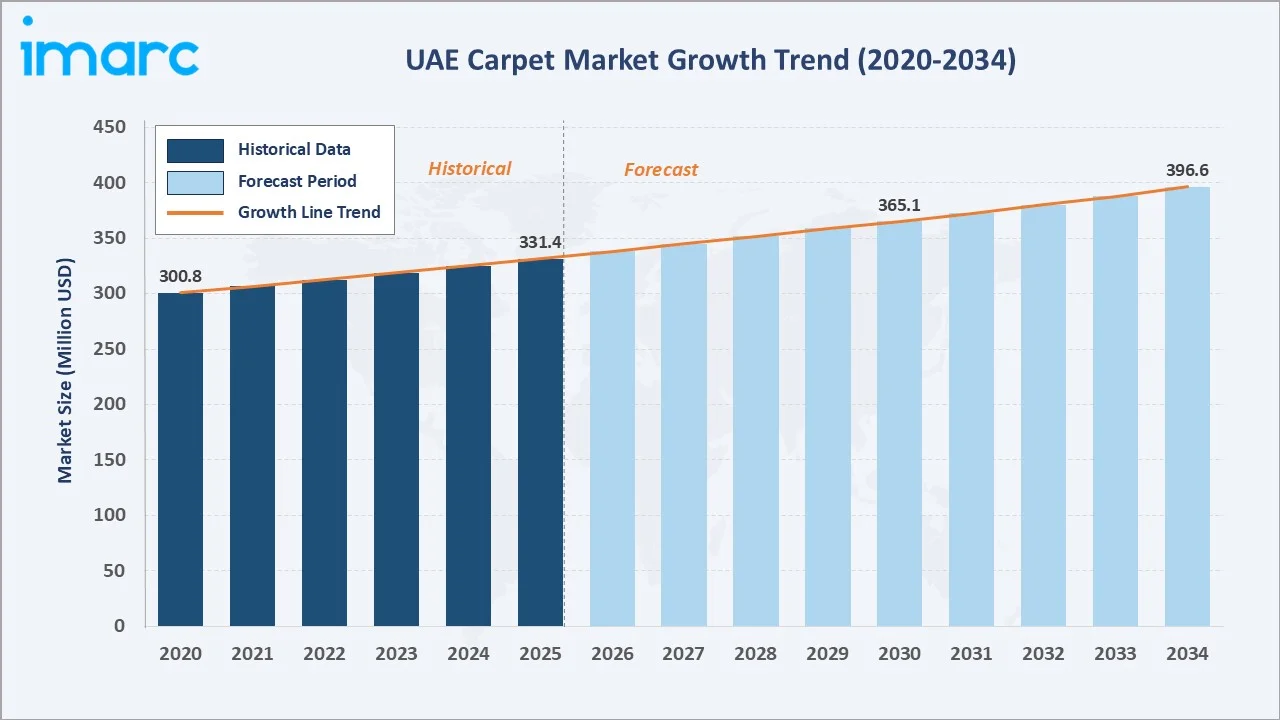
The UAE carpet market reached USD 331.4 Million in 2025 and grew to USD 337.8 Million in 2026, projected to reach USD 396.6 Million by 2034 at a CAGR of 1.96% during 2026-2034. Under the UAE’s Vision 2031, the country aims to double its GDP from AED 1.49 trillion to AED 3 trillion. This supports the market by stimulating construction, commercial development, hospitality, and real estate activity, thereby increasing demand for carpets in residential, office, hotel, and retail spaces. Nylon leads product material share at 39.6% in 2025, economy price-point segments dominate at 62.8%, and Dubai commands 46.2% regional share.
Market Snapshot
|
Metric |
Value |
|
Base Year Market Size (2025) |
USD 331.4 Million |
|
Market Size (2026) |
USD 337.8 Million |
|
Forecast Market Size (2034) |
USD 396.6 Million |
|
CAGR (2026-2034) |
1.96% |
|
Base Year |
2025 |
|
Historical Period |
2020-2025 |
|
Forecast Period |
2026-2034 |
|
Dominant Material |
Nylon (39.6%, 2025) |
|
Dominant Price Point |
Economy (62.8%, 2025) |
|
Leading Region |
Dubai (46.2%, 2025) |
The UAE carpet market expanded from USD 300.8 Million in 2020 to USD 331.4 Million in 2025 and is estimated to reach USD 337.8 Million in 2026. The market is projected to reach USD 365.1 Million by 2030 and USD 396.6 Million by 2034.
To get more information on this market, Request Sample
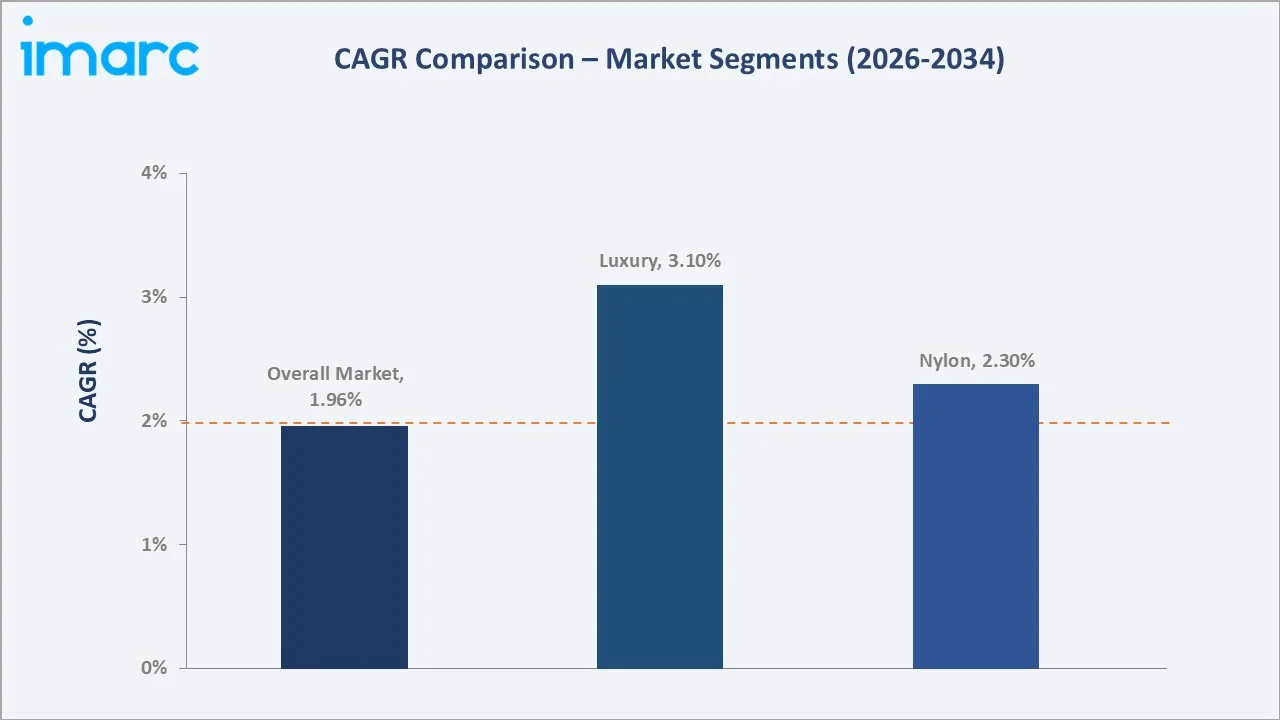
Nylon material is growing fastest at ~2.30% CAGR. The luxury price segment advances at ~3.10% CAGR, supported by premium hospitality and residential demand across the UAE.
Executive Summary
The UAE carpet market is on a steady growth trajectory, underpinned by expanding construction activity, a thriving hospitality sector, and rising consumer emphasis on interior aesthetics. This market expansion reflects the growing centrality of floor coverings in residential, commercial, and hospitality design across the Emirates.
Nylon commands a 39.6% material share in 2025, owing to its superior durability and wide color range suitable for high-traffic environments. Economy carpets dominate the price landscape at 62.8%, yet luxury segments are gaining at ~3.10% CAGR as premium hotels, villas, and corporate offices invest in high-end floor solutions. Dubai leads regionally at 46.2%, supported by sustained real estate and mega-project investments, while Abu Dhabi accounts for 35.8%, driven by government infrastructure initiatives.
Key Market Insights
|
Insight |
Data |
|
Dominant Material |
Nylon – 39.6% share (2025) |
|
Dominant Price Point |
Economy – 62.8% share (2025) |
|
Leading Region |
Dubai – 46.2% (2025) |
| Key Market Opportunity | Sustainable flooring, luxury hospitality demand, digital customization platforms |
Key Analytical Observations Supporting the Above Data:
- Nylon at 39.6%: Nylon carpets at 39.6% lead the UAE market due to strength, stain resistance, and suitability for high-traffic commercial and hospitality applications across the Emirates.
- Economy at 62.8%: Economy-tier carpets at 62.8% reflect price sensitivity across UAE residential and mid-market commercial segments, though luxury demand is rising steadily at ~3.10% CAGR.
- Dubai at 46.2%: Dubai commands a 46.2% share, driven by continuous real estate launches, luxury hotel projects, and strong interior-design market activity linked to tourism and Expo legacies.
UAE Carpet Market Overview
The UAE carpet market encompasses woven, tufted, and machine-made floor coverings serving residential, commercial, and hospitality end uses. The ecosystem spans raw material suppliers, fiber and yarn producers, carpet manufacturers, finishing facilities, distributors, and specialty retailers. Macroeconomic influences include government infrastructure spending, foreign direct investment in real estate, tourism growth, and rising household disposable income across all UAE emirates.
Construction booms linked to Expo legacy projects and large-scale tourism infrastructure have sustainably elevated demand for both economy and luxury floor coverings. Digital printing technology and sustainable material innovations are reshaping product offerings and opening new design-led market segments.
Market Dynamics
To evaluate market opportunities, Request Sample
Market Drivers
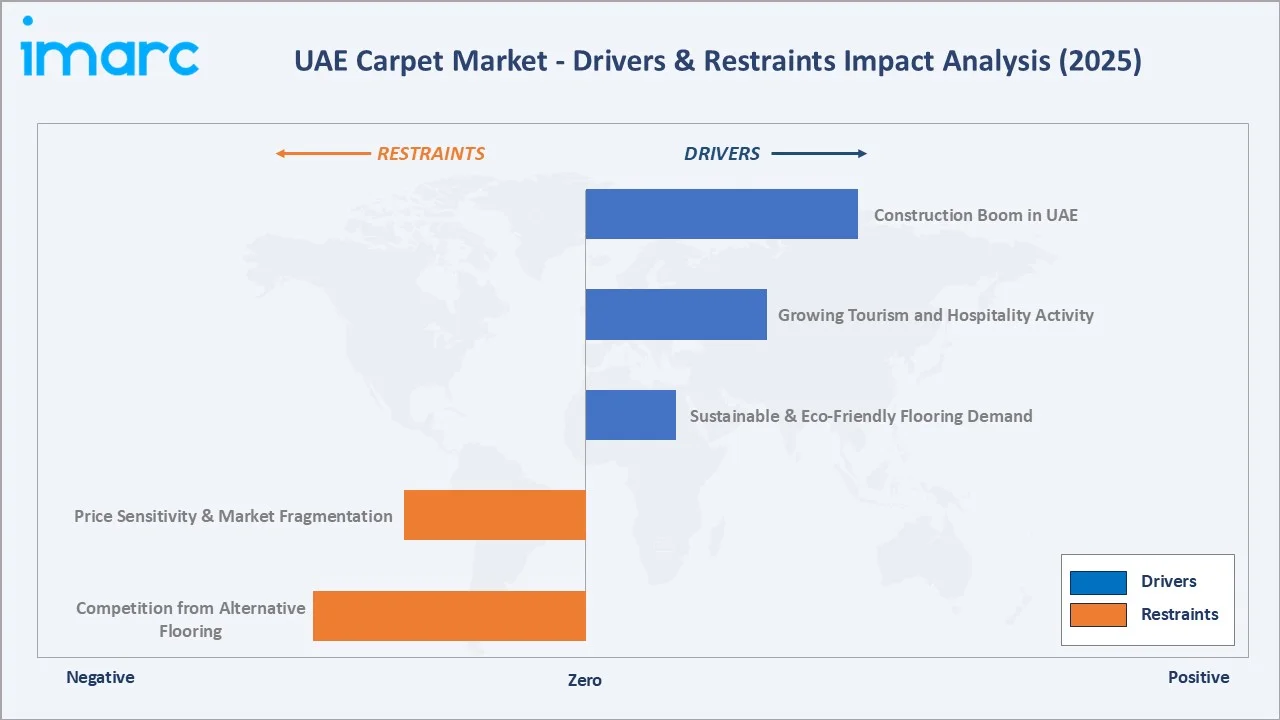
- Construction Boom in UAE: The UAE’s sustained construction pipeline, including mega-projects under Vision 2031 and ongoing luxury real estate developments in Dubai and Abu Dhabi, drives consistent demand for residential and commercial carpet installations.
- Growing Tourism and Hospitality Activity: Dubai’s 19.59 million international overnight visitors in 2025, representing a 5% increase from 2024, are driving demand for carpets across hotels, resorts, restaurants, and other hospitality establishments. The expansion of tourism infrastructure and premium accommodation is further supporting demand for high-quality and customized carpets.
- Sustainable & Eco-Friendly Flooring Demand: Growing consumer preference for sustainable and eco-friendly flooring solutions, driven by environmental awareness and corporate sustainability commitments, is expanding the addressable market for recycled-fiber and natural-material carpets.
Market Restraints
- Price Sensitivity & Market Fragmentation: The presence of numerous local and international carpet suppliers, combined with consumer sensitivity to price, limits premium pricing power and exerts downward pressure on margins across mid-market product categories.
- Competition from Alternative Flooring: Competing flooring solutions such as ceramic tiles, luxury vinyl tiles, and engineered wood have gained consumer preference in certain residential and commercial segments, moderating the overall expansion pace of the carpet segment.
Market Opportunities
- E-Commerce & Digital Sales Channels: The accelerating pace of UAE e-commerce adoption and the rise of digital interior design platforms create significant growth opportunities for online carpet retailing, enabling brands to reach a wider customer base with customized offerings.
- Eco-Friendly Material Innovation: Emerging demand for carpets incorporating biodegradable fibers, recycled materials, and low-VOC backing compounds presents a premium market opportunity aligned with UAE sustainability regulations and corporate procurement standards.
Market Challenges
- Fragmented Distribution Ecosystem: Connecting carpet retailers, designers, manufacturers, and end users through a coherent digital ecosystem remains an operational challenge, particularly for smaller distributors lacking the technology infrastructure to offer seamless customization and delivery services.
- Evolving Design Trends & Product Lifecycle Pressure: Shorter design life cycles and rapidly evolving interior design preferences require manufacturers and distributors to frequently update product lines, increasing inventory management complexity and product development costs across the value chain.
Emerging Market Trends
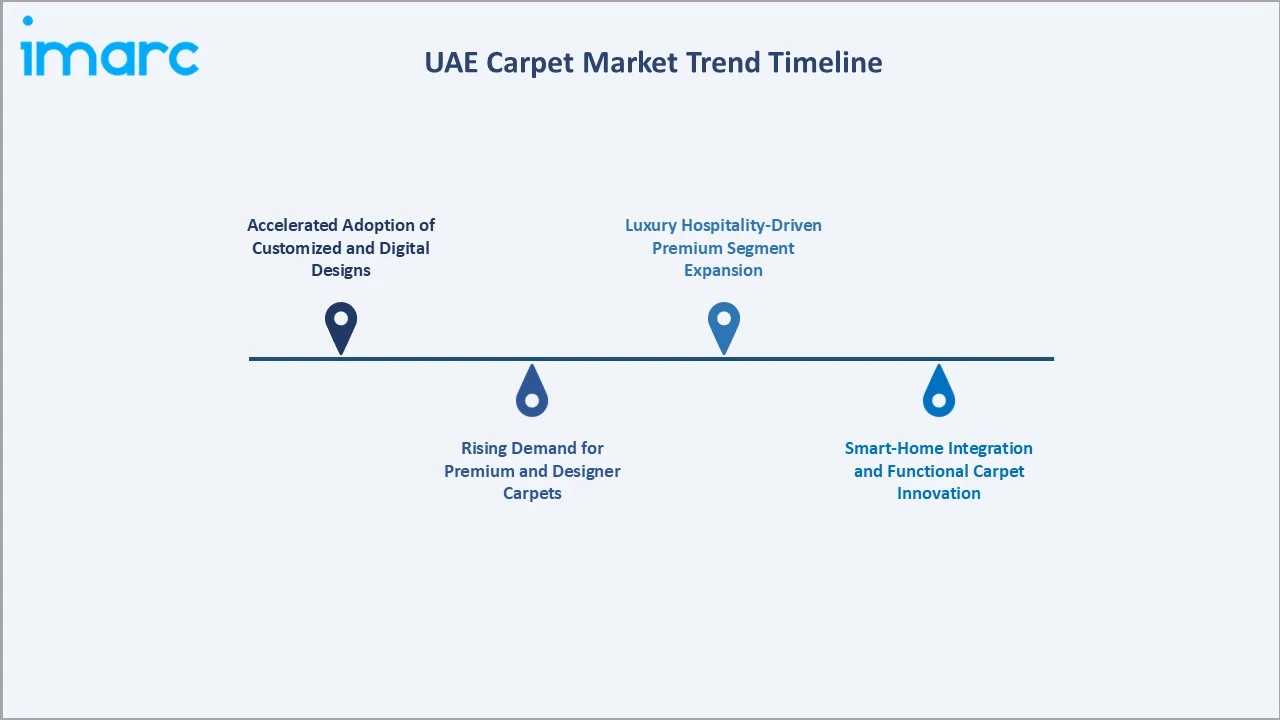
1. Accelerated Adoption of Customized and Digital Designs
Digital printing technology enables UAE carpet brands to offer intricate, bespoke patterns tailored to individual client specifications. High-end residential and hospitality customers increasingly demand unique carpet designs that reflect brand identity or personal aesthetic preferences, driving premium customization revenues.
2. Rising Demand for Premium and Designer Carpets
The UAE carpet market is witnessing growing demand for premium, contemporary, and designer carpets, supported by the expansion of the luxury residential, hospitality, and commercial sectors. In January 2026, Motte Carpet entered Dubai’s design market, launching its premium contemporary carpet collections at the Sevil Dolmaci Art Gallery in Dubai Design District. The launch, targeting designers and architects, showcased handcrafted pieces developed in collaboration with various designers, highlighting growing demand for premium and design-focused carpets in the UAE.
3. Luxury Hospitality-Driven Premium Segment Expansion
The rapid expansion of five-star and ultra-luxury hotel properties across Dubai, Abu Dhabi, and Ras Al Khaimah is creating sustained demand for bespoke premium carpets. International brands such as Brintons and Tai Ping are leveraging this hospitality-led growth by establishing dedicated UAE hospitality project divisions.
4. Smart-Home Integration and Functional Carpet Innovation
Emerging product categories featuring integrated sensor layers, antimicrobial treatments, and thermal insulation properties are gaining traction among UAE residential consumers. IoT-enabled floor coverings that track foot traffic patterns are being piloted in commercial applications, opening new technology-driven revenue streams for manufacturers.
Industry Value Chain Analysis
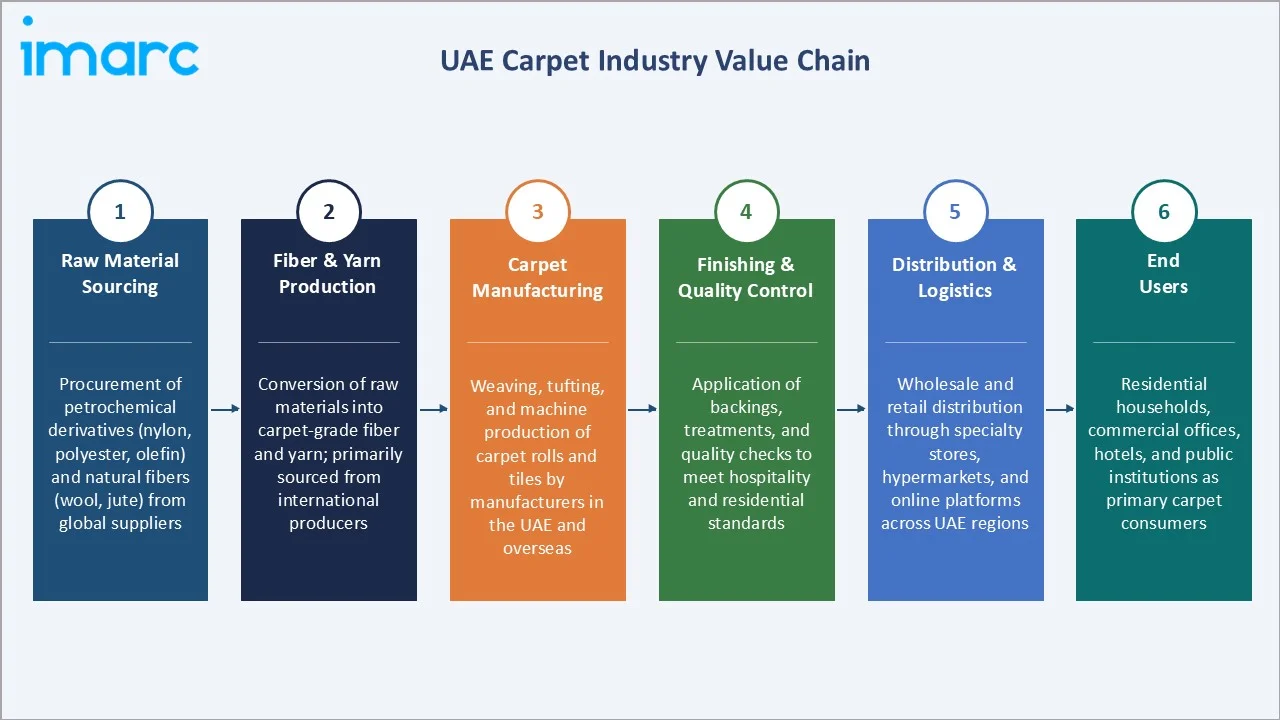
The UAE carpet market value chain spans from raw material sourcing through manufacturing, finishing, and distribution to end users. Each stage represents distinct competitive differentiation opportunities for market participants.
|
Stage |
Key Participants |
| Raw Material Sourcing | Procurement of petrochemical derivatives (nylon, polyester, olefin) and natural fibers (wool, jute) from global suppliers. |
| Fiber & Yarn Production | Conversion of raw materials into carpet-grade fiber and yarn; primarily sourced from international producers. |
| Carpet Manufacturing | Weaving, tufting, and machine production of carpet rolls and tiles by manufacturers in the UAE and overseas. |
| Finishing & Quality Control | Application of backings, treatments, and quality checks to meet hospitality and residential standards. |
| Distribution & Logistics | Wholesale and retail distribution through specialty stores, hypermarkets, and online platforms across UAE regions. |
| End Users | Residential households, commercial offices, hotels, and public institutions as primary carpet consumers. |
Carpet manufacturing is the most value-added stage in the UAE carpet value chain, as it transforms fibers and yarns into finished carpets through weaving, tufting, and specialized production techniques. Product differentiation through design, patterns, textures, customization, and material selection significantly enhances value.
Technology Landscape in the UAE Carpet Industry
Computerized Tufting Technology
Computerized tufting machines are widely used to manufacture carpets with consistent patterns, textures, and pile heights. Advanced machines enable high-speed production with precise control over yarn insertion and stitch density. Digital pattern programming allows manufacturers to produce customized designs with greater flexibility. This technology also helps reduce material wastage and improve production efficiency.
Digital Carpet Printing Technology
Digital printing enables manufacturers to produce highly detailed, multicolored, and customized carpet designs. Inkjet-based systems allow patterns to be created directly on carpet surfaces without conventional printing screens. The technology supports short production runs and rapid design changes, making it suitable for customized projects. It is particularly relevant for luxury residential, hospitality, and commercial interiors requiring unique designs.
Automated Weaving Technology
Automated weaving systems are used to manufacture woven carpets with precise structures and consistent quality. Modern looms provide computerized control over yarn placement, pattern formation, and production parameters. They can support intricate designs and different carpet constructions while maintaining production consistency. Automation also reduces dependence on manual intervention and improves manufacturing productivity.
Market Segmentation Analysis
The report covers the following segments:
|
Segment Category |
Leading Segment |
Market Share |
Year |
| Material | Nylon |
39.6% |
2025 |
|
Price Point |
Economy |
62.8% |
2025 |
| Sales Channel | 🔒 | 🔒 | 2025 |
| End User | 🔒 | 🔒 | 2025 |
|
Region |
Dubai |
46.2% |
2025 |

By Material
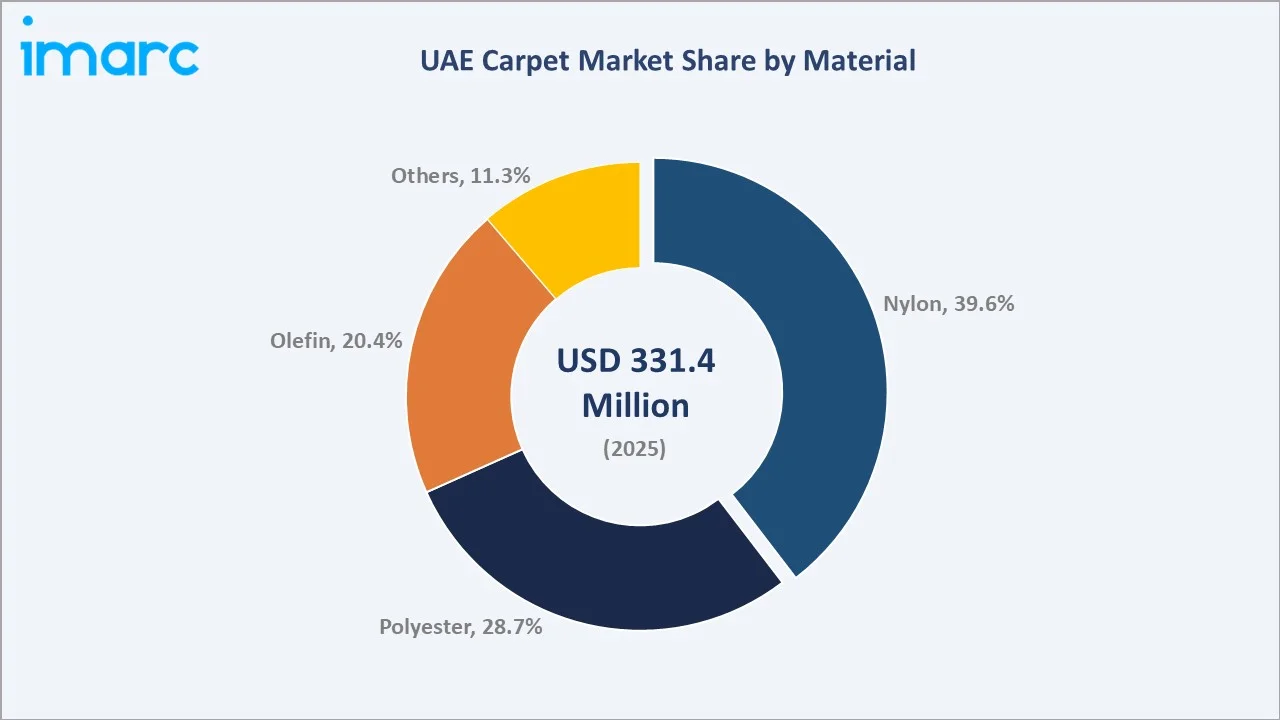
Nylon leads with a 39.6% share in 2025, valued for its resilience, vibrant coloring capability, and performance in high-traffic applications. Polyester holds a 28.7% share, gaining traction for its affordability and improved sustainability profile when made from recycled PET.
To access detailed market analysis, Request Sample
Olefin accounts for 20.4%, widely used in outdoor and commercial settings due to moisture and UV resistance. Other materials, including wool and blended fibers represent 11.3%, primarily serving luxury and heritage-design segments.
By Price Point
Economy holds a 62.8% market share in 2025, representing the dominant demand segment driven by mid-income residential consumers and budget commercial buyers seeking functional and durable floor coverings.
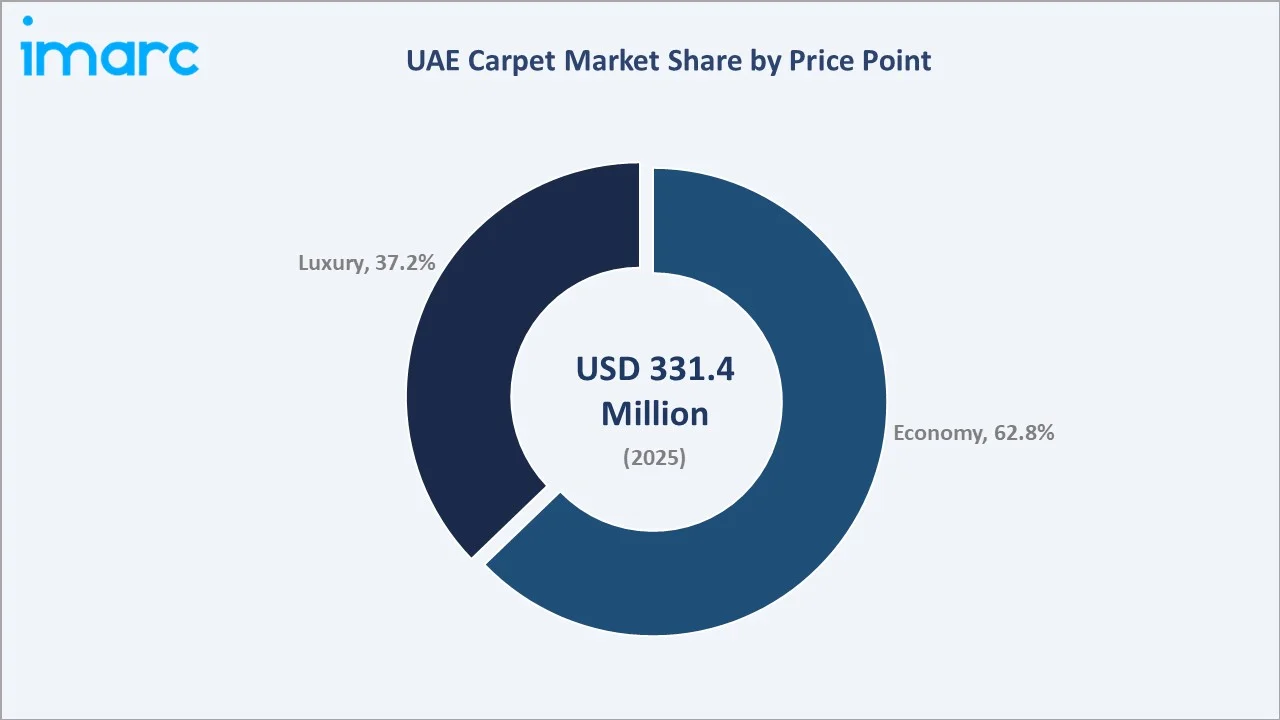
Luxury carpets command a 37.2% share, sustained by the UAE’s globally significant luxury hospitality and high-net-worth residential markets. The luxury segment grows at ~3.10% CAGR, outpacing the overall market rate, as premium hotel projects and affluent villa developments sustain above-average demand for bespoke and designer carpet products.
Regional Market Insights
|
Region |
Share (2025) |
Key UAE AI Market Drivers & Characteristics |
| Dubai |
46.2% |
Strong tourism, hospitality, commercial real estate, and luxury residential development drive carpet demand. |
| Abu Dhabi |
35.8% |
Government infrastructure projects, corporate spaces, hotels, and premium residential developments support market growth. |
| Sharjah |
12.4% |
Growing residential construction, retail activity, and demand for affordable decorative flooring solutions support carpet consumption. |
| Others |
5.6% |
Emerging real estate projects, hospitality development, and residential demand contribute to steady carpet adoption across other emirates. |
Dubai dominated the UAE carpet market in 2025, accounting for 46.2% of the total market, supported by strong tourism, hospitality, real estate, and commercial development. Abu Dhabi represented 35.8%, driven by infrastructure investments, corporate establishments, and premium residential and hospitality projects.
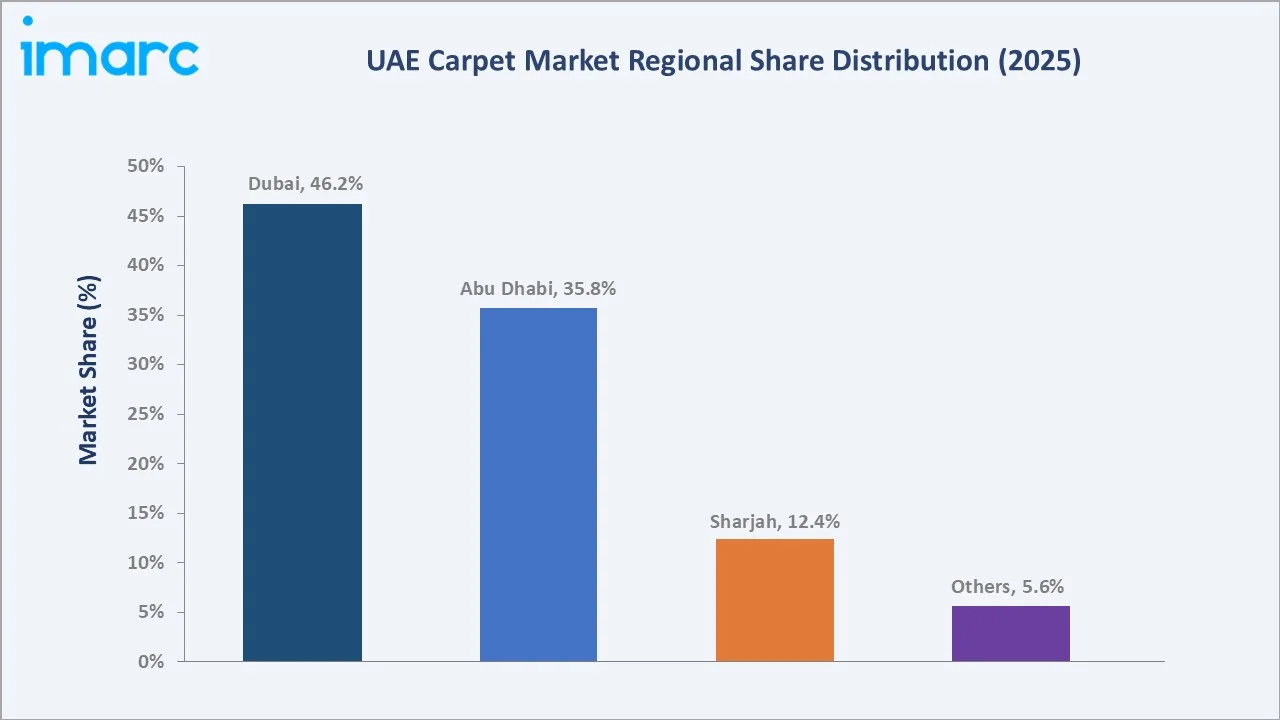
Sharjah held a 12.4% share, supported by expanding residential construction and retail activity. The other emirates collectively accounted for the remaining 5.6%, reflecting growing demand from residential, commercial, and hospitality applications.
Competitive Landscape
The UAE carpet market features a mix of global manufacturers, regional producers, and local distributors competing on product quality, design diversity, customization capability, and distribution reach. Multinational players hold a strong position in luxury and commercial segments, while local firms serve economy residential demand.
|
Company |
Key Brands |
Market Position |
Core Strength |
| Mohawk Industries, Inc. | Mohawk, Karastan, SmartCushion, Redbook Carpets |
Market Leader |
Mohawk Industries, Inc. supplies commercial and residential carpet solutions in the United Arab Emirates through authorized regional distribution partners. |
| ORIENTAL WEAVERS | Oriental Weavers | Market Leader | Oriental Weavers acts as a major global supplier and wholesale exporter of machine-made carpets, rugs, and commercial flooring to the UAE and the Middle East. |
| Interface, Inc. | Interface | Established Player | Interface, Inc. supplies modular commercial carpet tiles and sustainable flooring solutions across the UAE through its exclusive dealers. |
| Milliken | Milliken |
Strong Challenger |
Milliken plays a prominent role in the UAE’s commercial and high-end interior design and architectural markets by supplying modular carpet tiles, broadloom carpets, and sustainable flooring solutions |
| Baniyas Furniture | Baniyas | Innovator | Baniyas Furniture is a leading supplier and custom manufacturer of carpets, rugs, and flooring solutions in the UAE |
Mohawk Industries, Inc. maintains leadership through product innovation and strong UAE hospitality partnerships. Local players serve the economy residential segment through extensive showroom networks and competitive pricing.
Key Company Profiles
Mohawk Industries, Inc.
Mohawk Industries, Inc. is a flooring manufacturer offering a broad portfolio of carpets, rugs, and other flooring solutions for residential and commercial applications. The company operates across multiple international markets and focuses on product innovation, design, quality, and manufacturing efficiency. In the UAE carpet market, its product portfolio is relevant to residential, hospitality, office, and other commercial projects. The company serves customers through established distribution and sales networks across different regions.
- Key Brands: Mohawk, Karastan, SmartCushion, Redbook Carpets.
- Strategic Focus: Focuses on product innovation, design differentiation, manufacturing efficiency, and expansion across international markets. In the UAE, its strategic focus can be aligned with growing demand for premium, durable, sustainable, and customized flooring solutions across residential, hospitality, and commercial applications.
ORIENTAL WEAVERS
ORIENTAL WEAVERS is a global manufacturer of carpets and rugs, offering products across residential, commercial, hospitality, and institutional applications. The company has a diverse portfolio covering machine-made, tufted, and other carpet solutions in various designs, textures, and materials. Its operations focus on product development, manufacturing capabilities, and serving international markets. In the UAE, its offerings are relevant to the country’s growing residential, hospitality, and commercial interior design requirements.
- Key Brands: Oriental Weavers
- Strategic Focus: Strengthening its presence in international markets through a broad product portfolio, design capabilities, and customer-oriented solutions. In the UAE, the company can leverage its diverse carpet offerings to cater to hospitality, residential, and commercial projects, while responding to evolving preferences for stylish and functional flooring.
Market Concentration Analysis
The UAE carpet market exhibits a moderately fragmented structure. The top five players, Mohawk Industries, Inc., ORIENTAL WEAVERS, Interface, Inc., Milliken, and Baniyas Furniture, collectively account for an estimated 45–50% of total market revenues in 2025. The remaining share is distributed among regional distributors, specialty importers, and local manufacturers serving economy residential segments.
Market fragmentation is most pronounced in the economy residential segment, where numerous small importers and local brands compete primarily on price. Consolidation trends are emerging in the premium commercial segment, with global manufacturers pursuing UAE distribution partnerships and direct hospitality project engagements to secure high-value contracts.
Investment & Growth Opportunities
Highest Growth Segments
Luxury carpets growing at ~3.10% CAGR are underpinned by UAE’s significant hospitality pipeline. Investors targeting premium carpet supply chains and bespoke project capabilities stand to benefit from sustained hotel and ultra-luxury residential demand.
Investment Themes
- Sustainable Flooring Investment: Government procurement mandates and green-building certification requirements are creating new revenue opportunities for sustainable carpet manufacturers, particularly those offering recycled-fiber and low-emission products certified under LEED and Estidama frameworks.
- Emerging Emirates Expansion: Emirates beyond Dubai and Abu Dhabi are experiencing increasing residential and commercial construction activity, offering untapped distribution opportunities for carpet brands currently concentrated in core emirates.
Future Market Outlook (2026-2034)
The UAE carpet market is projected to grow from USD 331.4 Million in 2025 to USD 337.8 Million in 2026, reaching USD 396.6 Million by 2034 at a CAGR of 1.96%. Growth will be sustained by the continued expansion of UAE construction and real estate sectors, increasing hospitality infrastructure investment, and the gradual premiumization of consumer preferences across residential and commercial segments.
Three structural forces are expected to shape the UAE carpet market through 2034. First, continued real estate and construction development, sustained tourism and hospitality expansion, and increasing demand for premium and customized interior solutions. Second, urban development and new residential and commercial projects will support carpet installations. Third, rising tourist activity will further drive demand from hotels and hospitality facilities.
Research Methodology
Primary Research
Primary research comprised interviews and consultations with industry participants, including carpet manufacturers, distributors, retailers, importers, and interior design professionals. The discussions provided insights into market dynamics, demand patterns, pricing trends, competitive strategies, distribution channels, and emerging consumer preferences. These inputs were used to validate secondary research findings and strengthen the overall market assessment.
Secondary Research
Secondary research incorporated information from government publications, industry associations, company reports, trade databases, official statistics, and credible industry sources. The research covered market trends, construction and tourism activity, trade patterns, regulatory developments, competitive landscape, and industry dynamics. These sources were analyzed to establish the broader market context and support the findings derived from primary research.
Forecasting Models
Market forecasting integrated historical market trends, current industry dynamics, macroeconomic indicators, construction activity, tourism growth, and evolving consumer preferences. Forecast assumptions were developed by assessing demand across key application segments and emirates. The projections were cross-checked against primary research inputs and secondary industry data to ensure consistency and reliability.
UAE Carpet Market Report Coverage:
| Report Features | Details |
|---|---|
| Base Year of the Analysis | 2025 |
| Historical Period | 2020-2025 |
| Forecast Period | 2026-2034 |
| Units | Million USD |
| Scope of the Report |
Exploration of Historical Trends and Market Outlook, Industry Catalysts and Challenges, Segment-Wise Historical and Future Market Assessment:
|
| Materials Covered | Nylon, Olefin, Polyester, Others |
| Price Points Covered | Economy, Luxury |
| Sales Channels Covered | Supermarkets and Hypermarkets, Specialty Stores, Online Stores |
| End Users Covered | Residential, Commercial |
| Regions Covered | Dubai, Abu Dhabi, Sharjah, Others |
| Companies Covered | Mohawk Industries, Inc., ORIENTAL WEAVERS, Interface, Inc., Milliken, Baniyas Furniture, etc. |
| Customization Scope | 10% Free Customization |
| Post-Sale Analyst Support | 10-12 Weeks |
| Delivery Format | PDF and Excel through Email (We can also provide the editable version of the report in PPT/Word format on special request) |
Key Benefits for Stakeholders:
- IMARC’s industry report offers a comprehensive quantitative analysis of various market segments, historical and current market trends, market forecasts, and dynamics of the UAE carpet market from 2020-2034.
- The research report provides the latest information on the market drivers, challenges, and opportunities in the UAE carpet market.
- Porter's five forces analysis assist stakeholders in assessing the impact of new entrants, competitive rivalry, supplier power, buyer power, and the threat of substitution. It helps stakeholders to analyze the level of competition within the UAE carpet industry and its attractiveness.
- Competitive landscape allows stakeholders to understand their competitive environment and provides an insight into the current positions of key players in the market.
Frequently Asked Questions About the UAE Carpet Market Report
The UAE carpet market reached USD 337.8 Million in 2026, supported by strong construction activity, hospitality sector growth, and rising consumer spending on interior décor solutions.
The market is projected to grow at a CAGR of 1.96% during 2026-2034, driven by real estate expansion, hospitality demand, and increasing consumer preference for premium flooring solutions.
The market is projected to reach USD 396.6 Million by 2034, supported by continuous construction activity, luxury hospitality growth, and rising adoption of sustainable and digitally customized carpet products.
Nylon leads with a 39.6% share in 2025, preferred for its durability, stain resistance, and color versatility across commercial, hospitality, and high-traffic residential environments throughout the UAE.
Economy leads with a 62.8% share in 2025, reflecting price sensitivity across residential buyers. The luxury segment grows at ~3.10% CAGR, driven by premium hospitality and affluent residential demand.
Dubai leads with a 46.2% share in 2025, driven by continuous real estate launches, luxury hotel developments, tourism infrastructure, and a globally significant interior-design and décor market.
Key players include Mohawk Industries, Inc., ORIENTAL WEAVERS, Interface, Inc., Milliken, and Baniyas Furniture, among others.
The market is projected to reach USD 365.1 Million by 2030, driven by ongoing construction, hotel pipeline completions, and steady residential demand across Dubai, Abu Dhabi, and emerging emirates.
Need more help?
- Speak to our experienced analysts for insights on the current market scenarios.
- Include additional segments and countries to customize the report as per your requirement.
- Gain an unparalleled competitive advantage in your domain by understanding how to utilize the report and positively impacting your operations and revenue.
- For further assistance, please connect with our analysts.
 Request Customization
 Speak to an Analyst
 Request Brochure
 Inquire Before Buying
Benefits of Customization
- Personalize this research
- Triangulate with your data
- Get data as per your format and definition
- Gain a deeper dive into a specific application, geography, customer, or competitor
- Any level of personalization
Get in Touch With Us
UNITED STATES
Phone: +1-201-971-6302
INDIA
Phone: +91-120-433-0800
UNITED KINGDOM
Phone: +44-753-714-6104
Email: [email protected]
Client Testimonials











Related Reports
Choose your plan
*Please note that the prices mentioned below are starting prices for each bundle type. Kindly contact our team for further details.*
Single User License
- 1 User License, Access on 2 Devices
- PDF Report + Excel Dataset (Password Protected)
- Lifetime Access
- No Printing Rights
- 10% Free Report Customization
- 10–12 Weeks of Analyst Support
Five User License
- Access for 5 Users, 2 Devices per User
- PDF Report + Excel Dataset (Password Protected)
- Lifetime Access
- Dedicated Account Manager
- 12–14 Weeks of Analyst Support
- No Printing Rights
- 15% Free Report Customization
- 25% Discount on Your Next Purchase
Corporate User License
- Unlimited User Access (Within Your Organization)
- PDF Report + Excel Dataset
- Lifetime Access
- Dedicated Account Manager
- 14–20 Weeks of Analyst Support
- No Printing Rights
- 20% Free Report Customization
- 30% Discount on Your Next Purchase
Essential Insights
What's included:
3 reports
- Lifetime Access
- PDF Reports
- Excel Datasets
- 2 Weeks of Free Analyst Support
- 2 User Licenses
- Access on 2 Devices
- Printing Rights
- Complimentary PowerPoint (PPT) Version
- Complimentary License Upgrade
Professional Access
What's included:
5 reports
- Lifetime Access
- PDF Reports
- Excel Datasets
- 8 Weeks of Free Analyst Support
- 2 User Licenses
- Access on 2 Devices
- Printing Rights
- Complimentary PowerPoint (PPT) Version
- Complimentary License Upgrade
Business Advantage
What's included:
8 reports
- Lifetime Access
- PDF Reports
- Excel Datasets
- 14 Weeks of Free Analyst Support
- 2 User Licenses
- Access on 2 Devices
- Printing Rights
- Complimentary PowerPoint (PPT) Version
- Complimentary License Upgrade
Enterprise Intelligence
What's included:
10 reports
- Lifetime Access
- PDF Reports
- Excel Datasets
- 20 Weeks of Free Analyst Support
- 2 User Licenses
- Access on 2 Devices
- Printing Rights
- Complimentary PowerPoint (PPT) Version
- Complimentary License Upgrade