
India Compact Construction Equipment Market Size, Share, Trends and Forecast by Equipment, Application, End Use, Operating Capacity, Power Output, and Region, 2026-2034
India Compact Construction Equipment Market Summary:
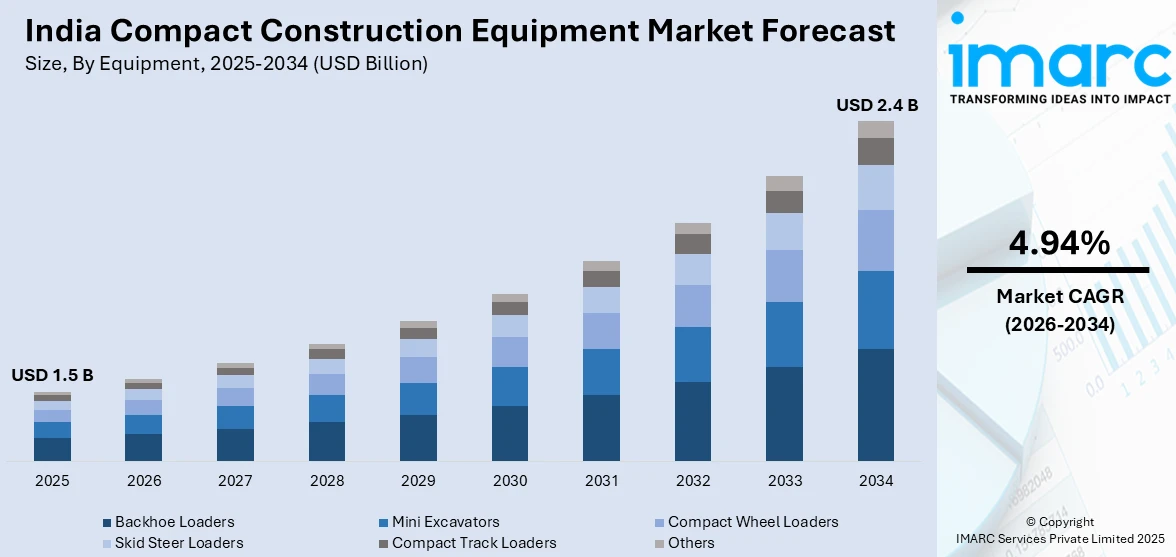
The India compact construction equipment market size was valued at USD 1.5 Billion in 2025 and is projected to reach USD 2.4 Billion by 2034, growing at a compound annual growth rate of 4.94% from 2026-2034.
The India compact construction equipment market is growing at a rapid pace due to the increasing adoption of versatile equipment, rapid urbanization, and infrastructure development initiatives. The market is also aided by government-backed initiatives that encourage the development of the domestic manufacturing sector and the modernization of the construction industry. The increasing demand from tier-II and tier-III cities, along with the preference for compact equipment that is maneuverable in confined spaces, is also driving the growth of the market.
Key Takeaways and Insights:
-
By Equipment: Backhoe loaders dominate the market with a share of 36.9% in 2025, driven by their exceptional versatility in performing multiple functions including excavation, loading, and material handling across diverse construction sites.
-
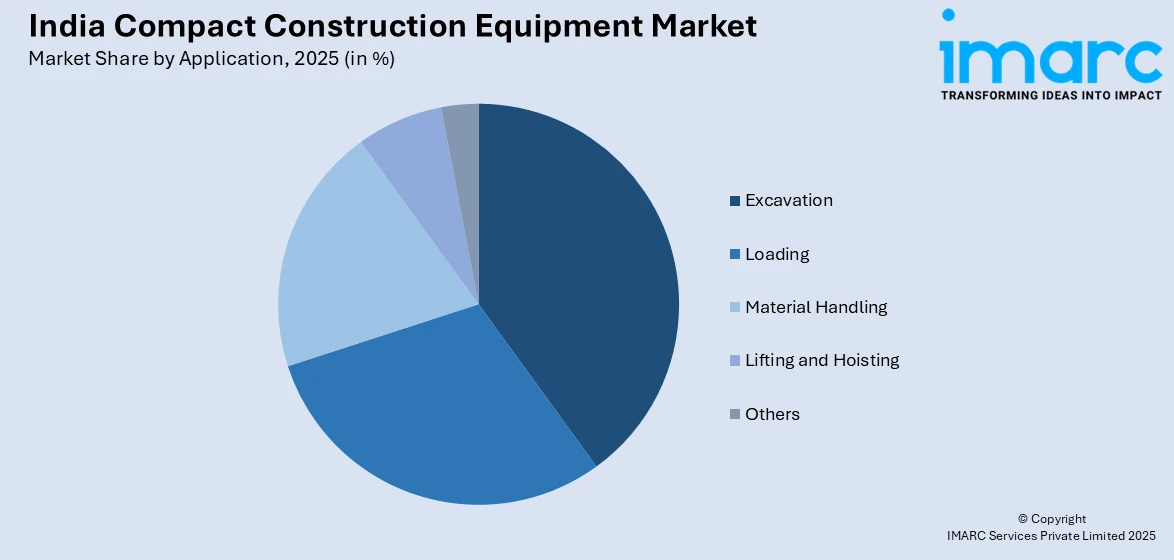
By Application: Excavation leads the market with a share of 33.4% in 2025, owing to extensive earthmoving requirements in infrastructure projects, foundation work, and site preparation activities across the country.
-
By End Use: Construction represents the largest segment with a market share of 57.8% in 2025, fueled by massive investments in residential, commercial, and infrastructure development projects under various government initiatives.
-
By Operating Capacity: Below 5 ton dominates the market with a share of 46.2% in 2025, driven by the increasing demand for lightweight, easily transportable equipment suited for urban construction and confined work sites.
-
By Power Output: Less than 100 HP leads with a share of 51.6% in 2025, highlighting robust demand for fuel-efficient, cost-effective machinery tailored to small- and medium-scale construction and agricultural projects.
-
By Region: West India dominates the market with a share of 32.8% in 2025, driven by concentration of major infrastructure projects in Maharashtra and Gujarat, along with robust industrial and commercial construction activities.
-
Key Players: The India compact construction equipment market exhibits a moderately competitive landscape characterized by the presence of both domestic manufacturers and international players. Market participants focus on product innovation, after-sales service excellence, equipment customization, and strategic partnerships to strengthen their market positioning and expand their customer base across different regions.
To get more information on this market Request Sample
The India compact construction equipment market continues to witness substantial growth momentum supported by the country's ambitious infrastructure development agenda. Government initiatives such as the National Infrastructure Pipeline, Smart Cities Mission, Bharatmala Pariyojana, and PM Gati Shakti are creating unprecedented demand for versatile construction machinery capable of operating efficiently in diverse environments. For example, in 2025 JCB India launched its new range of CEV Stage 5‑ready compact machines, including backhoe loaders, telehandlers, skid steer loaders, compactors, and wheeled loaders designed for better fuel efficiency and emissions compliance, at the Bharat Construction Equipment Expo, reinforcing OEM focus on advanced, sustainable equipment offerings. The market is characterized by increasing preference for equipment that offers superior maneuverability, fuel efficiency, and multi-functionality, enabling contractors to optimize operations across constrained urban sites and rural development projects. Technological advancements including telematics integration, advanced hydraulic systems, and emission-compliant engines are reshaping product offerings while the proliferation of equipment rental platforms is democratizing access for small and medium contractors.
India Compact Construction Equipment Market Trends:
Rising Adoption of Technologically Advanced Machinery
The India compact construction equipment market is witnessing accelerated adoption of technologically sophisticated machinery featuring advanced hydraulic systems, intelligent control interfaces, and integrated telematics capabilities. Manufacturers are increasingly incorporating features such as real-time performance monitoring, GPS-enabled fleet management, and automated operation modes that enhance productivity while reducing operator fatigue. For instance, at EXCON 2025, JCB India showcased next‑generation telematics solutions and an Operator App alongside its new machines and digital tools, underscoring the industry’s shift toward connected, data‑driven equipment. These technological enhancements enable precise operation in confined spaces, optimize fuel consumption, and facilitate predictive maintenance, thereby lowering total cost of ownership and improving project execution efficiency across diverse applications.
Growing Emphasis on Emission-Compliant and Sustainable Equipment
Environmental consciousness is increasingly influencing purchasing decisions in the India compact construction equipment market as stricter emission regulations take effect. The implementation of CEV Stage V emission norms is catalyzing investment in cleaner propulsion technologies, with manufacturers introducing equipment featuring advanced engine systems, hybrid powertrains, and electric variants. For example, in January 2026, CASE Construction Equipment launched its BS CEV Stage V‑compliant construction machinery range, including backhoe loaders, vibratory compactors, and excavators engineered for reduced emissions without compromising performance, at an event in Gurgaon, underscoring industry efforts to align with greener regulations and customer expectations. Construction companies operating in urban areas are particularly drawn to machinery that minimizes noise pollution and exhaust emissions, aligning with green building certification requirements and corporate sustainability objectives while ensuring regulatory compliance.
Expansion of Equipment Rental and Leasing Models
The compact construction equipment rental market in India is experiencing significant expansion as contractors increasingly prefer flexible, pay-as-you-use access to modern machinery over outright purchases. This trend is particularly pronounced among small and medium-sized contractors who benefit from reduced capital investment requirements, elimination of maintenance responsibilities, and access to the latest equipment technologies. In July 2025, Haryana‑based rental firm Aggcon Equipments International filed its Draft Red Herring Prospectus (DRHP) with SEBI to raise over ₹330 crore through an IPO, reflecting strong investor confidence and the growth potential of organised rental players in India’s construction equipment rental space. Rental platforms are expanding their geographic footprint and diversifying their fleet offerings, thereby democratizing access to advanced compact equipment across tier-II and tier-III cities and supporting the growth of entrepreneurial contractors.
Market Outlook 2026-2034:
The outlook for the India compact construction equipment market is highly favorable during the forecast period, driven by continued government spending on the modernization of infrastructure, urbanization, and the mechanization of the construction and agricultural sectors. The market is expected to gain from the development of highway projects, metro rail systems, affordable housing schemes, and smart city projects, which require flexible and compact equipment. The localization of manufacturing, development of the dealer network, and improved financing options are also expected to drive the market. The market generated a revenue of USD 1.5 Billion in 2025 and is projected to reach a revenue of USD 2.4 Billion by 2034, growing at a compound annual growth rate of 4.94% from 2026-2034.
India Compact Construction Equipment Market Report Segmentation:
|
Segment Category |
Leading Segment |
Market Share |
|
Equipment |
Backhoe Loaders |
36.9% |
|
Application |
Excavation |
33.4% |
|
End Use |
Construction |
57.8% |
|
Operating Capacity |
Below 5 Ton |
46.2% |
|
Power Output |
Less than 100 HP |
51.6% |
|
Region |
West India |
32.8% |
Equipment Insights:
- Mini Excavators
- Compact Wheel Loaders
- Skid Steer Loaders
- Compact Track Loaders
- Backhoe Loaders
- Others
The backhoe loaders dominates with a market share of 36.9% of the total India compact construction equipment market in 2025.
Backhoe loaders have established themselves as the cornerstone of India's compact construction equipment market owing to their unparalleled versatility and multi-functional capabilities. These machines combine the functionality of a loader and an excavator in a single unit, enabling operators to perform diverse tasks including excavation, trenching, material loading, and site grading without requiring multiple pieces of equipment. For instance, in June 2025, Escorts Kubota launched its BLX 75 backhoe loader under the E‑Kubota brand specifically for the Indian market, reinforcing strong OEM focus on expanding and upgrading backhoe offerings to meet evolving construction needs. This versatility translates into significant cost savings and operational efficiency, making backhoe loaders particularly attractive for contractors engaged in infrastructure development, utility installation, and rural construction projects.
The dominance of backhoe loaders in the Indian market is further supported by their adaptability to the terrain conditions and projects in India. The machines are compact and can be easily operated in the tight spaces of cities, and at the same time, they are rugged enough to withstand the tough conditions of rural India. The after-sales service support available to backhoe loaders in India is also a major factor that has increased customer confidence in these machines.
Application Insights:
Access the comprehensive market breakdown Request Sample
- Loading
- Excavation
- Material Handling
- Lifting and Hoisting
- Others
The excavation leads with a share of 33.4% of the total India compact construction equipment market in 2025.
Excavation applications command the largest share of the India compact construction equipment market driven by extensive earthmoving requirements across infrastructure development, foundation construction, and site preparation activities. For example, at EXCON 2025, JCB India showcased an expanded range of excavators, from compact 2–5 tonne models for confined urban sites to its largest‑ever 52 tonne excavator manufactured in India, highlighting sustained investment in both compact and high‑capacity digging solutions to meet diverse project needs. The acceleration of highway construction, metro rail projects, and residential developments has created sustained demand for efficient excavation equipment capable of operating in diverse soil conditions. Compact excavation machinery is particularly valued for its ability to perform precision digging in space-constrained environments while maintaining productivity levels comparable to larger equipment.
The growing emphasis on underground utility installation and cable laying projects further strengthens demand for excavation-focused compact equipment. Urban infrastructure modernization initiatives require extensive trenching and excavation work for water supply networks, sewage systems, and electrical conduits, all of which benefit from the maneuverability and precision offered by compact machinery. Additionally, the mining and quarrying sectors contribute to excavation equipment demand, with compact machines increasingly deployed for selective extraction and site maintenance operations.
End Use Insights:
- Construction
- Agriculture
- Mining
- Utility Works
- Others
The construction dominates with a market share of 57.8% of the total India compact construction equipment market in 2025.
The construction sector's commanding position in the India compact construction equipment market reflects the massive scale of building and infrastructure development activities across the country. Government-led initiatives including affordable housing programs, commercial complex developments, and industrial corridor construction are driving unprecedented demand for versatile compact machinery. The sector's preference for equipment that can seamlessly transition between different construction phases, from site preparation through finishing, strongly favors multi-functional compact machines.
Urban construction projects particularly benefit from compact equipment's ability to operate efficiently within restricted site boundaries while minimizing disruption to surrounding areas. The rise of mixed-use developments and high-rise construction in metropolitan areas has increased demand for machinery that combines powerful performance with space-efficient design. Additionally, the expansion of construction activities into tier-II and tier-III cities is broadening the customer base for compact equipment, as local contractors adopt mechanization to improve productivity and project delivery timelines.
Operating Capacity Insights:
- Below 5 Ton
- 6 to 8 Ton
- Above 8 Ton
The below 5 ton leads with a share of 46.2% of the total India compact construction equipment market in 2025.
Equipment with operating capacity below five tons has emerged as the most sought-after category in the India compact construction equipment market, driven by the growing preference for highly maneuverable machinery suitable for urban and semi-urban construction environments. These lightweight machines offer exceptional ease of transportation between job sites, require minimal setup time, and can access confined spaces that larger equipment cannot enter. The combination of adequate power and compact dimensions makes sub-five-ton equipment ideal for residential construction, landscaping, and utility installation projects.
The economic advantages of operating lighter equipment further reinforce this segment's dominance, as lower fuel consumption, reduced maintenance requirements, and simplified operator training translate into attractive total cost of ownership. Small contractors and rental companies particularly favor this capacity range for its versatility across diverse applications and customer segments. The segment also benefits from growing adoption in agricultural applications, where compact equipment is increasingly replacing manual labor for farm mechanization activities.
Power Output Insights:
- Less than 100 HP
- 101-200 HP
- 201-400 HP
- More than 400 HP
The less than 100 HP dominates with a market share of 51.6% of the total India compact construction equipment market in 2025.
Equipment with power output below 100 horsepower represents the majority of the India compact construction equipment market, reflecting strong demand for fuel-efficient and cost-effective machinery across diverse applications. This power range delivers sufficient performance for most compact equipment applications while maintaining favorable operating economics that appeal to cost-conscious contractors. The segment encompasses a broad array of equipment types including mini excavators, compact loaders, and smaller backhoe models that collectively address the majority of construction and agricultural mechanization requirements.
Advancements in engine technology have enhanced the productivity and reliability of sub-hundred-horsepower equipment, enabling these machines to deliver performance previously associated with larger, more powerful units. Modern hydraulic systems and intelligent power management features optimize engine output utilization, ensuring efficient operation across varying load conditions. The growing availability of emission-compliant engines in this power category, combined with manufacturer investments in fuel-efficient technologies, continues to strengthen the segment's appeal among environmentally conscious buyers.
Regional Insights:
- North India
- South India
- East India
- West India
West India exhibits a clear dominance with a 32.8% share of the total India compact construction equipment market in 2025.
West India has established itself as the leading regional market for compact construction equipment, driven by the concentration of major infrastructure projects and industrial developments in Maharashtra and Gujarat. The region hosts numerous large-scale construction initiatives including airport developments, urban redevelopment programs, and commercial complex construction that generate substantial demand for versatile compact machinery. The presence of established manufacturing hubs and well-developed dealer networks facilitates equipment availability and after-sales support.
The robust economic activity in metropolitan centers including Mumbai, Pune, and Ahmedabad creates continuous demand for construction equipment across residential, commercial, and infrastructure segments. Additionally, the region's progressive adoption of modern construction practices and higher mechanization levels compared to other parts of the country contribute to sustained equipment demand. Port development projects, industrial corridor construction, and smart city initiatives in West India are expected to maintain the region's leadership position throughout the forecast period.
Market Dynamics:
Growth Drivers:
Why is the India Compact Construction Equipment Market Growing?
Accelerated Infrastructure Development Under Government Initiatives
The India compact construction equipment market is experiencing robust growth propelled by unprecedented government investment in infrastructure development through flagship programs including the National Infrastructure Pipeline, PM Gati Shakti National Master Plan, and Bharatmala Pariyojana. These initiatives are driving massive construction activity across highways, railways, airports, and urban infrastructure, creating sustained demand for versatile compact machinery capable of operating efficiently across diverse project types. In March 2025, Union Minister Nitin Gadkari highlighted that out of 26,425 km of road projects awarded under the Bharatmala Pariyojana, 19,826 km have already been constructed, a clear indicator of accelerating job orders and execution on the ground that is boosting demand for construction equipment across regions. The government's commitment to transforming India's infrastructure landscape is translating into consistent equipment orders as contractors expand their fleets to meet project execution requirements. The emphasis on completing projects within stipulated timelines is encouraging adoption of mechanized solutions that enhance productivity and reduce dependence on manual labor.
Rapid Urbanization and Expansion of Tier-II and Tier-III Cities
India's accelerating urbanization is generating substantial demand for compact construction equipment as cities expand and modernize to accommodate growing populations. The Smart Cities Mission and urban development programs are spurring construction activity in metropolitan areas while the growth of tier-II and tier-III cities is opening new markets for compact machinery. As of August 2025, over 7,636 urban development projects worth around ₹1.53 lakh crore have been completed under the Smart Cities Mission across 100 cities, driving infrastructure upgrades such as smart mobility, sanitation, and public amenities that rely on versatile construction equipment on the ground. These smaller cities are witnessing increased residential and commercial construction, road infrastructure development, and utility network expansion, all of which require versatile equipment capable of operating in evolving urban environments. The preference for compact machines in urban settings stems from their ability to navigate congested areas, minimize disruption to surrounding activities, and access restricted spaces that larger equipment cannot enter effectively.
Growing Preference for Multi-functional and Versatile Equipment
The India compact construction equipment market is benefiting from increasing contractor preference for multi-functional machinery that can perform diverse tasks across different project phases. Compact equipment categories such as backhoe loaders, skid steer loaders, and mini excavators offer exceptional versatility through interchangeable attachments that enable a single machine to perform excavation, loading, grading, and material handling operations. At EXCON 2025, Doosan Bobcat showcased an expanded range of compact skid steer loaders (S510 and S650) alongside its Earthforce series of mini excavators, all designed to deliver enhanced versatility across material handling, grading, and urban infrastructure applications, underlining OEM efforts to cater to the demand for multi‑functional machines. This multi-functionality reduces the need for multiple specialized machines, lowering capital investment requirements and simplifying fleet management. The growing awareness of total cost of ownership considerations is driving equipment selection decisions toward versatile compact machines that maximize asset utilization across diverse applications and project types.
Market Restraints:
What Challenges the India Compact Construction Equipment Market is Facing?
High Initial Acquisition Costs and Financing Constraints
The substantial capital investment required for compact construction equipment acquisition poses a significant barrier for small and medium-sized contractors, particularly first-time buyers. Limited access to affordable financing options and stringent lending requirements restrict equipment purchases, compelling many contractors to rely on outdated machinery or manual methods that compromise productivity and project quality.
Shortage of Skilled Equipment Operators
The India compact construction equipment market faces challenges stemming from inadequate availability of trained operators capable of maximizing equipment performance and ensuring safe operation. The shortage of skilled personnel results in underutilization of advanced machine features, increased maintenance requirements, and higher operational risks, particularly for technologically sophisticated equipment incorporating telematics and automated functions.
Variability in Project Payment Cycles
Inconsistent payment cycles and delayed disbursements in construction projects create cash flow challenges for contractors, affecting their ability to invest in new equipment or maintain existing machinery. The extended receivable periods strain working capital and discourage equipment upgrades, potentially limiting market growth particularly among smaller contractors dependent on timely project payments.
Competitive Landscape:
The India compact construction equipment market is characterized by a dynamic competitive environment featuring a mix of established global manufacturers and domestic players competing across diverse product categories and regional markets. Market participants differentiate themselves through product innovation, comprehensive after-sales service networks, equipment customization capabilities, and competitive pricing strategies. The competitive intensity is driving manufacturers to invest in research and development activities focused on fuel efficiency, emission compliance, operator comfort, and advanced technological features. Strategic partnerships between international equipment manufacturers and domestic companies facilitate technology transfer, localized production, and expanded market reach. The growing importance of rental and leasing channels is also reshaping competitive dynamics as manufacturers and dealers develop flexible ownership models to address diverse customer requirements and expand their addressable market.
Recent Developments:
-
In December 2025, Escorts Kubota has launched the U22‑6 Mini Excavator, a 2.2‑ton compact machine designed for urban construction and tight job sites. The launch was announced via NSE/BSE regulatory filings and showcased at EXCON 2025 in Bengaluru. The model highlights the company’s push into advanced, space-efficient construction equipment.
India Compact Construction Equipment Market Report Coverage:
|
Report Features |
Details |
|
Base Year of the Analysis |
2025 |
|
Historical Period |
2020-2025 |
|
Forecast Period |
2026-2034 |
|
Units |
Billion USD |
|
Scope of the Report |
Exploration of Historical Trends and Market Outlook, Industry Catalysts and Challenges, Segment-Wise Historical and Future Market Assessment:
|
|
Equipments Covered |
Mini Excavators, Compact Wheel Loaders, Skid Steer Loaders, Compact Track Loaders, Backhoe Loaders, Others |
|
Applications Covered |
Loading, Excavation, Material Handling, Lifting and Hoisting, Others |
|
End Uses Covered |
Construction, Agriculture, Mining, Utility Works, Others |
|
Operating Capacities Covered |
Below 5 Ton, 6 to 8 Ton, Above 8 Ton |
|
Power Outputs Covered |
Less than 100 HP, 101-200 HP, 201-400 HP, More than 400 HP |
|
Regions Covered |
North India, South India, East India, West India |
|
Customization Scope |
10% Free Customization |
|
Post-Sale Analyst Support |
10-12 Weeks |
|
Delivery Format |
PDF and Excel through Email (We can also provide the editable version of the report in PPT/Word format on special request) |
Frequently Asked Questions About the India Compact Construction Equipment Market Report
The India compact construction equipment market size was valued at USD 1.5 Billion in 2025.
The India compact construction equipment market is expected to grow at a compound annual growth rate of 4.94% from 2026-2034 to reach USD 2.4 Billion by 2034.
Backhoe loaders dominated the market with a share of 36.9%, driven by their exceptional versatility, multi-functional capabilities, and suitability for diverse construction applications across urban and rural environments in India.
Key factors driving the India compact construction equipment market include accelerated infrastructure development under government initiatives, rapid urbanization and expansion of tier-II and tier-III cities, growing preference for multi-functional and versatile equipment, and increasing adoption of equipment rental platforms expanding access for small contractors.
Major challenges include high initial equipment acquisition costs limiting accessibility for smaller contractors, shortage of skilled operators capable of maximizing equipment potential, variability in project payment cycles affecting contractor cash flows, limited financing options in rural areas, and the need for continued investment in service network expansion across emerging markets.
Need more help?
- Speak to our experienced analysts for insights on the current market scenarios.
- Include additional segments and countries to customize the report as per your requirement.
- Gain an unparalleled competitive advantage in your domain by understanding how to utilize the report and positively impacting your operations and revenue.
- For further assistance, please connect with our analysts.
 Request Customization
 Speak to an Analyst
 Request Brochure
 Inquire Before Buying
Benefits of Customization
- Personalize this research
- Triangulate with your data
- Get data as per your format and definition
- Gain a deeper dive into a specific application, geography, customer, or competitor
- Any level of personalization
Get in Touch With Us
UNITED STATES
Phone: +1-201-971-6302
INDIA
Phone: +91-120-433-0800
UNITED KINGDOM
Phone: +44-753-714-6104
Email: [email protected]
Client Testimonials




.webp)




.webp)













Related Reports

Choose your plan
*Please note that the prices mentioned below are starting prices for each bundle type. Kindly contact our team for further details.*
Single User License
- 1 User License, Access on 2 Devices
- PDF Report + Excel Dataset (Password Protected)
- Lifetime Access
- No Printing Rights
- 10% Free Report Customization
- 10–12 Weeks of Analyst Support
Five User License
- Access for 5 Users, 2 Devices per User
- PDF Report + Excel Dataset (Password Protected)
- Lifetime Access
- Dedicated Account Manager
- 12–14 Weeks of Analyst Support
- No Printing Rights
- 15% Free Report Customization
- 25% Discount on Your Next Purchase
Corporate User License
- Unlimited User Access (Within Your Organization)
- PDF Report + Excel Dataset
- Lifetime Access
- Dedicated Account Manager
- 14–20 Weeks of Analyst Support
- No Printing Rights
- 20% Free Report Customization
- 30% Discount on Your Next Purchase
Essential Insights
What's included:
3 reports
- Lifetime Access
- PDF Reports
- Excel Datasets
- 2 Weeks of Free Analyst Support
- 2 User Licenses
- Access on 2 Devices
- Printing Rights
- Complimentary PowerPoint (PPT) Version
- Complimentary License Upgrade
Professional Access
What's included:
5 reports
- Lifetime Access
- PDF Reports
- Excel Datasets
- 8 Weeks of Free Analyst Support
- 2 User Licenses
- Access on 2 Devices
- Printing Rights
- Complimentary PowerPoint (PPT) Version
- Complimentary License Upgrade
Business Advantage
What's included:
8 reports
- Lifetime Access
- PDF Reports
- Excel Datasets
- 14 Weeks of Free Analyst Support
- 2 User Licenses
- Access on 2 Devices
- Printing Rights
- Complimentary PowerPoint (PPT) Version
- Complimentary License Upgrade
Enterprise Intelligence
What's included:
10 reports
- Lifetime Access
- PDF Reports
- Excel Datasets
- 20 Weeks of Free Analyst Support
- 2 User Licenses
- Access on 2 Devices
- Printing Rights
- Complimentary PowerPoint (PPT) Version
- Complimentary License Upgrade