
India Cybersecurity Market Size, Share, Trends and Forecast by Component, Deployment Type, User Type, Industry Vertical, and Region, 2026-2034
India Cybersecurity Market Size, Share, Trends & Forecast (2026-2034)
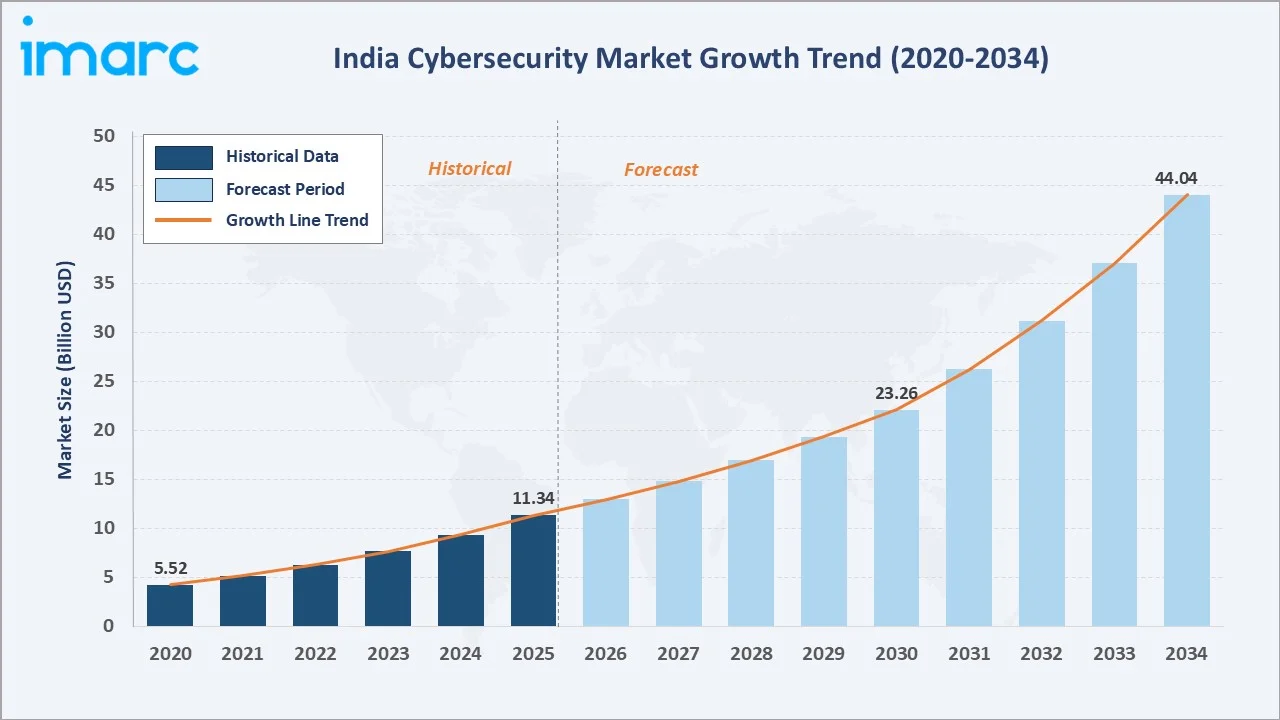
The India cybersecurity market reached USD 11.34 Billion in 2025 and is projected to reach USD 44.04 Billion by 2034, growing at a CAGR of 15.46% during 2026-2034. The market is driven by escalating cyber threats, rapid digital adoption, and increasing regulatory compliance requirements. India processed over 15 billion UPI transactions monthly in 2025, expanding the digital attack surface. Solutions dominate at 68.7%. Cloud-based deployment leads at 62.5%. South India commands 35.6% of the market share.
Market Snapshot
|
Metric |
Value |
|
Market Size (2025) |
USD 11.34 Billion |
|
Forecast Market Size (2034) |
USD 44.04 Billion |
|
CAGR (2026-2034) |
15.46% |
|
Base Year |
2025 |
|
Historical Period |
2020-2025 |
|
Forecast Period |
2026-2034 |
|
Dominant Component |
Solutions (68.7%, 2025) |
|
Dominant Deployment |
Cloud-based (62.5%, 2025) |
|
Leading Region |
South India (35.6%, 2025) |
The India cybersecurity market expanded from USD 5.52 Billion in 2020 to USD 11.34 Billion in 2025, anchored at USD 23.26 Billion in 2030, and forecast to reach USD 44.04 Billion by 2034. COVID-19 exposed critical infrastructure vulnerabilities in 2020, triggering accelerated government investment in national cybersecurity frameworks. The post-pandemic digital transformation sustained above-trend cybersecurity market growth through 2022-2025.
To get more information on this market, Request Sample
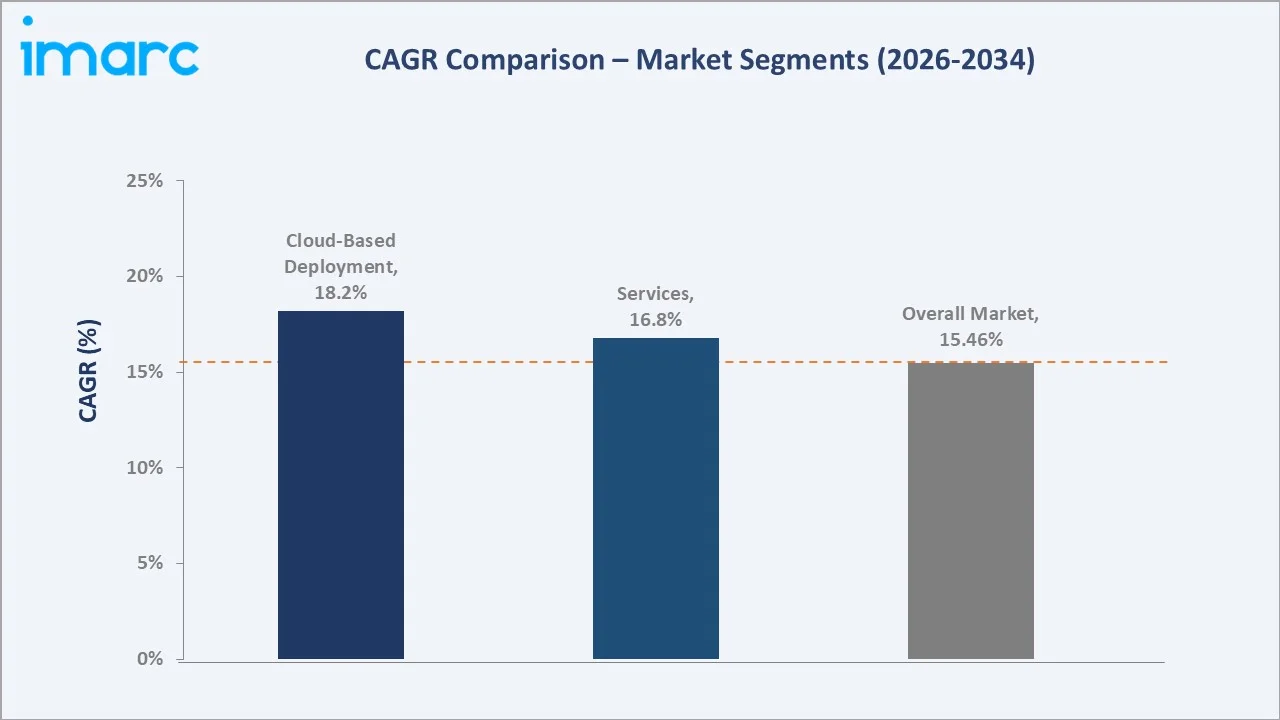
Cloud-based deployment grows fastest at ~18.2% CAGR as enterprises migrate from on-premises to scalable cloud-native security platforms. Services segment grows at ~16.8% CAGR through expanded managed security service adoption by mid-market enterprises facing talent shortages.
Executive Summary
The India cybersecurity market reached USD 11.34 Billion in 2025, representing one of Asia's most dynamic intersections of technology investment, regulatory compliance, and digital transformation. The market encompasses identity and access management, infrastructure security, governance risk and compliance, data security, cloud security, professional services, and managed security services.
Solutions at 68.7% dominate through enterprise demand for integrated security platforms. Cloud-based deployment at 62.5% leads through rapid SaaS adoption. South India, at 35.6%, leads through Bengaluru's technology capital position and highest concentration of IT/ITeS enterprises.
Key Market Insights
|
Insight |
Data |
|
Dominant Component |
Solutions – 68.7% share (2025) |
|
Dominant Deployment |
Cloud-based – 62.5% market share (2025) |
|
Leading Region |
South India – 35.6% market share |
|
Market Opportunity |
AI-powered threat detection; Zero Trust architecture; managed SOC services; DPDPA compliance solutions; OT/ICS security; quantum-safe cryptography |
Key Analytical Observations Supporting The Above Data:
- Solutions at 68.7%: Solutions dominate due to enterprise demand for integrated security platforms covering identity management, infrastructure protection, and compliance. These tools enable real-time threat detection, automated response, and centralized security posture management.
- Cloud-based at 62.5%: Cloud-based deployment leads because organizations prefer scalable, cost-effective, and remotely managed security infrastructure. Cloud platforms support rapid deployment, continuous updates, and seamless integration.
- South India at 35.6%: South India dominates due to Bengaluru's concentration of IT/ITeS enterprises, global technology companies, and cybersecurity-focused startups. The region's advanced digital infrastructure and high enterprise security spending drive its market leadership.
India Cybersecurity Market Overview
The India cybersecurity market encompasses the design, deployment, and management of security solutions and services protecting digital assets, networks, endpoints, cloud environments, and critical infrastructure across enterprise, government, and SME sectors.
Macroeconomic drivers include rapid digital transformation, increasing internet penetration, proliferation of connected devices, and government mandates for data protection. The DPDPA enforcement, CERT-In's six-hour incident reporting mandate, and National Cybersecurity Strategy drive structured regulatory compliance spending.
Market Dynamics
To evaluate market opportunities, Request Sample
Market Drivers
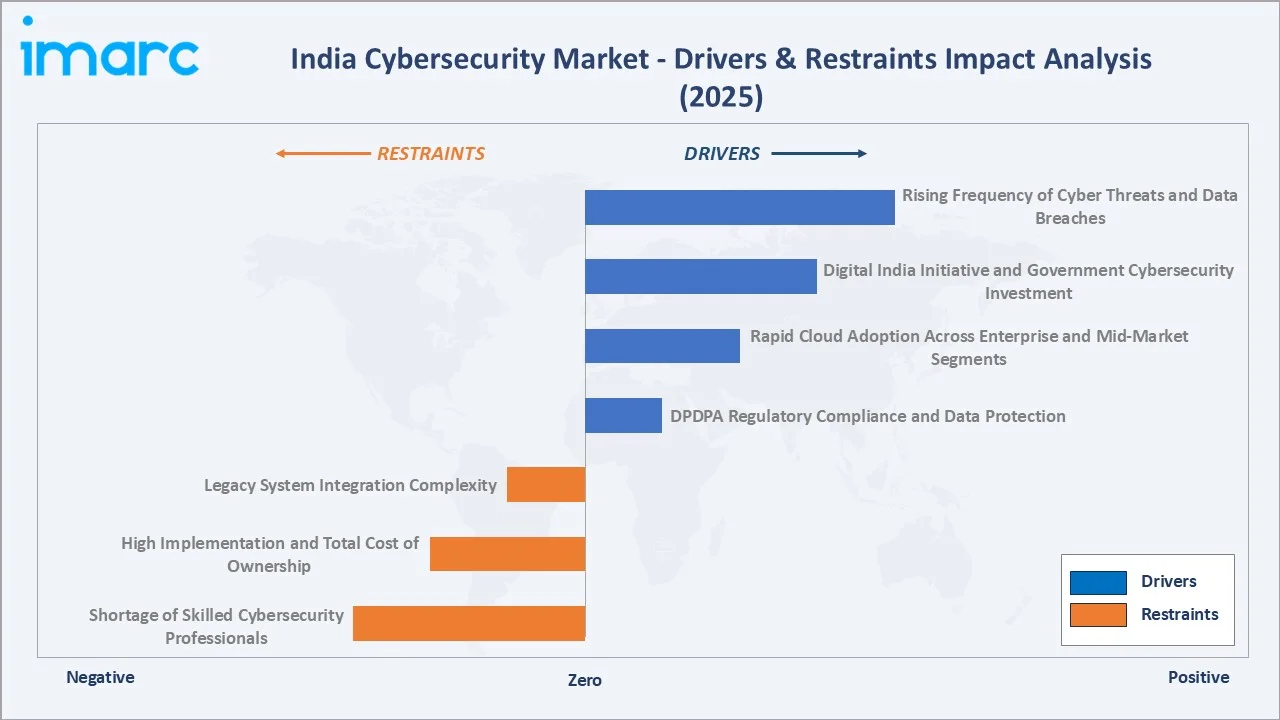
- Rising Frequency of Cyber Threats and Data Breaches: Rising frequency of cyber threats is driving significant investment in advanced security solutions. India reported over 1.5 million cybersecurity incidents in 2024, including ransomware, phishing, and supply chain attacks. Organizations across BFSI, healthcare, and government are accelerating procurement of threat detection, response, and recovery platforms to safeguard critical digital assets and ensure operational continuity.
- Digital India Initiative and Government Cybersecurity Investment: Government-led digitalization is expanding India's attack surface while mandating cybersecurity investment. The Digital India programme, CERT-In directives, and DPDPA compliance requirements are compelling enterprises and public bodies to allocate significantly higher security budgets. In March 2025, the Indian government announced USD 125 million in cybersecurity infrastructure investment for critical national systems, underscoring regulatory-driven market growth.
- Rapid Cloud Adoption Across Enterprise and Mid-Market Segments: Cloud migration is creating strong demand for cloud-native security platforms, cloud access security brokers, and zero-trust network access solutions. Indian enterprises are projected to spend over USD 24 billion on cloud infrastructure by 2026, directly driving proportional cybersecurity investment to protect cloud workloads, data, and identities across hybrid and multi-cloud environments.
- DPDPA Regulatory Compliance and Data Protection Requirements: The Digital Personal Data Protection Act enforcement is mandating comprehensive data security programmes across all organizations processing personal data. Compliance requirements for data classification, encryption, breach notification, and audit trails are generating structured procurement cycles for data loss prevention, governance risk compliance, and identity security solutions across all regulated sectors.
Market Restraints
- Shortage of Skilled Cybersecurity Professionals: India faces a deficit of over 800,000 cybersecurity professionals, limiting operational capacity of security operations centers and slowing enterprise adoption of advanced threat detection platforms. Talent scarcity increases managed service reliance and raises cybersecurity operational costs, constraining growth in price-sensitive mid-market segments and limiting the speed of enterprise security transformation.
- High Implementation and Total Cost of Ownership: Comprehensive cybersecurity implementation spanning endpoint protection, network security, identity management, and compliance tools requires substantial capital investment. For small and medium enterprises, high licensing costs, integration expenses, and ongoing maintenance create adoption barriers, slowing market penetration beyond large enterprise and government segments into the broader SME market.
- Legacy System Integration Complexity: A significant portion of Indian enterprise infrastructure operates on legacy systems incompatible with modern security architectures. Integrating advanced cybersecurity platforms with existing ERP, banking core systems, and government IT infrastructure creates technical complexity, extended deployment timelines, and higher implementation costs that constrain overall market growth rates.
Market Opportunities
- AI-Powered Threat Detection and Autonomous Response: AI and machine learning integration in cybersecurity is enabling real-time behavioral analytics, automated threat hunting, and accelerated incident response. Indian organizations are increasingly adopting AI-driven security platforms to address talent shortages and manage exponentially growing threat volumes across distributed multi-cloud environments, creating significant market expansion opportunity.
- Managed Security Services for SME Market Penetration: The managed security services model addresses the talent gap while enabling SME cybersecurity adoption without large capital investment. As DPDPA compliance mandates extend to mid-market enterprises, managed SOC providers offering affordable subscription-based security monitoring are positioned for accelerated growth through India's 63 million SME base.
Market Challenges
- Evolving Attack Vectors and Zero-Day Vulnerability Exposure: Rapidly evolving attack methodologies including AI-generated deepfake fraud, supply chain compromises, and OT/ICS targeting outpace traditional signature-based security defenses. Organizations must continuously update threat intelligence, retrain security models, and replace legacy tools, creating ongoing investment pressure and operational complexity that increases total security programme costs.
- Multi-Vendor Security Tool Sprawl and Integration Challenges: Indian enterprises average 15-25 distinct security tools, creating management complexity, visibility gaps, and integration overhead. Tool sprawl reduces security effectiveness while increasing total cost of ownership. The shift toward consolidated security platforms is a long-term procurement trend, but transition complexity slows adoption timelines across large enterprise environments.
Emerging Market Trends
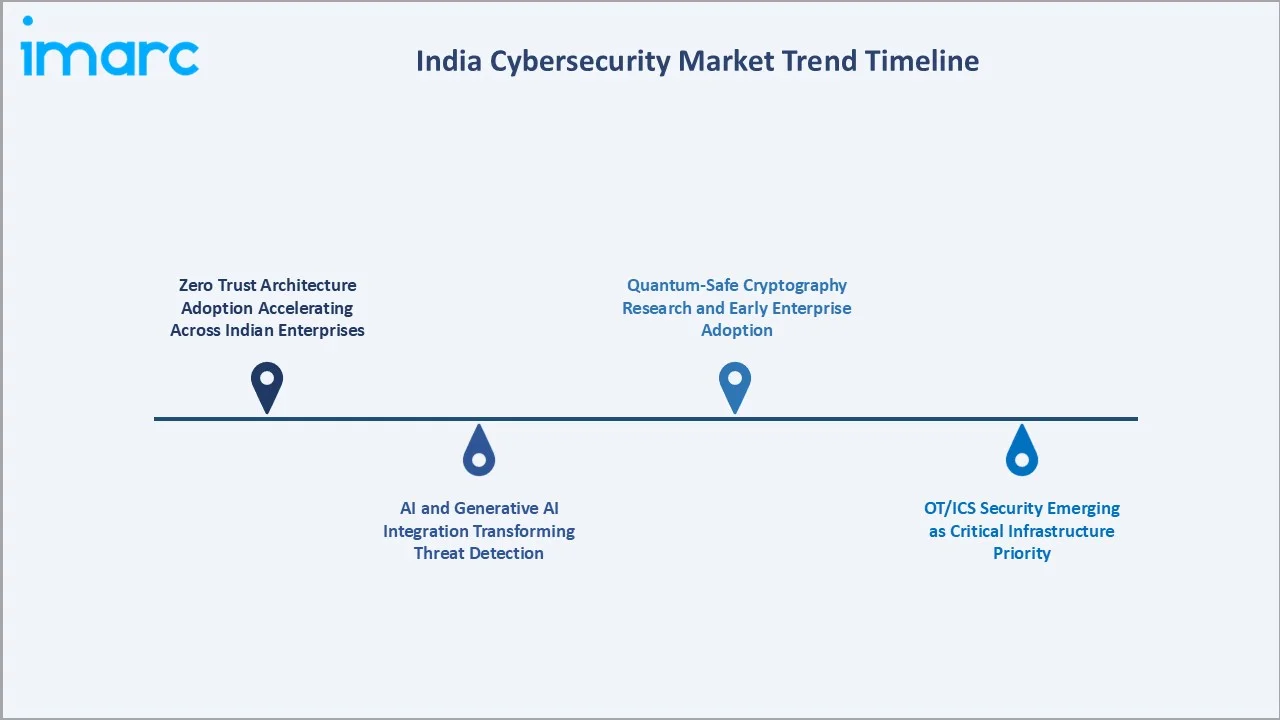
1. Zero Trust Architecture Adoption Accelerating Across Indian Enterprises
Zero Trust security frameworks are becoming the dominant enterprise security architecture as perimeter-based models prove inadequate for cloud-first and hybrid work environments. Indian IT services majors and BFSI enterprises are deploying identity-centric Zero Trust frameworks integrating multi-factor authentication, microsegmentation, and continuous verification. This architectural shift is driving expanded procurement of identity security, network access control, and zero-trust network access platforms across large enterprise and regulated industry segments.
2. AI and Generative AI Integration Transforming Threat Detection
Generative AI is simultaneously expanding the threat landscape through deepfakes and AI-crafted phishing, while enabling AI-powered security platforms to detect threats at machine speed. Indian cybersecurity vendors are embedding large language models into SIEM platforms and threat intelligence tools to automate analysis and accelerate response. AI integration is reducing analyst workloads and enabling 24x7 threat monitoring capabilities that close the talent gap constraining enterprise security operations.
3. OT/ICS Security Emerging as Critical Infrastructure Priority
Operational technology security is becoming a national priority as India's power grid, manufacturing, and transportation sectors undergo digital transformation. The government's focus on critical infrastructure protection and increasing nation-state cyber activity is driving investment in OT-specific security monitoring, anomaly detection, and incident response platforms. In May 2025, CERT-In issued specific guidelines for OT security in critical sectors, creating regulatory-driven procurement momentum.
4. Quantum-Safe Cryptography Research and Early Enterprise Adoption
Indian organizations in defense, banking, and telecommunications are beginning quantum-safe cryptography migration planning. NIST's post-quantum cryptography standard finalization in 2024 triggered enterprise assessment programmes in India's most security-conscious sectors. Early adopters are deploying crypto-agile architectures to future-proof long-lived data against quantum decryption threats while positioning for compliance with forthcoming quantum-safe encryption mandates.
Industry Value Chain Analysis
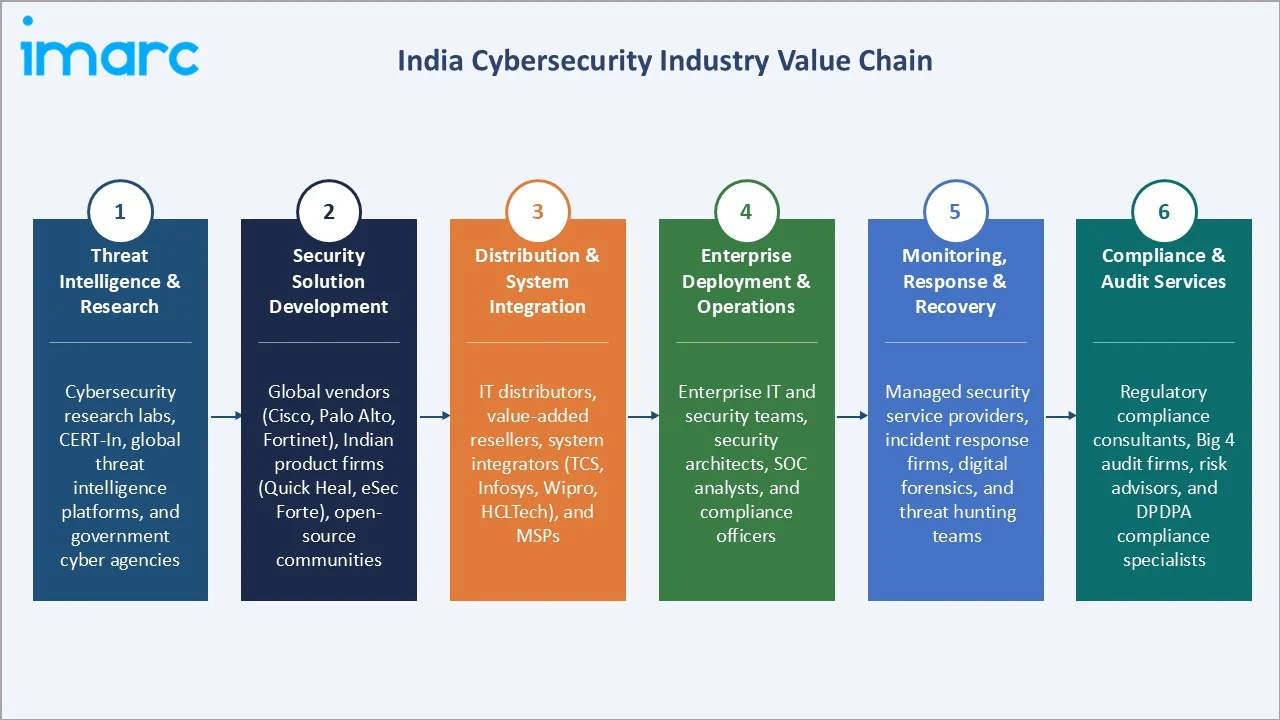
The cybersecurity industry value chain integrates threat intelligence and research, security solution development, distribution and system integration, enterprise deployment and operations, managed monitoring and response, and compliance and audit services into a comprehensive security delivery ecosystem.
|
Stage |
Key Participants |
|
Threat Intelligence & Research |
Cybersecurity research labs, national CERT-In, global threat intelligence platforms, academic security institutions, government cyber agencies |
|
Security Solution Development |
Global cybersecurity vendors (Cisco, Palo Alto Networks, Fortinet), Indian product companies (Quick Heal, eSec Forte), open-source security communities |
|
Distribution & System Integration |
IT distributors, value-added resellers, large IT system integrators (TCS, Infosys, Wipro, HCLTech), managed service providers |
|
Enterprise Deployment & Operations |
Enterprise IT and security teams, security architects, SOC analysts, cloud security teams, compliance officers |
|
Monitoring, Response & Recovery |
Managed security service providers (MSSPs), incident response firms, digital forensics specialists, threat hunting teams |
|
Compliance & Audit Services |
Regulatory compliance consultants, audit firms (Big 4), legal and risk management advisors, DPDPA compliance specialists |
The managed monitoring and response stage is the value chain's most commercially dynamic segment as talent shortages drive outsourced SOC adoption. DPDPA compliance requirements are creating structured procurement for compliance and audit services. The system integration tier is consolidating as enterprises prefer end-to-end security transformation partners over point-solution vendors.
Technology Landscape in the India Cybersecurity Industry
AI-Powered Security Information and Event Management (SIEM)
AI-integrated SIEM platforms enable real-time log analysis, behavioral anomaly detection, and automated alert correlation across enterprise environments. Next-generation SIEM solutions embedded with machine learning reduce false positives while accelerating mean-time-to-detect. As Indian enterprises scale SOC operations, AI-powered SIEM adoption is growing rapidly as a core platform for enterprise security operations.
Identity and Access Management (IAM) Platform Technology
IAM platforms provide centralized authentication, authorization, and privileged access management across hybrid cloud environments. Adaptive authentication, biometric verification, and just-in-time access provisioning are key capabilities driving enterprise IAM adoption. DPDPA compliance requirements are directly accelerating IAM deployment across data-processing organizations across all regulated industry sectors.
Extended Detection and Response (XDR) Platform
XDR platforms unify endpoint, network, cloud, and email security telemetry into a single threat detection and response framework. By correlating signals across the entire IT stack, XDR reduces dwell time and enables faster incident containment. Indian enterprises managing complex multi-cloud environments are adopting XDR to consolidate fragmented security tool landscapes and improve overall detection and response efficiency.
Market Segmentation Analysis
The report covers the following segments:
|
Segment Category |
Leading Segment |
Market Share |
Year |
|
Component |
Solutions |
68.7% |
2025 |
|
Deployment Type |
Cloud-based |
62.5% |
2025 |
|
User Type |
🔒 |
🔒 |
2025 |
|
Industry Vertical |
🔒 |
🔒 |
2025 |
|
Region |
South India |
35.6% |
2025 |

By Component
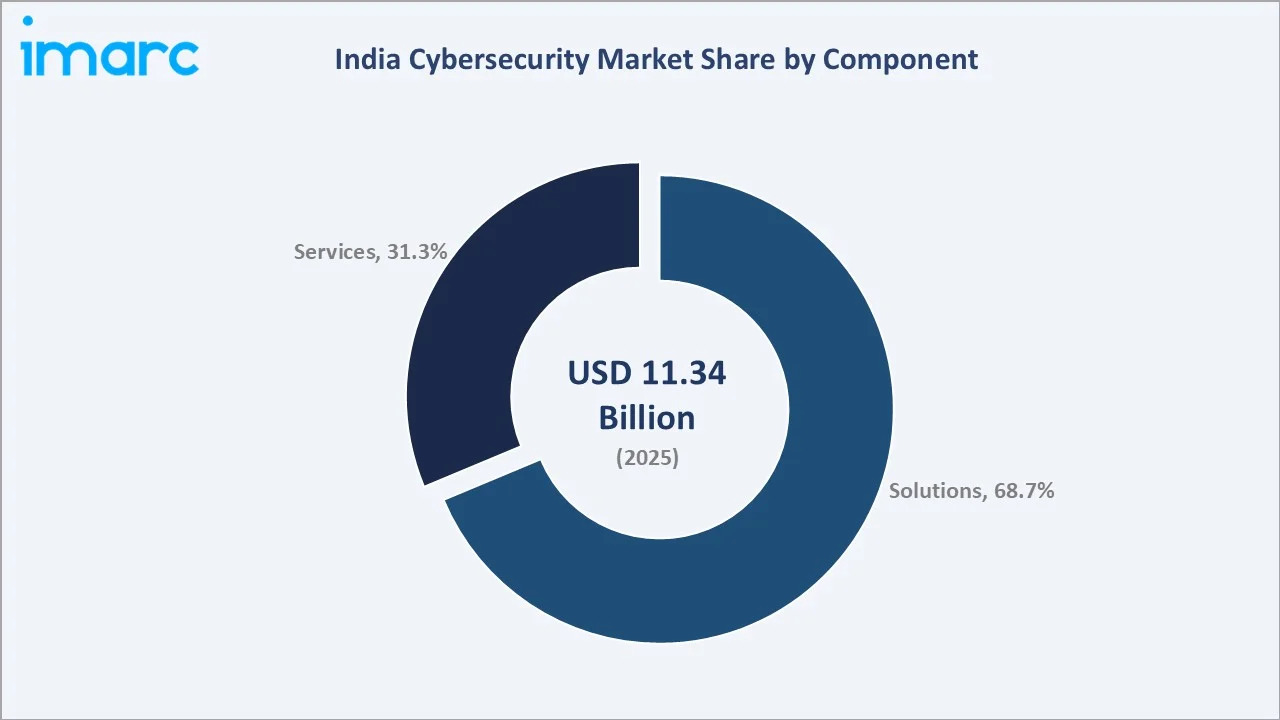
Solutions lead at 68.7% (2025). The solutions segment encompasses Identity and Access Management (IAM), Infrastructure Security, Governance, Risk and Compliance, Unified Vulnerability Management Service Offering, Data Security and Privacy Service Offering, and other specialized security tools. Enterprise demand for integrated security platforms with unified management consoles is the primary adoption driver across large enterprise and regulated industry segments.
To access detailed market analysis, Request Sample
Services at 31.3% encompasses Professional Services and Managed Services. Managed services grow fastest through expanded MSSP adoption by enterprises seeking 24x7 SOC capabilities without internal talent investment. Professional services including consulting, implementation, and training sustain stable demand from regulatory compliance programmes across BFSI, healthcare, and government sectors.
By Deployment Type
Cloud-based deployment leads at 62.5% (2025). The Cloud-based segment reflects enterprise migration to SaaS security platforms, cloud-native security tools, and managed security services delivered via cloud infrastructure. Cloud deployment's scalability, automatic update capability, and lower upfront cost are key adoption drivers across all enterprise sizes. The CAGR of cloud-based deployment is estimated at ~18.2% during 2026-2034.
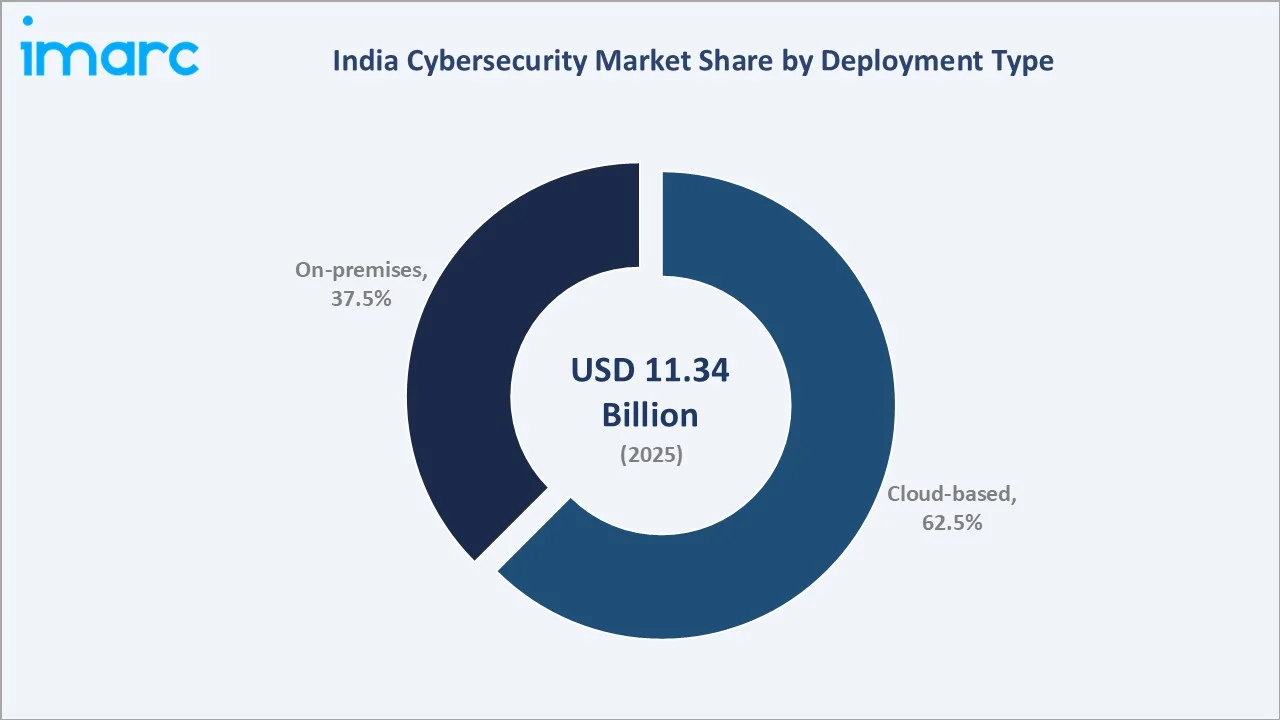
On-premises at 37.5% retains significant share through data sovereignty requirements of banking, defense, and government sectors. Regulatory mandates requiring sensitive data to remain within controlled environments sustain on-premises deployment across critical infrastructure operators and regulated industries with strict data residency requirements.
Regional Market Insights
|
Region |
Share (2025) |
Key India Cybersecurity Market Drivers & Characteristics |
|
South India |
35.6% |
Driven by Bengaluru's IT/ITeS concentration, highest enterprise cybersecurity maturity, and presence of global technology company security operations centers. |
|
West & Central India |
29.4% |
Driven by Mumbai's BFSI sector cybersecurity dominance, Pune's manufacturing IT security demand, and increasing fintech cybersecurity investment. |
|
North India |
24.1% |
Driven by Delhi NCR's government and defense cybersecurity spending, startup ecosystem growth, and BFSI digital transformation security investment. |
|
East India |
10.9% |
Supported by Kolkata's expanding IT sector, government digital services cybersecurity, and increasing e-commerce and fintech security investment. |
South India's 35.6% market leadership is anchored by Bengaluru's dual position as India's technology capital and the highest-density concentration of cybersecurity operations centers, threat intelligence teams, and security startups. West & Central India's 29.4% reflects Mumbai's BFSI sector cybersecurity investment as India's financial capital hosting major banks and insurance companies.
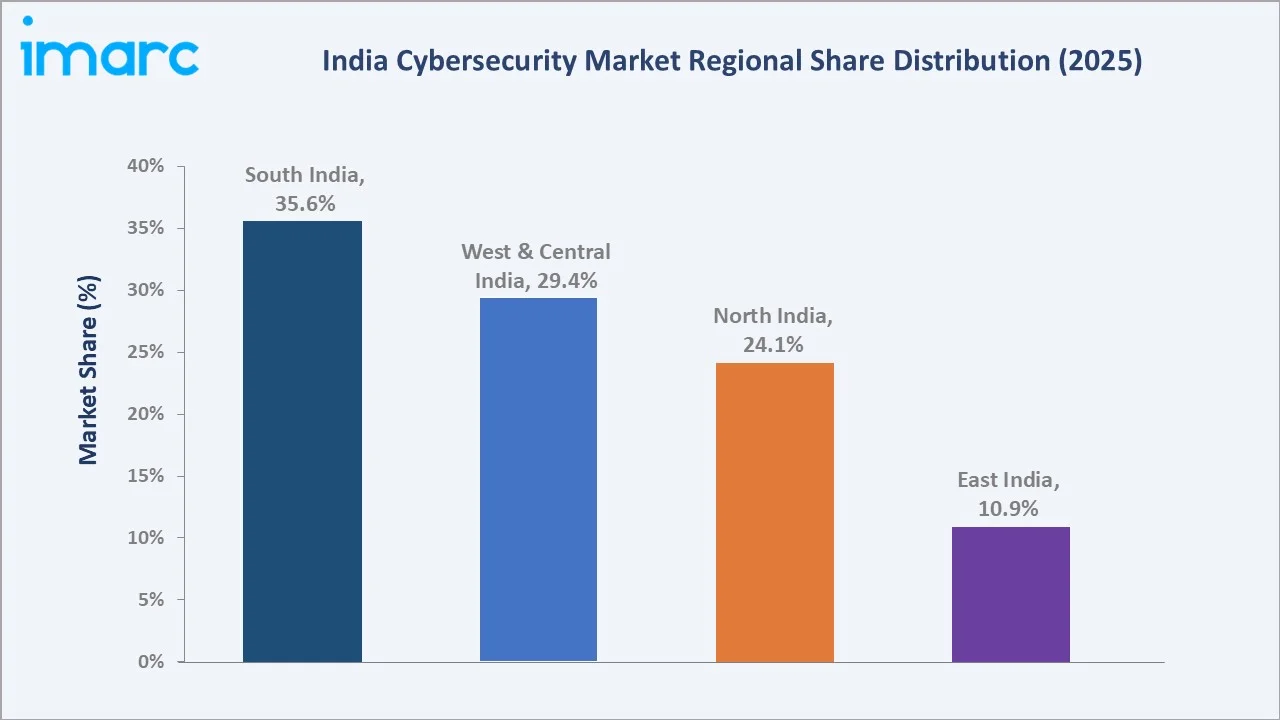
North India's 24.1% reflects Delhi NCR's government digitalization programmes and defense cybersecurity mandates. East India at 10.9% is the highest growth potential region as Kolkata and emerging technology hubs scale digital infrastructure investment and cybersecurity awareness increases.
Competitive Landscape
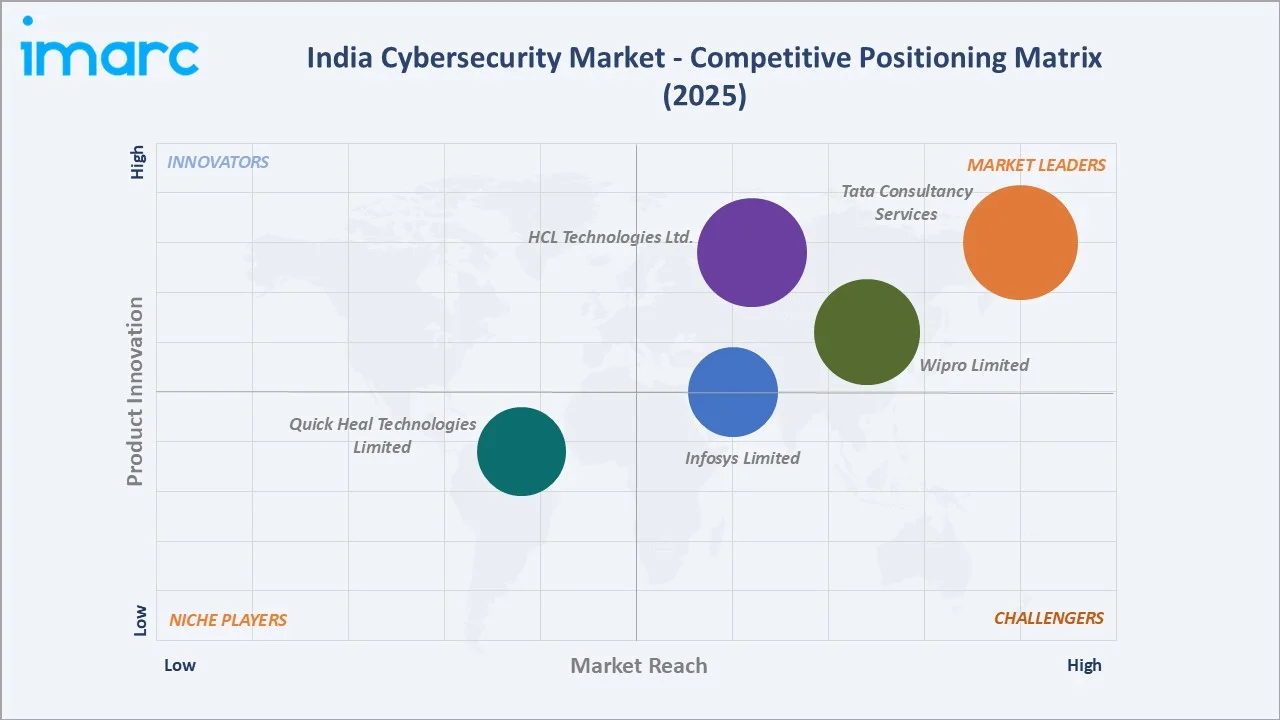
The India cybersecurity market competitive landscape encompasses distinct tiers: domestic IT services majors, global cybersecurity product vendors, Indian security product companies, and managed security service providers serving enterprise, government, and SME segments.
|
Company Name |
Key Products |
Market Position |
Core Strength |
|
Tata Consultancy Services Limited |
Cyber Defense Suite, AI Threat Intelligence |
Market Leader |
End-to-end cybersecurity integration within large-scale digital transformation programmes for Fortune 500 clients globally. |
|
Infosys Limited |
Infosys Cyber Next, Threat Intelligence Platform, IAM Solutions |
Market Leader |
AI-driven cybersecurity transformation with advanced analytics and global delivery capability across regulated industries. |
|
Wipro Limited |
CyberTransform Platform, MDR Service, |
Market Leader |
Managed detection and response leadership with 24x7 global SOC operations and strong BFSI sector penetration. |
|
HCL Technologies Limited |
HCLTech Cybersecurity Services, DRYiCE Security, |
Market Leader |
Integrated OT/IT security convergence and strong manufacturing sector cybersecurity expertise and global delivery. |
|
Quick Heal Technologies Limited |
Seqrite Enterprise Security, Endpoint Detection & Response |
Established Player |
India's leading domestic endpoint security and enterprise threat management platform with deep SME market penetration. |
Indian IT services majors leverage deep enterprise relationships and global delivery models to provide integrated cybersecurity services. Domestic security companies like Quick Heal Technologies and eSec Forte serve SME and government segments with India-specific threat intelligence and affordable managed security services.
Key Company Profiles
Tata Consultancy Services Limited
Tata Consultancy Services is India's largest IT services company and a leading provider of cybersecurity services globally. TCS delivers end-to-end cybersecurity solutions through its Cyber Defense Suite, integrating AI-powered threat intelligence, managed SOC, identity security, and cloud security services across enterprise and government clients.
- Key Products: Cyber Defense Suite, AI Threat Intelligence Platform, Managed SOC, IAM Solutions, Cloud Security Services.
- Recent Developments: In May 2026, TCS expanded its cybersecurity portfolio through an enhanced partnership with Google Cloud, introducing AI-driven cybersecurity solutions, including the TCS Agentic AI Cyber Defense platform. The new offerings leverage agentic AI to automate threat detection, incident response, security operations, and cyber resilience for enterprise customers, helping organizations strengthen defenses against increasingly sophisticated cyber threats while accelerating secure AI adoption.
- Strategic Focus: Focused on AI-integrated cybersecurity transformation, managed detection and response services, and enterprise Zero Trust architecture implementation across regulated industries globally.
Wipro Limited
Wipro is a major global IT services provider with a dedicated cybersecurity practice offering managed detection and response, cloud security, and cybersecurity consulting. Wipro's 24x7 global SOC network serves enterprises across BFSI, healthcare, manufacturing, and government sectors worldwide.
- Key Products: CyberTransform Platform, Managed Detection & Response Service, Cloud Security Portfolio, Cybersecurity Consulting, Vulnerability Management.
- Recent Developments: In June 2026, Wipro Limited partnered with Recorded Future to strengthen AI-powered cybersecurity and threat intelligence services for global enterprises. The collaboration introduced a Managed Threat Intelligence and Brand Monitoring service within Wipro's CyberShield managed security portfolio, combining AI-driven threat intelligence, proactive threat hunting, digital risk protection, and brand monitoring to help organizations detect, prioritize, and respond to cyber threats more effectively at scale.
- Strategic Focus: Centered on managed security services expansion, cloud security transformation, and building AI-augmented SOC capabilities for enterprise clients across regulated industries globally.
Quick Heal Technologies Limited
Quick Heal Technologies is India's leading domestic cybersecurity company, serving enterprise and SME markets through its Seqrite enterprise security platform. Quick Heal provides endpoint security, threat intelligence, and enterprise security management with India-specific threat intelligence and localized support.
- Key Products: Seqrite Endpoint Security Cloud, Seqrite Unified Threat Management, Seqrite Data Loss Prevention, Seqrite Endpoint Detection & Response.
- Recent Developments: In May 2026, Quick Heal Technologies Limited, through its enterprise cybersecurity arm Seqrite, partnered with JISA Softech to deliver integrated, DPDP-ready cybersecurity and data privacy solutions for Indian enterprises. The collaboration combines Seqrite's cybersecurity platform with JISA's encryption and tokenization technologies, enabling organizations to strengthen cyber resilience while simplifying compliance with India's Digital Personal Data Protection (DPDP) Act and evolving data protection regulations.
- Strategic Focus: Focused on expanding enterprise security platform capabilities, deepening SME market penetration across India, and building India-specific threat intelligence relevant to domestic attack patterns and compliance requirements.
Market Concentration Analysis
The India cybersecurity market is moderately fragmented at the services and solutions tiers. Domestic IT majors (TCS, Infosys, Wipro, HCLTech) collectively command significant managed security services revenue through enterprise relationships. Global product vendors (Cisco, Palo Alto Networks, Fortinet) lead in network security and advanced platform categories. Market concentration is increasing at the platform tier through M&A and partnership-driven ecosystem consolidation.
Investment & Growth Opportunities
Highest Growth Segments
Cloud-based security (~18.2% CAGR), managed security services (~16.8% CAGR), AI-powered threat detection platforms (~22% CAGR from growing base), DPDPA compliance solutions (~20% CAGR), OT/ICS security (~25% CAGR from small base), and Zero Trust Network Access (~19% CAGR) represent the highest-growth India cybersecurity investment vectors through 2034.
Emerging Investment Opportunities
DPDPA compliance-as-a-service for SME markets represents the largest near-term India cybersecurity opportunity. Security platform vendors establishing automated compliance frameworks integrated with data discovery, classification, and breach notification capabilities are positioned for above-market revenue growth as DPDPA enforcement scales across all sectors.
Investment Themes
- AI-native cybersecurity platform development for Indian enterprise subscription revenue: AI-integrated security platforms achieving 30-40% reduction in mean-time-to-detect create measurable ROI that justifies premium pricing. Cloud-based AI security subscription models create recurring revenue streams as enterprise security platform consolidation accelerates through 2034.
- Managed SOC services for mid-market and SME DPDPA compliance: India's 63 million SME base represents an underserved cybersecurity market where DPDPA enforcement creates structured demand. Affordable SOC-as-a-Service providers delivering compliance-integrated monitoring at sub-USD 1,000 per month are positioned to capture this mass-market opportunity.
Future Market Outlook (2026-2034)
The India cybersecurity market is projected to grow from USD 11.34 Billion in 2025 to USD 44.04 Billion by 2034, delivering a 15.46% CAGR over the forecast period. The market's anchor value of USD 22.10 Billion in 2030 represents India's cybersecurity industry at a structural inflection point where AI threat detection achieves mainstream commercial deployment replacing conventional security management.
Three structural forces define India cybersecurity market growth through 2034. Regulatory enforcement as a policy imperative across DPDPA, CERT-In mandates, and sector-specific regulations creates government-backed cybersecurity investment demand that is policy-mandated and budget-committed. Digital transformation creates expanding attack surfaces across UPI payments, cloud workloads, and IoT deployments, increasing cybersecurity's value proposition as the only risk management system providing comprehensive digital resilience. Technology cost reduction through cloud delivery models is making enterprise-grade cybersecurity commercially accessible to mid-market and SME segments for the first time.
Research Methodology
Primary Research
Primary research comprised structured interviews with 50+ industry stakeholders (2025) including Chief Information Security Officers; Security Operations Center Directors; managed security service provider CEOs; enterprise procurement heads; and regional cybersecurity market specialists covering all four Indian regions.
Secondary Research
Secondary research encompassed CERT-In annual cybersecurity reports; NASSCOM cybersecurity market data; DPDPA regulatory filings; company annual reports; industry association publications; and government cybersecurity investment disclosures. Over 60 secondary sources reviewed across domestic and international publications.
Forecasting Models
Market revenue forecasts developed using a segment bottom-up model: (i) solutions component; (ii) services component; (iii) deployment mode overlay; (iv) regional calibration. Top-down validation using national digital economy growth correlations and regulatory compliance investment mandates.
India Cybersecurity Market Report Scope:
| Report Features | Details |
|---|---|
| Base Year of the Analysis | 2025 |
| Historical Period | 2020-2025 |
| Forecast Period | 2026-2034 |
| Units | Billion USD |
| Scope of the Report | Exploration of Historical and Forecast Trends, Industry Catalysts and Challenges, Segment-Wise Historical and Predictive Market Assessment:
|
| Components Covered |
|
| Deployment Types Covered | Cloud-Based, On-Premises |
| User Types Covered | Large Enterprises, Small and Medium Enterprises |
| Industry Verticals Covered | IT and Telecom, Retail, BFSI, Healthcare, Defense/Government, Manufacturing, Energy, Others |
| Regions Covered | South India, North India, West and Central India, East India |
| Companies Covered | Tata Consultancy Services Limited, Infosys Limited, Wipro Limited, HCL Technologies Limited, Quick Heal Technologies Limited, etc. |
| Customization Scope | 10% Free Customization |
| Post-Sale Analyst Support | 10-12 Weeks |
| Delivery Format | PDF and Excel through Email (We can also provide the editable version of the report in PPT/Word format on special request) |
Key Benefits for Stakeholders:
- IMARC’s report offers a comprehensive quantitative analysis of various market segments, historical and current market trends, market forecasts, and dynamics of the India cybersecurity market from 2020-2034.
- The research study provides the latest information on the market drivers, challenges, and opportunities in the India cybersecurity market.
- Porter's five forces analysis assist stakeholders in assessing the impact of new entrants, competitive rivalry, supplier power, buyer power, and the threat of substitution. It helps stakeholders to analyze the level of competition within the India cybersecurity industry and its attractiveness.
- Competitive landscape allows stakeholders to understand their competitive environment and provides an insight into the current positions of key players in the market.
Frequently Asked Questions About the India Cybersecurity Market Report
The India cybersecurity market reached USD 11.34 Billion in 2025. The market is driven by rising cyber threats, rapid digital transformation, government digitalization programmes, and regulatory compliance requirements under the Digital Personal Data Protection Act. Enterprise adoption of cloud security, identity management, and managed detection and response platforms is accelerating growth across all market segments.
The market grows at 15.46% CAGR during 2026-2034, reaching USD 44.04 Billion by 2034. Cloud-based deployment grows fastest at ~18.2% CAGR through enterprise migration to cloud-native security platforms. AI-powered threat detection platforms grow at ~22% CAGR from expanding base as organizations automate security operations.
Solutions lead at 68.7% through enterprise demand for integrated security platforms covering identity and access management, infrastructure security, governance risk and compliance, data security and privacy service offering, and unified vulnerability management service offering. Managed services are the fastest-growing services sub-segment.
Cloud-based deployment leads at 62.5% through rapid enterprise cloud migration, preference for scalable subscription-based security models, and availability of cloud-native security platforms enabling faster deployment and continuous updates across distributed enterprise environments.
South India leads at 35.6% through Bengaluru's concentration of IT/ITeS enterprises, global technology companies, and cybersecurity-focused startups and security operations centers. The region has the highest enterprise security maturity in India.
Leading companies include Tata Consultancy Services Limited, Infosys Limited, Wipro Limited, HCL Technologies Limited, and Quick Heal Technologies Limited, among others listed in the report.
The market is projected to reach approximately USD 23.26 Billion by 2030, with AI-integrated security operations achieving mainstream enterprise adoption, DPDPA compliance programmes fully operational across regulated industries, and managed SOC services penetrating mid-market and SME segments.
Need more help?
- Speak to our experienced analysts for insights on the current market scenarios.
- Include additional segments and countries to customize the report as per your requirement.
- Gain an unparalleled competitive advantage in your domain by understanding how to utilize the report and positively impacting your operations and revenue.
- For further assistance, please connect with our analysts.
 Request Customization
 Speak to an Analyst
 Request Brochure
 Inquire Before Buying
Benefits of Customization
- Personalize this research
- Triangulate with your data
- Get data as per your format and definition
- Gain a deeper dive into a specific application, geography, customer, or competitor
- Any level of personalization
Get in Touch With Us
UNITED STATES
Phone: +1-201-971-6302
INDIA
Phone: +91-120-433-0800
UNITED KINGDOM
Phone: +44-753-714-6104
Email: [email protected]
Client Testimonials




.webp)




.webp)













Related Reports

Choose your plan
*Please note that the prices mentioned below are starting prices for each bundle type. Kindly contact our team for further details.*
Single User License
- 1 User License, Access on 2 Devices
- PDF Report + Excel Dataset (Password Protected)
- Lifetime Access
- No Printing Rights
- 10% Free Report Customization
- 10–12 Weeks of Analyst Support
Five User License
- Access for 5 Users, 2 Devices per User
- PDF Report + Excel Dataset (Password Protected)
- Lifetime Access
- Dedicated Account Manager
- 12–14 Weeks of Analyst Support
- No Printing Rights
- 15% Free Report Customization
- 25% Discount on Your Next Purchase
Corporate User License
- Unlimited User Access (Within Your Organization)
- PDF Report + Excel Dataset
- Lifetime Access
- Dedicated Account Manager
- 14–20 Weeks of Analyst Support
- No Printing Rights
- 20% Free Report Customization
- 30% Discount on Your Next Purchase
Essential Insights
What's included:
3 reports
- Lifetime Access
- PDF Reports
- Excel Datasets
- 2 Weeks of Free Analyst Support
- 2 User Licenses
- Access on 2 Devices
- Printing Rights
- Complimentary PowerPoint (PPT) Version
- Complimentary License Upgrade
Professional Access
What's included:
5 reports
- Lifetime Access
- PDF Reports
- Excel Datasets
- 8 Weeks of Free Analyst Support
- 2 User Licenses
- Access on 2 Devices
- Printing Rights
- Complimentary PowerPoint (PPT) Version
- Complimentary License Upgrade
Business Advantage
What's included:
8 reports
- Lifetime Access
- PDF Reports
- Excel Datasets
- 14 Weeks of Free Analyst Support
- 2 User Licenses
- Access on 2 Devices
- Printing Rights
- Complimentary PowerPoint (PPT) Version
- Complimentary License Upgrade
Enterprise Intelligence
What's included:
10 reports
- Lifetime Access
- PDF Reports
- Excel Datasets
- 20 Weeks of Free Analyst Support
- 2 User Licenses
- Access on 2 Devices
- Printing Rights
- Complimentary PowerPoint (PPT) Version
- Complimentary License Upgrade