
India Docking Station Market Size, Share, Trends and Forecast by Type, Technology, Application, Distribution Channel, and Region, 2026-2034
India Docking Station Market Size, Share, Trends & Forecast (2026-2034)
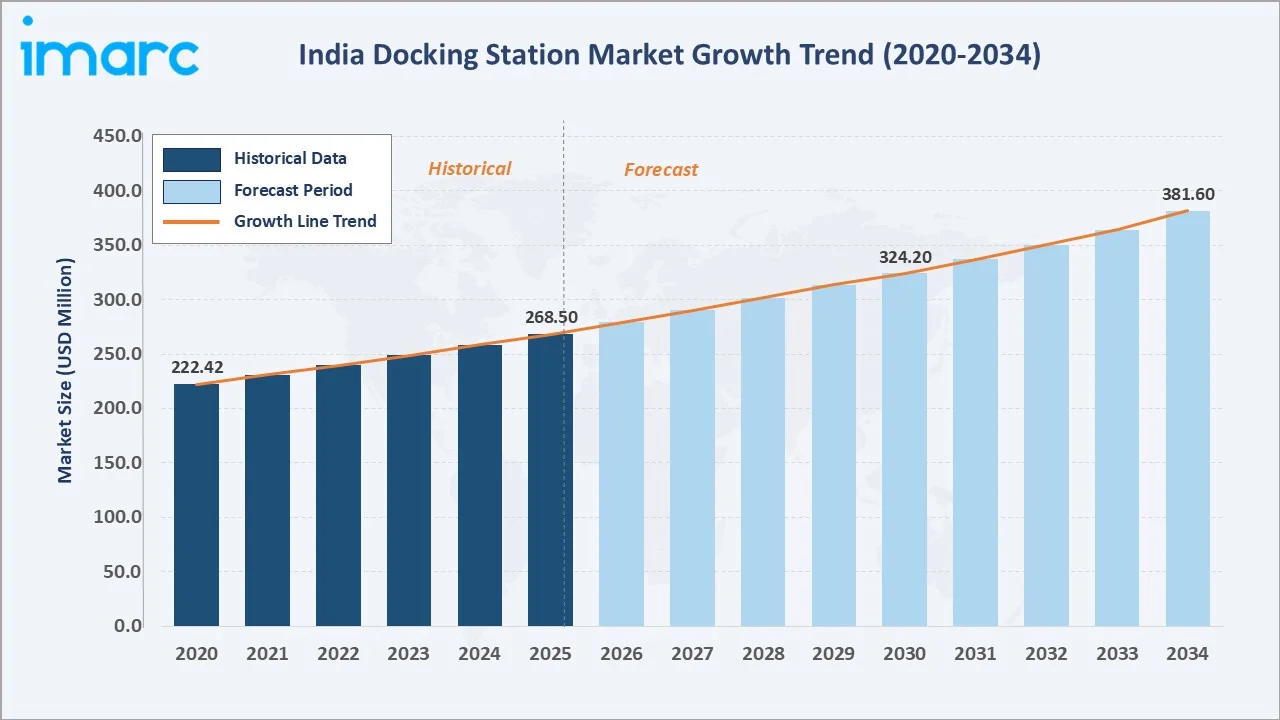
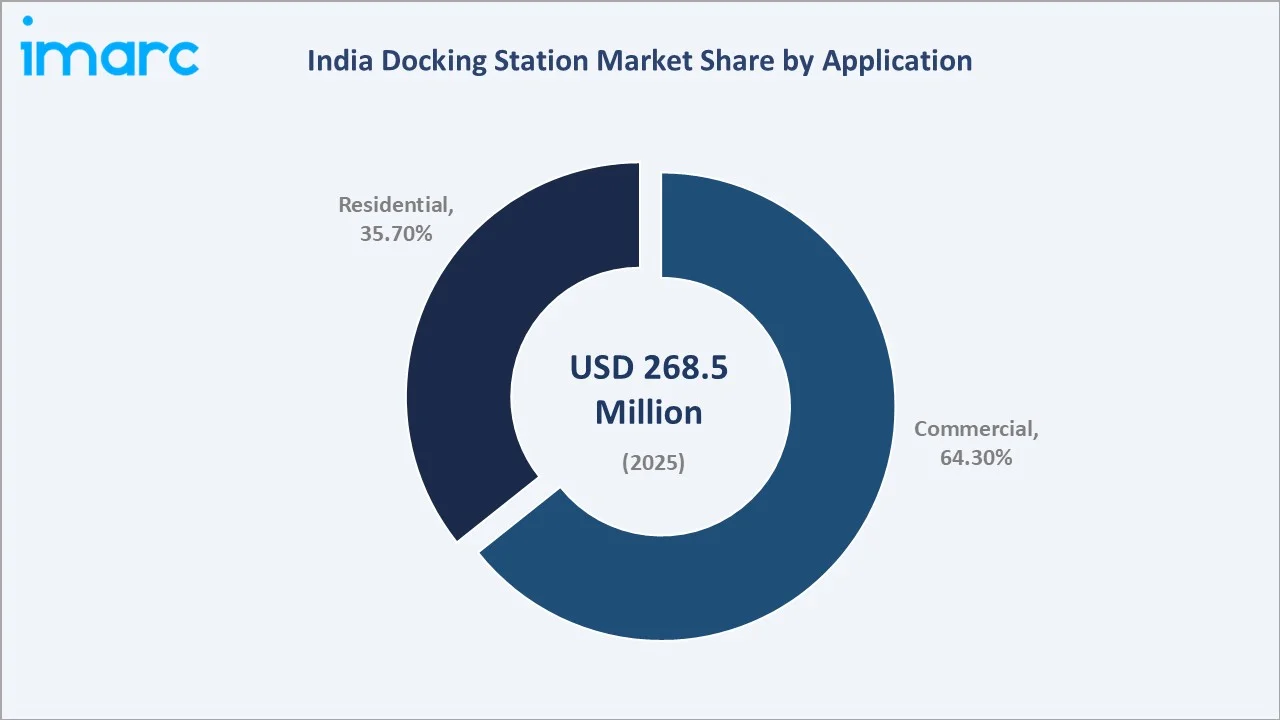
The India docking station market was valued at USD 268.50 Million in 2025 and is projected to reach USD 381.60 Million by 2034, expanding at a CAGR of 3.84% during the forecast period (2026-2034). Growth is driven by the rapid adoption of electronic gadgets, with 85.5% of Indian households having at least one smartphone, mobile phones, rising preference for hybrid work models, India’s expanding IT/ITES sector, rising multi-device usage among professionals, and the USB-C/Thunderbolt upgrade cycle in the corporate segment. Commercial applications dominate at 64.3% of market share (2025), while offline channels lead distribution at 58.4%. North India holds the largest regional share at 36.4%.
Market Snapshot
|
Metric |
Value |
|
Market Size (2025) |
USD 268.50 Million |
|
Forecast Market Size (2034) |
USD 381.60 Million |
|
CAGR (2026-2034) |
3.84% |
|
Base Year |
2025 |
|
Historical Period |
2020-2025 |
|
Forecast Period |
2026-2034 |
|
Largest Region |
North India (36.4%, 2025) |
|
Fastest Growing Region |
South India (CAGR ~4.4%, 2026-2034) |
To get more information on this market, Request Sample
The India docking station market growth expanded from USD 222.42 Million in 2020 to USD 268.50 Million in 2025. Anchored at USD 324.20 Million in 2030, the forecast to USD 381.60 Million, supported by enterprise device refresh cycles and India’s expanding gig and knowledge economy workforce.
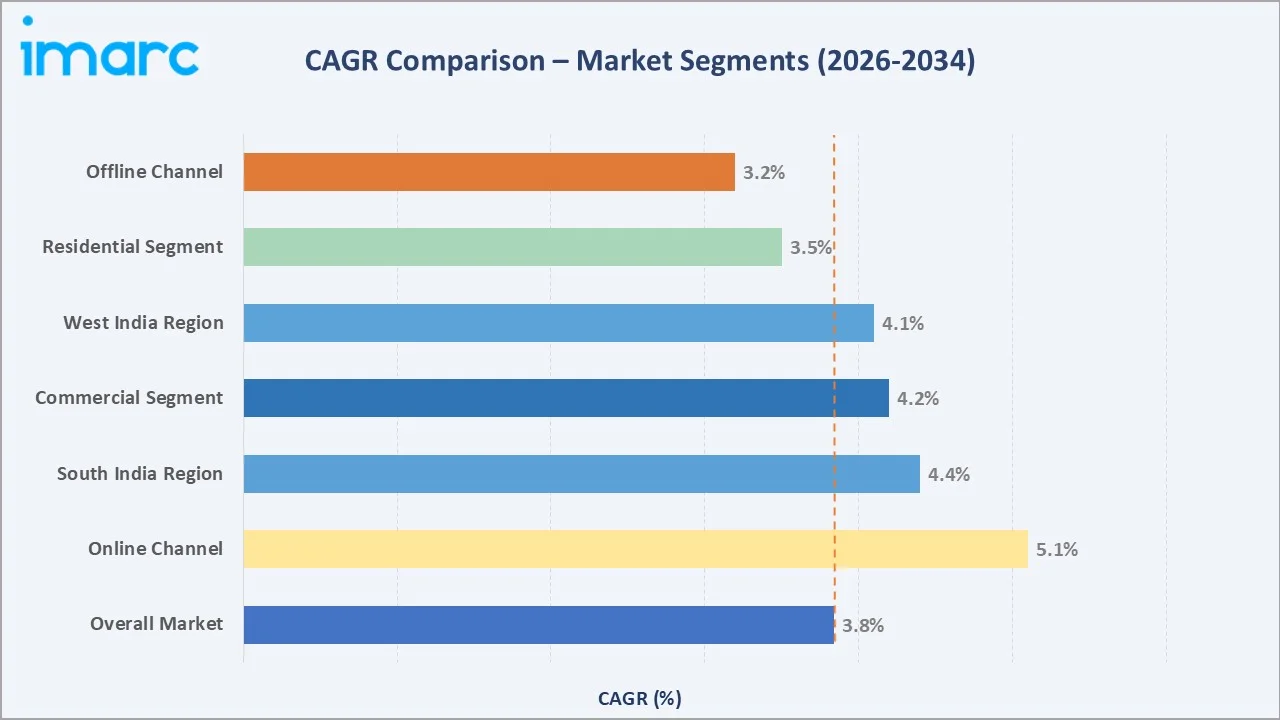
The CAGR across key segments with online distribution channels leads growth at ~5.1% CAGR, reflecting the rapid expansion of e-commerce platforms, including Amazon India and Flipkart. South India at ~4.4% CAGR outpaces the national average of 3.84%, driven by Bengaluru’s IT sector and Hyderabad’s growing tech corridor.
Executive Summary
The India docking station market demonstrated consistent growth from USD 222.42 Million in 2020 to USD 268.50 Million in 2025, driven primarily by the COVID-19-induced shift to hybrid work models that permanently elevated demand for portable workspace enhancement accessories. Docking stations, enabling laptop users to connect multiple monitors, peripherals, Ethernet, and power through a single cable, have become essential productivity infrastructure for India’s 5.4 million knowledge workers in the IT/ITES sectors. The forecast trajectory to USD 381.60 Million by 2034 reflects the structural expansion of India’s digital economy.
Commercial applications at 64.3% (2025) encompass corporate office deployments, coworking spaces, and institutional procurement by India’s IT companies, banks, and government departments, where docking stations are purchased in bulk quantities for corporate clients, creating high-value B2B sales opportunities. Residential at 35.7% represents the growing work-from-home professional segment and student/content creator market purchasing universal docks through Amazon India and Flipkart. The offline distribution channel at 58.4% is dominated by corporate IT procurement and specialist electronics retailers, while online at 41.6% is the fastest-growing channel at ~5.1% CAGR, driven by India’s e-commerce penetration and price transparency on Amazon India and Flipkart.
North India’s 36.4% market dominance reflects Delhi-NCR’s position as India’s largest IT/ITES employment hub. South India, at 28.6%, is powered by Bengaluru’s extraordinary concentration of software development firms, global capability centres (GCCs), and IT multinationals. West India, at 22.4%, is anchored by Mumbai’s BFSI sector IT infrastructure and Pune’s rapidly growing IT/automobile engineering cluster, while East India, at 12.6%, represents an emerging growth market driven by Kolkata’s expanding BPO and IT sectors.
Key Market Insights
|
Insight |
Data |
|
Dominant Application |
Commercial – 64.3% revenue share (2025) |
|
Dominant Distribution Channel |
Offline – 58.4% revenue share (2025) |
|
Leading Region |
North India – 36.4% revenue share (2025) |
|
Fastest Growing Region |
South India (CAGR ~4.4%, 2026-2034) |
Key Analytical Observations Supporting The Above Data:
- Commercial dominates at 64.3% (2025): India’s IT/ITES sector employed 5.4 million professionals, with a large number of employees using laptops as primary computing devices.
- Offline leads at 58.4% but online accelerating: India’s B2B IT procurement ecosystem, dominated by distributors Ingram Micro India, Redington India, and Synnex, channels bulk corporate docking purchases through offline VAR (value-added reseller) networks.
- North India leads at 36.4% (2025): The Noida-Greater Noida electronics manufacturing corridor, home to Samsung, Oppo, and Vivo production facilities, is creating new demand from manufacturing technology staff.
India Docking Station Market Overview
The India docking station market encompasses devices that provide portable computers, primarily laptops and, to a lesser extent, smartphones and tablets, with a fixed set of connections for external monitors, keyboards, mice, Ethernet, storage, and power delivery through a single standardized connection. The ecosystem spans proprietary brand-specific docks and universal docks using USB-C, Thunderbolt 3/4, or USB-A connections that work across brands. India’s docking station market is fundamentally an enterprise and professional productivity accessory category.
Applications include corporate hot-desk deployments, home office setups for hybrid workers, video production and gaming workstations, and educational institution computing labs. Macroeconomic influences include India’s GDP growth, the rapid expansion of GCCs, government’s Digital India initiative driving public sector IT modernisation, and India’s growing 1.3 billion mobile device ecosystem creating secondary dock demand for smartphone productivity use cases.
Market Dynamics
To evaluate market opportunities, Request Sample
Market Drivers
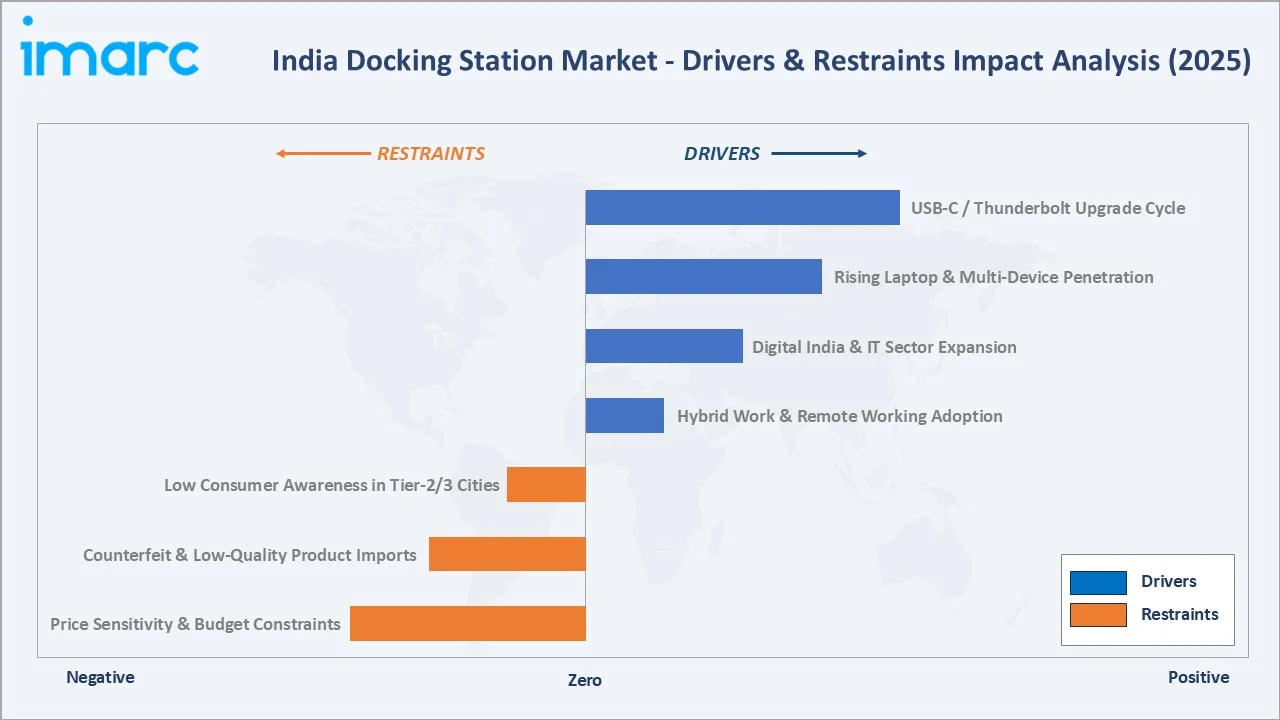
- Hybrid and Remote Work Model Adoption: India’s remote work adoption rate reached 68% among large IT companies, with a standard hybrid worker requiring both an office dock and a home dock, effectively doubling the addressable docking station per-user market versus the pre-COVID 100% office model.
- Digital India and IT Sector Growth: India’s IT industry revenue grew to USD 254 billion in FY2024 (NASSCOM). Each new IT professional joining the workforce represents a docking station demand occasion, with large IT companies providing standard laptop + dock equipment bundles for new hires.
- Rising Laptop Penetration and Multi-Device Usage: The average urban professional in India uses computing devices simultaneously, a laptop, smartphone, and tablet, creating natural docking station demand for unified peripheral management.
- USB-C/Thunderbolt Technology Upgrade Cycle: The global standardization on USB-C and Thunderbolt 3/4 as the universal docking interface is triggering a systematic replacement cycle in India’s corporate laptop fleet.
Market Restraints
- Price Sensitivity in India’s Value-Conscious Market: India’s median IT professional salary of INR 6–8 lakh/year creates a price ceiling for self-purchased docking accessories, with most consumer purchases concentrated in the INR 1,500–6,000 range for basic USB-C hubs versus INR 12,000–45,000 for full-featured Thunderbolt 4 docks.
- Counterfeit and Sub-Standard Imports: India’s e-commerce marketplaces, particularly Amazon India’s third-party seller network and Flipkart’s marketplace, host a substantial volume of uncertified, non-BIS-compliant USB-C hubs and docking stations from unauthorized Chinese manufacturers.
Market Opportunities
- GCC (Global Capability Centre) Expansion as Premium Dock Demand Driver: As talent converges with technology, India's enterprise solutions landscape is evolving, with more than 1,700 Global Capability Centers (GCCs) now in operation. In the last five years alone, over 400 new GCCs and 1,100 additional units have been established.
- India Smartphone + Laptop Convergence for Productivity: Premium Android users, Samsung Galaxy S25 Ultra and Google Pixel 9 Pro buyers, represent an emerging segment for compact USB-C travel docks.
- PLI-Linked Domestic Manufacturing for Cost Advantage: The PLI IT Hardware scheme offers 4% to 6% cash incentive on incremental net sales for eligible manufacturers, creating a compelling opportunity for Indian electronics brands to establish India-assembled docking station production.
Market Challenges
- USB-C Hub vs. Docking Station Perception Confusion: India’s consumer market conflates USB-C hubs with full-featured docking stations, creating a pricing perception problem where consumers undervalue true docking stations.
- Import Dependence and Currency Risk: India’s docking station market relies on imported products, creating significant exposure to INR/USD exchange rate volatility and import duty changes.
Emerging Market Trends
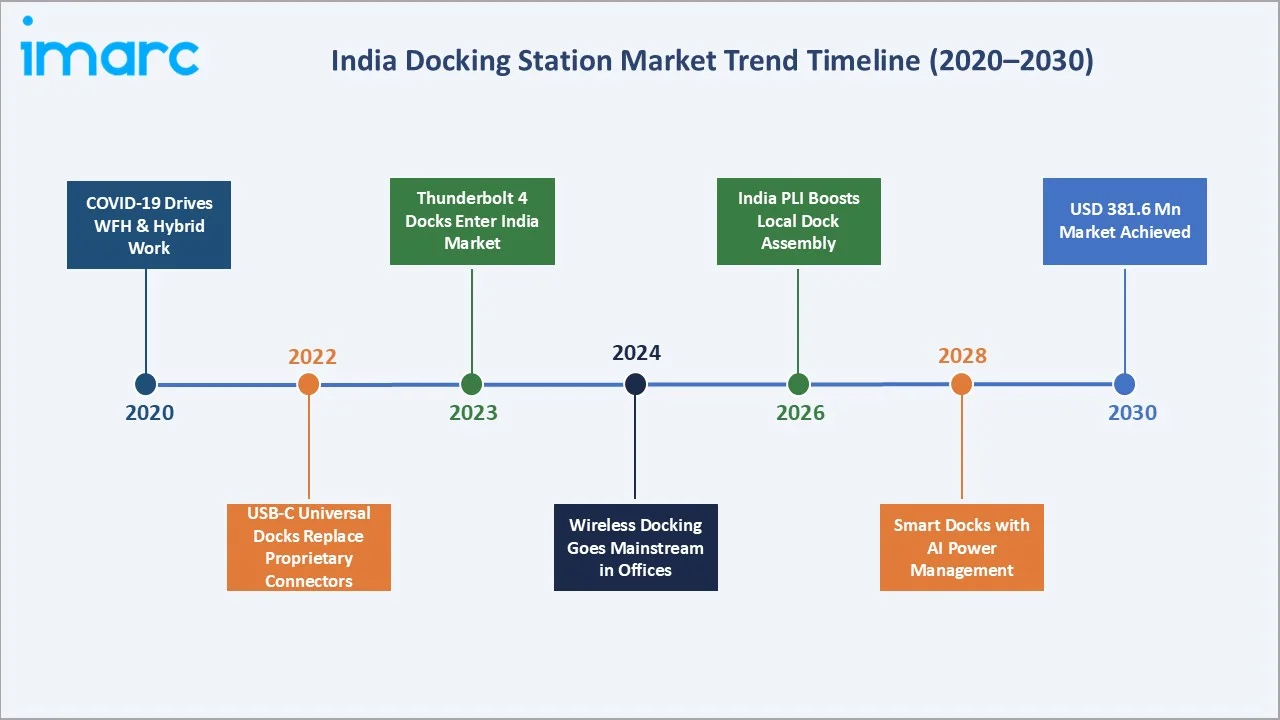
1. Thunderbolt 4 and USB4 Universal Dock Standardization
The consolidation around Thunderbolt 4 and the USB4 standard, offering 40Gbps bandwidth, 100W power delivery, and dual 4K display support in a single USB-C cable, is eliminating the proprietary dock market that previously existed for Dell, HP, and Lenovo.
2. Multi-Monitor and 4K/8K Display Proliferation
India’s corporate office environment is witnessing rapid migration from single 1080p displays to dual or triple 4K monitor setups, driven by productivity research demonstrating efficiency gains from expanded display real estate for software development, data analysis, and financial modelling tasks.
3. Smart Dock with Integrated KVM and Meeting Room Intelligence
The next generation of enterprise docking stations integrates KVM (Keyboard-Video-Mouse) switching for shared workstation environments, AI-powered meeting room management (automatic device wake, display activation when presence is detected), and zero-touch IT provisioning.
4. Compact Travel Docks for India’s Mobile Professional Segment
In India, business travel spending stood at an USD 38.3 billion in 2024, driving demand for pocket-sized USB-C travel docks that convert any hotel TV or HDMI display into a dual-monitor workstation.
Industry Value Chain Analysis
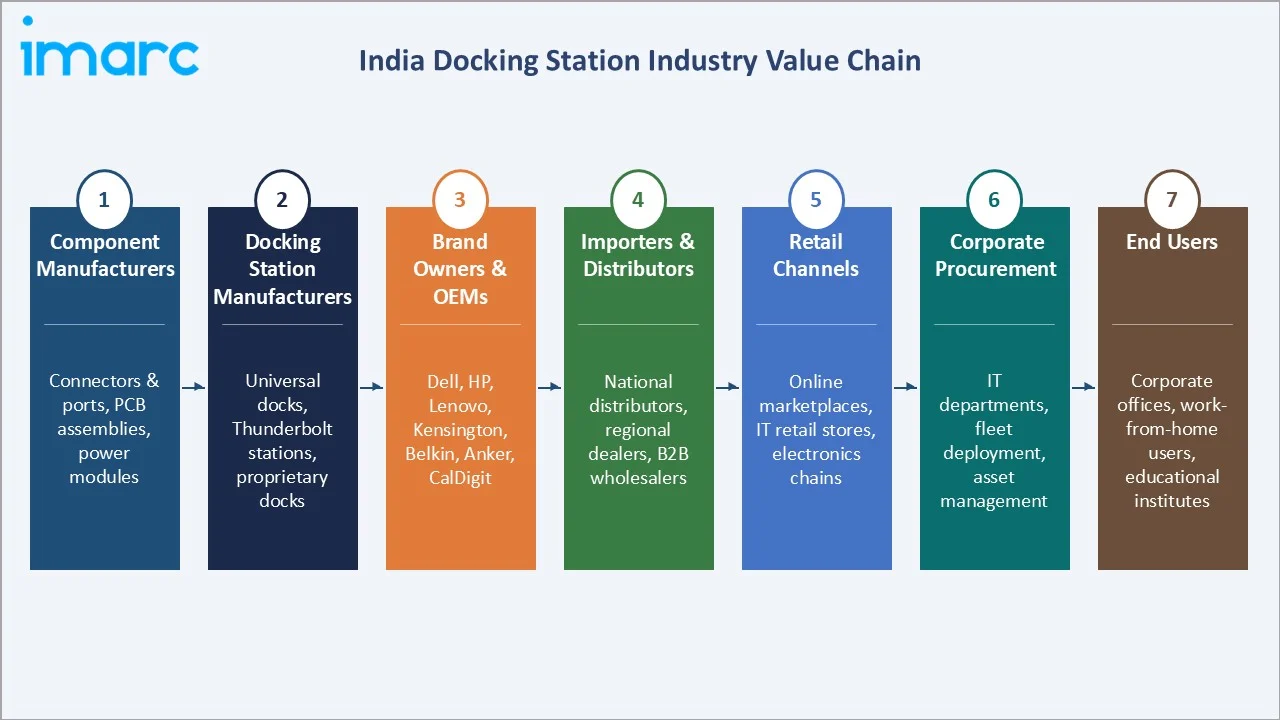
The India docking station value chain spans semiconductor IP and component manufacturing (primarily outside India) through product assembly, import, distribution, and retail to end corporate and consumer buyers across the country’s four major regions.
|
Stage |
Key Participants |
|
Components & Semiconductor ICs |
USB hub controllers, video bridge chips, power delivery ICs |
|
Docking Station Manufacturing |
Global OEM factories in China, Taiwan, Vietnam, producing docking hardware; local India PLI-eligible assembly units in Noida, Chennai, Pune |
|
Import & Distribution |
Electronics importers, B2B IT distributors, grey market imports through small traders |
|
Retail & B2B Sales Channels |
Croma, Reliance Digital, Vijay Sales (offline); Amazon India, Flipkart (online); direct corporate IT procurement |
|
End-Use Consumers |
Corporate IT departments, software/IT services companies, SME offices, work-from-home professionals, content creators, gamers |
The brand owner layer captures the highest margins in the docking station value chain, charging 40–60% premiums over comparable-spec third-party docks by leveraging proprietary driver integration and corporate IT support bundles. Distributors collectively handle approximately 65-70% of India’s B2B docking station sales volume, earning 8–12% distributor margins on a category that is procurement-efficient for their existing IT reseller channel networks.
Technology Landscape in the India Docking Station Industry
USB-C Power Delivery and DisplayPort Alternate Mode
Modern USB-C docking stations leverage the Power Delivery (PD) 3.1 standard, supporting up to 240W charging through a single cable, and DisplayPort Alternate Mode (DP Alt Mode) to enable single-cable docking connections carrying video, data, and power simultaneously.
Thunderbolt 4 and Intel’s Titan Ridge Controller
Intel’s Thunderbolt 4 certification provides the highest performance docking standard available in India’s market, offering 40Gbps bidirectional bandwidth, dual 4K display support, 100W power delivery, and daisy-chaining up to six Thunderbolt devices.
Wireless Docking and WiGig Technology
Intel WiGig, also referred to as Intel Wireless Gigabit, is a wireless technology that operates on the 60 GHz band, providing ultra-fast, seamless wireless communication with speeds of up to 7 Gbps. The technology achieves 1–2 Gbps wireless throughput at sub-10ms latency, sufficient for single 4K display wireless docking but not yet competitive with wired Thunderbolt 4 for multi-4K configurations.
Market Segmentation Analysis
The report covers the following segments:
|
Segment Category |
Leading Segment |
Market Share |
Year |
|
Type |
🔒 |
🔒 |
2025 |
|
Technology |
🔒 |
🔒 |
2025 |
|
Application |
Commercial |
64.3% |
2025 |
|
Distribution Channel |
Offline |
58.4% |
2025 |
|
Region |
North India |
36.4% |
2025 |

By Application
To access detailed market analysis, Request Sample
Commercial applications dominate at 64.3% market share (2025). This segment encompasses enterprise IT procurement by India’s 5.4 million IT/ITES employees, banking and financial services institutions, government departments, and educational institutions. Dell, HP, and Lenovo’s proprietary dock ecosystems are the primary beneficiaries of commercial demand.
Residential at 35.7% encompasses work-from-home professionals, students, content creators, and PC gamers. As of 2024, 12.7% of full-time employees in India work from home, while 28.2% work a hybrid model, as India’s hybrid work normalisation permanently expands the home office accessory market.
By Distribution Channel
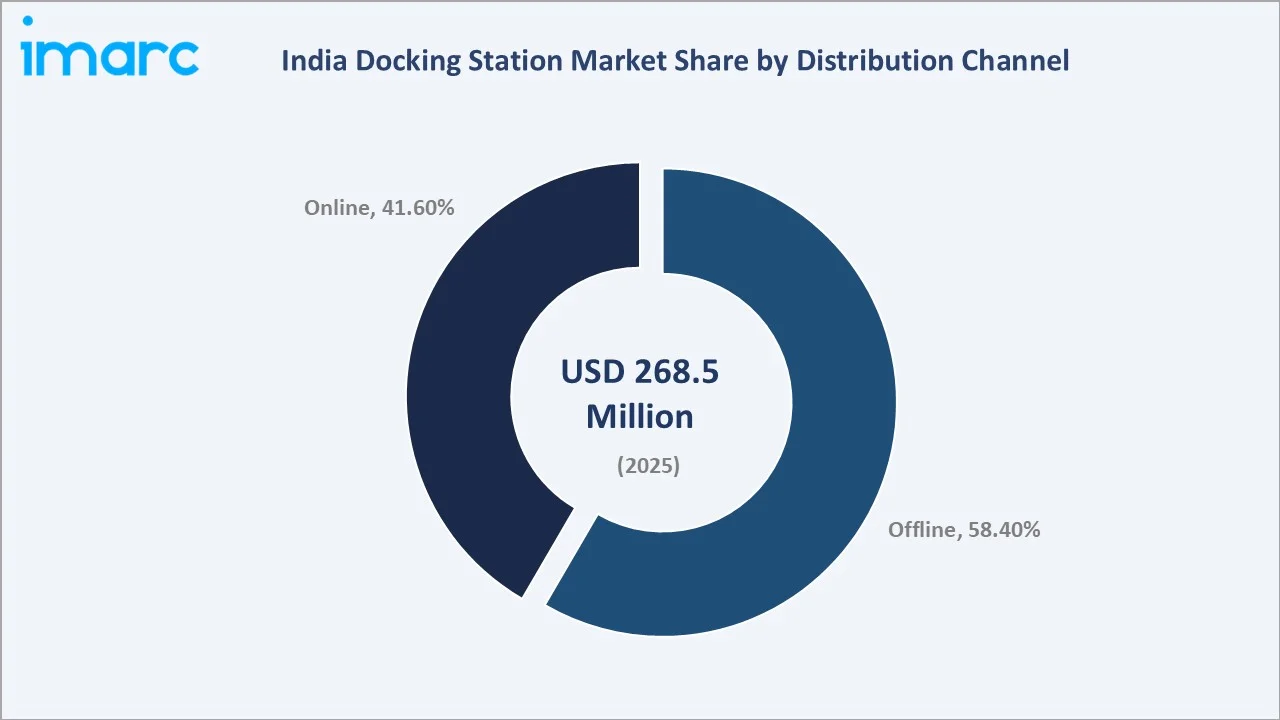
Offline channels lead at 58.4%, encompassing three distinct sub-channels: B2B IT distributors handling bulk enterprise procurement; specialist electronics retail chains in Tier-1 cities; and corporate direct sales through Dell India and HP India enterprise account teams. The offline channel’s dominance reflects the enterprise procurement model’s preference for relationship-based purchasing with warranty and service commitments that online platforms cannot easily replicate.
Online channels at 41.6% are growing at ~5.1% CAGR, the fastest channel segment, driven by Amazon India’s best-seller algorithm, Flipkart’s electronics category expansion, and the brand discovery advantage that e-commerce platforms provide for international brands that lack India physical retail presence.
Regional Market Insights
|
Region |
Share (2025) |
Key Growth Drivers |
|
North India |
36.4% |
Delhi-NCR IT/ITES hub, large government IT procurement, PLI electronics manufacturing in Noida |
|
South India |
28.6% |
Bengaluru as India’s Silicon Valley, Chennai IT corridor, Hyderabad HITEC City, semiconductor and electronics manufacturing |
|
West India |
22.4% |
Mumbai BFSI sector IT infrastructure, Pune IT/automobile industry, Ahmedabad GCC (Global Capability Centre) growth |
|
East India |
12.6% |
Kolkata IT/ITES parks, Bhubaneswar smart city IT development, growing BPO sector, government digital transformation programs |
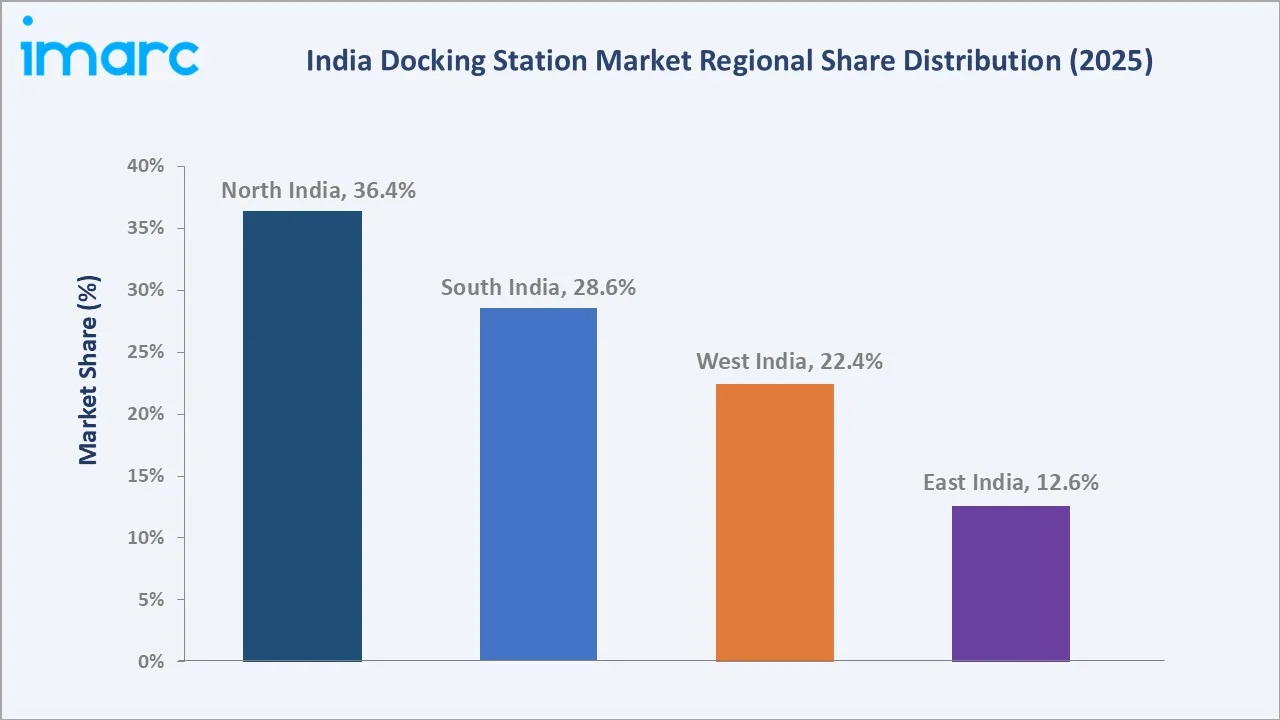
North India’s 36.4% dominance (2025) reflects the extraordinary concentration of technology sector employment in the Delhi-NCR corridor, home to Gurugram’s “Millennium City” IT hub, Noida’s IT SEZ, and central government IT departments in Delhi and NDMC precincts.
South India, at 28.6%, is driven by Bengaluru’s extraordinary GCC density, with above-average laptop-to-dock adoption rates. Hyderabad’s HITEC City and Chennai’s OMR corridor add substantial regional volume. West India’s 22.4% share (2025) is anchored by Mumbai’s BFSI sector and Pune’s growing IT, engineering, and automotive technology sector.
Competitive Landscape
The India docking station market is moderately concentrated at the premium/commercial tier and highly fragmented in the value consumer segment. Dell, HP, and Lenovo collectively hold approximately 45–50% of total market revenue by leveraging their corporate laptop bundle sales, where docking station procurement is embedded in laptop configuration decisions.
|
Company Name |
Product Line |
Market Position |
Core Strength |
|
Dell Inc. |
Dell Pro Dock, Dell Pro Smart Dock, Dell Pro Thunderbolt 4 Dock, Dell Pro Thunderbolt 4 Smart Dock, Dell Pro Thunderbolt 5 Dock, Dell Pro Thunderbolt 5 Smart Dock |
Market Leader |
India’s largest laptop brand with deepest docking ecosystem, direct Dell India sales force for B2B docking bundles |
|
HP Development Company, L.P. |
HP USB-C 100W G6 Dock, HP Thunderbolt 4 Ultra 280W G6 Dock, HP Thunderbolt 4 Ultra 180W G6 Dock, HP Thunderbolt Dock 120W G4, HP Thunderbolt 4 100W G6 Dock, HP USB-C Travel Hub G3 |
Market Leader |
HP India B2B channel through Ingram Micro and Redington, HP Thunderbolt G4 Dock widely deployed in India IT/ITES sector |
|
Lenovo |
ThinkPad Thunderbolt 5 Smart Dock (7500), ThinkPad Thunderbolt 4 Smart Dock Gen 2 (7500), ThinkPad USB4 Smart Dock (5500), ThinkPad Hybrid USB-C with USB-A Dock, ThinkPad Universal Thunderbolt 4 Dock, ThinkPad Slim Travel Dock, ThinkPad Universal USB-C Dock, ThinkPad Dual Display Travel Dock |
Strong Challenger |
ThinkPad Universal Thunderbolt 4 Smart Dock, deep India corporate penetration via Lenovo DCG channel, strong presence in Bengaluru, Pune, and Hyderabad MNC deployments |
|
Targus |
Thunderbolt 5 Triple Video 8K EcoSmart Dock with 140W EPR, Dual Video Mobile Dock with 140W EPR Pass-Thru & SD Reader, HyperDrive Flex 9 Port Dual 4K HDMI Dock, HyperDrive Next Business USB-C 10 Ports Docking Station, HyperDrive Thunderbolt 4 Docking Station, USB4 Triple Video Docking Station with 100W Power, HyperDrive 14-Port USB-C Docking Station |
Established |
Business travel and corporate mobility positioning, strong B2B distribution through Redington and IT resellers, recognised brand in India banking and insurance sector |
|
Microsoft |
Surface USB4 Dock, Surface Thunderbolt 4 Dock, Surface Dock 2, Surface Dock |
Established |
Proprietary Surface Connect dock for the Microsoft Surface range, strong in India education and government Surface deployment programs |
The remaining 50–55% is distributed among specialist accessory brands with varying India market positions, plus a long tail of grey-market and unbranded Chinese imports that dominate the consumer hub segment.
Key Company Profiles
Dell Inc.
Dell Inc. is India’s market leader for docking stations, driven by its dominant position in India’s corporate laptop market and the systematic bundling of Dell Thunderbolt docks in enterprise laptop procurement configurations.
- Product Portfolio: Dell Pro Dock, Dell Pro Smart Dock, Dell Pro Thunderbolt 4 Dock, Dell Pro Thunderbolt 4 Smart Dock, Dell Pro Thunderbolt 5 Dock, Dell Pro Thunderbolt 5 Smart Dock.
- Recent Developments: Launched Dell AI PC + WD22TB4 Dock bundle specifically targeting India GCC market; opened Dell Experience Centre in Bengaluru featuring live docking station demonstrations.
- Strategic Focus: Bundled laptop + dock enterprise solution deepening; Dell Direct India for B2B online procurement with volume pricing; AI PC docking ecosystem positioning for 2025–2026 AI PC refresh cycle; service and warranty differentiation through Dell ProSupport India.
HP Development Company, L.P.
HP is India’s second-largest commercial laptop brand and a strong competitor in the enterprise docking station market, with HP Elite docking stations widely deployed across India’s BFSI, government, and IT sectors.
- Product Portfolio: HP USB-C 100W G6 Dock, HP Thunderbolt 4 Ultra 280W G6 Dock, HP Thunderbolt 4 Ultra 180W G6 Dock, HP Thunderbolt Dock 120W G4, HP Thunderbolt 4 100W G6 Dock, HP USB-C Travel Hub G3.
- Recent Developments: HP Amplify Partner Program India expansion to specialist PC partners, HP India sustainability program offering refurbished dock trade-in for corporates.
- Strategic Focus: HP Wolf Security integration in dock-connected enterprise environments; HP Amplify channel ecosystem for India B2B docking sales; BFSI vertical focus in Mumbai and Bengaluru; government sector procurement through GeM (Government e-Marketplace) portal listing.
Lenovo
Lenovo is the world’s #1 PC brand and a formidable competitor in India’s docking station market, with its ThinkPad Universal dock series tightly integrated with the dominant ThinkPad enterprise laptop line that commands strong loyalty among India’s software developers and IT professionals.
- Product Portfolio: ThinkPad Thunderbolt 5 Smart Dock (7500), ThinkPad Thunderbolt 4 Smart Dock Gen 2 (7500), ThinkPad USB4 Smart Dock (5500), ThinkPad Hybrid USB-C with USB-A Dock, ThinkPad Universal Thunderbolt 4 Dock, ThinkPad Slim Travel Dock, ThinkPad Universal USB-C Dock, ThinkPad Dual Display Travel Dock.
- Recent Developments: ThinkPad Universal Thunderbolt 4 Smart Dock launched with AI-powered automatic device recognition and configurable macro buttons.
- Strategic Focus: ThinkPad ecosystem lock-in through Smart Dock deep ThinkPad driver integration; India Puducherry assembly qualifying for PLI benefits; government education procurement through Lenovo India’s STPI channel; AI PC era dock innovation with integrated NPU-powered features.
Targus
Targus is a specialist business productivity brand with deep B2B relationships in India’s BFSI, healthcare, and government sectors, where its corporate dock and laptop security (lock + dock combo) products are recognised as enterprise-grade solutions.
- Product Portfolio: Thunderbolt 5 Triple Video 8K EcoSmart Dock with 140W EPR, Dual Video Mobile Dock with 140W EPR Pass-Thru & SD Reader, HyperDrive Flex 9 Port Dual 4K HDMI Dock, HyperDrive Next Business USB-C 10 Ports Docking Station, HyperDrive Thunderbolt 4 Docking Station, USB4 Triple Video Docking Station with 100W Power, HyperDrive 14-Port USB-C Docking Station.
- Recent Developments: Expanded Targus India channel to IT resellers, Targus India BFSI campaign targeting Mumbai and Delhi banking IT managers with dual 4K dock demonstration program.
- Strategic Focus: BFSI and government vertical depth in India; security lock + dock combo as differentiation vs. pure dock competitors; EcoSmart sustainability positioning for India ESG procurement requirements; IT reseller channel breadth across Tier-1 and Tier-2 Indian cities.
Market Concentration Analysis
The India docking station market exhibits moderate-to-high concentration in the commercial (B2B) segment and high fragmentation in the consumer segment. In the B2B market, Dell, HP, and Lenovo collectively command approximately 45–50% of total market revenue through their proprietary ecosystem advantage, a structural moat created by the deep driver and firmware integration between their laptop lines and matching dock products. The next tier of specialist accessory brands adds approximately 25–30% of total market revenue.
The consumer market segment is highly fragmented, with 50+ brands competing across Amazon India and Flipkart. Uncertified Chinese brands represent an estimated 20–30% of consumer segment units sold, a distortion that suppresses branded manufacturer margins and creates quality perception risk for the overall category. BIS enforcement actions in 2023–2024, removing non-compliant electronics listings from Amazon India and Flipkart, are gradually improving the quality floor in the consumer segment.
Investment & Growth Opportunities
Fastest Growing Segments
Online distribution channel (~5.1% CAGR), Wireless Docking (~8.2% CAGR), and Residential application (~3.5% CAGR) represent the three highest-growth investment vectors through 2034. The Thunderbolt 4/USB4 premium segment is growing at 12–15% annually in India, creating the highest value-per-unit opportunity within the overall market.
Emerging Market Opportunities
India’s Tier-2 IT cities, Coimbatore, Jaipur, Kochi, Indore, Visakhapatnam, are emerging as significant docking station demand centres as IT/ITES companies establish secondary delivery centres outside the primary metros to benefit from lower real estate and talent costs. These cities collectively added a high number of IT jobs and currently represent an underserved market opportunity with below-average docking penetration that will grow to match Tier-1 city adoption rates.
Venture and Strategic Investment Trends
India’s PLI IT Hardware scheme is the primary strategic investment catalyst in India’s docking station market, with eligible domestic manufacturers receiving 4%-6% cash incentives on incremental net sales.
- Key investment themes: Thunderbolt 4/USB4 premium dock brand building, India-assembled USB-C dock PLI manufacturing, online D2C docking brand development, corporate dock-as-a-service subscription models, and smart dock integration with India’s growing smart office ecosystem.
- Distribution channel investment: E-commerce first strategy with Amazon India exclusive launches, Flipkart B2B business marketplace penetration, and GeM portal listing for government procurement are the three highest-return distribution investment channels for new entrants.
- Government procurement opportunity: India’s central and state government digital initiatives (eSanjeevani, UMANG, PM Wani) require extensive laptop + docking infrastructure in government offices – a procurement channel providing volume, long-term contracts, and payment certainty that is underserved by specialist accessory brands today.
Future Market Outlook (2026-2034)
The India docking station market is positioned for steady, structurally supported growth through 2034. From USD 268.5 Million in 2025, the market is forecast to reach USD 381.6 Million by 2034, at a 3.84% CAGR. This growth is anchored by three irreversible structural drivers: India’s IT workforce expansion, who represent systematic docking station demand; the hybrid work model’s permanence in India’s IT sector, creating dual-location dock demand per user; and the universal USB-C/Thunderbolt 4 standardisation, creating a predictable 3–5 year corporate dock replacement cycle that generates recurring revenue regardless of macroeconomic cycles.
Between 2026 and 2030, the defining transformations will be the mainstream adoption of wireless docking in India’s premium corporate campus environments, the emergence of India-assembled docking stations under PLI IT Hardware incentives reducing prices by 8–12%, and the South India region’s growth overtaking North India’s absolute revenue contribution as Bengaluru’s GCC sector premium tech professionals with above-average Thunderbolt dock adoption rates. The 2030–2034 period will be defined by AI PC integration, transforming docking station functionality.
Research Methodology
Primary Research
Primary research for this report included structured interviews with 90+ industry stakeholders in 2025, comprising corporate IT procurement managers, channel distributors (Ingram Micro India, Redington India), electronics retail category managers (Croma, Reliance Digital), brand representatives, and independent IT consultants advising India’s GCC sector on workspace technology. Geographic coverage included Delhi-NCR, Bengaluru, Mumbai, Pune, Hyderabad, and Chennai.
Secondary Research
Secondary research encompassed IDC India PC market reports, NASSCOM IT sector workforce data, ICEA (India Cellular and Electronics Association) import statistics, MeitY PLI scheme documentation, GfK India electronics retail data, Amazon India and Flipkart category bestseller analysis, company annual reports, USB-IF and Thunderbolt certification databases, BIS product compliance records, and India Government GeM portal procurement data. Over 180 secondary sources were reviewed.
Forecasting Models
Market size forecasts were developed using a bottom-up channel aggregation validated against top-down and bottom-up methodologies. Key inputs include NASSCOM India IT employment projections, GCC sector headcount forecasts, laptop shipment growth, PLI manufacturing ramp timelines, and ASP deflation curves for USB-C standardization. Three-scenario modelling was applied across 2026–2034.
India Docking Station Market Report Coverage:
| Report Features | Details |
|---|---|
| Base Year of the Analysis | 2025 |
| Historical Period | 2020-2025 |
| Forecast Period | 2026-2034 |
| Units | Million USD |
| Scope of the Report |
Exploration of Historical Trends and Market Outlook, Industry Catalysts and Challenges, Segment-Wise Historical and Future Market Assessment:
|
| Types Covered | Laptop Docking Stations, Smartphones, Tablets Docking Stations, Hard Drive Docking Stations, Others |
| Technologies Covered | Wired Docks, Wireless Docks |
| Applications Covered | Commercial, Residential |
| Distribution Channels Covered | Offline, Online |
| Regions Covered | North India, South India, East India, West India |
| Companies Covered | Dell Inc., HP Development Company, L.P., Lenovo, Targus, Microsoft, etc. |
| Customization Scope | 10% Free Customization |
| Post-Sale Analyst Support | 10-12 Weeks |
| Delivery Format | PDF and Excel through Email (We can also provide the editable version of the report in PPT/Word format on special request) |
Key Benefits for Stakeholders:
- IMARC’s industry report offers a comprehensive quantitative analysis of various market segments, historical and current market trends, market forecasts, and dynamics of the India docking station market from 2020-2034.
- The research report provides the latest information on the market drivers, challenges, and opportunities in the India docking station market.
- Porter's five forces analysis assist stakeholders in assessing the impact of new entrants, competitive rivalry, supplier power, buyer power, and the threat of substitution. It helps stakeholders to analyze the level of competition within the India docking station industry and its attractiveness.
- Competitive landscape allows stakeholders to understand their competitive environment and provides an insight into the current positions of key players in the market.
Frequently Asked Questions About the India Docking Station Market Report
The India docking station market was valued at USD 268.5 million in 2025 and is projected to reach USD 381.6 million by 2034, growing at a CAGR of 3.84%.
Commercial applications dominate with 64.3% revenue share (2025), driven by bulk enterprise procurement from India’s 5.4 million IT/ITES professionals in IT campuses across Delhi-NCR, Bengaluru, and Mumbai.
North India leads with 36.4% market share (2025), anchored by Delhi-NCR’s IT/ITES hub in Gurugram and Noida, housing huge number of corporate IT professionals who drive systematic commercial docking procurement.
Online channels are fastest growing at ~5.1% CAGR, driven by Amazon India’s electronics category growth, Anker and UGREEN D2C brand strategies, and increasing consumer comfort with premium technology purchases online.
Key companies include Dell Inc., HP Development Company, L.P., Lenovo, Targus, Microsoft, and others.
Key drivers include hybrid work model permanence (68% adoption in IT sector), India’s IT sector growth, rising Thunderbolt 4 PC upgrades, and GCC sector expansion.
Key trends include Thunderbolt 4/USB4 standardization, wireless docking emergence, multi-4K display adoption, smart docks with AI power management, and compact travel dock demand from India’s mobile professionals.
South India’s 28.6% share is driven by Bengaluru’s GCC operations, Hyderabad’s HITEC City, and Chennai’s IT corridor, hosting high-earning tech professionals with above-average premium dock adoption.
Key challenges include price sensitivity limiting Thunderbolt 4 adoption, counterfeit Chinese imports, limited Tier-2 city consumer awareness, and Apple Silicon display compatibility complexity.
India’s PLI IT Hardware scheme incentivises domestic assembly with 4% cash incentives on incremental sales, potentially enabling India-assembled USB-C docks at 8–12% lower prices, expanding the mass-market addressable opportunity.
Top opportunities include Thunderbolt 4 premium brand building, PLI-linked India assembly manufacturing, Tier-2 city market expansion, GCC sector B2B docking solutions, and government GeM portal procurement.
Need more help?
- Speak to our experienced analysts for insights on the current market scenarios.
- Include additional segments and countries to customize the report as per your requirement.
- Gain an unparalleled competitive advantage in your domain by understanding how to utilize the report and positively impacting your operations and revenue.
- For further assistance, please connect with our analysts.
 Request Customization
 Speak to an Analyst
 Request Brochure
 Inquire Before Buying
Benefits of Customization
- Personalize this research
- Triangulate with your data
- Get data as per your format and definition
- Gain a deeper dive into a specific application, geography, customer, or competitor
- Any level of personalization
Get in Touch With Us
UNITED STATES
Phone: +1-201-971-6302
INDIA
Phone: +91-120-433-0800
UNITED KINGDOM
Phone: +44-753-714-6104
Email: [email protected]
Client Testimonials




.webp)




.webp)













Related Reports

Choose your plan
*Please note that the prices mentioned below are starting prices for each bundle type. Kindly contact our team for further details.*
Single User License
- 1 User License, Access on 2 Devices
- PDF Report + Excel Dataset (Password Protected)
- Lifetime Access
- No Printing Rights
- 10% Free Report Customization
- 10–12 Weeks of Analyst Support
Five User License
- Access for 5 Users, 2 Devices per User
- PDF Report + Excel Dataset (Password Protected)
- Lifetime Access
- Dedicated Account Manager
- 12–14 Weeks of Analyst Support
- No Printing Rights
- 15% Free Report Customization
- 25% Discount on Your Next Purchase
Corporate User License
- Unlimited User Access (Within Your Organization)
- PDF Report + Excel Dataset
- Lifetime Access
- Dedicated Account Manager
- 14–20 Weeks of Analyst Support
- No Printing Rights
- 20% Free Report Customization
- 30% Discount on Your Next Purchase
Essential Insights
What's included:
3 reports
- Lifetime Access
- PDF Reports
- Excel Datasets
- 2 Weeks of Free Analyst Support
- 2 User Licenses
- Access on 2 Devices
- Printing Rights
- Complimentary PowerPoint (PPT) Version
- Complimentary License Upgrade
Professional Access
What's included:
5 reports
- Lifetime Access
- PDF Reports
- Excel Datasets
- 8 Weeks of Free Analyst Support
- 2 User Licenses
- Access on 2 Devices
- Printing Rights
- Complimentary PowerPoint (PPT) Version
- Complimentary License Upgrade
Business Advantage
What's included:
8 reports
- Lifetime Access
- PDF Reports
- Excel Datasets
- 14 Weeks of Free Analyst Support
- 2 User Licenses
- Access on 2 Devices
- Printing Rights
- Complimentary PowerPoint (PPT) Version
- Complimentary License Upgrade
Enterprise Intelligence
What's included:
10 reports
- Lifetime Access
- PDF Reports
- Excel Datasets
- 20 Weeks of Free Analyst Support
- 2 User Licenses
- Access on 2 Devices
- Printing Rights
- Complimentary PowerPoint (PPT) Version
- Complimentary License Upgrade