
India Industrial Lubricants Market Size, Share, Trends and Forecast by Product Type, Base Oil, End Use Industry, and Region, 2026-2034
India Industrial Lubricants Market Size, Share, Trends & Forecast (2026-2034)
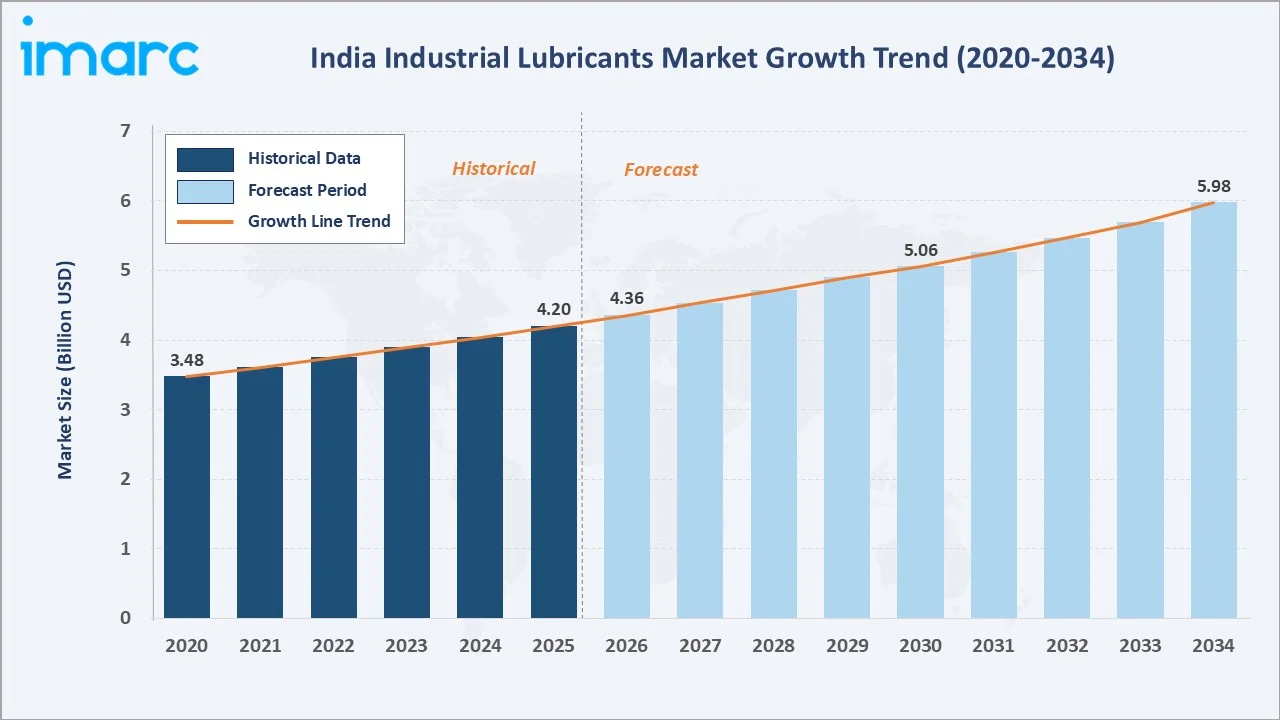
The India industrial lubricants market grew from USD 4.20 Billion in 2025 to USD 4.36 Billion in 2026 and is projected to reach USD 5.98 Billion by 2034, growing at a CAGR of 3.81% during 2026-2034. India's manufacturing sector, contributing approximately 17% of GDP in 2025 and targeted to reach 25% by 2030 under the Make in India initiative, is the primary demand engine, generating consistent consumption of hydraulic fluids, gear oils, greases, and metalworking fluids across construction, automotive, mining, power generation, and chemical production sectors. Hydraulic fluid dominates at 31.8% by product type, mineral oil leads at 72.5% by base oil, and West & Central India commands the largest regional share at 35.4%.
Market Snapshot
|
Metric |
Value |
|
Base Year Market Size (2025) |
USD 4.20 Billion |
|
Market Size (2026) |
USD 4.36 Billion |
|
Forecast Market Size (2034) |
USD 5.98 Billion |
|
CAGR (2026-2034) |
3.81% |
|
Base Year |
2025 |
|
Historical Period |
2020-2025 |
|
Forecast Period |
2026-2034 |
|
Dominant Product Type |
Hydraulic Fluid (31.8%, 2025) |
|
Dominant Base Oil |
Mineral Oil (72.5%, 2025) |
|
Leading Region |
West & Central India (35.4%, 2025) |
The India industrial lubricants market grew from USD 3.48 Billion in 2020 to USD 4.20 Billion by 2025 and is estimated to reach USD 4.36 Billion in 2026. The market is projected to reach USD 5.06 Billion by 2030 and USD 5.98 Billion by 2034.
To get more information on this market, Request Sample
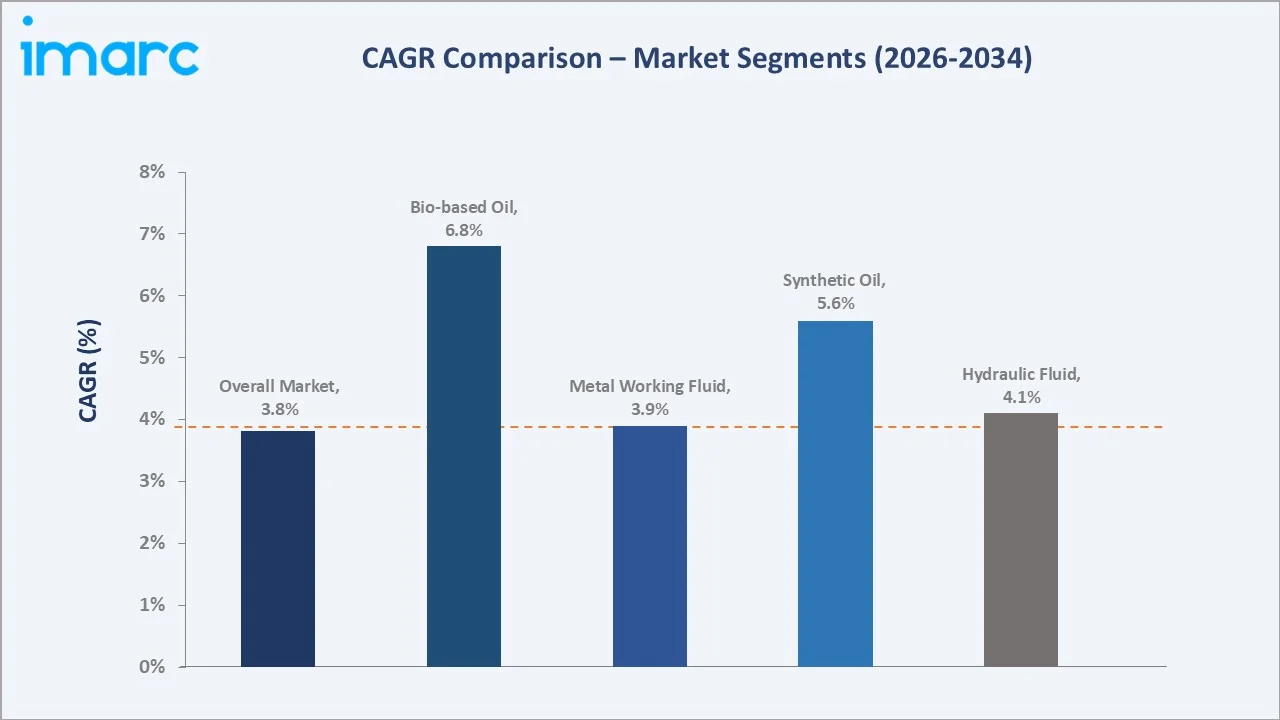
Hydraulic fluid grows at ~4.1% CAGR driven by expanding construction and manufacturing equipment fleets. Synthetic oil expands at ~5.6% CAGR through premium lubrication upgrades in high-speed machinery. Bio-based oil leads growth at ~6.8% CAGR through sustainability mandates and food-grade application adoption.
Executive Summary
The India industrial lubricants market is experiencing steady and structurally supported growth, anchored by India's industrial expansion ambitions, infrastructure investment surge, and rising lubricant quality standards across manufacturing end-uses. The market is driven by PLI scheme-led manufacturing capacity additions, PM GatiShakti infrastructure development, and the growing adoption of premium synthetic lubricants in high-performance industrial applications.
Mineral oil dominates at 72.5% of base oil consumption due to established supply chains and cost competitiveness, while Synthetic oil's share is expanding at ~5.6% CAGR as Indian manufacturers upgrade to OEM-specified premium formulations. Hydraulic fluid leads product demand at 31.8%, reflecting India's construction and heavy machinery equipment boom. West & Central India holds 35.4% of market share, anchored by Maharashtra and Gujarat's dense manufacturing and automotive corridors.
Key Market Insights
|
Insight |
Data |
|
Dominant Product Type |
Hydraulic Fluid - 31.8% share (2025) |
|
Dominant Base Oil |
Mineral Oil - 72.5% share (2025) |
|
Leading Region |
West & Central India - 35.4% (2025) |
|
Key Market Opportunity |
Synthetic and bio-based lubricant upgrades under India's National Green Hydrogen Mission and energy efficiency mandates projected to create a premium lubricant opportunity by 2030 |
Key Analytical Observations Supporting the Above Data:
- Hydraulic Fluid at 31.8%: Hydraulic fluid dominates through India's construction equipment fleet expansion and widespread use in hydraulic presses, injection molding machines, and mining equipment across Maharashtra, Gujarat, and Rajasthan's industrial clusters.
- Mineral Oil at 72.5%: Mineral oil base dominates through its significant cost advantage over synthetics and compatibility with India's installed base of conventional industrial equipment. Refinery-linked supply chains ensure consistent availability and competitive pricing across all Indian geographies.
- West & Central India at 35.4%: Maharashtra's automotive and engineering hubs combined with Gujarat's petrochemical and pharmaceutical manufacturing clusters generate the highest lubricant consumption per square kilometer of industrial area in India, anchoring this region's market leadership.
India Industrial Lubricants Market Overview
The India industrial lubricants market encompasses petroleum-based and synthetic lubricating products formulated for industrial machinery applications, including hydraulic fluids, metal working fluids, gear oils, greases, compressor oils, turbine oils, and specialty process oils. The market serves end-use industries including construction, automotive, metal and mining, cement, power generation, chemical production, textile manufacturing, food processing, agriculture, and oil and gas.
Market Dynamics
To evaluate market opportunities, Request Sample
Market Drivers
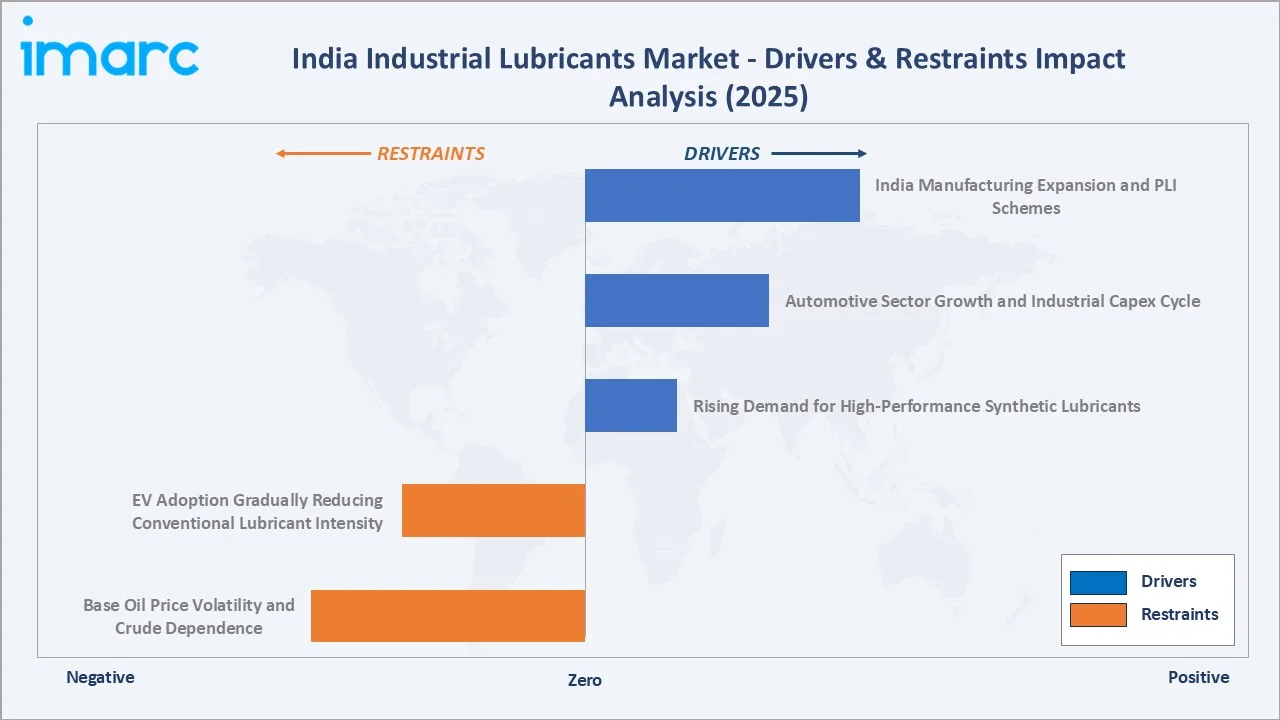
- India Manufacturing Expansion and PLI Schemes: The Production Linked Incentive (PLI) scheme covering 14 sectors with a total outlay of INR 1.97 Trillion is driving significant greenfield and brownfield manufacturing capacity additions across electronics, pharmaceuticals, textiles, food processing, and automotive components. Each new manufacturing facility requires an initial lubricant fill and ongoing top-up consumption, generating a sustained multi-year demand pipeline across hydraulic fluids, gear oils, and specialty process lubricants.
- Automotive Sector Growth and Industrial Capex Cycle: India's vehicle production increased from 22.65 million units in FY21 to 31.03 million units in FY25, generating substantial demand for transmission oils, gear lubricants, and specialty fluids in automotive manufacturing plants. The broader industrial capex cycle, with corporate India's capital expenditure, is expanding the industrial machinery base requiring lubricant maintenance.
- Rising Demand for High-Performance Synthetic Lubricants: OEM equipment specifications increasingly mandate synthetic lubricants in high-speed CNC machines, precision textile equipment, and pharmaceutical clean-room machinery. Indian manufacturers' quality upgradation driven by export competitiveness requirements and ISO certification standards is accelerating the switch from mineral to synthetic lubricants across organized industrial segments.
Market Restraints
- Base Oil Price Volatility and Crude Dependence: India imports approximately 85% of its crude oil, making industrial lubricant pricing highly sensitive to international crude oil price fluctuations. Base oil price volatility creates procurement uncertainty for industrial buyers on annual maintenance contracts, compressing lubricant supplier margins and creating substitution pressure during price spike episodes.
- EV Adoption Gradually Reducing Conventional Lubricant Intensity: India's electric vehicle push, targeting 30% EV share in new vehicle sales by 2030, will reduce conventional transmission oil and certain gear lubricant volumes in the automotive segment over the forecast period. While industrial lubricants are less affected than automotive lubricants, the directional trend toward lower lubricant intensity per unit of output in electrified manufacturing processes is a structural headwind for volume growth.
Market Opportunities
- Food-Grade and Bio-Lubricant Demand in Food Processing: India's food processing sector expansion of INR 10,900 Crore approved financial outlay under PLISFPI creates growing demand for food-grade lubricants and biodegradable bio-lubricants that meet regulatory and international food safety standards. This premium-priced niche segment represents a high-value growth opportunity for specialized suppliers.
- Condition Monitoring and Predictive Lubrication Services: Indian manufacturers' Industry 4.0 adoption is creating demand for lubricant condition monitoring, oil analysis services, and predictive maintenance programs that extend oil drain intervals, reduce unplanned downtime, and optimize lubricant total cost of ownership. Value-added service models combining lubricant supply with oil analysis generate higher customer retention and recurring revenue streams.
Market Challenges
- Unorganized Sector Competition and Adulteration: India's industrial lubricant market includes a significant unorganized segment supplying sub-standard and adulterated lubricants at deep discounts to price-sensitive SME buyers. This creates a two-tier market where organized suppliers struggle to compete on price alone in commodity segments, requiring them to justify premium pricing through technical support, OEM approvals, and quality certifications.
- Slow Industrial Adoption of Premium Synthetic Lubricants: Despite the demonstrable total cost of ownership benefits of synthetic lubricants, longer drain intervals, reduced energy consumption, and lower maintenance costs, Indian SME industrial buyers remain price-focused on initial purchase cost. Shifting procurement behavior from first-cost to lifecycle-cost evaluation requires sustained technical sales efforts and investment in market education.
Emerging Market Trends
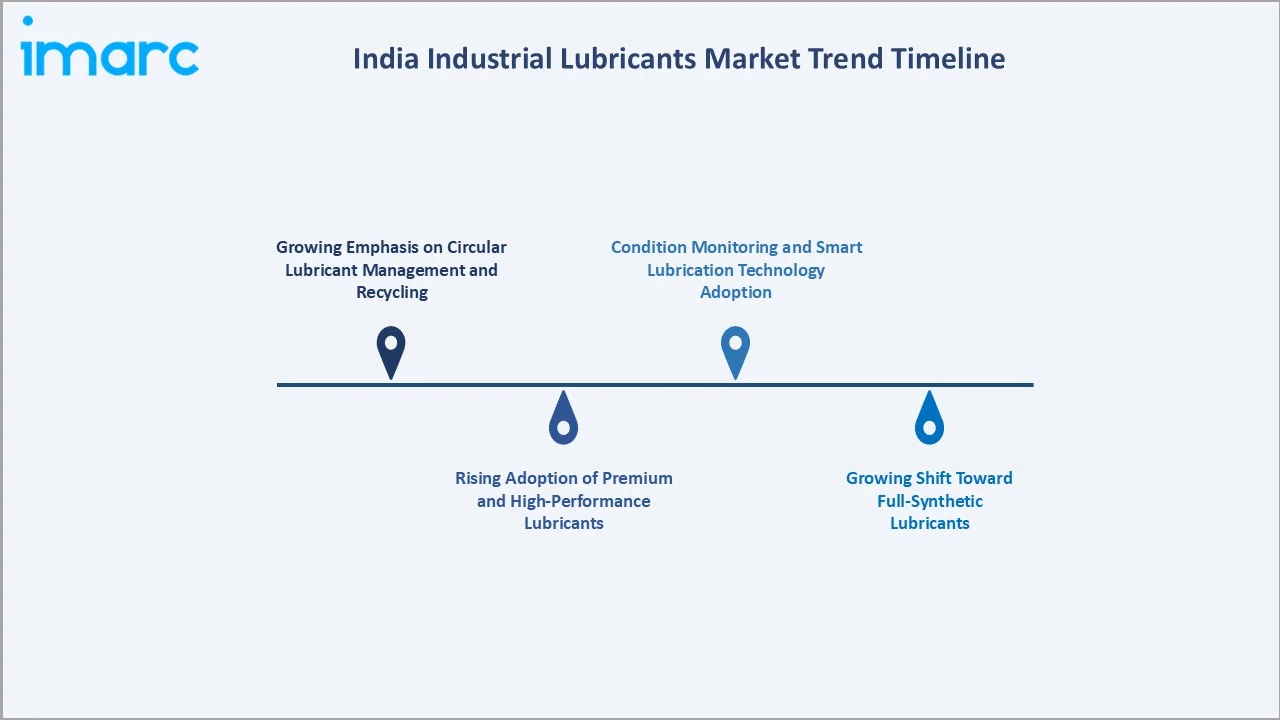
1. Growing Emphasis on Circular Lubricant Management and Recycling
The India industrial lubricants market is witnessing increased focus on structured used-oil collection, recycling, and responsible disposal, supported by evolving EPR requirements. In September 2026, PETRONAS Lubricants India and Tata Motors signed an MoU to pilot a scalable used-lubricant collection and recycling model in Maharashtra and Tamil Nadu, supporting India’s EPR framework and circular economy goals.
2. Rising Adoption of Premium and High-Performance Lubricants
In July 2026, Indian Oil strengthened its Servo product portfolio with the launch of the Servo Hyper Series, a new range of premium lubricants. The company describes the series as its most technologically advanced lubricant offering, developed to address the changing performance requirements of next-generation engines and sophisticated, high-performance industrial machinery. The launch highlights this trend, as lubricant manufacturers increasingly focus on products offering enhanced equipment protection, operational efficiency, and performance under demanding conditions.
3. Condition Monitoring and Smart Lubrication Technology Adoption
Leading Indian manufacturing groups and PSU facilities are adopting real-time lubricant condition monitoring systems, oil particle counters, viscosity sensors, and spectroscopic oil analysis to shift from fixed-schedule oil changes to condition-based maintenance. This trend reduces lubricant waste, extends equipment life, and creates a new value-added service revenue stream for lubricant suppliers offering integrated monitoring programs.
4. Growing Shift Toward Full-Synthetic Lubricants
The India lubricants market is witnessing increasing adoption of full-synthetic formulations as manufacturers expand advanced lubricant technologies beyond premium applications into mass-market segments. In April 2026, Castrol India Limited expanded its two- and four-wheeler engine oil portfolio with the introduction of new full-synthetic formulations, strengthening its position in the Indian lubricants market. As part of this product transition, the company is extending full-synthetic technology to mass-market segments by upgrading key viscosity grades within its Castrol Activ and Castrol GTX ranges to full-synthetic formulations.
Industry Value Chain Analysis
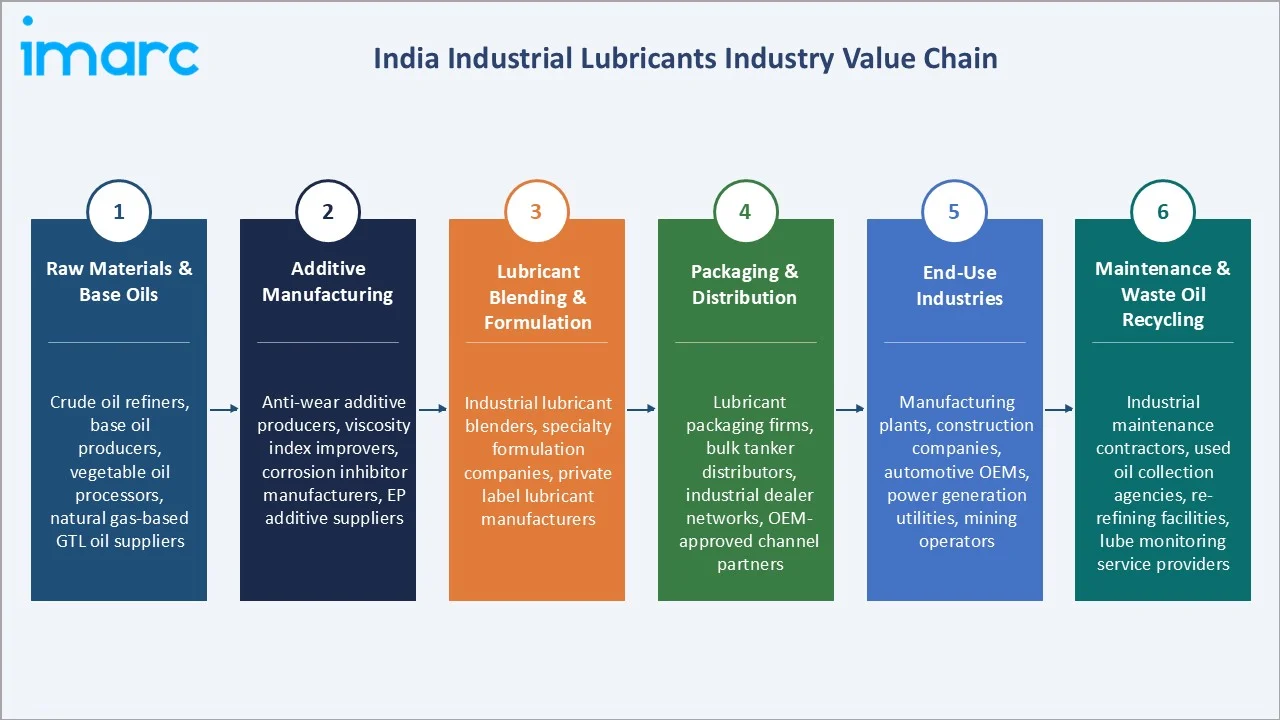
The India industrial lubricants value chain spans base oil production, additive manufacturing, lubricant blending and formulation, packaging and distribution, end-use industry consumption, and waste oil collection and re-refining, with India participating strongly at the blending, distribution, and consumption stages.
|
Stage |
Key Players |
|
Raw Materials & Base Oils |
Crude oil refiners, base oil producers, vegetable oil processors, natural gas-based GTL oil suppliers. |
|
Additive Manufacturing |
Anti-wear additive producers, viscosity index improvers, corrosion inhibitor manufacturers, EP additive suppliers. |
|
Lubricant Blending & Formulation |
Industrial lubricant blenders, specialty formulation companies, private label lubricant manufacturers. |
|
Packaging & Distribution |
Lubricant packaging firms, bulk tanker distributors, industrial dealer networks, OEM-approved channel partners. |
|
End-Use Industries |
Manufacturing plants, construction companies, automotive OEMs, power generation utilities, mining operators. |
|
Maintenance & Waste Oil Recycling |
Industrial maintenance contractors, used oil collection agencies, re-refining facilities, lube monitoring service providers. |
The lubricant blending and formulation stage is the primary value addition point in India, where domestic refiners and multinational companies blend imported base oils and additives into finished lubricant formulations. India's re-refining infrastructure remains underdeveloped relative to the used oil generated, creating a regulatory and commercial opportunity for investment in circular lubricant economy programs aligned with the extended producer responsibility framework.
Technology Landscape in the India Industrial Lubricants Industry
High-Performance Synthetic Base Oil Formulations
Polyalphaolefin (PAO), polyalkylene glycol (PAG), and ester-based synthetic base oils enable lubricant formulations with operating ranges of -50°C to 200°C, significantly exceeding mineral oil performance envelopes. Indian lubricant manufacturers are increasingly introducing Group III+ and Group IV synthetic grades to serve the expanding base of high-speed CNC machines, turbines, and automotive transmission systems requiring extended drain intervals and superior thermal stability.
Nanotechnology-Enhanced Lubricant Additives
Nanoparticle-based additives, including copper nanoparticles, PTFE, and molybdenum disulfide nano-additives, are being incorporated into premium industrial greases and gear oils to deliver superior anti-wear and extreme pressure performance in high-load applications. Indian research institutions are actively developing nano-lubricant formulations, with commercial applications emerging in steel plant roll neck bearings, railway axle boxes, and wind turbine gearboxes.
Re-refining Technology and Circular Base Oil Production
Re-refining technology is gaining traction in India as lubricant producers increasingly recover used oils and convert them into high-quality base oils for reuse. Advanced processes such as vacuum distillation and hydrotreating help remove contaminants and restore the performance characteristics of used lubricants. This supports circular base oil production, reduces dependence on virgin feedstocks, and minimizes waste generation. Growing emphasis on EPR compliance and circular economy practices is expected to accelerate investments in used-oil collection and re-refining infrastructure.
Market Segmentation Analysis
The report covers the following segments:
|
Segment Category |
Leading Segment |
Market Share |
Year |
|
Product Type |
Hydraulic Fluid |
31.8% |
2025 |
|
Base Oil |
Mineral Oil |
72.5% |
2025 |
|
End Use Industry |
🔒 |
🔒 |
2025 |
|
Region |
West and Central India |
35.4% |
2025 |

By Product Type
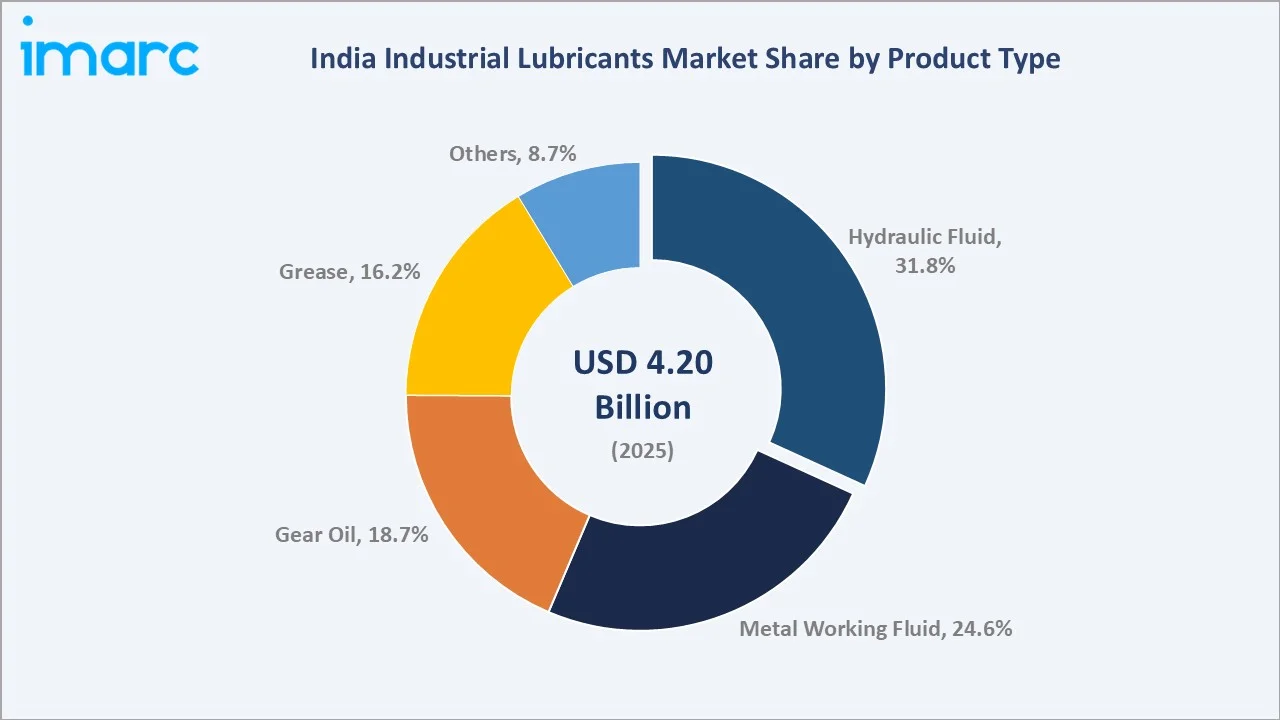
Hydraulic fluid commands 31.8%, driven by India's expanding construction equipment fleet, growing hydraulic press installations in metal forming and rubber processing, and rising demand from the plastic injection molding industry. Hydraulic fluid's broad cross-sector applicability across construction, manufacturing, mining, agriculture, and power generation makes it the most universally consumed industrial lubricant category.
To access detailed market analysis, Request Sample
Metal working fluid at 24.6% serves India's extensive metal machining, grinding, and forming operations in automotive, aerospace, and general engineering segments. Gear oil at 18.7% serves industrial gearboxes across cement plants, steel mills, sugar factories, and mining operations. Grease at 16.2% addresses bearing lubrication across all industrial sectors, with high-temperature greases growing fastest for steel and cement kiln applications.
By Base Oil
Mineral oil dominates at 72.5% through its established supply chain from India's domestic refineries, combined with competitive pricing and compatibility with India's vast installed base of conventional industrial equipment.
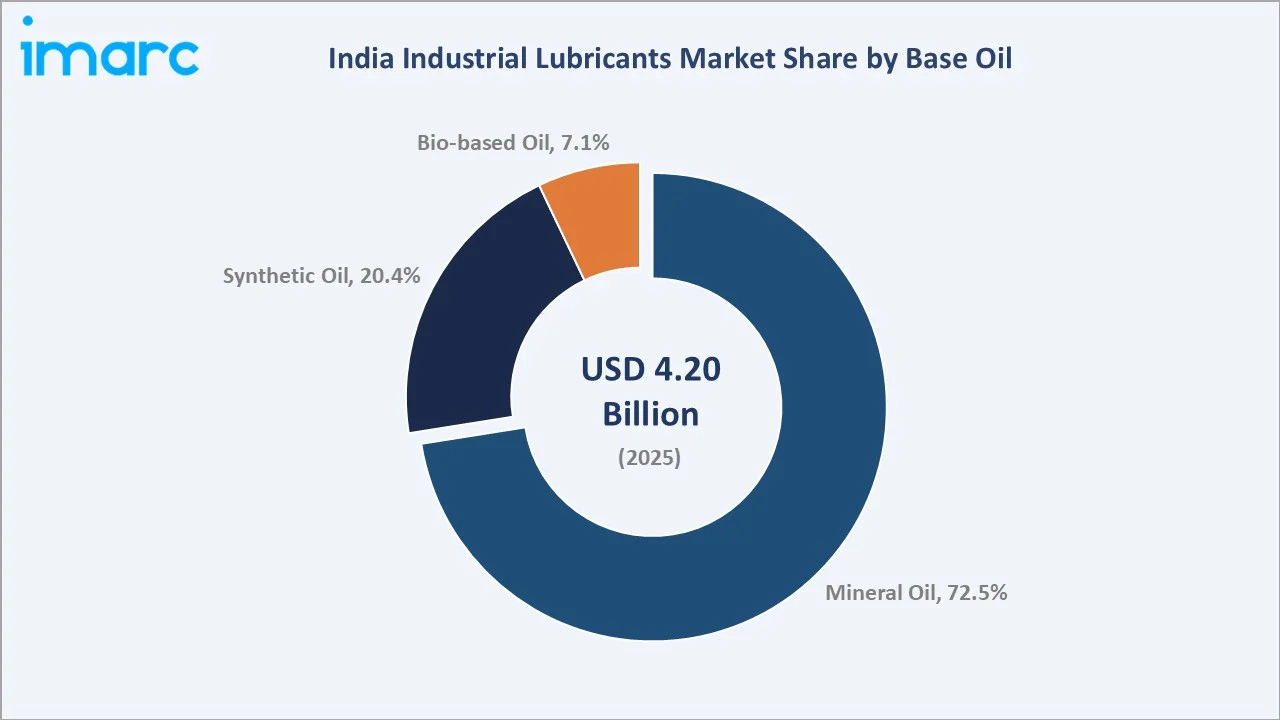
Synthetic oil at 20.4% is growing at ~5.6% CAGR through premium industrial and automotive applications requiring extended drain intervals and superior performance. Bio-based oil at 7.1% is the fastest-growing category at ~6.8% CAGR, driven by food processing compliance requirements, environmental regulations, and India's growing sustainable manufacturing commitments across ESG-reporting listed corporates.
Regional Market Insights
|
Region |
Share (2025) |
Key India Industrial Lubricants Market Drivers & Characteristics |
|
West & Central India |
35.4% |
Reflecting dense manufacturing clusters, petrochemical industries, and automotive OEM hubs generating the highest hydraulic fluid and gear oil consumption in the country. |
|
South India |
27.6% |
Reflecting automotive manufacturing corridors, heavy engineering industries, and mining and cement sectors driving sustained lubricant demand. |
|
North India |
22.3% |
Reflecting industrial estates, sugar and textile mills, mining operations, and agricultural machinery generating diverse lubricant consumption. |
|
East & Northeast India |
14.7% |
Reflecting steel and mining sectors, engineering industries, and growing infrastructure development driving emerging lubricant demand. |
West & Central India's 35.4% share reflects combined industrial output, with automotive clusters, engineering zones, the chemical industry, and petrochemical and pharmaceutical corridors generating the country's highest industrial lubricant consumption density.
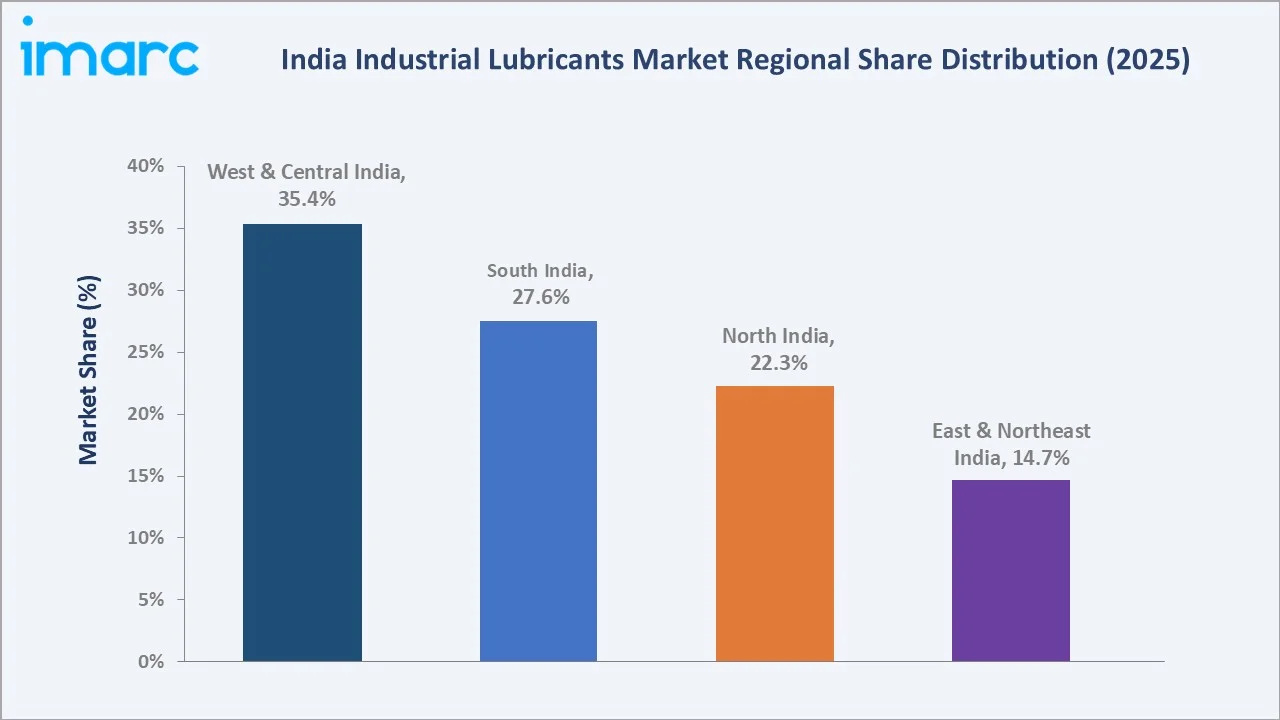
South India's 27.6% is driven by automobile manufacturing leadership and aerospace and engineering sectors. North India's 22.3% reflects NCR's industrial estates and large agri-machinery and sugar mill lubricant demand. East & Northeast India at 14.7% is positioned for above-average growth through steel and mining sector expansion under National Mineral Policy investments.
Competitive Landscape
The India industrial lubricants market is a moderately concentrated landscape led by PSU-backed giants, through their nationwide refinery-linked distribution infrastructure. Multinational brands compete strongly in premium segments, while Indian private players serve niche and regional market segments.
|
Company |
Key Brands |
Market Position |
Core Strength |
|
Indian Oil Corporation Ltd |
SERVO |
Market Leader |
Indian Oil Corporation Ltd is the leading player in India's industrial lubricants market through its flagship brand SERVO. |
|
Bharat Petroleum Corporation Limited |
MAK Lubricants |
Market Leader |
Bharat Petroleum Corporation Limited plays a major role in India's industrial sector through its flagship brand MAK Lubricants. |
|
Shell plc |
Shell |
Established Player |
Shell plc plays a leading role in India's industrial lubricants market by providing specialized fluid technologies. |
|
Exxon Mobil Corporation |
Mobil industrial lubricants |
Established Player |
Exxon Mobil Corporation supplies advanced Mobil Industrial Lubricants to enhance productivity, energy efficiency, and equipment reliability. |
|
Savita Oil Technologies Limited |
Savsol |
Challenger |
Savita Oil Technologies Limited plays a foundational role in India's industrial and automotive lubricant sector as a leading pioneer in petroleum specialties. |
The competitive landscape is evolving as OEM relationships, certification, and technical formulation capability become key differentiators over price. PSU suppliers' nationwide distribution advantages are being matched by multinational brands' superior product technology and technical service capabilities, creating hybrid competition that rewards suppliers with both broad reach and premium formulation portfolios.
Key Company Profiles
Indian Oil Corporation Ltd
Indian Oil Corporation Ltd is India's largest refiner and the dominant industrial lubricant supplier through its SERVO brand, which commands the highest market share in the organized Indian lubricant market. The company’s integrated base oil refining and lubricant blending operations at Panipat, Mathura, and seven other refineries provide unmatched cost and supply chain advantages across all Indian geographies.
- Key Brands: SERVO
- Recent Developments: In July 2026, Indian Oil strengthened its Servo portfolio with the launch of the Servo Hyper Series, an advanced range of premium lubricants developed to meet the growing performance demands of modern engines and high-performance industrial machinery.
- Strategic Focus: Expanding premium synthetic SERVO range to capture industrial upgrade cycle, growing SERVO BIO presence in food processing and textile segments, leveraging IOCL's retail touchpoints for industrial lubricant distribution, advancing re-refining capabilities under extended producer responsibility framework.
Shell plc
Shell plc is the premium industrial lubricant supplier through its Lubricants business, serving India's most demanding industrial applications across power generation, steel, mining, automotive manufacturing, and food processing. Shell's global R&D capabilities and OEM approval portfolio position it as the preferred technical lubricant partner for India's sophisticated manufacturing base.
- Key Offerings: Shell
- Strategic Focus: Leveraging global OEM approval network for premium positioning in India's expanding advanced manufacturing base, growing Shell food-grade lubricant market share, advancing bio-lubricant development for ecologically sensitive industrial applications.
Market Concentration Analysis
The India industrial lubricants market is moderately concentrated, with the top three PSU-backed players collectively accounting for an estimated 45-50% of the organized market by volume. Adding the top five multinationals control approximately 65-70% of the organized market, leaving a significant 30-35% served by smaller regional players and the unorganized sector.
Market consolidation is expected to accelerate through 2034 as quality standards tighten, large manufacturing corporates standardize on approved supplier lists, and digital procurement platforms give organized suppliers greater SME market reach. The unorganized segment is expected to contract as quality enforcement and customer sophistication improve, benefiting organized market leaders with certified product portfolios and technical service capabilities.
Investment & Growth Opportunities
Highest Growth Segments
Bio-based lubricants (~6.8% CAGR), synthetic lubricants (~5.6% CAGR), hydraulic fluids for construction (~4.1% CAGR), food-grade specialty lubricants, condition monitoring service programs, and re-refining infrastructure investments represent the highest-return opportunity vectors in the India industrial lubricants market through 2034.
Investment Themes
- Premium Synthetic Lubricant Formulation and OEM Approval: Investing in PAO and ester-based synthetic lubricant R&D and securing OEM approvals from major Indian industrial equipment manufacturers creates long-term premium pricing power and customer captivity, generating superior margins versus commodity mineral oil segments.
- Digital Lubricant Services and Condition Monitoring: Building IoT-enabled oil condition monitoring platforms, lube management software, and oil analysis laboratory networks create recurring service revenue streams while deepening customer relationships and generating data advantages for product formulation optimization.
Future Market Outlook (2026-2034)
The India industrial lubricants market is projected to grow from USD 4.20 Billion in 2025 to USD 4.36 Billion in 2026, reaching USD 5.98 Billion by 2034, exhibiting a CAGR of 3.81% during 2026-2034. The market is projected to reach an anchor value of USD 5.06 Billion by 2030, representing the mid-period milestone at which PLI-supported manufacturing capacity additions achieve full production ramp-up, infrastructure project completions generate sustained operational equipment maintenance demand, and the synthetic lubricant upgrade cycle reaches critical mass across India's organized manufacturing sector.
Three structural forces will define the India industrial lubricants market through 2034. First, India's manufacturing GDP expansion from 17% to 25% of national GDP creates a durable secular demand tailwind for all industrial lubricant categories, with each new manufacturing facility adding to the permanent installed base requiring periodic lubricant replacement. Second, the quality upgrade cycle from mineral to synthetic and bio-based lubricants shifts the market's value mix toward premium products, growing market value at a faster pace than volume and benefiting suppliers with strong technical formulation portfolios. Third, the service transformation of lubricant supply creates new recurring revenue streams and deeper customer relationships for suppliers investing in condition monitoring, oil analysis, and predictive lubrication management capabilities.
Research Methodology
Primary Research
Primary research comprised in-depth interviews with Indian industrial lubricant manufacturers, base oil procurement managers, industrial equipment OEM lubrication engineers, end-use industry maintenance managers, lubricant distributor networks, and regulatory representatives. These discussions validated market size estimates, product type demand dynamics, regional consumption patterns, and technology adoption trajectories for the 2026-2034 forecast period.
Secondary Research
Secondary research encompassed lubricant production data, certification records, used oil audit data, Society of Indian Automobile Manufacturers (SIAM) production statistics, IMARC Group proprietary chemicals and materials databases, annual reports of key market participants, and industry publications covering India's lubricant and specialty chemicals market developments through 2025.
Forecasting Models
Forecasting models incorporated historical lubricant demand correlations with industrial output, construction activity, and automotive production indices, PLI scheme manufacturing capacity addition timelines, synthetic lubricant upgrade adoption curves, crude oil price scenario analysis for base oil cost modeling, and macroeconomic indicators. Both bottom-up end-use industry demand modeling and top-down market value approaches were cross-validated for forecast consistency across all segments and regions.
India Industrial Lubricants Market Report Coverage:
| Report Features | Details |
|---|---|
| Base Year of the Analysis | 2025 |
| Historical Period | 2020-2025 |
| Forecast Period | 2026-2034 |
| Units | Billion USD |
| Scope of the Report |
Exploration of Historical Trends and Market Outlook, Industry Catalysts and Challenges, Segment-Wise Historical and Future Market Assessment:
|
| Product Types Covered | Hydraulic Fluid, Metal Working Fluid, Gear Oil, Grease, Others |
| Base Oils Covered | Mineral Oil, Synthetic Oil, Bio-based Oil |
| End Use Industries Covered | Construction, Metal and Mining, Cement Production, Power Generation, Automotive, Chemical Production, Oil and Gas, Textile Manufacturing, Food Processing, Agriculture, Pulp and Paper, Others |
| Regions Covered | North India, West and Central India, South India, East and Northeast India |
| Companies Covered | Indian Oil Corporation Ltd, Bharat Petroleum Corporation Limited, Shell plc, Exxon Mobil Corporation, Savita Oil Technologies Limited, etc. |
| Customization Scope | 10% Free Customization |
| Post-Sale Analyst Support | 10-12 Weeks |
| Delivery Format | PDF and Excel through Email (We can also provide the editable version of the report in PPT/Word format on special request) |
Key Benefits for Stakeholders:
- IMARC’s industry report offers a comprehensive quantitative analysis of various market segments, historical and current market trends, market forecasts, and dynamics of the India industrial lubricants market from 2020-2034.
- The research report provides the latest information on the market drivers, challenges, and opportunities in the India industrial lubricants market.
- Porter's five forces analysis assist stakeholders in assessing the impact of new entrants, competitive rivalry, supplier power, buyer power, and the threat of substitution. It helps stakeholders to analyze the level of competition within the India industrial lubricants industry and its attractiveness.
- Competitive landscape allows stakeholders to understand their competitive environment and provides an insight into the current positions of key players in the market.
Frequently Asked Questions About the India Industrial Lubricants Market Report
The India industrial lubricants market reached USD 4.36 Billion in 2026, driven by PLI scheme manufacturing expansion, infrastructure construction demand, and rising adoption of premium synthetic lubricants across organized industrial sectors.
The India industrial lubricants market is projected to grow at a CAGR of 3.81% during 2026-2034, sustained by manufacturing sector expansion, infrastructure investment, automotive production growth, and the premiumization shift toward synthetic and bio-based lubricants.
The market is projected to reach USD 5.06 Billion by 2030, the mid-period milestone where PLI manufacturing ramp-ups, completed infrastructure projects, and synthetic lubricant upgrades collectively accelerate market value growth across all product and regional segments.
Hydraulic fluid leads with a 31.8% share in 2025, driven by India's expanding construction equipment fleet, growing hydraulic press installations in manufacturing, and broad cross-sector applicability across construction, mining, agriculture, and power generation equipment.
Mineral oil leads with a 72.5% share in 2025, supported by competitive pricing from domestic refinery production, established supply chains, and compatibility with India's vast installed base of conventional industrial equipment nationwide.
West & Central India leads with a 35.4% share in 2025, anchored by dense manufacturing clusters across automotive, petrochemical, pharmaceutical, and engineering, generating India's highest industrial lubricant consumption density per square kilometer.
Key players include Indian Oil Corporation Ltd, Bharat Petroleum Corporation Limited, Shell plc, Exxon Mobil Corporation, and Savita Oil Technologies Limited, among others.
The India industrial lubricants market is projected to reach USD 5.98 Billion by 2034, driven by sustained manufacturing GDP expansion toward the 25% target, completed infrastructure investments generating maintenance demand, and the widespread adoption of premium synthetic and bio-based lubricants.
Key opportunities include premium synthetic lubricant formulation with OEM approvals, re-refining infrastructure for circular base oil production, food-grade lubricant manufacturing for PLI food processing expansion, condition monitoring service platforms, and bio-lubricant product development for sustainability-mandated applications.
Need more help?
- Speak to our experienced analysts for insights on the current market scenarios.
- Include additional segments and countries to customize the report as per your requirement.
- Gain an unparalleled competitive advantage in your domain by understanding how to utilize the report and positively impacting your operations and revenue.
- For further assistance, please connect with our analysts.
 Request Customization
 Speak to an Analyst
 Request Brochure
 Inquire Before Buying
Benefits of Customization
- Personalize this research
- Triangulate with your data
- Get data as per your format and definition
- Gain a deeper dive into a specific application, geography, customer, or competitor
- Any level of personalization
Get in Touch With Us
UNITED STATES
Phone: +1-201-971-6302
INDIA
Phone: +91-120-433-0800
UNITED KINGDOM
Phone: +44-753-714-6104
Email: [email protected]
Client Testimonials




.webp)




.webp)













Related Reports

Choose your plan
*Please note that the prices mentioned below are starting prices for each bundle type. Kindly contact our team for further details.*
Single User License
- 1 User License, Access on 2 Devices
- PDF Report + Excel Dataset (Password Protected)
- Lifetime Access
- No Printing Rights
- 10% Free Report Customization
- 10–12 Weeks of Analyst Support
Five User License
- Access for 5 Users, 2 Devices per User
- PDF Report + Excel Dataset (Password Protected)
- Lifetime Access
- Dedicated Account Manager
- 12–14 Weeks of Analyst Support
- No Printing Rights
- 15% Free Report Customization
- 25% Discount on Your Next Purchase
Corporate User License
- Unlimited User Access (Within Your Organization)
- PDF Report + Excel Dataset
- Lifetime Access
- Dedicated Account Manager
- 14–20 Weeks of Analyst Support
- No Printing Rights
- 20% Free Report Customization
- 30% Discount on Your Next Purchase
Essential Insights
What's included:
3 reports
- Lifetime Access
- PDF Reports
- Excel Datasets
- 2 Weeks of Free Analyst Support
- 2 User Licenses
- Access on 2 Devices
- Printing Rights
- Complimentary PowerPoint (PPT) Version
- Complimentary License Upgrade
Professional Access
What's included:
5 reports
- Lifetime Access
- PDF Reports
- Excel Datasets
- 8 Weeks of Free Analyst Support
- 2 User Licenses
- Access on 2 Devices
- Printing Rights
- Complimentary PowerPoint (PPT) Version
- Complimentary License Upgrade
Business Advantage
What's included:
8 reports
- Lifetime Access
- PDF Reports
- Excel Datasets
- 14 Weeks of Free Analyst Support
- 2 User Licenses
- Access on 2 Devices
- Printing Rights
- Complimentary PowerPoint (PPT) Version
- Complimentary License Upgrade
Enterprise Intelligence
What's included:
10 reports
- Lifetime Access
- PDF Reports
- Excel Datasets
- 20 Weeks of Free Analyst Support
- 2 User Licenses
- Access on 2 Devices
- Printing Rights
- Complimentary PowerPoint (PPT) Version
- Complimentary License Upgrade