
India Industry 4.0 Market Size, Share, Trends and Forecast by Component, Technology Type, End Use Industry, and Region, 2026-2034
India Industry 4.0 Market Size, Share, Trends & Forecast (2026-2034)
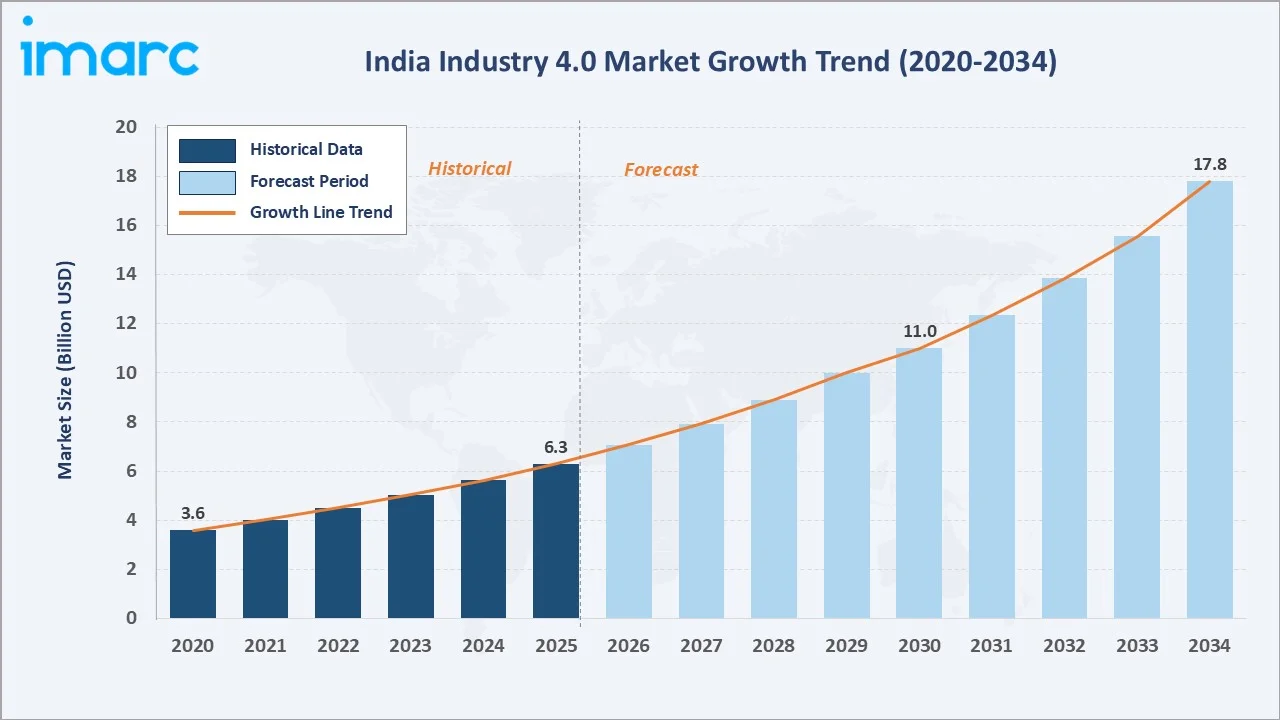
The India Industry 4.0 market reached USD 6.3 Billion in 2025 and is projected to reach USD 17.8 Billion by 2034, growing at a CAGR of 11.91% during 2026-2034. The market is driven by India's PLI scheme accelerating smart manufacturing, rapid adoption of industrial IoT, AI, and robotics, and 5G rollout enabling real-time industrial connectivity. As of December 31, 2025, India’s Production Linked Incentive (PLI) schemes attracted investments of more than ₹2.16 lakh crore, generating incremental production and sales exceeding ₹20.41 lakh crore. The rising manufacturing investments encouraged by PLI schemes are accelerating the market by prompting companies to adopt automation, industrial IoT, robotics, AI, digital twins, and smart manufacturing systems. Hardware leads components at 46.8%. Manufacturing dominates end-use industry at 34.8%. West and Central India leads regionally at 36.4%.
Market Snapshot
|
Metric |
Value |
|
Market Size (2025) |
USD 6.3 Billion |
|
Forecast Market Size (2034) |
USD 17.8 Billion |
|
CAGR (2026-2034) |
11.91% |
|
Base Year |
2025 |
|
Historical Period |
2020-2025 |
|
Forecast Period |
2026-2034 |
|
Dominant Component |
Hardware (46.8%, 2025) |
|
Dominant End Use Industry |
Manufacturing (34.8%, 2025) |
|
Leading Region |
West and Central India (36.4%, 2025) |
The India Industry 4.0 market has demonstrated strong growth, increasing from USD 3.6 Billion in 2020 to USD 6.3 Billion in 2025, reflecting expanding smart factory investments, government digital manufacturing initiatives, and growing enterprise adoption of connected industrial technologies. The market is projected to reach USD 11.0 Billion by 2030 and further grow to USD 17.8 Billion by 2034, supported by India's ambition to become a global manufacturing hub, semiconductor mission investments, and accelerating AI-driven industrial automation.
To get more information on this market, Request Sample
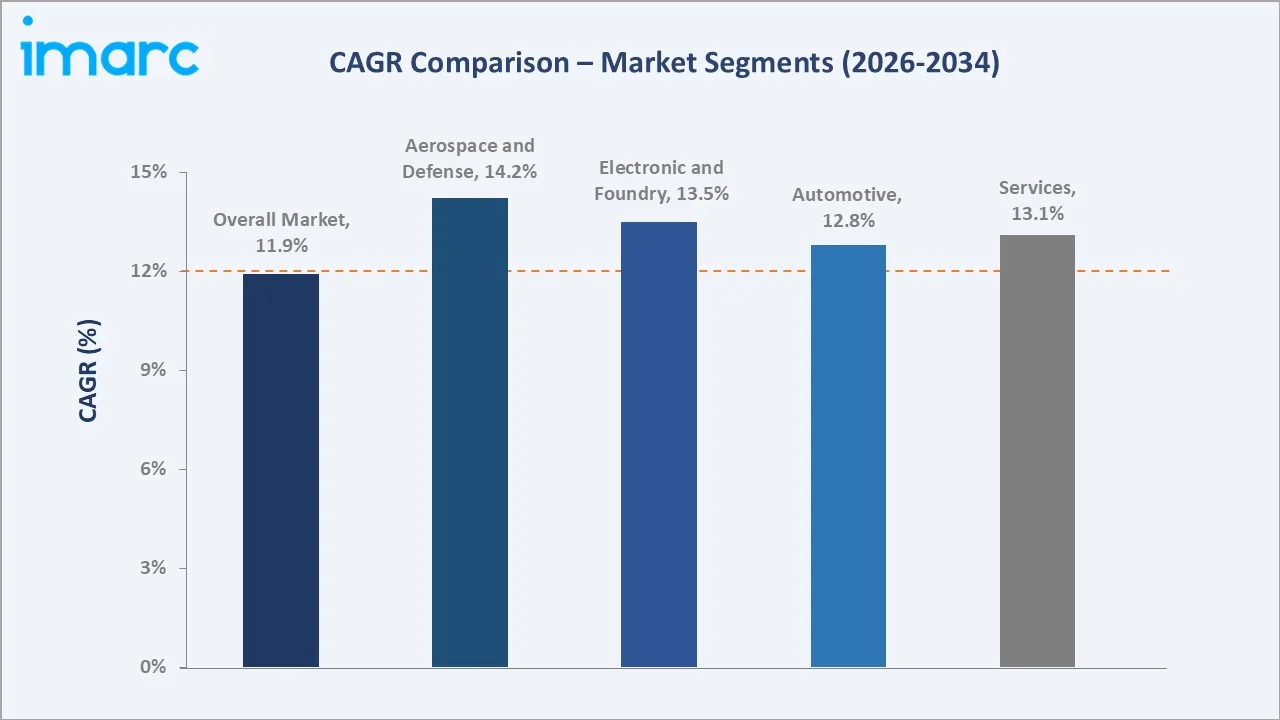
Aerospace and defense growing at a CAGR of ~14.2% through smart defense manufacturing and precision engineering adoption. Electronics and foundry grow at ~13.5% CAGR through semiconductor mission-linked smart manufacturing. Services grow at ~13.1% CAGR through system integration and managed industrial IoT services.
Executive Summary
The India Industry 4.0 market is experiencing exceptional growth, supported by transformative government initiatives including the Production Linked Incentive scheme, Make in India 2.0, the National Semiconductor Mission, and the 5G rollout that collectively create the policy and infrastructure foundation for smart manufacturing scale-up. Growing enterprise investment in industrial IoT sensor networks, AI-powered quality control, robotic process automation, digital twin simulation, and connected factory management platforms is progressively transforming India's manufacturing sector from labor-intensive to technology-enabled operations.
Hardware leads at 46.8% through sensor, robotics, and smart equipment investments. Manufacturing leads at 34.8% through PLI-driven smart factory adoption. West and Central India leads at 36.4% through its dense industrial corridor concentration.
Key Market Insights
|
Insight |
Data |
|
Dominant Component |
Hardware – 46.8% share (2025) |
|
Leading End Use Industry |
Manufacturing – 34.8% market share (2025) |
|
Leading Region |
West and Central India – 36.4% share (2025) |
|
Market Opportunity |
Semiconductor mission-linked smart manufacturing; PLI-driven Industry 4.0 adoption; agricultural and food processing automation; defense smart manufacturing; SME digital manufacturing programs |
Key Analytical Observations Supporting the Above Data:
- Hardware at 46.8%: Hardware dominates as Industry 4.0 implementation begins with physical layer investments, IoT sensors, industrial controllers, robots, smart actuators, edge computing devices, and connected machine tools, which collectively form the data acquisition foundation upon which software analytics and services layers are built.
- Manufacturing at 34.8%: Manufacturing leads as the PLI scheme's investment commitment across 14 sectors is directly linked to smart manufacturing adoption requirements among PLI beneficiary enterprises.
- West and Central India at 36.4%: West and Central India leads through Maharashtra and Gujarat's concentration of India's largest manufacturing industrial corridors combined with Pune's automotive manufacturing cluster and Mumbai's technology services base. This region hosts the highest density of PLI-beneficiary manufacturers, international automotive OEMs with global Industry 4.0 mandates, and chemical and pharmaceutical manufacturers with stringent quality automation requirements.
India Industry 4.0 Market Overview
The India Industry 4.0 market encompasses hardware, software, and services enabling the digital transformation of industrial operations through cyber-physical systems, industrial IoT, artificial intelligence, robotics, digital twins, additive manufacturing, and extended reality technologies. It includes industrial automation hardware (sensors, actuators, robots, PLCs, edge devices), industrial software platforms (MES, SCADA, digital twin, AI/ML analytics), and professional and managed services (system integration, consulting, implementation, and maintenance).
The market serves manufacturing, automotive, electronics and foundry, energy and utilities, oil and gas, food and beverages, aerospace and defense, and other end-use industries. Key technology enablers include Industrial IoT (IIoT), AI and machine learning, cloud computing, 5G connectivity, digital twin simulation, 3D printing, and blockchain for supply chain transparency. Growing government policy support, India's engineering talent pool, and ambitious manufacturing sector expansion targets collectively create one of the most attractive Industry 4.0 investment environments.
Market Dynamics
To evaluate market opportunities, Request Sample
Market Drivers
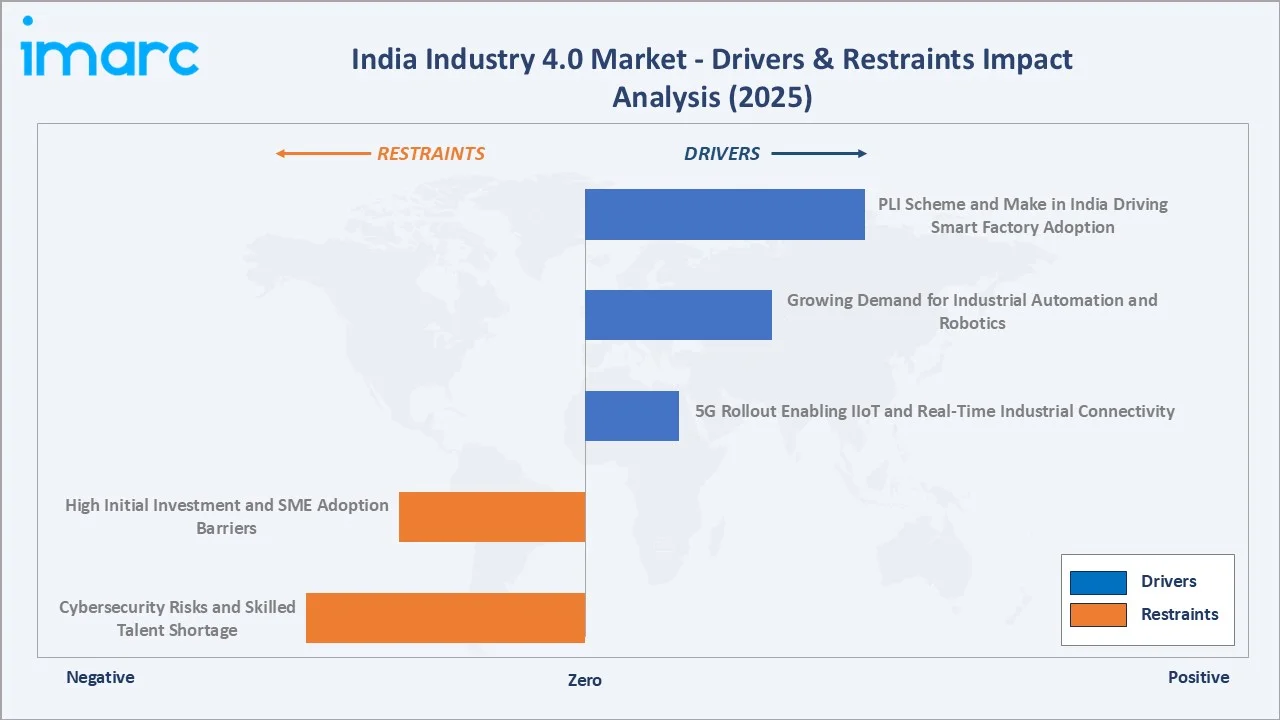
- PLI Scheme and Make in India Driving Smart Factory Adoption: The Government of India introduced Production Linked Incentive (PLI) schemes across 14 strategic sectors, with an approved outlay of ₹1.91 lakh crore. As of March 31, 2026, the schemes facilitated more than ₹2.40 lakh crore in actual investments and generated over 14.15 lakh direct and indirect employment opportunities, creating a structural demand for smart manufacturing investments as PLI beneficiaries scale production to meet output thresholds. International OEM technology mandates embedded in supply chain agreements are further requiring Indian supplier factories to adopt Industry 4.0 quality management, traceability, and process control technologies to maintain export order eligibility.
- Growing Demand for Industrial Automation and Robotics: According to the International Federation of Robotics (IFR), India deployed 8,510 industrial robots in 2023, registering a strong 59% year-on-year increase in installations. India's robot density signals massive, untapped automation potential. Rising labor costs in India's metropolitan manufacturing hubs, quality consistency requirements for global export markets, and the operational risk of labor shortages are creating converging business imperatives for robotic automation investment.
- 5G Rollout Enabling IIoT and Real-Time Industrial Connectivity: By the end of 2025, India recorded that 5G subscriptions surged to nearly 430 million. India's 5G network coverage is creating the connectivity infrastructure enabling low-latency, high-bandwidth industrial IoT deployments that 4G LTE cannot reliably support. Private 5G network deployments at manufacturing campuses are enabling wireless CNC machine connectivity, autonomous mobile robots, and real-time quality inspection that fixed network industrial automation was previously unable to achieve.
Market Restraints
- High Initial Investment and SME Adoption Barriers: Full-scale Industry 4.0 implementation requiring sensor infrastructure, industrial software platforms, edge computing deployment, and system integration services represents a high capital outlay for manufacturing facilities of varying scales. This investment threshold creates significant adoption barriers for India's large SME manufacturing sector, most of which operate with limited capital budgets and limited organizational capacity for technology-led transformation, constraining the market's total addressable scale in the near term.
- Cybersecurity Risks and Skilled Talent Shortage: The convergence of IT and OT networks in Industry 4.0 environments creates new industrial cybersecurity attack surfaces. Simultaneously, India faces a significant shortage of professionals combining industrial domain knowledge with digital technology expertise, limiting implementation speed even when capital is available.
Market Opportunities
- National Semiconductor Mission and Electronics Manufacturing: India's INR 76,000 Crore National Semiconductor Mission, targeting domestic semiconductor fabrication, compound semiconductors, and semiconductor design, will create world-class electronic manufacturing facilities requiring state-of-the-art Industry 4.0 process control, contamination monitoring, and yield optimization systems.
- SME Digitization Programs and Government-Funded Initiatives: Government digital manufacturing support schemes are creating government-subsidized Industry 4.0 adoption pathways for India's SME sector. Technology service providers partnering with government programs to deliver affordable, modular Industry 4.0 solutions targeting SME manufacturers, including pay-per-use IIoT sensor subscriptions, cloud-based MES, and remote monitoring services, can capture a large and policy-supported market segment.
Market Challenges
- Legacy Equipment Integration Complexity: India's manufacturing base includes a large proportion of legacy machinery, mechanical equipment without digital interfaces, that requires expensive retrofitting or replacement to integrate with Industry 4.0 sensor networks and data platforms. Integrating heterogeneous legacy OT equipment from multiple vendors into unified industrial data platforms requires specialized systems integration expertise and creates project complexity that extends implementation timelines and increases deployment costs.
- Data Sovereignty and Industrial Data Management: India's evolving data localization regulatory framework and concerns about industrial process data confidentiality create adoption friction for cloud-based Industry 4.0 platforms among Indian manufacturing enterprises in sensitive sectors. The lack of standardized industrial data sharing frameworks between suppliers and OEMs further complicates supply chain-wide Industry 4.0 integration initiatives, particularly for export-oriented manufacturers interfacing with global supply chain data systems.
Emerging Market Trends
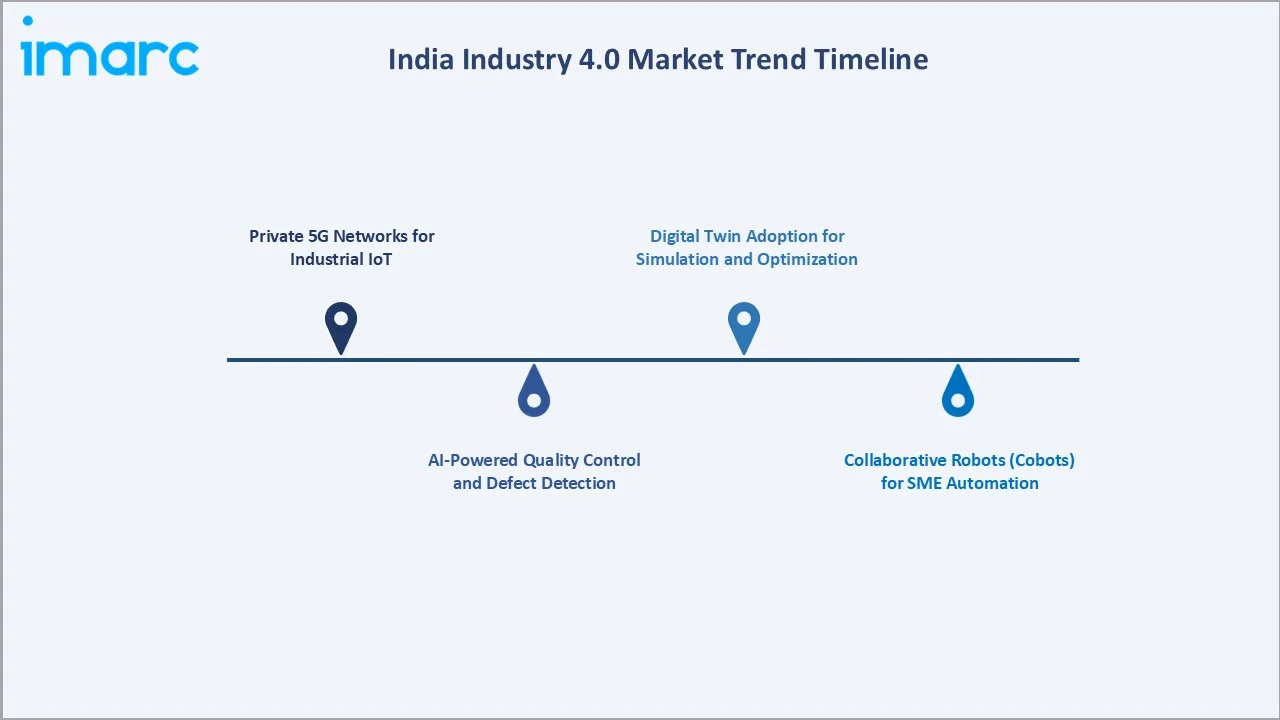
1. Private 5G Networks for Industrial IoT
Private 5G network deployments at Indian manufacturing campuses are emerging as a transformative connectivity layer enabling wireless industrial automation. Reliance Jio's enterprise 5G offerings are enabling manufacturers to deploy wireless CNC machines, autonomous mobile robots, and real-time video quality inspection without the latency constraints of public 5G networks.
2. AI-Powered Quality Control and Defect Detection
Computer vision-based AI quality inspection systems are achieving defect detection accuracy rates at production speeds beyond human inspection capability. Indian AI startups are developing manufacturing-specific AI vision platforms that are capturing early-mover positioning as domestic alternatives to international AI quality control systems, with Indian SME pricing accessibility superior to global incumbents.
3. Digital Twin Adoption for Simulation and Optimization
Digital twin technology, creating virtual replicas of manufacturing equipment, production lines, and entire factory layouts, is gaining adoption among India's automotive OEMs and large discrete manufacturers for production planning optimization, predictive maintenance, and new product launch simulation. In March 2026, Siemens launched the Teamcenter Digital Reality Viewer and Digital Twin Composer in India to strengthen industrial AI and digital twin capabilities. The solutions help enterprises simulate and optimize operations before implementation, reducing risks, rework, and capital costs.
4. Collaborative Robots (Cobots) for SME Automation
Collaborative robots, designed to work safely alongside human operators without protective fencing, are emerging as the automation technology of choice for India's SME manufacturers seeking entry-level industrial automation within budget constraints. In February 2025, Delta introduced its D-Bot series collaborative robots (cobots) in India under its Smart Manufacturing theme. The 6-axis cobots support payloads of up to 30 kg and are designed for applications such as electronics assembly, packaging, material handling, and welding.
Industry Value Chain Analysis
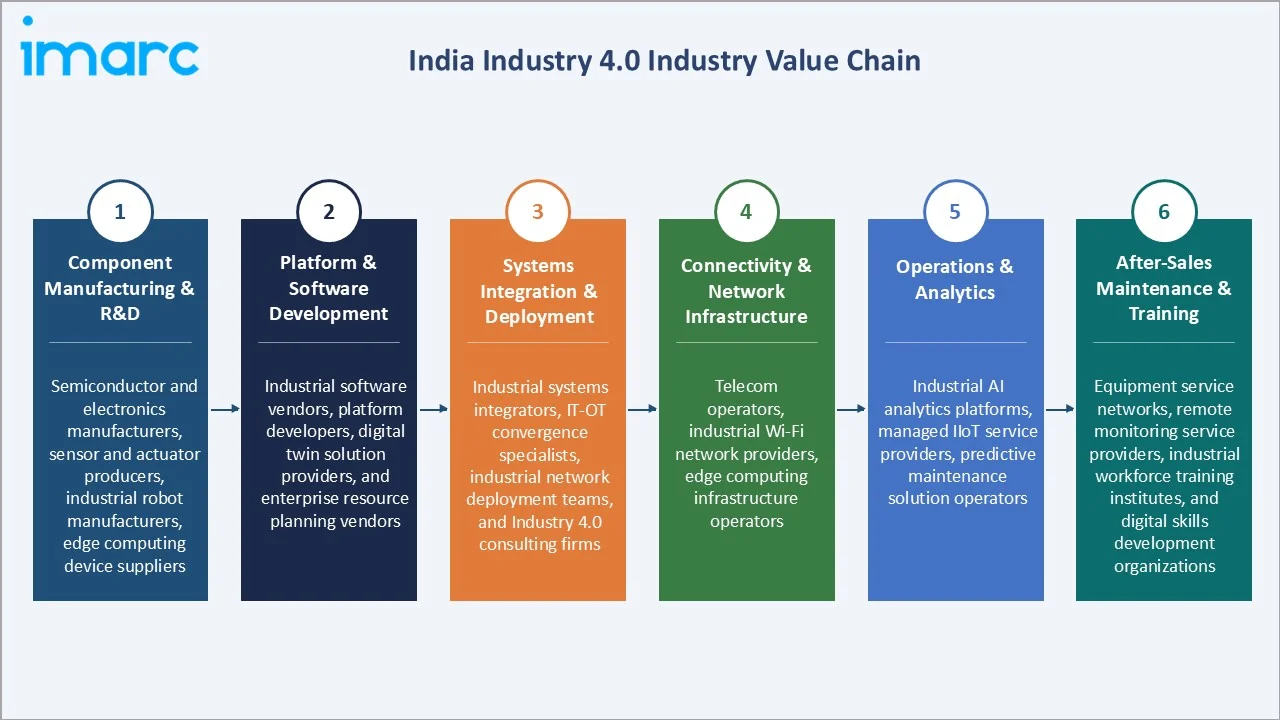
The India Industry 4.0 market value chain integrates component manufacturing and R&D, platform and software development, systems integration and deployment, connectivity and network infrastructure, operations and analytics, and after-sales maintenance and training.
|
Stage |
Key Participants |
|
Component Manufacturing & R&D |
Semiconductor and electronics manufacturers, sensor and actuator producers, industrial robot manufacturers, edge computing device suppliers. |
|
Platform & Software Development |
Industrial software vendors, platform developers, digital twin solution providers, and enterprise resource planning vendors. |
|
Systems Integration & Deployment |
Industrial systems integrators, IT-OT convergence specialists, industrial network deployment teams, and Industry 4.0 consulting firms. |
|
Connectivity & Network Infrastructure |
Telecom operators, industrial Wi-Fi network providers, edge computing infrastructure operators. |
|
Operations & Analytics |
Industrial AI analytics platforms, managed IIoT service providers, predictive maintenance solution operators. |
|
After-Sales Maintenance & Training |
Equipment service networks, remote monitoring service providers, industrial workforce training institutes, and digital skills development organizations. |
Systems integration and deployment represent the most value-added stage in the India Industry 4.0 value chain, as it directly determines the functional integration of hardware, software, and network components into coherent operational systems that deliver measurable productivity improvements. This phase requires the rarest combination of industrial domain expertise and digital technology knowledge, making qualified industrial systems integrators the scarcest and highest-margin participants in the ecosystem.
Technology Landscape in the India Industry 4.0 Market
Industrial IoT and Sensor Technology
Industrial IoT represents the foundational data acquisition layer of India's Industry 4.0 deployment, with connected sensors, smart meters, and industrial gateways enabling real-time monitoring of equipment health, energy consumption, environmental conditions, and production parameters. India's IIoT deployment is expanding rapidly across automotive, pharmaceuticals, and power generation, with Indian IIoT platform providers developing India-specific solutions that address local connectivity challenges, multilingual operator interfaces, and cost structures appropriate for Indian SME manufacturing contexts.
Industrial AI and Machine Learning
AI and machine learning applications in Indian manufacturing span predictive maintenance, visual quality inspection, demand forecasting, energy optimization, and supply chain risk prediction. India's large IT services sector provides a strong foundation of AI talent that is increasingly being directed toward industrial applications. Government-funded AI research is building India-specific industrial AI capabilities across sectors including agriculture processing, pharmaceutical manufacturing, and defense production.
Cloud and Edge Computing
Cloud computing provides scalable infrastructure for storing, processing, and analyzing manufacturing data across multiple facilities, while edge computing processes critical information closer to machines. Together, they support real-time analytics, remote monitoring, enterprise integration, and faster industrial decision-making. These technologies are becoming important enablers of interconnected smart factories.
Market Segmentation Analysis
The report covers the following segments:
|
Segment Category |
Leading Segment |
Market Share |
Year |
|
Component |
Hardware |
46.8% |
2025 |
|
Technology Type |
🔒 |
🔒 |
2025 |
|
End Use Industry |
Manufacturing |
34.8% |
2025 |
|
Region |
West and Central India |
36.4% |
2025 |

By Component
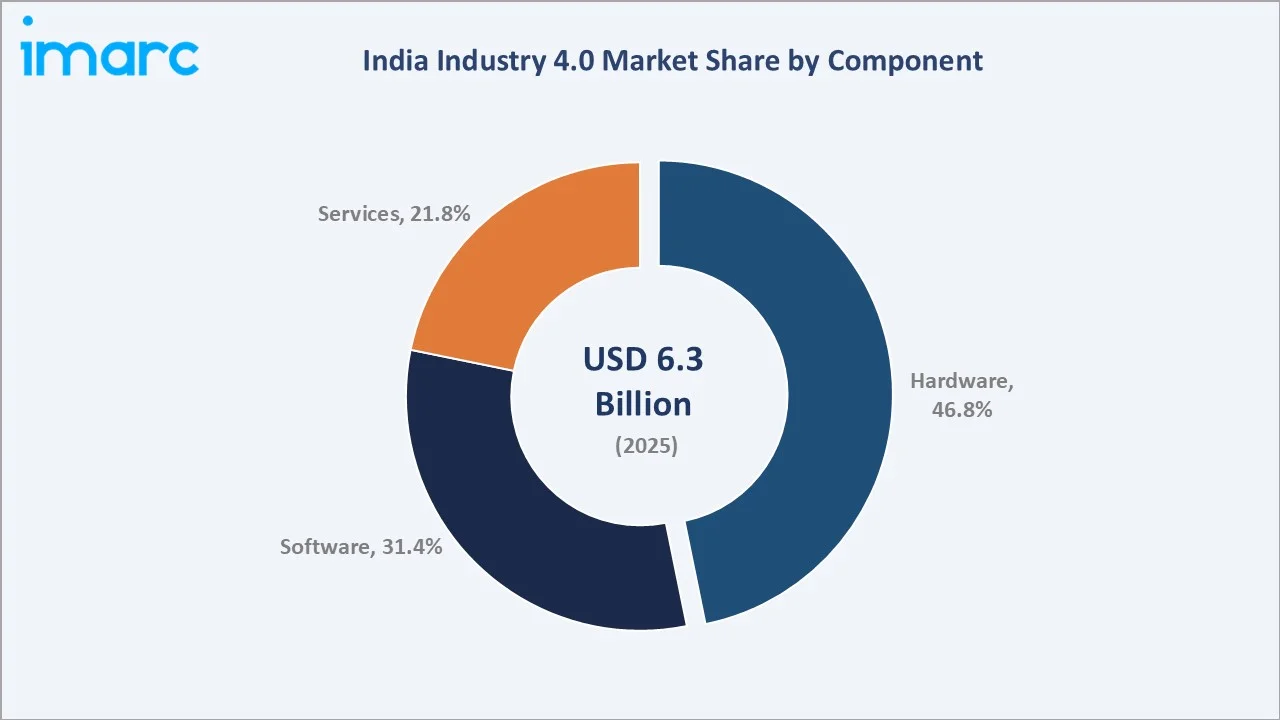
Hardware leads at 46.8% (2025), reflecting the physical investment intensity of Industry 4.0 implementations as manufacturers deploy IoT sensor networks, industrial controllers, robotic systems, edge computing devices, and smart factory equipment that form the operational foundation of digital manufacturing. India's manufacturing expansion is driving substantial new hardware procurement across PLI-beneficiary sectors.
To access detailed market analysis, Request Sample
Software accounts for 31.4% (2025), growing rapidly as manufacturers move beyond hardware deployment to implement industrial software platforms including AI analytics, digital twin, MES, and cloud integration. Services hold 21.8% (2025), representing systems integration, consulting, implementation, and managed services that are the highest-margin component as Industry 4.0 project complexity increases demand for specialized expertise.
By End Use Industry
Manufacturing leads at 34.8% (2025), driven by PLI scheme-induced smart factory investment, quality automation requirements for export market compliance, and the productivity imperatives of competing with global manufacturing benchmarks.
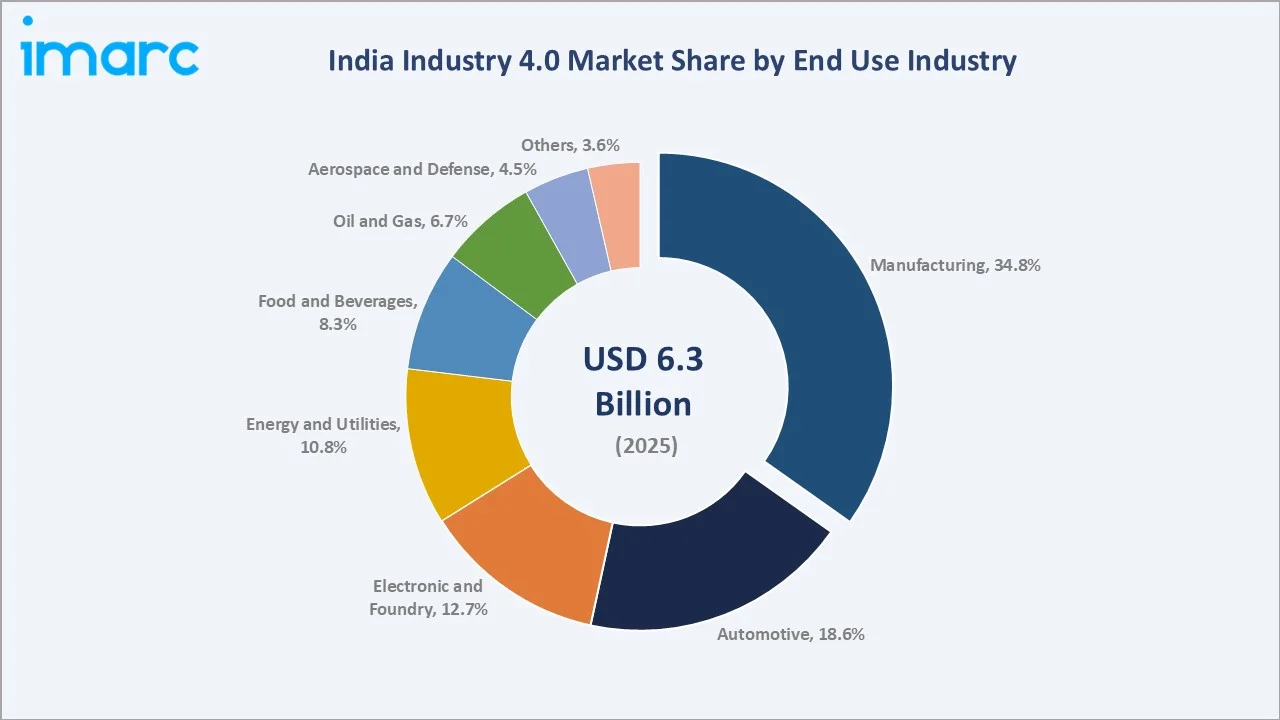
Automotive holds 18.6% (2025), reflecting the automotive sector's global Industry 4.0 adoption standards embedded in OEM supplier requirements. Electronic and foundry account for 12.7% (2025), growing rapidly through semiconductor mission investments. Energy and utilities represent 10.8%. Food and beverages hold 8.3%, oil and gas 6.7%, aerospace and defense 4.5% (fastest-growing), and others 3.6%.
Regional Market Insights
|
Region |
Share (2025) |
Key India Industry 4.0 Market Drivers & Characteristics |
|
West & Central India |
36.4% |
Largest market driven by Maharashtra and Gujarat's concentration of industrial corridors, automotive manufacturing, pharmaceutical manufacturing, and a growing industrial base under smart manufacturing initiatives. |
|
South India |
29.2% |
Fast-growing region driven by Bengaluru and Hyderabad's technology ecosystem enabling Industry 4.0 platform development. |
|
North India |
21.6% |
Growing market anchored by Delhi NCR's electronics and auto components manufacturing and Uttar Pradesh's defense manufacturing corridor. |
|
East & Northeast India |
12.8% |
Emerging market with growing Industry 4.0 adoption in West Bengal's manufacturing sector and Odisha's steel and mining industry digitalization. |
West and Central India's 36.4% leadership reflects the region's unmatched industrial infrastructure concentration, hosting India's largest automotive, pharmaceutical, chemical, and consumer goods manufacturing clusters, combined with Maharashtra and Gujarat's proactive smart manufacturing policy environments. South India's 29.2% and strong growth trajectory reflect Bengaluru's unique dual role as both India's leading technology platform development hub and a growing aerospace and semiconductor manufacturing center.
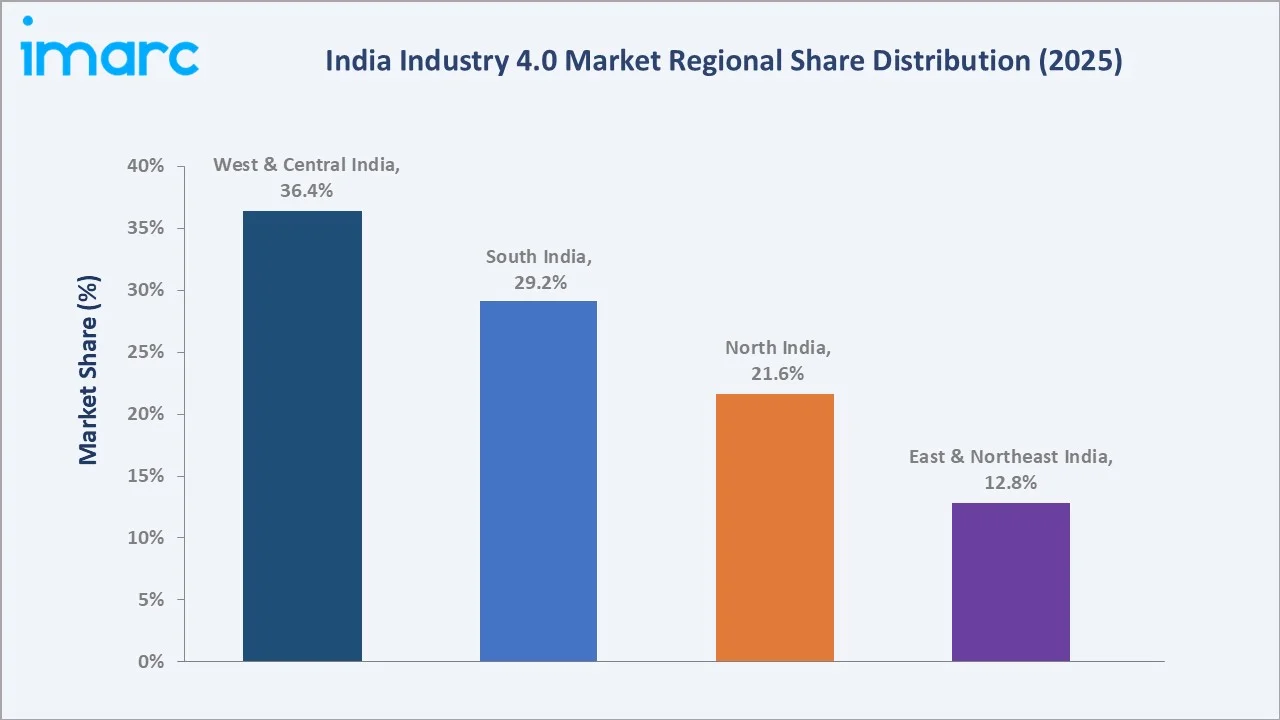
North India at 21.6% benefits from Delhi NCR's large electronics and auto components manufacturing base, Rajasthan's solar and cement industry digital adoption, and Uttar Pradesh's defense manufacturing corridor. East and Northeast India at 12.8% represents the highest growth opportunity region, with Odisha and Jharkhand's steel industry digital transformation and West Bengal's expanding manufacturing sector creating growing Industry 4.0 investment demand.
Competitive Landscape
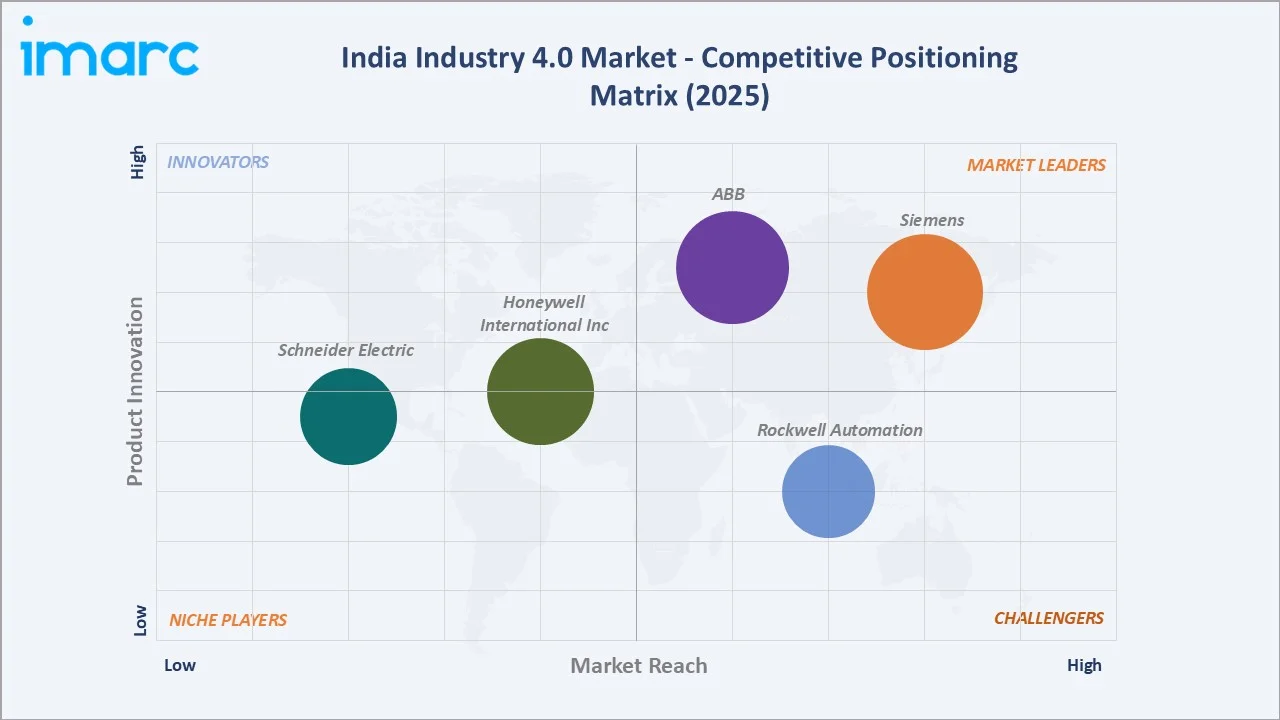
The India Industry 4.0 market is moderately concentrated, with multinational technology giants, European industrial automation leaders, and Indian technology services companies competing across hardware, software, and services segments. Market participants compete on technology portfolio breadth, industrial domain expertise, system integration capability, local manufacturing presence, and after-sales service network quality. AI capabilities, 5G integration expertise, and sector-specific Industry 4.0 solution depth are emerging as key competitive differentiators.
|
Company |
Key Offerings |
Market Position |
Core Strength |
|
Siemens |
Siemens Xcelerator, SIMATIC Automation, Digital Twin |
Market Leader |
Siemens is driving India’s Industry 4.0 revolution by providing the core software, automation, and industrial artificial intelligence (AI) infrastructure required to modernize factories. |
|
ABB |
Articulated Robots, Collaborative Robots, Delta Robots, SCARA Robots, ABB Ability |
Market Leader |
ABB provides foundational technologies like advanced robotics, AI-driven analytics, and smart automation. |
|
Honeywell International Inc |
MIP Series, V7 Series, OmniPoint, ControlEdge RTU, ThermAir |
Established Player |
By combining industrial automation, edge devices, and enterprise software, Honeywell helps Indian manufacturers transition from traditional production to smart, data-driven, and autonomous operations. |
|
Rockwell Automation |
Robot Automation, Smart Manufacturing, Industrial Automation and Control Systems |
Challenger |
The company provides critical technology for local industries. It works to bridge digital skill gaps and develops automation and cloud-based software tailored to the Indian manufacturing sector. |
|
Schneider Electric |
EcoStruxure Platform, AVEVA |
Established Player |
Acts as a key technology partner, helping factories and businesses automate, digitize, and save energy using AI, IoT, and cloud computing |
Companies are also investing in AI-powered analytics platforms, private 5G integration capabilities, industrial cybersecurity practices, and sector-specific Industry 4.0 solutions for defense, semiconductor, and pharmaceutical manufacturing to differentiate in India's rapidly evolving smart manufacturing market. The market is expected to see further consolidation through partnerships between multinational automation vendors and Indian IT services companies.
Key Company Profiles
Siemens
Siemens is the leading industrial automation and digital manufacturing company, operating manufacturing facilities in India that themselves serve as showroom smart factories demonstrating Industry 4.0 capabilities. Siemens' Xcelerator digital business platform, integrating digital twin, industrial IoT, AI analytics, and cloud connectivity, is India's most comprehensive Industry 4.0 platform offering. The company serves India's largest manufacturing enterprises across automotive, pharmaceuticals, power generation, and process industries.
- Key Offerings: Siemens Xcelerator, SIMATIC Automation, Digital Twin.
- Strategic Focus: Xcelerator platform adoption deepening across India's manufacturing sector, factory low-carbon manufacturing showcase, semiconductor and defense manufacturing sector expansion, digital enterprise transformation consulting for PLI scheme beneficiaries.
ABB
ABB is a leading provider of industrial robotics, process automation, electrification, and motion control technologies, serving India's manufacturing, energy, and infrastructure sectors from its India robotics manufacturing facility. ABB Ability platform enables remote monitoring and predictive maintenance for ABB-installed equipment base across Indian industries. The company's collaborative robots are gaining adoption across automotive and electronics manufacturing.
- Key Offerings: Articulated Robots, Collaborative Robots, Delta Robots, SCARA Robots, ABB Ability.
- Strategic Focus: Collaborative robot market expansion in India's auto ancillary and electronics manufacturing, ABB Ability platform service growth, energy transition automation for renewable energy facilities, and pharma and food automation segment deepening.
Market Concentration Analysis
The India Industry 4.0 market is moderately concentrated in the premium enterprise segment, with multinational technology leaders including Siemens, ABB, Honeywell International Inc, and Rockwell Automation collectively estimated to account for approximately 45-55% of organized market revenue in 2025. Indian IT services companies are capturing growing software and services revenue as system integrators and platform implementers, representing a significant and expanding share of the market's software and services component.
Fragmentation persists in the SME manufacturing segment, where unstructured IT vendors, regional automation companies, and unorganized digital consultancies compete for smaller-scale Industry 4.0 implementation projects. The market is expected to see increasing consolidation as international automation vendors acquire domestic Indian software companies to build integrated OT+IT portfolios, and as Indian IT companies deepen operational technology partnerships with hardware automation leaders.
Investment & Growth Opportunities
Highest Growth Segments
Aerospace and defense Industry 4.0 (~14.2% CAGR), electronic and foundry smart manufacturing (~13.5% CAGR), services and system integration (~13.1% CAGR), South India technology-manufacturing convergence, and SME digital manufacturing programs represent the highest-growth investment vectors in the India Industry 4.0 market through 2034.
Investment Themes
- Semiconductor and advanced electronics manufacturing automation: India's National Semiconductor Mission targeting fab investments requires world-class process automation, contamination monitoring, and yield optimization systems representing multi-billion-dollar Industry 4.0 hardware and software procurement. First-mover service and supply relationships with planned Indian semiconductor fabrication facilities offer decades of recurring equipment and software revenue.
- SME Industry 4.0 as-a-Service models: India's SME manufacturers represent a large and largely untapped Industry 4.0 market accessible only through affordable subscription models, IIoT monitoring as a service, cloud MES on pay-per-use, and cobot leasing that eliminate prohibitive upfront capital requirements. Platform providers succeeding in SME Industry 4.0 capture enormous scale and become deeply embedded infrastructure partners.
- AI and predictive analytics platform for Indian manufacturing: Building AI analytics platforms trained on Indian manufacturing data creates competitive advantages over global platforms that are calibrated to non-Indian industrial contexts. Domestic AI platform providers serve as preferred vendors for data-sensitive Indian defense and pharmaceutical manufacturers.
Future Market Outlook (2026-2034)
The India Industry 4.0 market is projected to grow from USD 6.3 Billion in 2025 to USD 17.8 Billion by 2034, delivering a 11.91% CAGR over the forecast period through PLI scheme-driven smart factory investment, semiconductor mission-linked electronics manufacturing automation, 5G-enabled IIoT expansion, AI-powered industrial optimization adoption, and progressive SME digitization across India's vast manufacturing ecosystem. The market's anchor value of USD 11.0 Billion in 2030 represents India's Industry 4.0 ecosystem at autonomous manufacturing technology mainstream adoption and private 5G industrial network widespread deployment inflection.
Three structural forces are expected to define the growth of the India Industry 4.0 market through 2034. First, India's industrial policy ambition will create a sustained, policy-backed demand wave for smart manufacturing technologies across India's highest-value industrial sectors through the entire forecast period. Second, the maturation of India's 5G private network infrastructure combined with falling AI compute costs and increasing availability of industrial AI trained on Indian manufacturing data will make the productivity case for Industry 4.0 adoption compelling even for cost-conscious SME manufacturers, dramatically expanding the addressable market beyond current large enterprise deployments. Third, India's unique combination of the largest engineering graduate supply, a mature IT services ecosystem with growing OT competence, and a government committed to digital manufacturing leadership will position India not merely as an Industry 4.0 adopter but as a global exporter of Industry 4.0 solutions.
Research Methodology
Primary Research
Primary research comprised in-depth interviews with senior executives from industrial automation vendors, Industry 4.0 technology platform providers, manufacturing enterprise technology leaders, system integrators, and industry analysts covering India's manufacturing digital transformation. Discussions validated market size estimates, assessed PLI scheme adoption impact, evaluated competitive dynamics, and provided insights into regulatory developments, technology investment priorities, and long-term growth opportunities across India's Industry 4.0 market.
Secondary Research
Secondary research encompassed company financial disclosures, PLI scheme progress reports, semiconductor mission documentation, manufacturing technology reports, AI strategy publications, smart manufacturing surveys, industrial robotics data, and credible technology industry analyst publications. These sources supported market trend analysis, competitive positioning assessment, regional adoption data, and sector-specific Industry 4.0 penetration analysis.
Forecasting Models
Forecasting models were developed using historical market revenue data, PLI scheme investment trajectory projections, semiconductor mission implementation timelines, 5G industrial adoption rate forecasts, and macroeconomic indicators. Both top-down and bottom-up approaches were applied and validated through primary expert consultations. SME digitization program adoption rates, AI platform penetration trajectories, defense smart manufacturing investment programs, and competitive platform consolidation dynamics were incorporated to generate reliable forecasts through 2034.
India Industry 4.0 Market Report Coverage:
| Report Features | Details |
|---|---|
| Base Year of the Analysis | 2025 |
| Historical Period | 2020-2025 |
| Forecast Period | 2026-2034 |
| Units | Billion USD |
| Scope of the Report | Exploration of Historical Trends and Market Outlook, Industry Catalysts and Challenges, Segment-Wise Historical and Future Market Assessment:
|
| Components Covered | Hardware, Software, Services |
| Technology Types Covered | Industrial Robotics, Industrial IoT, AI and ML, Blockchain, Extended Reality, Digital Twin, 3D Printing, Others |
| End Use Industries Covered | Manufacturing, Automotive, Oil and Gas, Energy and Utilities, Electronic and Foundry, Food and Beverages, Aerospace and Defense, Others |
| Regions Covered | North India, West and Central India, South India, East and Northeast India |
| Companies Covered | Siemens, ABB, Honeywell International Inc, Rockwell Automation, Schneider Electric, etc. |
| Customization Scope | 10% Free Customization |
| Post-Sale Analyst Support | 10-12 Weeks |
| Delivery Format | PDF and Excel through Email (We can also provide the editable version of the report in PPT/Word format on special request) |
Key Benefits for Stakeholders:
- IMARC’s industry report offers a comprehensive quantitative analysis of various market segments, historical and current market trends, market forecasts, and dynamics of the India industry 4.0 market from 2020-2034.
- The research report provides the latest information on the market drivers, challenges, and opportunities in the India industry 4.0 market.
- Porter's five forces analysis assist stakeholders in assessing the impact of new entrants, competitive rivalry, supplier power, buyer power, and the threat of substitution. It helps stakeholders to analyze the level of competition within the India industry 4.0 industry and its attractiveness.
- Competitive landscape allows stakeholders to understand their competitive environment and provides an insight into the current positions of key players in the market.
Frequently Asked Questions About the India Industry 4.0 Market Report
The India Industry 4.0 market reached USD 6.3 Billion in 2025, driven by PLI scheme-induced smart manufacturing investment, rapid industrial IoT and robotics adoption, and 5G rollout enabling new industrial connectivity capabilities. Growing government digital manufacturing initiatives and enterprise productivity imperatives are further supporting near-term market growth.
The India Industry 4.0 market grows at 11.91% CAGR during 2026-2034, reaching USD 17.8 Billion by 2034. The CAGR reflects policy-backed smart manufacturing investment, semiconductor mission-linked electronics automation demand, 5G-enabled IIoT expansion, AI adoption acceleration, and progressive SME manufacturing digitization across India's vast industrial base.
Hardware leads at 46.8% (2025), reflecting the physical investment intensity of Industry 4.0 implementations as manufacturers deploy IoT sensor networks, industrial robots, edge computing devices, and connected factory equipment that form the operational foundation of digital manufacturing across India's expanding PLI-scheme production facilities.
Manufacturing dominates at 34.8% (2025), driven by PLI scheme-linked smart factory investments, global supply chain quality requirements mandating automation, and the productivity imperatives of India's ambition to become one of the top manufacturing destinations, requiring Industry 4.0 productivity benchmarks.
West and Central India leads at 36.4% (2025), anchored by Maharashtra and Gujarat's industrial corridor concentration, including automotive clusters, pharmaceutical manufacturing belts, and chemical processing zones representing India's highest density of PLI-beneficiary manufacturers and international OEM supplier factories.
Leading companies include Siemens, ABB, Honeywell International Inc, Rockwell Automation, and Schneider Electric, among others.
The market is projected to reach approximately USD 11.0 Billion by 2030, representing the ecosystem at autonomous manufacturing technology mainstream adoption and private 5G industrial network widespread deployment. Growth will be anchored by semiconductor fab Industry 4.0 investments, defense smart manufacturing, and South India's technology-manufacturing convergence.
Priority investment opportunities include semiconductor and advanced electronics manufacturing automation aligned with National Semiconductor Mission fab investments, SME Industry 4.0 as-a-Service platforms enabling affordable modular adoption, AI analytics platforms trained on Indian manufacturing data, and defense precision manufacturing automation under domestic procurement mandates.
Need more help?
- Speak to our experienced analysts for insights on the current market scenarios.
- Include additional segments and countries to customize the report as per your requirement.
- Gain an unparalleled competitive advantage in your domain by understanding how to utilize the report and positively impacting your operations and revenue.
- For further assistance, please connect with our analysts.
 Request Customization
 Speak to an Analyst
 Request Brochure
 Inquire Before Buying
Benefits of Customization
- Personalize this research
- Triangulate with your data
- Get data as per your format and definition
- Gain a deeper dive into a specific application, geography, customer, or competitor
- Any level of personalization
Get in Touch With Us
UNITED STATES
Phone: +1-201-971-6302
INDIA
Phone: +91-120-433-0800
UNITED KINGDOM
Phone: +44-753-714-6104
Email: [email protected]
Client Testimonials




.webp)




.webp)













Related Reports

Choose your plan
*Please note that the prices mentioned below are starting prices for each bundle type. Kindly contact our team for further details.*
Single User License
- 1 User License, Access on 2 Devices
- PDF Report + Excel Dataset (Password Protected)
- Lifetime Access
- No Printing Rights
- 10% Free Report Customization
- 10–12 Weeks of Analyst Support
Five User License
- Access for 5 Users, 2 Devices per User
- PDF Report + Excel Dataset (Password Protected)
- Lifetime Access
- Dedicated Account Manager
- 12–14 Weeks of Analyst Support
- No Printing Rights
- 15% Free Report Customization
- 25% Discount on Your Next Purchase
Corporate User License
- Unlimited User Access (Within Your Organization)
- PDF Report + Excel Dataset
- Lifetime Access
- Dedicated Account Manager
- 14–20 Weeks of Analyst Support
- No Printing Rights
- 20% Free Report Customization
- 30% Discount on Your Next Purchase
Essential Insights
What's included:
3 reports
- Lifetime Access
- PDF Reports
- Excel Datasets
- 2 Weeks of Free Analyst Support
- 2 User Licenses
- Access on 2 Devices
- Printing Rights
- Complimentary PowerPoint (PPT) Version
- Complimentary License Upgrade
Professional Access
What's included:
5 reports
- Lifetime Access
- PDF Reports
- Excel Datasets
- 8 Weeks of Free Analyst Support
- 2 User Licenses
- Access on 2 Devices
- Printing Rights
- Complimentary PowerPoint (PPT) Version
- Complimentary License Upgrade
Business Advantage
What's included:
8 reports
- Lifetime Access
- PDF Reports
- Excel Datasets
- 14 Weeks of Free Analyst Support
- 2 User Licenses
- Access on 2 Devices
- Printing Rights
- Complimentary PowerPoint (PPT) Version
- Complimentary License Upgrade
Enterprise Intelligence
What's included:
10 reports
- Lifetime Access
- PDF Reports
- Excel Datasets
- 20 Weeks of Free Analyst Support
- 2 User Licenses
- Access on 2 Devices
- Printing Rights
- Complimentary PowerPoint (PPT) Version
- Complimentary License Upgrade