
India Mining Truck Market Size, Share, Trends and Forecast by Type, Application, Payload Capacity, Drive, and Region, 2026-2034
India Mining Truck Market Size, Share, Trends & Forecast (2026-2034)
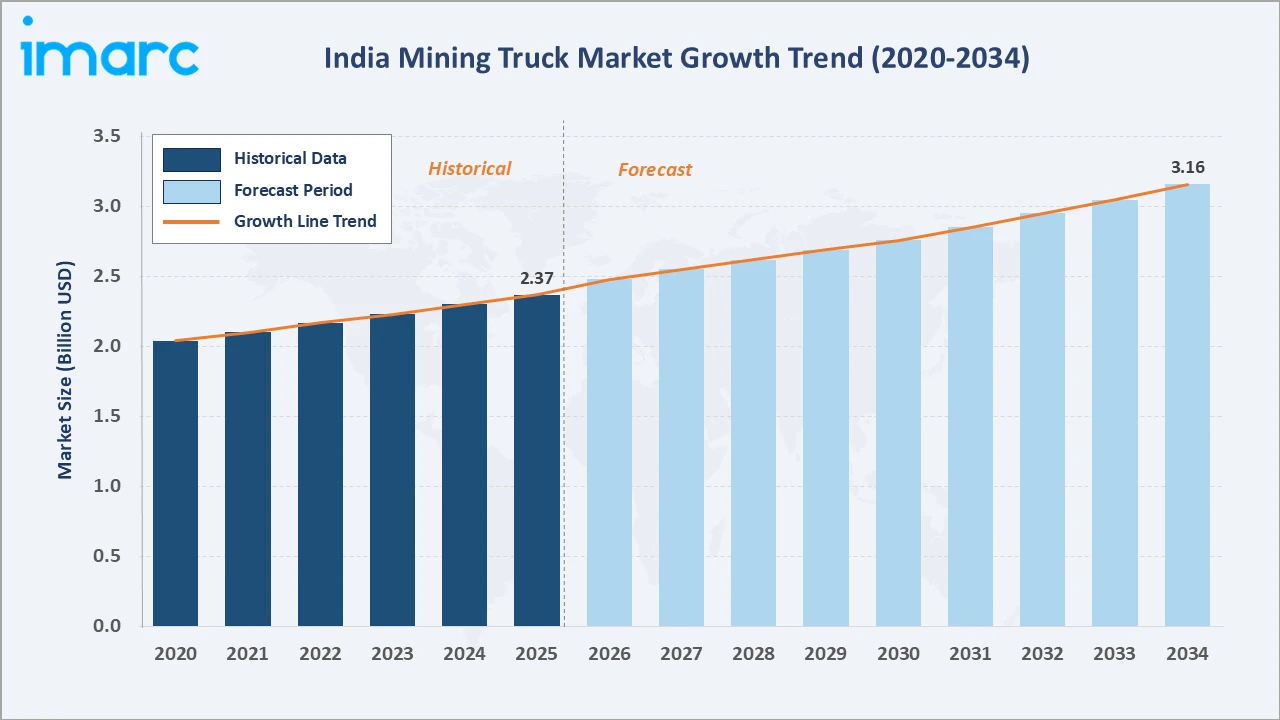
The India mining truck market grew from USD 2.37 Billion in 2025 to USD 2.48 Billion in 2026 and will reach USD 3.16 Billion by 2034, at a CAGR of 3.06%. India produced 1,040.08 million tonnes of coal in FY 2025-26.
Rising coal output, iron ore mining, and fleet modernization are reshaping demand for every mining truck in India. Rear dump trucks dominate types at 48.0%. Coal mining leads applications at 48.0%. East India commands 38.0% of national market share, supported by its large coal and mineral belts.
Market Snapshot
|
Metric |
Value |
|
Base Year Market Size (2025) |
USD 2.37 Billion |
|
Market Size (2026) |
USD 2.48 Billion |
|
Forecast Market Size (2034) |
USD 3.16 Billion |
|
CAGR (2026-2034) |
3.06% |
|
Base Year |
2025 |
|
Historical Period |
2020-2025 |
|
Forecast Period |
2026-2034 |
|
Dominant Type |
Rear Dump (48.0%, 2025) |
|
Dominant Application |
Coal Mining (48.0%, 2025) |
|
Leading Region |
East India (38.0%, 2025) |
The India mining truck market size increased from USD 2.04 Billion in 2020 to USD 2.37 Billion in 2025 and is estimated to reach USD 2.48 Billion in 2026. It is expected to reach USD 2.76 Billion by 2030 and USD 3.16 Billion by 2034, reflecting steady fleet demand.
To get more information on this market, Request Sample
Copper mining is expected to grow fastest at ~4.2% CAGR, supported by demand for copper in power networks and electric vehicles. Water trucks follow at ~3.5% CAGR as dust control rules tighten, while West India grows at ~3.4% with rising lignite and mineral output.
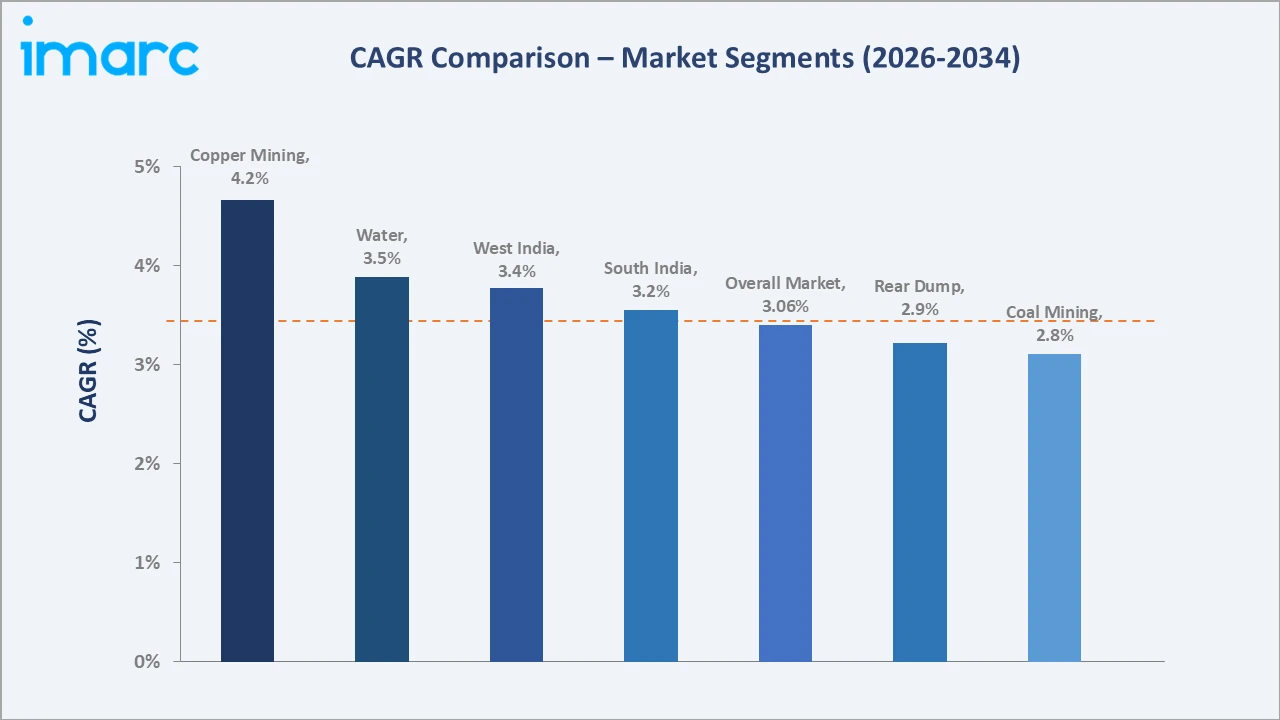
Rear dump trucks grow at ~2.9% CAGR and coal mining at ~2.8%, while South India grows at ~3.2% through iron ore and lignite mining in Karnataka and Tamil Nadu.
Executive Summary
The India mining truck market expanded from USD 2.37 Billion in 2025 to USD 2.48 Billion in 2026 and is projected to reach USD 3.16 Billion by 2034. Fleet renewal is accelerating. Rear dump trucks lead at 48.0%, coal mining at 48.0%, and East India at 38.0%.
Domestic and global manufacturers continue to lead large rigid dump trucks, while commercial vehicle makers are gaining ground in mining tippers. Rising interest in electric trucks, higher payloads, and connected fleets signals a more advanced India mining truck market over the forecast period.
Key Market Insights
|
Insight |
Data |
|
Dominant Type |
Rear Dump - 48.0% share (2025) |
|
Dominant Application |
Coal Mining - 48.0% market share (2025) |
|
Leading Region |
East India - 38.0% share (2025) |
|
Market Opportunity |
Electric dump trucks; higher-payload trucks for coal; fleet telematics; after-sales services; fleets for commercial coal blocks |
Key Analytical Observations Supporting the Above Data:
- Rear Dump at 48.0%: Rear dump trucks dominate because they are the standard haulage machine in opencast coal and iron ore mines. Their rigid frames, high payloads, and compatibility with shovels and excavators make them the preferred choice for overburden and mineral movement.
- Coal Mining at 48.0%: Coal mining leads because coal remains India's main source of power generation. Opencast mines operated by Coal India, Singareni Collieries, and captive and commercial block owners rely on large truck fleets to move coal and overburden.
- East India at 38.0%: East India leads due to its vast coalfields in Jharkhand, Odisha, Chhattisgarh, and West Bengal, along with major iron ore and bauxite reserves. Most Coal India subsidiaries operate their largest opencast mines in this region.
India Mining Truck Market Overview
Mining trucks are heavy-duty, off-highway vehicles used to haul coal, ore, overburden, and other materials in opencast mines. They include rear dump, bottom dump, water, lube, and tow trucks, along with heavy mining tippers used in smaller and shallow mining operations.
The India mining truck industry links component suppliers, truck manufacturers, dealers, financiers, mine developers and operators, mining companies, and regulators. Coal output, mineral auctions, fleet replacement cycles, fuel costs, and safety norms shape demand for each mining truck in India across all regions.
India is the world's second-largest coal producer, and opencast mines account for most of its coal output. Large opencast coal, iron ore, bauxite, and limestone mines create steady demand for haulage trucks and support vehicles.
Market Dynamics
To evaluate market opportunities, Request Sample
Market Drivers
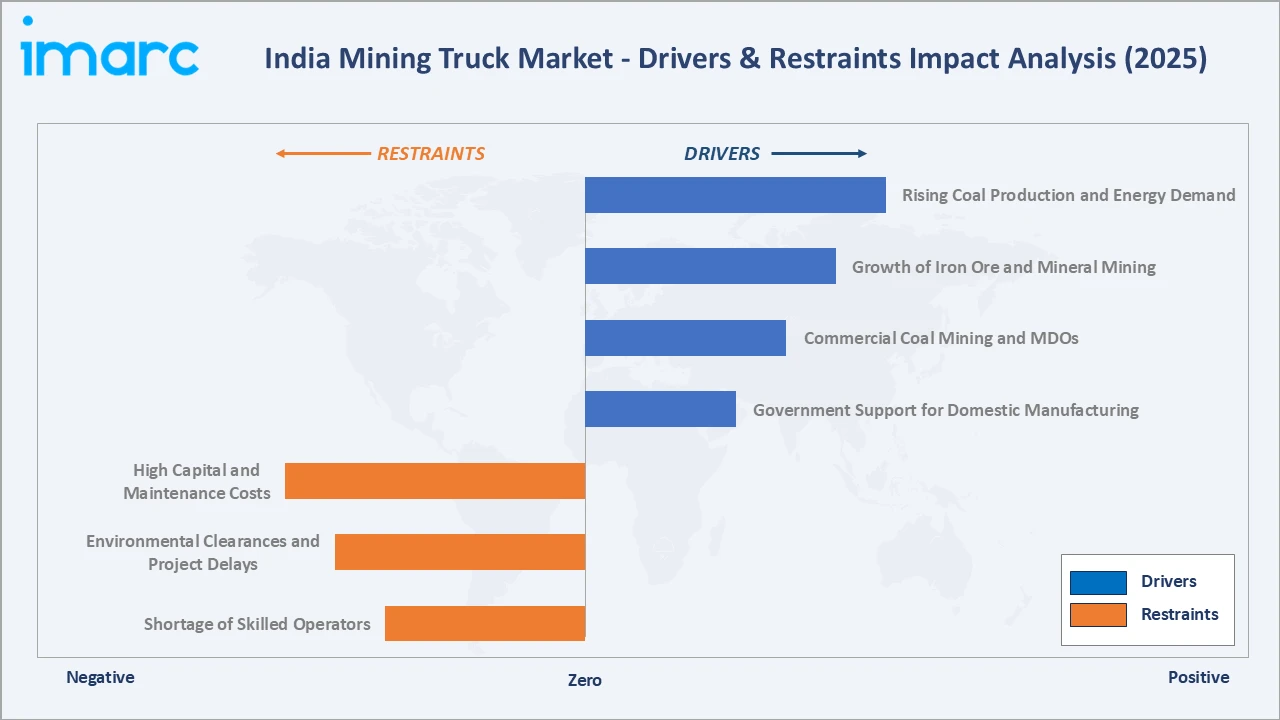
- Rising Coal Production and Energy Demand: Coal still fuels most of India's electricity, and domestic production has crossed one billion tonnes. Expanding opencast output requires more haulage capacity, supporting steady purchases of rear dump trucks, water trucks, and support vehicles.
- Coal India and Singareni Collieries continue to expand opencast capacity to meet power sector demand. Higher production targets require more trucks and replacement of old fleets with modern, fuel-efficient models.
- Growth of Iron Ore and Mineral Mining: Rising steel production is increasing demand for iron ore, limestone, and bauxite. Mineral block auctions and capacity expansions by NMDC and private miners are creating new demand for medium and large mining trucks.
- The National Critical Mineral Mission and mineral block auctions are opening new mines for copper, bauxite, and other minerals. These projects require trucks suited to different payloads, terrains, and haul distances.
- Commercial Coal Mining and MDO Contracts: Captive and commercial coal blocks are adding new mining capacity each year. Mine developers and operators and contractors purchase large truck fleets to meet production targets, broadening the customer base beyond public sector miners.
- Many new coal blocks are operated by private companies and contractors that prefer reliable trucks with strong service support. Long-term mining contracts encourage contractors to invest in modern fleets.
- Government Support for Domestic Manufacturing: Make in India policies and public procurement preferences encourage local production of mining equipment. Domestic manufacturers and global companies with Indian plants benefit from indigenization, shorter delivery times, and easier access to spare parts.
- Several global manufacturers produce dump trucks in India, while domestic companies are developing indigenous models. Local manufacturing also supports exports of mining trucks to neighboring and overseas markets.
Market Restraints
- High Capital and Maintenance Costs: Large mining trucks require heavy upfront investment, and tyres, engines, and spare parts add to operating costs. Smaller miners and contractors often delay purchases or rely on used equipment and tippers instead of new trucks.
- Equipment financing, leasing, and rental options help contractors manage capital costs. Manufacturers also offer maintenance contracts and parts packages that make operating costs more predictable for miners.
- Environmental Clearances and Project Delays: Mining projects need forest, environmental, and land approvals that can take years. Delays in clearances and land acquisition slow the start of new mines, postponing fleet orders and creating uncertainty for equipment suppliers.
- Single-window clearance systems and faster approvals for coal blocks are helping reduce delays. However, land acquisition and local issues still affect project timelines in several mining regions.
- Shortage of Skilled Operators: Operating and maintaining large mining trucks requires trained operators and technicians. Shortages of skilled workers in remote mining regions can reduce fleet productivity, increase downtime, and raise safety risks at mine sites.
- Manufacturers and miners are investing in operator training centers, simulators, and skill development programs. Driver assistance and safety systems also help reduce errors and raise productivity.
Market Opportunities
- Electric and Alternative-Fuel Mining Trucks: Battery-electric dump trucks and tippers offer lower operating costs and zero tailpipe emissions. Miners seeking to cut diesel use and carbon emissions are creating early demand for electric trucks and charging solutions.
- Electric trucks are well suited to mines with downhill loaded hauls and access to grid power. Manufacturers are offering charging infrastructure and battery services to support early fleet deployments.
- Connected Fleets and After-Sales Services: Telematics, payload monitoring, and predictive maintenance help miners improve truck availability. Annual maintenance contracts, spare parts, and remanufacturing services offer manufacturers and dealers recurring revenue across the truck life cycle.
- Miners increasingly prefer suppliers that guarantee truck availability through service contracts. Remote monitoring helps prevent costly truck breakdowns.
Market Challenges
- Harsh Operating Conditions: Heat, dust, heavy rainfall, and steep haul roads place severe stress on trucks, tyres, and components. Monsoon disruptions reduce mining activity for months, affecting fleet utilization and the timing of new purchases.
- Manufacturers are designing trucks with stronger frames, better cooling, and dust-resistant components for Indian conditions. Improved haul road maintenance also helps extend truck and tyre life.
- Dependence on Imported Components: Large trucks often rely on imported engines, drivetrains, and electronic systems. Currency movements and supply delays can raise costs and extend delivery times, encouraging manufacturers to localize more critical components.
- Domestic manufacturers and global companies with Indian plants are increasing local sourcing of frames, bodies, and components. Localization reduces costs and improves spare parts availability.
Emerging Market Trends
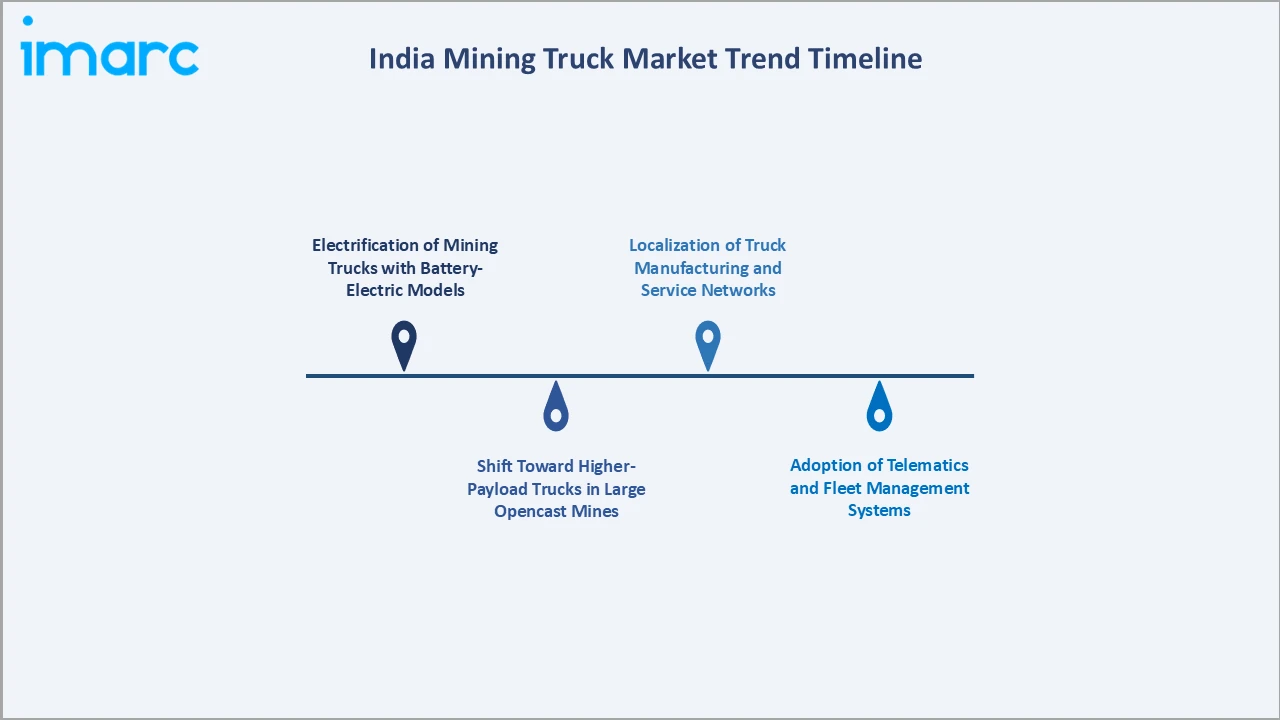
1. Electrification of Mining Trucks
Manufacturers are launching battery-electric dump trucks and tippers designed for Indian mines. India mining truck market analysis shows electric models attracting interest from coal and mineral miners seeking lower operating costs and reduced emissions.
Electric dump trucks are being trialed in coal and mineral mines, with charging systems designed for mine sites. Electric tippers are also gaining interest for shallow mining and mineral movement.
2. Shift Toward Higher-Payload Trucks
Large coal mines are moving to trucks with payloads above 100 tonnes to reduce cost per tonne. Higher-payload trucks paired with large shovels improve productivity and reduce the number of trucks on haul roads.
Bigger trucks require wider haul roads, larger loading equipment, and skilled operators. Large public sector mines are leading this shift, while smaller mines still use tippers.
3. Telematics and Fleet Management Systems
Miners are adopting fleet management systems, GPS tracking, and payload monitoring to optimize truck dispatch and cycle times. Data from connected trucks helps reduce fuel use, idle time, and unplanned breakdowns.
Real-time monitoring of truck health helps miners schedule maintenance and avoid unplanned downtime. Connected fleet data also supports better production planning and safety management.
4. Localization of Manufacturing and Service
Manufacturers are expanding Indian production, assembly, and parts distribution to serve mining customers faster. Plants and service centers located near coalfields reduce delivery times and support higher fleet availability.
Local manufacturing and parts warehouses help manufacturers respond quickly to customer needs. Remanufacturing centers in India also extend the life of engines, transmissions, and other major components.
Industry Value Chain Analysis
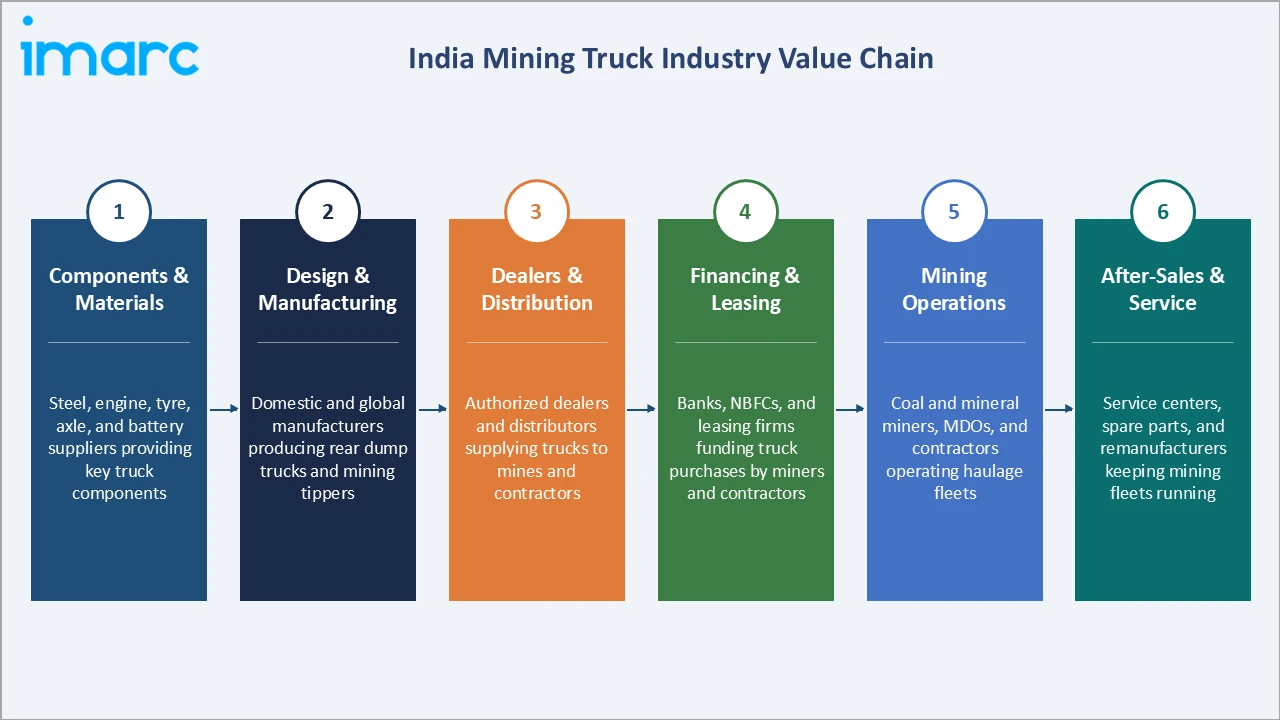
The India mining truck value chain spans components and materials, design and manufacturing, dealers and distribution, financing and leasing, mining operations, and after-sales service. Value is concentrated in manufacturing technology and after-sales support, which shape truck reliability, uptime, and customer loyalty.
|
Stage |
Key Participants |
|
Components & Materials |
Steel, engine, tyre, axle, and battery suppliers |
|
Design & Manufacturing |
Domestic and global mining truck manufacturers |
|
Dealers & Distribution |
Authorized dealers and equipment distributors |
|
Financing & Leasing |
Banks, NBFCs, and equipment leasing firms |
|
Mining Operations |
Coal and mineral miners, MDOs, and contractors |
|
After-Sales & Service |
Service centers, spare parts, and remanufacturers |
Design and manufacturing is the most consequential stage, as payload, engine power, durability, and fuel efficiency determine truck productivity and operating cost. After-sales service also matters greatly because spare parts availability and quick repairs keep trucks running in demanding mining conditions.
Financing and leasing support truck purchases by contractors, while dealers determine service reach. After-sales parts, maintenance, and remanufacturing are becoming increasingly important for keeping fleets productive throughout the truck life cycle in India's major mining regions.
Technology Landscape in the India Mining Truck Industry
Electric Drive and Battery Systems
Electric drive trucks use diesel-electric or battery-electric powertrains to deliver high torque on steep haul roads. Battery-electric dump trucks with regenerative braking and fast charging are emerging as cleaner alternatives to diesel trucks in Indian mines.
Diesel-electric trucks are common in the largest payload classes, while mechanical drive trucks dominate smaller classes. Battery-electric models are expanding the range of drive options available to Indian miners.
Telematics, Payload Monitoring, and Fleet Management
Onboard sensors, payload meters, and telematics systems track truck location, load, fuel use, and component health. Fleet management software helps dispatchers assign trucks efficiently and plan maintenance before failures occur.
Fleet data is integrated with mine planning software to improve haulage efficiency. Payload monitoring also prevents overloading, which reduces wear on tyres, frames, and drivetrains.
Safety Systems and Autonomous Haulage
Collision avoidance, proximity detection, operator fatigue monitoring, and rear cameras improve safety at crowded mine sites. Autonomous haulage systems used in global mines are being evaluated for future use in large Indian opencast mines.
Safety technologies are becoming standard requirements in mining truck tenders. Remote monitoring and teleoperation trials are also building the foundation for future autonomous haulage in India.
Market Segmentation Analysis
The report covers the following segments:
| Segment Category | Leading Segment | Market Share | Year |
|---|---|---|---|
| Type | Rear Dump | 48.0% | 2025 |
| Application | Coal Mining | 48.0% | 2025 |
| Payload Capacity | 🔒 | 🔒 | 2025 |
| Drive | 🔒 | 🔒 | 2025 |
| Region | East India | 38.0% | 2025 |

By Type
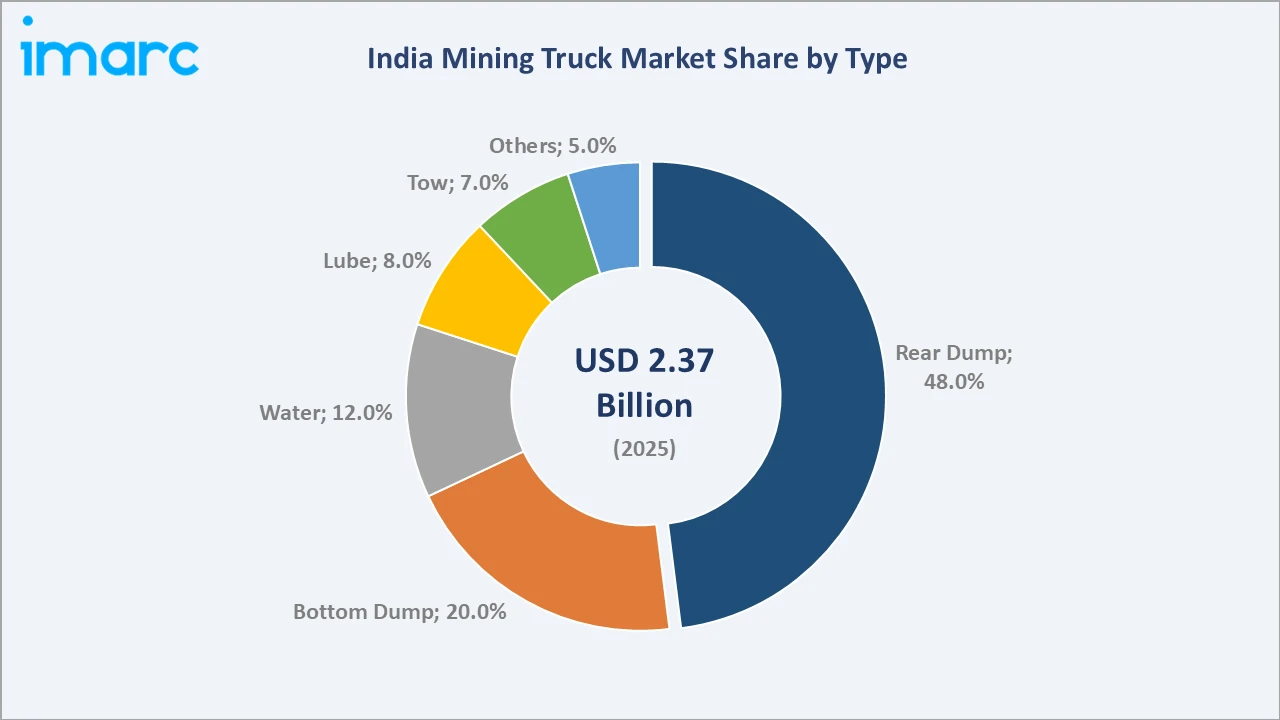
Rear dump trucks lead at 48.0% (2025). Their rigid design, high payload capacity, and ability to work with large shovels make them the main haulage machine in opencast coal, iron ore, and limestone mines across India.
To access detailed market analysis, Request Sample
Rear dump trucks between 35 and 100 tonnes are widely used in Indian coal mines, while larger trucks serve the biggest opencast projects. Their simple design supports easy maintenance at remote mine sites.
Bottom dump trucks hold 20.0%, water trucks 12.0%, lube trucks 8.0%, tow trucks 7.0%, and others 5.0%. Water trucks grow faster at ~3.5% CAGR, compared with ~2.9% for rear dump trucks, as dust suppression rules tighten at mine sites.
Bottom dump trucks are used for long, flat coal hauls, while water trucks control dust on haul roads. Lube and tow trucks support fleet maintenance and recovery of disabled trucks at large mines.
By Application
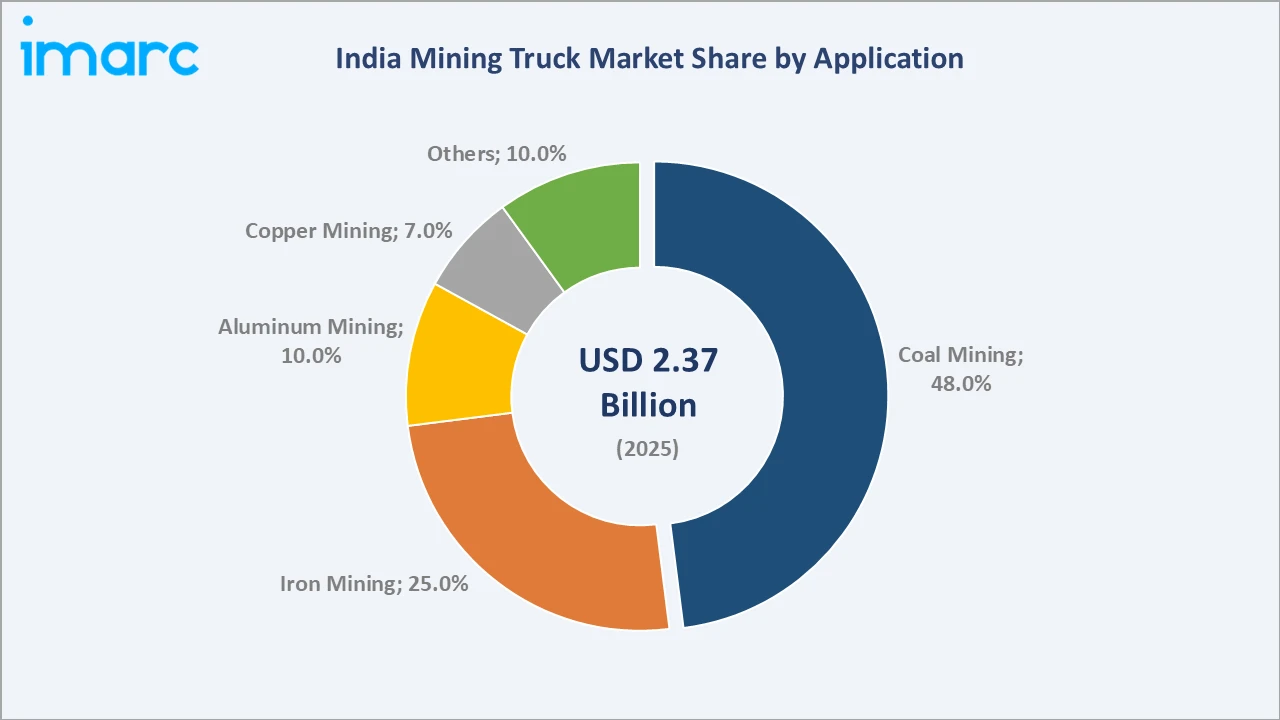
Coal mining leads at 48.0% (2025). Coal India, Singareni Collieries, and captive and commercial block owners operate large opencast mines that require extensive fleets of rear dump trucks, water trucks, and support vehicles.
Opencast mining accounts for most of India's coal production, making coal mines the largest users of haulage trucks. Overburden removal also requires large truck fleets working alongside shovels and excavators.
Iron mining holds 25.0%, aluminum mining 10.0%, copper mining 7.0%, and others 10.0%. Copper mining grows fastest at ~4.2% CAGR, compared with ~2.8% for coal mining, supported by demand from power networks and electric vehicles.
Iron ore mines in Odisha, Karnataka, and Goa use large truck fleets, while bauxite mines serve aluminum smelters. Copper projects are expanding as India seeks secure supplies of critical minerals.
Regional Market Insights
| Region | Share (2025) | Key India Mining Truck Market Drivers & Characteristics |
|---|---|---|
| East India | 38.0% | Coal, iron ore, and bauxite belts of Jharkhand and Odisha. |
| South India | 25.0% | Singareni coal, Karnataka iron ore, and lignite mines. |
| West India | 22.0% | Maharashtra coal, Gujarat lignite, and Goa iron ore. |
| North India | 15.0% | Rajasthan zinc, copper, and limestone mining. |
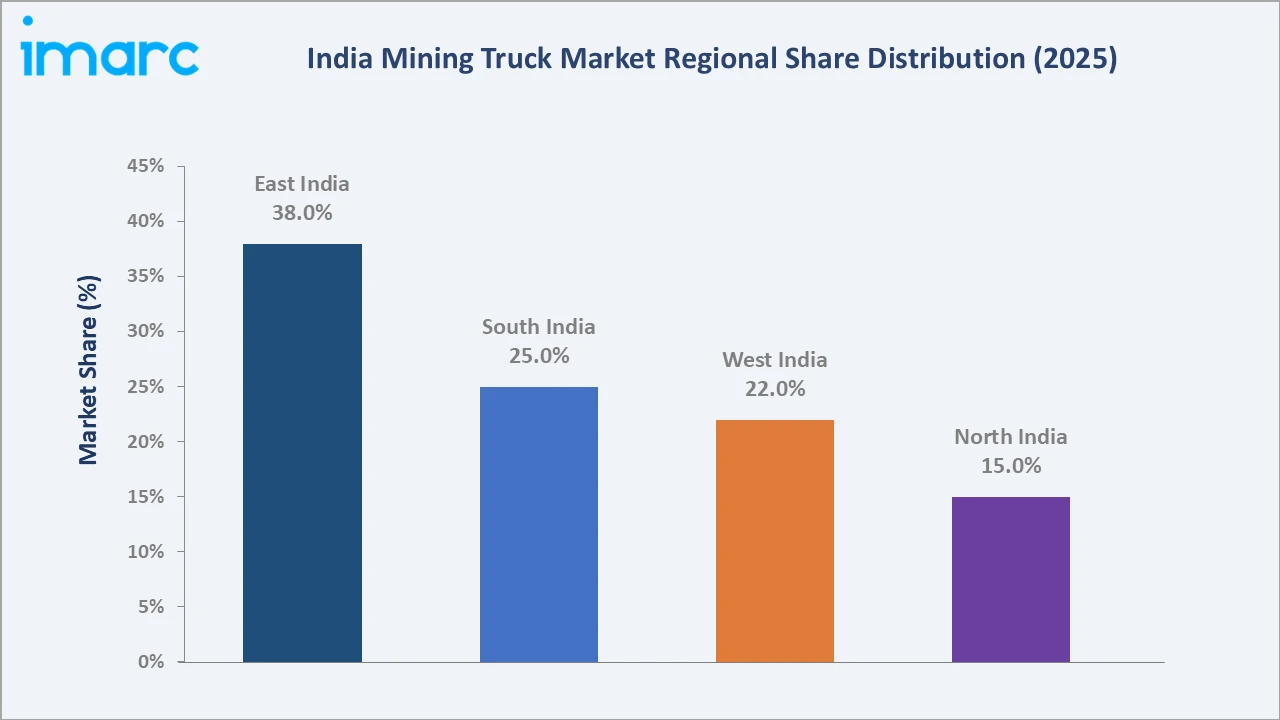
East India's 38.0% market leadership reflects its large coalfields, iron ore mines, and bauxite reserves, along with the largest opencast mines of Coal India subsidiaries. South India's 25.0% is supported by Singareni coal mines, Karnataka iron ore, and Tamil Nadu lignite operations.
Southern mines are investing in modern trucks to improve productivity and meet rising demand from power plants and steel mills. Lignite mines in Tamil Nadu also operate large fleets of haulage trucks.
West India at 22.0% grows at ~3.4% CAGR, driven by coal mines in Maharashtra, lignite in Gujarat, and iron ore in Goa. North India at 15.0% benefits from zinc, copper, and limestone mining in Rajasthan, while South India grows at ~3.2%.
East India's growth is supported by new coal blocks and expansion of existing opencast mines. West India benefits from lignite and coal projects, while North India's non-ferrous mines use specialized trucks.
Competitive Landscape
The India mining truck market includes domestic heavy equipment makers, global mining equipment companies, and commercial vehicle manufacturers offering mining tippers. Competition centers on payload, reliability, fuel efficiency, after-sales support, and pricing, shaping India mining truck market share.
Leading manufacturers compete through proven truck designs, local manufacturing, and wide service networks. Global companies differentiate through large-payload trucks and technology, while commercial vehicle makers offer cost-effective tippers for smaller mines.
| Company | Key Brands | Market Position | Core Strength |
|---|---|---|---|
| BEML Limited | BH35, BH60, BH100, BH60-EV | Market Leader | Indigenous dump trucks for coal mines. |
| Tata Motors Limited | Tata Prima, Tata Signa | Market Leader | Wide range of mining tippers. |
| Ashok Leyland | TAURUS, AVTR | Strong Challenger | High-horsepower mining tippers. |
| Komatsu India Pvt. Ltd. | HD465, HD785, HD1500 | Market Leader | Locally built rigid dump trucks. |
| Caterpillar | Cat | Innovator | Large off-highway mining trucks. |
| Hitachi Construction Machinery Co., Ltd. | EH Series | Innovator | Rigid and electric dump trucks. |
| Daimler India Commercial Vehicles Pvt. Ltd. | BharatBenz | Strong Challenger | Heavy-duty mining tippers. |
The most important competitive dynamic is the race to combine high payload and reliability with lower operating costs. Leading manufacturers are launching electric trucks, expanding local manufacturing and service networks, and offering telematics and maintenance contracts to strengthen customer relationships.
Commercial vehicle makers focus on cost-effective tippers, wide dealer networks, and financing support to reach contractors. Partnerships with miners and contractors are also helping manufacturers secure repeat fleet orders.
Key Company Profiles
BEML Limited
BEML Limited, a Schedule A company under the Ministry of Defence, is a leading Indian heavy equipment maker manufacturing dump trucks, water sprinklers, and motor graders at its Mysuru truck division.
- Key Brands: BEML, BH35, BH60, BH100, BH60-EV.
- Recent Developments: In September 2026, BEML unveiled the BH60-EV, India's first indigenously designed 60-ton electric dump truck, following its 35-ton electric dump truck launched in April 2026.
- Strategic Focus: Using its Bilaspur plant for wheeled mining equipment, including trucks and water sprinklers, to serve Coal India customers within 24 to 48 hours.
Tata Motors Limited
Tata Motors Limited is India's largest commercial vehicle manufacturer, offering Prima and Signa tippers for construction, coal movement, and mining, along with electric and LNG-powered tippers for cleaner operations.
- Key Brands: Tata Prima, Tata Signa, Prima E.28K.
- Recent Developments: In January 2026, Tata Motors launched Tata Trucks.EV, including the Prima E.28K electric tipper for shallow mining and mineral movement.
- Strategic Focus: Expanding into deep mining with the Prima 3540.K AutoShift, its most powerful tipper, powered by a 375 hp engine.
Ashok Leyland
Ashok Leyland, the Indian flagship of the Hinduja Group, is a leading commercial vehicle manufacturer offering heavy-duty tippers purpose-built for mining, infrastructure, and construction applications.
- Key Brands: TAURUS, AVTR, Ashok Leyland.
- Recent Developments: In January 2026, Ashok Leyland reintroduced its TAURUS high-horsepower tipper range with 320 and 360 HP engines for mining terrains.
- Strategic Focus: Advancing electric, LNG, and hydrogen vehicles through dedicated centres of excellence for motors, batteries, and software.
Market Concentration Analysis
The India mining truck market is moderately concentrated, with a few domestic and global manufacturers leading large rigid dump trucks, while commercial vehicle makers compete strongly in mining tippers used in smaller and shallow mines.
Leading manufacturers benefit from long relationships with public sector miners, proven products, and established service networks. Smaller players differentiate through pricing, customized tippers, and flexible financing options.
Market concentration is higher in large rigid dump trucks, where technology, payload capacity, and after-sales networks create barriers to entry. Competition is more dispersed in mining tippers and support trucks, where several manufacturers offer competitively priced models.
Long-term relationships with public sector miners strengthen the position of established manufacturers. Commercial vehicle makers differentiate through pricing, wide dealer networks, and flexible financing for contractors.
Investment & Growth Opportunities
Highest Growth Segments
Copper mining (~4.2% CAGR through power and EV demand), water trucks (~3.5% CAGR through dust control rules), West India (~3.4% CAGR through lignite and mineral output), and South India (~3.2% CAGR through iron ore mining) represent the highest-growth investment areas through 2034.
Rear dump trucks will remain the largest type segment, but water trucks and electric models will gain share as miners focus on safety and emissions. Mineral mining will support growth in all four regions.
Emerging Investment Opportunities
Electric dump trucks, higher-payload trucks, and connected fleet services are among the most promising opportunities, supporting growth in the India mining truck industry. Investment in local component manufacturing, remanufacturing, and service centers near coalfields also offers attractive long-term returns.
Partnerships with mining companies and contractors on fleet management and maintenance can secure long-term revenue. Manufacturers that develop electric and higher-payload trucks will benefit from rising demand for efficient haulage.
Investment Themes
- Electric trucks: Battery-electric models reduce fuel costs and emissions.
- Fleet services: Telematics and maintenance contracts raise truck uptime.
Future Market Outlook (2026-2034)
The India mining truck market is projected to grow from USD 2.37 Billion in 2025 to USD 2.48 Billion in 2026, reaching USD 3.16 Billion by 2034 at a CAGR of 3.06%. The 2030 value of USD 2.76 Billion marks wider fleet modernization.
Three structural forces define India mining truck industry growth through 2034 rising coal production; expansion of mineral mining; and growth of commercial coal blocks. Together, these forces support steady growth across types, applications, and regions, while costs, clearances, and skills remain key factors.
Manufacturers that combine reliable trucks, strong service networks, electric options, and connected fleet solutions are best positioned to capture growth. Partnerships with miners and contractors will continue to shape long-term competitive success.
Research Methodology
Primary Research
Primary research comprised structured interviews with industry stakeholders, including mining truck manufacturers, component suppliers, dealers, mining companies, mine developers and operators, contractors, and industry associations across all regions of India. Interviews covered demand, pricing, fleet sizes, and replacement cycles.
Secondary Research
Secondary research covered company press releases, annual reports, Ministry of Coal and Ministry of Mines statistics, government data, industry associations, and trade publications. Over 50 credible secondary sources were reviewed, compared, and cross-checked for accuracy and consistency across datasets and regions.
Forecasting Models
Market revenue forecasts were developed using a demand-based model: mining truck sales by type, application, and region multiplied by average selling prices, then aggregated to total market value. Assumptions were validated through discussions with industry experts, manufacturers, and mining companies.
India Mining Truck Market Report Coverage:
| Report Features | Details |
|---|---|
| Base Year of the Analysis | 2025 |
| Historical Period | 2020-2025 |
| Forecast Period | 2026-2034 |
| Units | Billion USD |
| Scope of the Report |
Exploration of Historical Trends and Market Outlook, Industry Catalysts and Challenges, Segment-Wise Historical and Future Market Assessment:
|
| Types Covered | Bottom Dump, Rear Dump, Lube, Tow, Water, Others |
| Applications Covered | Coal Mining, Iron Mining, Copper Mining, Aluminum Mining, Others |
| Payload Capacities Covered | <90 Metric Tons, 90≤149 Metric Tons, 150≤290 Metric Tons, >290 Metric Tons |
| Drives Covered | Mechanical Drive, Electrical Drive |
| Regions Covered | North India, South India, East India, West India |
| Companies Covered | BEML Limited, Tata Motors Limited, Ashok Leyland, Komatsu India Pvt. Ltd., Caterpillar, Hitachi Construction Machinery Co., Ltd., Daimler India Commercial Vehicles Pvt. Ltd., etc. |
| Customization Scope | 10% Free Customization |
| Post-Sale Analyst Support | 10-12 Weeks |
| Delivery Format | PDF and Excel through Email (We can also provide the editable version of the report in PPT/Word format on special request) |
Key Benefits for Stakeholders:
- IMARC’s industry report offers a comprehensive quantitative analysis of various market segments, historical and current market trends, market forecasts, and dynamics of the India mining truck market from 2020-2034.
- The research report provides the latest information on the market drivers, challenges, and opportunities in the India mining truck market.
- Porter's five forces analysis assist stakeholders in assessing the impact of new entrants, competitive rivalry, supplier power, buyer power, and the threat of substitution. It helps stakeholders to analyze the level of competition within the India mining truck industry and its attractiveness.
- Competitive landscape allows stakeholders to understand their competitive environment and provides an insight into the current positions of key players in the market.
Frequently Asked Questions About the India Mining Truck Market Report
The India mining truck market size is estimated at USD 2.48 Billion in 2026, supported by rising coal production, expanding mineral mining, and fleet modernization by public and private miners across the country.
The market grows at a 3.06% CAGR during 2026-2034, reaching USD 3.16 Billion by 2034, driven by coal demand, mineral auctions, and commercial coal mining.
Rear dump trucks lead at 48.0%, owing to their high payload capacity and wide use for coal and overburden haulage in opencast mines.
Coal mining leads at 48.0%, supported by large opencast coal mines operated by Coal India, Singareni Collieries, and captive and commercial block owners.
East India leads at 38.0%, driven by vast coalfields, iron ore mines, and bauxite reserves in Jharkhand, Odisha, Chhattisgarh, and West Bengal.
Leading companies include BEML Limited, Tata Motors Limited, Ashok Leyland, Komatsu India Pvt. Ltd., Caterpillar, Hitachi Construction Machinery Co., Ltd., and Daimler India Commercial Vehicles Pvt. Ltd.
Demand for a mining truck in India is shifting toward higher-payload, electric, and connected trucks that lower cost per tonne, reduce emissions, and improve fleet availability.
The market is projected to reach approximately USD 2.76 Billion by 2030, supported by steady growth in coal, iron ore, and non-ferrous mining.
Need more help?
- Speak to our experienced analysts for insights on the current market scenarios.
- Include additional segments and countries to customize the report as per your requirement.
- Gain an unparalleled competitive advantage in your domain by understanding how to utilize the report and positively impacting your operations and revenue.
- For further assistance, please connect with our analysts.
 Request Customization
 Speak to an Analyst
 Request Brochure
 Inquire Before Buying
Benefits of Customization
- Personalize this research
- Triangulate with your data
- Get data as per your format and definition
- Gain a deeper dive into a specific application, geography, customer, or competitor
- Any level of personalization
Get in Touch With Us
UNITED STATES
Phone: +1-201-971-6302
INDIA
Phone: +91-120-433-0800
UNITED KINGDOM
Phone: +44-753-714-6104
Email: [email protected]
Client Testimonials

















Related Reports

Choose your plan
*Please note that the prices mentioned below are starting prices for each bundle type. Kindly contact our team for further details.*
Single User License
- 1 User License, Access on 2 Devices
- PDF Report + Excel Dataset (Password Protected)
- Lifetime Access
- No Printing Rights
- 10% Free Report Customization
- 10–12 Weeks of Analyst Support
Five User License
- Access for 5 Users, 2 Devices per User
- PDF Report + Excel Dataset (Password Protected)
- Lifetime Access
- Dedicated Account Manager
- 12–14 Weeks of Analyst Support
- No Printing Rights
- 15% Free Report Customization
- 25% Discount on Your Next Purchase
Corporate User License
- Unlimited User Access (Within Your Organization)
- PDF Report + Excel Dataset
- Lifetime Access
- Dedicated Account Manager
- 14–20 Weeks of Analyst Support
- No Printing Rights
- 20% Free Report Customization
- 30% Discount on Your Next Purchase
Essential Insights
What's included:
3 reports
- Lifetime Access
- PDF Reports
- Excel Datasets
- 2 Weeks of Free Analyst Support
- 2 User Licenses
- Access on 2 Devices
- Printing Rights
- Complimentary PowerPoint (PPT) Version
- Complimentary License Upgrade
Professional Access
What's included:
5 reports
- Lifetime Access
- PDF Reports
- Excel Datasets
- 8 Weeks of Free Analyst Support
- 2 User Licenses
- Access on 2 Devices
- Printing Rights
- Complimentary PowerPoint (PPT) Version
- Complimentary License Upgrade
Business Advantage
What's included:
8 reports
- Lifetime Access
- PDF Reports
- Excel Datasets
- 14 Weeks of Free Analyst Support
- 2 User Licenses
- Access on 2 Devices
- Printing Rights
- Complimentary PowerPoint (PPT) Version
- Complimentary License Upgrade
Enterprise Intelligence
What's included:
10 reports
- Lifetime Access
- PDF Reports
- Excel Datasets
- 20 Weeks of Free Analyst Support
- 2 User Licenses
- Access on 2 Devices
- Printing Rights
- Complimentary PowerPoint (PPT) Version
- Complimentary License Upgrade