
India Motorcycle Rental Market Size, Share, Trends, and Forecast by Product, Type, End Use, and Region, 2026-2034
India Motorcycle Rental Market Size, Share, Trends & Forecast (2026-2034)
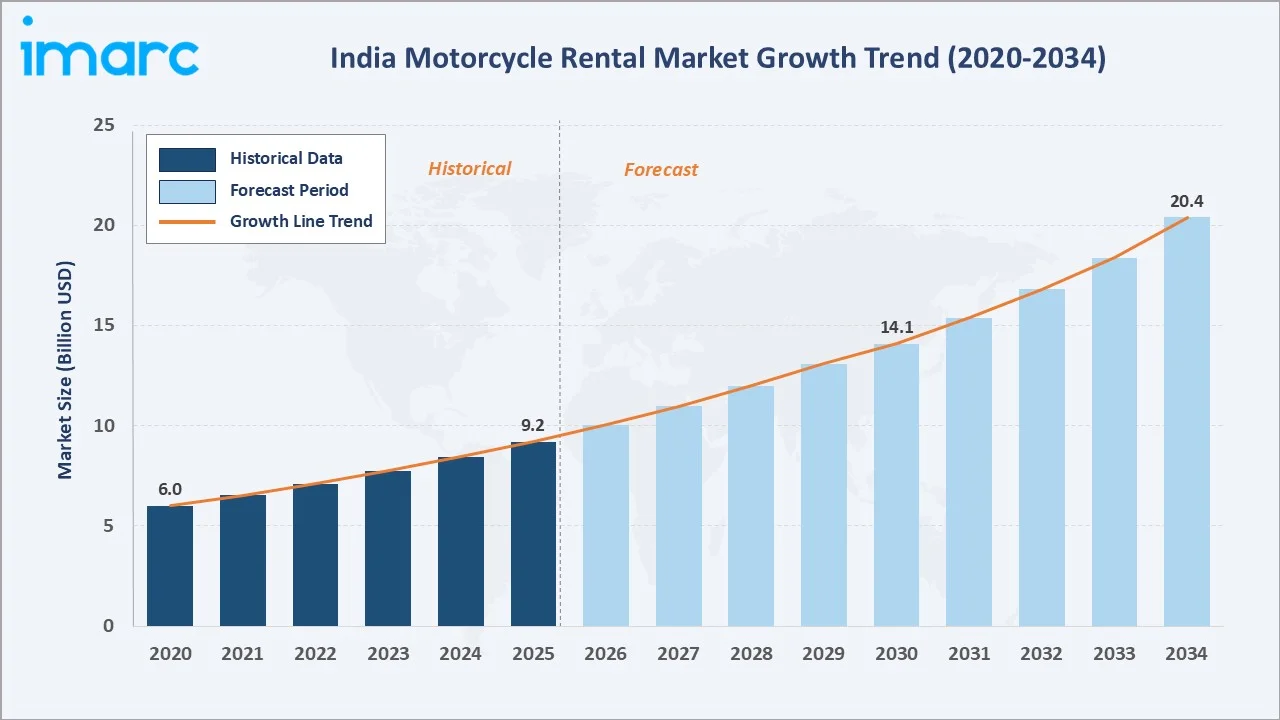
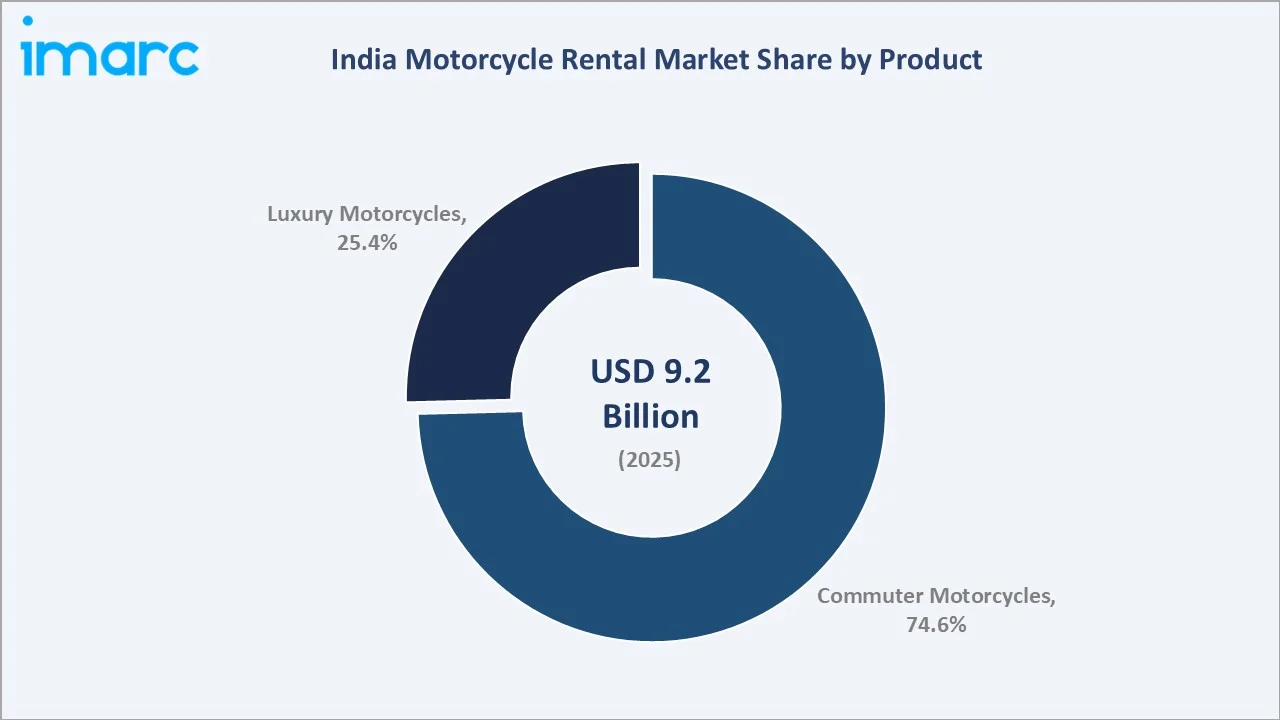
The India motorcycle rental market grew from USD 9.2 Billion in 2025 to USD 10.3 Billion in 2026 and is projected to reach USD 20.4 Billion by 2034, growing at a CAGR of 8.94% during 2026-2034. The market is driven by rising domestic tourism, rapid urbanization driving last-mile mobility needs, and growing adoption of app-based rental platforms. India’s tourism sector recorded 2.9 billion domestic tourist visits in 2024, while international tourist arrivals reached around 2.02 crore in 2025. This expanding tourist base is supporting the market, as travelers increasingly seek affordable, flexible, and convenient mobility options for local sightseeing and short-distance travel. Commuter motorcycles lead product type at 74.6%. On road rental dominates the type at 81.3%. South India leads regionally at 32.7%.
Market Snapshot
|
Metric |
Value |
|
Base Year Market Size (2025) |
USD 9.2 Billion |
|
Market Size (2026) |
USD 10.3 Billion |
|
Forecast Market Size (2034) |
USD 20.4 Billion |
|
CAGR (2026-2034) |
8.94% |
|
Base Year |
2025 |
|
Historical Period |
2020-2025 |
|
Forecast Period |
2026-2034 |
|
Dominant Product |
Commuter Motorcycles (74.6%, 2025) |
|
Dominant Type |
On Road (81.3%, 2025) |
|
Leading Region |
South India (32.7%, 2025) |
The India motorcycle rental market has demonstrated strong and sustained growth, increasing from USD 6.0 Billion in 2020 to USD 9.2 Billion in 2025 and an estimated USD 10.3 Billion in 2026, reflecting expanding shared mobility adoption, growing tourism-linked rentals, and increasing digital platform penetration. The market is projected to reach USD 14.1 Billion by 2030 and further grow to USD 20.4 Billion by 2034, supported by rising urban mobility demand, EV rental fleet expansion, and government-backed smart city mobility initiatives.
To get more information on this market, Request Sample
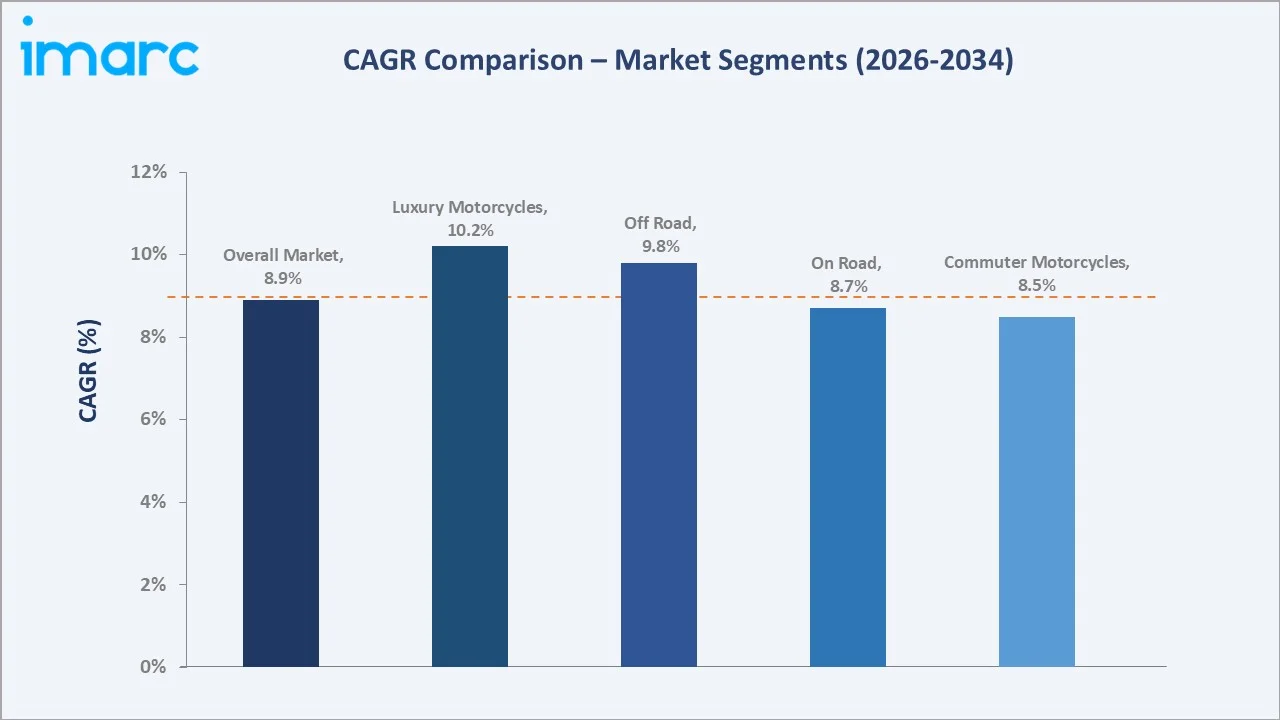
Luxury motorcycles lead the segment CAGR at ~10.2% through rising premium adventure tourism and high-income rental demand. Off road rental grows at ~9.8% CAGR through expanding adventure tourism in Himalayan and coastal destinations. On road rental grows at ~8.7% CAGR through sustained urban commuter and tourist demand.
Executive Summary
The India motorcycle rental market is witnessing robust growth, supported by the country's large young demographic, rising domestic tourism, rapid urbanization creating last-mile mobility gaps, and the proliferation of technology-enabled rental platforms. Growing awareness of shared mobility economics, where renting eliminates ownership costs including EMI, insurance, maintenance, and parking, is accelerating rental adoption among urban millennials and Gen Z consumers.
Commuter motorcycles lead at 74.6% through urban daily mobility use cases. On road rental leads at 81.3% through city commuting and intercity travel demand. South India leads regionally at 32.7% through its dense urban tourism and tech-savvy consumer base.
Key Market Insights
|
Insight |
Data |
|
Dominant Product |
Commuter Motorcycles – 74.6% share (2025) |
|
Leading Type |
On Road – 81.3% market share (2025) |
|
Leading Region |
South India – 32.7% share (2025) |
|
Market Opportunity |
EV rental fleet expansion; subscription mobility models; Himalayan adventure tourism tie-ups; corporate employee mobility programs; app-based self-ride platform scaling |
Key Analytical Observations Supporting the Above Data:
- Commuter Motorcycles at 74.6%: Commuter motorcycles dominate the market due to their affordability, fuel efficiency, and suitability for daily urban commuting across Indian cities characterized by heavy traffic congestion. The 100cc-200cc commuter segment is the most widely available, lowest-cost rental option and serves India's largest rental use case of last-mile workplace and campus connectivity in Tier 1 and Tier 2 cities.
- On Road at 81.3%: On Road rental dominates, as urban commuting, tourist sightseeing, and intercity travel on paved road networks represent the primary demand driver for motorcycle rentals across India. The overwhelming majority of rental fleet deployments are in urban agglomerations, where on-road commuter use is the primary revenue-generating activity for rental platform operators.
- South India at 32.7%: South India leads the motorcycle rental market due to Bengaluru and Hyderabad's status as India's leading technology hubs with large young professional populations, the region's high domestic tourism activity across Kerala and coastal Karnataka, and strong digital platform adoption enabling seamless app-based rental transactions among South India's tech-literate consumer base.
India Motorcycle Rental Market Overview
The India motorcycle rental market encompasses short-term and long-term rental of two-wheeled motorized vehicles through organized platform operators, local rental businesses, and digital app-based rental services. It includes commuter motorcycle rentals for daily urban commuting and last-mile connectivity, and luxury or premium motorcycle rentals for adventure tourism, leisure riding, and experiential travel. The market covers on-road rental operations in urban, suburban, and intercity contexts, as well as off-road and adventure rental in Himalayan, coastal, and wildlife destination tourism circuits.
Rental services span hourly, daily, weekly, monthly, and long-term subscription models. The market is served by organized digital platform operators, authorized dealer rental programs, and unorganized local rental shop networks across Indian cities and tourist destinations. India's population, growing disposable incomes, young demographic profile, and rapidly expanding domestic tourism market create a large and growing total addressable opportunity for motorcycle rental services.
Market Dynamics
To evaluate market opportunities, Request Sample
Market Drivers
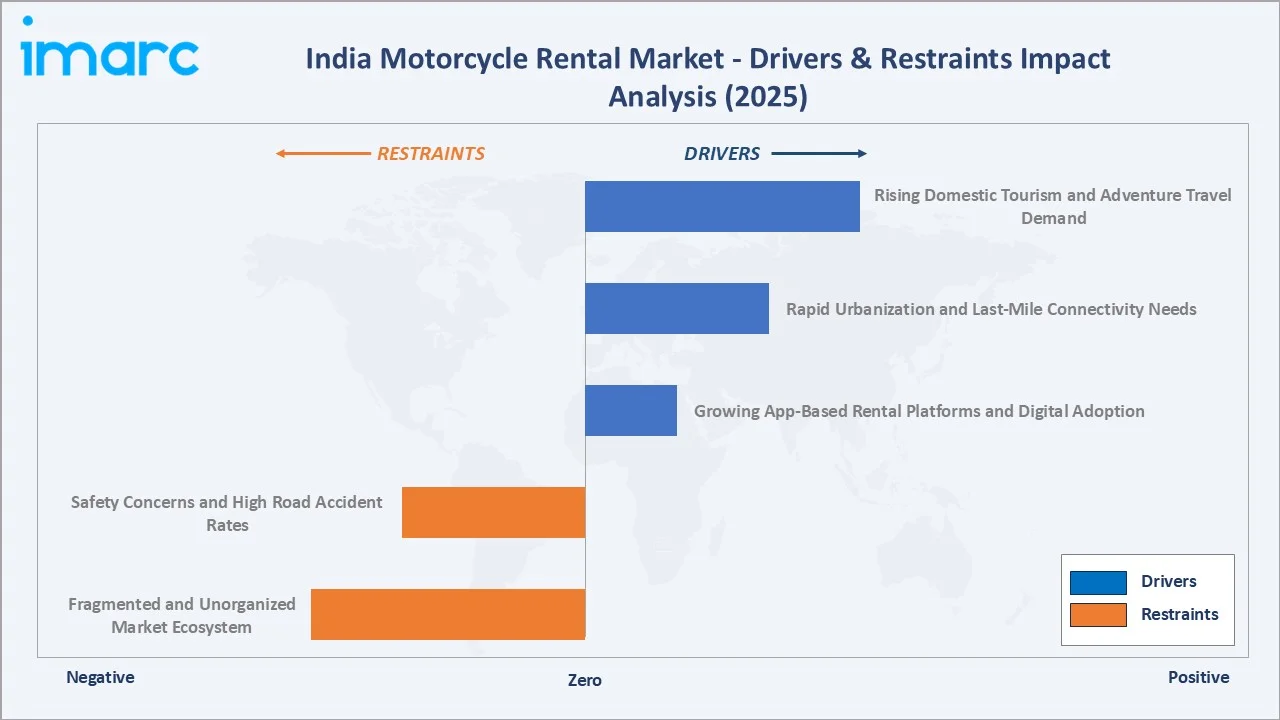
- Rising Domestic Tourism and Adventure Travel Demand: India's domestic tourism market recorded 2.9 billion domestic tourist visits in 2024, with motorcycle rental emerging as the preferred mode for adventure travel to destinations. Growing aspiration for experiential travel, social media-driven adventure tourism content, and increasing awareness of motorcycle touring culture among 18-35 year old Indians are driving strong and sustained demand for premium and commuter motorcycle rentals at tourist destinations.
- Rapid Urbanization and Last-Mile Connectivity Needs: By 2036, India’s urban population is projected to reach around 600 million people, representing nearly 40% of the total population, compared with 31% in 2011. India's urban population with city expansion creating significant last-mile connectivity gaps between metro stations, bus stops, and workplaces. Motorcycle rental platforms fill this connectivity gap by offering affordable, flexible short-duration rental options that public transit cannot provide.
- Growing App-Based Rental Platforms and Digital Adoption: The proliferation of smartphone-based motorcycle rental apps has transformed motorcycle rental from physically visited local shops to seamless digital transactions completed in minutes. App-based platforms offer GPS fleet location, digital KYC verification, UPI payment, and automated pricing, dramatically reducing rental friction. India's internet users and smartphone users provide a large digitally-enabled addressable market for platform-based rental operators.
Market Restraints
- Safety Concerns and High Road Accident Rates: Road accident deaths in India increased by 2.3% in 2024, surpassing 1.77 lakh fatalities, which translates to an average of nearly 485 deaths per day. India recorded road fatalities, with two-wheelers involved in the highest proportion of accidents nationally. Safety concerns, particularly among first-time renters, female users, and parents, limit rental adoption and require platform operators to invest significantly in safety training, helmet provision, and insurance coverage, adding to operational costs and creating barriers to market expansion among safety-conscious demographic segments.
- Fragmented and Unorganized Market Ecosystem: Despite the growth of organized digital platforms, the India motorcycle rental market remains significantly fragmented, with a large share of rental activity conducted through informal local bike rental shops that operate without digital booking systems, insurance verification, or standardized pricing. This fragmentation makes it difficult for organized platform operators to establish consistent pricing power and consumer trust, while limiting the aggregated market data available for accurate demand forecasting.
Market Opportunities
- Electric Vehicle Rental Fleet Expansion: India’s electric vehicle (EV) market maintained strong momentum in FY26, with sales increasing to 2.66 million units, compared with 2.05 million units in FY25. The rapid growth of India's EV ecosystem creates a significant opportunity for motorcycle rental platforms to transition fleets to electric models. EV rentals offer lower per-kilometer fuel costs, reduced maintenance requirements, and alignment with sustainability messaging that resonates strongly with urban young professional rental customer segments.
- Subscription Mobility and Corporate Employee Programs: Monthly subscription rental programs, offering unlimited or pooled kilometer allowances for fixed monthly fees, are creating a new recurring revenue model for motorcycle rental platforms. Corporate tie-ups with IT companies, BPOs, and manufacturing plants to provide last-mile employee mobility through contracted rental programs represent high-volume, predictable revenue streams that reduce platform revenue volatility compared to transactional daily rental models.
Market Challenges
- Vehicle Damage, Theft, and Insurance Compliance: Motorcycle damage, theft, and non-compliance with insurance requirements represent significant operational challenges for India motorcycle rental platforms. Platform operators must balance deposit structures, insurance premiums, and damage liability policies that protect fleet assets while remaining sufficiently customer-friendly to avoid inhibiting rental uptake. Managing damage claims in a legally complex and enforcement-inconsistent environment requires significant administrative overhead.
- Regulatory Uncertainty for App-Based Rental Models: The state transport regulations governing commercial vehicle rental contain provisions that are inconsistently interpreted by different RTOs (Regional Transport Offices) regarding app-based self-drive motorcycle rental operations. Regulatory uncertainty over whether self-drive motorcycle rentals require commercial vehicle registration, operating permits, or taxi aggregator licenses creates compliance complexity and inconsistent enforcement risk for platform operators expanding across multiple Indian states.
Emerging Market Trends
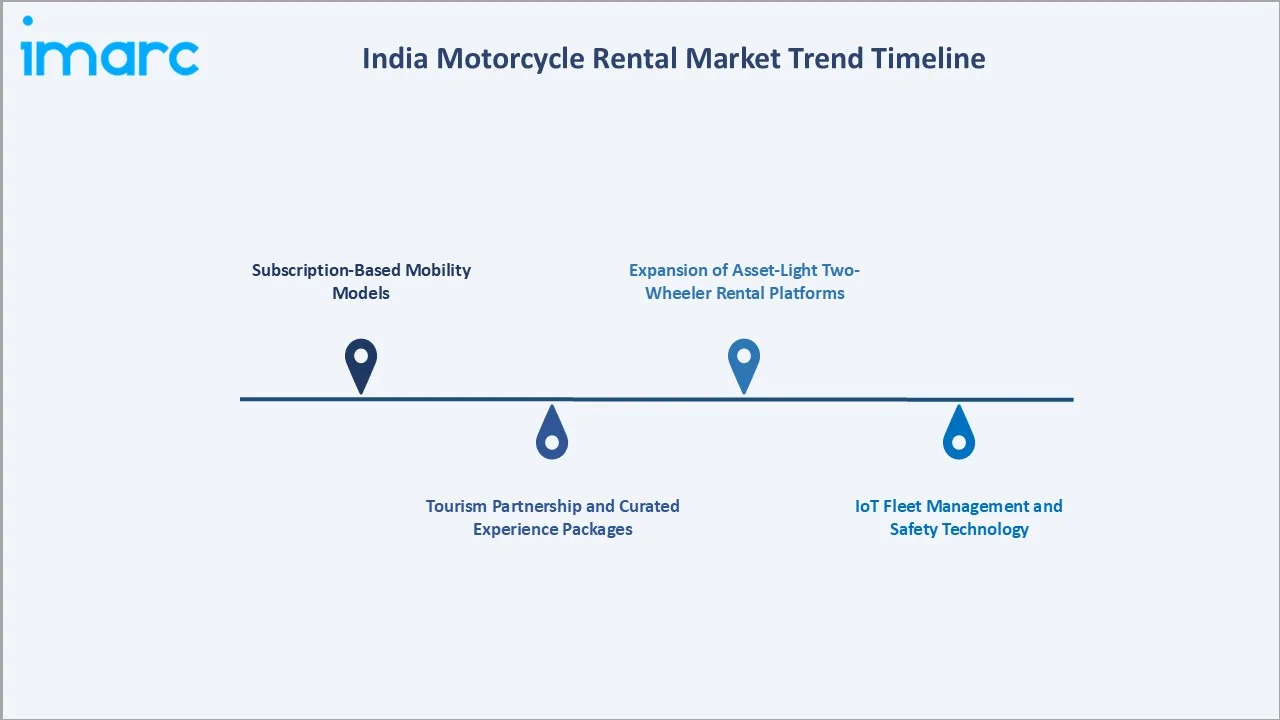
1. Subscription-Based Mobility Models
Monthly motorcycle rental subscriptions, offering fixed-fee unlimited or pooled kilometer access with maintenance and insurance included, are gaining traction among urban commuters seeking predictable mobility costs. Various leading platforms have introduced subscription tiers, providing cost visibility that daily rental pricing lacks. Subscription models reduce platform revenue volatility, improve fleet utilization predictability, and create customer loyalty that transactional rental engagement cannot sustain.
2. Tourism Partnership and Curated Experience Packages
Motorcycle rental platforms serving tourist destinations are increasingly partnering with travel agencies, hotel chains, and state tourism boards to create curated riding packages that combine motorcycle rental with route planning, accommodation, roadside assistance, and guided ride experiences. Kerala Tourism's promotion of motorcycle tourism on state scenic routes, Rajasthan's heritage circuit motorcycle packages, and Himalayan adventure rental programs from operators in Manali and Leh are driving premium rental revenue well above standard daily rates.
3. Expansion of Asset-Light Two-Wheeler Rental Platforms
The entry of established mobility platforms into motorcycle and scooter rentals highlights a growing shift toward asset-light, app-based two-wheeler sharing models. In June 2026, Zoomcar expanded into motorcycle and scooter rentals in Bengaluru through its existing app. The company is initially testing the service in the city before exploring expansion into other markets, while continuing to follow its asset-light marketplace model without owning the vehicles. This trend is expected to improve rental accessibility, broaden consumer choice, and encourage similar platform-led expansion across major Indian cities.
4. IoT Fleet Management and Safety Technology
Real-time IoT tracking, remote immobilization capability, geo-fenced operation zones, and automated crash detection are being integrated into rental fleet management systems by organized platform operators. GPS tracking enables accurate vehicle location for both theft prevention and customer assistance, while engine kill switches allow operators to immobilize vehicles in case of non-payment or unauthorized geographic departure. These safety and fleet management technologies are critical enablers for scaling organized rental platforms beyond small local operations
Industry Value Chain Analysis
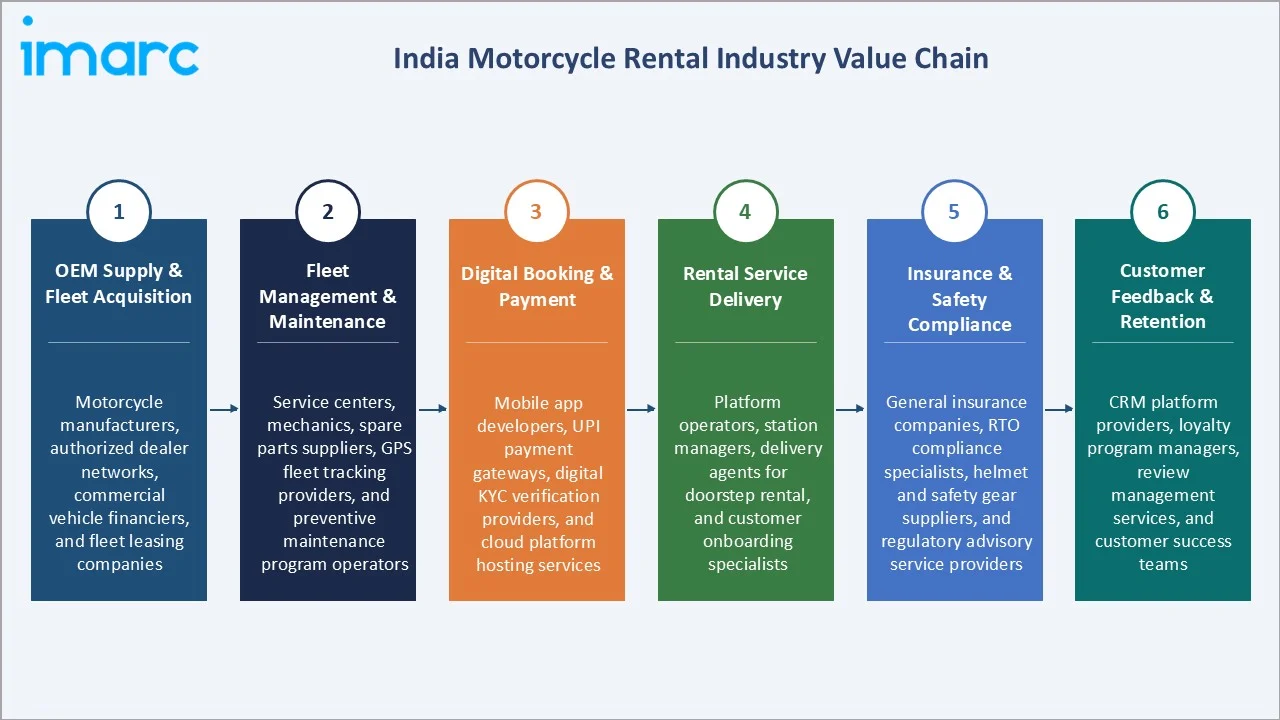
The India motorcycle rental market value chain integrates OEM fleet acquisition, fleet management and maintenance, digital booking and payment, rental service delivery, insurance and safety compliance, and customer feedback and retention.
|
Stage |
Key Participants |
|
OEM Supply & Fleet Acquisition |
Motorcycle manufacturers, authorized dealer networks, commercial vehicle financiers, and fleet leasing companies. |
|
Fleet Management & Maintenance |
Service centers, mechanics, spare parts suppliers, GPS fleet tracking providers, and preventive maintenance program operators. |
|
Digital Booking & Payment |
Mobile app developers, UPI payment gateways, digital KYC verification providers, and cloud platform hosting services. |
|
Rental Service Delivery |
Platform operators, station managers, delivery agents for doorstep rental, and customer onboarding specialists. |
|
Insurance & Safety Compliance |
General insurance companies, RTO compliance specialists, helmet and safety gear suppliers, and regulatory advisory service providers. |
|
Customer Feedback & Retention |
CRM platform providers, loyalty program managers, review management services, and customer success teams. |
Digital booking and payment represent the most value-added stage in the India motorcycle rental value chain, as it directly determines customer acquisition efficiency, booking conversion rates, payment success, and platform scalability. App-based platforms that deliver seamless sub-3-minute booking experiences with instant digital KYC and UPI payment integration achieve significantly higher conversion rates and customer retention than traditional counter-based rental models.
Technology Landscape in the India Motorcycle Rental Industry
Mobile App-Based Booking and Fleet Management Platforms
App-based booking platforms are the foundational technology layer for organized motorcycle rental in India. Leading platforms have invested in proprietary apps offering GPS vehicle location, keyless unlock via Bluetooth, digital helmet dispensing (in select stations), and real-time ride tracking. Backend fleet management systems monitor vehicle health through diagnostic data integration, enabling predictive maintenance scheduling that reduces unexpected breakdown rates.
Electric Vehicle and Battery Swapping Technology
Battery swapping infrastructure enables EV rental platforms to avoid long charging downtime by enabling instant battery exchanges at swap stations. This technology makes EV rental operationally viable for high-utilization rental fleets where vehicle availability is critical to revenue generation. Battery-as-a-service models further reduce upfront EV fleet acquisition costs by separating battery ownership from vehicle ownership.
Digital Identity Verification and UPI Payment Integration
Aadhaar-linked digital KYC verification and driving license authentication APIs have dramatically reduced onboarding friction for new rental customers from multi-day document processing to sub-5-minute digital verification. UPI payment integration enables instant, zero-friction rental transactions without requiring cash or card payment infrastructure. BHIM UPI's penetration across India's internet users makes it the most accessible payment channel for broad-market motorcycle rental platform adoption.
Market Segmentation Analysis
The report covers the following segments:
|
Segment Category |
Leading Segment |
Market Share |
Year |
|
Product |
Commuter Motorcycles |
74.6% |
2025 |
|
Type |
On Road |
81.3% |
2025 |
|
End Use |
🔒 |
🔒 |
2025 |
|
Region |
South India |
32.7% |
2025 |

By Product
Commuter motorcycles lead at 74.6% (2025), reflecting the mass-market demand for affordable, fuel-efficient daily commuting vehicles that serve India's primary rental use case of urban last-mile mobility. The 100cc-200cc commuter segment's low rental cost, wide availability, and suitability for Indian urban road conditions make it the dominant revenue category for platform operators.
To access detailed market analysis, Request Sample
Luxury motorcycles account for 25.4% (2025), representing the premium segment encompassing premium models rented primarily for adventure tourism, leisure riding, and bucket-list experiences. The luxury segment commands 3-8x higher daily rates than commuter rentals, making it a disproportionately high revenue contributor relative to its share of total fleet size.
By Type
On road rental dominates at 81.3% (2025), driven by the overwhelming majority of rental activity occurring in urban commuting, city tourism, and paved intercity road travel contexts. On-road rental platforms operating in major Indian cities serve daily commuters, outstation travelers, and urban tourists with standardized fleet vehicles optimized for road surface conditions.
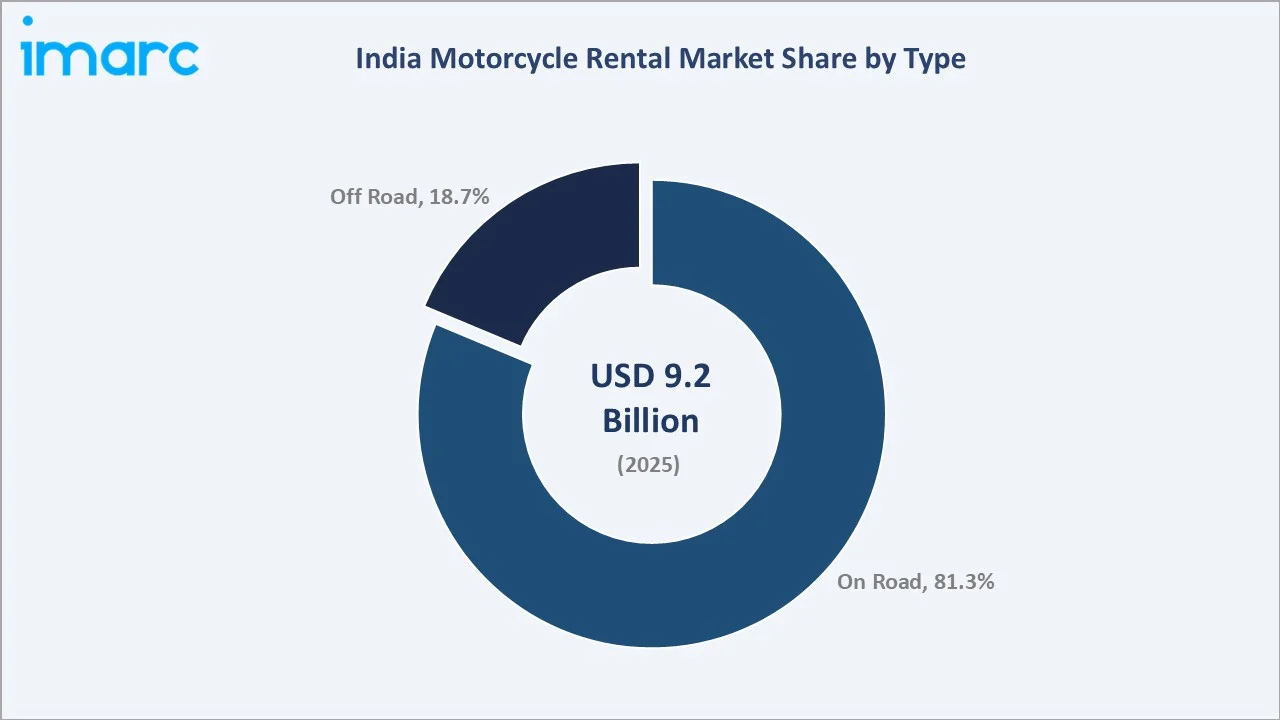
Off road rental accounts for 18.7% (2025), encompassing adventure motorcycle rental at destinations including Leh-Ladakh, Spiti Valley, Coorg, and Andaman Islands, where rugged terrain and unpaved roads require specialized enduro, adventure, or dual-sport motorcycles. Off-road rental commands the highest daily rates in the market and serves the highest-income, most experientially motivated rental customer segment.
Regional Market Insights
|
Region |
Share (2025) |
Key India Motorcycle Rental Market Drivers & Characteristics |
|
South India |
32.7% |
Largest regional market driven by Bengaluru and Hyderabad's large IT professional populations providing dense urban commuter rental demand, Kerala's active domestic tourism circuits, and high digital platform adoption. |
|
North India |
28.6% |
Strong market anchored by Delhi NCR's urban commuter demand, Himalayan adventure tourism rental hubs, and heritage circuit motorcycle tourism. |
|
West India |
24.1% |
Growing market driven by Mumbai's large workforce mobility needs, Goa's year-round scooter and motorcycle tourism rental culture, and Pune's expanding tech sector creating urban commuter rental demand. |
|
East India |
14.6% |
Emerging market with growing rental adoption in Kolkata's urban commuter segment, expanding motorcycle tourism in Darjeeling, Sikkim, and North Bengal scenic circuits. |
South India's 32.7% market leadership reflects the region's unique combination of dense urban professional populations and high domestic tourism activity across Kerala's backwater circuits and coastal tourism ecosystem. North India's 28.6% is underpinned by the large Delhi NCR urban rental market and India's most visited Himalayan adventure tourism destinations, which attract premium motorcycle rental customers seeking iconic Spiti and Leh-Ladakh riding experiences.
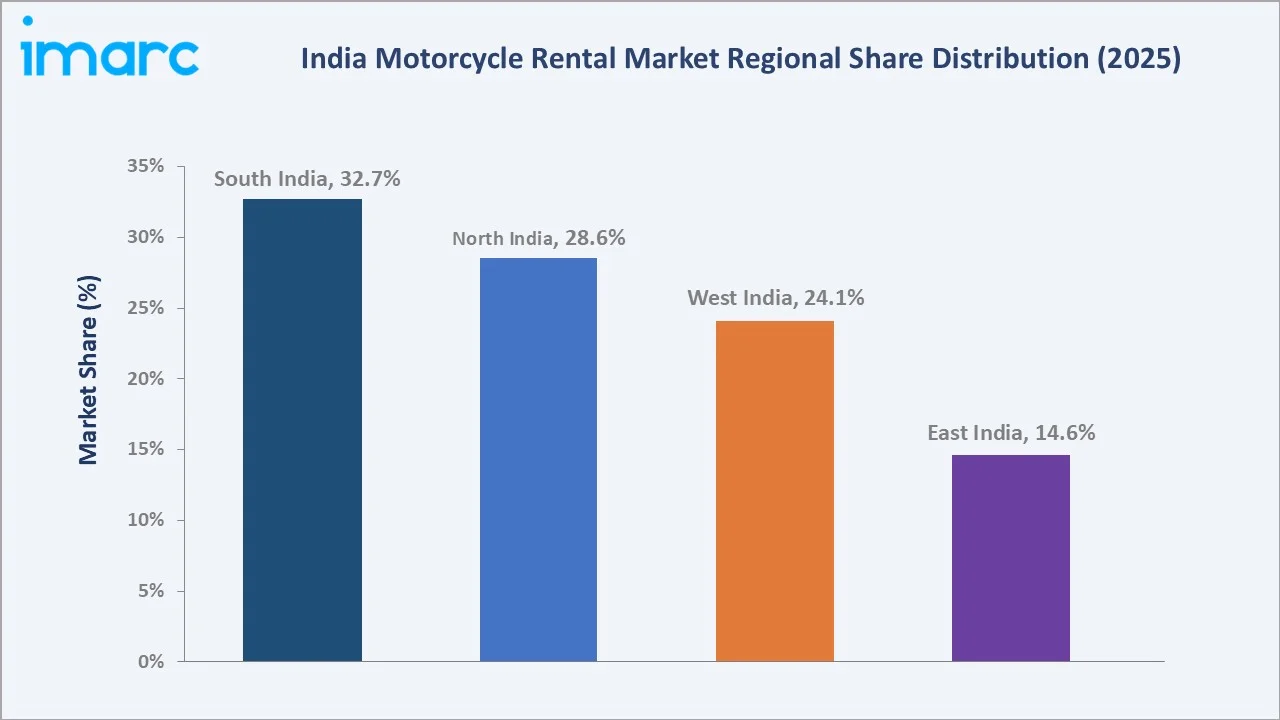
West India's 24.1% is driven by Goa's internationally recognized scooter rental culture, where renting is the de facto tourist transport mode, and Mumbai's large urban professional base seeking flexible mobility alternatives to congested public transport. East India at 14.6% represents the highest-growth regional opportunity, with Kolkata's expanding urban rental market and growing motorcycle tourism to Northeast India creating increasing demand for organized rental services.
Competitive Landscape
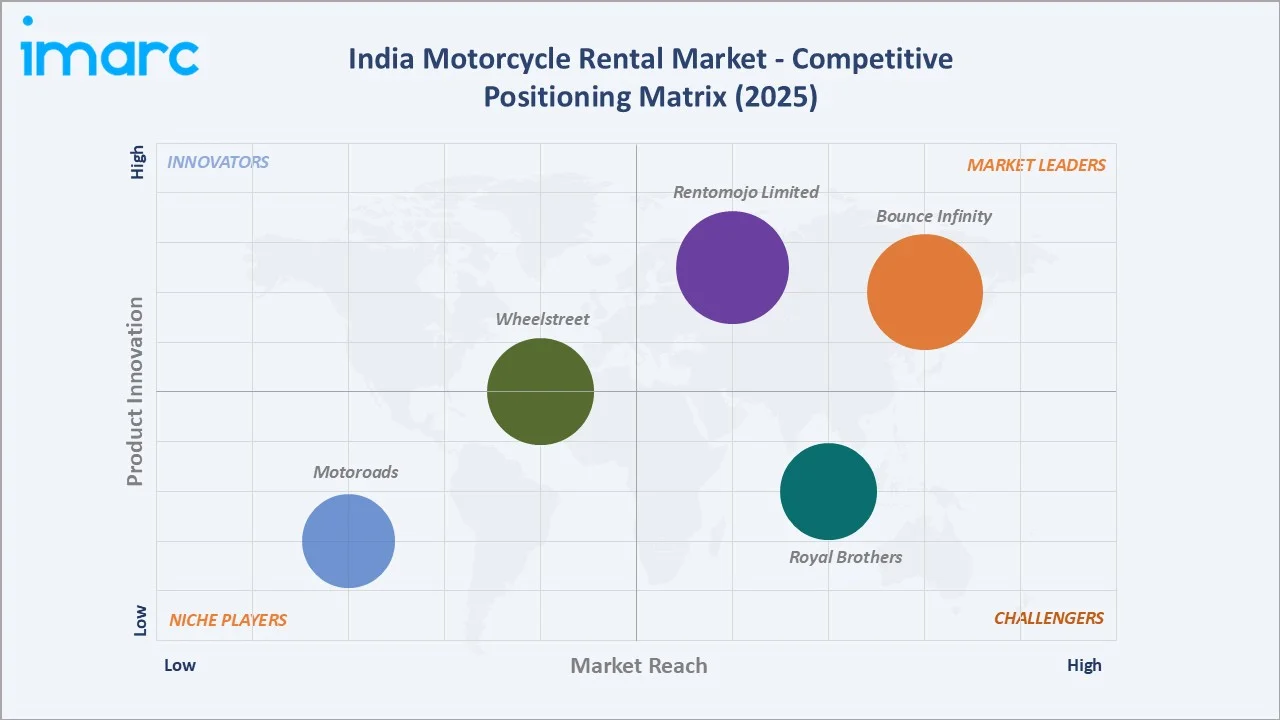
The India motorcycle rental market is moderately fragmented, with a mix of organized digital platform operators, regional organized rental chains, and a large unorganized local rental shop segment. Organized platform players compete on fleet size, geographic presence, app experience quality, pricing, fleet condition, and service reliability. EV fleet transition readiness, subscription program depth, and tourism partnership networks are emerging as key competitive differentiators among leading platform operators.
|
Company |
Key Offerings |
Market Position |
Core Strength |
|
Bounce Infinity |
Bounce Daily App |
Market Leader |
By operating under the brand name Bounce Daily, they provide affordable, flexible, and sustainable mobility alternatives to traditional, gas-powered rentals. |
|
Rentomojo Limited |
Rentomojo motorbikes for rent |
Market Leader |
RentoMojo facilitates long-term motorcycle and two-wheeler leasing in India, catering primarily to working professionals and students. |
|
Wheelstreet |
Wheelstreet Bike rental |
Established Player |
Multi-city organized rental network; comprehensive fleet from commuter to premium segment. |
|
Royal Brothers |
Royal Brothers Bike Rentals |
Challenger |
Royal Brothers pioneered a standardized, professional rental model across multiple states and cities. |
|
Motoroads |
Motorbike rental in Delhi |
Niche Player |
Motoroads simplifies the rental process for foreigners and out-of-towners, making it easier to arrange transportation securely before arrival. |
Companies are also investing in EV fleet transition, GPS safety technology, helmet vending infrastructure, and insurance product development to differentiate in India's rapidly evolving motorcycle rental market. The market is expected to see consolidation through platform mergers and acquisitions as well-funded organized operators seek scale advantages over fragmented local competition.
Key Company Profiles
Bounce Infinity
Bounce Infinity is one of India's largest organized motorcycle and scooter rental platforms, operating an app-based rental model with fleet concentration in Bengaluru and other South Indian cities. The company pioneered India's EV rental transition with its Bounce Infinity E1 electric scooter, offering subscription-based EV rental with battery swap service integration. Bounce has registered users and has processed millions of rental trips since inception, establishing itself as the dominant organized rental brand in South India.
- Key Offerings: Bounce Daily App.
- Strategic Focus: EV rental fleet expansion with Bounce Infinity E1 as flagship product, battery-as-a-Service model reducing customer EV range anxiety; subscription revenue model building recurring income, and geographic expansion from South India base to North and West India metro markets.
Rentomojo Limited
Rentomojo Limited is India's leading premium adventure motorcycle rental platform, specializing in major brand rentals at major Indian tourist destinations including Manali, Leh, Rishikesh, and Rajasthan circuits. The platform serves domestic adventure tourism and international motorcycle tourists with curated touring packages combining rental with route planning, accommodation recommendations, and mechanical support services at key waypoints.
- Key Offerings: Rentomojo motorbikes for rent.
- Strategic Focus: Adventure tourism package deepening with curated itineraries and accommodation tie-ups, expanding fleet with Royal Enfield additions, and growing international tourist segment through multilingual platform and foreign license acceptance.
Market Concentration Analysis
The India motorcycle rental market is moderately fragmented, with organized platform operators. The remainder is served by a large number of unorganized local rental shops operating across tourist destinations and urban areas without digital platform infrastructure or standardized service quality. Fragmentation persists across geographic markets, product segments, and rental duration categories, with significant variations in platform maturity between major metro markets and Tier 2 cities and tourist destinations. The market is expected to see increasing consolidation as well-funded organized platform operators acquire smaller regional players and as app-based platforms displace unorganized local rental shops through superior digital discovery, pricing transparency, and service reliability.
Investment & Growth Opportunities
Highest Growth Segments
Luxury motorcycles (~10.2% CAGR through premium adventure tourism growth), off road rental (~9.8% CAGR through Himalayan tourism expansion), EV rental fleet (15%+ CAGR from emerging base), South India urban commuter rental, and corporate subscription mobility programs represent the highest-growth investment vectors in the India motorcycle rental market through 2034.
Investment Themes
- EV rental platform scaling: Falling EV acquisition costs and growing urban EV infrastructure create a compelling window for scaling EV motorcycle rental fleets. Platforms transitioning to EV achieve per-kilometer operating cost advantages versus petrol fleets, enabling competitive pricing while improving unit economics, a powerful combination for capturing urban commuter market share at scale.
- Adventure tourism rental network development: India's adventure-oriented domestic tourist segment and rapidly growing international adventure tourist arrivals create a large and high-value addressable market for premium motorcycle rental. Establishing rental hubs at India's adventure tourism destinations, with curated touring packages, route support, and safety infrastructure, captures high-margin revenue from India's fastest-growing travel segment.
Future Market Outlook (2026-2034)
The India motorcycle rental market is projected to grow from USD 9.2 Billion in 2025 to USD 10.3 Billion in 2026 and further to USD 20.4 Billion by 2034, delivering an 8.94% CAGR over the forecast period through rising domestic tourism demand, expanding EV rental fleet adoption, growing urban last-mile mobility platform penetration, and increasing preference for asset-light mobility among India's large young professional demographic. The market's anchor value of USD 14.1 Billion in 2030 represents India's motorcycle rental ecosystem at EV rental mainstream adoption and subscription mobility model inflection across major metro markets.
Three structural forces are expected to define the growth of the India motorcycle rental market through 2034. First, India's sustained domestic tourism boom will drive consistent and growing demand for both commuter and premium motorcycle rentals at urban hubs and tourist destinations nationwide, with the Himalayan and heritage tourism circuits anchoring luxury rental growth. Second, the progressive transition of rental fleets to electric vehicles will dramatically improve platform unit economics, enabling aggressive pricing strategies that accelerate rental adoption among price-sensitive urban commuter segments currently served by petrol alternatives. Third, the maturation of subscription mobility models will create a structural shift in India's urban mobility consumption pattern, with organized platforms establishing subscription as a preferred alternative to vehicle purchase among young urban professionals, sustaining high single-digit CAGR growth through 2034.
Research Methodology
Primary Research
Primary research comprised in-depth interviews with senior executives from motorcycle rental platform operators, domestic tourism industry professionals, EV technology providers, RTO regulatory specialists, and investment professionals active in India's shared mobility sector. Discussions validated market size estimates, assessed platform adoption trends, evaluated competitive dynamics, and provided insights into regulatory developments, EV transition timelines, and long-term growth opportunities in the India motorcycle rental market.
Secondary Research
Secondary research encompassed company financial disclosures, Ministry of Tourism domestic visitor statistics, road transport yearbooks, motor insurance data, startup funding databases, app store download analytics, and credible mobility industry analyst reports. These sources supported market trend analysis, competitive positioning assessment, regional rental demand data, and platform adoption metrics across India's motorcycle rental ecosystem.
Forecasting Models
Forecasting models were developed using historical market revenue data, domestic tourism growth trajectories, urban population expansion projections, smartphone and digital payment penetration rates, and macroeconomic indicators. Both top-down and bottom-up approaches were applied and validated through primary expert consultations. EV adoption timelines, subscription model penetration rates, regulatory framework evolution, and competitive platform consolidation dynamics were incorporated to generate reliable forecasts through 2034.
India Motorcycle Rental Market Report Coverage:
| Report Features | Details |
|---|---|
| Base Year of the Analysis | 2025 |
| Historical Period | 2020-2025 |
| Forecast Period | 2026-2034 |
| Units | Billion USD |
| Scope of the Report |
Exploration of Historical Trends and Market Outlook, Industry Catalysts and Challenges, Segment-Wise Historical and Future Market Assessment:
|
| Products Covered | Computer Motorcycles, Luxury Motorcycles |
| Types Covered | Of Road, On Road |
| End Uses Covered | Tourism, Commute |
| Regions Covered | North India, South India, East India, West India |
| Companies Covered | Bounce Infinity, Rentomojo Limited, Wheelstreet, Royal Brothers, Motoroads, etc. |
| Customization Scope | 10% Free Customization |
| Post-Sale Analyst Support | 10-12 Weeks |
| Delivery Format | PDF and Excel through Email (We can also provide the editable version of the report in PPT/Word format on special request) |
Key Benefits for Stakeholders:
- IMARC’s industry report offers a comprehensive quantitative analysis of various market segments, historical and current market trends, market forecasts, and dynamics of the India motorcycle rental market from 2020-2034.
- The research report provides the latest information on the market drivers, challenges, and opportunities in the India motorcycle rental market.
- Porter's five forces analysis assist stakeholders in assessing the impact of new entrants, competitive rivalry, supplier power, buyer power, and the threat of substitution. It helps stakeholders to analyze the level of competition within the India motorcycle rental industry and its attractiveness.
- Competitive landscape allows stakeholders to understand their competitive environment and provides an insight into the current positions of key players in the market.
Frequently Asked Questions About the India Motorcycle Rental Market Report
The India motorcycle rental market size is estimated at USD 10.3 Billion in 2026, driven by rising domestic tourism, growing urbanization creating last-mile mobility demand, and expanding app-based digital rental platform adoption. Growing preference for asset-light mobility among young urban professionals is further supporting near-term market growth.
The India motorcycle rental market grows at 8.94% CAGR during 2026-2034, reaching USD 20.4 Billion by 2034. The CAGR reflects India's large domestic tourism opportunity, accelerating EV rental adoption, growing urban platform penetration, and the structural shift toward subscription mobility models among urban consumers.
Commuter motorcycles lead at 74.6% (2025), driven by affordable daily rental rates, wide availability, and suitability for urban last-mile commuting across major Indian cities. The 100cc-200cc commuter segment serves the largest volume rental use case of workplace and campus connectivity for India's massive urban workforce.
On road rental dominates at 81.3% (2025), driven by the overwhelming majority of rental activity occurring in urban commuting, city tourism, and paved intercity travel contexts. Organized platform operators serving major Indian cities generate the bulk of market revenue from on-road commuter and tourist rental deployments.
South India leads at 32.7% (2025), anchored by Bengaluru and Hyderabad's large IT professional populations providing dense urban commuter demand, Kerala and strong domestic tourism rental culture, and South India's high digital platform adoption enabling seamless app-based rental transactions.
Leading companies include Bounce Infinity, Rentomojo Limited, Wheelstreet, Royal Brothers, and Motoroads, among others.
The market is projected to reach approximately USD 14.1 Billion by 2030, driven by EV rental fleet mainstream adoption, subscription mobility model scaling, and sustained domestic tourism growth across Himalayan, coastal, and heritage tourism circuits nationally.
Priority investment opportunities include EV rental fleet scaling, adventure tourism rental network development at India's top tourism destinations, corporate subscription mobility program establishment with IT and manufacturing sector clients, and app-based platform consolidation through acquisition of established regional rental brands.
Need more help?
- Speak to our experienced analysts for insights on the current market scenarios.
- Include additional segments and countries to customize the report as per your requirement.
- Gain an unparalleled competitive advantage in your domain by understanding how to utilize the report and positively impacting your operations and revenue.
- For further assistance, please connect with our analysts.
 Request Customization
 Speak to an Analyst
 Request Brochure
 Inquire Before Buying
Benefits of Customization
- Personalize this research
- Triangulate with your data
- Get data as per your format and definition
- Gain a deeper dive into a specific application, geography, customer, or competitor
- Any level of personalization
Get in Touch With Us
UNITED STATES
Phone: +1-201-971-6302
INDIA
Phone: +91-120-433-0800
UNITED KINGDOM
Phone: +44-753-714-6104
Email: [email protected]
Client Testimonials




.webp)




.webp)













Related Reports

Choose your plan
*Please note that the prices mentioned below are starting prices for each bundle type. Kindly contact our team for further details.*
Single User License
- 1 User License, Access on 2 Devices
- PDF Report + Excel Dataset (Password Protected)
- Lifetime Access
- No Printing Rights
- 10% Free Report Customization
- 10–12 Weeks of Analyst Support
Five User License
- Access for 5 Users, 2 Devices per User
- PDF Report + Excel Dataset (Password Protected)
- Lifetime Access
- Dedicated Account Manager
- 12–14 Weeks of Analyst Support
- No Printing Rights
- 15% Free Report Customization
- 25% Discount on Your Next Purchase
Corporate User License
- Unlimited User Access (Within Your Organization)
- PDF Report + Excel Dataset
- Lifetime Access
- Dedicated Account Manager
- 14–20 Weeks of Analyst Support
- No Printing Rights
- 20% Free Report Customization
- 30% Discount on Your Next Purchase
Essential Insights
What's included:
3 reports
- Lifetime Access
- PDF Reports
- Excel Datasets
- 2 Weeks of Free Analyst Support
- 2 User Licenses
- Access on 2 Devices
- Printing Rights
- Complimentary PowerPoint (PPT) Version
- Complimentary License Upgrade
Professional Access
What's included:
5 reports
- Lifetime Access
- PDF Reports
- Excel Datasets
- 8 Weeks of Free Analyst Support
- 2 User Licenses
- Access on 2 Devices
- Printing Rights
- Complimentary PowerPoint (PPT) Version
- Complimentary License Upgrade
Business Advantage
What's included:
8 reports
- Lifetime Access
- PDF Reports
- Excel Datasets
- 14 Weeks of Free Analyst Support
- 2 User Licenses
- Access on 2 Devices
- Printing Rights
- Complimentary PowerPoint (PPT) Version
- Complimentary License Upgrade
Enterprise Intelligence
What's included:
10 reports
- Lifetime Access
- PDF Reports
- Excel Datasets
- 20 Weeks of Free Analyst Support
- 2 User Licenses
- Access on 2 Devices
- Printing Rights
- Complimentary PowerPoint (PPT) Version
- Complimentary License Upgrade