
India Organic Tea Market Size, Share, Trends and Forecast by Product, Taste, Form, Distribution Channel and Region, 2026-2034
India Organic Tea Market Size, Share, Trends & Forecast (2026-2034)
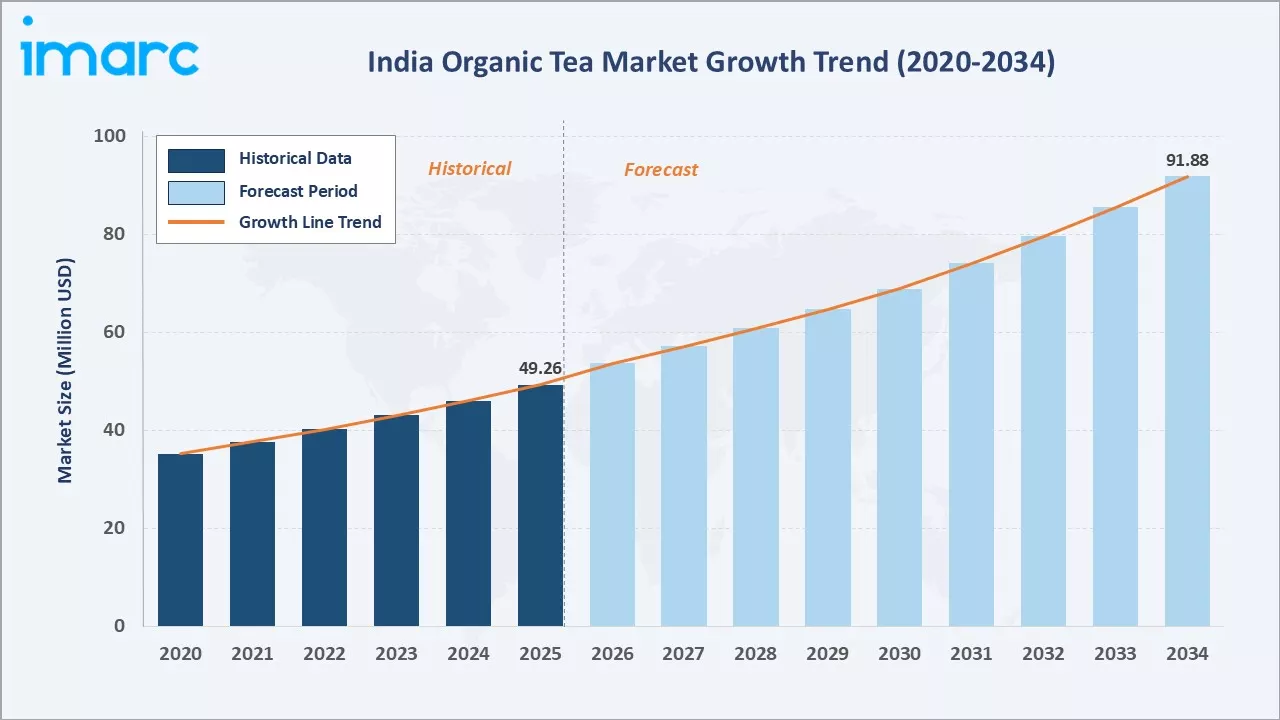
The India organic tea market grew from USD 49.26 Million in 2025 to USD 53.65 Million in 2026 and will reach USD 91.88 Million by 2034, at a CAGR of 6.96%. India exported 5,314.95 MT of organic tea worth USD 46.88 Million in 2025-26.
Rising health awareness, demand for chemical-free products, and growing online sales are reshaping the India organic tea industry. Camelia sinesis-based tea dominates products at 72.0%. Plain tea leads tastes at 58.0%. North India commands 27.0% of national market share, supported by high health awareness and strong retail networks.
Market Snapshot
|
Metric |
Value |
|
Base Year Market Size (2025) |
USD 49.26 Million |
|
Market Size (2026) |
USD 53.65 Million |
|
Forecast Market Size (2034) |
USD 91.88 Million |
|
CAGR (2026-2034) |
6.96% |
|
Base Year |
2025 |
|
Historical Period |
2020-2025 |
|
Forecast Period |
2026-2034 |
|
Dominant Product |
Camelia Sinesis-Based (72.0%, 2025) |
|
Dominant Taste |
Plain (58.0%, 2025) |
|
Leading Region |
North India (27.0%, 2025) |
The India organic tea market size increased from USD 35.19 Million in 2020 to USD 49.26 Million in 2025 and is estimated to reach USD 53.65 Million in 2026. It is expected to reach USD 68.95 Million by 2030 and USD 91.88 Million by 2034, reflecting steady demand growth.
To get more information on this market, Request Sample
Herbal tea is expected to grow fastest at ~8.4% CAGR, supported by demand for tulsi, chamomile, and immunity blends. Flavored tea follows at ~8.0% CAGR as consumers try new infusions, while South India grows at ~7.6% with rising urban wellness spending.
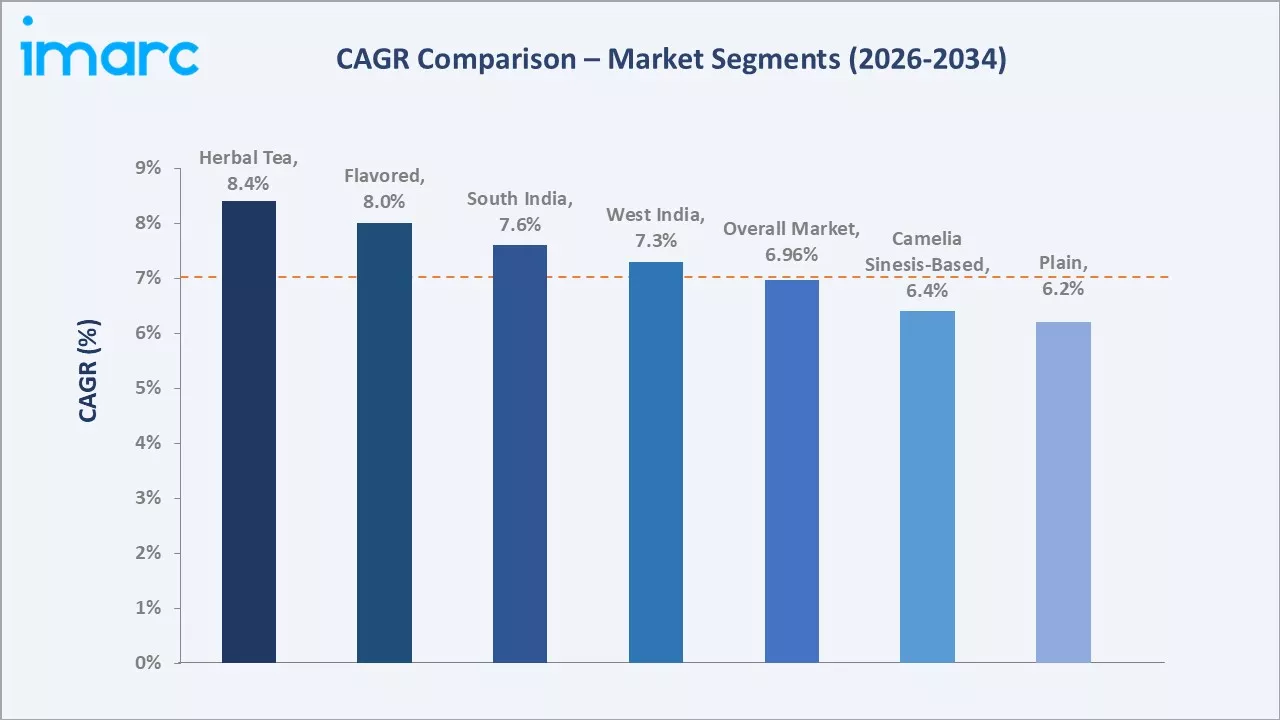
Camelia sinesis-based tea grows at ~6.4% CAGR and plain tea at ~6.2%, while West India grows at ~7.3% through strong online demand in Mumbai, Pune, and Ahmedabad.
Executive Summary
The India organic tea market expanded from USD 49.26 Million in 2025 to USD 53.65 Million in 2026 and is projected to reach USD 91.88 Million by 2034. Brands are expanding herbal blends. Camelia sinesis-based tea leads at 72.0%, plain tea at 58.0%, and North India at 27.0%.
Established organic wellness brands continue to lead, while direct-to-consumer startups and estate brands are gaining visibility online. Rising interest in herbal blends, premium teas, and convenient formats signals a broader and more diverse India organic tea market over the forecast period.
Key Market Insights
|
Insight |
Data |
|
Dominant Product |
Camelia Sinesis-Based - 72.0% share (2025) |
|
Dominant Taste |
Plain - 58.0% market share (2025) |
|
Leading Region |
North India - 27.0% share (2025) |
|
Market Opportunity |
Herbal and functional blends; online and quick commerce; premium Darjeeling and Assam teas; tea bags and gift packs; organic exports |
Key Analytical Observations Supporting the Above Data:
- Camelia Sinesis-Based at 72.0%: Camelia sinesis-based teas, including organic black, green, white, and oolong teas, dominate because tea drinking is deeply rooted in Indian culture. Organic Darjeeling, Assam, and Nilgiri teas offer familiar taste with added health and purity benefits.
- Plain at 58.0%: Plain tea leads because most Indian consumers prefer the natural taste of black and green tea, often prepared with milk or consumed straight. Plain organic teas are widely available in loose leaf and tea bag formats at accessible prices.
- North India at 27.0%: North India leads due to its large urban population, high health awareness in cities such as Delhi, Chandigarh, and Lucknow, strong modern retail presence, and the headquarters of leading organic tea and wellness brands in the region.
India Organic Tea Market Overview
Organic tea is produced from tea plants and herbs grown without synthetic fertilizers, pesticides, or genetically modified inputs, and certified under recognized organic standards. It includes organic black, green, white, and oolong teas, along with herbal infusions such as tulsi, chamomile, and ginger.
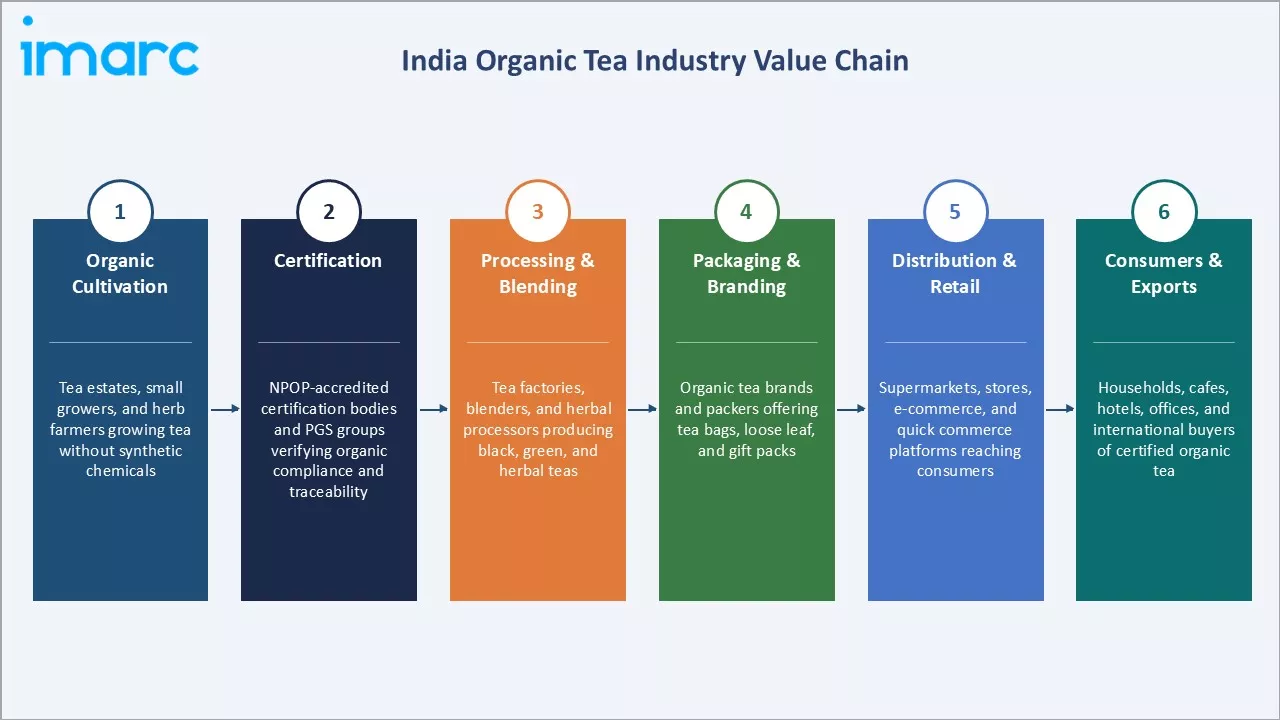
The India organic tea industry links tea estates, small growers, certification bodies, processors, blenders, brand owners, distributors, retailers, and consumers. Health awareness, organic certification, retail access, tea prices, and export demand shape the growth of organic tea across India's regions.
India is one of the world's largest tea producers, and organic tea represents a small but growing share of total output. Organic estates in Darjeeling, Assam, the Nilgiris, and Northeast India supply both domestic brands and export markets.
Market Dynamics
To evaluate market opportunities, Request Sample
Market Drivers
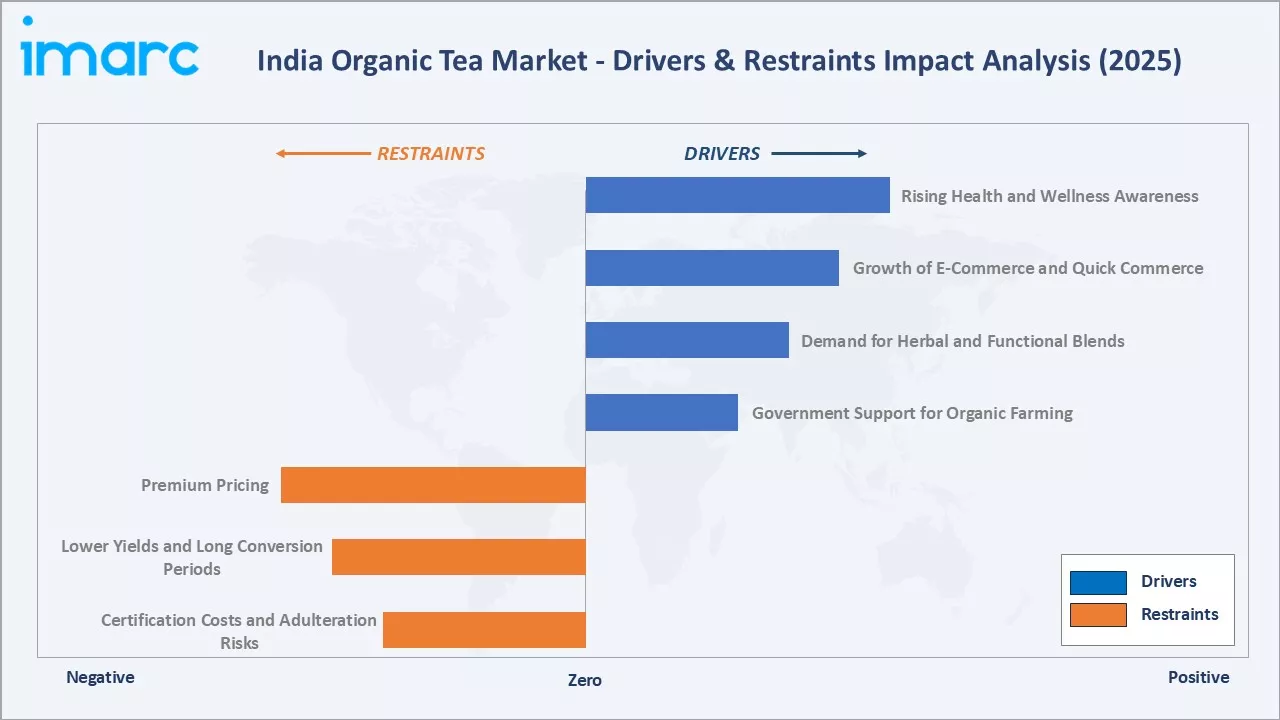
- Rising Health and Wellness Awareness: Consumers are increasingly concerned about pesticide residues and chemicals in food and beverages. Organic tea is seen as a healthier, cleaner choice, supporting demand among urban households, fitness-conscious consumers, and people managing lifestyle diseases. Doctors, nutritionists, and fitness influencers increasingly recommend green and herbal teas as part of healthy lifestyles. Consumers are also reading labels more carefully and preferring certified organic products for daily consumption.
- Growth of E-Commerce and Quick Commerce: Online marketplaces, brand websites, and quick commerce apps make organic teas easy to discover and purchase. Digital channels help niche and premium brands reach consumers across cities and towns without large retail networks. Quick commerce platforms deliver organic teas within minutes in major cities, encouraging trial and repeat purchases. Online reviews, subscriptions, and discounts help brands build loyal customers and reach Tier II and III cities.
- Demand for Herbal and Functional Blends: Teas with tulsi, ashwagandha, turmeric, ginger, and moringa are gaining popularity for immunity, stress relief, and digestion. Functional blends are driving growth in the India herbal tea market and attracting younger consumers. Ayurvedic ingredients have strong cultural acceptance in India, giving herbal blends a natural advantage. Brands are positioning these products for specific needs such as sleep, digestion, energy, and stress management.
- Government Support for Organic Farming: Programs such as the National Programme for Organic Production, Paramparagat Krishi Vikas Yojana, and organic certification support encourage growers to adopt organic practices. Northeast India and hill regions are promoting organic tea cultivation. State governments in Assam, Sikkim, and Uttarakhand are promoting organic farming and organic branding. Export promotion through APEDA and the Tea Board also encourages growers to obtain organic certification.
Market Restraints
- Premium Pricing: Organic tea is priced significantly higher than conventional tea due to lower yields and certification costs. In a price-sensitive market where tea is consumed daily, higher prices limit adoption among mass-market consumers. Brands are introducing smaller pack sizes, value tea bags, and combo offers to make organic tea more affordable. Highlighting health benefits and purity helps justify premium pricing for many urban consumers.
- Lower Yields and Long Conversion Periods: Converting estates to organic farming takes several years and often reduces yields. Growers face higher pest management costs and income uncertainty during conversion, limiting the supply of certified organic tea. Group certification, farmer training, and premium price contracts help growers manage conversion risks. Partnerships between brands and grower groups are improving the supply of certified organic tea over time.
- Certification Costs and Adulteration Risks: Organic certification and audits add costs, especially for small growers. Concerns about mislabeled or adulterated products can reduce consumer trust, making traceability and credible certification essential for brands. Participatory guarantee systems and digital traceability tools are helping lower certification costs and build trust. Strict testing and transparent labeling remain essential for brands to protect their organic credentials.
Market Opportunities
- Premium and Specialty Teas: Organic Darjeeling, first flush, white, and oolong teas offer high-value opportunities for gifting and specialty consumers. Brands can highlight estate origin, freshness, and sustainable farming to command premium prices. Gift boxes, tea tasting experiences, and estate tourism create additional opportunities for premium organic tea brands. Online platforms allow estates to sell directly to consumers at higher margins.
- Ready-to-Drink and Convenient Formats: Organic tea bags, iced teas, cold brews, and ready-to-drink beverages appeal to busy urban consumers. These formats support growth in the India organic beverages market and attract new users. Cafes, hotels, and corporate offices are adding organic tea options to their menus. Ready-to-drink organic teas with low sugar and natural ingredients are also attracting interest from health-focused consumers.
Market Challenges
- Climate Variability: Unpredictable rainfall, heatwaves, and pests affect tea yields and quality. Organic growers, who cannot use synthetic chemicals, face greater challenges in managing pests and maintaining consistent production during adverse weather. Growers are adopting climate-resilient practices such as shade trees, water conservation, and drought-tolerant varieties. Research support from tea institutes is helping organic estates improve pest management and resilience.
- Competition from Conventional and Wellness Brands: Conventional tea brands with strong distribution and lower prices dominate the market. Wellness brands offering non-organic herbal teas also compete for health-conscious consumers, increasing pressure on organic players. Organic brands differentiate through certification, purity, and transparent sourcing. Clear communication of organic benefits helps brands stand out in a crowded market of tea and wellness products.
Emerging Market Trends
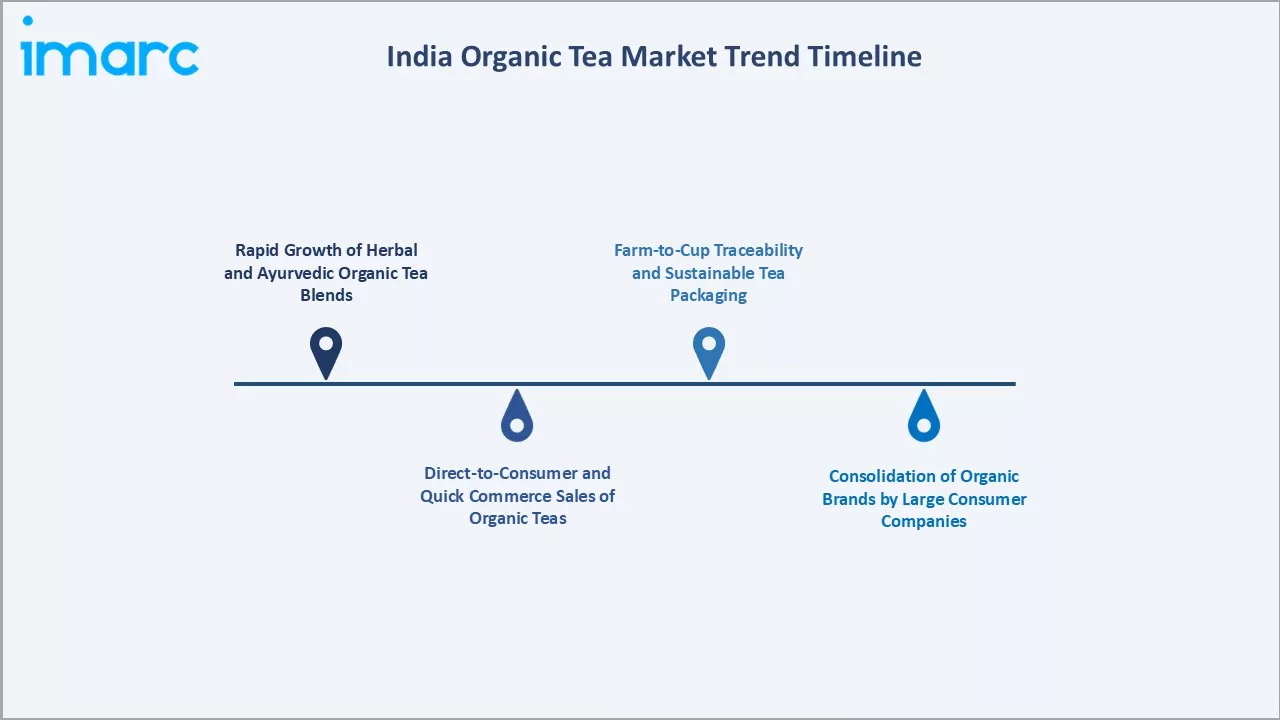
1. Rapid Growth of Herbal and Ayurvedic Blends
Brands are launching organic teas featuring tulsi, ashwagandha, turmeric, and giloy for immunity, stress, and sleep. India organic tea market analysis shows herbal blends attracting younger consumers and expanding beyond traditional tea drinkers.
Herbal blends are increasingly sold in tea bags, loose leaf, and powder forms. Seasonal and limited-edition blends help brands maintain consumer interest and encourage repeat purchases.
2. Direct-to-Consumer and Quick Commerce Sales
Organic tea brands are building direct-to-consumer websites and partnering with quick commerce platforms for fast delivery. Digital marketing, subscriptions, and influencer campaigns are helping brands build loyal customer bases.
Quick commerce has made organic teas available for instant delivery in major cities. Brands are using customer data from digital channels to develop new blends and personalize offers.
3. Consolidation by Large Consumer Companies
Large food and beverage companies are acquiring organic and wellness brands to strengthen their health portfolios. These acquisitions provide organic brands with wider distribution, stronger marketing, and better supply chain capabilities.
Acquisitions of leading organic brands by large consumer companies have increased investment in marketing and distribution. This consolidation is raising consumer awareness and expanding organic tea availability in mainstream retail.
4. Traceability and Sustainable Packaging
Brands are adopting farm-to-cup traceability, QR codes, and estate origin labeling to build trust. Plastic-free tea bags, compostable packaging, and recyclable tins are gaining popularity among environmentally conscious consumers.
Consumers are increasingly interested in where their tea comes from and how it is produced. Brands that share estate stories and farmer impact information are building stronger emotional connections with buyers.
Industry Value Chain Analysis
The India organic tea value chain spans organic cultivation, certification, processing and blending, packaging and branding, distribution and retail, and consumers and exports. Value is concentrated in branding, certification credibility, and distribution reach, which shape pricing power and customer loyalty.
|
Stage |
Key Participants |
|
Organic Cultivation |
Tea estates, small growers, and herb farmers |
|
Certification |
NPOP-accredited certification bodies and PGS groups |
|
Processing & Blending |
Tea factories, blenders, and herbal processors |
|
Packaging & Branding |
Organic tea brands and private-label packers |
|
Distribution & Retail |
Supermarkets, stores, e-commerce, and quick commerce |
|
Consumers & Exports |
Households, cafes, hotels, and export buyers |
Packaging and branding is the most consequential stage, as brand trust, product variety, and storytelling determine consumer choice and premium pricing. Certification also matters greatly because credible organic certification is essential for consumer confidence and access to export markets.
Organic cultivation adds value through estate origin, quality, and sustainable practices, while distribution and retail determine consumer access. Online platforms and quick commerce are becoming increasingly important for reaching urban consumers and building brand awareness across major Indian cities.
Technology Landscape in the India Organic Tea Industry
Organic Farming and Biological Pest Control
Organic tea estates use compost, vermicompost, biofertilizers, and biological pest control instead of synthetic chemicals. Biodynamic practices, shade trees, and intercropping improve soil health and biodiversity, helping maintain productivity and quality over time.
Organic estates often invest in composting units and on-farm input production to reduce costs. These practices also support soil health and long-term productivity in hilly tea-growing regions.
Processing, Blending, and Quality Testing
Modern processing equipment, controlled withering, and drying technologies preserve flavor and quality. Laboratory testing for pesticide residues, heavy metals, and moisture ensures compliance with organic standards and food safety regulations in India and export markets.
Packaging innovations such as nitrogen flushing and airtight pouches help preserve freshness. Quality testing and certification documentation are essential for supplying modern retail and export markets.
Traceability and Digital Commerce
Digital traceability systems, QR codes, and batch tracking allow consumers to verify origin and certification. E-commerce platforms, data analytics, and customer reviews help brands understand preferences and launch new blends quickly.
Online marketplaces and social media allow small organic tea brands to compete with larger players. Digital tools also support inventory management and faster responses to changing consumer demand.
Market Segmentation Analysis
The report covers the following segments:
|
Segment Category |
Leading Segment |
Market Share |
Year |
|
Product |
Camelia Sinesis-Based |
72.0% |
2025 |
|
Taste |
Plain |
58.0% |
2025 |
|
Form |
🔒 |
🔒 |
2025 |
|
Distribution Channel |
🔒 |
🔒 |
2025 |
|
Region |
North India |
27.0% |
2025 |

By Product
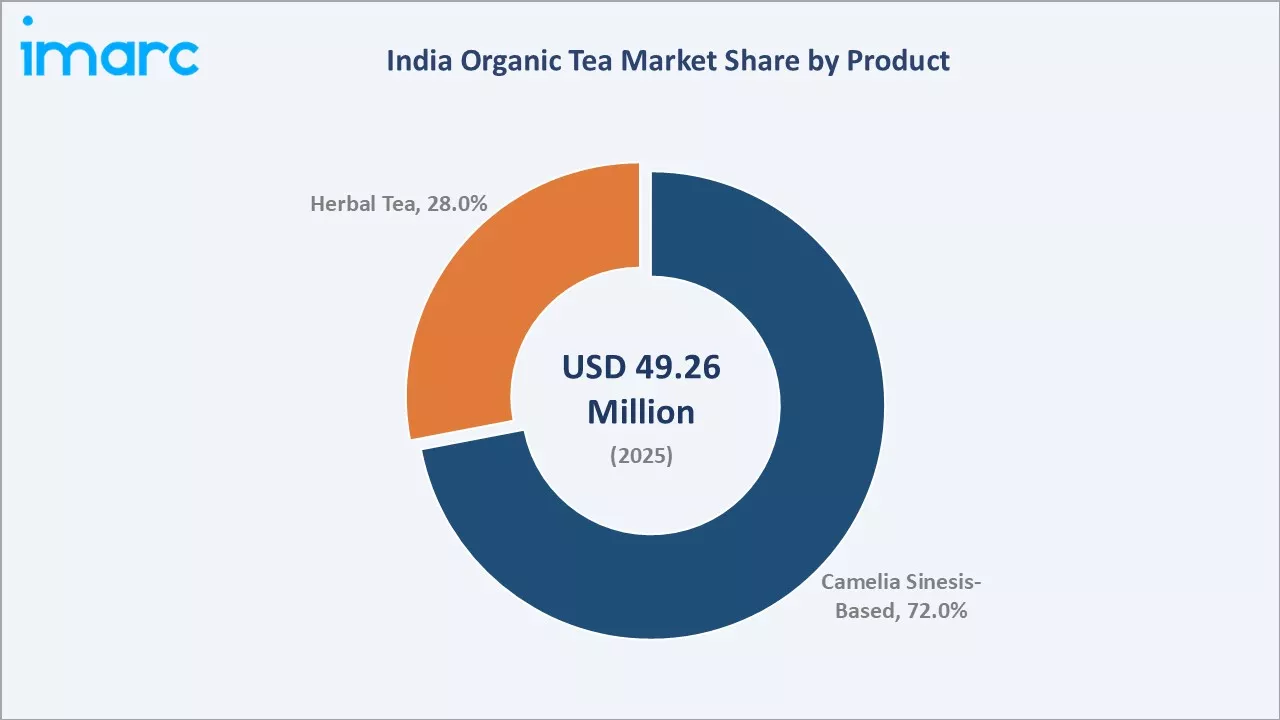
Camelia sinesis-based tea leads at 72.0% (2025). Organic black, green, white, and oolong teas from Darjeeling, Assam, and Nilgiris dominate because they match traditional Indian tea habits while offering purity and health benefits.
To access detailed market analysis, Request Sample
Organic green tea is especially popular among health-conscious urban consumers, while organic black tea remains the preferred daily choice for many households. White and oolong teas serve niche premium segments.
Herbal tea at 28.0% grows faster at ~8.4% CAGR, compared with ~6.4% for camelia sinesis-based tea. Tulsi, chamomile, ginger, and Ayurvedic blends are gaining popularity for immunity, relaxation, and caffeine-free wellness benefits.
Organic green tea remains the largest camelia sinesis-based category among health-focused consumers, while organic black tea leads in daily household consumption. Premium white and oolong teas serve specialty and gifting segments.
By Taste
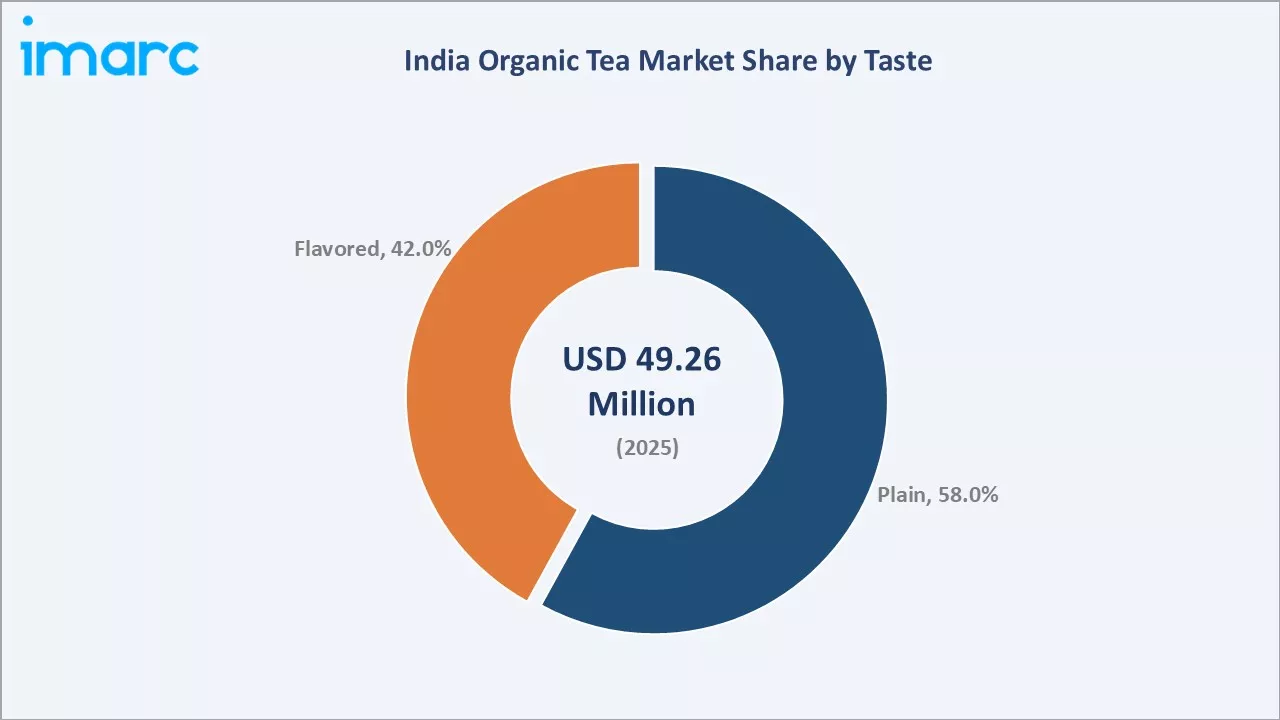
Plain tea leads at 58.0% (2025). Most consumers prefer the natural taste of organic black and green tea, consumed with milk or straight. Plain variants are widely available, competitively priced, and used daily in households across India.
Plain organic teas are also preferred for gifting and export because they highlight the natural character of estate teas. Many consumers add their own spices or milk to plain organic teas at home.
Flavored tea at 42.0% grows faster at ~8.0% CAGR, compared with ~6.2% for plain tea. Lemon, ginger, mint, masala, and fruit-infused organic teas attract younger consumers seeking variety and new taste experiences.
Masala and ginger-flavored organic teas are popular in traditional households, while fruit and floral flavors attract younger urban consumers. Brands are using seasonal and limited-edition flavors to drive repeat purchases.
Regional Market Insights
|
Region |
Share (2025) |
Key India Organic Tea Market Drivers & Characteristics |
|
North India |
27.0% |
High health awareness and strong modern retail presence. |
|
South India |
26.0% |
Nilgiri organic teas and rising urban wellness demand. |
|
East India |
25.0% |
Darjeeling and Assam organic estates and tea culture. |
|
West India |
22.0% |
Premium urban consumers and strong online sales. |
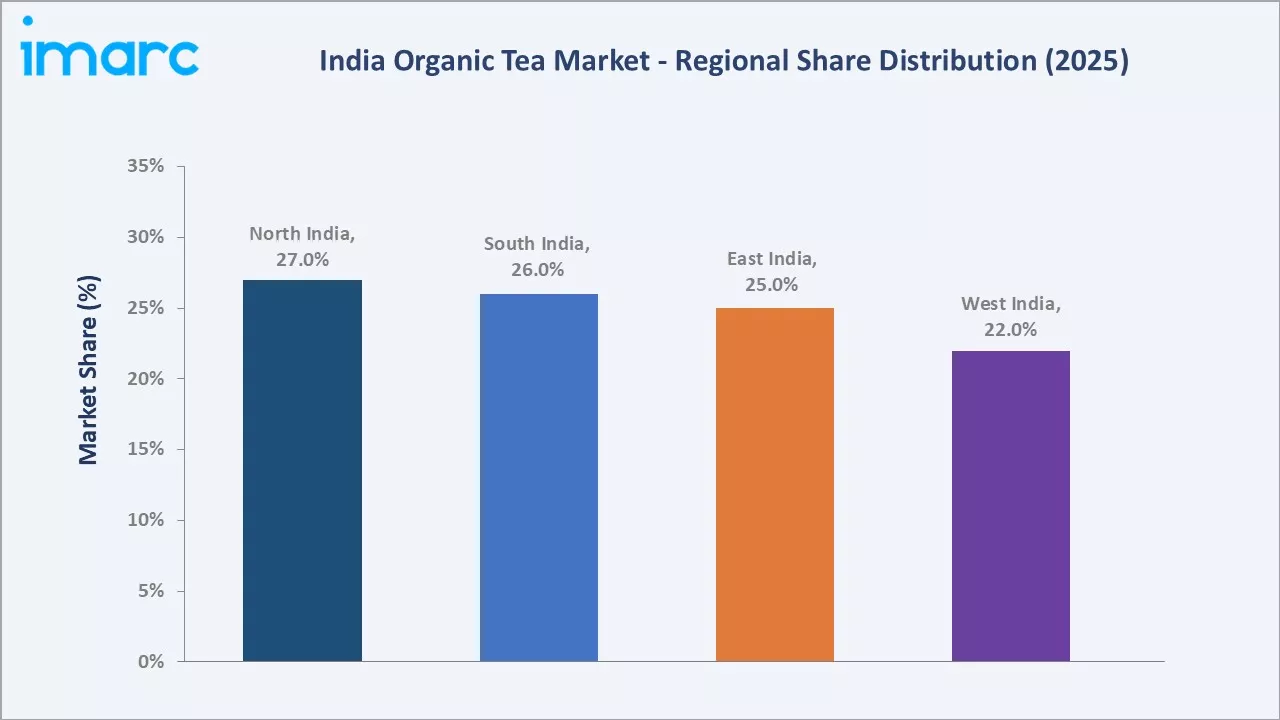
North India's 27.0% market leadership reflects high health awareness in major cities, strong modern retail presence, and the headquarters of leading organic tea brands. South India's 26.0% is supported by Nilgiri organic teas and rising wellness spending in Bengaluru, Chennai, and Hyderabad.
Southern cities are seeing strong growth in premium and herbal teas, supported by rising incomes and wellness awareness. Online sales are helping organic brands reach consumers across all regions of India.
East India at 25.0% benefits from organic estates in Darjeeling and Assam and a strong tea-drinking culture. West India at 22.0% grows at ~7.3% CAGR, driven by premium consumers and online sales, while South India grows fastest at ~7.6%.
North India's growth is supported by major organic and wellness brands and strong modern retail. East India benefits from proximity to organic estates, while West India attracts premium urban consumers in Mumbai and Pune.
Competitive Landscape
The India organic tea market includes organic wellness brands, direct-to-consumer tea companies, organic food companies, and organic tea estates. Competition centers on certification credibility, product range, taste, pricing, and distribution reach, shaping India organic tea market share.
Leading brands compete through certified product ranges, health-focused positioning, and strong online presence. Estate brands differentiate through origin, quality, and sustainable farming, while organic food companies leverage wide retail distribution.
|
Company |
Key Brands |
Market Position |
Core Strength |
|
Organic India Pvt. Ltd. |
Organic India, Tulsi Teas |
Market Leader |
Leading organic tulsi and herbal teas. |
|
VAHDAM India |
VAHDAM |
Market Leader |
Premium teas and herbal infusions. |
|
24 Mantra Organic |
24 Mantra Organic |
Strong Challenger |
Organic staples and Assam tea. |
|
Luxmi Tea |
Makaibari, Tokyo Green |
Strong Challenger |
Organic Darjeeling estate teas. |
|
Darjeeling Tea Boutique |
Arya |
Strong Challenger |
Organic and biodynamic tea estates. |
|
Organic Tattva |
Organic Tattva |
Innovator |
Organic foods and green teas. |
The most important competitive dynamic is the race to combine organic credibility with wellness benefits and digital reach. Leading brands are expanding herbal and functional blends, investing in direct-to-consumer and quick commerce channels, and benefiting from support of large consumer companies.
Smaller brands focus on niche blends, attractive packaging, and online marketing to reach younger consumers. Partnerships with cafes, hotels, and gifting platforms are also helping organic tea brands expand their customer base.
Key Company Profiles
Organic India Pvt. Ltd.
Organic India Pvt. Ltd., a Tata Consumer Products company, is a leading organic wellness brand offering certified organic tulsi teas made from 100% whole herbs in staple-free, unbleached tea bags.
- Key Brands: Organic India, Tulsi Green Tea, Tulsi Original.
- Recent Developments: In 2026, Organic India expanded its pharmacy distribution channel to more than 50 cities and accelerated its expansion into South and East India.
- Strategic Focus: Strengthening its authenticity proposition through the 'Sirf Naam Se Nahi, Kaam Se Organic' campaign and deeper distribution integration.
VAHDAM India
VAHDAM India is a homegrown global wellness brand offering teas, herbal infusions, spices, and supplements sourced directly from Indian farmers, shipping to customers in more than 160 countries.
- Key Brands: VAHDAM, Himalayan Green Tea, India's Original Masala Chai.
- Recent Developments: In January 2026, VAHDAM India introduced herbal supplements in India, following its formal domestic launch of wellness teas and herbal infusions.
- Strategic Focus: Prioritizing online and quick commerce channels in India, with the domestic market expected to reach 20% of business.
24 Mantra Organic
24 Mantra Organic, an ITC company, markets organic staples, spices, and beverages, including organic Assam tea, under the 24 Mantra Organic brand, working with over 34,000 farmers.
- Key Brands: 24 Mantra Organic.
- Recent Developments: In May 2026, ITC outlined plans to strengthen 24 Mantra Organic's presence in organic foods and increase organic exports from India.
- Strategic Focus: Expanding farm-to-fork traceability across more than 1,90,000 acres of organic farmland to reinforce consumer trust.
Market Concentration Analysis
The India organic tea market is fragmented, with a few established organic wellness brands holding strong positions, while many estate brands, direct-to-consumer startups, and regional sellers compete in specific regions and online channels.
Leading brands benefit from strong certification credentials, wide product ranges, and established distribution. Smaller players differentiate through unique blends, estate origin, and personalized direct-to-consumer experiences.
Market concentration is higher in branded organic herbal teas, where certification, brand trust, and distribution create barriers to entry. Competition is more dispersed in organic estate teas and online channels, where many small brands sell directly to consumers.
Acquisitions by large consumer companies are strengthening leading organic brands with wider distribution and marketing support. Smaller players differentiate through niche blends, estate origin, and personalized online experiences.
Investment & Growth Opportunities
Highest Growth Segments
Herbal tea (~8.4% CAGR through functional blends), flavored tea (~8.0% CAGR through new infusions), South India (~7.6% CAGR through urban wellness demand), and West India (~7.3% CAGR through online sales) represent the highest-growth investment areas through 2034.
Camelia sinesis-based teas will remain the largest product segment, but herbal and flavored teas will gain share as consumers seek variety and functional benefits. Online channels will support growth in all four regions.
Emerging Investment Opportunities
Herbal and functional blends, premium estate teas, and direct-to-consumer channels are among the most promising opportunities, supporting growth in the India organic tea industry. Investment in organic tea bags, ready-to-drink formats, and exports also offers attractive long-term returns.
Contract farming with organic grower groups and investment in certification support can help brands secure reliable supply. Export-oriented organic estates also benefit from growing international demand for certified Indian teas.
Investment Themes
- Wellness blends: Herbal and Ayurvedic teas attract health-focused consumers.
- Digital channels: Online and quick commerce expand reach to new cities.
Future Market Outlook (2026-2034)
The India organic tea market is projected to grow from USD 49.26 Million in 2025 to USD 53.65 Million in 2026, reaching USD 91.88 Million by 2034 at a CAGR of 6.96%. The 2030 value of USD 68.95 Million marks wider organic tea adoption.
Three structural forces define India organic tea industry growth through 2034: rising health awareness; digital and quick commerce growth; and demand for herbal blends. Together, these forces support steady growth across products, tastes, and regions, while pricing, supply, and certification remain key factors.
Brands that combine credible certification, attractive blends, transparent sourcing, and strong digital presence are best positioned to capture growth. Partnerships with growers and retailers will continue to shape long-term competitive success.
Research Methodology
Primary Research
Primary research comprised structured interviews with industry stakeholders, including organic tea estates, small growers, processors, brand owners, distributors, retailers, certification bodies, and industry associations across all regions of India. Interviews covered demand, pricing, sourcing, and consumer preferences.
Secondary Research
Secondary research covered company press releases, annual reports, Tea Board of India and APEDA statistics, government data, industry associations, and trade publications. Over 50 credible secondary sources were reviewed, compared, and cross-checked for accuracy and consistency across datasets and regions.
Forecasting Models
Market revenue forecasts were developed using a demand-based model: organic tea consumption by product, taste, and region multiplied by average retail prices, then aggregated to total market value. Assumptions were validated through discussions with industry experts, brand owners, and retailers.
India Organic Tea Market Report Coverage:
| Report Features | Details |
|---|---|
| Base Year of the Analysis | 2025 |
| Historical Period | 2020-2025 |
| Forecast Period | 2026-2034 |
| Units | Million USD |
| Scope of the Report | Exploration of Historical Trends and Market Outlook, Industry Catalysts and Challenges, Segment-Wise Historical and Future Market Assessment:
|
| Products Covered |
|
| Tastes Covered | Flavored, Plain |
| Forms Covered | Tea Bag, Leaf and Powder Tea, Liquid |
| Distribution Channels Covered | Hypermarkets and Supermarkets, Convenience Stores, Online, Others |
| Regions Covered | North India, South India, East India, West India |
| Companies Covered | Organic India Pvt. Ltd., VAHDAM India, 24 Mantra Organic, Luxmi Tea, Darjeeling Tea Boutique, Organic Tattva, etc. |
| Customization Scope | 10% Free Customization |
| Post-Sale Analyst Support | 10-12 Weeks |
| Delivery Format | PDF and Excel through Email (We can also provide the editable version of the report in PPT/Word format on special request) |
Key Benefits for Stakeholders:
- IMARC’s industry report offers a comprehensive quantitative analysis of various market segments, historical and current market trends, market forecasts, and dynamics of the India organic tea market from 2020-2034.
- The research report provides the latest information on the market drivers, challenges, and opportunities in the India organic tea market.
- Porter's five forces analysis assist stakeholders in assessing the impact of new entrants, competitive rivalry, supplier power, buyer power, and the threat of substitution. It helps stakeholders to analyze the level of competition within the India organic tea industry and its attractiveness.
- Competitive landscape allows stakeholders to understand their competitive environment and provides an insight into the current positions of key players in the market.
Frequently Asked Questions About the India Organic Tea Market Report
The India organic tea market size is estimated at USD 53.65 Million in 2026, supported by rising health awareness, growing demand for herbal blends, and expanding online and quick commerce sales across the country.
The market grows at a 6.96% CAGR during 2026-2034, reaching USD 91.88 Million by 2034, driven by wellness trends, digital channels, and premium and herbal teas.
Camelia sinesis-based tea leads at 72.0%, owing to strong demand for organic black, green, white, and oolong teas from Darjeeling, Assam, and the Nilgiris.
Plain tea leads at 58.0%, supported by consumer preference for the natural taste of organic black and green tea consumed daily across Indian households.
North India leads at 27.0%, driven by high health awareness, strong modern retail presence, and the presence of leading organic tea and wellness brands.
Leading companies include Organic India Pvt. Ltd., VAHDAM India, 24 Mantra Organic, Luxmi Tea, Darjeeling Tea Boutique, and Organic Tattva.
The India herbal tea market is evolving through Ayurvedic and functional blends featuring tulsi, ashwagandha, turmeric, and ginger, supported by online sales and growing wellness awareness.
The market is projected to reach approximately USD 68.95 Million by 2030, supported by steady growth in herbal, flavored, and premium organic teas.
Need more help?
- Speak to our experienced analysts for insights on the current market scenarios.
- Include additional segments and countries to customize the report as per your requirement.
- Gain an unparalleled competitive advantage in your domain by understanding how to utilize the report and positively impacting your operations and revenue.
- For further assistance, please connect with our analysts.
 Request Customization
 Speak to an Analyst
 Request Brochure
 Inquire Before Buying
Benefits of Customization
- Personalize this research
- Triangulate with your data
- Get data as per your format and definition
- Gain a deeper dive into a specific application, geography, customer, or competitor
- Any level of personalization
Get in Touch With Us
UNITED STATES
Phone: +1-201-971-6302
INDIA
Phone: +91-120-433-0800
UNITED KINGDOM
Phone: +44-753-714-6104
Email: [email protected]
Client Testimonials



















Related Reports

Choose your plan
*Please note that the prices mentioned below are starting prices for each bundle type. Kindly contact our team for further details.*
Single User License
- 1 User License, Access on 2 Devices
- PDF Report + Excel Dataset (Password Protected)
- Lifetime Access
- No Printing Rights
- 10% Free Report Customization
- 10–12 Weeks of Analyst Support
Five User License
- Access for 5 Users, 2 Devices per User
- PDF Report + Excel Dataset (Password Protected)
- Lifetime Access
- Dedicated Account Manager
- 12–14 Weeks of Analyst Support
- No Printing Rights
- 15% Free Report Customization
- 25% Discount on Your Next Purchase
Corporate User License
- Unlimited User Access (Within Your Organization)
- PDF Report + Excel Dataset
- Lifetime Access
- Dedicated Account Manager
- 14–20 Weeks of Analyst Support
- No Printing Rights
- 20% Free Report Customization
- 30% Discount on Your Next Purchase
Essential Insights
What's included:
3 reports
- Lifetime Access
- PDF Reports
- Excel Datasets
- 2 Weeks of Free Analyst Support
- 2 User Licenses
- Access on 2 Devices
- Printing Rights
- Complimentary PowerPoint (PPT) Version
- Complimentary License Upgrade
Professional Access
What's included:
5 reports
- Lifetime Access
- PDF Reports
- Excel Datasets
- 8 Weeks of Free Analyst Support
- 2 User Licenses
- Access on 2 Devices
- Printing Rights
- Complimentary PowerPoint (PPT) Version
- Complimentary License Upgrade
Business Advantage
What's included:
8 reports
- Lifetime Access
- PDF Reports
- Excel Datasets
- 14 Weeks of Free Analyst Support
- 2 User Licenses
- Access on 2 Devices
- Printing Rights
- Complimentary PowerPoint (PPT) Version
- Complimentary License Upgrade
Enterprise Intelligence
What's included:
10 reports
- Lifetime Access
- PDF Reports
- Excel Datasets
- 20 Weeks of Free Analyst Support
- 2 User Licenses
- Access on 2 Devices
- Printing Rights
- Complimentary PowerPoint (PPT) Version
- Complimentary License Upgrade